



Abstract
Objective
Regenerative medicine is experiencing a strong expansion worldwide, including the treatment of some common orthopedic pathologies, with an increase in physicians adopting these technologies. This growing interest has been associated with an equally significant spread of websites dedicated to public information on this topic, often lacking scientific bases. This study aims to evaluate the quality of information on the World Wide Web about stem cells for cartilage disorders in orthopedic practice.
Design
On February 19, 2021 we performed a search on Google using as keywords “cartilage stem cells,” considering only the freely accessible sites in Italian, English, French, and Spanish. We selected the first 50 valid results for each language and evaluated them using the DISCERN scale.
Results
A total of 249 sites were observed, of which 49 were discarded as duplicates (8) or not relevant to the topic (41). Of the 200 sites surveyed, 47 were affiliated to a singular surgeon (23.5%), 31 to private stakeholders (15.5%), 73 to information sites (36.5%), 8 to public hospitals (4%), 13 to universities (6.5%), and 28 referred to international scientific journals (14%). Only 76 sites (38%) were rated as fair or better, while the remaining 124 (62%) were classified as poor or very poor.
Conclusions
The quality of the information promoted for stem cells in orthopedics is generally low, although a significant minority of the sites offers good quality information. A greater commitment on the part of surgeons and other stakeholders is desirable to promote information on regenerative medicine through scientific criteria supported by adequate literature.
Introduction
Articular cartilage is a specialized connective tissue, formed of aneural, alymphatic, and hyaline avascular cartilage. Its homeostasis is determined by a complex interplay between growth factors, hormones, joint mechanics, and aging1,2 with poor self-regeneration ability. Cartilage disorders are commonly encountered in the orthopedic practice with a high prevalence both in sport practitioners and in the general population, as a consequence of traumatic or degenerative processes, currently affecting hundreds of million adults worldwide. This is why cartilage repair and restoration procedures are a topic of interest for both orthopedic surgeons and patients. Different biologic therapies have been proposed in the past decades, like mesenchymal stem cells (MSCs), growth factors, or platelet-rich plasma (PRP), to regenerate native-like cartilage tissue. Biologic options are being presented as optimal instruments to regenerate articular cartilage, being a source of great promise and debate, given the lack of substantial clinical evidence. The widespread media coverage regarding stem cells is responsible for the increasing interest in biological therapeutic options in recent years.
With the increasing availability of online medical information, a large number of patients affected by cartilage diseases rely on internet resources as their primary source of health care information, but the myriad treatment options can be confusing for patients, especially when online educational resources are of poor quality and contain inaccurate or misleading information.3-9 The purpose of this study was to critically evaluate the accuracy and quality of Italian, English, French, and Spanish online patient education resources for stem cells as a treatment modality for cartilage diseases.
Materials and Methods
We led 4 Google searches (http://www.google.com accessed on February 19, 2021) using “cartilage stem cells” and their translation in Italian, Spanish, and French as keywords. The search was conducted in private mode, in order not to incur potential confounding factors related to previous searches on the same browser.
We obtained 13,000,000 English results, 51,400 Italian results, 320,000 Spanish results, and 240,000 French results. For English and Spanish researches, we selected only websites affiliated to the United Kingdom and Spain, respectively, to analyze and compare web communication in the European context (with comparable national health systems). For each search, we evaluated the top 50 results including only free, unrestricted, and pertinent sites. Due to this reason, 41 not relevant sites (17 Italian, 14 French, 10 Spanish) were rejected. Eight sites were duplicated (4 French, 2 Italian, 2 Spanish) and, therefore, deleted.
First, the sample of each query was analyzed to investigate the affiliation of websites and which is the most frequent within the language considered; then, all the results were evaluated using the DISCERN scale, a widely used and validated score. 10
DISCERN score was originally developed in 1999 by a well-structured scientific panel as a collaboration between the British Library and the National Health Service to evaluate the quality, reproducibility, validity, and reliability of written health information, for use by health professionals and individual consumers. It is a step-by-step checklist consisting of 15 items plus an additional “overall item” rated on an ordinal Likert-type 5-point scale ranging from 1 (for no) to 5 (for yes), designed to describe the balance, clarity, and content quality of the information:
Questions 1 to 8 to address the reliability of the publication (source of information, aim of the publication, relevance of publication)
Questions 9 to 15 to address specific details of the information about treatment choices (the benefits and the risks of a specific treatment and how a specific treatment works)
The scores are eventually summed to obtain an overall comprehensive score, which is then assessed as “very poor” (<27), “poor” (27-38), “fair” (39-50), “good” (51-62), and “excellent” (63-75). Additional Question 16 summarizes the overall quality rating at the end of the instrument.
The DISCERN scale also appraises the amount of evidence provided on the analyzed procedure, examining the statements about possible adverse events, contraindications, disadvantages, and the truthful communication of less dangerous or similarly effective alternatives, in order to make an up-to-date choice with the utmost number of details considered.
Statistical Analysis
A descriptive analysis was carried out. Comparisons of categorical data from the websites according to an affiliation (private hospital, individual/team of surgeon(s), scientific article, information) were performed to compare both results of Countries and DISCERN score by website sources.
Results
Of the 200 outcomes analyzed, 73 (36.5%) were associated with scientific-related web magazines (information sites), 47 (23.5%) with individual surgeons, 31 (15.5%) with private hospitals, 13 (6.5%) with universities, 8 (4%) with national health system facilities, while 28 (14%) were scientific articles from peer-reviewed journals.
The structure of the sample, according to the website affiliation, listed by language is reported in Figure 1.
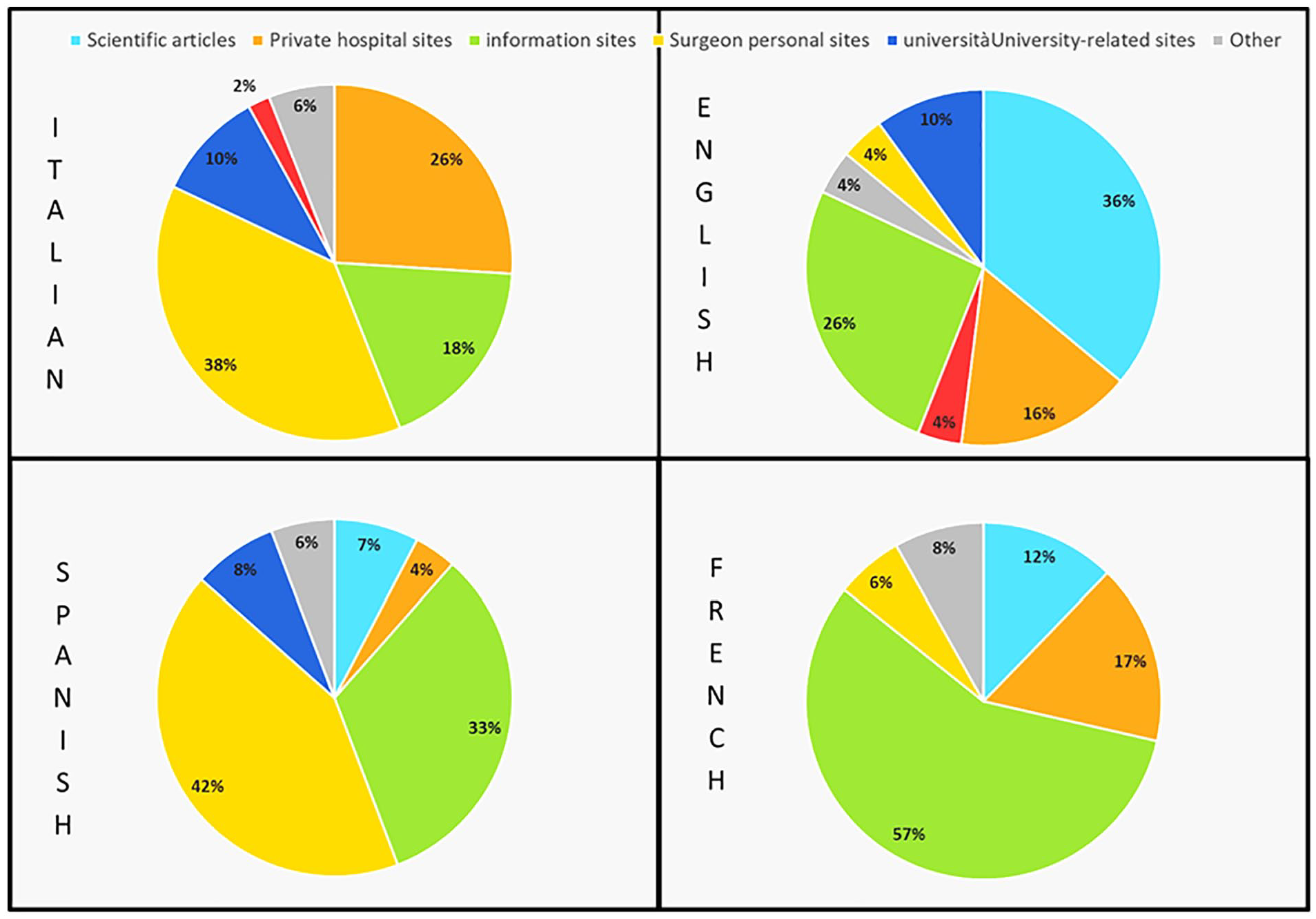
Examined websites affiliations listed by language. The comparison of 4 adjoining European contexts (with comparable national health systems) denotes different mass communication approaches, maybe reflecting a subtle but significant cultural diversification among these countries.
None of the examined websites was quality assessed by a third-party organization or dedicated scientific forum. Four private structures (2 Italian, 1 Spanish, 1 French) were sponsored by Google appearing on the top of the first 2 search pages. Only 87 out of 200 provided details on the publication date and updates. A total of 91 sites did not provide any bibliographic references, while 58 provided them in quantity and quality adequate to the text. Furthermore, 31 websites provided information about the possibility of abstaining from the procedure, 46 regarding the contraindications, and 59 reporting alternative treatments. According to the DISCERN score, 11 sites were classified as “excellent,” 31 sites were classified as “good,” 34 as “fair,” 46 as “poor,” and 78 as “very poor” as shown in Table 1 .
DISCERN Score: Online Information Regarding “Cartilage Stem Cells” (Italian, English, Spanish, and French Websites).
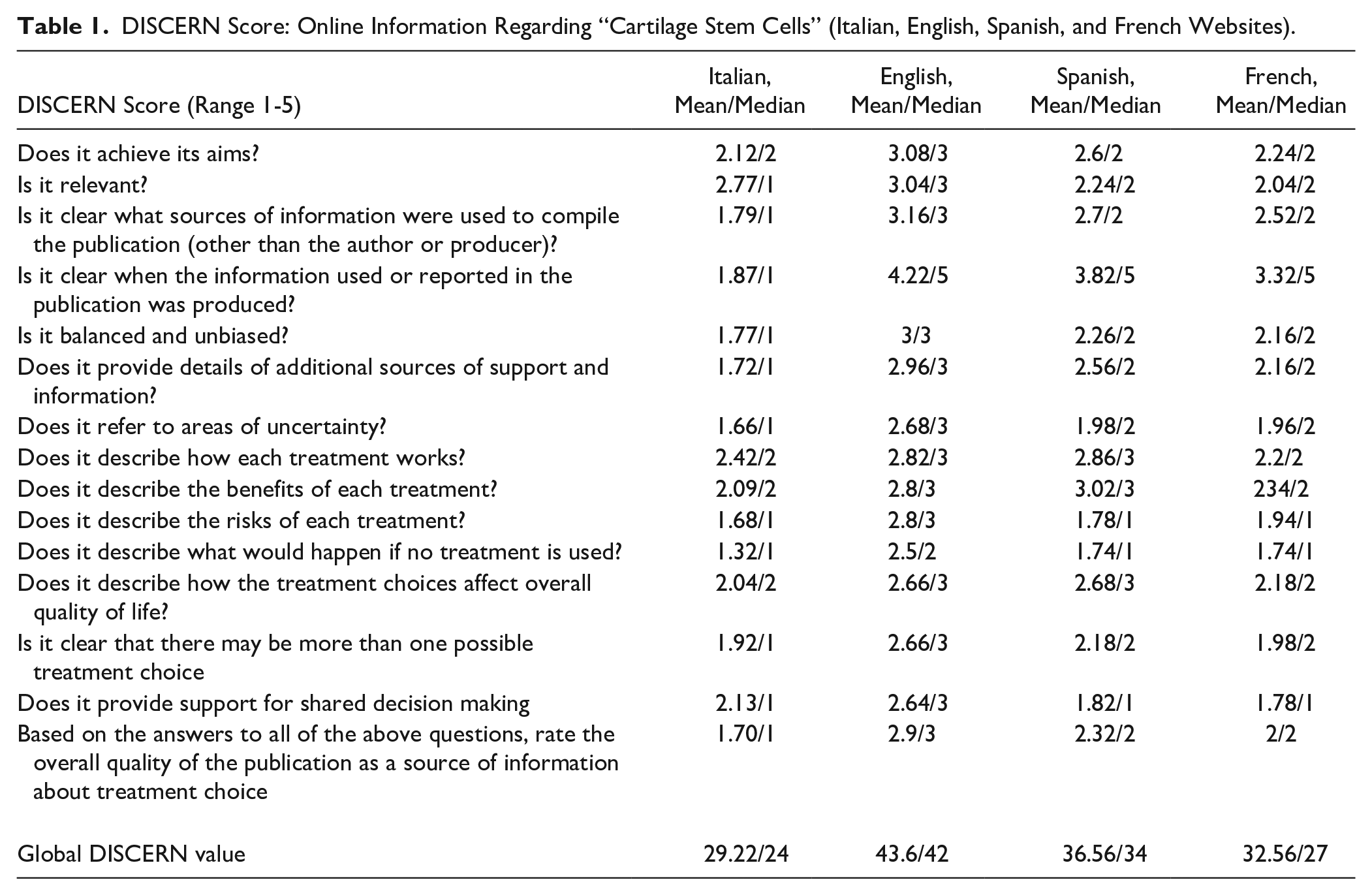
To sum up, 62% of the websites were of low quality (poor and very poor) while only 38% were considered acceptable (fair or better). The statistical descriptive analysis of DISCERN scores categorized by affiliation is reported in Table 2 .
Statistical Descriptive Analysis of DISCERN Score Listed by Website Sources.
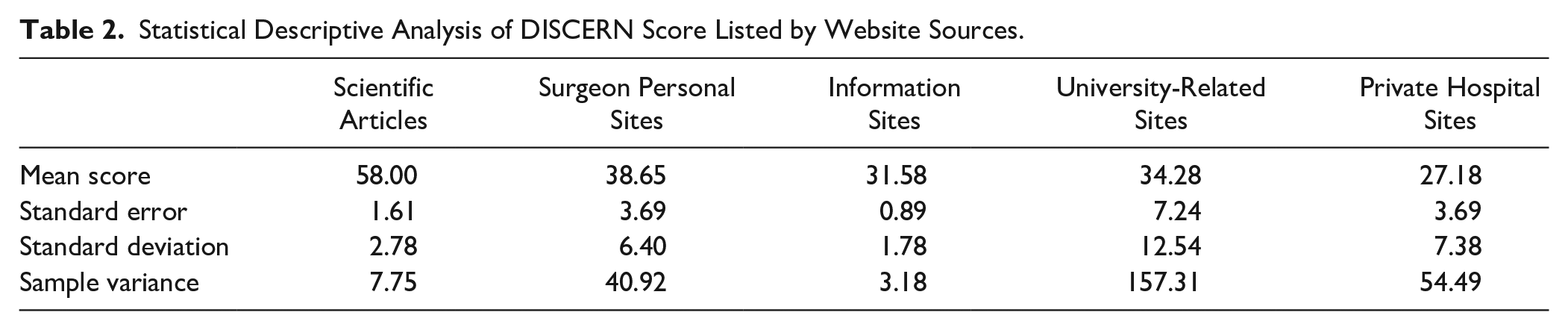
According to our analysis online information quality regarding “cartilage stem cells” is strictly influenced by website affiliation, with higher DISCERN scores for scientific articles followed by personal surgeon’s sites and lower scores for private hospital websites. Due to different communication purposes, the quality of scientific information can be altered by autopromotional faults though ethical preconditions should not be neglected. In our research, scientific articles are predominant in the English context (United Kingdom), information sites in the French context while surgeon personal sites in Italy and Spain, thus determining an overall difference of web information quality for each country (higher global DISCERN scores for English examined websites). The comparison of 4 adjoining European contexts (with comparable national health systems) denotes different mass communication approaches, maybe reflecting a subtle but significant cultural diversification among these countries.
Discussion
The goal of this study was to evaluate the quality of online resources for stem cell therapy for articular cartilage diseases. A validated tool (DISCERN) was applied to the top 200 Italian, British English, French, and Spanish websites (50 for each language) to rate the quality and accuracy of written online information. The results of our study demonstrate a large variation in quality among9 websites, and the perceived quality depends also on website features associated with its presentation such as its usability. There are significant differences between private and not private information sources set by the tendency toward marketing in the private context so that peer-reviewed literature and adequate evidence are often lacking.
In the collective imagination “stem cells” represent the ideal biologic solution when talking about cartilage disorders, though this denomination inappropriately conceals a myriad regenerative options (PRP; adipose-derived MSCs, AD-MSCs; bone marrow aspirate concentrate, BMAC; monocytes growth factors; umbilical cord blood; etc). Formally with the term “stem cells” we identify only cells with the potential for self-renewal, asymmetric cell division, and differentiation into multiple line cells. Adult stem cells, isolated from various adult tissues, are divided into unipotent and multipotent stem cells. Dowthwaite et al. 11 described cartilage stem cells on the surface of articular cartilage for the first time in 2004.
Anyway, internet generalist health information intentionally (or with a certain amount of superficiality) does not speak with full knowledge of the facts, so that the term “stem cells” is often used and abused when reporting the properties of restoring native tissue. It is also true that even in the scientific community there is no current consensus on stem cells identification/definition. A controversial aspect is represented by cellular lineage conversion or plasticity; completely undifferentiated cells and lineage-committed cells should be distinguished. We still have limited knowledge and ability to use stem cells, so that the well-promoted “stem cell therapies” should be closely scrutinized.12,13 The poorly characterized cell formulations derived from lipoaspiration or bone marrow aspiration, widely used and promoted, are very different than characterized culture-expanded cells. For this reason, they should not be considered as “stem cells” (being tissue-committed progenitors), though many practitioners worldwide advertise the broad availability of stem cells therapies. A. Caplan in 2017, not by chance, proposed to change the name to MSCs since these cells are erroneously considered “stem cells”: we should not disregard this point of reflection. 14
In the past 15 years, there has been increased scientific interest and output on the use of biological therapies for cartilage disorders. No specific guidelines or incontrovertible recommendations are still available on this topic and at the same time, online health education tools can be inadequate so that patients might not be able to judge the quality of online information.15,16
Since the past decades, patients are increasingly utilizing online resources to access information related to their health; this modality of information seeking is common among younger patient groups, but it is gradually increasing among older patients as well. 17 The quality of website education tools is very important since a large proportion of patients report that the information they find online influences their treatment decisions. According to a recent study, approximately 40% of patients will turn to the internet before undergoing surgery. 18
There are many sources of health information but only a small proportion of this material is evidence-based and focuses on the outcomes of treatment rather than on the processes. Since patients need to participate with an active role in decision makings, the quality of health information sources plays a key role in psychological status and treatment choice. As reported by Nwachukwu et al. 19 patient education websites should prepare patients for physician visits, explaining the disease process and the possible treatment option, and present a balanced assessment of the currently available scientific evidence.
Little work has been done to evaluate the quality of information about cartilage diseases and stem cell therapy available through websites or social media. Currently available online patient education does not grant sufficient understanding regarding the use of stem cells for cartilage diseases.15,16,19
Little evaluation of content or effectiveness is generally performed so that patients may receive inaccurate or misleading information, ranging from deliberately deceitful institutions promoting miraculous products or techniques to more benign sites that lack scientific background and credibility. The rapidly growing success of social media is a fundamental challenge for health professionals and consumers, launching the need to identify quality information to prevent quick and alternative cures leaning on vulnerable populations. A limited health literacy associated with dissatisfaction with traditional health care and a persistent desire for a quick and not-demanding cure can amplify the magnitude and the impact of the problem. This consideration underscores the importance of promoting accurate and complete information. Anyway, the completeness of the information is a necessary but not sufficient condition, since the subjects of a website could be scientifically incorrect. Inaccurate non-evidence-based information might modify patient care choice. Truthfulness is necessarily dependent on evidence-based medicine, being variable on circumstances and time due to correspondence to the latest scientific knowledge.
General guidelines for assessing the credibility of online health information include such criteria as the accuracy of content, the authority of the site, and ease of use. The perception of credibility is determined by expertise and trustworthiness.
A significant amount of online medical information may contain misleading or inaccurate information, is not peer reviewed, and may elicit results that are too superficial or narrow to fully meet adequate patients’ informational needs. 20 Prior studies regarding online patient education in an orthopedic context (scoliosis, low back pain, hallux valgus, etc.) reported limited quality and poor educational value, strictly depending on authorship.21-23 Inaccurate health information is potentially costly to health care systems and society as a whole. Informational accountability concerning information currency, recent updates, and use of citations is often lacking.
Considering the overwhelming volume of information available on the Internet, patients need more considered guidance on how to search for resources that address their specific health problems. 24 There is some inconsistency between quality and search engine rank since the highest-ranked websites do not generally grant the highest quality scores. On this premise, health care providers and patients cannot rely only on search engine positioning to get the highest quality resources.
The visual design of a site, the currency of information, and contact details may influence the assessment of health information by internet consumers. 25 For non-biomedical web consumers, “intelligibility” of a website is certainly more important than “the sources” or scientific references.
The quality of medical information has been investigated using various evaluation tools (DISCERN, JAMA, HON, Flesch-Kincaid) 26 in many different medical disciplines. Given the above, we need to improve the quality of health information websites, by providing the tools for pragmatic and solid communication (even for “common internet users”). Maybe website managers should simply comply with DISCERN questionnaire (intended as a checklist), before designing health information platforms. Based on these premises the information reported should be clear, balanced, and unbiased, describing not only the benefits but also the correct indications, the risks, the outcomes, and the alternative options available for each treatment. The scientific sources should be considered an essential quality to define a complete, well-structured, and solid website, once again.
Being a step-by-step checklist DISCERN is a valid and reliable indicator of evidence-based website quality and a simple tool for information consumers to assess information quality when reading online health information: the high number of citations (over 600) for DISCERN confirms its wide use in academic research. Nonetheless, according to Griffiths and Christensen, 27 individual consumers without technical expertise might consider DISCERN too lengthy and not spend the time required by this tool for a correct evaluation of health information. Anyway, DISCERN may be a useful evaluation tool for consumer organizations or web constructors interested in assembling lists of quality portals or links. Unfortunately, sometimes a certain approximation is deliberately required at market conditions so that improbable miraculous therapies could be emphasized. Inaccurate information associated with aggressive marketing strategies has led to the indiscriminate use of many regenerative medicine techniques. Precisely for this reason, the availability of scientific sources should be the holy formal guarantee for all web users.
This study has some limitations. Our top-200 ranked list provides a snapshot of the websites focused only on the Italian, British English, French, and Spanish context and set on a particular day (the order of research may change daily). In addition, social-media content or blogs were not assessed in our study, limiting our research to the evaluation of comprehensive information style websites. Future works could focus on other kinds of platforms (social media) to seek information about cartilage diseases and stem cell therapy. Furthermore, we used only a single search string assuming that this choice does not change the key message of our study.
Conclusions
According to the international literature, the age of onset of cartilage disorders is increasingly early, thus determining patients’ additional requirement to restore articular function without resorting to joint replacement. 28 We inevitably live in a world projected toward everlasting youth: regeneration is the secret of eternal youth and, for this reason, this is a topic of great interest. We should adequately instruct and inform our patients, based on scientific evidence and not simply on scientists’ exhilaration. The road to flawless cartilage regeneration is still long, and further research is needed; ethical considerations should support medical online information on this developing topic.
Our results can help health care providers to select high-quality resources when conducting searches on their own and when educating patients. This is very important when promoting a new treatment modality since health information needs to be unambiguous and evidence-based to be credible.24,25 Patients are not generally able to distinguish the most reliable and valid information from less credible ones so that an adequate amount of relevant references should support medical communication: Not only potential benefits but also possible drawbacks should be presented. Online medical information should not be a marketing tool but a means of education.
Footnotes
Acknowledgments and Funding
The author(s) received no financial support for the research, authorship, and/or publication of this article.
Declaration of Conflicting Interests
The author(s) declared no potential conflicts of interest with respect to the research, authorship, and/or publication of this article.
