




Abstract
Objective
The purpose of this study was to evaluate the effect of N-acetylcysteine (NAC)-enriched storage medium on fresh osteochondral viability at 4°C. Our hypothesis was that the cell viability of chondrocytes obtained from human osteochondral tissue and stored at 4°C significantly improves in the presence of NAC.
Design
Controlled laboratory study. For this study, 8 samples of femoral condyle osteochondral tissue were obtained from patients undergoing total knee replacement. The samples were stored at either 4°C in phosphate-buffered saline (PBS) or at 3 different concentrations of NAC (NAC 1, 2, and 5 mM). Cell viability was analyzed at time 0 and 4 weeks by flow cytometry. The results of cell viability (median) were analyzed statistically using analysis of variance and Tukey’s post hoc test. P values <0.05 were considered statistically significant.
Results
The viability at time 0 was 95.5% ± 3.7%. At 4 weeks, the cell viability was 56.8% ± 20.1% in the control group (PBS), 83.8% ± 11.9% in the group stored with NAC 1 mM, 73.4% ± 13.6% in the group stored with NAC 2 mM, and 66.4% ± 27.7% in the group stored with NAC 5 mM. A statistically significant difference from the baseline viability (time 0) was observed in the PBS control group (P = 0.0018) but not in the other groups. A statistically significant difference was observed in the NAC 1 mM group compared with the PBS group (P = 0.0255).
Conclusion
The use of NAC at 1 mM concentration improves cell viability after 4 weeks of storage in chondrocytes obtained from human osteochondral tissue.
Introduction
Full-thickness chondral and osteochondral defects are common in active young patients. 1 Because articular cartilage has a limited potential of regeneration, even minor injuries can lead to the development of progressive joint damage and global joint degeneration or osteoarthritis.2,3 This leads to high levels of disability and therefore high health care costs. 4 Multiple alternatives have been described for the treatment of cartilage injuries such as subchondral drilling, microfracture, autologous and allogeneic osteochondral grafts, and autologous chondrocyte implantation, with variable results described in the literature.5-8
When one of the “first-line” treatments fails in a young patient, the use of fresh osteochondral allografts is an alternative to consider, particularly in those secondary to fractures and osteochondritis dissecans. 9 Several studies have shown good results in the medium and long term.10-13 Davidson et al., 11 in one of the largest series of patients treated with osteochondral allografts, demonstrated a statistically significant difference in functional assessments and implanted tissue features compared to pre-operative status, with an average follow up of 40 months. Krych et al. 12 observed in a study of 43 patients treated with this technique a return to sports rate of 88%, while the return to the same preinjury level was 79%.
Fresh osteochondral allograft transplantation is based on mature hyaline cartilage transplantation at the site of the lesion, with viable chondrocytes that can withstand storage under hypothermic conditions. The advantages of this technique are as follows: (1) flexibility in adjusting the size of the graft to the size of the lesion, especially important in larger defects; (2) a blood supply and innervation are not required; (3) it does not generate a significant immune reaction in the host 14 ; and (4) it does not cause donor site morbidity. Disadvantages include a low rate of donors in our country (Chile), limitations on tissue storage, time for use, and low risk of transmission of infectious disease. 9
Several studies have evaluated the storage conditions of osteochondral allografts to extend the storage as long as possible while maintaining optimal cell viability.15-18 The storage time has not yet been well defined. The initial studies described that the time window between tissue procurement and transplantation should not exceed 48 hours, but more recent studies have extended this period to 14 to 28 days. 9
Multiple alternatives to the storage medium have been described; saline solution and Ringer’s lactate solution are the most used. 9 Apoptosis is the mechanism through which cell viability decreases during the obtaining, storage, and implantation of osteochondral allografts. 19 There are different apoptosis-regulating pathways in chondrocytes, but the nitric oxide pathway is dominant in the apoptosis of articular cartilage. 20 Moreover, it has been reported that N-acetylcysteine (NAC) prevents apoptosis and degenerative changes in animals. 21 Gómez-Lechón et al. 22 showed that NAC increases cell viability and decreases apoptosis activation in isolated hepatocytes for cell transplantation.
The aim of our study was to evaluate the effect of NAC-enriched storage medium on fresh osteochondral viability at 4°C at 4 weeks. Our hypothesis was that the cell viability of chondrocytes obtained from human osteochondral tissue and stored at 4°C improves significantly in the presence of NAC.
Materials and Methods
Osteochondral Tissue Harvest
This study was approved by the institutional review board and ethics committee of our institution. The inclusion criteria were patients between 18 and 80 years old who underwent total knee arthroplasty. Exclusion criteria were patients younger than 18 or older than 80 years, a history of inflammatory arthritis, severe chondral damage in the posterior area of femoral condyles, and the rejection of informed consent.
Osteochondral tissue samples were obtained from 8 patients (5 females/3 males) between 51 and 80 years old (average 70 years) who underwent total knee arthroplasty at our center. Two patients were classified as Kellgren-Lawrence (KL) grade 2, 4 were classified as KL grade 3, and 2 were classified as KL grade 4.
After performing posterior femoral cuts, the osteochondral tissue samples were placed in a sterile container in saline solution. The samples were transferred to the laboratory at room temperature within less than 2 hours for processing. Once in the laboratory, the samples were washed in 50 mL Falcon tubes with 30 mL of sterile phosphate-buffered saline (PBS) supplemented with gentamicin (200 µL/100 mL). Subsequently, the tissue was divided into 5 parts to assess the cell viability at time 0 (basal cell viability) and at 28 days in 3 concentrations of NAC (1 mM, 2 mM, and 5 mM; control group in PBS). During the 28 days of storage, the samples were maintained at 4°C.
Chondrocyte Viability
Cell viability was quantitatively assessed by flow cytometry. This methodology allows discrimination between vital and nonvital cells according to their ability to uptake fluorescent dyes. 23 In each sample, the total thickness of the cartilage was separated from the subchondral bone and then mechanically divided into fragments of approximately 0.5 cm × 1 cm. An enzymatic disaggregation with 1 mg/mL of collagenase in PBS was performed for 12 hours. Subsequently, labeling was performed with SYTO BC (Thermo Fisher Scientific, Waltham, MA, USA), which labels living cells, and propidium iodide (Sigma-Aldrich Corporation, St. Louis, MO, USA), which binds to the DNA of nonviable cells. For this, the samples were incubated in the dye solution in the dark for 20 minutes and then evaluated using flow cytometry. To quantify cell viability, the ratio between live cells (SYTO BC positive) and total cells (SYTO BC positive + propidium iodide positive) was determined. 18
Statistical Analysis
Results of cell viability (mean ± standard deviation) were analyzed using analysis of variance and Tukey’s post hoc test for paired samples. Values of P < 0.05 were considered statistically significant.
Results
Quantitative analysis of chondrocytes viability by flow cytometry for each NAC concentration and control group in PBS is presented in Figure 1 and Table 1 . Cell viability was shown to decrease significantly over time by comparing basal viability after 28 days of storage in PBS (95.5% ± 3.7% vs 56.8% ± 20.1%; P = 0.0018). Although the viability of chondrocytes stored at different concentrations of NAC at 28 days (NAC 1 mM 83.8% ± 11.9%, NAC 2 mM 73.4% ± 13.6%, and NAC 5 mM 66.4% ± 27.7%) was lower than the basal viability, these differences were not statistically significant (NAC 1 mM P = 0.0604, NAC 2 mM P = 0.0615, and NAC 5 mM P = 0.1886). When comparing cell viability at 28 days between the different media, it was observed that the media enriched with NAC had a higher percentage of vital cells than the nonenriched medium (PBS); this difference was statistically significant between the NAC 1 mM group and the PBS control group (83.8% ± 11.9% vs 56.8% ± 20.1%, P = 0.0255).
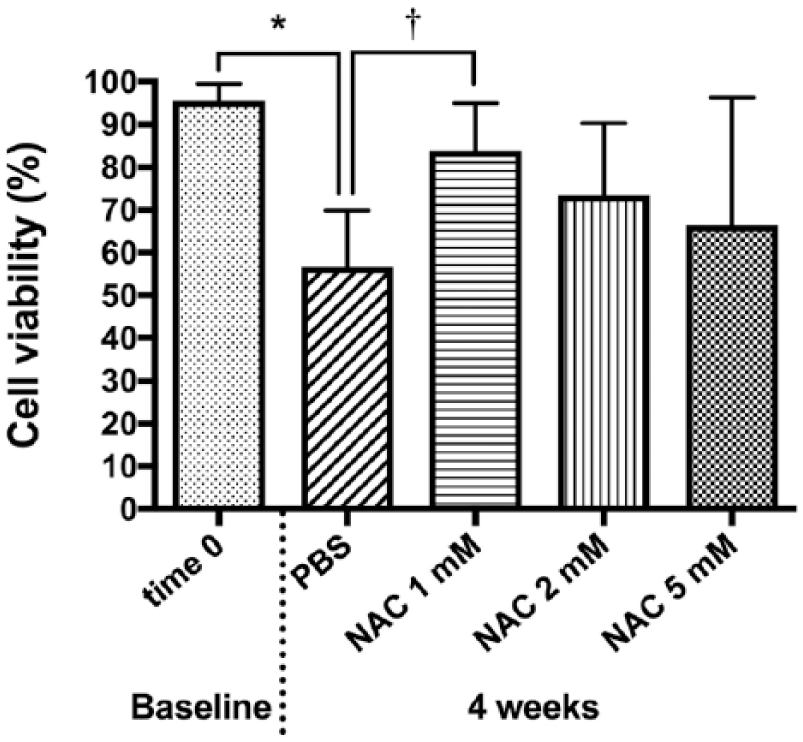
Basal cell viability and at 4 weeks in NAC-enriched medium (1 mM, 2 mM, and 5 mM). The results correspond to the mean ± SD. Values of P < 0.05 were considered statistically significant. *P = 0.0018. †P = 0.0255. NAC = N-acetylcysteine; PBS = phosphate-buffered saline.
Cell Viability Quantitatively Assessed by Flow Cytometry.
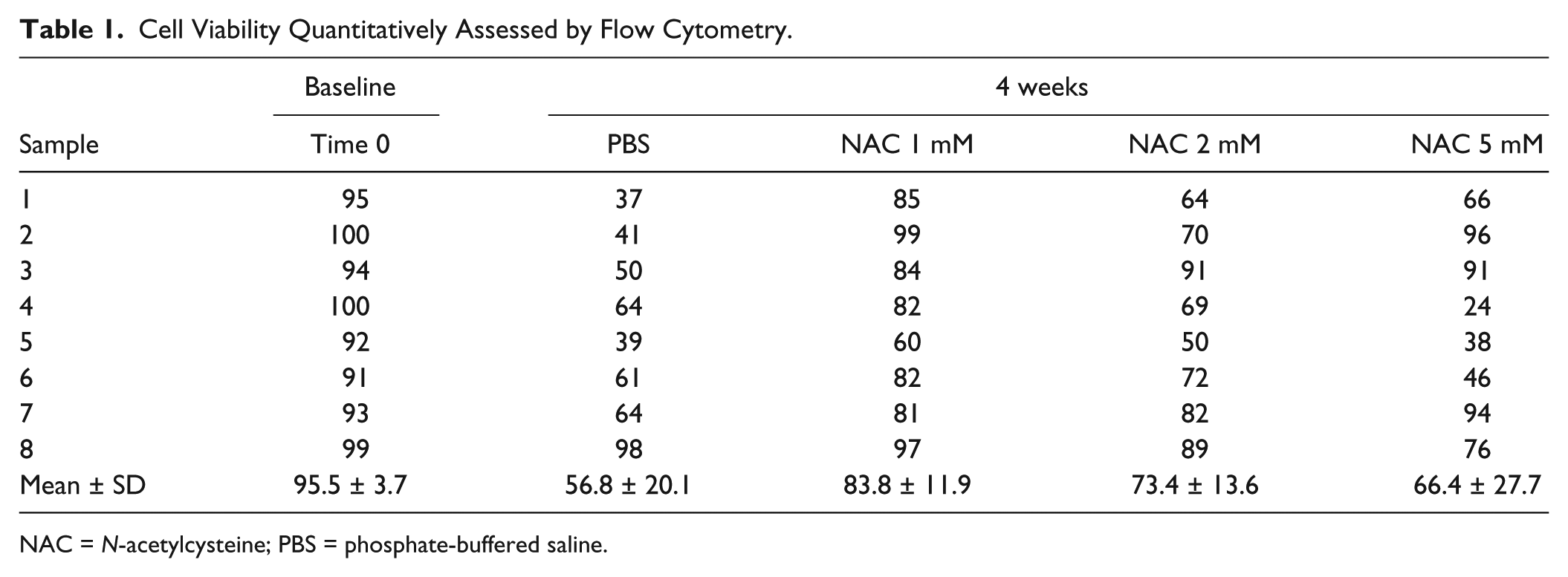
NAC = N-acetylcysteine; PBS = phosphate-buffered saline.
When comparing cell viability between the groups stored in NAC-enriched medium, it was observed that cell viability presented an inversely proportional relationship to the concentration of NAC; however, the differences between groups were not statistically significant.
Discussion
Several studies have shown that after 14 days of storage, the cellular viability of osteochondral allografts significantly decreases, which could compromise treatment success.15,24,25 However, tissue banks currently require at least 2 weeks for the microbiological and serological graft analysis prior to its availability for use. 26 For this reason, it is very relevant to generate information that allows an increase in the storage time of osteochondral allografts without compromising their vitality.
This study demonstrated that the use of an NAC-enriched medium maintains cell viability after 28 days of cold storage. Our results showed that chondrocyte viability decreases to 56.8% ± 20.1% after 28 days in the nonenriched medium. However, by storing the tissue in the presence of NAC, cell viability can be maintained up to 83.8% ± 11.9% after this time.
Several studies have evaluated the effects of storage on the viability of chondrocytes of osteochondral allografts. Ball et al. 15 evaluated the storage of human osteochondral allografts in lactated Ringer’s solution and a conventional culture medium (Dulbecco’s modified Eagle medium [DMEM]) at different times. They observed that cell viability at 28 days in the lactated Ringer’s group was 29% ± 16%, a statistically significant decrease with respect to the same group that was stored for 7 days. However, by storing the tissue in DMEM, viability remained at 83% ± 10% at 28 days, which is comparable to our results. Moreover, other studies have evaluated the use of conventional culture media such as DMEM as an allograft storage medium, presenting cell viability at 28 days of close to 30% to 60%.27,28 A relevant factor in the maintenance of cell viability in these studies was the need to replace the culture medium every 2 to 3 days,15,29 which represents a disadvantage with respect to the medium evaluated in our study, which did not require any replacement, at least for 28 days. This could be explained by NAC’s blockade of the cellular signaling pathway of nitric oxide in the regulation of chondrocyte apoptosis, 21 which could be maintained over time with a NAC concentration of 1 mM.
Although the ideal storage time for osteochondral allografts has not been specifically determined, a recent study showed that beyond storage time, cell viability more than 70% is associated with better clinical outcomes. 25 In our study, this cellular viability was achieved at 28 days of storage in the medium enriched with NAC 1 mM and 2 mM.
There are some limitations to our study. First, the samples used corresponded to the cartilage of patients with osteoarthritis who underwent a total knee replacement. Although the cartilage samples used had a healthy macroscopic aspect, the underlying pathology of the patients could affect tissue properties. However, considering the results obtained, this would be in the most “unfavorable” scenario, because the chondrogenic potential is directly related to age. 30 Another limitation of this study is that samples from the posterior segment of the femoral condyles were used, not the rest of the knee. It has been observed that the properties of the articular cartilage vary in different areas of the knee; thus, the effect of storage on the cellular viability of the chondrocytes could also be affected. 31 However, given the difficulty in accessing other types of human osteochondral tissue samples, evaluations were made only in the posterior femoral condylar area. Finally, our study evaluated only the cellular viability of chondrocytes and no other biochemical or biomechanical characteristics of the tissue. This was because of the low cellularity of the cartilage; thus, the entire sample had to be processed for flow cytometry. Although it seems relevant to know the effect of storage on other tissue properties, cellular viability has been described as the most important factor in graft survival and clinical outcomes.25,32
This study demonstrated that the storage of fresh human osteochondral allografts in a NAC-enriched medium provides greater cellular viability than when stored in a basal medium (PBS). The clinical relevance of the study is that NAC increases the window of time for the use of fresh osteochondral allografts in patients with severe cartilage injuries.
Footnotes
Declaration of Conflicting Interests
The author(s) declared no potential conflicts of interest with respect to the research, authorship, and/or publication of this article.
Acknowledgments and Funding
The author(s) disclosed receipt of the following financial support for the research, authorship, and/or publication of this article: The research leading to these results has received partial funding from the Chilean Society of Orthopedics and Traumatology.
Ethical Approval
This study was approved by the local ethics committee (Study-ID:2013-01).
Informed Consent
Written informed consent was obtained from all subjects before the study.
Trial Registration
Not applicable.