




Abstract
By offering low-cost tools of communication and coordination, social media platforms such as Facebook may constitute a substitute for coordination by means of hierarchical organization. Social media may disrupt, appearing as a “weapon of the weak,” a relationship that has traditionally linked membership to resources and influence. Against such a backdrop, this article investigates the extent to which organizational features and activities as well as the content of Facebook posts predict the reach and audience of voluntary organizations on Facebook. By linking organizational survey data and social media data and harnessing machine learning methods, hypotheses linking organizational features and the reach and level of attention obtained by voluntary organizations on Facebook are tested. The results support the notion that social media may work as a substitute for hierarchical forms of membership mobilization but do not support the “weapon of the weak” hypothesis.
Social media, especially Facebook, have become a significant tool of communication and coordination that is leveraged in many voluntary organization operations. They keep the costs of organizing to a minimum (Benkler, 2006) and make the mobilization of supporters, as well as the building of audiences or communities, easier (Lovejoy & Saxton, 2012). Digital networks enable decentralized coordination and joint action through trust and the sharing of information and resources (Scharpf, 1997). Thus, they are a substitute to coordination by means of hierarchy—conceived as a “mode of interaction in which a superordinate is able to specify a subordinate’s choice” (Scharpf, p. 172). In short, social media can transform the operations and organizational forms of voluntary organizations by providing alternative modes of communicating and coordinating to those of traditional hierarchical ones.
A central question is to determine the extent to which social media are “weapons of the weak” (van der Graaf et al., 2015) enabling organizations with limited resources to mobilize support and advocate in the public sphere for their causes or whether they are “weapons of the strong” (Schlozman et al., 2010), reinforcing the capacity of affluent organizations. Another important question is to determine whether social media contribute to a structural change of the voluntary sector—with new forms of network-based organizations emerging and older forms of organizations being outclassed—or whether older forms of organizations are able to harness the new technologies to their advantage, in spite of the emergence of new, less hierarchical, forms of organizations.
To address these questions, this study analyzes data linking a survey of national voluntary organizations in Norway with their digital traces on Facebook—enabling, thus, connecting organizational characteristics to organizations’ communication on Facebook (messages, reactions to messages)—and examines the influence of an array of organizational features on the attention obtained on Facebook by voluntary organizations, both in aggregate terms at the organizational level and at the message level.
Conceptual Framework
Although voluntary organizations’ use of social media can be characterized by the three dimensions of adoption, activity, and visibility (Campbell & Lambright, 2020), research has focused mainly on adoption (Maxwell & Carboni, 2016; Saxton & Guo, 2014; Saxton & Waters, 2014) and activity—especially organizations engagement with stakeholders and the public (Campbell & Lambright, 2020; Ji, 2017; Kanol & Cemal Nat, 2021; Li et al., 2021; Selivanova, 2022). This research builds upon and extends the seminal work of Lovejoy and Saxton (2012) and Saxton and Waters (2014) that establishes a hierarchy of engagement to analyze how nonprofit organizations use Facebook and Twitter to engage stakeholders, identifying three broad categories of social media content: information, community, and action.
Another important line of research using digital traces has investigated whether social media use by nonprofit and voluntary organizations affects their organizational capacity and ability to attract resources, especially through fundraising (Lam & Nie, 2020; Lee, 2021; Lee & Shon, 2021; Olinski & Szamrowski, 2021; Jiwon Suh, 2022; J. Suh et al., 2021; Sun & Asencio, 2019).
Yet, adoption rates have increased over time, especially for Facebook, whose adoption rate in the public and among voluntary organizations is nearly universal (Saxton & Waters, 2014). Furthermore, although these studies have provided a valuable foundation for understanding social media use in these settings, they do not address directly the main challenge that confronts voluntary organizations using social media, the “attention challenge” identified by Guo and Saxton (2020) and do not systematically address the question of whether social media reinforce or reduce resources inequalities among nonprofit and voluntary organizations.
Guo and Saxton (2017), Guo and Saxton (2020) and An (2019) have proposed a four-factor explanatory model of the determinants of audience attention to social media messages, where the first factor relates to audience- or network-level characteristics, and the three remaining factors reflect the organization’s communication strategy: timing and pacing, targeting and connecting, and content (message-level characteristics). Following this logic, the proposed conceptual framework links (a) organizational characteristics to (b) network-level and communication strategy characteristics other than message content (timing and pacing strategy and targeting and connecting strategy) to (c) message levels characteristics (content, sentiment).
We can conceptualize the relationship between organizational features, types of social media use (communication strategies), content (message-level features), and indicators of attention with the help of a three-dimensional model. The first dimension of the model reflects how the amount of attention an organization receives may depend on the nature of the organization’s organizational features, including its field of activity (ICNPO—International Classification of Nonprofit Organizations—category), resources (sources of funding, number of volunteers and members), organizational form, level of professionalization, level of advocacy activities, and insider versus outsider orientation.
Concerning organizational forms, the traditional organizational form characterizing national organizations in Norway is rooted in the popular movements that emerged in the context of a struggle for national independence and democratization after Norway was liberated from Danish rule in 1814. The defining characteristic of the popular movements was the vertically integrated organizational model (Tranvik & Selle, 2007), where local chapters were relatively autonomous core units hierarchically coupled to regional chapters and the national organization. In addition to the traditional popular movement organizational model, the population of voluntary organizations with a national scope has been progressively enriched and diversified. Thus, four types of national scope organizations are distinguished: (a) organizations being the central division of an organization with local and regional chapters, (b) standalone national organizations, and (c) umbrella organizations, and (d) Norwegian branch of international organizations.
The insider/outsider divide is one of the more durable categorizations in the interest group literature (Grant, 2000). Insider groups are regarded as legitimate by governments and are consulted on a regular basis. Outsider groups either do not wish or are unable to enter into a consultative relationship with officials. This status distinction between types of advocacy organizations has also been applied to qualify the strategy of these organizations, distinguishing between an insider strategy of close consultation with political and administrative actors and an outsider strategy based on public appeals through the media and the mobilization of group members and citizens (Kollmann, 1998; Walker, 1991).
The second dimension, which is influenced by organizational characteristics, is the nature of the voluntary organization’s communicative use of social media and of its social media network. Voluntary organizations can use social media to achieve different mission-related goals, including the organization and coordination of volunteer activities, fundraising and the generation of market income, and influencing opinion and policymakers. Furthermore, voluntary organizations’ communicative use of social media may vary—in addition to message content—along the dimensions of timing or frequency and of connecting strategy (Guo & Saxton, 2020). Finally, social media logic (van Dijck & Poell, 2013), emphasizing popularity and connectivity in digital networks, entails that the organization’s audience network will be one of the central determinants of the extent of the audience’s attention (Bakshy et al., 2011; Saxton & Waters, 2014).
The third dimension of the model is that of the message or content of communication. The content of the message can be seen as the “what” of communication, moving between authors and receivers. In this conceptual framework, three dimensions of the message’s content are taken into account: The type of post, defined as a result of an unsupervised clustering algorithm, and the emotions contained in the post, identified through a dictionary-based sentiment analysis.
Based on the conceptual framework, the following research questions and hypotheses can be formulated for the organizational and message levels:
More precisely, which organizational features (organizational forms and levels of resources) influence social media use and the level of attention obtained by a voluntary organization? If social media platforms, by providing cheap means of communication and coordination, have become the “weapon of the weak” and of networked organizations that is, whether they have contributed to transforming the relationship between members, resources, and policy influence, we can expect that the level of resources will not be correlated with influence on social media and that the standalone organizational form—not relying on a geographically or functionally nested hierarchy of organizations to mobilize support—will obtain attention on social media. However, organizational features have different impacts on attention according to the dominant organizational logic(s) characterizing the organization. Two types of organizational logics—logic of membership aimed at mobilizing and representing its members or a logic of influence aimed at influencing decision-makers (Schmitter & Streeck, 1981)—that can coexist within a given organization can be distinguished, entailing two hypotheses:
At the message level, in addition to the organization’s features and activities on social media, attention is expected to be dependent on the informational and emotional content of posts. Posts that are most useful to the audience that is, rich in information (whether related to news or organizational activities) might be expected to mobilize the most attention. Hence, the following hypothesis is proposed:
In addition, emotions, especially fear and anger, have been shown to affect politics and media use, with fear motivating individuals to be vigilant (Marcus et al., 2000) and anger affecting protective behaviors related to norms and group identification (Vasilopoulos et al., 2019). Emotion-laden content on social media is likely to elicit the same emotions in the audience as the result of emotional contagion (Utz, 2019)—the process through which people take on the emotions displayed by others. Accordingly, while anxiety-laden messages are expected to trigger information-seeking behaviors, anger-laden messages are expected to provoke actions oriented toward obtaining restitution and are, therefore, more likely to generate interaction. Consequently, we can expect the following:
Data and Methods
Linked Digital Traces and Survey Data
The data are constituted of, on one hand, data from a national organization survey aimed at all types of national voluntary organizations and conducted in 2019 (Arnessen & Sivesind, 2020) and, on the other hand, Facebook data for all those organizations that have a Facebook Public Page. A national organization was defined as a voluntary organization where the activities and services have a national scope and can be used regardless of where one lives in the country. The survey focused on the whole population of nationwide organizations and not a sample of it. The population was established on the basis of information obtained from public registers. In all, 958 national organizations among a population of 3,875 organizations answered the survey, yielding a response rate of 25%. There are some variations in terms of response rates across the different organizational ICNPO categories. Organizations within the category “social services” had a high response rate (56%) compared with the average, while it was somewhat lower for political parties (18%), international activities (19%), and others (9%). In several of the largest ICNPO categories, such as “art and culture” and “education,” the response rates were relatively high (respectively, 35% and 34%); the categories “sports,” “recreation and leisure” (both 24%), “business and working life” (25%), and “rights” (23%) close to the average; and the category “faith” a somewhat lower response rate (20%).
The survey data were linked to organizations’ digital traces on Facebook. Facebook was chosen because it is the most pervasive social media platform among Norwegian users. According to IPSOS (2021), 83% of the Norwegian population has a Facebook profile (compared with 27% for Twitter) and 69% use the platform daily (compared with 9% for Twitter). In addition, nearly 70% of voluntary organizations with a national scope use Facebook pages.
Access to the Facebook pages and the crawling of their public content was enabled via Facebook CrowdTangle. The crawled CrowdTangle dataset included all the posts published during the study period, with a total of 74 554 posts posted by voluntary organizations with a Facebook page (among the 958 organizations having completed the survey, 660 had a Facebook page) during the year 2019 (January 1 to December 31, 2019).
Variables
Dependent variable
The first dependent variable in the analysis was the total number of interactions generated by a post, which was used as an indicator of attention to a voluntary organization’s communication. The number of likes, shares, comments, and reactions generated by a post was provided by CrowdTangle. These metrics were added to constitute the variable “total interactions” at the post level. The second dependent variable was the total number of interactions at the organizational level. The degree of attention provoked by a voluntary organization’s communication on Facebook was measured at the organizational level as the total number of interactions generated by the totality of posts posted by the organization on Facebook during the study period (January–December 2019).
Independent variable and control variables at the organizational level
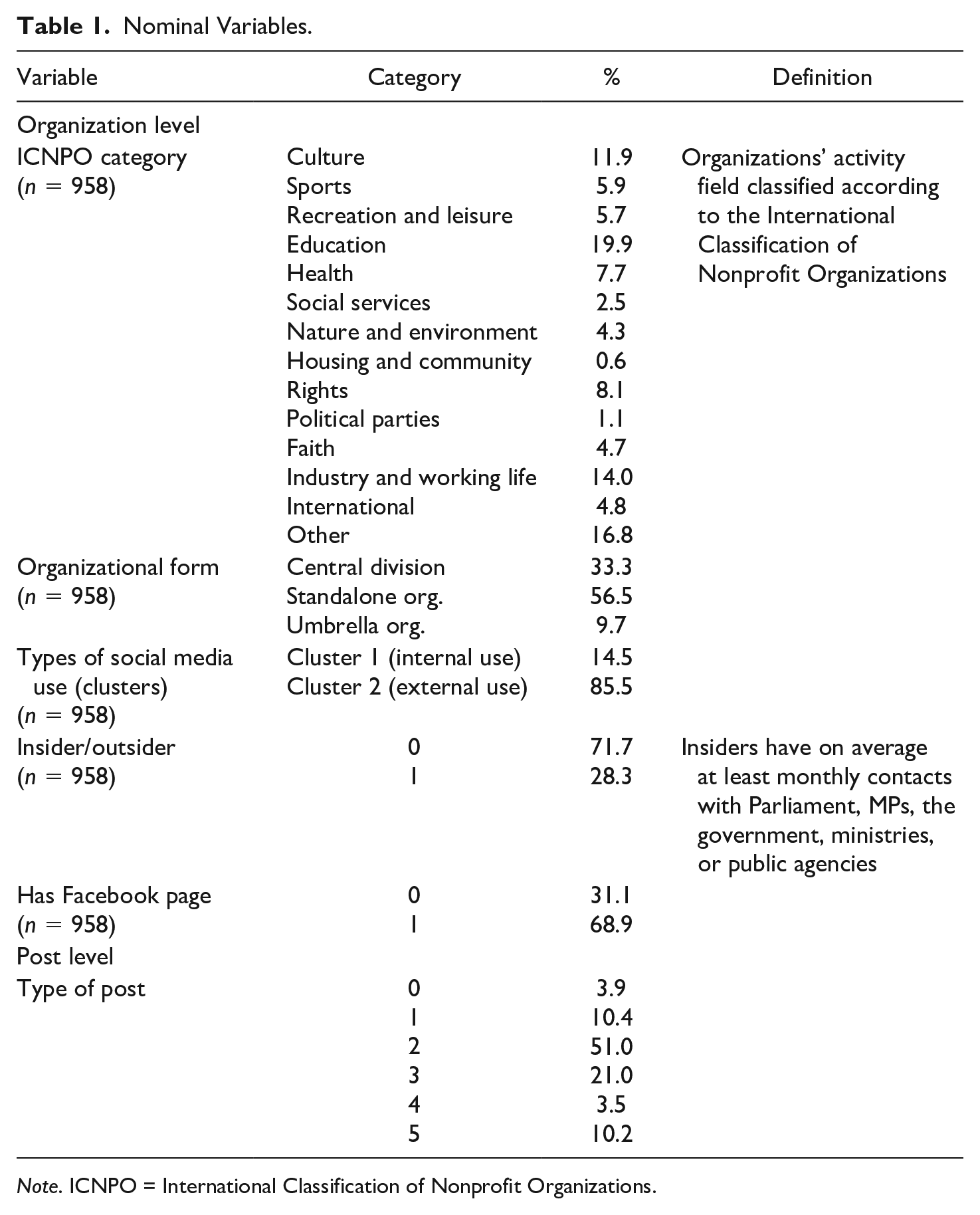
The main explanatory variables (see Tables 1 and 2 for the descriptive statistics associated with these variables) at the organizational level are related to the organizational features of the organization (the resource level of each organization, the field of activity of the organization, its organizational form), the advocacy activity of the organization (level of advocacy activities, insider/outsider status), and the organization’s use of social media (type of social media use: internal vs. external, number of followers on Facebook, and number of posts per day on Facebook).
Nominal Variables.
Numerical Variables.
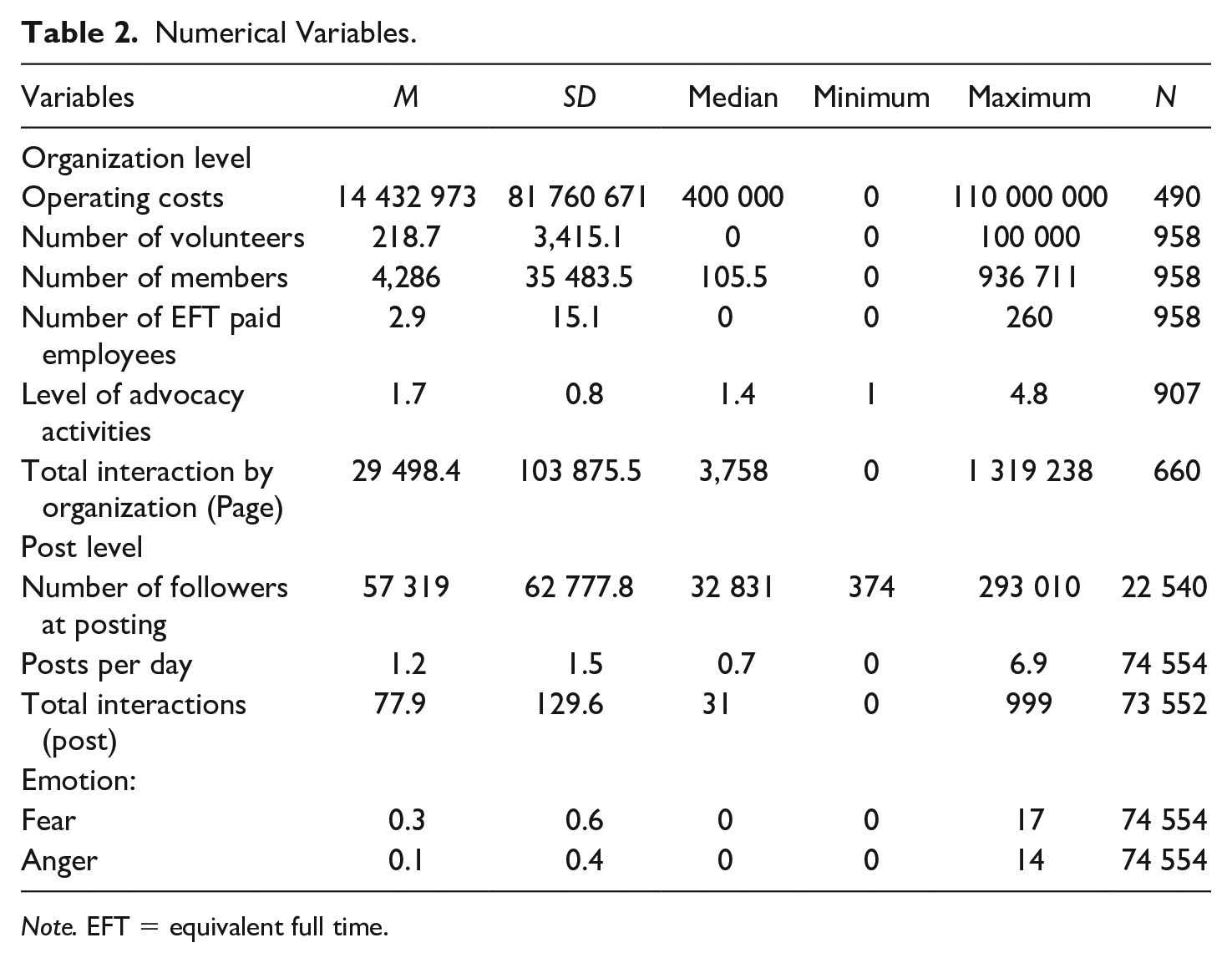
Note. EFT = equivalent full time.
Resources are a complex phenomenon that includes many types of elements. Four indicators of resources were used: operating costs, number of volunteers, number of memberships, and number of equivalent full-time (EFT) paid employees. Furthermore, organizational features are captured by two additional variables. The variable “ICPNO category” identifies the main field of activity of the organization according to the International Classification of Non-profit Organizations (United-Nations, 2018). The organizational form of the organization is apprehended by three dummy variables corresponding to the following organizational forms: central division of a national organization with regional and local chapters (the popular movement organizational form), standalone organization (organization being national in scope without local and regional branches), and umbrella organization (a national organization composed of national organizations). The reference category for these dummy variables was the organizational form “international organization,” which has an international scope.
The organization’s advocacy activity was assessed by the variable “level of advocacy activity,” which is an index averaging the frequency of contact (ranging from never to yearly, monthly, weekly, or daily) with five types of political decision-makers: the parliament, members of the parliament, the government, the ministries, and other public agencies. The variable insider-outsider is an approximation of the status (insider vs. outsider) of the organization when it comes to access to political decision-makers, taking a value of zero (outsider) if the averaged level of advocacy activity is less than monthly and one otherwise.
The nature of social media use is captured by three variables capturing the purpose of social media use, the level of activity on Facebook, and the size of the audience reached on Facebook. The first dimension, subsequently denominated “type of social media use,” was obtained from 16 survey items related to different purposes of social media use that had two main clusters, one indicating an internal use of social media (i.e., oriented toward members and volunteers) and the other oriented outward and toward external use of social media (i.e., oriented toward the general public). Details of the principal component analysis and clustering are presented in Supplementary Information. The variable “posts per day,” the average daily number of posts, was an indicator of the activity of the organization on Facebook, while the variable “number of followers” was an indicator of the reach of the organization on Facebook.
Independent variables at the post level
At the post level, two variables were constituted by mobilizing unsupervised machine learning algorithms applied to the text content of the posts. Typically, unsupervised algorithms make inferences from datasets by using only input vectors without referring to known or labeled outcomes. Unsupervised algorithms identify patterns that are inherent in the data.
Types of posts: K-means clustering
To create a typology of posts posted by voluntary organizations on Facebook on the basis of their content, an unsupervised K-means clustering algorithm was applied to the data, yielding six types of posts (see Supplementary Information for details of the results): Cluster 1: Fundraising posts, Cluster 2: Congratulations posts, Cluster 3: Activity planning posts, Cluster 4: Call to mobilization posts, Cluster 5: Informational posts, and Cluster 6: Call to action posts.
Emotions in posts: Sentiment analysis
Sentiment analysis is the process of automatically determining the valence, emotions, and other effectual states in text or speech by using computer algorithms (Mohammad, 2021). From the sentiment analysis, two variables reflecting emotions—fear and anger—that have been shown to affect information selection and processing (Gadarian & Albertson, 2014; Hasell & Weeks, 2016) and that might influence reactions to a Facebook post were used in multivariate analysis (See Supplementary Information for more information).
Modeling Strategy
Multivariate regression analysis was employed to estimate how organizational features and message features (type of post, topics, and emotions) influence the attention of voluntary organizations’ posts on Facebook, measured by the number of interactions that they provoke. The analysis was carried out at both the organizational level (total number of interactions provoked by an organization during the period) and the post level (number of interactions provoked by a post). However, at the organization level, the dependent variable (total interactions) was observed only for those organizations that have a Facebook page, entailing that the dependent variable was censored (observed only for those organizations that have a Facebook page). The central task of analyzing limited dependent variables (Maddala, 1983) is to use censored data to infer the uncensored distribution for the entire population, assuming that the dependent variable follows a normal distribution.
The Heckman (1976) selection model, sometimes called the Heckit model, is a method for estimating regression models that suffer from sample selection bias. Under the Heckman selection framework, the dependent variable is observable only for a portion of the data. A sample selection model involves two equations: (a) a regression equation considering mechanisms determining the outcome variable and (b) a selection equation considering a portion of the sample whose outcome is observed and mechanisms determining the selection process (Maddala, 1983).
At the post level, posts are nested into organizations. Multilevel (or mixed-effects) models are an extension of simple linear models that allow both fixed and random effects, and they are useful particularly when there is non-independence in the data, which can arise from a hierarchical or multilevel structure. Multilevel models can be thought of as a trade-off between (i) aggregating individual observations at the unit (organization) level and (ii) analyzing data from one unit at a time (posts). The individual regressions (post level) have many estimates and considerable data, but they are prone to high margins of error (statistical “noise” or estimation error). The aggregate (organization level) is less characterized by estimation error but may lose important differences when all samples within each unit are averaged. Multilevel modeling with two levels (post and organization levels) was implemented in this study to investigate how organizational features influenced audience attention at the post level.
Results
The raw data set consists then of 958 national organizations (organizational level) linked to their Facebook data (post level). However, only 660 organizations are active on Facebook, yielding a “censured data structure.” In addition, given the existence of missing values for some of the variables at both the organization and post levels, the number of observations (N) included in each models varies depending on the variables included in the model and does not necessarily reflect the total number of observations constituting the basis of the descriptive analysis presented in Tables 1 and 2. With this in mind, the results are presented in two stages corresponding to the organizational and post levels of analysis.
Which Organizations Get Attention?
Table 3 displays the results of the two-step Heckman estimation with two dependent variables measuring the reach of the organization on Facebook (i.e., its audience in terms of number of followers) and the aggregated level of attention (i.e., total interactions) of the organization on Facebook. The Heckman two-step estimation procedure, in addition to correcting the bias of the estimation due to the censoring of the dependent variable (which is only observed for those organizations that have a Facebook Page), allows us, considering the probit estimation in the first step of the model, to investigate the factors influencing the adoption of a Facebook page by voluntary organizations. It enables us to identify, while not our primary focus, which organizational features are associated with the adoption of Facebook Page. The probit selection equation columns display the estimation of the probability of using a Facebook page, whereas the outcome equation columns estimate the effect on the number of followers (reach) and the number of interactions (attention) of the variables capturing organizational features and activity on Facebook.
Organization-Level Predictors of Attention on Facebook: 2-Step Heckman/Heckit Estimation.
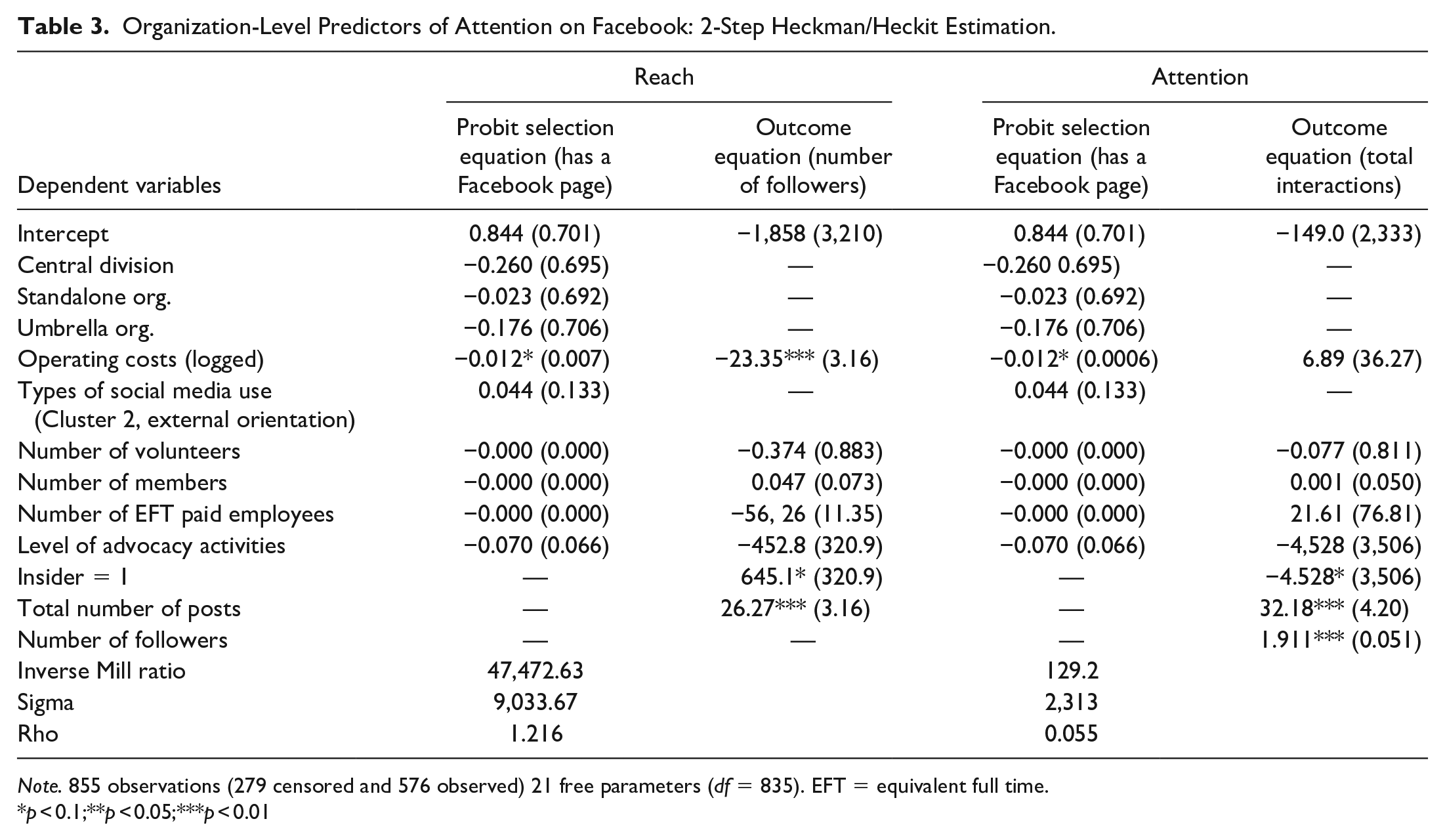
Note. 855 observations (279 censored and 576 observed) 21 free parameters (df = 835). EFT = equivalent full time.
p < 0.1;**p < 0.05;***p < 0.01
It appears that only the indicator of resources or “operating costs” had a slightly negative influence on the organization’s probability of adopting Facebook as a means of communication. In other words, it seems that the richest organizations did not need Facebook to communicate, either because they had their own communication platform or had access to mainstream media when they needed it.
If we look at the second part of the model, the linear regression, two variables had a significant influence on both the reach (number of followers) and level of attention (total interactions) obtained by an organization: number of posts and insider status. However, whereas insider status was positively related to the number of followers, it had a negative influence on total interactions (when controlling for the number of followers). In other words, the level of activity on Facebook, measured by the number of posts an organization posted on Facebook during the period, was a predictor of both the reach (number of followers) and attention (number of interactions) that the organization received. Being an insider (i.e., having regular access to political decision-makers) predicted a greater audience but entailed a lesser degree of attention.
Which Messages Get Attention?
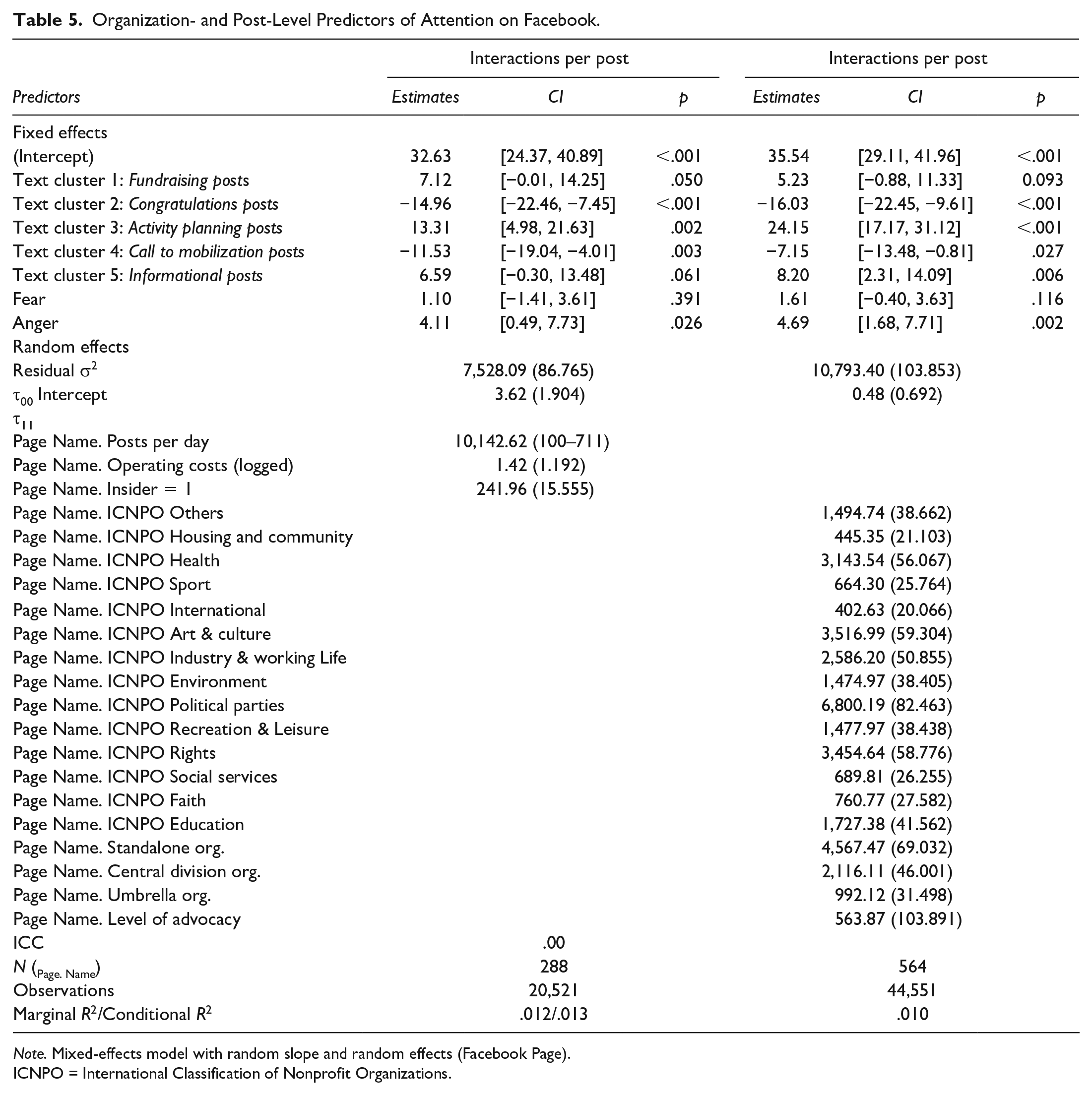
Tables 4 and 5 display the results of the analyses at the post level. Whereas the first model (Table 4) displays the estimates of the influence of posts’ features (type, emotions, topics) on the level of attention that a post gets (post interactions), taking into account that posts are nested in organizations (random slope model), the models presented in Table 5 include organizational features as predictors (random effects), estimating the influence of these features on the level of attention reached by a post. Posts related to fundraising (Cluster 1), congratulations (Cluster 2), and calls to mobilization (Cluster 4) had a negative impact on attention, whereas posts related to organizational activities (Cluster 3) and information (Cluster 5) had a positive influence on attention. Similarly, anger in posts had a significant effect on attention. These findings support H3 and H4, according to which informational posts and anger-laden posts are most likely to generate attention on Facebook.
Organization- and Post-Level Predictors of Attention on Facebook.
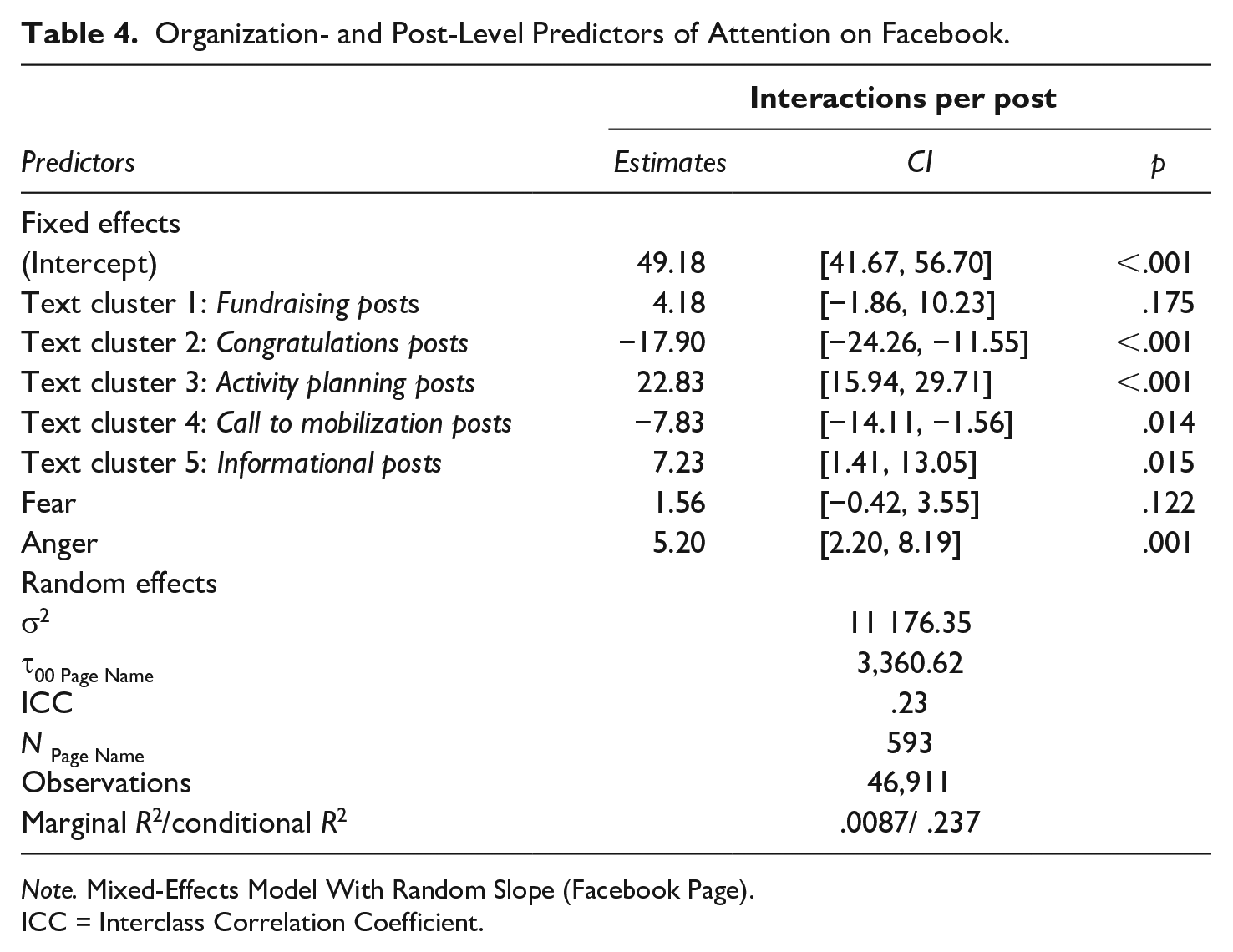
Note. Mixed-Effects Model With Random Slope (Facebook Page).
ICC = Interclass Correlation Coefficient.
Organization- and Post-Level Predictors of Attention on Facebook.
Note. Mixed-effects model with random slope and random effects (Facebook Page).
ICNPO = International Classification of Nonprofit Organizations.
When taking into account organizational features (Table 5), some categories of organizations (ICNPO categories)—art & culture, health, environment, and political parties—positively influenced the level of attention received by Facebook posts. Being a standalone organization (without local and regional chapters) also had a positive influence on attention. Being an organization with high operating costs, being an insider when it comes to contact with political decision-makers, having a high level of advocacy activities, or being active on Facebook (in terms of number of posts per day) were organizational and activity features positively associated with attention on Facebook.
Summing up the results, posts related to organizational activities (Cluster 3), posts posted by organizations within the fields of art & culture, health, environment, and political parties, and organizations with a high level of activity on Facebook, that are standalone national organizations, are engaged in advocacy, and are insiders in terms of their integration into the political system are more likely to receive attention in the form of interactions with their audience on Facebook.
Organizational Logics and Attention
According to H1, when the logic of influence predominates, insider and most resourceful organizations, will not seek attention, but influence, and consequently will generate less attention. Alternatively, when the logic of membership dominates, standalone organizations are expected to use social media as a substitute to hierarchical coordination and generate attention on social media (H2).
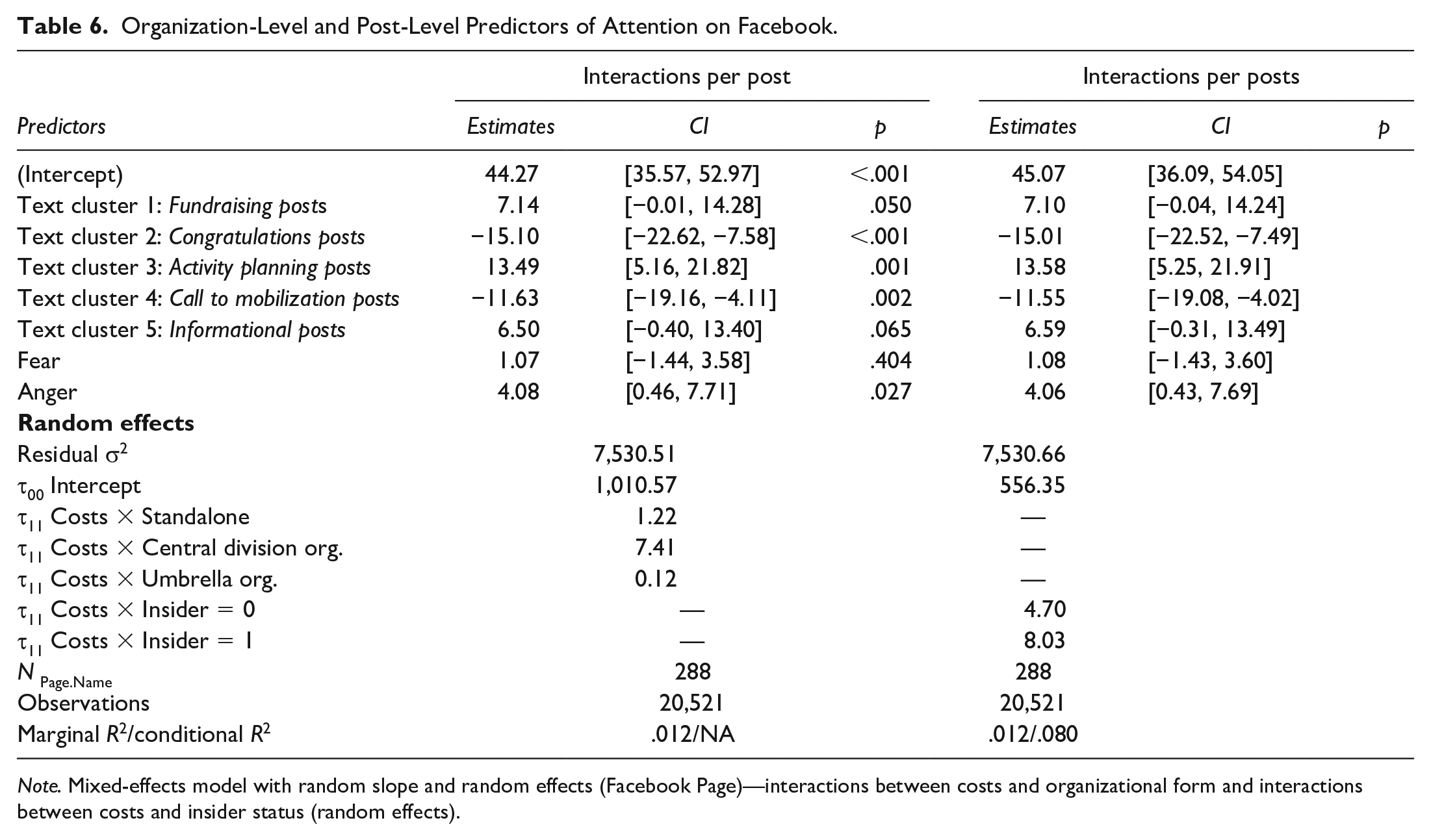
Looking at the interactions between the random effects of the variables capturing the main organizational features in Tables 6 and 7, shows, first, that combining high levels of resources (as measures in terms of operating costs) and being a central division organization or an insider increases attention. The correlation between high levels of resources, being a central division organization and having the insider status—characterizing the traditional neo-corporatist popular movement model—appears to be applicable to the new digital environment offered by social media platforms such as Facebook. In other words, social media do not seem to constitute a “weapon of the weak” for less resourceful organizations.
Organization-Level and Post-Level Predictors of Attention on Facebook.
Note. Mixed-effects model with random slope and random effects (Facebook Page)—interactions between costs and organizational form and interactions between costs and insider status (random effects).
Organization-Level and Post-Level Predictors of Attention on Facebook.
Note. Mixed-effects model with random slope and random effects (Facebook Page)—interactions between membership and insider status and membership and organizational form (random effects).
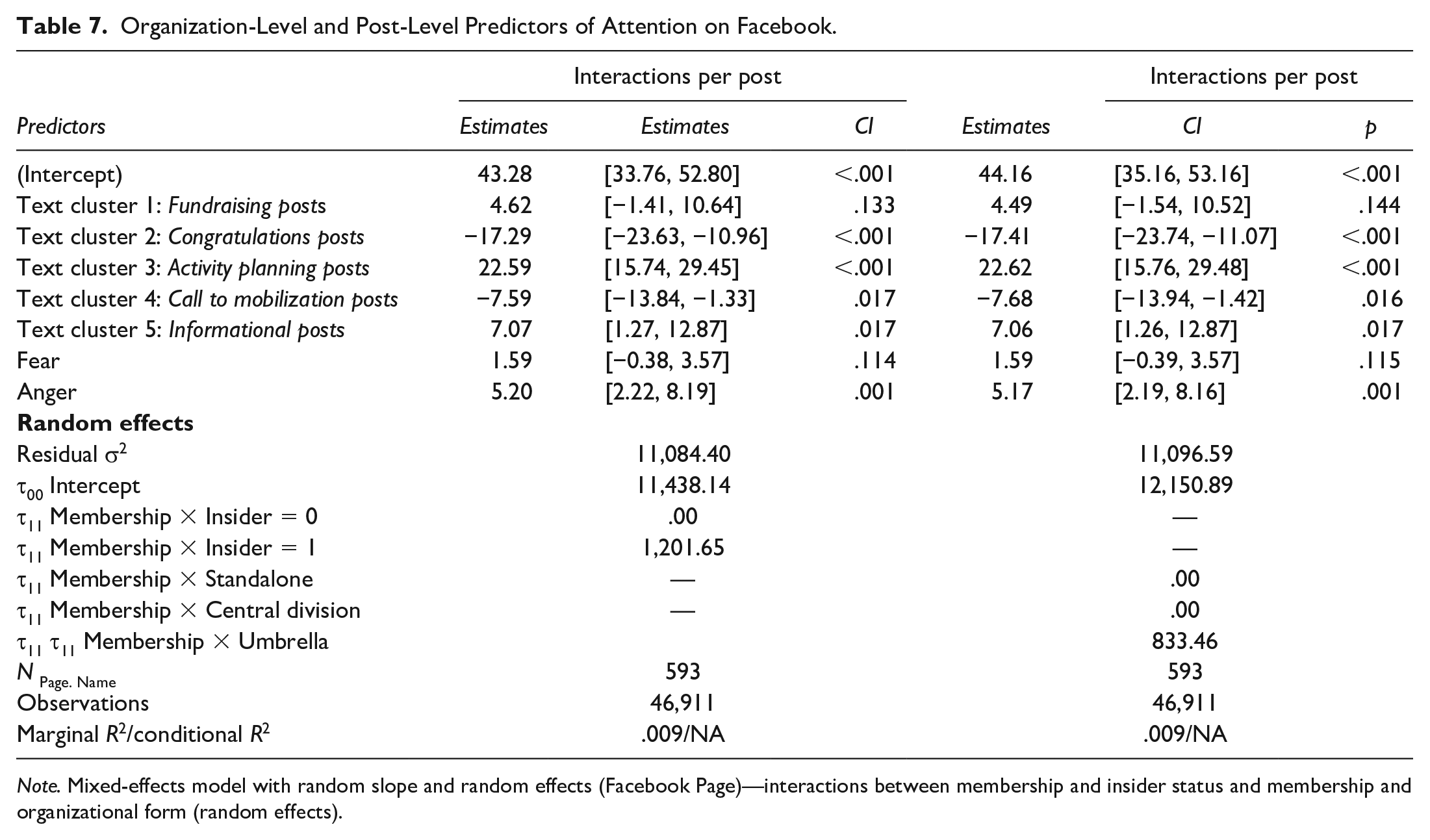
Second, the interactions between membership and insider status and membership and organizational forms (table 7) indicate that insiders and umbrella organizations who have many members are getting most attention on Facebook. In other words, if standalone organizations are getting more attention in social media (as shown by the analysis displayed in Table 5), it is not because of their membership. On the contrary, and in contrast to umbrella organizations, it seems that standalone mobilize supporters who are not their members.
In sum, H1 does not get support since the resourceful central division organizations that have an insider status still seek and get attention in social media. H2 is partially supported, inasmuch standalone organizations appear to use Facebook as an alternative to hierarchical coordination to mobilize support. However, these supports are not their members. More than a logic of influence and a logic of membership differentiating voluntary organizations use of Facebook, it seems that Norwegian voluntary organizations that get most attention on Facebook are either (a) traditional popular movements displaying a high level of correlation between high levels of membership and resources and insider status or (b) standalone organizations with a low level of membership mobilizing supporters in the public through social media.
Conclusion
Social media in general and Facebook in particular have changed the ways voluntary organizations communicate with their stakeholders. Linking survey data and digital traces has allowed us to get a better picture of the ways voluntary organizations mobilize the affordance of Facebook.
If one looks to the factors influencing the adoption of Facebook, it seems that the only discriminant factor explaining its non-adoption is the size of the organization, measured in terms of operating costs. If not all national organizations use Facebook, those that do not are not necessarily the poorest. Although several contributions on the adoption of social media by voluntary organizations (e.g., Maxwell & Carboni, 2016; Saxton & Guo, 2014; Saxton & Waters, 2014) have emphasized the organizational barriers to adoption, including lack of expertise and resources, inappropriateness for the target population, and internal institutional policies, our results reveal that, at least in the Norwegian context, most of these barriers, especially those related to resources and capacity, are no longer at work given the pervasiveness of Facebook.
Following Guo and Saxton (2020), this study has emphasized that, with the quasi-universal adoption of social media, the main challenge for voluntary organizations is no longer the issue of adoption of these means of communication but the issue of attention. Although a direct comparison of this study’s findings with those obtained by Guo and Saxton (2017, 2020) using Twitter data in the United States is not possible, the same factors (network characteristics, communication strategy, and message content) appear to be linked to audiences’ attention in similar ways in both studies. Yet, taking interactions with voluntary organizations’ Facebook posts as an indicator of attention reveals patterns of attention inequalities at both the organizational and post levels.
At the organizational level, the intensity of the organization’s activity on Facebook (measured by the number of posts posted) predicts both the audience reach of the organization and the overall level of attention. However, while the size of the audience (the number of followers) is positively associated with the insider status of the organization, the level of attention of the organization is negatively associated with its insider status when controlling for the size of the audience. This points toward a paradoxical effect of insider status: Being an insider is often the case for organizations that are well established, visible to the public, and enjoy a good public reputation, features that guarantee a large audience on Facebook.
Simultaneously, these well-established organizations are not necessarily those who have a communication that is engaging for their audiences, explaining that this status is negatively associated with the overall level of engagement at the organizational level. However, high levels of membership, resources, and insider status are still associated with higher level of attention on Facebook, indicating that the traditional popular movement organizations have made their transition into the digital sphere and get significant levels of attention on Facebook. This finding contradicts H1, stating that resourceful organizations with insider status, if they are oriented toward a logic of influence, will not necessarily pursue attention, but influence that is, use social media to network with decision-makers and opinion leaders to gaining influence on the agenda and the outcome of political decision-making processes.
Considering the combined effect of organizational features and message level features, it appears the messages that generate most attention are most likely to be emanating from standalone organizations, that is, organization that are not embedded in a geographically or functionally nested hierarchy of organizations as means to organizing and mobilizing their support base of members. However, standalone organizations do not appear to have large membership bases, and seek to mobilize supporters (not members) through networks of interaction that are facilitated by social media-enabled communication infrastructure such as Facebook Page. The national standalone organizations (without local and regional chapters) who are engaged in advocacy activities are more likely to post message generating high levels of attention and engagement on Facebook. This finding partially supports H2, according to which, standalone organizations are more likely to generate most attention on Facebook. However, their activity on Facebook, contrary to what was hypothesized, is not animated by a membership logic.
Digital networks enabled by social media platforms are powerful tools of coordination and exchange that offer a substitute for organizational hierarchy. Younger organizations do not necessarily need to replicate the popular movement organizational model, with its regional and local chapters, to mobilize a nationwide membership base. However, older organizations might adopt these new technologies to gain efficiency in interacting with their regional and local bases (Enjolras & Strømsnes, 2018). The findings reported in this article show that traditional popular movement organizations have adapted to the new digital environment by harnessing the affordances of social media even if the more recently created standalone organizations appear to profit most of this development in terms of attention (Enjolras & Strømsnes, 2018).
It seems, also, that social media and especially Facebook confer an advantage to this new organizational form (national standalone organization) inasmuch as Facebook provide powerful mobilization and coordination tools that can offer a substitute to hierarchy as instrument of mobilization and coordination. However, if the number of standalone organizations, using digital networks as a substitute to hierarchy for coordinating their support base, are growing within the population of national voluntary organizations, this does not necessarily entail the weakening of the “democratic infrastructure” constituted by the voluntary sector, inasmuch as the traditional popular movement organizations appear to be still influential, also online.
If social media may increasingly be a “weapon of the networked,” that is, a substitute for hierarchy for more recently created organizations, it is not a “weapon of the weak” (van der Graaf et al., 2015) insofar as those organizations that are succeeding in terms of reach and attention on social media are not the poorest. Indeed the correlation between membership base, resources and insider status perdures on social media. Digital platforms such as Facebook do not appear, so far, to have undermined the “democratic infrastructure” constituted by the voluntary sector, but may have contributed to an increasing dualization of the sector with, on one hand, organizations waging influence—including influence on policy-making and the digital public sphere—and maintaining an insider status on the basis of their membership-base and their resources, and on the other hand, organizations with a lesser membership-base that are harnessing digital technologies to mobilize supporters and to obtain influence on policy-making.
These findings are, however, subject to limitations. Most importantly, the study is limited to Facebook—one social media platform available to nonprofit and voluntary organizations among others such as Twitter, Instagram or TikTok—and does not investigate the possibility that nonprofit and voluntary organizations might selectively target different audiences by being present on several platforms with different communication strategies. Second, the identified relationships may be contingent on the Norwegian institutional context and organizational landscape. In addition, the measures (metrics) of attention are somewhat rudimentary and do not allow to sufficiently capture all the dimensions of strategical use of Facebook by voluntary organizations. Finally, the variables at the post level—measuring latent dimensions of the content such as types of posts or post sentiment—are constructed from the post content and depend upon the method used to construct these latent dimensions. As pointed by (Fong & Grimmer, 2021), the use of such methods bears the risk that unmeasured latent dimensions of the text (content) may affect the dependent variable (attention), leading to a specification error. Yet, the methodology developed in this contribution—linking survey data of organizations with Facebook data—is replicable in different national and institutional contexts. Further research will be needed, mobilizing alternative specifications of the content’s latent dimensions, to enrich our knowledge of voluntary organizations’ strategic use of social media and the ways they affect their activities.
Research Data
sj-docx-1-nvs-10.1177_08997640221129551 – Supplemental material for Determinants of Voluntary Organizations’ Attention on Facebook: The Case of Norwegian Voluntary Organizations
Supplemental material, sj-docx-1-nvs-10.1177_08997640221129551 for Determinants of Voluntary Organizations’ Attention on Facebook: The Case of Norwegian Voluntary Organizations by Bernard Enjolras in Nonprofit and Voluntary Sector Quarterly
Footnotes
Declaration of Conflicting Interests
The author declared no potential conflicts of interest with respect to the research, authorship, and/or publication of this article.
Funding
The author(s) disclosed receipt of the following financial support for the research, authorship, and/or publication of this article: This was support from the Norwegian Ministry of Culture.

Supplemental Material
Supplemental material for this article is available online.
Author Biography
References
Supplementary Material
Please find the following supplemental material available below.
For Open Access articles published under a Creative Commons License, all supplemental material carries the same license as the article it is associated with.
For non-Open Access articles published, all supplemental material carries a non-exclusive license, and permission requests for re-use of supplemental material or any part of supplemental material shall be sent directly to the copyright owner as specified in the copyright notice associated with the article.
