




Abstract
This paper takes the mycorrhizal as a metaphor for culture. It posits that we, you and I, and everyone else have deep roots in our cultures and that to engage environmental futures calls us to engage with this deeper level of being as part of what Donna Haraway calls ‘natural cultural histories’. This insight is explored through a series of fungal reflections in which ‘thinking as a body’ is central to destabilising the sense that we are individuals. Always our individuality is conditional and open, embedded as it is in cultural flows. The paper touches on some theoretical dimensions to this understanding and then turns to exploring how the author develops these understandings in his own work. To illustrate this fungal play and its pheromonal possibilities the paper is accompanied by illustrations from Cat McNicholl.
What follows is an exploration of thinking beyond my training as an academic. It is an essay in which I compost culture in order to generate spaces for new understandings. It is partly a poetic play, a metaphorical musing, a theoretical manifesto. Am I guilty of hubris in offering such an approach? Well, if I put my ego aside, composting it too, I stand as a fungal wayfinder, a spore on the currents of thought and culture. I embrace metaphor because it loosens the grip of language on the heart and mind. Sohail Inayatullah in his work with Causal Layered Analysis has repeatedly demonstrated the power of the metaphor in shaping futures consciousness (S. Inayatullah 2020). Many Futures colleagues have embraced this metaphorical calling in their work too, as collectively expressed in the CLA Readers that appear roughly each decade since 2004 (S. Inayatullah 2004; Inayatullah and Milojević 2015; S. Inayatullah, Mercer, Milojević, & Sweeney 2022).
Introduction
This special issue is a gathering. I am delighted to share this space with other wayfinders as we touch one another with our thoughts and insights, and aspirations too. Anna Tsing offers us a fungal insight in this regard, as she muses: “How does a gathering become a ‘happening,’ that is, greater than a sum of its parts? One answer is contamination. We are contaminated by our encounters; they change who we are as we make way for others. As contamination changes world-making projects, mutual worlds—and new directions—may emerge. Everyone carries a history of contamination; purity is not an option” (Tsing 2015, p. 27).
My essay ‘I am Mushroom’, is an exploration of contamination. Tsing (2015) follows the matsutake and its many relations around the planet. It becomes a metaphor for global capitalism and the ways in which it frames lives and relationships. In asserting ‘I am mushroom’ I am recognising contamination as root and shoot, as the inter-textual relationships we have as scholars, and as the ecological relationships we have as humans in nature. We need an ecological thinking to assist us here. It can be poetic, even aesthetic. It needs to build new culture whilst composting the old. In this Didier Debaise comes to our aid: “What is needed is a philosophy that, in its very form, its ambition and its manners of relating to things, can grant due importance to the deeply plural experience of nature. I will call this philosophy ‘speculative’ and will define it through its function: the intensification of an experience to its maximal point” (Debaise 2017, p. 77).
Experience speaks to the sensory, even, as David Abram (1996) argued long ago, the sensuous. I take this point seriously in the essay below. In it I address my work on anticipatory aesthetics and the futures senses (Bussey 2015a; 2017a; 2017b). Over the years this work has become my central preoccupation. Aesthetics speaks to order, structured meaning. It has deep philosophical roots. It is key to how our species makes sense of and navigates the world. Every culture is an aesthetic arrangement in which memory, order and anticipation work to support and enforce identity. I love this insight. It means that just as we are blessed with physical senses (sight, taste, touch, smell and hearing) we are also blessed with cultural senses (memory, foresight, voice, optimism and yearning) which – perhaps because of my context as a futurist and historian – I am calling ‘futures senses’.
This is all stated here to provide context for what follows. In this essay I follow the rhizomic networks of mycelial thought. Metaphor acts as guide, a ‘speculative’ tool in the sense making and storytelling I am engaged in. Images by Cat McNicholl are introduced to emphasise the interplay of aesthetics, imagination and perception. Ultimately, this is a thought experiment that lays out the degree to which my environmental futures work is deeply contaminated be many encounters, both with the written work of scholars, poets and activists and the living work of nature, Gaia, herself in all her creative, messy and intricate generative play.
Creative Academic Essay: Mushroom Musings
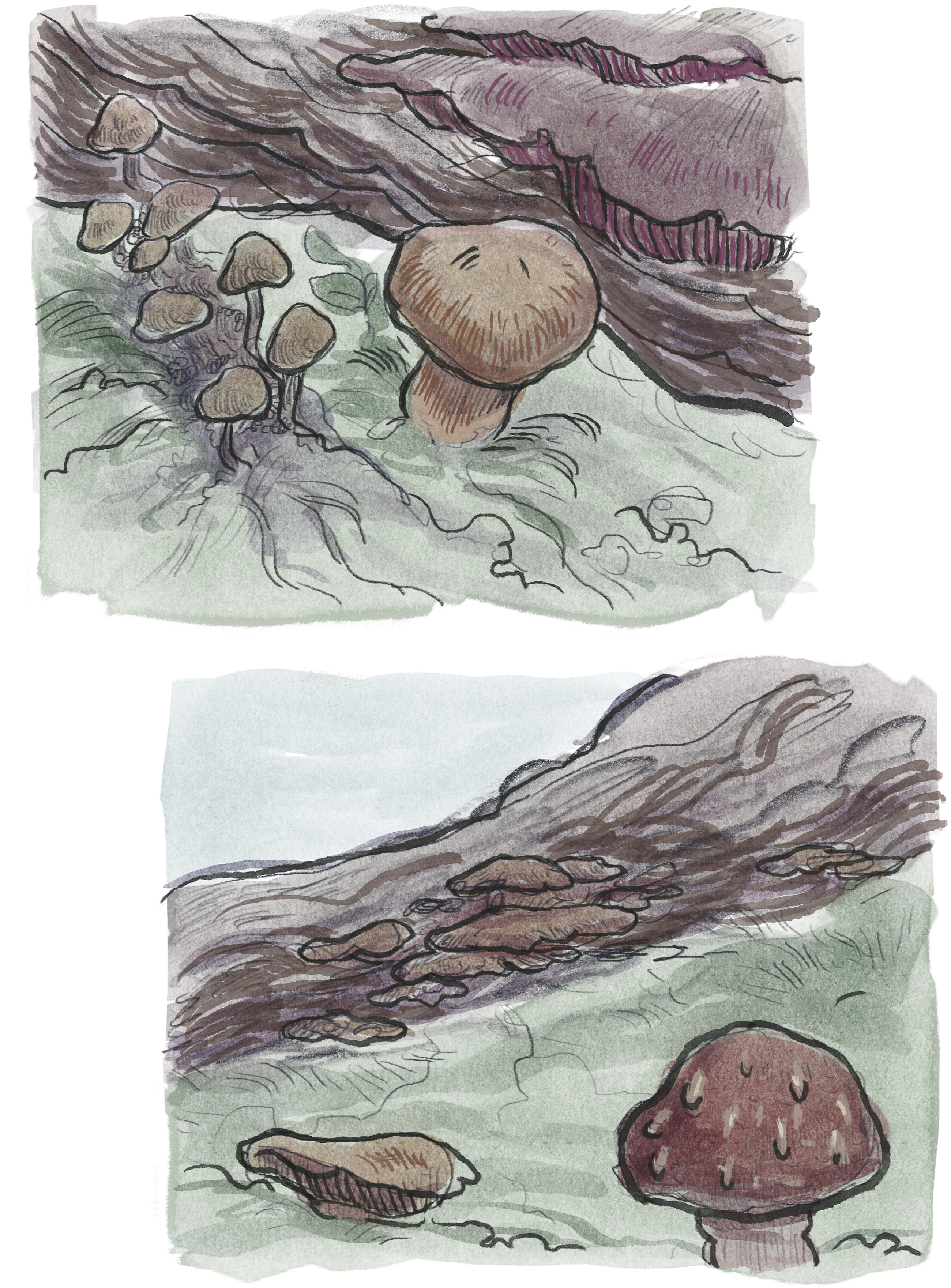
The head of the mushroom stood tall and proud. It had pushed its way up through the litter of leaves beneath a bunya pine. These ancient trees date back to the dinosaurs. Fungi go back, way back before them. I stoop and look with real admiration, and a touch of awe at this fungal explosion (Figure 1). The mushroom radiates living energy (Figure 2). Really! I always get excited when I encounter such enthusiastic outgrowths of the mycorrhizal substrata that sit beneath the visible extrusions of mushroom, toadstool and the countless colourful fungal forms that populate the subtropical forests where I am lucky enough to live. To be a futurist in such a living place is a gift. My Mushroom encounter. Mushroom exuberance.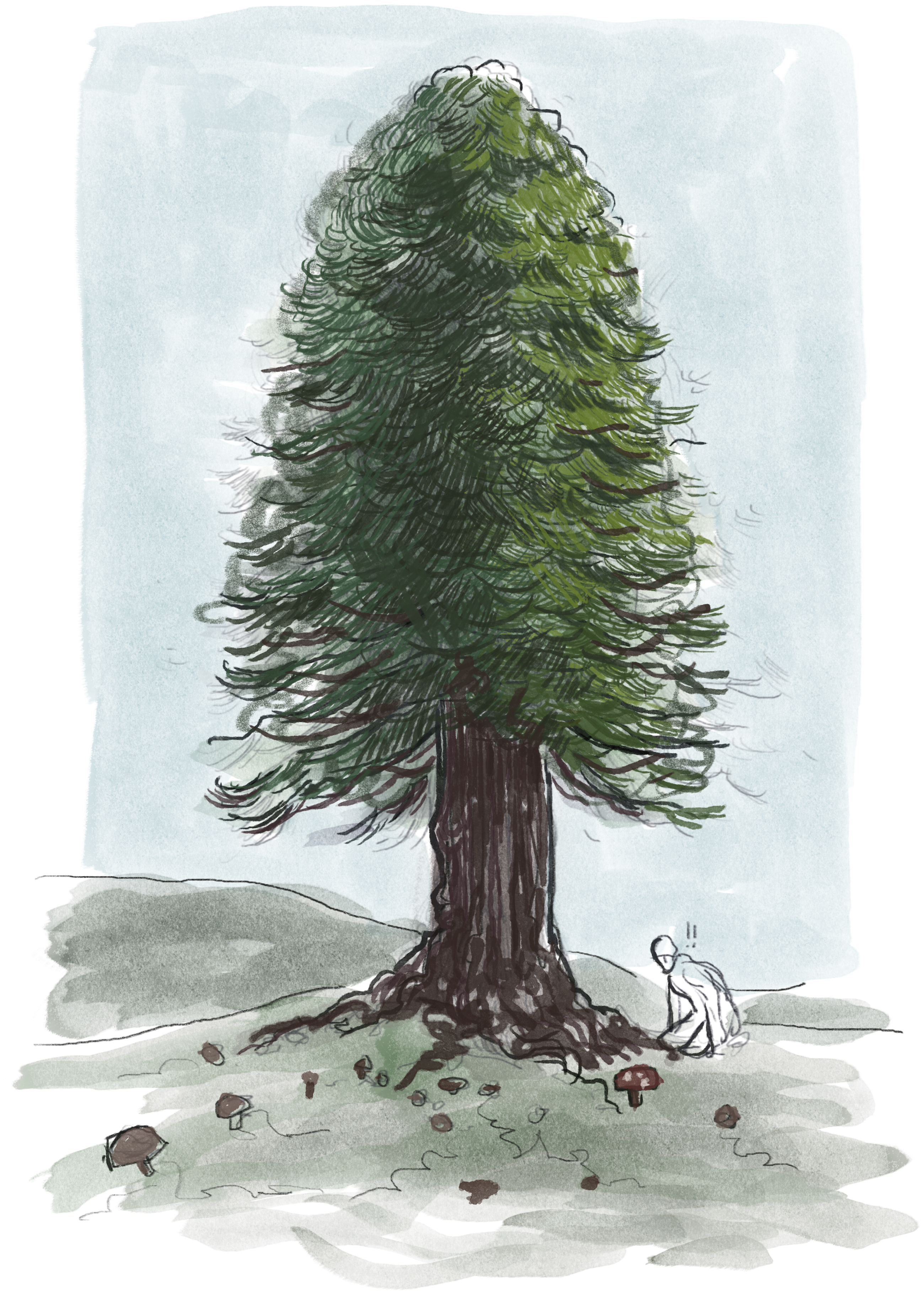
For all our splendid cultural expression as a species, nature will always have a response. A corollary. Deleuze and Guattari (1987) took the rhizome as a metaphor for the entangled nature of human culture. They did not separate the cultural from the natural but saw our work as a species as an extension of natural processes. Culture works in ways fungi would recognize. In fact, we are not so different from fungi. In this world the individual certainly matters but it is as collectivities that our true creative fungal nature emerges. As an individual I am mushroom. A single, objectively recognisable product of the cultural networks that have shaped the conditions of my being.
I am mushroom. We all are. Cultural outgrowths of the subterraneous cultural processes that enliven our world. The soulful ecologist Loren Eiseley saw this long ago when he described the human species as ‘spore bearers’ (1970, p. 76). He speaks to the fungal nature of human culture. He intuits something primal and deep about our own nature. A nature that is ‘natural’ and embedded in the same processes we see around us in the living world. My intuiting that ‘I am Mushroom’ then, is a response to his image of us being spore bearers. And given the luxury of time, the decades between Eiseley and ourselves (he died in 1977), we also have a growing surge in this awareness. Everywhere we look we can find thinkers and activists declaring, as Isabelle Fremeaux and Jay Jordan (2021) do, that ‘we are nature defending itself’. This shift in attention and broadening of language, still struggling to find a new grammar and lexicon, is where some of the most interesting and contested futures work lies.
Fungal Culture
It is tempting to think of the mycorrhizal as a metaphor but for me it is real. Culture functions mycorryzally. I am sure this is part of what James Lovelock was sensing when he offered us Gaia as a metaphor for a unitary planetary consciousness. Yet what are we to make of this as futurists thinking ecologically, holistically? First, we need to understand that not all knowing is empirical as commonly understood. I am okay with this (Bussey 2015b). Lovelock in his last book notes the following: “Gaia is not easy to explain because it is a concept that arises by intuition from internally held and mostly unconscious information. This is quite different from the concepts that arise directly from the stepwise logic preferred by scientists. Dynamic self-regulating systems wholly defy a logical explanation that uses step-by-step arguments. So I cannot give you a logical explanation of Gaia” (Lovelock and Appleyard 2020, p. 14)
He of course is referring to a specific kind of reductive logic. But fungi have a different kind of logic, and they offer clues to thinking, being and futuring differently. This leads me to the second point. Fungal human culture is deeply creative. Wherever it bursts forth it hybridizes, contaminates as Anna Tsing (2015) notes. For environmental futures to move from advocacy to transformation, from strategy to wayfaring, we need to lean into methods that tap the power of culture’s mycorrhizal depths. We need to hone different senses. To approach this deeper understanding of environmental futures calls forth an anticipatory aesthetic. One that moves our practice into that liminal space where culture seethes and churns beneath the surface of our domesticated order. Aesthetics of course implies order. It points towards the ‘good’. This intrinsic quality is something we humans have developed to an abstract level but neurologically the attraction to any ‘good’ is evolutionarily wired into us also (Bussey 2017a). My delight in finding mushrooms is not in my delight in eating them but quite simply ‘delight’, yet it is also rooted in my sensing that here is a mystery, a living mystery.
As a cultural phenomenon anticipatory aesthetics calls upon cultural senses, or what I call futures senses (Bussey 2017b; 2025b). These senses help us navigate our realities whilst also constituting these realities. They are what makes me ‘mushroom’, an extension of the mycorrhizal processes that lie behind my sense of self. Environmental futures calls us to open to such processes and develop the sense that we are ‘spore bearers’. As spore bearers we recognise that we are culturally co-creative. Ecologically embedded in the phenomenal world. We produce Futures. And like our fungi cousins we do so mimetically through our forms of communication, and chemically through our constant interactions with other humans and our more-than-human family. In this we can begin to attune to what Stacy Alaimo calls ‘the strange agencies of everyday things’ and begin to work with an appreciation that we are deeply ‘entangled with the very stuff of the world’ (Alaimo 2014 p 19; p.16).
Entanglement
One of the key questions for me as an environmental futurist is: What does it mean to be entangled? There are different ways to approach this question. The feminist posthumanist environmental thinking of Alaimo is one helpful way. In this she posits that we are “to think as a body – indeed as a body that is part of the substantial interchanges, flows, and substances of the co-extensive world” (Alaimo 2014 p.16-17). Another is via the exciting and poetic work of queer scholar Eva Hayward who seeks to understand what it means to be a ‘trans-speciated self’ where “‘we’ (as in you and me) are our selves specific parts of the world’s ongoing refiguring; ‘we’ are part of the world in its (and our) dynamic structuration, its (and our) differential becoming” (Hayward 2008, p. 67). This problem of differentiation is at the core of Western epistemology. As soon as we have object, we have subject; and we reify these in such a way that we become separate. Both Hayward and Alaimo, as posthumanists, are challenging this separation. It is suggestive of what Hayward calls a ‘critical enmeshment’ in which she is “pulled into the fleshy gerunds of what I write” (2008 p.65). The work of both theorists exemplifies the kind of strategies being developed by people working to free ourselves from the current disciplinary of language of epistemic culture. Both theorists are using language as a mode of exploring new ontological configurations in which we, you and I, and our enmeshed realities begin to morph into new and hopefully more open futures.
Hence being ‘entangled’ for me means opening to new possibilities of identity. It also involves both disorientation and reorientation. Part of my approach to this in Futures contexts is to bring the body in. To ‘think as a body’ is not rhetorical. For us to appreciate entanglement we need to explore our broader embodied natures through movement and play. My awe with mushrooms is because I feel something of the mystery and energy of their lifeways (See Figure 3). Of what being fungal means. Mystery.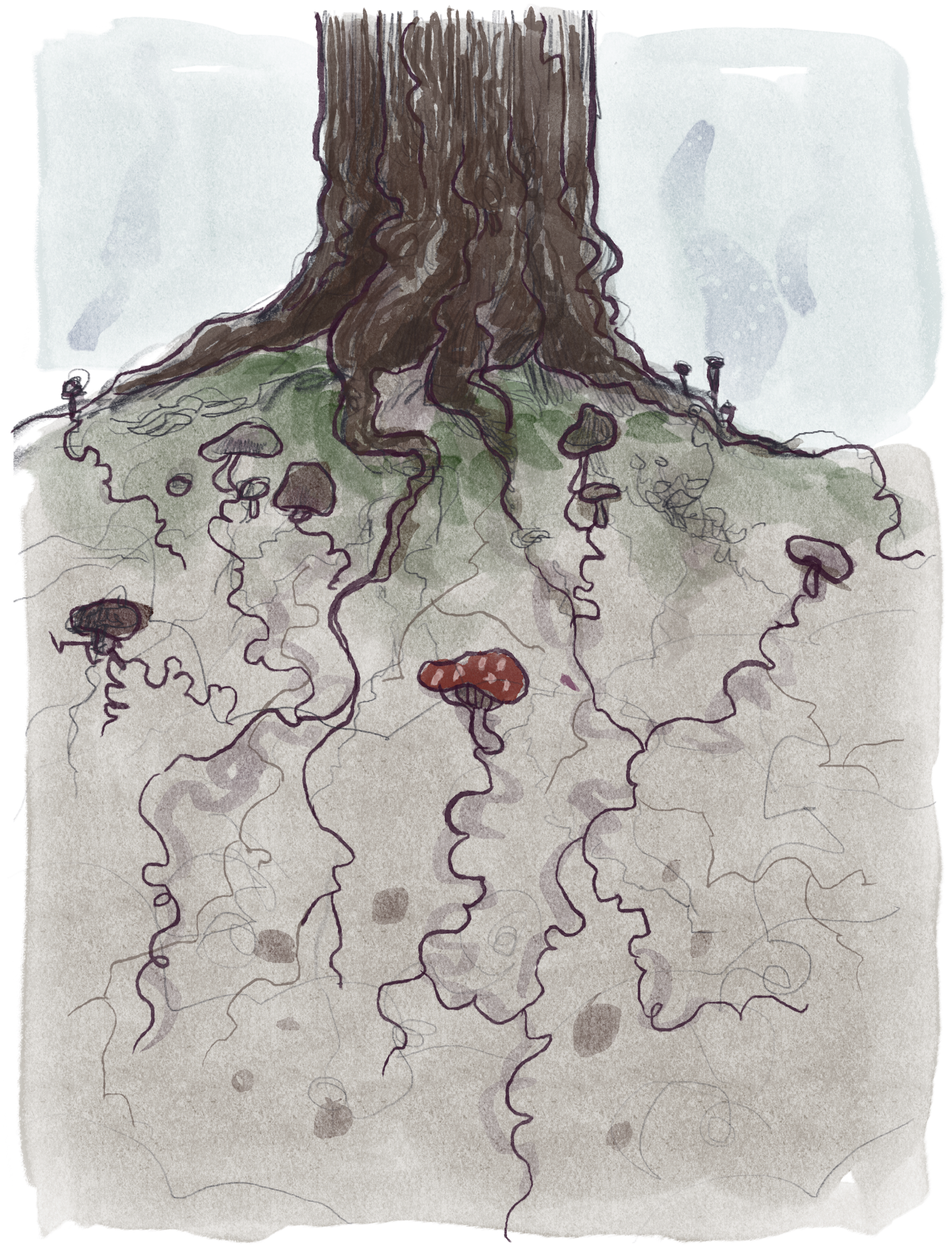
To probe this space, I turn to scientists who also have a feeling for such life forms. Merlin Sheldrake (2020) offers us insights into fungi in an accessible way in his book aptly titled Entangled Life. His exploration of the fungal world helps me follow Alaimo in imagining “what it is like to be a human imagining what it is like to be a thing” (Alaimo 2014, p. 15). This involves a kind of ‘sensuous knowledge’ (Salami 2020, p. 125). In doing so we are accessing a kind of soft knowledge that we generate when we immerse ourselves in Being in the Body. This is tapping into body wisdom, aligning us with want Donna Haraway calls “naturalcultural histories” (2016, p. 125), where we stand, breathe and yearn into the world of forms. This involves a different kind of understanding, one that is spiritual and rich in possibilities. The ‘I am mushroom’ understanding that unbalances, trans-forms, acting as a solvent of our precious boundaries that once freed us, but now constrain. Sheldrake speaks to this when he notes: “To talk about individuals made no sense any more. Biology – the study of living organisms – had transformed into ecology – the study of the relationships between living organisms” (2020, p. 19)
In this shift we find the colonial project of biology is breaking down and giving way to relational understandings. Here we find the ‘warm data’ of relational dynamics that Nora Bateson (2017) so vividly expresses. Here too, we find life messing with us, even challenging the separation between animate and inanimate. Intelligence becomes something distributed through systems. This is what Suzanne Simard (2021) uncovers in her work with trees. In this work, it makes no sense to speak of the individual tree. Tree, forest and everything that goes along with these life forms is entangled. Stefanie Fishel captures this insight beautifully: “The tree is a rhizomatic, symbiotic community living in relation to its forest and that forest is a rhizomatic, symbiotic community living in relation to other forests and the biosphere. A singular tree is also a global tree” (Italics in the original, 2023, p. 228).
Fishel’s work is deeply attuned to the microbial and the mycorrhizal. This is abundant space. Rich in creativity and provocative if we take time to listen. Sheldrake in his entanglement helps us listen by opening us to story. “‘We’ are ecosystems that span boundaries and transgress categories. Our selves emerge from a complex tangle of relationships only now becoming known” (2020, p. 20).
Fungal Possibilities
So, I am mushroom but so are you! Yet we remain very much unaware of this deeper reality, embedded as we are in a modern individualist episteme that discounts wholes in favour of parts. A key element in environmental futures for me then is tapping into the fungal possibilities of culture through embodied processes that promote awareness of our entanglements. I frame this through three related approaches: awareness, movement and calling which I expand upon below. Together they help me weave a fungal fugue which has long been a working metaphor for me going right back to my PhD days when I played with Deleuze and Guattari and the concepts of rhizome and planes of immanence (1987).
The fugue as a musical form offers structure amidst openness. It is deceptive because what we hear seems ‘right’ and yet the musical line could go off in any number of directions. So, rightness is relative to the listener. And one person’s fugue might be a total disorder to another listener. As an aesthetic, the fungal works like this too. Environmental futures work can probe this openness and order/disorder, Deleuze’s ‘chaosmos’ (1994, p. 208), as a form of wayfaring. This means we need tools that support this work without offering us an endpoint or terminus. For me this work begins with awareness.
Awareness
Many of our attempts to engage the planetary crisis we have triggered by being successful as a technological species have focused on fixing the problem. The diagnostic tools of science, technology, economics, policy and governance all miss the point. They are unaware of the deep cultural/fungal forces that shape consciousness. To be aware requires us to approach the fungal depths of consciousness through a range of futures senses. We need a new aesthetics. One that helps us in our wayfaring, offering us cartographic skills to map-make in a way that does not reify the world around us but opens it up to us in its richness and mystery. We have been given senses to do this. There are physical senses and there are futures senses. Our futures senses orient us to the futures before us and the pasts behind us. They help us locate ourselves in our present and our shared presents. These Futures Senses move us beyond palliative care for a dying present, they free us from the need to perform triage or CPR on our ailing civilisation. There are five Futures Senses I work with. The first is Memory. Memory is the data set from which we make meaning. The past is vast and dynamic. Each of us has a foot in it. Memory and imagination intertwine, feeding one another. The body is the interface. Indigenous scholar Debora Dank captures this sense beautifully: “A curious thing about the wind, and about reminiscence: they travel together, holding memories, making gifts of the vast pure past. As the wind runs, its fingers pick up something here and a little something else there. It plays with our ears and with our bear skin, lifting hairs and brushing against us. It holds those whispered but vivid hints of place and space and occasionally it drops a cue, a memory, and we remember” (2022, p. 8).
The body is a conditioned expression of memory as received via culture, a subset of all the fungal substrata that we stand upon. Again, I find I am mushroom. A unique expression of all possible remembered forms. Memory is what brings the past into the present and projects it into the future. Yet it all begins with our becoming aware of memory as both a physical and cultural asset.
Another Futures Sense is foresight. Foresight is an invitation to remember what is yet to be. The future leans into us sending messages that we perceive as ruins of the futures out there (Bussey 2025b). The roads taken and not taken both beckoning to us. All around us the visible and invisible mingle. Much we refuse to see as it is all too messy. Yet our yearning propels us forward. Setting habit aside, we begin to see emergence, becoming and possibility. We are not lost, and we have friends here. Causality runs both ways into our futures and into our pasts. We read it, we impose it, we respond to it too. There is no present that is not full of becoming, full of messages from the futures out there. Fungal temporality plays with us. A snowflake lands on my cheek, on a frozen pool and on my great-great grandchild’s cheek too. The same snowflake (Figure 4)? How can that be? Our perception softens, allowing in that which is yet to be. Entangled as we are, there is scope to dance and allow and also trust. Snowflake past/present/future.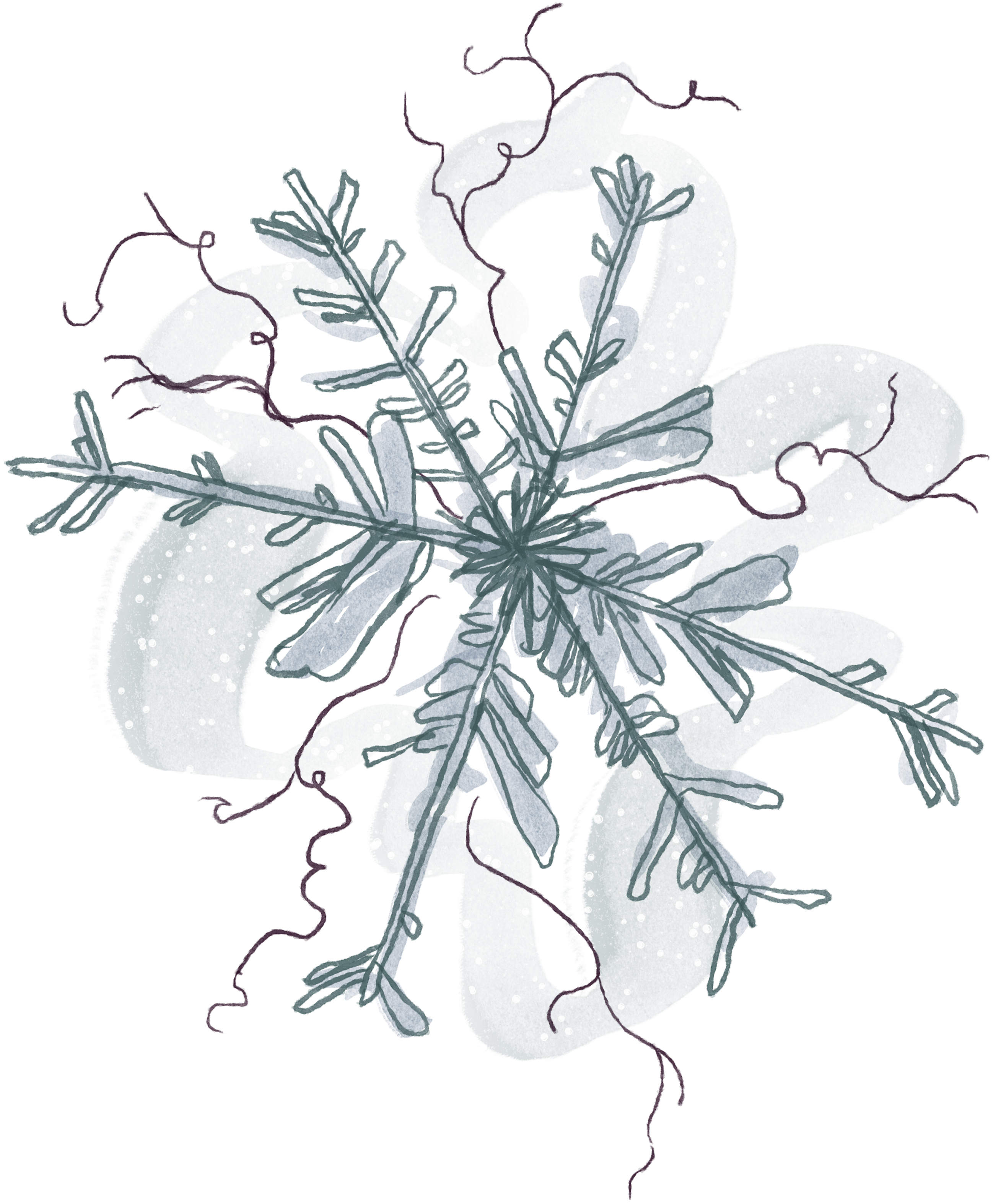
Becoming aware of how memory and foresight function to construct meaning, and frame what is possible in the present requires us to recalibrate our senses. A third sense is called forth. The Futures Sense of Voice. As mushroom, Voice becomes choice, discernment, a dawning awareness of our own agency. The ability to act grounded in the fungal networks of culture and informed by both memory and foresight. Voice is culture as each of us expresses it (Das 1995). It is what generates the fungal fugue. Futures work is about enabling each one of us to recognise and operationalise Voice. It involves becoming aware of the power of memory and foresight in shaping the narrative possibilities of Voice, and Voice itself is how we express our own fungal potential. Voice is always the voice of the collective run through our own individual expression. This is confusing and confronting. Yet it can also be comforting. We are not alone. We become together, and in this co-creative act new stories emerge.
Successful futures work empowers Voice. And when Voice is empowered Optimism arises. Optimism is a key Futures Sense as it provides the energy needed to find our way out of the cage of the conditioned present. I think of Optimism as soul food. It allows me to shift focus and direct my wayfaring towards preferred futures. This is the sense that needs nurturing. It calls for a reframe of Memory, Foresight and Voice and it calls in mutuality. This is not a demand but a reciprocal calling. This is personal and deep. My entangled Voice, responds to calls from the future. As an ancestor of these voices and calls, I am all ears. Listening beyond my finitude I hear murmurations of things to come. My heart swells as I call back “I am here! I love you!” What else is there to say? Perhaps: “I am coming”? I am never sure if this is something only I see. But I feel it and I see it in workshops all the time. So I am optimistic and I nurture optimism as a collective Futures Sense. Our species is Optimistic even though we are told over and over again, it is foolish to be so. Environmental Futures work is challenging. Yet when we grow our awareness of optimism it becomes easier for us to envisage and construct preferred futures together and sustain them as individuals.
The final Futures Sense is Yearning. All human beings yearn for things. Of course, these are often material or emotional. I want a better car or a loving partner. But when we get these things we continue to yearn. Yearning draws us into life. It has both individual and collective forms. At the individual level it can be expressed as ambition. It can also be deeply spiritual. A longing for things well beyond us and often hard to articulate. At a collective level it leads to increasingly large and complex expressions of culture such as pyramid building and empire, and of course religion. For me Yearning is key to futures work… unleashing its power, honing it as an essential Futures Sense. Yearning is like the electrical and chemical signalling that fungal forms express (see Sheldrake 2020, p. 66ff). My mushroom self Yearns and releases pheromonal signals that tap into collective Yearnings. To explicitly work with this sense brings environmental futures work into focus and enables me to sharpen the other senses. It enables the posthumanist project by supplying the needed energy to break free from the epistemological gravity that holds us stuck is unyielding structures that no longer serve the collective project of transformation. In my work, this is a Neohumanist calling (Bussey 2025c), to become newly human through a mycorrhizal understanding of self and other. This is ultimately spiritual. Spirituality is of course taboo in the current academic world but, sometimes we have to speak it as we see and feel it.
This sensuous and sensory reading of Futures work needs to be grounded in bodily work which brings me to the second approach I take in running futures workshops.
Movement
It is easy to get lost in our heads. Much of our speculative and imaginative work is corralled by language and domesticated by a lifetime of disciplining the body to be submissive to the mind and to social systems. Education and industrial work both condition us in this way. I use movement and play to challenge this conditioning. The results are always remarkable. Some years ago I co-edited a book with Camila Mozzini-Alister on Phenomenologies of Grace (2020). In this we explored how people use movement as a tool in workshop settings to release creative energy and liberate the imagination from its conditioned safety net. The dominant form covered in this text was Interplay 1 which I am personally invested in. However, we also touched on yoga, authentic movement, music and Jose Ramos’ mutant futures (Ramos 2013, 2020).
In this text we used the term ‘grace’ to indicate the rupture in normal conditioned responses to the world around us. The Futures Senses are enlivened by movement and opened to ‘grace’. In 2023 I joined a weeklong workshop held in Lisbon, Portugal. The focus of the week was ‘Urban Imaginaries’
2
. I led an embodied session at the beginning of each day in the Botanical Gardens under a large fig tree. This involved movement, improvision and play (Bussey 2025a). The tools I used were drawn from the InterPlay process. The co-creator of InterPlay is Cynthia Winton-Henry. She makes this point: “In a world that has nearly lost the birthright of dance, my gift for it seems unexplainable and random, especially as I age. Yet, as I research art, dance history, theology, social justice, leadership, education, and spirituality across contexts, I’ve discovered the kinaesthetic, spiritual intelligence that belongs to all people, all ages, all of the time” (2020, p. 348).
The power of movement is remarkable. Through it we, as a collective, tap into what Sophie Stroud terms ‘the mycelial rot-scape’ of culture which for her is mythic in nature (Stroud 2022, p. 156). Through embodied practices we find new energy and an affirmation of much that being mushroom is all about. Movement, as Winton-Henry affirms, puts us in touch with ‘the kinaesthetic, spiritual intelligence’ that we all share. Movement is life. Stroud points this out noting that the moon is always moving, or ‘Mooning’ (2022, p.31-32). It is a fleshly gerund, as Hayward would put it (2008, p.65). Again, movement is life. We find it in the human and the more-than-human worlds we inhabit as it is an expression of the fungal intelligence that informs culture. Movement awakens us to this by activating the dopamine and other joyous chemicals that our bodies contain. The lights come on and we come alive. Then the real work can begin. This brings us to the third approach I deploy in exploring our fungal futures.
Calling
Time calls to us (Bussey 2017c; Bussey and Humble 2024). The future also calls to us. In our mycorrhizal world everything is alive. From this perspective we can understand ‘calling’ as pheromonal. Pheromones are communicative chemical messages. When we dance, move, play we are not just releasing hormones in our bodies we are also producing collective expressions as pheromones. But beyond that, we can understand the fungal world of culture as also producing pheromones. These can attract but also repel. I argue that environmental futures work involves ‘futures pheromones’ (Figure 5) (Bussey 2025c). Working with a group of people, taking them through an exploration of the animacy of their Futures Senses and engaging in embodied exercises are steps to sensitising us to these futures pheromones. These pheromones move across time and space. If we step out of our Western frame into the world of Tantra, they can be understood as what Prabhat Rainjan Sarkar called microvita (Bussey 2011; Sarkar 1991). They reach into our psyches and communicate future possibilities. They have an anticipatory function alerting us to both danger and possibility. Workshops involving movement, such as the workshop on Urban Imaginaries, generate powerful amounts of futures pheromones. After each session we were all literally drunk. They produced a high, but what is important is to take the high and turn it into powerful action. The best futures workshops do this. Futures Pheromones in flow.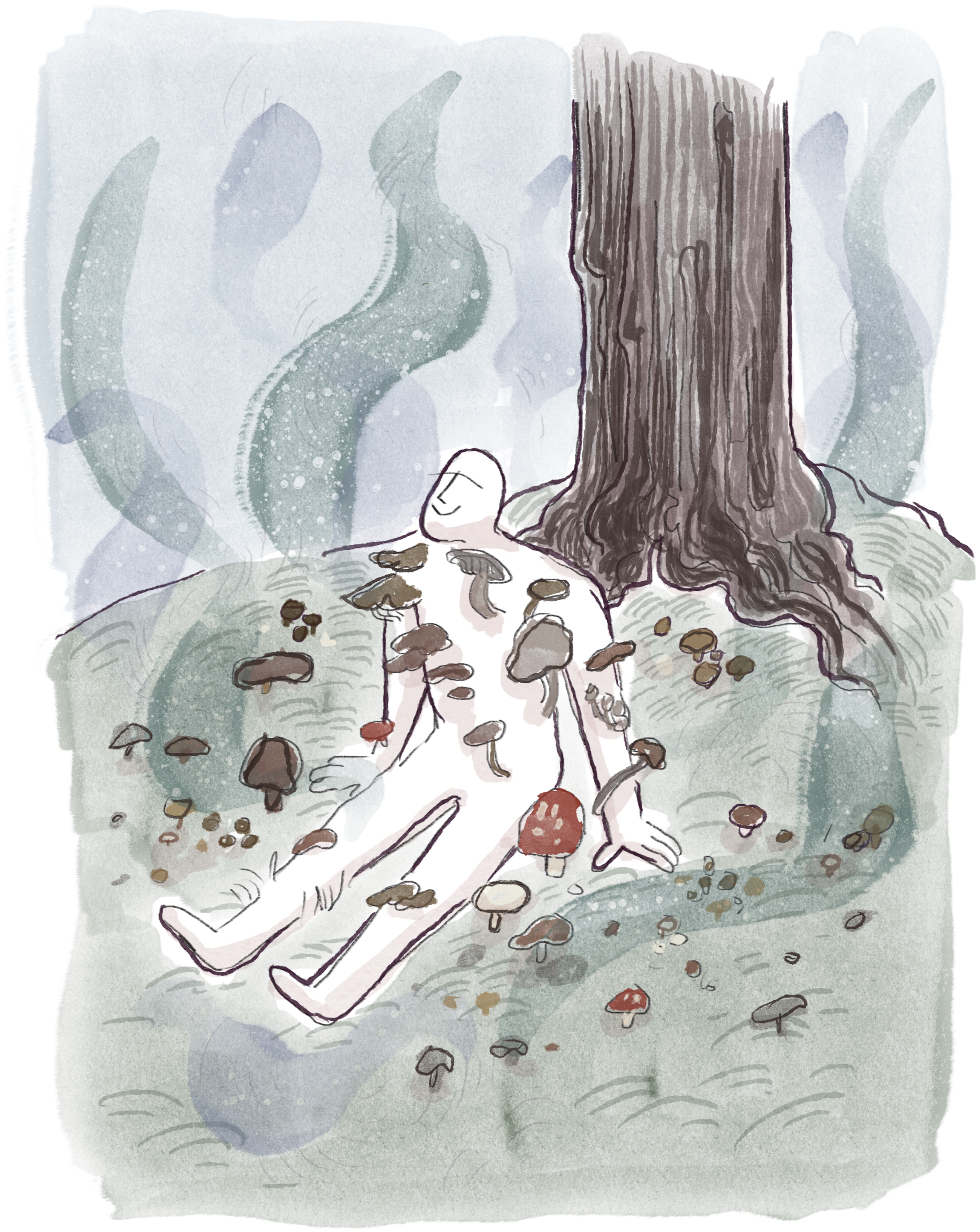
I do this using the futures senses and movement, but it can be done through any number of means. In a recent workshop run by Ivana Milojević, Sohail Inayatullah and Ora-orn Poocharoen in Thailand the Futures Triangle was key in exploring and releasing futures pheromones. Here the practical and the pragmatic rub shoulders with the visionary. As the authors note: “The futures triangle introduces a level of realism into the process by examining the context in which change occurs. It enables researchers and activists to map the forces in play, offering a better understanding of what requires alteration – whether it is challenging the weight, enhancing, or clarifying the vision, or linking the vision to the pushes, the drivers of change” (Milojević et al., 2024).
The Futures Senses are operationalised via the Futures Triangle. Furthermore, the Futures Triangle is a highly flexible tool as are most futures tools. I have used it with movement as a way to ground participant’s understanding of the constructedness of the present. In this setting participants work in teams to voice the ‘weight of the past’, the ‘push of the present’ and the ‘pull of the future’. They literally speak on behalf of their temporal coordinate and then collectively witness and engage with what emerges. There is an element of surprise here, but also of collective emergence.
Finally, it is worth returning to the aesthetic dimension of the mycorrhizal. I recently co-edited a special of this journal (WFR) with Emily Jaworski. In this we were interested in the possibilities offered through an Arts:Futures Encounter (Bussey and Jaworski 2024). This special issue showcases a wide range of aesthetic approaches that extend futures thinking. There are articles using images including a visual short story with images by my visual collaborator in this paper, Cat McNicholl (Heiner-Wright and McNicholl 2024). There is also poetry, prose and philosophical reflections on art itself and on the role of aesthetics in genetic selection. Of note is a poetic reflection by Riika Armanto in which she asserts “I move to think” (Armanto and Armanto 2024). Another contributor, Celeste Nazeli Snowber also ‘moves to think’ and she documents this thinking through photography and spoken word (Snowber, 2024). This special issue exudes futures pheromones in which the fungal power of culture sends forth its spores to the world in the form of a co-creative gifting.
Being Mushroom
When I find a mushroom or fungal explosion in my garden I fall into another world of wonder and possibility. I entertain fungal fantasies that challenge my encultured sense of separation from the world around me. My journey back into this othered-world has involved a range of disruptions and epiphanies. Life is like this. I share the sense that Snowber expresses here: “I am grounded and regrounded in the shapes of the sky, the colours in the garden, the improvisational nature of birds, or the taste of tangerine. I am a bird on the earth, a creature meant to be in the sky, but love the land. I have been invited to create within and with the more-than-human-world; this is my response to being human. Call and response. Response and call. Here is the heart of reciprocity” (2022, p. 6).
To be mushroom is to be open and begin the return to a more embedded holistic understanding of environmental futures work. It shifts the focus of such work onto wayfaring in which we both generate and respond to the pheromonal processes of culture. This work for me is guided by the Futures Senses and is embodied in movements that generate a wave of pheromonal possibility. The range of voices at work in this space is deeply encouraging. I touched only the tip of an iceberg in the brief dip into the theoretical dimension of my fungal thinking. This is indeed a co-creative and emergent futures space in which together we weave a fungal fugue (Figure 6). It is open ended and I for one do not wish to foreclose on this journey. We have much to learn both individually and as a species. A fungal fugue.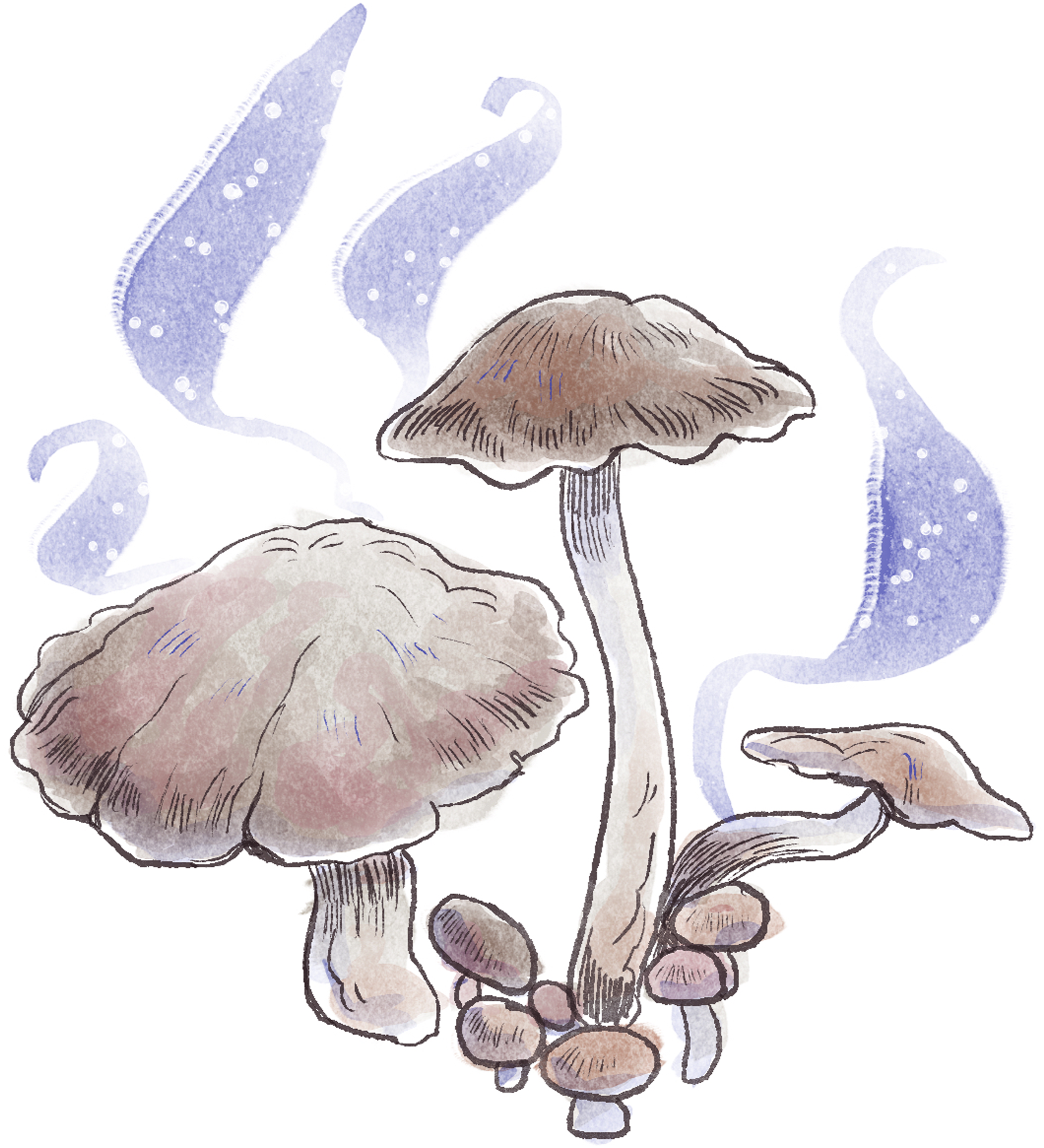
Conclusion
This paper has been an aesthetic experiment in which I work with both the reality and the metaphor of the mushroom. Illustrations by Cat McNicholl bring vibrant life to the musings. My anticipatory aesthetic approach has emerged over many decades of teaching, workshopping and meandering in nature. As an academic I have encountered many thinkers, activists and dreamers who encourage me through their own meanderings and musings. I find in such works, some cited in this paper, vision and inspiration, and a sense of community. This special issue is another cause for celebration in community. The fungal fugue goes on. The dominance of late modernity is waning, despite the immense force it is exerting on the planet to conform to an anorexic and instrumental worldview. There is magic in the air, and it is calling us to celebrate our fungal selves in our refusal to be governed by the logics of technocratic culture.
Footnotes
Declaration of Conflicting Interests
The authors declared no potential conflicts of interest with respect to the research, authorship, and/or publication of this article.
Funding
The authors received no financial support for the research, authorship, and/or publication of this article.
