



Abstract
This Futures focussed paper shares my creative response to a reflexive ricochet of being researcher, to unexpectedly becoming the researched and back again. I am currently using phenomenologically art-led and heuristic research methods to explore the implications of the Futures Senses in tertiary career education. The field of career theory is holistic and multidisciplinary. It draws from psychological, sociological and cultural fields to contextualise human action across the lifespan. Therefore, I work with people in transition and anticipation. This paper emerged from my immersion in the Futures Sense of Yearning and the moment I recognised the futures sense of Yearning in myself. This unexpected epiphany initiated a reflexive response as spectator of, and traveller on, my own transitional and anticipatory experience which was hovering in the spaces between the inner and outer self. Using a Jungian spontaneous drawing technique I set to give voice to what Jung noted as the ‘… two worlds: the world of the external perception and the world of the perception of the unconscious…’. This process revealed latent embodied knowing that surfaced through dialogue with the artwork. The layered emergent data of the artwork is analysed using a Causal Layered Analysis (CLA). The CLA invites diverse and layered perspectives of the subject of inquiry by examining it from the perspectives of litany, systems, worldviews and metaphor. Inayatullah uses an iceberg analogy, to illustrate the layers of an inquiry that are simultaneously exposed and discrete; known, unknown and ‘re-known’. Thus, a CLA of self is used, to reveal the ‘iceburg in the room’, with intention to explicate the meaning of the personal, as it relates to the collective.
Introduction
My current PhD research involves the integration of a heuristic approach to the subject matter of the Futures Senses (Bussey 2014, 2016, 2017), using a phenomenologically, art-led methodology (Rubin 2001). I am interested in the presence of an innate anticipatory aesthetic that holds us in relationship with Futures and dances in the intersubjective space. There are five futures senses that Bussey has conceptualised and introduced: Yearning, Voice, Optimism, Foresight and Memory (Bussey 2014, 2016, 2017). This paper explicitly focuses on the futures sense of Yearning, aware that the other four senses are active in the wings.
Heuristic inquiry is a holistic methodology to researching human experience (Sultan 2019). It involves the phases of, engagement, immersion, incubation, illumination, explication and synthesis (Moustakas 1994, 2001, 2011a, 2011b; Douglass and Moustakas 1985; Sultan 2019). Heuristic research is unique in its tolerance of the uncertain and is ‘a creative approach that honours the power of imagination while challenging the very concept of absolute certainty’ (Sultan 2019, 80).
Following the heuristic research method. I was engaged in the futures sense of Yearning in the context of my teaching, when I was tapped on the shoulder and the engagement pivoted, placing a mirror to my own living experience of Yearning. The immersion phase requires being open to a place of not knowing and ensuing emergent data (Sultan 2019). The Illumination phase, which involves self-exploration, discovery and deeper knowledge and understanding (Douglass and Moustakas 1985; Moustakas 1994, 2001, 2011a, 2011b) is communicated multidimensionally in this paper, with art process and product, and artefacts throughout. The deep exploration phase of Explication is assisted by a Causal Layered Analysis (CLA), as the futures tool for bridging the gaps where the latent data that sits in the ‘in between’ can be analysed (Inayatullah 2007, 2008, 2009; Inayatullah et al. 2022). Inayatullah (2009) uses an iceberg analogy to illustrate the layers of the Causal Layered Analysis (CLA), as what is most obvious (litany), is only a tenth of its overall capacity. This paper reveals the iceberg in the room through immersion and creative synthesis.
This article invites you into this saturated moment whose content and layers performed as a shape shifting murmuration of knowing, being and becoming. In this threshold moment I became conscious of the ricochet effect immersion in the futures sense of Yearning was having on me. A reflexive event where tension between inner and outer experiences morph into a kinetic momentum that words could not frame. Artmaking releases the ‘creative restlessness’ (Bussey 2017) of the transition and transformation taking place and becomes the interlocutor to converse with the internal. Such liminal moments cannot be described in a linear format, as understanding comes from the spaces in between. Far from empty or negative, these spaces hold the relational forces that connect and move elements of a system (Yunkaporta 2019).
A non-linear approach to structuring this paper is used to explore patterns of relatedness, outside linear time (Yunkaporta 2019). Therefore, the paper ‘…starts at a point, deviates purposefully, returns to the original storyline and culminates in a purpose’ (Purcell 2023). Signposting this non-linear deviation are truncated versions of the ‘essential elements’ of heuristic enquiry (Sultan 2019) which mirror the features of Futures thinking. These headings are used as structural landmarks throughout the paper: 1. Curiosity and openness 2. Respect for the researcher 3. Attention to process and content 4. Responsive to meaning making 5. Emphasis on richness of personal experience 6. Comfort with ambiguity 7. Non-attachment to the outcomes
Curiosity
Artefact
‘…yearning is futures focused and can be considered a futures sense …it is what drives us all ‘forward’, on to the next horizon. It takes the form of a creative restlessness of spirit’ (Bussey 2023, 6).
As an educator, I work with people in transition. People who have engaged in university studies intent on pursuing conceptual futured selves (Pinar 1975). Internalised, anticipatory images of self are constructed and realised through a plethora of psycho-social-affective-cultural and pragmatic information, often accompanied by perceptions of linear career trajectories, informing personal and collective identities about living, working, and acting in the world.
Future selves occupy a space of anticipation. Thus, the ‘What if?’ of my current PhD research is, what if, our embodied anticipatory aesthetic that underpins our relationship with futures, is offered a seat at the career education table too? I wonder if the Futures Senses play a part in the intersubjective relational spaces that compliment dominant and restrictive narratives of career education. My construct of career is synonymous with currere, from their etymological roots of motion, ways of being, knowing and acting, and lived experience that integrates past, present, futures and pilgrimage (Pinar 1975). I live in my research inquiry with an eye on world events and knowing that the personal has meaning collectively.
Respect
Artefact
The excerpt of the song in Figure 1 calls to action a reconfiguration of self. Whilst engaged in Immersion of the futures sense of Yearning, the ‘iceberg in the room’ floated to the surface in a web of cognitions, emotions and sensorial information, underpinned by grief and the newly acquired identity of adult orphan from the recent death of my mother. When my mother died, familiar identities estranged. The ‘skin’ I occupied was formed by responsibility to parents and my role as daughter. This/these identity/ies emerged and submerged, reforming, shifting and prompting a renegotiation of self, and the actions of that self, in an existence bereft of familiar relationship patterns (Gergen 1991). Lyrics from the song ‘Set Me on Fire'. Writers Daniel Dodd Wilson, Butterfly Giselle Boucher, Melissa Morrison Higgins 2012.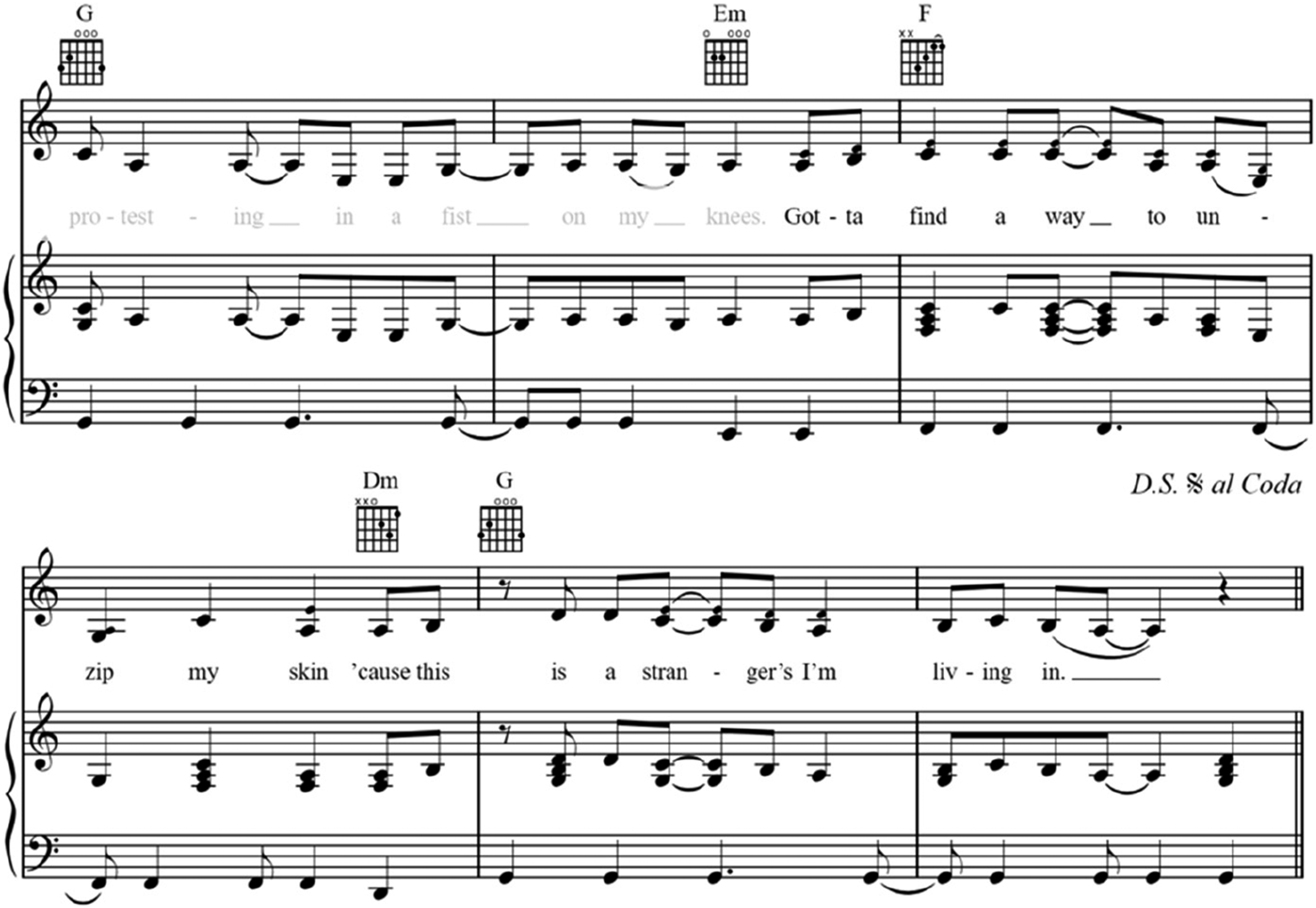
This life transition impacted on my work life which seemed soulless as grief used its clarifying lens to evaluate identity, meaning, purpose, belonging and who do you answer to when those who see you are no longer there? (Marshall 2004). A career crisis, not a crisis of employment, because career is a holistic term and so this crisis disrupted my status quo. A number of interlinked threads of change, formed a shape of desire to redesign and re-evaluation my actions in the world as meaningful ones. An attempt to understand the place of self in ‘the inter-collective’ (Jung 2009, 47).
A moment of opportunity and risk is presented by making sense of this human experience publicly (Sultan 2019). However, the heuristic researcher is confident that the personal has meaning collectively and so there is an innate responsibility to study this living experience, that is interrelated, interconnected and continuing experience (Pinar 1975). It is a quest that is driven aesthetically as the learning becomes a process of meeting I (Greene 1993). I see Thou (Buber 1970), in the mirror. This is learning, and it is effortful. There is tension, avoidance, and curiosity, a sense of being held over a flame.
Ambiguity
Artefact
Liminal space holds a state of flux (Figure 2), the sensing of possibility, at the limits of reach. It is a sensorial relationship with the future (Bussey 2014) and presents as embodied knowing that has not yet been sterilised by the pre-frontal cortex There is a tension, a Yearning that expands ‘human consciousness, liberating it from conditioned reality, escaping the trap of ‘culture’ – as a human artifice that separates us from nature’ (Bussey 2023 6). Photomontage by author of collected images and text (Untracht 1968) and original text by author.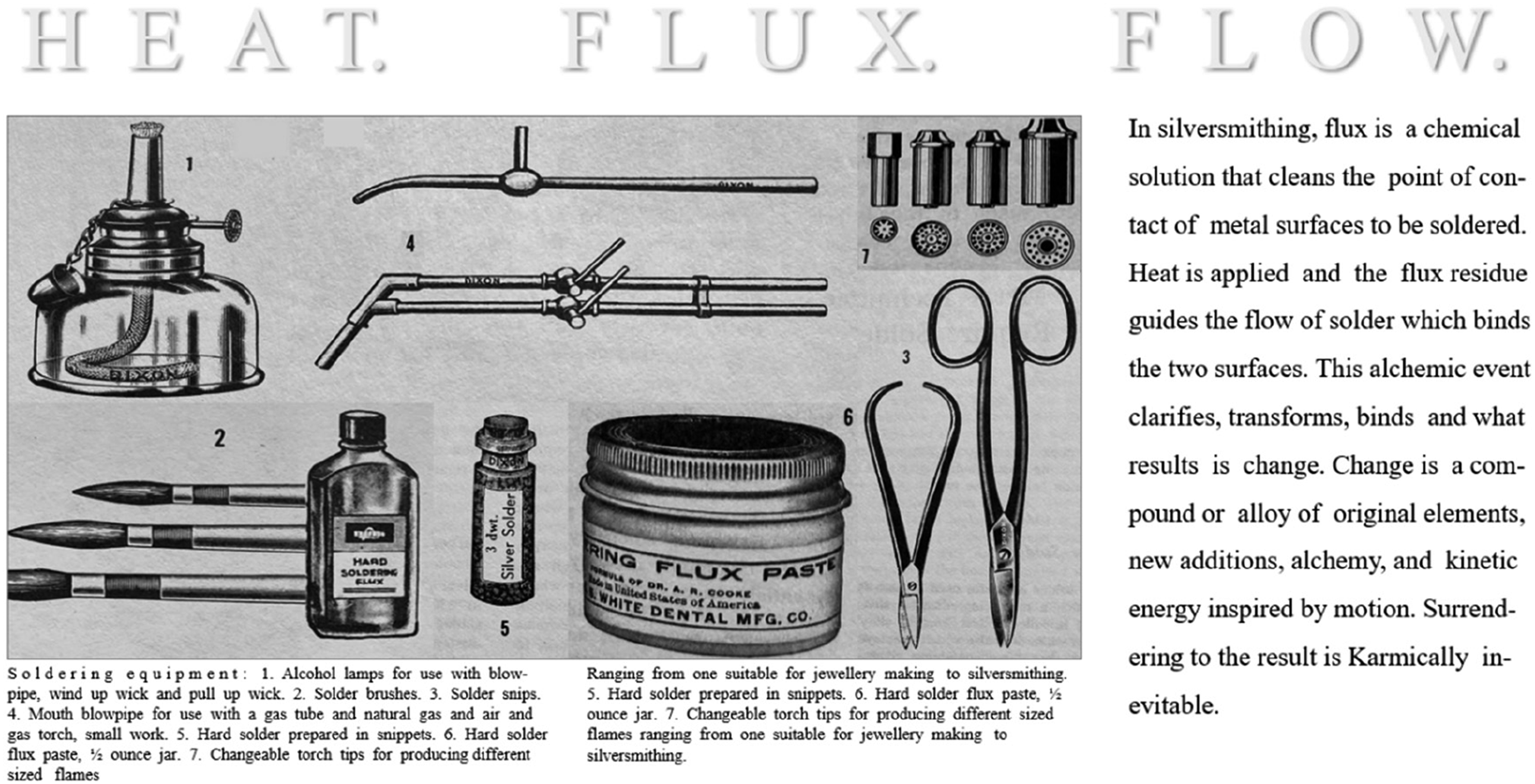
Embracing ambiguity, I chose to use a Jungian technique of spontaneous drawing. Which Jung (2009 53) described as ‘systematic exercises for eliminating critical attention thus producing a vacuum in consciousness as unconscious materials are needed to supplement the conscious attitude and to correct its one-sidedness’ (Rastogi et al. 2021). This drawing technique intentionally privileges the unconscious by bypassing the propensity of conscious mind to design, predict and look to the external for aesthetic validation.
The spontaneous drawing requires the artist to apply ‘random’ marks on a piece of paper sometimes using the non-dominant hand or with eyes closed. Time is then spent observing marks, shapes, negative and positive spaces, to release forming images; akin to finding pictures in clouds. The artist then works into the drawing to reveal the emergent image. This is a phenomenological approach to the art materials, movement of the artist and the emerging imagery (Rubin 2001). Authentic engagement with the process of spontaneous drawing avoids the desire of the conscious mind to want to control the outcome. The private mental and public realms intertwine in a reciprocal feedback loop and provide a dialogical exchange, with artwork as the locutor between the artist and knowing.
In this case, I analyse the emergent data from the artmaking and artwork using Inayatullah and Milojević’s, (2015) Causal Layered Analysis (CLA); a critical futures tool that enables multiple layers of understanding. This reflects the deep involvement with creative process and the use of image to explore the psyche (Jung 2009).
Process
Artefact
Initially the work in Figure 3 spoke to me of a raging storm. Beautiful and dangerous. Destructive and constructive. Friend and foe. Awe inspiring. Overwhelming, energetic, powerful and intimidating. A welcome exhalation of energy. A small sailing boat appeared in the storm, vulnerable but glowing with light. Stoic and brave. It chooses to surrender and float, ‘go with the flow’, ride the waves. Floating avoids sinking in deep. It seems that the boat sits in the eye of the storm, a place of status quo. The boat morphs into a light house with beams stretching through the intentional chaos of the storm, not bright at this stage, but certainly intentional in finding their way through complexity. Under the lighthouse a deep and wide foundation is revealed which morphs into an iceberg, with all its introverted strength. Original artwork by author: ‘Divine Ache.The Iceberg in the Room'; Oil pastel and pencil on cartridge paper, 420 mm × 594 mm, 2023.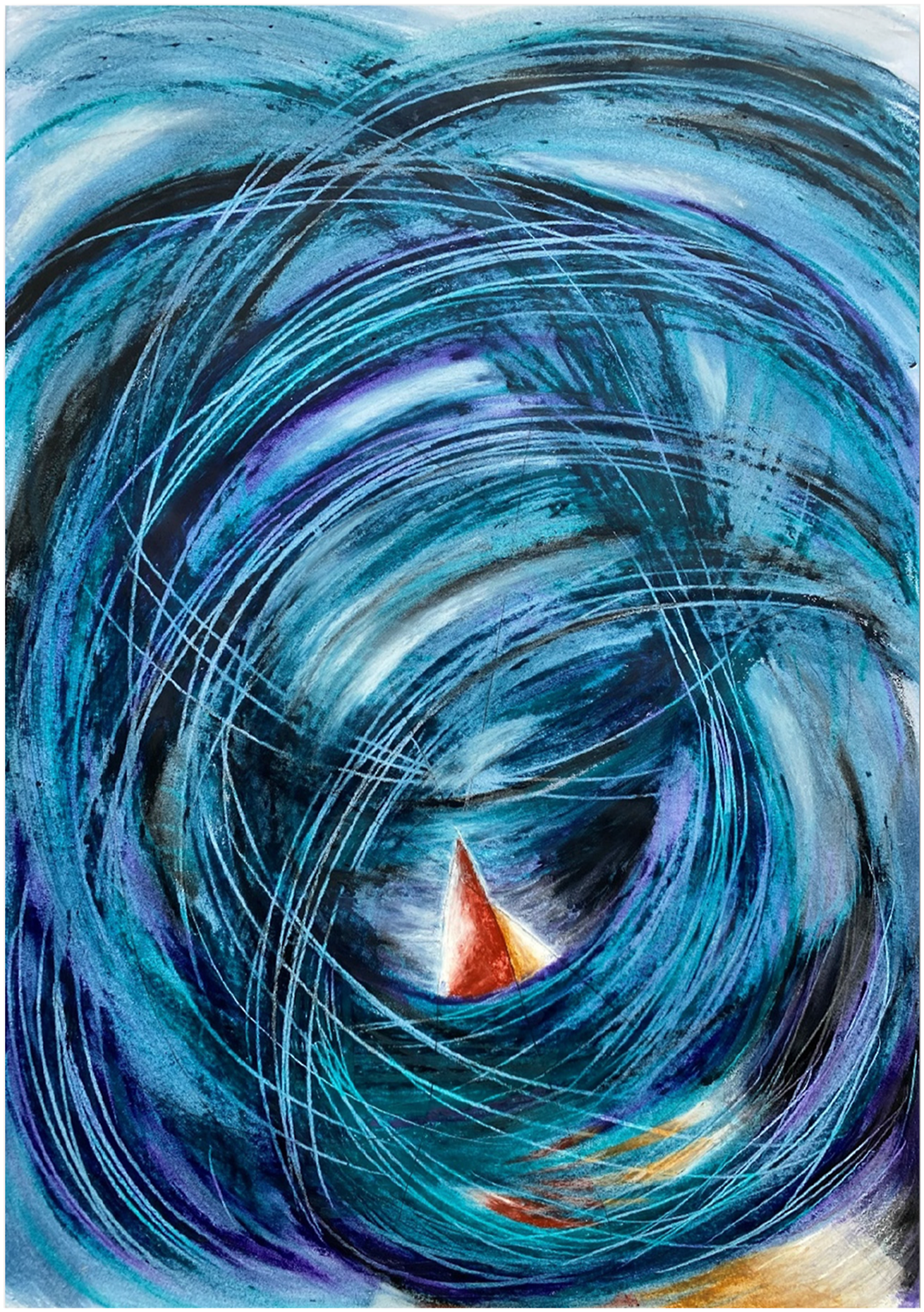
Transition as subject was revealed in dialogue with the artwork. The iceberg in the room: a career crisis. Not a crisis of employment. But one of a life transition intersection, wh
Artefact
The letter in Figure 4 was found five decades on from when it was written, preserved in a biscuit tin that was unearthed amid packing up my late mother’s home. It skewers past, present and future, through the embodied act of writing. Polanyi (1958) asserts that it is the duty of researchers to make personal knowledge public, as it connects with readers, and ‘enables shifts from stagnation to movement, inaction to agency, personal to universal’. Discovering this childhood artefact had a direct effect on researching and writing about my identity as academic, daughter, child, woman (Westacott, Elsom, and Green 2021). ‘The Good Girl Letter', digital photograph of author's artefact.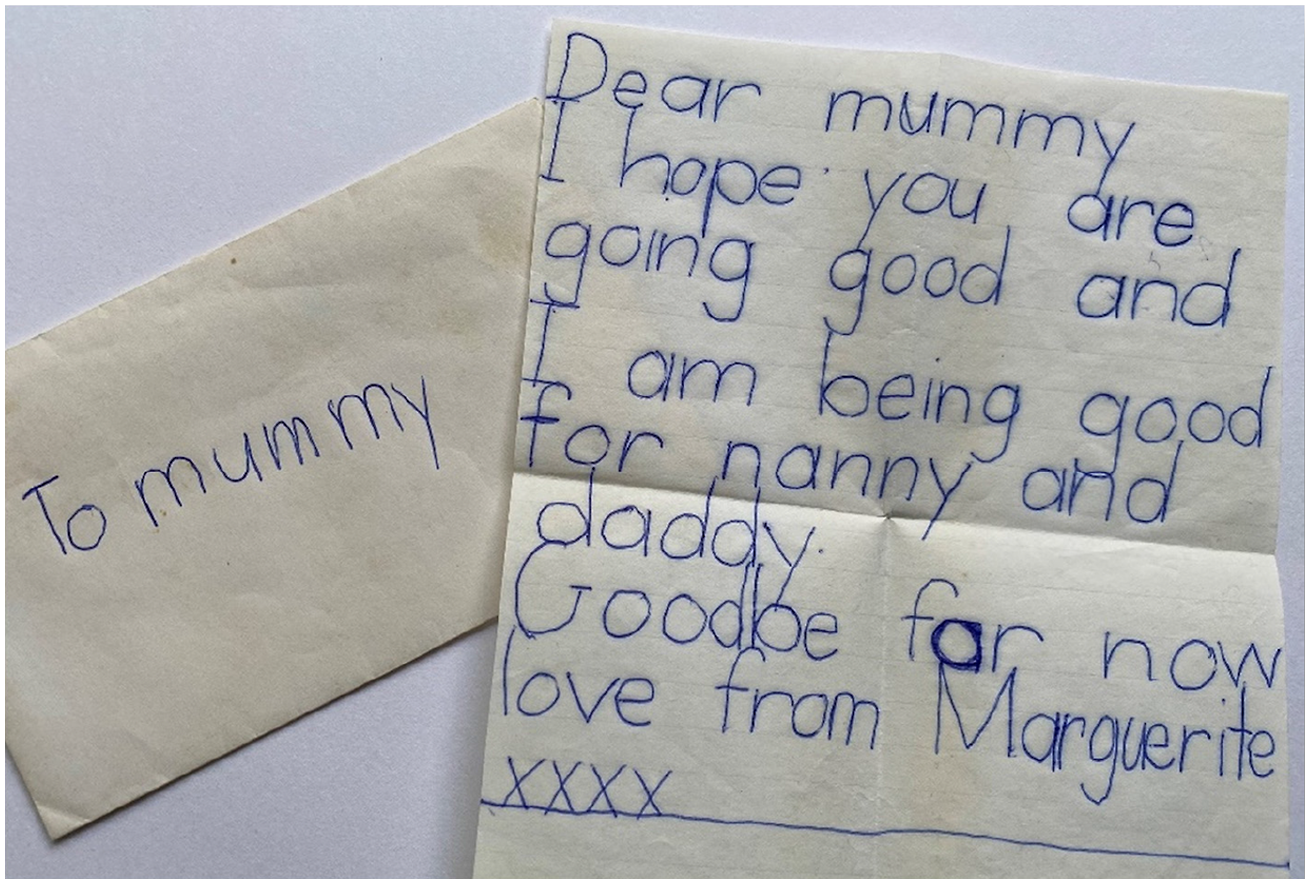
The richness of personal experience is represented in the artefacts shared in this article, all representing embodied consciousness and the human relationship with the world through our senses (Pallasmaa 2009). The artefacts become the transitional objects (Winnicott 1989) in the space between the lifespan landmarks of change, identity, and the self that the death of loved ones bring. In an extensive literature review, Marshall (2004) found that the experience of the orphaned adult ‘is a complex and multi-dimensional life transition which impacts on both sense of self and other areas of the adult child's life’ (325), it represents a time of upheaval where priorities and values are reassessed. The ‘Good Girl’ letter awoke the framework that the child, the daughter, operates within. Thus, turning to spontaneous drawing as represented in the ‘Divine Ache. The Iceberg in the Room’ (see Process section) becomes a bridge to externalising that which is internal, tacit, and intuitive in the relational space, engaging the subconscious and perceptual (McNiff 2013).
Jung’s psychoanalytical perspective posits that it is the symbols within the artwork, rather than the artwork itself, that arise from the unconscious (Swan-Foster 2020). From this view, the motifs that arose in “Divine Ache. The Iceberg in the Room ‘(see Process) of water, boat, lighthouse, iceberg have symbolic tendrils of relationship, affect and identity, with my parents, the (physical) loss of them, and the intersectionality of life transitions.
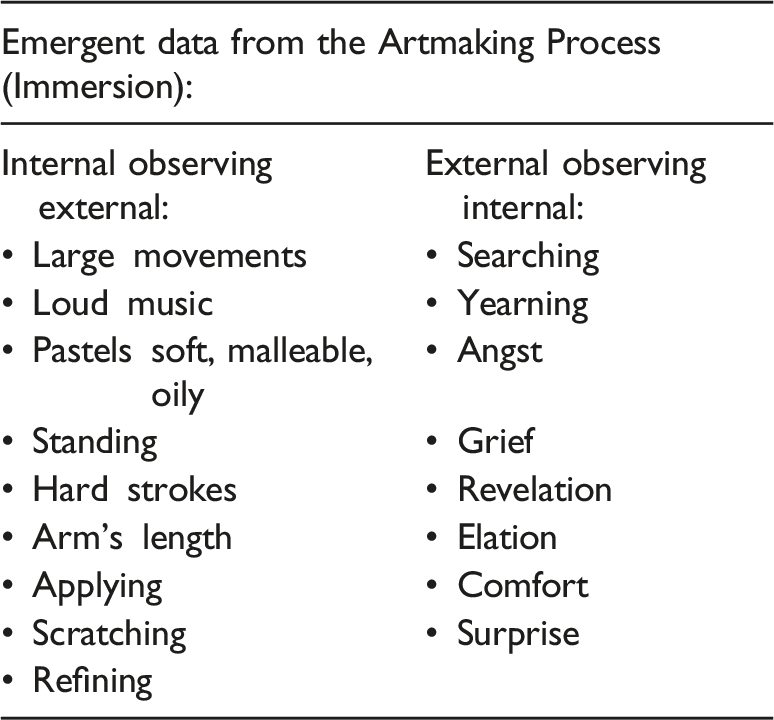
Analysing the artmaking process and artwork phenomenologically requires looking at and inhabiting the artwork with intention to understand and to know (Merleau-Ponty 2012). Yearning’s restlessness of spirit is witnessed in the physicality of applying media and choice of medium that is malleable. Symbols, metaphors, choices of media and technique, movement (or none) of the artist ‘connect the abstract worlds of mind and spirit and the concrete world of land, relationships and activity’ (Yunkaporta 2019, 110). Symbols identified in ‘Divine Ache. The Iceberg in the Room’ and the selection of included artefacts in this paper, connect with many aspects of self across past, present and future, demonstrating a ‘recycling of time, as embodied in the saying: when you look behind you, you see the future in your footprints’ (Neale and Kelly 2020, 2).
I shared earlier (see section ‘Curiosity’) that I work with people in transition, and I contextualise career as the sum of our actions in this world. This reflexive and refelctive revelation is my own ‘grappling’ with transition and a shifting identity that is not contained or defined by the familiar ‘skin’ that has been occupied for nigh on 60 years. After the death of my second parent, a substantial aspect of existing identity lost its foothold and another emerged bidding ‘final adieu to the concrete entity of self’ (Gergen, 1991), instead embracing the interconnectedness and intersectionality of the multiplicity of selves. Unfortunately, life milestones as this are situated in a culture that restricts us from building time into our lives for these key transitions (Blackie 2022). Therefore, artmaking and embarking on a CLA of self, became the bridge to externalising that which is internal, tacit, and intuitive in the relational space, engaging the subconscious and perceptual (McNiff 2013).
The art process and product revealed complexities around transition and grief and loss; and a re-evaluation of my place in the world. When given a vista, Yearning calls on every level, and takes on the role of transitional object.
Meaning Making
Artefact
The CLA is used to deconstruct and reconstruct the current presenting reality, helping to find a new narrative of self, by moving from the fragmentation of complexity to a preferred future and integrated way forward (Inayatullah et al. 2022).It enables a deeper learning about self that has meaning for the collective, re-interpreting the past to open up the present and transform the future(Inayatullah 2007 2008, 2009; Inayatullah et al. 2022). (Figures 5–8) ‘Storm', detail of 'Devine Ache. The Iceberg in the Room'. ‘Boat in the Storm' detail of 'Devine Ache. The Iceberg i. ‘Iceberg' detail of 'Devine Ache. The Iceberg i. ‘Devine Ache. The iceberg in the room’.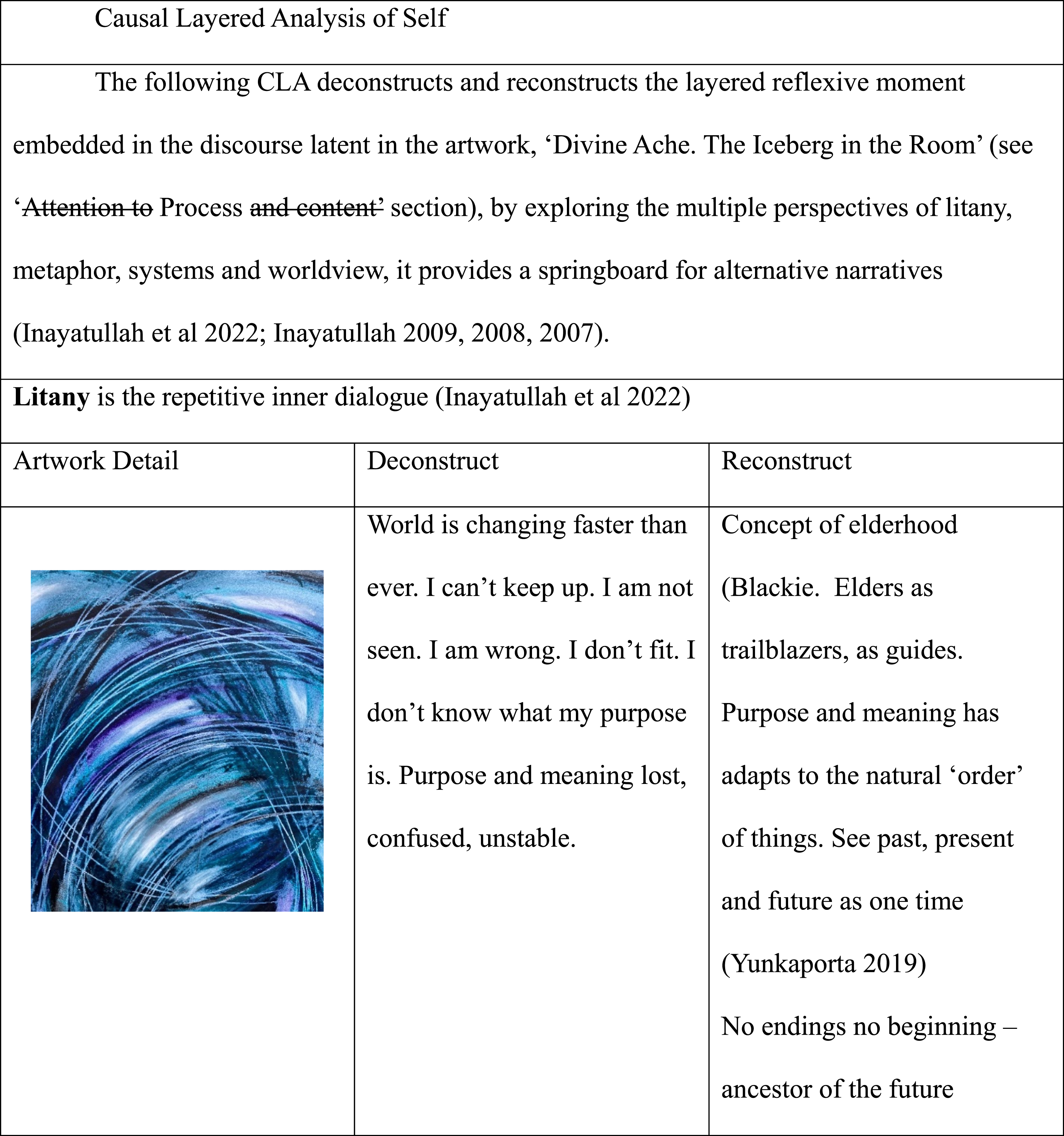
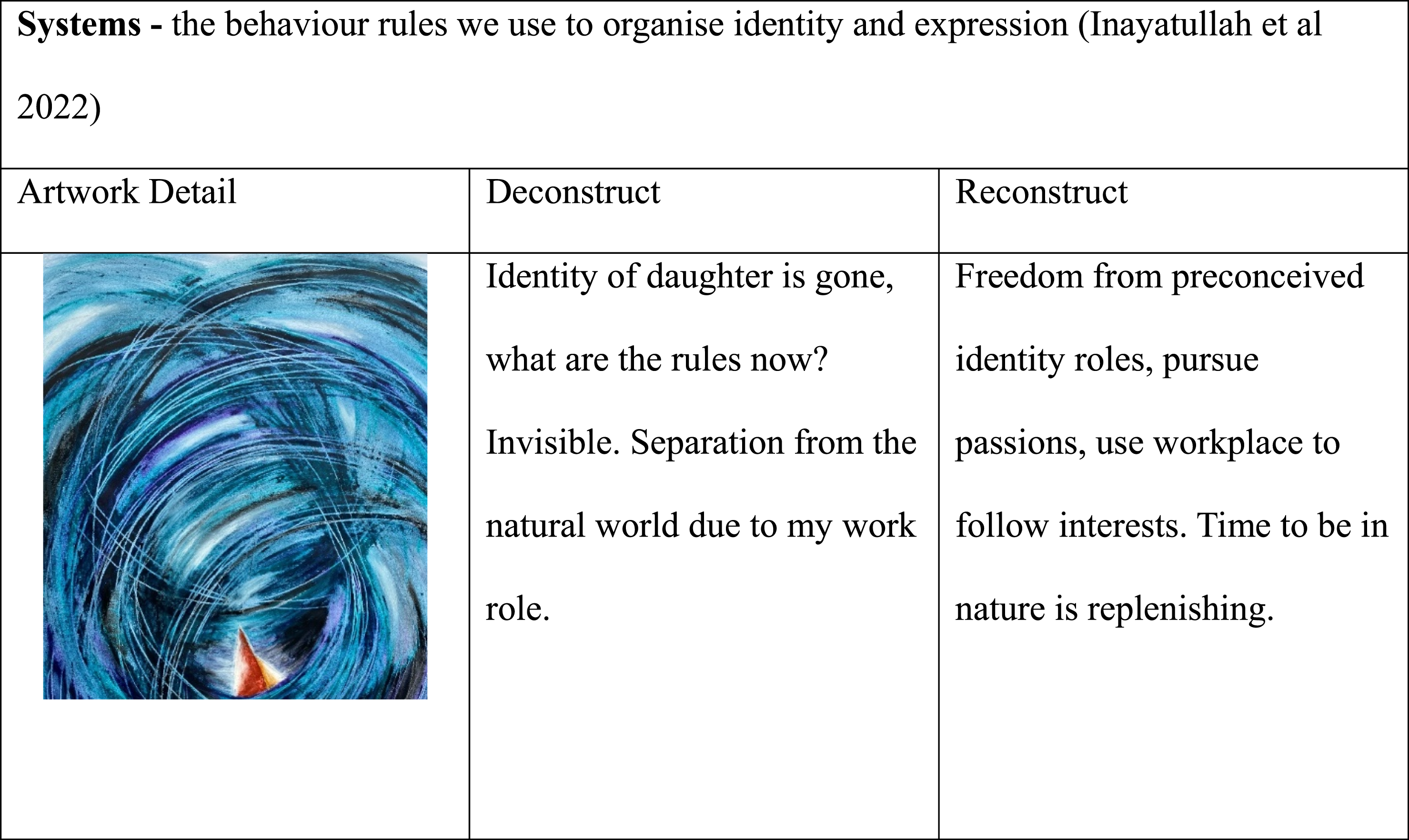
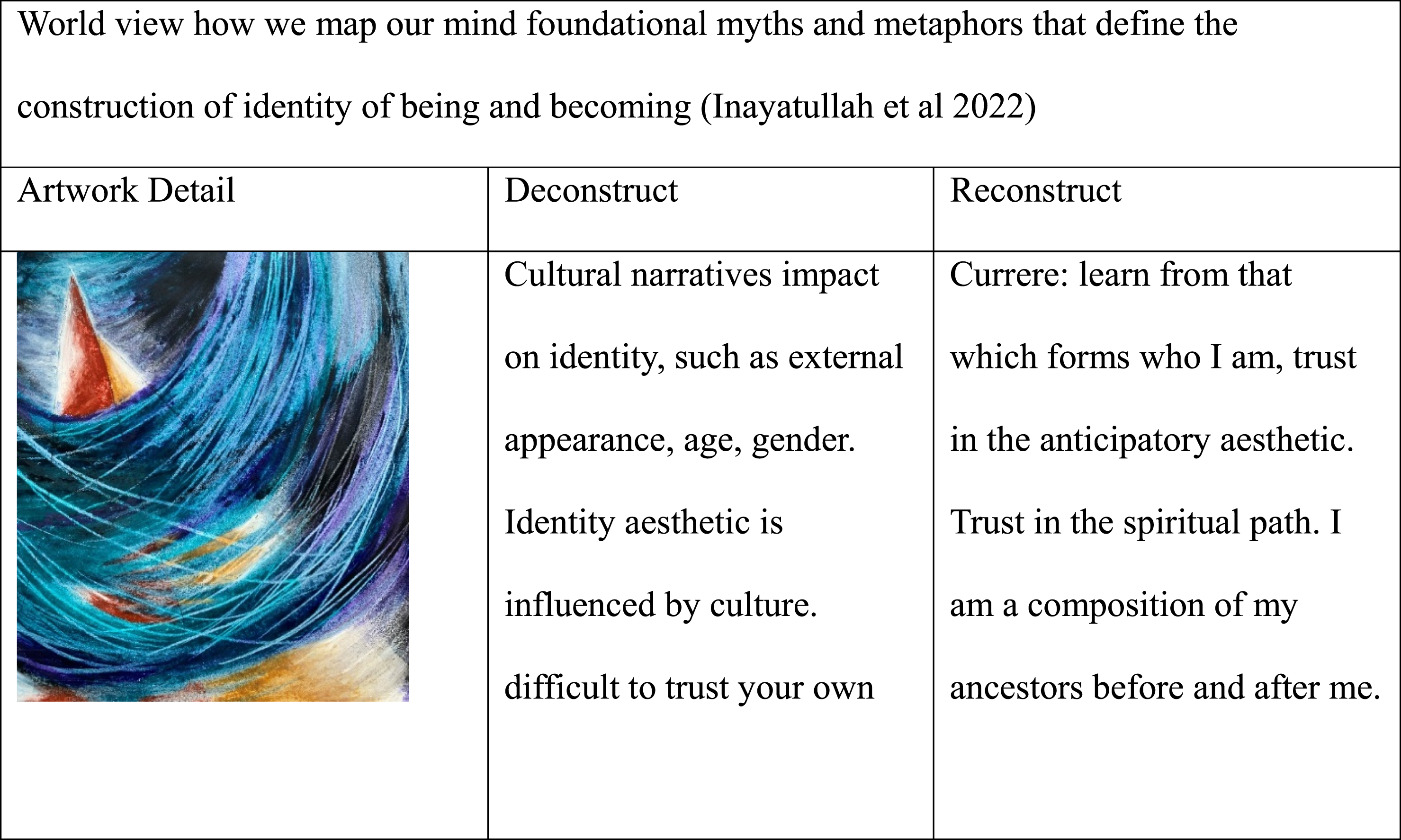
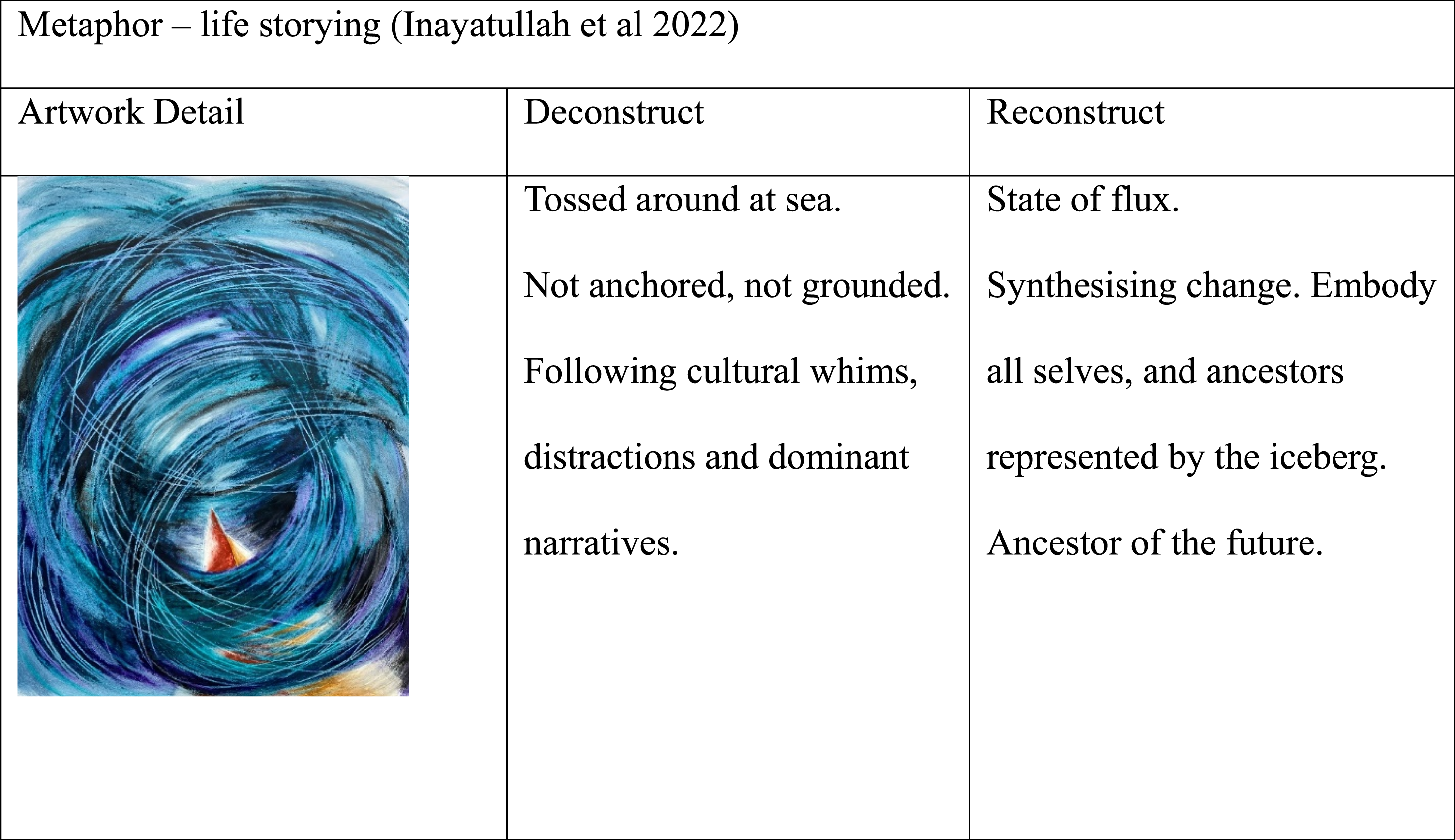
The narrative of self, prior to the processes outlined in this paper, was one of being weathered by change. Change that involved complex realignment of my place in this world as an orphan adult and which brought a realisation of the intersection of multiple life transitions, symbolised by the rudderless boat in a storm The causal layered analysis has been used as an analytical tool to complement the emergent information from the artmaking and artwork, in order to reveal an alternative and preferred new life story. One of elderhood, to replace ‘elderly’ (Blackie 2022). An embodiment of the recognition of respect for self as elder and the important relational role elders play in society, as expressed in the 2023 National Aborigines and Islanders Day Observance Committee Week (NAIDOC 2023) theme statement. An alternate narrative that includes opportunity to grieve fully, and to see and feel ancestors through my actions in the world. One of embracing recycled time - not fragmenting past future present (Neale and Kelly 2020). One of enacting the role of future ancestor and acknowledging the workplace as one that can be designed to enable this intent. Rather than be in search of ‘the image of enviable female elderhood, in a culture that does not have one, ‘my role is to become that, instead, looking to my role as one of giving back, through ‘the hard-earned wisdom’ (Blackie 2022). It is now time for me to heed Jung’s belief that ‘the journey to elderhood is a spiritual passage and that the purpose of the second half of life is to grow into the person we were always meant to become’ …’ the afternoon of life must also have significance of its own’(Blackie 2022, 8). I.
Non-Attachment
Artefact
‘We often think it is only the dramatic moment or the monumental event that is worthy of being told as a story but really, it is the small and seemingly insignificant occurrences that build one upon the other to create a life.’ (Moon 2002, 33)
This section of the paper is about seeing the shape of the connections between the presenting elements to ‘look beyond the things and focus on the connections between them, then look beyond the connections and see the patterns they make’ (Yunkaporta 2019, 89). There are no final conclusions or solutions, but instead, possibilities.
This paper has been a narrative of a moment in time by the hand of the clock, but a moment that linear time could not contain as it wove its way through past, present and future. It started with my research context in the world of career education with people in transition. It took a line of flight into a deeply reflexive and personal reflection that was initiated by immersion in the futures sense of Yearning. The restlessness of the futures sense of Yearning, inspired a creative exploration that paused the moment to soak in its depth and complexity. Tools that privilege the unconscious were used to reveal what words initially could not, and to give voice to the intersubjective space between knowing, not knowing and re-knowing. The intersection of life transitions stepped into the light. The futures tool of the CLA was used to tease apart the matted threads and reveal alternative futures. This narrative began in the collective and settled in the personal. It now revisits the collective as we are all ‘bound within complex patterns of relatedness and communal obligations that include our responsibility to our ancestors and those whose ancestors we are (Krznaric 2021; Yunkaporta 2019).
Grief and/or loss accompany life transitions, as dichotomies of risk and courage, fear and excitement, I see this expressed in an initial activity I do with my new students at the beginning of their university journey. They use the online collaborate tool, Answer Garden, to respond to a question that asks how they are feeling about the change of coming to university, see Figure 9. The result is qualitative data in the form of a word cloud that represents students across classes and campuses. The aim is to demonstrate that change is an affective experience, and initiate their sense of belonging through relational commonalities. Screenshot of ‘Answer Garden' (https://answergarden.ch/) word cloud.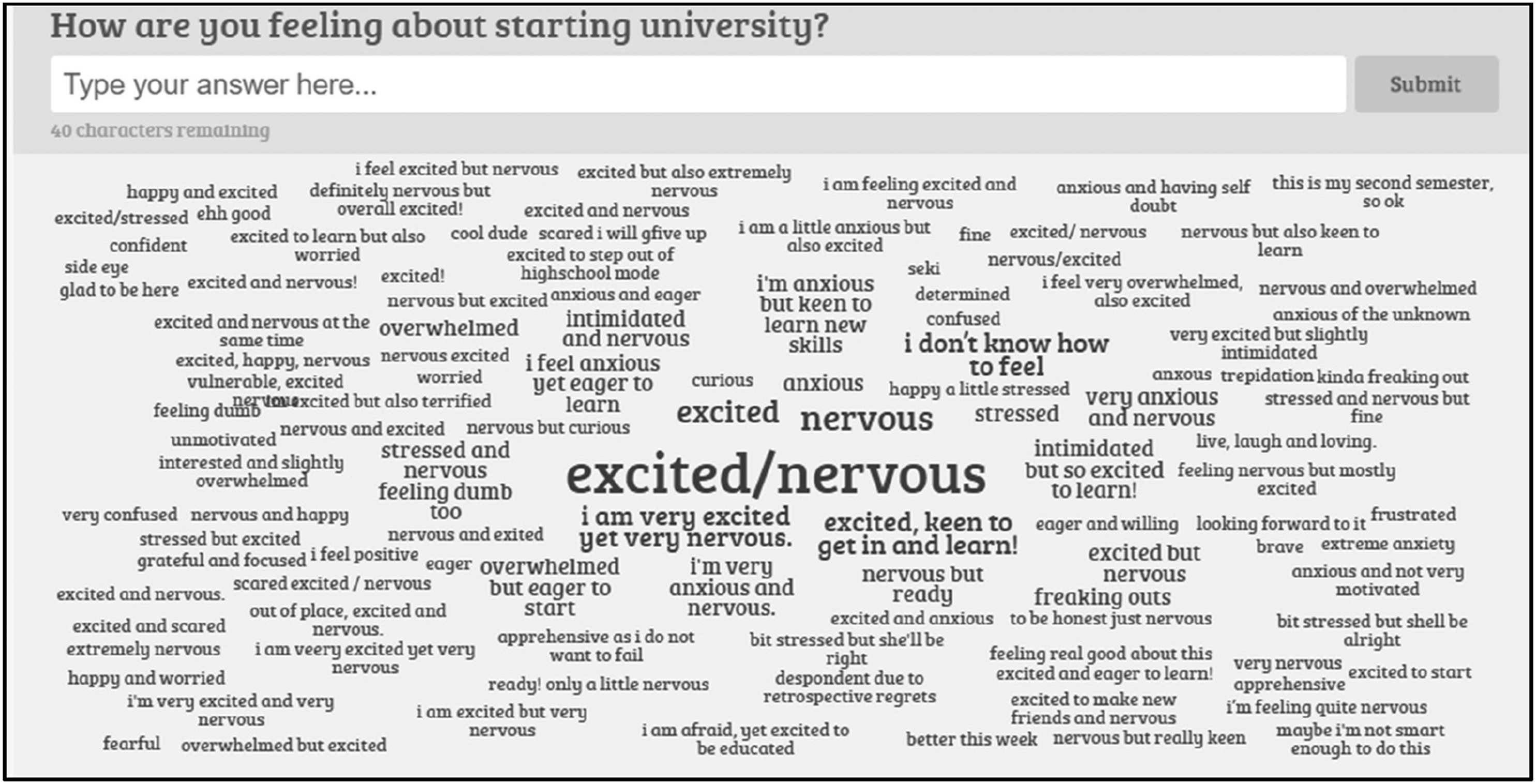
Students in transition experience grief and loss, the complexities of forming identities that are constructed and deconstructed through change. Their journey mimics the cyclical process of Joseph Campbell’s (1949) hero’s journey, where thresholds, challenges, enlightenment and relationships are experienced, in tandem with their past, present and conceptualised future selves.
The emergent theme is transitions. Bright and Pryor’ s (2011) chaos theory of careers, advocates for including change, chance and complexity as an essential component in career education, debunking dominant myths of linear and predictable career paths and acknowledging the reality of change. It may be incumbent upon educators to create spaces of learning that enable dialogue of grief and loss, to acknowledge this in the intersectional lives of our students. Building into our collective learning spaces time for learning from living experience. We may do well to heed Yunkaporta’s (2019, 81) advice to ‘get ahead of the game and begin creating culture and societies of transition to lessen the impact of this calamity on our communities and potentially avoid post-apocalyptic stress altogether’ or maybe to build empathic understanding of complexity in the relational spaces. To understand intentionally, and deeply what may be happening in the intersubjective space.
We are in the ‘age of haste, that kills contemplation’ (Han 2017, 4), goal orientation deprives us of the view and meaning of the spaces in between and of ‘the small and seemingly insignificant occurrences’ (Moon 2002, 33) that make life fulfilling and meaningful.
In research the final destination is often a segue to a new beginning, but I align with the indigenous worldview that Neale and Kelly share, in that ‘there are no endings … nor are there any beginnings, time and place are infinite and everywhere’ (2020, 1).
Footnotes
Declaration of Conflicting Interests
The author(s) declared no potential conflicts of interest with respect to the research, authorship, and/or publication of this article.
Funding
The author(s) received no financial support for the research, authorship, and/or publication of this article.
