




Abstract
Scholars and practitioners have long criticized the inherent dominance of Western ideas in futures studies and claimed the need for a de-centering or decolonizing of the field. As a process of transforming science, de-centering occurs on at least two levels: at the level of thought and at the level of social structure. Sociologists of science, Science and Technology Studies (STS) scholars, and others have conducted research for many years on the interlinkages between social structures and knowledge structures and have developed several concepts to do so. In this article, I discuss some of these concepts and combine these theoretical conceptualizations with a co-citation analysis of recent publications in the futures studies. Based on a sample of futures studies publications that have appeared in the last ten years (n = 500) retrieved from the Web of ScienceTM database, a strongly inter-related network with four clusters can be identified. The works in each these four clusters are related in terms of their subject matter. They concern (1) the politico-intellectual program of futures studies, (2) their epistemological foundations, (3) questions of methodology, and (4) scenarios as the core technique of futures thinking. Both the works and their authors come from a broad variety of cultural backgrounds; they also display a relatively high number of co-citations with works in clusters other than their own. Taken together, these findings indicate that the information space sampled in this study to represent futures studies has already become de-centered to a large degree, both at the level of social structure and at the level of thought.
Keywords
Introduction
The historic origins of futures studies as a scientific enterprise can be found in the “West.” Europeans like H. G. Wells and Ossip K. Flechtheim called for the creation of futurology as an academic discipline, and researchers in North America, including luminaries like Olaf Helmer and Herman Kahn, contributed the field’s first genuine methods (Keßler 2007; 2011; Aligica and Herritt 2009; Gordon 2011; Ghamari-Tabrizi 2005). As a consequence, Western notions dominated these endeavors, predefining to a considerable extent what had to be understood as the “future,” how the “future” could be explored, and what “science” meant in this socio-political and intellectual context. Still, at the same time, futures studies, proponents were convinced that the future was a global issue and, therefore, the attempts at institutionalizing futures studies were international from very early on (Masini 2005; Son 2015; Andersson 2018; H. de Jouvenel 2019). Once the main channels of scientific communication (e.g., conferences, associations) began to attract contributions from around the globe, the proponents quickly became aware of the biased nature of the foundational ideas of futures studies. Up until today, most organizations conducting futures studies have placed a high priority on international collaboration (Miller 2018). Thus, most scholars in the field have displayed an awareness for a crucial need to de-center futures studies to fully exploit the field’s intellectual potential and to increase the “validity” of the images of the future it produces (Sardar 1993; Bisht 2017).
However, moving from awareness to change is a long, drawn-out process. De-centering also has to happen on at least two levels: the social level and the level of thought. In science (and not only there), communities of professionals can be de-centered in terms of their social composition, while the intellectual tenets that they hold are still primarily those of the center. The contrary is also possible, although less frequent: scholars representing non-centric views might get appointed by schools in the center to increase theoretical (and methodological) diversity.
An empirical assessment of the degree to which a scientific field has become de-centered thus requires the sophisticated combination of methodology and theory in a research design that addresses both the social level and the level of thought. Ideally, these should also be integrated in order to obtain theoretically informed answers. In this paper, I take the first steps towards presenting such a research design. Co-citation analysis, a procedure that is well-established in scientometrics, was used to identify clusters of shared points of reference, namely, publications that are cited together in a pre-selected body of literature. By plotting these publications within a network based on their relative frequency of citation and co-citation, the method delivers a structured representation of an information space. While in terms of mathematical operations, co-citation analysis is a form of network analysis, the nodes of the co-citation network are not individuals (authors), but texts. Thus, a co-citation analysis informs about the intellectual proximities between works as they are perceived by actors (i.e., authors) in the field. It thus covers, first and foremost, the level of thought.
However, based on this rendering of an information space, and with the help of other sources of knowledge (general understanding of the history of the field, research on the social links between authors, etc.), it is then possible to add to this empirical description of the level of thought an additional layer covering aspects of the social structure. In principle, thus, co-citation analysis is a suitable method for achieving the integration between the social and the intellectual sphere.
Prioritizing empirical analysis of intellectual references, however, such an approach postpones the delicate question of the actual social form of futures studies to a later step of analysis. Is it a field, a scientific discipline, or an epistemic community? All of these points have been disputed (Marien 2002). Is it, then, something completely different? Without forcing the researcher to decide about this a priori, co-citation analysis allows for an empirical exploration that does not rely on any of these theoretically rich conceptions. Instead, it uses the neutral notion of an information space which is defined by the search terms of the data collection. And once the data has been gathered, theoretical interpretations developed in sociology of science and STS can then be inspected as to which degree they are capable of delivering fruitful starting points of interpretation.
The paper follows this logic and presents first the co-citation analysis of recent works in futures studies. The method as well as the characteristics of the data collection are introduced (section Method), and then the results are discussed (section Results and Discussion). The ensuing section (section Social Structure and Thought in Futures Studies) then refers a series of concepts used in the sociology of knowledge, ideas, and science and assesses how these can further the interpretation of the empirical results.
Method: A Co-citation Analysis of Futures Studies Publications, 2010–2022
Co-citation analysis is an established scientometric technique (Small 1980; Braam, Moed, and Raan 1991a; 1991b; Osareh 1996a; 1996b) which can be used for a variety of objectives but which has been more frequently used as approach taken to explore basic structures in an information space in recent years. Based on social network analysis procedures (Prell 2012; Borgatti, Everett, and Johnson 2013; Scott 2017; Yang, Keller, and Zheng 2017), the co-citation analysis presented in this paper takes recent publications in futures studies and explores dyads of references that are often cited together. Based on these data, the analysis results in citation clusters that can then be interpreted as the structures of the attention space described by the search terms.
While some variations of the analysis are known, in most cases the data used for a co-citation analysis in scientometrics consist of a list of publications extracted from an established literature database. This list must include all literature cited in each of the publications, as the reference lists are the data input for the co-citation analysis. The nodes that constitute the network resulting from co-citation analysis represent not the publications collected in the first place, but the sources that these publications cite. Therefore, even if the data collection process is restricted to publications from the last ten years, the nodes still can comprise older sources.
Few studies have examined futures studies by analyzing bibliometric data or conducting scientometric network analyses. In an attempt to describe the historical trajectories of research themes and their diffusion across publications, Lu, Hsieh, and Liu (2016) subjected data extracted from the Web of ScienceTM database to a main path analysis. Furthermore, Fergnani (2019) used bibliometric data to identify clusters of themes in contemporary publications.
Unlike these studies, where the research focus was placed on identifying clusters and thus on identifying differences, co-citation analysis enables researchers to obtain a dual view of both differences and similarities. In a first step, the similarities among the references cited in the sample are measured by analyzing how often two references are cited together. This frequency is then used to determine the proximity of these two references as nodes in the resulting network. The nodes are mapped onto a low-dimensional Euclidean space, and objects that are cited together more frequently are closer to each other and marked with stronger edges. The software used for the work described in this paper, VOSviewer, enables all nodes to be assigned to different clusters with a clustering technique described by Waltman, Eck, and Noyons (2010). But the clustering can be interpreted in relation with the network and, thus, the possible claims about fragmentation can be critically examined.
Because the shared points of intellectual references for current publications are analyzed rather than their themes, co-citation is a suitable method for determining whether the information space of futures studies has become de-centered or whether it still has a center-periphery structure.
For this paper, data were collected from Web of ScienceTM, a database of scientific literature run by Clarivate. Web of ScienceTM contains entries that include the lists of references, and the data can be exported in a format that can be read by VOSviewer. Clearly, the analysis relies heavily on the quality of the underlying database; again, I re-emphasize that a co-citation analysis has value primarily as an exploratory procedure. The resulting data only comprises publications that are listed in the Web of ScienceTM; this means that non-English articles and book publications are structurally discriminated against.
I searched the database using the terms “futures research,” “futures studies,” and “futurology” in one or more of these standard categories of an entry: Topic (=TS), title (=TI), abstract (=AB), keywords provided by the author (=AK), and keywords automatically assigned by a Clarivate algorithm (=KP). These fields were restricted to avoid including the title of the journal (=SO) as the only decisive factor in the selection; for example, the fact that an article was in the Journal of Futures Studies or the European Journal of Futures Research was not deemed sufficient per se for its selection.
The time period covered was also restricted to range from 1 Jan 2010 to the date of the data collection, 24 March 2022. This search resulted in 854 search results. Accepting the ranking provided by Web of ScienceTM (according to their “relevance”), we exported the first 500 records. The Web of ScienceTM account used did not allow a larger number of full records to be exported, but this number was considered as sufficient given the ranking (which considers, e.g., the number of citations) and the exploratory nature of the analysis.
Several steps of data washing were carried out, all of which ensured that the same references had a uniform entry. For instance, various versions of references citing the two volumes (in several new editions) of Wendell Bell’s Foundations of Futures Studies were identified. Disregarding these bibliographic details, all references to these books were unified to read “Bell W, 1997, FDN FUTURES STUDIES.” These corrections have been carefully documented and will be distributed upon request to the author, together with the data.
Results and Discussion: Four Clans With a Large Amount of Mutual Trade
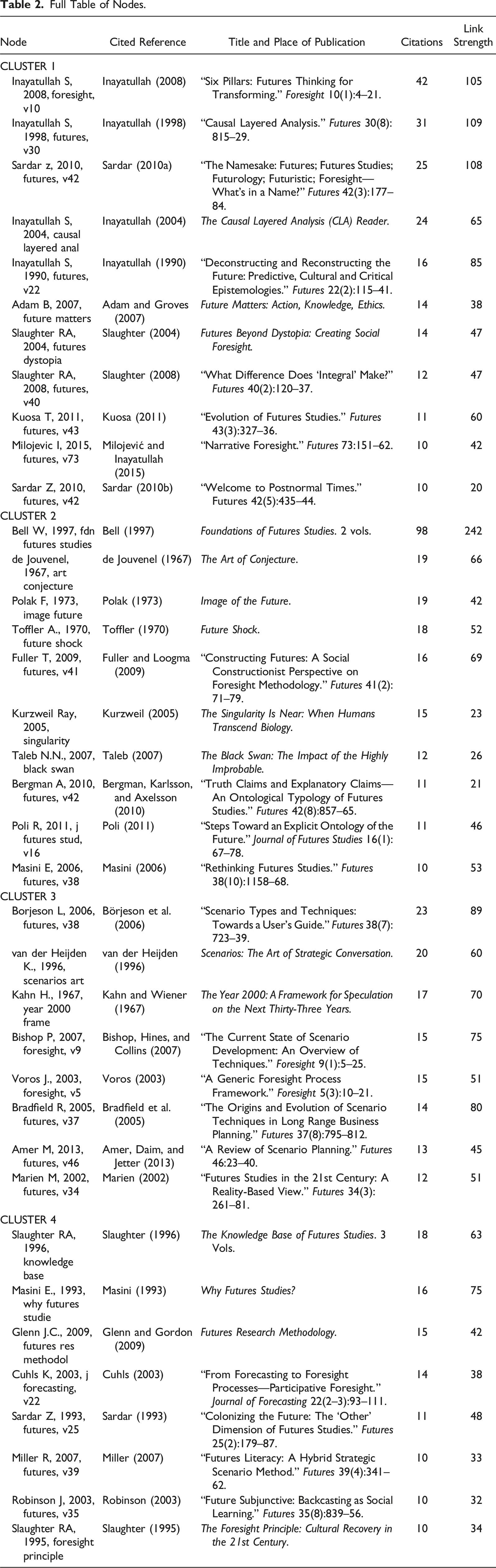
VOSviewer retrieved a total of 16,885 references from the 500 entries exported from Web of ScienceTM. Of these, I selected those works that had been cited at least 10 times, resulting in a network comprising 37 nodes. The “oldest” node, The Year 2000 by Herman Kahn and Anthony J. Wiener, was published in 1967, and the “youngest,” an article on “Narrative Foresight” by Ivana Milojević and Sohail Inayatullah, was published in 2015. One work was cited much more often than all of the others: Wendell Bell’s (1997) two-volume Foundations of Futures Studies, which was cited 98 times in the 500 articles exported from the database. The second most highly cited node, Sohail Inayatullah’s (2008) article “Six Pillars: Futures Thinking for Transforming,” received 42 citations. Bell’s book has a total link strength of 242, meaning that it was co-cited 242 times together with one of the other nodes entering the network, whereas Inayatullah’s article has a total link strength of 105.
The centrality of these two works in the information space as described by the search terms is also represented in the visual display derived from the co-citation analysis (see Figure 1), both by the size of the nodes and their positions toward the center of the network. All nodes are allocated according to their proximities, meaning that a node has more co-citation relations with those in its immediate surroundings. Sardar (2010a), the red node in the upper central area of the network, is cited together with Kuosa (2011) and Milojević and Inayatullah (2015), but not with Kurzweil (2005), a green node to the right of the bottom, or with Slaughter (1995), represented as a yellow node in the center of the bottom. Those familiar with the futures studies literature will quickly be able to identify some of the other nodes; all nodes are documented in Table 2. Co-citation Network.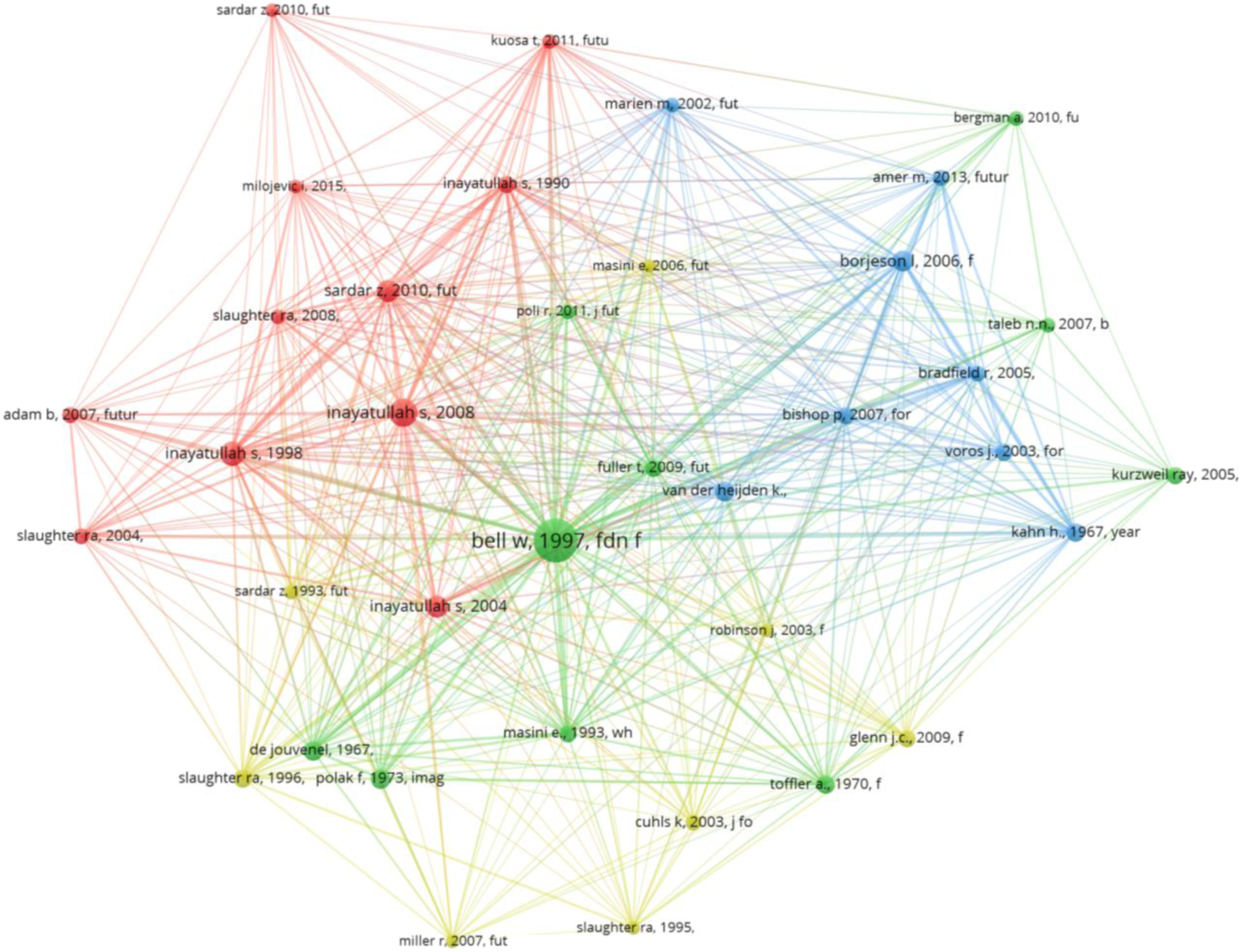
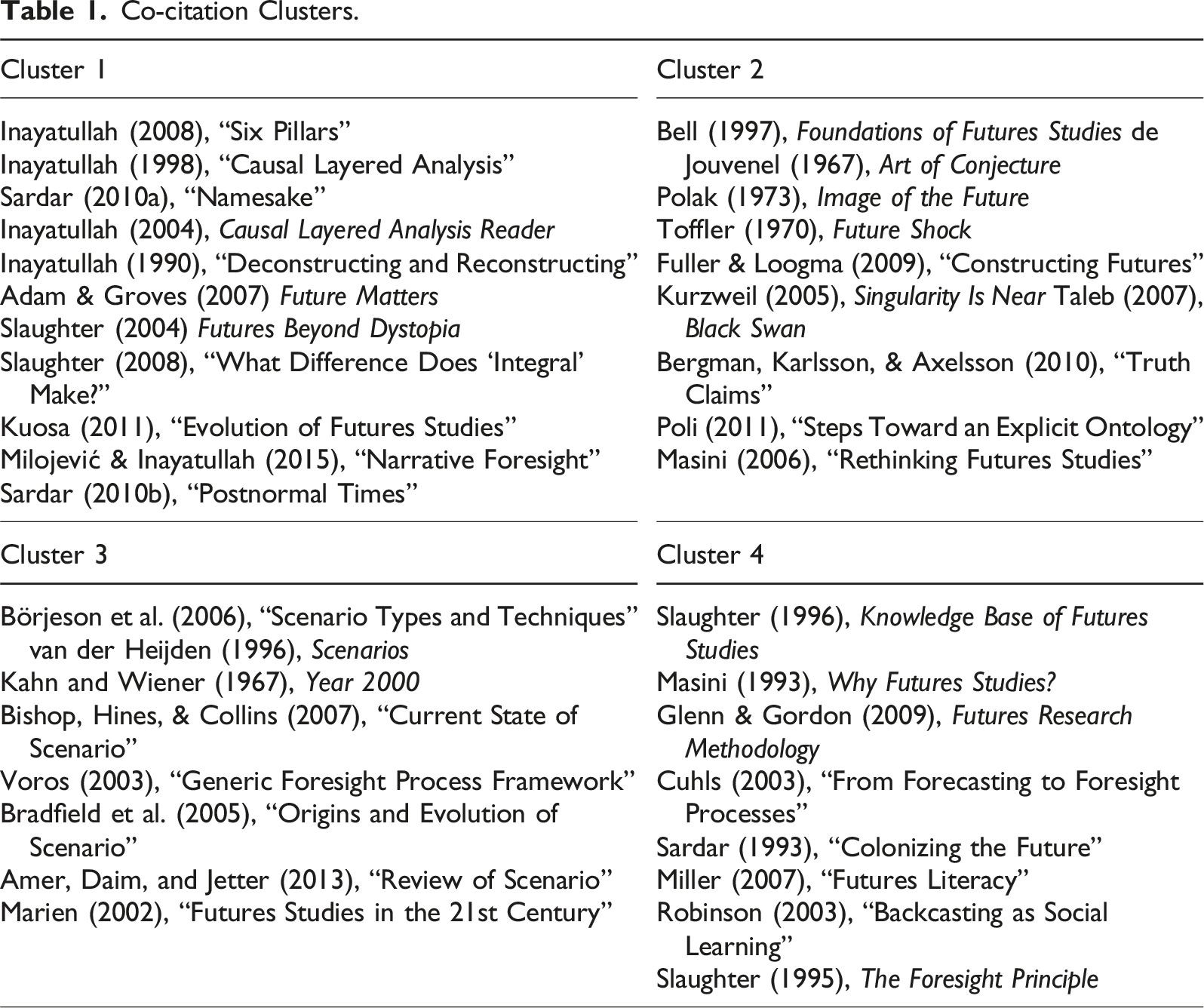
The resulting network consists of nodes that are highly interlinked. The information space representing futures studies, thus, is not fragmented at all. While the clustering procedure performed in VOSviewer’s co-citation analysis resulted in the identification of four clusters, characterized in Figure 1 by the colors red, green, blue, and yellow, these clusters heavily overlap. It is a highly interlinked network without structural holes, bridges (Burt 1992), or “weak ties” (Granovetter 1973; 1983). This means that, despite the fact that the co-citation analysis resulted in four clusters, publications from one cluster are also often cited together with publications in other clusters. The information space defined by the search terms, which we assume to be representative of the scientific branch of futures studies, is structured, but not segregated into sects who do not communicate with each other.
Co-citation Clusters.
Full Table of Nodes.
Cluster 1 comprises seminal writings that attempt to broaden the conceptual and theoretical outlook of futures studies. The authors of these papers strove to integrate democratic principles, non-Western perspectives, as well as epistemological and philosophical developments into futures studies methodologies. In this cluster, we find several works by Sohail Inayatullah, including two texts on Causal Layered Analysis, as well as works by Ziauddin Sardar and more recent contributions by Richard Slaughter. The nature of virtually all texts in this cluster is programmatic; and in most cases, this program goes beyond an analysis sine ira et studio and extends into the moral responsibility that futures studies plays in the struggle for the existence of (and on) this planet. Transformation is a key term in most of these publications. Futures studies, we read, can free us from being “tied to old patterns of behavior” and “help us recover our agency” in an increasingly heterogeneous world (Inayatullah 2008, 5, 20). Continuing to live how we did during the industrial era, and to concentrate our thinking on short-term advantages as has become the norm in this era, is “leading us to a world that no sane person would choose for themselves, let alone hand on to their children.” (Slaughter 2004, 1) The post-normal times that humanity is entering are “an inbetween period where old orthodoxies are dying, new ones have yet to be born, and very few things seem to make sense”—what humanity needs to do in order to cope with this situation is “to unlease a broad spectrum of imaginations from the rich diversity of human cultures” (Sardar 2010b, 435, 443), and futures studies is the place where this diversity is combined. It seems justified to call this cluster the politico-intellectual program of futures studies.
Cluster 2 includes works that present elaborate perspectives of the future from an ontological angle. Classic books, for instance, by de Jouvenel, Toffler, and Polak, are clustered together with more recent bestselling books, such as The Singularity is Near by Ray Kurzweil and Black Swan by Nassim N. Taleb, as well as articles that are address questions of ontology. The characteristic feature of all texts in this cluster, it seems, is that they concern themselves at considerable length with the epistemological status of predictive knowledge. From de Jouvenel’s description of conjecture as an art, not a science (B. de Jouvenel 1967), on to Wendell Bell’s carefully elaborated position that since all science is based on conjecture, futures studies also qualify as science (Bell 2003, 179), we find in this cluster the most captivating discussions of what kind of science futures studies are and which types of claims futures studies use (Bergman, Karlsson, and Axelsson 2010). I suggest to call this cluster the epistemological foundation of futures studies.
Cluster 3 comprises works that relate to a specific, yet central method in futures studies: the use of scenarios. This cluster includes references ranging from the classic The Year 2000 by Herman Kahn and Anthony J. Wiener to more recent contributions to and reviews of scenario techniques. This, this cluster is dubbed the scenario technique cluster of futures studies literature. However, two texts in this cluster are hard to be brought in line with this description. In his article “A generic foresight process framework,” Joseph Voros (2003) does not focus on scenarios, but rather describes a methodological framework in which scenarios play one role amongst other techniques of future thinking. The article certainly has the famous cone of scenario plausibility (Voros 2003, 16), or “futures cone,” but is by far not the only source for this classical image. Thus, the inclusion of Voros’s text in this cluster remains a bit surprising. Even more astonishing, at first sight at least, might be the presence of Michael Marien’s “Futures studies in the 21st Century: A reality-based view.” This text puts forth a critique of various myths widespread in futures studies. Among these myths he aims to destroy in the first part of the article are the ideas that futures studies is a field, that futurists are generalists, and that futures studies provide analyses that nobody else provides. As an analysis of the citing literature showed, however, this has much more to do with the various types of futures thinking that Marien describes in the second part of the chapter: probable futures, possible futures, preferable futures, present changes, panoramic views, and questioning. These types are used to emphasize that scenarios can bear different epistemological emphases and be used to describe all or some of these types of futures proposed by Marien.
Cluster 4, finally, contains publications that address methodological questions, i.e. questions that do not relate to a specific technique, like scenarios in Cluster 3, but more generally how to proceed when doing futures studies. It consists of works that survey and sometimes criticize the established methodologies, as well as those that propose methodological innovations. The works in this cluster range from Kerstin Cuhl’s diagnosis of a methodological move from forecasting to foresight to other, more handbook-style publications like Richard A. Slaughter’s (1996) The Knowledge Base of Futures Studies, or Futures Research Methodology by Jerome C. Glenn and Theodore J. Gordon (2009) that provide comprehensive overviews over different methodological approaches. It also includes critiques of the methodological canon, chief among them Ziauddin Sardar’s (1993) critique of futures studies as being colonized by Western scholars and their ideas. It seems plausible to dub this the methodology cluster.
Certainly, not all works fit this substantial interpretation of the clusters neatly. Nonetheless, it seems justified to conclude that the clusters resulting from the co-citation analysis in VOSviewer bear meaning, and that they are not only artifacts of the underlying clustering procedure. What exactly can be made, in sociological terms, of this meaning is addressed in the subsequent section. The same applies to the observed strong interlinkages across the clusters’ “boundaries,” or rather the apparent lack of strict boundaries between the clusters.
Before this sociological discussion, however, it appears feasible to briefly spell out the conditions under which the results found in the co-citation analysis apply to futures studies, or more precisely, under which conditions the information space covered by the search terms can be said to be a sensible representation of futures studies. I claim that one can indeed derive statements about the state of futures studies provided that one accepts the following two assumptions: (1) that the database used and the search terms selected enable us to identify a sample that encompasses the core reference pillars of futurist thought styles, even if it is not representative in a statistical sense (given that still a considerable amount of work in futures studies is produced as reports and grey literature); and (2) that referencing is indicative of awareness, but not necessarily endorsement.
If these assumptions are accepted, the following conclusions can be drawn: ⁃ Futures studies appear as a scientific endeavor with a considerably high degree of mutual awareness of and engagement with the ideas of others. ⁃ The identified clusters themselves do not denote “centers” neither in a geographical sense nor in the sense of a “scientific school.” Rather, they concern themselves with different topics: the political-intellectual program of futures studies, its epistemological foundations, a core technique of futures research and analysis, and more fundamental methodological debates on how to carry out futures studies. ⁃ The fact that such clusters can be found suggests that there exists (tacit) conventions, or customs, on what to cite for which line of argument. If, for example, an author wants to make an epistemological argument, they will feel (or get) encouraged to look into the works of Bell, Bergman et al., Poli etc. ⁃ Authors with a non-Western origin are considerably prominent, and the high citation impact of their works might be understood as indicating that their claims are widely perceived.
All these findings suggest that futures studies share a more or less consensual corpus of reference texts. This corpus appears to be structured not along “social” factors like schools of thought, or other alliances of power, but along thematic subjects and lines of argument. Futures studies is not fragmented into sect-like citation clusters that avoid references to texts outside their own camp. Rather, the clustering suggests that literature is cited in line with the type of argument one wishes to make. Also, the claim to de-centralize futures thinking has been put forth early, and there are highly cited authors that come from non-Western countries.
Social Structure and Thought in Futures Studies
The remaining question is how these empirical findings can be related to sociological theories of the social structures governing science. To address this question, a quick tour de force through the history of social studies of science is required. This tour de force concentrates on concepts that have proposed to capture the links between the social structure of a science and the ideas it maintains. In a second step, I will then assess whether and with which results these concepts can be applied to the findings of the co-citation analysis reported above.
Sociologists, anthropologists, and ethnologists have been interested in the interlinkages between social structure and knowledge for almost two centuries. In line with the coeval theoretical debates, the sociology of science subfield which emerged during the first decades of the 20th century conceived of science as a social subsystem of society which had its own norms and forms of sanctioning (Merton 1938; 1939; 1968; 1996; Wilson 1942). To explore the norms, how these are applied in practice, and how this application together with other factors leads to the observed uneven distribution of recognition in science, the analyses performed placed a focus on structures of communication and collaboration (Price 1963; Hagstrom 1965; Crane 1972). It was in this context that methods of network analysis that take persons as nodes first gained salience in the sociology of science.
The results that emerged, however, indicate that both communication and collaboration structures vary across scientific disciplines and fields. Searching for reasons for these differences, some scholars went on to argue that these results had to be interpreted in relation to the “age” of the academic discipline and, therefore, its state in the process of institutionalization (Shils 1970). Other scholars argued that the social shape of scientific disciplines did not result from a collaborative effort, but emerged from competition among smaller units in a field, such as the specialties (Mullins 1972), theory groups (Mullins 1973), scientific schools (Tiryakian 1979), or epistemic cultures (Knorr Cetina 1999; Lamont 2009).
As these conceptualizations gained broader acceptance, the analytical focus moved away from the norms governing science and shifted to questions that pertained to the nature of knowledge itself: How are knowledge and social structure related? Does evidence show that the knowledge produced mirrors the social structures within which it is embedded? Are the ideas with which a given scientific community concerns itself homologous with its social shape, norms, rituals, and culture?
Such questions had been debated earlier by scholars in the sociology of knowledge and more generally by anthropologists, and several concepts—or rather concept pairs—had been used to explore the complex relation between social structure and scientific knowledge. One early example of such a concept pair, originally proposed by Ludwik Fleck in 1935 (Fleck 1979), is thought collective and thought style (Denkkollektiv and Denkstil). With regard to futures studies, German historian Elke Seefried (2014; 2015a) has described three dominant thought styles in futures studies, which she dubbed empirical and positivistic, normative and ontological, and critical and emancipatory. 1
Seefried’s analysis focuses on the history of futures studies in the 1960s and 1970s, but traces of these approaches—or styles of thought—can be found today as well, even in certain methodologies used in futures studies. For instance, standard Delphi surveys are rooted in the positivist philosophy of science which is characteristic of the first approach taken (Tolon 2012; Dayé 2016; 2018), whereas policy games still reflect their origin in an elitist understanding of political processes (Bessner 2014; 2018; Dayé 2014; 2020); future workshops, as described and organized by Robert Jungk, clearly belong to the critical and emancipatory thought style. The public images futurists also like to create for themselves also appear to differ accordingly.
The original theoretical thrust of thought collectives and thought styles, however, was that they form the necessary context for truth claims. A statement can be true or false true only within a specific thought style. Ludwik Fleck (1979, 39) commented that “the statement, ‘Someone recognizes something,’ demands some such supplement as, ‘on the basis of a certain fund of knowledge,’ or, better, ‘as a member of a certain cultural environment,’ and, best, ‘in a particular thought style, in a particular thought collective.’” Conversely, this means that members of a specific thought collective are adhering to a specific thought style, and they fail to comprehend statements that rely on the background knowledge and conventions of other thought collectives. While her analysis is indeed very informative and deserves wide reception, Seefried’s use of the term is not in line with the understanding developed by Fleck.
Another, lesser known conceptual pair used to capture homologies between the social structure of a science and its body of ideas has been the metaphor of academic tribes and their territories. In 1989, when the first edition of Tony Becher’s Academic Tribes and Territories (Becher 1989) was published, the concept of tribes had already been disputed among anthropologists and ethnologists (Fried 1966; 1975), but had also been the subject of public debate. For Becher, then, the provocation was intentional. The juxtaposition of the outdated terms tribe and territory with academics, people who think of themselves as being at the forefront of cultural development, is irritating. In most parts of the book, and even more so in the revised second edition co-authored by Paul Trowler (Becher and Trowler 2001; see also Trowler, Saunders, and Bamber 2012; Trowler 2014), provocation seemed to be sufficient. The terms have been used mostly metaphorically, and never were fully elaborated as analytic concepts. The argument that Becher (1989, 1) put forth was that “the ways in which particular groups of academics organize their professional lives are intimately related to the intellectual tasks on which they are engaged.” An analysis of futures studies that would follow this perspective would look for how the social organization of this intellectual undertaking mirrors cognitive procedures dominating the field—to take some of the terms that Michael Marien (2002, 270–71) found to be the most common ones: alternatives, forecasting, visioning, risk, holistic thinking etc. And indeed, it could be argued that the structure that emerged from the co-citation analysis, with its high amount of references across the clusters, mirror the basic idea of futures studies that the problems that humanity faces can only be addressed by a global effort that transcends cultural and political boundaries.
As has been made clear with the last two conceptual pairs, all these conceptualizations come with specific theoretical backgrounds that make them more or less applicable to the interpretation of the data presented above. Quite a few of these concepts—theory group, scientific school, and Diana Crane’s (1972) study of invisible colleges—focus on groups of individuals, and this restricts their applicability as analytic frames of co-citation analyses, as these start with publications. However, some ideas can inform the analysis, chief among them the finding that one sign of a more mature science is a clear differentiation of tasks. From this perspective, the topic-orientation of the citation clusters found in the analysis presented on these pages can be interpreted as futures studies showing a stage of maturity that will ensure intellectual productivity over the coming decade, provided that nor fragmentation occurs. In case a fragmentation will occur, then the information space most likely would get restructured into clusters that are more author-centered than topic-centered. Then, the conceptualization of theory groups by Nicholas C. Mullins (1973), with its focus on intellectual leaders, organizational leaders, research centers, and programmatic statements, might become an appropriate tool of analysis.
A conceptualization that avoids, to some degree, the competitive character implied in several of the other notions is epistemic culture. Proposed initially by Karin Knorr Cetina (1999), this concept is very close to Fleck’s position about ideas only being comprehensible in relation to a social collective. However, in Knorr Cetina’s focus of interest are the cultural practices through which knowledge is produced. Based in comparative ethnographic studies of laboratory work, she explores how scientists interact with different forms of material that represent “nature” in the laboratory. This ethnographic view on practices cannot be followed with a co-citation analysis, or for that manner, with any bibliometric study. What comes into view with such studies are not the practices of knowledge production—we do not observe what scientists and researchers do when they create knowledge. At the utmost, such studies can tell us something about practices of mutual referencing within a scientific community. And our conclusions and sociological interpretations have to be grounded in these observations.
One final concept from the sociology of ideas should be discussed here in terms of its potential contribution to interpreting the results of the co-citation analysis: the scientific/intellectual movement (SIM), proposed by Scott Frickel and Neil Gross (2005). Like other authors, Frickel and Gross observe that in their beginning, scientific fields, specialties, or disciplines share many features of social movements. People join in an organized collective effort to help establish, and at best institutionalize, a particular idea or set of ideas. These ideas are perceived as having the power to transform the dominant ways of thinking. Therefore, the ideas are always contentious—what is more, however, is that due to the alleged transformative power of their ideas, SIMs are inherently political: “every program for intellectual change involves a desire to alter the configuration of social positions within or across intellectual fields in which power, attention, and other scarce resources are unequally distributed” (Frickel and Gross 2005, 207).
Summing up, the combination of a co-citation analysis of recent publications in futures studies with a look into the theoretical and conceptual toolbox of the sociology of knowledge, ideas, and science carried out in this paper leads us to the following interpretation. Like any other scientific endeavor, futures studies began as a scientific/intellectual movement (SIM) with the aim to establish in science and society the relevance of systematic futures thinking. Unlike other specialties, however, who could abandon their political thrust upon successful institutionalization, futures studies remained a SIM, as the ideas making up its intellectual core are fundamentally and unavoidably political. At the same time, futures studies matured in intellectual terms insofar as the literature shows a clear topic-oriented structure, and not one structured around important individuals or research centers. The four clusters identified by the co-citation analysis represent different lines of work, different gravitational centers of the debate within futures studies, and this suggests that a more or less consensual division of labor has been achieved. Also, this division of labor is immediately plausible in substantive terms: that there are parallel debates about the politico-intellectual program, about the epistemological foundations, about methodology and about a core technique of futures thinking appears sensible even to outside observers. What is more, futures studies managed to avoid fragmentation. There is still considerable citation across the different clusters, suggesting that futures studies has not turned into a field where the competition between different intellectual programs lead to mutual neglect.
Conclusions
Frederik Polak believed that images of the future were a reaction of humanity towards its inability to know the future. He wrote that “man has met the challenge of the unknown by carving from it images of the future.” (Polak 1973, 5) These images are necessarily permeated by concepts of value, means, and ends. More importantly, however, they “are intimately related to the time concept he [i.e., man] has held.” (Polak 1973, 9, 7)
Clearly, an analysis of contemporary images of the future as described by Polak requires an in-depth exploration of the philosophical tenets—explicit and tacit—informing thinking about the future. Co-citation analysis does not allow such an exploration. However, the results of the analysis deliver a picture of the current publication landscape in futures studies, their shared works of reference, and their mutual juxtapositions. And this picture reveals the diversity of shared reference points, a considerable number of which are from writers outside of the Western “centers.” Furthermore, it shows that this diversity did not lead to the segregation of the information space of futures studies into various subgroups that concentrate only on their internal debates, ignoring what goes on elsewhere—a phenomenon that is quite common in large disciplines, where it sometimes, although not always, is a consequence of specialization. On the contrary, the network of shared reference works in futures studies is highly interlinked, meaning that works engage with other works, regardless of their assumed alliances. Thus, unless we would insinuate that the majority of references are cited without the reader having understood the arguments contained, the results of this analysis indicate that futures studies simply has no thought collectives that carry different thought styles in the sense proposed by Fleck.
This interpretation contrasts starkly with the claims, some of which are supported by evidence, that futures studies is a highly fragmented endeavor. To cite one example, this was the problem formulated in the introduction regarding the study of thematic clusters in futures studies by Fergnani (2019), and the existence of this problem was largely corroborated by the presented analytical results. Fergnani’s paper was based on a comparable, but more comprehensive strategy of data collection and eventually on a larger data set than the one used for this paper, but for the most parts of the analysis, the same software was used. To some extent, however, we can assume that the emphasis placed on fragmentation results from the analytical methods chosen. If you seek only clusters, you will find only clusters. The findings show that co-citation analysis can provide a more balanced view, as it combines clustering with a network analysis which helps to contextualize and balance the interpretation of the clusters.
While the research presented here did not allow for a substantial analysis of various images of the futures, the results presented in this article nonetheless indicate that futures studies show the sociological and intellectual preconditions to continue to put forth de-centered images of the future. We can expect authors to produce a considerable diversity of images of the future while keeping an eye on the task of synthesizing them.
Footnotes
Declaration of Conflicting Interests
The author(s) declared no potential conflicts of interest with respect to the research, authorship, and/or publication of this article.
Funding
The author(s) disclosed receipt of the following financial support for the research, authorship, and/or publication of this article: This work was supported by the TU Graz Open Access Publishing Fund.
