




Abstract
How can science have more impact on policy decisions? The P-Cube Project has approached this question by creating five pedagogical computer games based on missions given to a policy entrepreneur (the player) advocating for science-informed policy decisions. The player explores simplified strategies for policy change rooted in a small number of variables, thus making it possible to learn without a prior background in political science or public administration. The games evolved from the intuition that, instead of making additional efforts to explain science to decision-makers, we should directly empower would-be scientists (our primary audience for the games), post-graduates in public policy and administration, and activists for science. The two design principles of the games revolve around learning about how policy decisions are made (a learning-about-content principle) and reflection. Indeed, the presence of science in the policy process raises ethical and normative decisions, especially when we consider controversial strategies like civil disobedience and alliances with industry. To be on the side of science does not mean to be outside society and politics. I show the motivation, principles, scripts and pilots of the science games, reflecting on how they can be used and for what reasons.
Keywords
The problem
Few would disagree with the statement that public policy decisions are better if informed by the best available, most robust scientific findings. Yet, this rarely happens. Science is neglected in crucial decisions affecting the lives of entire communities, or selectively mobilized to support preconceptions. Scientists may not have an answer yet to the questions on the policy agenda, and their incomplete findings may be selectively chosen by decision-makers. Policy questions may be formulated in ways that scientists do not recognize and cannot address. And, fundamentally, science is made up of conjectures and confutations: it is not about fixed truths. Finally, evoking science in policy decisions may be little more than covering an arbitrary choice with a veneer of rationality. The “following the science” principle is often displayed in public discourse as a symbol of rational, sensible judgement.
Additionally, the expression science-based policy may raise false (and normatively unacceptable) expectations. To argue for a stronger impact of science on policy decisions does not mean to presuppose a decisional conveyor belt where science and analysis produce ‘the’ optimal decision, without leaving room for judgement to regulators and elected politicians. Indeed, over the years, the public debate, at least in the European Union (EU) has moved towards the concept of evidence-informed policy (Mair et al., 2019). The reason for that is the acknowledgement that evidence (of which science makes up a large part) cannot be the sole base for decisions. Public policy decisions are also, and arguably most importantly, about values channelled into the decision-making process in legitimate ways, from elections to participatory tools like consultation and citizens’ assemblies.
Even if we, correctly, reject the technocratic chimaera of grounding public decisions on fixed scientific truths (that do not exist), the question remains of why science is often neglected in public policy choices. The problem is well-known in the literature on knowledge utilization (Weiss, 1979): if science is about seeking the truth, democratic politics is about seeking consensus, following standard operating procedures, and sticking to the rule of law. Attention for science is scarce in the political world: science competes with more powerful attractors of political attention (Jones and Baumgartner, 2005). At the same time, more evidence-informed decisions are needed to make reforms politically sustainable over time and less prone to backlash (see Patashnik, 2009 on how backlash makes reforms conditional, contested, and contingent). 1
The classic solution to this problem has been the effort to increase public understanding of science, and, more specifically, to raise scientific awareness amongst elected politicians, regulators, and bureaucrats. To support this, there has also been an investment in science communication (Cairney and Kwiatkowski, 2017), perfecting the ways scientific findings can be visualized and communicated, with the aim of enhancing knowledge utilization. Citizen science and more generally public engagement are other strategies pursued in recent years (Bonnie et al., 2016; Mattei, 2023).
In short, the effort has been one of seeking to bring the world of science closer to the world of decisions – for example with science communication. This assumes that if the right evidence is delivered to the right decision-makers at the right time, scientific findings will be utilized when making decisions. On top of that, policy tools – such as policy evaluation, regulatory impact assessment and risk analysis (Jordan and Turnpenny, 2015) - should re-direct the attention of decision-makers towards scientific evidence.
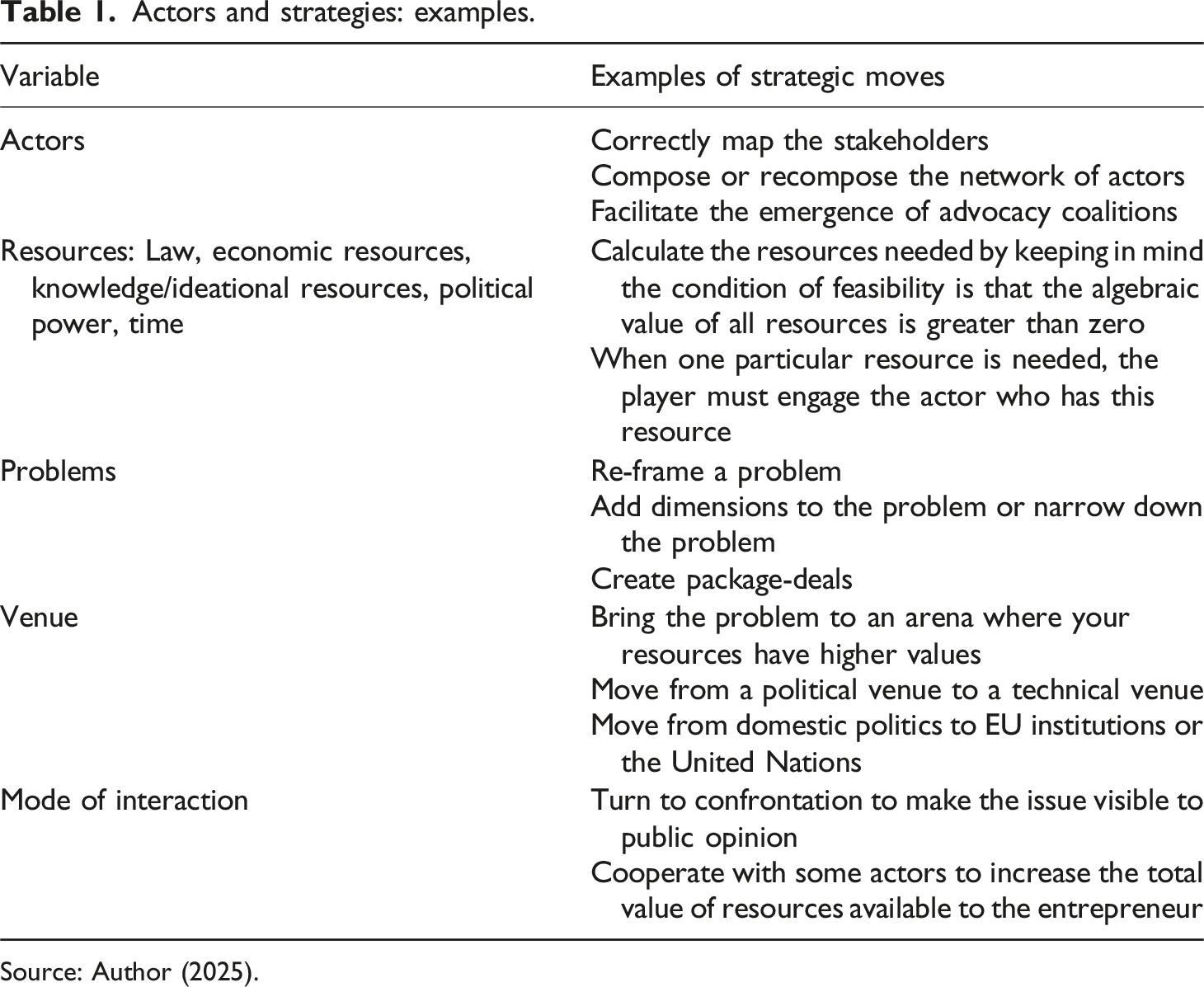
Actors and strategies: examples.
Source: Author (2025).
Further, experts and scientists do not have a single role in the policy process. Depending on the type and phase of the process, they take up different roles (Dunlop, 2014). To illustrate, at an early stage of dissecting an emerging problem, the expert has the role of reducing uncertainty and exposing key causal mechanisms. But when there is already a policy controversy, expertise is a resource contested between alternative coalitions: the policy process is much more adversarial – with the result that the participation of experts and scientists to decisions is, in these conditions, quintessentially political.
Do we have an alternative to the conventional approach? I do not propose a radical alternative, but a complementary approach. Without denying the value of investing in science communication, evidence-rich policy tools, citizen science, and public engagement, I take a different angle, that is, I point to how scientists and advocates of science-informed decisions can intervene in the policy process by leveraging a few, fundamental variables. This is not asking scientists to play ‘party politics’. It is more like playing ‘policy politics’ (Zaki and Dupont, 2024: 26), that is, orchestrating strategies to influence the content of decisions, not to support a political party.
There are many ways to pursue this approach, such as changing the curriculum of science degrees by adding sessions on public policy. This article is about one specific tool: computer games. Much can be said about the promise of gamification of public policy for active learning (Dente and Vecchi, 2024). Playing a game is an immersive opportunity to experience concepts such as actors, strategy, and institutions directly, through the participants’ own participation and reflection, rather than reading about concepts in textbooks (Asal et al., 2018; Heard-Lauréote and Field, 2024; Hess, 1999; McCarthy and Anderson, 2000). There are different types of games, such as computer games and board games. Our suite of games feeds into the literature and practice of adopting games in political science and public policy courses (Shin, 2021 on political science, Sawyer and Rejeski, 2002 on public policy).
Since these questions are presented and discussed at length in the Introduction to this Special Issue, I will not repeat the pedagogical and social-scientific motivations (in terms of theories of decision-making) that informed the design of our project. I must clarify, however, that, in the context of the project, the games presented here are about natural sciences 2 , whilst the overall project has also generated games about decisions in the EU, urban governance, and social policy.
The science games can be played (and indeed have already been played) by public policy and administration post-graduates to increase awareness of science. But when designing the suite, we had in mind a primary audience of post-graduates in the natural sciences, like students taking a specialization track after a degree in medicine or biology. This way – we reasoned – we will be engaging the scientists directly, including would-be scientists who are willing to, or will have to, contribute to policy decisions at some point in their lives. We also wish to talk directly to the young scientists via the games, changing the perception that one should not contribute to any policy process because the scientific input is inevitably neglected or, worse, betrayed, bent to support a political position. 3
Apart from post-graduates, another, secondary, audience is the world of activism and advocacy. And this is a good moment to explain who is the ‘we’ mentioned in the previous paragraph. The science games of this article were developed by a team I coordinated at Science for Democracy (https://sciencefordemocracy.org), an international organization part of the P-Cube consortium. As Science for Democracy, we are often involved in training people mobilized on issues of end-of-life decisions, human rights, and regulation of technologies. Some are young scientists, some are not. Some are in education, some are not.
In terms of organization, the next section presents the conceptual background that led to the creation of a set of five computer-based science games within the P-Cube project. We then look at how the games work. Next, we discuss the learning aims, game by game, before reflecting on the way forward and concluding.
Designing the games
In developing the scripts, we were mindful of the precise historical and geographical context around the project. Indeed, the project was carried out by European universities, with all participants based in the EU. The EU (and broadly speaking, European) context provides a lively debate on the regulation of artificial intelligence, the dangers represented by misinformation and fake news, the troubled attempt to reconcile innovation and precaution, and the need to connect scientific evidence and risk management (Meads and Allio, 2016). This context is also characterized by communication deficits. In the meantime, we have learned from valuable empirical studies about the variables that stymie or facilitate the usage of evidence in policy decisions (Cairney and Oliver, 2017; Oliver et al., 2014). Games and active learning have become very present in the recent discussion on how to teach European and EU politics and public policy (Heard-Lauréote and Field, 2024 on simulations and more generally games, on active learning see Bijsmans, 2024).
We did not have to start from scratch, then. At the same time, other contexts would have probably suggested other points of departure. This does not mean we could not look at examples coming from other countries, like the USA for the psychedelics game – but, inevitably, the lessons learned from these examples were calibrated in the European context. Familiar with this context, we set out to develop a set of games taking inspiration from real-world cases but adapting the events to the characteristics and narrative arc typical of a game. We also delivered a literature review on science and public policy, a teacher’s handbook for each game, and a prototype of a stand-alone course integrating all science games as deliveries for P-Cube (https://www.p-cube-project.eu).
The P-Cube science games are: (a) Psychedelics (b) Tobacco (c) Facial recognition technology (d) End of life (e) The right to science
These five games are played by individuals, or small groups, on computers, in any case with the presence (in person or online) of the instructor. We thought free accessible games would be cheaper and easier to access than board games. The students-instructor relationship during the game sessions and beyond is essential to facilitate active learning and interactive pedagogical methods (Alford and Broch, 2013). This relationship is particularly important in games that cover complex issues and allow for multiple layers of reflection, as will be shown below. Importantly, we did not want to present just one story, that is, our story. As Science for Democracy, we definitively have our beliefs, but the games are designed to open up conversations, debates and why not contestation on normative and ethical issues, like the legitimacy of working with Big Tobacco, the ethical issues of regulating euthanasia, and the stigma surrounding psychedelics.
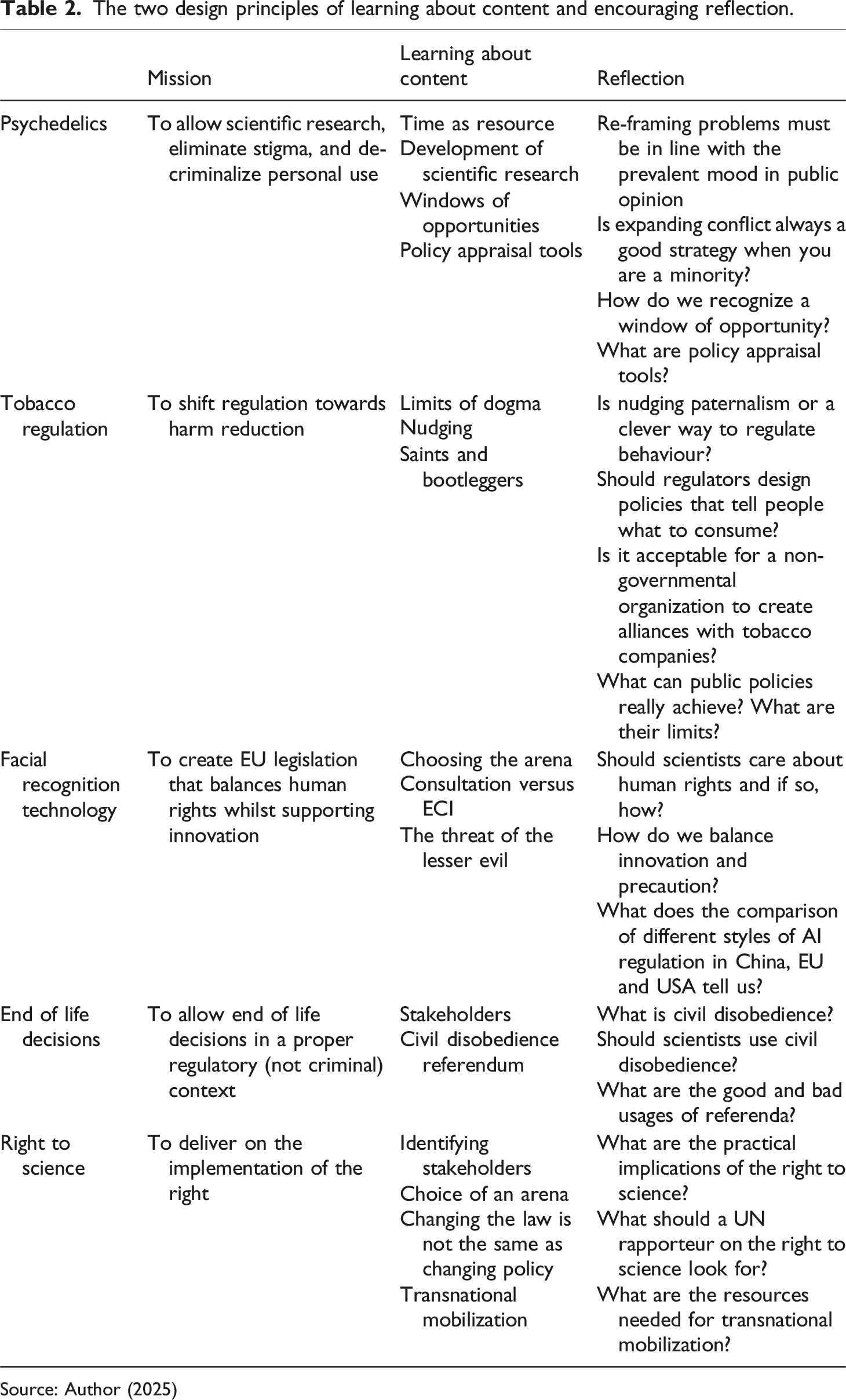
Like all P-Cube games, ours are not simulations. Neither are they negotiation games, where a group negotiates with another group. Each game is played first, in a session between 25 and 45 minutes, and discussed in a second reflection session. The two key design principles are to facilitate learning about the key variables to shape policy, and to encourage reflection. We presented and piloted the games in different contexts across Europe: at public events dedicated to engagement with science, in conferences and congresses of activists for science, during executive courses on the role of evidence in policy decisions, to science students, to post-graduates taking courses on governance, and the Policy Leaders Fellowship program of the European University Institute (https://www.eui.eu/apply?id=policy-leader-fellowship).
Having clarified that, what do players do in the five science games? Two design concepts are key: the mission and the identification of the player with the policy entrepreneur. Each game revolves around a mission assigned to a policy entrepreneur 4 . The entrepreneur is given a mission in each game. Hence we are talking of five missions. The mission is defined in terms of outcome, in the sense that the mission is about achieving policy decisions that match preferences about policy reforms. In each step, a move is feasible if the total value of resources is greater than zero (with some exceptions dictated by the nature of the move). Otherwise, the strategy is not feasible and the player has to re-consider the choices available. In a few cases, we find process-related preferences. For example, the entrepreneur is more likely to choose one strategy because it is less intrusive with individual choices than others (nudging instead of command-and-control). This variation has allowed us to incorporate an important distinction made by Dente about actors with content-related preferences and actors with process-related preferences (Dente, 2014).
The policy entrepreneur is the only actor who learns by receiving feedback at each stage. This is a big simplification, since all actors may learn in the real-world process of policy change. However, as Dente (2014) argues in his book, we need ‘one perspective’ to look at public policy, we cannot be above all perspectives of all actors. Also, in practical terms, we found too much complexity in terms of programming the games when trying to model the learning processes of other actors that populate the missions.
Now that we looked at the entrepreneur, let us see what this actor can do. The player-entrepreneur’s decisional strategies revolve around a finite, theory-justified number of fundamental variables (Dente, 2014): the actors, the resources available, and the institution(s), forum or venue where the strategies play out, step after step. The social construction of problems (Dente, 2014) and target populations is the fourth fundamental variable (Schneider and Ingram, 1993, 2019). The fifth variable to be considered in building strategies to influence policy is the mode of interaction, that is, confrontation, bargaining, or cooperation.
These are the only elements with which a player can build the strategies to make progress in the missions. They vary in the sense that they can be manipulated by the policy entrepreneur. Table 1 provides an exemplification. Resources can be political, legal, ideational, and economic. Time is another resource. The value of resources changes depending on the forum or venue – knowledge resources may have higher values in a submission of evidence to an independent regulator than in a heated political debate on the parliamentary floor. The policy entrepreneur can be an individual or a collective entity.
Let us briefly look at the missions - game by game. In psychedelics, the mission is to guarantee freedom of scientific research and a gradual process of making these substances available for medical use (in the early stage), and, in the final stage, regulated but available also for leisure. The initial stages follow an evidence-informed policy agenda, the final stage is more clearly political.
Tobacco regulation revolves around the mission of bringing about legislation to differentiate between the damage caused by cigarettes and the dogmatic ‘tobacco kills’ posture, showing how public policy should avoid dogma. The mission of this game is to reduce harm and to benefit from scientific research on tobacco. Controversially, one step of the game involves collaboration with Big Tobacco. Facial recognition technology is based on the EU context, where the advancements of science and technology must be balanced with the protection of fundamental rights – this is the mission. This game allows participants to explore the policy process of the EU.
The end-of-life decisions game was designed to raise attention to both civil disobedience as strategy and strategic litigation in courts. The policy entrepreneur has the mission to influence decision-makers to allow free, ethical end-of-life decisions. Since there are limits in mobilizing Members of Parliament, after having tried a referendum in the end it is a combination of civil disobedience and strategic litigation that allows the policy entrepreneur to accomplish the mission.
Finally, ‘right to science’ is our sort of master-game, the complex game that contains the philosophy of defining the role of science in public decisions. Along the way, the entrepreneur must define the right, map stakeholders, find the most suitable policy forum, distinguish between technical and political decision-making processes, and orchestrate non-governmental organizations as ‘vigilantes beyond borders’ (Eilstrup Sangiovanni and Sharman, 2022).
Missions
We can now look at the missions, bearing in mind the two design principles of learning about the content and encouraging reflection.
Psychedelics
Timing, re-framing and coupling
This mission brings attention to time as a resource. In the first steps, the players are confronted with the situation created by the War on Drugs and the criminalization of psychedelics. Over time, there are opportunities to redefine the problem by broadening how the issue of psychedelics is understood, not only as usage of prohibited substances, but importantly as a limitation to freedom of scientific research that can help veterans with post-traumatic stress disorder. Given that veterans have a positive image profile (Schneider and Ingram, 1993), the player has to focus attention on how psychedelics can help those veterans suffering from post-traumatic stress disorder. Another association that becomes possible over time is between the use of these substances and mass incarceration of people from racial minorities. The entrepreneur must wait for the moment when problem re-definition becomes feasible in the public discourse.
Another re-framing or coupling move then appears with the COVID-19 pandemic. The pandemic aggravates mental health issues. Psychedelic compounds emerge in the narrative arc as a promising way forward. Thus, there is renewed attention to the medical usage of psychedelics. This climate creates the conditions for the final policy change - orchestrated by the policy entrepreneur by pushing for de-criminalization, science-based regulation, and medical utilization.
The development of scientific research
Over time – the narrative in this game goes - an increasing number of scientific studies expose the promise of psychedelics in the treatment of mental health conditions such as depression, post-traumatic stress disorder, eating disorder, anxiety, and substance use disorder. The participants learn about the evolution of science through conjectures and confutations. In the reflection phase of the pilots, we contrasted the time patterns of changes in science with the time patterns of democratic politics, based on relatively short electoral cycles. We also looked into Kingdon’s independent streams of policy solutions (in our case solutions originated by scientists), politics, and problems (Kingdon, 1984). Pedagogically, the game drives home the lesson that although windows appear randomly, the key strategic issue is how to exploit them. Windows of opportunity exist, at least potentially, most of the time, but few are seen, recognized, and even fewer exploited.
The role of evidence-rich tools
A final intended learning outcome concerns the role of evidence-rich tools, specifically, in this mission, regulatory evaluation and impact assessment of proposed legislative changes. Here the class has an opportunity to reflect on the importance of connecting the battle for freedom of scientific research with appraisal tools concerning the empirical, social science analysis of existing and proposed policies (Jordan and Turnpenny, 2015). The message for the scientists playing the game is that they need to embrace the logic of these policy instruments and use them.
Tobacco
Scientific evidence and harm reduction
Can we have too much of a good thing, that is, in our case, scientific research leading to policy decisions about harm to health caused by tobacco? This mission is set in Dogmatia, a fictional country of the Global North. Public opinion is strongly for restrictions on tobacco. Over the years, the government of Dogmatia has introduced increasingly restrictive regulations. They are now talking about adopting a zero-smoker target for new generations. The policy entrepreneur is a member of a civil society organization that seeks to align regulation with scientific facts. Like Science for Democracy, this fictional organization adopt a libertarian view that the state should not tell people what to consume. Rather, the proper role of public policy is to reduce harm. The mission, then, is to turn public opinion from prohibitions towards harm reduction. This requires a major re-framing of the public discourse. The mission also includes changing policy to allow research on tobacco-as-plant positive properties (as well as negative, of course). Harm reduction (in the instructions of this game) means accepting that some people want to smoke, and the job of the government is to minimize the harmful consequences of this behaviour.
The first, preliminary and basic point the game makes is about recognizing in policy decisions the findings of scientific research. On this account, we reasoned with the class in the pilots that the evidence of tobacco damaging our health has been taken into consideration. Dogmatia – we said - seems to do well with its limitations concerning age and places where tobacco can be consumed. Then, the narrative arc complicates the picture: to begin with, Dogmatia’s diffuse stigma around this plant, widely shared in the Global North, has distributional consequences for some Indigenous populations of Latin America, since for them tobacco is a sacred plant. They have few resources and no obvious constituency in the Global North. And stigma does not resonate well with science. Another consequence is that Dogmatia’s stigma on tobacco may hinder research on the benefits of this plant.
Nudging
In developing a strategy to influence decisions, the policy entrepreneur seeks to shift Dogmatia’s policy towards nudging (Thaler and Sunstein, 2009), reducing the attractiveness of tobacco packaging, without actively prohibiting people from buying cigarettes. In our pilots, the nudging strategy was used to learn about process-related preferences and content-related preferences (Dente, 2014). Nudging is process-related in that, it shifts policy from more to less interventionist trajectory – even if in terms of content both prohibition and nudging have the same goal of reducing tobacco consumption.
Network building: saints and bootleggers
The following steps go in the direction of content-related preferences. The entrepreneur must identify strategies to attack the stigma surrounding the public perception of tobacco. Frames are structures of beliefs that underlie policy positions (Schön and Rein, 1994). Attacking stigma is a conceptual activity - a battle of ideas, so to speak. This draws attention to ideational resources. Yet to move further into the game with sufficient resources, the entrepreneur must be able to orchestrate networks. This means the identification and creation of an advocacy coalition with sufficient resources overall, not just ideational resources.
Effectively in the final moves the player composes a network reaching out to scientists with public profile, anthropologists with knowledge of Latin-American culture, advocacy organizations, and, controversially, to Big Tobacco – multinational companies in the tobacco industry. The latter have considerable amounts of economic resources. They can easily initiate new laboratory research into tobacco. The idea that the tobacco plant can be used to discover a new vaccine against COVID-19 in the middle of the pandemic provides political ammunition to those who are trying to demolish the stigma surrounding the plant. This coalition between ‘bootleggers and saints’ gradually changes the framing of the problem, brings to the table new resources, and eventually the time for a new harm reduction idea comes.
The strategy involves campaigning, mobilisation, and coalition-building. In the pilots, this has triggered a reflection on the empirical and normative value of creating a coalition of odd fellow travellers, including anthropologists, scientists, and tobacco companies. 5 Apart from the limits imposed by the World Health Organization, is it acceptable to build alliances with tobacco companies? Is the whole harm reduction discourse driven by corporate interests (Levy et al., 2023)? Reflection can be radical to the point of contesting the presuppositions behind the mission assigned to the policy entrepreneur. Finally, we found that there is scope for a broader, normative debate on the limits of public policies. Should public policies change what people are, and create a society with no tobacco consumption?
Facial recognition technology
Choosing the correct arena
In Facial Recognition Technologies (FRT) the policy entrepreneur is a non-governmental actor. The mission this time is to balance innovation with the protection of human rights. FRT is set in Watchopia, a democracy where non-governmental organizations are concerned about human rights issues raised by new technology. This is because in Watchopia there are no rules on how companies, governments, migration agencies and local authorities use FRT. Watchopia is a member state of the EU. This game is appropriate for courses where participants are first introduced to the policy process of the EU, and then play this game. The policy entrepreneur approaches FRT with the belief that artificial intelligence must be trustworthy and respectful of human rights.
Arenas and instruments
The initial moves are about the identification of the correct institutional venue for regulation. In the early phases of the mission, the policy entrepreneur seeks to gain some advantage at home, by limiting the most exploitative usages of FRT – courts and independent regulators are therefore the arenas sought by the player. For example, the policy entrepreneur targets for judicial review the unjustifiable exploitation of this technology in migration policy.
But Watchopia’s courts can only act on a few modes of FRT utilization. To move closer to the accomplishment of the mission, the entrepreneur must bring action at the EU level. In the storyline, the Commission tables a proposal to regulate FRT, and calls for evidence. The instructor here explains the consultation stage of policy formulation processes. In the pilots, showing the call for evidence portal of the European Commission triggered questions about its clarity and accessibility.
Later in the game, the policy entrepreneur encounters a phase when activists for human rights launch a European Citizens’ Initiative (ECI) that would block most if not all usages of the technology. The player-policy entrepreneur is called to balance the need to protect human rights with the positive role of innovation, and consequently (the story goes on) decides not to follow this Initiative but, rather, to intensify pressure on the European Parliament and the Council of the EU. It is in this context that the policy entrepreneur finds the proposal of the Commission as ‘the lesser evil’: better than the stalemate in the EU legislative procedure (Council and Parliament are hostages to the big tech lobby), and better than a confrontation on an ECI that is supported by more than one million citizens. The conceptual background for this move was taken by Suzanne Schmidt (2000), who wrote about the power of the lesser evil in EU decision-making processes.
In terms of reflection in the pilots, we reasoned that both the ECI and consultation are opportunity structures for participation, but they have different rules. Their logic differs. We reflected on whether participatory instruments are better than representative institutions or whether they complement and strengthen each other. The presence of courts and independent regulators in the early stages leads to arguments about whether scientific arguments are better heard in non-elected institutions – which would imply the paradoxical conclusion that ‘democracy does not like science’.
Technology, innovation, and human rights
In the reflection phase of our pilots, we (as instructors) put in front of the class the argument that to be ‘on the side of science’ does not mean to ignore the human rights issues raised by technology. If anything, with this mission the participants learn that we need a human rights compass when we approach science and technology. After all, the very right to science is a human right – which means that even the fundamental right to science is grounded in a human rights framework. The argument was not contested, but the discussion went in the direction of its implications and meanings in different cases.
End-of-life
Stakeholders, mass arenas, representative arenas
Technical progress and scientific research developed in the past decades – assisted nutrition and hydration, but also tracheotomy - allow for a set of ‘vital supports’ for those patients in need. The right to choose thus becomes also the right ‘not to choose’ aggressive treatments. This emerging right is about allowing patients to decide, when they are sustained by vital supports in an irreversible way and are no longer autonomous, to end their lives. The mission is to change domestic laws that classify these decisions as criminal offence. The scene is set in a Catholic country where this is a divisive issue also for the left, who has many Catholic voters. The context is definitively tough.
This mission is modelled on the Marco Cappato case in Italy (Montanari Vergallo, 2019). 6 Who are the stakeholders in this mission? It is easy to imagine the stakeholder of the end-of-life decisions: all of us, independently from the political and religious beliefs we may hold, may end up in a situation where a friend, a relative or ourselves must make these decisions. But without mobilization - this is the logic of the game - we are all silent stakeholders. We need organization. We need exemplary acts. The various phases of the game drive the participants towards a more specific identification of those who can be actors in bringing about policy change.
Once the participants learn about the stakeholders, the screens appearing in succession point to the use of resources in two different arenas. One is the classic arena of parliamentary institutions. It is easy to think that if a policy must change, the parliament should do it by changing the law. However, this type of change requires some pre-conditions that, as the dynamics and twists of the game show, are often absent. Another arena exists in some countries, like California, Italy and Switzerland, where referenda can be called by a certain number of citizens. This is the mass arena. One particular rule of this mass arena in Italy is that unless 51% of those with the right to vote show up, the outcome of the referendum is not valid. This rule is factored in the game.
The crucial learning point when the participants use the mass arena of the referendum is that the intense preferences of those who call the referendum differ from the weak preferences of the large majority of the citizens. The latter prefer not to get out and cast their vote, because they cannot picture themselves as stakeholders, they do not ‘see’ that they too are stakeholders. The referendum does not reach the threshold for validity. What happens next?
Civil disobedience
Civil disobedience as strategy enters the game to allow the entrepreneur to reflect on its content and appropriate usage. This strategy is missing in classic textbooks on public policy. Yet history shows that civil disobedience is a powerful lever for fundamental change. When and how to draw on civil disobedience depends on a set of conditions that can be discussed in the reflection phase. This mission, as mentioned, is modelled on the Cappato case: like Cappato, the policy entrepreneur takes an individual with chronic, terminal conditions who wants to terminate his life from Italy (where this is a criminal offence) to Switzerland, where there is no prohibition. Upon return to Italy, the policy entrepreneur self-reports to the police, asking to be prosecuted to expose the unfairness of the current criminal code and to defend the ethical and political foundations of civil disobedience. The court acknowledges the ethical motivations behind the act of civil disobedience and calls on parliament to change the provisions of the criminal code.
Turning to reflection, in the pilots, we encouraged discussion on the connection between mass political arenas and representative arenas. What ‘do referenda do’ in contemporary societies? Can they exist alongside traditional forms of representation, like parliamentary institutions? Why do some countries have referenda and others do not? What does the experience of the Brexit referendum tell us?
The most original issue in the pilots, was, of course, reflection about civil disobedience. What is it, under which conditions is it legitimate to activate it? What is the difference between principled and tactical nonviolence? Can everyone be a civil disobedient? Is it true that even a single person can change a policy, and if so, why does not this happen all the time? What about civil disobedience by scientists (Capstick et al., 2022)? 7
The right to science
Identifying stakeholders
When we talk about the right to science, 8 it is not easy to imagine who can be a stakeholder, that is, how to identify those who may have a stake in this right. This game drives the policy entrepreneur towards the identification of the right set of stakeholders, correcting conceptual mistakes that are easily made. The mission is inspired by a recent commentary on the right to science (see Committee on Economic, Social and Cultural Rights, 2020; Romano and Boggio, 2024).
Learning about resources in different arenas
During the first part of the mission, the policy entrepreneur decides whether to activate national or international arenas: at this point, in the pilots, we posed this question: what do you know about international institutions and their mandate? Why the United Nations (UN)? What is the Universal Declaration on Human Rights? And more importantly, how do arenas / institutions make (or do not make…) their statements about universal rights concretely accessible to citizens?
In the second set of strategic moves, when the player has already moved to the UN, the game makes a crucial distinction between technical arenas and political arenas – where the same resource weighs differently (see Table 1). These two types of arenas may exist within a single institution. The players discover how technical bodies of the United Nations are more relevant to the mission, because within these bodies knowledge resources matter more than in the ‘political’, inter-governmental General Assembly. The same resource matters more or less - depending on whether we are in the General Assembly or in a specialized, lawyers-driven committee. At the end of a series of moves, the entrepreneur obtains a commentary on the right to science, mirroring what happened in reality in 2020 (Committee on Economic Social and Cultural Rights, 2020).
Changing the legal framework is not the same as changing the policy
The two design principles of learning about content and encouraging reflection.
Source: Author (2025)
Conclusions
How can we increase the role of science in democratic, transparent, evidence-informed policy processes? Although we often see this as an issue of educating politicians and bureaucrats about how science works, I have explored another pathway, that is, to facilitate the learning process of young generations pursuing evidence-informed policy. The instruments for this broad objective are surely many. I am not arguing for the superiority of games. We cannot tell at this stage whether they work better or worse than other tools, not even in the single controlled environment of a university - unless one looks at the impact on learning for a sufficiently long period of observations and students’ evaluations. Most likely, to produce effects, these games have to feed into an ecology of innovative learning and assessment instruments, including case studies, testimonies, field visits, and so on.
With these limitations, the games show original strategic pathways based on a limited number of variables that can be manipulated. Indeed, one aim of the science games is not to scare those who do not know about policy processes by adopting too many concepts and complicated models. This contribution is also original in terms of theorizing science-informed decisions as essentially contestable territory: civil disobedience most of all, but also other strategies involving ethical and normative debates about the proper role of public policy and science. Advocacy for science can be a controversial and politically charged activity.
Now that the games exist, the next step is to gather data on whether the participants really learn, what they learn, under what conditions (playing with activists is different from playing in a class of post-graduates), and what they think they will do in the future with what they have learned. In terms of learning about the content, we must move beyond questionnaires on the experience of playing the game (whether it was fun, or difficult, or anything else) and ask participants questions about the understanding of policy decisions and policy processes. Quasi-experimental conditions can assist us in establishing whether participants learn more or better when playing the games, as opposed to those who are exposed to classic lectures and group presentations. Students may learn the same content differently than activists. It is also valuable to collect data about the quality of reflection, since this is, together with learning about content, a fundamental design principle. With all these options open, we are just at the beginning of an exciting path.
Footnotes
Acknowledgements
I contributed to the P-Cube project in my capacity as an active member of Science for Democracy. I wish to thank the team that worked with me in developing the scripts: Aziz Bagadirov, Virginia Fiume, Marco Perduca, Carla Pisi, and Gaia Taffoni. Gaia also took part in pilots and presentations to students, public managers, advocacy organisations and international conferences, where we received precious feedback. Simone Busetti, Anna Malandrino, Mina Sotiriou, Giancarlo Vecchi and the reviewers provided comments on different iterations of the draft. The usual disclaimer applies. The idea of ‘explaining the policy process to scientists’ originated from my conversations with Peter Biegelbauer and Thomas König. Bruno Dente was a constant source of inspiration for this endeavor, I wish to dedicate this article to his memory.
Declaration of conflicting interests
The author(s) declared no potential conflicts of interest with respect to the research, authorship, and/or publication of this article.
Funding
The author disclosed receipt of the following financial support for the research, authorship, and/or publication of this article: This work was supported by the Erasmus + (Project number: 2020-1-IT02-KA203-07963).
