




Abstract
Neighbourhood planning in the UK is a striking example of the international turn to localism and public participation, the statutory weight afforded to it setting it apart from many other initiatives. Its promoters portray it as a straightforward transfer of power from state to community. However, its legitimacy relies upon complex, hybrid forms of representative, participatory and epistemological authority. A growing literature is interrogating the relations between neighbourhood planning groups – the collectives utilising these new powers – and the neighbourhoods for which they speak. This paper brings empirical evidence forward to build on such work by exploring how the identities of neighbourhood planning groups are constituted. Three different and sometimes conflicting relational identities are characterised. Each identity is associated with particular material relations, types of knowledge and ways of representing the neighbourhood, and consequently produces different forms of legitimacy. Analysing identities in this way aids understanding of the practices through which legitimacy is achieved in experiments in democracy that rely on hybrid forms of authority. It may also open possibilities for intervention that speak to some of the concerns raised in the literature about these hybrid forms.
Introduction
Claims to be shifting power downwards and outwards from the state to local communities, and thus increasing citizen participation in decision-making, are commonplace in late Modern democracies. Rationales for this trend are long established (e.g. Fiorino, 1990; Heinelt, 2018) – as are its critiques (e.g. Albert, 2016; Cooke and Kothari, 2001). Various initiatives in the UK have reflected this international trend over the past decades (Connelly, 2011b), with a raft of new ‘community rights’ introduced by the Localism Act 2011. While heavily criticised as a cynical drive to impose neoliberal policies of austerity (Kisby, 2010; Lowndes and Pratchett, 2012), some of the resulting initiatives offer useful lenses to reflect on claims of community empowerment. Neighbourhood planning is one such experiment in democracy with a particularly spatial focus.
Described as ‘arguably the most radical innovation in UK neighbourhood governance in a generation’ (Wargent and Parker, 2018: 379), neighbourhood planning allows community groups to write their own planning policies for the first time. After completing a prescribed process (including designation of the plan area by the Local Authority, extensive consultation, independent examination, and a local referendum) (see Bailey and Pill, 2015 for an overview), adopted neighbourhood plans become part of the statutory development plan. This means that planning applications must normally be made in accordance with them, and this statutory weight sets it apart from previous reforms intended to foster citizen participation and empower communities. Neighbourhood planning was portrayed as an antidote to a planning system that had become too complex and technical, and which was only really accessible to professionals and those with the resources to hire them. It promised to widen the sources of knowledge and ways of knowing that would inform planning (Bradley, 2018), enabling affected communities to make their own decisions about how their areas should change: a fundamental and long overdue rebalancing of power, away from the centre and back into the hands of local people… as planning shifts away from being an issue principally for “insiders” to one where communities take the lead in shaping their own surroundings. (The Conservative Party, 2010: 2)
A growing literature is interrogating the relationship between the neighbourhood planning group (the collective that leads the work of developing a plan, henceforth NPG) and the neighbourhood for which they act as ‘spokesperson’. The concerns of this literature centre around whether and how NPGs represent their neighbourhoods and how different kinds of democratic and participatory processes are thereby enhanced or undermined. It tends to take neighbourhoods, NPGs and their relations as relatively singular and coherent, whether pre-existing or brought into being through the doing of neighbourhood planning. In contrast, this paper focuses on the non-coherence and fluidity of an NPG’s identity. It seeks to build on previous work by exploring how this multiple collective identity is constituted in relation to the neighbourhood. Based on long-term ethnographic research and using theoretical resources drawn from science and technology studies (STS), it takes a performative and co-productionist approach to questions of identity, representation and legitimacy (Chilvers and Kearnes, 2016). Analysing the NPGs in this way can help understand the practices through which legitimacy is achieved in this and other experiments in democracy that rely on multiple forms of representation and participation to justify their validity. It also opens possibilities for intervention that speak to some of the concerns raised in the literature about these experiments.
Neighbourhoods and NPGs
Neighbourhood planning invites citizens to ‘autonomously assemble, define the spatial extent of their neighbourhood and author a plan for it’ (Lord et al., 2017: 344). A number of authors have noted that this entails the production of a significant new actor or collective identity: ‘the neighbourhood’, as a new and particular instantiation of ‘community’. Neighbourhood planning is productive, not just descriptive, of the neighbourhoods to which it refers (Bradley, 2015; Brownill, 2017). However, not all citizens in any given area will be involved in such assembling, defining and authoring. They are all entitled to contribute to the plan’s development, vote in the final referendum and be active members of the new polity. However, only two types of body are able to initiate a neighbourhood plan – a Town/Parish Council in areas where there is one, or a specially constituted Neighbourhood Forum where there is not. But these ‘Qualifying Bodies’ often do not actually make the plan themselves – this tends to be undertaken by an NPG that may include some (or no) members of the Qualifying Body. It is the NPG that takes up the new powers available to ‘the neighbourhood’; they lead the community-led planning. So the process simultaneously produces at least two significant new actors: the neighbourhood as a particular instantiation of community and the NPG as its ‘spokesperson’ (Callon, 1984). This raises questions about the extent to which the NPGs can be said to legitimately represent their neighbourhoods.
Some have argued that NPGs are little more than new vehicles to legitimise the imposition of externally decided objectives on local communities (Haughton and Allmendinger, 2013), while others suggest they will empower the already relatively privileged within communities (e.g. Wills, 2016). Parker et al. (2014, 2015, 2016) have pointed to the powerful influences that external actors such as Local Authorities, consultants and independent Examiners have over the process, and the limiting effect this may have on community ownership of plans. Bradley (2015: 98) has examined the ‘unsettled accommodation’ between participatory, representative and market models of democracy which combine in the relationships between NPGs and neighbourhoods. Sturzaker and Gordon (2017) analyse the tensions between the varying claims to legitimacy of the different actors in neighbourhood planning, arising from the sources of their claims: direct democratic voting, direct citizen participation, and formal or informal representation of the community. Connelly (2011a), investigating analogous situations, concluded that the defining characteristic of new, localist forms of governance such as neighbourhood planning is precisely this hybridity in drawing on different sources of representative legitimacy. These different sources are in tension and combine uneasily, requiring new forms of analysis and norms of evaluation to fully understand their nature.
Davoudi and Cowie (2013) discussed the democratic legitimacy of neighbourhood forums, contrasting them with Parish Councils, which formally represent their communities as elected bodies. However, while Parish Councils retain formal ownership of a plan, they do not directly take on the powers of neighbourhood planning, which are wielded by the NPG. Even where NPGs are constituted as sub-committees of Parish Councils, bequeathing them the legitimacy of representative democracy, they may develop distinct identities and outlooks from their ‘parent’ Councils and even come to see themselves as quite separate entities, weakening this claim (Parker et al., 2018). Furthermore, the essence of neighbourhood planning is as a participatory process: a new form of governance that moves beyond representative democracy even while operating alongside it. The intention to bring planning closer to the people inherently requires even NPGs constituted in this way to go beyond a nominal (and often flawed (Gallent and Robinson, 2013; Tewdwr-Jones, 1998)) formal representativeness to establish their legitimacy through their representations of neighbourhood. The requirements on NPGs not only to produce plans and evidence that can withstand independent examination and sometimes hostile attack from well-resourced vested interests (Parker et al., 2016), but also to engage widely and deeply with the community and for the subsequent plan to be approved in a local referendum, necessitate recourse to these hybrid forms of representation and legitimacy. Both cases discussed in this paper have passed examination and referendum and been ‘made’ by their Local Planning Authorities, demonstrating formally sanctioned legitimacy. One or more of these obligatory passage points (Callon, 1984) would be failed – a successful translation would not be made – if, for example, an NPG just commissioned a consultant to make a plan with no further input from them, or if they failed to engage widely with the neighbourhood, or failed to engage appropriate technical knowledge.
Research design
This paper is based on long term ethnographic fieldwork in two locations in Northwest England – Wroston and Oakley – from 2015 to 2018. The data have been anonymised, with all names, places and other identifying features disguised. I began attending regular fortnightly meetings of the two NPGs in February 2015. Both had recently had their Neighbourhood Plan Area approved by their Local Authority and were beginning plan preparation in earnest. Both plans had been initiated by Town/Parish Councils. Oakley's NPG was made up of a mixture of parish councillors and volunteers; Wroston's was entirely made up of volunteers when I first joined them, although three parish councillors came to play significant roles later. Oakley is a small coastal town with a population of just over 4000; Wroston, a small rural village with a population of around 530 (Office for National Statistics, 2011). Wroston’s plan was mainly concerned with delivering sufficient housing to enable the village to grow organically, provide affordable homes for local people and retain its services (shop, pub, etc.), while resisting proposals for large-scale development on two sides of the village. Oakley's plan focused on integrating already allocated development sites into the town in terms of transport, character and amenity; protecting small urban greenspaces; economic development; and delivering affordable housing and housing for elderly people in appropriate locations. As I started working with them, both groups engaged consultants on whom they initially relied heavily. The consultant remained a dominant figure through the process for Oakley but became much less central in Wroston whose NPG decided to spend their limited funds on a specialist landscape architect.
As a participant-observer I became deeply embedded in the NPGs and took a full part in the life of the groups, engaging in both formal discussions and casual conversations before, during, after and away from meetings, and undertaking work with and for them on developing their plans. As well as regular meetings, this included frequent email and phone conversations; carrying out tasks individually and collaboratively between meetings; and attending meetings between NPG sub-groups and other key actors (e.g. developers, Local Authority officers, consultation events). I took fieldnotes by hand during meetings, and audio-recorded NPG meetings from July 2015. Handwritten and typed-up fieldnotes were cross-referenced with recordings and with selective transcriptions. I chose ethnographic methods to trace, in fine-grained detail and in situ, the practices through which legitimacy was performed and achieved (Atkinson et al., 2007). I wanted to be able to access the practices themselves, rather than accounts of practices, and to observe first-hand how different knowledges and relations were made visible (articulated, recorded and translated into evidence) or invisible (ignored, rejected or taken for granted) (Law, 2004).
In this methodological approach and in interpreting my observations, I draw on ‘post-Actor Network Theory sensibilities’ and related approaches from the field of STS (Law, 2008a, 2008b; Singleton and Law, 2013) that invite us to analyse the world in ways that decentre conventional causal explanations, and understand the material and the social world to be inextricably intertwined. The implications of such sensibilities are as follows. Each entity (object, subject, concept, etc.) only emerges – acquires its particular form and character – as an effect of the specific network of socio-material relations in which it finds itself: it is a precarious, heterogeneous assemblage that requires work to establish and maintain (Latour, 2005). This work is done by material as well as social ‘agents’ – the non-human world (including, for example, landscapes, technologies, policies, reports, imaginaries, etc.) is ‘lively’ (Haraway, 2016) rather than inert or passive, and has ‘agency’ (Latour, 2005), understood as the ability to have effects. This all implies that ‘the ways in which we know and represent the world (both nature and society) are inseparable from the ways in which we choose to live in it’ (Jasanoff, 2004: 2). How we produce and represent knowledge, including the material forms of knowledge production, stabilises and supports particular ways of being in the world: institutional forms, social practices, identities, etc. These in turn act to support and stabilise particular material knowledge practices and types of knowledge. This process is always already ongoing and has performative consequences: it shapes what we (can) know and how we (can) live, as these consequences sediment down and become more stable, more apparently fixed, natural and given.
From this perspective, researchers (and planners!) do not just describe realities, but enact them: knowing and describing ‘are part of a practice of handling, intervening in, the world and thereby of enacting one of its versions’ (Law and Mol, 2002: 19). This also entails a recognition that all knowledge is partial, incomplete and situated in a particular historically contingent position, specific to the material practices, conceptual frameworks and institutional structures in which it is produced (Haraway, 1988). Different practices of knowing enact different objects of knowledge (such as neighbourhoods) and subjects (such as NPGs). ‘The’ neighbourhood or NPG (for example), as enacted through different material practices, are collections of overlapping, partially coherent, distinct but not separate entities. They are multiple: ‘more than one, less than many’ (Mol, 2002: 84). This kind of theoretical perspective helps to explore how processes such as neighbourhood planning produce not just plans and evidence, but also identities. And it helps to show how the kinds of worlds that can be expressed depend on the framing of the process, the practices it entails and the identities that it creates. These are explored below.
The multiple identities of NPGs
The identity of the NPG is defined primarily in relation to the neighbourhood for which it is a spokesperson: that is its raison d’être. However, in neither case study was the collective identity of the NPG singular or unified. Both NPGs performed the same three strikingly different identities in relation to their neighbourhoods: identities which implied ways of being in the world that were at least in tension and often contradictory. By ‘performed’, I do not mean to imply a deliberate performance; rather, I am relying on the idea of ‘performativity’ (Barad, 2003). These were realities that were being enacted into being. In this sense, identity is something that is done, continually in the process of being made, rather than simply existing. These identities were enacted across a wide range of situations: in the NPGs’ own meetings, in casual conversations, in meetings with other actors and at public consultation events; in the inscriptions the NPGs produced – draft plans, minutes, emails, publicity, evidence documents, etc.; and in the inscriptions and discourses of other actors (e.g. national and local Government, neighbourhood planning support organisations, consultants, publics). Broadly speaking, these identities could be defined as being:
Each identity relied on and enacted different material relations and types of knowledge through different practices. Consequently, each enabled different kinds of representation of neighbourhood – different versions of neighbourhood – in the plan and its evidence base. They thus afforded different sources of legitimacy, such that they collectively enabled the NPGs to come to what Chilvers and Kearnes (2016: 1) describe as ‘the often partial accommodation of competing forms of moral, political and epistemological authority’ – the difficult balance between expert knowledge, popular representation and the right to be involved in decision-making. In the following sections, I explore how the knowledge or representations (i.e. portrayals) of neighbourhood enabled by each identity conferred the legitimacy to represent the interests of, or appropriate trajectories for, the neighbourhood so portrayed. Being an embedded and embodied part of the socio-material neighbourhood involved portraying themselves as an extension of it, enabling them to legitimately represent its interests as a result of their deep and intimate association with it. Being impartial conveyors of the neighbourhood’s views and knowledge involved portraying the socio-material experiences of their neighbours in a disciplined and ordered form, enabling them to legitimately represent their interests as a result of robust consultation and engagement processes. Being detached and distanced from the neighbourhood involved portraying it through the use of technical devices and the production of inscriptions associated with expertise, enabling them to legitimately represent its interests as a result of the production and application of credibly objective evidence.
As each identity is only able to draw on one of these sources of authority (all of which are only partial sources of legitimation), it was necessary for the NPGs to make the three conflicting identities hang together somehow as a durable identity-multiple – more than one but less than many (Mol, 2002). But due to the tensions between them (e.g. the identities ‘in’ and ‘apart from’ the neighbourhood could be seen as each other’s constitutive other (Hall, 1996)), it was also necessary to maintain them as separate and distinct. However, as different elements of the same identity-multiple, these identities interfered and intersected with each other, sometimes supporting and sometimes undermining each other. The extent to which each was enacted and the balances and alignments between them would determine the extent to which each source of partial legitimation could be performed. I explore the consequences for the NPGs of failing to maintain an adequate balance between them in later sections. However, while each identity was performed discretely, at discrete moments, they were not sharply divided categories. Their boundaries blurred as the NPGs slid backwards and forwards between them. While one identity may be enacted at any one time, ‘the’ NPG existed continuously in this fluid multiplicity. Different identities were particularly associated with different aspects of plan production, so there was a shift in balance over a long timescale, but the NPGs also shifted between them on much shorter timescales: it would be a very unusual meeting in which all three identities were not enacted multiple times. In the following sections, I explore these identities as manifest phenomena, following the practices and speech of the groups themselves. This approach serves to further illuminate and problematise other reflections on the plurality of representations and ‘representativenesses’ in neighbourhood planning (Bradley, 2015; Davoudi and Cowie, 2013; Sturzaker and Gordon, 2017) and in localist governance more widely (e.g. Connelly, 2011a, 2011b).
In the neighbourhood
The meeting finishes early, so I join Simon and Elliot for a pint in the Anvil & Hammer down the road. Conversation drifts and meanders, but what comes out most strongly is the deep sense of connectedness that both have with the village, physically and socially. They discuss in great detail who lived in which (named) houses and when, prompted by discussing when Elliot had come to the village; and this leads them in and out of other snatches of village life and times and stories: the Millennium New Year’s Eve and other NYEs; the different landlords at the pub and their quirks; buildings and the works done to them to repair, restore, replace, and extend; specific detailed walks that would take them by landmarks and views; all of which make up shared reference points and which both provide and enable the construction of shared meanings. They are deeply embedded here, although both are relative newcomers compared to people like Owen, Tom and Anne who have lived here all their lives. Their lives, families, friends and identities are all deeply entwined with their sense of place. (Fieldnotes, Wroston, 14 May 2015)
In both cases, the ‘chatter’ in and around the meetings (before, after, and as explanation or digression while they were going on) revealed the in-depth knowledge of people and place that the groups shared. It generated a sense of being enmeshed in these neighbourhoods, with personal identities bound up with social, affective and material ties. Individual instances often seemed somewhat trivial or difficult to precisely articulate or source to group members themselves. This partially explains why they tended not to be formally recorded, but these countless concrete and lived connections informed and permeated everything the NPGs did.
Further examples from fieldnotes illustrate this. In a Wroston NPG meeting, Susan showed a YouTube video about erosion in the river that runs through the village, provoking a long discussion about the changes they had all personally seen in the course and flow of the river over the years, connected to their practices of walking, driving, cycling, fishing, gardening and more. The observation of these changes anchored these practices in place and time. In another meeting, Tom and Owen brought up ‘the’ train crash of 1876, and the time when the village briefly had its own train stop, and jumped from there into tales of how their parents, grandparents, aunts and uncles used to get around between the nearby villages – who used to work and shop and go to school where and how, and how these patterns had changed over time to arrive at the present configurations. When discussing which addresses to send business surveys to, Anne asked for suggestions of local businesses and the NPG collectively reeled off a surprisingly long list of the many ‘invisible’ ones (e.g. sole traders working from home) as well as the few obvious ones.
In December 2015, Simon, Elliot and Ray drove Scott, their consultant, around the village to ‘re-familiarise’ him with it. The NPG had agreed at the previous meeting that some of the consultant’s writing was surprising given the lived materiality of the village and associated practices that they were all so familiar with. As Laura put it, ‘it doesn’t sound like he’s talking about Wroston y’know, specifically about Wroston’ (3 December 2015). And as Anne said over coffee one morning, after hinting at long-standing personal and political feuds and disagreements in the village and between NPG members, ‘But it’s good, it’s like Cheers, isn’t it, the place where everybody knows your name, it’s nice’ (29 April 2015).
Similar accounts of shared experiential knowledge saturated my encounters with the NPG in Oakley. Everyone in the group knew when the ‘hanky tree’, with its distinctive blooms, came into flower. Everyone knew, too, of the problems the town experienced with drainage and flooding. It wasn’t particularly liable to coastal or fluvial flooding, and so was considered by the council and the Environment Agency to be largely an area of low flood risk. But discussions at meetings frequently revolved around the problems caused by the area’s sloping topography and limestone geology, combined with the impermeable barrier of the railway line at the bottom of the hill. This combination of materialities leads to sudden and powerful surface water flows (as Andrew often repeated, ‘it’s not so much flooding, as the damage that moving water can do’) and to springs appearing apparently out of nowhere: Jane told of discovering one appearing in the study room of the library overnight, filling the room with six inches of water. Everyone had watery stories to tell: very specifically tied to the materiality of the area, and repeatedly ignored by developers and decision-makers.
Problems with traffic and parking were another universally agreed-upon phenomenon. The NPG brought a sophisticated, multi-dimensional understanding of the problems to their frequent discussions on this theme, drawing on many years’ worth of their own encounters and conversations to evoke the perspectives of tourists on foot and on bikes, in cars and with caravans; residents; parents of young children; local pedestrians, cyclists and drivers; older people; disabled people; lorry drivers; and through-traffic drivers. They also emphasised ‘abnormal’ events (such as long hold-ups caused by lorries and/or caravans meeting on narrow roads), which they said were discounted by the Local Authority, but which were for them an integral part of the normal experience of living in Oakley.
These stories were woven into an ongoing narrative of neighbourhood. They combined personal experience with stories of chance encounters, informal exchanges and chatter in community groups. These were not ‘consultation’, just conversations, and only engage specific social circles. However, both neighbourhoods had been subject to extensive consultation in recent years for parish/community-led and Local Authority plans. This led Oakley’s NPG to talk of consultation fatigue – a generalised reluctance to engage with yet another process, when there was little evidence of previous engagement having effects. But it also led to both groups feeling that they had a sense of the mood of the neighbourhood – not from a detailed re-reading of consultation responses, but from a generalised incorporation of what they felt were the main concerns into their own thinking. This sense of the NPG synecdochally being the neighbourhood was also drawn on by the consultants, such as when Andrea, Oakley's consultant, said to the NPG that, ‘we want to find out exactly what you want for Oakley’ (3 March 2015): ‘you’ standing in for both the collective in the room, and the neighbourhood at large. This was reinforced over time, with the consultant subsequently saying that they could start drafting policies ‘now that we know what the community wants’ – despite there having been no further consultation with the community in the intervening period. A sense emerged of the NPG, as an entity, being deeply embedded within and multiply connected to this socio-material neighbourhood.
These entanglements were not presented as evidence, acting more as background noise or context from which the groups were attempting to define a signal. But this casually intimate local knowledge, which could only arise from ongoing practices and experiences in place, is partly definitive of what they are as a collective. This identity was performed most clearly when the NPGs were in closed discussions amongst themselves or with their consultants. When enacting this identity, the collectives spoke as the neighbourhood: we think, we want, we know, with no distinction or boundary between NPG and neighbourhood. Their identity derived from their embodiment as an indivisible part of the lived neighbourhood, as these fieldnote extracts illustrate: Ray: ‘As far as Hobson’s Farm is concerned, we as a village, we as a group, what sort of things do we think ought to be being considered for that?’ (Wroston, 31 March 2016) Robert: ‘I think it’s for the people of Oakley, that is the neighbourhood plan steering group … I think it’s for the people of Oakley, to put it to the council: these are the ideas we would like’. (Oakley, 5 January 2016)
Of the neighbourhood
Community engagement is … a key part of any NP. The final vision, aims and objectives need not just to reflect group views, but the views of the community so it is essential that they have a clear chance to help shape them. DH said views from previous surveys (eg the Parish Plan) may help provide a starting point – the group agreed. CS said that it is important that aims and objectives don’t come ‘top-down’ and can be kept under review while they firm up – the group agreed. (Minutes of Wroston NPG meeting, 11 September 2014)
These focus on gathering views and information in ways that can be quickly and easily presented as evidence, often quantified: they shape community engagement in particular ways by determining the type of intervention that community members can make, and even defining what it means to be a community member. They do not simply describe the publics that they represent, they actively produce them, bringing them into being as bounded entities with particular characteristics and capacities, in relation to particular issues (Laurent, 2011; Rose, 1999). Stephanie, Chair of Oakley NPG, said that regarding the previous Community-Led Plan, ‘the big mistake we made was asking for people’s comments. You can’t quantify comments. With a tick-box exercise you can easily set out what people have told you, but we had reams of people’s thoughts … it really held things up’ (29 March 2017). They sought to avoid similar situations with their consultations on the Neighbourhood Plan.
Performing this identity, NPGs remain connected to the neighbourhood they consult and for whom they speak. However, the use of technologies of participation distances them from their own affectedness and material experience and renders their representations apparently disinterested and independent. This enables them to represent the experience of others in simplified, codified forms that are disciplined and ordered into accepted conventions for evidence, thus rendering them legible to external bodies such as the Local Planning Authority and independent Examiner, and enabling the NPG to speak not as the neighbourhood, but for the neighbourhood (Potter, 1996). The first formal stage in developing a neighbourhood plan is for a qualifying body to apply to their Local Planning Authority to designate the Neighbourhood Plan Area (and, in non-parished areas, to designate the Neighbourhood Forum as a properly representative body). The LPA may decide, including on the basis of consultation, to reject the plan area or Forum, or propose a different one, so external neighbourhood legibility is important from the very start.
The excerpt from minutes above speaks to Wroston NPG’s commitment to deep and wide engagement. This was also illustrated by the care they took in designing, delivering and collecting community surveys in order to ensure that as many people as possible would complete and return them. The group agreed to hand-deliver surveys to every home in the parish – and where possible talk to the householders, not just post the surveys – including the 29 homes on ‘the fell’, some many miles from the village. They also arranged survey collection times with each household along with easy alternative methods (e.g. at sealed collection boxes in the post office), as well as scripting the survey to maximise responses.
Oakley NPG also demonstrated a strong commitment to widespread consultation, recognising that there were groups in the neighbourhood that were less likely to engage – and that they were not ‘descriptively’ representative of (Davoudi and Cowie, 2013) – that they needed to reach out to. Early meetings were focused on encouraging the neighbourhood to respond to their draft vision and objectives. As well as general publicity (e.g. posters and banners about town, an insert and full colour double-page spread in the local paper, the Town Council’s website and Facebook pages), they made concerted efforts to contact specific groups – the elderly, disabled people, young parents, older teenagers and businesses – through letters, emails and face-to-face visits, as well as running pop-up stands in the town centre and at the train station. At the NPG meeting on 21 July 2015 Robert said of the stands that ‘We got a really good response doing that, we picked up a lot of different people’, and as Martin insisted later that meeting, to general agreement, ‘the neighbourhood plan has to include everyone’. Both consultants also emphasised this aspect of their identity, often repeating phrases such as ‘there has to be a mandate from the community’ (Andrea, 31 March 2015).
Members of both groups also made frequent reference to not exceeding their mandated authority. On 5 March 2015, for example, Anne said (in relation to the Wroston draft Vision) ‘It’s very contentious … . We’ve got nothing but our personal opinions at this point in time, I’d rather not put it in yet, we can add it after the opinion survey’. In the same meeting, Tom asked ‘Do we need more houses, do we want to attract more people to Wroston? … I want to know exactly what people in the village want’. The theme was reprised at the next meeting by Elliot (and repeatedly throughout the plan’s development): ‘The plan’s got to be done by the village, not just by a group of people’.
Both groups, for the first year, made efforts to communicate with their neighbourhoods through publishing agendas and meeting minutes online, and regular articles in the local papers. Wroston's NPG debated several times how open their meetings were, and could be made, to willing participants. Oakley's NPG also discussed this several times, and on 5 May 2015 made specific plans to recruit someone to the group from an outlying part of the town. However, both continued to distinguish between occasional meeting attendees and NPG members.
In this identity, there is not a hard boundary between the NPG and the neighbourhood. The NPG remains connected to the community who they consult and for whom they speak. This soft boundary is permeable – but there is a boundary. The NPGs distance themselves from their own embodied experience and knowledge in order to access those of the wider neighbourhood. This requires specific forms of engagement and can be represented in particular ways. They explicitly recognise that their claims to know the neighbourhood need mediation via technologies of participation, that they cannot unproblematically stand in for the community in general. In this identity, the NPGs speak in terms of ‘they’, emphasising the importance of hearing what they want before we make decisions; of keeping them engaged, of making sure it’s their plan.
This identity maps broadly onto the political element of Chilvers and Kearnes’ matrix. Despite being initiated by Town/Parish Councils, both NPGs had developed their own independent identities and operated as more-or-less autonomous bodies. Both showed a keen awareness that their claim to represent the neighbourhood rested on their ability to position themselves as having striven to solicit and act on the views of as wide and inclusive a cross-section of the neighbourhood as possible, through technologies of participation. These technologies were assumed, by the NPGs, their consultants, Local Authorities, etc., to provide a reliable method of establishing neighbourhood views. They also distanced the NPGs from their own affective and material entanglements, to avoid conflict with their perceived ability to fairly and impartially represent the concerns of the neighbourhood at large.
Apart from the neighbourhood
Sarah reports back for her and Paula … both seem very keen on the Shared Space concept – quite a radical option, and they show awareness that it will be resisted by the community, but they see it as the best way of achieving what the community says it wants … Sarah says ‘I think Oakley people would be totally against it, they won’t like a big change like that’. John argues that the NPG’s role is to open people’s minds to possibilities, look beyond ‘no change’. (Fieldnotes, Oakley, 21 April 2015)
This difference manifested itself in a number of ways. For example, the fieldnote above records an Oakley NPG sub-group reporting back after research into town centre traffic problems. They concluded, on the basis of the evidence produced, that the most effective solution would be to redesign a specific area as a ‘shared space’ – removing curbs, road-markings, etc. and forcing pedestrians, cyclists and drivers to engage more actively with each other and with the street scene. Recognising this was beyond their planning remit, the NPG deliberated it as a ‘community aspiration’. After considerable discussion and further research, they decided that although they thought the scheme would work, it would be roundly rejected by the neighbourhood more broadly. At the same meeting, on a different controversial subject (a public building being brought back to its original use), Andrew noted that ‘That is still something that people emotively want, and we need to be ready for that’, marking a clear distinction between the emotional and unreasonable desires of ‘the public’ and the rational understanding of the NPG.
Similarly, on 5 January 2016, when Martin was reporting back on community feedback on his work developing walking and cycling options, I noted Much laughter as the first few [feedback forms] ask for no cycling on the prom, where the NPG are promoting shared foot/cycle paths. He concludes wryly that ‘I think that’s gonna say that we need a bit of, uh, management of community expectations … ’
Such observations about these differences and distances had been present from the outset, as expressed by Stephanie on 17 March 2015: ‘ … it’s important that we put together some creative and plausible ideas that people can agree with … the more radical we are, the more likely it is that people will reject them, and we’ll lose the whole lot’.
The Local Authority in which Wroston is located was, during this time, in the process of producing a new version of its own Local Plan. They decided to leave white spaces on their own Policies Map in areas where neighbourhood plans were being prepared. This effectively ceded control of what happened in Neighbourhood Plan Areas to the respective NPGs, publicly enacting them as having the requisite skills and knowledge. The NPG utilised devices such as a formal housing needs survey and landscape appraisal, and the involvement of professional consultants, to distance themselves from their own socio-material entanglements. Formal and informal feedback at a Wroston public consultation event in March 2017 also reflected the extent to which the wider community identified the expertise built up by the NPG, epitomised by this comment on a feedback form: ‘Very impressed with the extent and quality of work undertaken by the group. Very professional’.
In this identity, the NPGs are enacted as being lay-experts, able to understand systems and processes that others don’t, to see matters of fact and perceive the world objectively, while the wider community is swayed by opinion and subjectivity. The community are often represented in terms of a deficit model (Wynne, 1993): if only they were in possession of the information and applied the rational approach that the NPG had, they would see things differently. This identity is associated more with abstract space than relational place (Agnew, 2011; Massey and Thrift, 2003), and maps broadly onto the epistemological element of Chilvers and Kearnes’ matrix. The NPG’s legitimacy to act derives here from their privileged access to specialist knowledge and know-how. However, as demonstrated by the fieldnotes above from Oakley, they are also able to bring their relational knowledge of place to bear on this technical knowledge, showing the fluidity between the different identities – albeit, informed by this more technical knowledge, they come to conclusions that they recognise sets them apart from the neighbourhood more widely.
This identity, like the previous one, is enabled through the use of particular technologies, techniques and practices that can ostensibly detach the NPG from their subjectivity and material entanglements in order to deal with unsullied objective evidence. This is necessary to create the perception of achieving the unmarked position of the knowing subject, the view from nowhere (Haraway, 1988). Although liable to be challenged by STS scholars and others who are inclined to open the black boxes of facts to reveal contingently knotted matters of concern or care (Latour, 2004, Puig de la Bellacasa, 2017), this enactment is vital to achieving credibility in a positivist planning system. The boundary here between NPG and neighbourhood is hard and clear. ‘We’ are separate from ‘them’, and even as ‘we’ recognise the need to attempt to bridge this gap and to connect with ‘them’. ‘We’ (and other actors) also recognise that ‘we’ are now essentially different to ‘them’.
Tensions between identities
Clear conflicts emerge between these identities: the authority to act on the grounds of expertise that is only available to those who are by definition different from the community sits uneasily with the authority to act on the basis of representing one’s own community, and even more so with being a socially and materially embedded synecdoche for the community. At times, these conflicts came close to fatally undermining both groups – to splintering the collective identities.
To give just one example, in Wroston, the early part of plan development up to mid-2015 was largely taken up with community consultation. But following this, there was very little formal engagement outside the NPG, as they became immersed in the technical processes of structuring the plan, assessing potential development sites and writing policies. These processes were more difficult and time consuming than had been anticipated, and the group (particularly Simon, the Chair) was reluctant to ‘go back to the community’ until there were concrete results to share. Even one-way communication via the local paper tailed off as the group’s attention became focused on more technical matters.
The group discussed this growing gap with increasing frequency through 2016, with comments such as ‘well, I agree wholeheartedly that we should have been putting articles in the local paper, we’ve been remiss … because we’ve not had a lot to report to be honest … ’ (Simon, 7 July 2016) becoming more and more common. On 18 August 2016 I recorded that: Simon and Barbara discuss whether to send the site assessments, once complete, to the planners again or to get opinions from the village. Barbara pushing hard again for more and earlier village involvement, Simon and others more keen to get the technical input from the planners first.
Tensions reached a crisis point on 17 November 2016. Barbara was again advocating a community event as soon as possible. She felt that the NPG had become too autonomous, separated from both the Parish Council and the neighbourhood, risking its legitimacy. The NPG agreed that this was a problem. But Simon in particular continued to maintain that they should wait until they had a technically credible set of site assessments before engaging more widely. The disagreement continued, tempers got short, voices were raised, heels were dug in, debate became argument and the group was eventually drawn into a shouting match. One member stormed out, barking ‘I’m not taking this!’ after he and another member repeatedly, and with increasing frustration, tried to shout each other down. The situation was finally calmed, with others trying to placate the more agitated members, and a compromise was agreed (to draft a detailed timetable for the remainder of the project for the group to discuss and agree at the next meeting, including engagement with the Parish Council and the neighbourhood).
The episode illustrates the tensions between these different identities. Everyone in the NPG recognised the need for all the actions discussed to be done – to demonstrate technical competence and credibility with experts as well as securing widespread popular support. But while some of the group were performing the primacy of the expert identity, being apart from the neighbourhood, others were performing the primacy of the representative identity, being of the neighbourhood.
The material entanglement of identity and legitimacy
Enacting each of these identities plays a crucial role in the ordering of socio-material relations: different, specific relations are performed by each identity, and in turn each identity is bound up with specific forms of materiality and is associated in different ways with more-than-human networks (Barad, 2003; Latour, 2005). This enables each to produce different forms of knowledge and to generate different forms of representative legitimacy. Each therefore affects the neighbourhood, its representation in the plan and its policies, and its support (or otherwise) for the plan in different ways. The NPGs achieve their mandate to act not through electoral representation, but through a shifting and fluid reliance on the different forms of legitimacy enacted through these different identities, that therefore have to be held together despite the tensions pulling them apart.
In the first, the NPG and its members are enacted as being socially and materially entangled, legitimised by their direct bodily experiences of and encounters with the human and non-human elements of the neighbourhood, and the affects and knowledge generated by these encounters. They are wholly part of the neighbourhood assemblage. In the second, they are enacted as partially disentangled through the use of technologies of participation, as able to encounter the materiality and affectedness of others’ experience and translate it into a form legible to external actors. They straddle the boundaries of the assemblage. In the third, they are enacted as wholly disentangled, able to encounter the materiality of the world itself through practices, technologies and inscriptions, beyond affects and cares. This technological mediation distances the knowing subjects from the neighbourhood, enabling a version of the ‘god trick of seeing everything from nowhere’ (Haraway, 1988: 581), of viewing objective facts from a remote Archimedean point in stark contrast to the messy, immersive encounters of the first identity. They are presented as detached from the neighbourhood assemblage, able to view it from a distance. These three positionings are presented in Table 1.
The multiple identities of neighbourhood planners.
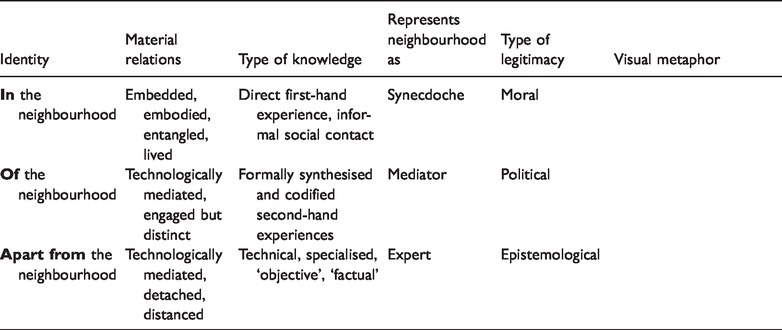
The NPGs are thus hybrid, multiple entities, relying for their legitimacy on their capacity to enact all sides of a variety of interconnected oppositions: to be at once entangled, partially engaged and distant; experts, lay people and mediators between the two; and servants, peers, leaders and challengers of the community. They must mobilise local experiential knowledge and abstract technical evidence, engaging local aspirations and strategic priorities. The neighbourhood may well have ‘emerged as a precocious new actor in the contested production of space’ (Bradley et al., 2017: 72), but it is also a fragile one, highly vulnerable to destabilisation, the consequences of which can be serious. If the NPG is not sufficiently in the neighbourhood, their plan risks becoming detached from their own lived experience, from the concerns and knowledge that motivated them to act in the first place, with the likely outcome of a bland, ineffectual plan or one which gives primacy to externally derived objectives (cf Haughton and Allmendinger, 2013; Parker et al., 2015). If they are not sufficiently of the neighbourhood, they could lose their public mandate, risking resistance during consultation and defeat at referendum, or else imposing policies that unjustly favour particular interests (cf Wills, 2016) and, more far-reaching in terms of everyday life, disrupt their own and others’ relations of friendship, neighbourliness and collegiality (Vigar et al., 2017: 435). If they are not sufficiently apart from the neighbourhood (and aligned with the expert community of practice of professional planners), they risk developing a plan that is unable to stand up to challenge by external actors (cf Lord et al., 2017; Parker et al., 2016).
Developing the identity-multiple analysis and foregrounding the associations of material relations, knowledge and legitimacy sketched out here may help to better understand how groups negotiate the hybrid forms of authority that neighbourhood planning invokes (Bradley, 2015; Sturzaker and Gordon, 2017). It may also help future citizen planners to manage that negotiation more reflexively. This is important because the neighbourhoods that are represented and enacted by each identity are quite different – they ‘make places show up differently, so that they might be worked with differently’ (Massey and Thrift, 2003: 286). The balance between identities-in-tension determines which versions of neighbourhood get planned for.
Conclusion
Neighbourhood planning is framed by its promoters as devolving power to pre-existing, well-defined communities. I have problematised this characterisation by claiming that neighbourhood planning is performative: it does not merely give powers to an already-existing community, but produces new actors, new collective identities, which are constituted both materially and socially. In the case studies, not only were new identities produced, but the NPGs – the collectives that took up the newly available powers – were enacted in three distinct but fluid identity-multiples. I have argued that each of these different identities enabled them to draw on a different source of legitimacy, and that all of these are necessary to do neighbourhood planning successfully. Each identity is in effect an obligatory passage point (Callon, 1984). However, these multiple identities are always in tension and sometimes in outright conflict, and holding them together requires considerable effort and skill.
Neighbourhoods are also assembled, not already given: brought into being through particular practices which define them (Brownill, 2017). This puts boundaries around them, spatially and conceptually: this is where they start and finish, these are their relevant and defining characteristics. But like all representations, these simplifications are imperfect and incomplete ways of ordering material relations in and with the world. And different representations, as enacted through different identities, will reinforce some simplifications and undermine others (Law and Mol, 2002).
Recognising the performativity of neighbourhood planning and its relational identities could enable more inclusive and reflexive modes of assembling those identities and neighbourhoods, and of analysing and managing tensions between them. The different identities sketched out in this paper not only perform relations with neighbourhood differently, but they also perform the neighbourhood differently. ‘In a world where everything is performative, everything has consequences, there is … no innocence’ (Law and Urry, 2004: 396). It matters in what balance these identities are held together, what kinds of relations and knowledge are made visible and invisible, strengthened and weakened, because this shapes the possibilities for what the plan and the socio-material neighbourhood can become. Each identity described in this paper intervenes in the world in a different way, co-producing different knowledges and realities. As well as asking, as others have done, whether and in what ways NPGs are representative of their neighbourhoods, we also need to ask how their identities are constituted in relation to those neighbourhoods, and what the consequences of this are.
This analysis also holds resonances for literatures well beyond neighbourhood planning. In keeping with the case study methodology, I would not claim that these findings are generalisable, but rather that they could be useful as sensitising concepts (Blumer, 1954) for research in other fields. This could include, but is not restricted to, studies of social movements, community empowerment and development, deliberative democracy, participatory governance, localism, urban and rural studies, and other fields where new and hybrid modes of representation, representativeness and legitimacy are increasingly coming to the fore.
Footnotes
Acknowledgements
I am grateful to Claire Waterton, Vicky Singleton and Noel Cass for their insightful and positive comments on earlier drafts of this paper, and to the editor and two anonymous reviewers for very helpful comments that assisted in refining it.
Declaration of conflicting interests
The author(s) declared no potential conflicts of interest with respect to the research, authorship, and/or publication of this article.
Funding
The author(s) disclosed receipt of the following financial support for the research, authorship, and/or publication of this article: This work was supported by an Economic and Social Research Council PhD studentship.
