



Abstract
Background:
Community-based pulmonary rehabilitation (PR) programs preserve essential PR elements such as exercise, disease education, and social support while addressing barriers to cost and transportation by offering low equipment options and flexible location delivery. We evaluated the feasibility of a 10-week community-based PR program, COPD Wellness, with and without Health Advocates (HA), who assist with unmet social needs in patients with COPD receiving care within a safety-net health care setting.
Methods:
In this single-center feasibility study (September 2017 to January 2020), participants with moderate-to-severe COPD were randomized to COPD Wellness alone or with HA support. The program included 10 weekly supervised 90-min sessions. Feasibility outcomes included recruitment rates, attendance, and adherence (≥6 sessions). Clinical outcomes included COPD Assessment Test (CAT) scores, 6-min walk distance (6MWD), depressive symptoms (PHQ-8), and exacerbation, analyzed using paired t-tests for within-group comparisons and independent t-tests for exploratory between-group analyses.
Results:
In total, 39 participants were enrolled (61% acceptance rate), with 19 randomized to COPD Wellness alone and 20 to COPD Wellness with HA. Median session attendance was higher in the HA group (6 vs 4 sessions), with greater adherence (53% vs 37%). CAT scores improved significantly overall (mean improvement 3.2, P = .01), with greater improvements among participants in the HA group (5.6-point reduction, P = .01). No significant changes were observed in the 6MWD, D-12 score, PHQ-8, or exacerbation rates. No adverse events were reported.
Conclusions:
The COPD Wellness program demonstrated feasibility, safety, and acceptability within a safety-net health care setting. The integration of HA addressed key social barriers, improving adherence and leading to greater improvements in COPD symptom burden compared with the COPD Wellness program alone. Future studies should explore scaling this model and assessing its long-term benefits in resource-limited environments.
This is a visual representation of the abstract.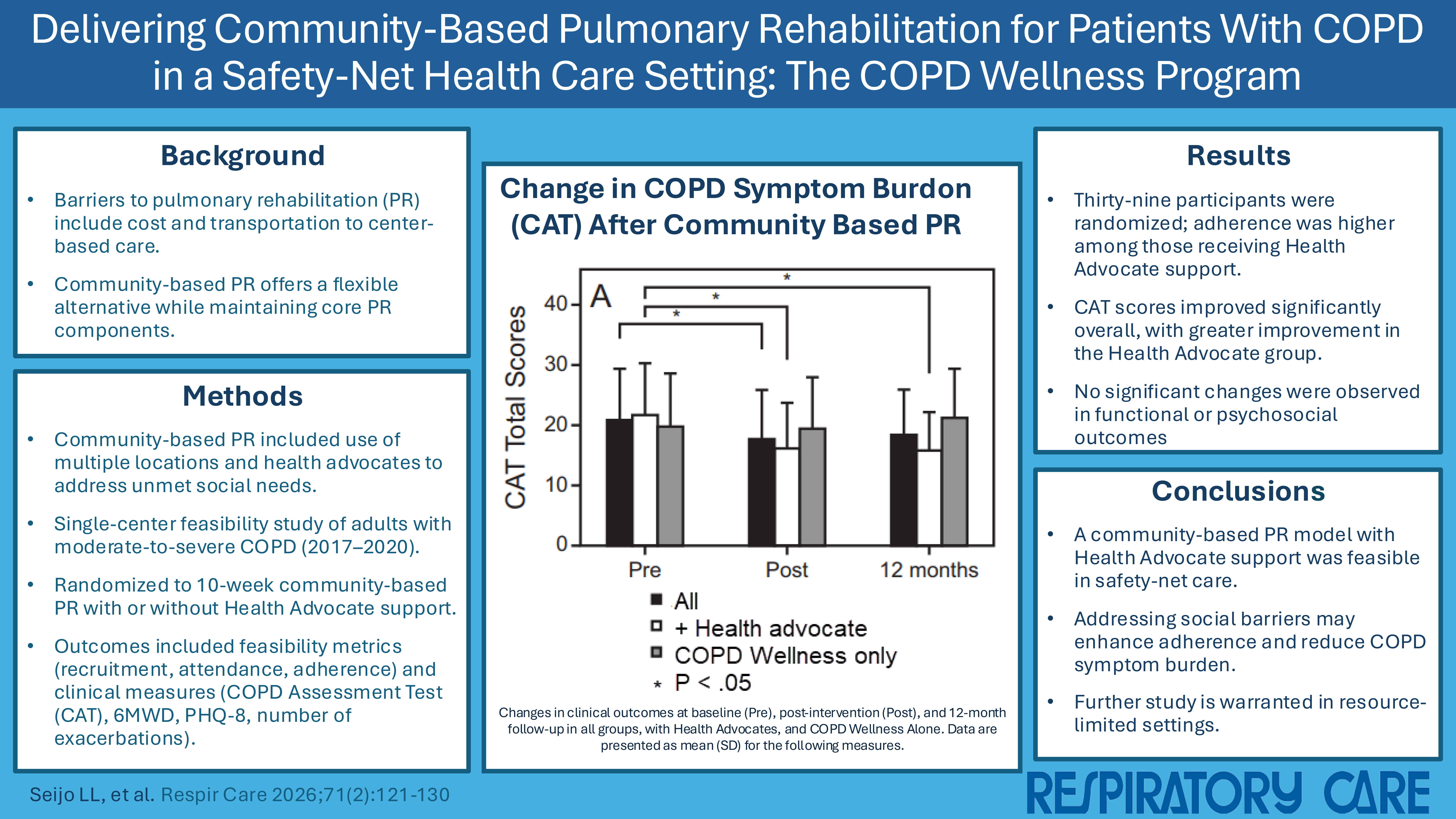
Keywords
Get full access to this article
View all access options for this article.
References
Supplementary Material
Please find the following supplemental material available below.
For Open Access articles published under a Creative Commons License, all supplemental material carries the same license as the article it is associated with.
For non-Open Access articles published, all supplemental material carries a non-exclusive license, and permission requests for re-use of supplemental material or any part of supplemental material shall be sent directly to the copyright owner as specified in the copyright notice associated with the article.
