



Abstract
This article analyzes green extractivism during Gabriel Boric's government in Chile, focusing on lithium policies. We examine the tension between environmentalist rhetoric and extractive practices by analyzing the lithium policy implementation, where negotiations with Chinese companies for value-added production coexist with agreements that consolidate the traditional extractive model, extending exploitation rights in the Atacama Salt Flat until 2050. Using discourse analysis and policy review, our findings reveal how Boric's administration has reinforced extractivist dynamics under the umbrella of energy transition, exemplifying what Svampa conceptualizes as the shift from the “consensus of commodities” to the “consensus of decarbonization.” The case illustrates how peripheral economies face structural limitations in overcoming resource dependency even under progressive governments, while indigenous perspectives and territorial rights are marginalized. This research contributes to understanding the contradictions between environmental discourse and extractive practices in Latin American progressive governments.
Introduction
Chile has experienced in recent decades a series of environmental crises that have profoundly marked its sociopolitical landscape. From industrial pollution in Quintero-Puchuncaví (Ponce, 2020; Bolados & Sánchez, 2017) to mobilizations against hydroelectric projects in Patagonia (Romero Toledo et al., 2009) and extractive conflicts in Freirina, Chiloé, and Dominga (Sepúlveda & Villarroel, 2012; Duarte-Hidalgo et al., 2020; Cárcamo & Ponce, 2021; Cárcamo, 2024; Quezada, 2023), these processes have exposed the structural tensions of Chile's extractivist development model (Maillet & Carrasco, 2019). Together, they reflect both the socioenvironmental costs of extractivism and the growing environmental awareness and mobilization of local communities (De la Maza, 2016).
The social uprising of 2019 marked a turning point by integrating environmental demands—such as the deprivatization of water and the rejection of extractivism—into broader social and political claims, articulating a structural critique of the economic model and its ecological consequences (Garretón, 2021; Ponce, 2024). In this context, the rise to power of the Frente Amplio under Gabriel Boric, with a platform centered on environmental protection and the expansion of rights, represented a critical moment in Chilean politics.
This research examines his government within the broader debate on progressive governments’ capacity to implement transformations in the development model, particularly regarding sustainable economies less dependent on natural resource extraction (Svampa, 2019). Using critical discourse analysis and public policy review, the article analyzes how “green extractivism” manifests under a government that presented itself as a progressive alternative, considering how global economic pressures and preexisting power structures influence the government's ability to fulfill its environmental promises.
This article is structured in five sections: theoretical framework on extractivism and the “consensus of decarbonization,” lithium's strategic role, Boric's political trajectory and antiextractivist promises, implemented lithium policies, and the SQM agreement case study.
Extractivism, neo-extractivism, and green extractivism in the Global South
Extractivism has been a fundamental concept for understanding economic development patterns in the Global South. Svampa (2019, 2012) defines it as a model of accumulation based on the overexploitation of nonrenewable natural resources, characterized by its export orientation and limited processing of raw materials. This paradigm has historically shaped the economic structure of numerous countries in the Global South, particularly in Latin America and North Africa, giving rise to what Acosta (2017) calls “enclave economies,” characterized by their scarce links to local development and their dependence on international markets.
Neo-extractivism emerged under progressive governments in Latin America during the early 21st century. As Gudynas (2014) argues, although these governments expanded state control over natural resources and implemented redistributive social policies, they nonetheless maintained—and in many cases intensified—resource extraction as the primary engine of economic growth.
The concept of “green extractivism” (Bruna, 2022; Dunlap et al., 2024) represents the latest evolution of this trajectory, describing the reconfiguration of extractive practices under the discourse of environmental sustainability and the global energy transition. The growing demand for minerals essential to green technologies—such as lithium and rare earth elements—is generating new forms of dependency in the Global South (Arias-Loyola, 2025). In this context, Zografos and Robbins (2020) and Kalt and Müller (2021) have coined the terms “green sacrifice zones” and “green colonialism,” which capture how ecological modernization is accompanied by intensified control of territories, politics, and labor by transnational corporations, international organizations, Western governments, and segments of national capital (Kingsbury, 2023; Dietz, 2023).
In this analytical framework, Bringel and Svampa (2023) have developed the concept of transition from the “consensus of commodities” to the “consensus of decarbonization.” This theoretical approach identifies the emergence of a new global paradigm that is reconfiguring geopolitical and economic relations around the energy transition. If the “consensus of commodities” characterized the economic cycle of the early 21st century in Latin America, based on the massive export of raw materials driven by high international prices (Svampa, 2012), the “consensus of decarbonization” represents a new phase that, paradoxically, does not break with extractivist logic but redirects it toward critical minerals essential for renewable energy technologies (Bringel & Svampa, 2023).
This new consensus is articulated around the global urgency to reduce greenhouse gas emissions and transition to low-carbon energy matrices. However, far from constituting a neutral or equitable process, decarbonization is generating new asymmetries and dependencies. Central countries, the main historical contributors to the climate crisis (Hickel, 2020; IPCC, 2021), are promoting decarbonization agendas that require enormous quantities of critical minerals (lithium, cobalt, copper, nickel) mostly located in the Global South. Thus, territories such as the Atacama Salt Flat in Chile or the South American “lithium triangle” become strategic spaces for the global energy transition.
The particularity of this consensus lies in its ability to redefine extractive practices under a new legitimizing discourse. While traditional extractivism faced growing questioning for its socioenvironmental impacts, green extractivism associated with decarbonization enjoys renewed legitimacy by presenting itself as indispensable for addressing the climate crisis. This dynamic is particularly evident in the “Lithium Triangle” of South America, where environmental discourses and resource governance mechanisms are being reconfigured to accommodate new forms of extraction under sustainability narratives (Voskoboynik & Andreucci, 2021). This narrative allows peripheral economies to continue in their role as providers of raw materials, now under the moral imperative of contributing to saving the planet. However, the “consensus of decarbonization” also introduces new elements: stricter environmental standards, indigenous consultation requirements, and sustainability certifications that, while not fundamentally altering extractive relations, create new spaces for negotiation and resistance (Jerez et al., 2021; Soto-Hernández & Newell, 2022).
The energy transition paradoxically reinforces extractive specialization in the Global South, perpetuating structural asymmetries (Bringel and Svampa, 2023). Demand for critical minerals creates immediate incentives that hinder productive transformations and intensify socioenvironmental pressures, generating conflicts that question the development model (Warnecke-Berger et al., 2022).
Methodology
This article employs a qualitative methodological approach that combines documentary analysis, political discourse analysis, and case study. The methodological design seeks to examine how Gabriel Boric's government articulates sustainability demands with economic pressures, particularly in lithium mining and renewable energy development.
The analysis covers the period from Gabriel Boric's electoral campaign (October 2021) to mid-2024, allowing examination of both campaign promises and policies implemented during the first years of government. Official documents were analyzed including laws, decrees, national strategies, and memorandums of understanding related to lithium policies, as well as public statements from the president and relevant ministers. Social media publications were also examined, particularly the X account @GabrielBoric, governmental website content, and national and international media coverage of the government's lithium policies.
NVivo software was used for information processing and analysis, which allowed systematic coding of texts and identification of discursive patterns. Critical discourse analysis focused on identifying tensions, contradictions, and continuities between campaign discourse and implemented policies, paying particular attention to how “green extractivism” justifications are narratively constructed.
The case study focuses specifically on lithium policies, analyzing both negotiations with Chinese companies for value addition and the Corporación Nacional del Cobre de Chile and Sociedad Química y Minera de Chile (CODELCO-SQM) agreement for primary extraction. This methodological approach seeks to contribute to understanding how “green extractivism” manifests under a government that presented itself as a progressive and environmentalist alternative, evaluating continuities and ruptures with previous extractive models.
Lithium: the new white gold
The extractive model, with the mining industry as its main exponent, constitutes the fundamental pillar of Chile's contemporary economic structure. The magnitude of this dependence is forcefully reflected in foreign trade data: in 2023, exports of minerals and metals represented 48.31% of the total value of products and services invoiced by the country, far exceeding other productive sectors such as agriculture and services (see Graph 1). This predominance of the extractive sector not only shapes Chile's insertion into the global economy as a provider of raw materials but also profoundly conditions the possibilities for transforming the development model. This phenomenon can be analyzed from theoretical frameworks such as dependency theory—which explains how peripheral economies become structurally subordinated to central economies through specialization in raw material exports (Cardoso & Faletto, 1969; Dos Santos, 1970)—and, more recently, from the concept of “green colonialism.”
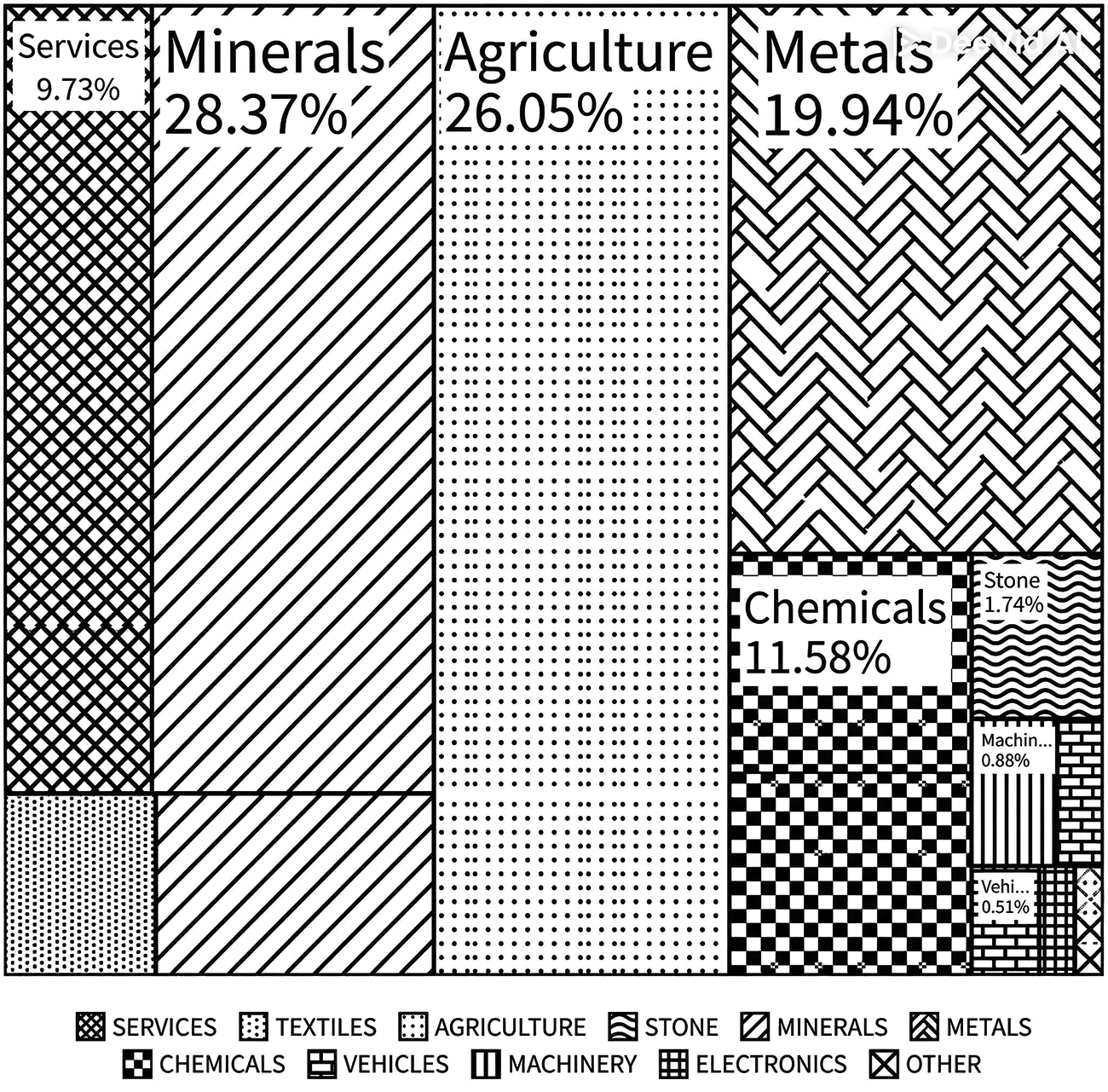
Distribution of exports in Chile according to categories of goods in percentages in 2023.
The concept of “green colonialism” developed by Hamouchene (2022) allows us to understand how colonial relations of plunder, dispossession, and dehumanization persist in the era of renewable energies. This theoretical perspective reveals that the global energy transition, far from breaking with extractivist logics, reconfigures them under new forms of geopolitical subordination. In the Chilean context, this dynamic is clearly manifested in the case of lithium, where the exploitation of this strategic resource reproduces historical asymmetries under the legitimizing discourse of decarbonization. The Antofagasta region exemplifies this pattern, where global demand for critical minerals generates cumulative environmental impacts on local communities, as evidenced by the environmental degradation registered in mining hotspots throughout the region (Zanetta-Colombo et al., 2024). The territory of the Atacama Salt Flat thus becomes a paradigmatic example of how new extractive geographies are justified through narratives of sustainability and ecological transition, while maintaining intact the relations of economic dependence and political subordination.
Lithium has positioned itself as a global strategic resource due to its exceptional energy density as the lightest metal, allowing significantly higher electrical charge storage per kilogram (COCHILCO, 2018). It is found in mineral formations and brine from salt flats, requiring specific processes for its subsequent conversion into compounds and derivatives of industrial value (Poveda Bonilla, 2020).
Global demand for lithium has experienced exponential growth since 2015, driven mainly by its application in rechargeable batteries for electric vehicles and energy storage systems for renewable energies (Castillo et al., 2024). This mineral has acquired a strategic character in the global geopolitical scenario, becoming one of the critical resources for the international energy transition (Metzger & Ponce, 2022).
In this context, Chile occupies a privileged position as a key player in the global lithium market. The Atacama Salt Flat, its main deposit, harbors estimated reserves of 9.3 million tons, representing approximately 33% of the economically viable reserves worldwide (USGS, 2024). Additionally, Chile's total lithium resources are estimated at 11 million tons within a global total of 105 million tons (USGS, 2024). This geological wealth, combined with exceptional climatic conditions for evaporation—a determining factor in the extraction process—gives Chile significant competitive advantages compared to other major producers such as Australia (the current largest producer) or China (the largest consumer and processor), which present different extraction methods and cost structures.
Chile reached first place in world lithium production with MINSAL's entry in 1998. Combined capacity between MINSAL (now SQM) and SCL (now Albemarle) allowed Chile to dominate approximately 50% of the global market, though this has decreased with competition from Australia (USGS, 2024).
However, the real challenge for Chile lies in advancing the lithium value chain. The country has not managed to cross the technological frontier of creating new lithium-derived materials and products (Castillo et al., 2024). This limitation reflects broader tensions between resource extraction versus value-added industrialization (Barandiarán, 2019), hindering technological development in electronics and other high-value industrial applications (Millas, 2018).
The global energy transition and electromobility have multiplied lithium demand. Initiatives such as the European Green Deal, China, and U.S. zero-emission strategies have accelerated demand, with lithium identified as critical for green transitions (European Commission, n.d.; International Energy Agency, 2025; Bobba et al., 2025).
In this context, Chile's ability to transform its geological privilege into sustainable technological and economic development represents one of the greatest challenges for its economic and environmental policy. The management of this resource evidences the contradictions between the aspirations for sustainable and inclusive development and the structural limitations of an economy traditionally dependent on the export of raw materials with little processing (Arias-Loyola, 2025). This tension intensifies when considering that the same decarbonization policies that drive the demand for lithium also demand sustainability criteria in its extraction, generating new pressures on the producing territories (Obaya and Céspedes, 2021).
Gabriel Boric's trajectory and the end of extractivism
Gabriel Boric's political trajectory represents a paradigmatic ascent from student activism to the presidency of Chile. After gaining prominence in the 2011 student movement, he served as deputy for the Magallanes Region (2014–2022), culminating with his election as President in 2021 after defeating José Antonio Kast in a highly polarized contest (Ponce, 2024).
During his presidential campaign, Boric articulated a discourse strongly centered on environmental sustainability, explicitly promising to lead “the first environmentalist government in the history of Chile” (see Image 1) and end extractivism as a driver of environmental degradation (Boric Font, 2021).

Gabriel Boric's twitter account during the presidential campaign period.
The Boric government's lithium policies illustrate inherent tensions between ecological aspirations and economic pressures. Initially, the government proposed prioritizing research on salt flats before making extractive decisions and creating a national lithium company led by Codelco, contemplating social, environmental, and economic aspects. However, these plans were eclipsed by the December 2023 memorandum (Ministerio de Economía, 2023).
Research and innovation around lithium present significant limitations. Entrepreneurs in the lithium battery sector have highlighted Chile's delay in battery production and associated technologies (Moreno-Brieva and Romero-Puente, 2026). Battery technology depends on cells manufactured exclusively in China, underlining Chile's technological dependence and peripheral position in the global lithium value chain (Arias-Loyola, 2025). Paradoxically, Chile possesses both lithium and copper but has not advanced toward value-added production, exemplifying the persistence of the extractivist model (Svampa and Viale, 2020).
Under the Boric administration, the National Lithium Strategy foresees exploitation in 23 salt flats—7 strategic and 16 open to private companies—while 27 Andean wetlands are protected. This expansion exposes contradictions, as eight designated salt flats fall under conservation categories per Law 21.600 (Biblioteca del Congreso Nacional de Chile, 2023; Gobierno de Chile, 2023; León, 2024).
The Maricunga Salt Flat illustrates these tensions. Classified as strategic, it is the southernmost Andean wetland in Chile, with Santa Rosa Lagoon designated as a Ramsar site. Despite this protected status, Codelco plans to exploit the northern sector, overlooking hydrological connectivity and ecological integrity (León, 2024). This exemplifies how the “consensus of decarbonization” legitimizes interventions in fragile ecosystems under the energy transition banner, contradicting environmental commitments.
President Boric faces continuous legitimacy challenges, with approval levels not exceeding 32% (CEP, 2024). This reflects broader difficulties progressive governments face reconciling transformation expectations with economic realities (Kulfas, 2023; Stefanoni, 2024). Despite antiextractivist promises, his government illustrates contradictions in reconciling economic development, environmental sustainability, and social justice in resource-dependent economies (Gudynas 2014). The current situation exemplifies challenges progressive leaders face implementing transformation agendas where inherited structures and global pressures limit room for maneuver (Burchardt et al., 2021).
Unfulfilled promises: negotiations with Chinese companies and SQM's triumph
The Boric government's handling of lithium policy reveals significant contradictions between its rhetoric of transformation and the concrete actions implemented. This policy has advanced on two parallel but fundamentally different fronts: on the one hand, attracting investments for industrialization and added value, and on the other hand, agreements on the primary extraction of the mineral.
In the field of industrialization, the government has managed to attract Chinese investments for the development of the lithium value chain. As documented by the Ministerio de Economía (2023), agreements have been reached with BYD Chile SpA and Yongqing Technology Co. Ltd for the installation of cathode material production plants, with investments of USD 290 million and USD 233 million, respectively. These projects, framed within the National Lithium Strategy, represent an advance toward the aggregation of value in national territory.
However, on the extractive front, transformation ambitions have encountered greater obstacles. As Poveda (2023) points out, President Boric initially announced that Chile would seek “public-private partnerships with national and foreign actors” to completely reimagine the extraction model, with greater state participation and control over the resource. According to Codelco (2023) in Reuters, broader negotiations on new extractive models stalled due to disagreements on state participation and regulatory conditions.
The outcome of this process was particularly paradoxical: while progress was being made in value-added projects, in the extractive sphere the government ended up signing a memorandum of understanding in December 2023 that consolidated SQM's position as the dominant actor in the exploitation of the Atacama Salt Flat until 2050 (CODELCO, 2023). This agreement, signed between CODELCO and SQM, represents a continuity—and even a deepening—of the extractivist model that President Boric had promised to overcome during his electoral campaign.
The CODELCO-SQM agreement has been criticized for various reasons. First, it extended SQM's exploitation rights, a company with a controversial history that includes cases of irregular financing of politics and questions about its environmental management (Pizarro, 2022). Second, the agreement was negotiated with limited participation from the indigenous communities of the territory, contravening the government's commitments to ILO Convention 169 and its promise to implement more robust consultation processes (Observatorio Ciudadano, 2024).
However, SQM's controversial history reveals direct continuity with Chile's authoritarian past. Controlled by Julio Ponce Lerou, Pinochet's former son-in-law, the company was privatized under the dictatorship (1973–1990). This authoritarian genealogy of Chilean extractivism is central to understanding structural resistance faced by Boric's reforms from national elites whose economic power was consolidated through dictatorial violence and privatization (Mönckeberg, 2002; Kingsbury, 2023).
From this perspective, the December 2023 agreement extending SQM's extraction rights until 2050 represents more than a technical decision: it reproduces a power structure rooted in capitalism. This continuity illustrates how extractivist dynamics outlive political transitions, becoming embedded in property relations and corporate structures that persist across regimes. As a result, the Boric government, despite its progressive rhetoric, ultimately reinforced an economic actor that embodies the enduring legacy of Pinochet-era arrangements in contemporary Chile.
The Lickanantay communities (also known as Atacameños) have historically inhabited the Antofagasta region, developing complex relationships with their territory that have been profoundly impacted by successive mining activities. These communities are distributed across the region and concentrated in two main watersheds, each with distinct historical experiences of mining extraction and territorial dispossession (Argento & Puente, 2019). However, the consultation processes implemented by the Boric government have been highly controversial. The Council of Atacameño Peoples rejected the National Lithium Strategy, criticizing the limited and superficial nature of the consultation spaces provided (Diario UChile, 2023). Despite the administration's commitments to ILO Convention 169, these processes have been characterized by being informational rather than participatory, where communities are presented with predefined strategies rather than being involved in the design stages (Lorca et al., 2022).
Lickanantay communities experience internal tensions between economic opportunities and territorial autonomy, creating complex dependencies that make decolonization elusive (Gundermann & Göbel, 2018; Argento & Puente, 2019; Lorca et al., 2022). For the Lickanantay communities, the Atacama Salt Flat represents a living territory with cosmological dimensions, where ecosystem elements are considered “younger brothers” in relationships of reciprocity (International Tribunal for the Rights of Nature, 2019). This biocentric perspective contrasts with extractivist policies, generating clashes between knowledge systems.
This shift in lithium policy evidences the difficulties of the Boric government to implement structural changes in a strategic economic sector. The pressures of the international market, the previous commitments of the Chilean State, and the resistance of consolidated economic actors seem to have significantly limited the government's ability to materialize its initial vision (Arias-Loyola, 2025).
The case of negotiations with Chinese companies and the subsequent agreement with SQM illustrates what Svampa (2023) describes as the persistence of “old dependencies under new guises,” where even governments with progressive agendas end up reproducing historical extractivist patterns, although these are presented under a rhetoric of energy transition and sustainable development. This contradiction between transformative discourse and concrete practices is especially noticeable in the Chilean case, given the emphasis that the Boric government initially placed on the need to overcome the extractivist model (Bringel and Svampa, 2023).
The implications of this agreement transcend the economic sphere, also affecting the political credibility of the government. The perception of inconsistency between campaign promises and government decisions has eroded the president's political capital among his support bases, particularly among socioenvironmental movements that initially backed his candidacy (Fundación Terram, 2024). This erosion manifests in growing disenchantment and increasingly vocal criticism from sectors that previously identified with the political project of the Frente Amplio.
Conclusions
The analysis of Gabriel Boric's government reveals a pattern common to recent progressive governments in Latin America: the consolidation of a model of “green extractivism” that, despite its transformative rhetoric, fails to break with structural dependence on raw material exports. The Chilean case illustrates the persistent gap between political discourse and policy implementation in contexts marked by global economic pressures and entrenched power structures.
Although Boric assumed office promising to lead “the first environmentalist government in the history of Chile,” his administration ultimately reinforced extractivist dynamics under the banner of the energy transition. The lithium sector exemplifies this contradiction: while framed as strategic for decarbonization and industrial upgrading, policies have largely reproduced traditional extractive logics without altering Chile's subordinate position in global value chains. The expansion of extraction into protected ecosystems illustrates how the “consensus of decarbonization” transforms fragile territories into green sacrifice zones.
The agreement extending SQM's exploitation rights until 2050 symbolically condenses these contradictions. Rooted in Pinochet-era capitalism, SQM embodies the persistence of authoritarian extractivist structures reproduced under new sustainability discourses. Similarly, inadequate and nonbinding consultation processes with Indigenous communities—evidenced by the rejection of the National Lithium Strategy by the Council of Atacameño Peoples—reveal how progressive governments may formally recognize rights while reproducing colonial patterns of territorial governance.
These contradictions underscore the limits of reformism in peripheral, resource-dependent economies. The transition from the “consensus of commodities” to the “consensus of decarbonization” (Bringel & Svampa, 2023) does not entail a rupture with global asymmetries but rather their reconfiguration under green legitimacy. In Chile, this has entailed a shift from traditional sacrifice zones to green ones, without resolving structural dependency.
The political consequences of these contradictions have been profound. The failure to deliver substantive transformation eroded Boric's legitimacy among socioenvironmental movements, Indigenous organizations, and sectors mobilized during the 2019 estallido social, including imprisoned activists. This disaffection culminated in December 2025 with José Antonio Kast's election. Kast's openly Pinochetista, extractivist, and anti-Indigenous platform illustrates how unmet transformative expectations opened space for reactionary forces that consolidated extractivist structures through dictatorship.
Overcoming extractivism requires structural transformations: productive diversification, economic restructuring, and autonomous technological capabilities. Without these, low-carbon transitions risk reproducing Global South dependencies.
Given Chile's structural dependence on resource exports—and the historical lesson of the 1973 coup against Allende—alternatives must be both transformative and politically viable. This requires genuinely binding Indigenous consultation from policy design stages, enabling territorial governance where Lickanantay communities exercise decision-making power over extraction, standards, and benefit distribution. Rather than extending SQM's concession until 2050, a gradual transition would entail temporary moratoria on new concessions, redistribution of lithium rents, and mandatory domestic processing. Overcoming extractivism demands productive diversification, value-chain integration, regional cooperation within the Lithium Triangle, and broad political coalitions linking socioenvironmental movements, labor, Indigenous organizations, and progressive sectors—where Boric's coalition proved insufficient. While reformist governments face structural constraints, political choices matter: Boric's decisions to extend SQM concessions, expand extraction into protected areas, and marginalize Indigenous participation reflected specific political priorities, not inevitabilities.
The Chilean case reveals that decarbonization does not necessarily lead to postextractivist outcomes. The dominant energy transition model, driven by transnational corporations, operates as a legitimizing framework for new forms of dispossession affecting Indigenous territories while serving Global North energy demands (International Tribunal for the Rights of Nature, 2019).
Genuine socioecological transitions require principles of social and environmental justice, including respect for nature and affected populations’ rights. Without these, energy transitions risk becoming updated extractivism under green legitimacy, necessitating critical rethinking of sustainable development frameworks in peripheral economies.
Footnotes

Ethical consideration
The author(s) declared that ethical approval was not necessary for this study.
Funding
The author received no financial support for the research, authorship, and/or publication of this article.
Declaration of conflicting interests
The author declared no potential conflicts of interest with respect to the research, authorship, and/or publication of this article.
Author Biography
Camila Ponce Lara is a Senior Researcher in Sociology. Her research focuses on social movements, youth and feminist activism, and environmental governance in the Global South.