



Abstract
The global economy’s neoliberal era began in 1973 with a military coup in Chile lead by General Augusto Pinochet. Though the country returned to civilian rule in 1990, the dictatorship continues to determine much of Chile’s political economy, especially in extractive sectors, a legacy that also carries consequences for decarbonization in the 21st century. As the latest stage of globalization, contemporary energy transitions offer an opportunity to examine the kind of global and local extractivisms established in the context of the dictatorship in Chile – an order that also accelerated the environmental impacts of the Anthropocene. Just as the Anthropocene is less a geological age defined by human activity as much as the compounding consequences of a relatively small segment of humanity, so too is neoliberalism traceable to specific people, histories, and institutions. This article traces these elements as Chile rewrites Pinochet’s constitution to highlight hopes and challenges of energy transitions as political, social, and ecological processes.
Introduction
This article develops a heuristic through which to understand energy transitions – the decarbonization of the global economy in the context of the larger Anthropocene – as the latest iteration of globalization. Energy Transitions follow, and in many ways must respond to, the neoliberal reordering of state, society and nature from the global to the local. Much like the larger Anthropocene in which it occurred, neoliberalism in Chile defies easy divisions between structure and agency. Both have triggered dire consequences for humanity as a whole, and now inform the limits and possibliity of political action. However, the root causes of these structural effects can be traced to the actions and interests of a relative few economic and political elites that benefit from the unequal reorganization of class power, economic precarity, and exposure to environmental risk (Malm and Hornberg, 2014). This uneven distribution of profit and pain took form in the late twentieth century Pinochet dictatorship in Chile (1973–1990) and has also to this point defined the materiality of energy transitions in the early 21st century that assumeand reproduce extractive ‘sacrifice zones’ for the basic necessary inputs for the electrified retrofitting of existing supply chains (Arboleda, 2020; Sengupta, 2021). Through an examination of lithium – and to a lesser extent, copper – extraction in Chile, this article outlines the conceptual triangle formed by energy transitions, neoliberalism and extractivism as a means to better understand the challenges of decarbonization in an unequal world.
Augusto Pinochet seized power in Chile on September 11, 1973 in a military coup, heading a regime that would murder, officially, 3,065 people before he left the presidency in 1989. A 2011 commission identified a total of 40,018 victims of kidnapping, detention, torture and forced disappearance by state and parastate authorities (BBC, 2011). A further estimated 200,000 Chileans were exiled during Pinochet’s 17 years in power. Outside the country, the Reagan and Thatcher administrations in the United States and United Kingdom celebrated the general for turning back communism in the Western Hemisphere and ending the threat of a democratic road to socialism proposed by his predecessor, Salvador Allende (who died as Chile’s Air Force strafed the presidential palace on the coup’s first day). Many economists also applauded as Pinochet subsequently handed direction of the economy to the ‘Chicago Boys’ – a group of Chilean technocrats and academics so named for having studied at the University of Chicago under Milton Friedman – who initiated rounds of privatization, deregulation and fiscal austerity (Letelier, 1976; Valdés 1995). In dismantling the import substituting industrialization policies of Allende and his predecessors, the Chicago Boys also pressed for a reprimarization of the Chilean economy (Peres-Cajías and Ducoing, 2021). The neoliberal structure of the Chilean economy, and the increased reliance on resource extraction and primary product exports, persisted and in many cases deepened in the decades following the return to civilian rule in 1990 (Leiva, 2019).
Pinochet died in 2006. His corpse doesn’t care about climate change. Nor did he show much concern for the environment while he ruled Chile, for reasons having to do with the times or due to lobbying by his core constituencies. Nonetheless, the ways his regime shaped law, industry and landscape remain key to understanding present and future attempts to mitigate the climate crisis and decarbonize the global economy. While the relationship between law, economy and the environment will be revised as Chile’s constitution is rewritten in 2021–2022, Chile’s place in global energy transitions, the geopolitical organization of space, and the consequences of the extractive regime established during Pinochet’s rule will continue to be overshadowed by the neoliberal era he helped introduce to Chile and the world.
Energy Transitions – the multiple decarbonizing projects, policies, and regulations responding to the climate crises of the Anthropocene – are the latest iteration of a globalization that reaches back to Europe’s conquest of the Americas. They come in the wake neoliberalism’s remaking of the world, and in these early stages have followed the market-defined path of their predecessor. Effectively extending the same tools that produced and deepened the climate crisis, transitions threaten not only to deepen inequality across multiple scales, but to undermine the viability of transitions themselves (Kingsbury, 2020). The neoliberalization that began with Pinochet’s coup intensified the pressures on environment and society of the maturing Anthropocene, pushing the planet further towards the crises of the twenty-first century (McNeill and Engelke, 2016). This organization of state, society and nature functions not only in its most immediately recognizable mechanisms – privatization, deregulation, austerity, open trade, police enforcement – but through colonizing every aspect of our lifeworld, operating through an expanded sesnse of what can be commodified while subordinating our thinking, and our understandings of the possible, to the prerogatives of the market (Brown, 2015). Margaret Thatcher’s infamous pronouncement that ‘there is no alternative’ to markets’ domination of collective life increasingly becomes something of a common sense in which, paraphrasing Frederic Jameson, it is easier to imagine the end of the world than an end to capitalism (Fisher, 2009).
Neoliberalization was never primarily concerned with free markets, development, efficiency, or any other of its many pretexts. The sociological blueprint established in Chile during the dictatorship would be repeated numerous times elsewhere in democratic and authoritarian settings (Harvey, 2005). 1 Privatization of key enterprises and the commodification of everything – industries, pensions, water, emotions – enriched those with connections to the dictator, broke the power of labour and social movements, and set in motion social and environmental crises that eclipsed those which the generals used to justify their interventions. The December 2021 election of Gabriel Boric – a 35 year old student protest leader, avowed feminist, and environmentalist – to the presidency comes after 2 years of social upheavals that have sought to overturn this legacy.
The Pinochet era overshadows the historical and conceptual triangle formed by energy transitions, neoliberal globalization, and extractivism in the Anthropocene. While Pinochet is individually culpable for the deaths caused by his regime – both directly in the form of executions and disappearances and the damage to lives and livelihoods caused by his economic reforms – in this article the proper name exceeds a specific person, signifying instead a mixture of structure – neoliberal extractivism – and agency – the elites that reshaped, directly benefitted from, and have defended the military’s revolution from above. Beyond the biophysical, geological, and chemical processes of removing valuable materials from the earth, extractivism describes an ideology that has characterized governments of the left, right and centre. It is a way of understanding the world that accepts mining as necessary and necessarily best situated in the developing world, where it also carries the promise of technological modernization, economic growth and social advancement (Acosta, 2016; Arboleda, 2020; Gudynas, 2015; Svampa, 2019). It is one of the defining characteristics of the Anthropocene – the geological age defined by human interventions (Chakrabarty, 2009; Crutzen, 2002). Here a small, privileged and protected strata of humanity subordinates landscapes and the majority of people to an instrumentalized vision of nature, sacrificing it and the future for the accumulation of wealth – a dynamic that plays out intra- and inter-nationally as well as across generations (Chancel and Piketty, 2015; Malm and Hornberg, 2014). The Anthropocene is not the age in which humankind as a whole shapes the present and future of life on Earth. It is rather the age in which some specific humans have sabotaged life for the rest and the future. This article discusses some of those specific humans and the structures they inhabit and reproduce.
I begin with a discussion of the materiality of contemporary energy transitions, and specifically the raw materials needed by decarbonization’s infrastructures that come from places like Chile. The growing demand for lithium – the light metal key for the batteries of electrified power grids and mobility regimes, among other uses – and copper – required across clean energy applications including turbines, solar panels, battery storage devices, and electric vehicles (Kemp et al., 2021) – would seem to give Chile a comparative advantage in global energy transitions. I then discuss how reforms carried out during the Pinochet dictatorship illustrate that in extractivist states like Chile, comparative advantage is often only advantageous for a small sector of the population. These local conditions are dialectically related to the larger scope of global trade and politics. The final two sections discuss how another round of local factors – the rebellions against the second government of Sebastián Piñera (2018–2022) and, ultimately, against the neoliberal and extractivist legacies of Pinochet – will shape the next stages of energy transitions in Chile, and potentially, beyond.
A brief note on methods
This article is part of a larger project on mining, decarbonization, and late neoliberalism. Over the course of 2020 to 2022 semi-structured interviews were conducted via zoom and other online platforms with mining industry representatives; elected officials at local, regional and national scales; current and former government ministers from ideologically opposing backgrounds and administrations; and civil society groups critical of or opposed to expanded lithium mining in Chile. Interviewees were selected based on their proximity to significant events in the lithium industry’s expansion in Chile, legislative processes related to mining and environmental regulations, and community responses to potential or existing lithium projects. These first-hand accounts corroborated and extended extensive media tracking and consultation with academic, non-governmental, and intergovernmental organizations’ generated literatures on the socio-economic and juridical histories of lithium mining in Chile and South America.
Data gathered across methods were analyzed to appraise the extent to which lithium extends or revises existing extractivist dynamics in the context of rapidly changing social, political, and ecological conditions in and beyond Chile. Lithium’s particular status provides a vantage from which to appraise the conceptual triangle formed by extractivism, decarbonizing energy transitions, and neoliberal globalization in the context of the Anthropocene. Each of these constitutive concepts carry with them their own extensive bibliographies and controversies (some of which are considered below). Data gathered for this article, however, illustrates they are distinct but overlapping, a Venn diagram in which the expanding lithium boom is situated at the centre. This conceptual triangle also allows for an appreciation of the local and global power dynamics at play during Chile’s multiple – political, economic, and ecological – transitions, as well as the limits of generalizing concepts like globalization and the Anthropocene.
Mining for climate change
Current high profile plans for decarbonizing the global economy, and especially those favoured by policymakers in the Global North, will require significant material inputs for greener industries, homes, and mobility infrastructures (Federal Consortium for Advanced Batteries, 2021; Hund, et al, 2020). Attention to these material realities of decarbonization – the physical elements that need to go in to the global economy like lithium, copper, or cobalt, and not just what needs to come out, like carbon and methane – highlights the differentiated impacts of climate change mitigation technologies on across specific places and experiences. Decarbonization proposals gaining the most political traction in the Global North centre on the expanded use of electric vehicles, renewable energy generation technologies – solar, wind and geothermal – and significantly enhanced power storage systems (eg, Federal Consortium for Advanced Batteries, 2021). 2 Due to lithium’s low weight and high conductivity, lithium-ion batteries have become central to these plans for decarbonization, and are occupying an increasingly prominent role in market, popular, and political understandings of what energy transitions entail (eg, The Economist, 2017; Levine, 2021; Pattison and Firdhaus, 2021).
South American lithium is primarily sourced in the so-called ‘lithium triangle’ – an area of the Andean highlands spanning northern Chile, northwestern Argentina, and southern Bolivia (see Figure 1). As opposed to Australia, the market leader where lithium is sourced from pegmatite rock formations and processed into stable concentrates before being shipped to China, Japan, or Korea, South America’s lithium comes from brine deposits. Here, subterranean aquifers are accessed by drilling and their contents pumped to the surface, disrupting the complex hydrological composition of the top- and subsoil ecosystems (Bonelli and Dorador, 2021). Over the course of 6–12 months, the brine is moved through a series of pools, where mechanical and solar heating concentrate the mineral contents. Chemical additives are applied throughout the process to isolate the lithium from companion minerals in the source brine. In the final stage, lithium carbonate or lithium sulfate is refined into a comparably stable state, then shipped to industrial and chemical manufacturers in North America, Europe, and East Asia.
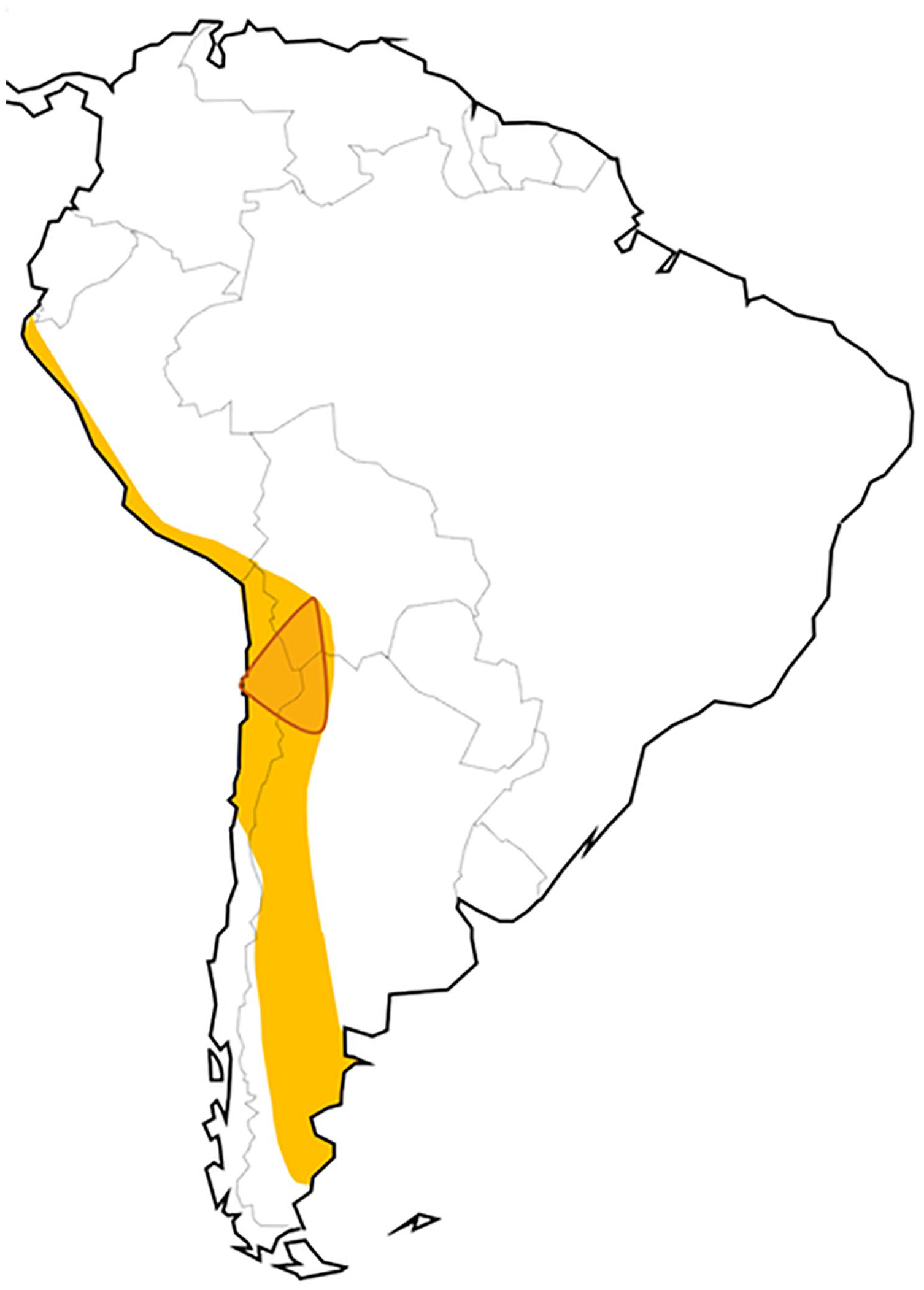
The Lithium Triangle, within the South American Arid Diagonal.
Chile’s place in the global lithium trade overshadows that of its neighbours. Its industry is the most established, though lithium’s share of the national economy is minuscule compared to that of copper, also primarily found in the desert highlands of the Atacama. This overlap also lends Chile a geographical advantage, as the landscapes have already been altered to facilitate extraction, with key infrastructures like ports, roads, and power generation in place (Arboleda, 2020). The composition of Chile’s aquifers are also more forgiving than, for example, those found in Uyuni in Bolivia, where high levels of potassium require additional mechanical and chemical processing to achieve requisite purity and concentration for applications like lithium-ion batteries (Guzmán, 2014).
The 2020s are projected to be boom years for lithium (Yue, 2021). They are not the first. Between 2014 and 2018 prices for lithium soared in anticipation of an electric vehicle (EV) boom that never fully materialized, leaving South American lithium projects in limbo. This was due in part to shifts in the global political situation that reduced demand for the mineral and Australia’s ability to rapidly and massively expand production (Benchmark Mineral Intelligence, 2019). However, more stringent decarbonization guidelines coming from the European Union, the United States, and China and the prominence of market and technology lead energy transitions suggests ‘we are on the verge of another commodity supercycle’ in which lithium will feature prominently (Adams, 2021).
This day will occur in spaces defined by extractivism: an unequal, globalized, and after Pinochet, neoliberal ordering of states, societies and nature. Here the specificity of place determines whether energy transitions are approached in terms of greening grids and consumer goods, or leveraging one’s ostensible comparative advantage as supplier in the decarbonized supply chains of the future. In interviews, for example, officials ministers from the right of centre Piñera government (Blanco, 2021) and left of centre Bachelet administration (Bitrán, 2021) as well as former advisors (Coviello, 2021) all characterized Chile’s energy transition in terms of ‘greening’ the mining industry through the use of desalinated seawater and solar electricity. All considered proposals for the localization or regionalization of green production chains – producing EVs and the secondary and tertiary industries that would require – in South America as nice but naïve, and saw decarbonization as a growth opportunity for the mining industry rather than an opportunity to renegotiate the country’s position in the global economy.
Of course, the climate crisis is altering politics and economics at every scale across the world, and Chile is no exception (Sangupta, 2021).[AQ] Attempts to address the climate crisis without critical reflection or action on extractivism’s political, economic, social, and ecological tolls illustrates how differently decarbonization will be addressed and experienced according to locality. Place matters, especially in the Anthropocene. Attention to lithium extraction forces proponents of energy transitions to consider the material implications of plans to mitigate the climate crisis and their unevenly distributed consequences in Chile and throughout the so-called lithium triangle (Fornillo, 2018; Jerez et al., 2021). The contours of this unevenness have been defined by neoliberalism – a structure that has and continues to limit the agency of those attempting to navigate this stage of the Anthropocene.
Neoliberal extractivism in Chile
Attention to the substance of the Chilean free market ‘miracle’ – as the GDP growth of the Pinochet and post-Pinochet eras are often misleadingly referred – undermines whiggish histories of neoliberalism. Against accounts of market efficiency, meritocracy, and small government, the revolution from above designed by the Chicago Boys and violently implemented by the Pinochet government reorganized Chile’s economy for the coming era of globalization as a primary product exporter (Bellisario, 2007). The dictatorship’s reforms dismantled the entrepreneurial state as well as the welfare state, and privatizations were a tool of internal political and social warfare that dismantled social movements and organized labour more than economic reforms in line with liberal pretenses (Clark 2018; Huneeus and Undurraga, 2021: 92). Nepotism and patronage were more common than picking oneself up by the proverbial bootstraps; the state’s retreat from the economy entailed the sell-off of public assets to an emerging coterie of connected oligarchs rather than the fine tuning by any contrived spectral hand of policy (Clark, 2018).
Though the Pinochet era was not the genesis of extractivism in Chile, the efforts of the Chicago Boys to reverse import substituting industrial policies pursued since the Great Depression changed and intensified its character as a social project. The lithium boom of the twenty first century would be the third major boom-bust cycle in Chilean extractives. In the mid-19th century global demand for nitrates sparked a mining boom in the North of the country that would last until the disruptions of the Great Depression and World Wars. Nitrates’ geographical centralization in difficult terrains and the labour intensive nature of nitrate mining resulted in comparatively higher wages across the sector, allowing for a modest expansion of consumer demand and some growth in secondary and tertiary industries (Badia-Miró and Ducoing, 2014). A second extractive cycle began in the early 20th century and extends into the present, this time in copper, that was more capital and technologically intensive and geographically dispersed. It was also dominated by foreign corporations and oriented to serve markets in the North. As a result, copper did even less than nitrates to develop and diversify the domestic economy while increasing its vulnerability to the whims of global markets. From the Great Depression until the coup of 1973 successive administrations attempted to mitigate this dependent dynamic, primarily by pursuing land reform and import substituting industrialization (Badia-Miró and Ducoing, 2014; Bellisario, 2007; Feinberg, 1974).
The Allende years (1970–1973) can be understood as an intensification of preceding administrations’ attempts to escape Chile’s dependent status. The nationalization of foreign-owned copper assets in 1971 – approved unanimously by the highly divided congress – corresponded with moves to diversify Chile’s economy and to regionalize its trading partners, interrupting but not ultimately escaping the country’s extractivist orientation (Feinberg, 1974: 31). The Chicago Boys lamented this turn in their economic manifesto for the future of Chile, El Ladrillo (The Brick). One of the ‘most pernicious’ effects of Allende’s Socialist reforms, they argued, was the negative impacts on export-oriented sectors of the economy, which they deemed to have ‘enormous’ but ultimately ‘frustrated potential’ they sought to tap (de Castro et al., 1992). However, the reforms executed under their advice should not be understood as a simple restoration of previously existing elite power in Chile. Reforms during the Allende years weakened the position of traditional rural elites also opposed by the type championed by the Chicago Boys and their fellow travellers since the 1960s (Clark, 2018: 27). After the coup, as more and more Chicago Boys and their affiliates were appointed to key government ministries, reforms in the rural economy benefitted increasingly capitalized and export-oriented farms, the financial sector, and foreign capital. These reforms reshaped the composition of elites as a class. Of the 20 largest family conglomerates in Chile in the 2010s, for example, only three would be included in such a list in the 1950s; the rest rose to prominence in the 1970s (Clark, 2018: 43).
This third extractive cycle in Chile is accelerating with decarbonization’s increased demand for lithium and copper (Bouckley, 2021; Hund et al, 2020). Until the estallido social (social explosion) of 2019 this boom has occurred in the continuing neoliberal context of the post-Pinochet era. Unlike nearly every other state in Latin America that operates on a rentier and contingent basis in resource sectors, Chile’s Law 18,097 of 1981 grants ‘full concession’ to contracting mining companies. Under this law, ‘once a given territory has been handed over to a mining company, the state has no legal right to demand its restitution unless it pays the concession holder for all minerals contained in the deposits’ (Arboleda, 2020: 167). As a result, the already meagre social benefits of extractivism in Chile has and continues to benefit a rather small segment of the population.
The Water Code of 1981 also neatly illustrates the materiality of a class project that extends well beyond Pinochet’s rule in Chile. It also shows the material bases for the extension of class power across regime types – bases which market and extractives-lead transitions seek to extend in the context of decarbonization. ‘The Water Code’s philosophy’, writes Carl Bauer (2004), ‘is laissez faire: it does not directly mandate or establish a market in water rights but instead aims to set up the legal rules and preconditions for such a market to emerge spontaneously, as a result of private initiative. In all these respects, the Water Code closely reflects the legal structure and ideological principles of Chile’s 1980 Constitution’ (32). Budds (2013) adds that the code established ‘a system of privatized water rights that were freely tradable with minimal state regulation’ the stated goal of which was to ‘enable the reallocation of scarce water to higher value uses, as users would be incentivized to sell water if they did not need it’ (301). She continues, ‘control over water was crucial for the development of Chile’s major natural resource industries, and the new principles enabled users to acquire permanent water rights that were allocated at no cost, were protected by law, constituted capital assets and were subsequently untaxed. The economic development of these industries was key to the success of the wider neoliberal program, which, in turn, was crucial for furthering the interests of its key proponents: the ambitions of the technocratic politicians, the stability and longevity of the military regime, and the prosperity of the business conglomerates’ (p.308). Much more than a legislative or ideological preference for market mechanisms over public regulation, the privatization of water – as other reforms carried out under Pinochet – supplemented and secured the economic power of the military government’s core constituencies, often explicitly at the cost of existing and future rivals (p.310). Large businesses and elite networks in mining and agriculture – including the family of two time president Sebastián Piñera (2010–2014, 2018–2022) – quickly consolidated control over water rights. For decades, this control of key resources has ‘impeded the implementation of integrated water resources management, precluded a significant role for civil society in water issues, restricted the defence of water rights against violations to those able to undertake private legal action, and fostered technocratic approaches to water management and governance’ (p.314). Privatization provided immediate and medium term financial benefits to elites and constitutionalized their defence (Clark, 2018: 43). Altering class power or enacting environmental protections of any significance would require a fundamental overhaul of Chile’s core institutional, legal, and political framework (more on this below).
In the years since the first passage of the Water Code and transition to civilian rule, the legal and socio-political scaffolding of the state-society-nature relation in Chile has evolved. However, despite ‘second generation’ reforms aiming to compensate for the social costs of neoliberalization, most elements of the model established during the Pinochet years like the Water Code have remained largely intact (Bauer, 2004). What is more, the upward distribution of wealth has been in some cases accelerated, particularly in the expansion of the extractive sector since the 1990s (López and Miller, 2008; Schatan, 2005). 3 The specific means by which neoliberal extractivism has been justified and reinforced has also shifted with the return of the military to the barracks.
As Fernando Leiva (2019) argues, in Chile a ‘new extractivist consensus actively incorporates a panopoly of new actors including think tanks, consulting firms, non-governmental organizations, international development agencies, academia, political cadre, as well as corporate mining executives as fundamental protagonists in a process in which national government entities play a subservient, supportive role.’ By enlisting civil society and other ‘stakeholders’ into the extractivist endeavor, the state plays an important coordinating role by incorporating disparate sectors into the extractivist enterprise, naturalizing it as unavoidable and beneficial. What is more, he continues, ‘instead of just shaping national development strategy, the assemblages generated by Chile’s new extractivist consensus have been explicitly conceived and designed with a much more defined political objective: as a mode of ‘governability from below’ oriented towards defeating community resistance to extractivism thereby removing all possible local obstacles to investors seeking to boost private corporate profits’ (p. 136). This new consensus in Chile operates both more subtly and more comprehensively than the era of rifles and police lines – though the police are by no means absent from this more subtle approach. Its aim to facilitate the outward flow of resources and the upward flow of wealth are hallmarks of the Chilean ‘miracle’. Chilean extractivism in the neoliberal era both in and beyond the Pinochet years, then, has only intensified, as have its social, environmental, and political consequences.
From strategic mineral to energy transitions
Despite being ground zero of neoliberalization, significant portions of the Chilean economy were never fully privatized, and ‘by 1985 the state controlled a share of the total economy comparable to the [Allende] years’ as it bailed out once privatized firms, ‘leading critics to deride the economic policies of the military regime as the “Chicago road to socialism”’ (Clark, 2018: 40). The copper industry, for example, has remained a predominantly national concern with significant private and foreign involvement, and the state development agency, CORFO, is a key player in ostensibly private market affairs. This has not lead to the sort of ‘progressive’ extractivism common throughout the region in the early 21st century – in which governments negotiated to increase their share of ground rents from mining, agriculture and energy sectors to fund enhanced social spending (Gudynas, 2015; Kramarz and Kingsbury, 2021). Quite the contrary, throughout the post dictatorship era rates of inequality in Chile remained among the highest in Latin America, and in some registers, it worsened (López and Miller, 2008; Rojas, 2019). 4
The lithium sector shares these uneven neoliberal characteristics. Due to its uses in nuclear weapons, Pinochet declared it a ‘strategic mineral’ and placed a moratorium on lithium concessions that remained in place for decades. The industry is privatized, but the mineral’s non-concessionable status means that two companies enjoy a virtual monopoly on lithium extraction in Chile. Albemarle, the US-based chemicals giant and world’s top lithium producer, was operating in the Atacama desert at the time of the decree and grandfathered into the regulatory regime. SQM, the former national fertilizer and chemicals conglomerate, was privatized by Pinochet in 1987 and gifted to his then son-in-law, Julio Ponce Lerou.
SQM was not the first case in which Ponce benefitted from his relationship to the dictator. In 1974 he was made president of CONAF, the national forestry corporation, and in 1978 as head of the national cellulose concern, which he subsequently privatized. In 1980 he was appointed head of CORFO, during which time he oversaw more privatizations and served on the board of SQM, where he represented the regime. Ponce resigned from CORFO in 1983 due to allegations of corruption – the same year the process of privatization began in SQM (Ramírez, 2015). In 2015 Ponce stepped down from his leadership role at the company, again under the shadow of corruption charges, but retained his ownership stake and returned to direct SQM to stave off a takeover from the Chinese lithium firm Tianqi in 2018. 5
Attempts to reform SQM’s (and Albermarle’s) lithium monopoly in Chile have thus far failed. Governments of the right under Sebastián Piñera attempted to liberalize the sector as part of a larger drive to attract new rounds of foreign direct investment. This private-sector emphasis has largely foundered, however, in the face of widespread protest, political in-fighting, and more recently, the social upheavals of 2019 and the Covid 19 pandemic. Michelle Bachelet’s administrations of the centre left (2006–2010, 2014–2018) considered lithium a matter of public policy (Poveda, 2020: 59). This abridged progressive extractivist orientation insisted on a role for the state in mediating extraction and linking it to the fight against poverty, often tying mining to specific local and national programs (Gudynas 2015: 123). The mainstream left, however, has by and large accepted even if at times unwillingly the common sense in place since the dictatorship: Chile is an extractivist state, and above all else, the market is to be prioritized.
In 2014 Bachelet convened the National Lithium Commission (CNL – for its initials in Spanish) with the stated goal of reforming the sector. The CNL’s final report proposed an enhanced role for the state in expanding lithium extraction via public-private partnerships but also maintained the mineral’s non-concessionable status. It also emphasized the need for community involvement throughout the lifecycle of mining projects, and proposed profit-sharing at specific mining sites as a way to compensate for the immediate and longer-term disruptions that come with mining of any sort (Poveda, 2020: 59). However, the report triggered tensions within the administration over ministerial purview. As a result, observed one mining activist in Chile, its findings and proposals were announced and promptly ignored, generally absent in the national lithium policy put forward in 2016 (Padilla, 2020). One member of the commission was even more blunt on the matter: ‘mining is the beating heart of the country . . . it is untouchable’ (Coviello, 2021).
For now (late, 2021), lithium in Chile retains the bizarre status in place since the dictatorship. Privatized but not purchasable, it is an extractive product in a thoroughly extractivist state dedicated to another industry – copper – also central to energy transitions. As one of the world’s most senior lithium producers, argues industry insider Joe Lowry (2020), Chile is at a disadvantage to newcomers like Argentina: its extraction and processing facilities predate the battery boom, and hence require significant retrofitting to meet purity and concentration standards for EV and other transition technologies. SQM is also widely perceived as one of the most corrupt conglomerates in Chile, with Ponce Lerou at the centre of corruption and bribery scandals that have spread across the entirety of the political spectrum (Bitran, 2021; Montes, 2015; Ramírez, 2015).
SQM, Albemarle, and Ponce Lerou – and the extractivist structures put in place during the Pinochet years – continue to influence lithium supply chains beyond Chile. 6 Their influence has as much to do with their established place in the industry as with the complexities of geopolitics in what we might optimistically call late neoliberalism (Sader, 2017). As with most other elements of global political economy, however, these coordinates are in constant flux: responding to the consequences of the deepening climate crisis and the increasing influence of China in industry and policy (Adams, 2021).
Leaving the dictator’s shadow?
Pinochet’s legacy is being challenged in ways that have seemed impossible since the transition to civilian rule in 1990. This does not mean there has been no resistance. The Mapuche have fought for independence and autonomy since the colonial era – a fight that has more recently included resistance to neoliberal reforms in water, forestry, and land (Tricot, 2009). Widespread protests during the 1982 to 1983 economic crisis forced concessions from the regime, loosening some aspects of its control over civil society (Huneeus and Undurraga, 2021: 107). More recently, youth lead movements have challenged the neoliberal social order in strikes for the right to the city and mobility (McSherry and Molina, 2011), in environmental protections for fragile ecosystems impacted by logging and mining (Arboleda 2020; Riofrancos 2019), and in the fight for reproductive freedom, sexual liberation and gender equality (Green Rioja, 2021), among other struggles. While these movements have made significant advances in the context of what remained Pinochet’s Chile long after the dictator’s death, none had the system-shaking consequences of October 2019’s nation-wide uprisings. 7
Tackling this social order means rewriting Chile’s constitution, an opportunity won by the 2019 ‘awakening’ in a plebiscite held a year later. Against the expectations of many, and overshadowed by the COVID-19 pandemic, the plebiscite was approved by a wide margin – nearly 80% of the vote approved the call to rewrite. Chile’s neoliberal and extractivist models were put into further question in May of 2021, when voters rejected the well-funded delegates to the constitutional conventions favoured by conservatives and establishment parties, (Sepúlveda et al., 2021). They instead opted for independents, representatives of civil society organizations, and visible figures from the protests of 2019. Women are also playing a prominent role, as this is the first constitutional convention with gender parity among delegates in the world. Independents have vowed to address inequality, land and water rights, and the environmental impacts of extraction on landscapes and livelihoods. There is also a strong plurinationalist bent to the convention, and a demand for addressing Chile’s relationship with the Mapuche and other indigenous peoples – a conviction underlined with the election of Elisa Loncón, a Mapuche academic and activist, to the presidency of the Assembly on July 4, 2021.
In short, the opening won in the streets in 2019 was by 2021 even more open than many thought possible. The election of Gabriel Boric in December 2021, who has proposed the formation of a national lithium industry and has been consistently critical of the negative social, environmental, and economic impacts of mining, finally, suggests a fundamental shift in Chilean extractivism is more likely than ever (Cambero, 2021a).
The progressive tilt of the constituent assembly process and the executive branch comes at a time when actions in the courts are also redirecting and challenging Chilean extractivism. Anticorruption proceedings against SQM and Albermarle (Sengupta 2021) have exposed the dictator’s continuing influence over policymaking and the nepotistic hue of neoliberalism in Chile. Recent cases have also been decided in favour of indigenous communities and environmentalists against copper miner BHP (Cambero, 2021), the Canadian firm Barrick Gold’s megamine at Pascua Lama was cancelled in the face of mass protest (Arboleda, 2020; Jasamine, 2020), and regulators have audited and rejected environmental assessments from SQM (Sherwood 2020) – among other developments. In what may be the most direct illustration of the potential for conflict between local responses to the climate crisis and extractives-lead decarbonization efforts, the Chilean congress has been considering legislation to protect glaciers from the impact of mining since 2014. The bill has, predictably, met stiff opposition from local and international mining companies and was vetoed once during the first Piñera administration. Miners fear that rewriting the constitution, altering the rules of the game set in place by Pinochet, could breathe new life into measures to protect nature from resource extraction (Reuters, 2021). The constituent assembly, however, breathed new life into these efforts.
From a business perspective ecologically-oriented policies could increase scarcity and trigger rises in the price of lithium. It could also, depending on the extent social reforms, potentially impact the wealth of elites in Chile and their shareholders. Perhaps predictably, for example, Boric’s election triggered a brief panic in Chile’s thoroughly internationalized financial and extractive sectors (Romero and Jones 2021). Investments that might have happened in Chile could instead land in Argentina, Peru, or Australia. 8 For their part the movements propelling the constituent assembly seek to revise the country’s extractivist position in the global economy and approach to state-society-nature dynamics. Against extractivism’s mandate to capitalize on the expected but short term boom of market-lead decarbonization, this second approach highlights the consequences of Chile’s place in the world order. While not opposed to industry, development, or mining per se these approaches reject the relegation of Chile – or parts of Chile – to necessary sacrifices for the national economy or the global energy transition without any sort of partnership, deliberation, or consideration of alternatives. They face a steep set of challenges.
Conclusion: Transitions as openings
Energy Transitions – the various projects, policies, and regulations required for decarbonization – are the latest iteration of a globalization that extends to Europe’s conquest of the Americas. They come on the heels of neoliberalism’s remaking of the world, and in these early stages appear to be following patterns established by their predecessor. This is a mistake. The neoliberalization that began with Pinochet’s coup intensified the pressures on environment and society of the maturing Anthropocene, pushing it toward the crises of the twenty-first century. It operated, and operates, not only in its most immediately recognizable mechanisms – privatization, deregulation, austerity, open trade, police enforcement – but primarily through the upward redistribution of wealth and the reorganization of class power. In Chile, neoliberalization carried out these efforts through intensified extractivism – a pattern that continues into energy transitions.
Julio Ponce Lerou and SQM are but one example of many in Chile. While lambasting the dangers of communism for the Americas and the virtues of ostensibly free markets, neoliberal governments made their friends rich at the cost of the larger citizenry. The consequences of these local realities of neoliberalization, as current energy transitions illustrate, go beyond the plunder of a nation’s economic resources. They determine the shape and scope of globalization itself and immediately socio-political and ecological expression of the Anthropocene in our time. Transitions and globalization are immense processes, larger than can often be meaningfully apprehended – but there are people and institutions that make and benefit from the inequalities they produce. They can be identified, and arguably must be if this transition can be an opening toward more inclusive and sustainable futures. The fast moving political events since the 2019 estallido social offer reasons for a cautious optimism that such processes have begun in Chile.
They also illustrate how neoliberalism, extractivism, and energy transitions cannot be considered in isolation from one another, how they operate across scales from the global to the local, and the resilience of their defences against sociopolitical and ecological change. This series of entanglements will likely produce practical as well as ethical stumbling stones in decarbonization’s path. The response of financial markets’ response to Chile’s uprising, constituent assembly, and presidential election all point to the neoliberal order’s concern that its plans for decarbonization are vulnerable to local resistances. More fundamentally, however, and as the Latin American Observatory on Mining Conflicts (2020) has put it, responses to the climate crisis that rely on intensified lithium extraction demand communities in the Andes sacrifice their sustainable ways of life in order to maintain the fundamentally unsustainable and unequal global economy that produced the climate crisis in the first place (p.15). Understanding how neoliberalism, extractivism, and energy transitions have historically constituted one another from this perspective also offers potential steps to address the climate crisis and its inequalities by recasting whose voice is heard, how, and when in determining the acceptable range of decarbonization’s costs and benefits.
The reality that global processes are determined by local factors also means that the paths energy transitions take are not set in stone. Pinochet may be shaping decarbonization from beyond the grave, but, as political scientist Camila Vergara (2021) has put it, Chileans are now, finally, ‘burying’ the dead dictator. How they do so will reverberate across the decarbonizing world.
Footnotes
Acknowledgements
Many thanks to Daniel Tubb, Daniella Soto Hernández, Javiera Barandiarán, Craig Johnson, Teresa Kramarz, Susan Park, Thea Riofrancos, and to participants in the Post/Extractivisms Research Group for conversations, comments, and insights surrounding lithium and other buzzes. Thanks also to student researchers who participated in my 2020-2021 seminar ‘Extractive Frontiers of the Energy Transition’: Chloe Chayo, Anna Carneiro, Maria Medellín Canales, Sebastián Mena, and Maya Sternthal, and to Carmen Bezner Kerr for all of the energy they put into understanding energy transitions. All errors and oversights are solely the fault of the author.
Funding
The author received no financial support for the research, authorship, and/or publication of this article.
