



Abstract
There is increasing interest by academics and mainstream media in the relevance of Friedrich Engels's writings for understanding contemporary economic and political issues. Still, Engels's writing about the adverse effects of the capitalist economic system on the health and well-being of workers, the environment, and society in general remains marginalized. Two recent art projects which saw the installation of statues of Engels in Manchester, the city in which he lived and wrote The Condition of the Working Class in England, have created avenues by which Engels and his writings can be communicated to a larger audience. In this paper, we explore how filmmaker Phil Collins's finding and placement of a Soviet-era statue of Engels in Manchester has been communicated as an arts and cultural event, a history lesson, and a call to action to right the injustices generated by the capitalist economic system. The greatest number of communications were reviews and notices of the installation or documentary as arts and cultural events. The arts and cultural and historical aspects of Engels's return to Manchester were dominant across all communications while calls for action were common in the mainstream news reports and blogs. References to capitalism and its effects were seen in mainstream news reports and reviews and arts notices. We conclude that the involvement of the arts and cultural community in political work may be an important means of promoting responses to increasingly intolerable economic, political, and social environments.
“Art is not a mirror held up to reality, but a hammer with which to shape it.”
Introduction
There is renewed academic and popular interest in the writings of Friedrich Engels who together with Karl Marx developed what is now known as Marxist political economy. In 1844 while residing in Manchester, Engels wrote one of his most significant and influential works, The Condition of the Working Class in England (hereafter, CWCE). In CWCE, Engels laid out what he saw as the fundamental cause of premature mortality among the working class: the operation of the capitalist economic system and its sending of workers prematurely to the grave to serve the profit motives of the bourgeoisie (Engels, 1845/2009). Engels labeled these premature deaths “social murder.” The renewed contemporary academic and popular interest in Engels's work is being driven by increasing social and health inequalities in many nations resulting from the acceptance of neoliberal approaches to governance and the imposition of austerity by ruling authorities (Medvedyuk et al., 2021). Engels's and Marx's analyses of the structures and processes of capitalism have been utilized in various fields ranging from feminism, economics, and public policy to environmental studies among others. While Engels did not address the issue of climate change as it did not yet exist as an issue, he certainly examined the role capitalism plays in exploiting nature in Dialectics of Nature (1883/2012) and Anti-Dühring (1877), an issue that contemporary scholars see as contributing to climate change (Flanagan and Raphael, 2022; Royle, 2021b).
This paper is a follow-up to Rainey and Hanson’s (2021) article published in Human Geography which examines the double return of Engels to Manchester in a form of two recently installed statues. One of these was transported from Eastern Ukraine to Manchester in 2017 and is the focus of this paper. Using Derridean notions of “the trace,” and “spectre,” Rainey and Hanson (2021) argue that Engels's statues serve as geographical traces that help articulate the dialectical nature of “the trace” whose meaning is engulfed in numerous contradictions.
Hall (2022) states that human geography aims to explore spatial organization as well as processes that shape the lives and activities of people in a specific environment. The installation of a former Soviet-era statue in the heart of Manchester's artistic center facilitated a change in the spatial organization as well as generated a social dialectic for those that reside in the city.
Medvedyuk et al. (2021) have documented an increasing interest in the academic literature and news media around Engels and his writings but also concluded that, to date, Engels's writings and their contemporary relevance continue to be marginalized in academia, news reporting, and public discourse. Visual arts and specific cultural events have the potential to communicate the relevance of Engels's critique of capitalism and the living and working conditions it spawns to a wider audience. In 2017, filmmaker Phil Collins
1
documented the placing of an abandoned Soviet-era stone statue in Manchester as part of the 2017 Manchester International Festival. The reinstallation of the statue was co-commissioned by HOME, Manchester's international center for contemporary art, theater, and film. Collins stated his motivation for doing so (McKenzie, 2019): In a wider sense, the figure of Engels was, for me, also important as a prism through which to rearticulate understanding of places such as Manchester, which represents the birth of capitalism and the factory system, but is also a site of counter-movements and resistance – from the Chartists and the 1842 general strike, to the suffragettes and the Vegetarian Society. It's these histories and the radical heart of the city that could not be found among its memorials, statues and street names. The sculpture of Engels as a new public monument subtly shifts that balance.
The placement of the Engels monument in Manchester was reported as a news event in the mainstream and alternative print media (Figure 1). But it also received coverage as an arts and cultural event generating reviews, notices, and opinion pieces. How the event—and the related documentary—was communicated intrigued us for a variety of reasons. The first was to relate such coverage to increasing academic and popular interest in Engels's critique of capitalism and its adverse effects. The second was to consider how the communication of an arts and cultural event may differ from reporting of research studies and political statements. Finally, we wished to consider how Rainey and Hanson’s (2021) application of the concepts of trace and specter for understanding Collins's work can support action in the current age of neoliberal governance, welfare state retrenchment, austerity, and climate change.
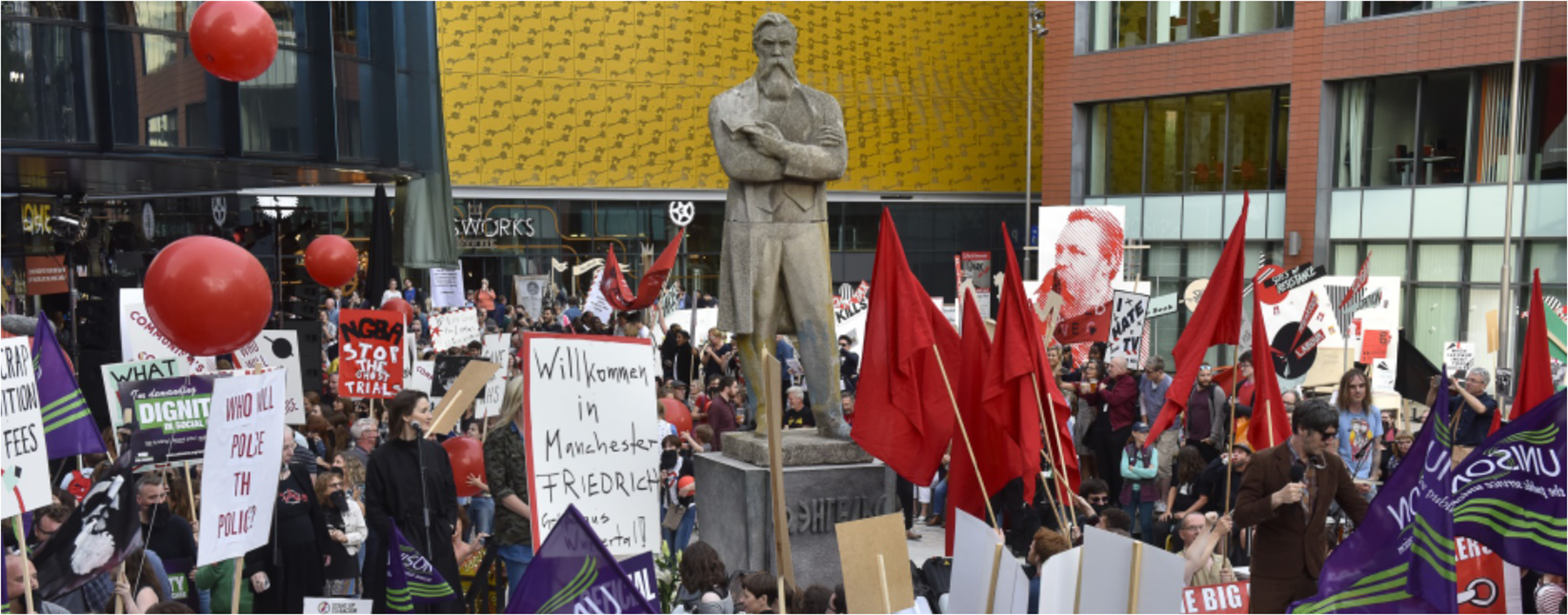
Installation of the Statue of Friedrich Engels during the Manchester International Festival, 16 July 2017.
Background
Engels was 22 years old in 1842 when he was sent by his father to Manchester to learn about the family's textile business (Hunt, 2009). Over the next 2 years, he observed and documented residents’ living and working conditions and collected reports and documents about these conditions and their adverse health effects on the working class. Upon returning to Bremen at the age of 24 years in 1844, he wrote CWCE in 6 months as a warning to Germans of the consequences of uncontrolled capitalist industrial practices. Written and published in German in 1845, an English-language edition with a new preface by Engels only emerged 42 years later in 1887. Engels returned to Manchester in 1849 and was employed until 1870 by the family-owned textiles business. During this time, he financially supported Karl Marx and his family, continued to organize the international socialist community, and published numerous manuscripts. Upon his retirement from the company in 1870, he moved to London where he lived until his death in 1895 (Hunt, 2009).
Phil Collins's bringing of the Engels statue from Ukraine to Manchester in 2017 was part of the Manchester International Festival and the subject of a 1-hour documentary film Ceremony: The Return of Friedrich Engels which was shown on BBC4 2 . The statue joined an earlier work, Engels's Beard by Jai Redmond, which was installed in 2016 at the University of Salford's Peel Park campus. These events are the subject of scholarly analysis by Goonewardena (2019), Rainey and Hanson (2021), and Wolff (2020).
Academic work has considered Collins's work as illustrating a number of concepts related to culture, communications, geography, history, and contemporary politics. For Rainey and Hanson “The statues of Engels in Manchester speak to discourses on political radicalism, ruin and futility” (2021: 272). Rainey and Hanson (2021: 265–266) evoke the concepts of trace and specter, respectively, to consider the meaning of Engels’s return: Crucial to our analysis, with its emphasis on the particular, is the notion of “trace” (Hanson, 2014: 18–25). Traces are the details of place and social life that tell stories of change, putting into motion the dialectic and with it a whole set of epiphanies and realisations. The two statues of Friedrich Engels function as traces in this respect. They contain seething contradictions of meaning, which either begin dialogue or remain tightly held apart paradoxes or both (and all three possible outcomes are aufhebung, the dialectic). As traces, the statues resignify in multiple modes while also illuminating the human discourses surrounding them and the wider environment they are placed in.
In his imagined return to twenty-first-century Manchester, we felt that Engels would encounter both the familiar and the strange and still have something to say. In certain respects, we were invoking the “spectre” of Engels, understood in a broadly Derridean sense (Derrida, 2012). Spectres haunt us in their absence, throwing open the very notion of what it means to be “present” while also forcing us to critically engage with heterogeneous pasts and possible futures. In their ghostly presence-absence, spectres perpetually question and probe the validation of political, social and epistemological forms, but do so without ever offering a secure response in return.
Goonewardena (2019) considers the Engels statue as illustrating past and current political struggles: “Monuments like these stand in the spatio-temporal force-field of political struggles, like lightning rods and transmission towers channelling their electric energy.” (176). And indeed, Collins's documentary juxtaposes Engels's attack on capitalism contained in the CWCE against the contemporary struggles of a number of current Manchester residents.
Finally, Wolff (2020) places the return of Engels as the end of a historical journey that began with German merchants, many of them Jewish, emigrating to Manchester to take up the textiles trade in the 19th century. It continues with the influx of German Jews during the Nazi era. Wolff entitled her essay Cotton and other Threads to make the link between the thread of textiles and the threads of history which she relates. Indeed, Wolff suggests that such threads (i.e. Ariadne's Thread) can help unravel a maze, logic puzzle, or an ethical dilemma such as solving current social issues which are similar to those identified by Engels in 1845: In the accompanying film, Ceremony: The Return of Friedrich Engels, Phil Collins draws attention to many parallels between “the condition of the working class” in 1844 and social problems in contemporary Manchester, observing interviews with benefits claimants and others, and asking himself what Engels would make of England today (2020: 165).
Purpose
In this paper, we focus on nonacademic communications about Collins's commissioned installation of the statue of Engels for the Manchester International Festival and the documentary Ceremony: The Return of Friedrich Engels which aired on BBC4 in 2017 to explore the social debates and dialectics generated by the statue. Considering the general unwillingness of the mainstream media to report on the relevance of Engels's writings to the contemporary scene, we were intrigued by the potential for greater reporting of the event and Collins's Ceremony. Our specific questions are presented below:
Inquiry Questions:
How many communications considered the installation and associated documentary as an arts and cultural event or as a call for action to right injustices? Did the communications make the historical links between Engels's critique of capitalism and the current UK public policy scene? Was the tone of the communications supportive of the artist's aim of mobilizing responses to current injustices? What response did it evoke from right-wing politicians and writers? Did the communications identify means of applying Engels's analysis and insights to respond to the adverse effects of capitalism? What is the potential for political and social movements of the arts community engaging in political education?
Methodology
Scoping reviews allow for the identification and analysis of concepts and evidence in chosen areas of study (Arksey and O’Malley, 2005). We followed Arksey and O’Malley’s (2005) five-stage approach for conducting scoping reviews: (1) formulating the question; (2) identifying relevant sources; (3) selecting these sources; (4) charting the data, and (5) collating, synthesizing, and reporting the findings.
We first used Google ScholarTM to identify relevant academic works by searching the terms “Engels” “statue,” and “Manchester.” Martin-Martin and colleagues (2018) show that Google ScholarTM yields significantly more citations than ScopusTM, WoS Core CollectionTM, and Web of ScienceTM in the coverage of academic literature in humanities and social sciences. We then used the same search terms in GoogleTM and FactivaTM to identify other communications on Collins bringing the Engels statue to Manchester. Factiva is Dow Jones “largest news aggregators and archives in the world” (ProQuest, 2021) which covers international news sources (Johal, 2009). We initially planned to sort these as either (a) academic articles, chapters, and books; (b) news reports in the mainstream and alternative media; (c) opinion pieces in the mainstream and alternative media; and (d) cultural reviews in the mainstream and alternative media. We identified additional categories of (e) arts and cultural events notices; (f) the content on political websites, and (g) references to the Engels statue in travel or tourism sites.
We considered the content of the sources as being organized around Engels's Return Home (history-related); a Cultural or Artistic Event, or Call to Action to address contemporary injustices. More specifically, we considered whether the article was supportive of Collins's intention to use the event to provoke responses to ongoing injustices in the UK brought on by unfettered capitalism, neoliberal approaches to governance, and imposition of austerity.
We applied the concept of valence to consider the tone of these communications. Cox and Béland (2013: 308) define valence as “an emotional quality of an idea that can be either positive or negative in its character, or high or low in its intensity.” As a result, the valence of an idea can be either (a) negative, high; (b) negative, low; (c) neutral; and (d) positive, low; or positive, high. Raphael and colleagues (2022) analyzed the importance of valence for promoting social and political movements for progressive change. In our research, we considered valence categorizations in relation to the artist's intention of having the placement of the statue acting as a call to action.
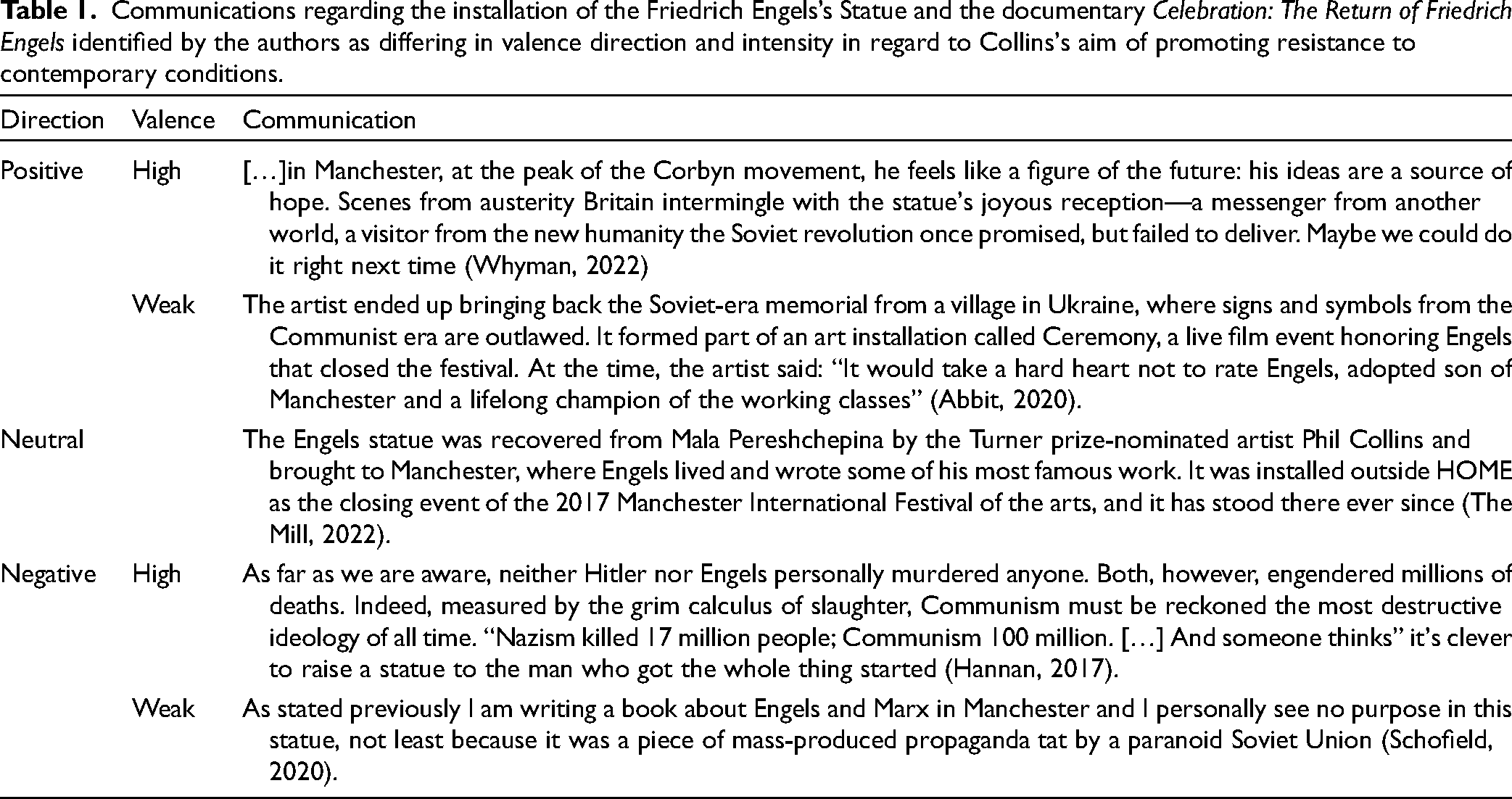
Articles suggesting support for this intention were rated as positive and if the language employed was deemed as provoking emotional arousal it was rated as strongly positive; others weakly positive. Articles simply reporting the event were coded as neutral, while attacks on the artist's intention were rated as either strongly or weakly negative. We also identified articles specifically mentioning the role of capitalism in creating current injustices. Table 1 gives an example of each category.
Communications regarding the installation of the Friedrich Engels’s Statue and the documentary Celebration: The Return of Friedrich Engels identified by the authors as differing in valence direction and intensity in regard to Collins's aim of promoting resistance to contemporary conditions.
Results
We found three academic works that explored the Engels statue's return to Manchester (a fourth simply introduced one of the three articles in a special issue of Human Geography on Friedrich Engels and Geography) (Royle, 2021a). Table 2 summarizes the results of our searches across other communication channels. The greatest number of reports of the Engels statue came from arts and culture-related sources, followed by opinion pieces, alternative news media, and then by mainstream news media, travel and tourism sites, leftist websites, companies involved in the project, and a foreign news service.
Frequency of occurrences related to the placement of Engels Statue in Manchester across communication channels.
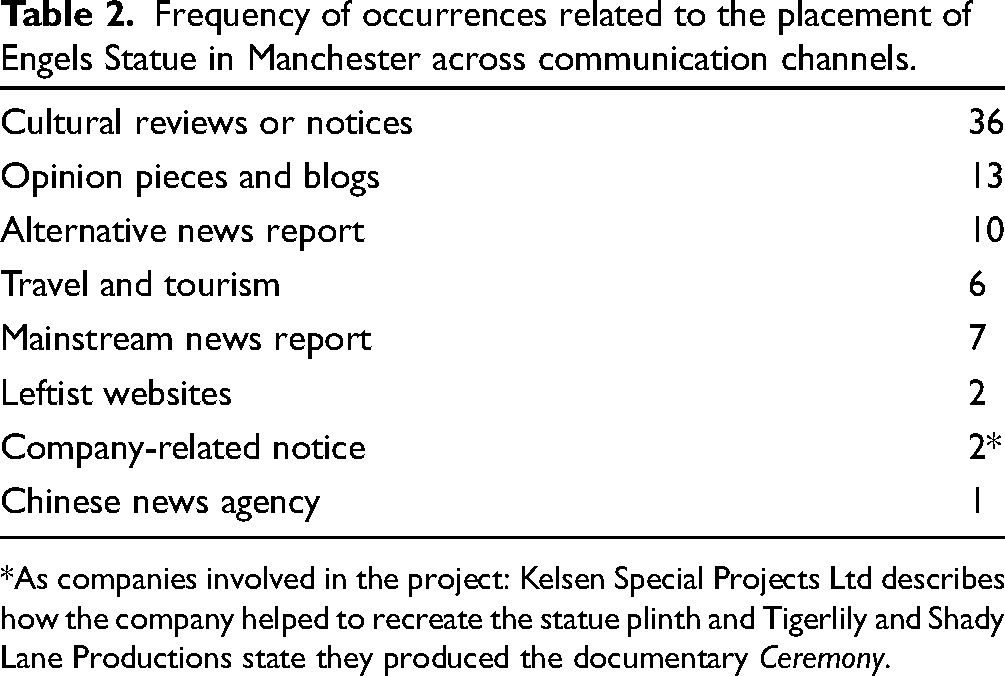
As companies involved in the project: Kelsen Special Projects Ltd describes how the company helped to recreate the statue plinth and Tigerlily and Shady Lane Productions state they produced the documentary Ceremony.
Figure 2 shows that communications were clustered around the period of the installation and showing of the Ceremony on BBC4 in 2017. Reviews and notice posts in 2017 were primarily about screenings of the Ceremony, and in 2022, the Russian invasion of Ukraine stimulated opinion pieces about the continuing placement of the statue in Manchester (see Supplemental material section).
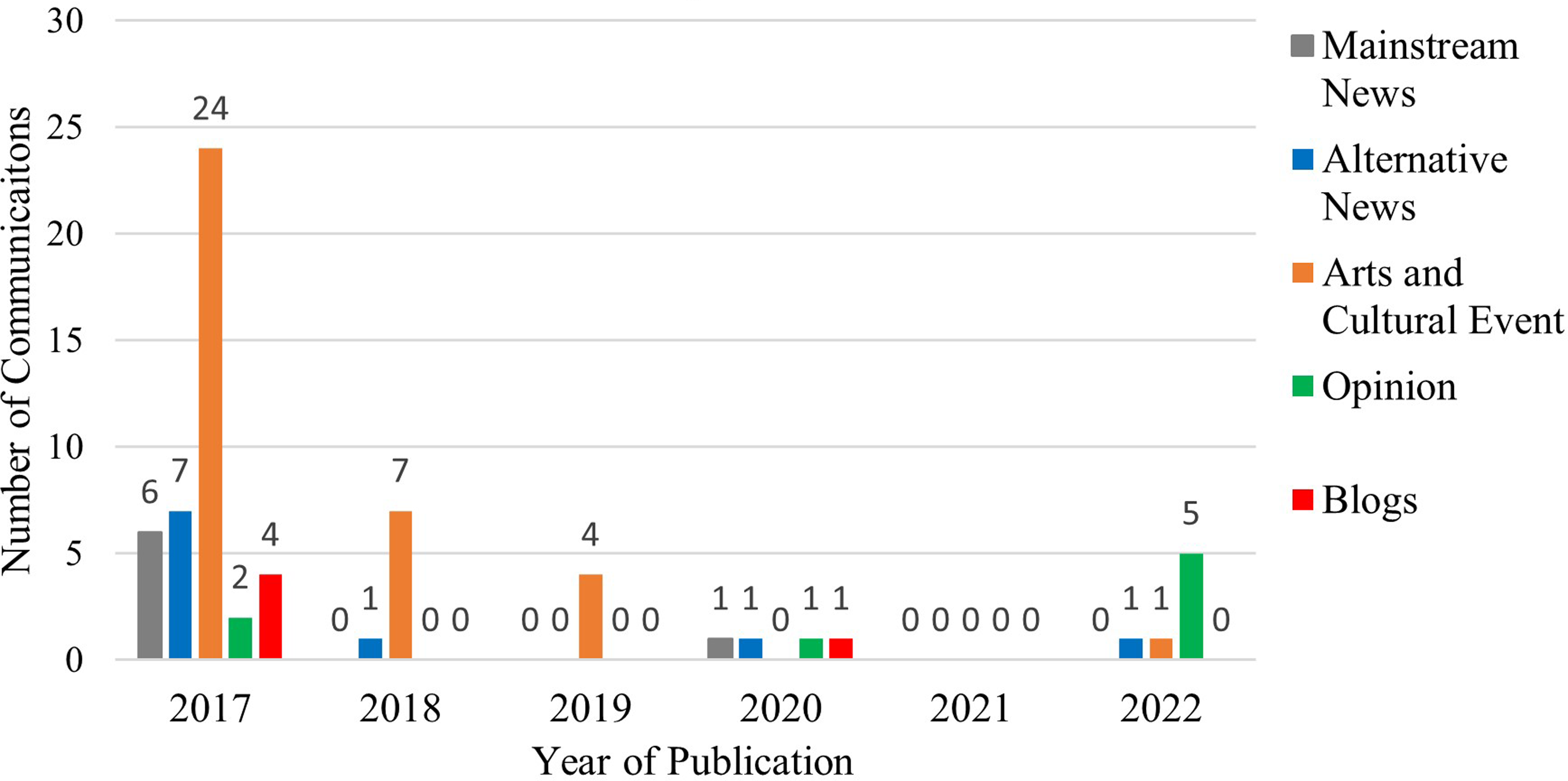
Distribution of communications by type and year, 2017–2022.
As news report in the mainstream media and one foreign news service
The seven mainstream news communications appeared in the New York Times, The Economist, Financial Times, The Guardian, International Business Times, and twice in the Manchester Evening News. In two cases the communication was contained in the culture and arts sections of the papers. In all seven, mentions were made of the time Engels spent in Manchester and his penning of CWCE. Five also spoke of the statue placement as an arts and cultural event and four spoke of it as a call to action to respond to current economic and social conditions. Especially interesting was the strongly positive tone of four with an additional one being weakly positive. The Guardian report (Higgins, 2017) was one such strongly positive communication: The book (CWCE), which was translated into English only in the 1880s, makes pretty grim reading in 2017. He wrote, in Florence Kelley Wischnewetzky's translation, of the “tender concealment of everything which might affront the eye and the nerves of the bourgeoisie”, and of Manchester, a city so in hock to profit that “no hole is so bad but that some poor creature must take it who can pay for nothing better”. Engels repeatedly used the phrase “social murder” to describe the conditions in which the proletariat were obliged to live. It is hard not to think of Grenfell Tower.
The strongly negative brief report in the Economist (2017) stated: The Soviet Union spent millions planting its icons in the West. Lenin devised a plan to use sculpture to propagate communism. Now, 100 years after the Bolshevik revolution, his plan has been realised in Britain—free of charge …. It testifies to the new vitality of socialism in the West (though revolutionary statues are under fire elsewhere). For tips on where it leads, Russia and Ukraine are good places to dig.
One news report by the China Daily (2020) considered the relevance of Engel's work to contemporary society on the 200th anniversary of his birth accompanied by a photo and mention of the Manchester statue. It provided a detailed history of Engels's contribution to Marxist thought and identified numerous surviving locations in Manchester where he lived and worked. As part of its examination of the relevance of Marxist theory to ongoing issues in China and elsewhere, it stated: As Phil Collins, the British artist who transported the statue of Engels from Ukraine to Manchester, has once said, Engels is a writer “with whom we can engage today, with the questions he raises. He “isn't to be confined to his time and forgotten”.
Interestingly, three of the mainstream articles and the article from the China Daily News agency mention capitalism: “The statue was installed three years ago in the cradle of the Industrial Revolution, which, along with much of Europe, had witnessed the darkest, most inhuman side of capitalism” (China Daily, 2020); “The statue now stands among such temples of Western capitalism as a McDonald's and a Hilton” (Davis, 2017); “In such narratives, modern despair and marginalization are laid at the feet of capitalism” […] Even now, when—for all the excesses of capitalism—the stark exploitation Engels evoked has disappeared in the western world, The Condition of the Working Class is an uncomfortable read” (Lloyd, 2017); and “Manchester is a meeting point. It represents both the birth of capitalism and the factory system and the magic of capitalism, the magic of surplus value” (Higgins, 2017).
As news report in the alternative media
Ten stories appeared in alternative news media sources: The Meteor, Salford Star and Confidentials Manchester (twice), The Mill, Northern Soul, Essentials, and Mancunian Matters. All 10 reported the story as an arts and culture event and nine provided details as to Engels's time in Manchester. Only three could be seen as representing a call to action, while five stories were positive, we saw two as weak and three as strong valence. Two stories were neutral in their reporting and three were weakly negative. One example of a weakly positive and one weakly negative are provided in the Meteor and Northern Soul respectively: Collins thinks bringing Engels back to prominence in Manchester reasserts the city's crucial role in the history of radical thought. It was the world's first “nuclear free city”; the Trades Union Congress (TUC) was founded at the Mechanics Institute on Princess Street; the Suffragettes, the Vegetarian Society and the Anti-Corn Law League all began here. And 2019 marks the bicentenary of the Peterloo Massacre, a seminal moment in the fight for democracy when a massive, peaceful demonstration demanding parliamentary reform was charged by cavalry, where the Free Trade Hall now stands (Dunnico, 2017).
Engels lived in the North West for nearly 20 years and Ceremony promised Collins would return him to prominence in Manchester, “reasserting the city's crucial role in the history of radical thought”. Unimpeachable sentiments, no doubt. However, although a typically committed introduction from Maxine Peake which drew parallels between the conditions which Engels faced in Manchester at the time and conditions we live in today, got things off to a promising start, the steady exit of people losing patience with the interactive presentations projected onto a huge screen in a nearby car park told a slightly different story (Bourke, 2017).
A strongly positive report was presented by Essentials: Collins has been gathering stories about “everyday resistance to the current political crisis.” he said: “In harrowing times for so many, it's more important than ever to remember Engels’ legacy—and the spirit of solidarity and dignity which beats at its core” (Sherwin, 2017).
Three articles were categorized as a call to action. As examples, Sherwin (2017) quotes Collins calling for a spirit of solidarity among the working class populations and in Meteor, Dunnico quotes Rachel Broady who states “At a time when Salford children are experiencing increasing poverty and a rise in Victorian diseases, I think as a city we should look more closely at the work of Engels” (2017: 2).
The Mill follows up on the reactions from Manchester residents in light of the Russia–Ukraine war where some residents are quoted: Notwithstanding Engels’ connection to Manchester, the statue has always seemed to me to be an oddity at best At worst, it felt like a particular insult to the people of Ukraine, for whom Engels represented a grim part of the country's history. Russia's invasion of Ukraine and the motivations at its heart make the continued presence of the statue worse still (The Mill, 2022).
Three communications from an alternative news source were seen as weakly negative. For example, Schofield (2020) calls the Engels statue a “humpty dumpty,” mass-produced propaganda of the Soviet Union, that serves no purpose but a reminder, a symbolism of “pure Marxism and the debased reality of regimes which have declared themselves Marxist.” There was no mention of capitalism in any of the alternative media communications.
As arts and cultural event
We identified 36 arts and cultural reviews or notices of events. Of these, 20 were notices of the statue installation or subsequent showings of Ceremony; 13 were reviews of the event or Ceremony, one was from a digital archive, one was an interview with artist Phil Collins and one a commentary. Twenty-four communications were positive with 12 of these strong, and 12, weakly so. Twelve notices were coded as neutral. None were negative.
Among the reviews that viewed Collins's placement of the statue and Ceremony strongly positively, Mansfield (2019) argues in The Scotsman: As the gap yawns ever wider between rich and poor, the questions Engels posed about industrialisation, capital, consumption and even nationalism have not been adequately answered. When British city centres are still largely full of statues of war heroes and colonialists, Engels makes a provocative addition, his ideas, according to one speaker on the film, representing “the best chance at human dignity” in a divided world.
In a film review of Ceremony Darke (2018) writes: […] as the statue of Engels passes by on the back of a lorry […] The festival atmosphere is a beautiful and moving instance of working-class solidarity, with crowds engaging in serious political discussions and speeches, while enjoying the silliness of, for example, instructions on successful shoplifting while wearing false Engels beards.
The author concludes the film review by stating “Ceremony genuinely made me cry a little and inspired me to reread my Engels.” In two other film reviews, IFFR (2018) and Hetherington (2019) write respectively: […] Ceremony, a combination of documentary road movie and social-activist pamphlet, Collins proposes a renewed link between Manchester and the idea of communism as a radical and visionary alternative for the “tyranny of capital” that still has a grip on our political, economic and emotional life.
Ceremony operates, with its accompanying techno soundtrack, its juxtaposition of archival footage, public proclamations, historical images, as a social seance channeling and retrieving the spirit of Engels, divining traces of his presences in Manchester in photographs of demolished factories, yellowing newspaper clippings, letters and obsolete maps.
In an interview with artist Phil Collins McKenzie (2019) argues “An artist's interpretation of the contribution of Engels (1820–95) to British history and the relevance of his views to today's uncertain times provide a new position from which to interrogate the significance of his life and work” and that Engels is used by Collins to address the fact that today, in a period of absolute prosperity, it seems impossible for the ruling classes and the policy-makers to comprehend the stress and misery of people suffering the ramifications of an overstretched benefits system, and the implied punishment in the manner in which immigrants and refugees are treated. Engels’s key text, The Condition of the Working Class in England, Collins asserts, is a suitable reflection of the country's problems today.
Among the arts and cultural communications, 19 out of the 36 events notices/reviews mentioned capitalism, taking due note of the artist's purpose in linking the economic system of 1845 to the present. A few examples: As the likeness travels through Europe, readings by Maxine Peake from 1845's The Condition of the Working Class in England draw parallels between the deep divisions that sparked Engels's communist ideas and the iniquities of late capitalism today (Seale, n.d.)
Engels's life in England, and his communist vision as a product of English life, justify his new home. It was in Manchester, amidst the city's factories and working men and women, that his vision of an alternative to capitalism really emerged (Alexander, 2018).
Acknowledging Engels's observations on the condition of the working class in the nineteenth century as its starting point, a Panel Discussion on the preview evening will bring together representatives from activist and community groups in Dundee and beyond. Reflecting upon the past decade of austerity measures in the UK, the discussion will engage different perspectives on the hardships and injustices of life under contemporary capitalism (Cooper Gallery Goethe Institute, n.d.).
As opinion pieces
Five of eight opinion pieces discussed Engels's statue in light of the recent Russian attack on Ukraine. Of the eight opinion pieces, three were published in mainstream newspapers and the others in alternative media. All eight spoke about the statue as an art event, seven examined the return of the Engels statue as a history lesson, and one saw the statue as a call to action. One piece was strongly positive, two weakly positive, four neutral, and one weakly negative.
Five opinion pieces published in March 2022 examined the possible removal of the statue because of the Russia–Ukraine war which began in February 2022. HOME, a publicly funded art center located in the center of Manchester—which is where the statue is currently installed—tweeted that the co-commissioners of the statue and artist Phil Collins were in discussion about how best to respond to the invasion (Bond, 2022).
This tweet garnered much criticism from the Twitter community with hundreds of people supporting the presence of the statue; for example, one tweet wrote “Engels was a German anti-war activist. Contemporary Russia is a capitalist economy that doesn't follow any of Engels writings and Putin hates communism.” (Bond, 2022). Consequently, HOME went on to explain that their previous statement did not mean a removal of the statue was planned but was rather a call for a consideration of the statue's meaning in the context of the conflict; adding that they would like to add more information on how and why the statue was installed in Manchester.
Three opinion pieces examined the conflict between Russia and Ukraine, arguing that the statue was never meant to be a “homage to the Soviet Union” (Mosbacher, 2022). Citing Dan Hannan, Mosbacher (2022) writes “Communism killed 100 million people. And we’re putting up a statue of Engels. […] bad ideas have consequences, for which some of the blame must be apportioned to Engels.”
The only negative valence opinion piece discussed the lack of consultation with the Manchester Ukrainian community prior to the movement of “a piece of Soviet propaganda” (Bolton, 2017) to the center of Manchester. Bolton (2017) states “that members of the community were approached about providing a choir for Ceremony, but they turned it down when they discovered the context” Three of eight opinion pieces mentioned capitalism in relation to Engels and the statue, all three communications were also positive in valence.
As blog posts
We identified five communications as blog posts. All considered the installation of the statue as an art and cultural event; three provided connections to a historical lesson, and two saw the return as a call to action. Three of the five blog posts used a neutral tone, while two were weakly positive.
Of these five, one examined the relevance of Manchester's new statue to “contemporary British politics, while also examining society's interpretation of Soviet history” (Jeyarajah, 2017). Acton28 (2020) compares Engels's contradictory life of a bourgeoisie by day and a radical political and social thinker by night to Bruce Wayne and Batman. Examining how statues remind us of history and the evolution of human thought, Acton28 (2020) writes “… in Manchester this statue of Engels symbolises the then, the now and the future.”
The last blog post provides a brief overview of the event and states the “project will be a reflection on Greater Manchester's place in history of radical thought, its working class culture and solidarity, and its industrial heritage and Engels’s contemporary relevance in the shadow of Karl Marx.” (Evangelinefblog, 2017) Three of eight communications mentioned capitalism in relation to Engels and the statue.
As overtly political websites
We identified two notices from far-left websites which discussed events held to celebrate the 200th anniversary of the birth of Engels. In both articles, Engels’s statue in Manchester was mentioned in relation to a polemic against alleged “fascists” in Ukraine who had removed the statue (Challenge Magazine, 2020). No explicit mention of capitalism is made.
As travel or tourism
We identified six communications as travel and tourism notices. All discussed the placement of the statue as an art event and five outlined its historical relevance with short accounts of Engels's time in Manchester and Engels's observations as contributing to communist thought. None see the return as a call to action and all used neutral language; none mention capitalism.
Lopez-Galiacho (2019) writes “Engels—entrepreneur and revolutionary at the same time—knew first-hand the terrible living conditions of the working class in the suburbs of Manchester—at that time the world's first industrialized metropolis—and reflected them in his seminal 1845 book.” Two reviewed Ed Glinert's Engels walking tour of Manchester (O’Rourke, 2018) and a list of places where Engels and Marx spent time together (The Meia, n.d.). Alliance City Living (2020) lists the statue of Engels as one of Manchester's “hidden gems” and HOME Arts and Cultural Centre pamphlets present the return of the statue as a cultural event with a short background of Engels and his work.
Summary
Figure 3 shows that all the communications except one mainstream news report focused on the installation or documentary as an arts and cultural event. All the mainstream news and alternative reports also focused on the historical aspects of Engels in Manchester. There was significant messaging about capitalism except for the alternative news reports. A healthy percentage of mainstream news, alternative press, and blogs reported the installation and documentary as a call to action. Figure 4 shows that the predominant tone of communications was positive across mainstream and alternative news reports and communications of the installation or documentary as an arts and cultural event. There were rather few negative communications.
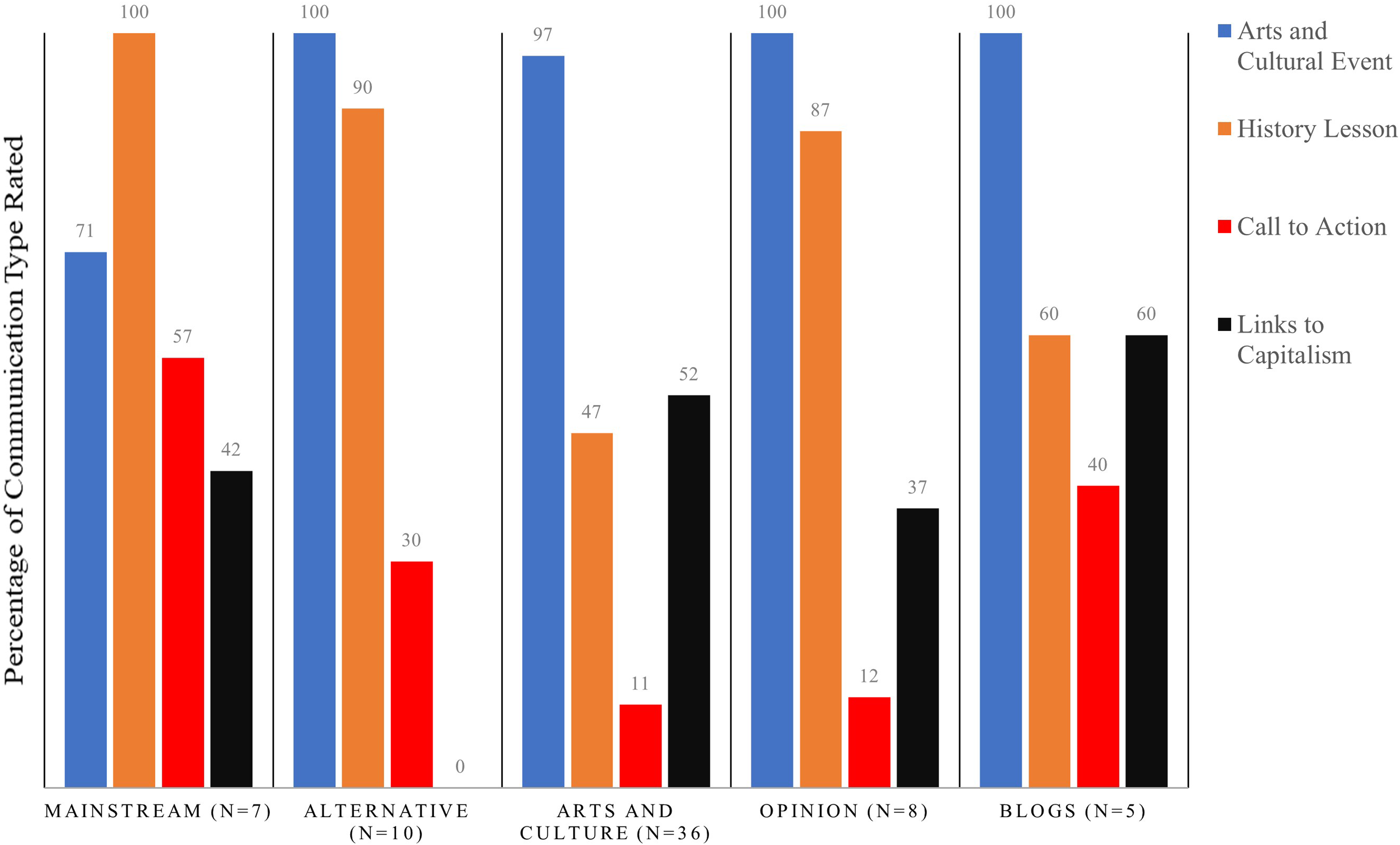
The percentage of each communication type is rated as to focus and links to capitalism.
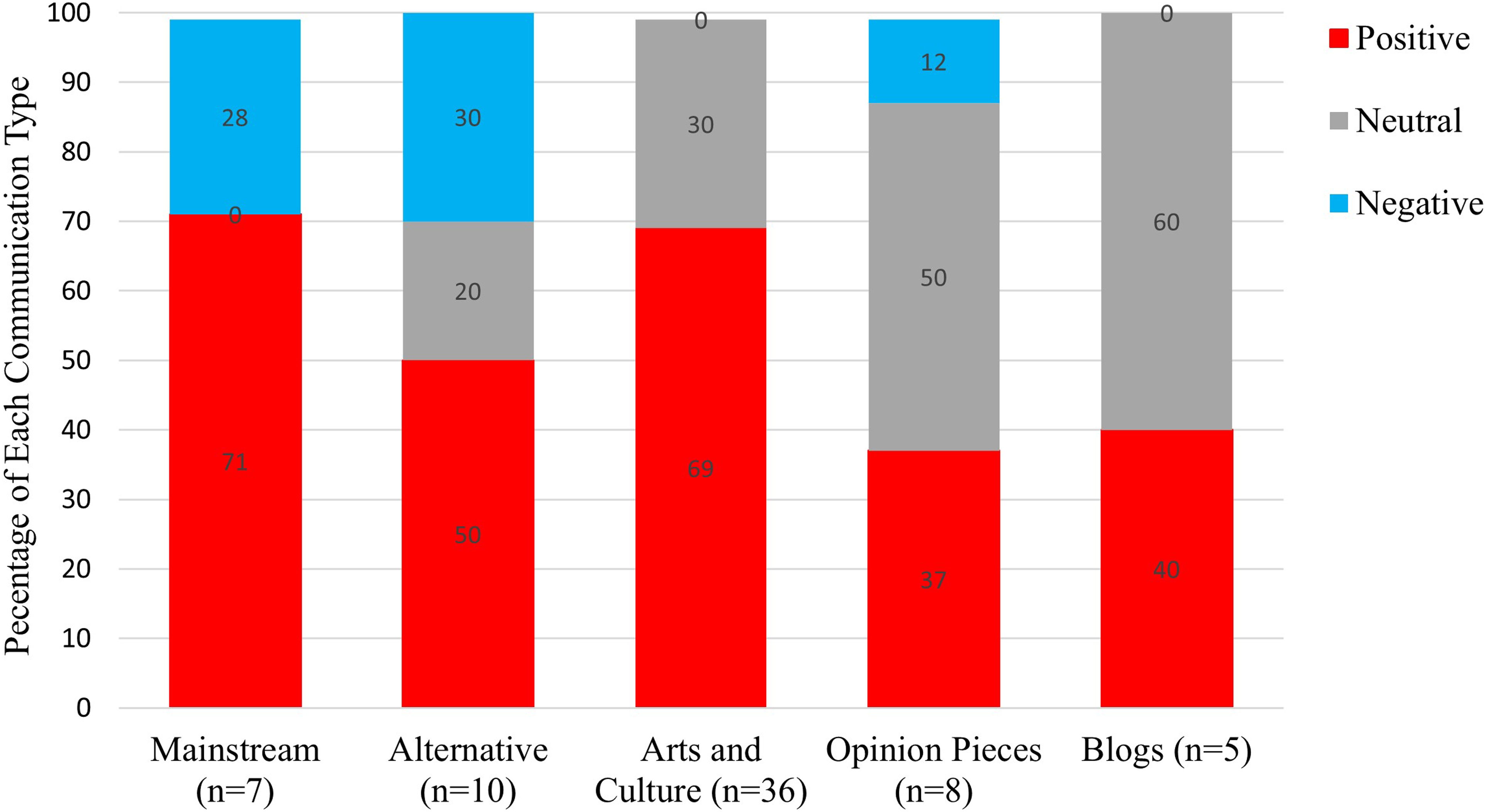
The percentage of each communication type is rated as to valence.
Discussion
We consider the six original questions guiding this inquiry.
Was the installation and associated documentary communicated as an arts and cultural event, history lesson or a call for action to right injustices?
It is clear that all communications were driven by the installation of the statue and the associated documentary as an arts and cultural event. The reporting was significantly greater when it considered Collins's work as an arts and cultural event. We identified a greater preponderance of communications in the arts and cultural category, however, it appeared to us that explicit calls for action were more muted in this section. Indeed, the greatest number of communications were reviews or notices about the event and the associated documentary. In terms of the artist's intention to make links between Engels's time in Manchester and the present, this aim was partially achieved: most communications provided background information about Engels's time in Manchester and CWCE. Much fewer, although still a significant proportion, linked his analysis of the forces driving the horrific living and working conditions of workers in 1844 to the present circumstances of many in England.
Did the communications make the historical links between Engels's critique of capitalism and the current UK public policy scene?
Across all the main communication channels, mainstream and alternative media, arts reviews and notices, and opinion pieces, there were numerous mentions made of the artist's intention to have the work draw attention to the similarities between 1844 and present-day England. Explicit mentions of capitalism as the culprit were few.
Interestingly, the mainstream media reports were the most likely to communicate these links (4 of 6). However, the largest cluster of communications—those reviewing the event or providing a notice of the event or documentary—only had a small minority (5 of 36) seeing these as a call to action to right the injustices of the contemporary scene. It appears that for the mainstream media reports, the linkages between 1844 and the present were the key component of the story.
Was the tone of the communications supportive of the artist's aim of mobilizing responses to current injustices?
The tone of most of the communications was positive (42 out of 77) and in many cases strongly so (23 of 42). Thirty communications were neutral, and six were negative of which four were weakly negative. Figure 2 shows the percentage of each communication type as to valence. Phil Collins is a very articulate spokesman for drawing attention to the dispossessed in today's England. The prestige of the Manchester International Festival and the quality of the BBC4-shown documentary also contributed to the positive coverage.
What response did it evoke from right-wing politicians and writers?
There were surprisingly few negative reactions to the placement of the statue and most were recent, relating to the Russian invasion of Ukraine. The lack of negative reaction contrasts with what was seen when Deputy Labour Leader McDonnell referred to the Grenfell Tower Fire as “social murder,” the term coined by Engels in CWCE. The few negative reactions are recent, and the majority are in relation to the Russian invasion of Ukraine and the tenuous links between that and Engels being a co-founder of communism.
Did the communications identify means of applying Engels's analysis and insights to respond to the adverse effects of capitalism?
The few communications that did so were remarkably eloquent in showing how current public policy—and in a few cases, capitalism—is causing unnecessary misery, suffering, and sickness and illness. These identify the means for responding as requiring social movements that can apply political pressure to address these injustices. Medvedyuk et al. (2021) document how social murder committed by the bourgeoisie through oppressive working and living conditions has had a resurgence in the academic literature and Govender and colleagues (2022) record similar findings in mainstream news media. In three of these cases, Collins's bringing Engels back to Manchester contributed to this resurgence.
What is the potential for political and social movements of the arts and culture community engaging in political education?
Brecht (1964) famously said, “Art is not a mirror held up to reality, but a hammer with which to shape it.” Collins uses art, in the form of a film of the statue installation, as a hammer with which he shapes the reality of the people that encounter them. Thus, the rather extensive coverage of Engels's return by various communication channels suggests that arts and cultural events can mobilize people in the service of progressive change. Such a view is not new and has been the subject of analysis for over a century. In contrast to Shakespeare's view of theater as a mirror held up to reality Collins's aims in bringing Engels back to Manchester are consistent with Brecht's view of art as a hammer to shape reality.
Of course, critique is just the first step in an ongoing process of engaging people in order to challenge the structures of capitalism to support the movement toward a postcapitalist society. However, it is an important one and Collins's work is significant in this regard.
Theoretical considerations
Links to past and present made explicit
Derrida's (2012) concept of hauntology illustrates how past figures, discourses, and ideas can influence and shape contemporary issues. In simplified terms, hauntology (the study of what is not, what is dead) is the opposite of ontology (the study of being). Hauntology looks at the return of elements from the past such as signs, symbols, ideologies or, in this case, a statue that comes back and means different things in a specific moment in time. In hauntology, Derrida (2012) developed the concepts of specter and trace. Engels's specter presents itself through the statue, and the traces which Rainey and Hanson (2021: 266) state are “details of place and social life that tell stories of change” provided in the communications about the statue and documentary.
Spectral figures such as Engels and Marx help “question and probe the validation of political, social and epistemological forms” (Rainey and Hanson, 2021: 266). Specters and traces also help stimulate our imagination to think of new ideas. For Rainey and Hanson (2021: 266), the specter of Engels points to “the need for a return to the grounded political analysis of Engels.” Verdery (1999) reinforces this point in her analysis of the political lives of dead bodies (including statues): Statues are dead people cast in bronze or carved in stone. They symbolize a specific famous person while in a sense also being the body of that person by arresting the process of that person's bodily decay, a statue alters the temporality associated with the person, bringing him into the realm of the timeless or the sacred like an icon. For this reason, desecrating a statue partakes of the larger history of iconoplasm … removes the specific body from the landscape, as if to excise it from history … Raising up new statues reverses the process, (re)sacralizing persons who were gone for some time unremarked. Both action signal a change in the universe of meaning that hitherto prevailed (p. 5).
Further, Derrida states as did Hamlet, that “time is out of joint” (2012: 20) because injustice is widespread and “the ghosts of those who are not yet born or who are already dead, be they victims of wars, political or other kinds of violence, nationalist, racist, colonialist, sexist, or other kinds of exterminations, victims of the oppressions of capitalist imperialism or any of the forms of totalitarianism” (2012: xviii) haunt us, and will do so time and time again. It is during the time of “disjointure (adikia) or the ‘injustice’ of the present” (2012: 30) that Derrida argues that specters appear. Considering the competing interests of global imperial powers and the conflicts that arise from these interests, the coming of Engels's specter through the statue is now timelier than ever.
Arts and politics
Visual art forms can contribute to social change, Berman states that “visual arts are an expression of the aspiration of people in their hope for a more just and democratic society” (Berman, 2018: 1). Through the Ceremony documentary and the reinstatement of the statue, Collins reshapes the discourse around Engels, putting Engels at the fore, forcing us to have a conversation with one of Engels's ghosts—which ghost depends on us, our knowledge of Engels, our social position, and the time at which we come to have this conversation.
Vázquez (1974) draws our attention to the theoretical insights of Engels and Marx on art, whose critical view of religious imagery was associated with fetishism and gave rise to the concept of commodity fetishism under capitalism. The mass-consumer art forms of Engels and Marx, often used as propaganda in the former Soviet Union were fetishized, taking away from the revolutionary movement that the thinkers tried to generate. Because Marx and Engels were critical of mass-produced art and art commodification, the statue of Engels becomes an especially important object for such analysis.
An important component of Collins's exercise was the creation and airing of the documentary Ceremony: The Return of Friedrich Engels. Nisbet and Aufderheide (2009) argue that documentaries provide an opportunity to “shape debates over social issues and policy questions” (Nisbet and Aufderheide, 2009: 450). Documentaries can also influence public opinion, shape policy, and help build activist networks (Nisbet and Aufderheide, 2009). By utilizing truth and facticity which Siapera and Papadopoulou (2018) see as the central parts of a radical documentary, Ceremony creates new meanings, and stirs debates to promote social and political justice. We would hope that Collins's work would come to influence policy and build advocacy networks in Manchester and elsewhere.
The explicitly political nature of radical and activist films helps achieve a return to the social body where the rediscovery of common social issues like worker oppression contributes to a new form of social reproduction (Siapera and Papadopoulou, 2018). In their analysis of radical Greek documentaries, Siapera and Papadopoulou (2018: 11) state that radical media makes private troubles into public issues by […] exposing the systematic ways in which the crisis has progressed, and therefore absolving and relieving people from the collective guilt that has been imposed on them; by giving voice and legitimating grievances and frustrations of people, dealing with affective traumas of social implosion, and connecting struggles […]: by showing the brutality used by the neoliberal state and its police and mainstream media; and by highlighting more productive and socially just ways of producing and organising.
Ceremony and the ongoing presence of the statue of Engels in Manchester, by bringing to the fore, issues of labour, capital and urbanization, can stimulate a new collective voice that can imagine a different future through new “forms of social being and organizing” (Siapera and Papadopoulou, 2018: 13).
Conclusion
Collins's installation and documentary continue to stimulate debate about the nature of capitalism and how it shapes the living and working conditions people experience. It also allows entry into Engels's analysis of imperialism which also maintains relevance for today's world. In the Spring of 2022, Collins and HOME are curating an exhibition “Intervention” by Collins and Oleksiy Radynski (Thursday 26 May 2022–Tuesday 23 August 2022), which in addition to making Ceremony again available to the public, is described as follows (HOME Mcr, n.d.): Radynski transform Engels into a mouthpiece, amplifying the voices of Ukrainian writers and activists. Scrolling across one of two temporarily installed LED panels are texts by Svitlana Matviyenko, Mariia Volotilina, Olexii Kuchanskyi and Radynski, sharing their experiences of the last few harrowing months, and offering perspectives on notions of Russian imperialism.
On the second LED panel a newly commissioned text by social anthropologist Volodymir Artiukh combines analysis on the international economic impact of the war with personal testimonies of those most affected, and excerpts from Engels's own writings. Together, these voices articulate decolonial and anti-imperialist positions on ideas of power, oppression and resistance, in what is the biggest geopolitical crisis unfolding in Europe since the end of the Cold War.
The past haunts the present. When explicit links from the past to the present are made, it promotes understanding of our world and suggests a better future. Engels's return to Manchester—and the associated documentary—are instances of how arts and cultural events can accomplish these goals. As such, radical arts and cultural events direct attention to the adverse effects of societal structures and processes and the public policies they spawn. These events can also serve as means of mobilizing against them. Developing, promoting, and communicating such radical arts and cultural events seems imperative.
Supplemental Material
sj-docx-1-hug-10.1177_19427786221120659 - Supplemental material for Communicating Friedrich Engels's return to Manchester: Arts and cultural event, history lesson, or call to action?
Supplemental material, sj-docx-1-hug-10.1177_19427786221120659 for Communicating Friedrich Engels's return to Manchester: Arts and cultural event, history lesson, or call to action? by Stella Medvedyuk, Piara Govender and Dennis Raphael in Human Geography
Footnotes
Declaration of Conflicting Interests
The authors declared no potential conflicts of interest with respect to the research, authorship, and/or publication of this article.
Funding
The authors received no financial support for the research, authorship and/or publication of this article.

Supplemental material
A supplementary file containing all communications is available online.
Notes
Author Biographies
References
Supplementary Material
Please find the following supplemental material available below.
For Open Access articles published under a Creative Commons License, all supplemental material carries the same license as the article it is associated with.
For non-Open Access articles published, all supplemental material carries a non-exclusive license, and permission requests for re-use of supplemental material or any part of supplemental material shall be sent directly to the copyright owner as specified in the copyright notice associated with the article.
