




Abstract
In this essay, I address the question of how Marxism influences our thought and action as radical intellectuals by focusing on Friedrich Engels’ work, Dialectics of Nature, the way it has been taken up in critical environmental studies and how Engels’ thinking has influenced me. In later life, Engels made important contributions on topics that are distinct from Marx's economic work. He attempted to apply dialectical methods to the “natural sciences” and he also used his knowledge of anthropology to produce a study of the historical origins of private property and women's oppression. In both cases he has been accused of adopting a positivist approach that lacks the emphasis on human agency found in Marx. Here, I challenge this view by showing how Engels’ work has been of use to practicing scientists – particularly to Richard Levins and Richard Lewontin in their book The Dialectical Biologist. I further argue that this understanding of dialectics is fully commensurable and actually advances an approach to Marxism that is based on human self-emancipation. As an undergraduate biology student these scientists inspired me with their approach to their subject as well as their activism. The essay concludes with some brief thoughts on the importance and limitations of adopting a Marxist method when considering socio-environmental change.
Over the past year there has been renewed interest in the life and works of Friedrich Engels (1820–1895). Several new books and articles marked the bicentenary of his birth, including a special issue of this journal. Some accounts have discussed Engels’ relationship with Karl Marx. This extraordinary intellectual and personal partnership lasted nearly 40 years and laid the foundations of what we now call Marxist philosophy and of socialist politics. However, other discussions of Engels’ legacy have focused on what Engels contributed that was distinct from Marx's work. In this vein, an enduring debate concerns his interest in the natural sciences, his attempts to produce a “dialectics of nature”, and more generally, the implications for his work when it comes to thinking about “nature”. This essay discusses what “thinking as an Engelsian” might mean, particularly for Radical Geography, by focusing on what it has meant for those interested in socio-natural transformation more generally. Some of the most productive and interesting uses of Engels’ work have been within the discipline of biology but I hope that the implications for geographers also become clear.
One of the foremost Engelsian biologists was Richard Lewontin, who has recently died at the age of 92. 1 When I was lucky enough to meet him in 2014 and interview him for my PhD project (he was still active as a researcher), Dick responded with his typical generosity to my nervous attempts to make sense of his politics and scientific practice. Lewontin was a Marxist and eminent evolutionary biologist whose work advanced understanding of genetic variation within populations of the same species, mostly using the fruit fly Drosophila melanogaster as a model organism. One of his best-known arguments was that in humans there is much greater genetic variation within supposed racial groups than between the races, an argument that played an important role in countering the assumption of genetically inscribed racial differences. Lewontin read widely and produced work that easily crossed boundaries between so-called disciplines. As Stephen Jay Gould put it, he was able to combine “the very best in genetics” with “a powerful political and moral vision of how science, properly interpreted and used to empower all the people might truly help us to be free”. His work on the relationship between organism and environment led him to reason that we should reject slogans like “save the environment” due to its assumptions of a stable and harmonious “natural environment” that humans are an outside pressure upon (Lewontin, 2001, 118) – his views on this were clearly in line with a central theme for radical geography. I will return to a discussion of dialectical biology, including Lewontin's. But first it is necessary to summarise some of the debates about an earlier Marxist thinker, Friedrich Engels, and his own interest in the natural sciences in the 19th century.
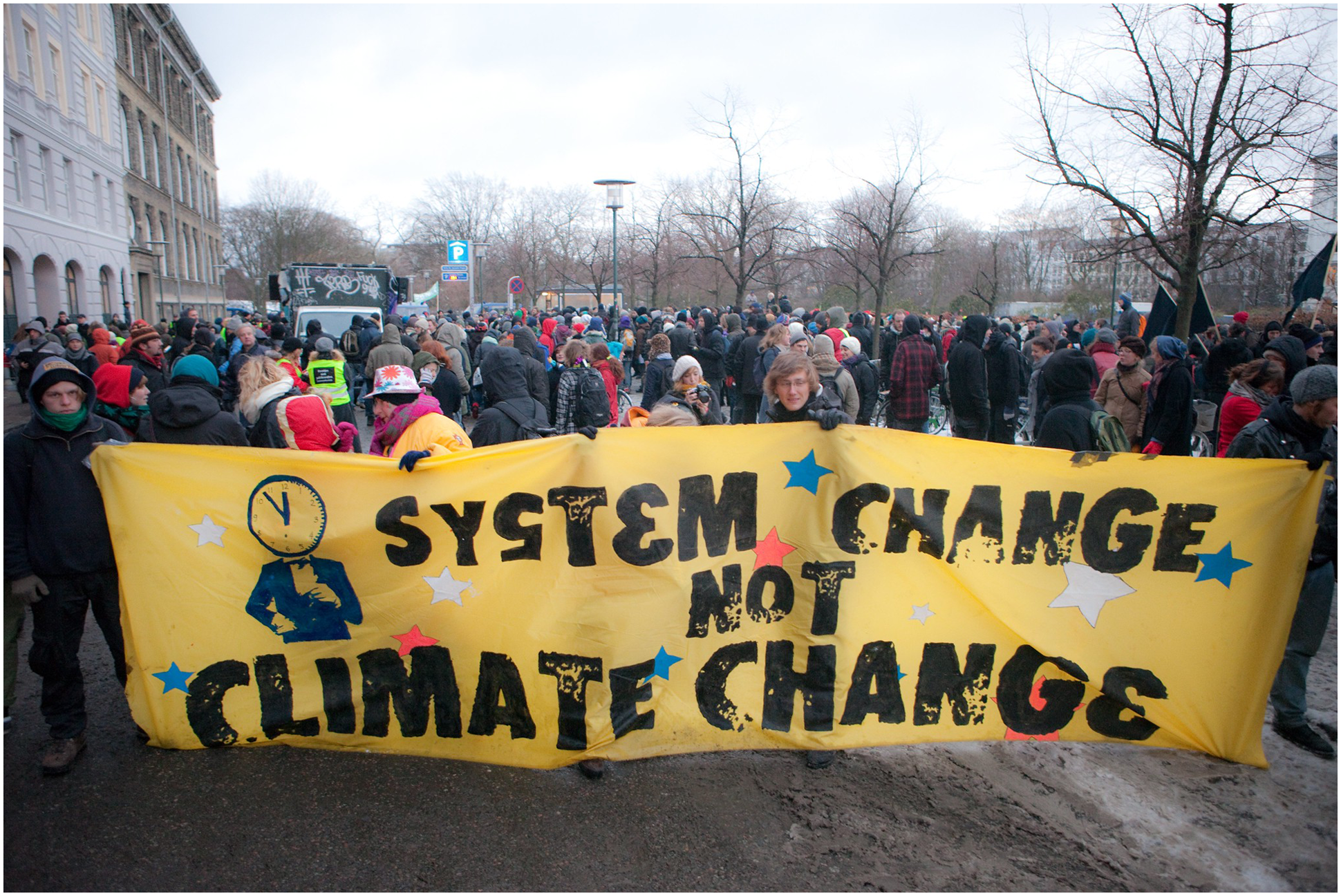
Protestors at the COP15 climate talks in Copenhagen with a banner reading “system change not climate change”
Engels was described by the 20th century biologist and communist sympathizer J.B.S. Haldane as “probably the most widely educated man of his day”. Like Marx, he systematically engaged with contemporary scientific discussions. Engels was aided in this by correspondence with natural scientists, such as Carl Schorlemmer and E Ray Lankester, and by visits to public lectures in Manchester's Hall of Science, where many of the key scientific discoveries, including Charles Darwin's work on the origin of species, James Joule's thermodynamics, and John Tyndall's experiments on the absorption of radiation by greenhouse gases were discussed. In her excellent work Marxism and the Philosophy of Science, Helena Sheehan describes how Engels was not only aware of the state of scientific knowledge but was also able to shed new light on questions in various fields by adding his own insights (Sheehan, 1993, 28).
In 1873 Engels started to write up the results of his enquiries into the natural sciences, announcing in a letter to Marx: This morning while I lay in bed the following dialectical points about the natural sciences occurred to me: The subject matter of natural science—matter in motion, bodies. Bodies cannot be separated from motion… One cannot say anything about bodies without motion, without relation to other bodies. Only in motion does a body reveal what it is (quoted in Sheehan, 1993, 24).
Much of Engels’ work after Marx's death instead consisted of editing and preparing the second and third volumes of Capital for publication and promoting the interests of the “Marx party” within the international revolutionary movement. His more immediate task, however, was to write a short book on The Origin of the Family, Private Property and the State, making use of Marx's unpublished notes on the anthropology of Lewis Henry Morgan – Marx was interested in anthropology and its implications for our understanding of pre-class societies although he did not publish extensively on this himself. Engels’ text was rushed out in order to respond to German socialist August Bebel's Women and Socialism. In contrast to Bebel, who tended to assume that women had always been oppressed, Engels historicised women's role within the family and related it to environmental change. As he argued, with the Neolithic Revolution and the origins of settled agricultural societies it became possible for people to accumulate a surplus of material goods. Families who were able to procure more food eventually gained prestige and some became leaders or soldiers so were no longer directly involved in food production at all, societies that had been egalitarian eventually became divided by social class. These changes had two impacts on the status of women. Firstly, women were less directly involved in agriculture than their ancestors had been in hunter-gatherer societies as it was difficult to combine heavy agricultural labour with pregnancy and childcare. Consequently, they spent more of their time in the home and experienced a loss of prestige. Secondly, their sexuality was more tightly controlled as the introduction of private property meant that men needed to know who their offspring were in order to pass on that property (see Brown, 2013, 165). Engels’ work on this topic has since been embraced by some and critiqued by others. For its advocates, it has provided a basis for locating the roots of women's oppression in class society – it points towards a structural understanding of the ways in which society, by circumscribing their social roles, harms women (and most men) rather than seeing men as the cause of women's oppression. As Martha Gimenez argued, men do not have some unique power “independent of social determinations” to shape society in their interests and at the expense of women (quoted in Brown, 2013, 144).
Georg Lukács’ early writings have been used to critique Engels’ work on both nature and the family. In the 1923 book History and Class Consciousness Lukács argued that orthodox Marxism refers only to a method. Marxism is not an exercise in uncritically repeating all of Marx's (or Engels’) specific pronouncements or endowing their texts with “quasi-Biblical status”. What it does provide is a way of thinking that Lukács refers to as dialectical materialism (1971 [1923], 1–2). However, Lukács’ did not agree with Engels about the application of such a method to questions of nature. He stated, in a now infamous footnote, that Engels had followed Hegel's mistaken lead in attempting to do so. For Lukács “the crucial determinants of dialectics—the interaction of subject and object, the unity of theory and practice, the historical changes in the reality underlying the categories…are absent from our knowledge of nature” (Lukács, 1971 [1923], fn6, p24). Lukács argued – at least at this point - that the dialectical method only applies in discussions of human society where it describes the relationship between an acting subject and its object, stating that, by contrast: “the dialectics of nature can never become anything more exalted than a dialectics of movement witnessed by the detached observer, as the subject cannot be integrated into the dialectical process, at least not at the stage reached hitherto” (Lukács, 1971 [1923], 207). This view was consistent with his understanding of the way in which scientific study is carried out. Lukács seems to have assumed that scientists treat the “manner in which data immediately present themselves” as “an adequate foundation of scientific conceptualisation” (p 7). This way of doing science is not only crude. For Lukács, it is compatible with capitalist society as it takes facts to be self-evident rather than historically evolving. He later nuanced his earlier work by affirming that there are indeed dialectical processes existing objectively “in nature” – a necessary position to take in order to avoid a dualistic stance that treats humans as if they are not part of nature. But he maintained that dialectics as a method could not be applied to our understanding of non-human nature (Burkett, 2013).
Similarly, Heather Brown draws on Lukács’ critique to separate Engels’ work on gender and the family from that of Marx. Brown argues that Engels had a “crudely materialist and scientistic view of society” whereas Marx's method was “dialectical” and “humanist”. She seems to accept Lukács’ characterization of the way scientists carry out their work. Scientific practice is assumed to involve abstracting the phenomena under observation from society – there is no role in it for the dialectical relation between an active subject and an object (Brown, 2013, 137–138). Consequently, Brown argues that Engels makes a deterministic argument in The Origin of the Family, that he saw the development of class and gender divisions as being determined by material and economic forces leaving little role for human subjectivity (pp167–168).
Engels has therefore sometimes been criticised as a positivist thinker, one who saw knowledge as simply a reflection of the experience of the senses. However, in his Dialectics of Nature he argued against the tendency to treat science as an exercise in collecting and cataloguing more and more data without any prior conceptual understanding. For Engels, rather than merely collecting data, scientists need a philosophical framework through which to make sense of their observations. Indeed, everyone has such as framework but those who do not admit it are, according to Engels, “no less in bondage to philosophy, but unfortunately in most cases to the worst philosophy” (Engels, 1873–1883, 491). Engels further explains how the enquiries of the natural sciences of the Victorian age were lending themselves towards a dialectical understanding that sees the world as characterised by dynamism rather than stasis and by processes of qualitative change: The revolution which is being forced on theoretical natural science by the mere need to set in order the purely empirical discoveries, great masses of which have been piled up, is of such a kind that it must bring the dialectical character of natural processes more and more to the consciousness even of those empiricists who are most opposed to it (Engels, 1885, 13).
Lukács is not the only Marxist to question Engels’ approach. The reception of his work on nature has divided Marxists into those who defend Engels in his application of dialectical method to nature and those who believe, like Lukács, that he was mistaken. In a recent book, Kaan Kangal has even suggested that the unfinished Dialectics of Nature should be considered the most contested work of Marxist thought ever written (Kangal, 2020). Kangal discusses at length what Engels’ intentions might have been in producing this work and tries to tease its meaning away from the subsequent layers of interpretation that have entangled it in the decades since its publication. He carefully assesses Engels’ relationship with those who came before him, especially Kant and Hegel, and addresses the extent to which Engels felt the need to differentiate himself from these thinkers and why. Kangal takes seriously the status of Dialectics of Nature as an unfinished work. Of course, we must be cautious in assuming that any final book-length version from Engels would have been the same as the collection of articles we have available. We should also be aware that some of the specific assertions he makes have been challenged by later thinking in the sciences.
My purpose here is not simply to recount these debates. Instead, it is to consider how Marxism (and more specifically Engels’ contribution to Marxism) can influence our thought and action as critical intellectuals today and what further insights it might enable. This essay challenges some of the criticisms of Engels by demonstrating how his work has proved useful to dialectical thinkers. To me, the contemporary relevance or otherwise of Engels’ way of thinking, particularly on questions of nature and the environment, is a more interesting question than whether his work was philosophically consistent or whether Engels himself was right or wrong in his finer details.
These questions are also of personal interest. I first came across the term “dialectical biology” as an undergraduate at Imperial College in London. I had long been interested in wildlife – especially marine conservation - and I did well in science at school, so a biology degree seemed like a logical next step towards some sort of conservation-related career. Moving to London also gave me more freedom to join political protests and meet other people with socialist views as well as exploring the London music scene. Similarly, the young Engels also seems to have enjoyed the opportunity to move out of his parents’ house and escape the boredom of his hometown of Barmen, embracing city life in Bremen and Berlin. (Engels never formally attended university but was able to observe lectures as a non-matriculated student in Berlin, something that seems idyllic in contrast to the expensively commodified education we have today).
Imperial College is a science, medicine and engineering focused institution and does not have the same reputation for political ferment as some other London Universities. But just because they are not studying a social science degree doesn’t mean students aren’t interested in politics. Joining the Socialist Workers Party,[1] I was soon able to find a few like-minded revolutionary physicists and engineers. This was in 2005. The movement against the Iraq war that had held a record-breaking demonstration in 2003 was still a significant force in British society. It held huge marches in central London to bring the troops home from Iraq and in opposition to other conflicts in the Middle East, such as the Israeli attack on Lebanon in summer 2006. As socialists we were also active against racism, including the rise in institutional Islamophobia that was clearly connected with the war and that was expressed in extreme form in the fascism of the British National Party (BNP). The BNP, an electoral party with links to the National Front, won 12 council seats in Barking and Dagenham in East London in 2006 and a London Assembly Member in 2008. In 2009 we protested when their leader Nick Griffin was invited to the flagship BBC television show Question Time, a sign of their normalization as a “legitimate” political party by the British establishment.
Due to my interest in environmental topics and the knowledge I was starting to gain from my studies, I felt most able to contribute intellectually to movements around the environment and climate change. I joined the Campaign against Climate Change and promoted its campaign for one million climate jobs, spreading the idea of trade unions playing a more pro-active role by demanding investment in jobs in renewables and other industries that would reduce carbon emissions. This demand captured the mood as the economic crisis started to bite, and workers were left unemployed, despite what seemed an obvious abundance of good things that needed to be done. It also aimed to raise much more widely the idea that organized workers could be part of bringing material changes in the world in which they lived. A high point of this campaign was the workers’ occupation at the Vestas factory on the Isle of Wight in summer 2009. A manufacturer of wind turbine blades, the factory was facing closure due to an apparent lack of demand for the turbines. Although the campaign was unsuccessful in its immediate demand to keep the factory running, it raised the possibilities for worker-led action and shone a light on the lack of ambition around investment in renewables from the then Labour government. Later that year I joined protests in Copenhagen surrounding the UN COP15 talks, where the conference itself, ending with Barack Obama's eleventh-hour introduction of the Copenhagen Accord, were widely regarded as chaotic and inconclusive.
Around this time, I also became interested in learning more about previous generations of politically active scientists, especially biologists such as Stephen Jay Gould, Lynn Margulies, Richard Levins, Richard Lewontin and Steven and Hilary Rose. Many of these people, like me, were drawn to politics through their opposition to racism. Levins and Lewontin were sympathetic to Fred Hampton and the Black Panther Party and protested police racism in the 1960s. Gould, while a student, organized protests against a colour bar at a Bradford dance hall. They also used their scientific knowledge to oppose biological racism and challenged accounts of supposed fundamental genetic differences between racialized groups. As an undergraduate student I didn’t fully understand what it meant to be a dialectical biologist – I tried to understand it later in a doctoral thesis – but it intrigued me that people could not only combine Marxist views with a career in biology, but that Marxism could tell us something about the living world that biologists study.
Several of these thinkers were influenced by Engels’ dialectical approach. Indeed, Levins and Lewontin dedicated their 1985 book, The Dialectical Biologist, to Engels, “who got it wrong a lot of the time but who got it right where it counted”. They refer to his Dialectics of Nature as the origin of the tradition of dialectics. Like Engels himself, many of the radical scientists of this generation remind us that everyone has a political position and a philosophical outlook. What distinguishes dialectical biologists from some others is that they admit this. Levins and Lewontin are explicit that their work comes from a Marxist perspective and contrast their thinking with that of scientists whose preconceptions are often unexamined (Levins and Lewontin, 1985, 267). These scholars have also questioned the supposed distinction between “social sciences” and “natural sciences”. In this they have countered the assumptions made by the likes of Lukács that the subjectivity of the observer and the “active participation of human beings” are uniquely relevant to the social sciences (Levins and Lewontin, 1998).
In their discussion of dialectics, Levins and Lewontin contrast their worldview to the dominant ideology that they say stems from the alienated world capitalism creates. Such an ideology is reductionist in that it attempts to break down the physical world in thought to its constituent parts and treat each part as existing in isolation. Levins and Lewontin echo Engels’ comments about matter in motion by explaining that, for dialectical thinkers, constant motion rather than stasis is the “natural state of things” (Levins and Lewontin, 1985, 279–280).
Recently the syllabus of a 2011 course in Human Ecology offered by Richard Levins for Harvard's Department of Global Health and Population was shared on the list-serve of Science for the People, an organisation that Levins and many of his contemporaries were associated with. In his outline of the themes of the course, Levins referred, presciently, to the way in which public health is often caught by surprise by the emergence of new infectious diseases and the resurgence of old ones. Although governments in the UK and elsewhere may claim that they did not see the global Covid19 pandemic coming, something of the sort had been predicted for some time by radicals including Mike Davis, Rob Wallace and, evidently, the late Richard Levins (see Levins et al., 1994). The Human Ecology course reading list included work on the social determinants of health, that treats disease as a social rather than a purely biological matter. Although Engels does not feature on the reading list, the idea that social conditions create the environment in which new diseases emerge and spread and the fact that they disproportionately impact the poorest and most vulnerable in society would have been familiar to Engels. At several points he discussed the spread of diseases such as typhoid, typhus and cholera in 19th century Britain in these terms (Clark and Foster, 2006; Royle, 2021).
Interesting for this discussion is how Levins emphasises the relationship between organisms and their environments. In a module that starts off by talking about the multiple global crises of climate change, pollution, exhaustion of resources, wars and inequality, Levins wanted students to start with the question of organisms and how they relate to their environment. It is evident from Levins’ course syllabus that he expected a lot of his students. They were encouraged to grasp subjects as diverse as the debates among evolutionary biologists and the history of human activity on a planetary scale and over a period of 50,000 years culminating with the emergence of capitalism. Levins traversed public health, species evolution, ecological relations and economics. Furthermore, students were apparently expected to intuit the relationships between these topics. Topics are “presented at two levels, the explicit subject matter and a subtext that deals with more general issues” (emphasis added). So why did Levins see organisms and their environments as so fundamental to our understanding of human ecology? And what was his more general subtext?
Levins’ lecture on organisms and environments would have explained one of his and Lewontin's key insights in evolutionary biology -- that organisms and environments should not be seen as distinct but are rather mutually co-constitutive. They contrast this view with the classical Darwinian approach that treats the evolution of living organisms as a process of passively responding to their environments. In other words, that the environment poses a problem which the organism must “solve” by evolving a phenotype that makes it better able to survive and pass on its genes within that environment. Levins and Lewontin instead highlight the ways in which organisms also make changes to their environments (Levins and Lewontin, 1985, 85–106). This is not controversial in itself; it is self-evident that, for example, animals such as beavers or ants make quite big changes to their immediate surroundings by damming rivers or building nests. Indeed, all living things, by definition, make changes to the environment through metabolism, by ingesting nutrients from their surroundings and expelling waste into it. The more contentious proposition raised by Levins and Lewontin are that organisms can change their environment in a directed way and that these changes in the environment might also influence evolution. Organisms, since they exist within an environment modified by themselves and their own ancestors, are essentially actively driving their own evolution. This process of organism-driven environmental modification is sometimes referred to by evolutionary biologists as “niche construction” (see Odling-Smee et al., 2003). For some, however, this goes too far in breaking down the strict separation between organism and environment that evolutionary biology has relied on and tacks dangerously close to the idea that species evolution is directed rather than random (see Royle, 2017).
In Levins’ course syllabus, this biological discussion is tackled alongside the question of what humans can or cannot do to transform their environments. So after reading and understanding the concepts from biology outlined above, students were asked to write an essay on the question: “what is the relation between individual actions for the environment (recycling, green homes, buying local, efficient cars and heating, etc) and social change?” From the question of how biological organisms transform their physical environments, students’ attention was turned to the different ways in which humans can act, whether individually or as a society. Students may have chosen to mention the ways in which people's different circumstances can also constrain their actions. Not everyone has the same ability to purchase a green home and attempts at social change are often thwarted.
The understanding of the active role that organisms play in modifying their environment is central to any dialectical biology. It is a recognition that questions of structure and agency are relevant to processes at the biological level. But it is also central to the kind of politics envisioned by dialectical biologists. In their book they draw a clear comparison between the way organism and environment interrelate and the way humans change – or attempt to change – their world, although not under conditions of their own choosing. The ideology of an alienated world treats subject and object as separate. It imposes a fatalistic narrative that “‘you can’t fight city hall’. The external world sets the conditions to which we must adapt ourselves, just as environment forces the species to adapt biologically” (Levins and Lewontin, 1985, 274). Instead Levins and Lewontin insist that subject and object are interrelated, and humans are historical actors analogously to the way in which “organisms are actors in their own evolutionary history”.
Salvatore Engel-Di Mauro, a previous contributor to this journal, has described in similar terms how his own work on soils led to a dialectical materialist perspective influenced by Levins’ and Lewontin's work. This methodology involved an explicit political commitment as opposed to other approaches that offered either no political perspective or a problematic one. For Engel-Di Mauro, dialectical materialism takes seriously the biophysical properties of the material world and the scientific study of these properties, rather than seeing them as secondary to social inequalities. He explains, with the example of changing soils in Hungary, how the properties of soils are both subject and object: they are altered by human activities but also themselves impact on social processes at multiple scales. They also reshape communities of soil scientists, leading to more “entrenched productivism” among those who study the soils. Importantly, these mutual transformations are evolutionary, on-going and open-ended and cannot be understood in a deterministic manner (Engel-Di Mauro, 2019).
To return to Lukács, orthodox Marxism is a method – I think he is right on this point. Marxism might be thought of as a lens through which we can view the world around us. As Marxists are interested in change and also want to change the world we need a kind of methodology capable of making sense of a world where everything is constantly changing and where we as human observers also act as a constituent part.
Of course, Marxism is not a magic trick. We can’t predict anything that will happen to the world, much less cause anything to happen, simply by being in possession of a good understanding of dialectics. But I think what Marxism does is lead us to emphasise the role of humans as subjects, in the face of a world where we are constantly told that there is very little we can do to change things. As well as this method we can also add our knowledge of the many historical examples - from the Levellers in 1640s England to the Russian Revolution to the revolts across the Middle East and North Africa in more recent memory - of people overthrowing rulers and attempting to take power themselves, showing that people can run society. Many of these examples of what Colin Barker referred to as “revolutionary rehearsals” (Barker, 2008) are downplayed or ignored in mainstream history.
Furthermore, for environmental geography, Marxism means a method of understanding and seeking change within a world where human influence on the biosphere is such that it has become commonplace to refer to an Anthropocene geological epoch. As a PhD student I wrestled with these ideas, through engaging with Neil Smith's disruptive claims about the production of nature and discussing with my supervisor Alex Loftus, whose Marxist political ecology is built on a rejection of a depoliticised nature. Although he didn’t put things in the quite the same way, it is interesting to note that Engels already emphasised the role of human transformation in the 19th century: The naturalistic conception of history… as if nature exclusively reacts on man, and natural conditions everywhere exclusively determined his historical development, is therefore one-sided and forgets that man also reacts on nature, changing it and creating new conditions of existence for himself. There is devilishly little left of “nature” as it was in Germany at the time when the Germanic peoples immigrated into it. The earth's surface, climate, vegetation, fauna, and the human beings themselves have infinitely changed, and all this owing to human activity (Engels, 1873–1883).
Footnotes
Declaration of Conflicting Interests
The author declared no potential conflicts of interest with respect to the research, authorship, and/or publication of this article.
Funding
The author received no financial support for the research, authorship and/or publication of this article.
