



Abstract
Two sculptures of Friedrich Engels have recently been installed in Greater Manchester, the city where the social philosopher spent most of his working life and was the focus of his proto-ethnographic account of the early industrial city. The first sculpture is a fibreglass ‘fabricated ruin’ set within a newly rebuilt section of the University of Salford campus. The second is a former Soviet monument that was transported from eastern Ukraine to Tony Wilson Place, a new arts, business and entertainment space in central Manchester. While the appropriation of the city’s radical figures and movements is very much part of Manchester’s narrative of post-industrial regeneration, the ‘homecoming’ of Engels in the decade following the 2008 financial crash and amid the unfolding Brexit crisis raises certain methodological concerns for us. Engels is a figure who has returned and can be returned to. Here, his ‘double return’ can be read in very particular ways. In this paper, we bring Engels back to Manchester as a figure who will immediately re-signify against the contemporary political, economic and cultural landscape. In doing so, we advocate a dialectics of geographical traces that can grasp the social contradictions and fractures of the present in a way that works both within and beyond the writing and practice of Engels. As we move on from the 2019 UK General Election in which the Conservative party formed a substantial majority government into the fractured British landscapes of 2021 and beyond, this practice becomes increasingly necessary.
Things fall apart the centre cannot hold
- WB Yeats (1919)
Introduction
The 200th birthday of Friedrich Engels is upon us. Ten years earlier, in 2010, we both spoke at an Urbis Research Forum event in Manchester marking the 190th birthday of the social philosopher. 1 In our presentation at this now defunct public seminar series, we asked ourselves, ‘what if Engels were to return to Manchester? How might he re-access the contemporary city?’ Over the past two centuries, Manchester has shifted from being the ‘first manufacturing city of the world’ (Engels, 1845: 92) to being a post-industrial city like any other, a result of processes of ‘creative destruction’ and the wider see-saw movement of capital in and out of spaces (Schumpeter, 1943: 82–84; Smith, 2008: 175-2015). The city has shifted from being globaliser to globalised (Cochrane et al., 1996: 1323). Yet, the urban analysis Engels (1845: 68–110) provided in ‘The Great Towns’ chapter of his 1845 The Condition of the Working Class in England still seemed relevant to us. Engels had described, with remarkable first-hand insight, how the built environment of the new industrial city both mediated and concealed social relations between the emergent bourgeoisie and working classes. His critical descriptions of the city would prefigure the concentric zone modelling of urban development, while his proto-ethnographic method of writing, which detailed particular places and the people he encountered within them, grounded his analysis in the everyday life of the city whether in homes, factories or the streets. 2 In his imagined return to 21st-century Manchester, we felt that Engels would encounter both the familiar and the strange and still have something to say. In certain respects, we were invoking the ‘spectre’ of Engels, understood in a broadly Derridean sense (Derrida, 1994). Spectres haunt us in their absence, throwing open the very notion of what it means to be ‘present’ while also forcing us to critically engage with heterogeneous pasts and possible futures. In their ghostly presence-absence, spectres perpetually question and probe the validation of political, social and epistemological forms, but do so without ever offering a secure response in return. In his Specters of Marx, written shortly after the collapse of the Eastern Bloc, Derrida (1994) argued that Marxism, in its multiple formulations, would continue to haunt the apparent triumph of capitalism, albeit in a certain messianic form without realisation, continually deferred and delayed. In response, Derrida (1994) was criticised for having ‘etheralised’ (Rose, 1996: 66) the grounded political content of Marx and the messianic, while Eagleton (1999: 83–87 ), among others, berated Derrida’s Marxian spectre, saying that it would be quite convenient for some if Marxism was to remain always yet-to-come.
In 1979, in the wake of the election of Margaret Thatcher, Hall (2017a) recognised that the UK was in the midst of a right-wing conjuncture. It had consolidated around the key institutions of public and political life and was buoyed by coming confrontations with organised labour as well as racist and anti-immigrant sentiments surrounding law and order. In 2021, after a decade of punitive austerity following the 2008 financial crisis and the ratcheting up of anti-migrant rhetoric and policy as well as the rise of English nationalism amid the UK’s decision to leave the European Union, we suggest that we are in the midst of another right-wing order entirely grounded in the legacy of Thatcherism which, as Hall (2017b -2017d) also recognised, had never gone away. Davies (2020) has begun to sketch out the new conjunctural analysis of the current moment in his book This Is Not Normal.
Two statues of Friedrich Engels were installed in Greater Manchester in 2016 and 2017 during a period of toxic ideological struggle within the UK. Drawing on our previous research in and around different sites in the city (Hanson and Rainey, 2014), in this paper we take these statues and the ways they resignify on the contemporary landscape as a means to articulate a dialectics of ‘the trace’. The Hegelian notion of aufhebung or ‘sublation’ is crucial here as it names, with deliberate equivocation, contradictory processes of cancellation, preservation and transformation that cut across social, economic and cultural life (Hegel, 1977: §113). Hegelian philosophy has taken on widely divergent political and theoretical trajectories ranging from teleological and deterministic renditions of the ‘end of history’ (Fukuyama, 1992; Kojève, 1969: 159–162) through to open-ended accounts of Hegelian thought that advocate continual practical and historical reflection, re-interpretation and political action (Adorno, 2008; Lefebvre, 2009; Rose, 2009). Adorno (2005) recognised both aspects within the writings of Hegel. In his Minima Moralia, Adorno (2005: 15–18) claimed that while Hegel’s systematic thought crushed the particular under the weight of the universal, Hegel’s work also, simultaneously, offered a means to affirm the particular. Adorno subsequently placed his own writing both inside and outside the Hegelian dialectic.
In this paper, we are adopting a similar relation to the oeuvre of Friedrich Engels by affirming and utilising his grounded descriptions of place and urban life while stepping away from his more dogmatic and deterministic explanations of the Hegelian-Marxist dialectic. Crucial to our analysis, with its emphasis on the particular, is the notion of ‘trace’ (Hanson, 2014: 18–25). Traces are the details of place and social life that tell stories of change, putting into motion the dialectic and with it a whole set of epiphanies and realisations. The two statues of Friedrich Engels function as traces in this respect. They contain seething contradictions of meaning, which either begin dialogue or remain tightly held apart paradoxes or both (and all three possible outcomes are aufhebung, the dialectic). As traces, the statues resignify in multiple modes while also illuminating the human discourses surrounding them and the wider environment they are placed in. A ‘dialectic of traces’, then, is a tool for thinking about the landscape of Manchester. Incorporating the Derridean insight of the radical instability of ‘presence’, these statues in their material forms, are malleable and contested and draw in different pasts and imagined futures with a critical engagement with the present. Traces also always point to something other, in the manner of Adorno’s (1973) negative dialectics and shed light on the traffic between the micro and macro and the ways in which often contradictory, warring forces shape a place like contemporary Manchester. A neat synthesis of meaning is not available nor are final conclusions possible as this landscape continues to unfold. This is why, in his return in the form of two statues, Engels does not appear as a fully formed figure to us, but rather as spectre and trace. Yet, this ‘homecoming’ and what it means for Engels to arrive in the city once again is a trigger for our imaginations and, in this respect, we are returning to the questions we posed a decade earlier (and see Hanson and Rainey, 2014). Engels as spectre, we argue in this paper, is also our contemporary and a return to his writing and analysis of urban life is sorely needed.
Fibreglass and concrete
Over 120 years after his death and over 170 years after the publication of The Condition of the Working Class in England, Friedrich Engels has made a double return to Greater Manchester. He first returned in the form of a fibreglass sculpture of his beard which was unveiled on 22 September 2016 on the campus of the University of Salford. 3
Designed by Jai Redman, the statue focuses exclusively on the head of Engels (Figure 1). It is tilted at an angle and set in a bed of gravel outside the University’s New Adelphi Building. Although recent and part of a £55 million refurbishment of the campus, the statue has the appearance of an ancient ruin. The back of Engels’ skull is exposed to make way for a staircase that can be used by visitors to ascend and descend the 4.5m sculpture while the iconic beard of the social philosopher juts out from the ground.
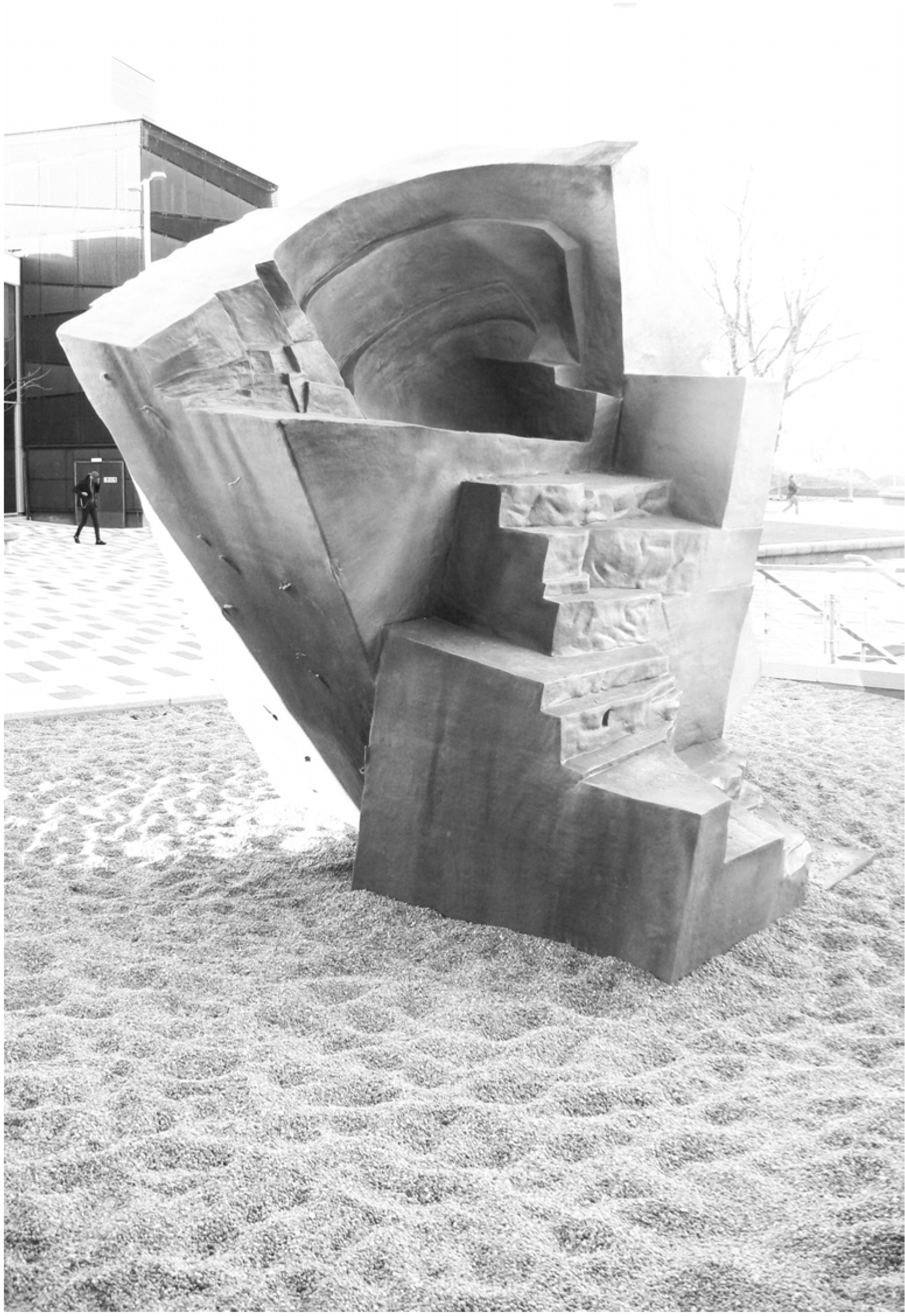
Engels’ Beard. Rear view. University of Salford, 2016. Image Credit: Steve Hanson (author).
The head sits ‘half sunk a shattered visage’ – a phrase used by Percy Bysshe Shelly to describe the ruined head of Rameses II that was removed from Egypt for display in the British Museum in 1818 (, 1965: p.62). In Shelley’s sonnet ‘Ozymandias’, the head of Rameses II speaks, saying ‘look at my works’, but only the sands of the Egyptian desert extend around. Redman’s statue of Engels stands for similar, if less ancient, historical ruins: those of 19th-century industrialism, the rise and fall of the USSR and the ongoing cycles of boom-and-bust capitalism that not only shaped the social world of Engels but also continue to structure the political, economic and social landscape of our own time, particularly in the wake of the 2008 financial crash.
As a fabricated ruin, Redman’s ‘shattered visage’ is both recognisable and strange and simultaneously oriented to both the past and the present. It is a deliberately uncanny work that stirs up the debris of history while also being an interactive and climbable structure that offers the viewer a raised vantage point from within their immediate surroundings.
In Walter Benjamin’s (2007: 257–258) striking image of modernity, the Angel of History is blown backwards from Paradise, its eyes transfixed on the storm of endless wreckage. The image is an indictment of progressivist history and the certainty, fixed momentum and neat synthesis that accompanied particular articulations of the Hegelian-Marxist dialectic, including theorisations that Engels himself, at times, seemed to advocate. Redman’s sculpture, as fabricated ruin, places Engels in the midst of the storm of history but looking outwards. It figures Engels as both tragic and critical, damaged but sagacious. The beard, for Redman (2016), is a symbol of wisdom and learning. In her poem commissioned in response to the sculpture, Kay (2016) includes the lines ‘we stand on your shoulders / on your acts of kindness’. Kay’s poem, ‘Thinker’, places the reader atop the head of Engels who holds a ‘small key’ to imagining a better world where ‘workers are not machines / students are not shoppers’. The poem offers hope amid the ruin and this dialectical oscillation between debris and desire, relic and project comes to define the ‘return’ of Engels in this paper.
Engels has also made another return to the city. On 16 July 2017, a second statue of Engels was unveiled in central Manchester at the close of the 2017 Manchester International Festival. The statue (Figure 2) had been transported via a flatbed lorry from the village of Mala Pereshchepina in the Poltava region of eastern Ukraine where it had been broken in half and left abandoned following the Ukrainian government’s decision to ban communist monuments and symbols in 2015.
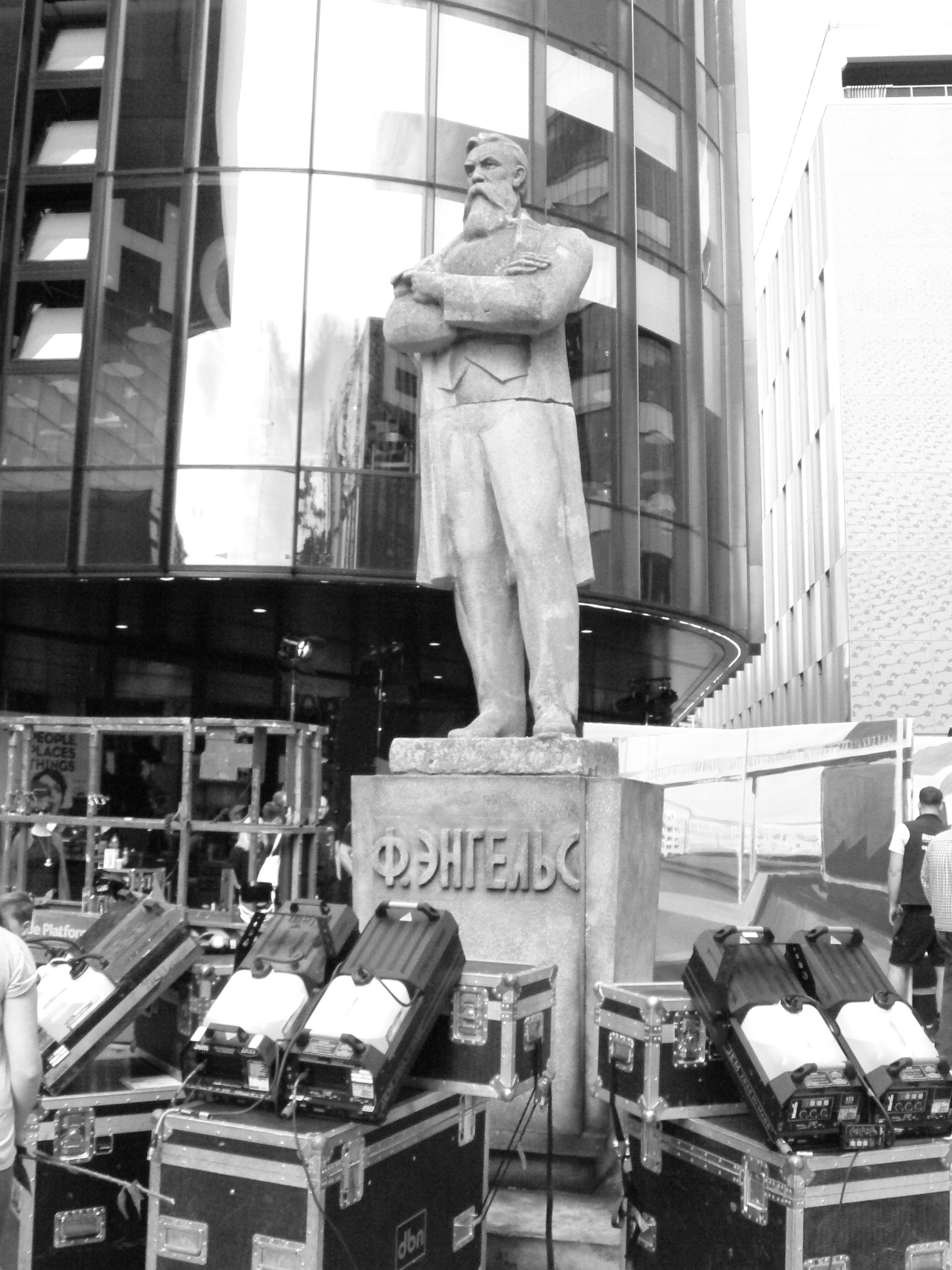
‘Ceremony’. A Soviet-era statue of Friedrich Engels is unveiled in Tony Wilson Place. Manchester International Festival, 2017. Image Credit: Steve Hanson (author).
The newly intact concrete monument now has a permanent place outside the HOME contemporary arts centre in the recently developed Tony Wilson Place on the edge of the city centre. Its unveiling was part of a wider project by the artist Phil Collins that included a film documenting the statue’s journey from Ukraine, via Poland and Germany, to Manchester. In the documentary, the statue’s trans-European movement was interspersed with reflections on the daily lives of working-class Mancunians across a range of ages and ethnicities. The project also included public workshops on arts and politics within Tony Wilson Place on the day the statue was unveiled and the experimental rock musician Gruff Rhys performed a bespoke song, ‘Communism’s Coming Home’, as the monument to Engels emerged from a cloud of stage smoke in front of a gathered audience.
Collins’ (2017) whole project was presented as a homecoming for the social philosopher under the title ‘Ceremony: The Return of Friedrich Engels’. Ceremony was also the title of a track by the band Joy Division. Joy Division were a post-punk group within the independent, Manchester-based Factory Records label, which was founded by Tony Wilson and others in 1978. Both the project’s name and the statue’s placement tie it to the wider revival of post-punk aesthetics within the city and UK. This revival, we have argued (Hanson and Rainey, 2014), is essentially double-edged. It is at once the recognition of an avant-garde working-class cultural movement within the north of England while at the same time serving as an edgy gloss to otherwise straightforward processes of gentrification in the city. The two statues of Friedrich Engels are similarly double-edged, as they provide a veneer of radical politics to sites of major land and property development.
Manchester has a track record of recuperating its radical figures in such ways. In 2002, The Haςienda nightclub, the flagship venue of Factory Records, was demolished to build private flats under the same name (Hanson and Rainey, 2014, 2019) while in 2008, the local property developer Urban Splash converted three former council housing blocks into upmarket apartments and named them after Emmeline, Sylvia and Christabel Pankhurst who were leaders and activists within the militant Suffragette movement at the opening of the 20th century. As Hatherley (2010: 141) notes in his Guide to the New Ruins of Great Britain, Sylvia Pankhurst was also one of the founding members of the Communist Party in Britain and would likely be disappointed to know that ‘her name would be used to promote the transfer of assets from the poor to the affluent’. Hatherley’s additional comment that it would only be a matter of time before Friedrich Engels’ name would be used in a similar manner now rings true (Hatherley, 2010).
Built on the vacant site of a former gasworks, Tony Wilson Place is part of the 20-acre First Street Estate (2020) owned by the Patrizia Group (2020) – a pan-European real estate company with €45 billion in global property assets. In his double return in the forms of fibreglass and concrete, Friedrich Engels has become the centrepiece for major property development and ownership. All of these structures – The Haςienda apartments, the Pankhurst tower blocks and the two statues of Engels, among many other examples in the city – are signifiers on the larger signified of Manchester’s constantly unfolding contradiction: that it is often described as a radical city (or ‘original modern’ in official branding) when it is in fact a neoliberal metropolis like any other (Bramley and Page, 2009; Folkman, 2016).
The unveiling of the statue also occurred 1 month after the 2017 General Election which, at the time, seemed to mark a major shift in the UK political landscape as the Conservative Party lost its parliamentary majority following an unexpectedly strong performance by the Labour Party, which campaigned on an explicitly socialist platform (Labour Party, 2007).
In this respect, Ceremony, with its coalescing of post-punk aesthetics and communist imagery, coincided with an apparent strengthening of left-wing politics in the UK. In his ‘homecoming’, Engels became a solid-as-concrete icon of belief in a socialist future for Britain. In retrospect, the moment was fleeting and in just over two years the Conservative Party would regain a parliamentary majority following a General Election dominated by Britain’s withdrawal from the European Union.
Ceremony was also not without controversy at the time. The Salford Trades Council were invited to carry their banner as part of the ‘homecoming’ celebrations alongside other trade unions and organisations. However, Council members walked out in protest after learning that Showsec, the company hired to provide security for the event, did not recognise trade unions among its employees (Salford Star, 2017).
Streaks of yellow and blue paint can also be found on the former Soviet monument. The national colours of Ukraine are a visual reminder not only of the collapse of the USSR and Ukrainian independence, but also the more recent and ongoing Russo-Ukrainian War, which ultimately provided the backdrop for the statue being taken down in its original home. In an article for The Guardian, Bolton (2017) suggested that the Ukrainian community in Manchester should have at least been consulted over the raising in the city of a statue with associations, for some, to the Holodomor and Soviet regime. The traces of paint are a reminder that the monument arrived in Manchester only because it had been rejected in Mala Pereshchepina.
The double return of Friedrich Engels to the city, in the forms of fibreglass and concrete, carries with it all sorts of conflicting hopes and desires, histories and resentments. Each statue is a site of multiple affect focused in one place where even the most solid concrete is culturally malleable. In Ukraine, the proud monument of Engels became the symbol of a sick regime, while in Manchester, for a time, it became a totem for the Bennite revival of the Labour Party (Panitch and Leys, 2020). In considering how these statues resignify over and over again, we are viewing them as ‘traces’ that illuminate the wider historical juncture we are in (Hanson, 2014).
The two statues, as fabricated ruin and transported object, connect across multiple times and create multiple juxtapositions in their placements. The starkest contrast is between radical politics and real estate: Engels, the co-author of The Communist Manifesto and foundational figure in the development of Marxist political thought, now looks out over the new, grand, First Street Estate with its connections to global capital via international property development. He is incorporated into it, part of a series of nostalgic turns that the city has made in its post-industrial regeneration, albeit turns that have been depoliticised or ‘recuperated’ in the words of the Situationist International, the ‘activity of a society as it attempts to obtain possession of that which negates it’ (Situationist International, 1969). These map onto wider turns within British public life, particularly a return to the rhetoric of the Second World War and the Blitz in both political discourse and the media as the UK leaves the European Union and grapples with the 2020–2021 global COVID-19 pandemic. Emptied of historical content and the deathly reality of these pasts, such turns create a cultural cul-de-sac, an impasse for imagining the future. It is, in a sense, the ‘end of history’, but not as teleological fulfilment but rather as a cultural ouroboros, the snake that eats its own tail.
Engels, our contemporary
In his critical review of Yvonne Kapp’s biography of Eleanor Marx, EP Thompson remarked that in the later years of his life in his London home on Regents Park Road, Friedrich Engels ‘might well have been living in some time-warp in the Tardis’ (Thompson, 1994). By referencing the fictional time-machine of the long-running British science fiction series Doctor Who, Thompson was suggesting that Engels was akin to a time traveller who found himself out of place and at odds with his surroundings. Towards the end of his life Engels had increasingly isolated himself from socialist movements within the UK and, as Thompson notes, preferred the company of his tight-knit circle of friends from the Marx family and the European continent. From within the control room of his ‘Tardis’, Engels was oriented to the political battles of the 1840s just as the Victorian era was drawing to a close. Engels was disappointed that the British working class had abandoned the radicalism of early 19th-century Chartism and not lived up to the revolutionary potential he had once ascribed to it. When the first English translation of The Condition was being prepared for eventual publication in 1885, he requested that the dedication ‘To the Working Classes of Great Britain’ be removed (Marcus, 1974: xii).
By the end of his life in 1895, Engels had been living in Britain for nearly 50 years. Much of this time had been spent in Manchester where he had worked in the offices of the family owned Ermen and Engels manufacturing firm where he would eventually rise to become full partner. Engels first arrived in Manchester from Barmen, Germany, in 1842, at the age of 22. He considered the city to be the starting point and centre of English manufacture (Engels, 1845: 82).
His early experiences of living and working in the city formed the basis for The Condition – a text that would not only become foundational for the development of Marxist political thought but would also become influential across the social sciences including disciplines such as human geography, sociology and urban studies. Through his direct and intimate proto-ethnographic account of the city, Engels not only detailed the squalor and misery of the early industrial slums, but also the strategies that the city’s bourgeoisie used to insulate themselves from the social and material horror that surrounded them.
For Engels, there was no clearer example of this than the Exchange, which was the centre of Manchester business and the hub of the global cotton trade. From the Exchange, thoroughfares extended outwards in all directions, cutting through working-class districts to provide an uninterrupted link to suburban areas of the bourgeoisie. The store fronts on these streets were owned and maintained by the middle classes, meaning that both entering and leaving the city a person could avoid its unsightly aspects (Engels, 1845: 85–86). ‘The town itself is peculiarly built’, Engels (1845: 85) writes, ‘so that a person may live in it for years, and go in and out daily without coming into contact with a working people’s quarter or even with workers, that is, so long as he confines himself to his business or pleasure walks’. Yet, the factories and the slum districts beyond the façade were the fuel of the expanding economy and the vast accumulation of wealth in the city. In Manchester, the modern industrial city was being shaped according to an incredible contradiction. The poverty and cramped conditions of the working-class districts, the base of the new economy, was being hidden. The essential had become the undesirable and the undesirable had become the concealed. Manchester was a city of ‘spectacle’, to use the terminology of the Debord (1995), where the built environment became image and, whether planned or unplanned, served to both mediate and mask the extreme and unbalanced separation of classes of the industrial city. ‘The spectacle unites what is separate, but unites it only in its separatedness’, writes Debord (1995: §29). In Manchester, this separation had been built into the very structure of the city, a seething and fissured whole. By reporting on this particular city at this particular time, Engels was identifying processes of urban development, exclusion and exploitation that would be repeated in industrial cities throughout the world. The Condition is a ‘living document’, writes Marcus (1974: 29, 256) and ‘Engels and what he represents are still with us; he is in significant measure our contemporary’.
When Engels returned to Manchester in 1850 to settle in the city following the failed revolutions on the European continent, it was less a ‘shock city’ on the cusp of revolution and more a city of ‘bourgeoisie self-satisfaction’, a ‘middle-class imperium’ (Hunt, 2009: 184–185). As Engels’ biographer and former Labour MP Tristram Hunt (2009) writes, in the three years following the publication of The Condition, the city had shifted from ‘black and white’ to ‘shades of grey’. The great railway projects, with their accompanying stations, began to link the city, more than ever, to the world and along with the rise of multi-storey warehouses designed in the Renaissance Palazzi style they had begun to replace some of the slum districts that Engels had once described and walked through (Hunt, 2009; Marcus, 1974: 189–190). In a hugely symbolic act, the city’s more liberal businessmen had erected the Free Trade Hall on the site of the 1819 Peterloo Massacre, directly connecting the campaign for free and unfettered trade to the city’s radical democratic heritage. Yet, even as the teleological world-significance that Engels had ascribed to the English working class evaporated before him, his simultaneous observation and analysis of the city continued to offer insight. In the Preface to the English Edition of The Condition, written 40 years after its original publication in German, Engels (1845: 36–37) writes:
Accordingly, the most crying abuses described in this book have either disappeared or have been made less conspicuous. Drainage has been introduced or improved, wide avenues have been opened out athwart many of the worst ‘slums’ I had to describe. ‘Little Ireland’ has disappeared, and the ‘Seven Dials’ are next on the list for sweeping away. But what of that? Whole districts which in 1844 I could describe as almost idyllic have now, with the growth of the towns, fallen into the same state of dilapidation, discomfort, and misery. Only the pigs and the heaps of refuse are no longer tolerated. The bourgeoisie have made further progress in the art of hiding the distress of the working-class.
In this reflection on the city’s changing urban fabric, Engels was describing what we now call ‘gentrification’. Manchester was not so much a city of revolution, but a city where ‘spectacle’, to return to Debord’s term, had become ever more dominant. When we follow Marcus and say Engels is ‘our contemporary’, we not only mean that Engels’ critical analysis of the city is still relevant, but that Engels would likely also be familiar with the social and economic processes that shape contemporary Manchester, some of which we have described above in his double return to the city, in the form of fibreglass and concrete.
Much has been written about Manchester’s political economy over the past 30 years and the accompanying analysis has emphasised the city’s shift from municipal socialism to an ‘entrepreneurial city’. That is, a shift from the city council’s focus on defending jobs and services to one of competing for discretionary funding, inward investment and a move towards more executive decision-making and civic boosterism (Cochrane et al., 1996; Deas, 1999; Hanson and Rainey, 2014; Harding et al., 2010; Harding, 2000; Lewis and Symons, 2018; Peck and Ward, 2002; Quilley, 2000). These were both attempts to handle the long-term decline of the city’s industrial base from the mid-20th century onwards (see Peck and Ward, 2002). What is interesting looking back on these ‘tales of transformation’, as Peck and Ward (2002: 4) call these accounts, is how often Manchester was positioned as being an aspiring European city and cultural centre. In an interview for The Guardian with Howard Bernstein, who was Chief Executive of Manchester City Council between 1998 and 2017, Harris (2017) writes:
Bernstein says that as much as £500 m of EU money has been spent in Manchester in the past five years alone, and is at pains to point out that much of the city’s success has been built on both the free movement of people, and collaboration with no end of European organisations, as well as continental cities. ‘Anything that starts to threaten that network of collaboration and movement will be a significant threat to the future,’ he says. ‘I think we face a real period of uncertainty over the next couple of years’..
Similarly, in his reflections on Manchester’s status as an emergent ‘pop cult’ city within the UK, the former Haςienda DJ and cultural commentator, Haslam (1999: 264), writes that,
The City Council chanted a twenty-four hour city mantra through the 1990 s, pledging to turn Manchester into a chic European city; people sitting in pavement café bars drinking cappuccino, eating late and dancing till dawn. In one sense, it was a very unambitious vision for a new Manchester, perhaps even misguided, especially as the Council stuck naively to the notion that Manchester could become Barcelona simply by enacting liberal licensing laws. Magistrates were encouraged to grant extended licenses to café bars and new licences were virtually unopposed.
These rhetorical coordinates have shattered in the face of Brexit and then fallen away with the COVID-19 crisis. In their book on the city, Peck and Ward (2002) emphasised how the neoliberal turn of entrepreneurial Manchester merely displaced and heightened economic and social uncertainty among its citizens. Manchester was simultaneously a city of dynamic transformation and continuing decline (Peck and Ward, 2002: 3). In our more recent reflection on the city and its political landscape we concluded, ‘The shift from municipal socialism to the entrepreneurial city, which underpinned much of the critical literature on Manchester’s political restructuring, seems to be fragmenting now’ (Hanson and Rainey, 2014: 9). Our concern is not simply the rhetorical tales of transformation of Manchester, but rather that over a decade on from the 2008 financial crash and in the wake of the political crisis of Brexit we are witnessing the collapse of the political centre and deeply fractured political and social turns within the UK, identified above with reference to the two statues of Friedrich Engels. Brexit or no Brexit, we are always already locked into these global networks of ownership and capital and paradoxically the nostalgic shift to myths of English nationalism in the form of exiting the European Union only heightens uncertainty and exposure to these power networks.
In viewing Engels as our contemporary, we are suggesting that Engels would likely not be surprised by any of this, either the global circuits of capital that shape and reshape urban life or, indeed the use of the city’s radical history to promote the interests of capital. Taking in Thompson’s figuring of Engels as a time traveller, out of place and critically at odds with his surroundings, to view Engels as our contemporary is to view him as a spectre who appears from the past while speaking to present and future.
‘The time is out of joint’, Derrida (1994) repeatedly states in Specters of Marx, reciting the line from Shakespeare’s Hamlet. The critic and cultural theorist Fisher (2012: 19) distinguished two trajectories within Derrida’s hauntology: that which is no longer but continues as a fatal pattern or repeated structure and that which has not yet happened but acts as an attractor, an anticipation shaping current behaviour. Engels speaks to our disarticulated ‘now’ from a similarly disjointed past, highlighting the repeating processes of the modern city that he so vividly described 170 years ago in his reading of Manchester. ‘The three great levers heave the world out of joint’, Kay (2016: 66) writes in the closing stanza of her poem dedicated to Engels, reciting his view that industrialism, in the form of steam power, the division of labour and the application of machinery has irrevocably changed the world leaving, for Kay, a puzzle that ‘cannot be solved, ever’ (Engels, 1845). The world heaved out of joint and time out of joint conjure up the spectre of Engels, both as a trigger for our imaginations and as the need for a return to the grounded political analysis of Engels.
Angel meadow
In the summer of 2009, archaeologists in central Manchester removed the tarmac and cobblestone surface of the Miller Street carpark on the edge of Manchester city centre, revealing cellar slum dwellings from the early industrial era. The excavation was carried out in preparation for the construction of One Angel Square – the new headquarters of the Co-op Group which was completed in 2013. For a brief moment, through the work of digger and trowel, the cellars of Miller Street had returned to the landscape.
Engels (1845: 91–95) described this street, along with many others, in The Condition. He detailed the grinding poverty, the poor ventilation and suffocating filth. He depicted the cramped, crowded living spaces and the mixture of human and animal life and human, animal and chemical waste. The text, in parts, becomes a visual and olfactory tour of early industrial Manchester. Miller Street is mentioned twice as Engels compared the ‘old town’ with the ‘new town’. Each was as bad as the other. The old town was the remnants of pre-industrial Manchester. Its dilapidated buildings and unplanned streets were being used to house thousands and thousands of migrants in what Engels often likened to ‘cattle sheds for human beings’ (Engels, 1845: 90). The new town, a section of the city that included Miller Street, had the appearance of better housing. Yet, this veneer merely concealed cheap construction, ill-repair and the use of cellars and back courts for housing. In the older and newer sections of the city, from Long Millgate to Miller Street, every space was filled, pressured and squeezed. These slums were a means to ‘plunder the poverty of the workers, to undermine the health of thousands, in order that they only, the owners, may grow rich’ (Engels, 1845: 92). If the built environment was a means to wring further profit out of the working classes, it was also, as we have seen, constructed in such a way as to conceal this fact. In describing Miller Street and its surroundings in such vivid detail, Engels was pulling down the façade of the city, exposing the spectacle.
In returning to these observations by Engels, prompted by the momentary return of the Miller Street cellar slum dwellings to the surface of the city in 2009, we might now return to the questions we posed a decade earlier and at the beginning of this article: ‘What if Engels were to return to Manchester? How might he re-access the city and, in particular, the contemporary city?’
If Engels were to return, in perhaps ghostly or spectral form, the Miller Street archaeological dig would have been a good point of entry. Here, Engels would have encountered the familiar and the strange, the known and the new and perhaps a development on his proto-ethnography would have emerged from this. A return to Miller Street would not so much have been a visit to a ‘site’ as it would have been to follow a ‘trace’, as we have described in this paper.
Rather than an isolated piece of heritage, the archaeological site would need to be reconsidered as a detail that sets in motion a series of historic and contemporary links: the early industrial Mancunian slums, the Co-op Bank (a subsidiary of the Co-op Group) and its near collapse following the financial crisis of 2008 and our present moment in 2021. In contemporary Manchester, Engels would have to follow new lines of geography – ones that not only stretched to the suburbs, but also globally. And they do so at different speeds, from the car-commute to the nanosecond of receive-and-send information exchange. Yet Engels would understand this as for most of his life he held a managerial position within a Dutch-German manufacturing company operating in the north of England. The international circulation of capital was already a lived reality and the sense of it speeding up, manifest in the slum clearances for the building of railway lines and stations in his own time, would have been clear. The forms of concealment and displacement that accompanied urban development in Engels’ own time would likely mean that he could easily familiarise himself with the uneven processes of gentrification underpinning the city’s ongoing ‘regeneration’ and it would likely also come as no surprise that despite Manchester’s much lauded redevelopment, the city consistently remains a national leader in child poverty (End Child Poverty, 2013: 9; National Children’s Bureau, 2017).
While the building of the Free Trade Hall on the site of the 1819 Peterloo Massacre indicated that the recuperation of radical political movements was already taking place in Engels’ own lifetime, it might need to be explained to Engels upon his return to contemporary Manchester how dark history is also packaged and deployed in modern processes of gentrification. He would need to look no further than One Angel Square. The name of the building is a direct reference to Angel Meadow, the very slum district to which Miller Street once belonged.
Today, in 2021, we can gaze up at One Angel Square and be reminded that Marxism was not the only working-class movement to have direct links to the city. In 1844, while Engels was walking the Manchester slums, the Rochdale Pioneers opened their first store in Rochdale, a northern Borough of what is now Greater Manchester. It operated according to principles laid out by the British socialist, Robert Owen, and is now regarded as the birthplace of the modern co-operative movement. However, the store didn’t gain local traction until the sensational collapse of the Rochdale Savings Bank in 1849 amid a scandal in which working-class depositors were defrauded of £70,000 after which people began to see the co-operative as a safer alternative for their savings (Holyoake, 1900: 30–31; Ó Gráda, 2002: 27 , 2009: 33).
A neat 160 years later, in 2009, in the middle of a global financial crisis and as the excavation on Miller Street was preparing the way for One Angel Square, the Co-op Bank would acquire the Britannia Building Society. Like so many other financial institutions at the time, the Britannia was saddled with bad debt. In a move that mimicked more profit-driven rather than collectivist banks, the Co-op Bank had sought out struggling institutions to acquire and increase its own scale. Whether out of hubris or incompetence (or both), this would lead to the near collapse of the Co-op Bank in 2013. With a £1.5 billion shortfall, the Co-op Bank would be taken over by two American hedge funds, Aurelius and Silverpoint, with the Co-op Group only remaining a minority shareholder. The Co-op Bank was ‘rescued, capitalist style’, as the Wall Street Journal said at the time (Patrick, 2013).
Today, in 2021, we can look at One Angel Square and be reminded of the boom-and-bust cycles of capitalism. In 1849 a local financial crisis provided an opportunity for the co-operative movement, but in 2013 amid a global crisis, only setback. The Co-op Bank is no longer a co-operative. And its ‘ethical investment policy’ is now only once removed from wherever Aurelius and Silverpoint decided to circulate their capital, or whoever moves capital through them, or whoever they might sell their shares on to. It’s been emptied out and left as a sort of animated corpse.
We don’t need to imagine Engels physically present to make these connections, to follow these traces. The statues are traces, but so are all the physical signifiers of the city. Archaeological sites and gentrified spaces are traces and so too are burned out buildings and graffiti. They speak of political processes, money and/or its absence and labour and/or its absence (after all, labour is one of the largest organisers of space and a constant depositor of traces). In this paper, we have focused on two statues placed on the landscape by a collusion of arts and property development and imagined Engels’ return to the Miller Street dig. By invoking Engels in this way, we want to reckon with our past as well as our future, both of which are entwined with circuits of capital accumulation, forms of concealment and the twisted, nostalgic turns that we have mapped out here. In gathering and following through the material traces around Engels’ double return, with its links to Soviet monuments, industrial slums, the arts and gentrification, we glimpse the unfolding landscape of Manchester as the city enters the third decade of the 21st century. Like Jai Redman’s statue of the social philosopher on the University of Salford campus, this gathering of traces places us in the storm of history yet looking outwards.
Conclusion
What we have been explaining in this paper is how the two statues of Engels in Manchester and Salford are not opaque. They are prisms via which we can scry the political landscape of the northwest of England and the island of Britain more widely. Through this prism one sees contradiction, the motive force of dialectic.
The statues of Engels in Manchester speak to discourses on political radicalism, ruin and futility. This is the place we find ourselves now in 2021. The period of 2017–2019, following the Labour Party’s unexpected, if tempered, results in the 2017 General Election, saw a triumphalist version of Marx remembered fondly from the past. The statue of Engels in Tony Wilson place became that hubristic totem for a brief moment. But it always carried with itself an inverse meaning.
The Jai Redman sculpture speaks with the tongues of the later Marx and Engels. The forward thrust has failed, old certainties are sinking into the ground. But both statues are still there, twin poles of a dialectic; they attract all kinds of political splinters towards them. The Jai Redman sculpture is undoubtedly of our time now; it speaks of a sunken society. But the thing about these objects is how malleable they are in terms of meaning. Only one is made out of concrete, but both are significatorily plastic (Hanson, 2009). How they will make meaning in the future is up to a collective who have yet to come together.
Footnotes
Acknowledgements
Mark Justin Rainey would like to thank the Melbourne Social Equity Institute at The University of Melbourne for providing the space and time to draft and research this article. He would also like to thank Steve Tamburello for facilitating a site visit to the Miller Street archaeological dig. Both authors would like to thank Camilla Royle and our reviewers for their valuable feedback and guidance.
Declaration of Conflicting Interests
The author(s) declared no potential conflicts of interest with respect to the research, authorship, and/or publication of this article.
Funding
The author(s) received no financial support for the esearch, authorship, and/or publication of this article.

Notes
Author Biographies