




Abstract
Behind every school leader is an individual with experiences. These experiences, personal and professional, shape how an educator conceptualizes leadership. This study examines the types of experiences that leaders, enrolled in a Master of Educational Leadership degree in Australia, draw on to inform their leadership. The findings reveal four key experiences that influence the way school leaders view and practice leadership: experiential; educative; vicarious; and personal. We discuss how the medium of digital story supports school leaders to develop their personalized educational leadership theory (PELT) as part of educational leadership development.
Keywords
Introduction
Governments across the world are increasingly investing in schools, understanding the economic and social benefits of an educated society (OECD, 2022). Schools, as a lever for societal improvement, have led to education systems driving school improvement agendas to increase student outcomes. While school improvement is complex, effective school leadership is identified as essential to improve teaching quality to raise student achievement (Australian Institute for Teacher and School Leadership [AITSL], 2020; Leithwood et al., 2020; Levin et al., 2019). Developing school leaders to lead school improvement, in conjunction with the intensification and diversification of their responsibilities (Argyropoulou et al., 2021), the growth and distribution of school leadership (Harris, 2013; Lárusdóttir & O’Connor, 2017), the increased relational nature of school leadership (Eacott, 2018), combined with concerns of burnout and the supply of future educational leaders (Hannon & Mackay, 2021; See et al., 2023), has led to the need for high quality educational leadership development of current and prospective school leaders (Gurr & Drysdale, 2020; Simon et al., 2018).
Developing school leaders is not a recent phenomenon; since the early 1900s, there has been a variety of approaches and theories reflecting the different philosophies within educational leadership development (Daniëls et al., 2019; Levine, 2005; Murphy, 1998). The development of principals and aspiring school leaders was, up until the 1980s, the domain of universities (Johnson, 1991), however, university-led school leadership programs have been criticized for being out of touch with school and leadership needs (Mendels & Mitgang, 2013). Education systems and public and private institutions have offered school leadership programs in countries such as the United States, Malaysia, Australia, and Hong Kong (Caldwell, 2020; Hallinger, 2003; Lam, 2020). Educational leadership programs for school leaders can be formal training programs (e.g., university degrees, formalized training courses) or informal workplace learning such as coaching or mentoring (Tynjälä, 2013). School leader educational leadership programs usually focus on developing the skills and knowledge perceived as essential to school improvement agendas: leading student learning, team collaboration, organizational, transformational, and instructional leaders, as well as other areas such as curriculum, administration, and collective leadership efficacy (Bush & Jackson, 2002; Elliot & Hollingsworth, 2020; Huber, 2010).
However, there are concerns regarding the limited evidence base that currently informs school leader professional development programs, and if these programs influence instructional improvement, school effectiveness, or culture change (Darling-Hammond et al., 2009). Research suggests professional development programs that incorporate school leaders working on problems of practice, including targeted social and professional supports, and mentoring/coaching, may lead to growth in school leaders’ capacities and practices to positively impact (Darling-Hammond et al., 2009; Miller et al., 2016). Nevertheless, there is an acknowledgment that further research is required to understand how school leader professional development leads to significant changes in school leaders’ behaviors and practices that result in measurable improvements for students, teachers, and schools (Miller et al., 2016).
This study is focused on an educational leadership program for school leaders (aspiring, newly appointed, and experienced) at the university level. While university-led educational leadership degree programs have evolved in terms of focus and theoretical underpinnings, criticisms include a limited discipline-based lens to the curriculum (Hackmann & McCarthy, 2011), a lack of acknowledgment of the importance of context (Townsend, 2011), and limited focus on the practice of leadership (Murphy, 2014). There has been a move from the theoretical orientation of leadership practices and distinct leadership models and approaches to a greater focus on school leader behaviors (McCarthy, 2015) and an acknowledgment that school leadership starts with the individual themselves (Barth, 1990; Leithwood & Beatty, 2008).
Knowing Self as Part of School Leadership Development
The argument that effective school leadership may derive more from an individual’s passion and personal capabilities rather than certification has led to the recognition that effective school leadership emerges from school leaders knowing themselves (Price Dowd, 2020; Rhodes, 2012). Loader (1997) advocated that development programs for school leaders should support an understanding of their inner life and their strengths and weaknesses. Day and Gurr (2014) called for school leaders to interrogate and articulate the values which drive their work and Branson (2007) emphasized the importance of school leaders understanding and expressing their personal values and conviction.
Leadership development that supports school leaders to explore themselves and the values and beliefs that underpin their leadership is perceived as foundational for effective leadership development (McCauley, 2000; Shamir et al., 2005). Understanding oneself requires self-awareness (Brewer & Devnew, 2022) and includes school leaders developing a narrative to communicate how their experiences shape their leadership actions (Eriksen, 2009; Ganz, 2009). This study asked school leaders to create a digital story that explores what antecedents inform their leadership practices.
Using Experiences to Facilitate School Leadership Development
Effective leadership development for school leaders should be informed by adult learning principles (Zepeda et al., 2014) and support school leaders to examine what they do and experience (Young & Crow, 2017). Without an opportunity to examine past experiences, learning may remain static, not generating growth and curiosity. School leaders’ experiences with role models, parental influences, education, leadership opportunities, and on the job experiences contribute to how leadership is understood and practiced (Bass, 1990; Brungardt, 1996; Gardner, 1990). Young (2015), building on the premise of learning through and by experiences, advocates for powerful learning experiences (PLEs) to be incorporated into educational leadership programs to help leaders identify and see their lived experiences from different perspectives to further develop their leadership skills and knowledge. Brown (2006), in a study on transformational learning in educational leadership development, determined that leaders who examined and evaluated their past experiences came to a deeper understanding of themselves. The research discussed highlights the importance of “self” and “experience” as significant components of educational leadership development.
This study, situated within an Australian university postgraduate educational leadership degree, explores how school leaders utilize individual and contextually relevant learning experiences to make sense of their own educational leadership. We argue that engaging school leaders in such learning opportunities supports them to explore their past experiences, articulate how and why these experiences have informed their leadership beliefs and approaches, and supports school leaders to articulate a conscious and deliberate approach to uncovering their own understanding of educational leadership.
Method
Background to the Study
This qualitative study is situated within a postgraduate subject entitled “Foundations of Educational Leadership” which is part of a Master of Educational Leadership degree at a university in Australia. Typically, students enrolled in this degree have undergraduate qualifications in teaching or education, 3 or more years of experience as an educator, and are looking to advance their knowledge and understanding of educational leadership. Over 80% of students teach and lead in schools. The subject provides students with a range of foundational understandings essential for leadership in educational organizations. The content covers the main theories which underpin educational leadership topics such as power and influence and various approaches to leadership such as distributed, servant, transformational, and instructional. Models and theories of educational leadership are examined through reflective andragogical strategies. Students apply these strategies to reflect critically on how their own beliefs and experiences shape their understanding and experience of leadership practices relevant to their professional context.
We argue it is crucial for emerging and current school leaders to understand themselves and their personal qualities, to identify how personal experience, values, and relationships inform their professional practice, and to be able to articulate this coherently and succinctly (Mastrangelo et al., 2004). Therefore, as part of the assessment for the subject, students are invited to articulate their personal and professional experiences and how these influence their practice as educational leaders. To complete this task, students are asked to plan, design and submit an 8 to 10 min digital story addressing the question: Who am I as an Aspiring, Beginning, or Experienced Educational Leader? Figure 1 is a screenshot of an excerpt from one of the participant’s digital stories.
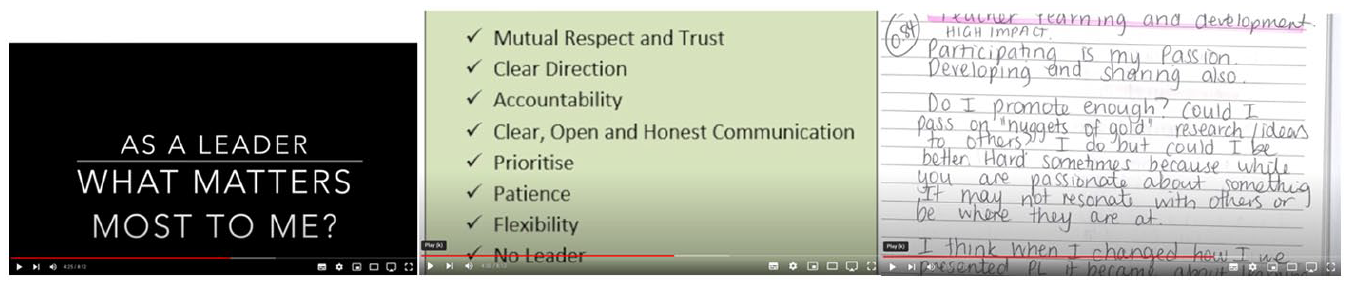
Excerpt from a participant’s digital story.
Digital storytelling is a story told in digital form that often combines written text, audio (e.g., sounds and voice-overs), and visual content (e.g., images and videos). While the digital story is commonly described as an art form (De Jager et al., 2017), researchers are reporting its strength in research as a data collection tool to communicate short, engaging, and emotive communication (De Jager et al., 2017). Additionally, the process of designing digital stories has been found to be both educative and transformative (Loe, 2013), with the potential to inform people’s actions (White & Epston, 1990). Digital storytelling was used in this study for its dual purpose of data creation for analysis and for its affordance of participants’ educative experiences through reflection and storytelling. Students used various software to create digital stories including PowerPoint, iMovie, and Movie Maker. As part of the submission of the digital story, students also submit the written transcript of the audio component of the digital story. Below is an excerpt of a written script by one of the participants.
Through the past five years, my leadership theory has really been solidified. As a young leader and someone who truly values the sense of team, my leadership experience began. . . if I am honest, pretty badly. In that, I believed in my people and therefore, I envisioned this idea of discussing our vision and then stepping back and allowing my team members complete autonomy over how they went about turning that vision into a reality. On reflection, this ‘Laissez-Faire’ style of leadership (Amanchuku, et al 2015) was a result of my naïve and somewhat idealistic views of what leaders should be.
The purpose of this research study is to examine student digital stories to identify the experiences educational leaders use to make sense of their own educational leadership. The research question that guided this study is:
What experiences do students in a postgraduate educational leadership degree draw upon to understand themselves as an educational leader?
Participant Sampling
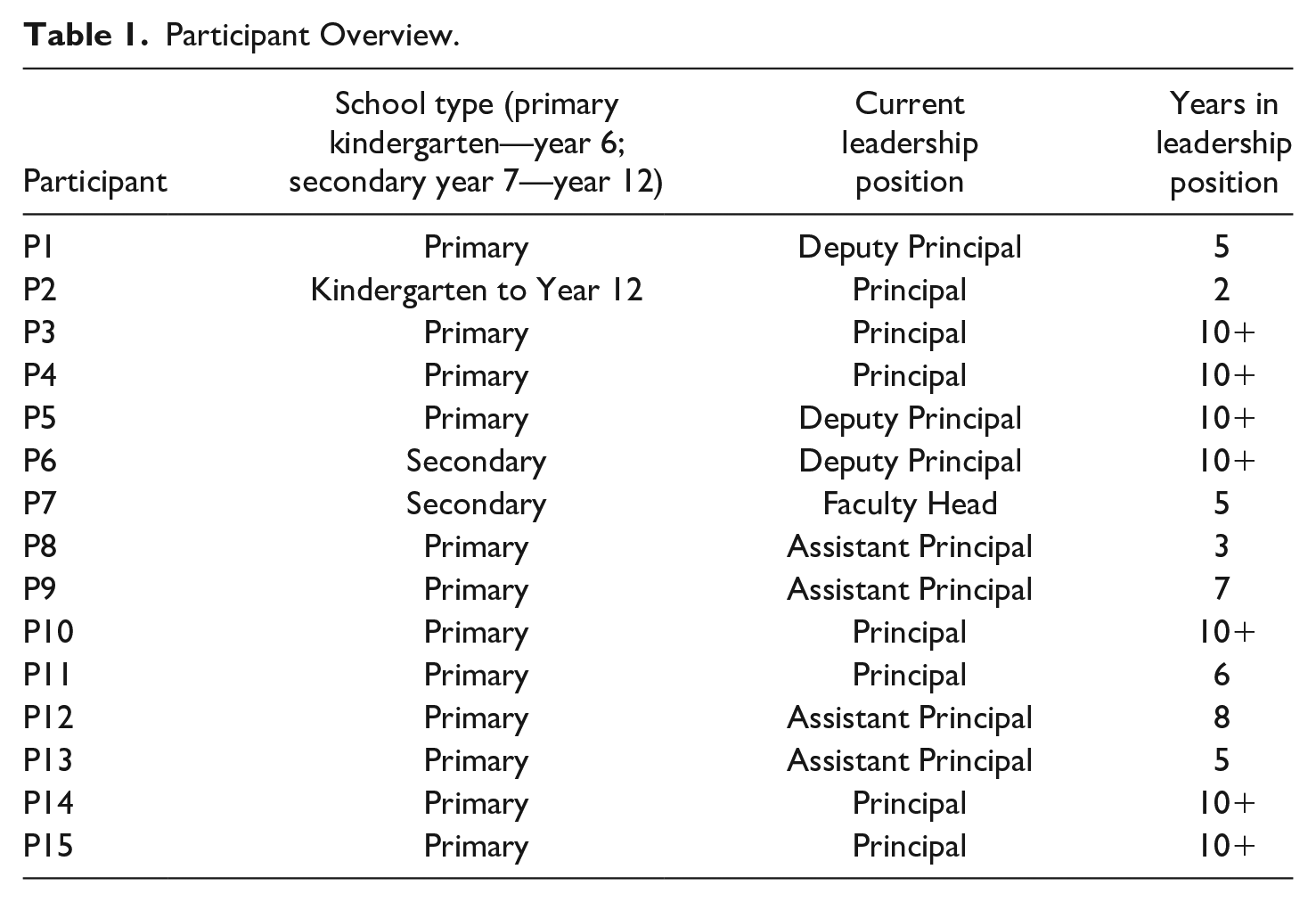
All current students enrolled in the subject over a 3 year period were invited to participate in the study. Thirty-seven students gave ethical consent for the researchers to access, collect, and examine their digital stories for research purposes. Purposive sampling was used in this study using two eligibility criteria: (1) students must currently be working in schools and (2) students must hold a formal leadership position. Fifteen school leaders met these eligibility criteria (Table 1).
Participant Overview.
Data Collection and Analysis
Data for this study was in the form of a digital story and a written transcript. The digital story was an 8 to 10 min audio and visual recording. To aid in marking the assessment task, the audio component of the script was transcribed in written form, submitted, and used for analysis.
Data was initially organized according to individual digital case records for each student where the digital stories and written transcripts were de-identified and uploaded chronologically.
Data analysis was inductive and involved coding data without fitting into a pre-existing code frame (Braun & Clarke, 2006). Data were analyzed in three phases: sample coding, full coding, and thematic analysis. To complete the initial sample coding each researcher completed an analytical sample of three cases by viewing the digital story on the screen, then recording memos electronically of the emerging insights into a separate word-processed document. While this analysis was inductive, researchers did use a process similar to document analysis where the first pass of analysis identifies meaningful and relevant passages for coding to ensure data analyzed was suitable for the nature of the study (Corbin & Strauss, 2008). Passages identified were related directly to the research questions and included identifying individual participants’ personal and professional experiences discussed in the digital story.
The three researchers then came together to share initial insights in conjunction with research memos taken from each researcher to explore patterns in participants’ experiences (Silverman, 2000). At this stage of analysis, 12 codes were determined and agreed upon by the researchers. Analysis of all cases was then undertaken by the researchers using the 12 codes.
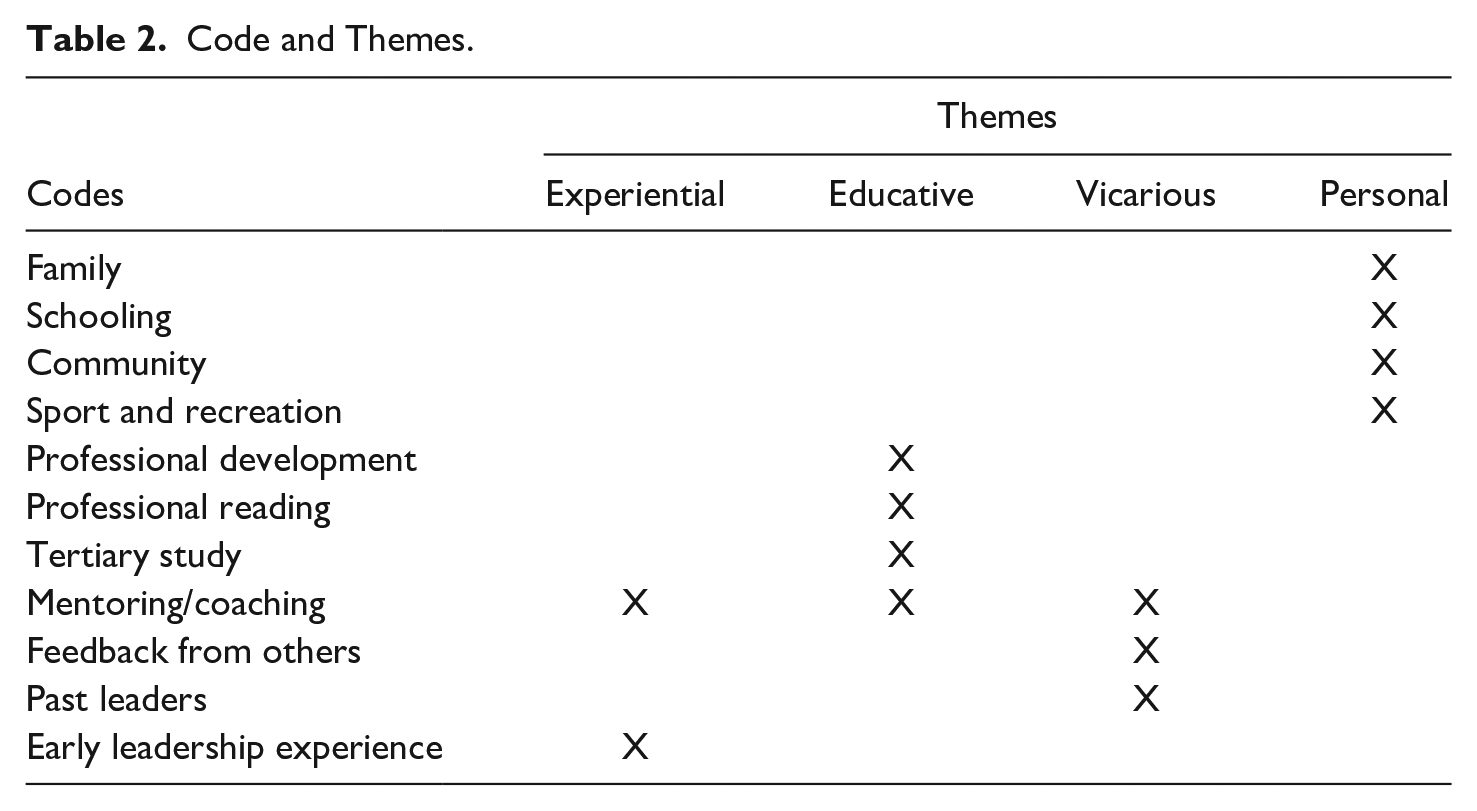
A thematic analysis was undertaken where after coding all data, a more focused rereading and reviewing of data was undertaken (Fereday & Muir-Cochrane, 2006). The researchers worked together to categorize the 12 codes of participants’ experience to determine themes. The frequency of codes was used to determine four prominent themes: experiential, educative, vicarious, and personal. The 12 codes and corresponding themes are outlined in Table 2. The four themes and how each theme supported educational leadership practices are reported in the next section.
Code and Themes.
Findings
Four themes emerged from the thematic analysis of the 15 digital stories. They describe what experiences school leaders in a postgraduate educational leadership degree draw upon to understand themselves as an educational leader. Each theme is discussed below in order of frequency, from most to least frequent. Each theme encapsulates experiences participants identify as informing their educational leadership beliefs and practices.
Experiential Leadership Experience
The first theme, Experiential Leadership Experience, was evident in all 15 digital stories. Experiential Leadership Experiences identifies when a participant reflected on professional experience(s) that inform(s) their leadership belief and practice. The process of learning through professional experience, often labelled learning for doing (Dewey, 1986), experienced based learning (Wolfe & Byrne, 1975), or experiential learning (Hoover & Whitehead, 1975) is typically defined by the cognitive, affective, and behavioral processes, skills and attitudes gained through active participation. Experiential Leadership Experiences in this study encapsulate examples of cognitive, affective, or behavioral learning obtained through professional experiences identified by the participant as informing their leadership beliefs and practices.
Two experiential leadership experiences were prominent in the 15 digital stories: early leadership experiences; and a change in a professional context. Eight participants identified that their earlier experiences as a leader, particularly challenges and/or failures, were instrumental in shaping their beliefs and future leadership practices. One participant explained:
I learnt a lot from my first year as Acting Assistant Principal .... after I had the time to reflect on what worked well … one is authenticity .... not a skill someone can develop or type of behaviour they can attempt to display, but rather the way they live and interpret experiences I am now applying to my leadership at my current school. (P8)
This example highlights the significance of the lived experience and how, through reflection, leaders can apply new learning to their practice. Another participant, also in an assistant principal role, discussed how knowing and understanding her “failures” in her early leadership was an important learning experience:
I went from classroom teacher to assistant principal and then became an off-class assistant principal all within 7 years. I regularly failed … in my teaching and my leadership, as I attempted to run before I could walk, and these failures had some of the most positive impacts upon my leadership and career. (P6)
The second experiential leadership experience, change of professional context, was evident in six digital stories. Participants explained how a change in school, school leadership position, or a new school leader impacted their beliefs. When a participant experienced what they perceived as significant change, new leadership approaches were generated, for example:
In the last two weeks, we have experienced a very intense time of responding to a completely new way of working and leading our schools. The required response to complex and fast paced change has brought a new lens to my thinking about my educational leadership approach. (P14) Throughout each stage of my leadership, I gained a better understanding of the impact of context upon my leadership approach, and more able to see where my old way of leading wouldn’t fit as well into a new setting or a new role. (P15)
While reflection on early leadership experiences and/or a significant change in a leader’s context were catalysts in (re)shaping leadership beliefs and practices, these experiences were perceived by seven participants as more powerful when coupled with mentoring, coaching, and/or a critical friend, for example:
I was fortunate to have an exceptional mentor who guided me through the steep learning curve of a beginning teacher and leading. The experiences he provided and led me through, ...... helped me learn about leadership was not mostly authoritarian, ....... but is heavily influenced by social interaction … modify(ing) my thinking, behaviours, and actions as a result. (P10) Learning on the job coupled with mentoring and coaching has been influential on informing and building my leadership .... I have also had the privilege of developing a relationship with a critical friend who has been instrumental in developing my capacity to be reflective and refine my leadership skills and abilities. (P1)
These two examples demonstrate that support from an ‘experienced other’ provided targeted, reflective conversations, and were perceived as instrumental in further generating new understandings of leadership, shaping a leader’s beliefs and practice from experiential leadership experiences.
Educative Experiences
The second theme, Educative Experiences, was evident in 14 of the 15 digital stories. Educative Experiences occurred when a participant discussed a formal or informal learning experience that shaped their leadership beliefs and practices. Educative Experiences include activities that embody an intention for learning and promote growth (cf., Dewey, 1938; Zais, 1976). This study shows that formal educative experience directly informed participants’ beliefs about educational leadership.
Not surpisingly, given the selection of participants, many digital stories referred to undertaking a Master of Education (Educational leadership) degree as informing their educational leadership:
(My master’s degree) has helped me to identify how different leadership styles impact upon others and how to evaluate my own leadership. This developing knowledge of the theory and practice of educational leadership has enabled me to identify why certain leaders had been inspirational to me and identify components of my own leadership style that were built upon these strengths. (P12)
What is evident here, and in 10 of the 15 digital stories, was how formal learning firstly, shaped participants’ beliefs about educational leadership and, secondly, how it stimulated further leadership learning. Undertaking formal professional learning, such as a university leadership degree, introduced theories that resonated with the school leader. This engagement with research informed participants’ practical work and led them to seek further leadership research and theory to inform their leadership practices, for example:
Through leadership programs and the associated deep professional learning, I started to re-engage with educational research, and review ways to sustain change in schools ...... I found myself increasingly driven by a desire to further my educational leadership … what I did was to use my educational leadership to enact his (Michael Fullan) moral imperative research. (P4)
Similar to Experiential Leadership Experiences, Educative Experiences were perceived as highly valuable to inform leadership practice when they were complemented by a mentor, coach, critical friend, or structured professional discussions with colleagues:
Examining multiple theories of leadership (in M Ed) and the importance of understanding yourself as a leader with my mentor has helped to develop my personal vision and purpose and a deeper understanding of my skills and competencies as an educational leader. (P1) I was undertaking professional learning and discussing challenges I was having in my current role with my mentor, and they suggested the need to engage with literature and research regarding leadership. This began my thirst for a deeper knowledge and understanding of educational leadership and the implications and impact, both positive and negative, of leadership. (P12)
Vicarious Leadership Experience
The third theme Vicarious Leadership Experience was evident in 13 digital stories. Vicarious learning is defined as being able to observe or “listen in” on experts or peers as they discuss a new topic (Cox et al., 1999), learning through the experiences of another (Fox, 2003), or through discussion (or discourse), conflict, challenge, support, and scaffolding from a more competent other (Topping, 2005). Within this study, we identified a Vicarious Leadership Experience when participants discussed other leaders’ practices and their outcomes, and how reflection on these experiences, in turn, informed their own leadership beliefs and approach.
Participants highlighted the personal qualities of different leaders they worked with, along with the positive and negative outcomes for themselves and the schools. Six of the digital stories highlighted desirable leadership qualities. For example:
When I look back the thing that stands out most is the qualities of the principal at the time. His leadership set the scene for me, and I still hope to bring some of the qualities that he possessed to my own role as principal and to my leadership through a time of great change. He had a range of personal qualities such as honesty, compassion, and integrity. (P14)
Conversely, other participants identified qualities that had negative outcomes. For example:
This principal displayed a leadership style that was very autocratic, abrupt, and abrasive. While this kind of leadership can be very effective in times of a crisis, it was detrimental to the morale of the teachers and left them, and myself, with feelings of resentment. In my own leadership journey, I aim to not be this kind of leader. (P2)
Some participants discussed qualities of past leaders and the negative outcomes of these qualities, yet reflected that they would use these experiences and the impact of the leader’s qualities to improve their own leadership, for example:
The style and dynamic of the school environment felt toxic and so contrasting to my own values and guiding principles that it was not a place I felt I belonged. It was this significant teaching experience where I learnt the most powerful lesson about the type of leader I did not want to be or work under - very much learning by exception. (P7)
As with the previous themes, four participants identified having a mentor, coach, or critical friend to discuss their experiences of others’ leadership was valuable in further developing their own leadership approach, for example.
Experiencing and learning from other leaders, being a lifelong learner about leadership and then employing the use of a critical friend has allowed me to define my core values as an educational leader. (P1)
Personal Experiences
The final theme Personal Experiences was evident when participants’ digital stories identified experiences related to their family, schooling, or childhood that shaped their future educational leadership beliefs and practice. Toor and Ofori’s (2008) research revealed that experiences during childhood both within the family and outside the family significantly influence leadership development at later stages. In this study family, irrespective of being a positive or negative influence, was highlighted by five participants as shaping their leadership approach. For example:
I come from a family of teachers. Growing up I saw the passion in my parents and that formed my early theories around education and leadership. (P2)
Growing up in a low socio-economic environment, where education was seen by one participant’s family as a means of improving life opportunities, where education was not always of high quality or highly valued by others, was highlighted in four digital stories. As with experiential experiences, early personal experiences shaped the participants’ moral purpose, where their leadership was framed in terms of improving children’s lives:
Much of who I am as an educational leader, is grounded in my experience of education as a student. I am a product of the public education system and Sydney’s Greater Western Suburbs. My education and experience as a student in the 90s were average at best. As a result, I have devoted my career to ensuring students are not disadvantaged simply because of their geographic location or the class they find themselves in. That their education is not subpar to their peers in more affluent suburbs. Teacher and teaching excellence has been at the core of my work since I graduated university. (P6)
Seven of the participants identified that personal life experiences or events like sporting success, becoming a parent, being bullied, struggling personally, and feeling like an “outsider” resulted in personal understandings that later informed their personal leadership approach. Being involved in sports led two participants to discuss the need for teamwork and collaboration and communication to achieve goals, which they identified as fundamental to how they enact their leadership. One participant discussed how becoming a parent led to an understanding of “pragmatism and resilience when things didn’t go as planned” and developed an important awareness of approaching educational leadership. Another noted that being bullied or being perceived as different or an “outsider” resulted in an appreciation of qualities like kindness, empathy, and trustworthiness. These personal qualities were then discussed by four participants as central to how they interacted and led others, for example:
Growing up, with authoritarian style parenting, I learned to mistrust others’ motives and to be guarded in my relationships. I hold trust in high regard, . . . developing trust is key for positive, supportive relationships personal and professional. (P13)
Discussion
This study used the medium of a digital story as part of an assessment task in a postgraduate educational leadership degree to identify past experiences that influenced the way educational leaders make sense of their educational leadership. The findings showed that leaders in this study drew on four main experiences: experiential, educative, vicarious, and personal. Each of these experiences had a profound influence on how they articulated and considered their educational leadership.
From these main experiences, four important implications are identified. First, formal educational leadership development does influence educational leaders’ beliefs and practices and, in this study, inspired further leadership learning for participants. While formal educational leadership courses have been criticized as having a limited influence on leaders (Young & Crow, 2017), this study showed that 14 of the 15 participants identified formal leadership development as informative to how they enacted their leadership. Formal educational leadership development promoted participants to think differently about their leadership, which led participants to seek educational literature and theory to inform how they made sense of their own leadership. As this was an assessment in a postgraduate educational leadership program, caution needs to be taken, as there may have been an expectation by the participants that their university leadership learning needed to be acknowledged.
The second implication is that childhood and past leadership experiences lay the foundations for participants’ future educational leadership approach. Positive or negative childhood experiences often informed participants’ leadership moral purpose, and the “why” of their educational leadership, while prior leadership challenges shaped leaders’ beliefs and future practices. Additionally, childhood and vicarious experiences provide important insights into the personal qualities participants perceived as important for effective leadership. In this study, participants stated they consciously drew upon specific personal qualities in their leadership practice.
The third implication was that three of the four experiences (vicarious, experiential, and educative) were more impactful in shaping an educational leader’s beliefs when coupled with a mentor/coach or critical friend. Participants discussed how an experienced other was a useful “guide” and “help” in enabling reflection, accessing additional resources to support leadership development, and providing opportunities to “modify” thinking and actions.
Finally, there were no examples within the digital stories that espoused entirley a specific leadership model or framework, despite deriving from a Master’s degree in educational leadership based on the study of numerous models and frameworks. Rather, each participant’s articulation of their educational leadership beliefs and practice was unique and personal. The findings and accompanying implications suggest that, as part of formal educational leadership development, a university postgraduate educational leadership degree which, requires students to examine personal, and professional experiences can support school leaders to develop an explicit understanding of the foundations of their leadership beliefs and values from which their leadership practices may derive.
Personalized Educational Leadership Theory (PELT)
From an analysis of the findings, we suggest that the andragogical approach of providing school leaders with learning opportunities to identify and examine past experiences through a medium such as a digital story in response to a reflective question such as “Who am I as an Aspiring, Beginning, or Experienced Educational Leader?” is a useful strategy for educational leadership educators to consider what we have entitled “Personalized Educational Leadership Theory” (PELT). We tentatively define PELT as a unique, authentic (to who you are) explanation of how an educational leader perceives and understands educational leadership through exploring experiential, educative, vicarious, and personal experiences. This study found that exploring educational leadership from a personalized perspective, developing an acute sense of self, how experiences shape self, how leaders manage their sense of self, and understanding how a sense of self informs how one work with others, strongly grounded students’ understanding of educational leadership.
The findings from this study suggest that school leaders, by examining past experiences with the phenomenon of educational leadership, were starting to develop, and articulate their own Personalized Educational Leadership Theory (PELT). For example, one participant stated how their educative experience informs the way they lead:
As a result of this mentoring relationship, I have begun to understand the impact of relationships that empower others with the skills necessary to be their own agents of change. Now when I engage in coaching and/or mentoring roles now as a senior leader, I ask myself, how can I approach this situation in a way that will enable my team member with the skills to ‘solve’ this issue on their own? (P1)
PELT is also be evidenced when a school leader explains or theorizes educational leadership from past experiences and how they have changed the way they now lead, for example,
The first event (that changed how I lead) was enduring a challenging principal when I was in the role as an experienced classroom teacher. Staff did not feel respected nor treated as professional adults. So what does this look like in my day to day role? It is ensuring time for my teams to work together through careful planning of budgets and timetabling, building collective efficacy through professional readings and reflection and using data as a basis to decide team goals, ensuring transparency in decision making and the selection of worthwhile team pursuits. (P8)
We argue that leadership educators can and should support school leaders to explore their own PELT by examining educational leadership research in consideration of their past experiences in order to make connections between research, experiences, beliefs, and the way leadership is understood and practiced. A theory consists of a set of assumptions, concepts, relationships, and logic that are combined to explain a phenomenon of interest (Gabriel, 2008). In other words, it is a language to describe behaviors. To develop theories, observations about the phenomena of study are made, including actions and relationships which are then refined into abstracted representations of those phenomena (Kivunja, 2018). These abstractions, or theories, seek to describe and explain important insights, although they may be held as tentative and exploratory (Johnson & Kruse, 2009). Some approaches to school leadership development teach educational leadership theories and approaches as separate models (Gurr, 2015), traits (McKinney et al., 2015), capabilities (Lewis, 2009), and claims (Leithwood et al., 2020), all of which provide a useful and empirical reference point to understand educational leadership, how it is practiced, and how it is informed (Amanchukwu et al., 2015). However, as Leithwood et al. (2005) suggest, leaders need a large repertoire of practices to draw from in multiple contexts and situations rather than being trained in one ideal set of practices. In this study, participants explored a range of common educational leadership theories and models as part of their learning in a postgraduate educational leadership subject. This was coupled with a learning opportunity that drew from their own experiences to understand educational leadership rather, than solely derive from a range of pre-existing theories. We suggest such framing may be useful in avoiding educational leadership being taught as a “one size fits all” model. Rather, the findings in this study suggest that enacted educational leadership arises in idiosyncratic ways based on vicarious, experiential, personal, and educative experiences which educational leaders draw on to make sense of their educational leadership.
Informed by experiences, the findings of this study suggest that a facilitated approach (such as a mentor or coach) to identify experiences and articulate them opens possibilities for future leadership development. Importantly, personalized educational leadership theory (PELT) is unique, situated in context and circumstance, and, as such, can and should be shaped and reshaped through ongoing development. What distinguishes this type of andragogical approach from other forms of educational leadership development is that it describes what educational leaders believe based on formative experiences, rather than a prescription of what they ought to do. This is what Shepherd and Suddaby (2017) describe as pragmatic empirical theorizing. Rather than needing to test a priori hypotheses, theory can be developed inductively from observed empirical data. This resonates with Johnson and Kruse’s (2009, p. 32; italics in original) approach that:
A theory is a tentative, working explanation of something. It consists of a set of assumptions, concepts, relationships, and logic that are combined to explain a phenomenon of interest.
Described in this way, a PELT is not a reality in and of itself, but instead seeks to represent in symbolic and descriptive form what is observed and analyzed. While theories of educational leadership offer empirical and sometimes scientific ways to understand and practice leadership, we argue that developing a PELT in a way that is abductive from lived experiences, tentative and possibly speculative, is an important component of formal (and arguably informal) school leadership development. Such an approach to school leadership development, that is both personalized and contextually situated, may be useful to avoid some of the past criticisms of university-led school leadership programs being out of touch (Mendels & Mitgang, 2013), misaligned to context (Townsend, 2011), and too theoretically focused (McCarthy, 2015).
Limitations and Future Research
While the construct of a personalized educational leadership theory may appear promising, there are limitations with the study. While our assumptions about how experience and reflection contribute to leadership development are supported in the findings from this study, it is apparent that notions of “self” require further examination and analysis. First, further detailed demographic data such as age and gender are recommended to uncover more nuanced analytical insights, given persistent imbalance in gender-based school leadership profiles (Martínez et al., 2021). Second, a broader consideration of socio-cultural elements such as racial heritage, socio-economic status, and cultural embeddness (Choi et al., 2023) would ensure a more comprehensive frame for analysis and enable a greater focus on critical reflection on self-awareness and the inherent factors that may impact perceptions on leadership practices.
Finally, we contend that a personalized approach to educational leadership, rather than a co-opted adjectival (Branson et al., 2018) approach, may help school leaders to further develop reflective, contextually sensitive, and critically self-aware leadership practices. However, further larger scale studies across multiple settings and sites, as well as follow up observations of educational leaders in sites, are needed to develop and refine this approach.
Conclusion
This study explored how an andragogical approach to identify and explore past experiences can be useful in educational leadership development which supports school leaders to articulate a personalized educational leadership theory (PELT). While based on a small sample of school leaders, and within only one formal educational leadership course, findings suggest that such a process supports a conscious and deliberate approach to uncovering what “drives” a school leader’s beliefs and practices of educational leadership. This andragogical approach to educational leadership development did not prescribe a certain type of model or theory of leadership, but instead developed an approach from self-perception that was at times ambiguous, and, as Moller (2012) and Crow and Scribner (2014) explain, was composed of unique and multiple experiences and identities unique to each leader. As Price Dowd (2020) suggests, leaders who understand themselves have been found to have more positive outcomes.
We conclude that engaging in planned learning associated with self, experiences, and reflection are valuable pedagogical approaches that can enhance educational leadership development (Ganz, 2009; Huber, 2004). In this study, a digital story and reflective questions were the andragogical approaches which provided participants with the frame to consider their own experiences and served to value these as consequential to their own leadership beliefs and practice. In exploring and reporting this approach, we acknowledge that a focus on experience alone is not sufficient to effective school leadership development. Instead, knowledge, skills, and capabilities should be developed in a variety of ways, including, but not limited to, the study of a variety of educational leadership theories (Daniëls et al., 2019), a focus on context (Wright & Da Costa, 2016), transfer of knowledge (Huber, 2010) and collaboration and networking (Hulsbos et al., 2016). Additionally, findings indicate that pairing a personal exploration of experience and self with a facilitated conversation by a coach or mentor may be useful (Zhang & Brundrett, 2010) in supporting educational leaders to consider more deeply, and with clearer conviction, their personal educational leadership theory.
Footnotes
Declaration of Conflicting Interests
The author(s) declared no potential conflicts of interest with respect to the research, authorship, and/or publication of this article.
Funding
The author(s) received no financial support for the research, authorship, and/or publication of this article.
