




Abstract
The purpose of this study was to explore the nature of postgraduate leadership courses and programs offered by Australian Higher Education Institutions for leaders and potential leaders in the Health & Human Service (H&HS) sector including structure, content, and teaching practices from the perspective of educators. Ten educators from a range of institutions were interviewed. Interview data was coded and analyzed using Inductive Content Analysis. Six global categories represent the broad range of experiences and perspectives of participants in this study. Findings demonstrate formal education has the potential to positively impact the development of leaders in the H&HS sector.
Keywords
Introduction
Leadership development has attracted immense interest in the health and human service (H&HS) sector given the complex and dynamic environment in which practitioners operate. Effective leadership in the H&HS sector is essential in promoting a positive culture, enhancing safety and quality of care, and improving patient outcomes (Daly et al., 2014; Dickson & Tholl, 2020; Karimi-Dehkordi et al., 2022; Middleton et al., 2020; Sfantou et al., 2017). Leadership and management education and training have proven to be a key ingredient in health system strengthening, but the capabilities required are context sensitive (Brommeyer & Liang, 2022). A literature review by Flaig et al. (2020) identified a range of beneficial outcomes for hospital leaders who undertake formal leadership development. Previous studies indicate the need to understand what are the knowledge, skills, and capabilities that enable individual H&HS practitioners to develop as more effective leaders in the diverse environments of the sector (Day & Dragoni, 2015; Fennell, 2021; Figueroa et al., 2019).
One important aspect of leadership development is leadership education. Leadership education refers to the academic, co-curricular, or professional programs focused on assisting people become better leaders through structured courses aimed at specific professions and sectors (Rosch et al., 2023; Simen & Meyer, 2021). Tekian and Harris (2012) argue that masters level degree programs are the credential of choice for health professionals as these programs offer the breadth and depth of knowledge and skills needed to operate as effective leaders. Numerous studies have identified that H&HS leaders are often promoted into positions based on their clinical expertise, yet are unprepared to lead others, and struggle to develop their leadership skills (Hart, 2016; Kelly et al., 2014; Onyura et al., 2019). Formal leadership education holds great promise for enhancing the leadership skills of leaders and potential leaders in the H&HS sector. A study by Kelly et al. (2014) found that nurses could benefit from developing leadership practices through advanced degree attainment. Another study by Hart (2016) found that formal education can be effective in developing increased leadership capability in healthcare organizations and that formal education has had a positive influence on the leadership development of the study participants. A systematic review by Onyura et al. (2019) identified there is a need for leadership education to incorporate capacity building and contends that alternative pedagogies may be needed to instill the value of contemporary, collectivist approaches to leadership. Middleton et al. (2020) confirmed the importance of learning leadership skills through formal postgraduate education. None of the studies addressed leadership development in the human service sector.
The future of health and human service leadership education holds both challenges and opportunities but there are major concerns that programs are not adequately preparing students for the challenges of the 21st century (Harding & Matkin, 2012; Iordanoglou, 2018; Megheirkouni & Mejheirkouni, 2020).
The purpose of this study is to better understand the nature of postgraduate leadership courses and programs offered by Australian Higher Education Institutions (HEIs) for leaders and potential leaders in the H&HS sector including structure, content, and teaching practices. The research questions guiding this study include;
Who are the leadership educators in Australian HEIs that are providing postgraduate leadership education for H&HS sector leaders?
How are postgraduate leadership education programs in Australian HEIs developed and delivered for H&HS leadership students?
What teaching and learning methods are used in Australian HEIs postgraduate leadership education programs for H&HS leadership students?
Methods
A pragmatic qualitative research approach was employed to gain insight into educators’ experiences with the structure, composition, teaching and learning methods, and models used in contemporary H&HS leadership development in Australian postgraduate education. The study was approved by the University of Tasmania Human Research Ethics Committee (HREC ID No: 27352) and all participants provided informed consent prior to participation.
Purposive sampling was used to recruit participants identified as key educators. Each university website was examined to identify the contact details for course coordinators or course directors involved in teaching postgraduate leadership programs for H&HS sector participants in Australian HEIs. Where a contact person could not be identified the university was contacted via email to identify participants. Each potential participant (n = 30) was sent an introductory email, including a participant information sheet and consent form.
Data collection consisted of semi-structured interviews conducted via Zoom using an interview protocol. The interview protocol was developed following a content analysis of postgraduate leadership education programs for Health and Human Service leaders in Australian universities (Fennell et al., 2023). Interviews were conducted, recorded, and transcribed via the videoconferencing platform, Zoom using the automatic transcription feature. Participant demographic information were collected both prior to and after interview via an emailed form sent to each individual participant.
Inductive content analysis (ICA) was selected as the method of qualitative data analysis for this study. ICA is characterized by an inductive process and iterative coding resulting in content categories. A content category is a broad concept within which a number of more specific content codes have been grouped (Vears & Gillam, 2022). ICA is particularly appropriate when the researcher is aiming to describe the phenomenon under investigation in a way that resonates with health professionals and provides direct relevance and/or a practical answer to a key question (Elo & Kyngas, 2008; Kyngas et al., 2020; Vears & Gillam, 2022). Data analysis commenced after the first three interviews. Initial readthrough of the transcripts occurred while listening to the zoom audio recording. During this phase each transcript was manually edited and anonymized. Spelling and grammatical errors were corrected, and punctuation inserted. The data was then identified by coded acronyms, that is, educator 1, educator 2, etc. Each anonymized transcript was analyzed using ICA as described by Vears and Gillam (2022). ICA involves iterative coding resulting in content categories and is particularly suited to practically oriented research (Vears & Gillam, 2022). The sample size was assessed continuously and was considered adequate when there were no new codes or categories emerging from the data (informational redundancy). After 10 interviews no new categories were uncovered and therefore data saturation was reached.
Findings
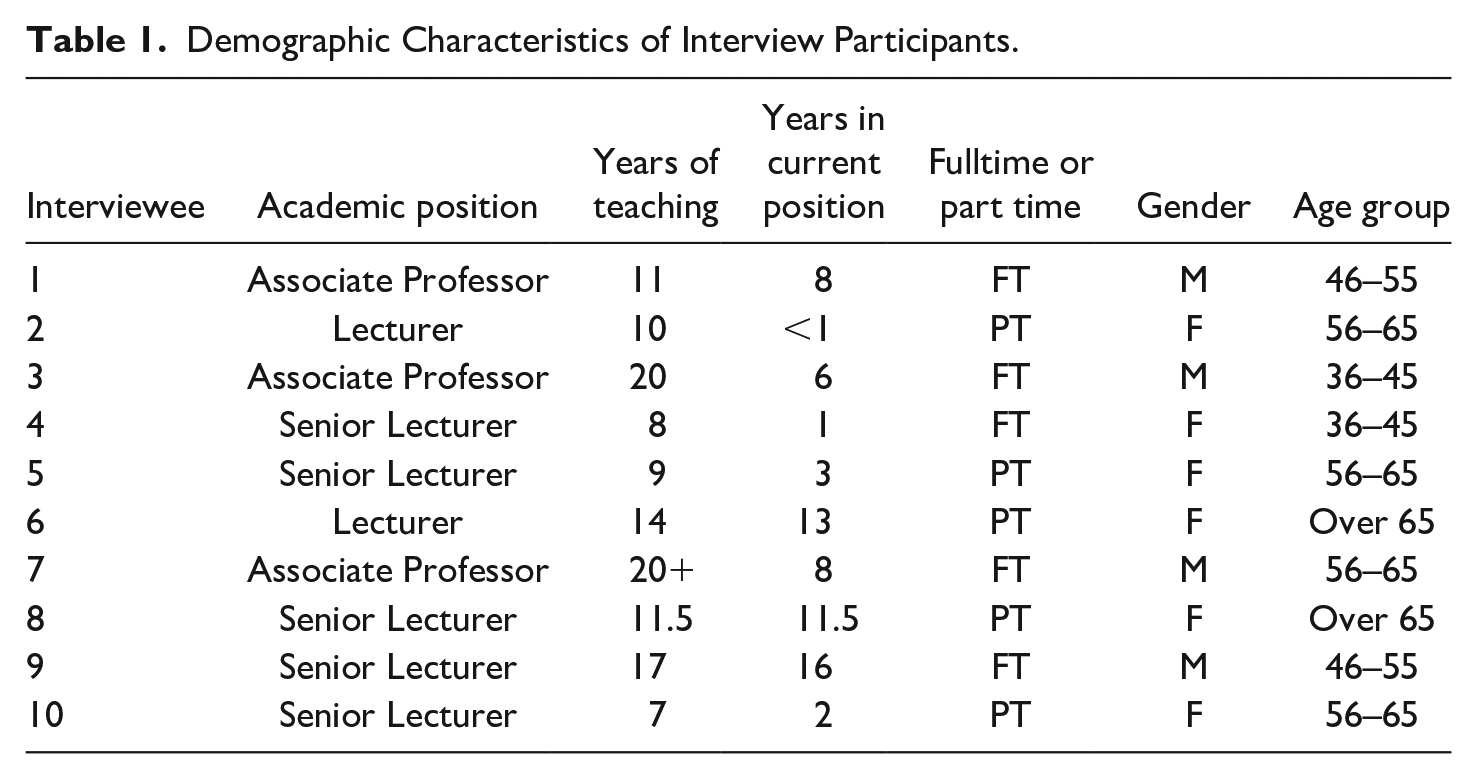
Ten educators were interviewed for this study, representative of each state in Australia, with the average duration of interviews being 38 min, and a range of 24 to 54 min. The majority held the academic position of Senior Lecturer (n = 5) with the others being Associate Professors (n = 3) and Lecturers (n = 2). The average years of teaching was 11.94 years, while the average years in their current position was 7.61 years. There were six female and four male participants with an even 50:50 split between full time and part time employment. Forty percent of participants were in the 56–65-year age group. The other participants were in the 36 to 45 (20%); 46 to 55 (20%); and over 65 (20%) age groups. There were no participants in the 18 to 25 or 26 to 35 age groups. Demographic characteristics of the study participants are presented in Table 1. None of the participants held a formal degree in leadership or leadership studies. Participants held a range of health and business-related qualifications including PhD (6), Doctor of Business Administration (1), Master of Health Science (1), Master of Business Administration (1), and Bachelor of Applied Science (speech pathology) (1).
Demographic Characteristics of Interview Participants.
The findings from the ICA are presented as six global categories with each having multiple sub-categories that represent the broad range of experiences and perspectives of the educators. These global categories fit into three major concepts: people, program, and skills and challenges, as has been envisioned in Figure 1. People, educators, and students, (outer circle) inform the design and delivery of a post graduate leadership program (middle circle) taking into consideration skills required and challenges faced (inner circle). The categories situated in each circle tracked closely with the questions asked at interview and this is consistent with the process as described by Vears and Gillam (2022). The categories are supported and substantiated with verbatim extracts from the educator interview transcripts to connect the reader with the underlying data (Knott et al., 2022).
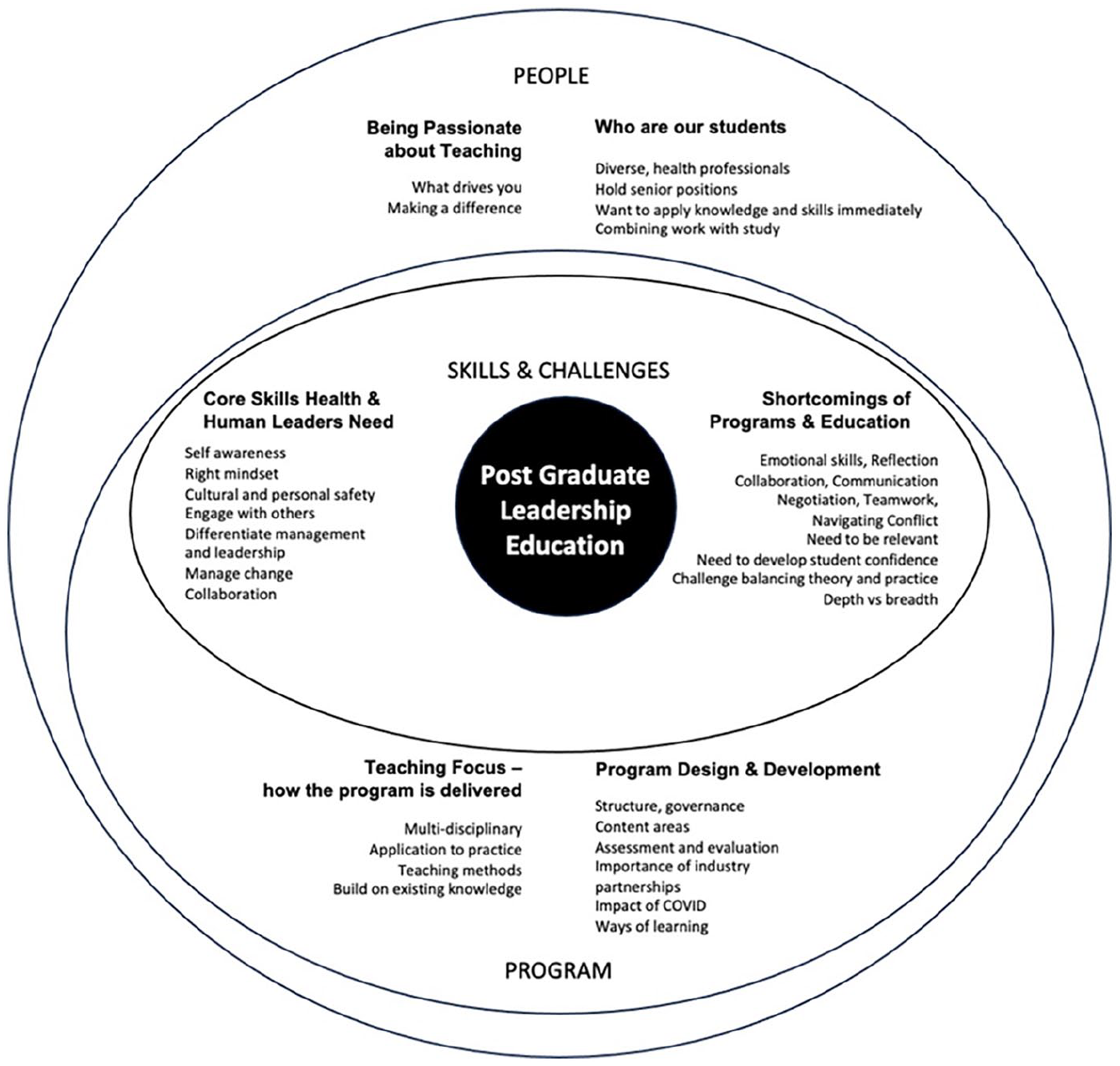
Categories and subcategories from ICA.
Being Passionate About Teaching
This category encompasses the educators’ core values and beliefs about teaching and two sub-categories emerged: what drives you and making a difference. Educators indicated they were driven by a variety of different motivations including social justice, inclusion, sustainability and not being siloed in one profession. Educators articulated they were committed to ensuring that students would be successful in their career progression.
“I want to make some sort of contribution to the upskilling of this workforce, a driving force for me is around the employability of people, make sure they are well positioned for their future careers” (Educator 1).
Educators felt strongly about making a difference in the lives of students, enabling them to thrive and be their best selves as leaders in the sector.
“my mantra is set people up for success, so it does drive everything I do. To create a learning environment where the learning has the best opportunity to embed and therefore the best opportunity to set people up to succeed in the knowledge that they’re gaining” (Educator 10).
Who Are the Students
This category was developed from the shared understanding that students were a diverse group but predominantly had a health professional background, were combining work with postgraduate study, and held senior operational or clinical positions. Educators did not identify if the student’s employment position made a difference to the way the course was taught.
“our client base or student base, well probably more than 99% of them are working in some way and most of them are combining work with postgraduate study” (Educator 8).
The key message was that they (students) wanted to be able to acquire the ability to apply the knowledge and skills immediately but the rationale behind this was not articulated.
“our students are part time, coming from a health professional background and like to take that whatever the learning is there, and immediately applied back to their workplace” (Educator 3).
How the Program Is Designed and Developed
This category connects many components of the design and development of leadership education programs including structure, governance, content, and evaluation. Program structures and governance arrangements differed across programs. Within this category six subcategories emerged; Importance of industry partnerships, Impact of COVID, Ways of learning, Content areas, Assessment, and Evaluation.
Educators consistently spoke about the importance and value of industry partnerships including giving students the opportunity to engage with industry, having content relevant to industry, as well as having industry input into the development of programs. All programs had some type of consultative committee that included industry representation.
“Program development involved extensive consultation with community” (Educator 1). “We really value our industry partnerships and are wanting to give them that engagement with, uh, industry people” (Educator 6).
Most educators spoke about the impact of COVID on their program as well as changing the way leaders operate in the broader H&HS sector. Educators reported there needed to be an increase in online teaching, cessation of residentials, and there was an adverse impact on work integrated learning.
“with the onset of Covid the online um education aspect has become much more prominent” (Educator 3). “Post covid work is very different. And so therefore, uh, you need to be considering this in relation to, uh, some of the concepts that you will certainly reference which are important” (Educator 10). “before covid, uh, to make sure that I found a range of, uh, jobs which would reflect where they came from and the sorts of challenges there. But then during covid those positions pretty much dried up” (Educator 6).
Learning methods differed depending on how the program was delivered as there is no one consistent mode of delivery across Australia. Some programs are fully online, some have residential units or intensive weeks, and others are delivered on campus. Educators did not indicate if they preferred a particular modality. This is exemplified in the response from Educator 5 “everyone has a different way of learning. So, I’ve got to cater for those who want it all, and some people want to read everything and, you know, read it in great detail and then others just want to skim.”
There was no consistent approach to subject or unit content across programs with a mix of both business and health units being offered but educators indicated the importance of ensuring what is being taught is contemporary. There was no apparent agreement between educators as to what they considered as essential content.
“there is an important element of making sure that in terms of the knowledge and the domain what we are giving students is something that is up to date and relevant and building on some of the, you know, trends in the sector” (Educator 4).
Educators identified the need to challenge students’ thinking and get them to develop higher level thinking skills.
“most students struggle to get themselves into the future. Um, they are wanting to, uh, execute. They’re wanting to have executed because, you know, uh, well, that’s that operational focus, isn’t it?” (Educator 10). “I’ll say that’s very good thinking, but now I want you to go to master’s level thinking” (Educator 10).
One consideration that stood out was the emphasis on encouraging collaboration and multidisciplinary teamwork that replicates what needs to occur in the workplace.
“I love getting those doctors and nurses all together on a project that may be not in their comfort zone. Um, but they have to work together because that’s what leadership is, being flexible and adjustable and working with other people, you know, who may not have the same perspective” (Educator 5).
Educators discussed a diverse range of assessment methods being employed in their courses including essays, case studies, presentations, simulations, reflective pieces, group work, and individual and group projects. There was a strong emphasis on the need for assessments to be authentic which participants identified as being about real problems, relevant, and linked to everyday practice.
“we talk about authentic assessment as being really, really important, so as closely aligned to you know, preparing people for practice as we can make it” (Educator 2).
All educators discussed the importance of program evaluation and there appears to be some consistency with programs undertaking a major course review every 3 to 5 years as well as evaluations at the end of each teaching period. Additionally, some programs also undertake accreditation reviews.
Teaching Focus and How the Program Is Delivered
Educators highlighted that as the courses are multi-disciplinary that it is inevitable that a very diverse range of teaching methods would be used including lectures, tutorial, projects, reflections, work integrated learning, case studies, simulations, and group work. When identifying this range of teaching methods participants identified it was important that the delivery of content built on existing knowledge.
“there is an important element of making sure that in terms of the knowledge and the domain what we are giving students is something that is up to date and relevant and building on some of the, you know, trends in the sector” (Educator 4). “that means that whilst presenting an evident, the evidence-based material around a particular topic like, for example, managing risk or leading change, that we would then be looking for very specific ways of students being able to apply that as it makes sense within the context of where they’re working” (Educator 8).
A key consideration by educators was to use the expertise of industry experts within the course so that students are challenged.
“I try as much as possible to bringing, you know different voices. So, we really need to make sure that you know we have colleagues coming who do work with LGBTQI communities, and what are the challenges within those organizations? Or, in terms of policy, what at the moment are challenges in terms of engaging this group and what is missing, and you know some of the trends on that. So, we have people coming in” (Educator 4). “So much is out there and what other people know what the other people contribute and, uh, experience of too” (Educator 5).
Challenges of Programs and Education
This category highlighted challenges in formal programs and more broadly leadership education as perceived by educators. Subject matter identified as missing included emotional skills, negotiation, teamwork, and managing conflict in teams. There was a strong focus on the need for ensuring relevance of subject matter to students professional needs.
“A lot of courses offer a lot of subjects without thinking whether it’s relevant for the students professional need relevant to what the student would be needing, or it isn’t structured and or offered in a manner that isn’t really useful for the student” (Educator 3).
Developing student confidence was identified by educators as a critical skill we need to foster as this is required for future success as a leader.
“If you’re graduating, you need to be confident that you’ve got what’s needed. You’ve got the basics there to have a go, and then whatever you do should be safe and ethical. People are wanting more and more spoon feeding. And what does that mean in terms of how we are preparing the workforce?” (Educator 1).
Educators highlighted the challenge in balancing theory and practice, and what will result in the mindset change needed as a leader.
“introducing a lot of theory can be great and increase knowledge but is it going to really help the mindset shift? It may, if you embed enough reflective practice in there, and so that yes, it should be theory informed, but not to you know, there should be much more” (Educator 2). “I think sometimes it’s a matter of exposing students to, in theory, uh, what would be ideal and in practise work, what possible compromises you’re gonna have to make, uh, to my mind that that’s probably, um, and to be aware of when you’re making the compromises, so it’s back to that, not black and white. It’s back to that grey again, I think” (Educator 6).
Educators discussed the necessity for those teaching into leadership programs to have experience in the relevant sector.
“I think it’s really incumbent, or a requirement for the university to ensure who is teaching in that particular unit or heading that unit has some experience in that area or some qualifications in the area” (Educator 3).
Educators identified that there is a need for a lot of work in the leadership development space and they have to deal with unrealistic expectations around what can be achieved in an educational program.
“There’s so much that needs to be done in terms of leadership development. I do get frustrated with the idea that we can go and do you know a little two-day course, and we’re suddenly transformed” (Educator 2). “you know, if you’re in a situation where there’s an ethical dilemma, yes, you will have actually had sufficient, uh, information about the challenges of ethical leadership, recognise that that is an ethical dilemma” (Educator 6).
A key challenge identified by educators was whether it is preferable for a leader to have in-depth knowledge in a particular area of work or to be well versed across a range of topics. Part of this category was also that students must be aware of their own skill needs.
“I think that there is a problem with specializing. I think it might be a shortcoming. I think we need to give breadth rather than specialise but I also believe that you know if you are a middle level manager or an executive, I think you really need to know what are the skills and the competencies that you need for yourself” (Educator 4). “I think it what you’re hoping is, it gives them sufficient awareness and insight to ask questions” (Educator 6).
Core Skills Health and Human Service Leaders Need
Educators identified a range of skills they perceive that leaders in H&HS need including the ability to engage with others, managing change, having self-awareness, cultural and personal safety, and having the right mindset as well as skill set. Also educators highlighted that leaders need to have a willingness to learn and to not think they already know everything. In addition, educators ascertained that engaging with others is about active listening, bringing people with you, collaboration, networking, and building connections.
Self-awareness and the ability to critically self-reflect is seen by participants as being at the beginning of all effective leadership.
“being super aware of our own emotions, our own values our own beliefs, our own reactions is the most critical thing that we need to be doing as practitioner and as the leader” (Educator 1).
Educators identified that leadership is not just about having certain skills, the person really needs to want to lead people.
“there are many amazingly brilliant and capable professionals, who would be much better left alone to be, continue to be brilliant and fabulous professionals, and not put in a role where they’re leading people, because it’s not what they want, and it’s not what motivates and think that they can’t do it” (Educator 2).
Educators identified a need to differentiate between leadership and management skills in the H&HS sector.
“I think one of the problems is that there’s a lot of management in the health sector as opposed to leadership. And there’s a lot of management which is really just replicating how you were managed” (Educator 6).
Collaboration was highlighted as a core skill as leaders are required to demonstrate teamwork, bring people together, and developing the ability to work through other people.
“I believe that leadership is more about stakeholder influence now than it is about direct leadership” (Educator 1). “leaders seek to do work with and through, and around them, so engaging others” (Educator 8).
The importance of cultural and personal safety was highlighted by educators as being a core skill of successful H&HS leaders.
“psychological safety space where you’re creating meeting environments, for instance, where people can speak up in a health environment” (Educator 1). “Leaders need to be, you know, inclusive, um, and culturally safe for Aboriginal and Torres Strait Islander peoples as well as, um, people from different cultural, uh, cultures and countries studying and in, uh, incorporating those needs and priorities of patients, including refugees, Um, people with diverse, uh, sexualities, um, And, uh, and making sure that inclusive of all sort of, uh, genders” (Educator 9).
Educators identified a key to managing change is communication and the process needs innovation and creativity.
“change is a particular important process, particularly relevant one, and in such you know, it’s the only thing that we can be certain of” (Educator 1). “I want them to have you know, the initiative and the innovation and creativity to think outside the box of how we could do this better, differently, how we can embed, change and make change more palatable” (Educator 5).
Discussion
This study identifies and describes the nature of postgraduate leadership courses and programs for health and/or human services offered by Australian HEIs as perceived by academic educators. Based on an analysis of the results this study sought to answer three key questions.
Who Are the Leadership Educators in Australian HEIs That Are Providing Leadership Education for H&HS Sector Leaders?
This study revealed that leadership programs in Australian HEIs are delivered by educators who do not hold formal qualifications in leadership but do have a passion about the subject matter and want to make a difference in students’ lives. Leadership educators hold a variety of degrees and include a range of H&HS practitioners as well as those with a business background. This finding is consistent with the literature including a phenomenological study by Jenkins (2019) who found that leadership educators had a “hodgepodge” of experiences both academic and professional with few holding a formal degree in leadership. Educators described different career paths before taking on their current role in academia. Entering into leadership education appeared to be pre-empted by the educators’ previous leadership experiences, unlike some of the more well-established academic disciplines, which may or may not be relevant to the H&HS sector. This is consistent with similar findings in the literature (Guthrie & Jenkins, 2018; Seemiller & Priest, 2017; Sultan et al., 2019). Channing (2020) argues that it is important that leadership educators have significant leadership experience and use this in their teaching. Further, as argued by Jenkins and Owens (2016) leadership educators are expected to be skilled at the design of engaged pedagogy, integrative learning experiences, and intentional learning communities yet may not have been provided with the preparation or training for these experiences. Additionally, Kilag et al. (2023) argue that educators who have practical experience in leadership roles, as well as training and education in leadership development, are more likely to be effective in promoting learning and development in program participants. However, the educators in this study used a range of teaching methods demonstrating their knowledge and expertise in enhancing the learning of students. The notion that good clinical or professional capabilities lead to good leaders or educators who can teach leadership in the H&HS sector needs to be studied in greater detail.
The study findings also suggest that development of identity could have an effect on leadership educators, but this would require further exploration. Although not specific to the H&HS sector, Seemiller and Priest (2017) argue that to be a leadership educator is more than having expertise in content knowledge and pedagogy, one needs to develop a professional identity that is reflective of being and becoming a leadership educator. Seemiller and Crosby (2019) identified that the professional identity of leadership educators is multifaceted and blends one’s identity as a leader, an educator and as a professional. Rocco and Priest (2023) conclude that further research is needed to enable the field of leadership education to fully embrace multi-level views of leadership identity development.
How Are Postgraduate Leadership Education Programs in Australian HEIs Developed and Delivered for H&HS Leadership Students?
The findings from this study revealed a high degree of variability in the way that programs are designed and developed across HEIs, similarities in the student population, and that educators face a range of challenges. There is, however, an underpinning belief that leadership can be learned and taught which is supported in the literature (Blumenthal et al., 2012; Channing, 2020; Devies et al., 2022; McCauley & Palus, 2021).
The study identified that program structures and governance arrangements differed across programs and none of the educators clearly articulated the conceptual framework that underpinned their leadership education program. The disruptive force of the pandemic caused educators to rethink how programs are delivered resulting in an increased focus on online teaching and difficulty in accessing work placements. These impacts are echoed in the literature (Ewing, 2021; Mohapatra, 2020; Nie & Pillans, 2023). McCarron and Yamanaka (2022, p. 38) refer to the “COVID-19-induced pivot to online learning” while Devies et al. (2022) argued that the COVID-19 pandemic substantially impacted how higher education delivered courses with more universities considering how they develop inclusive curriculums.
The study found there is little agreement between educators on the content matter and this is consistent with the literature (Allen & Roberts, 2011; Hartman et al., 2015; Purcell & Smith, 2023; Sowcik & Komives, 2020). Friesen (2018) argued that it is important to identify the foundational knowledge required so that students can develop a universal language for practicing leadership. However, Pierre et al. (2020) acknowledged that standardizing programs is challenging while embracing the diversity of paradigms, disciplines, and delivery that is necessary for effective leadership education. A lack of agreed upon core curricula has been identified within the literature as a significant challenge for educators and the field of leadership studies with calls to identify a minimal and consensual core content (Allen & Roberts, 2011; Diallo & Gerhardt, 2017; Komives & Owen, 2023). A content analysis of Australian leadership curriculum by Fennell et al. (2023) identified 49 subject areas within core units of study with the broad topic areas of “leadership” and “management” as most common without specification of the conceptual or theoretical underpinnings.
Additionally, the study found that the student population is similar across HEIs in Australia. Students come from a diverse range of health professions, tend to hold senior clinical or operational positions, and are trying to balance the competing agendas of work, study, and family. Educators reported consistently that students want to be able to apply the knowledge and skills gained in leadership education immediately into their workplace. This application of leadership knowledge and skills into workplace practice is strongly supported in the literature (Curtis et al., 2011; Moldoveanu & Narayandas, 2019; Simen & Meyer, 2021). Page and Margolis (2017) share their experience of partnering and collaborating with students in the use of “concrete actions that offer them the muscle memory of their lived experience to take back to their organizations and begin to apply immediately”(p. 83). Goldman et al. (2021) mentioned in their case study highlighted the synergistic effect of anchoring leadership learning around a real-life project and demonstrated positive outcomes for both individual students and organizations. Delbert and Jacobs (2021) identify the need for action learning activities that focus on application into practice. Simen and Meyer (2021) state that graduate students flourish when they can tap into lived experience, prior knowledge, and the direct application of learning experiences to current endeavors. Waring et al. (2023) state in their study on political skill acquisition by healthcare leaders highlight the benefit of problem-based and situational learning experiences for leadership development.
This leads to the need for assessment tasks to be authentic, which educators identified as being about real problems that are relevant and linked to everyday practice. There is consistent research in the field of authentic assessment in higher education showing that authentic assessment can not only equip students with leadership knowledge and skills but can develop their leadership self-concept (Ashford-Rowe et al., 2014; McArthur, 2023; Sokhanvar et al., 2021; Wiewiora & Kowalkiewicz, 2019). Situating authentic assessment within a social context encourages educators to think beyond the task performance and to consider the broader motivations for teaching including social justice, inclusion, and sustainability as identified by the educators interviewed. This is congruent with the notion that higher education has a responsibility to prepare students for employment or in the case of postgraduate education to prepare students to take on more advanced roles (Royce et al., 2021).
The findings of this study identified that a number of common challenges are faced by educators. Educators identified a tension with trying to find the right balance between theory and practice and this was echoed in the literature (Conger, 2013; Gleason & Breen, 2022). Sowcik and Komives (2020) offer a word of caution to educators and program developers to not rely on practical application at the cost of an important theoretical base. Educators were further challenged with the breadth vs depth argument. Conger (2013) considers there are pros and cons with both approaches. The advantage of covering many dimensions of leadership in a program is that students develop an appreciation that leaders require an array of capabilities, but programs must balance this to ensure this is not at the expense of opportunities for in-depth skill development. Conger (2013) goes on to argue that superficial treatment of many dimensions of leadership is misleading students about the rich skill set required to lead. Delbert and Jacobs (2021) discuss the development of a program that purposely chose to focus on broad leadership skills and that avoids a specialized focus based on current fads. The challenge for educators is to identify which dimensions of leadership are critical to teach if we are to have successful leadership in the H&HS sector.
There was considerable congruence between the core requirements of H&HS leaders and the challenges in current education programs as identified by the educators particularly related to communication and collaboration. Communication, collaboration, and conflict management skills are considered critical in the H&HS sector for healthcare leaders (Abraham et al., 2021); postgraduate medical residents (Merriam et al., 2021); and nursing leaders (Heinen et al., 2019). Blumenthal et al. (2012) identified deficiencies in leadership education for medical personnel that included communication, team building, negotiation, and problem solving. Simen and Meyer (2021) found that leadership education at the graduate level should include communication skills, emotional intelligence, and conflict resolution. The requirement for H&HS leaders to work collaboratively and facilitate sustainable teamwork is also supported in the literature (Bornman & Louw, 2023; Folkman et al., 2019; Forsyth & Mason, 2017) so it is surprising that these remain as perceived gaps in education.
What Teaching and Learning Methods Are Used in Australian HEIs Postgraduate Leadership Education Programs for H&HS Leadership Students?
The findings from this study demonstrate that there is no standardization in the teaching of leadership and educators employ a diverse range of pedagogical practices. Educators did highlight the need for programs to be multidisciplinary with a focus on increasing self-awareness and incorporating reflective practice.
Educators discussed a plethora of teaching methods and pedagogical practices but did not indicate that there was any one particular method or practice that proved to be highly successful. This finding is consistent with the literature. Jenkins (2013) reported that discussion-based pedagogies were most frequently used by undergraduate leadership educators followed by projects and presentations, self-assessments and feedback, and personal growth strategies. Jenkins (2016, 2018) in later studies found that differences between undergraduate and postgraduate leadership educators’ instructional strategies was statistically insignificant. A systematic review undertaken by Frich et al. (2015) identified that most leadership development programs used two or more teaching methods within their curricula. Priest and Donley (2014) found that mentoring enabled students to make real-world meaning of their leadership education. A survey of leadership students undertaken by Lachance and Oxendine (2015) found the five most valuable teaching/learning methods were 360-degree assessments, classroom sessions, consulting projects and teamwork, field trips with healthcare leaders, and one-on-one meetings with faculty. Sadowski et al. (2018) identified small group teaching, mentoring, coaching, experiential learning, and reflective practice as most effective teaching methods. Shah et al. (2019) found two frequently used teaching/learning methods useful for health professionals were building a respectful learning environment and sharing personal narratives in addition to reflection and interactive discussion. Merriam et al. (2021) identified the highest ranked teaching methods were mentorship/coaching, work—based reflection, and interactive discussion. Delbert and Jacobs (2021) identify a number of instruction methods to be used in leadership education including action-based learning, problem-based learning, simulations, interdisciplinary case studies, group discussions, multimedia presentations, mentoring, and 360-degree feedback in addition to didactic teaching sessions. A study by Goldman et al. (2021) highlighted the value of interweaving different learning methods into a real-life project. Waring et al. (2023) argue that a combination of learning methods is more likely to provide the development support that students need. Similar to the educators the literature indicated that the use of exams was the least used instructional strategy (Jenkins, 2013, 2018). Analyzing educators’ views with findings from the literature, there appears to be some consensus on which to offer a number of recommendations. The use of small group discussion, problem-based learning, case studies, coaching and mentoring sessions, integrating action based or work integrated learning, and giving and receiving feedback are supported. Other noted methods include individual leadership development plans in conjunction with a work integrated project, group collaborative work, and guided reflection.
Educators highlighted the multidisciplinary nature of their programs and the need for leadership education programs to have a multidisciplinary focus is strongly supported in the literature. Frich et al. (2015) identified that physician only leadership programs missed the opportunity for developing capacity to collaborate across professions which may be important for team-based leadership. This was echoed by Onyura et al. (2019) who identified that uni-professionalism raises concerns about whether budding physician leaders are prepared enough for the multi-professional and inter-sectoral relationship building that will be demanded of them in practice. Geerts et al. (2020) contends that interdisciplinary programs are advantageous, they mirror the collaboration that is needed in the workplace and can help break down silos. Purcell and Smith (2023) argue that wicked problems are expanding and there is a definitive need for leaders whose academic education prepares them to collaborate across disciplinary and professional boundaries. Leadership in the health sector requires a higher level and integration of interdisciplinary knowledge, skills, vision, and innovation for effective and collaborative healthcare practice (Figueroa et al., 2019). Similarly, Coles and Sawyer (2021) argue that the current conditions within human service system demand an integration of the various disciplines and we need to transcend professional affiliations.
Increasing self-awareness and undertaking reflective practice were identified by educators as both a requirement and a challenge. Self-awareness is associated with successful leadership (Ashley & Reiter-Palmon, 2012) and reflection develops greater self-awareness (Volpe White & Guthrie, 2016). A study by Middleton et al. (2020) highlighted the importance of self-awareness as a pre-requisite to self-development and growth and yet Frich et al. (2015) argued that few programs address self-awareness or personal growth. Hartman et al. (2015) identified that personal growth would most likely be increased through mentoring, feedback, and group projects and least likely to increase through listening to experts, lectures, or completing case studies. The inclusion of reflection and reflective practice being built into leadership education programs is soundly advocated in the literature (Guthrie & Jones, 2012; Harvey & Jenkins, 2014; Jenkins, 2018; Koshy et al., 2017; Sadowski et al., 2018; Shah et al., 2019; Volpe White & Guthrie, 2016). Helyer (2015) discusses the benefits of reflective practice to critically appraise what has been experienced via education and practice and sees a critical role for reflection in work-integrated learning. Goertzen and Squire (2019) argue that integrating intentional and structured opportunities for reflection can inform future practice and improve performance. Dunn (2021) argues that reflecting on past leadership experiences rather than theoretical concepts has been shown to develop leadership capacity. This could be achieved through the use of guided reflection during coaching or mentoring sessions. A positive and significant relationship between reflection, coaching and mentoring, and leadership development is supported in the literature (Daniëls et al., 2020; Ekere et al., 2022). Page and Margolis (2017) recommend the intentional use of reflection through coaching where the predominant student population are full time working professionals.
Thinking collectively about academic leadership programs could lead to considerable benefits including “the rigorous interdisciplinary development of leadership research and teaching, clearer articulation of what constitutes leadership and the value of researching and teaching leadership, and the educational pathways and tenure process of current and future leadership faculty” (Friesen, 2018, p. 51). Garay-Rondero et al. (2019) argue that a lack of consensus on the most effective approaches to teaching leadership poses a significant challenge for leadership educators. The importance of context cannot be overlooked, and H&HS leadership educators need to be intentional in addressing this unique context. Delbert and Jacobs (2021) argue that leadership education needs to be practice based, interdisciplinary, experimental, innovative, and encourage authenticity which is consistent with the perceptions and experiences of the academic educators interviewed.
Limitations
This study is limited to Australian universities and may not be applicable to other contexts. However, the findings might contribute to valuable understandings for leadership educators who see a resemblance between the context of this study and their own. This study focused on the experiences of 10 educators the majority of whom were in the 56–65-year age bracket. There were no participants in the 18 to 25 or 26 to 35 age groups, and they might have offered a different viewpoint. The perspectives of recognized leaders, students, alumni, or the broader H&HS sector were not included, and this might have influenced the richness of the data.
Conclusion
This study adds to the literature through the analysis of 10 academic educators’ perceptions of leadership education for H&HS sector leaders and potential leaders in Australia. Using ICA, six categories emerged which are interconnected and support each other. Furthermore, the findings of this study are consistent with previous research, which demonstrates formal education has the potential to positively impact the development of leaders in the H&HS sector.
The researchers hope these findings will help enhance understanding of the current landscape and whilst informative, the study findings are not conclusive. More research is needed before any strong inferences or conclusions can be made about leadership education for the H&HS sector. Other interesting areas for exploration would be to examine leadership education from the perspectives of leaders in the sector, alumni, and current students. Ultimately the goal is to contribute to increased effectiveness of leadership education for the H&HS sector.
Footnotes
Acknowledgements
The authors acknowledge the assistance provided by Clare Raffety in the design of the visual map of categories and subcategories from the ICA.
Declaration of Conflicting Interests
The author(s) declared no potential conflicts of interest with respect to the research, authorship, and/or publication of this article.
Funding
The author(s) received no financial support for the research, authorship, and/or publication of this article.
