




Abstract
This article presents a scoping review of literature on leadership in international schools from 2012 to 2022 identifying key themes and areas for further research. The review reveals a focus on the challenges of leadership practice within international schooling and outlines how these themes are understood within the reviewed literature body. The article responds to recurring calls for more theorisation around educational leadership within the context of international schooling and research focused on practices of leading embedded within intersectionalities, contextual factors, and place-based ontologies. Drawing on the themes identified within the scoping review, we recommend the examination of leadership development pathways, including current approaches that have not been captured by peer-reviewed literature. Importantly, we argue for complexity-cognisant research that is framed to encompass multiplicity and multi-perspectival investigation across the various iterations of international schools and educational leadership.
Introduction
The burgeoning international school sector provides a fertile area for research (Cravens, 2018). The sector has a predicted trajectory of ongoing growth (Bunnell, 2020a) within a ‘changing landscape’ (Bunnell, 2014: 45). Prior research has focused on the nature of these schools (Hayden and Thompson, 1995), how they function both individually and, in some ways, as a collective (Hayden and Thompson, 2013; Pearce, 2013), and how educational leadership is perceived and practised in these settings (Blandford and Shaw, 2001).
This scoping review is designed to examine peer-reviewed research published between 2012 and 2022, pertaining directly to the development and practices of educational leadership in international schools. Scoping reviews provide a way to encapsulate a body of literature and identify key areas of interest, methodologies, and common findings across multiple studies. In addition, scoping reviews can highlight evidence gaps and identity future research directions (Arksey and O'Malley, 2005).
This article begins by providing some context of educational leadership in international schools before outlining the methods used and presenting the analysis of papers identified in our scoping review. Finally, we offer recommendations for future directions for research on leadership in international schools.
Definition
The term ‘international schools’ encompasses a loose and, often, disparate ‘group’ of schools. Various typologies have been utilised to classify international schools, yet there is no consensus on how they can be sorted and defined. Original attempts based on establishment features (Hayden and Thompson, 2013) and commonalities (Benson, 2011) are considered normative and outdated (Bunnell, 2019a), although still sometimes used as categories for examination in research (Bunnell and Gardner-McTaggart, 2024). Previous research indicates that the field of international schooling is rapidly developing (Lee and Walker, 2018) with ‘changing clientele’ (Brummitt and Keeling, 2013: 62), and becoming perhaps less determinate over time (Bunnell, 2014). Consequently, there is a shift towards a matrix or spectrum view that encapsulates the diversity of international schools, including population, curriculum, and location (Gardner-McTaggart, 2018b; Machin, 2018). In a 2021 study, Gibson and Bailey offered an overview of the sector, expanding the consideration to include chains of schools and identifying the concept of transnational ownership, that is, school ownership and administration being spread across countries, as a potential future challenge.
This review adopts Bunnell's definition (2019a) of international schooling and adds scope for changes noted by Gibson and Bailey (2021). The term international schools, therefore, is considered as a loosely collective noun referring to individual or chains of schools ‘with a global view, located mainly outside an English-speaking country, delivering a non-national curriculum, at least partly in English’ (Bunnell, 2019a: 1), where governance and/or ownership may, or may not be, transnational (Gibson and Bailey, 2021). As seen by the challenge of definition, this is a complex sector of education, one ‘ahead of [its] time as transnational spaces’ (Machin, 2017: 133). Given the size of the sector is similar to school systems in some nations (Bailey and Gibson, 2020), it presents a rich and largely untapped area for investigation (Cravens, 2018).
International schools: context for the literature review
International schools emerged in the early 1900s with the ‘dual aspirations for international understanding and global free trade’ (Sanderson and Whitehead, 2016: 172), which still guide many today. Although historically under-researched (Bunnell, 2022), international schools received increased critical attention from the early 2000s and remain an area of growing research interest (Brummitt and Keeling, 2013; Bunnell, 2014; Hayden and Thompson, 2013). Several studies have examined a range of facets, including the complex and changing landscape (Bunnell, 2014; Keller, 2015), various stakeholder concerns (Bailey, 2021; Rey et al., 2020), and the recognition of the capitalised International Schooling as a field of sociological interest (Bunnell, 2020b; 2021). An emerging theoretical line of inquiry sees the application of Bourdieusian theories (1990) to studies of international schools as a means of considering power and social reproduction through institutional structures (Khalil and Kelly, 2020; Whitmarsh, 2022).
Ideological in nature, yet still ‘pragmatically serving the globally mobile’ (Bunnell, 2022: 40), there was difficulty in distilling the essence of international schools from the outset. The original international schools aimed to go beyond curriculum delivery, incorporating a social agenda such as enhancing world peace through overt instruction in intercultural awareness (Gardner-McTaggart, 2018b). Over time, international curricula facilitating both the pragmatic and ideological agendas emerged (Gardner-McTaggart, 2021).
One such curriculum framework is the International Baccalaureate (IB). Founded in Geneva, Switzerland, in 1968, the IB was pivotal in shaping the practical landscape of international education development (Cambridge and Thompson, 2004) and promoting a vision of International Mindedness (Tarc, 2018). However, some argue that the IB is a transnational tool facilitating privilege (Koh and Kenway, 2016), implementation is not always cohesive (Lee et al., 2018), and much of the international school sector has moved on (Bunnell, 2014) from using the IB curriculum framework.
While there has been significant focus on ideological and practical complexities of the sector, research on educational leadership in international schooling has been relatively limited. Nonetheless, we recognise the important role played by educational leaders in developing and sustaining high-quality schooling (Hallinger and Heck, 1999). This review, therefore, offers deeper insight into the approaches, findings, and themes of current research on leadership in international schools to theorise educational leadership within this dynamic sector.
Method
This scoping review aims to contribute to the theorisation and critique of leadership in the international school sector and seeks to address the following questions:
What are the key themes examined in current literature about educational leadership in international schools? What areas within the research have been identified as needing further examination?
In alignment with Daudt, van Mossel and Scott's (2013) application of Arksey and O’Malley's (2005) scoping review framework, the purpose of this review is to establish ‘the extent, range, and nature of research activity’ (Levac et al., 2010: 1) and to identify areas that could be strengthened in understanding the development and practices of international school leaders. The Preferred Reporting Items for Systematic reviews and Meta-Analyses (PRISMA) (Tricco et al., 2018) with the extension for scoping reviews guided literature identification and analysis was used (see Figure 1).
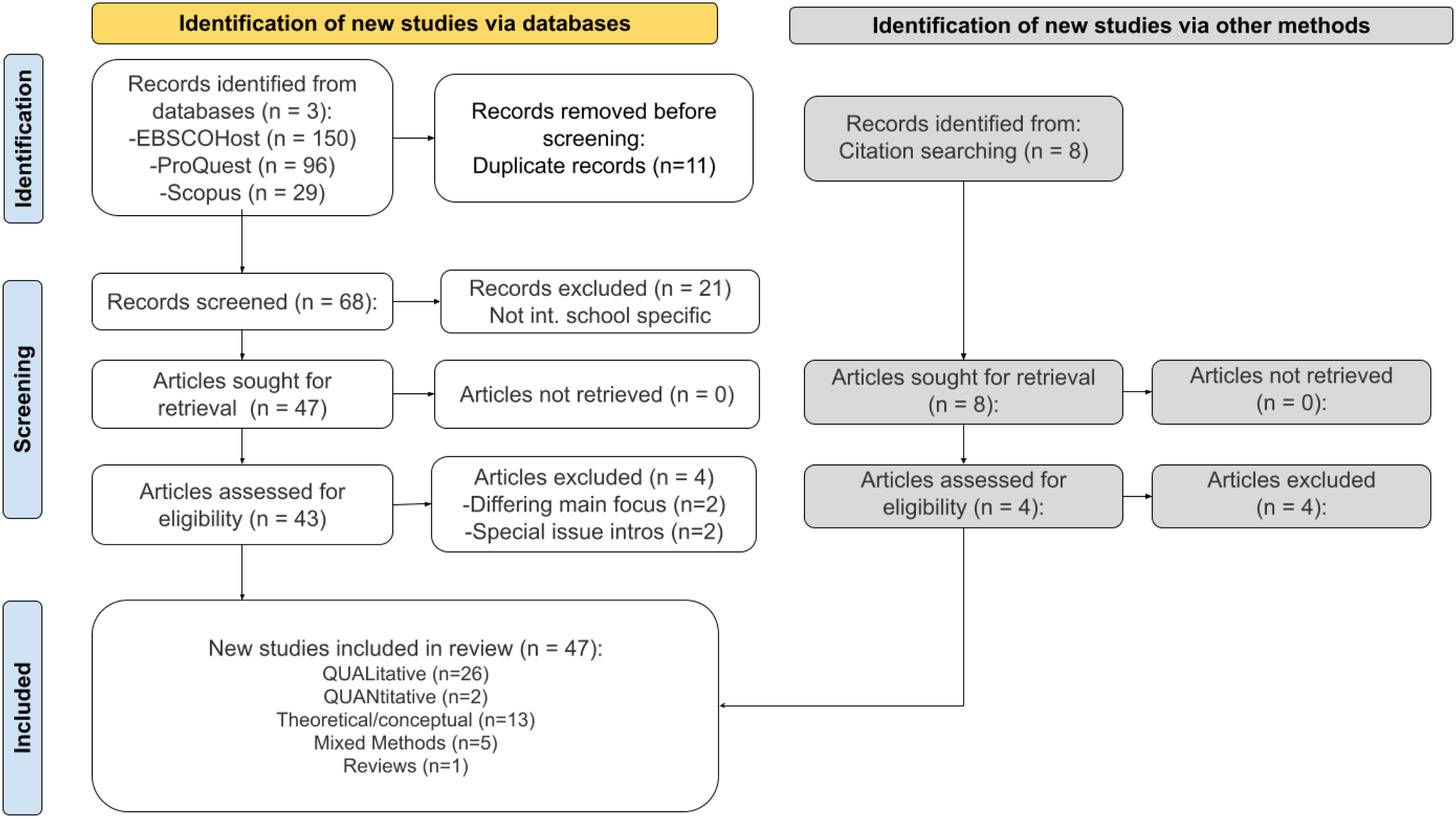
PRISMA diagram (Tricco et al., 2018) showing the flow of identification and screening of sources for scoping review.
For this article, studies of leadership in international schools were reviewed. Key term searches were conducted in late 2022 using three databases: EBSCO, ProQuest and Scopus. These platforms were selected as large, multidisciplinary databases, that include high-quality, peer-reviewed, full-access articles including many education-specific journals. Searches identified relevant studies and papers to be validated and reviewed. Filters were applied to search within the inclusion criteria listed below. We selected to use the term leadership to identify papers that examine roles and functions of leaders but recognise that including other terms, like management or administration, could have changed the search outcomes as these terms are often used interchangeably in international settings. Additional literature was identified by a manual search of references in identified papers, in an attempt to mitigate a potential limitation of the PRISMA approach, that of only a small number of papers being identified.
Eligibility criteria:
Use of terms international school* AND educational lead* or leadership structures in the title or abstract Peer-reviewed, published, academic journal or book Results were filtered for ‘English language’ Full-text accessibility Published between 2012 and 2022, a decade at the time the scoping review occurred
Exclusion criteria included:
Not international school specific
○including those with generic reference to ‘IB’, or ‘international education’ without specific reference to international schools throughout the body Differing main focus, e.g. Covid19 pandemic, international education, or teaching Grey literature or theses Does not clearly state peer-review was used
Database index searches initially identified 275 papers in total. During eligibility screening of the title and abstract according to inclusion criteria, eleven duplicates were removed, and four exclusions occurred after close reading determined that they did not focus predominantly on leadership or were editorials. An additional four papers were included after the manual search of reference lists. In total, 47 papers were included in the scoping review.
Research methods in the literature varied, with 26/47 being qualitative, 2/47 quantitative, and 5/47 mixed methods. Theoretical contributions, or conceptual papers made up 13/47 and one was a literature review. Notably, many of the empirical studies are of limited scale, with small sample sizes, and at times conducted with convenience sampling participants within one school context.
Literature specifically concerned with leadership in international schools is limited. In an effort to identify key themes and issues, the methodology, participants, study sites, research question/s, and main findings of included peer-reviewed papers were charted in an iterative process. Consultation occurred throughout the process of extracting information and consensus around findings was gained through ongoing discussion amongst the research team.
Beginning with an ‘evidence synthesis’ (Munn et al., 2018: 1), the scoping review provides an overview of the field and stances of different authors. It identifies key themes and areas of research interest, describing ‘concepts and knowledge gaps’ (McGowan et al., 2020: 178). Findings are presented in two sections: 1) characteristic challenges of understanding international schools' leadership including, comparisons with national systems, context-specific leadership, transience, complexity, cultural diversities, and place; and 2) areas for further examination of leadership in international schools: minimally theorised leadership, and development pathways. Drawing on these findings, the discussion situates these studies in the broader field of educational leadership and considers possible directions for further research.
Emerging themes: leadership in international schools
Since 2012, significant growth in the number of international schools, and changes in the student population base, has occurred (Bailey and Gibson, 2020), resulting in increased academic attention. However, it should be noted that given the significant and rapid landscape changes (Gardner-McTaggart, 2018b), an ongoing challenge for the field is accurately representing facets of leadership within newer iterations of international schools (Bunnell, 2019b).
Various lenses are noted in the literature included in this review. Responding to earlier calls for sociological examination, one view sees researchers examine issues of power, including colonisation (Gibson and Bailey, 2022) and hegemonic whiteness (Gardner-McTaggart, 2021) within elite international schools. Such studies intentionally problematise many of the typical features of the sector, establishing the sociological field of International Schooling (Bunnell, 2019a), denoted by the capitalisation of its terms. In this dynamic landscape, cognisance of changing characteristics in a ‘new era’ (p. 55) of international schools is central. Outside these sociological studies, evidence of critique of international school leadership is limited.
Another lens sees comparative studies examine national systems and international schools (James and Sheppard, 2014), exploring international schooling as a microcosm of the tensions of education in neoliberal and commercial contexts (Gardner-McTaggart, 2019b; Machin, 2018). Providing multiple contextual examples from Malaysia, Bailey and Gibson (2020) explore variations in leadership development pathways and in the roles of leaders in schools that sit outside of a national education system.
Relatedly, the IB can provide researchers with a means of contextualising explorations of broad and complex leadership practice within IB international school settings. Some solutions-focused pieces offer guidance for leaders, who are navigating their practice within the context (Calnin et al., 2018; Morrison, 2018; Walker and Lee, 2018). Meanwhile, others investigate the relationship between facets of the IB framework, such as the Learner Profile, International Mindedness, and effective leadership practice, offering an educational lens on the field (Gardner-McTaggart, 2019b; Lee and Walker, 2018; Tarc, 2018).
Overall, leadership in the international school context is ‘a neglected area of concern’ (Bunnell, 2019b: 3), involving limited empirical research. In a systematic review of research in the field, Gardner-McTaggart (2018b) demonstrates the difficulty of investigating leadership in international schools without framing contextual details. Concluding that ‘the challenges of leadership facing the international school leader focus around transition and change; the nexus of transience and permanence’ (Gardner-McTaggart, 2018b: 159), the review reiterates the powerful relationship between leadership and context. It is worth noting that our scoping review includes 29 papers published from 2018 onwards. Aside from Gardner-McTaggart's own publications (2018a; 2018c; 2019a; 2019b), none of these papers were included in the 2018 systematic review, thus emphasising the need for an updated review of literature in the field.
Contextual challenges for international school leaders dominate the research discourse (Cravens, 2018). The majority of this literature addresses a combination of concerns, keeping ‘place’ generically ‘school’ and/or international, although in some cases broad regions are referenced. Since 2018, multiple papers focusing on particular national contexts have emerged (Adams and Velarde, 2021; Bailey and Gibson, 2020; Gibson and Bailey, 2021; 2022; Hammad and Shah, 2018; Sawalhi and Tamimi, 2023). More studies grounded in location-specific aspects of context and culture, however, are needed for further exploration and theorisation.
In recent years, the amount of literature concerning educational leadership in international schools has increased. Three areas of concern become evident: characteristic challenges for understanding international school leadership, minimally theorised leadership, and a lack of clear leadership development pathways. The review continues by outlining these themes and areas for further examination identified within the research.
Characteristic challenges of understanding international school leadership
Considerable research attention has been paid to challenges for leadership in international schools. In the process of this review, some research themes were identified, yet many of the claimed findings have yet to be reproduced by subsequent studies. These themes include comparison with national systems, context-specific leadership, transience, complexity, cultural diversities, and place (human-to-world interconnections). Understandings of these characteristic challenges provide important insight about international school leaders and highlight how this field could be further developed.
Comparisons with national systems
Comparisons between the experiences of leaders in international schools and national school systems are frequently evident within reviewed literature. Arguing that contextual features are not unique to international schools, Cravens (2018) suggests they could offer ‘the perfect testing ground’ (p. 586) for understanding challenges faced by all school leaders. Similarly, when exploring leadership practices associated with student achievement in schools using the IB system, Lee, Walker and Bryant (2018) conclude that despite unique contextual features, ‘leadership practices enacted in IB schools are not much different for those of local schools’ (p. 578). In contrast, Bailey and Gibson (2020) illuminate the wide variety of leadership challenges arising in international schools – many of which would be unexpected within regulated national systems – such as issues concerning ethics and morality with admissions' policies and the necessary business skillset in a for-profit environment, also noted by Machin (2019). What leadership practices in the international school sector might also contribute to research on nationally focused educational leadership discourse and practice, and its development is yet to be investigated. Relatedly, context-specific leadership is considered across the reviewed literature.
Context-specific leadership
Brewer et al. (2020) see value in a socio-historical lens for leaders to more deeply understand context as a prerequisite to effective leadership, stating that ‘a leader should understand the people, activities, discourses and their artefacts as well as the wider cultural field’ (Brewer et al., 2020: 343). However, context-specific leadership remains a potential challenge for international schools as it is still seen as enigmatic due to limited research and under theorisation (Bunnell, 2018). While multiple small-scale studies offer insights into specific geographic locations and rich national and local variances (Adams and Velarde, 2021; Hammad and Shah, 2018), a need for large, wide-ranging, and comparable studies remains. Following this, concerns about transferability of research relating to national curriculums being imported into any environment arise. The IB curriculum framework is one example of a framework that straddles national, international, and transnational schooling contexts, and as such provides a possible context for comparison.
Transience
According to Gardner-McTaggart (2018b) ‘transience is a real, debilitating problem for international schools’ (p. 160). Although rapidly changing, the nature of international schools has historically meant that transience permeates stakeholder groups (Bunnell, 2018), including students, faculty, parent communities, governance or ownership (James and Sheppard, 2014; Kelly, 2022), and school leadership (Gardner-McTaggart, 2018a). Despite more ‘local’ iterations of international schools, Bunnell and Gardner-McTaggart (2022) suggest the existence of a ‘continuous transitory force of senior leaders, moving between schools, constantly (re)producing and consolidating its position of power’ (p. 4). While there is agreement that aspects of transience continue to present some challenges (Caffyn, 2018) albeit differently than in the past, researchers are yet to develop theories to explore its implications or examine how permanence and place might serve as mitigating factors to discontinuities. As the international school landscape continues to evolve, and host-nation influences increase, the challenge of transience could potentially be offset through more value being placed on local continuities, or at least being viewed with host-country, or context-informed understanding.
Complexity
The complexity of the international schooling landscape positively and negatively impacts leading practices. While James and Fertig (2016) conceptualise all schools as ‘complex, evolving, loosely linked systems’ (p. 106), they acknowledge that complexity in international schools is ‘arguably … exacerbated’ (p. 107). The authors argue that the rapid expansion of many international schools can obscure links to their own history, resulting in less organisational consistency. Yet, Gardner-McTaggart's (2018b) study found that complexity is intensified by transient leaders repeatedly reshaping schools, guided primarily by their individual values.
Examining posts on the digital review site, International Schools Reviews, Bunnell (2018) identifies many inherent complexities in international school leadership. As noted more recently by one of the same authors (Bunnell and Gardner-McTaggart, 2022), many leaders appear to enjoy varied careers around the world. Nevertheless, further rigorous research is needed to examine specific complexities in international schooling, including socio-historical and political forces; and how these arise within daily practices of leading.
A small proportion of the reviewed literature examines complexity related to commercial concerns and aspects of managerialist leadership in international schools. Machin (2014) examines tensions inherent when market fundamentalism underpins education, and how leaders manage this ‘plurality’ (p. 28), eventually reconceptualising this ‘not … as educational or managerial, but hybridic’ (Machin, 2018: 519). Applying institutional theory to the rapidly expanding sector, Machin (2019), considers the organisational forces that take ‘relatively homogenous organisational forms’ (p. 115) despite varied settings, and examines how leaders respond to these pressures. Looking further ahead, Gibson and Bailey (2021) anticipate shifting priorities as chains, or groups of schools, grow in prominence across the sector, changing ideas about leadership structures and governance. The prevalence of commercial concerns remain one of the key distinctions between national and international schooling (Bailey and Gibson, 2020).
Despite these challenges and complexities, the international school sector continues to grow. Turning to positive sociology, Bunnell (2019b) identifies a need for further research examining how leaders ‘survive in the face of adversity’ (p. 8), when choosing to stay ‘on the circuit’ of international schooling. This image of survival contrasts Bunnell and Gardner-McTaggart's (2022) claims about the privilege and power inherent in these positions. Also highlighting positive aspects, Walker and Lee (2018) suggest that complexities create ‘new opportunities for teacher collaboration, culture building, and developing a productive learning environment’ (p. 470). These authors temper the presentation of challenges with solutions-focused contributions for leadership inquiry and practice.
Attempting to address contextual complexities, Keller (2015) proposes a framework supporting leaders in the key ‘dualities’ (p. 900) of their work, with schools positioned in their local context, while maintaining an international ethos. While this local versus expatriate view reinforces an oversimplified binary (Ledger et al., 2014), Keller's (2015) work highlights the potential richness of international school contexts. A deeper understanding of the richness and complexity of these contexts could be developed by embracing diverse voices, identifying whose stories are told, how they are socially and historically situated, and absences within the field.
Cultural diversities
Positioned as an added complexity characteristic of many international schools (Bailey and Gibson, 2020; Gardner-McTaggart, 2018b) is the cultural diversity of students, staff, leadership and governance structures. Cultural diversity receives relatively limited examination in the reviewed literature and, where it does, a deficit view is often presented, positioning the cultural diversity of the school community as a challenge for international schools. This view, however, has been disrupted by the call to develop intercultural competencies (Calnin et al., 2018; Hill, 2018) and recognition that the leadership body itself lacks diversity (Bunnell and Gardner-McTaggart, 2022; Gardner-McTaggart, 2018a; Slough-Kuss, 2014). Keung and Rockinson-Szapkiw (2013) argue for placing value on cultural intelligence during leadership recruitment to change this positioning. A dearth of empirical research with a focus on intercultural competencies or that considers varied perspectives within one setting when leading in multicultural communities exists and subsequently, Fisher (2021) argues for further research into culturally relevant, effective leadership practices. One case study by Barakat and Brooks (2016) offers additional prompts for professional learning to enhance culturally responsive leadership, which could become part of solutions-focused change.
Furthermore, research is needed examining how leaders become aware of their assumptions and biases in decision-making and counter the primarily ‘monocultural’ viewpoint described by Gardner-McTaggart (2021). It is noted that although Gardner-McTaggart (2021) references the limited diversity of participants, the study was set in ‘Western Europe’ (p. 7), so this is perhaps not an unexpected outcome of sample or finding. However, this example relates to a broader research gap identified. Additional factors, such as gender, language(s) and religion are critical pieces in understanding leadership in international schools, yet discussion of these intersectionalities is largely absent in the reviewed literature.
Place
With the sector expanding, regional considerations have increasing relevance for research into leadership. For example, studies from Malaysia offer insight into aspects of international schools' leadership in one location that is experiencing expansion in the sector (Bailey and Gibson, 2022; Gibson and Bailey, 2021; Javadi et al., 2017) enabled by government reforms. Exploring the process of entering leadership roles, Bailey and Gibson (2020) identify six challenge factors: ‘loneliness; transience; cultural differences; governance; business elements; and managing school composition’ (p. 1021). Even within one nation, these challenges are embedded within concepts of context and culture – in the case of Malaysia, a culturally, linguistically, and ethnically diverse country with a history of colonisation. Reiterating the centrality of cultural diversity in international schools in Malaysia, Adams and Velarde (2021) argue that particular leadership strategies (i.e. instructional, transformational) are better suited to the context. While Gibson and Bailey (2022) call out a ‘lack of criticality of the racial context’ (p. 4), it is insightful to see developing engagement grounded in one location, and the emergence of some inter-research critique. This may provoke further inquiry into the rapid development of the international schools' sector, and its leadership, with attention to specificities of culture and context.
In another example of place-specific examination, Hammad and Shah's (2018) exploratory, qualitative study brings together key ideas of societal beliefs, internationalisation, values, and cultural dissonance finding that disconnections increase leadership challenges and require leaders to have significant intercultural competencies. The study also found that when facing inhibitors to the school's international ethos, leaders drew on two strategies: ‘compliance or circumvention’ (p. 773) as means of coping with contextual multiplicities. Further research is required to understand how leaders navigate the characteristic challenges of the intersection between the international school ethos and place and contextual specificities of its location.
International schools' leadership literature coheres around characteristic challenges, and yet, each identified challenge stands to benefit from further examination to broaden viewpoints and enhance discourse in the sector. However, the second finding, a lack of theorisation around leadership and leadership practices, may be a priority.
Areas for further examination of leadership in international schools
Minimally theorised leadership
Although leadership is recognised as a key factor in the performance of international schools (Lee et al., 2012b), rigorous scholarship pertaining directly to leading practices such as distributed leadership (Lee et al., 2012a), or theorising leadership (Lee et al., 2018) remains limited. Bunnell (2018) suggests that the realities of leading in the sector are ‘neglected by discussion and research’ (p. 551). Attention to how theorisation might look within the sector embraces complexity. James and Fertig (2016) suggest that a single theory is ‘likely to be inappropriate’ (p. 117) in the complex sector of international schooling. This view is reiterated by Chatelier's (2022) conceptualisation of the role of leadership to be ‘the negotiation of difference’ (p. 1). While consideration of leadership challenges, complexity, and context are common, it is less common to find research analysing or recommending ‘types’ of leadership or developing theories. In addition, studies of international schools' leadership, including leaders' competencies or characteristics appear to be growing in prevalence, with over half of the reviewed literature published since 2018. An example of this is seen in studies that analysed job advertisements in differing time periods (Bunnell and Gardner-McTaggart, 2022; Roberts and Mancuso, 2014).
Drawing on the idea of leadership styles, Roberts and Mancuso (2014) conducted a small mixed methods study, examining job advertisements via a recruitment agency for international schools. Examining the period of 2006–2012, they found an increased demand for transformational leadership alongside the more longstanding managerial and collaborative capabilities sought. Quoting a key recruitment figure at the time, Roberts and Mancuso (2014) reiterate that international school boards are ‘looking for God on a good day’ (p. 103). Sampling advertisements from the same recruitment agency, in a more recent time period (late-2019 to December 2020), Bunnell and Gardner-McTaggart (2022) conclude that characteristics sought in recruitment differ from what is overtly stated within the advertisements and, according to Fahey et al. (2021), these can also differ amongst stakeholder perspectives.
Since 2018, other leadership discourses, including language of effective leadership (Calnin et al., 2018; Hill, 2018; Morrison, 2018), aspects of distributed (Burks, 2020; Hill, 2018; Walker and Lee, 2018) and instructional (Hallinger and Lee, 2012) leadership, service or hero leadership (Gardner-McTaggart, 2019a; 2019b) and consideration of ethics (Tarc, 2018) are evident within international school research. Acknowledging the need for a managerial lens given the demands on Heads of Schools within the market-driven context, Machin (2018) found the need to marry the identities of educational leadership and managerialism, to ‘reconcile the tensions and potentials’ (p. 531). Chatelier (2022), a researcher involved with the Council of International Schools (CIS), explores three ‘rarely mentioned forms of leadership’ (p. 2) – industry, thought, and educative – and suggests that these, modelled by CIS during social justice movements particularly since 2020 (i.e. Black Lives Matter), may also be applicable for senior leaders in international schools.
Overall, the reviewed literature examined, much like the sector itself, is disparate, fractured, and ostensibly, from a global base. The plethora of small-scale studies of individual schools or nations inhibits a cohesive understanding of the field. There remains substantial scope to frame further research and to begin theorising, particularly given a rapidly expanding sector, and growing need for leaders. The following section looks at leadership development and its minimal presence in the literature body.
Development pathways
A relatively small body of literature is concerned with leadership development. The rapid growth of international schools increases demand for leadership in both traditional and ‘new era’ (Bunnell, 2014: 155) international schools. Bailey and Gibson (2020) note a lack of distinct pathways to leadership. Leaders interviewed in their study took divergent pathways, and the ‘pipeline’ appeared ‘ad hoc’ (p. 1012), ‘a result of mainly serendipity rather than systematic preparation’ (p. 1012). Bailey and Gibson (2020) highlight a gap in leadership preparation and question where the obligation for leadership development for international schooling lies.
In contrast, Gardner-McTaggart (2019b) itemises various means of leadership development, both within the sector such as provided by IB, and CIS, as well as ‘in vogue’ (p. 768) Masters M degrees in educational leadership. However, Morrison (2018) notices a discrepancy between what is being fostered and what they argue the job of ‘modern-day educational leadership’ (p. 512) actually involves: management. In a study that critically unveils a ‘leadership nobility’ (p. 12), Bunnell and Gardner-McTaggart (2022) argue that senior leadership is not a place for learning on the job and note that experience facilitates reproduction of the status quo.
Career progression to leadership roles may be advantageous for some (Gardner-McTaggart, 2018c), yet restrained for some groups. For example, Bunnell and Gardner-McTaggart (2022) reference possible gender biases in leadership recruitment and Slough-Kuss (2014) note a lack of diversity. Sanderson and Whitehead (2016) suggest that barriers to career progression may relate directly to culture as well the organisational culture of schools. These authors surface facets of a broader concern, one that deserves further research attention to identify, understand, and theorise rich and varied experiences across a broad range of identities of international school leaders and aspiring leaders. An additional silence in the reviewed literature exists in examining intersectionalities, which are surely salient in a multi-faceted and complex inter-woven context.
Although particular to IB World Schools, schools authorised to offer IB programmes, which include but are not limited to international schools, have access to a solution-focused framework for developing leadership capabilities offered by Calnin et al. (2018). Based on contemporary educational leadership research and ‘research relating to cultural and contextual differentiation’ (p. 112), this framework centres Robinson et al.'s (2008) work on effective leadership and underpins the IB Leadership Development Series of professional learning. It presents seven ‘leadership intelligences’ (p. 104) that are assumed learnable, interrelated, and straddle varying facets of positional roles: strategic, cultural, entrepreneurial, relational, reflective, heuristic, and pedagogical intelligence (pp. 105–106). Yet to be supported by empirical research, the concept leaves room for reflexive questions around the vexed nature of unproblematised heuristics. This ‘intelligence’ may need to be reviewed in a way that supports building reflexivity around inherent assumptions and biases. Regardless, whether ideologically responding to the need for effective educational leadership or a pragmatic attempt to maintain relevancy within a shifting landscape, the IB Leadership Development Framework makes an important contribution to the literature. Such frameworks seem particularly important across diverse curriculum options, given that aspiring leaders, may, by all accounts, ‘witness any and all of the models of educational leadership’ (Gardner-McTaggart, 2018b: 153).
A relative lack of attention to leadership development, clarity of pathways, and theorisation of international school leadership has been identified within reviewed literature. While undertaking this scoping review, however, we have identified three key areas in need of further examination in order to move the field forward and these are discussed in the following section.
Discussion
Our scoping review of research on international school leadership demonstrated a range of characteristic challenges critical to understanding the role and practices of leaders including comparison with national systems, context-specific leadership, transience, complexity, cultural diversities, and place. Across these themes the research first highlights commonalities within leader profiles, such as being expatriate and not speaking the host-nation language (Bunnell, 2020a; Gardner-McTaggart, 2018a; 2018b; Slough-Kuss, 2014), and a disconnection from the evolving international school sector, which sees new schools that are increasingly likely to be for-profit, enrol primarily host-nation students, and utilise a curriculum other than the host-nation's (Bailey and Gibson, 2020). Second, multiple authors (Bunnell, 2014; 2022; Lee et al., 2012b) argue that the field has historically lacked depth of critical discourse, been minimally theorised, and offered limited rigorous empirical evidence for their claims. Further empirical research and theorisation about leadership is needed, particularly concerning the practices of leading in international school settings. Third, a lack of acuity around leadership development and its pathways is reported. These three areas need immediate attention to align with the broader educational leadership field. Drawing from this field, we identify potential areas for further research and suggest possibilities for moving the international schools' leadership research agenda forward.
In the field of educational leadership, several studies have suggested that, while context is a significant factor in education and schooling, universal leadership practices can be learned. One such example is The International Successful Principalship Project (Drysdale et al., 2009; Moos & Johansson, 2009), an international project about school leadership that focuses on leadership across school systems. Gurr (2014) identifies some core practices that leaders can simply ‘fine tune’ (p. 87) to specific cultures and contexts. Critics, however, question the claim of a core set of leadership practices, arguing the need for theories embedded in social, political, and critical paradigms to enable understanding of the complexity of leadership. Considering both sides of the debate in an editorial for a special issue of Educational Management, Administration and Leadership about school leadership development, Walker and Hallinger (2013) noted that the internationalisation of knowledge seems to demonstrate some sense of ‘commonality across very different settings’ (p. 401). However, using the metaphor of refraction, they argue that rich variety in contexts makes evidence of these commonalities difficult, if not impossible, to recognise. Various contributions have attempted to theorise how educational leadership can pay attention to context and offer a starting point for international school-specific contributions.
In response to our finding of limited theorisation in the literature, we argue that examination of and theory building around day-to-day practices of leading within multi-faceted and complex contexts is critical for advancing the field. While debates continue about the purpose and application of practice-based theories (Hopwood, 2021; Variyan and Edwards-Groves, 2024), the Theory of Practice Architectures (TOPA) has been frequently used in studies aiming to understand, theorise, and transform the practices of educational leaders (Harris et al., 2024; Kemmis et al., 2014). Hopwood (2021) argues that the approach can be used for the critical examination and theorisation of current practices and potential avenues for transformation. Used to examine both in situ practices and ‘the kinds of cultural-discursive, material-economic and social-political arrangements that make those practices possible’ (Kemmis et al., 2014: 224), TOPA could offer a fruitful lens for examining the complexities of leading in the international school sector. This speaks to a shift in the focus amongst practice theorists from relationality to social change (Schatzki, 2019) – ‘questions' of practice are increasingly being mobilised to understand not how the world is, but how it comes to be’ (Hopwood, 2021: 80).
Gruenewald's (2003) Dimensions of Place presents a complementary consideration, involving five interrelated ideas (perceptual, sociological, ideological, political and ecological) that support incorporating ‘place’ as a concept for analysis. Despite research agreement on the importance of place for international school leaders, minimal attention has been paid to the interactions of the sector with specific locations and cultures. The systematic review of research on women and educational leadership in Mainland China, Hong Kong and Taiwan, by Wang and Gao (2024) considers such varied dimensions as a place-based examination. Based on our review, we identify a significant need for research about leadership in international schools that encompasses these dimensions of place.
Alongside discourse about specific types, models, frameworks, and capabilities of leadership, another aspect of educational leadership discourse challenges ‘reductionist and de-contextualised’ prescriptions of ‘what works'’ (Niesche and Gowlett, 2019: 1) and takes what Niesche (2018) describes as a ‘new theory turn’ (p. 146), a direction in which social, cultural, and political theories are used to conceptualise educational leadership. In addition to building an understanding of international school leadership practices, the field requires the development of critical leadership research, which might include inquiries focused on gender and leadership (Fitzgerald, 2020; Wilkinson and Bristol, 2018), issues of equity (Blackmore, 2014; 2016), and social justice (Gümüş et al., 2021). Within the international schools context, research from this perspective could ensure broader representation, acknowledge intersectionalities, and challenge normative and privileged leadership narratives, as well as further theorising leadership.
Conclusion
This review examined a decade of research on educational leadership in international schools, identifying common themes, limitations, and proposed directions forward for research. Existing educational leadership research brings insight to the consideration of leadership practices. As a relatively unexamined and under-theorised area of research (Calnin et al., 2018), drawing from various disciplines has, and continues to, inform the field of educational leadership.
This review recommends research that embeds attention to contextual complexities and place in its design. We recommend research designed with scope for multiplicity and multi-perspectival investigation. We argue for a theory-rich agenda for future research, including examination of how leadership development occurs outside of the examples represented in peer-reviewed contributions, and intentional consideration of practices of leading as embedded within intersectionalities, contextual factors, and place-based ontologies.
Supplemental Material
sj-docx-1-ema-10.1177_17411432251330773 - Supplemental material for Leadership in international schools: A scoping review
Supplemental material, sj-docx-1-ema-10.1177_17411432251330773 for Leadership in international schools: A scoping review by Nicky Bourgeois, Susan Ledger and Jess Harris in Educational Management Administration & Leadership
Footnotes
Declaration of conflicting interests
The authors declared no potential conflicts of interest with respect to the research, authorship, and/or publication of this article.
Funding
This research has been supported by the Australian Government Research Training Program Scholarship.

Supplemental material
Supplemental material for this article is available online.
Author biographies
References
Supplementary Material
Please find the following supplemental material available below.
For Open Access articles published under a Creative Commons License, all supplemental material carries the same license as the article it is associated with.
For non-Open Access articles published, all supplemental material carries a non-exclusive license, and permission requests for re-use of supplemental material or any part of supplemental material shall be sent directly to the copyright owner as specified in the copyright notice associated with the article.
