




Abstract
In this paper, we discuss the potential role of podcasting as a mainstream element of action research work and dissemination. Pulling from debates in qualitative and action research literatures about epistemology, voice, and participation, we make the case that podcasting, despite many possible challenges because of its possibilities for misinformation, can add innovative contributions to the field that push the epistemological boundaries of research dissemination. We conclude with a conversation on fostering consensus about how to create collaborative processes for informative, trustworthy, and useful podcasts in action research.
Introduction
In 2020, Joe and Adam, along with Shikha Diwakar and Vanessa Gold as the production team, created The Action Research Podcast (AR Pod) to offer unique and valuable insights about the “what” “why” and “how” of action research (AR). Just like any good action research project, the podcast spawned from a challenge in the field: the difficulties budding researchers and practitioners face in locating and accessing important content related to action research theory and practice. In the creation of this podcast, we also encountered deeper epistemological questions about the way knowledge is shared and the role of podcasting in action research.
Although scholars are paying more attention to non-traditional ways of sharing and producing knowledge (e.g., Fine et al., 2021; Mertler, 2024), more detailed explorations are needed. Podcasting is a medium that offers unique possibilities for pushing the conversation of what counts as knowledge, as well as how knowledge is shared and interpreted. Podcasting also allows the field of action research to ask questions about what does or does not constitute accepted forms of academic research and knowledge dissemination—core questions also considered in qualitative research (Denzin et al., 2023)—and it serves as a medium to acknowledge and criticize the limitations of what is currently accepted as research, what is not, and where research and knowledge dissemination has the potential to go within academia (Henriksen & Mishra, 2019).
For example, consider an unspoken contradiction within the dissemination efforts of the academic action research community. Participation and collaboration are one of the core tenets of action research (Stringer & Ortiz Aragón, 2021), yet generally speaking, when it comes to knowledge dissemination, the community of AR scholars tends to revert to standard and traditional outlets, primarily peer-reviewed research articles. The irony here is in the unilateral nature of the writer–reader dichotomy inherent in journal articles. In many ways, journal articles as a form of knowledge dissemination comprise a similar dynamic to the often-criticized dichotomy of researcher-researched that many of us in the action research community try to push back against or avoid, given that it is inherently non-collaborative. Podcasting offers a way to make knowledge production more participatory, collaborative, responsive, and flexible, as we discuss below.
At the same time, there are important components of article writing, like peer-review, that ensure that researchers hold each other mutually accountable for quality and trustworthy scholarship. As there is still not a widely accepted system of accountability to gauge the veracity or empiricism of a podcast analogous to the peer-review system, we think that starting a conversation about how to hold ourselves and each other accountable in podcasting can improve and expand the ways action research constructs knowledge and shares ideas. Our argument is that the action research community can make podcasting a form of action research, as it is a creative and innovative way to make knowledge dissemination participatory—a concept that needs much more exploration.
Based on these considerations, as well as reflection on our processes and partnerships with action researchers, in this paper, we discuss several questions related to the epistemological possibilities and problems of podcasting in action research: (1) What role might podcasting have in action research? (2) What are the epistemological implications of podcasting compared to written research? (3) Is podcasting a form of qualitative action research in itself? (4) What might informative, trustworthy, and useful podcasts about action research consist of?
We discuss each of these questions in turn, relying on considerations of qualitative researchers and action researchers to think about the potentials of podcasting as a “mainstream” form of research activity core to the values of action research and many forms of qualitative research, as well as some of the pitfalls that this might entail and how to go about avoiding them.
We also bring our experience in developing the podcast and engaging with leading scholars in the field to this discussion, particularly through the lens of what that has taught us about the role of podcasting in action research, qualitative research, and current and potential impacts on the field. The experiences, considerations, successes, and failures of our work over the past three years serves as our data, and we connect that to greater trends and issues in sharing research writ large to think about forms of contributing to these two important fields.
Finally, we bring a critical lens to this discussion since we believe we have reached a critical point in the evolution of academia and how scholars view and accept research. In this regard, podcasting is the platform we are using to begin raising a discussion about what is acceptable (and what is not) with respect to knowledge dissemination and knowledge democracy in academia. In essence, this is an article about epistemology or the role of generating and sharing knowledge in novel modalities.
Definitions and Context
Before getting into our discussion, it is important to clarify three key terms to ensure that they are understood properly in the context of this paper. The first is action research. We define action research as a paradigm to engage in multiple iterations of research, action, and reflection that can employ various methodologies and methods to understand a phenomenon, create a plan of action, put that plan of action in place, and evaluate whether and in what ways that action achieves the goals of the individual or community of action researchers that set it out (Stringer & Ortiz Aragón, 2021). We focus on the participatory and potentially democratic nature of action research (Brydon-Miller, 2008; Brydon-Miller & Maguire, 2009) as well as the ways relational dynamics in action research can be extended as a core component of the field (Raider-Roth, 2022). Qualitative research methodologies are very often employed in action research, which ties qualitative methodologies closely to action research.
The second definition is qualitative research as it relates to podcasting and action research. We follow Denzin and Lincoln’s (1994; 2011) and Denzin, Lincoln, Giardina and Canella’s (2023) seminal works on qualitative research to define qualitative research open-endedly, with myriad and competing approaches, yet brought together by fundamental focus on interpretation of phenomenon. We also include Merriam and Tisdell’s (2015) definition of qualitative research as any systemic investigation that seeks to understand how people make meaning of their lives and experiences, as well as how they construct their worlds. Usually, qualitative research engages the mediums of words, images, music, physical expression or any other form of communication that is not counting or assigning numerical values to phenomena. Following Merriam and Tisdell’s distinction between basic and applied research approaches, qualitative research is very often applied in action research precisely because action research has the goal of improving people’s lives. So, when we discuss podcasting in action research, we base our considerations on the discourses of qualitative research as a field intent upon questioning epistemological boundaries and engaging in the depth and breadth of human experience. As such, it is one of the foundational methodologies in the paradigm of action research.
The third definition is podcasting. Podcasting is a technology and medium for recording and publishing voices and music for global dissemination. Podcasting is a very broad activity with many potential uses and content types. Technically, podcasting is a social media platform; however, culturally, there are various ways podcasting is employed. Recognizing the technical and cultural sides of podcasting is important because podcasting is essentially a social media technology, one that spans the spectrum of professionalism from multi-million-dollar productions to a person with a microphone. The variety of content types, which vary from monologues to dialogues, to conversations and/or storytelling with music and sound effects, or investigative journalism pieces, means that podcasting is a medium, a technology, similar to writing words on paper or a digital document. How podcasting is done, the processes and considerations, as well as the content within it, will determine much about the quality and trustworthiness of the work—similar to writing. Because the technology is relatively new (Gunawardena et al., 2009; Naff, 2020), different cultural norms will be developed, much like academic writing processes developed in the past. So, it is important to thoughtfully engage in this powerful communication technology in a way that can support the field and the community of researchers that make up action research.
This is especially the case because academic research on podcasting is limited. Scholars have focused on podcasting’s potential educational use in K-12 classrooms (Flanagan & Calandra, 2005; Harris & Park, 2008), in higher education and medical education (Cho et al., 2017; McGarr, 2009), and for second language learning (Kavaliauskienė, 2008). However, there is a gap in knowledge about podcasting in research, as discussion on the possible role of dissemination and research in the fields of action research and qualitative research is very slim (DeMarco, 2022; Naff, 2020; Singer, 2019; Thoma et al., 2018). Scholars (e.g., Day et al., 2017) have discussed the positive role of podcasting for collaborative research, with some theorizing about podcasting as potentially replacing traditional knowledge dissemination platforms (Fox et al., 2021). Mostly celebratory, these articles point to the potentials, with scant warnings about the pitfalls (DeMarco, 2022). We take a more critical, balanced approach to fill in the gap in knowledge about the downsides of podcasting, the promises, as well as ways forward.
As for the cultural side of Podcasting, it has become an increasingly popular way for people to share ideas, with over 4 million titles and new series coming out every day (https://podcastindex.org/stats). Podcasting is now an important form of “infotainment,” with many titles claiming to be educational. Major podcasts like Serial, the TED Radio Hour and RadioLab have made podcasting a valued platform of investigative journalism, news, and commentary. Additionally, there are hundreds of podcasts published by universities, university departments, and research labs (see, e.g., https://news.uchicago.edu/podcasts). However, the quality and efficacy of different podcasts vary widely.
The technology to engage in podcasting is easy to obtain—anyone with a computer, microphone, and Internet access can create their own. While this is an empowering way to democratize information sharing, it is a double-edged sword because there is little to no vetting system for podcasts, which leaves the platform susceptible to misinformation. This is the current crucible of expanding platforms for sharing ideas, and we keep both the promise and problems of podcasting in mind during the following discussion.
Positionality Statements
Good positionality statements are based on being transparent about the perspectives, interests, and potential biases of the authors based on their relevant positions concerning the topic at hand (Muhammad et al., 2015). Clearly, two people who have been developing and hosting a podcast for three seasons will have a certain proclivity and interest in legitimizing podcasting. Indeed, both authors, one a recently minted PhD and the other an associate professor, have received significant positive attention for the podcast, which means that there is somewhat of a vested interest in making podcasting more acceptable as a core research activity.
Nonetheless, as good action researchers who seek to critically reflect on an issue, while we may advocate for the efficacy of podcasting in research, we are also very concerned that future podcasts do not fall victim to the pitfalls that could delegitimize and create issues for action research. So, an equally important vested interest is to be very critical of the processes and good practices that academic podcasts benefit from having. It is important to us that our critical stance towards what we sometimes refer to in this article and on the podcast as “traditional” forms of research and knowledge dissemination is not mistaken or misunderstood to suggest we do not see value, appreciate, and admire all of the amazing research that has been published. In many ways, that system has gotten both of us to where we are today in the world of academia and scholarship. That said, our critical stance about “traditional” forms of research is more of a “loving critique” (Austin, 2016) and a statement towards what we identify as an unrealized potential for expanding the ways in which we share and democratize knowledge, to not only keep up with the times, but also to preserve the original intent and nature of research.
What Role Might Podcasting Have in Action Research?
We start the conversation by noting four opportunities that academic podcasting offers in comparison to more traditional forms of knowledge dissemination, that is, peer-reviewed articles, that could give podcasting an important role in the knowledge sharing of action research. Many scholars can relate to being a graduate student and experiencing the frustration that comes with reading a research article and not being able to grasp the important and complex concepts fully. In the right framework and structure, podcasting offers a platform to address this challenge.
In fact, one purpose of an academic podcast could be for scholars, hosts, and guests to have a conversation that helps clarify complexities within research, asks difficult questions, and peels back the layers of non-intuitive concepts or processes. This would be an educational role for podcasts—the first opportunity. Podcasting enables a platform for dialogue where profound theories, methods, methodologies, or other complex concepts that exist within a research paradigm can be discussed in greater detail and support listeners to gain a more robust understanding of a topic—or can introduce a seasoned scholar to new ideas and consider a concept they were already familiar with in a different way.
For example, in the Action Research Podcast, we spoke with guests who had been doing action research for a long time and asked them to speak from their experience as an action researcher and share information on important themes or topics that they had familiarity with based on their work, rather than making any specific empirical claims or arguments. The “insider’s” look into the processes and thinking that goes into action research allowed for greater depth and a peeling back of the curtain of action research so that listeners can get insights into the thinking, reflection, relationships, and procedures, as well as the successes and failures within projects, that is, the “messiness” of actual research. This is a major contribution to knowledge in action research and qualitative research because that kind of detail is usually unable to be described in meaningful ways in peer-reviewed works.
The second potential contribution or role podcasting could make is to push concepts and ideas further. In our experience, when action researchers who are not working on the same project discuss concepts and issues in action research, the ideas and arguments in seminal works like Action Research (Stringer & Ortiz Aragón, 2021) come to life and extend beyond the page to explore how they are contextualized, understood, and considered differently.
In our podcast, ideas like reflexivity, communication, ethical relationship building, and rigor have been expanded upon as the speakers discuss the different contexts and perspectives of collaborators and action research scholars to better nuance and refine these ideas (Stieglitz & Levitan, 2020). We have found that theoretical conversations between action research scholars in our podcast have pushed concepts further than what we knew in the literature—such as reflexivity, feminisms in action research, and what rigor in action research means—offering an important inflection point for the field. The potential contribution and role that podcasting can play in the field to push theories and knowledge would need to be in dialogue with written works to be most effective. So, if podcasting can enter the pantheon of acceptable scholarly work (and there can be an intuitive way to engage in citing them (e.g. (APA, 2020)), it could open up new praxis and theoretical possibilities that would have taken years or perhaps generations to develop in the written form—as writing is a much slower dialogue.
Related, the third potential contribution of podcasting is to engage in multi-vocality, multi-theories, and multiple-epistemologies (Huaman & Martin, 2020; Johnson & Levitan, 2022; Levitan, 2018). Podcasting offers a way to have an accessible and distinctive epistemological orientation to knowledge. Because podcasting can be a conversation, the format allows the final published product to hold multiple truths from different perspectives at the same time. The format of conversations with multiple speakers focused on reflection on experience, allows contributors to the podcast to share their different perspectives in ways that may not align with each other—or reach a single conclusion. Instead, multiple and perhaps non-aligned truths are shared, which allows the listener to understand the varieties of truths that exist on a given topic in a single episode. In traditional written works, scholars generally make single arguments or claims in their work (as we are doing in this paper). However, qualitative researchers and action researchers have been exploring multiple epistemologies (e.g., Huaman & Martin, 2020; Johnson & Levitan, 2022; Levitan, 2018), and podcasting offers a compelling way to communicate these multiple truths in a format that makes it possible to digest in an intuitive way.
Finally, the fourth role podcasts can play in the field is to expand who is contributing to the field. Many practitioners of action research do not have the time or opportunity to spend hours writing a research article, yet they have valuable experiences and insights that should be shared with the broader action research community. As podcasting allows for the sharing of these experiences via conversation and voice, practitioners and collaborators who may not be able to publish their work but who may have years of experience are able to have a platform to share insights. As the fields of action research and qualitative research have been pushing for democratizing the knowledge generation process (Grimwood, 2022), this could be a key and extremely important role of podcasting for the field. Developing knowledge about how to increase multi-vocality and how to engage with various voices is an important component of qualitative and action research that needs more discussion (Huaman & Martin, 2020; Johnson & Levitan, 2022; Levitan, 2018).
We find that the role of podcasting as a means of expanding and developing content that can be trustworthy, from a reflection on experience perspective, offers great possibilities for the fields of action research and qualitative research because it offers knowledge through dialogue and personal engagement. In this regard, we argue podcasting efficiently fills a gap with respect to the type of knowledge and information researchers are in search of, especially budding researchers. Further, this is exactly the type of knowledge one may be challenged to find even in the most thoughtful peer-reviewed articles. The medium of voice and conversation allows for a different kind of engagement than reading, which allows for expansions of meaning-making and knowledge sharing. Podcasting is an important means for expanding and developing content because, unlike traditional published research, the podcast format allows for engagement with the researcher(s) and practitioners who have experienced the research and, therefore, have something to share with a wider audience. Podcasting allows for the “Can you tell me more about…” and the “But what I don’t understand is…” and the “What specifically would you suggest to someone considering this methodology?”—the practical, personal, and less-curated learning.
At the same time, there are corresponding pitfalls for each of these opportunities. The most salient is the question of trustworthiness. These kinds of conversations may not be able to be reviewed in the same way as empirical research papers, as there is not a methods section or a theoretical framework section to justify why what a guest or host is saying may contain partial, or a certain quality of truth. This could impact the educational value of podcasting, as podcasting could be miseducational if the content is not grounded properly. Similarly, pushing concepts further without testing them is both an opportunity and a potential pitfall, as listeners may take the novel ideas as something given, which may or may not be accurate. For example, the flow of conversation can spark a new idea about an issue, such as what rigor means in action research, that is novel and interesting, but there is not an opportunity to refine the idea. This means that the speaker, upon further consideration, might realize that what they said was not exactly right or accurate, but there are no built-in opportunities to refine what was said. Technologically, it is very difficult to insert new statements into the flow of a conversation, so there is a danger of an unconsidered moment becoming a piece of the literature that is not accurate. Thinking about how to mitigate this risk through systems of framing or follow-up episodes is an area for further exploration.
Furthermore, multi-vocality and multiple epistemologies can create confusion or have people lose sight of the bonds that hold action research together as a field. The foray into multiple epistemologies is fraught with confusion, though the insights and benefits outweigh the costs since they provide better means of actually contributing to the lives of the individuals in an action research project (Johnson & Levitan, 2020, 2022; Levitan & Johnson, 2020). Nonetheless, without framing or conversation about the ways multiple truths can be held, podcasts can create pitfalls for budding action researchers who may think that “anything goes” because of these multiple truths, which is inaccurate. Finally, democratizing knowledge with practitioners who may not have had time to consider their experiences within the broader literature could also be misleading, as practitioner knowledge, while valuable, can also miss important considerations in the wider field.
Fortunately, as we discuss below, there may be some ways to navigate these pitfalls so that podcasting can contribute important knowledge and play a foundational role in action research epistemology and knowledge sharing. We conclude that podcasting should have a role in the fields of action research and qualitative research. Yet, given a still underdeveloped system of checks and balances at this point in time, there is more work to do as a field to establish the ethical and cultural norms of podcasting.
What are the Epistemological Implications of Podcasting Compared to Written Research?
As discussed above, there are many important aspects of research that printed knowledge sharing does not do justice to, and this gap in modality can be addressed by podcasting. Yet, there are important epistemological questions and concerns that need to be addressed. Podcasting can push the boundaries of knowledge sharing beyond the sole voice of scholars and create a newfound space to hear the important first-person perspectives of experience holders from the field. In the world of action research, podcasting presents an opportunity to bring any and all stakeholders into the dissemination process. In this section, we dive deeper into the epistemological implications of podcasting for action research.
In more traditional processes of disseminating research, particularly qualitative research, the extent of stakeholders’ participation in the dissemination process involves a pseudonym, a paragraph or two describing their demographics, and then a series of quotes/quotations (Merriam & Tisdell, 2015). We argue this is a pretty slack representation of humans and the human experience that exists in the research process, let alone in real life. Podcasting offers an alternative framework where that person becomes more than a pseudonym and a series of quotes, but rather the real person that they/she/he are, with their actual voice and perspective being integrated into the dissemination process. Indeed, in this example, knowledge dissemination itself would become participatory, fitting quite nicely into the action research paradigm (Stringer & Ortiz Aragón, 2021).
The process of reflection is another important topic worth pointing out while comparing podcasting with more traditional forms of knowledge dissemination. Reflection is an important part of any action research project (Raider-Roth, 2004; Stevens et al., 2016), yet it can be challenging to accurately represent a process of deep reflection through writing. Certainly, there are impressive examples of writing that incorporate reflection throughout (Korthagen, 2001), yet sometimes documenting reflection through writing can come off as shallow. We argue that the problem, in this case, is not the writer (it is probable deep reflection existed throughout the process) but rather the difficulty of expressing deep reflection through writing and the lack of an alternative mechanism to share that important information. Podcasting is a perfect platform for researchers to not only reflect on their process but also share their reflections and reflection process with a wide audience. This could involve everything from first-person self-reflection to group reflections. Podcasting allows for deep dialogue around critiques, challenges and successes, feelings and emotions, decisions that could have been improved or could have gone differently, and more.
Similarly, it is worth noting and repeating an important epistemological contribution of podcasting that we revisit throughout this paper, which has to do with creating a unique platform for researchers and/or their collaborators to engage in dialogue about their process. Dialogue and Q&A allow those most intimately involved in a process to peel back the layers of important terms and concepts, theories, research methods, and so on. Notably, this is not an option in the peer-review and publication process. It is possible that incorporating dialogue into the research dissemination process would create value for all parties involved, for example, the researcher and anybody involved in the research process, as well as scholars, graduate students, and practitioners who are interested in the research. The absence of dialogue creates a gap in research and knowledge dissemination and represents an important step in pushing the field of action research towards knowledge democracy and more participatory forms of knowledge dissemination.
Finally, podcasting expands the possibilities for dissemination by allowing for ongoing updates on current projects. Showing rather than telling, in a way, the story of the project and what is happening during a project with an unknown conclusion. A Voices from the Field approach allows for snapshots of projects as well as explicit references to and dialogue around theoretical frameworks that people may find helpful for demonstrating the whole process of a research project from start to finish. With the right technology, it can even allow for a more sensory-oriented form of dissemination, where sounds from the field, the actual voices of participants, or emotions such as laughter or crying can add extra context to a story. As there are numerous facets of a project, as well as emotional ups and downs that go into action research projects, the ability to share this kind of process can represent a significant contribution to the field.
These components extend and move beyond the traditional epistemological orientation of most written research to contribute more visceral understandings as well as open new possibilities for greater depth and voice in sharing research knowledge. The contrast with even the best-written research and story-telling is important because it shows the unique possibilities and position of podcasting as a contribution to the field.
Is Podcasting a Form of Qualitative Action Research in Itself?
One of the goals of action research, particularly community-based and participatory methods, is to expand access and engagement with research to collaboratively improve the lives of the communities with whom one works (Brydon-Miller et al., 2020; Brydon-Miller & Maguire, 2009; Brydon‐Miller & Maguire, 2009). This includes sharing information and knowledge, as well as taking action to make real and sustainable changes (Burns et al., 2012). It also assumes some sort of central challenge or problem (Stringer & Ortiz Aragón, 2021). Based on this orientation towards action research, we ask, can podcasting in itself be a form of action research? This section brings in our reflections and experiences as hosts of the Action Research Podcast to support the argument that, if created using Action Research methodologies, some podcasts could be considered action research, but podcasting in itself is not action research. This section builds on our epistemological conversations above to begin to explore the processes and possibilities of podcasting.
During our interviews with experts in the field, we started by covering classic topics of action research, but we quickly found that our conversations also pushed the field further through our collaborative processes of reflection on action. At times, our collaborations impacted future actions and projects, which is core to the action-reflection cycle of action research. For example, our conversations on reflexivity and positionality in action research (Stieglitz & Levitan, 2020) sparked a new exploration into the reflexivity of insiders in action research, the insights of which were used in a student’s action research dissertation project and is now being developed into an article. Turning reflection into action is not always easy in action research. However, the above example shows how seamless that process can be via podcasting that uses action research approaches.
Additionally, discussing issues about action research with action researchers on the podcast has led to new understandings of the field, as well as new directions to push the field. For example, members of the AR Pod production crew, who are also doctoral students, mentioned how the AR Podcast’s form of reflection impacted the action in their respective projects–creating a broader cycle of collaboration and discussion between action researchers to build community and make concrete changes. This form of action research, in a sense, can be seen as creating meta-cycles around cycles of action research and connecting action researchers to create a network of action and reflection, which can be conceived of in the following way based on Stringer and Ortiz Aragón’s (2021) action research cycle (Figure 1). (Credits: Ellen MacCannell and the authors).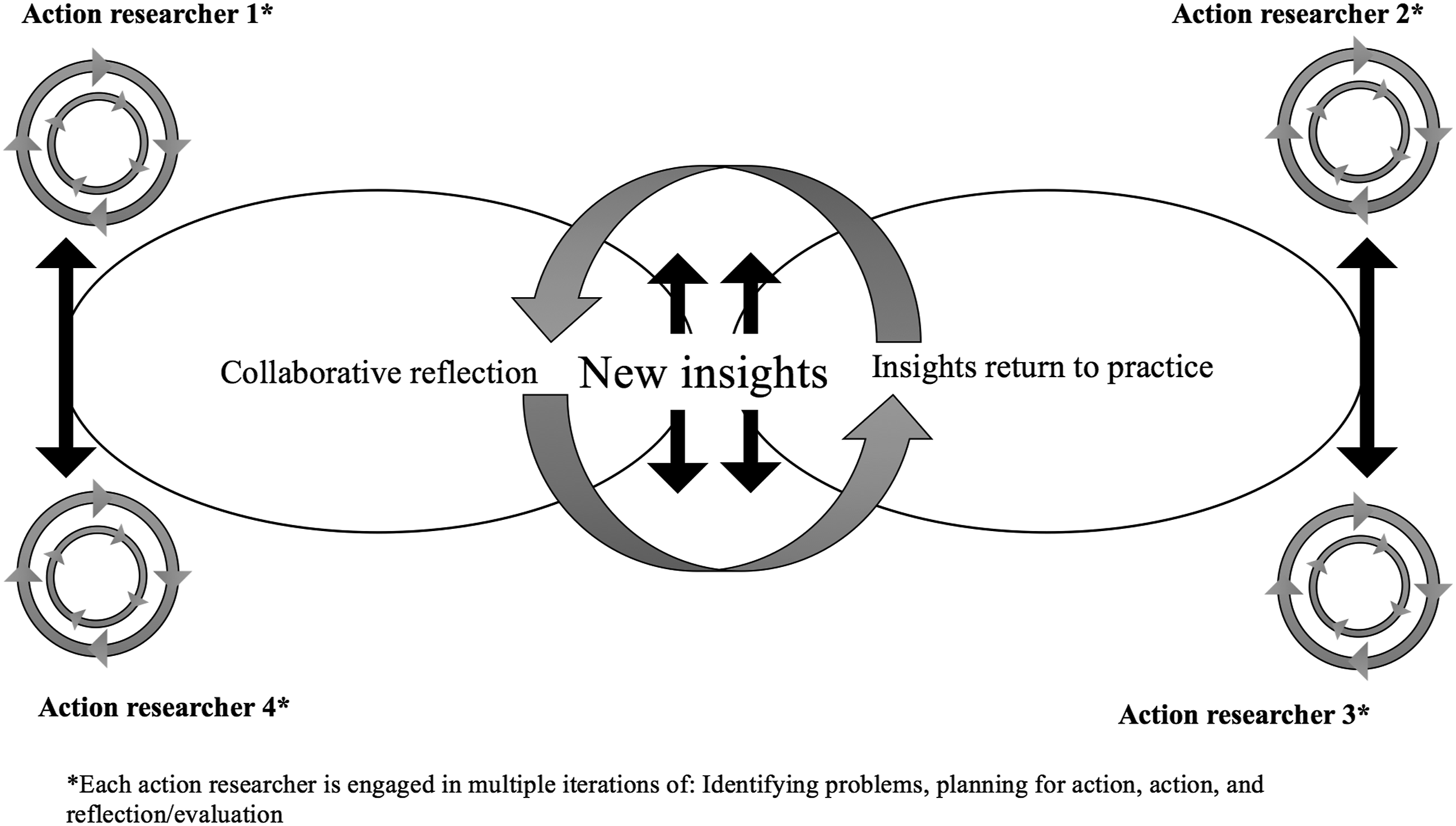
In this figure, we visualize the various collaborators reflecting together on distinct action research projects in order to reflect on areas of importance to them and to others. This kind of collaboration, if it has action-related impacts, meets the criteria for a form of action research and extends the systemic formation of networks of action researchers to make sustainable change (Burns, 2007). Therefore, podcasting when done in a collaborative manner can be action research. This broadens the epistemological horizons of action researchers, creating networks of collaborations between action researchers that also contribute to knowledge–a meta-level of reflection that happens when action researchers get together to discuss important issues within AR that is multi-perspective and multi-directional, as well as being direct, collaborative and shared with others.
Based on the definition of qualitative research mentioned above, podcasting would not inherently be considered qualitative action research. However, podcasting can use action research methodologies. Specific podcasts could be considered action research if there are certain components included. For example, if a podcast were to delve into interpretations and meaning-making qualities of human experience (Denzin & Lincoln, 2011) combined with action-reflection-action, then podcasts may be able to be considered an action research project. To push these ideas further, podcasting could serve as a means of generating findings about the experiences of individuals.
However, there is not necessarily a way to take the interviews, analyze them, draw conclusions and make arguments. Therefore, podcasting is not necessarily a methodology for doing qualitative research or action research as such. While qualitative researchers are often looking to push the limits and expand what counts as research, there is a lot of debate about the quality markers of qualitative research (Denzin et al., 2023). Suffice it to say that producing and hosting a podcast is not qualitative research in the same way it could be action research.
What Might Informative, Trustworthy, and Useful Podcasts Consist of for Action Research?
Now that we have argued podcasting can play an important role in the field of action research and, push the epistemological boundaries of the field, what makes for informative, trustworthy, and useful podcasting—especially considering the pitfalls we outlined above? As acknowledged throughout this article, there is still no well-developed system to fully integrate podcasting into the world of academia, particularly with respect to it being widely accepted as a form of empirical knowledge dissemination. Because of this, it may be time to build an understanding of how to create a system to recognize or acknowledge trustworthy, useful, and informative academic podcasts.
Suggesting what that system might look like is outside of the scope of this paper, but we believe this is an appropriate moment to start a conversation about how researchers in action research might build consensus on trustworthy podcasting. We see the following section as an invitation to start a multimodal dialogue about how to create communities of practice around podcasting in action research to ensure we all foster quality, useful, and productively mutually accountable work. In the spirit of collaboration and humility, the following set of ideas about what an academically oriented, research-based podcast could look like comes solely from our own experience as podcast hosts and our attempt to make our podcast as legitimate and trustworthy as possible. The following ideas are not a prescription, nor are these ideas suggestions for a system, but the start of a conversation.
The following ideas are guided by ethical and quality research guidelines from action research (Bradbury, 2015; Bradbury et al., 2020; Bradbury & Reason, 2006; Friedman et al., 2018; Levitan, 2019) and qualitative research (Denzin & Lincoln, 2011) such as equity in power dynamics, relationality, reflexivity, participation, multi-vocality, insights grounded in reflection on self- and others’ experiences, sharing ideas that are useful for addressing an issue, ensuring context is central to conclusions, improving an aspect of life, and/or raising the wellbeing of a group as well as individuals. Sharing practical and useful knowledge that can make real, felt, positive contributions for others is core to this orientation, as is holding all of these values firmly but lightly to keep the joy, risk-taking, discovery, insights, and innovations as the central theme of the work.
To follow the above quality and ethical guidelines, action research podcasters can hold each other productively mutually accountable by creating check-ins and reflection moments, building trust, fostering freedom and risk-taking, engaging in rounds of feedback, as well as creating opportunities for revision so that ideas are communicated clearly and thoughtfully. Specifically, we have four suggestions: (A) be intentional about what guests and research topics are engaged within a podcast episode, (B) ground the conversation in experience, research, and/or ongoing projects, (C) engage in transparency, truth-telling, and warm demander question-posing through preparation (Ware, 2006), and (D) incorporate iterative systems and moments for checks and balances.
As discussed above, we have found podcasting to be an ideal space to dive deeper into research, theories, and methods that already exist yet beg for further discussion. In this regard, inviting guests onto podcasts who have already, to some extent, been legitimized in the field through the pre-existing systems of checks and balances in academia allows for some immediate trustworthiness. Seasoned scholars, established and respected field practitioners, or authors of peer-reviewed publications all coming on to discuss topics within their area of expertise makes for an easy case. However, in alignment with the ethical guidelines above, emerging scholars, collaborators who are not action researchers, and other participants can also meaningfully contribute to action research knowledge by speaking about their expertise, which is why it is important to be intentional about the topics to engage in as well (A). Aligned with the principals of action research, everyone has some expertise based on their lived experiences, so framing and contextualizing those lived experiences in the choice of topics relevant to the guests, as well as recognizing the range and limitations of the guests’ and hosts’ experiences, can make for a useful and trustworthy podcast (B).
Preparations as hosts are also very important as we read guests’ work and think about the kinds of questions that we are going to ask guests in order to ensure that we can offer a space for them to share their experiential or research knowledge in the most transparent and compelling way possible. This includes asking guests what they would like to talk about, as well as what we would like to hear from them, reading their work, and asking them about who they are as well as what they have done—what they care about and are passionate about in their lives and work. We also ensure that we ask clarifying questions or offer counterpoints when something the guests say is confusing, may have multiple interpretations, or we disagree. We position ourselves as co-learners and co-participants or collaborative problem solvers when we speak about tricky topics. This kind of power-sharing and positioning for energized, informed and productive discussion allows for greater transparency and willingness to amend ideas and statements to clarify them and make them more precise (C). As hosts, we see it as our responsibility to do our own research and due diligence on any topic we will be discussing in order to bring a stance to the conversation that is informed and accurate.
In addition to being intentional about podcast guests and topics, grounding the topics in experience, and engaging in practices to foster transparency and collaborative problem solving, having iterative systems in place to fact-check and provide trustworthiness of content has been a major part of the Action Research Podcast process. For example, the Action Research Podcast has a production team that listens to the whole discussion after it has been recorded, checks major points, and incorporates citations when necessary. Once that process has been completed, the recording is sent back to the guest to get their approval before publication (D).
It is also worth addressing here that the action research podcast currently does not have a formal system for incorporating academic reviews, although we believe it should be a consideration. However, it may be tricky to incorporate educational reviews into the discussions of a podcast, given that the free-flowing, conversational nature of a podcast is part of the purpose and value of listening to it. Incorporating academic reviews may feel forced in this example. However, there is certainly a place for them in a structured situation. One example of this may be in a structured reflection post-podcast, where a primary purpose would be to incorporate academic reviews. Another example could be reviews of the podcast, like Gold’s (2023) review of the Action Research Podcast, which serves as a way to offer “Bonafide’s” to the podcast, similar to a book review, to give a form of public peer-review.
While we acknowledge these systems are not perfect or comprehensive, we believe they have helped us make the Action Research Podcast more trustworthy and build important processes to contribute to the field. Our conversation above lays out some of the characteristics of what this looks like—a thoughtful and prepared topic based on deep prior engagement, reflection, prior research and reading, as well as placing the interview in context. However, above and beyond these characteristics lays a foundational set of considerations with respect to publishing research-oriented podcasts that are informative, trustworthy, and useful.
As mentioned earlier, the inherently open-sourced nature of the Internet has enabled a world where any and everybody can be a self-professed expert. This is especially prevalent on social media sites such as Facebook and X (formerly known as Twitter), as well as any randomly published blog or website. We have seen the messages on these platforms, regardless of their level of veracity or oversight, permeate all facets of society, ranging from the way a social influencer influences a teenager’s sense of fashion, music, language, and overall behavior to engaging personalities that are able to influence entire political parties and their followers. Indeed, one could argue that the platform for publishing podcasts and the lack of oversight is not far removed, if removed at all, from the wild west of the Internet characterized by misinformation, fake news, and falsified individual identities and credentials purposefully designed to trick the masses and guide them towards an agenda.
Given the challenges with misinformation, we argue that under the right set of community practices amongst those in the scholarly community who support the tenets of action research and qualitative research, that research-oriented academic podcasts can separate itself from the chaos. In fact, we argue it is imperative to develop quality practices if scholarship is going to adapt to the times and immerse itself in the value and opportunity of new technologies for knowledge dissemination.
Conclusion and Areas for Further Research
In this article, we discussed academic podcasting’s place in action research. Podcasting offers an important contribution to action research because (1) it uses a medium of communication to share knowledge and experiences that are not easily written in articles and book chapters, (2) it creates opportunities for demystifying research processes, pushing the field further, expanding participation, and broadening and contextualizing theories, (3) it expands the epistemological edges of research and can even become an action research project and, (4) with collaborative community work, there can be processes in place that can make sure academic podcasting is trustworthy.
We also acknowledged the pitfalls of academic podcasting, primarily a lack of systematic checks and balances equivalent to the peer review processes that exist for verifying the trustworthiness, academic robustness, and empiricism of published journal articles and chapters that make up nearly the entire catalogue of accepted forms of knowledge dissemination amongst scholars. Similarly, we acknowledge the challenges that would come with trying to create a similar system as peer review, but specific to academic podcasts. We opened up a conversation that we hope others will join to start to build consensus around podcasting as an academic activity.
The opportunities and potentials that podcasts offer are too great for scholars to turn their backs on. Academic podcasts are innovative in nature, if anything, due to their inherent ability to dive deeper into important topics that are grounded in academia. Engagement with research driven by dialogue and critique offers otherwise unattainable insights regarding important research-oriented content. This is relevant to researchers, practitioners, scholars, and graduate students who would otherwise be forced into unproductive hours of searching through endless archives of not-always-meaningful articles.
Questions for further research include: How might we develop a system for having podcasts engage with other academic outputs that allows for cross-referencing with written research or for incorporating podcast content into academic citations and bibliographies? How might podcasting contribute to the development of future methodologies and the careers of emerging scholars? What methods could be developed to assess the impact and effectiveness of academic podcasts?
Finally, academic podcasting fits well into the action research cycle, but its relationship to action research is more complex than that. Action research is inherently about working collaboratively with a group or community to solve or address a challenge. Under the right circumstances and context, academic podcasts are a perfect segue toward innovative and adaptive knowledge dissemination and knowledge democracy. As a community, we can work towards addressing the challenge of ensuring that action research continues its expanding influence in the evolving world of academia.
Footnotes
Acknowledgements
We would like to thank Shikha Diwakar, Vanessa Gold, and Cory Legassic for their work on the podcast, as well as Ellen MacCannell for her editorial support. We would also like to thank the guest editors on this IRQR for their helpful feedback. While these individuals supported our work, any mistakes, omissions, or errors are our own.
Declaration of Conflicting Interests
The authors declared no potential conflicts of interest with respect to the research, authorship, and/or publication of this article.
Funding
The authors received no financial support for the research, authorship, and/or publication of this article.
