



Abstract
Our work is an exploration of three women’s post-doctoral encounters both within and outside of academia. We say “outside” because our collective encounters as post-doctoral scholars at major R1 institutions in the United States and Canada impacted not only the work we were able to produce within our roles, but it also began to impact our lives in both large and small ways outside of them. Our storied letter writing as artful inquiry offers an attempt to vent, to heal, through the spilling over of all once held so tightly within; Using our words as materials, our stories provoke and activate the imagining and (re)imagining of our individual and now collective journeys in academia and beyond.
We come to this article as three academic women spanning three different geopolitical contexts, connected through email letters and musings and laughter and grief in accompanying Zoom meetings, as we began to share (difficult and confronging) encounters as postdoctoral fellows. Saralyn and Shelly were at the same research institution with Saralyn witness to Shelly’s daily experience of humiliations and degradations as a qualitative researcher in a decidedly non-qualitative space. Kat and Saralyn had developed a relationship through a shared academic collective. We came together, not with the intention to write, but to create a space to share, to feel, and to emote together (Ahmed, 2021, 2023).
Our entanglement has no beginning and no end. Starting in the middle of the mess, our collective becoming is the result of our individual un∼re-becoming; a shared space of reckoning through time and space that became “iteratively reconfigured through each intra∼inter-action, thereby making it impossible to differentiate in any absolute sense between creation and renewal, beginning and returning, continuity and discontinuity, here and there, past and future” (Barad, 2007, p. xi). Modes and methods of mapping artful inquiry in this article come in the form of cartographic practices for knowledge production that maps differences between normalizing and alternative stories in locating constraining and disciplining, and empowering and affirmative politics of location (Barad, 2007; Braidotti, 2011, 2013; Dolphijn & van der Tuin, 2012; Hughes & Lury, 2013). For instance, constraining and disciplining politics of location existed through our gendering as women and through tendencies of experiential feeling-with the world deemed as “less than” objective, rational, and cognitive forms of knowing (Ahmed, 2023). Empowering and affirming politics of location existed through currency as White, western women holding (non)privileged (postdoctoral) positions in academia. Dwelling at the borders between our multiple subjectivities, mapping artful inquiry moved us from a static, stable, fixed, and rigid sense of (troubled) identities to becoming-otherwise through intra∼interactions within the affective and relational milieu. Using Ahmed’s (2021) work on complaint and spillage, we offer a collective and collaborative “breaking, of a container, a narrative, a turning of phrases” (p. 18) through collaborative letter writing against, and with, accompanying feelings, emotions, and states of un∼re-becoming that are mapped across a kinscape.
While the full range of letters are available via the QR code embedded in Figure 1, or via the link, https://qrco.de/bewc7F, in this article we travel our encounters with an exploding volcano and anger, with an iceberg and isolation, with the Never-Sea and invisibility, and with edge-places and courage. Our kinscape is a space to share where we stood together instead of apart and alone in often hostile, lonely spaces. It is a space where when we stood up and stood out; and yet our subjectivities were always imbued in the fluxes and flows of the ever-changing dynamic, shifting, and transforming relational space within discursive (social) and material (matter) worldings. Mapping artful inquiry through a kinscape. Art by Andrea Schmitz.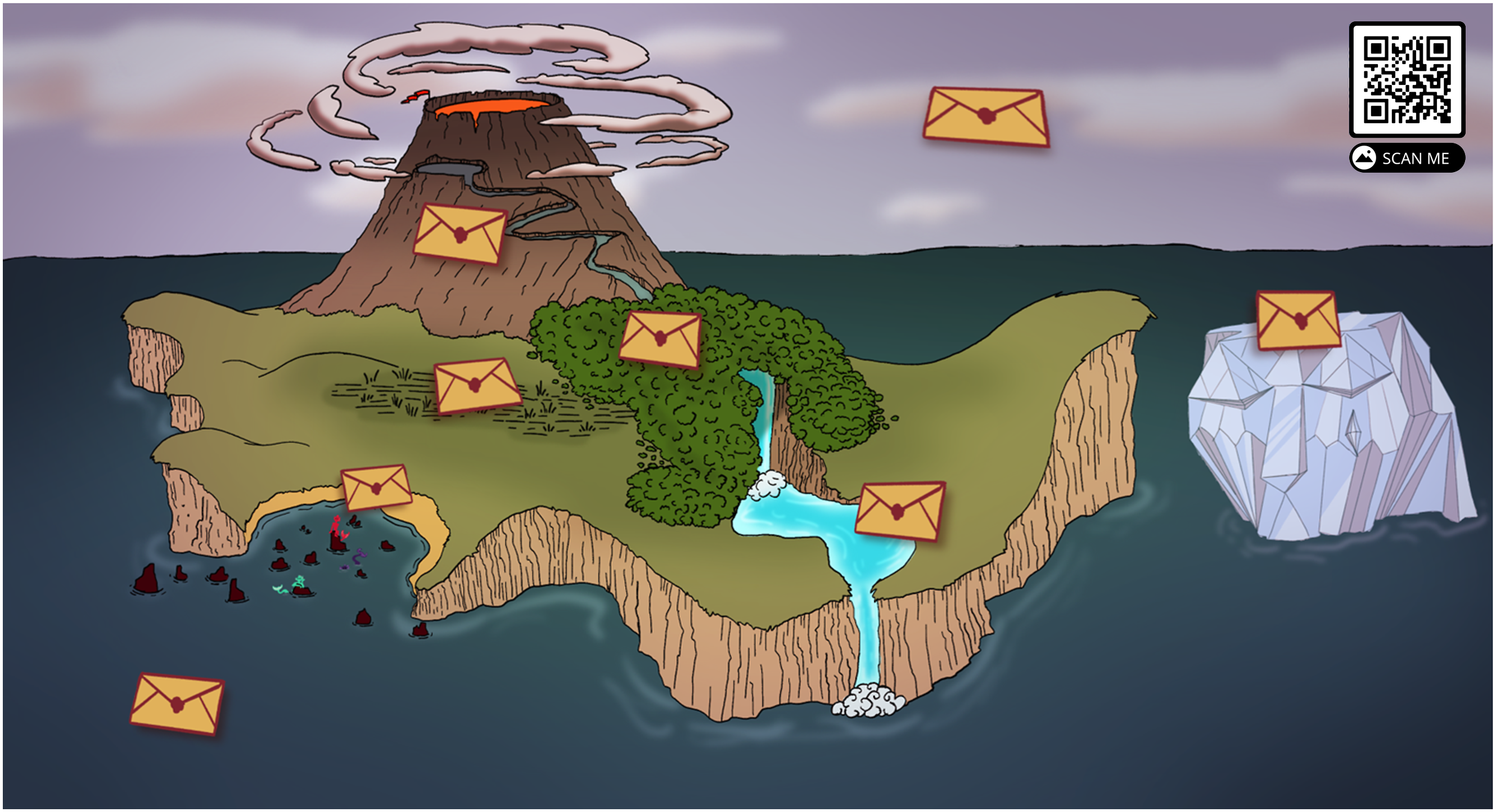
Dwelling With an Exploding Volcano and Anger
I will never forget the feeling of being ambushed in that virtual space – surrounded by faces of colleagues who silently watched and listened – while I was peppered with question after question after question by a man, the onslaught of words from this red faced, shouting, childman as he pointed his finger across states and screens and it is too much, too much, too much, so I speak up and out and assert myself and Saralyn then enters the conversation attempting to be that voice of reason with those who are unreasonable and as our project leaders enter the space—they feel tension and automatically ask what they missed—what happened—what is going on— And in that silence a snap of sorts—release from a constant pressure—as I minimize my screen, turn off my camera, and write a resignation email through tears, as the childman leaves the room because he has another engagement and gets away clean with zero accountability, and I wonder—did he win? Was this supposed to be a test? And he did, for months later I see the paper I worked on with my name no longer listed as an author—and he can have it. Yet. Still. “was it me?” “is it me?” “am I the problem?” “am I too sensitive?
The internalization of blame long after the fellowships were behind us—ghosts from times past (Jukes & Riley, 2024; Varga & Monreal, 2021), gone but not gone, readily accessible through something as simple as the ping of an electronic notification, a situation, a smell, a sound… (Figure 2). Dwelling-with an exploding volcano and anger.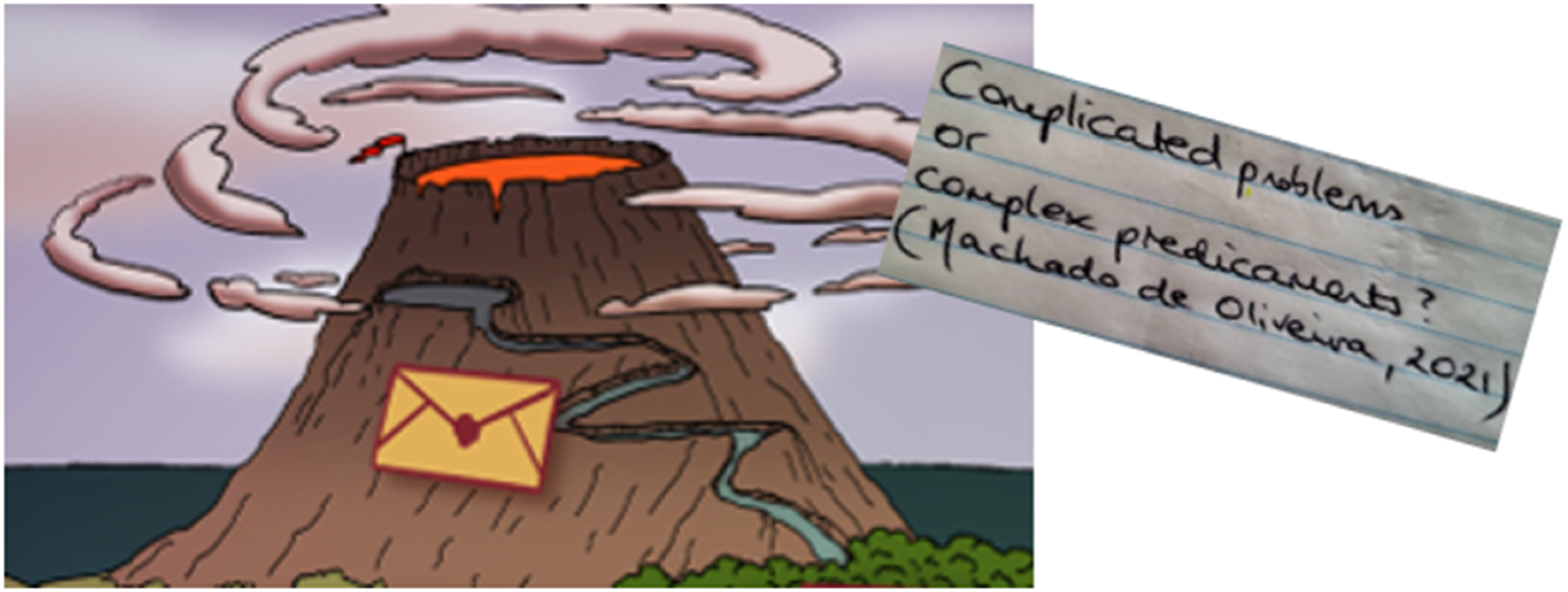
The anger at feeling deserted—alone on an island, navigating obstacles we often cannot see until we are knee-deep, immersed within them brought us here. Yet mapping artful inquiry through an experiential living-with kinscapes, our bodies are woven together (human and more-than human) within a dense network of family relations knotted in a certain time and place (Macdougall, 2011; Vowel, 2022). Our kinscape is born of shared (re)membering of the horrors, dangers, and hauntings in tumultuous and unwelcoming academic spaces. For Anna Tsing and colleagues (2017), “Every landscape is haunted by past ways of life” (p. 2); thus, kinscapes offer us a way to grapple with the ghosts of postdoctoral events through our shared responsibilities “to the ghosts of the past and the future” (Barad, 2017, p. 86). Kinscapes offer a material way of knowing ourselves that expand upon the social gaze that all too often burns holes in our spirits as academics. They help us to disrupt social discourses telling us we were somehow sub-human, as we sat muted amid academic exploitation. Offering hope and the embodied realization that we are a part of a larger network of being, belonging, and becoming, the kinscape presented through our artful inquiry shows an interplay of external and internal traps, wastelands, and desolate nothingness, all the while entangled with glimmers and shimmers of hope for different temporal horizons in academia. In the shimmer, there are always possibilities of becoming something other through the dynamic flux of changeability (Malone et al., 2020). In kinscapes, stories have agency. 1
In these shadowy spaces, our journey does not begin; but instead beckons us to (re)turn, to (re)story postdoctoral events through feminist-inspired and collaborative conversations in the form of letters as artful inquiry (Fernández et al., 2022; Samaras & Sell, 2013; Toledo et al., 2023). Our letter writing as artful inquiry seeks to (re)story unequal academic spaces and advance relational care ethics for epistemic justice, liberation, and wellness. As three White, western women immersed in the postdoctoral studies, these positions bring with them privileges that protected us from some of the worst ravages of the academy (Matias, 2020). Yet, they did not fully insulate us from the gender shrapnel that we encountered in our roles (Mayock, 2016).
Although we have all moved beyond our initial post-doctoral roles in terms of our careers—we still refer to ourselves as the “postdoc collaborative.” But we know that our identities as postdocs are not locked in time but finely etched shatterings that form un/re-becomings towards something new. As the pressure ruptures the weight we carry, our writings represent what Ahmed (2023) refers to as a “a killjoy rearrangement of the past bring[ing] us closer to the truth” (p. 141). Knitting a kinscape together as collective un∼re-becomings on paper and screen, our shared moments revealed identities unraveling; shivering and shaking and released into the world to be carried together through “the violence, the structure of it, the repetition, the pattern” (Ahmed, 2023, p. 141).
Our online meeting, our letter writing, our map creating, and our kin making all coalesced through shared and not yet shared encounters to reveal tensions between what we could share, what we were willing to share, and the implications of sharing within academic spaces. What would these creations do to us, for us, and within and beyond the academy? We rely on Butler-Kisber’s (2005) exploration of artful inquiry within qualitative research as one that “fosters risk-taking and increases vulnerability…producing sensitive interaction and a strong spirit of collaboration” (p. 215). But risk-taking is more nuanced than this, more subtle and yet also more overwhelming and forceful.
Our artful inquiry takes back what was taken from us and is our way of challenging power structures that once held sway, in moments that still hold sway over us, providing a “conspiratorial conversation through empathy, connections, altered perceptions and emotions, and disturbed equilibria” (Barone, 2008, p. 39, qtd. in Flint, 2020, p. 9). Thus, for the three of us, artful inquiry is shown through our narrative work to each other in the form of letter writing, but also in our analysis of how these works matter, to each other, to our collective, to the academy, as we sought to “represent the essence of a phenomenon at a certain point in time while raining the signature of the creator” (Butler-Kisber, 2002, p. 238) (Figure 3). Dwelling-with the tip of the iceberg and isolation (Anzaldúa & Keating, 2013).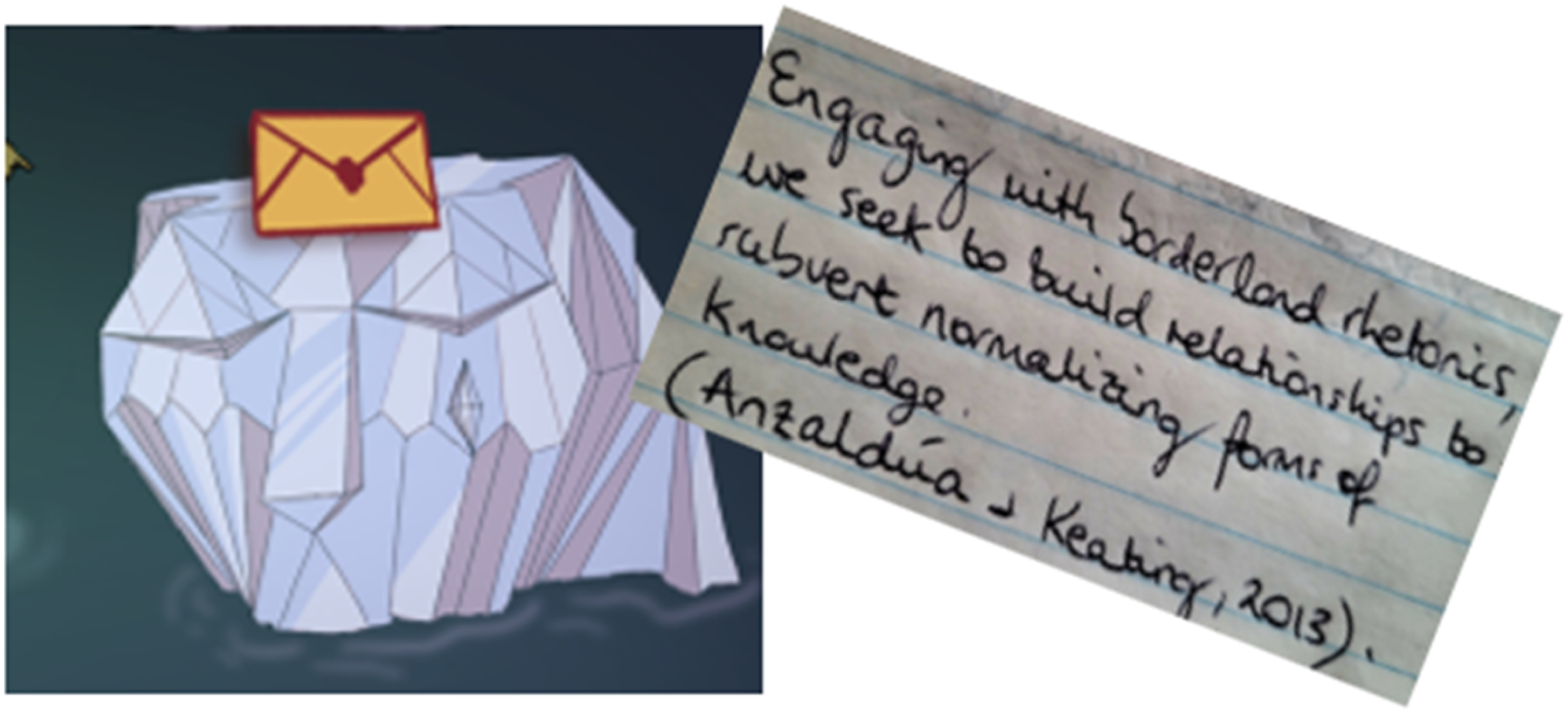
Dwelling-With the Tip of the Iceberg and Isolation
This whole time, I thought I was alone in experiencing a postdoc of horrors. So, your words while confronting, are equally comforting. To be honest, I still feel like a deer in headlights. It doesn’t seem possible to distill into words the kaleidoscope of raw emotions that spun like spider webs through eighteen months of hell. Even now that I am removed from the fray, I am still afraid to speak up. I am afraid of the recourse, or the pull back to their attention like an army rookie shaped and molded through fear of misstep. The mental warfare that I endured from those in power picked at me piece by piece until I was a mere shell of myself. Insides hollowed out, I tried to posture the outside of myself in more enduring ways. For one, I attended each meeting with a full face of make-up as a method to shield myself from the bullets sent my way. Yet at each meeting’s completion, the make-up I wore was as disheveled as my thinking and I would end up wasting countless minutes wiping away panda eyes from tears I could not stop. I was not well. Removing the make-up and coming clean, I settled into the realization that I was indeed a victim of abuse, gaslighting, and bullying in what should have been a space of learning and development. I knew the perils of academia from the stories from friends, but they seemed like some distant echo, not an embodied knowing. I should be stronger than this. Maybe I was too soft and too sensitive. I needed to grow thicker skin. But if I am asked to adapt, then I ask that the systems and structures that maintain the status quo of inequities, inequalities, and injustices are also held accountable. I vehemently acknowledge that my struggles with power as a White, western woman in a privileged space of academia are certainly not the same as the structural and systemic violence and injustices inflicted on Indigenous peoples, People of Color, or racialized peoples throughout the world. But I am desperately searching for more relational and sustainable ways of undertaking our work in the academy - with all walks of life that includes the more-than-human. Perhaps a course on accountability map-making 101 will do the trick.
As neoliberal reforms from the 20th century continue to proliferate and persist in higher education, its damage runs deep. Trapped in neoliberal spinning wheels, our thoughts, desires, and outputs were quantified, commodified, and objectified through an over-privileging of rationality, productivity, individualism, and independence (Price, 2011); all the while keeping us isolated and divided in a field of winners and losers in which we were not provided with the rules of the game. Although we know better than this. We know that we need to connect our heads, hearts, and hands with the places and spaces in which we work, research, and play. Our emotions bind us to how we inhabit the world with others; in relationship, we learn that we are all in this world together, but we are not one and the same (Braidotti, 2017). Our distinctions and differences matter (Barad, 2007).
Dwelling-With the Never-Sea (or Never Seen) and Invisibility
Our musings with the kinscape are where we collectively came together and learned it was okay to not gloss over where we had been—to avoid removing the not so pretty pieces of our individual and collective journeys. Rooted in shared solidarity, we no longer needed to pretend. As we rebelled against conformity and reveled in not being okay, we were able to release the need for a quick fix to solutions. For instance, we initially thought of marking the map with an “X” to proudly proclaim that we had healed and that we had found the elusive treasure. But there is no treasure on the other side of pain, confusion, and bewilderment. As we navigated entangled feelings of hurt and healing, bitterness and sweetness, despair and hope, there is no “X” to aspire to—no solid ground that can undo all that has come before. Instead, we converse with ghosts of the past in the here and now for a different tomorrow; all the while shivering, anxious, and afraid but at least questioning, always questioning… My mind refuses to dwell too long on this project. It skitters and dances across the surface like a water strider, moving as quickly as it can without sinking. I can’t write about this while sitting still. My bodymind is telling me that stasis means drowning. I will never sit back and let another woman be bullied by a man. Screw the risk. What use is the privilege we have if we don’t deploy it? Silence is complicity. I hate that our confidence in ourselves and our expertise read as challenging authority. Rather than being celebrated for our unique points of view, insights, and gifts, we were crushed under the heel of conformity. Punished for daring to speak up. Struck down for not bowing to others’ authority without question. I cannot abide that we were recruited for our interdisciplinary expertise, but our opinions and insights were read as unwelcomed critique. While interdisciplinary research is a stated goal of the academy (Sherman et al., 2021; Wickson et al., 2006), it is difficult to do in practice because of these hurdles we faced, included unstated workings of power. The three of us seem to be managing just fine, though. I find it amusing in a meta way that we all call each other postdocs. We are not anymore. We all escaped. The force of the role though, has such power that it still exerts a hold over us. It bends us into trauma-informed shapes. I’m going to go play video games…
Letters mapped with our kinscape seek to unclamp our constrained and disciplined voices as we endured postdocs of horrors, while also offering empowering and affirmative moments of healing through a spilling over of all that was once held so tightly within. For Ahmed (2021), “to be heard as complaining is not to be heard. To hear someone as complaining is an effective way of dismissing someone” (p. 14). We refuse to dismiss power dynamics at play but seek to bring the invisible into something that is noticeably absent (Ahenakew, 2016) (Figure 4). Dwelling-with the never-sea (or never seen) and invisibility.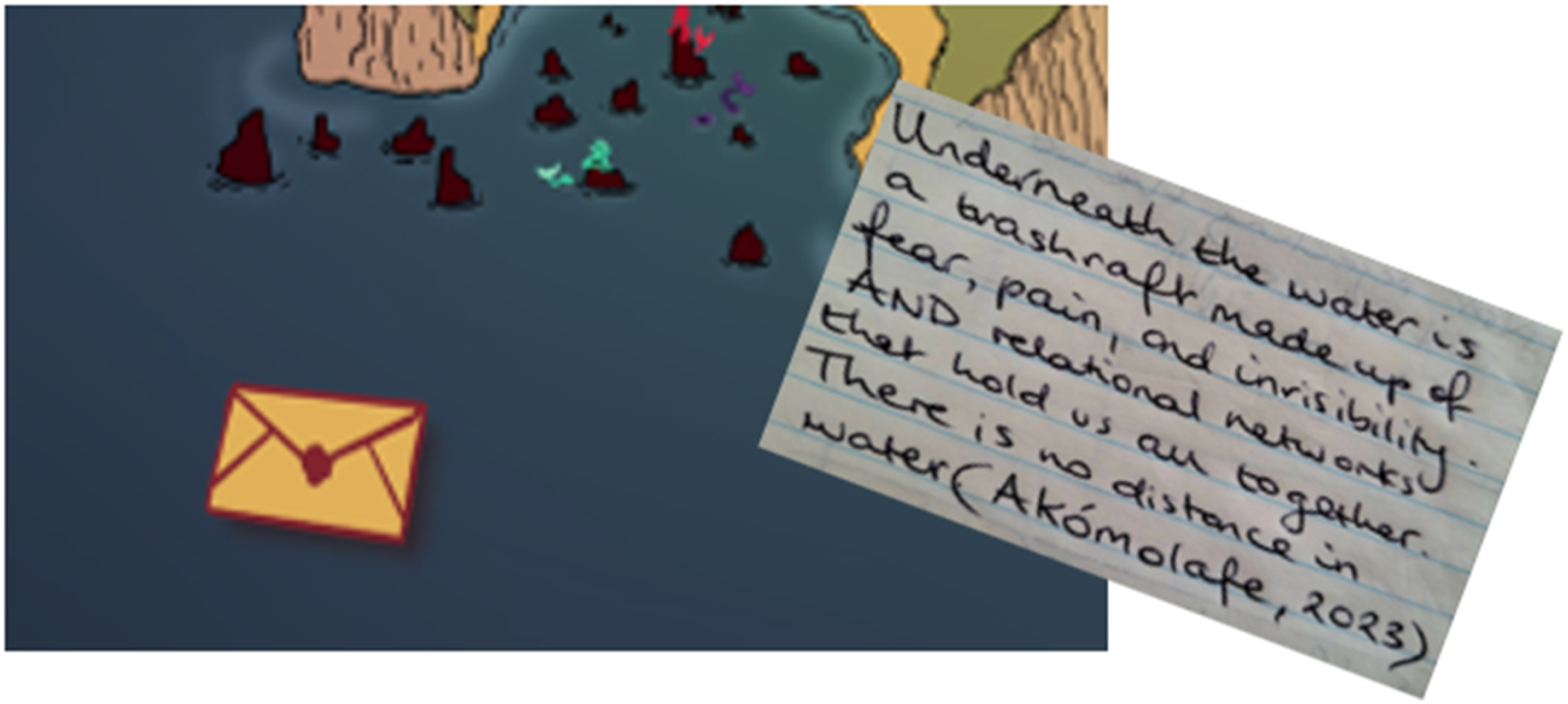
Dwelling-With Edge Places and Courage
Upon edge places, we come to appreciate the transitional nature of things. Existing in co-presence with each other, and with the kinscape, we are re-made time and time again through the in-between, creative, overlapping, and multiple territories of affecting and becoming. As precarious, messy, and complex knottings of more-than-human, queer worldings, the space between can be understood as connective rather than as separative; albeit highly political and richly confrontational (Haraway, 2004, 2008). Mapping artful inquiry upon edge places opens up new ways of being, becoming, and belonging-with the strong and limiting parts of ourselves and everything in between; with the ongoing tensions that persist in human relationships, despite our best efforts to heal in spaces that are all too often fraught with divisiveness; and with all earthly kin that do and do not need us humans. Mostly, mapping artful inquiry has helped us to not only listen but also deeply hear the ghosts of entangled past∼present∼future(s) to co-compose a more liveable cosmopolitics in the here and now for the future. I am not sure how I managed to find you both. Two others also trying to make their way within this already fast-paced, high pressure, often cutthroat world of academia. Two others who also experienced a postdoctoral experience that was everything… Until it took everything… Far more than I was ever willing to pay or be paid for. I think back to how very proud I was of this next step, this first step and how different a picture of this role was painted than what it became, what it was, almost from the minute the ink was dry on the contract. I was too scared to complain. I now look back and think that is part of what they knew from the beginning - another power play without my even realizing I was in the game. The normalization of all that felt inherently wrong, and I was left wondering, wanting, wandering - is it me? It got to where I cringed inwardly when my phone dinged with an incoming email. Where it became harder and harder to sit down at my computer and begin the work I was being paid for. Surveilled. Bullied. And Triggered. She literally asked if her words had “triggered me” - this woman who when I accepted the position I was so excited to work with, to learn from. I did not know what that word meant - what it entailed - but from then on that is what I lived. This state of anxiety waiting for another verbal accosting without explanation. And then there were two. A tag team of academics who trafficked in belittlement to my own bewilderment. And they knew they could. I met one of you through a screen - separated by miles and through screens - as you watched me get torn apart by a little man with a big ego to the point where you interjected at a risk to yourself. I was done that day. Returning to Ahmed who speaks of complaint as a feminist pedagogy - I snapped and in that snap - “a break became a connection” (p. 22) - to you to here Today. Ahmed continues about how a snap has another layer, a dimension - where it provides a space of shared communion - “how we hear what each other can hear” (p. 22). I am thankful to be in that space with both of you. I look forward to sharing and helping to shoulder the burdens and scars that remain. A fearsome threesome who found not peace from all that occurred before came before… As we waged battles not our own inwardly shrinking to the point where little remained. Finding safe spaces of solace after months of searching. Painful yet productive places that allowing for the reopening of wounds in order for healing to begin (Figure 5).
Weweretheproblemthereissomethingwrongwitheachofyoutoxictriggeredwhycanyounotjustcomplywithstructuresthatweretoxictrickyandharmfulwhymakewaveswhystandupwhyresist. Dwelling-with edges places and courage.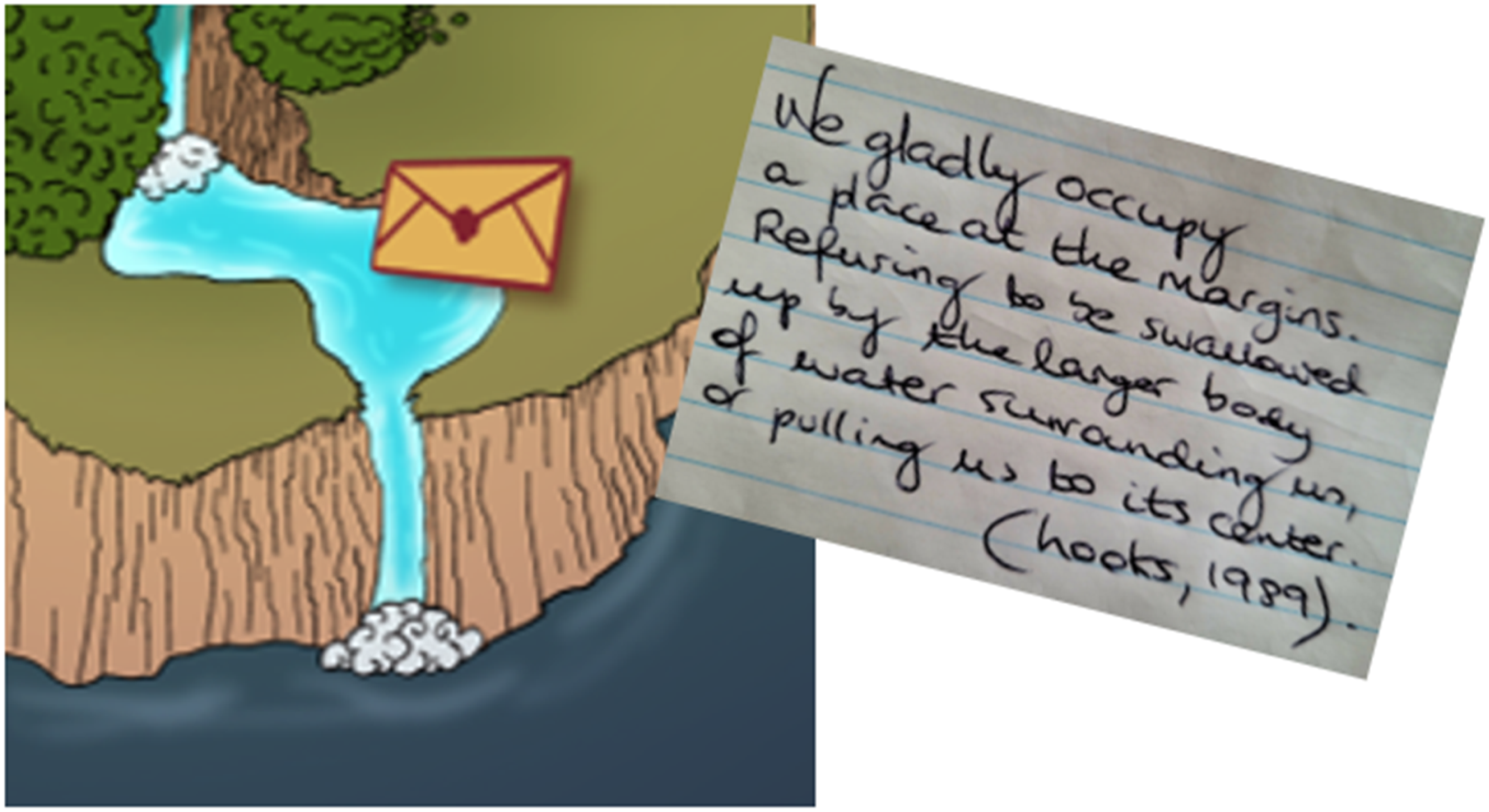
Living Amidst the Ruins
Living amidst the ruination of others (Rose, 2011), we follow Arendt (1961), to see the ruins as an opportunity for critical and creative inquiry into what has been laid bare, starting from the grim and unjust realities of our postdoctoral events. Our process moved from conversations to letter writing to mapmaking to kinscaping, as modes and methods of artful inquiry. (Re)visiting hauntings and hallowed academic spaces, we now embody the idea that academia can be a dangerous space complete with pitfalls, roadblocks, and the insistence of (anthropocentric, androcentric, and modernist/colonial) arrogance (Machado de Oliveira, 2021). As we continue to search for a sense of rootedness out of rootlessness, our kinscape is one of unbelonging where “unlikely kin are made” (Pearce, 2021, p. 93). Our story is thereby one of fracturing and a partial (re)connecting of “bodies, minds, and spirits within a world that is not merely a collection of objects but a communion of subjects” (van Horn, 2021, p. 3). As we work to (re)imagine what comes next, we follow Silverman (2023), Flint et al. (2021), and Armstrong et al. (2014) to stitch together affects, emotions, insights, refusals, and rage. Each time we (re)member and (re)tell a story, we open to new potentialities and possibilities for becoming something different; not good or bad, just different. Our mapping artful inquiry through a kinscape is for us an act of resistance and hope for more relational and sustainable ways of doing academia (Forte et al., 2024). Ghosts remain. Even if not visible. Ghosts can also be a shadow self that precedes and colors present and future encounters. But ghosts can be our friends if we allow them the opportunity to whisper tales of our vulnerabilities; if we allow them to interrupt who we were, are, and are becoming. While we took abuse, surveillance, diminishment in the presence of others, bullying, and blame, “We don’t have to take the blame, even when we are blamed” (Ahmed, 2023, p. 45). Yet moving away from the internalization of this blame through radical relationality and response-ability, we do need to create a space that allows for a reduction of the weight we carried; and thus, “charting our own [shared] path” and “lessening our sense of guilt or blame” (Ahmed, 2023, p. 45). To keep this story going, we ask you, dear reader, what letter you might write that speaks to your encounters with ghosts in academia—as a student, postdoctoral fellow, and academician, or something different?
Footnotes
Declaration of Conflicting Interests
The author(s) declared no potential conflicts of interest with respect to the research, authorship, and/or publication of this article.
Funding
The author(s) received no financial support for the research, authorship, and/or publication of this article.
