



Abstract
This article discusses difficulties and opportunities in working with/through/towards intersectionality, which we illustrate using work conducted during our interpretive workshop. Speaking from the perspective of emerging researchers in educational science and teacher education, we are united by our critical examination of research in and about relations of inequality, whereby intersectionality represents an important point of reference as a sensitizing concept for theory and practice. However, the concrete discussion and use of the concept of intersectionality raised many questions.
Keywords
This article discusses difficulties and opportunities in working with/through/towards intersectionality, which we illustrate using work conducted during our interpretive workshop. Speaking from the perspective of emerging researchers in educational science and teacher education, we are united by our critical examination of research in and about relations of inequality, whereby intersectionality represents an important point of reference as a sensitizing concept for theory and practice. However, the concrete discussion and use of the concept of intersectionality raised many questions for us that are also commonly debated in and outside academia; for example: How does the intersectionality framework contribute to a better understanding of processes of marginalization? How can we do research without constantly reproducing and, hence, reifying social categories? What exactly does an intersectional lens entail in processes of analysis? How can the concept of intersectionality in collective research processes be re-conceptualized in ways that provide opportunities to think and work towards transformative processes and increased justice?
We address these questions by interpreting our analytical process and making the interpretation workshop sessions and the research process therein our research object. We recorded our analytical sessions while interpreting an educational biography interview to focus on the process—the process of working and thinking through the opportunities for and barriers to trying to grasp the complexity of the different dimensions of discrimination. Accordingly, the interview interpretation sessions form the object of this article. A goal of this joint work that we carried out from an intersectional perspective was capturing opportunities for, but also barriers to, this mode of researching. Drawing on Kleinsasser (2000, in Day, 2002, p. 3), we were inspired by the notion that “when thinking becomes visible, it can be inspected, reviewed, held up for consideration” (ibid.).
This article (1) briefly discusses intersectionality before providing (2) an explanation of the interpretive workshops, which were our research context and performance. Next, (3) we describe the interpretive group activities and then (4) summarize and conclude by addressing the main strings of thought that can be drawn from this collective research process.
Intersectionality as a Sensitizing Concept
Intersectionality, which we use as a sensitizing concept (Strauss, 1987), cannot be grasped as a uniform entity; rather, it is a transdisciplinary project that must be understood in their respective, historically concrete relations (Riegel, 2010). It opens up one’s own view to both theoretically and analytically approach the complexity of social conditions and their effects on everyday life in a non-essentializing way. Intersectionality is an increasingly used concept that has been and is still subject to numerous scholarly negotiations and debates (Walgenbach, 2017; among others). However, looking at the history of intersectionality, it demonstrates that the concept’s origin is anything but a purely academic endeavor. Rather, it emerged through the struggles of anti-discrimination movements lead by Black women and queer people in the United States (Combahee River Collective, 2019; Crenshaw, 2019; Truth, 2019), which aspired to make visible and problematize how social movements typically only referred to one form of oppression and neglected others, which led to exclusionary outcomes and analytical gaps. Instead, intersectionality advocates for examining the relations of discrimination and difference through their interconnectedness and simultaneity (Chamakalayil & Riegel, 2019).
Intersectionality was coined as a concrete term in the mid-1980s in legal scholar Kimberlé Crenshaw’s key articles “Demarginalizing the Intersection of Race and Sex” (1989) and “Mapping the Margins” (1991). Crenshaw pointed out the simultaneity of different discrimination relationships and thus disrupted hegemonic legal discourse by urging people not to think in “one-way streets” (Crenshaw, 2019). Her aim was not merely to add up discrimination based on ascribed social categories, but to focus on their specificity. However, when the concept of intersectionality was adopted in European social science contexts, it was accompanied by problematic developments. On the one hand, theoretically reducing intersectionality to social categories (and thus focusing on the subject level) can be traced to where these categories were initially given relevance, which analytically neglects part of how power relations are determined. However, it is these power relations in which these categories are given relevance, reproduced and hierarchized in the first place (Gutiérrez-Rodríguez, 2011). On the other hand, the merits of the activist genesis also remained partly ignored or unmentioned, which promoted a renewed marginalization (Chamakalayil & Riegel, 2019; Hausotter & Ganz, 2020). Nevertheless, a widespread cross-disciplinary examination of intersectionality can be observed, whereby the question of how social categories and inequality relations are defined continues to grow in complexity (Chamakalayil & Riegel, 2019).
This article does not want to go into an in-depth discussion about how categories are defined or the relationship between intersectionality and social theory. Rather, it approaches intersectionality from an analytical perspective and, following Kathy Davis (2008), also acknowledges its openness and vagueness as an opportunity with room for potential. As an analytical perspective, intersectionality promotes thinking about structural connections, which helps to sharpen one’s view for structural as well as contingent and relational aspects (Knapp, 2011). As Donna Haraway (1985, p. 79) writes, “[s]ome differences are playful, some are poles of world historical systems of dominance. ‘Epistemology’ is about knowing the difference.” In our opinion Christine Riegel’s (2010) model incorporates this claim, hence our reference to her conceptualization of intersectionality. Her multi-level model accounts for both the interactions and entanglements of diverse power and inequality relations as well as their modes of action at different social levels (see Figure 1 below). Model by Riegel (2010, p. 72)—translated from German to English by Marlene Märker.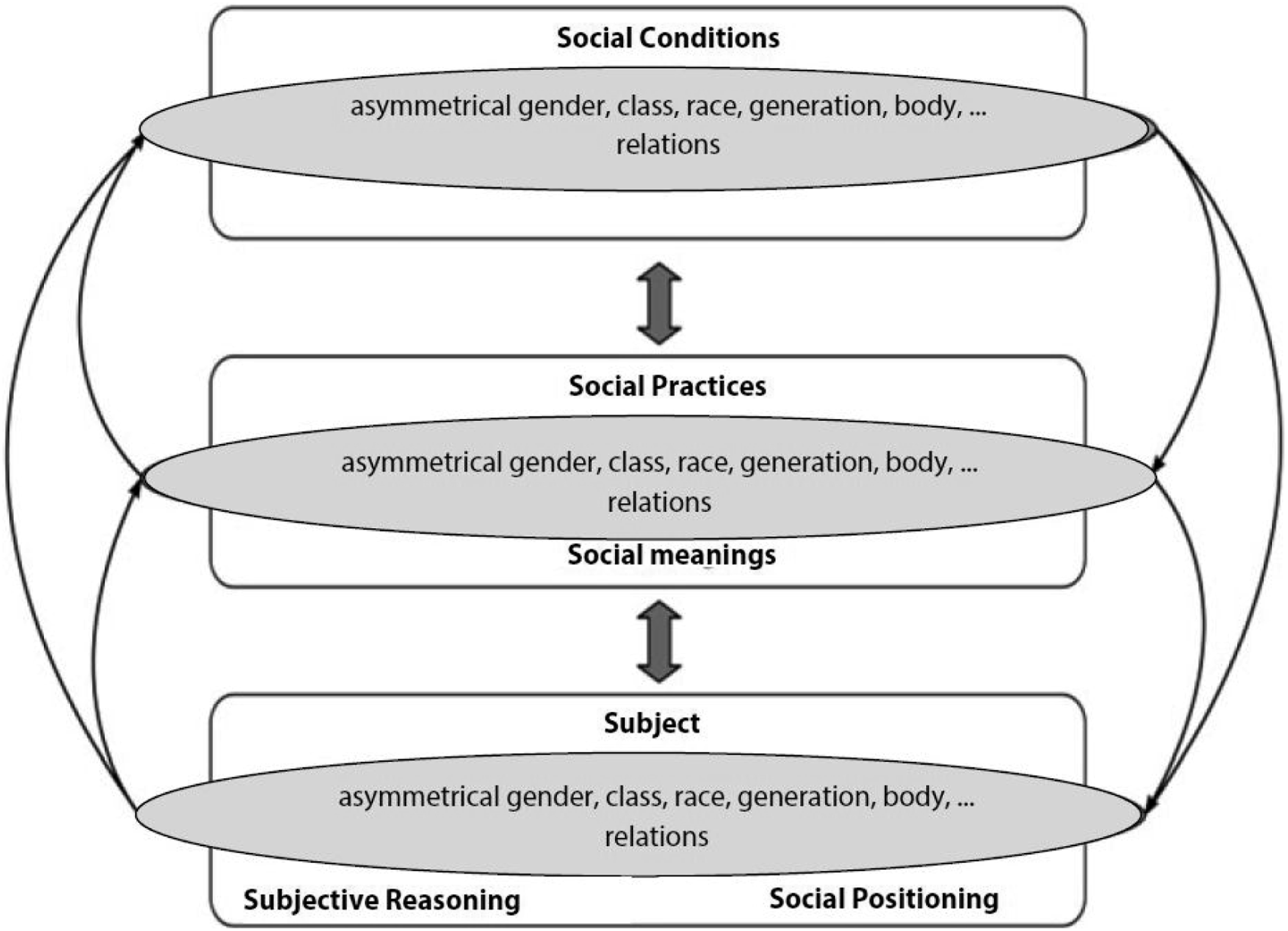
Riegel’s Model of Intersectional Analysis
Social conditions, social meanings and practices, and the subject level comprise the dimensions of the model’s intersectional analytical framework. However, these discrete levels are purely analytical, since they are dynamically intertwined within and with one another (Riegel, 2010, p. 71). Riegel explains the model and its features in more detail: The intersectional interaction of multiple inequalities is reflected at the social conditions level in political and legal regulations (e.g., right of residence, family, and labor law), but also how states, organizations, and institutions are organized. These regulate access to social resources via strands of difference that interact dynamically. In turn, social conditions are not independent of the social meanings level, which refer to socially prevailing norms, images, discourses, and representations. These are not only socially effective as structures of social relations, but they are also repeatedly taken up and reproduced in everyday practices. Furthermore, these levels have an inequality-structuring effect on subjects’ social positioning and thus on their life opportunities and their modes of action (whereby a person is not always on the socially privileged or disadvantaged side). Social positionings refer to the respective subjective space of action, whereby subjects themselves draw on socially existing categories as well as provide reason for their actions in reference to these power relations, thus contributing to their reproduction or working on resisting or changing them (Riegel, 2010, pp. 71–74).
Subjective reasoning does not necessarily mean that subjects are aware of their reasons for or against an action; in line with critical psychology, “reasoned” refers to the opposite of “conditioned” or determined (forthcoming Märker, 2024; Markard, 2010). Drawing on critical psychology insights, individual action can only be understood if social conditions and the social meanings and practices, as experienced by the individual—how the world is interpreted from a person’s social situation and intersectional position—are taken into account (Markard, 2010; Riegel, 2010). For empirical analysis, this means that all three levels must be considered in their dialectical interplay.
Riegel’s model further also provides heuristic questions, which help analyse the different intersectional levels: Which social categories and dominance relations become relevant (how)? How do these interact? How are these social differences and relations of inequality (situational, habitual, discursive and praxeological) produced and reproduced? What functions and what consequences does this have for the subjects involved and for the social order of the system? What possibilities are there to break through this reproduction process of inequality-structuring difference formation? (Riegel, 2010, p. 77; translation Märker)
Riegel’s model as well her heuristic questions served as the theoretical basis for approaching our empirical material (ibid.). Drawing on grounded theory (Strauss, 1987), we described intersectionality as a sensitizing concept, which helped balance being open to the empirics against necessary orienting perspectives when theorizing. To further describe the specific work mode of our group, the next section provides more general considerations of (biographical) reconstructive research and interpretation workshops.
Researching in Interpretation Workshops
We carried out our research in interpretation workshops, which were conducted according to Bettina Dausien (2019). This is a common mode of work in (biographical 1 ) reconstructive research; that is, coming together as a group of researchers 2 to work on the data material. Working in an interpretation group is not only helpful, but also a quality criterion (Dausien, 2019, p. 257). Interpretive research is a “practice of constructing meanings (theories, models, interpretations, theses, etc.)—namely, meanings that refer to meanings that are produced, handed down and transformed in the social context in which the respective researchers are interested” (Dausien, 2006, p. 197; translation Hackl). Alfred Schütz (1971, in Dausien, 2006, p. 197) calls this research mode “second-degree constructions,” while Dausien—in reference to Schütz—uses the term “re-construction” (Dausien, 2006, p. 197), which further expresses that the relation between the constructions of meaning (everyday world “text” and scientific interpretation as “second-degree text”) is neither arbitrary, nor a one-to-one-reproduction, nor a clear representation. We will return to this term of re-construction soon.
Interpretation workshops emerge when a group forms with the goal of achieving richer interpretations of something. As Jo Reichertz (2013) suggests, a more diverse interpretation group minimizes (theoretical) bias, while these groups promote discussions that develop different readings and lead to more profound perspectives. While interpretation workshops are common in qualitative research, interpretive sessions are less commonly the object of research themselves. In making the interpretive sessions the research object, we can speak of having added another degree of text—another circle of reflection or reconstruction. In other words, we expand the underlying notion of re-construction by arguably re-constructing what occurred when attempting to re-construct the meaning that is (re)constructed in narrating one’s story. To do so, we recorded these sessions and wrote memos after every session, which were used to trace considerations that came up in and after the interpretation sessions.
For a biographical–narrative interview with a student (given the pseudonym Melisa) and its processing during an interpretation workshop, we spent eight sessions together. We started each meeting by bringing up Riegel’s model (see above) and the according heuristic questions to approach the empirical material in an inquisitive manner. Next, we will briefly introduce Melisa since her biography and its specific data material shaped and were the basis of our interpretation and discussions.
Introduction: Melisa
Melisa Coskun (name anonymized) introduced herself in the narrative–biographical interview as follows: My name is Melisa Coskun, I’m 27 years old, I was born in Vienna, born Viennese, and my migration background
3
is Turkish. My parents come from Turkey and are just workers, guest workers,
4
I can say, yes, and I am just an educational climber.
Melisa’s parents moved to Austria before her birth because her father came to work there. Both parents had to forego further education after their compulsory schooling. However, they wanted their four children (Melisa has an older sister, a younger brother, and a younger sister) to gain access to higher education and have undertaken many efforts to support their children achieve this. However, Melisa’s narration also circled around language barriers, discrimination experiences, and a lack of information that led to longer, less direct, and painful routes to university—nevertheless, she managed to reach university; she fought and struggled her way through with the help of family and friends. Half-way through her bachelor’s studies, she narrated her life story to one of this paper’s authors.
Working on the Case—Possibilities and Restrictions
Because our article focuses on the process rather than the concrete interpretation, 5 the following section reflects upon difficulties and opportunities that emerged during the research process. Throughout the process, questions arose about intersectionality in life stories. One concerned categories and intersectionality in language: How do we use categories and how can we find intersectionality-adequate language? Categories are ambivalent: They seem helpful, painful, misleading, solidarising, restrictive, enabling, etc.—often even several of these at the same time. One interpretation group member asked: “How can complexity be understood if there are no words that allow for precise naming, or is it precisely this ‘not precise naming’ that does justice to complexity; would I then have to describe more and is describing then analyzing?” (Memo P3). Another question was: “How do we approach the life story in order to be able to make the implicit more understandable—without ‘putting in’ or ‘putting over’ our own perspective?” (Memo P3).
Lines of difference and the accompanying de/privileges are not always directly visible (Mohseni et al., 2018). In that regard, we reflected on Riegel’s questions about the interaction and how and why social categories become relevant, and saw this as an opportunity for interpreting and reflecting upon intersectional relationships (and their visibility) on various levels. However, the doubt and task remained: “Don’t we already have an image of Melisa and shouldn’t we critically question it … over and over again?” (Memo P3).
Intersectional interweaving is difficult to directly grasp in language. We, as interpreters, lacked the words even if we searched for them. This could also be difficult for the narrator (in the biographical interview)—and even more so while narrating, as they try to keep the narration flowing—because there are few terms or sentences that they can use to directly name intersectional discrimination or barriers. Much more we found expressions of feelings in intersectional positions and narratives that showed the underlying interconnectedness. One visible example was when Melisa spoke about how her parents could not attend her school to speak with the teachers if she had problems, since her father had to work long hours and her mother could not confidently partake in German-language conversations in such a setting. The narration of Melisa’s life story and educational pathway showed traces—at least—of race, class, and gender positioning and their intersection; however, there was no one term for her intersectional experience. The richer the narration, the better we can grasp the intersectionality in its interpretation and understand the meaning sometimes best through the emotions when they are included in the narration.
This format also made the words that pointed to intersectionality become a bit more imaginable and more recognizable for us during the interpretation. Biographical research uses the German term Erfahrungsaufschichtung as a concept (Dausien, 1996, p. 105), which translates to “experience layering or the structuring of experience.” 6 This can be used to also understand intersectionality when working with biographies as layered and structuring experience over time. The term refers to the need to trace the layering and processing of actions and events in life stories in the autobiographical retrospective. In the biographical paradigm, processuality is considered a layering of experiences in the biographical time horizon where multiple overlays and refractions are built in: Refractions linked with the distinction between the experience, memory, and narrative aspects, but also with how life story and history are intertwined. This work on refractions is guided by the methodology of biographical–narrative research and specifically by Riegel’s model (see above), where connecting the levels further detail the interweaving of life story and history. Linking different elements is also of particular interest from an identity perspective. In other words, how a person connects (via the subjective meanings level, as described in Riegel’s model) their experiences to present their biography, thereby making it their story. (Dausien, 1996) Analyzing the identity aspect could well be designed as an intersectionality analysis by being able to use all the “tools” for capturing complexity that biographical research offers (regarding the layering of experience and the processes of becoming) and the work on the societal related to the subjective dimension. Hence, Riegel’s model offers a lens on linking the dimensions, while Dausien’s emphasis on the layering of experience provides a reminder to not overlook the processing in time and the relationality of experiences.
The intersectional analysis questions unveiled a liveliness and concreteness that could reflect a special opportunity for working with intersectional frameworks on biographical narratives in workshops. The complexity behind this work mode helped move away from additive views of inequality and discrimination dimensions. Instead, it offered the possibility to fill, challenge, and rework theory with life—or, in other words, to ground theory. Additionally, we thought about our own feelings that arose during the interpretation workshops and their possible role in grasping phenomena: I have the feeling that a connection to the interviewee is slowly building up or that something is condensing here? [...] Perhaps that is also a central component, to be moved, to be touched and thus to recognise certain implicit things (Memo P3).
Hence, we began at the reality of a person’s life, but nevertheless went beyond this; we theorized without the emerging theory being a detached theory. Therein, we observed a reference to Antonio Gramsci’s living philology (1992, p. 864): He calls for no more science of “large numbers” according to hegemonic interests, but instead theorizing in the concrete case in solidarity with the dominated—or moving from a passivating to an activating science. Consequently, such a research mode also holds an emancipatory potential when the research process and its lively, narrative filling better touch us and can thus initiate processes of change in each of us—and thus possibly contribute to better understanding and theorizing. It is a process that can never be completed because the world is both too complex and always in the process of becoming.
Doing Group
Regarding the complexity of intersectional discrimination and our entanglement with/through/towards the given interview, we started to feel and to form a connection to Melisa while simultaneously forming a group ourselves. We identified two moments of a process at work, which could only be separated analytically; the first where we consider an “articulation,” and the second, “group dynamics.”
First, we read Melisa’s interview as a group and attempted to understand these sequences. This initiated a process within us of connecting with the narration. Based on our practical experiences and our attempts to theoretically understand our experiences, we were able to articulate some of Melisa’s stated experiences; for example, after Melisa shared the difficulties she was facing with us about when she first started school, one colleague expressed to the group: “I know that when we read it together for the first time, the passage touched me very much and I had tears in my eyes” (Memo P3).
The German language allows for choosing between calling this Einfühlung (empathy) or Mitgefühl (sympathy). While Einfühlung means something like “recognising someone’s feelings,” Mitgefühl means more to “feel-with someone.” This empathic process quickly provoked us to feel a “desire to form killjoy-solidarity” (Memo P2; with reference to Ahmed, 2017) as one of us stated. This Mitgefühl, and perhaps our own ideological mindset, formed something like attention horizon [Aufmerksamkeitshorizont, as Georg Lukács (1984, p. 352) calls it]. The narrated content is placed in one’s own (understanding of the) continuum of experience and is also imperceptibly rearranged. For example, when Melisa narrated her experiences and spoke about how racism and class had laid a biographical track for her in her educational biography with bricked walls (Ahmed, 2017), one group member was reminded of similar tracked and lined experiences from his own educational biography. However, this was not rooted in racism, but his ascribed positioning based on class. We drew comparisons with other research findings and theories as well as our own experiences with varying degrees of similarity to make the experiences narrated conceivable to us. In doing so, the need for solidarity and partisanship emerged in the group, as noted in one memo: There needs to be a search for solidarity and partisanship (in everyday life, political activity, as well as in science) and in doing so, however, it is necessary not to indulge too much in an equalising phantasm of an “us.” I see this desire (...) to strive for everyone to reflect on a common interest. That corresponds to my interest? (Memo P2).
Over time, it was neither sufficient to generate knowledge alone, nor to understand meaning or observe. We developed a sense of unease regarding—among others—the contemplative research setting, positionalities, the question of knowledge production, and the question of what happened to the emancipatory epistemological interest of the social sciences?
As noted above, such a perspective demands a very heterogeneous interpretation group (Reichertz, 2013, p. 12), which can expand the awareness horizon. At the same time, we observed how—including in our setting—groups form something like a group opinion (Mangold, 1960; Pollock, 1955). The formation of this group opinion was a dynamic process itself in addition to the process of articulation—the second moment of our doing group process. This group opinion was constituted with various power relations within the group, like information, sexism, and classism. Who dared to speak? What was said out loud and who has the last word?
For example, we discussed “Questions of recognition and consensus. What is not discussed because there is a feeling that we want to create a productive atmosphere together. Avoiding dissent/conflict” (Memo P3). Although “we listen[ed] to each other and connect to each other’s thoughts” (Memo P1), the group dynamics caused us to follow certain paths, while we abandoned others. In sum, this created a group dynamic that eventually became the “creator of the work” (Memo P1). The group dynamic partly solidified into a group consensus and made conflicting readings more difficult to articulate.
Consequently, the group spoke more in this zone of connected experiences and sense-making—or a “broken intra-action,” as defined by Karen Barad (2007) in their book “Meeting the Universe Halfway.” They suggest: The neologism “intra-action” signifies the mutual constitution of entangled agencies. That is, in contrast to the usual “interaction” which assumes that there are separate individual agencies that precede their interaction, the notion of intra-action recognizes that distinct agencies do not precede, but rather emerge through, their intra-action. It is important to note that the “distinct” agencies are only distinct in a relational, not an absolute, sense, that is, agencies are only distinct in relation to their mutual entanglement; they don’t exist as individual elements. (Barad, 2007, p. 33)
Our connecting with Melisa entangled our subject–object relationship, which made us secondarily become our own object. That allowed us to follow the traces of power right into our own selves (cf. Foucault, 2007, cited in Froebus, 2021, p. 87). Besides observing our own research practices, the Melisa-in-us directed the attention horizon to our own education biographies. However, the intra-action was broken in this case: While members of the interpretation group were actively engaging and consciously forming the group dynamic, Melisa’s agency was only present as objectified text; as actant not actress (Latour, 1996). By not being present, Melisa could not reflect on the dynamics of the intra-actions interpreting her (and our) educational biography.
Thus, by drawing on Himani Bannerji, these processes—like us—are “always and at once—there all together” (Bannerji, 1995, p. 17). First, individuals articulate their experiences (of everyday life and working with theory) with the stated experiences of the data. This articulation forms an intra-action. Second, this intra-action helps form an activity that constitutes a group dynamic, which further co-constitutes what is allowed to be said and therefore what articulations of experiences are discussable.
Conclusion
Intersectionality as a sensitizing concept enables the continuous, critical reflection on one’s own role and involvement in the research process as well as possible omissions; narrowing or one-sidedness; making those issues the object of analysis, which is relevant for the work carried out in research workshops (Riegel, 2016). It is important to stay in the simultaneity of focusing and complexity: An interpretation process and its subsequent writing process cannot do without “simplifying and freezing […] the living practice” (Schneider, 2017, p. 239); for example, when analytically dissecting an interview passage. Therefore, the task when aiming for a living theory is to always regain sight of the complexity again. To do so, the intersectional approach provides orienting guidelines and raises unsettling questions for own practices and research, which would be better worked with, through and towards rather than neglected.
When working with interviews, we found it beneficial to make the work with or in interpretation workshops visible as part of the research. In that regard, an intersectional perspective can open up awareness horizons and thereby allow for re-articulating own experiences in theorizing. Therefore, our joint work demonstrates that even when members of research teams do not share the same experiences or understandings thereof, working with these different experiences and perspectives allows us to think theory livelier. Narrated experiences (in biographical research) resonated within us and came alive in a (broken) intra-active way. Thus, we worked with our own situated knowledges and re-worked the prospects of doing research in this manner.
Nevertheless, questions around solidarity arose. While our memos showed how we repeatedly “wrestle[d] with questions of purpose,” as María Elena Torre described in a conversation with us, we felt a desire to form killjoy-solidarity (Ahmed, 2017)—which comes with its own difficulties surrounding forming such allyships in interwoven power and inequality relations. By trying to challenge and widen existing boundaries we aimed to transform and democratize research and academia. Rather than representative notions of politics or representative “democracy,” we refer to democratization as developing “solidarische Beziehungsweisen” (Adamczak, 2017), a concept which translates to “solidarity relations” or “solidary ways of relating.”
On the way to developing livelier theory and solidarity relations, interpretation workshops hold potential. For example, when discussing various forms of oppression and connecting these experiences to those of different persons with different positionings in the social reality, we can transcend the isolated form of individualized oppression. We may notice that our experiences—though not entirely the same—share moments of sameness, which may help expand the scope for personal action and also support discussing collective strategies to overcome shared, different experiences of oppression. Nevertheless, interpretation workshops are limited in their ability to establish solidary ways of relations because the person, whose experiences are interpreted, is usually just given as narrated text. This could be overcome by opening up the interpretation workshop to the interviewed person, as similarly proposed by collective memory work (Haug, 2000). The method developed in a group around Frigga Haug (2000) and aimed for a research process that widens the participant’s capacity to act, where they each write data and collectively analyze it. Collective Memory Work is inspired by Gramsci’s (1991–2002) “living philology” and his perspective on hegemony. Interweaving methodology and theory in a “filologia vivente,” that is, living philology, arguably needs a counter-hegemonic stance in research. A counter-hegemonic stance not only influences which knowledge we produce, but also which research relationships and relations we seek and form. We see a huge need to precisely reflect upon these entanglements and solidary ways of relating specific to research on inequality in unequal power relations. Again, this links to Gramsci (1991–2002) and his counter-hegemonic perspective of understanding all humans as philosophers: Following his claim, we need people’s whole wisdom 7 for a better, freer world. Accordingly, we must acknowledge the significant problem that only a very small group has access to the means necessary for developing and doing research within the hegemonic knowledge production of academia. Addressing this problem and searching for a more collaborative and inclusive way of doing critical interpretive research will allow for (building) collective self-understanding. This can help generate non-objectifying/passivating knowledges that have practical connections, through which the expansion of individual and collective agency can be achieved (Haug, 2000; Osterkamp, 2008).
Footnotes
Acknowledgments
We would like to thank the peer reviewers for their helpful comments, Veronika Wöhrer for her valuable feedback and Leora Courtney-Wolfman for formal corrections. Also we want to thank Dominik Schmitz and Winnie Wendelin for their feedback to former versions of this text.
Authors Contribution
The project and the writing of this article is the result of a joint effort in which all authors contributed equally as first authors.
Declaration of Conflicting Interests
The author(s) declared no potential conflicts of interest with respect to the research, authorship, and/or publication of this article.
Funding
The author(s) received no financial support for the research, authorship, and/or publication of this article.
