



Abstract
This article reflects upon initial teacher education programme’s employment of reflection. The article argues that the orginary ground of educational reflection, dominated by theorists such as Dewey and Schon, has been colonised by a form of ‘Total Reflection’ that is conceptualised and manufactured within the Teacher Standards and its associated discourse. Through employment of the concept of Abbau, the work of Borges and mirror theory, the article reveals how student teachers are not enabled to be reflective but instead are created as the celebrated automata whose professional image is shrouded, codified and solidified by a Master Weaving machine. The article suggests that if educational reflection is to become useful in teacher development, then it must return to its past incarnations.
Dream tigers I, who have felt the horror of mirrors Not only in front of the impenetrable crystal Where there ends and begins, uninhabitable, An impossible space of reflections… But of gazing even on water that mimics The other blue in its depth of sky, That at times gleams back the illusory flight Of the inverted bird, or that ripples, And in front of the silent surface Of subtle ebony whose polish shows Like a repeating dream the white Of something marble or something rose, Today at the tip of so many and perplexing Wandering ears under the varying moon, I ask myself what whim of fate Made me so fearful of a glancing mirror. Mirrors in metal, and the masked Mirror of mahogany that in its mist Of a red twilight hazes The face that is gazed on as it gazes, I see them as infinite, elemental Executors of an ancient pact, To multiply the world like the act Of begetting. Sleepless. Bringing doom. They prolong this hollow, unstable world; In their dizzying spider’s-web; Sometimes in the afternoon they are blurred By the breath of a man who is not dead. The crystal spies on us. If within the four Walls of a bedroom a mirror stares, I am no longer alone. There is someone there. In the dawn reflections mutely stage a show. Everything happens and nothing is recorded In these rooms of the looking glass, Where, magicked into rabbis, we Now read the books from right to left. Claudius, king of an afternoon, a dreaming king, Did not feel it a dream until that day When an actor shewed the world his crime In a tableau, silently in mime. It is strange to dream, and to have mirrors Where the commonplace, worn-out repertory Of every day may include the illusory Profound globe that reflections scheme. God (I keep thinking) has taken pains To design that ungraspable architecture Reared by every dawn from the gleam Of a mirror, by darkness from a dream. God has created nighttime, which he arms With dreams, and mirrors, to make clear To man he is a reflection and a mere Vanity. Therefore these alarms. Jorge Luis Borges- Mirrors
Introduction
‘…They prolong this hollow, unstable world. In their dizzying spider’s-web. Profound globe that reflections scheme.…’
It would appear that since the 1980s, reflection, whereby One analyses One’s own performance by bringing up an inner mirror (Garfield, 2016), has become embedded in teacher education programmes (Beauchamp, 2015; Moxnes & Osgood, 2018). To some, reflection is regarded as valuable to professional practice (Van Beverena et al., 2018). This is because it is a pedagogical tool which ‘sustains responsive instructional practice’ (Etscheidt et al., 2012, p. 7), one that is crucial to teachers ‘analysing their own practice’ (Van Beverena et al., 2018, p. 46) and is a process that has been ‘shown’ to ‘contribute to excellence in teaching and improved educational outcomes for all children’ (The State of Queensland, 2006, p. 2). Thus, we are told that reflection is to be observed as an ‘outstanding model of teacher education’ (Sellars, 2012, p. 1398). For others though, it is a complex concept (Ghaye, 2007), which lacks supporting evidence, has numerous interpretations, definitions and criticisms (Beauchamp, 2015; Scales, 2008). It is a concept which has done more harm than good (Russell, 2013) and has become nothing more than a ‘slogan system with little clarity or adherence to its original aim’ (Beauchamp, 2015, p. 127).
Despite such criticisms, student teachers in England must engage in reflective practice if they are to meet the National Teaching Standards (Scales, 2008). Within such standards the student teacher has to ‘reflect systematically on the effectiveness of lessons and approaches to teaching’ (Deapartment of Education (DoE), 2011, p. 11). Furthermore, the Initial Teacher Training Framework, Standard Eight, relates to ‘professional behaviours’, detailing that student teachers must ‘[Reflect] on progress made, recognising strengths and weaknesses and identifying next steps for further improvement’ (Department of Eduaction (DoE), 2019, p. 29). It is clear, then, that the promotion of reflective practice is viewed as an ‘essential mission and essential component of [teacher] preparation’ (Etscheidt et al., 2012, p. 7). This ‘essential mission’ is not confined to education either and it is important to note here that reflection is a common concept across many professions (Beauchamp, 2015). Indeed, the literature base denotes that it is ‘widely accepted in health professions, such as medicine, nursing, midwifes and professions such as social work …’ (Van Beverena et al., 2018, p. 11).
In spite of such commonality of mission across the professions, there remains a problem in that, the term reflection and its associated concepts of ‘reflective practice/ teaching’, ‘reflexivity’, ‘reflection in practice’, ‘reflection on practice’, ‘critical reflection’, ‘the reflective teacher’ and ‘reflexive awareness’ are not that easy to differentiate nor to understand. Like Ottesen (2007, p. 37), I find that it ‘makes perfect sense to ask what this reflection thing is about’. ‘….The crystal spies on us . ... ‘
In this article, by utilising the concept of Abbau, reflection will be reduced to its history, its definitions and its current employments within the ‘tradition bound’ context of education (Moran, 1994, p. 175). The article seeks to reduce, dismantle and perhaps destruct (Abbau) current reflection idealisations and aims to bring into focus reflection’s originary meaning by releasing it from within the sedimented interpreted experiences of the Teacher Standards, the ITT Framework and teacher preparation programmes (Moran, 1994). Within such a tradition bound context, it appears, a form of ‘Total Reflection’, such as that in Borges’ poem above, is employed as checkpoint to ‘intensified surveillance’ where the ‘body must arrive, present itself for inspection and move only according to the motion and speed required by the [educational] machine’ (Butler & Athanasiou, 2013, p. 17). Upon such inspecting surfaces, Borges might state students, are ‘no longer alone…there is someone there’ as the reflective mirror of educational standards enacts ‘a tableau, silently in mime…which mutely stage[s] a show’, as self-reflection becomes inverted and woven into a shroud as the glass of this mirror is ‘blurred by the breath of a man’ who makes a shadow out of their dreams. ‘I look on them as infinite, elemental fulfillers of a very ancient pact…’
Through an exploration of ‘Total Reflection’, a theory of the mirror will be defined in terms of reflection operating as ‘elemental fulfillers’ whose function is to perpetuate an ‘ancient pact’ of the homogeneity of the standards and of the application of power. Such theory will explore how student teachers’ dreams and creativity are thereby stabilised by an educational system where processes of standards and a performance culture suffocates the emerging identity of teachers (Scales, 2008). Such that, ‘increasing rigid segmentality’ ensures that student teachers ‘lose their ability to bud’ (Deleuze & Guattari, 1987:212). Post this exploration of theory, the article will illuminate what reflection could be. That is if it could throw of the shroud of the master weaving machine. ‘I have been horrified before all mirrors…’
This article’s aim is to reflect on reflection. It asks the question whether in practice reflection is nothing more than a ceremony of a structured gaze of power, where a student’s self-image succumbs to a technologisation of a master’s weaving machine (Agamben, 1998). A machine which creates a segmented, immobile, frozen space where each individual is fixed in place by ‘invisible hegemonics’ (Foucault, 1977, p. 175). Beneath the surface of the Teacher Standards, the mirror theory explores a frozen space, a space ‘edged by mirrors’ within whose folds and reserves (Derrida, 2005, p. 191) lies a Greek labyrinth,
1
an aporia, whose walls ‘return the echoes of the voice … the voice carries itself’ (Derrida, 2005, p. 18) and where all roads lead to a quadrilateral jail of control (Yates & Irby, 1967). Here, Serres’ statute (2015) points the way, a Cartesian one way–no way aporia whose labyrinth is rigidly constructed by the Teacher Standards and ITT Framework. Standards and Frameworks where the Other is ‘always welcomed’ to the extent that the student teacher ‘adjusts to the chez soi’” (Derrida see Patton & Smith, 2001, p. 98) and finds comfort wrapped in a suffocating shroud reposed upon a Procrustean bed. … Everything happens and nothing is recorded. In these rooms of the looking glass, …’
Within this space, it will be argued reflection is designed as an immobilising act which centres on producing a stability of the mobile object, where dreams are immediately steadied, translated and turned into shadows of their former selves (Kelly & Cordileone, 2013). As such I argue that reflection becomes a “metamorphic substitution… a metonym, a sign of absence and loss” (Bhabha, 2004:91). Reflection, here then, “ … herd[s] people under falsely unifying rubrics …….and invents collective identities for large numbers of individuals who are actually quite diverse…”(Said, 2003: xxii). Through “metaphoric masking” I believe that reflection inscribes a loss which envelopes this stereotypes “fixity and its phantasmatic quality” (Bhabha, 2004:11). The polyvalence, illusiveness and phantasmatic baffling quality of reflection, within these spaces of teacher education, for myself marks it out as Borges dream tiger, as such it is a beast “who inhabits a kind of penumbral space between the shimmering presence of vision and shadowy absence of writing” (Glover, 2012: 4). Let us begin this journey by allowing the dream tiger to enter …
Enter the Dream Tiger: a Brief History of Reflection
‘… God
2
(I keep thinking) has taken pains. To design that ungraspable architecture …’
A review of the literature relating to reflection reveals ‘complexity and openness’ in regard to its employment at an ‘empirical and conceptual level’ (Van Beverena et al., 2018, p. 17). However, despites such complexity, it is possible to discern two distinct, but not it seems mutually exclusive, entomologies. Firstly, within the ‘glass of history’ is that which relates to an ontology of optics (Bhabha, 2004, p. 318) of light and spaces and of a vocabulary of ‘bodies, angles and surfaces’ (Michelson, 2006, p. 414). Here, within its scientific form, reflection commences when light changes direction after coming into contact with a surface (Hardman & Riordan, 2014). To employ particle theory: as streams of protons, within a light source, hit a surface they reverse their order and bounce back to produce a mirror image (Hardman & Riordan, 2014). The mathematician Euclid is credited with ‘discovering’ reflection around 300 BCE although it was over a millennium later that the scientist Alhazen formulated a law of reflection (Howard, 1996). From this point forward, especially from the Renaissance, reflection’s employment became entwined with mirrors and the refraction of light (Michelson, 2006). In such an optical form, reflection, as in a mirror frees an originary image from its concreteness ‘as the image is materially excised from the physical world’, thus rendering it portable (Michelson, 2006, p. 446). ‘Where, magicked into rabbis, we. Now read the books from right to left… it multiples the world like an act…’
As Scholes (1977, p. 18) denotes “mirrors … are superbly iconic in their reflections of reality, but patently artificial in three respects. They reduce three dimensions to a plan surface of two, they double distance and, reduce size [our face in a mirror is only half its true size] and most significantly they reverse right and left’.
As Plato relates (see Mualem, 2006) there is a substantial ontological gap between the related scene and its reflection. Within such a frame of separation (Gasche, 1986) and the ‘phenomenology of the other world’ (Patton & Smith, 2001, p. 18), the representation of the optics of reflection is ‘always spatially split’ (Bhabha, 2004, p. 73), producing ‘irreconcilable differences between the object to be explained and the explanation’ (Gasche, 1986, p. 26). Within this ‘other world’ reflection produces a ‘landscape which divides itself into juxtaposed pieces’ (Serres, 2015, p. 166) as the image becomes a ‘double take’ (Gasche, 1986, p. 166) a ‘remainder par excellence … that falls from the body’ (Baudrillard, 1994, p. 97). As reflection splits what it doubles, it splits in itself, as we no longer see ourselves (Gasche, 1986). Reflection, therefore, as an ontology of optics creates a shadow of our former selves (Baudrillard, 1994). This is because as light bounces back at angles it creates a ‘ring of reflection’ that can never be closed allowing into this juxtaposed ‘other world’ a landscape of positionality and point of view (Gasche, 1986, p. 237). Reflection, therefore, becomes speculation: the process ‘of constant exchange between a mirror and its mirror image’ (Gasche, 1986, p. 43). It is interesting to note here that reflection’s synonym – speculation – while meaning physical inspection also, derives from the Latin, meaning to spy out, watch, examine and observe, and from the French suggests a look-out post (Michelson, 2006). The significance of this panoptic inspection and positionality of privilege power is one that should not be lost in an analysis of reflection in teacher education.
Historically, reflection has been influenced by many theorists (Akbari, 2007) outside that of the realms of optics and mirrors. Reviews of such philosophical work though assume a language of symbols shared by its interlocutors (Borges, 1998). Whilst it appears difficult to find consistent meaning, what is clear is that Plato, Aristotle, Solemn, Buddha and Confucius have developed theories of reflection (Houston, 1998). As example, for Confucius reflection is a systemised and synthesised process of ‘open-mindedness fair and autonomous’ evaluation of knowledge in order to ‘integrate knowledge within One’s self’ (Kim, 2003, p. 71). Whereas Locke defined it as a concept that One ‘take notice which the Mind takes of its own operation’ (Michelson, 2006, p. 414). For some writers, it appears that reflection became the ‘major methodological concept of philosophy’ from the work of Descartes onwards (Gasche, 1986, p. 78).
Educational Reflection
‘Today at the tip of so many and perplexing wandering ears under the varying moon, '
Moving forward to more recent times the literature base forwards several reasons why reflection has remained a prominent concept. Not least, because of the work of educational scholars within the 20th century (Appleyard & Appleyard, 2015). It appears within education that numerous scholars have developed a multiplicity of reflection theories and practices (Van Beverena et al., 2018). Within this wealth of literature, and the space available in this article, it appears that two educational scholars appear significant. These being John Dewey and Donald Schӧn.
In 1933, Dewey (considered by some as the founding father of this concept (Van Beverena et al., 2018), in his book entitled ‘How we think’, (Dewey, 1910/1933) elaborated reflection as a specialised form of thinking, a form of problem solving (Rodgers, 2002) and a ‘scientific enquiry’ (Van Beverena et al., 2018, p. 2) which enabled the complexity of learning (Etscheidt et al., 2012) to be utilised for personal and intellectual development (Martin & Double, 1998). Dewey further explained that by evaluating One’s attitudes, values and actions towards and within practical experiences that educators might develop better teaching and learning practices (Etscheidt et al., 2012). Through his model then, Dewey regarded reflection as a complex endeavour which relied on both the intellectual and affective domain and one in which its practice required the open-mindedness of all those involved (Van Beverena et al., 2018). For Rodgers (2002, p. 861), Dewey ‘has a lovely way of characterising open-mindedness as “hospitality” to new ways of seeing and understanding’.
The concept of reflection was ‘further developed and popularised’ through the influential work of Schӧn, who sought to develop it as a defence against professional practice which was dominated by the epistemology of technical rationalism (Van Beverena et al., 2018, p. 2). Schӧn developed the key concept of ‘reflective practice’ which included ‘reflection in action’ and ‘reflection on action’ (Scales, 2008). For Schӧn, reflective practice should be based upon a thoughtful consideration of experience and application of such experiential knowledge, under the tutelage of professionals, to develop One’s professional practice.
During the last few decades reflection has continued to be extensively theorised (Van Beverena et al., 2018) and operationalised within the sphere of education. To some, educational reflection has become a simple, straightforward, common sense concept that at a basic level ‘involves thinking about things’ (Moon, 2005, p. 8). Others though argue that reflection has major theoretical and practical flaws (Akbari, 2007). For example, Michelson (2006), in a detailed and articulate analysis observes reflection to be a highly gendered concept that seeks to overcome irrationality, the body and emotion. Furthermore, Michelson (2006) believes that reflection hides at its centre a differential epistemology that is bound within western constructs of race and class. As example, Michelson notes that the indigenous peoples and communities of Senegal and Anchorage cannot fully operationalise self-reflection as their cultures have no expression of individualism. For others, the issue with reflection is more simple. For instance, Patton and Smith (2001) question how one can be self-reflexive in an audit driven culture. As such Etscheidt et al. (2012, p. 9) argue that reflexivity has become a ‘slogan prone to meaninglessness’.
I wish now, through the employment of Abbau, to bring forth perspectiva to educational reflection – to see through it and beyond it. The history of reflection observes it as a concept related to open-mindedness and hospitality to new ways of thinking and understanding. However, reflection, in its present employment within the Teacher Standards and associated discourse, appears to differ from its philosophical and educational origins. I do not believe though, as some do that reflection has ‘merely lost its way’ (Akbari, 2007, p. 196). I want to argue that reflection has been manufactured as an ‘auto reproduction’ designed for control and to create order (Michelson, 2006, p. 441). As such I agree with Michelson (2006) that it has become a category of differential power of the bureaucratic state which has always served to legitimise authority over others. Reflection, then, is no longer an ontological problem but is a concept that has been remanufactured as a ‘discursive strategy’, a moment of interrogation and a demand for identification (Bhabha, 2004, p. 71). Shrouded by power, reflection has perhaps become but an ‘hallucination of the truth the blackmail of the real, of the murder of every symbolic form and of its hysterical historical retrospection’ (Baudrillard, 1994, p. 8). ‘When the real is no longer what it was, nostalgia assumes its full meaning’ (Baudrillard, 1994, p. 6). Enter the dream tiger, but the dream tiger is already here – it always has, and always, in the present educational climate, seemingly will be here. The article now circles back to refine and expand its premise that educational reflection is Total Reflection.
Grasping the Architecture: A Theory of the Mirror
‘God has created a nighttime, which he arms with dreams and mirrors to man he is a mere reflection and a mere vanity’
From the outset in attempting to detail a theory of the mirror to teacher education’s employment of reflection it has been helpful to utilise theory from Gasche – The Tain of the Mirror (1986). In addition, utility has also been gained by reference to Michelson’s (2006, p. 441 & 449) questions. These being:
“What politics of inspection are being enacted in a given act of reflection?
Who is looking?
Who is standing where?
Does reflection require that we stand outside of ourselves?”
In trying to answer these questions, One finds oneself circling back to reflection in its entomological form. We know that this involves light protons bouncing back off a reflective surface. This notion of ‘bouncing back’ is helpful to our analysis, in so far as it introduces the ‘glassy essence’ of the mirror (Taylor, 2011, p. 190). ‘Mirrors are made of a substance which is purer, finer ground more subtle and more delicate than most’ (Taylor, 2011, p. 169). Mirrors are structures and a surface whose ‘material substratum (is) sensitive enough to receive or return impressions’ (Derrida, 2005, p. 52&55). I wish to argue that the mirror of educational reflection is not pure, delicate or subtle but indeed quite the opposite. Let me begin by explaining the mirror theory.
Beneath the mirror’s surface, lies its substratum ‘a reserve, a volume, a fold, a labyrinth’ (Derrida, 2005, p. 41). As Gasche (1986, p. 238) helpfully explains, ‘To look through the mirror is to look at its reserve the dull side’, in short, at the tain of the mirror. It is on the reverse side on the tin foil that the dissemination' writes itself (Derrida – see Gasche, 1986, p. 238). In breaking through to this visible concealed foundation of idealisation we locate the power centre of the mirror (Gasche, 1986). It is here, on the tain at the border between the real-life world that the other world is created (Deleuze & Guattari, 1987). The tain is therefore highly significant to the theory of the mirror. For it is the tain that acts ‘a mask (of) something else and this ideological blanket functions as a cover for a simulation of the third order’ (Baudrillard, 1994, p. 10). Another important aspect of a mirrors reflective property is that it involves a time lag, as the protons bounce back of the silvered surface of the tain. This temporal lag, however small, introduces an irreducible impurity, a distortion into reflection, and introduces a margin which marginalises error, chaos and irrationality. To see such distortion at work, One need only look at an antique mirror where the tains silvering has seeped through the visible surface. Here, then at this point of distortion a radically different real is created demonstrating that ‘there is never a clear mirror’ (Derrida, 2005, p. 131). It is on the tain, where reflection is manufactured as a ‘perspectiva artificialias’ (Panofsky, 1997, p. 36). Mirrors, then close down and open up space by providing a void in the optical ontology of reflection (Kelly & Cordileone, 2013). It is the tain which ‘sections off’ and frames a moment where ‘looking at the outside enables a point of entry into a living process’ (Michelson, 2006, p. 44 &57). To expand the mirror theory further, we must examine the actions of the tain, its ‘hidden tropes and space of inner doubling’ (Derrida, 2005, p. 34).
On brief examination of the mirror’s surface, the tain reveals itself as opaque; however, deeper analysis shows that the surface of the tain might be read (Gasche, 1986). Reflection, through such examination and analysis shows an infra-structure that enables it (Gasche, 1986). The tain alters the ‘fabric of traces’ and is controlled ‘by the logic of a non-present remainder’ (Royle, 2003, p. 68). It is the trace of the Teaching Standards and accountability that provide a stable and lasting inscription upon this silvery backing (Derrida, 2005). This backing then, the surface of reflection, the tain, is tainted. Through the transparency of the tain we may ‘read the “system” of the infrastructure that commands the mirror play and determines the angle of reflection’ (Gasche, 1986, p. 230). Ad infinitum the grasp of the Teacher Standards, with their ‘codes of understanding’ (Said, 2003, p. xvii) are everywhere, they carve into the surface of the tain and fold the other into silence and into the other world (Serres, 2015). In the space of the tain there is therefore a technologicalisation at work. The body is not reflected, only a certified, codified image (Agamben, 1993). The mirror’s play cannot accommodate creativity without relinquishing the telos of its operation (Gasche, 1986). The tains purpose here is to stop reflection and introduce a controlled total reflection as it ‘expropriates from us in advance. It has already ruled everything out that fantasies seem to give back to us… and condenses all together image, spectrality, and simulacrum’ (Derrida, 2005, p. 63). Hidden in plain sight then are the hidden powers of reflection that totally influence the discourse and practices of student teachers (Scales, 2008). Let us explore the space of the tain a little more deeply.
As the body’s image bounces back through the space of the tain a repressive machinery of power explores, breaks it down and rearranges it through ‘mechanisms of normalising judgement’ (See Bhabha, 2004; Foucault, 1977, p. 14). The image of the student is grasped by the factish contained in this machine (Latour, 2010). If we truly hope to understand reflection, and ‘why the Moderns believe in belief and believe themselves to be fetish-less’, then the mechanism and machinations of this machine must be portrayed in its entirety (Latour, 2010, p. 30). The machine represented in this space is one of weaving. It grabs and grasps ‘thousands of tangled threads held out by chance’ (Serres, 2015, p. 72). The machine takes opposed strands and weaves them into a unified character (Gasche, 1986). A master weaver is at work here as dreams and creativity are combined into a thread and ‘into cloth [which] exemplifying the Many in the One and the One in the Many’ (Gasche, 1986, p. 96). Through this automation and mechanical reproduction, it frames and encases as the cloth shrouds the student teacher, producing a docile body, an einstellung mind (Evgeny, 2011) and reproduces relationships of domination (Bhabha, 2004). Here, memory is reborn as the ‘mechanism drives it back to forgetfulness’ (Serres, 2015, p. 17). Thus, the machine designates ‘the mode and operation by which the mind has knowledge of itself’ (Gasche, 1986, p. 16). Through its reflexive processes and its weave, it adds in absence, an absence which subtracts self-thought and self-feeling (Gasche, 1986). The only purity in this process is repetition with no iterability (Kelly & Cordileone, 2013). The master weaver constantly weaves within this space of exteriority, at a border bounded by an irreducible impurity where reflection is folded back into itself. The machine unpicks, remakes, and produces a body as a shadow of its former self. Here the shadow carries away all reality with it as the machine’s cloth shrouds, strangles and suffocates the image (Baudrillard, 1994). The weaver’s cloth solidifies it and outwits the body as the shroud envelops the body turning it over and inscribing it (Derrida, 2005). Reflection thus becomes a tool, a shield ‘against outside influences’ and acts as an ‘instrument of validation’ (Akbari, 2007, p. 198) that limits a student’s ‘horizon of the possibility’ into a ‘homogeneous reunification’ (Gasche, 1986, p. 135).
Total Reflection: Penetrating the Impenetrable Architecture
‘And in front of the silent surface…The face that is gazed upon as it gazes…‘
If we accept the mirror theory articulated above then educational reflection, as a positive space of teacher development, becomes shrouded, occluded and disappears. In this shrouded space those who set reflection in flow ‘must [themselves] already be part of the knower and the known’ (Gasche, 1986, p. 19) as they ensure self-empowerment becomes framed and entangled within a controlled surveilled corpus of knowledge and techniques (Foucault, 1977). Like much of the modern state processes, reflection is revealed as harmful as the state institutionalises it to remake the self with its ‘top-down policies and contraptions’ (Taleb, 2013, p. 5). This space of reflection, then, contains a Trojan Horse that has entered at a gallop (Serres, 2015). Within such space, I argue that Total Reflection is an imposed panopticon of micro-physical power whose field of vision validates (Foucault, 1977). Here, Total Reflection validates a metaphysics of presence which ensures a state identity is mapped and projected onto the student teacher (Butler & Athanasiou, 2013; Meierdirk, 2018).
Seeing through Total Reflection, the student teacher’s corporeality is stripped of subjectivity, creativity and personality as their self-portrait is re-drawn and framed in an act of controlled observation (Mualem, 2006). Here, then, this process invests the student teacher’s body with relations of power as the political need meticulously prepares, calculates and uses for its own ends (Foucault, 1977). Shrouded in this form, reflection does not allow the student teacher to find themselves within themselves but instead only to find themselves within the things by which they are surrounded (Gasche, 1986). Within educational reflection the student teacher might believe they are free to reflect but in reality, they are ‘wholly controlled’ (Latour, 2010, p. 13). Thus, we may observe that reflection here will allow you to ‘live and speak but only after every outlet has been obstructed’ (Deleuze & Guattari, 1987, p. 14). Educational reflection purports to open up a closed totality but as Total Reflection, if it opens itself up at all, it is ‘in the mere anticipation of its subsequent reclosure’ (Gasche, 1986, p. 14). Total Reflection’s totality, therefore, ensures the student teacher is judged by how well they comply to the standards and the competencies of controlled professional practice (Meierdirk, 2018). Shrouded by totalisation it presents a real that is neither present nor absent, but whilst ensuring the student teacher is partially present it occludes creativity and dreams and marginalises them in the margins of the other world.
In analysing this other world, we must though not allow the concept of self-reflection, as articulated earlier, to ‘block us from grasping the crux of the problem’ (Agamben, 1993, p. 72). In the associated discourse of the Teacher Standards, reflection becomes an aporia in which you cannot find your own way and so cannot walk any further. This other world discourse of reflection ‘tells us not to trust our own feelings’ but that we must ‘maintain and extend the epistemological hierarchy written into cartesian capacity’ (Michelson, 2006, p. 449). Educational Reflection therefore becomes but ontological illusion and confusion as it is controlled by the infra structures of the tain. Total Reflection, whilst ontologically empty, in terms of its history, contains a reality as ‘hiatus irrationalis’ (Konopka, 2009, p. 319) as student teachers become consumers and ‘inhabitants of a make believe’ other world (Rudinow, 1979, p. 174). The spectre of the other world introduces ‘a general techno prosthetic virtual possibility’ of being (Kelly & Cordileone, 2013, p. 20) where the personnel arrivant never quite arrives as it was never allowed to totally depart. Here, in this other world, a real is mass produced as operational – ‘It is no longer really the real because no imagery envelops it anymore’ (Baudrillard, 1994, p. 3). Thus, Total Reflection ensures that the student teacher becomes a ‘methaphoric substitution’ an illusion of presence a sign of absence of loss and of mourning (Bhabha, 2004, p. 73).
This form of reflection, then, produces ‘reductive figures’ (Gasche, 1986, p. 81) as otherness, in this other world, is not a plus but a minus (Gasche, 1986). Here, the student loses their subjectivity and personality and becomes a representative of the whole, timeless, space less and a pure eye of this world (Mualem, 2006). Reflection here does indeed add to subtract, it takes away to create a Dasein in a cumulative operation of totalisation which folds back into itself. A Dasein which is produced as a solidified homogenised generality. This is the limitation which a time lag introduces into this other world an irreducible impurity – that of a space of controlled exteriority. Here, then, at the limitation is the point of origin – where reflection’s point ensures teachers lose their point of view and that ‘various forces… take away from us [and make] us into puppets manipulated by power’ (Latour, 2010, p. 211). Here, the machine produces the student teacher as the ‘celebrated automata’ (Foucault, 1977, p. 36). In its deferring it becomes a ‘programmatic metastable perfect descriptive machine’ (Baudrillard, 1994, p. 4) which signals separation as it mutilates out creativity so that this other world contains nothing of the student’s outside world only a portable shadow of self – a trace image.
In this one-way, no way Greek labyrinth, we need to create Abbau to ensure this negative understanding destroys itself in and through the process of self-reflection. The manifestations of power must be revealed (Gasche, 1986). Such that this ‘ocular metaphoric’ (Bhabha, 2004, p. 13) and politic of vision ensures mastery of the ‘disruptive aspects of self’ before membership of the profession is granted (Michelson, 2006, p. 449). Educational reflection, dressed up in this guise, is not an appropriate method of accessing the real life-world (Glover, 2012). It cannot set you free, nor purge you from your sins (Akbari, 2007). There is no integrity in its point of view. Reflection, here, splits and frames, minds are locked down, voices are silenced as student teachers internalise relationships of ruling (Michelson, 2006). Student teachers are manufactured as a ‘passive object of the gaze but an active subject of subjectification’ (Serres, 2015, p. 191). In this ‘theatre of prothesis’ (Derrida, 2005, p. 20), the machine downgrades and makes puppets as sovereignty ensures teachers become ‘small scale models of power’ (Foucault, 1977, p. 36). Reflection becomes a ‘work of mourning’ (Kelly & Cordileone, 2013, p. 27) and loss acted out on a stage edged by mirrors. In this mirror play of force, the body is no longer constructed but is deconstructed to become a haunting of the stage (Foucault, 1977; Hodkinson, 2021). This stage, this space is not the real outside, but is an insider’s inside as reflection woven through by insider trading creates a space of herd people (see Bhabha, 2004).
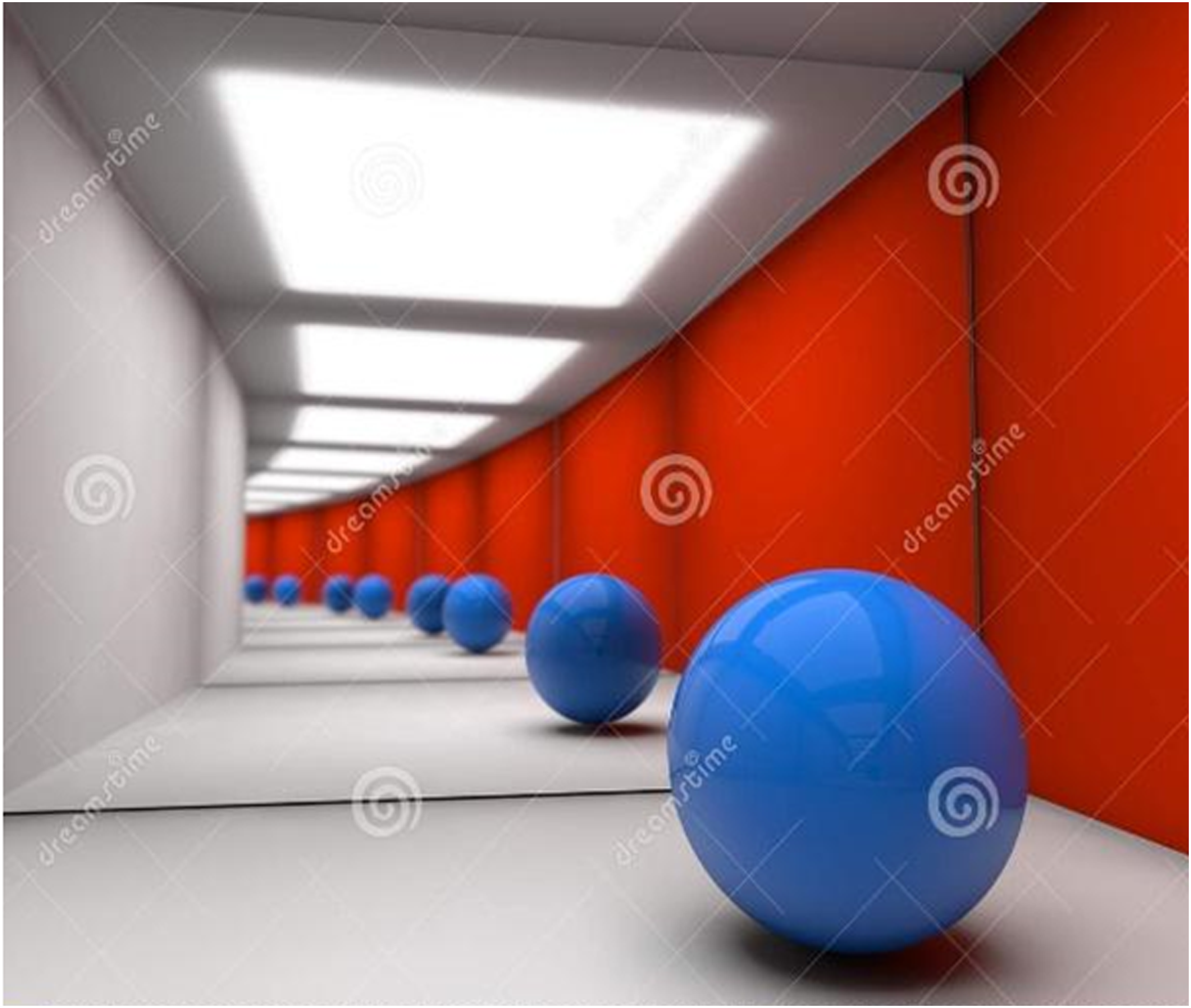
Enter 3 the dream tiger as the mirrors that edge this space repeat indeterminably the straited trace image of loss into and beyond infinity – the student teacher ever becoming but ever controlled within this sterile space (Serres, 2015). On this stage the hospitality and open mindedness of Dewey is lost and forgotten. Hospitality reverts to its own history that of hospes – the master (Kelly & Cordileone, 2013). Here, the ‘host remains the host and the guest remains the guest who won’t disturb it too seriously, the order of the house, your going to speak our language, eat our way et cetera’ (Kelly & Cordileone, 2013, p. 98) Take up your shroud and sleep within your Procrustean bed – welcome to the profession!
What Educational Reflection Might Be? Putting Abbau to Work
“In the hallway there is a mirror which faithfully duplicates all appearances. I prefer to dream that its polished surface represents and promises the infinite” (Borges, 2000, p. 78)
Conceptualisation of Total Reflection by employment of the mirror theory reveals an open matrix of normalising judgement and an aporia built upon opposites and contradictions (Gasche, 1986). Like Derrida (See Patton & Smith, 2001) though I do not observe aporias to be negative, as their paralysis provides a chance and moreover a responsibility to find another way through. As Derrida (2005, p. 59) relates, the exception here ‘could indicate a path, if not a way out’. If educational reflection is to be successful, we need to find a polished surface, at work in the mirror play, that ‘faithfully duplicates … and promises the infinite’ and turns this aporia into euphoria.
Within this article, Abbau has been employed to dismantle reflection and to reach back to the roots of this world (Gasche, 1986). Through such a reaching back we begin to loosen the solidified threads of reflection (Gasche, 1986) and reveal the ontic-ontological differences and space between reflection and Total Reflection (Derrida, 2005). This process of Abbau is idiographic as it has helped to discover what One once was (Gasche, 1986). In proposing a way forward through the aporia of this Greek labyrinth, we again need to turn to the process of Abbau. Abbau, here, acts as biodegradation, retrogression and as a precursor to deconstruction (Derrida, 2005). We need to reactivate reflection’s origins, thus shining a light that reveals a way forward.
Abbau, then, in one form is a type of degradation where the outside environment causes physical and chemical reactions which change the surfaces of materials (Gasche, 1986). For example, copper and Verdigris. Let us put Abbau to work to degrade the polished surface of the tain and begin the process of deconstruction and de-sedimentation of the assumptions, ideologies and institutions of the master weaver’s machine (Derrida, 2005). The tain’s receptive surface must be renewed and its machinations and mechanisations destroyed (Derrida, 2005). We must blur the focus of the Total Reflection lens. To do this we need to bring back real-life to break the ‘crust of a mechanism rigified through repetition’ (Agamben, 1998, p. 67). Real life, with all its creativity, imagination and chaos, is the key to a new future world as it creates a ‘passage, a crossing breaking through [the tain] via rupture’ (Derrida, 2005, p. 156). Experience here can act as a Shibboleth which presents a visa enabling a right to cross this frontier (Derrida, 2005). Through Abbaus’ ‘reductive construction’ (Gasche, 1986, p. 114), we can construct a radically new old ground. By stepping back and retrieving old theories of reflection, by grounding this ground we once more set it free (Gasche, 1986). We need to alter the inscription of the tain and deconstruct the non-sensibility of the perceived sensibility of the space of Total Reflection (Gasche, 1986). The tain needs to be renewed as a ‘liminal signifying space that is internally marked by the discourse of minorities, the heterogeneous history’ (Bhabha, 2004: 212). Let me explain this way forward in a little more depth by returning to the central player in the process of reflection, namely the student teacher.
Like Sellars (2012: 461) this article argues that the ‘most powerful durable and effective agents of educational change are teachers’ not ideologies, authorities, institutions or policy makers. Educational reflection as Total Reflection acts to suppress a student teacher’s identity within an ideological and patriarchal system of standards and training (Scales, 2008). If reflection is to become useful again it must cease to be but a function of a private Cartesian mind (Rudinow, 1979). We must create another form of student teacher whose mind is not locked into the Other’s aporia. The intentional disregard for student teacher’s imagination and creativity woven into the cloth of Total Reflection seems somewhat ironic as educational reflection’s originary form sought to ensure that teachers could act independently in their classrooms (Akbari, 2007). There is a need, therefore, to return back to such a notion and to move away as Dewey stated from routine actions (Scales, 2008) and we must, as Schon detailed, rally against technical rationalism which disguise ideologies as common sense. We must reset this form of reflection by enabling student teachers to create pockets of resistance (Kelly & Cordileone, 2013), whereby they challenge assumptions and question existing practices in their development of reflective teaching (Benade, 2015). Student teachers must be allowed to have their point of view, and training curricula need to value knowledge rooted in ‘personal testimony and constructed through dialogue with others’ (Michelson, 2006, p. 450). To develop such reflection, we need to go back to the past and acting as Luddites we need to destroy the master weaving machine by ensuring that personal values and feelings are not divorced from reflective tradition (Michelson, 2006). As Buber advocates there is a need to develop an organic community. One where we are not constructed mechanically but nurtured in a life world that is mutually respectful, co-operative and real (Morgan & Guilherme, 2012).
Conclusions
‘Reared by every dawn from the gleam, Of a mirror, by darkness from a dream.’
Although reflection has had many names and faces this article has argued that in its current form, within the educational arena, reflection has been hijacked and forced to compete on unequal terms with the standards and accountability agenda. In its current guise, therefore, educational reflection has become Total Reflection and as such its ideal has no ideality and thus has no hope of finding itself in itself (Gasche, 1986). For reflection to lead to valuable learning outcomes it needs to shake off the shroud of the Teacher Standards and its associated discourse and be enabled to return to its originary ground. A ground which would observe a student teacher’s career being built on open-mindedness and personal testimony in a culture dominated by mutual respect. It seems, that what really matters to reflection is not the limiting constructs of political ideology but that personal experience should provide a trajectory and a pathway to individual student development. Experience, therefore, should become the ‘method not a system of rules or technical norms but the pathway is the process of happening’ (Derrida, 2005, p. 37). In the Platonic sense, then, there is a need to move away ‘from false reflection towards the truth’ (Patton & Smith, 2001, p. 14). This should have been a noble creature: he Hath all the energy which would have made A goodly frame of glorious elements, Had they been wisely mingled… Bryon (2018: 349)
Footnotes
Declaration of Conflicting Interests
The author(s) declared no potential conflicts of interest with respect to the research, authorship, and/or publication of this article.
Funding
The author(s) received no financial support for the research, authorship, and/or publication of this article.
