




Abstract
The “emotion curve” is a creative methodology that asks research participants to express in graphic form changes in their emotional responses over time, reflecting on a given time period or on a particular activity or event (in our case, music-based activities). This methodology was developed as part of our research with community music-making NGO Musicians Without Borders at their “Music Bridge” participatory music and movement training program in Derry/Londonderry, Northern Ireland. This article discusses how the “post-conflict” context of our research, and our engagement with the principles of prefiguration and participatory action research, shaped the development of this innovative methodology, paying particular attention to achieving methodological “fit” (or commensurability) with the practices, objectives, and ethos of our research partners. This creative and “fitting” (or commensurate) methodology has been the basis of a “mutually transformative dialog” with our research partners.
Introduction
The Sounding Conflict: From Resistance to Reconciliation 1 project seeks to integrate interdisciplinary arts and social research methodologies to develop new and complementary modalities of research participation, and to evaluate the effectiveness of their application. Our strand of the project has focused on the “Music Bridge” music facilitation training program in Derry/Londonderry, delivered by international NGO Musicians Without Borders (MWB), 2 which aimed to equip participants with community music facilitation skills through a 3-year course, delivered in four training sessions throughout each year. Along with more conventional ethnographic research methods, such as participant observation, music life histories, semi-structured interviews, and surveys, we have adopted and developed several innovative research methodologies. These research methodologies were designed in partnership with MWB and then, as far as possible, woven into the training program, with the intention of complementing their training while critically reflecting upon it and shedding light on our research questions. Our research questions were concerned with music making and creativity as a means of transforming conflict and post-conflict societies, and with MWB we were interested to understand how community music practitioners deploy transformative principles “on the ground.” Evaluation was another key concern, both in terms of our own evaluations of the impacts of MWB’s pedagogy and community work, and in terms of thinking about MWB’s own evaluative practices and the ways in which we might augment or otherwise assist with that process.
This article addresses our approach to these research questions through one of our methodologies, the “emotion curve,” and discusses how the development of this innovative methodology was shaped by the “post-conflict” context of our research and by our engagement with the principles of participatory action research (PAR). A key factor was our aim of “methodological fit” or “methodological commensurability” with our research partners, MWB, and here we consider the practical, objective-sharing and ethical aspects of this process of methodological innovation, before reflecting on this as the basis of a “mutually transformative dialog” with our research partners.
The framing of our methodological development was also inevitably shaped by disruption to our research engagement with MWB’s “Music Bridge” program, and the causes of that disruption also highlight the fractious political context we are working within. The program was hosted and part-subsidized by Cultúrlann Uí Chanáin, an Irish language cultural center in Derry/Londonderry; however, during 2017, Cultúrlann Uí Chanáin faced a number of serious funding challenges. In May, they were hit with a budget cut of almost 60% by their main funder, Foras na Gaeilge. 3 This funding was eventually restored in October 2017, after protests and a consultation process, but these issues were further compounded by ongoing uncertainty over funding for community groups as a result of the collapse of the Stormont Assembly in January 2017, with the subsequent suspension lasting 3 years. Indeed, opposition to a proposed Irish Language Act, which would protect funding for groups such as Cultúrlann Uí Chanáin, was a major factor in this collapse. The Stormont Assembly was restored in January 2020, without a “standalone” Irish Language Act, but with recognition in law of the Irish language (along with Ulster Scots language; Hughes, 2020). However, in the absence of decision-making by a local executive or legislature, austerity-related budget cuts were implemented by Westminster during the suspension period. The “Music Bridge” training program did not continue beyond May 2017, with this ongoing funding uncertainty as a factor, and our research engagement was limited to working directly with the Music Bridge cohort of 2017–2018 and comparing these outcomes with the materials collated by MWB with participants in 2016–2017, rather than having the opportunity to extend our analysis on a longer term basis. This is no doubt a bitterly ironic example of “system-level constraint[] on our work” (Ross & Call-Cummings, 2019, p. 97)—a lack of meaningful reconciliation or effective “peacebuilding” at the political level had disrupted our research into grassroots initiatives toward meaningful reconciliation and “peacebuilding.” We continued our research with “Music Bridge” participants on an individual level, including utilizing other creative methodologies such as “Soundbite StoryMaps” (see Magowan, Donaghey and McNelis, forthcoming). Here, we offer some insights into how the “emotion curves” creative methodology was developed in partnership with MWB, especially in terms of practical, objective-sharing, and ethical considerations. This will likely be of interest to researchers who are developing their own creative methodologies, especially in post-conflict contexts or working with groups dedicated to social transformation, and the “emotion curve” may be transferable or adaptable to a wide range of contexts.
Description of the Emotion Curve Methodology and Its Development
Our first research survey, which addressed issues of creativity, empathy, and perspectives on the potential of music making toward community transformation, was administered during the April 2017 “Music Bridge” training session in Derry/Londonderry. As part of this survey, we asked participants to reflect on the 5-day training period and to express in graphic form the changes in a range of emotions over that time. The question was stated thus: “Reflecting on your experience of this range of emotions throughout this program, draw a curve to express any change in their intensity over the course of the program.” Space to render the curve was given in separate boxes, labeled with ten emotions—empathy, insecurity, confidence, detachment, trust, distrust, joy, frustration, sympathy, and well-being (Figure 1)—which were intended to cover a range of emotional registers and transformations that participants would experience during the activities in the week’s training. Participants were expected to use the same pen or pencil that they were using to complete the rest of the survey (which included tick box exercises such as ranking and Likert Scales, as well as space for written reflections).
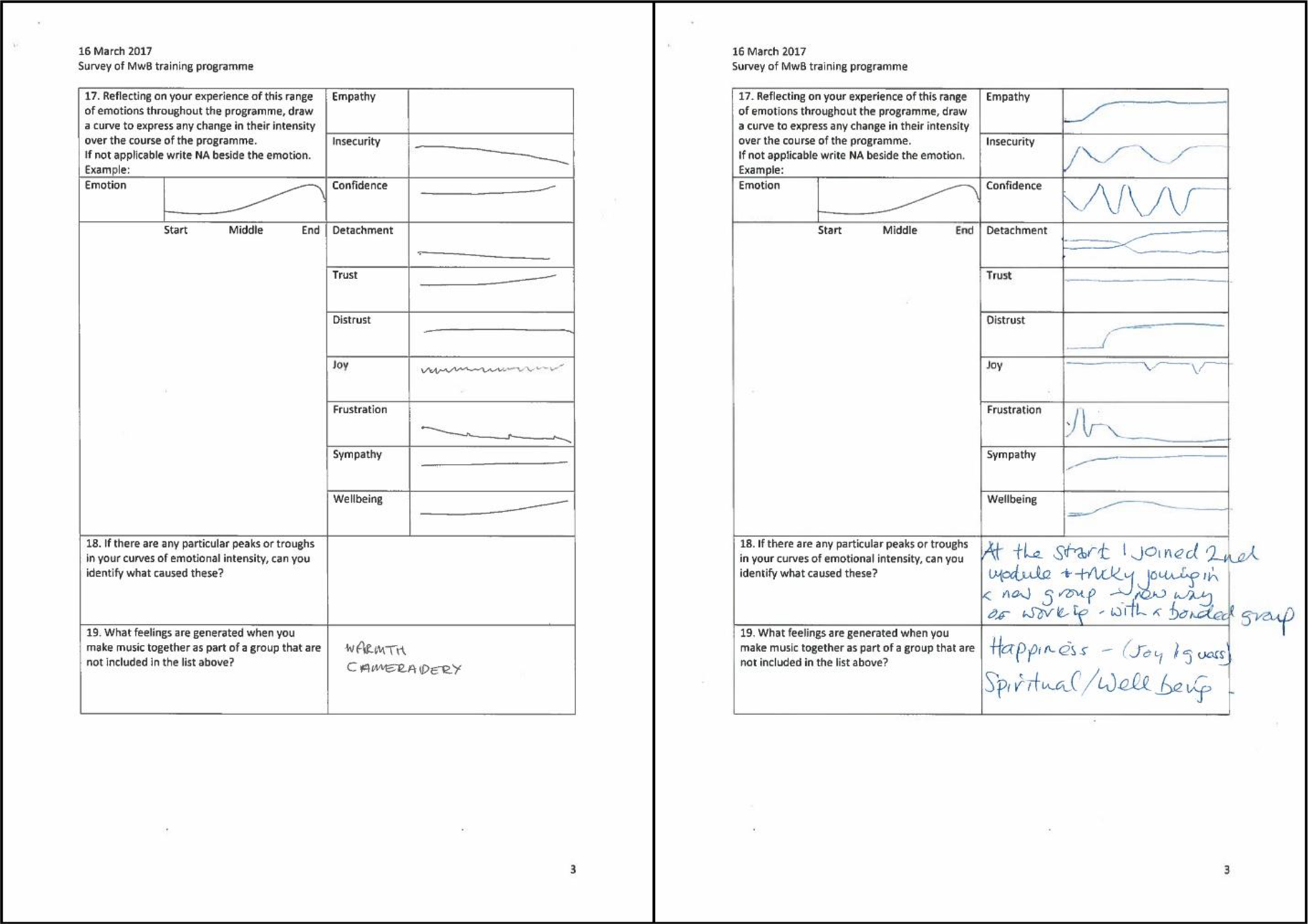
Examples of emotion curve as part of April 2017 survey.
There was a certain level of uniformity in the responses – most respondents rendered some form of undulating line across each given space (led by the example curve given in the question itself). The frequency of “N/A” (not applicable) as a response to specific emotions suggests that some of our suggestions did not resonate sufficiently with some of the participants (e.g., see Figure 2). In addition, there were also graphic aspects that stood out in several of the responses, indicating a flux of emotional dynamics (such as sharp spikes and serrated trajectories, for example see Figure 1), which suggested a range of expressive potential within the methodology.
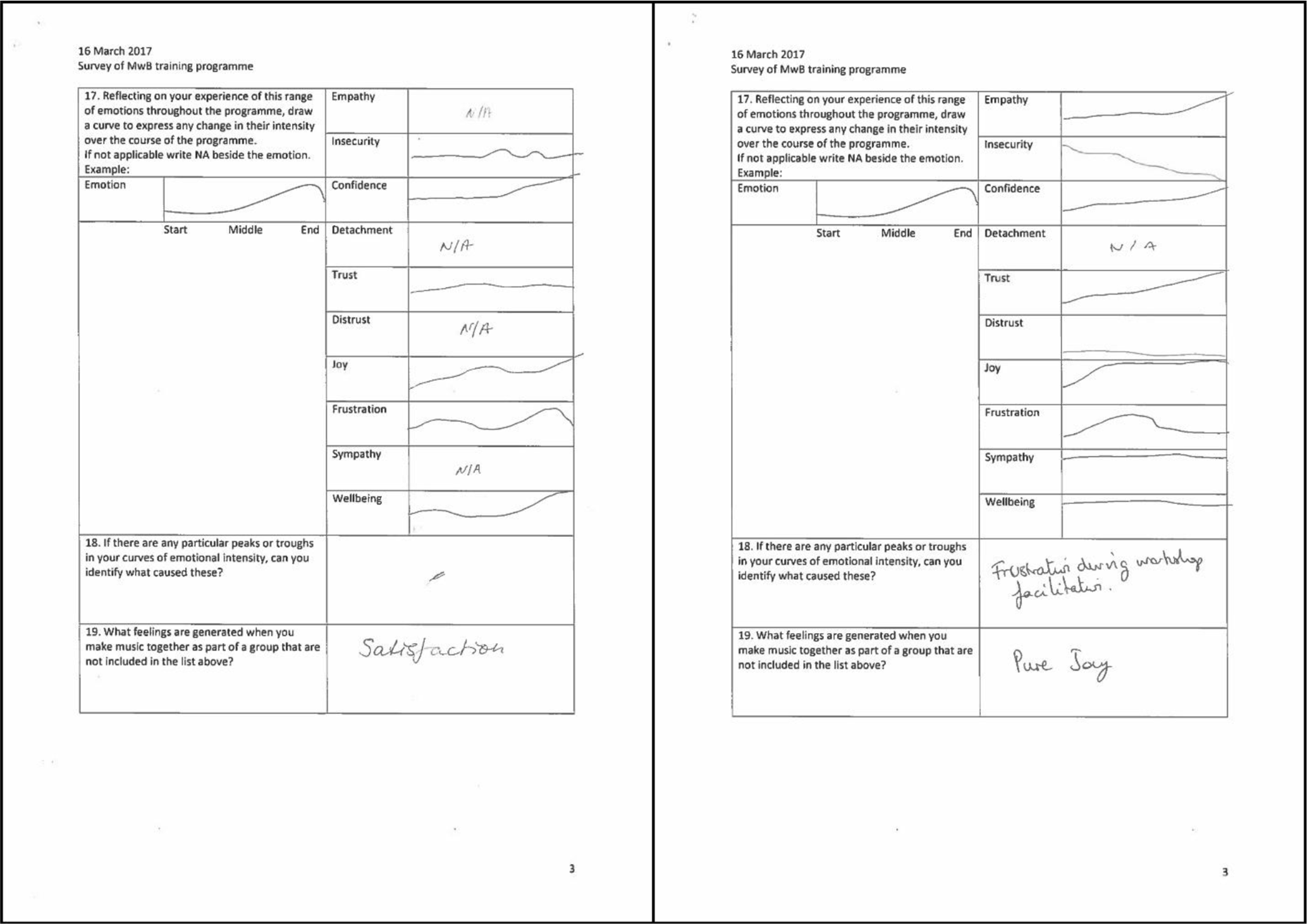
Examples of emotion curve as part of April 2017 survey.
We sought to refine the “emotion curves” when repeating this exercise in the subsequent May 2017 training session with the same “Music Bridge” cohort. We reduced the range of emotions from ten to five, on the basis of responses to the first survey—this time suggesting empathy, confidence, frustration, satisfaction, and joy. We also gave more space with larger boxes for responses (increased from 5.5 × 1.5 cm to 13.25 × 4 cm, approximately), expanded the scope for graphic rendering by providing felt-tip pens in a range of colors, opening opportunity for the use of color for “reflections and metaphor” (McIntosh, 2010, p. 161), and concentrated the emotional reflection on a specific ten-minute-long music and movement improvisation game (a normal part of the training schedule), rather than reflecting on the whole training program.
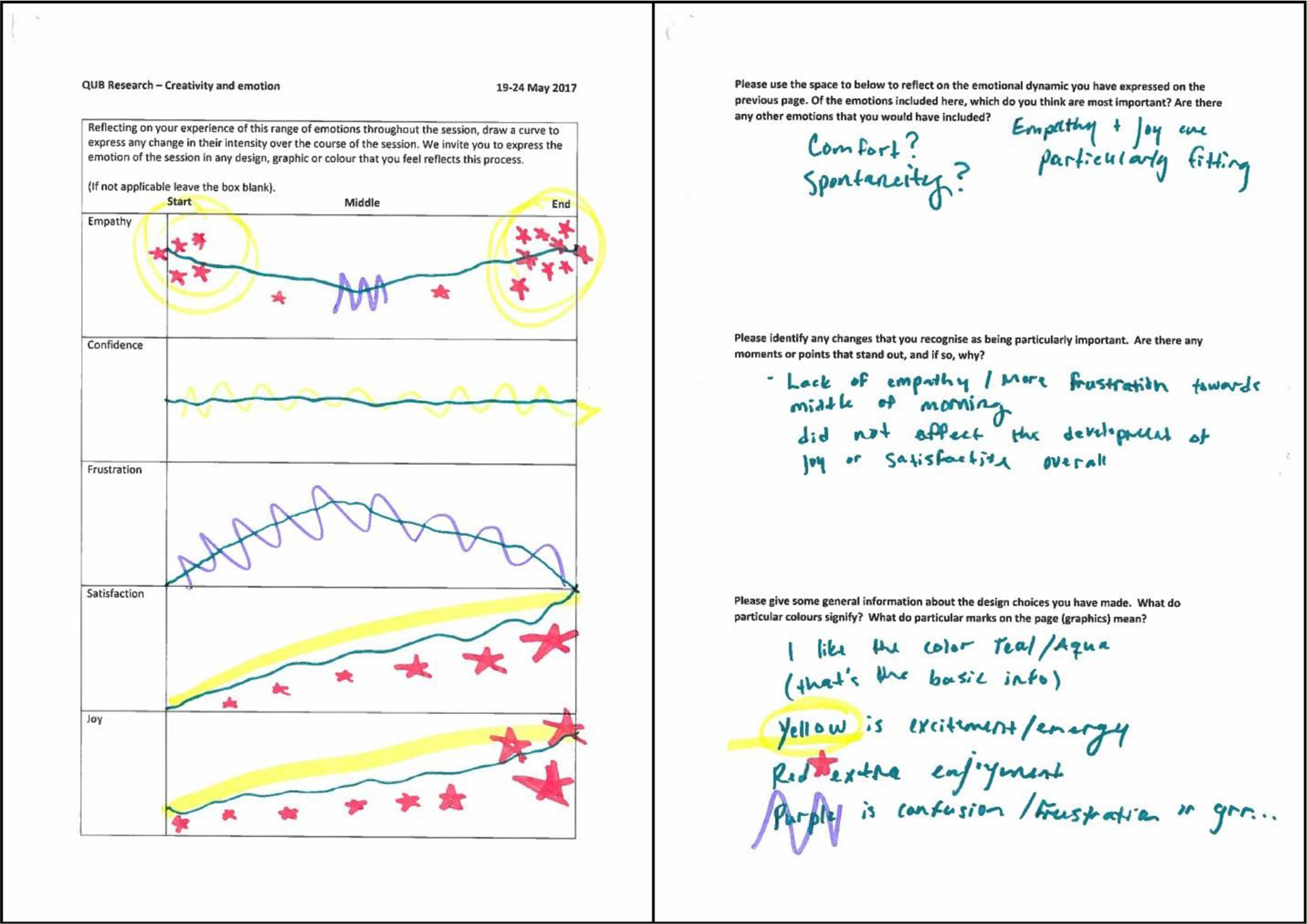
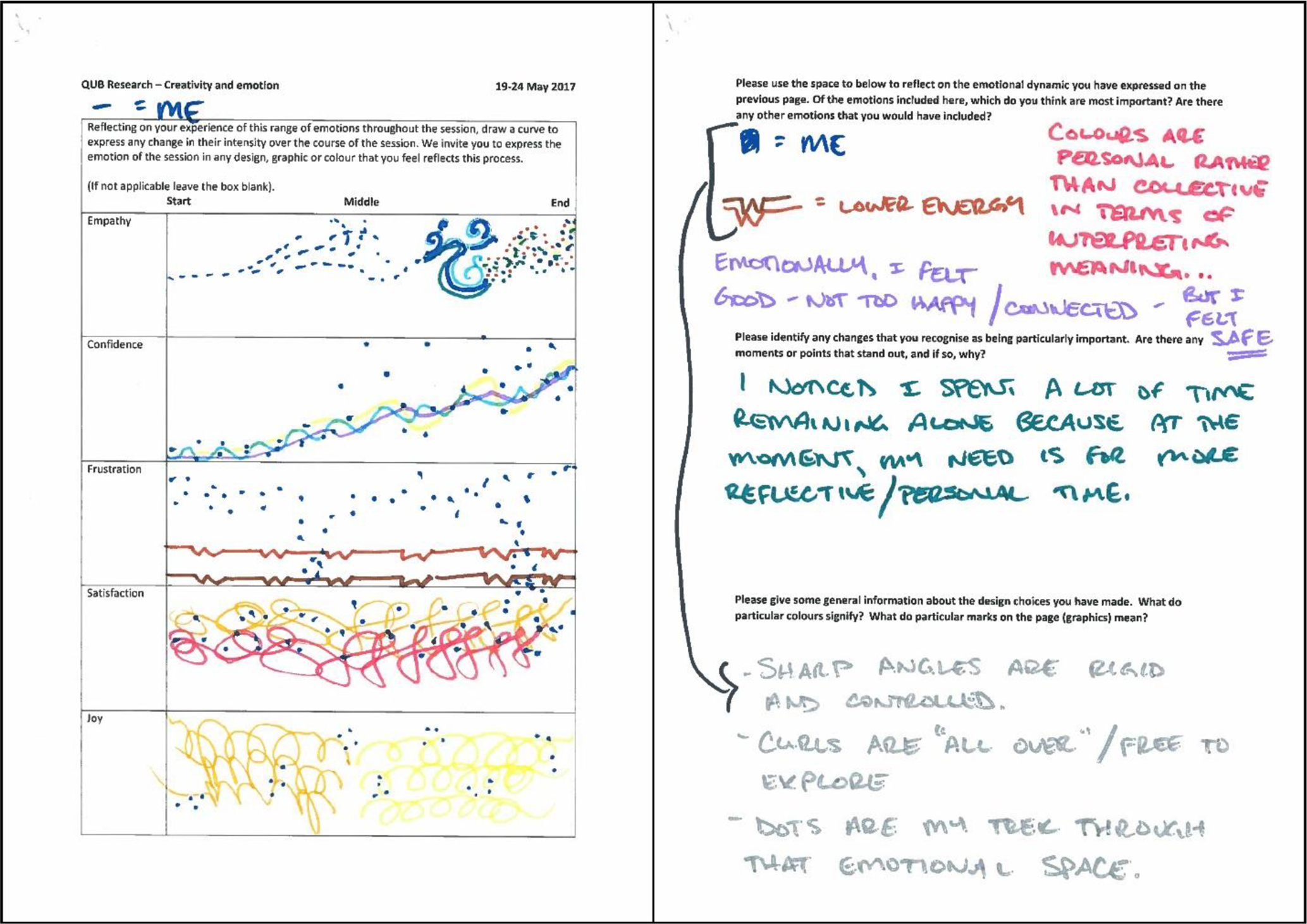
The “emotion curve” was now separated from the wider survey as a standalone exercise, and the question was restated as: “Reflecting on your experience of this range of emotions throughout the session, draw a curve to express any change in their intensity over the course of the session. We invite you to express the emotion of the session in any design, graphic or color that you feel reflects this process.” So, while a curve was still suggested, we sought to be much less prescriptive in the phrasing of the question than in the first incarnation, and the responses were much more varied and expressive as a result (Figures 3-6).
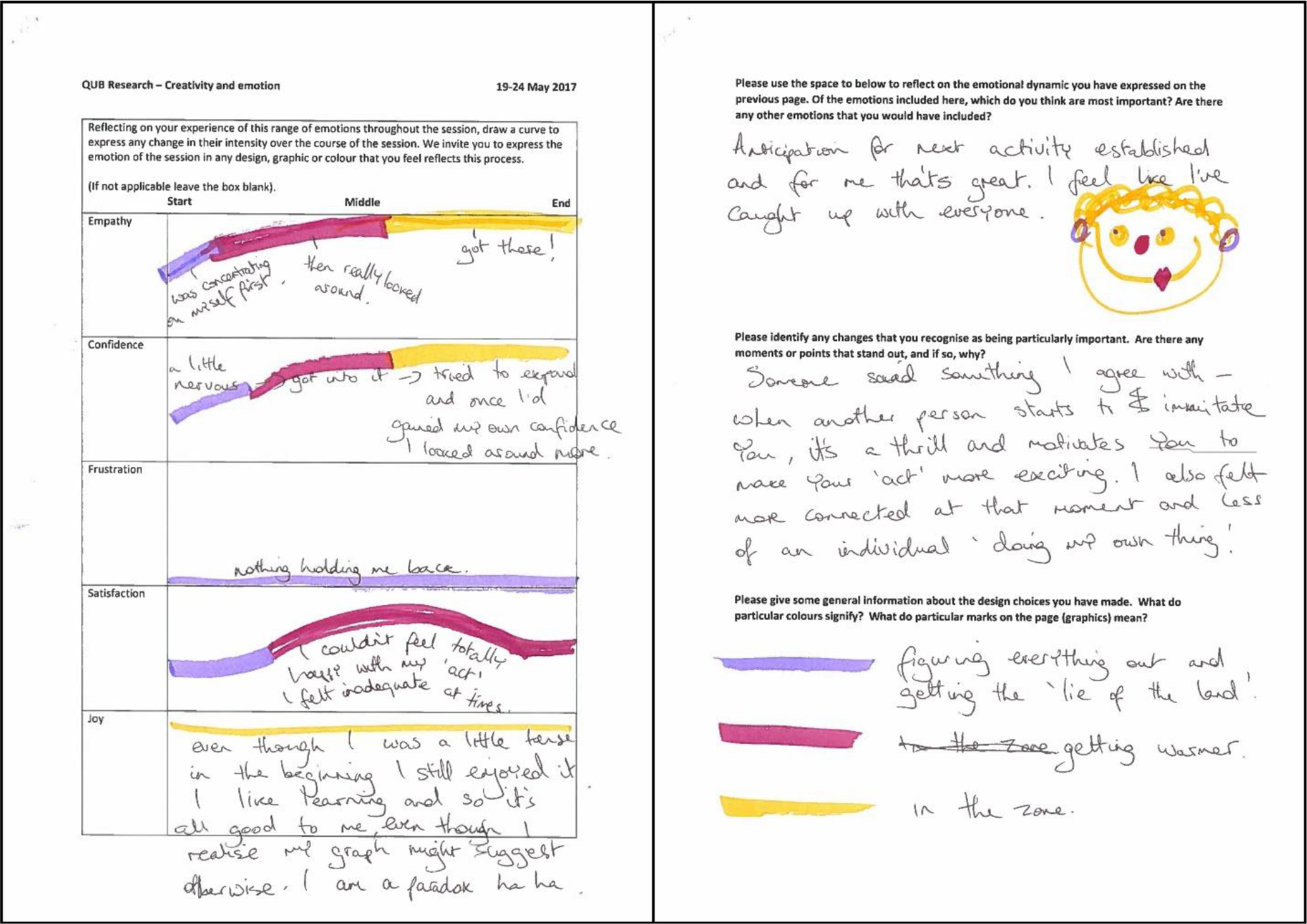
Example of emotion curve and explanatory questions.
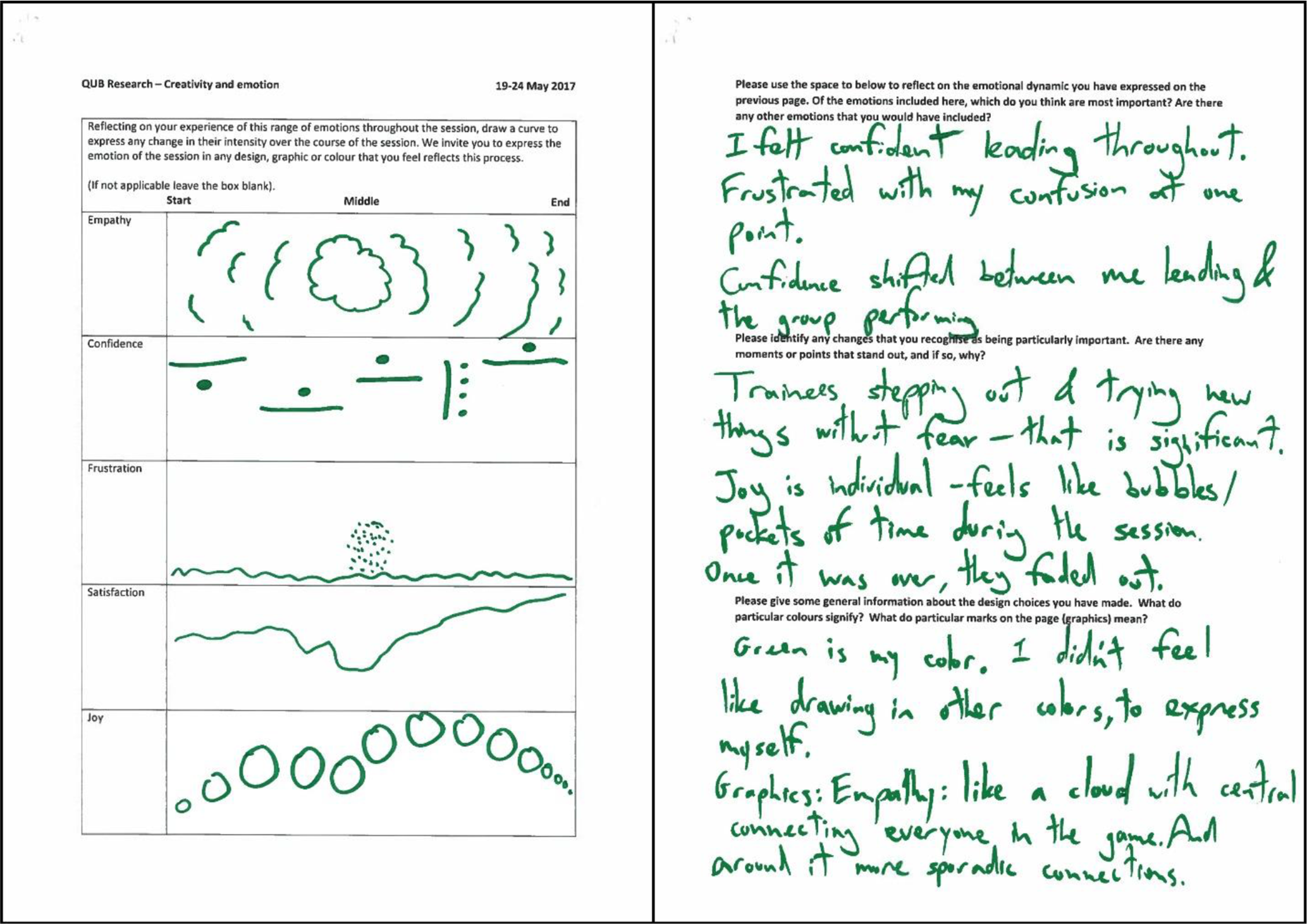
Example of emotion curve and explanatory questions.
Example of emotion curve and explanatory questions.
Example of emotion curve and explanatory questions.
The emotion curve exercise, then, encouraged the participants to reflect critically on their emotional experience during given the time frame(s) and to render this creatively in a nonverbal and (largely) nontextual form. This can be described as a “graphic elicitation method” (Palmer et al., 2014, p. 527; and see Umoquit et al., 2008) in its encouragement of critical reflection and as a catalyst toward thoughtful engagement and participation with the research project. Heath et al. (2018) note, “social researchers have become increasingly attuned to nontextual approaches to exploring the social world” (p. 713). Although, to qualify this in our case, the reverse side of our emotion curve sheet also invited written reflections on the graphic rendering, which enabled respondents to devise a “key” to their curves and substantially augmented the potential for interpretation. Nonetheless, the graphic curve itself remained the focal point of the exercise, rather than the “supplementary” text.
The appearance of a line chart graph is almost parodic—the emotion curves are not an attempt to quantify affect or emotional response, but invite subjective reflection that is part of the creative process of improvisation and free expression emphasized in the MWB facilitation program’s pedagogy. In common with Heath et al.’s (2018) observational sketching method, the emotion curve is used “as a complement to other methods, including as a participatory method and as a useful tool for thinking” (2018, p. 713 [emphasis added]). A key benefit of this methodology has been the introduction of unfamiliar and sometimes complex themes to research participants, which feeds into interview and survey material. For example, introducing the research project’s overarching focus to participants on a range of sound environments, music making, and storytelling in both conflict and post-conflict contexts, along with thinking critically about sound, as well as themes of affect and transformation, greatly benefited our framing of the in-depth interviews and the surveys. This combined approach provided familiarity for participants with the key research themes and encouraged them to become more critical (both in terms of opening up avenues for nontextual, nonverbal reflection, and informing critical dialog). In short, completing the emotion curve exercise helped the participants understand much more clearly our interest in the relationship between sound, conflict and emotion. This was conceived as a two-way process from the outset, as the creative practices were co-designed with the organization prior to commencement and at each step of the process as we developed new methodologies. Participants had also been engaged in interview and survey research with us at the prior “Music Bridge” training session in April 2017, and, indeed, this is likely to have fed into the emotion curve exercise as participants were able to offer analytical insights, into the emotional dynamics of creative practice, some of which were connected to the points raised in interviews. This opened up discussion about how they might apply this mode of reflexivity to their own work.
Thus, this creative engagement reinforced the effects of our research project’s sonic focus in inviting participants to think differently about their conflict/post-conflict context. This echoes Buck and Puwar’s (2012) plea for “live methods,” which are “in touch with the full range of senses and the ‘multiple registers’ within which social life is realized” (p. 11). This approach has the potential “to provide insight into aspects of social life that are not accessible by traditional methods” (Gauntlett, 2007, as cited in Nind et al., 2013, p. 654) and augments the quality and criticality of interview and survey-based research methods. This is especially valuable in Northern Ireland, which has been extensively researched as a conflict and post-conflict context for decades, and as such, along with research fatigue (Clark, 2008; Höglund, 2011), there is also a sense of a “rehearsed” or expected response to academic inquiry into conflict-related issues. This creative methodology breaks that sense of an expected response by framing our inquiry in an unexpected way. As Palmer et al. (2014) put it, these methodologies are “tools to shift people out of everyday thought patterns” (p. 528).
Methodological Fit or Methodological Commensurability
We were continually sensitive to the imposition that creative research evaluations might have presented to MWB’s normal activities and did not engage in these new methods without considerable collaborative assessment of their logistical, practical, and potential benefits in discussion with the director and facilitators. In order to minimize any interruption to the program, we sought to incorporate our research processes into the activities of the training program where possible, drawing especially on PAR methodologies, social movement studies, and the concept of “methodological fit” or “methodological commensurability.” The concept of prefiguration informs our aim of “methodological fit” and complementarity with MWB and their practices, objectives, and ethos. Prefiguration has informed some ethnographic social movement studies (Kagan & Burton, 2000; Yates, 2015), and, as Gordon (2018) notes, while this term has etymological roots in theology, its current usage (typically as “prefigurative politics”) is drawn from contemporary social movements as a “term for the ethos of unity between means and ends” (p. 522). This concept resonates with the aims of community music-making in its emphasis on a “bottom-up rather than top-down approach” (Bartleet & Higgins, 2018, p. 3). Indeed, the very concept of community music-making “has its roots in the UK counter-culture era of the late 1960s and 1970s” (Higgins, 2008, as cited in Bartleet & Higgins, 2018, p. 2) which was typically anarchistic and left-libertarian, and prefigurative politics has been a defining characteristic of anarchist political philosophy from the 19th century onwards. Prefiguration also resonates with the nonverbal aspects of community music-making (and our own creative methodologies). Discussing the difficulties of social movement organizing in the absence of prior experience of organizing in “a free and democratic way,” Raekstad (2017) argues that “[p]refigurative practice can change all this, and it can do so without argument, in fact, without uttering a single word” (p. 6 [emphasis added]). Approaching research into community music-making from this prefigurative analysis makes a great deal of sense, then, not only as a critical tool, but also in terms of developing a commensurate research methodology, and this has the potential for a wide range of applications, not limited to post-conflict contexts.
Practical Fit
MWB afforded us time within the training program to carry out the emotion curves exercise, and we successfully avoided any sense of interruption or imposition because the exercise was closely interwoven with the training program itself. Of course, time was also a crucial consideration, and any research-related exercises entailed a demand on the limited time scale of the training program. But as Palmer et al. (2014) highlight, visual methodologies “can engage busy research participants in a reflective space” and “within short timeframes” (p. 527), so while these methodologies may not be as flexible as interviews (which can be conducted during break periods or outside the training program schedule), the ultimate time demand was limited to around 25 min (10 min for the game and 15 min to complete the emotion curve). This “practical fit” was important for us as researchers in maintaining a good working relationship with our research partners, but our risk of imposition was not just on MWB’s training, but also on the participants’ learning experience. Including this exercise within the training program framed the research as a commensurate part of the participants’ learning experience, offering them a tool for their own music-making evaluative practices, while simultaneously enhancing the sense of creative engagement with us as researchers. By weaving our research exercise into the training program, we therefore made a practical contribution to that training, which relates to the mutually transformative dialog between ourselves and MWB (discussed below), but also points to our sense of having shared goals and objectives with the work of MWB.
Objective-Sharing Fit
Our research methodologies aimed to be commensurate with the objectives of MWB, and this entailed a contribution toward MWB’s work. In addition to our contribution to the training program, our research “service” for MWB is a contribution to the diversity of their evaluation, as well as to the perceived objectivity and rigor of that evaluation. Though as Lonie (2018, p. 283) notes, the “suggestion that independent academic evaluation is necessarily more objective or rigorous than self-evaluation processes should not go unchallenged.” Evaluation is a characteristic of “excellent community music practice” (Lonie, 2018, p. 283) that, according to the Commission for Community Music Activity, ideally entails “an ongoing commitment to accountability through regular and diverse assessment and evaluation procedures” (Higgins, 2012, p. 83). However, Lonie (2018) rejects the idea that this evaluative role should be understood as advocacy; he writes of “an ongoing need to separate the impetus of evaluation from learning about how and whether certain processes or outcomes are occurring, and generating ‘good news stories’ or ‘advocacy’ data,” and views advocacy as a “clear barrier to the ideal standard of evaluation as providing reliable evidence on project performance and informing future planning accordingly” (p. 283). Lonie (2018) is not arguing for some naïvely conceived sense of objectivity, but highlights a particular tension that arises in participatory research processes that involve evaluation, especially if there is an external application of that evaluation which relies on the “status” inferred through research by a university. As Lonie (2018) recognizes, “there are sophisticated ways in which policy stipulations, including those relating to evaluation, are negotiated, repurposed and applied in situ” (p. 282), which is to say that evaluative research carried out by university researchers for, or on behalf of, a community music-making organization may be used internally to shape pedagogy and self-evaluation practices, but can also be used to satisfy the “cost benefit evaluation models” (Lonie, 2018, p. 281) of funders— and each of these applications will likely be quite distinct.
While the line chart-esque appearance of the “emotion curves” might invoke a pastiche (if not outright parody) of a quantitative approach to affect, the graphic outcomes of this methodology hold the potential to be deployed in community arts organizations’ appeals to funders, in a subversion of “cost benefit evaluation models.” As part of a wider description of the impact of their training, the emotion curves succinctly and effusively convey the transformative impacts of the training on participants, and this is arguably a much more evocative demonstration of that transformation than the numeric graphs and text-heavy tables generated through “standard” survey evaluations.
Crucially, however, the applications of our research must be decided by our research partners themselves. This is ethically driven, as part of the ethnographic turn in anthropology, that has seen “indigenous, feminist and other activist scholars push[ing] the critique of anthropology beyond the production of academic texts into the practical work of decolonizing the research process” (Harper & Gubrium, 2017, p. 1). Of Smith (2000, p. 239)’s set of eight questions appraising the potential for exploitation in ethnographic research, numbers seven and especially eight apply here: “Who will own the research?” and “Who will benefit?” ([emphasis added]; see also Walter & Suina, 2019). We, as researchers, can offer particular insights, and, indeed, innovative modes of evaluation, but community arts organizations themselves are best placed to deploy autonomously that contribution as they require.
Ethical Fit
Distinctions between conventional, nonparticipatory, and applied research have been much debated over the past four decades in various guises, which have shifted from the authoritarianism of objectivity to the democratizing approaches and relationships entailed in communitarian action research. The latter seeks to ensure that the voices of those involved are heard, empowering them in shaping research decisions and outcomes that will lead to greater enhancement in their own and others’ lives and practices. This ethical consideration is often associated with creative research methods applied to nonverbal and nontextual media “with researchers empowering participants by giving them means to express their voices” (Nind et al., 2013, p. 662). PAR research “benefits the excluded, impoverished, marginalized, oppressed, and so forth, by … increasing their self-esteem, their participation in institutional decision making, and their access to political influence or economic resources” (Krimerman, 2001, p. 63). Ultimately, it can lead to a form of advocacy or action for social change whereby those engaged in the research challenge the limitations or parameters of their own situations to effect new outcomes for themselves or others. This interrelationship between action research and the ability to generate alternative arenas for progressive social action brings advocacy together with participation in what has been termed “prefigurative action research” (Kagan & Burton, 2000, p. 1), as we have discussed. Its emphasis lies directly in the ability to effect a “more just future society” and it uses “[l]iberatory social innovations [to] pioneer alterative social relations” (Kagan & Burton, 2000, p. 2).
Our participatory sonic and multimodal research approaches are intended to address the power differentials between researcher and participant and to facilitate their voices and creative practice in driving the research agenda. In doing so, we “invite participants to come ‘behind the scenes’ of research design, visual [and sonic] documentation, and data analysis – offering training in these skills and building participants’ capacity as active citizens” (Appadurai, 2006, as cited in Harper & Gubrium, 2017, p. 4). Developing new creative research methods focusing on sound and participatory music-making has the potential to contribute to wider senses of peacebuilding and facilitate the promotion of shared values that can build bridges between artistic practitioners, their arts practices, and processes of remembering, as well as further strengthening senses of empathy within and across communities. By employing evaluation strategies around the emotional impacts of creative methodologies, it has also been possible to trace how the inclusive and safe spaces of participatory music making give rise to collaborative ways of working according to common frames of understanding, which further builds confidence for participants in empathetic expressions of their memories and histories of places of “the Troubles” in post-conflict Northern Ireland. Palmer et al. (2014) argue that communicating “more holistically, and through metaphors [images] can enhance empathic understanding, capture the ineffable, and help us pay attention to reality in different ways, making the ordinary become extraordinary” (p. 528 citing Bagnoli, 2009, p. 548 [emphasis added]). The post-conflict context of our research is key to our methodological concerns then, though this emphasis on a “more just future society” is applicable to research engagement with any socially progressive groups. This raises critical questions about which groups are deemed as “socially progressive,” on what criteria, and by whom, especially where state funding and private (often corporate) “philanthropic” bodies are concerned.
However, our engagement with PAR is not altogether straightforward, especially in terms of our actual contribution to “making social change.” We touch the “keystones” of involving “those conventionally ‘researched’ in some or all stages of research, from problem definition through to dissemination and action,” as we share “[o]wnership of the research … with participants, who negotiate processes with the academic researcher,” and where “[e]ducation and knowledge building are … viewed as important outcomes” (Pain, 2003, p. 652, as cited in Klodawksy, 2007, p. 2846). However, we move beyond “conventional” approaches by ensuring that the research co-design has been in partnership with MWB and adjusted both to align with, and yet offer new approaches to, their previous forms of evaluation.
Klodawksy (2007) identifies the “qualities of the interactions themselves” (p. 2847) as a core element of PAR, and this chimes with the prefigurative approach in that the “means by which data are co-generated and interpretations debated are a key part of the change process” (Breitbart, 2003, p. 162, as cited in Klodawksy, 2007, p. 2847). However, one of the more challenging aspects of evidencing the impacts of creative evaluation is to determine the extent to which our research meets Stoecker’s identification of “making social change” (1999, p. 841 [emphasis added]). In the case of MWB participants, this requires long-term follow-up of the use of facilitation methods with a range of social groups in different countries and a variety of settings. While MWB facilitators are directly engaged in processes of “making social change” with the communities with whom they deliver their programs through imparting creative skills, how the evaluation of creative practices impacts upon facilitators and indirectly affects their clients is potentially more difficult to track. Klodawksy (2007) highlights that “there are differences over what constitutes meaningful involvement and how social change is to be evaluated” (p. 2847), and as discussed above, our contributions to the diversity of evaluation undertaken by MWB may be understood as a “service” of sorts. In addition to our complementary suite of evaluation processes, we have contributed directly to the “Music Bridge” training program pedagogically, and the research process with our participants has been a transformative one (this is further discussed by participants in reflection on the “StoryMap” methodology, see Magowan et al., forthcoming). While our research methods are applied for concerted periods with direct impact, over the longer term these creative research practices may be considered as associative in terms of their ongoing effects and integration within the aims and outcomes of the training program. As such we are “supporting social change” and “making” changes through our interactions with research participants, who themselves go on to engage with the wider public in various conflict-transformation initiatives. Nevertheless, in line with our engagement with PAR, our prefigurative and creative approach has laid the basis for a “mutually transformative dialog” with our research partners.
Conclusion: A Mutually Transformative Dialog
MWB have been open to learning from us as academic researchers, and our creative research methodologies, including the “emotion curves,” have been a key aspect of this engagement. This has been the basis of a “mutually transformative dialog.” On one side of this dialog, as Krimerman (2001, p. 69) puts it, “social scientists themselves can, do, and must play a major role in the invention and extension of key concepts,” and this is inevitably transformative for the research participants’ understanding – in our case in terms of the role of sound in conflict and post-conflict contexts. This is highlighted above in consideration of the practical augmentation of the research engagement of our participants, though its transformative impact in and of itself and should not be overlooked. There has also been a corollary transformation on us as researchers, especially methodologically, as we strive to incorporate aspects of MWB’s activity into our research. In this regard, we sought to engage with MWB and participants in an ongoing dialog over the development, use, and impacts of the research in order to extend its benefits and find new ways to enhance inclusivity, empathy, and approaches to nonviolence.
Our participation in MWB’s activities inevitably shapes those activities and their impacts, and the process of critical reflection undertaken by the participants as a result of our research engagement with them is also meaningful. The transformative effects that reflection and reconfigured action can have upon participants in turn may come to constitute a “prefigurative politics” insofar as the mark of MWB is to ensure that “music connects” to create a form of social movement which is reliant on the reproduction of its facilitation methodologies and principles, and which “has dramatic consequences for the kind of social reality [its participants] prefigure” (Khasnabish & Haiven, 2015, p. 23). This is one aspect of the “mutually transformative dialog” we seek (Allen, 2016; Chatterton, 2006)—in our participatory research approach, we do influence the “making of social change.”
Our “emotion curves” creative methodology has been commensurate with the practices, objectives, and ethos of our research partner, MWB, while the post-conflict context of our research in Northern Ireland has necessitated this innovation (to overcome research fatigue and “rehearsed” responses of participants to the effects and legacies of conflict), at the same time inviting new levels of engagement (in terms of contributing to the work of a socially transformative initiative). The outcome of this creative and prefigurative approach has been a “mutually transformative dialog” that has greatly benefited the quality of our research, and, we hope, has had a lasting positive effect on the practices and work of MWB.
Footnotes
Acknowledgments
We would like to thank Musicians Without Borders for their support and collegiality in the ongoing collaboration of this Sounding Conflict research project, which is funded by the AHRC/Partnership for Crime, Conflict and Security Research. In particular, we thank the Director, Laura Hassler, for facilitating this research partnership and for her deeply pertinent insights and advisory support. Meagan Hughes has provided us with essential materials and kindly hosted us in three training programs with her extremely efficient and welcoming organizational prowess. We are also indebted to the senior facilitators of Musicians Without Borders and the community music leaders of the Music Bridge program, whose patience, interest and good humor has made this a rich and rewarding collaboration. We are most grateful for the generosity and willingness of all the Music Bridge participants who have given of their time and critical reflections in answering multiple surveys and offering engaging and thoughtful responses. Our thanks also go to Eibhlin Ní Dhochartaigh and Peter O’Doherty for their support of this research in the Cultúrlann Uí Chanáin. Our thanks also go to Professor Hastings Donnan for his generous support and inspiration in facilitating the development of the project and hosting it in the Senator George J. Mitchell Institute for Global Peace, Security and Justice at Queen's University Belfast.
Declaration of Conflicting Interests
The author(s) declared no potential conflicts of interest with respect to the research, authorship, and/or publication of this article.
Funding
The author(s) disclosed receipt of the following financial support for the research, authorship, and/or publication of this article: This work was supported by the AHRC/Partnership for Conflict, Crime and Security Research under Grant AH/POO5381/1.
