



Abstract
This article examines At Home With . . ., a collaborative film series that emerged during the COVID-19 pandemic and engaged migrant artists in the United Kingdom as co-authors in a reimagining of home through moving image. We position participatory film practices as both aesthetic and ethical interventions into dominant visual narratives. By inviting participants to film their daily routines, the project shifted from documentation to a decentralized, artist-led practice that foregrounds situated and multisensory understandings of home. We argue that this approach offers an alternative representational and methodological space—one that acknowledges the complexity of migration while resisting reductive framings.
Introduction
In 2019, Project Finding Home, a 3-year practice-led research 1 study, set out to explore how artists from migratory backgrounds navigate the idea of “home” within the United Kingdom’s so-called “hostile environment.” 2 Just as our team 3 was preparing to begin fieldwork, the COVID-19 pandemic interrupted our plans to create ethnographic films with the artists reflecting on their migration stories through personal understandings of home and their artistic practice. While the pandemic imposed unexpected constraints on our research process, it also opened unexpected creative possibilities.
Creating a set of simple instructions (see Figure 1) with our collaborating filmmaker (Winstan Whitter), we invited the artists and co-creators on the project to film themselves with their smartphones on daily walks, cooking meals, or reflecting on meaningful domestic objects.
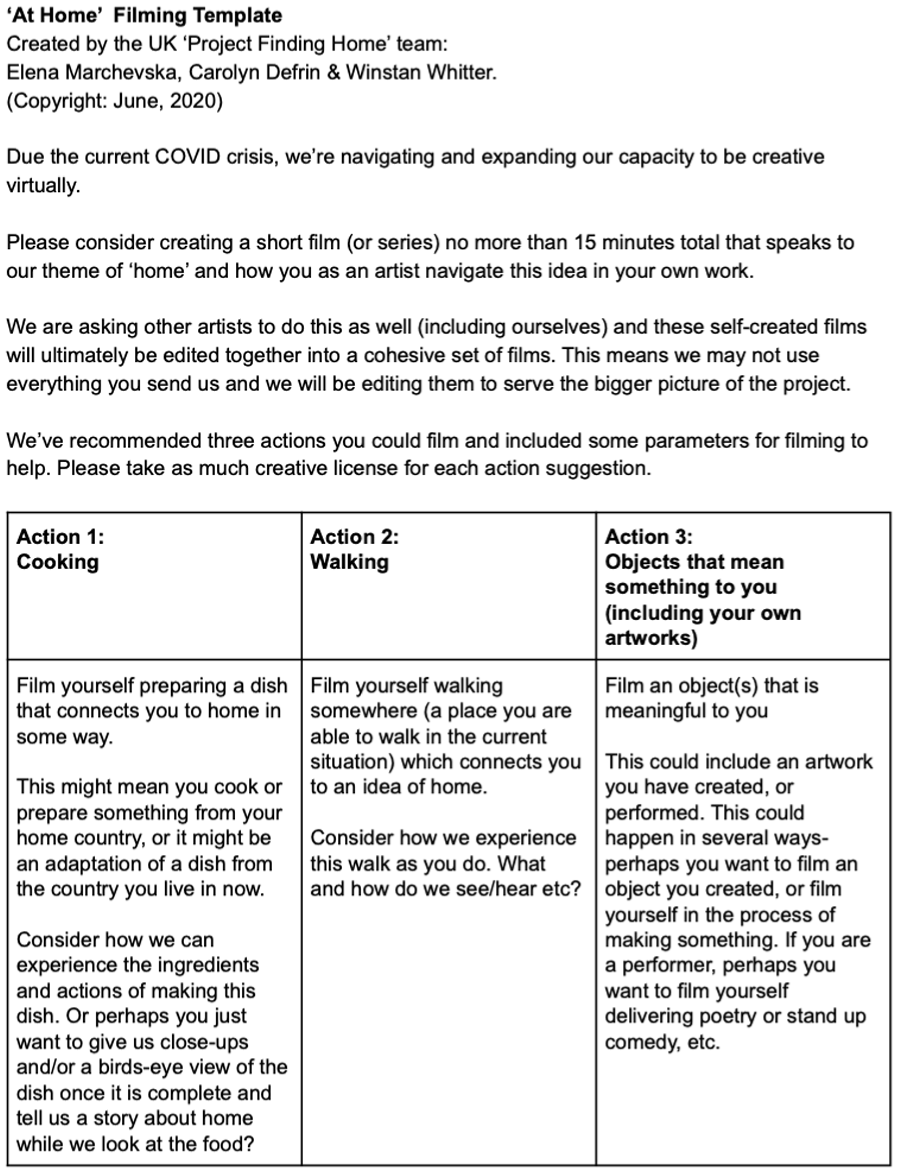
Filming Template Project Finding Home, Page 1.
This structure facilitated a move away from formal documentary traditions toward a more intimate, participatory practice—foregrounding the aesthetics of the everyday and the ethics of self-representation.
Through this filming template, seven artists, each with distinct migration histories, reflected on what it meant to find home within pandemic confinement. The resulting short films entitled the At Home With . . . series became small portals into expansive intergenerational geographies of movement and belonging—what Bhabha (1994) might describe as “the unhomely,” where personal and political histories blur, and where home is constantly negotiated in the space between.
What emerged from this film series was not only a nuanced body of visual work, but a deeply co-created process—perhaps more collaborative than our original, pre-pandemic design might have achieved. These films illuminate how home is made between hands: between the hands of many filmmakers, holding nuanced migratory experiences, as well as the hands of many generations. The hand that cuts yellow peppers for a meal in June 2020 carries the gestures of a grandfather’s hand reaching for his first banana as he arrives in a new country in 1920. The hand of a mother holding her daughter’s hand across a quilted blanket holds hope for a more caring future. The films also reveal how home is made between lands: not simply in the physical locations migrants move through, but in the relational, affective terrain they inhabit and remake. The pandemic emphasized the four walls of a home, but also reframed surrounding local nature as a critical space for home-making, which reflected a kind of sprawling, incapacity for home to be contained. Recalling Ahmed’s (2006) notion that home is not simply where one is, but where one feels one ought to be, these films reiterate how fragmented, multi-layered, and processual that feeling can be for those with migration experience.
The following article begins by situating the At Home With . . . series (see Figure 2) within the United Kingdom’s “hostile environment” and then broader traditions of participatory art and community filmmaking with migrant communities. We then reflect on how the process of making these films opens up space to reimagine home and homeland beyond mainstream migration narratives: as something shaped not by containment, but by movement. We will also briefly share how the At Home With . . . series continued to take shape recently in workshop settings with university and secondary school students. Finally, we end the article with a set of simple recommendations and guiding principles that can help other academics, artists, and community workers to create nuanced perspectives with migrant expertise.
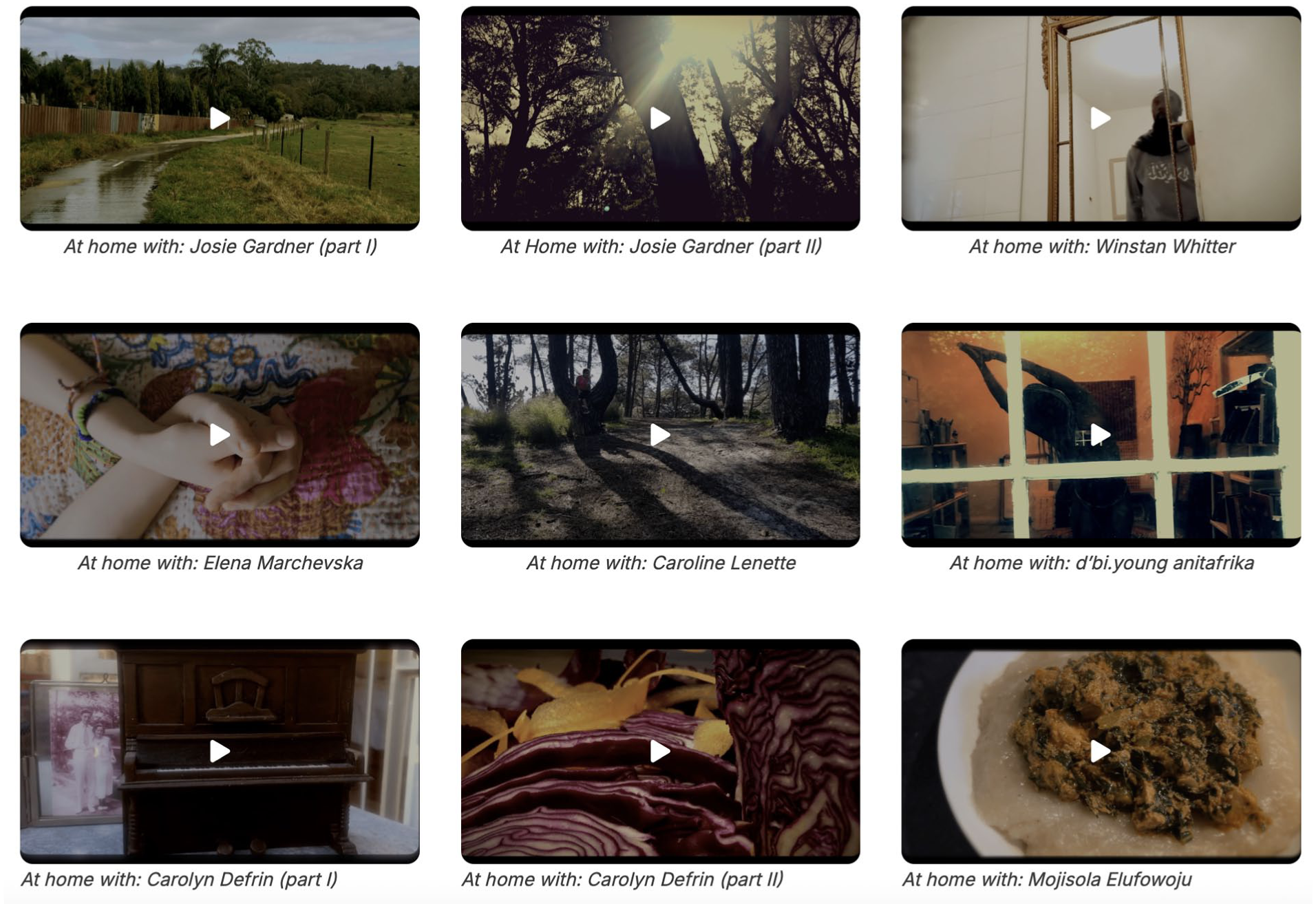
Screenshot From “Project Finding Home” Website: At Home With . . . Series (2021).
In line with our project’s practice-led research methodology and co-creative process, this article also makes space for imparting different kinds of knowledge. Therefore, the text moves between academic, reflective observation and poetic writing, with the latter two marked through indentation and italics respectively. The reader can also find embedded links throughout the article to view the films. These varied modes of reading and viewing build on a long tradition of feminist and decolonial thinkers 4 that challenge neo-liberal epistemological hierarchies of conventional academic outputs.
Rethinking Home in the Context of Migration Policies
Border regimes have long equated “home” with national identity. To be “at home” in this logic is to be of the land, which is often fenced, policed, and inherited terrain. These national imaginaries are not neutral, but “continually produced through systems of representation” (Hall, 1997, p. 16), defining who belongs and who remains perpetually out of place. hooks (1990) further challenges an idea of home as a fixed, possessive space, describing instead a radical sense of home as something made in defiance of domination—a site of resistance and healing.
In Britain, the legacy of colonial ideologies endures in the contemporary management of migration. The “hostile environment” policy, introduced by then-Home Secretary Theresa May in 2012, was designed to make life “as difficult as possible” for undocumented migrants (Kirkup & Winnett, 2012). Since then, the policy has embedded immigration enforcement into housing, health care, education, and employment. Even long-time residents, as in the Windrush scandal, 5 have been affected and mistreated. The idea of home under this regime becomes not a right but a privilege—guarded by bureaucracy and surveillance, measured through legal status, language proficiency, and biometric data with the current Prime Minister professing a fear that the United Kingdom may become “an island of strangers” if borders are not secured and immigration curbed. 6
The precarity of home is a defining reality for migrants across various legal statuses and circumstances. While nuanced policies differently impact distinct migrant categories—such as economic migrants, refugees, asylum seekers, and those on temporary visas (e.g., cultural workers, agricultural workers, and international students), these restrictive measures necessitate a deeper understanding of how people with migrant and refugee backgrounds conceptualize home and cultivate a psychological sense of belonging. In the next section, we explore participatory visual arts practices, and specifically film and video formats as a mode toward creating such understanding.
Art as Intervention: Mobile, Relational Home-Making
The border is a barrier and it is a generative space where migrants assert agency and graft new and plural meanings of home and belonging. As Sigmon et al. (2002) emphasize, exploring these notions is critical in contexts marked by legal and social uncertainty. Boccagni et al. (2021) argue that asking people from migrant backgrounds about the place they call home sheds light not only on what home means to them but also on how it intersects with their living conditions, belonging, and integration. Home, in this sense, can move beyond static ideas attached to a country name, or brick and mortar locations, revealing nuanced socio-political and emotional dimensions of migrants’ lives. And, it can push past the limiting and often further marginalizing inquiry commonly posed to migrants: “Where are you (really) from”? And ask instead: what does it mean to be “at home” in movement and in the interstitial zones of modern life?
Participatory filmmaking with migrant and refugee communities has emerged as a powerful response to the static, exclusionary imaginaries of home. These practices resist the dominant frames of crisis, danger, or assimilation by foregrounding migrant voices, aesthetics, and epistemologies. As Minh-ha (1990) argues, documentary is never neutral—it is shaped by positionality, power, and relation. Participatory film, at its best, reconfigures these relations, asking: Who controls the narrative? Who decides what counts as representation? In this “set of methods involving a group or community in shaping and creating their own films” (Gutiérrez Torres, 2025, p. 430), these audio-visual practices contest hegemonic representations of migration that regularly reduce migrants to images of threat, burden, or spectacle.
Festivals like the London Migration Film Festival and Amnesty International’s Human Rights Festival have carved space for alternative storytelling, resisting dehumanizing mainstream coverage through an expansion of nuanced narratives that not only depict migration-related content, but offer views of migrants as full human beings, beyond their migratory circumstances. Meanwhile, projects such as Scotland, Our New Home (SONH), a participatory film program with young asylum seekers, demonstrate how home can be documented not as territory, but as a set of relational practices: cooking, riding the bus, walking to school (Frimberger & Bishopp, 2020, p. 77).
Mobile phones have transformed participatory filmmaking. Once inaccessible, filmmaking tools now fit in pockets, enabling migrants to document their experiences from within. A new vernacular visual language has emerged: shaky, intimate, grounded in subjectivity.
Projects like Now You See Me Moria demonstrate both the potential and limits of digital agency. Originating from within a refugee camp in Lesbos in Greece, the project offers a living archive by and for displaced people (with over 40,000 Instagram followers.) People with lived experience as refugees post their own images of daily life to challenge singular media tropes of victimhood or threat. “Like no others, these photographers are capable of portraying the intimate everyday world . . . because they themselves are part of it” (CIVA, 2021). Similarly, the Reel Borders initiative foregrounds stories from “borderlanders,” inviting non-professional filmmakers to explore life in zones of tension across the Irish, Spanish-Moroccan, and Turkish-Syrian borderscapes. With the project’s key question exploring how film (produced by key border actors including government institutions, artists and activists) can “construct, contest, or experience the border,” these stories and the methodologies that produce them remind us that border regimes do not just constrain movement—they shape how life is lived, narrated, and remembered (Al Kalak et al., 2022).
Yet this is not without risk. The same devices that enable self-inscription also expose users to surveillance, manipulation, and exploitation. As Leurs and Smets (2018) expound, refugee created content can be weaponized to stoke anti-immigrant sentiment and justify punitive border controls. In the next section, we explore ethical considerations when circulating images of migrants’ experience and how these images can become a potent, affective, yet ultimately ambiguous currency in the visual economy (Ruíz, 2023).
Ethical Considerations
While many of these participatory film initiatives expand the narrative of migrant lived experience, much scholarship exists with a critique and caution around practices that profess empowerment, but may fall into a trap not only of further marginalization (through the reproduction of power dynamics) but also of potential re-traumatization of people whose very recent journeys need time to process (Thompson, 2009; Torres, 2024). As Blomfield et al. (2019) argue, there is a long tradition of (mainly observational) filming in refugee studies, rooted in western ethnography and anthropology, that favors voyeurism and imposes predetermined sociocultural norms. As further argued “this de-personalizing tendency of visual representation is mirrored in the public communication spaces of news and social media” (Frimberger & Bishopp, 2020, p. 6). The media’s focus on the (non-refugee) viewers perspective can obscure a focus on refugees’ rights to shape their own self-representations and “articulate their own life histories, trajectories and aspirations as irreducibly human endeavours” (Chouliaraki & Stolic, 2017, p. 5). This is broadly described as a social science tradition of voyeuristic, “damage-centered academic research” (Tuck & Yang, 2012, p. 227). Tuck and Yang (2012) further caution that “pain-based inquiry projects,” in the name of social change, can presuppose the conflation of an “authentic voice” with refugees’ narratives of pain.
The participatory film project, SONH, mentioned earlier, acknowledges that these projects are not linear journeys toward empowerment: “the emancipatory process of a young person ‘finding their voice’ and shaping their self-representations in our film project was not a straightforward, developmental process towards ‘empowerment’” (Frimberger & Bishopp, 2020, p. 77). Reflecting on their 6-month participatory film project, the company notes the challenges faced by the young refugees during the filmmaking process, highlighting that the “project process was an intensely social process, in which autonomy, collaboration and teacher authority were negotiated on a moment-by-moment basis” (Frimberger & Bishopp, 2020, p. 75).
This level of self-reflective criticality speaks to the complexity of participatory and processual approaches within digital migration and is one that we will address within our At Home With . . . film series as well.
Introducing At Home With . . .: Methodology, Ethics, and Self-Reflexivity
Our film series, At Home With . . ., grew out of Project Finding Home—a 3-year international research collaboration between artists, academics, and migrants across the United Kingdom, Canada, and Australia, about the complexities of forced migration and creative place-making strategies. The project emerged at the height of the COVID-19 pandemic, when conventional in-person ethnographic methods had to adapt. Confronting both the hostile environment and the crisis of public health, we sought new ways to explore how migrants were remaking home under extraordinary constraints. Aligning with other scholar/artists across Europe (Smets & Ahenkona, 2024) enacting co-research with migrants through participatory video at this moment in time, we viewed these constraints with creative possibility.
Inspired by feminist refugee epistemologies (Le Espiritu & Duong, 2018), who foreground refugees as experts of their lived experiences, we asked: How do people reconstitute home in states of multiple layers of uncertainty? What counts as knowledge when we center embodied, everyday practices? Our methodology was informed by a refusal to extract “stories of suffering” and an insistence on nurturing migrant expertise through everyday practices as well as through critical knowledge production that Le Espiritu and Duong (2018) note are available in interiority and layered temporalities.
Working with Winstan Whitter, a documentary filmmaker and editor who specializes in social community advocacy, we developed a simple instructional blueprint (see Figure 3) which invited the collaborating artists to document a walk, a meal, or an object that reflected their sense of home. The journeys and experiences of refugees and migrants are deeply complex and highly varied, and we need interdisciplinary lenses “to explore the ways that different people experience and respond to their own situations and to those of other people” (Fiddian-Qasmiyeh, 2020, p. 1). Therefore, the three prompts were chosen to reflect not only central activities of pandemic life, but to offer a range of relational perspectives through movement, food, or objects. Further detail about these artists and how we built relationships with them will be expounded upon in the next section that analyses our films. We deliberately avoided highly technical instructions or aesthetic prescriptions and offered only simple guidelines for basic lighting and sound, along with a selection of sample films for inspiration.
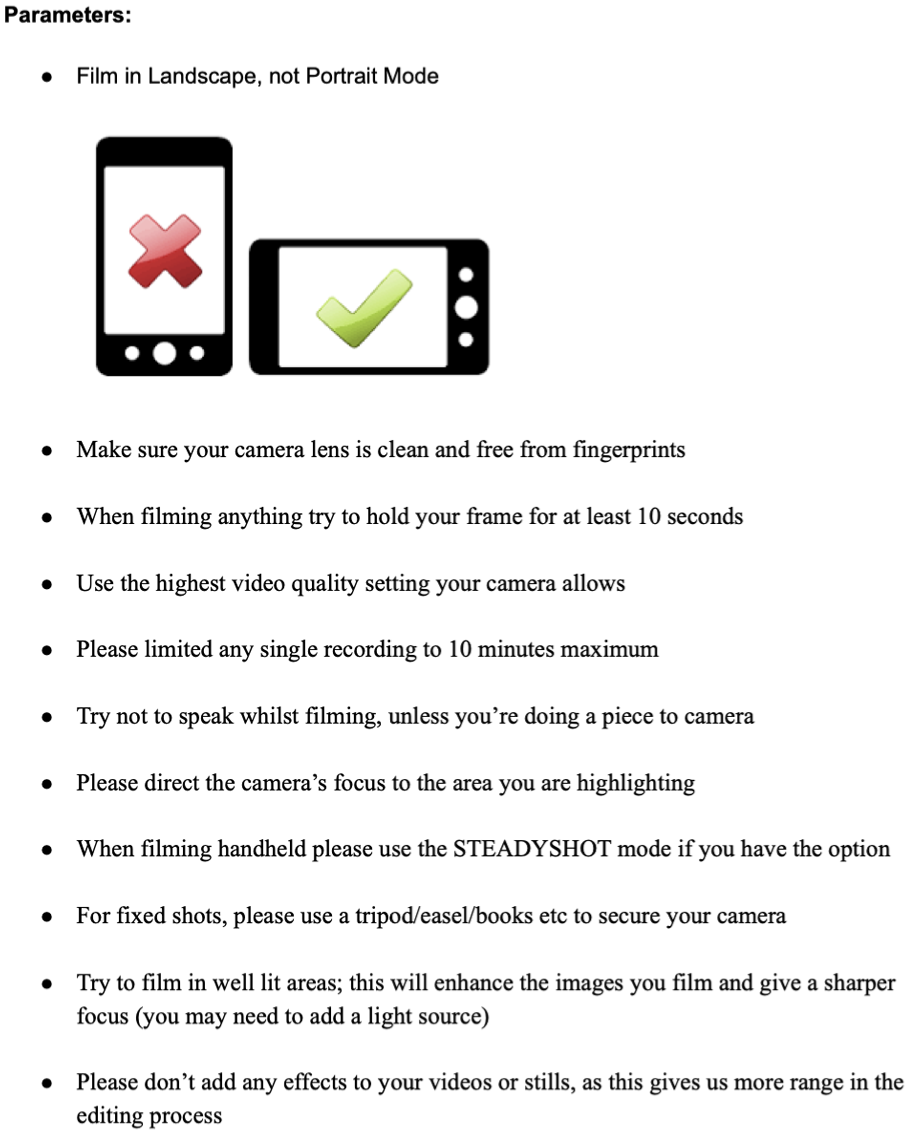
Filming Template for Project Finding Home, Page 2.
As visible from the text in the image above, looseness was intentional. We wanted digital devices not to capture “good footage,” but to facilitate self-inscription—a term used by Denić (Denić in Leurs & Ponzanesi, 2024, p. 50) to describe how participants mark their presence in visual culture on their own terms. To this point, it was critical to keep content suggestions open and simple to enable individual interpretation and choice to take the instructions in different directions.
We were also cautious in this process and were actively considering how to avoid repeating the stereotypical representation of migrants’ journeys and retraumatizing our collaborators as discussed in the previous section. To resist potential voyeurism and objectification, we first tested the blueprint on ourselves. As researchers with our own migrant and diasporic backgrounds, we used the same tools—our phones—to create short films about our own lives at this moment in the pandemic. Coming to this intersectional topic of home and migration from an embodied, intergenerational perspective, we recognize we are not neutral. Both of us have direct and indirect experiences of forced migration which will be elucidated in the analysis of the films in the next section.
This process is what O’Neill (2012) calls ethno-mimesis, a methodological and performative praxis that combines ethnographic, participatory methods and art to represent experience. For us to engage and share ourselves in this way felt like a measure toward more lateral, equitable collaboration. Our goal was not to “give voice” but to hold shared space—to co-create conditions where a multitude of voices could emerge on their own terms. Migrants are not simply subjects of policy—they are artists, thinkers, neighbors, and kin. They are also us. As a team of researchers and artists, we collectively hold nuanced relationships to forced migration and it was a goal in our filmmaking process to see how those specific nuances could be depicted; how each film sits alongside each other to construct new meanings of home-making.
This “alongside” is part of what Thompson (2009) discusses when he notes the criticality of “looking with” especially when working creatively with vulnerable populations who have experienced the trauma of war and displacement. As a counter to many artworks that can diminish those in vulnerable circumstances, by “looking at” them, he offers a concept of “alongside” as a mode toward recognizing the expertise of those with lived experience of being on the move. Artworks that center refugee and migrant voices and invite viewers (or researchers, or policy makers) to see “with” them enables a relational co-production of knowledge that can resist and transcend top-down singular narratives. For us, as artist-researchers with our own migratory backgrounds, this “alongside” took on additional layered meanings.
Finally, our aim with these films was to express life with and beyond migration experience. As noted by Tuck and Yang (2012) earlier, we were mindful not to fall into the trap of only showing how migration histories impact us (thus relegating and fixing ourselves to these sub-altern identities). Our thinking around this was deeply informed by artist Khaled Barakeh, who was working with us on Suspending Home—another strand of Project Finding Home occurring simultaneously with At Home With . . . . Over 3 years of collaboration, he often voiced concerns about representation. As a conceptual artist from Syria, then based in Berlin, he was clear that his work should not cast him as a spokesperson for all refugees or reduce his art to only his migrant identity. While Suspending Home was shaped by his experience of moving from Syria to Germany, his aesthetic choices—such as avoiding faces, layering anonymous voices, and suspending studio furniture on fishing wire—resisted a singular framing of his work, inviting broader reflections on instability and precarity. Our original plan to avoid standard “talking head” formats in the At Home With . . . series (using bird’s-eye views and close-ups) was deepened by turning the cameras over to artists, shifting the project further away from static images of positionality.
Between Hands, Between Lands: Film Analysis of At Home With . . .
This next section analyzes five of the At Home With . . . film series through a primary research finding: that home emerges in an ever-shifting relationship between generations who have moved and continue to move. Through our prompts to film daily walks, meal preparations, and meaningful domestic objects, the individual films unearthed multiple vocal and bodily registers pointing to how home can live between ancestors, ourselves, and the generations after us.
In the section below we will include excerpted text from the film’s audio narration and personal prose, as we reflect on the films we each made as part of the series. These two writing styles are designated in italics and indented text, respectively. Academic writing also weaves throughout this section for analysis.
Beginning with the films that we (Carolyn, Winstan, and Elena) made to test the blueprint, this section then further analyses how the emerging theme of intergenerational home-making unfolded in the other participating artists’ films by Mojisola and d’bi.
Carolyn
In Carolyn’s film (see Figure 4), we see close-ups of a piano and then a series of black and white photographs emerging from behind the piano. Through voiceover, Carolyn reflects on the relationships between her grandparents, migration, and art-making.
A piano
While it is one of the most stationary and grand instruments of stillness is
travelling music
Something about the keys take you places
While the house that holds the keys stands still
In a very grand sort of way
For me, part of home has always been held in a set of small photographs I keep of my grandparents—fragile images that have moved with me, settling on bookshelves for a time before folding up again as I’ve relocated more than ten times over the past two decades. During the pandemic, I pulled them off the shelf alongside a toy piano I had kept from an artwork I made in 2013. Working on a small scale has often given me space to creatively engage with the vastness of the world, and in this juxtaposition of photographs and piano, I began to see a layered relationship between past, present, and future. In 2015, nearly a century after my grandfather left war-torn Poland for the US, I obtained Polish citizenship which allowed me to move from the US to the UK and Europe to live and work as an artist and researcher. Now, in 2020, I sit still in my London home, in a part of the world that is both where I come from and not—not entirely—for the shape of home moves and stands still, moves and stands still.
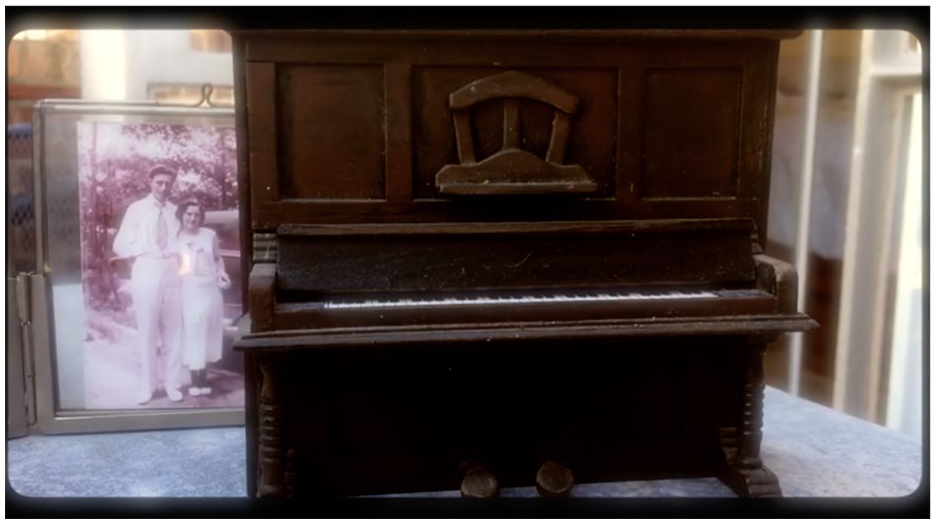
Screenshot From At Home With . . .: Carolyn Defrin.
Watch the full film here: At Home With . . .: Carolyn Defrin (part II)
Winstan
In Winstan’s film (see Figure 5), we see close-ups of a mirror hanging in his bathroom in his home in Stamford Hill, London. As he reflects on the meaning of the mirror to him through a voiceover narration, we also see him using the mirror to get ready to go out.
This amazing mirror I’ve had
Since I can first remember
Being a child growing up in my house in Stamford Hill with my parents
This mirror used to hang in the hallway
Feels like home
It’s very familiar
And if I saw exactly the same mirror
Anywhere in the world
Any position, you know
In a hallway
In a living room
In a bathroom
In a bedroom
It would feel like—wait a minute—
This is really connected to me
This is home
It’s funny how objects can do that to you
But they do if they’ve been in your life long enough
The thing about this mirror it it’s still in my life today
It’s become a family heirloom
Because my parents have now both passed
So it holds memories of my parents which to me represents home
And now this mirror that still hangs in my bathroom
Continues the life of my parents’ home
Born in Ghana 1974, I came to London in 1975 when I was one and a half years young. I was raised in London and went back to my other home in Cape Coast, Ghana for the first time in 2002. Met all my relatives and three brothers for the first time. I was frequently travelling back and forth between the UK and Ghana from 2007 - 2009. Since all my grandparents and parents have left earth, I navigate the two homes through memories provoked by objects, i.e., the mirror, Ghanaian carvings, music, images, conversations, food, smells, and spiritual connections with my ancestors. I recently went to my third home in Jamaica, for the first time in January 2024. I visited my aunty (my father’s sister) and met my eldest sister for the first time ever. This has helped complete knowing my parents more, seeing their roots and having a greater overview of home through my heart.
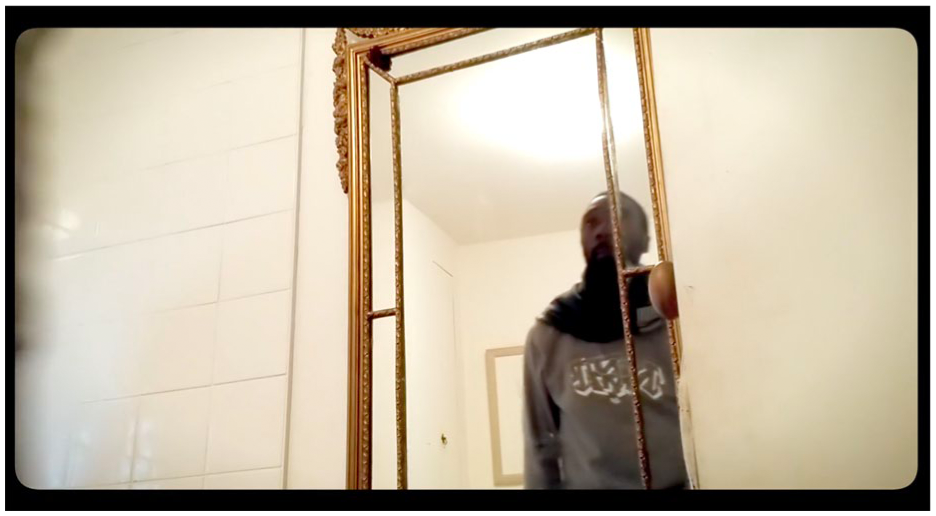
Screenshot from At Home With . . .: Winstan Whitter.
Watch the full film here At Home With . . .: Winstan Whitter
Elena
In Elena’s film (see Figure 6) she walks with her two daughters through their local south London park, which has become a regular ritual during the pandemic. The three take turns reciting different language alphabets: Elena, Macedonian; her youngest daughter: French; her eldest daughter: English. As the three continue to walk, Elena reflects through voiceover about relationships between migration, care, systems, and nature.
“There are other worlds they have not told you of
Worlds that contain you and me in a more caring constellation . . .
We walk . . . I wonder how do I tell you about care . . .
Caring is not a romantic endeavor
Nor an exclusive affair of motherly love
But a matter of earthly survival
Hand, brain and heart must work together now . . .
How can you capture our journey when the language melts
Words disappear
Voices are muted?”
For me home is in the hands of my two daughters. It is also in between, across and around the multiple languages we speak. Having grown up in a civil war, experiencing displacement first-hand as a child, I have since migrated to the UK and spent 11 years (from 2009-2020) navigating the immigration system and the anxieties that accompany constant financial and administrative scrutiny. Finally achieving “indefinite leave to remain status” in the wake of the UK’s exit from the European Union, the pandemic, and now a post-Brexit culture of further fear and discrimination against migrants, play a constant role in conceptualising whether “finding home” is possible.
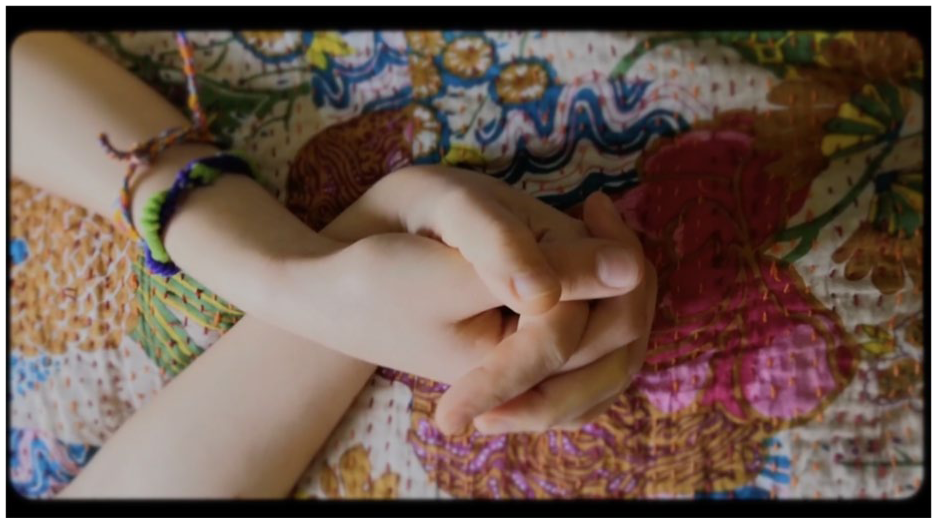
Screenshot From At Home With . . .: Elena Marchevska.
Watch the full film here: At Home With . . .: Elena Marchevska
Through the creation of our own short films, a framework began to emerge, aligning with Brah’s (1996) concept of “homing,” which distinguishes the desire for home from the essentialist yearning for a homeland. Knowing that the United Kingdom has become not only a geographical place for our physical homes, but also a place for us to negotiate past, present, and even future feelings of home, we sense what Brah notes as a dissonance between feeling at home and claiming home—two sentiments that often exist in tension for migrants. But, understanding home as a process, and as what Fathi and Ní Laoire (2024) identify as a continuously constructed series of daily practices and performances, allows for these dualities to co-exist. For Carolyn, the juxtaposition of two domestic objects provokes a sense-making of the pandemic time in 2020 with her own migration journey to the United Kingdom in 2012 and her grandfather’s journey to the United States in 1918. For Winstan, the family mirror passed down to him from his parents, signifies the way in which home continues to be constructed, imagined and re-imagined even after his parents have passed. And for Elena, these dualities emerge through different languages spoken between and across her family–some shared, some differentiated. Where they find home (as a family) moves between these shared languages and expands outwards as her children learn new languages. As each family member recites different alphabets, this playful multilingual exchange subtly reveals a complex layering of belonging and memory. Rather than reinforcing the dominance of a single national language—an increasingly politicized demand in the West, this moment offers an alternative vision of home as plural, fluid, and intergenerational. Language here is not fixed, but palimpsestic: each new tongue overlays but does not erase the others. Echoing scholarship that frames the border as a palimpsest—a layered site of histories, crossings, and reinscriptions 7 —we see how everyday acts like alphabet recitation carry traces of migration, ancestry, and foundational adaptation. For Elena, home is found not in linguistic assimilation, but in the coexistence of languages spoken between and across generations. These linguistic layers do not compete for dominance; instead, they become a shared lexicon through which family, memory, and identity are formed. And equally, for Carolyn and Winstan, familial objects are not only kept, but revered as essential home-making ingredients that sustain where we come from–geographically but also critically culturally and philosophically, and where we will go to.
Our three films resonate with the concept of “home-Home-HOME,” manifesting this constellation that produces specific notions of home and “specific strategies for making home that challenge perceptions and policies of fixity and limbo and unsettle the dichotomy between stasis and movement” (Brun & Fábos, 2015, p. 14).
We expand this analysis through the next two films made by two of the collaborating artists on the project: Mojisola and d’bi.
Mojisola
. . . Where do I come from
Is it connected to what we feed our soul?
The skills I learned from my grandmother who nurtured me in my youth
The colour, the smell, the texture
Brown like me
Soft like me
Proud like me
Organic, earthy, slim
Crown of a recipe and joyful to make . . .
When I think about home there is huge link with food, where is home, what is home,
my grandmother, the soil, the earth, my spirit,?
In Mojisola’s film (see Figure 7), she first sings a song in her mother tongue, then prepares a traditional Nigerian dish while speaking a poem she’s written about home. A sonic collage of humming, sizzling, spoon stirring and beating the pan. A visual palette of greens, red sauces, and cassava root mash.
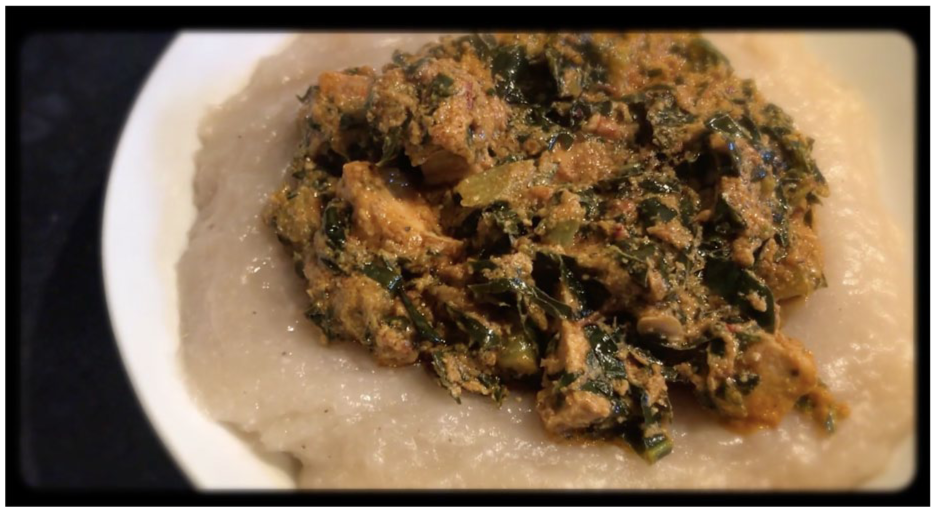
Screenshot From At Home With . . .: Mojisola Elufowoju.
Watch the full film here: At Home With . . .: Mojisola Elufowoju
The palimpsest nature reappears here as Mojisola cooks and wonders if where she comes from links to her grandmother’s cooking and physical appearance. Her relating of home through ancestral links holds a kinship with both Carolyn and Winstan’s films; feeling the presence of parents and grandparents awaken through objects, we also now witness how it emerges through cooking. And also, Mojisola’s film resonates with Elena’s film with a reaching forward into the future. Who is she preparing the meal for?
We originally planned to film Mojisola at the National Theatre in London, where she was a staff director on Inua Ellams’ Three Sisters adaptation in 2020. As the pandemic unfolded, we reached out to her in Sheffield, where she is based, and invited her to film herself in response to our blueprint instructions. The moment we watched her video, we were transported to our first planning meeting, described below in Marchevska’s fieldnotes:
We meet Mojisola Elufowoju FRSA in the Nigerian restaurant Aso Rock in Dalston, London, UK. She comes out of rehearsal from the Arcola theatre, where she is working on the forthcoming production Here’s What She Said to Me (Agboluaje, 2020) While she talks about some of the stories, she is simultaneously giving us advice on what to order. Born in London, Mojisola grew up in Nigeria, where she was looked after largely by her grandmother. She currently runs Sheffield Theatres’ resident company, Utopia Theatre, which focuses on stories of the African diaspora. Together we discussed her artistic achievements and dreams and how Sheffield, a sanctuary city for migrants in the UK, has become her home. At one point, her son pops by with flowers for her, he explains that he needs to travel and will miss her birthday, so an early surprise. We see a confident young man and his mother embrace; he joins us for a quick coffee, and we all get entangled in intergenerational stories of migration. They tell us anecdotes about their lives unfolding between Nigeria and the United Kingdom, he speaks about what it means to grow up black in Northern England. Mojisola uses food references in her discussion of mothering between Nigeria and England. She recalls ingredients and smells, and talks about the processes of making different recipes. Food becomes a mediator and softens the edges of a story that is in places difficult and challenging.
As Mojisola brings her grandmother’s recipe to life, we experience a multi-temporal shape of home which shifts the ideological boundaries of knowledge about to the intimate lived experience of and with someone who is an expert in finding home between time and place. As argued by Bailey (2017), migrants’ sense of belonging is “intrinsically related to the food they bring from home and the memories it generates. The practices of cooking and sensorial experiences surrounding them demonstrate the place and home making processes.” Food is belonging, “grounded in individual memories and family stories, remembered and made real through smells, tastes, sounds, images and relationships” (Bailey, 2017, p. 53).
d’bi
In d’bi’s video (see Figure 8), she films herself in her small home in Hampstead Heath, moving between yoga and dance. With her face obstructed and her body heavily framed by the double reflection of the camera screen into the window, she speaks to a Jamaican ancestor about the complexities of the pandemic and the compounding impact it has on her as a mother who had already chosen to leave her children to pursue education in another country:
Dear Ranka,
I am here
Listening deeply
Moving slowly
Preparing diligently . . .
People are dying Ranka
In the hundreds and thousands
People are dying all over the world
And always have
And always will
I chose to have children in this time
And now my children are 15 and 11
And I
I am navigating hostile waters
Here in the waters where I am the one
Who chose
To be
To be with my doubts and fears
Watching them fall away from me like the leaves of grandmother oak
Feeling exposed without them
Deep in the forest
Without in the forest/without my children
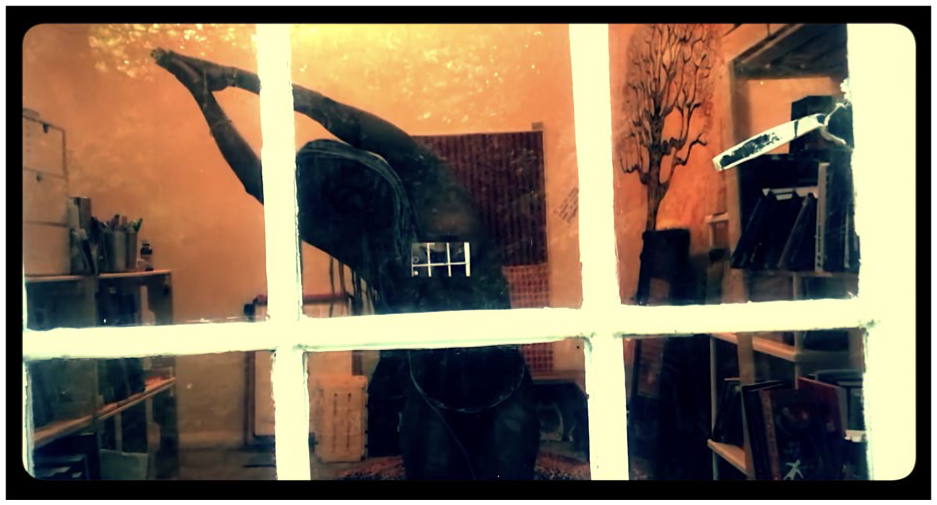
Screenshot From At Home With . . .: d’bi.young anitafrika.
Watch the full film here: At Home With . . .: d’bi.young anitafrika
d’bi’s film echoes this complex temporal in-betweenness of home––between ancestors and children—and sheds nuanced light on the knowledge available in an epistolary (letter-writing) nature that Espiritu and Duong note in several artworks by refugee artists. As d’bi speaks to her ancestor, Ranka, about her present separation from her children and the uncertainties of the future, she invites her listeners into multiple temporalities, resisting a linear, singular journey. In addition, her constantly moving body throughout the film, changing position through a series of yoga poses, helps to contest the mainstream static images of people on the move as “stuck” in one place. This resonates with a concept of home that Fathi (2021) notes as an interplay between bodily senses and spatial dynamics which contributes to a core sense of self. “Placing the body at the heart of discussions on home in migration is also about how bodily presence in social and public spaces can evoke feelings of homeliness or unhomeliness” (Fathi & Ní Laoire, 2024, p. 6). As d’bi places her own body at the center of the film, she directs our eye, deciding where the camera will be positioned and how we will see her. Her voice guides us to think beyond only an external view of her body and to enter her internal thoughts, hopes, and complicated dualities of home. In this way, as noted earlier in Thompson’s alongside, we look “with” her, not only “at” her.
We met d’bi during our pre-pandemic film planning at her favorite Ethiopian restaurant in Brixton and discussed possibilities for filming her walking around this south London neighborhood that she felt a connection to because of its history of Jamaican heritage from the Windrush period onwards. As a poet, she was thinking a lot at the time about the power of words and the power of silence- when choosing silence challenged notions of being silenced.
Looking back now at her film and our pre-pandemic conversations, we sense this multi-layered convergence of not only movement and stillness, but of voice and silence. How, in the last 5 years and particularly in this current moment in June 2025, border regimes are continuously constructing ways to still movement and silence voices. Pressing play again on each of these films we described above enables past, present, and future generations to come forward and continuously construct numerous narratives beyond mainstream media.
Relatedly, this next section shares the continued development of this collaborative filming framework with young students in educational settings.
Evolving the Concept of Being “At Home” with Students in the United States and the Netherlands
Since the completion of Project Finding Home in 2021, the At Home With . . . series has continued through workshops with students in the United States and the Netherlands. These opportunities have enabled us to further test the blueprint with young people at different life stages of navigating home. The first group was composed of high school students at the Hotchkiss School in Connecticut, in the United States, and the second group included graduate students at the University of Groningen, in the Netherlands. Below we will elaborate on the context in which the workshops were delivered and highlight findings from our interaction with the participants.
Hotchkiss School
In 2023, the At Home With . . . series was featured in the exhibition SHIFT: Artists Explore the Complex Condition of Human Migration (Hotchkiss School, 2023) at the Tremaine Art Gallery, affiliated with The Hotchkiss School in Lakeville, Connecticut. This independent boarding school educates nearly 600 students in Grades 9 to 12 (14–18 years old). The multimedia exhibition, curated by the school’s Director of Photography, Film, and Related Media, showcased works in film, animation, photography, installation, and poetry. During discussions with the school staff, we proposed workshops for advanced photography and film students, inviting them to create their own films in response to our blueprint.
We conducted six online workshops with 30 students aged 15 to 17. They viewed the At Home With . . . film series at the gallery, received instructions, and developed their own works. Rooted in SHIFT’s exploration of migration, the workshops encouraged reflection on themes such as cultural assimilation, forced migration, and the refugee experience. Many students, some with migratory backgrounds, also connected these ideas to their own lives as boarding students navigating a new sense of home away from their families.
During the initial workshops, students discussed the themes of migration, often connecting the stories from the At Home With . . . series to their own family stories. Their films reflected nuanced perspectives, capturing moments like cooking traditional meals, exploring the school’s woods, or showcasing sentimental dorm room items. These creative responses also revealed how family, friends, and places remain present through transitions, continuing to teach us that the blueprint can aid in producing “alternative visualities and visibilities that challenge hegemonic communication of migration” (Horsti, 2024, p. 45). Mannay (2015, p. 62) further highlights how “creative methods . . . engender a space where both researchers and participants can move beyond the enclosed world of familiarity.” Such methods help counter one-dimensional portrayals of migration and challenge assumptions about young people’s understanding of their personal and political histories.
In a later debrief, teachers expressed surprise at the care and detail students brought to the task. They appreciated the clear, yet open-ended instructions, which allowed students the freedom to respond authentically. Pedagogically, they saw potential in reusing this approach to address complex topics like migration, noting its ability to provide an accessible entry point into such a contested issue in the United States.
Groningen Workshop
In 2024, we were invited to conduct a workshop with students on the European Studies Master program. Titled “Euroculture: European Politics, Culture, and Society in a Global Context,” this 2-year Erasmus Mundus Joint Master Degree program in European Studies focuses on mobility through theory and the lived experience of the students. Most students had moved countries twice in the past 8 months due to the nature of the Euroculture program, and the majority had just settled in Groningen in the last 8 weeks. With regular challenges in finding accommodation and community, there were common struggles in balancing life, work, and studies. And with almost all of them preparing to move again after the summer for their internships, and then again for their fourth semester, this feeling of being “on the move” would continue as a constant negotiation. The course director informed us “these students are thus very aware of the pleasures and challenges of (voluntary) mobility, and it could be very interesting to explore the suggested themes in relation to your own work on migration and home” (2024).
Focusing on the use of creative methods in migration research, we shared the set of film instructions in advance of the workshop as a prompt for how creativity and lived experience could inform the theoretical aspects of their studies.
Working with 12 students online for a 2-hour workshop, we shared our “Finding home” methodological approaches regarding co-producing and co-analyzing in a participatory and safe way. We then shared the films the students created in response to the blueprint instructions discussing their relations to migration and the topic of mobility. Many students commented that while many of them have studied theoretical and policy approaches to current EU migration laws, very rarely had they thought about how this related to their personal and family journeys as first- or second-generation migrants. Some of the students also discussed how this exercise enabled them to put themselves in the shoes of first-generation migrants—through their own relationships to food, nature, and personal objects, and how this provoked new directions in thinking beyond mainstream media narratives of division and fear.
Concluding Recommendations
The co-creative, visual-art-based method of the At Home With . . . film blueprint offers a multi-layered tool for exploring the transient yet meaningful aspects of home-making in migration contexts. By engaging participants creatively and collaboratively, this methodology has revealed patterns of home-making while avoiding the pitfalls of media sensationalism and journalistic reductionism.
As Younes (2025) provokes in her emphasis on the possibilities for identity and representation that can come from a convergence of knowledges (ancestral, artisanal, artificial, and ecological), a question arises: what kind of stewarding of future narratives do we want to encourage?
As we think beyond this project into our own continued artistic research practices that make use of participatory film on migration related content, we offer the following recommendations informed by our learnings through this project:
Engage as an active participant in the co-production of knowledge. This relational approach fosters trust, collaboration, and vulnerability, even when the researcher does not share the same background as the participants and co-researchers. By embedding yourself in the process, you help create a more equitable environment where everyone is sharing nuanced experiences.
To foster true co-creation, relinquish control over the creative process. Providing a flexible structure, such as the blueprint used in the At Home With . . . series, offers participants the freedom to interpret, innovate, or diverge entirely. This allows for a broader range of perspectives and more authentic storytelling. The recurring tropes—food, nature, objects, and space/place—demonstrated that shared tools can still yield deeply personal and varied interpretations of home.
Common themes, such as family recipes, heirlooms, or reflections on nature, often surface in participants’ work. While these patterns reveal shared experiences, it is essential to avoid fixing their meanings or limiting their interpretive potential. Concepts like “home” are fluid and context-dependent, and the methodology should encourage participants to explore its evolving significance.
The films produced using this method challenge dominant media portrayals of migrants as exclusively vulnerable or one-dimensional. Instead, participants displayed agency, humanity, and ownership of their stories. This co-creative approach provides a counter-narrative to the reductive and sensationalized depictions often found in the media, offering a more nuanced understanding of migration and home.
While our approach has significant strengths, such as fostering speculative and introspective engagement, it also has limitations. Future research could benefit from incorporating focus groups and one-on-one interviews to provide deeper insight into how different age groups and migration experiences shape the concept of home.
Ultimately, we advocate for sharing these methods with both creative communities and scholars in social science and migration studies. By doing so, we can help shift the conversation away from limited, stereotypical portrayals of migrants and toward a more specific and appreciative understandings of our experiences. We hope the strategies and insights shared here inspire new, ethical approaches to addressing issues of representation and collaboration in both academic and creative contexts.
Footnotes
Declaration of Conflicting Interests
The authors declared no potential conflicts of interest with respect to the research, authorship, and/or publication of this article.
Funding
The authors disclosed receipt of the following financial support for the research, authorship, and/or publication of this article: This article from Social Sciences and Humanities Research Council of Canada Grant Number: 175872.
