



Abstract
Can the news help people be more resilient to misinformation? Altay et al. found that news use increases surveillance knowledge and awareness of true and false news, while decreasing belief in false news. We conducted a two-wave panel survey (N = 3,395) to replicate these findings in two new countries: France and Germany. The replication reinforces the conclusions of the original study: we found that higher news consumption predicted greater surveillance knowledge acquisition across the waves, as well as greater awareness of and belief in true news stories. News consumption also increased awareness of false news stories without increasing belief in false news stories. These findings strengthen the idea that news helps people become more informed and better at discerning truth from falsehoods.
Introduction
Journalists serve the public by providing accurate and relevant information to help people understand the world and make informed decisions. Extensive research highlights positive effects of news and legacy media on informing the public, shaping political knowledge, and raising awareness about important issues (Aalberg and Curran 2012). Although these benefits are well documented, researchers increasingly suspect that mainstream news is misinformation’s greatest amplifier (Thorson 2024; Tsfati et al. 2020) and contributes to misperceptions more than untrustworthy websites (Allen et al. 2020, 2024). In addition to making honest mistakes, mainstream news can spread misinformation in attempts to debunk it, raise awareness, or by covering prominent politicians or featuring guests who spread misinformation (Hoes et al. 2024). Even if infrequent, exposure to misinformation through mainstream media is much more impactful because of its mere reach and authority (Budak et al. 2024; Weeks et al. 2021). For instance, the reach of news outlets like the BBC is orders of magnitude larger than the reach of untrustworthy websites such as Breitbart, and they are much more trusted (Newman et al. 2025). Thus, even if the BBC rarely disseminates misinformation, this misinformation may be more influential than if it came from untrustworthy websites. In addition, theoretically, misinformation coming from mainstream news outlets is likely to misinform the public via the well-documented media effects, such as framing, priming, or agenda setting (Hoes et al. 2025; McCombs 2002; Scheufele 1999; Scheufele and Tewksbury 2007). In contrast, untrustworthy websites are more likely to solidify pre-existing beliefs of their core audiences rather than misinforming the general public by persuading them (Anderson 2021; Budak et al. 2024; Jungherr and Schroeder 2021; Miró-Llinares and Aguerri 2021).
Given these competing narratives as to mainstream news having positive effects on knowledge and information acquisition versus amplifying misinformation and generating misperceptions, it is crucial to systematically replicate studies examining both the positive and negative consequences of news consumption. Here, we offer a replication of Altay et al. (2023) who tested the effects of news use on awareness of and belief in COVID-19 misinformation. In a two-wave panel survey in Brazil, India, and the United Kingdom, they found that news use increased people’s awareness of misinformation but not their belief in misinformation (in the United Kingdom, it even decreased false beliefs). They also show that news use increased surveillance knowledge gains, as well as awareness of true news.
In Table 1, we list the similarities and differences between the original article and the current replication. We use the same design, dependent variables, and statistical models. The most important differences with Altay et al. (2023) are that we do not measure online versus offline news use and the use of digital platforms. 1 Also, in the original study, the UK sample was nationally representative, in Brazil, it was representative of the online population, and in India, of the English-speaking online population, whereas in our replication, the samples are not representative and overrepresent women and younger participants because we sampled WhatsApp and Instagram users. We address this issue in the discussion and in Supplemental Appendix A. Most importantly, in Supplemental Appendix O, we show that the results hold when applying stratification weights based on age, gender, and education.
Comparison of the Similarities and Differences Between the Original Article and the Current Replication.
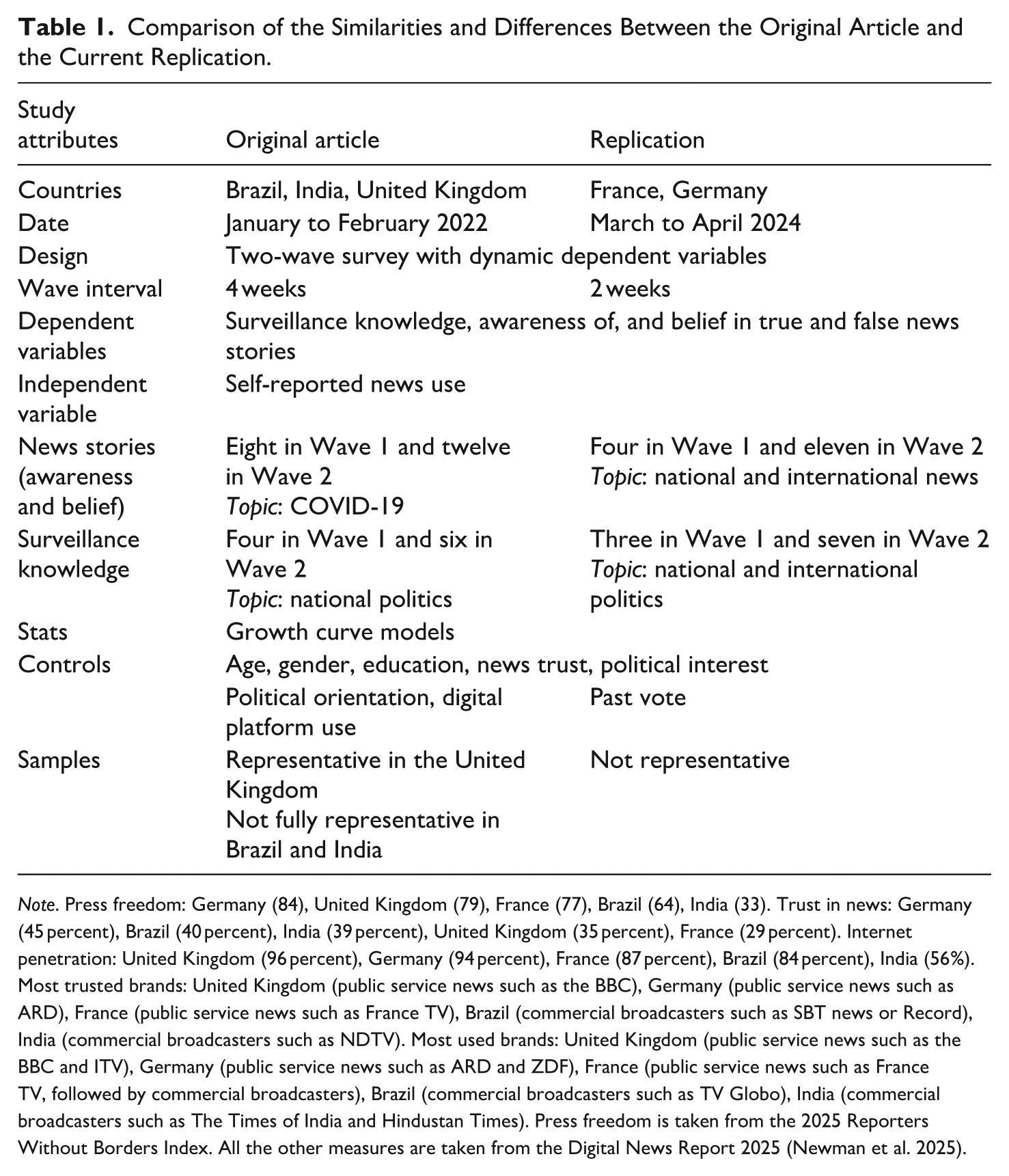
Note. Press freedom: Germany (84), United Kingdom (79), France (77), Brazil (64), India (33). Trust in news: Germany (45 percent), Brazil (40 percent), India (39 percent), United Kingdom (35 percent), France (29 percent). Internet penetration: United Kingdom (96 percent), Germany (94 percent), France (87 percent), Brazil (84 percent), India (56%). Most trusted brands: United Kingdom (public service news such as the BBC), Germany (public service news such as ARD), France (public service news such as France TV), Brazil (commercial broadcasters such as SBT news or Record), India (commercial broadcasters such as NDTV). Most used brands: United Kingdom (public service news such as the BBC and ITV), Germany (public service news such as ARD and ZDF), France (public service news such as France TV, followed by commercial broadcasters), Brazil (commercial broadcasters such as TV Globo), India (commercial broadcasters such as The Times of India and Hindustan Times). Press freedom is taken from the 2025 Reporters Without Borders Index. All the other measures are taken from the Digital News Report 2025 (Newman et al. 2025).
Despite these differences, we offer an informative replication of the original study in two new countries and across consequential topics. We focus on France and Germany to examine whether the effects detected by Altay et al. (2023) in the United Kingdom, Brazil, and India can emerge in other countries. France and Germany are both major Western European democracies with robust public broadcasting services and high press freedom (Newman et al. 2025). Because countries with stronger public broadcasting services have higher political knowledge levels (Aalberg et al. 2010; Goidel et al. 2017; Newton 2016) and are more resilient to mis- and disinformation (Humprecht et al. 2020), the positive effects of news use may be stronger in France and Germany than they were in Brazil and India in the original study by Altay et al. (2023).
Replication Study Methods
Participants
In 2024, between March 1 and March 11, we recruited 2,009 German and 2,021 French participants via the market research company Bilendi. Participants were recontacted between March 18 and 28. The second wave was completed by 1,700 German participants (985 women, Mage = 40.5 (12.5), median education = A two-year college degree, 38% had a bachelor’s degree or more) and by 1,695 French participants (1,042 women, Mage = 44.1 (11.5), median education = finished high school, 31 percent had a bachelor’s degree or more). The median distance between waves was 14 days (M = 13.4, SD = 1.74).
The data were collected as part of an online field experiment (Altay et al. 2025). Participants first consented to take part in the study and answered screening questions related to the experiment about (i) whether they have Instagram and WhatsApp accounts, (ii) how frequently they use them, and (iii) whether they follow a list of social media accounts. To be eligible, participants had to have either an Instagram account or a WhatsApp account, as well as use Instagram or WhatsApp, and not already be following two specific news accounts on social media. In the original study by Altay et al. (2023), such screens were not applied. In Supplemental Appendices C and D, we report all the questions and items included in the replication and the original study.
Independent Variables
We measured news consumption with one question “How often do you access news? By news, we mean national, international, regional/local news and other current events accessible via any platform (radio, TV, newspaper or online).” on an eight-point scale “More than 10 times a day,” “Between 5 and 10 times a day,” “Between 2 and 5 times a day,” “Once a day,” “Between 2 and 3 times a week,” “Once a week,” “Less than once a week,” “Never.” The original study measured news consumption by asking participants how many of the past seven days they accessed news from major brands offline or online. In addition, the original study included the same news consumption question used in the replication, except that it offered three additional response options: “4–6 days a week,” “Less often than once a month,” “Don’t know,” which were rarely selected by participants in the United Kingdom (respectively 4.4, 2.2, and 4.5 percent) and were excluded from the replication. In Supplemental Appendix E, we show that measuring news consumption with one question does not change the main conclusions of the original article, while in Supplemental Appendix F, we show that the removal of these response options does not affect the results of the original article.
Dependent Variables
In the original study, surveillance knowledge – commonly used to assess knowledge acquisition (Boukes 2019)– was measured with four multiple-choice questions in Wave 1 and with two additional new questions in Wave 2 (with five response options, including “Don’t know”). Just like in the original study, we also measured surveillance knowledge across both waves. In Wave 1, we used three multiple-choice questions (with seven options, including “Don’t know”) about national (e.g., the name of a French/German minister) and international politics (e.g., the date of the next European election). In Wave 2, our study participants answered the same three surveillance knowledge questions as in Wave 1, plus four new surveillance knowledge questions about events that took place between Wave 1 and Wave 2 (i.e., we added four new questions, whereas the original study added only two). In the replication and the original study, surveillance knowledge was computed as the sum of correct responses per wave.
In Wave 1, we measured belief in, and awareness of, true and false news stories by asking participants to rate two true news stories selected from mainstream news outlets and two false news stories that have been fact-checked as false by independent fact-checkers. For each story, participants were asked “Before this survey, had you ever read or heard this statement?” ([1] Yes, [0] No, [0] Don’t know/Don’t remember 2 ), and “Do you think this statement is rather true or false?” (from “Completely false” [1] to “Completely true” [8]). In the original study, the news stories were on COVID-19, with participants rating eight news stories, whereas in the replication, they were on national and international affairs, with our participants rating four news stories. Also, in the original study, the wording and the scales was slightly different: “Before taking this survey, had you read or heard this claim?” ([1] Yes, I had, [0] No, I hadn’t, [0] Don’t know/Can’t recall), “How accurate or inaccurate is this claim?” (from [1] “Very inaccurate” to [7] “Very accurate”). In Wave 2, participants rated the same two true news stories as in Wave 1, plus five new news stories about events that took place between the waves. They also rated the same two false news stories as in Wave 1, plus two additional false news stories about events that took place before Wave 1 (we did not find new false news stories circulating between the waves and relied on false news stories that appeared before Wave 1). Just like in the original study, awareness in claims was computed as the sum of “Yes” responses per wave. In the replication, we introduced a placebo news story to control for participants’ tendency to report being aware of news stories they have not encountered. In Supplemental Appendix H, we show that the results are robust to controlling for this.
Covariates
As in the original study, we include three covariates, in addition to age, gender, and education (all described in Supplemental Appendices C and D). First, we measured political interest with the following question: “How interested are you in politics?” (from [1] “Not at all interested” to “Extremely interested” [6]). In the original study, the wording was slightly different: “How interested, if at all, would you say you are in politics?” The response options were the same as in the original study, except that Altay et al. (2023) included a “Don’t know” option – selected by 2.3% of UK participants.
We also assessed trust in news, asking participants “To what extent do you trust the news media and journalists?” (from [1] “Not at all” to “Totally” [7]). In the original study the question was: “We are now going to ask you about trust in the news. Please indicate your level of agreement with the following statement: I think you can trust most news most of the time” (from [1] “Strongly disagree” to [5] “Strongly agree,” with a “Don’t know” option selected by 3.8% of UK participants). Lastly, we measured past votes during the first round of the 2022 presidential election in France and the 2021 federal election in Germany (see Supplemental Appendix C). The original study measured political orientation on a left-to-right continuum (from “Very left-wing” to “Very right-wing,” see Supplemental Appendix D). In Supplemental Appendix I, we show that the results from both studies remain unchanged when excluding past vote and political orientation.
Statistics
Following the original study, we use multilevel growth curve models with random intercepts and random slopes for Wave across participants (Wave|Participants) to account for changes in the dependent variables between waves. In Supplemental Appendix J, we show that the results are identical when using linear regression with clustered standard errors on participants. In the original study, we control for age, gender, education, trust in news, interest in politics, and past vote (instead of political orientation, measured in the original study). Because we use data from an online field experiment, we also control for country, condition (treatment vs. control), and the experimental branch (Instagram vs. WhatsApp). In Supplemental Appendix K, we show that the results are similar when only analyzing the Control Condition, while Supplemental Appendix L shows that the results remain unchanged without controlling for WhatsApp and Instagram.
Results
In Figure 1, we report all the associations between news consumption and the dependent variables and break the results down by countries. We see that the associations between news use and surveillance knowledge, awareness of true and false news, and belief in true and false news are consistent in France and in Germany, with only minor differences in effect sizes.
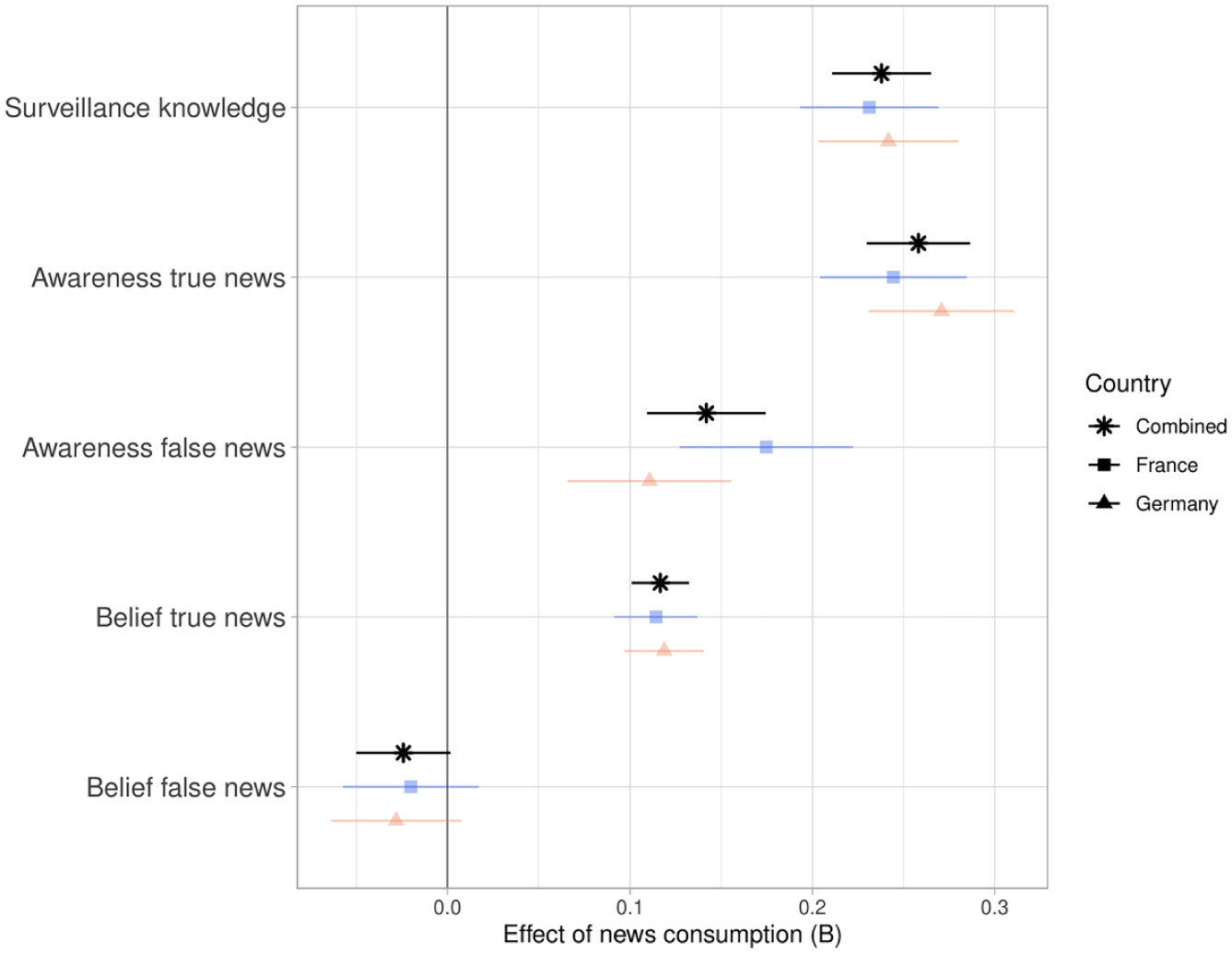
Associations between news consumption at W1 and the dependent variables at W2 (standardized regression coefficients). The black asterisk combined estimates across countries. The blue squares are estimates of the French sample, while the orange triangles are the estimates of the German sample. The lines around the estimates are 95 percent confidence intervals.
Figure 2 offers a visual representation of the relationship between news use at Wave 1 and the outcomes assessed at Wave 2. We see that most of the pink slopes (dashed lines) are steeper than the blue slopes (solid lines), and that the distance between the slopes is greater on the right of the X-axis than on the left. This indicates that the benefits of news consumption across waves are greater among participants who consume more news. For instance, the top of the figure shows that participants who consume the least news had no significant increase in knowledge across waves (as the slopes overlap), whereas participants who consume the most news had the greatest knowledge gains (as the slopes are far apart). This indicates that news consumption is associated with greater surveillance knowledge, awareness of, and belief in true news stories.
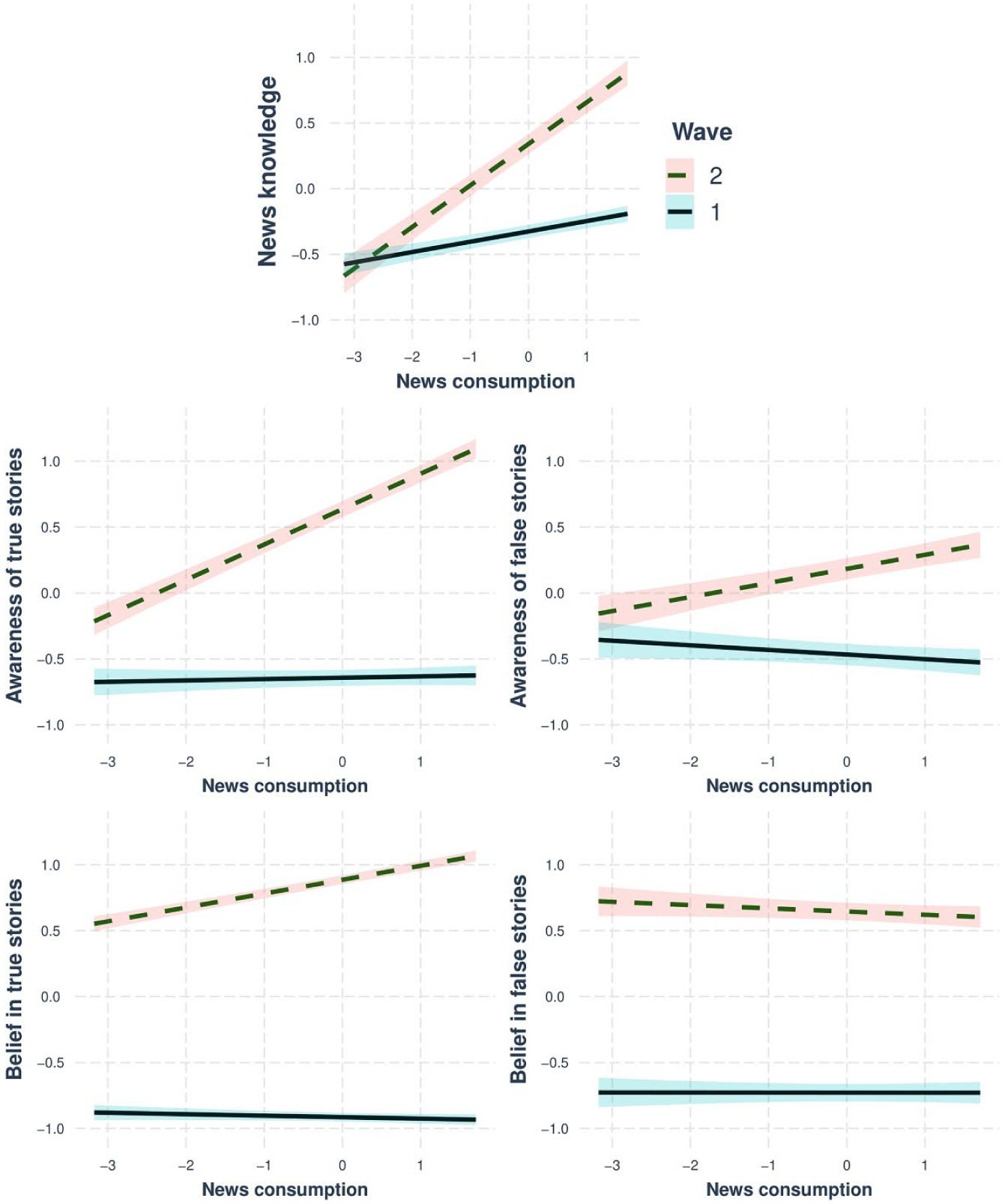
Associations between news consumption at W1 and the dependent variables at W2. The dependent variables are scaled and centered around zero so that their effects are comparable. Predicted values from the statistical models.
Turning to the main statistical analyses, we first find that higher self-reported news consumption in Wave 1 predicted greater gains in surveillance knowledge across waves (β = .24 [.21, .26], p < .001). Participants who accessed news more than once a day had 1.17 additional correct answers to the surveillance knowledge questions across the waves compared to participants who accessed news once a week or less. Second, higher self-reported news consumption in Wave 1 predicted greater awareness of both true (β = .26 [.23, .29], p < .001) and false news stories (β = .14 [.11, .17], p < .001). Participants who accessed news more than once a day became aware of 1.30 additional true stories and 0.39 additional false stories across waves compared to participants who accessed news once a week or less.
Third, higher self-reported news consumption in Wave 1 predicted greater belief in true news stories (β = .12 [.10, .13], p < .001) but not in false news stories (β = −.02 [−.05, .01], p = .07). Across waves, participants who reported consuming news more than 10 times a day acquired belief in one additional true news story (0.96) compared to participants who reported never consuming news.
Discussion
The original article by Altay et al. (2023) found that news use increased surveillance knowledge in the United Kingdom and Brazil, awareness of true news stories in the United Kingdom, Brazil, and India, and awareness of false news stories in the United Kingdom. Replicating these results in France and Germany, we show that news consumption increased surveillance knowledge acquisition across waves, as well as participants’ awareness of and belief in true news stories. Moreover, news consumption increased awareness of false news stories without increasing belief in them, as in the original study in the United Kingdom.
In Table 2, we summarize the standardized effects of news use by country from Altay et al. (2023) and in our replication. We see that, overall, the effect sizes are larger in the replication than in the original study. For instance, the effects of news use on surveillance knowledge are two to three times larger in the replication than in the original study. This difference could be due to the shorter time lag between the waves in the replication (two weeks) compared to the original study (four weeks): some of the items in the replication were more recent and had less time to decay in participants’ memory than in the original study.
Comparison of the Standardized Effect Sizes of News Use in the Original Article and in the Replication.
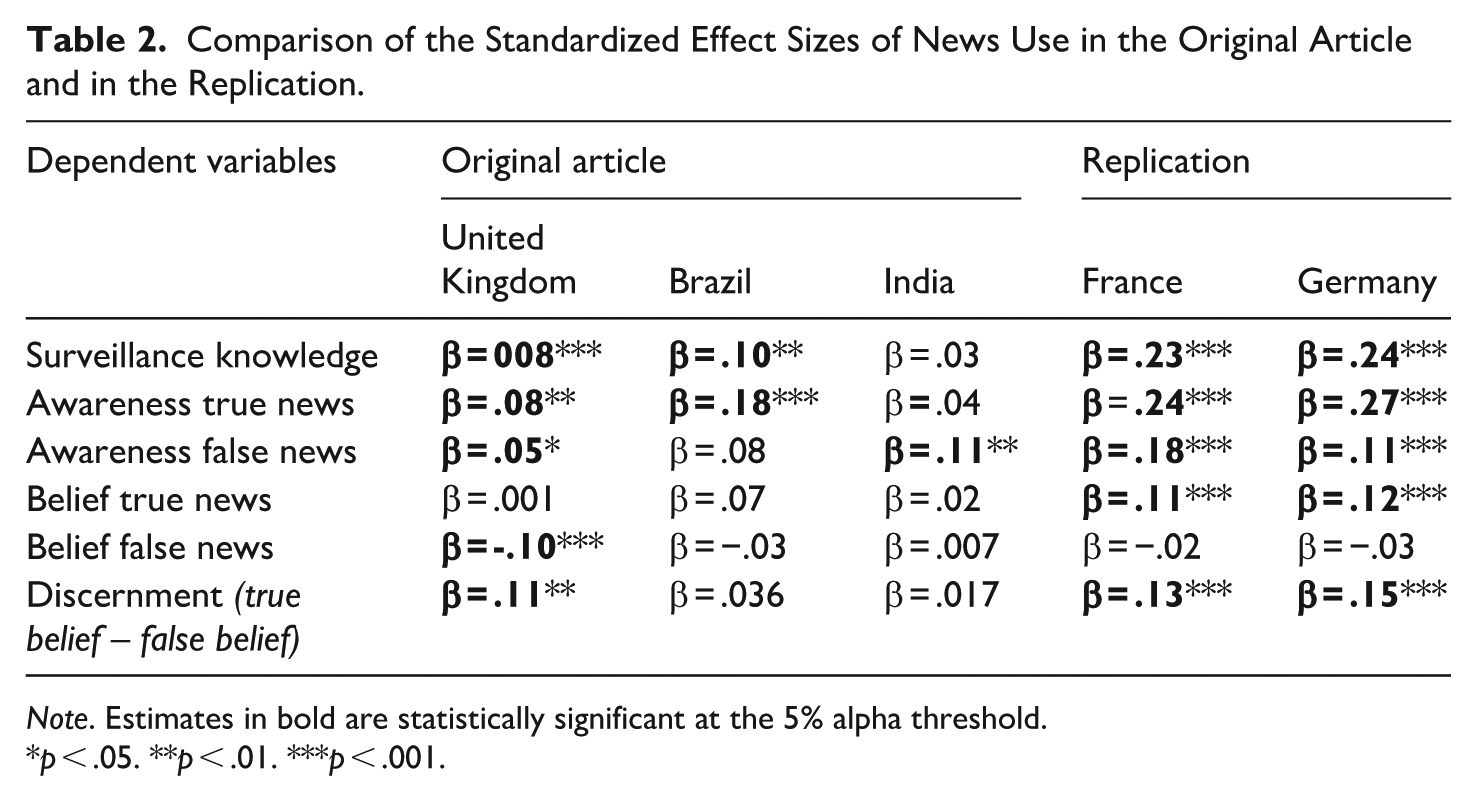
Note. Estimates in bold are statistically significant at the 5% alpha threshold.
p < .05. **p < .01. ***p < .001.
In addition, these differences may be due to the different countries studied in our replication vis-à-vis the original study. Specifically, our replication most closely resembles the UK results and differs most from the Indian results, 3 with the Brazilian results in between. Germany, the United Kingdom, and France have robust public broadcasting services and score very high in press freedom (from 79 to 84), while India scores very low (33), with Brazil in between (64). 4 This suggests that in Western democracies, such as the United Kingdom, France, or Germany, where people mostly turn to trustworthy outlets that cover news accurately (Altay et al. 2022), news helps people become better informed, more aware of both true and false news stories, and better able to discern between true and false stories. This observation aligns with the idea that news effects are contingent on news quality and the news ecosystems, and that quality journalism
and well-funded public broadcast media enhance political knowledge (Aalberg et al. 2010; Goidel et al. 2017; Newton 2016) and make people more resilient to misinformation (Humprecht et al. 2020). As such, in addition to replicating the original study, we expand that work, showing the boundary conditions of news effects on knowledge and misinformation. We note, however, that future work that includes a greater number of countries is needed to systematically test how national media systems, political cultures, party systems, education levels, among other country-level factors, moderate the effects of news use.
A key difference between the original study and our replication is that, while in the UK, news use increased news discernment (i.e., true news minus false news) by reducing belief in false news, in France and Germany, news use increased discernment by increasing belief in true news. This could reflect differences in the selection of news stories: we did not find new false stories that appeared between the waves and relied on generic stories that appeared before Wave 1, while the original study relied on specific new false stories about COVID-19. Similarly, in the original study, the true news stories were relatively niche facts about COVID-19, whereas in the replication, the true news stories were high-profile current events.
In addition to this direct replication, we offer a few extensions of Altay et al. (2023). In Supplemental Appendix M, we show that the positive effects of news use are stronger among participants with higher trust in news and higher interest in politics. This is in line with evidence that individuals with higher trust benefit most from news in terms of reducing beliefs in electoral misinformation (Mont’Alverne et al. 2024). The moderating role of trust could reflect the fact that people who trust news more are more receptive to news content, as trust is an important element of persuasion (Mercier 2020). In Supplemental Appendix N, we show that the benefits of news use were weaker among participants who primarily consume news on social media compared to online websites, radio, or television. This may reflect the fact that news on social media is less informative than on legacy media, possibly due to differences in format, or the fact that platforms often downrank news, and so public affairs information is overshadowed by other content.
The main limitation of this replication and the original study is their reliance on self-reported measures of news use. Due to recall and social-desirability biases (Prior 2009), we may overestimate the baseline levels of news consumption. Similarly, we may be overestimating news effects, as people who report consuming more news may have other characteristics that make them more resilient to misinformation. Although we control for relevant covariates (i.e., education, age, political orientation, news trust, political interest or digital platform use), unobserved variables may explain both the self-reported news use and familiarity with false and true claims (yet, in Supplemental Appendix J, we show that the effects hold when controlling for Wave 1 knowledge, thus our results cannot be attributable to the fact that people who report consuming more news were more knowledgeable in Wave 1). Future work that relies on online behavioral data should test the same effects. Such studies would produce yet another type of replication, namely, whether our findings and those from Altay et al. (2023) replicate with behaviorally tracked news use, which is free from recall and social-desirability biases, but is not free from other limitations (Bosch and Revilla 2022; Stier et al. 2020).
Second, our samples are not representative of the French and German populations and, as such, we cannot generalize our results to these populations. For the initial study, from which we analyze the data here, we had to recruit frequent Instagram and WhatsApp users, which led to this limitation. We note that in the original study by Altay et al. (2023), the Indian and Brazilian samples were also not representative. In Supplemental Appendix O, we apply post-stratification weights that adjust for demographic imbalances in our samples (based on age, gender, and education), and show that the results are robust to these imbalances. In addition, we acknowledge that although panel designs are more informative than cross-sectional designs, they do not allow for strong causal inferences. Further, our replication measured news use by access mode (e.g., online or offline) or type of news outlets. As such, our results may hide important heterogeneity in news use and its potentially different effects. Lastly, future studies should investigate systematically the factors that may explain why news seems to be more beneficial in countries such as the United Kingdom, France, or Germany than in India or Brazil (such as press freedom or the quality of the news ecosystem).
Overall, this replication reinforces the conclusion of the original article by Altay et al. (2023). Even if news sometimes draws people’s attention to false and misleading content (Thorson 2024; Tsfati et al. 2020), it does not leave the public misinformed. Instead, news helps people become better informed, more aware of true and false news circulating in the information ecosystem, and more able to discern true from false claims. These findings should encourage digital platforms to promote, not downrank, trustworthy news sources, encourage digital literacy initiatives focused not only on spotting misinformation, but also on recognizing and attending to verified news, and collaborations with journalists to enhance coverage that encourages users to consume news (e.g., less conflict and negativity, more constructive reporting). Such initiatives are ever more pressing.
Supplemental Material
sj-docx-1-hij-10.1177_19401612251378969 – Supplemental material for News Informs and Boosts Discernment: A Replication in France and Germany
Supplemental material, sj-docx-1-hij-10.1177_19401612251378969 for News Informs and Boosts Discernment: A Replication in France and Germany by Sacha Altay, Emma Hoes and Magdalena Wojcieszak in The International Journal of Press/Politics
Footnotes
Declaration of Conflicting Interests
The authors declared no potential conflicts of interest with respect to the research, authorship, and/or publication of this article.
Funding
The authors disclosed receipt of the following financial support for the research, authorship, and/or publication of this article: The author(s) gratefully acknowledge the support of the European Research Council (ERC Consolidator 101126218, NEWSUSE: Incentivizing Citizen Exposure to Quality News Online: Framework and Tools, PI Magdalena Wojcieszak) and of the Center for Excellence in Social Sciences at the University of Warsaw, which funded the project. The postdoctoral positions of S.A. and E.H. are funded by the ERC under the European Union’s Horizon 2020 research and innovation program (grant agreement no. 883121; PI F. Gilardi). The funders had no role in study design, data collection and analysis, decision to publish, or preparation of the manuscript. Any opinions, findings, conclusions, or recommendations expressed in this material are those of the author(s) and do not necessarily reflect the views of the ERC.
Supplemental Material
Supplemental material for this article is available online.

Data Availability Statement
Notes
Author Biographies
References
Supplementary Material
Please find the following supplemental material available below.
For Open Access articles published under a Creative Commons License, all supplemental material carries the same license as the article it is associated with.
For non-Open Access articles published, all supplemental material carries a non-exclusive license, and permission requests for re-use of supplemental material or any part of supplemental material shall be sent directly to the copyright owner as specified in the copyright notice associated with the article.
