



Abstract
As an institution, journalism relies on several key normative values to claim authority and legitimacy—autonomy, objectivity, and transparency. Although these concepts have been widely studied, most research employs quantitative approaches or focuses on specific beats, often political journalism. Drawing on fifty-five in-depth interviews with Austrian journalists, we examine the meaning of these journalistic values and their relevance in political, lifestyle, sports, and economic journalism. We find that autonomy is universally valued, though commercial influences and pressures are more frequently noted in lifestyle and sports journalism. Objectivity is emphasized in political and economic journalism but less prioritized in “softer” news beats, where subjective perspectives are more widely accepted. Transparency is important across all fields, yet differences emerge between “hard” and “soft” news regarding the necessity to disclose sources or funding agencies. Thus, universality across beats cannot be assumed, and the heterogeneity of the journalistic field, in terms of its application of different normative values, needs to be considered in future studies.
Keywords
The widely reported decline in audiences’ trust in journalism and an increase in news avoidance (Newman et al. 2024; Toff and Kalogeropoulos 2020) have led journalism scholarship to focus on journalists’ performance and audience perceptions of certain journalistic normative values (Garusi and Splendore 2023; Tsfati et al. 2006). Key concepts at the heart of such analyses include autonomy, objectivity, and transparency, which are typically considered vital ingredients for journalistic authority and legitimacy (Carlson 2017; Karlsson and Clerwall 2013; Örnebring and Karlsson 2022).
Yet, while scholarship regularly examines aspects of these values, much of the research tends to assume specific sets of indicators through quantitative approaches (Hanitzsch et al. 2019; Örnebring et al. 2016; Skovsgaard et al. 2013). This has left us with limited knowledge about journalists’ concrete perceptions of these journalistic pillars in their everyday work. However, how journalists talk about normative values and differences in meaning can provide insights into their discursive institutionalization (Schmidt 2008). In addition, the research focus has often been on political journalism (e.g., Donsbach and Klett 1993; Örnebring et al. 2016; Skovsgaard et al. 2013), and we lack a nuanced understanding of how autonomy, objectivity, and transparency are perceived across different journalistic specializations. This is, however, important as journalistic culture, its values and norms vary depending on time and space (Hanitzsch 2007) as well as the journalistic beat they are employed in (Fürsich 2012).
This study addresses these gaps by examining what autonomy, objectivity, and transparency mean to journalists across specializations and what role they ascribe to each value in their work. By comparing in-depth interviews with fifty-five Austrian journalists reporting on political, economic, sports, and lifestyle topics, we find that journalists consider autonomy and objectivity crucial to their work and believe transparency should be prioritized. Differences in the emphasis on autonomy, objectivity, and transparency vary across beats, with sports and lifestyle journalists introducing unique aspects of these values compared to political and economic journalists, suggesting a distinction between “hard” and “soft” news reporting. Our results question the universality of some journalistic normative values, emphasizing the heterogeneity of the journalistic field.
Autonomy, Objectivity, and Transparency as Journalistic Normative Values
Autonomy, objectivity, and transparency are all related to truth-telling (Singer 2007) and are sources for the journalistic field to establish and maintain its legitimacy and authority as a provider of truth and knowledge (Carlson 2017). Scholarship has described these values as examples of the genesis of the journalistic profession as it developed into a distinct field (Örnebring and Karlsson 2022). They have been inscribed in educational texts (Vos 2012) and (re)produced and challenged through education, socialization, and metajournalistic discourse (Krzyżanowski 2014; Vos and Craft 2017) and can thus be perceived as a discursive enactment of journalism as a social institution (Hanitzsch and Vos 2017; Schmidt 2008). From a perspective of discursive institutionalism, journalism can be understood as a system of shared beliefs, ideas, and collective memories that exists as “given (as the context within which agents think, speak, and act) and as contingent (as the results of agents’ thoughts, words, and actions)” (Schmidt 2008: 314). To distinguish itself from other social institutions, journalism engages in internal meaning-making and collective narrativization while claiming journalistic authority and legitimacy as arbiters of truth externally (Hanitzsch and Vos 2017; Carlson 2017). As such, journalists’ discourses around different normative values expose collective narratives, connecting the individual’s perspective to the field’s structure and revealing which normative values are debated or strongly internalized and taken-for-granted (Schmidt 2008; Schultz 2007).
Autonomy
Of the journalistic normative values, autonomy has arguably been entrenched the longest. In fact, as Örnebring and Karlsson (2022: 38) state, “the idea that journalism should be independent even predates journalism itself.” As early as the seventeenth and eighteenth centuries, news writers and printers fought to be independent from the state and to earn the right to print and publish autonomously (Hallin and Mancini 2004; Örnebring and Karlsson 2022). Autonomy can be understood as an essential aspect of what field theory considers the journalistic field’s nomos, its core function for society (Bourdieu 1996), as it “signals to the general public that the field is capable of self-regulation” (Sjøvaag 2013: 163). It is often used as an indicator to distinguish between journalism and nonjournalism or between good and bad journalism (Singer 2015). Autonomy from other institutions and external pressures was crucial in the field’s genesis (Örnebring and Karlsson 2022) and has since become a key marker of journalistic ideology and journalists’ claims of credibility, legitimacy, and authority (Carlson 2017; Deuze 2005).
Consequently, journalistic autonomy has been mythologized and naturalized as a taken-for-granted prerequisite, both by scholarship and the profession. Approaches to what journalistic autonomy should entail are normative (for a discussion, see Örnebring and Karlsson 2022). While the concept includes the notion of freedom (Örnebring and Karlsson 2022: 46), research primarily focuses on the forces that limit journalistic autonomy, primarily commercial and political influences and corporate control (Sjøvaag 2013). However, this emphasizes the structural level of autonomy and does not acknowledge individuals’ means to negotiate and shift issues of autonomy. While individuals must give up some of their personal autonomy to participate in newsrooms (Singer 2007), the collective relies “on a public impression” as autonomous to adequately perform their work (Sjøvaag 2013: 160).
Autonomy is often named by aspiring journalists as a motivation to enter the field (Hanusch et al. 2014). However, only few studies disentangle what autonomy means to journalists as individuals and collective. For example, research finds that journalists struggle to articulate what autonomy entailed for them as they had never thought about it before (Lauk and Harro-Lott 2016), while it was a key boundary marker for journalists to distinguish their work from citizen journalism (Örnebring 2013) and freelancers relying on crowdfunding to discern themselves from traditional newsrooms (Hunter 2015).
Large-scale surveys distinguish between journalists’ personal autonomy in relation to their editorial freedom as well as their perception of structural dependencies (Örnebring et al. 2016). These relate to economic, political, organizational, procedural, and personal network influences (Hanitzsch et al. 2019). However, journalists do not necessarily perceive a causal relationship between influences on autonomy and their personal workplace autonomy (Örnebring et al. 2016), which might be due to the internalization of external factors as “natural aspects of their work” (Sjøvaag 2013: 159).
Objectivity
As another long-standing normative value rooted in the late nineteenth and early twentieth century, objectivity is often quoted to protect journalism’s autonomy from external influences and maintain journalistic authority (Örnebring and Karlsson 2022). In an attempt to professionalize, journalism turned to the “scientific” method of reporting “only the facts” (Vos 2012), a move that has been linked to the development of the commercial press, as more objective newspapers could attract readers across the political spectrum (Schudson 1978). Moreover, the emergence of objectivity as a professional norm has been described as a reaction to the perceived failings of early twentieth-century journalism, like publishing strategic communication as journalism, exaggerating, and stereotyping (Vos 2012). While scholarship emphasizes that the normative value originates in the United States (Donsbach and Klett 1993: 54), it has since found its way into journalistic discourse around the world (Ljungdalh 2024; Skovsgaard et al. 2013).
Definitions of objectivity focus on verifiable facts, accuracy, and the separation of news and views (Ljungdalh 2024; Vos 2012). Wahl-Jorgensen et al. (2017) distinguish further between objectivity as reporting without subjective views and personal opinions; balance as providing equal space to all views involved; and impartiality as providing a broad range of views on a topic. Despite its prominence, the objectivity norm has been strongly disputed as early as the 1920s (Schudson 1978). Common criticism is grounded in the political attitudes of journalists, which might introduce bias, the organizational or structural constraints impacting journalistic work, the socialization of journalists that limits what journalists can view or perceive, and the fact that language always carries connotations that shift in time (Boudana 2011; Coward 2013). More recently, the strategic ritual of objectivity (Tuchman 1972) has been criticized for amplifying elite perspectives, creating a false balance, and reproducing social inequality and power structures (Brüggemann and Engesser 2017; Schmidt 2024; Wahl-Jorgensen et al. 2017).
Survey findings indicate that journalists believe being objective is a key component of “good” journalism (Donsbach and Klett 1993; Skovsgaard et al. 2013; Tsfati et al. 2006). In interview studies, journalists reproduced textbook definitions of objectivity, indicating how ingrained the norm is, also through journalism education (Blaagaard 2013; Møller Hartley and Askanius 2021). Further, research shows that journalists employ objectivity as a boundary marker to exclude citizen journalism (Blaagaard 2013). Yet, interview studies also indicate that journalists believe objectivity is unattainable (Ljungdalh 2024) and have complicated feelings toward the normative value, especially when they have to report on conflict-laden issues (Hunter 2015; Møller Hartley and Askanius 2021), need to navigate issues of false balancing (Boykoff and Boykoff 2004; Brüggemann and Engesser 2017), or are members of a marginalized group (Konieczna and Santa Maria 2023). In addressing these biases, some journalists have turned to more subjective and emotional reporting and reflect their positionality more clearly (Coward 2013; Konieczna and Santa Maria 2023; Wahl-Jorgensen 2020).
Transparency
More recently, transparency has emerged as a normative value in the hope of regaining audience trust in the media and thus strengthening journalistic authority (Karlsson 2010). It has been described as a new strategy of truth-telling and an alternative to objectivity (Hellmueller et al. 2013; Vos and Craft 2017) as it acknowledges the social construction of news, provides audiences with information, and allows an intersubjective understanding of the origin and genesis of a news story (Deuze 2005). Transparency has been linked to openness (Karlsson 2010), sincerity (Phillips 2010), and social accountability (Singer 2007).
Similar to objectivity, transparency has its origins in US journalism (Vos and Craft 2017), emerging in the early 2000s and is linked to the rise of digital journalism as well as “a growing culture of transparency in society overall” (Koliska and Chadha 2018: 2401). Definitions of transparency include disclosure transparency, through which audiences are provided with details on how the news is produced; participatory transparency, which aims to get the audiences involved in the newsmaking process by suggesting focal points in reporting or including audience comments in the news; and availability transparency, which promotes linking to sources as well as news as a living document, including corrections (Karlsson 2010; Vos and Craft 2017). Transparency was adopted early on in digital journalism as the affordances of online newsmaking enabled hyperlinking for disclosure transparency or reciprocity for participatory transparency (Karlsson 2010; Phillips 2010; Singer 2015). Karlsson (2020: 1803) further proposes the concept of ambient transparency, which includes journalists’ opinions and hyperlinks providing “peripheral information” that contextualizes the news story without being part of it.
Few studies so far have investigated how journalists adopt transparency in their work. When asked about objectivity and transparency, US journalists have been found to view factuality as the most important, followed by disclosure transparency and neutrality (Hellmueller et al. 2013). That study further shows that journalists socialized with the internet are more likely to embrace disclosure transparency. Similarly, in metajournalistic discourse, transparency is often viewed as an antidote to objectivity, a “key ethic,” and a “component of journalism’s voluntary and informal system of accountability” in the trade press (Vos and Craft 2017: 7). At the same time, metajournalistic discourse delegitimizes transparency as “the buzziest of buzzwords” (Cunningham 2006, cited in Vos and Craft 2017: 10), rejecting the norm as one introduced by bloggers. Similarly, a study with German journalists shows that most did not see the advantage of transparency (Koliska and Chadha 2018), indicating that it is not yet incorporated as an institutional norm.
The Relevance of Journalistic Values for Journalistic Beats
Neither autonomy, objectivity, nor transparency can be understood as universally applicable to all forms of journalism (Örnebring and Karlsson 2022; Waisbord 2013). Yet, most research has focused on political journalism, leaving a range of blind spots in our understanding of how journalists may view and incorporate these normative values in their work. How journalists talk about normative values can provide insights into their collective narratives and discourses around journalism as a social institution and what is perceived appropriate and acceptable behavior (Hanitzsch and Vos 2017). Moreover, investigating differences in these discourses across journalistic beats can offer insights into which normative values are taken for granted and which might be contested or subject to change.
Some evidence suggests differences between journalistic specializations. For instance, research on economic journalists indicates that they struggle to find neutral experts, which they would require for objective reporting (Harjuniemi 2023). Moreover, lifestyle journalists experience covert influences on their ability for critical and in-depth reporting through free samples and sponsored reporting trips (Hanusch et al. 2020; Rosenkranz 2016). In fact, Hanusch et al. (2017) have argued that while autonomy was established in political journalism for good reason—to enable Fourth Estate journalism—other beats may operate through different institutional logics. At the same time, journalists in different beats compare themselves and their values to political journalism as the default, which might complicate their perception of what entails “good” journalism even further (Banjac and Hanusch 2023).
Likewise, while survey findings indicate that objectivity appears to be a key component of “good” journalism (Donsbach and Klett 1993; Skovsgaard et al. 2013), there seem to be differences between journalists reporting in different beats. For example, political and economic journalists were less convinced than their colleagues reporting on culture and “softer” topics that objective reporting is fully achievable (Post 2015). Similarly, some sports journalists argue that objectivity is not feasible in sports reporting as it requires passion and enthusiasm, which may not always be combinable with an objective approach (Steen 2007). Furthermore, objective reporting in sports journalism is complicated by close relations with athletes, with some journalists behaving more as fans than reporters (Rowe 2005). Therefore, one may argue that the objectivity norm developed in relation to political journalism must be rethought against the variety of journalistic specializations.
Lastly, while research has not yet studied journalists’ perceptions of transparency across different beats, we would expect distinctions here as well. Therefore, we currently lack a comparative exploration of the perceived relevance and meaning of autonomy, objectivity, and transparency across different journalistic specializations. We also have an incomplete understanding of whether the distinction of these concepts is experienced as such by journalists in their everyday work. Thus, we ask the following questions:
Method
We address these questions by drawing on in-depth interviews with fifty-five Austrian journalists across four specializations (political, lifestyle, sports, and economic journalism) and different media types (public and commercial broadcast, national and regional newspapers, magazines, and news agencies). Austria was chosen due to access to its journalistic field. However, Austrian journalistic culture is somewhat typical of Western European countries, as journalists have a strong orientation toward being detached observers and attaching high value to autonomy (Hanitzsch et al. 2019). Like in other European countries, Austrian journalists have tended to be slightly critical toward the objectivity norm (Donsbach and Klett 1993), but recent growth in journalism school education may have led to more acceptance of the ideal (similar to Danish cohorts, see Willig 2016). At the same time, the Austrian media system is highly concentrated and competitive, and both state institutions and media tycoons increasingly exert political influence (Balluff et al. 2024; Grünangerl et al. 2021).
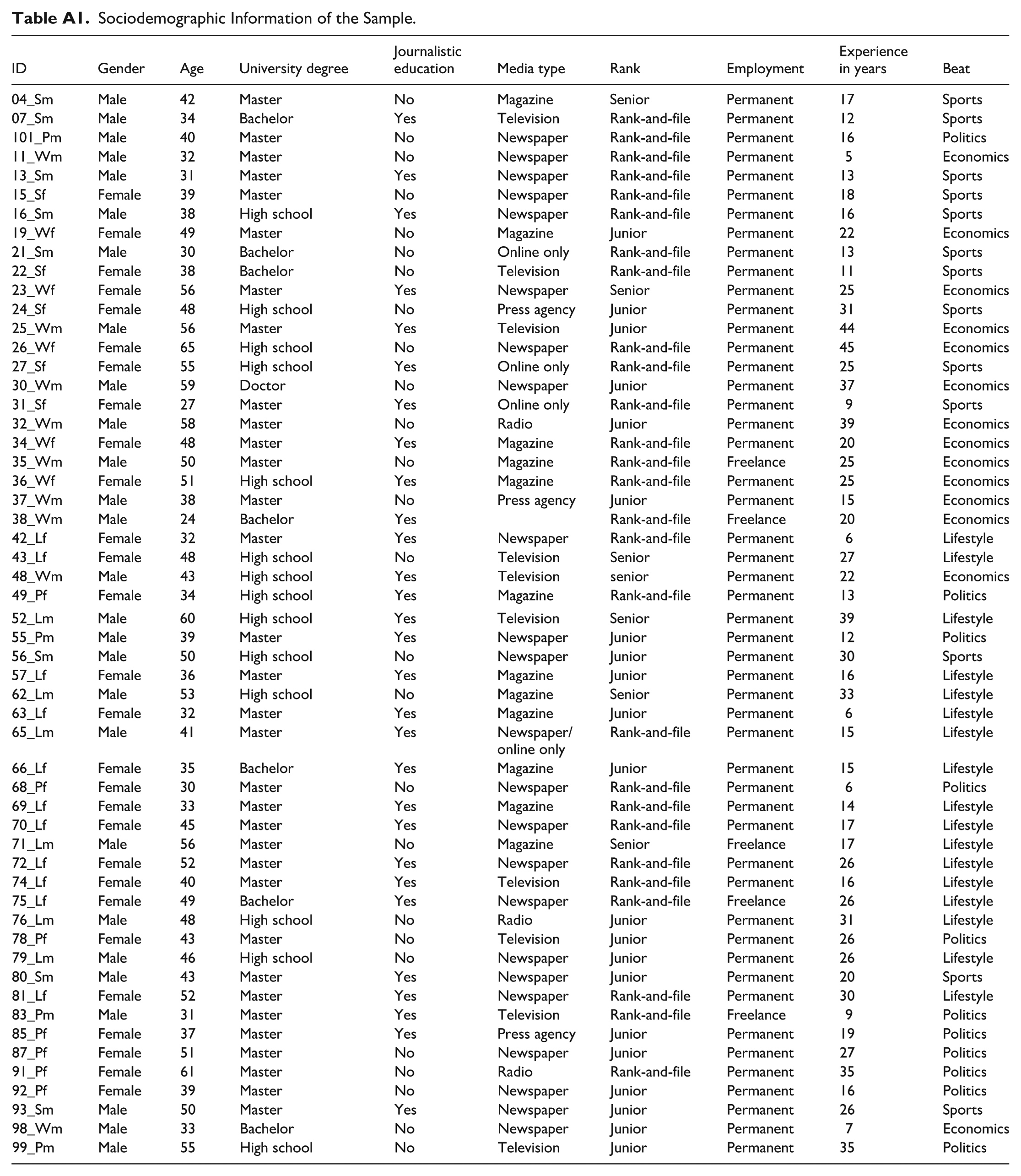
Participants were selected through a purposive sampling approach across different beats and media types. We contacted 168 journalists and received positive replies from fifty-five. Of these, thirty-five worked for print media (local and national media, tabloids and broadsheets, daily, weekly, and monthly media), eleven for television (public service and commercial), three for radio (public service), three for online-only media, and three for news agencies. Seven respondents held senior or executive roles (e.g., editor-in-chief), twenty-one junior management roles (e.g., desk heads), twenty-seven were rank-and-file, and six worked as freelance journalists. Regarding beats, eleven respondents reported on politics, fourteen on economics, thirteen on sports, and seventeen on lifestyle topics. Respondents’ ages ranged from twenty-four to sixty-five years (M = 43.7), and their journalistic experience ranged from two to forty-five years (M = 21.2). Thirty-six held a university degree. Twenty-eight identified as women and twenty-seven as men (see Table A1 in Appendix A). The research design was part of a larger study that received ethical approval from the Faculty of Social Sciences, University of Vienna (ID: 20230120_003), and was pre-registered at the Open Science Framework.
Interviews were conducted between May 2023 and July 2024 by two researchers, with forty-two interviews held face-to-face and thirteen online using Zoom. The researchers conducting the interviews shared a research diary to reflect on the interview immediately after completing it and ensure that the interviews remained comparable. Interview questions related to journalists’ topic selection, their everyday work and how their newsroom was organized, their views on legitimate journalism, and their evaluation of competitors based on aspects of autonomy, objectivity, and transparency, prompting meta-narratives on these normative values. The interview guide’s openness still allowed respondents to consider other values that were important to them. 1
Interviews lasted, on average, sixty-nine minutes (41–108 minutes), leading to sixty-three hours of material in total. The interviews were recorded, automatically transcribed using the General Data Protection Regulation-conforming online transcription service Amberscript (Wollin-Giering et al. 2024), and verified, which served as a first read through the material (Braun and Clarke 2006).
Interviews were analyzed in MAXQDA using thematic analysis (Braun and Clarke 2006) and an iterative deductive-inductive approach (Srivastava and Hopwood 2009). After a first and second reading, the research team met to code a selection of interviews together. For this first coding round, we coded three broad deductive themes, namely instances in which respondents talked about autonomy, objectivity, and transparency. Subsequently, two researchers continued coding all interviews in close conversation about more ambiguous passages. In a second round, the researchers then inductively formed subthemes within these broader themes (Braun and Clarke 2006). These include the meaning and definition of normative values, their relevance for “good” journalism and their everyday practice, and the conflation of values. These findings were then interpreted through existing conceptual frameworks and empirical findings from previous studies (Karlsson 2010; Örnebring and Karlsson 2022; Sjøvaag 2013; Wahl-Jorgensen et al. 2017).
Findings and Discussion
When looking at what role journalists ascribe to autonomy, objectivity, and transparency in their work (RQ1), we find that while they struggled to define transparency and autonomy initially, they had a clear understanding of what objectivity entailed, which included common indicators taught in journalism education and discussed in metajournalistic discourse (Vos 2012) (RQ1a). This indicates that this value is highly internalized to the extent of being orthodox (Schultz 2007). However, journalists also unintentionally conflated autonomy and objectivity in their answers and pointed to the interconnectedness of autonomy, objectivity, and transparency as going “hand in hand to some extent” (48_Em2). Moreover, respondents primarily viewed autonomy and objectivity as important but also believed that transparency ought to be more crucial (RQ1b). Lastly, respondents viewed commercial and political influences, organizational structures, personal standpoints, and their audiences’ awareness as constraining factors when pursuing these values in their work (RQ1c).
When comparing journalists’ perceptions and understanding of autonomy, objectivity, and transparency across beats (RQ2), we find pronounced differences regarding autonomy and transparency, and less so for objectivity, further emphasizing that objectivity as a journalistic normative value, as well as possible criticism of it, are highly present in journalists’ gut-feeling across journalistic beats (Schultz 2007). Furthermore, sports and lifestyle journalists named additional aspects of autonomy and objectivity not mentioned by political and economic journalists, suggesting a distinction between “hard” and “soft” news reporting regarding the relevance and meaning of these values (Banjac and Hanusch 2023). In the following, we detail these findings along the individual normative values.
Autonomy
Journalists’ initial associations with autonomy as a value concerned their personal degree of editorial freedom and structural tensions surrounding autonomy in general. They believed autonomy was “complicated” (98_Em) and “difficult” (57_Lf, 49_Pf) to achieve. Their immediate reaction was to consider their dependencies, noting that autonomy was never completely attainable, as all news media were structurally dependent. At the same time, journalists agreed that autonomy was highly relevant for journalism’s legitimacy, credibility, and role as the Fourth Estate. They referred to their journalism education, which taught them the importance of journalistic autonomy, but found that these aims conflicted with their everyday work. As one lifestyle reporter explained: “In the past, I made the experience that it does not work out as one would like” (65_Lm).
Thus, on the structural level, journalists primarily associated autonomy with being independent from commercial and political influences. Commercial dependency was most frequently named in this regard, as journalists “depend on a market, on readers, on subscribers” (68_Pf), “big corporations” (57_Lf) that owned them, or “state funding” (62_Lm). In contrast to survey research (Hanitzsch et al. 2019: 110–12), respondents rarely linked autonomy with being independent from procedural influences or networks, such as sources. Instead, they were concerned that journalism’s quality was minimized by increasing commercial constraints and that dependencies on advertisers could lead to self-censorship, as when two economic journalists referred to “scissors in your head” (37_Em, 98_Em). Commercial dependence was further seen as a gateway for political intervention (26_Ef). This concern was brought up by many respondents and might be rooted in previous scandals of political intervention in Austria, which was often linked to covert state or party funding through advertisements (Balluff et al. 2024). Political and lifestyle journalists, in particular, believed political autonomy to be more important than commercial autonomy. However, while political journalists articulated this belief for their own work, lifestyle journalists addressed journalism in general, suggesting that the latter had internalized this normative ideal while believing they were not affected by it.
Some journalists also contemplated their personal standpoint, minimizing their autonomy. As one lifestyle journalist argued: In my reporting, I am not allowed to judge, but of course, I have a standpoint, a socio-political and a political standpoint. I am a voter, a politically mature person [. . .], and of course, I generate my stance from this. (43_Lf)
Generally, journalists’ perceptions of their personal autonomy in everyday work reiterate findings from previous studies (Hanitzsch et al. 2019; Örnebring et al. 2016). Respondents viewed themselves as completely or at least partially independent from commercial influences and enjoying a high degree of editorial freedom. However, we also find nuances in their answers. While some said they were “completely autonomous” (52_Lm) or “feel independent” (66_Lf), others noted that they are “relatively free” (21_Sm) or their “whole newsroom strives to be autonomous” (74_Lf) (Table 1).
Autonomy Across Journalistic Specializations.
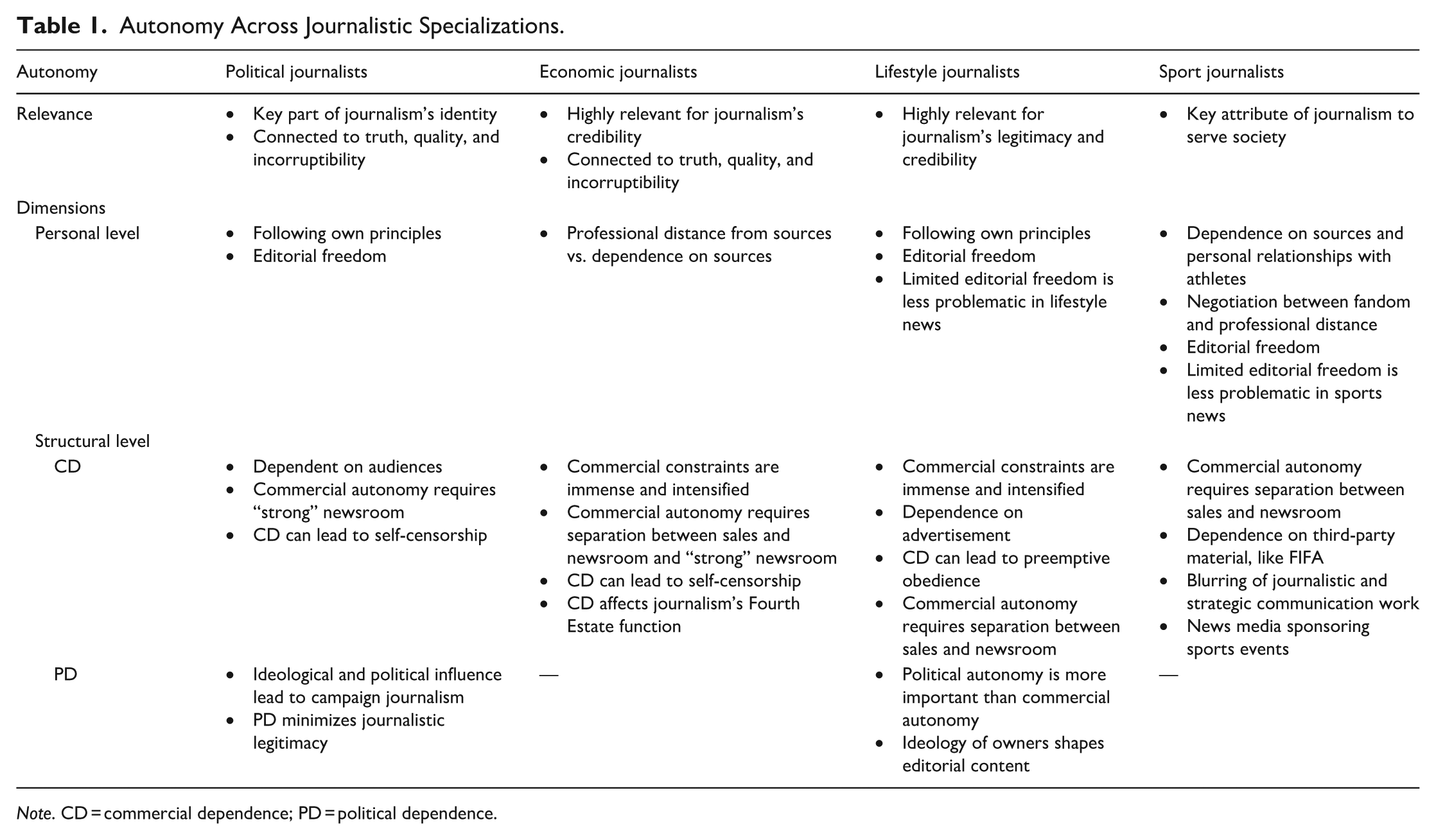
Note. CD = commercial dependence; PD = political dependence.
When looking at differences across beats, we find some additional patterns. While political and economic journalists connect autonomy with truth, quality, and incorruptibility, lifestyle journalists primarily see its relevance in facilitating journalistic legitimacy and credibility. Moreover, while political and lifestyle journalists considered personal standpoints (personal level) as well as commercial and political dependencies (structural level), economic and sports journalists reflected more on their dependencies on sources (personal level) and commercial influences (structural level). All journalists mentioned commercial influences; however, lifestyle and sports journalists discussed them much more prominently.
Lifestyle magazine journalists, particularly, contemplated their dependence on advertising and sponsorship. They recalled experiences where magazine publishing depended on a certain percentage of advertisement sales (62_Lm, 71_Lm). Moreover, they acknowledged that they were often required to create a journalistic “environment” for advertising (71_Lm) and worked in close collaboration with their media organization’s sales department. As one lifestyle journalist stated, “In my opinion, any magazine that claims that sales and editorial are strictly separated is lying because there’s no other way” (63_Lf). This awareness of commercial influences reiterates findings on the dependencies of lifestyle journalism on advertisement, sponsorship, and free products to review (Hanusch et al. 2017).
Another dependency, primarily named by sports and economic journalists, concerned source relationships. Sports journalists believed their colleagues in other fields regarded them as more dependent on their objects of reporting. “The fools from sports” (22_Sf) were viewed as more invested and too close to the athletes they regularly reported on. Economic journalists reported on instances where sources tried to appeal to personal vanities and “place” stories with them, as one journalist explained: “And then on Saturday evening, Sunday morning, they contact you with, ‘Yes, I’ve got a story for you. Exclusive, you’ll get it with an embargo,’ in the hope that you’re just the useful idiot” (11_Em).
Sports journalists introduced another facet of journalistic autonomy: The complexities of sports sponsorship. They acknowledged that sports were a highly capitalist field, with immense sums paid for broadcast rights, and criticized the increasing dependency on specific stakeholders like FIFA or other sponsors who had authority over the visual representation of sports. One journalist noted that he tried to avoid photos with prominent brand logos in his reporting but was unable to do so. This commercial dependency is further complicated as many news media are sponsors of sports events themselves, making them highly involved and corrupting autonomy and objectivity. As one sports reporter argued: “When you are the main sponsor of the Austrian Ski Association [ASA], it is difficult to report independently about the ASA because there is simply a financial component in there” (16_Sm).
Objectivity
Objectivity was largely perceived as a key part of journalistic identity, a source of credibility, and an ideal to strive for but mostly unattainable in practice. Journalists questioned how they could be completely objective when “not even science is objective” (52_Lm) and argued they were “humans and there is no such thing as one truth or 100 percent objectivity” (85_Pf). Instead, they viewed the norm as a reminder guiding their daily practice, for instance, by “remembering that I have an opinion and to remind myself to question it and scrutinize whether I interpret a quote like that because I have this opinion” (49_Pf). Here, journalists drew on organizational strategies to aspire to objectivity but also argued that while a newsroom could be committed to achieving objectivity, individual journalists were responsible for applying these tools.
Journalists first and foremost defined objectivity through the separation of news and views (Vos 2012). For them, objective reporting was primarily about gathering and reporting news without any specific agenda or underlying goals other than informing audiences. Here, journalists stressed an aspect of cleanliness when talking of “clean” (4_Sm) approaches to journalism or “clean separation of facts and opinion” (11_Em). Furthermore, objectivity was related to providing balance, which meant to source against one’s initial hunches and, as one political journalist explained, “not drawing conclusions from something or thinking that someone might provide me with a specific opinion” (49_Pf). Objectivity was further associated with impartiality, which meant including pluralistic viewpoints in journalists’ reporting (Wahl-Jorgensen et al. 2017). Moreover, respondents emphasized the notion of neutrality, which also meant not favoring one position over another or taking a viewpoint for granted. Here, journalists were aware of potential false balancing but acknowledged the difficulty of circumventing it sometimes in structured newsroom practices (Table 2).
Objectivity Across Journalistic Specializations.
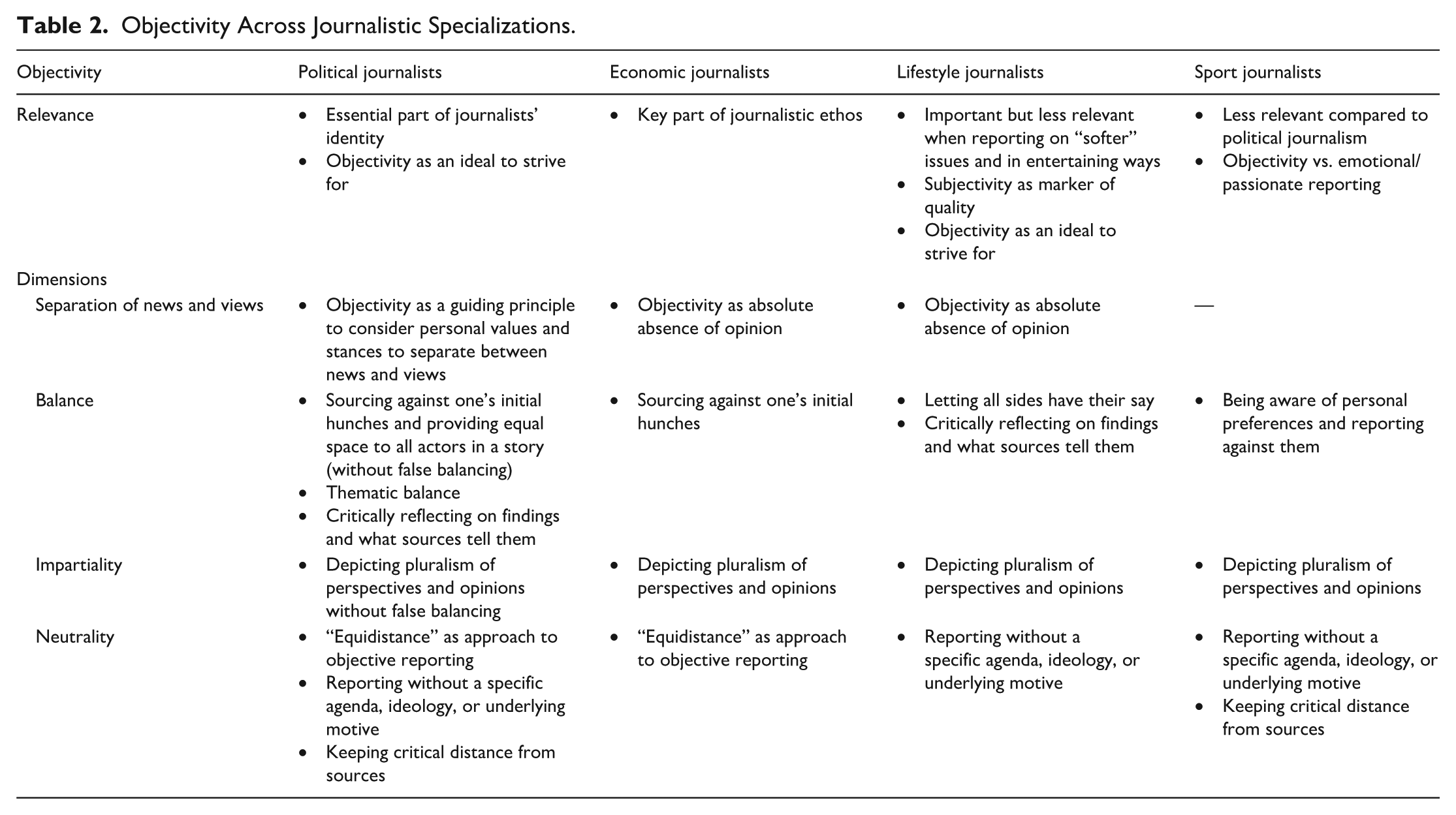
Turning to the differences across beats, we find that while respondents generally perceived the objectivity norm as relevant to their everyday work, journalists reporting on softer news believed they did not have to follow it as strictly. Both lifestyle and sports journalists argued they need not pursue objectivity as strictly as political journalists, especially when their reporting concerns entertaining and nonpolitical topics, like product reviews or sports events, where subjective viewpoints and passionate reporting are essential. While sports journalists argued they were objective most of the time—“a result is a result” (93_Sm)—many acknowledged the difficulty of being objective in close proximity to the sport and the need to transport the atmosphere of events, thus supporting previous studies (Boyle 2006; Steen 2007). In contrast, economic journalists voiced the most rigid definitions of objectivity; they treated it as a key part of the journalistic ethos and defined it as an absolute absence of opinion. In general, economic, lifestyle, and sports journalists’ discourses were less in-depth, while political journalists were much more detailed in what separation of news and views, balance, impartiality, and neutrality mean for their everyday work, indicating that objectivity as a doxa and gut-feeling is much more ingrained in political journalists (Schultz 2007).
Transparency
While journalists had an immediate association when talking about objectivity and autonomy, they struggled with the concept of transparency. Similar to previous research (Koliska and Chadha 2018), respondents were unsure what we meant by “transparency” and had difficulty defining it. However, some believed transparency was an important issue in strengthening journalism’s credibility and regaining audience trust. Overall, respondents thought journalistic media, and their employers, could do more to increase transparency, as there was “plenty of room for improvement” (49_Pf; 23_Ef) and that their employer “has a bit of catching up to do” (91_Pf).
Some journalists touched on availability transparency (Karlsson 2010) when they highlighted establishing a culture of acknowledging errors would be important, which they thought was largely missing in Austrian media (49_Pf, 98_Em). However, journalists’ perceptions of transparency were mainly related to disclosure transparency (Karlsson 2010), which they viewed as increasingly crucial. Journalists argued it was important to explain how and why a story had been selected, what kind of sources journalists had at hand, and that they worked according to “quality criteria” (85_Pf). Journalists further said disclosing their approaches could protect them from audience criticism, for example, by mentioning that they had approached politicians, spokespeople, or others for comment.
One substantial theme relating to disclosure transparency concerned revealing commercial influences and dependencies. Some respondents argued for mandatory disclaimers, agreeing it was important to be transparent about relationships with advertisers, native advertising, and being invited to press junkets. Others believed there was no problem with transparency about commercial influences, as most media communicated them well. At the same time, respondents also believed that audiences did not engage with existing transparency disclaimers. Ultimately, these discourses revealed how journalists viewed their audience as either (1) media literate enough to spot product placement and other commercial influences or (2) not interested in this information or not able to understand disclaimers (Table 3).
Transparency Across Journalistic Specializations.
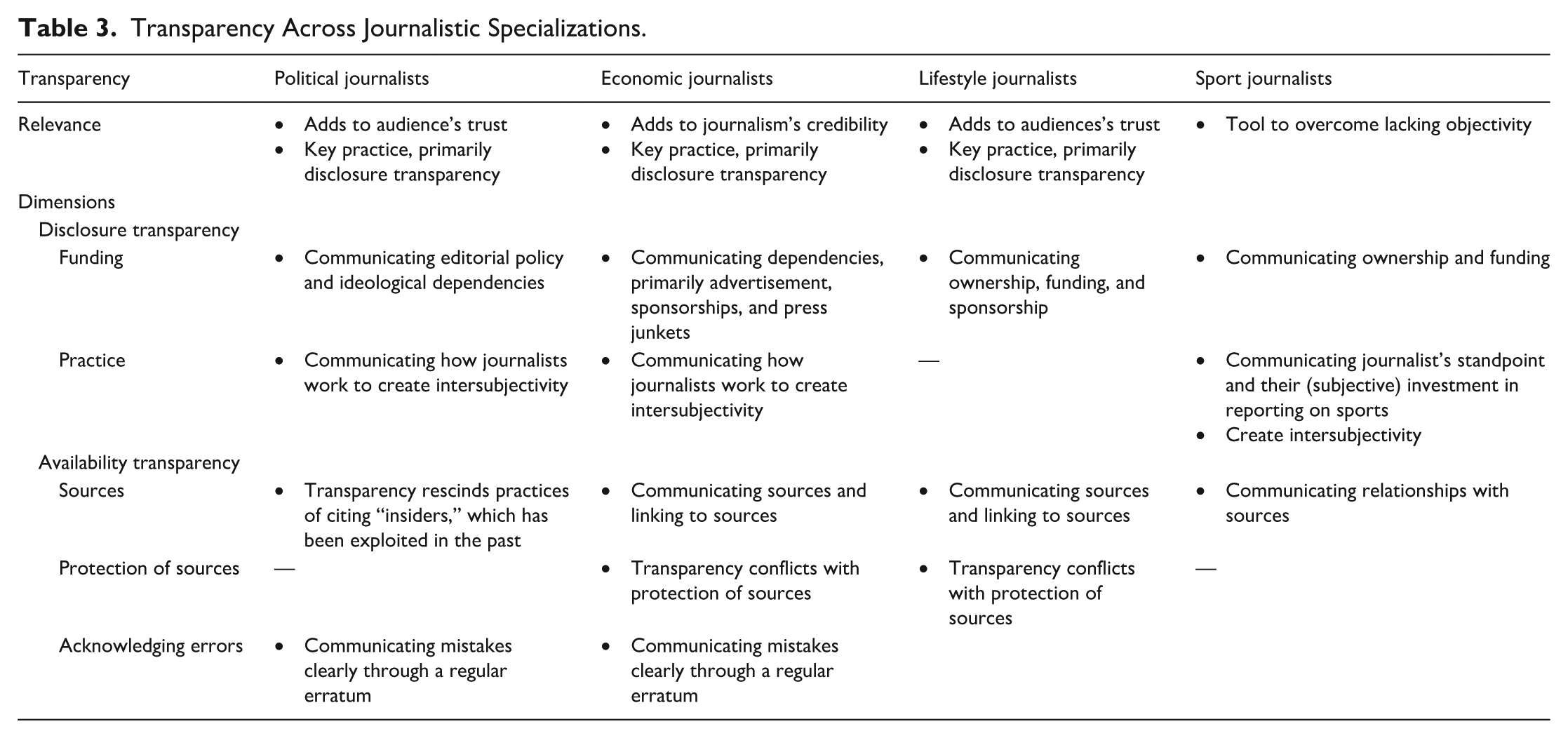
Regarding different perceptions of transparency across beats, we find that associations with disclosure transparency possibly leading to increased audience trust were particularly strong for political, economic, and lifestyle journalists, while sports journalists primarily saw transparency as a tool to overcome lacking objectivity. Thus, sports journalists referred to communicating media ownership, their personal standpoint, and their relationship to sources. Moreover, economic, lifestyle, and sports journalists focused on communicating financial dependencies, while political journalists referred more to communicating their news organizations’ editorial standpoint and ideological dependencies to increase audience trust. This finding suggests that while commercial dependencies are present in all specializations, they are perceived as mediating political dependencies in political journalism. Both lifestyle and sports journalists thought it important to communicate sources; however, only political and economic journalists contemplated the need to disclose mistakes in a regular erratum, further suggesting that making mistakes is viewed as more impactful when it concerns political or economic topics.
Lastly, we find a conflicting approach regarding disclosing sources and source relationships across soft and hard beats. While political and sports journalists emphasized that communicating sources and journalists’ relationships with them could support their truth claims, economic and lifestyle journalists tended to believe that protecting sources contravened disclosure transparency. In contrast, while political journalists acknowledged source protection to some degree, they also thought this practice left room for exploitation by “opening the door to fraud by saying, well, I’ll just make it up and then tell you how an insider reported it, because who wants to prove that it’s not true?” (101_Pm). These negotiations suggest that political journalists might be more accustomed to unethical practices in sourcing due to recent scandals of political influence in Austrian journalism (Balluff et al. 2024).
Conclusion
Overall, our findings emphasize the importance of autonomy and objectivity for journalism’s credibility and legitimacy claims and suggest an increasing relevance of transparency. Journalists agreed on the importance of autonomy and objectivity—especially for “good” journalism—confirming that they contribute to the field’s core function for society (Bourdieu 1996). Likewise, journalists considered transparency—and disclosure transparency in particular—as essential to maintain journalists’ legitimacy as arbiters of truth and regain audience trust (Karlsson 2020; Vos and Craft 2017).
Our results suggest that some dimensions of autonomy and objectivity as journalistic normative values are highly institutionalized—reiterating texts of metajournalistic discourse and journalism education—to the extent of being orthodox (Schultz 2007). These dimensions primarily relate to commercial influences and specific journalistic practices, encapsulating the canonical ideal of detachment (Hanitzsch et al. 2019: 173). Here, respondents referred to their journalistic education, highlighting its role in the socialization and institutionalization of certain values (Vos 2012; Willig 2016).
However, journalists conflated autonomy and objectivity in their answers and argued that both were not easily attainable. This suggests that these values are in tension with similar influences and are entangled in journalists’ perceptions, even though scholarship distinguishes them (Örnebring and Karlsson 2022). Moreover, some journalists pointed to their personal histories and positionality as additional reasons why complete autonomy and objectivity could only be an ideal. This further reiterates arguments from research on journalists from marginalized groups (Konieczna and Santa Maria 2023; Schmidt 2024) and could point to an additional shift in professional norms where journalists aim to make their positionality more transparent (Velloso 2025).
Transparency was generally perceived as an emerging professional norm that could minimize the adverse effects of unattainable autonomy and objectivity. Even though commercial, political, and personal dependencies will always exist, disclosing them could provide a remedy (Vos and Craft 2017). Generally, respondents thought news media could improve their adherence to all three norms, especially regarding transparency. For autonomy and objectivity, our interviews indicate that journalists are nervous about the possible deterioration of both journalistic ideals due to the ongoing crisis in journalism, such as decreasing funding, increasing commercialization, and increasing overt political influence.
Our findings further indicate differences in the meaning and perception of autonomy, objectivity, and transparency. For political and economic journalists, autonomy primarily relates to independence from political and commercial influences, is highly relevant to journalism’s role of the Fourth Estate, and is linked to being able to seek and tell the truth based on facts. Contrarily, lifestyle and sports journalists’ autonomy pertained to less abstract ideals of independence from commercial influences but lived experiences, where advertising sales and large sponsors in sports shape journalists’ reporting much more overtly. These findings reiterate broader market logic and soft beats’ dependence on external commercial actors to produce content (Hanusch et al. 2017, 2020).
Similarly, concerning definitions of objectivity, while journalists from all beats reflected whether objectivity was attainable, some respondents reporting on lifestyle and sports believed they should not have to adhere to this norm, as they (1) believed subjective elements to be central to reporting on sports or provide a review, and (2) did not consider sports and lifestyle journalism as serious a beat as political or economic journalism. This latter finding reiterates scholarship on the symbolic hierarchy in the journalistic field, which is not only forced on journalists working in less prestigious beats but also reproduced through them (Banjac and Hanusch 2023). The findings further emphasize our argument that the objectivity norm, which developed with political journalism, might need to be rethought against the variety of journalistic specializations.
To conclude, in explicitly comparing journalists’ understanding of key journalistic normative values across specializations, our study questions the universality of some of these values, emphasizing the heterogeneity of the journalistic field and allowing for a more nuanced understanding of different dimensions of journalistic authority. We call for scholarship to be cognizant of these differences in future studies, for example, by including items that are also relevant for lifestyle and sports journalists in survey research or by intentionally sampling across beats in qualitative and quantitative research in general.
Furthermore, while this was not at the heart of this study, media type and media ownership intersect with journalistic specialization when it comes to journalists’ understanding of normative values. For example, autonomy and objectivity might be less attainable or more relevant depending on ownership and target audience, while transparency might be perceived as more actionable in digital media (Benson et al. 2024; Buschow and Suhr 2024). Here, future research should more clearly compare the meaning, relevance, and enactment of these values across beats, media type, and media ownership to further understand different institutional logics in journalism. Likewise, research needs to examine the consequences of our finding that key normative pillars are approached differently across journalistic beats. While lifestyle and sports journalists in our study viewed their inability to be autonomous or objective as less consequential since they did not report on political issues, differences could still affect journalistic legitimacy and audience trust in general.
We acknowledge that our approach to interviewing journalists is limited as it excludes to what extent they enact these norms. Moreover, focusing on autonomy, objectivity, and transparency might have prompted journalists to view these values as more important than they are in journalists’ everyday work. However, we believe this was an appropriate approach as we were not interested in whether these values are particularly significant but more in how journalists make sense of them. Instead, by intentionally investigating journalists’ discourses around autonomy, objectivity, and transparency, we can tap into their understanding and meaning-making of these normative values as well as the collective narratives underlying these discourses. Consequently, these discourses can be viewed as an “enactment of journalism’s identity as a social institution” (Hanitzsch and Vos 2017: 120), connecting the individuals’ perspective with the field’s structure. Further, these discourses provide insight into change and continuity of the field’s key vision, what it should be about, and what is appropriate behavior, as narratives articulated across beats can be viewed as strongly internalized and taken-for-granted (Schultz 2007).
Footnotes
Appendix A
Sociodemographic Information of the Sample.
| ID | Gender | Age | University degree | Journalistic education | Media type | Rank | Employment | Experience in years | Beat |
|---|---|---|---|---|---|---|---|---|---|
| 04_Sm | Male | 42 | Master | No | Magazine | Senior | Permanent | 17 | Sports |
| 07_Sm | Male | 34 | Bachelor | Yes | Television | Rank-and-file | Permanent | 12 | Sports |
| 101_Pm | Male | 40 | Master | No | Newspaper | Rank-and-file | Permanent | 16 | Politics |
| 11_Wm | Male | 32 | Master | No | Newspaper | Rank-and-file | Permanent | 5 | Economics |
| 13_Sm | Male | 31 | Master | Yes | Newspaper | Rank-and-file | Permanent | 13 | Sports |
| 15_Sf | Female | 39 | Master | No | Newspaper | Rank-and-file | Permanent | 18 | Sports |
| 16_Sm | Male | 38 | High school | Yes | Newspaper | Rank-and-file | Permanent | 16 | Sports |
| 19_Wf | Female | 49 | Master | No | Magazine | Junior | Permanent | 22 | Economics |
| 21_Sm | Male | 30 | Bachelor | No | Online only | Rank-and-file | Permanent | 13 | Sports |
| 22_Sf | Female | 38 | Bachelor | No | Television | Rank-and-file | Permanent | 11 | Sports |
| 23_Wf | Female | 56 | Master | Yes | Newspaper | Senior | Permanent | 25 | Economics |
| 24_Sf | Female | 48 | High school | No | Press agency | Junior | Permanent | 31 | Sports |
| 25_Wm | Male | 56 | Master | Yes | Television | Junior | Permanent | 44 | Economics |
| 26_Wf | Female | 65 | High school | No | Newspaper | Rank-and-file | Permanent | 45 | Economics |
| 27_Sf | Female | 55 | High school | Yes | Online only | Rank-and-file | Permanent | 25 | Sports |
| 30_Wm | Male | 59 | Doctor | No | Newspaper | Junior | Permanent | 37 | Economics |
| 31_Sf | Female | 27 | Master | Yes | Online only | Rank-and-file | Permanent | 9 | Sports |
| 32_Wm | Male | 58 | Master | No | Radio | Junior | Permanent | 39 | Economics |
| 34_Wf | Female | 48 | Master | Yes | Magazine | Rank-and-file | Permanent | 20 | Economics |
| 35_Wm | Male | 50 | Master | No | Magazine | Rank-and-file | Freelance | 25 | Economics |
| 36_Wf | Female | 51 | High school | Yes | Magazine | Rank-and-file | Permanent | 25 | Economics |
| 37_Wm | Male | 38 | Master | No | Press agency | Junior | Permanent | 15 | Economics |
| 38_Wm | Male | 24 | Bachelor | Yes | Rank-and-file | Freelance | 20 | Economics | |
| 42_Lf | Female | 32 | Master | Yes | Newspaper | Rank-and-file | Permanent | 6 | Lifestyle |
| 43_Lf | Female | 48 | High school | No | Television | Senior | Permanent | 27 | Lifestyle |
| 48_Wm | Male | 43 | High school | Yes | Television | senior | Permanent | 22 | Economics |
| 49_Pf | Female | 34 | High school | Yes | Magazine | Rank-and-file | Permanent | 13 | Politics |
| 52_Lm | Male | 60 | High school | Yes | Television | Senior | Permanent | 39 | Lifestyle |
| 55_Pm | Male | 39 | Master | Yes | Newspaper | Junior | Permanent | 12 | Politics |
| 56_Sm | Male | 50 | High school | No | Newspaper | Junior | Permanent | 30 | Sports |
| 57_Lf | Female | 36 | Master | Yes | Magazine | Junior | Permanent | 16 | Lifestyle |
| 62_Lm | Male | 53 | High school | No | Magazine | Senior | Permanent | 33 | Lifestyle |
| 63_Lf | Female | 32 | Master | Yes | Magazine | Junior | Permanent | 6 | Lifestyle |
| 65_Lm | Male | 41 | Master | Yes | Newspaper/online only | Rank-and-file | Permanent | 15 | Lifestyle |
| 66_Lf | Female | 35 | Bachelor | Yes | Magazine | Junior | Permanent | 15 | Lifestyle |
| 68_Pf | Female | 30 | Master | No | Newspaper | Rank-and-file | Permanent | 6 | Politics |
| 69_Lf | Female | 33 | Master | Yes | Magazine | Rank-and-file | Permanent | 14 | Lifestyle |
| 70_Lf | Female | 45 | Master | Yes | Newspaper | Rank-and-file | Permanent | 17 | Lifestyle |
| 71_Lm | Male | 56 | Master | No | Magazine | Senior | Freelance | 17 | Lifestyle |
| 72_Lf | Female | 52 | Master | Yes | Newspaper | Rank-and-file | Permanent | 26 | Lifestyle |
| 74_Lf | Female | 40 | Master | Yes | Television | Rank-and-file | Permanent | 16 | Lifestyle |
| 75_Lf | Female | 49 | Bachelor | Yes | Newspaper | Rank-and-file | Freelance | 26 | Lifestyle |
| 76_Lm | Male | 48 | High school | No | Radio | Junior | Permanent | 31 | Lifestyle |
| 78_Pf | Female | 43 | Master | No | Television | Junior | Permanent | 26 | Politics |
| 79_Lm | Male | 46 | High school | No | Newspaper | Junior | Permanent | 26 | Lifestyle |
| 80_Sm | Male | 43 | Master | Yes | Newspaper | Junior | Permanent | 20 | Sports |
| 81_Lf | Female | 52 | Master | Yes | Newspaper | Rank-and-file | Permanent | 30 | Lifestyle |
| 83_Pm | Male | 31 | Master | Yes | Television | Rank-and-file | Freelance | 9 | Politics |
| 85_Pf | Female | 37 | Master | Yes | Press agency | Junior | Permanent | 19 | Politics |
| 87_Pf | Female | 51 | Master | No | Newspaper | Junior | Permanent | 27 | Politics |
| 91_Pf | Female | 61 | Master | No | Radio | Rank-and-file | Permanent | 35 | Politics |
| 92_Pf | Female | 39 | Master | No | Newspaper | Junior | Permanent | 16 | Politics |
| 93_Sm | Male | 50 | Master | Yes | Newspaper | Junior | Permanent | 26 | Sports |
| 98_Wm | Male | 33 | Bachelor | No | Newspaper | Junior | Permanent | 7 | Economics |
| 99_Pm | Male | 55 | High school | No | Television | Junior | Permanent | 35 | Politics |
Acknowledgements
The authors would like to thank Miriam Donauer for her support in verifying automated transcripts. Further the authors would like to thank the three reviewers for their constructive comments.

Ethical Considerations
This study was assessed by the Institutional Review Board of the Faculty of Social Sciences (IRB) at the University of Vienna, which confirms that the Research Ethics Screening has classified the project in the category of minimal ethical risk, ID: 20230120_003.
Consent to Participate
Participants for this study provided written consent to participate after having been informed about the purpose of the study and any potential risks involved with it.
Funding
The authors disclosed receipt of the following financial support for the research, authorship, and/or publication of this article: This research was funded in whole or in part by the Austrian Science Fund (FWF) [10.55776/P35317]. For open access purposes, the author has applied a CC BY public copyright license to any author accepted manuscript version arising from this submission.
Declaration of Conflicting Interests
The authors declared no potential conflicts of interest with respect to the research, authorship, and/or publication of this article.