



Abstract
Russian state propaganda outlets Russia Today (RT) and Sputnik are an important part of Russian foreign policy and key global sources of disinformation. Previous work has argued that they focus on exploiting social divisions among foreign audiences and worried that Russian propaganda may influence the broader media agenda. To date, though, there has been no comprehensive study of what RT and Sputnik actually cover, or any quantitative analysis of their influence on other coverage. We analyze 4.7 million English-language news articles from RT, Sputnik, and sixty-seven other news outlets linked to on Facebook from 2017 to 2021, articles that collectively generate 22.6 billion user interactions. Contrary to assumptions in previous studies, RT and Sputnik gave modest attention to US domestic politics, focusing instead on a set of geopolitical issues including the Middle East, armed conflicts, and international statecraft. Using a VAR model, we show that RT and Sputnik Granger-cause coverage on its high-priority issues across all categories of US media: center, left-wing, right-wing, and far-right. On domestic issues, RT and Sputnik follow center and far-right outlets instead of leading. Our study is an important corrective to earlier scholarship, which has overstated RT and Sputnik’s engagement with US domestic issues and blurred the specialized roles different Russian organizations play in malign influence operations.
Introduction
Russian state-sponsored media outlets RT (formerly Russia Today) and Sputnik are large-scale producers of pro-Kremlin propaganda and disinformation, and they often use social media to amplify their messaging (Elswah and Howard 2020; Office of the Director of National Intelligence [ODNI] 2017; Paul and Matthews 2016; Wagnsson 2022). Policymakers and even heads of state have denounced these outlets as “lying propaganda,” 1 and worried aloud that their coverage may influence non-Russian media. The war in Ukraine, ongoing as of this writing, has also reinforced the importance of understanding Russian propaganda’s potential influence on Western public opinion. For example, previous research has shown that exposure to negative information about Ukraine can lower Americans’ assessment of the Ukraine government, even when they are aware that RT is the source of the information (Fisher 2020).
However, key questions about RT and Sputnik’s coverage and influence have remained unanswered. First, to date, there has been no comprehensive analysis of the topics these outlets actually cover. While recent scholarship has examined RT and Sputnik’s organizational behavior (Elswah and Howard 2020) and tactics on specific issues (e.g., Bradshaw et al. 2022, Moore and Colley 2022), there has been no systematic study of their overall news strategy and focus. Second, there has been no data on which RT and Sputnik stories generate the most user engagement on social media. Likes, shares, and comments strongly predict content visibility, as user interactions both reflect and amplify reach on platforms like Facebook. Third, there has been no rigorous and systemic analysis of whether and how RT and Sputnik’s reporting shapes coverage by other media outlets. Policymakers have worried about Russian propaganda’s impact on domestic media in the United States and Europe, but evidence for RT and Sputnik’s day-to-day influence on the news agenda has been limited.
This article addresses these questions with one of the largest studies of its kind to date. We analyze 8.5 million English-language news articles from sixty-seven different US news outlets posted on Facebook between 2017 and 2021. Our corpus includes nearly all content published by RT, Sputnik, far-right media (n = 14), right-wing media (n = 19), centrist media (n = 23), and left-wing media (n = 11). We analyze article text alongside Facebook user engagement data licensed by NewsWhip, a social media listening firm. Altogether, our news story corpus generated more than 22.6 billion user interactions, accounting for most of Facebook interactions on English-language political news during this period. We use structural topic modeling (STM) to identify the topical focus of each article, and vector autoregression (VAR) models to explore the direction of relationships between news outlets.
Our data show that both RT and Sputnik’s issue coverage diverges strongly from other outlets in our sample. Both RT and (even more strongly) Sputnik are focused on a small set of geopolitical topics, subjects such as the Middle East, armed conflicts, and international statecraft. While previous research portrays these outlets as “partisan parasites” (Moore and Colley 2022) focused on “causing chaos” (Elswah and Howard 2020, Zelenkauskaite 2022) in Western liberal democracies, divisive domestic topics are a small portion of their coverage and user engagement.
Worryingly, we find clear evidence of Russian propaganda’s ability to shape the news agenda on the geopolitical topics it cares about most. RT and Sputnik’s coverage Granger causes additional coverage on these topics across all four categories of US outlets: ideologically centrist, left-leaning, right-leaning, and far-right. By contrast, on divisive domestic issues, RT and Sputnik consistently follow centrist and far-right outlets (though not left-wing ones). Our work offers a fuller understanding of Russian propaganda strategy, showing how RT and Sputnik operate in ways distinct from other state institutions, and illuminating an important vector through which Russian propaganda influences the US media environment.
Literature Review
RT and Sputnik
State-sponsored media outlets are a crucial instrument of Russia’s defense and foreign policy, alongside online trolls, spies, and hackers (DiResta et al. 2022; Freelon et al. 2022; Jamieson 2018; Linvill and Warren 2020). RT, formerly known as Russia Today, was founded in 2005 as a “24-hour English-language channel” with at least $30 million in (publicly known) Kremlin funding. It has since added op-eds and analysis, now operates in six languages, and has developed a strong presence on social media (Furman et al. 2023; Hastings 2020). Sputnik, a subsidiary of Russian government-owned news agency Rossiya Segodnya, has embraced the appearance of a normal news wire service since its 2014 founding. Subtler in tone than RT, Sputnik publishes content in more than thirty languages and maintains bureaus in Washington D.C., Paris, Beijing, and Berlin.
Despite their journalistic appearance, RT’s and Sputnik’s primary goal is to advance the interests of the Russian state. Rossiya Segodnya, the organization that owns and controls Sputnik, stated that its mission is to secure “the national interests of the Russian Federation in the information sphere” (U.S. Department of Justice 2018). Margarita Simonyan, the chief editor of both RT and Sputnik, explicitly referred to RT as an information weapon (U.S. Department of Justice 2018). Similarly, Russian president Vladimir Putin declared that the goal of both RT and Sputnik is to “break the monopoly of the Anglo-Saxon global information streams” (Rutenberg 2017). Scholars have noted continuities between Soviet kontrpropaganda and RT and Sputnik’s aggressive counter-framing tactics, which seek to undermine negative portrayals of Russia and shift the news agenda in favorable ways (Henriksen et al. 2024; Kuznetsova 2018, 2023).
There is little dispute that RT and Sputnik serve primarily as a defense and foreign policy instrument for the Russian state. However, scholars disagree on how RT and Sputnik advance Russia’s strategic interests. In the following sections, we give a brief overview of two major approaches to treating RT and Sputnik. The first approach views RT and Sputnik as a tool of public diplomacy, and the second, a more prominent approach in the field of communication, considers them as a tool to sow chaos in the West.
A Tool of Public Diplomacy
Public diplomacy is defined as efforts to manage the international environment through engagement with a foreign public (Cull 2009). The goals of public diplomacy often involve increasing awareness of a country’s policies, establishing a positive reputation, and/or increasing its influence among the international community. International broadcasting, as Cull (2008) argued, is one of five key tools to achieve these public diplomacy goals. It plays a crucial role in creating favorable news agendas, representing the country positively, or delivering messages that advocate the country’s policies (Simons 2014).
For Russia, a key task of public diplomacy is countering negative narratives about Russia by Western media (Just 2016; Simons 2014). In the document “Doctrine of Information Security,” outlets such as RT and Sputnik were tasked with stemming the “flow of negative and non-objective information about Russia” (Yablokov 2015). Multiple studies found that RT focused on justifying Russia’s foreign policy, promoting key Russian achievements, or defending its military activities. For example, Hastings (2020) found that both RT and Sputnik justified Russia’s 2014 invasion of Ukraine as supporting Crimean self-determination. Other studies focused on RT’s activities on social media, revealing similar patterns. Orttung and Nelson (2019) found that RT’s strategy on YouTube focuses on strategic geopolitical areas outside the West, including Syria and other parts of the Arabic speaking world. Crilley and Chatterje-Doody (2020) showed that RT used moral and legal justifications to legitimize Russia’s intervention in the Syrian Civil War on YouTube. Furman et al. (2023) revealed that Sputnik’s Turkish Twitter account promoted Russian vaccine technologies in Turkey.
Taken together, then, this body of scholarship portrays RT and Sputnik primarily as a public diplomacy tool to counter Western narratives and shift the media agenda in ways that favor Russia’s strategic goals. Experts have highlighted a consistent set of issues Russia views as being of key geopolitical importance: political events and conflicts in the Middle East and North Africa; Russia’s strategic partners such as China and North Korea; developments in the oil and gas industry (the economic linchpin of Russia’s economy); arms sales and the Russian defense industry; NATO expansion; and conflicts in which Russia directly participated (Georgia, Syria, 2 Ukraine).
A Tool to Sow Chaos
Other researchers have portrayed RT and Sputnik as a tool to sow chaos in the West, a primary goal of “active measures” against Western liberal democracies. “Active measures” are disinformation campaigns organized by the Russian state to weaken a targeted adversary via “driving wedges between ethnic groups, creating friction between individuals in a group or party, [and] undermining the trust specific groups in a society have in its institutions” (Rid 2020: 12).
As Kragh and Åsberg (2017) argued, active measures is distinct from public diplomacy in that it seeks to “hamper the target country’s ability to generate public support in pursuing its policies” (p. 7). While Russia’s public diplomacy efforts focus on managing its own reputation internationally, active measures aim to weaken its adversaries—usually by sowing discord and division among their societies. The KGB was well-known for conducting active measures against the United States during the Cold War. For example, it published forged letters about the Kennedy assassination, suggesting CIA’s involvement in the killing (Holland 2004); it also spread the conspiracy theory that the United States manufactured AIDS at a military facility in Maryland (Boghardt 2009; Selvage 2019).
Many scholars have portrayed RT, Sputnik, and their subsidiaries’ primary goal as “sow[ing] chaos” in the West (see Elswah and Howard 2018; Zelenkauskaite 2020). Their analyses focused on RT’s and Sputnik’s coverage of divisive issues in Western liberal democracies (e.g., Ramsay and Robertshaw 2018). For example, Moore and Colley (2022) studied RT’s coverage of the US 2020 election and argued that RT operates what they termed the partisan parasite model, with RT mimicking the coverage of a US right-wing media outlet by promoting Trump and amplifying election fraud claims. Similarly, Kuznetsova and Makhortykah (2023) found that RT promoted anti-Biden content with a focus on anti-establishment narratives on Facebook during the 2020 election. In their study of Russian state media’s Facebook posts on the Black Lives Matter (BLM) protests, Bradshaw et al. (2022) found that RT and Sputnik covered BLM critically, whereas newer Russian outlets such as Ruptly covered the protests positively and concluded that Russian state media play both sides. In addition to these two US examples, other scholars studied how RT and/or Sputnik sow chaos in the Netherlands, Denmark, Norway, Sweden, and Finland (Deverell et al. 2021; Hoyle et al. 2023; Wagnsson 2022; Wagnsson et al. 2023). All these studies hold a key assumption about RT and Sputnik, namely that these two media outlets advance Russia’s interest primarily by sowing chaos in the West “instead of representing Russia positively” (Elswah and Howard 2020: 640).
Given the clear conflict between those two portrayals of RT and Sputnik, it is crucial to bring systemic data analysis into the study of these outlets. Past research has leaned heavily on case studies and subjective, impressionist accounts, but there has not been a comprehensive study of the entire body of news coverage from RT or Sputnik. To understand RT’s and Sputnik’s coverage, we first ask, what topics did RT and Sputnik cover between 2017 and 2021 (RQ1a)? More specifically, how much attention RT and Sputnik gave to geopolitical topics vs domestic, divisive topics (RQ1b)?
User Engagement
Studies of media influence need some measure of audience and impact beyond just the volume of news stories on different topics. For our purposes, Facebook engagement—the total number of likes, shares, reactions, comments that the article received on the dominant social media platform—is a strong proxy for platform exposure and overall cross-platform audience.
Since reporter Kevin Roose showed that the highest-engagement Facebook posts came mostly from far-right, disinformation-friendly pages (Roose 2021), Facebook has tried to argue that user interactions on its platform tell us little about posts’ audience. Facebook’s protestations, though, are contradicted by both common sense and reams of its own data and internal documents. Logically, only widely seen content can generate high levels of user interactions.
Internal Facebook documents released by whistleblowers show the tight link between user interactions and audience even more clearly (Hagey and Horwitz 2021, Merrill and Oremus 2021). During our collection period, visibility of content on Facebook’s News Feed depended overwhelmingly on the number of likes, reactions, shares, and comments that an article received. Russia even routinely used fake social media accounts to promote aligned stories aligned with its interests (ODNI 2017; Roonemaa and Springe 2018). To understand RT and Sputnik’s audience and influence, we ask, what kind of topics (geopolitical vs domestic, divisive topics) from RT’s and Sputnik’s coverage garnered the most user engagement on Facebook (RQ2)?
Who Leads? Who Follows?
In addition to reaching large audiences on social media, Russian media may exert their influence by shaping the coverage by US media. The popular press has alerted us to the interplay between Russian media and US media, which has received renewed attention since the start of Russia’s invasion of Ukraine in February 2022.
There have been persistent worries backed up by specific instances of US far-right media repeating Russian propaganda. The New York Times has documented numerous instances where US far-right media personalities echoed the Russian state or Russian state-owned media. For example, former Fox News host Tucker Carlson repeated the Kremlin’s assertion that the war in Ukraine is an act of Russia’s self-defense; media personality Charlie Kirk quoted a Russian state-owned media outlet and repeated the claim that Ukraine had fired mortar shells at a separatist enclave backed by Russia (Frenkel and Thompson 2023). The Guardian’s analysis also highlighted this pattern, with right-wing “Freedom Caucus” members of the House of Representatives repeating Kremlin talking points (Stone 2023).
Importantly, observers noted that the interplay between Russian media and US far-right media seems to be bi-directional in the coverage of the Ukraine war. According to a New York Times analysis, Russian-language media followed English-language media in spreading the conspiracy theory that the United States funded biological weapons labs in Ukraine, which was stoked first by the far-right site Infowars (Frenkel and Thompson 2023). Another New York Times analysis revealed that Russian state media TASS and RIA Novosti repeatedly used talking points from Tucker Carlson’s Fox News show to bolster narratives in support of the invasion of Ukraine (Thompson 2023).
Given the potential bi-directionality of influence, we explore the follow or lead relationships between Russian media and US media. It is important to note that the lead or follow relationship can exist at both the agenda level—namely, the transfer of issue salience typically seen in intermedia agenda-setting research (Harder et al. 2017), and the narrative level—namely, the diffusion of narratives that was the focus of the two New York Times’ analyses. We are focused here on the transfer of issue salience rather than the diffusion of specific narratives for two reasons. First, we want to expand beyond a single issue and assess the follow or lead relationship on all the agendas to which RT and Sputnik devoted attention. Second, we believe that shifting public attention to specific agendas has been a key way Russian state-owned media exert their influence. For example, RT and Sputnik interfered in the US election by giving extensive coverage of WikiLeaks’s release of information from the Democratic National Committee in 2016 (U.S. Senate Select Committee 2020).
All of this leads to our third research question: Does Russian outlets’ news coverage lead or follow coverage by US outlets (RQ3)? Importantly, directionality of the transfer of issue salience between Russian media and US media might differ based on different news topics. For geopolitical topics, we are concerned that US far-right media might both lead and follow Russian media, as suggested by journalistic accounts (Frenkel and Thompson 2023; Stone 2023). Therefore, we hypothesize a reciprocal relation between Russian and US far-right sources: that US far-right media responded to Russian media with more coverage on geopolitical topics (H1) and that Russian media responded to US far-right media with more coverage on geopolitical topics (H2). For domestic, divisive topics, we focus on Russian media’s relationship with both right leaning and far-right media. A previous study on RT’s coverage of the 2020 US election suggests that RT was operating a “partisan parasite” model, imitating US right-wing outlets such as Fox News and One America News in terms of covering similar election related topics (Moore and Colley 2022). Hence, we hypothesize that Russian media responded to US right leaning media with more coverage on domestic, divisive topics (H3) and that Russian media responded to US far-right media with more coverage on domestic, divisive topics (H4).
Data and Methods
To address these questions, we construct one of the largest corpora of English-language digital news content to date. Our corpus contains article headline, blurbs, and total Facebook engagement (collected via NewsWhip) for 24,566,634 articles from sixty-nine publishers, including Russian media (RT and Sputnik), far-right media (n = 14), right-wing media (n = 19), center media (n = 23), and left-wing media (n = 11). 3 We drew on previous research on right-wing media (Yang 2020) to identify right-leaning media and added Epoch Times given its increasing prominence in the United States (Peng et al. 2023). We relied on Pew’s Election News Pathways Project 4 to identify prominent sources in the United States, including three largest TV networks (NBC, ABC, and CBS), two cable networks (CNN and MSNBC), two magazines (Newsweek and Time), five national newspapers (New York Times, Wall Street Journal, USA Today, LA Times, Washington Post), two public radio networks (PBS and NPR), and four major news sites (Politico, the Hill, Business Insider, and Buzzfeed). For left-leaning media, we used Faris et al. (2017)’s top left-wing media list, covering both online sites such as Huffington Post and traditional magazines such as Mother Jones. Using Media Bias Fact Check (MBFC), a fact check organization commonly used to classify news bias across multiple studies (see Edelson et al. 2021; Greene 2024; Li and Bond 2023), we merged MBFC’s least biased, center-left, and center-right categories into the center category and categorized all US media outlets in our sample into four partisanship groups: left, center, right, and far-right. None of the US media outlets in our sample is labeled as far left by MBFC. See Supplemental Information file for the names of the publishers in each partisanship category.
NewsWhip is a digital analytics and open source intelligence firm that tracks news stories and user engagement with news, both on large digital platforms and on thousands of individual news websites. 5 While the underlying data NewsWhip collects is public, NewsWhip’s infrastructure and its collection agreements with firms like Meta allow it to collect faster and more systematically than individual researchers. NewsWhip’s API also provides access to historical online news content and accompanying social media engagement data dating back to 2014. Scholarship relying on primarily NewsWhip data has been published in leading academic journals such as Journal of Communication (Harlow et al. 2017; Li et al. 2023), Political Communication (Brown and Mourão 2022), and Science Advances (Garrett and Bond 2021).
For scholars, NewsWhip’s online news data dramatically exceeds alternatives. For example, social media listening tools such as CrowdTangle allow researchers to identify news content posted by news organizations’ Facebook pages, but not all online news articles from news organizations’ websites. Media Cloud, an open-source tool for media analysis, relies on RSS feeds, which might miss many news articles for certain media outlets such as Breitbart (Yang, 2025). We accessed NewsWhip’s historical data through a paid annual subscription in March 2022 and tested a few sampling windows (5,000 articles per year, month, or week) for each media outlet to identify the most appropriate sampling frame that allows us to collect all articles. We found that 5,000 articles per week is sufficient and retrieved all historical online news content data published by the sixty-nine publishers—along with social media engagement data—between 00:00 UTC time January 1, 2017 and 23:59 UTC December 31, 2021. 6 To preprocess our text data, we filtered out non-English-language articles using both NewsWhip’s built-in classifier and fastText’s (Mouselimis 2021) language classifier. Next, we removed articles with missing headlines, articles that are likely to be republished wire reports (author field mentions AP, AFP, UPI, or Reuters), articles identified by NewsWhip’s methodology as being about sports, culture, or entertainment, and articles with fewer than ten total engagements on Facebook. 7 We excluded articles with minimal engagement to avoid unlinked stories sometimes picked up by web crawlers (e.g., login pages, test stories, search engine optimization content) and to focus on stories we have evidence people actually saw. We also stripped punctuation and numbers, standardized whitespace, removed words in the (English-language) SMART stopword list, and lower-cased and stemmed all words. This leaves us with 4,789,383 articles for analysis. 8
Comparing Russian and US Media Agendas: Structural Topic Modeling
We use the STM to identify topic distributions for the media outlets. STM as an unsupervised approach has been widely used in the field of political communication (Pan and Chen 2018; Roberts et al. 2014; Thorson et al. 2020). Its modeling of differences in topic prevalence by day and publisher allows us to account for both shifting news agendas and idiosyncratic variations in word usage by publishers, reducing the risk of a single publishers’ articles all being included in a single nuisance topic.
Our selected model is trained on article headlines and blurbs. 9 After merging topics that are similar (e.g., a topic on the FBI investigation into Donald Trump, and a topic on Robert Mueller), we have K = 86 topics. This model was initially trained on a random 10 percent sample of articles, and then the other 90 percent of articles were fit to it. For each topic, then, we have a probability distribution over the words in the corpus, and for each article, we have a probability distribution over the topics. We also assign single-topic labels to each article by identifying the topic with the highest probability for that article. To aid interpretation, we have re-numbered the topics by the number of articles published by RT in the 10 percent training set assigned to these labels (That is, topic one is the topic with the most RT articles in our initial random sample).
Results from Topic Modeling
We begin with an overview of what RT and Sputnik actually covered (RQ1a), and which of their topics received engagement on Facebook (RQ2). The results are summarized in Figure 1.
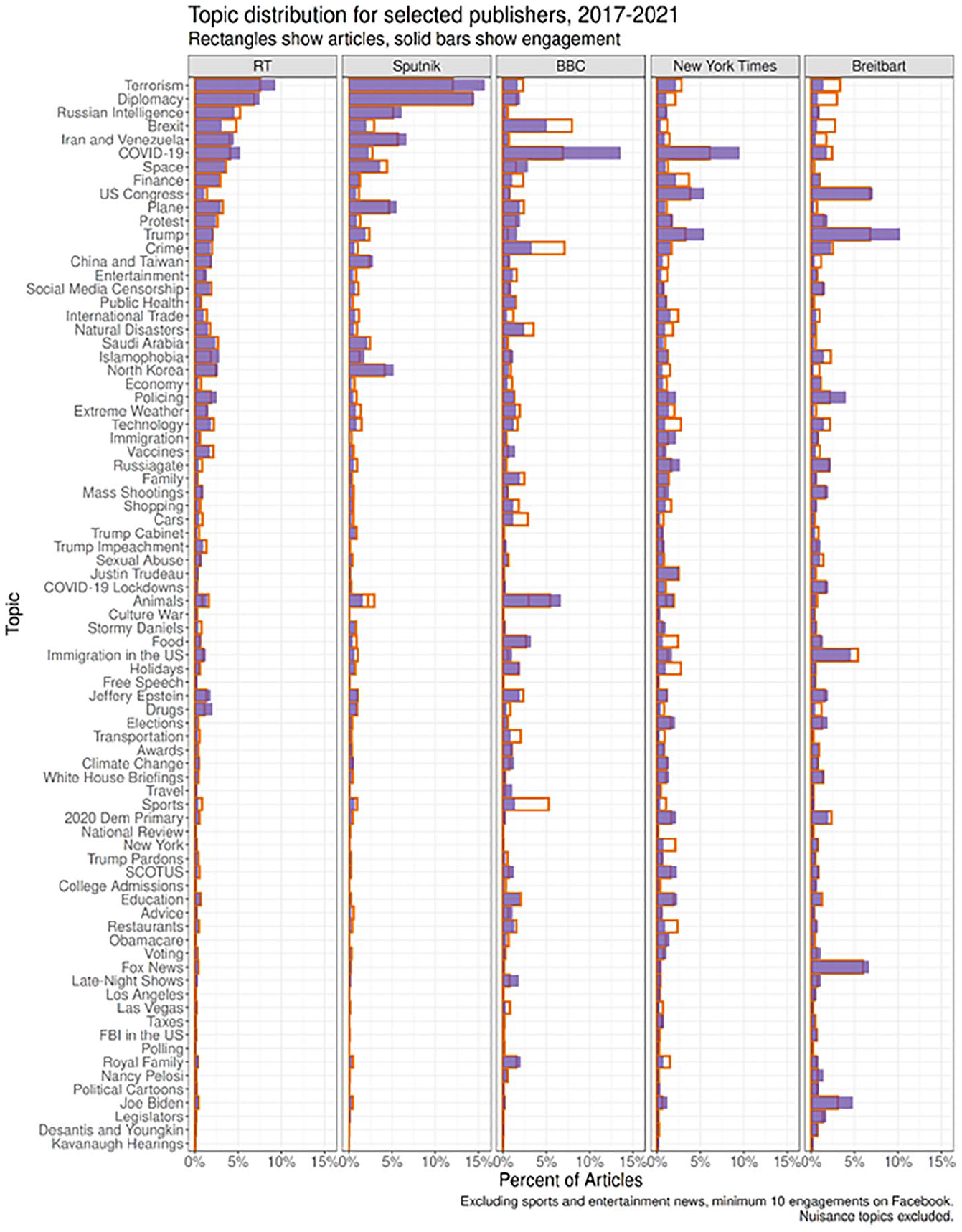
Topic distributions (orange rectangles) for select publishers. Solid purple bars show topic distributions weighted by user engagement on Facebook. BBC was added for comparison.
A total of 43.1 percent of RT’s articles in this time period focused on ten topic areas, including the terrorism and the Middle East (topic 1), diplomacy and statecraft (2), Russian intelligence activities (3), Brexit (4), US sanctions (5), COVID-19 (6), space (7), finance (8), US Congress (9), and planes and aircraft (10). The Middle East, in particular, receives more engagement on Facebook than would be expected just from the number of articles published, but in general coverage and engagement are closely aligned for RT. Sputnik’s general coverage and engagement are also broadly aligned, though the Middle East, again receives higher engagement than expected. Sputnik is more concentrated in both topic coverage and engagement. 10
Classifying Topics
We took two steps to classify topics. We first decided whether the topic was related to geopolitical topics or not, and then decided whether it was related to divisive, domestic topics or not. We developed a codebook, which two of the authors used to independently classify each of the eighty-six topics using the top ten words as well as representative articles for that topic.
First, topics that are related to foreign policy, international conflict, defense and security, global alliances, trade relations, international energy and fossil fuel markets, and diplomacy were labeled as geopolitical topics (Krippendorff’s α = 1). Next, we followed Mukerjee et al.’s (2023) partisan topics classification scheme and coded the following topics as domestic divisive topics in Western democracies: immigration, gun control, mass shootings, election, abortion, taxation, US Congress, Trump, racial justice, police brutality, protests, climate change, political scandals, LGBTQ, Brexit, and confederate statues (Krippendorff’s α = 0.82). There was no overlap between the two categories. All the topics not classified as either geopolitical or domestic were treated as “other” topics in the analysis. Supplemental Information file contains a list of all geopolitical, domestic, and “other” topics.
Following these procedures, we identified forty topics as divisive domestic topics and eight as geopolitical topics. RT and Sputnik published 51,085 articles related to the US domestic topics (27% of all articles), which received 37,297,207 total engagements on Facebook (29.9% of total engagement). By contrast, they published 73,734 articles on geopolitical topics (39.0%), receiving 46,790,019 engagements (37.5%). A mishmash of other topics were included in the “other” category, including entertainment, celebrities, weather events, food, and technology. RT and Sputnik’s ratio of these two topic categories and their engagement stands in stark contrast to those of other outlets in our corpus. For the whole sample that includes all media outlets, US domestic topics make up 47.6 percent of all articles and 57.6 percent of all engagement, while geopolitical topics make up 10.0 percent of articles and only 5.5 percent of engagement. 11
Figure 2 presents Russian media’s daily attention (measured in topic proportions) to eight topics—four key geopolitical topics (top row), and four domestic divisive topics (bottom row). Russian media’s attention to the four geopolitical topics is consistently at a larger scale than the domestic topics.
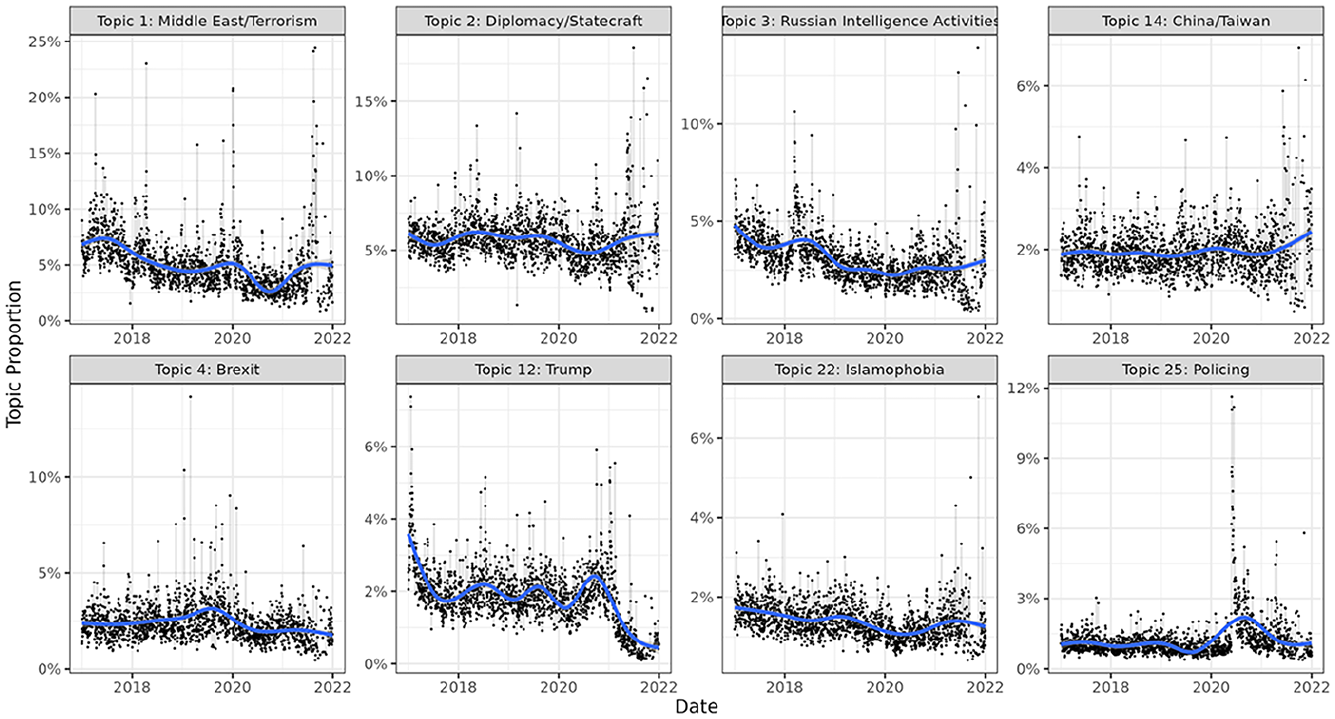
The average of RT and Sputnik’s daily attention, measured across four geopolitical topics and four divisive domestic topics.
Modeling Follow/Lead Relations
We aggregated each article’s topic distribution at the media outlet level and constructed the proportion of daily attention that each media outlet paid to each topic each day between 2017 and 2021. We created a time series per media outlet per topic and aggregated the time-series data at the media group level, which includes Russian media, left-wing media, right-wing media, far-right media, and center media.
For each of the time series, we conducted Augmented Dickey–Fuller tests. We built a vector autoregression (VAR) model for each topic, a common multivariate technique for analyzing potentially two-way relationships between two or more endogenous variables. In a VAR model, each variable is regressed on multiple lagged values of itself as well as multiple lagged values of other variables. We followed standard practices to specify the VAR models, including using Cholesky factorization, selecting lag lengths based on AIC and/or BIC, and conducting eigenvalues stability tests as a robustness check for unit root processes (Wood 2009).
We run a second, alternative model, which includes every media outlet from the main model and the BBC. This second model aims to address an alternative explanation for the agenda influence of Russian media on US media’s coverage of geopolitical issues, namely that US media outlets generally lag behind international news outlets when reporting on international news. Previous research suggests that the concentration of media ownership has pushed many US media companies to invest less in international reporting (Halton 2001). As a result, there has been a decline in the number of foreign correspondents and in the coverage of foreign news stories (Hoge 1997).
It is plausible that the apparent “influence” of Russian media may be attributed to this broader lag effect, which is a unique characteristic of US media compared to their international counterparts. By including the BBC, which typically covers international news promptly, we can disentangle the unique impact of Russian media from the general delay in US media’s international reporting.
If the influence of Russian media primarily arises from their tendency to cover geopolitical issues earlier than US media, similar to the BBC, adding the BBC to the VAR model would remove the effects attributed to Russian media. However, if the influence of Russian media extends beyond this delay, the second model would detect the distinct effects of Russian media in addition to the broader lag effect.
Because VAR models can be difficult to interpret (Benati and Surico 2009), we rely on Granger causality tests and impulse response functions (IRFs)—two common procedures for interpreting VAR results (Freeman et al. 1989) that are adopted as standard practices in the field of political communication (See Jansen et al. 2019; Lukito 2020; Ozawa et al. 2023; Zhang et al. 2023;). For the Granger causality test, we test bivariate relationships in the VAR model using the Toda and Yamamoto (1995) method, which relies on a chi-square test, a better option than the traditional F-test for models that include multiple variables (Lukito 2020).
Finding that Russian media “Granger caused” US media coverage does NOT mean US media would never cover these topics absent Russian state media attention. In contrast to the counterfactual approach to causality that makes strong claims about “token” causation typically tested in randomized control trials (Breen 2022), Granger causality test only provides evidence of predictive causality. In the context of our study, Russian media coverage “Granger causes” US media coverage if prior values of Russian media coverage can predict future values of US media coverage (Granger 1969). Given low levels of geopolitical coverage in most US publications, though, influence should mostly be found in increased coverage. For example, when Russian media increases coverage of a topic, US outlets should show an increase a day or more later—and this increase is more than would be expected based solely on the outlets’ own past coverage. For topics with little baseline coverage, by contrast, a decrease by RT (for example) cannot drive coverage much lower. Note that increased coverage in the same twenty-four hour window does not count, and that our results show on which subsequent days we see additional coverage.
IRFs visualize the magnitude, significance, and temporal patterns of shocks for each pair of variables. IRFs indicate how one standard deviation change in attention to a given topic by a media outlet predicts the attention that the other media outlet pays to the same topic over time, controlling for other variables in the model. We calculate and report IRFs with bootstrapped confidence intervals recommended by Brandt and Freeman (2006). Since we are interested in the transfer of issue salience, we focus on positive responses and their duration. If media outlet A statistically significantly influences media outlet B, then we should expect an upward movement with a confidence interval that does not include the horizontal line of 0 in the IRF graph.
Russian Media-Led US Media on Geopolitical Topics
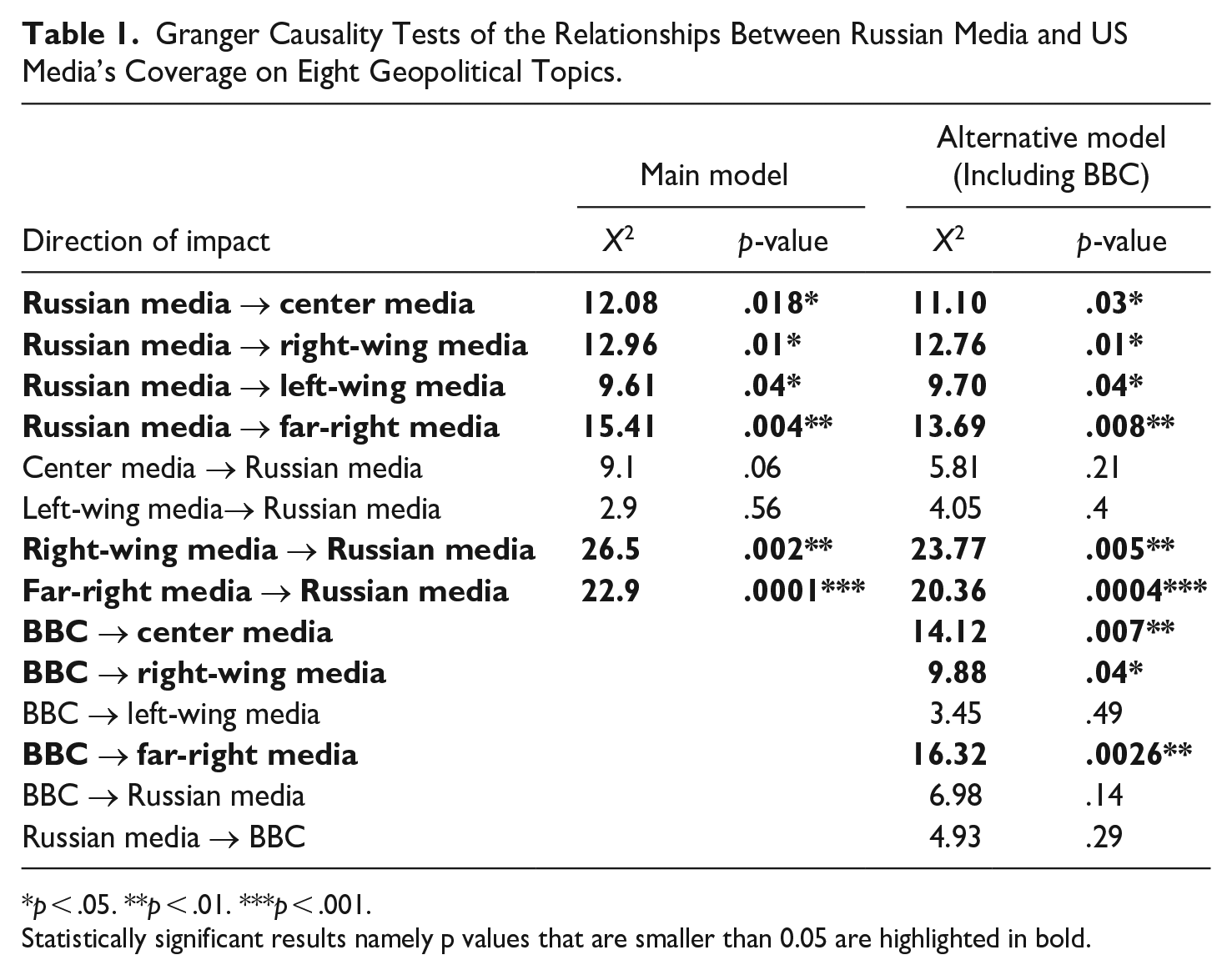
Table 1 shows the bivariate relationships between Russian media and US media (by partisanship) on geopolitical topics. Note that the results are based on the averages of attention to all eight geopolitical topics.
Granger Causality Tests of the Relationships Between Russian Media and US Media’s Coverage on Eight Geopolitical Topics.
p < .05. **p < .01. ***p < .001.
Statistically significant results namely p values that are smaller than 0.05 are highlighted in bold.
The core result from our main model is striking: across all four US media categories—center, left-wing, right-wing, and far-right—we see strong evidence for Granger causality, with Russian coverage leading coverage of US outlets. It also shows two clear reciprocal relationships, with right-wing and far-right US media leading to additional coverage by RT and Sputnik.
Adding the BBC to the second model did not change our core finding, though it did reveal some evidence of the broader lag effect—notably, the BBC led center, right-wing, and far-right US media. This suggests that many US media outlets may indeed, as previous research argued, lag behind international news outlets in reporting on global events. Nevertheless, it also shows that the “influence” of Russian media may extend beyond this broader lag effect. The BBC does not Granger cause RT and Sputnik: Russian media’s impacts on the US news agenda are independent and distinct.
The five IRFs in Figures 3 and 4 show follow or lead relationships in much greater resolution. Each graph shows how the variable (R) responds to a one standard deviation of regression increase in the variable (I) being shocked. The x-axes show the days following the shock, and the y-axes depict the responses of the variable (R). Responses are “significant” if the confidence intervals do not include zero. A response above the zero line denotes a positive effect. A response below the zero line denotes a negative effect.
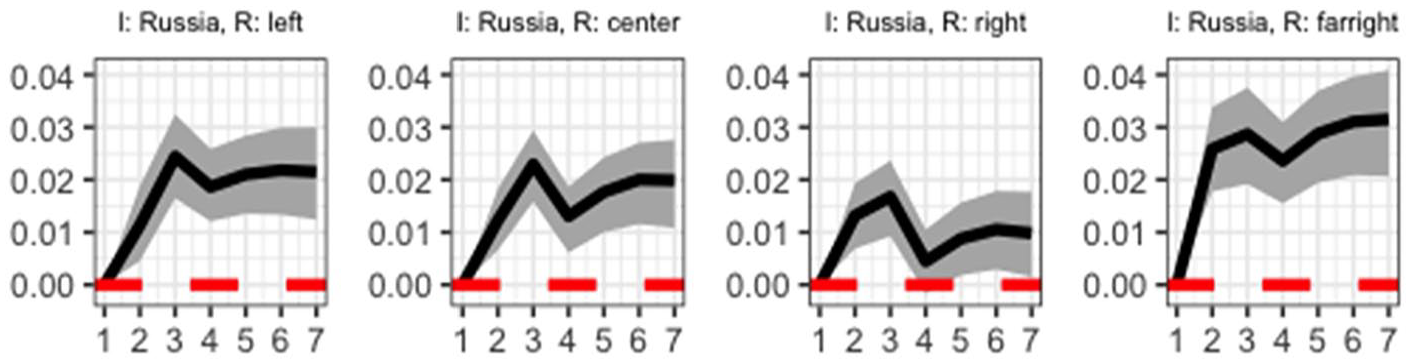
Impulse response function graphs on eight geopolitical topics (X axis shows time periods in days).
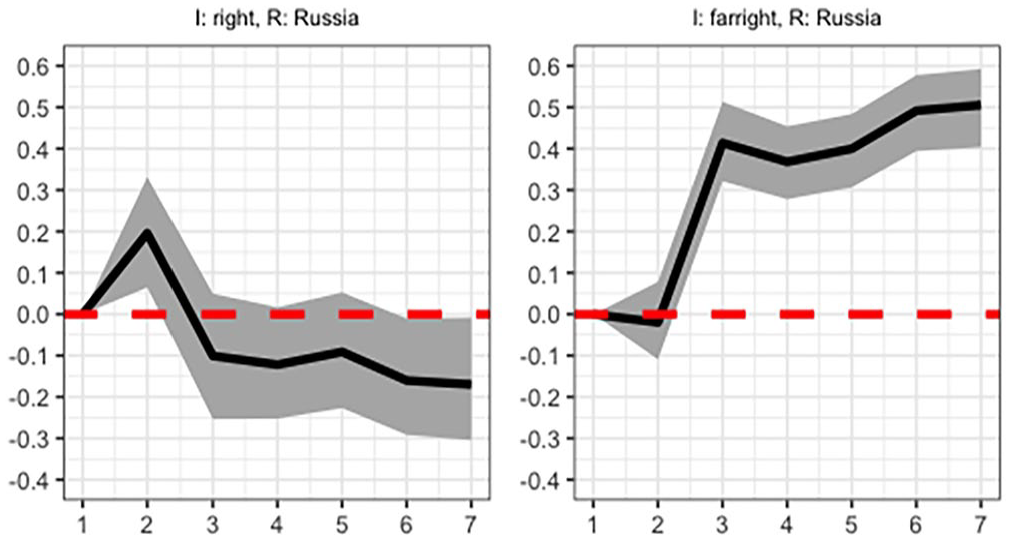
Impulse response function graph on eight geopolitical topics (right-wing media → Russian media and far-right media → Russian media).
As Figure 3 shows, a one standard deviation of regression increase in the coverage of geopolitical topics by Russian media produced somewhere between a 1 percent and 2 percent increase for leftwing, center, and rightwing media, and an approximately 2.5 percent increase for far right media the next day. Figure 4 shows that both right-wing and far right media also led Russian media. The results support both H1 and H2: the relationship between Russian media and far-right media on geopolitical topics is bi-directional. Surprisingly, we also found that Russian media also led center media, right-wing media, and left-wing media. We provide a few examples that best fit the patterns in Supplemental Information file and will address this unexpected finding in the discussion section.
To understand on which specific topic Russian media led all types of US media, we conducted VAR analysis on each geopolitical topic, and included the IRFs and Granger causality results in Supplemental Information file. The results show that Russian media led US media on the coverage of terrorism in the Middle East, Russia’s intelligence activities, international trade, China and Taiwan, and North Korea.
Russian Media Follow Center and Far Right Media on Domestic, Divisive Topics
Table 2 shows bivariate relationships between Russian media and US media (by partisanship) on divisive domestic topics. Note that the results are based on the averages of attention to all forty topics.
Granger Causality Tests of the Relationships Between Russian Media and US Media’s Coverage on forty Domestic, Divisive Topics.
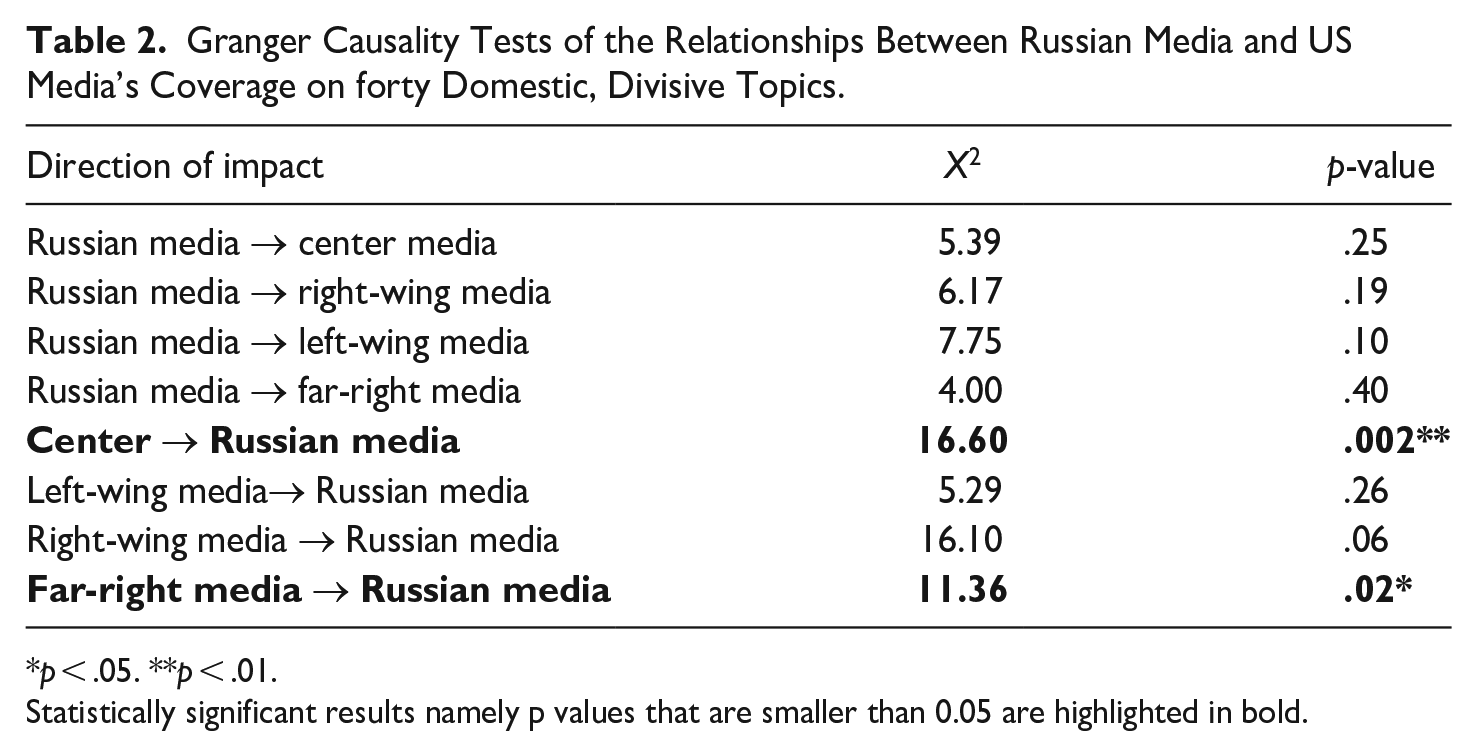
p < .05. **p < .01.
Statistically significant results namely p values that are smaller than 0.05 are highlighted in bold.
Unsurprisingly, no US media followed Russian media on those topics. However, center and far-right media led the Russian media. We created two IRF graphs below, showing the valence of Russian media’s response and its duration.
As Figure 5 shows, one standard deviation of increase in center media’s coverage of domestic topics produces nearly a 26 percent increase in Russian media’s coverage, the following day, while one standard deviation of increase in far-right media’s coverage produces nearly a 6 percent increase. We did not find that right-wing media led Russian media on those topics. Hence, the results support H4 but not H3. We provide a few examples that best fit the patterns in Supplemental Information file.
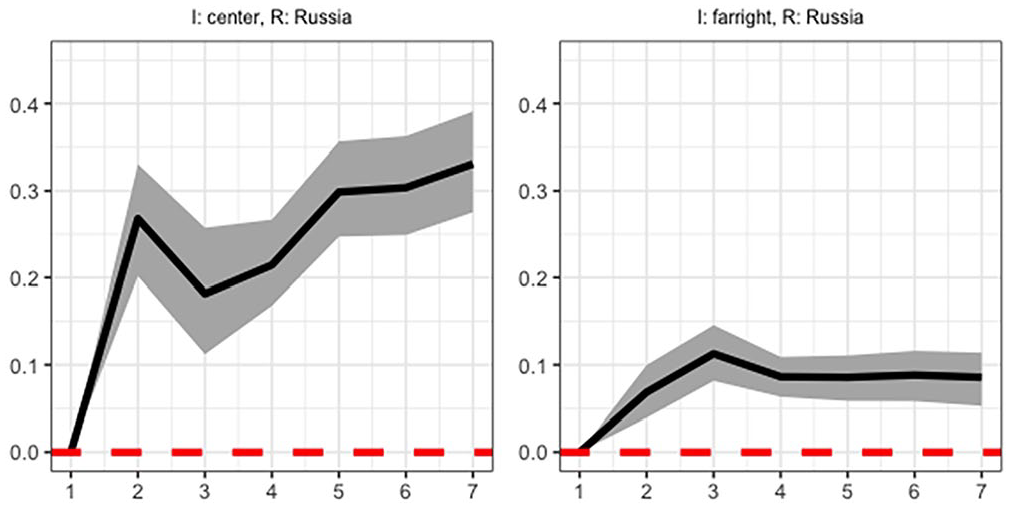
Impulse response function graphs for media groups on forty domestic, divisive topics (X axis shows time periods in days).
To understand on which specific topic center media and far-right media led Russian media, we conducted VAR analysis on each domestic, divisive topic, and included the IRFs results in Supplemental Information file. The results show that Russian media responded to center media with statistically significantly more coverage on a wide range of topics, including Covid-19 restrictions, protests, policing and riots in the United States, social media censorship in the United States, Stormy Daniels, election results, and others. They also responded to far-right media with more coverage on Joe Biden, FBI, free speech, immigration, mass shootings and other topics.
Discussion
The lead–follow patterns we observe have troubling implications, even if the underlying mechanisms for this pattern are not entirely clear. Russian outlets leading US outlets in geopolitical coverage is consistent with their reported goals (Rutenberg 2017). In some cases, foreknowledge of events controlled by the Kremlin may contribute to the apparent influence. RT and Sputnik’s lax journalistic standards may also hasten their editorial process. Both of these hypotheses are worth examining in future work. The fact that RT and Sputnik lead the news agenda on their key issues has important implications for the international information environment, even if the precise mechanisms remain opaque.
While our finding that RT and Sputnik lead all categories of outlets on geopolitics is novel, the fact that RT and Sputnik follow far-right news outlets on divisive domestic issues is consistent with previous work. Previous descriptions of RT’s domestic coverage as reactive and “opportunistic” (Elswah and Howard 2020) and as “partisan parasites” (Moore and Colley 2022) suggest following rather than leading. Our analysis confirms and expands these earlier findings, showing that they hold across more topics, outlets, and years than previously known.
We note some limitations. We focus here on the United States, and our findings may not generalize to other countries targeted by Russian media. Expanding beyond just US outlets, and beyond English-language news content, should be a priority for future research. Moreover, while Granger causality could be suggestive of influence (Farnsworth et al. 2010; Knüpfer and Hoffmann 2024; Zhang et al. 2023), it is not proof of true causation on its own. The temporal relationship between Russian media and US media might be driven by unobserved processes. Future research investigating the mechanisms behind this apparent influence will likely need to rely on natural experiments to eliminate potential unmeasured confounding variables, as is common with causal inference using observational data. Lastly, our findings are based on the headlines and blurbs, not the journalistic texts as a whole. Future work able to access full article text should address important questions about article framing.
We should remember that Russian state-controlled broadcasters are part of a broader apparatus of state influence. While RT and Sputnik may produce far fewer stories on divisive US issues than on geopolitics, other agents of the Russian state like the Internet Research Agency clearly do focus on polarizing content. RT and Sputnik can also be conscripted to push socially divisive messages at a few critical moments, as happened in the days before the 2016 US presidential election (U.S. Department of Justice 2018). Still, scholarship that portrays RT and Sputnik as focused overwhelmingly or exclusively on exploiting social divisions in the US risks missing the most important ways in which RT and Sputnik advance Russia’s interests.
Lastly, our analysis focuses on the transfer of issue salience as a key measure of Russian media’s influence. While important, issue salience should not be seen as the only media influence. Whether US media systematically adopt Russian narratives on key issues, as some evidence suggests, is a critical subject for further study.
Conclusion
Overall, our analysis of RT and Sputnik offers an important corrective to previous research. Suggestions that RT and Sputnik “cause chaos,” our data show, reflect only part of the story. On the one hand, our analysis is strongly consistent with scholarship that has portrayed these Russian propaganda outlets as opportunistic amplifiers of division, or “partisan parasites” that mimic the language and coverage of right-wing news outlets. Critically, though, RT and Sputnik’s true focus is on a small set of geopolitical issues closely tied to Russian interests, not on US domestic issues. These propaganda outlets generate large amounts of user engagement of this small set of issues, but fewer interactions on other topics. Overall, RT and Sputnik’s patterns of both coverage and user engagement are starkly different from those of other outlets. Future work should avoid leaving the impression that polarizing domestic political issues are the primary topics of RT and Sputnik’s coverage or their social media engagement.
Most worryingly, our data provide new evidence about Russian state media’s apparent influence on the US media agenda. Both Granger causality tests and IRFs suggest that RT and Sputnik regularly lead US outlets of all stripes on geopolitics. To date, much of the concern about Russian influence has focused on specific US far-right publishers. For example, US intelligence officials, citing undisclosed intelligence, have claimed that ZeroHedge takes direction from Russian spies (Merchant 2022). Infowars’ re-publication of RT news stories, and the promotion of Russia-friendly fake news by YourNewsWire (rebranded as NewsPunch and later ThePeoplesVoice.tv), have both similarly raised eyebrows.
Our analysis, though, shows that the problem may be bigger. Evidence for Russian agenda influence encompasses left-leaning outlets as well as right-wing ones, and even the mainstream, centrist news organizations that receive the largest audience share. Any proposed mechanisms for this that apply only to right-wing outlets are insufficient to explain the patterns observed in our data.
As the first systematic study of RT and Sputnik’s news production and social media engagement, this study raises some new questions we cannot yet answer. Closer examination of the mechanisms through which RT and Sputnik exercise agenda leadership on specific issues is an important subject of future work. Similarly, our work makes it more urgent to examine if these outlets succeed just in shifting the agenda, or if they are consistently able to transfer their chosen frames and narratives into US news coverage as well.
Still, what this data do show is already a reason for urgent concern. In strategic communication—and especially public diplomacy—steering the news agenda toward favored topics is a critical goal in its own right. On this measure, at least, there is evidence that Russian state propaganda may be working.
Supplemental Material
sj-docx-1-hij-10.1177_19401612241271074 – Supplemental material for Does Russian Propaganda Lead or Follow? Topic Coverage, User Engagement, and RT and Sputnik’s Agenda Influence on US Media
Supplemental material, sj-docx-1-hij-10.1177_19401612241271074 for Does Russian Propaganda Lead or Follow? Topic Coverage, User Engagement, and RT and Sputnik’s Agenda Influence on US Media by Yunkang Yang, Stefan McCabe and Matthew Hindman in The International Journal of Press/Politics
Footnotes
Acknowledgements
We thank Dr. Josephine Lukito and Dr. Yini Zhang for their helpful feedback on this article.
Declaration of Conflicting Interests
The author(s) declared no potential conflicts of interest with respect to the research, authorship, and/or publication of this article.
Funding
The author(s) disclosed receipt of the following financial support for the research, authorship, and/or publication of this article: Dr. Stefan McCabe is supported by the John S. and James L. Knight Foundation through a grant to the Institute for Data, Democracy and Politics at the George Washington University. Subscription fees for accessing NewsWhip data were paid through an internal research grant obtained by Yunkang Yang and Matthew Hindman at the Institute for Data, Democracy & Politics at the George Washington University.
Ethical Approval and Informed Consent Statements
There are no human participants in this article and informed consent is not required.

Supplemental Material
Supplemental material for this article is available online.
Notes
Author Biographies
References
Supplementary Material
Please find the following supplemental material available below.
For Open Access articles published under a Creative Commons License, all supplemental material carries the same license as the article it is associated with.
For non-Open Access articles published, all supplemental material carries a non-exclusive license, and permission requests for re-use of supplemental material or any part of supplemental material shall be sent directly to the copyright owner as specified in the copyright notice associated with the article.
