



Abstract
The UN climate summits represent decisive moments for climate change policy. Under significant media coverage, world leaders gather for intense negotiations over policies to address global warming. Given the enormous political, economic, and environmental issues at stake, news media typically frame these summits in terms of success or failure. Still, we know surprisingly little about how these mediated mega events influence public perceptions both during and beyond the specific summit. Focusing on the 2021 Glasgow summit (COP26), this study combines a media content analysis and a two-wave panel survey with a rolling cross-section component, to determine how news framing influenced both summit-specific and more generic climate change beliefs among citizens in Sweden. Findings show (1) that beliefs about the success/failure of the summit took shape immediately following the summit, (2) that news framing effects were particularly pronounced when the final agreement was settled, and (3) that these instantaneous framing effects on summit-specific beliefs left small but lasting imprints on citizens’ generic climate change beliefs several weeks after the summit. These findings have implications for both climate opinion and theories of dynamic news framing effects.
Introduction
The UN climate summits represent decisive moments for climate change policy. Under significant media coverage, world leaders gather for intense negotiations over policies to address global warming. These summits are often associated with significant spikes in news coverage of climate change (Hase et al. 2021; Schmidt et al. 2013; Schäfer et al. 2014; Wessler et al. 2016)—where a common frame is that of success or failure of negotiations (Christensen and Wormbs 2017; Kunelius and Eide 2012; Wessler et al. 2016). Consequently, news coverage of climate summits could potentially influence not only how citizens perceive the success or failure of specific summits, but also their more fundamental beliefs regarding whether it is at all possible to curb global warming—or whether it has become too late.
Despite being such major global political events, there are still few studies of how citizens understand these summits—and particularly how news coverage influences both summit-specific perceptions and more generic climate change beliefs among the public. Media effects research shows that news coverage can shape issue perceptions, interpretations, and attitudes (Chong and Druckman 2007; Lecheler and De Vreese 2019; Valkenburg and Peter 2013) —which also applies to climate change (Damsbo-Svendsen 2022; Feldman, et al. 2012; Shehata et al. 2022). This study specifically addresses two unresolved questions with respect to the dynamics of news framing effects on citizens’ climate change beliefs over time. First, we address whether people’s summit-specific beliefs are updated continuously during the summit—or whether framing effects are more likely at specific defining moments (Matthes and Schemer 2012; Shehata et al. 2021; Thomas 2022). Second, we address a theoretical dynamic effect process relating summit-specific perceptions formed immediately in response to the summit to citizens’ more fundamental beliefs about climate change as a global threat. Our argument builds on a specific psychological account of dynamic news framing effects linking mental models to cognitive schemas over time (Scheufele and Scheufele 2010; Matthes 2007). Although news frames are likely to instantaneously influence specific issue perceptions and interpretations (Lecheler and De Vreese 2019; McLeod et al. 2022), it is unclear whether such influences have discernable imprints on more generic issue beliefs—also several weeks after the summit has ended.
To address these questions, this study combines a media content analysis with a two-wave panel survey, including a rolling cross-section component (see below), conducted in Sweden during the 2021 Climate Summit in Glasgow (COP26). Before presenting the study design and data in greater detail, however, the next section outlines our theoretical argument. The literature review first summarizes research on news coverage and public opinion relating to climate change summits. Building upon cognitive media effects, we then discuss how news framing may influence citizens’ summit-specific and more generic climate change beliefs. Focusing on effect duration and psychological accounts of indirect framing effect dynamics over time, this section theorizes the link between specific and more generic beliefs. After discussing the Swedish case, data, and measures, our main findings from longitudinal panel analyses are presented. We close the paper by discussing the implications of these findings in relation to research on climate opinion and dynamic news framing effects.
Climate Summits as Global Mediated Mega Events
Global warming constitutes one of the greatest challenges of our lifetime. Summarizing the main findings from their most recent report, the IPCC concludes that “[. . .] climate change is a grave and mounting threat to our wellbeing and a healthy planet. Our actions today will shape how people adapt and nature responds to increasing climate risks.” (IPCC 6th assessment report, released February 2022).
The consequences of a heating planet have become increasingly apparent in recent decades. Today, climate change is an established issue with a considerable footprint in the news media, politics, and public discourse. At the same time, there are clear political divisions on the subject (Brulle et al. 2012; Castillo Esparcia and López Gomez 2021; Egan and Mullin 2017; Hornsey et al. 2016), some of which appears to have increased in recent years (Chinn et al. 2020). The degree and nature of politicization varies considerably across contexts. In some countries—such as the U.S.—there is widespread disagreement on scientific facts which aligns with political partisanship (Egan and Mullin 2017). In other countries such as Sweden, on the other hand, there is broad consensus on scientific facts (Oscarsson et al. 2021) but more polarized opinions on the urgency and solutions to tackle the challenge (Rönnerstrand 2022).
One important factor behind these developments relate to the news media (Chinn et al. 2020; Feldman et al. 2012). Over time, news coverage of climate change has increased extensively (Schmidt et al. 2013). 1 While climate change is now a top issue on the media agenda, there is also substantial fluctuation in issue salience over time, not least in relation to dramatic weather events (e.g., Shehata et al. 2022; Ungar 1999) and institutionalized political initiatives (Hase et al. 2021; Schmidt et al. 2013; Schäfer et al. 2014). The largest annual mega-event is the United Nations Climate Change Conference—often referred to as COP (Conference of the Parties) summits (Schmidt et al. 2013; Schäfer, Ivanova et al. 2014; Wessler et al. 2016). Since the first COP was organized in Munich in 1995, world leaders have gathered every year for a couple of intense weeks of negotiations over policies aimed at addressing global warming. The COP has become the main global event and arena for international climate negotiation and cooperation, characterized by an incremental process of give-and-take as leaders work toward making progress on issues such as emission reductions, financing, and technology transfer. 2
From a media effects and public opinion perspective, these summits stand out in at least two ways. First, the COP meetings come with significant spikes in media attention to climate change in general and struggles over how to tackle the problem of global warming in particular (Hase et al. 2021; Schmidt et al. 2013). Summit coverage usually follows a specific issue attention cycle—with reporting peaking around the opening and closing of the meeting (Schmidt et al. 2013; Wessler et al. 2016). Second, while there is extensive focus on complex policy proposals, a common news frame associated with these mediated events revolve around the success or failure of the summits with respect to negotiations and final agreements (Christensen and Wormbs 2017; Painter et al. 2018; Wessler et al. 2016). For instance, while the dominant frame following the 2009 Copenhagen meeting (COP15) was one of disappointment and failed expectations (Kunelius and Eide 2012), the main theme in news reporting of the 2015 Paris summit (COP21) was “one of success rather than shortcoming” (Christensen and Wormbs 2017: 682).
To date however, there is only a handful of studies focusing on the potential effects of these large-scale events on public opinion (see Bakaki and Bernauer 2017; Brüggemann et al. 2017; De Silva-Schmidt et al. 2022). While these studies provide important knowledge on how climate summits shape public opinion, none focus on the framing of the summits by the news media. And although there is ample research on how media cover climate summits (Christensen and Wormbs 2017; Schäfer, Ivanova et al. 2014; Schmidt et al. 2013; Wessler et al. 2016), studies that link news content characteristics to individual level perceptions and beliefs are few. From a framing effects perspective, we are particularly interested in two unresolved issues: (1) the conditionality of news framing effects over time, and (2) the longitudinal relationship between (summit-) specific and generic (climate change) beliefs.
Dynamic News Framing Effects: Mental Models and Cognitive Schemas
This study focuses specifically on climate change beliefs: how citizens’ basic perceptions of climate change as a societal problem are influenced by a mediated mega event such as the Glasgow summit. Our focus on beliefs—rather than attitudes or engagement—follows a long tradition of research on climate perceptions, misperceptions, and skepticism (Capstick et al. 2015; Ojala 2015; Shehata et al. 2022), but is also key to cognitive theories of media effects such as framing (Lecheler and De Vreese 2019). A belief is thus conceptualized as a cognition, similar to knowledge in the sense of being a truth-claim about reality. Compared to knowledge, however, a belief statement “is a subjective proposition about the attributes of some aspect of reality” (Hindman 2012: 590; see also Eveland and Cooper 2013.
The distinction between specific and generic beliefs builds upon research on mental models and cognitive schemas (Roskos-Ewoldsen et al. 2009; Scheufele 2004). This literature helps us theorize the relationship between two distinct levels of beliefs. In their review of the psychology of news framing effects, Scheufele and Scheufele (2010) define a mental model as a “temporary cognitive representation of a problem or a situation” (p. 115), in contrast to more generic and stable cognitive schemas (Roskos-Ewoldsen et al. 2009; Shehata et al. 2021). Furthermore, the “theory of mental models [. . .] helps to explain how news frames transform or establish audience schemas” (Scheufele and Scheufele 2010: 115), suggesting that specific (and temporary) beliefs may under certain conditions also change more generic (and stable) beliefs (Matthes 2008; Roskos-Ewoldsen et al. 2009). Following their argument (Scheufele and Scheufele 2010), when consuming news stories, citizens’ specific beliefs (mental models) initially depend on their generic beliefs (schemas)—but news coverage may also influence and change these mental models. Over time, through repeated and cumulative frame exposure, “that is, many reports framing the issue in a consistent fashion—an audience member’s mental model will be modified in a step-by-step fashion consistent with the predominant framing of the issue in the mass media. After a while, audience members will also adjust their more stable cognitive schemas” (Scheufele and Scheufele 2010: 115; see also Koch and Arendt 2017; Lecheler, et al. 2015; Shehata et al. 2021).
Following this, mental models of specific events, actors, and developments—such as an ongoing climate summit—are likely to be continuously constructed and updated as citizens consume news stories about these events. Exactly how such stories are encoded and processed depends partly on individual predispositions and preexisting beliefs (Valkenburg and Peter 2013), but the dominant news frame typically has an immediate effect on specific perceptions and interpretations (Lecheler and De Vreese 2019; Scheufele 2004). We focus here on news framing of the summit in terms of success or failure for the climate, which has been identified as a recurring theme in news coverage of COP summits (Christensen and Wormbs 2017; Krøvel 2011; Kunelius and Eide 2012; Lück, et al. 2018; Painter et al. 2018; Wessler et al. 2016). While summit success–failure framing takes the established climate change frame (Brüggeman and Engesser 2017; Shehata et al. 2022) as a point of departure, it focuses on the day-to-day political negotiations and accomplishments of the summit (Kunelius and Eide 2012; Painter et al. 2018). More specifically, the success frame provides an optimistic account of ongoing negotiations and accomplishments with respect to addressing climate change. In contrast, the failure frame paints a pessimistic picture—describing the summit in terms of a disappointment for the climate, broken promises, unsatisfactory, etc. Thus, news framing of the summit in terms of success or failure for the climate should matter for citizens’ summit-specific success–failure beliefs. This leads us to assume that:
H1: Day-to-day news framing of the Glasgow summit in terms of success (or failure) has an immediate effect on citizens’ specific beliefs about the summit as a success (or failure) for the climate.
At the same time, the timing—and duration—of news framing effects may be a critical issue here. The idea that media effects are time-dependent and dynamic is widely recognized (Perse and Lambe 2017; Slater 2015; Shehata et al. 2021; Thomas 2022; Valkenburg and Peter 2013), also when it comes to framing effects theory (Baden and Lecheler 2012; Tewksbury et al. 2009). A growing number of experimental studies of framing effects address questions relating to effect duration. Taken together, these longitudinal experiments clearly suggest that framing effects are relatively short-lived, dissipating rather quickly, but also that effect duration depends on a variety of factors (Lecheler and De Vreese 2016; McLeod et al. 2021). For instance, in a review of effect duration studies, Lecheler and De Vreese (2016) noted that message negativity, issue salience and information processing style mattered for effect duration (see also Matthes and Schemer 2012). While being repeatedly exposed to certain news frames appears to increase duration, competitive framing yields recency effects (Lecheler and De Vreese 2016). As summarized by McLeod et al. (2022) in a recent review of framing effects: “Not only are these effects likely to be short-lived as time passes, they may dissipate as individuals are exposed to competing frames and other information after the experiment has concluded.” (p. 12).
Our study contributes to this literature by taking a slightly different approach to questions about dynamic news framing effects. Apart from moving from the experimental setting to the “real world,” two theoretical claims are addressed. First, it may be the case that not only effect duration but also effect timing matters. Whether citizens are equally responsive to day-to-day news coverage of climate summits over time is unclear and may reflect different modes of belief updating. On the one hand, citizens may continuously update their summit-specific beliefs in response to news coverage, basing their perceptions on the dominant frames provided by the media in the most recent days. On the other hand, citizens may remain resistant to the dominant frames provided by the news media during negotiations, until a final agreement is reached and there is an end-product to assess. While the former suggests a media effects process of continuous belief updating over time, the latter indicates that media effects are more likely at specific decisive moments in time. This leads us to pose an open research question, where we ask:
RQ1: Do news framing effects on citizens’ summit-specific beliefs differ before and after a final agreement is settled?
Second, while previous studies of effect duration typically rely on a direct effects approach, we build specifically on a theoretical idea of indirect dynamic framing effects. In essence, a pure direct (or total) effects approach may conceal small but significant indirect influences—whereby specific beliefs closely tied to the frames dominating news coverage gradually carry over to more generic beliefs. In contrast to (summit-) specific beliefs, generic beliefs refer to mental representations of broader categories of events, institutions, and developments—thus moving from “the particular” characterizing mental models (perceptions of actors and events related to the Glasgow summit) to “the more abstract” of cognitive schemas (perceptions of climate change as a global problem) (Roskos-Ewoldsen et al. 2009; Scheufele and Scheufele 2010; Shehata et al. 2021). As an established issue on the political and media agenda, public beliefs about climate change as a societal problem, its causes, and consequences, have crystalized over many years (Brulle et al. 2012; Capstick et al. 2015). One potentially critical belief which climate summits could influence is whether it is at all possible to curb climate change—or whether it has now become too late to make a difference. While specific perceptions about the success or failure of the Glasgow meeting may be largely irrelevant on their own, their potential lasting imprints on citizens’ basic optimistic or pessimistic beliefs about the challenge of climate change may be significantly more consequential.
Thus, while studies of effect duration indicate that such effects are relatively short-lived, psychological accounts of framing effects building upon the distinction between mental models and schemas (Scheufele and Scheufele 2010; Shehata et al. 2021), suggest a slightly different dynamic effect process: that indirect effects may be present and significant over time as framing effects on specific beliefs gradually influence general beliefs. While we do not completely equate generic beliefs with cognitive schemas, the former may serve as proxies for the latter. We therefore analyze not only whether news framing has immediate effects on specific beliefs about the Glasgow summit, but also whether such news framing has indirect effects on citizens’ generic beliefs about climate change as a societal problem that extend several weeks after the Glasgow summit has ended. Our second hypothesis is therefore that:
H2: Exposure to news framing the Glasgow summit in terms of success (or failure) has indirect effects on citizens’ generic beliefs concerning whether it is at all possible to curb climate change (or whether it is too late) that last several weeks after the summit, and these indirect effects are mediated by summit-specific beliefs.
The Swedish Case
The Glasgow summit represents a global political event. However, both public opinion dynamics and news coverage primarily play out in national contexts. This study focuses on the case of Sweden. With respect to media system characteristics, Sweden has typically been considered as a democratic corporatist country very similar to its Scandinavian neighbors (Hallin and Mancini 2004; Humprecht et al. 2022). Studies on how Swedish news media cover climate issues show variation in salience over time (Shehata et al. 2022), but generally broad acceptance of the scientific facts of anthropogenic global warming (Shehata and Hoppmann 2012; Olausson 2009).
Turning specifically to Swedish news coverage of climate change summits, Figure 1 displays the number of news stories focusing on 14 specific COP meetings between 2008 and 2021—fifty days prior to and 50 days after the opening of each meeting. Two things are worth noting. First, news coverage of the climate summits varies considerably between meetings. The two most heavily covered summits during the past 15 years were Copenhagen (2009) and Paris (2015). Meanwhile, several meetings received considerably less attention (i.e., Marrakech 2016 and Bonn 2017). Importantly, the Glasgow summit appears to be one of the most extensively covered summits in the past decade. Second, media coverage of climate summits follows a distinct cycle of issue attention (Downs 1972) with clear peaks at the opening and closing of the summit (Painter et al. 2018). Figure 1 confirms this pattern also for Sweden.
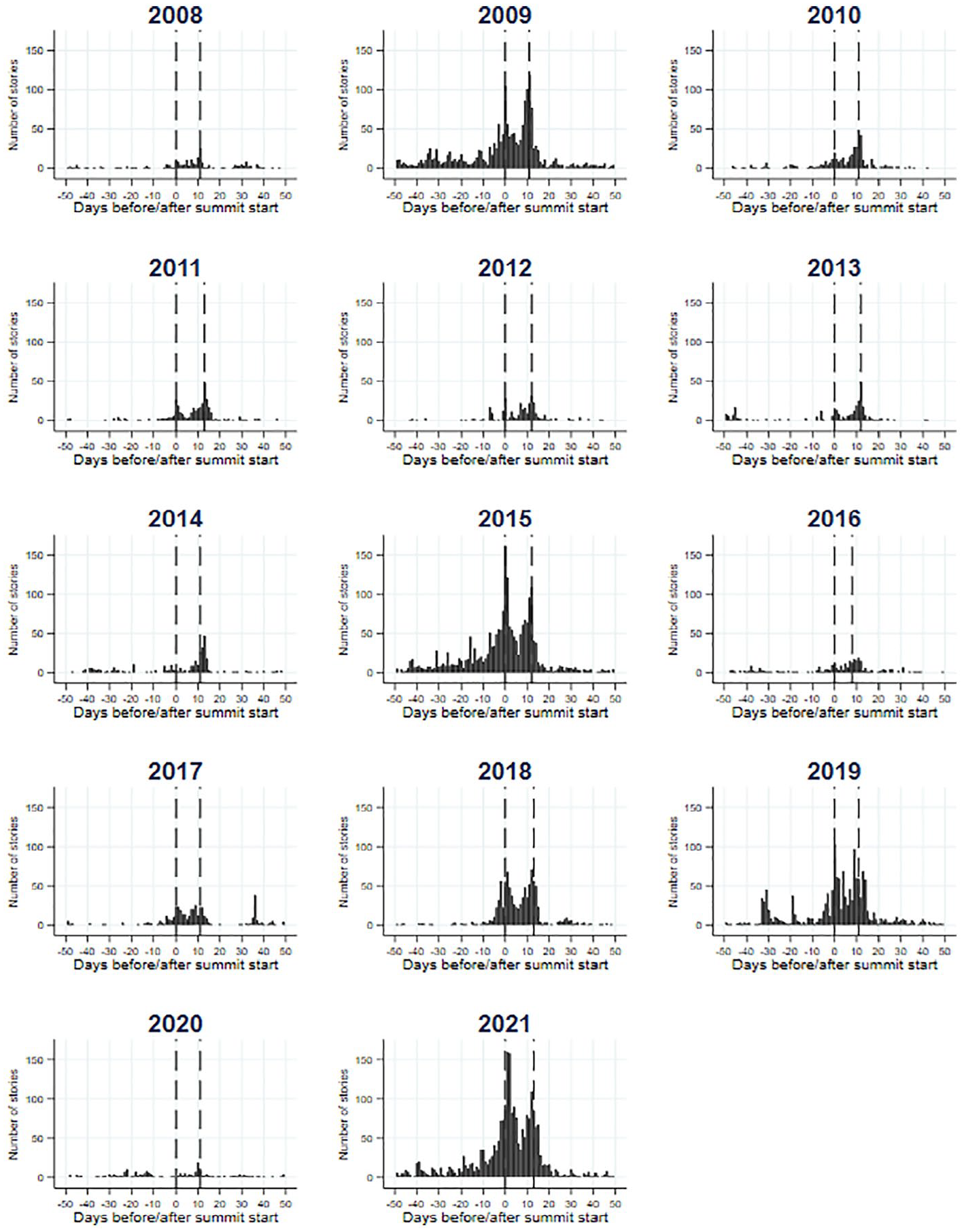
Number of news stories referencing climate summits 2008–2021 in Swedish news media fifty days preceding and after the opening of yearly COP summits (number of news stories in national press/TV/radio in print and online).
Data, Methods, and Analytical Approach
To address our research questions and hypotheses we use two complementary data sources. The first is a probability-recruited two-wave panel survey with a rolling cross-sectional component, fielded during the final stretch of COP26. The second is a manual content analysis of all COP26 coverage in the most prominent Swedish news media during a three-month period.
The survey data were obtained from a probability-recruited research panel, facilitated by The Swedish Citizen Panel at the University of Gothenburg. Respondents were initially recruited to the panel through postal invitations. The recruitment process spanned over several years, with approximately 8–12 percent accepting the initial invitation. From this panel, a total, 3,412 respondents were invited to participate in this specific study, with a net participation rate of 57.3 percent in the first wave (n = 1,957). All participants in the first wave were invited to participate in the second wave, resulting in an 91 percent participation rate (n = 1,790). The participants were not stratified by demographics and therefore overrepresented more educated individuals, males, and somewhat older individuals compared to the general Swedish population (see Table A2 in the Supplemental Information file). Wave 1 incorporated a rolling cross-sectional component running before and after the final day of the summit. Wave 2 was conducted 23 days after the official closing of the summit. The strength of the Rolling Cross-Section (RCS) design is that respondents are randomized on what day they receive the survey. Differences in summit perceptions can thus be attributed to the chronology and news reporting of the summit itself (Johnston and Brady 2002). The setup of wave 1 and wave 2 are illustrated in Figure A.1 in Supplemental Information file.
The distinction between summit-specific and generic beliefs is crucial to our study. To capture specific perceptions of the COP26 summit, respondents were asked to what extent they agreed with two statements, measured on a seven-point scale ranging from (1) Not true at all to (7) Completely true, with an option for No opinion. The two statements were: (a) “The meeting is a major failure for the climate”; and (b) “The meeting is a great success for the international climate collaboration.” For the main analyses, these two items were combined into an index, with higher values reflecting more positive perceptions about the summit while lower values indicating more negative perceptions (M = 3.94, SD = 1.26, r = .50, alpha .65). Generic beliefs were operationalized using three different survey indicators—all focusing on beliefs about humanity’s ability to curb global warming. The first survey question asked respondents about the statement “It is too late to limit global warming,” with response options ranging from (1) Not true at all to (7) Completely true. The second survey question asked “How high is your trust in world leaders’ abilities to curb global warming?,” with responses recorded on a balanced seven-point scale ranging from (1) Very low trust to (7) Very high trust. The third question asked, “In general, how do you view the opportunities for the world’s countries to limit global warming?,” with a balanced seven-point response scale ranging from (1) Very small opportunities to (7) Very large opportunities. The survey questions tapping summit-specific and general beliefs were developed within the project.
To study framing effects on summit perceptions, we rely on a linkage approach combining information about respondents’ news use with content data on how different news sources framed the summit (de Vreese et al. 2017). Respondents were asked about their use of seven major Swedish news outlets as well as two alternative news sources (one left-leaning and one right-leaning). More specifically, we asked about regular use of the public service television news Aktuellt/Rapport (SVT), the commercial television news bulletin TV4 Nyheterna, the main news cast Ekot (SR) on public service radio, the two largest tabloids Aftonbladet and Expressen, the two major broadsheets Dagens Nyheter and Svenska Dagbladet, as well as the alternative left-wing site ETC and the alternative right-wing site Nyheter Idag. 3
The media content data consist of all news stories including summit-relevant phrases 4 in the above-mentioned outlets/programs covering a three-month period from October 1st to December 31st. The search for relevant news stories was carried out using mediearkivet retriever (https://www.retriever.se/tag/mediearkivet/). All stories which did not have any of the relevant keywords in either the title or the preamble of the article were excluded. In total, three hundred ninety stories were included. Each news item was manually coded for how the summit and its outcomes were framed. More specifically, we coded if stories focused on (a) failure of meeting/deal (0 = no; 1 = yes); (b) success of the meeting/deal (0 = no; 1 = yes); (c) balance between failure/success (−1 = story main focus on failure; 0 = equal focus on failure and success; 1 = story main focus on success). Coding was conducted by a trained coder. To ensure reliability, one of the authors of this article conducted an inter-coder reliability test on a subsample of fifty articles (13% of the total), which demonstrated an 87 percent agreement between coders and a Krippendorff’s alpha coefficient of .82, indicating satisfactory reliability.
A linkage variable was computed as the product of outlet-specific news use, on the one hand, and how these outlets framed the meeting during the preceding three days, on the other hand. More specifically, the three-day average of how each outlet framed the summit was multiplied by the frequency of outlet-specific use for each respondent. These scores were then summarized for all news outlets, providing a frame exposure variable with negative values reflecting a higher dosage of news framing the summit as a failure, while positive values indicate exposure to more success-framed news. The distribution of the linkage variable is shown as a histogram in Figure 5 below.
Analytically we rely on a combination of descriptive statistics of day-to-day changes in news framing and climate change beliefs, ordinary least squares (OLS) regression and longitudinal mediation models. To test the longitudinal indirect effects, we estimate a structural equation model (SEM) as illustrated in Figure 2. The paths of main interest are a, b and c (direct effects) as well as the indirect b × c effect of news exposure on climate change beliefs channel through summit-specific beliefs. In addition, e represents the extent to which baseline generic beliefs color summit-specific beliefs, while f is the t−1 autoregressive effect of generic climate change beliefs over time. The mediation process was estimated for three indicators of generic beliefs separately relying on a Monte Carlo approach for computing the standard errors, confidence intervals and statistical significance for the indirect effects. We used the medsem package in Stata to test these indirect effects (Mehmetoglu 2018; see also Zhao et al. 2010). Apart from the lagged dependent variable used in the longitudinal analyses, the regression models control for between-person differences in gender, age, political ideology and political interest.
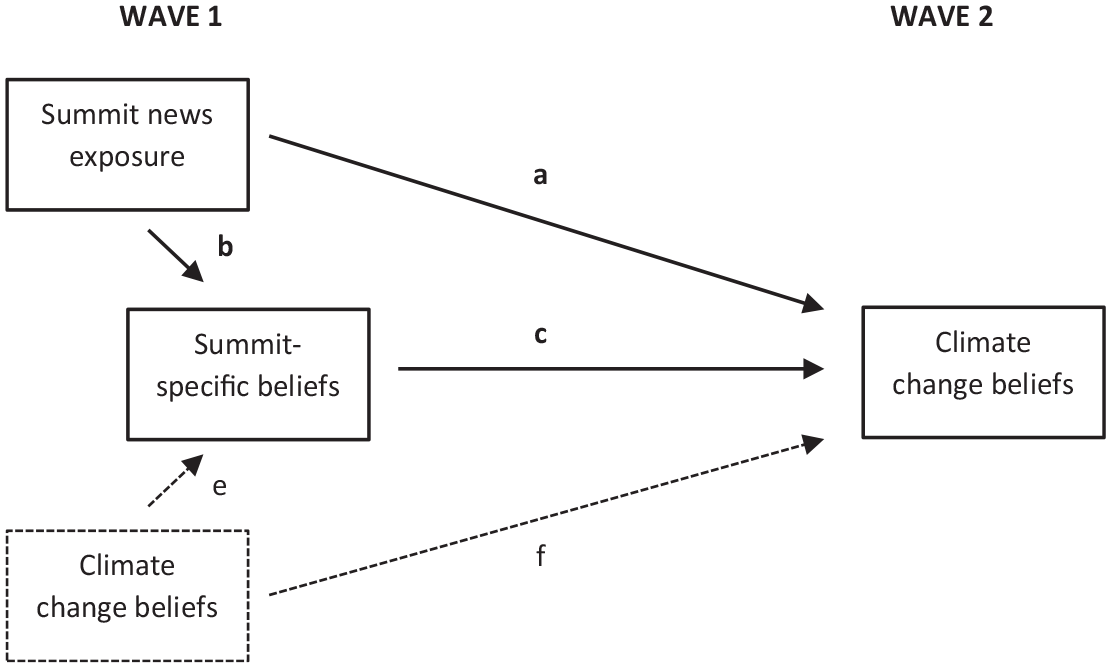
Mediation model of summit-specific and generic climate change beliefs.
Results
Figure 3 provides an overview of daily news coverage of the Glasgow summit. The solid line indicates the day of the closing (13th November) of COP26, while the dashed lines represent the start and end of our rolling cross-section survey. The figure displays a clear news spike around the opening and a smaller spike during the closing of the summit. Looking at the days around the closing of the summit, there is a substantial increase in mixed or failure framed news stories. In addition, media coverage quickly perishes after the summit ends.
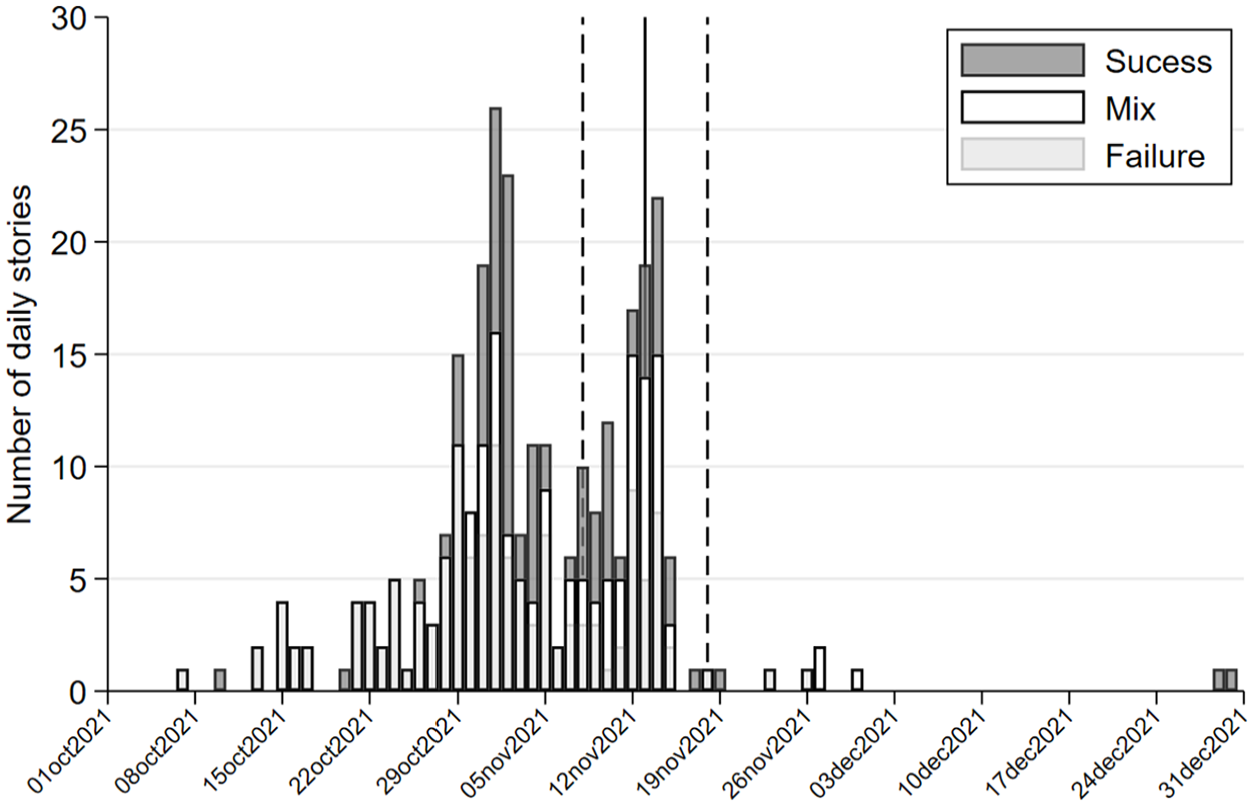
Number of daily news stories in our sample divided by success/failure frame.
With respect to public perceptions, Figure 4 displays descriptive data on how citizens perceived the success or failure of the Glasgow summit, based on the rolling cross-section component of wave 1, with a new random sample of participants responding to the survey each day. Four graphs are displayed: the share who report that they don’t have any summit-specific perceptions each day; that is, those who respond “Don’t know” to the two survey questions (graph a and b) as well as the mean value for these two questions when the don’t knows are excluded (c and d).
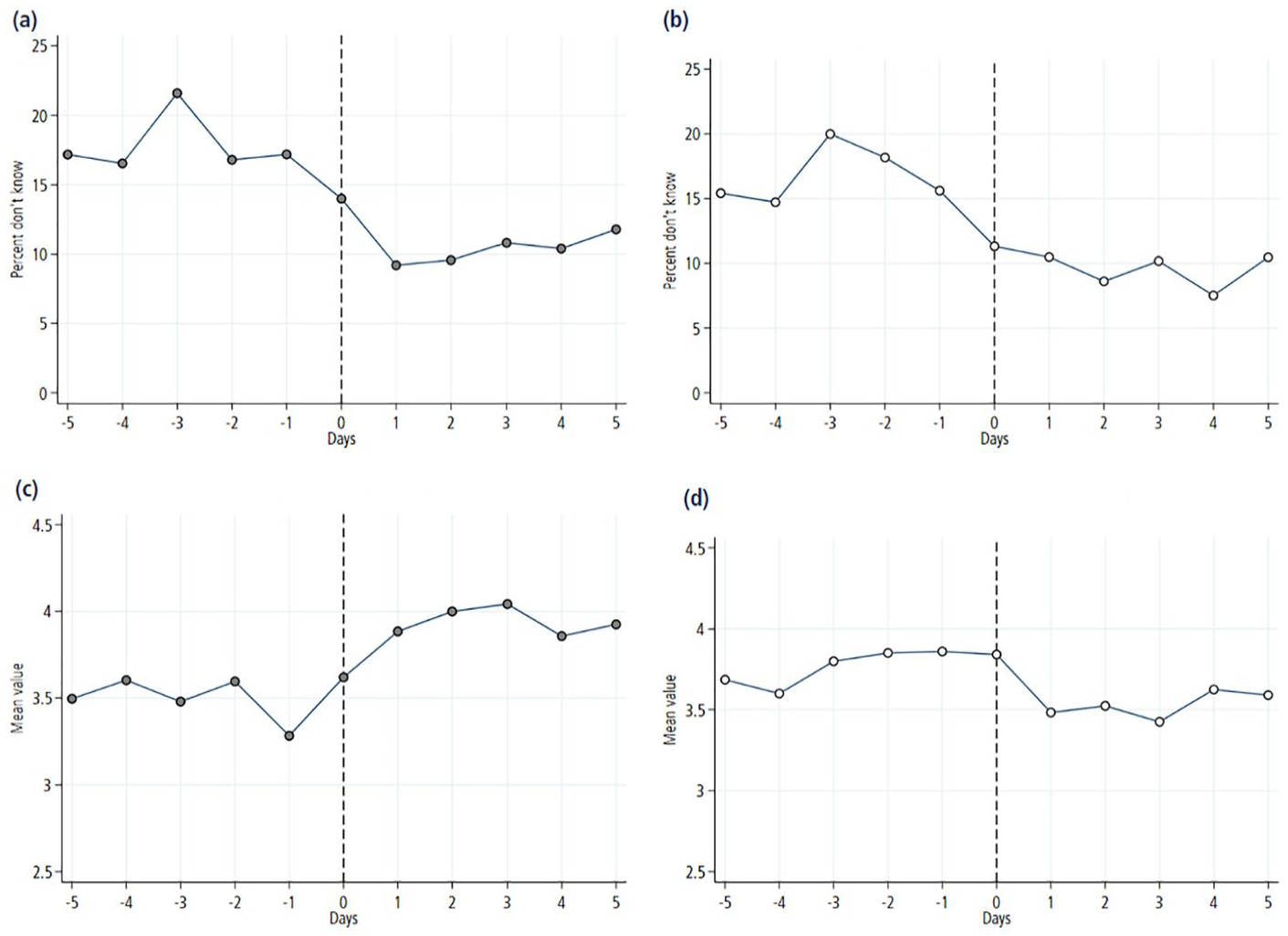
Share of respondents choosing the “don’t know” option and the mean value for the two summit questions each day in wave 1. (a) The meeting is a major failure for the climate, (b) The meeting is a great success for international climate cooperation, (c) The meeting is a major failure for the climate, and (d) The meeting is a great success for international climate cooperation.
Graphs a and b show that the share of “Don’t know” responses declines during the final days of the summit. The share of “Don’t know” stabilizes at around 10 percent after the summit ends. Furthermore, graphs c and d reveal clear swings toward pessimistic perceptions of the summit as the meeting ends. The mean value for the item “the meeting is a major failure for the climate” increases from 3.5 just before to 4.0 just after the ending of the summit. A similar pattern, although somewhat weaker, occurs for the item “the meeting is a great success for the international climate collaboration.” These aggregate-level developments provide an indication of the size of changes taking place during the summit—fluctuations of about 0.5 points on the belief scales.
Next, we turn to how these summit-specific perceptions were influenced by news coverage, using the combined summit belief index. Lower values represent more pessimistic perceptions while higher values reflect more optimistic summit perceptions. The independent variable is our linkage measure, capturing the extent to which respondents are exposed to negative (failure) and positive (success) news framing of the meeting. The regression results are presented in Model 1 of Table 1 and illustrated in Figure 5, displaying the predicted marginal effect of news frame exposure. The graph clearly shows how exposure to more positive news (high values) is associated with more optimistic perceptions of the summit in wave 1. The effects are not particularly large though. The plot suggests that increasing frame exposure by approximately ten units (i.e., from −5 to +5 where most respondents are) is related to an increase in summit-specific beliefs of around 0.2 units on the seven-point scale.
OLS Regression Explaining Summit-Specific Perceptions (Unstandardized Coefficients, Standard Errors in Parentheses).
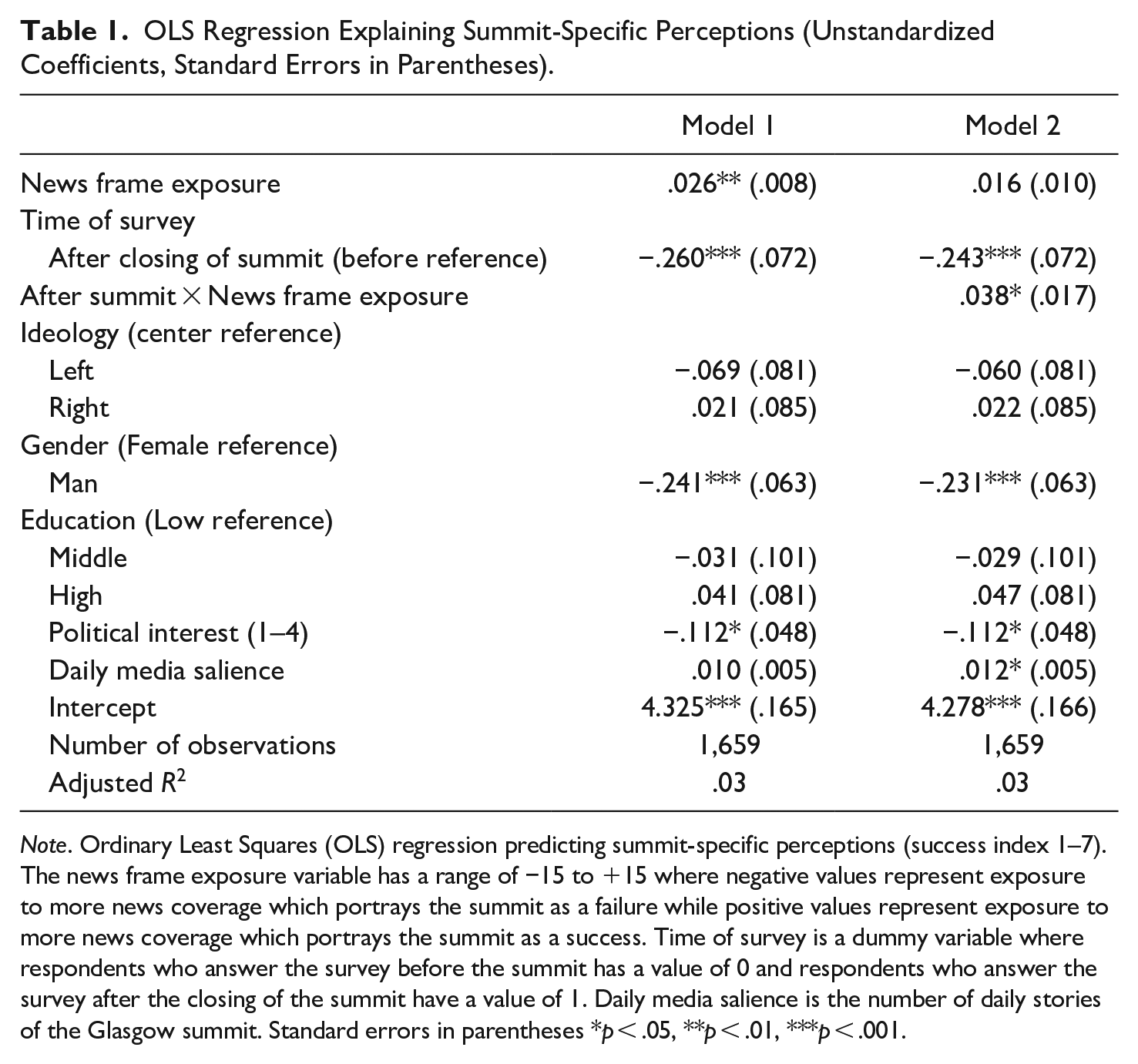
Note. Ordinary Least Squares (OLS) regression predicting summit-specific perceptions (success index 1–7). The news frame exposure variable has a range of −15 to +15 where negative values represent exposure to more news coverage which portrays the summit as a failure while positive values represent exposure to more news coverage which portrays the summit as a success. Time of survey is a dummy variable where respondents who answer the survey before the summit has a value of 0 and respondents who answer the survey after the closing of the summit have a value of 1. Daily media salience is the number of daily stories of the Glasgow summit. Standard errors in parentheses *p < .05, **p < .01, ***p < .001.
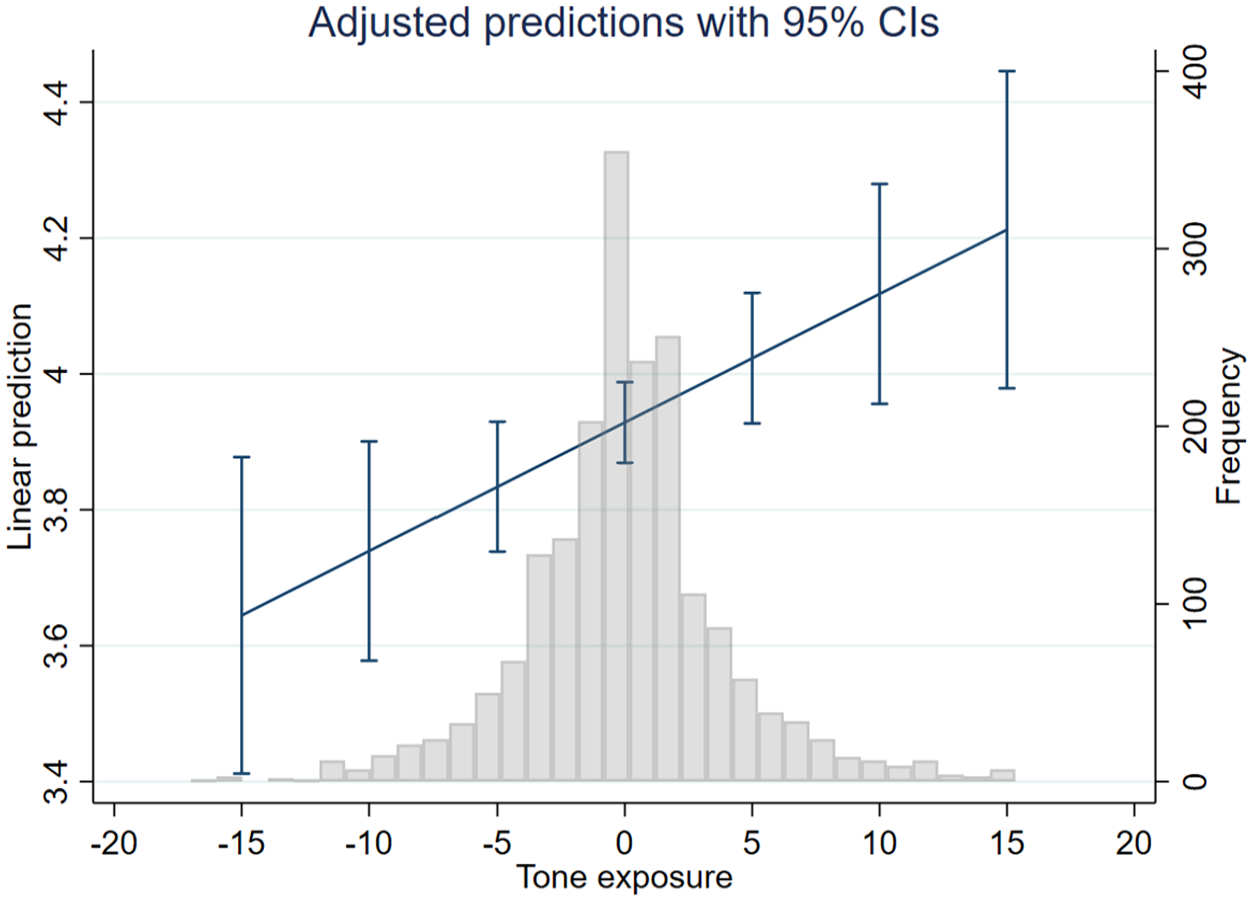
Predicted marginal effect of exposure news frames (negative/positive) on summit-specific perceptions (negative/positive).
To address whether news framing effects on citizens’ summit-specific beliefs differ before and after a final agreement is settled (RQ1), an interaction term between the linkage variable and a dummy indicating whether respondents answered the survey before or after the closing of the summit on November 13th was included. The findings are presented in Model 2 of Table 1. The significant interaction term indicates a positive effect of news frame exposure after the closing of the summit, but no effect before the closing of the summit. Thus, while the effect remains relatively small, it is significantly larger among respondents answering the survey after the summits ended. These results suggest a dynamic according to which news framing matters for people’s summit-specific perceptions, but only when there is a final agreement on the table.
Finally, we analyze whether these immediately formed summit-specific beliefs matter for citizens’ generic climate change beliefs, using longitudinal mediation models (Figure 5), addressing H2. These analyses focus only on those respondents who answered the survey after the ending of the summit. Findings from the SEM estimates are found in Table 2. With respect to the first indicator—that it is now too late to limit global warming—findings show a direct effect of news exposure on summit-specific beliefs (b = 0.04, p < .01) as well as a negative effect of summit-specific beliefs on generic beliefs (b = −0.10, p < .01). Thus, being exposed to success-framed summit news is related to more success-oriented summit beliefs, which in turn decreases the likelihood of believing it is too late to limit global warming. The indirect effect is small but statistically significant (b = −0.004, p < .05). Since the direct effect of news exposure on generic beliefs is non-significant, the findings suggest full mediation.
Mediation Model of Summit-Specific and Generic Climate Change Beliefs (Unstandardized Coefficients, Standard Errors in Parentheses).
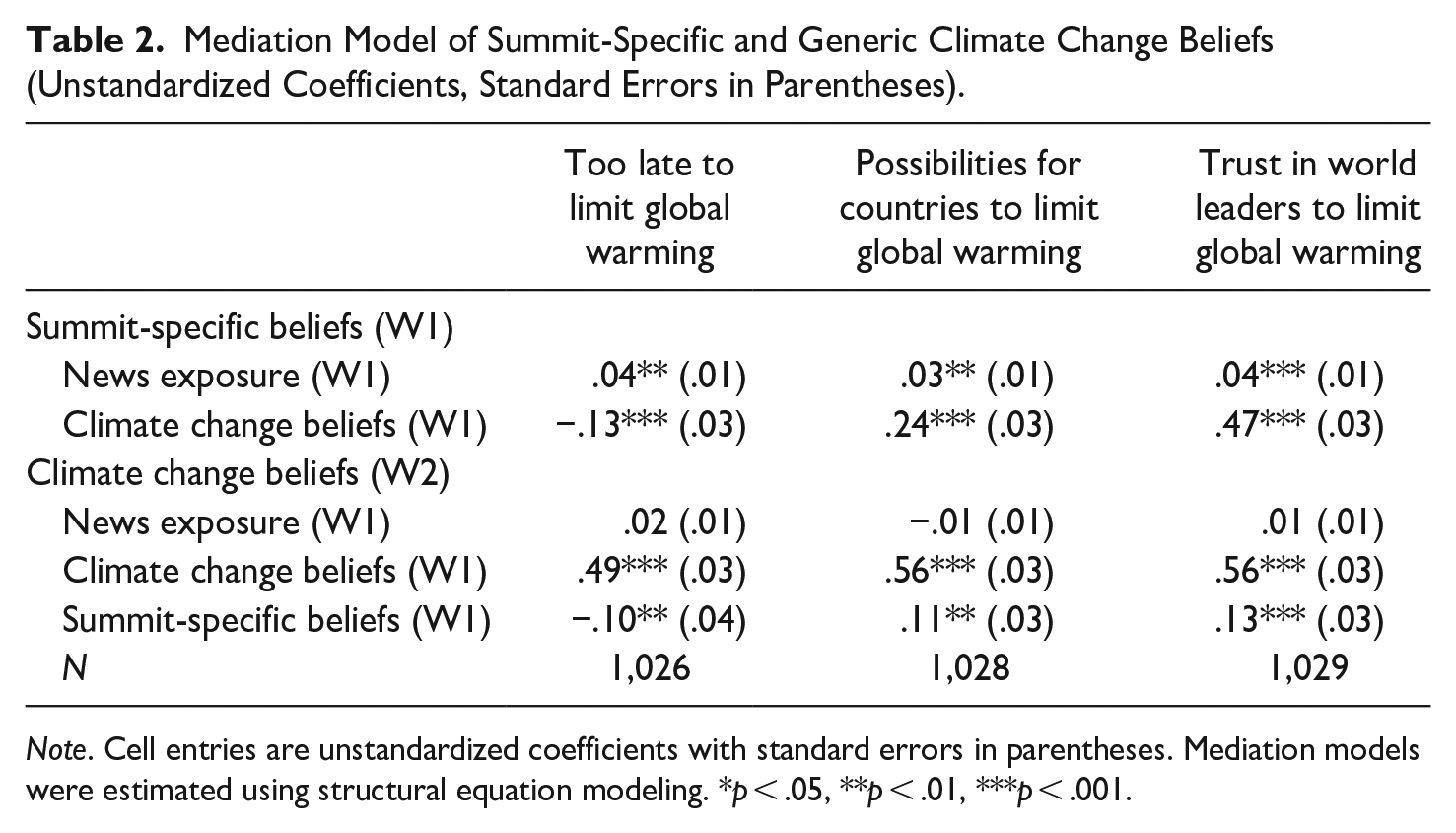
Note. Cell entries are unstandardized coefficients with standard errors in parentheses. Mediation models were estimated using structural equation modeling. *p < .05, **p < .01, ***p < .001.
Findings are very similar for the second indicator—possibilities for world countries to limit global warming. News exposure has an immediate effect on summit-specific beliefs (b = 0.03, p < .01), while such specific beliefs influence subsequent generic beliefs (b = 0.11, p < .01). The indirect effect is again small but statistically significant (b = 0.004, p < .05), while the direct effect of news exposure on generic beliefs is not, suggesting full mediation.
The third indicator—trust in world leaders to limit global warming—provides additional support for the specific-generic belief process. Being exposed to news framing the summit as a success is related to larger tendency to perceive the summit in this way (b = 0.04, p < .001), and these beliefs have direct effect on changes in generic beliefs (b = 0.13, p < .001). Also in this case, the indirect effect is statistically significant but small (b = 0.005, p < .01) and full mediation suggested by the non-significant effect of news exposure on generical beliefs.
Discussion
Climate change can be described as the defining challenge of our generation. From a policy perspective, the main international arena for addressing this global issue is the annual UN climate meetings (COP). The purpose of this study has been to determine how news coverage of these climate summits influences citizens’ short-term beliefs about the success or failure of these meetings, but also whether these summit-specific beliefs matter for more long-term generic climate change beliefs. In doing so, the study aims to contribute both to research on climate summits and climate change opinion (Capstick et al. 2015; Christensen and Wormbs 2017; Schmidt et al. 2013; Wessler et al. 2016) as well as to theories on dynamic news framing effects (Lecheler and De Vreese 2019; Scheufele and Scheufele 2010; Shehata et al. 2021).
Using a mixed methods design, combining a two-wave panel survey including a built-in rolling cross-sectional component, with data on Swedish news coverage of the 2021 UN climate summit in Glasgow (COP26), we find (1) that specific beliefs about the success/failure of the meeting took shape immediately following the summit, (2) that news framing effects were particularly pronounced when the final agreement was settled, and (3) that these instantaneous news framing effects on summit-specific beliefs left small but lasting imprints on citizens’ generic climate change beliefs several weeks after the summit. These findings have implications for research on news framing effects, climate change opinion and belief formation in general.
While our findings add support for the presence of news framing effects in a real-world case outside the experimental setting (Lecheler and De Vreese 2019; McLeod et al. 2022), this study primarily contributes to framing effects research by explicitly addressing the dynamics of news framing effects. More specifically, the study tested hypotheses derived from a psychological theory of dynamic news framing effects distinguishing between mental models and cognitive schemas (Matthes 2008; Scheufele 2004), according to which consistent frame exposure may change more stable generic beliefs by first influencing more situational and temporary, lower-order, beliefs (Scheufele and Scheufele 2010; Shehata et al. 2021). In our case, frame exposure had instantaneous effects on summit-specific beliefs, which in turn mediated the influence of news framing on generic climate change beliefs over time. Importantly, this reflects a case where short-term framing effects may have long(er)-term implications—which is one of the main puzzles and limitations in the heavily experimentally dominated field of framing effects research (McLeod, et al. 2021; Tewskbury et al. 2009). In contrast to previous experiments on effect duration, however, this study moved beyond simple direct (or total) effects, to provide a more nuanced account of dynamic framing effects over time. By focusing on specific dynamic effect processes—involving the relationship between specific and generic beliefs—we identified longitudinal indirect effects that are not captured in most duration studies (Lecheler and De Vreese 2016; McLeod, et al. 2021). In fact, the indirect effect processes documented here may even be present despite the lack of evidence for total effects between frame exposure and generic beliefs (Hayes 2009), suggesting that certain longitudinal influences, potentially small in size but highly relevant as effects accumulate over time, may be impossible to identify without proper theoretical and analytical precision (Scheufele and Scheufele 2010; Shehata et al. 2021; Thomas 2022). Over time, a series of consistent framing effects on specific beliefs, which are largely irrelevant on their own, may thus lead to long(er)-term influences by gradually transforming generic societal beliefs with significantly wider applicability (Scheufele 2004; Shehata et al. 2021).
Furthermore, this study focused on climate summits and climate change beliefs, contributing to this literature in particular while also raising questions about the character of the case. On the one hand, the study contributes to research on climate summits and climate opinion by implementing a unique research design allowing to capture the dynamic nature of mediated political events such as climate summits (Brüggemann et al. 2017; De Silva-Schmidt et al. 2022). Both our news content analysis and public opinion data illustrate how the Glasgow summit followed a dynamic with news coverage peaking at specific points reflecting intense moments of political negotiations. The fact that many respondents formed summit-specific beliefs during the final days of the meeting, with a clear swing toward negative assessments after the summit ended, highlights the theoretical and practical importance of theorizing and measuring public opinion at critical junctures. On the other hand, this also raises the question whether our findings are case-specific or whether the effect dynamics documented here also apply to other issues and contexts. In terms of framing effects theory, there is nothing particular about climate change as an issue: the effect process and relationship between mental models (specific beliefs) and schemas (generic beliefs) apply across issue domains (Matthes 2008; Scheufele and Scheufele 2010). What matters is rather whether citizens have strong and crystalized beliefs that are held with high levels of certainty—factors that tend to limit framing effects (Matthes and Schemer 2012). As a highly salient and established issue, climate change certainly represents a case where strong prior generic beliefs exist. Specific beliefs are however likely to be significantly more dynamic and open for influence. Oftentimes they form and take shape in response to completely new (and previously unknown) events and developments. Other times they develop as new information becomes available. The fact that news framing of a specific climate summit had indirect effects on more generic climate change beliefs, suggests that these dynamic effect processes may apply to many other, both established and less established, issues as well. Most importantly, our case and research design allowed us to address a particular effect process that we believe is widely applicable across issues: the formation of specific issue-beliefs and their implications for generic beliefs over time.
These contributions notwithstanding, a few limitations should be highlighted. One of the strengths of this study is the two-wave setup including a RCS-component. However, it is important to recognize that our research design lacks a pre-measurement of climate beliefs before the summit. Moreover, since wave 2 of the survey was fielded in a context almost without any summit coverage, it remains open how belief formation dynamics would play out over a longer period of time. Finally, the country context—Sweden—needs to be considered when assessing the generalizability of our findings. While climate summits are global news events appearing to follow a similar news dynamic, both news framing and opinion formation are likely to vary across national contexts (Barkemeyer et al. 2017). The Swedish context, where climate change has been on the media and public agenda for a long time, as well as where a broad political consensus and acceptance of the scientific facts of climate change exists (Oscarsson et al. 2021; Rönnerstrand 2022), is likely to yield different dynamics compared to countries where the climate issue is more polarized and/or less salient (Egan and Mullin 2017).With these caveats in mind, the fact that COP meetings are annual and share relatively predictable attention dynamics, lends upcoming summits as suitable cases to which the conclusions in this and similar studies can be reassessed.
Supplemental Material
sj-docx-1-hij-10.1177_19401612231218426 – Supplemental material for Success or Failure? News Framing of the COP26 Glasgow Summit and its Effects on Citizens’ Beliefs About Climate Change
Supplemental material, sj-docx-1-hij-10.1177_19401612231218426 for Success or Failure? News Framing of the COP26 Glasgow Summit and its Effects on Citizens’ Beliefs About Climate Change by Per Oleskog Tryggvason and Adam Shehata in The International Journal of Press/Politics
Footnotes
Declaration of Conflicting Interests
The author(s) declared no potential conflicts of interest with respect to the research, authorship, and/or publication of this article.
Funding
The author(s) disclosed receipt of the following financial support for the research, authorship, and/or publication of this article: This work was supported by the European Research Council (ERC) under the European Union’s Horizon 2020 under grant agreement no. 804662. Any opinions, findings, and conclusions or recommendations expressed in this article are those of the author(s) and do not necessarily reflect the views of the ERC.

Supplemental Material
Supplemental material for this article is available online.
Notes
Author Biographies
References
Supplementary Material
Please find the following supplemental material available below.
For Open Access articles published under a Creative Commons License, all supplemental material carries the same license as the article it is associated with.
For non-Open Access articles published, all supplemental material carries a non-exclusive license, and permission requests for re-use of supplemental material or any part of supplemental material shall be sent directly to the copyright owner as specified in the copyright notice associated with the article.
