



Abstract
This study investigates how exposure to favorable messages about one's preferred party can affect emotional reactions and subsequent behavioral intentions. Integrating the motivated reasoning and discrete emotions’ frameworks, we offer a theoretical framework of motivated mobilization for explaining political engagement in response to poll exposure. Specifically, we examine the mediating role of emotions in the relationship between motivated assessments of polls and political mobilization. To test this model, we offer empirical evidence from an online survey-experiment (N = 540) conducted during the 2019 Indian general election. We find that exposure to favorable poll results increases enthusiasm and decreases anger, while both enthusiasm and anger activate behavioral intention for political participation. While our study supports the existing findings which show that partisanship is an important predictor of mobilization for a party and candidate, we uncover the affective routes through which partisanship operates to shape poll reactions. The results underscore the importance of capturing individual variability in preexisting affiliations and their shaping of poll reactions through affect-driven motivated reactions. We discuss these results with regard to the dynamics of political mobilization during election campaigns, the role of emotions in political cognition at large, and in understanding and mitigating biases in poll perceptions.
Keywords
Since the onset of opinion polls in the 1930s, there have been ongoing debates on their impact on election outcomes and other forms of political participation. This is due to widespread media coverage of polls during election campaigns across the world (Strömbäck 2012). Extensive research has analyzed how exposure to opinion polls through the news media can (de)mobilize voters. While the bandwagon theory argues that voters are more likely to move towards a party that is ahead in the electoral race (Gallup and Rae 1940; Lazarsfeld et al. 1944; Moy and Rinke 2012), the underdog framework posits that voters are more likely to favor a party that is trailing in the polls (Ceci and Kain 1982; Chung et al. 2017; Simon 1954). Despite substantial work, both the bandwagon and underdog effects’ theories have been shown to be inconsistent and context dependent (Moy and Rinke 2012). Whether individuals decide to vote in line with the perceived majority (bandwagon) or against the perceived majority (underdog) might depend on a variety of factors such as preexisting beliefs and affiliations as well as the nature of the election race and political regime (e.g., two vs. multi-party regime; Kuru et al. 2019).
This divergence calls for more research to disentangle the cognitive and affective pathways underlying the processing of election poll messages in the media. We identify two emergent lines of research with the aim of resolving the aforementioned inconsistencies and gaining a more comprehensive understanding of the psychological processes in poll consumption, namely: (1) the role of emotions in poll reactions and (2) the motivated processing of poll evaluations. Building on the existing literature on mobilization from the bandwagon and underdog effects’ frameworks, we offer a theoretical framework that attempts to integrate these two lines of inquiry by investigating emotions and partisan motivated processing of polls, which enables us to better understand the mechanisms at play that lead to differential mobilization in response to poll exposure.
While numerous studies have focused on the role of emotions and poll exposure, they have primarily emphasized the role of negative emotions in subsequent political involvement (Kim 2015; Martin 2004). Little attention has been paid to understand how positive messages can not only trigger positive emotions but also subsequently shape the intention for turnout and political engagement. Several theories investigate the effect of emotions on political attitudes and behavior. In this article, we focus on the appraisal theory which posits that an individual's assessment or appraisal of the environment results in certain emotions that subsequently determine their actions and behaviors (Frijda 1987; Lazarus 1991). Furthermore, we need to focus on discrete emotions (Nabi 2003; Valentino et al. 2011) such as enthusiasm, anger, and anxiety to understand specific reactions that are relevant for political mobilizations. Distinguishing between emotions of the same valence is important since discrete emotions within each group are associated with different action tendencies (e.g., Nabi 2003, 2010).
Specifically, we show how exposure to favorable news in terms of in-party positive poll results could increase positive emotions which, in turn, activate behavioral intention for political participation. This framework is in line with research which suggests that enthusiasm is the most important positive emotion in the context of political campaigns and mobilization (Marcus et al. 2000; Stolwijk et al. 2016; Valentino et al. 2011). For negative emotion we focus on anger and anxiety, which are again based on the existing literature on political mobilization (Marcus et al. 2000; Valentino et al. 2011). We term this pathway from poll exposure to affective reactions and subsequent political intentions/behaviors “motivated mobilization.” In the process, we extend the motivated reasoning framework to the study of opinion polls to understand their effects on electoral and political mobilization by focusing on the mediating role of emotions.
To test this framework, we offer novel empirical evidence from the 2019 Indian elections, a non-Western and highly polarized context where electoral competition is high, and polls capture large media attention (Neyazi and Schroeder 2021). Till now, most of the empirical evidence of polls’ effects on political behavior has been based on studies in the American and European contexts with little attempt to test this effect outside of the Western democracies. We conducted an online survey experiment in India before the 2019 national election to understand how individuals react to poll findings presented to them in the form of news stories. Overall, we found that exposure to favorable poll messages (showing in-party candidates ahead) increases enthusiasm and decreases anger; in turn, both enthusiasm and anger activation increases in behavioral intention for political participation. In the next section, we first provide a more detailed theoretical discussion which is followed by the empirical background and hypotheses.
Integrating the Respective Roles of Emotions and Motivated Reasoning
Emotions play an important role in political cognition. In addition to measuring the bandwagon or underdog effects of polls, academic debates have also focused on the manipulative effects of polls in persuading voters through the emotional process (Aalberg and Van Aelst 2014; Marsh 1985; Rothschild and Malhotra 2014). Other, however, see this as a sign of healthy democracy, as polls provide information about the party and issue positions (Mayerhöffer and Brlek 2014). In the former view, such persuasion could be the result of the individual's less deliberate decisions influenced by the “prevailing attitudes and values of the wider social context.” (McAllister and Studlar 1991: 721). Thus, instead of expressing one's actual preference, the individual, in this view, mindlessly follows the crowd. In this respect, emotions, traditionally contrasted with reason and cognition, could be an important driver in the individual's reactions to polls in a similar manner.
On the other hand, motivated reasoning largely moderates the effects of any poll exposure, particularly in the context of elections. In an attempt to understand inconsistent bandwagon and underdog effects, recent research on poll effects has therefore focused on why and how people might interpret and react to poll messages in heterogenous ways. This line of work conceptualized polls as media messages for a more “active” rather than “passive” audience by focusing on the role of prior attitudes and beliefs. These studies examined how preexisting views on issue positions or party identification shape the processing of poll messages (Kuru et al. 2017, 2019; Madson and Hillygus 2019). According to the motivated reasoning theory, unfavorable messages (one's preferred party losing an election, or majority of the public supporting an issue not supported by that person) first lead to an immediate negative affective reaction, which then heavily shapes the downstream cognitive processing of the message; on the other hand, favorable messages do the opposite, presumably by triggering positive affective reactions (Lodge and Taber 2013). It has been shown that people discredit issue polls based on their pre-existing attitudes (Kuru et al. 2017) and election polls based on party identification (Madson and Hillygus 2019). Further, informational correctives against this bias that focus on polls’ methodological quality (such as providing sample details or expert comments) were largely ineffective (Kuru et al. 2019, 2020), highlighting the need for exploring and targeting alternative decision pathways such as emotions.
We combine these two lines of work and theorize on the relationship between emotions and motivated information processing with respect to poll exposure effects on political mobilization. While studies on motivated reasoning have demonstrated the impact of partisan bias on the processing of poll messages (Kuru et al. 2017, 2019; Madson and Hillygus 2019), there is relatively little understanding on how the psychological mechanism operates. Although these studies relied on the motivated reasoning theory to explain the effects, the process of how affective components may come first and then shape cognitive evaluations has not been directly studied (cf. Bakker et al. 2021; Lodge and Taber 2013). Therefore, to understand the psychological mechanisms undergirding poll reactions, it is important to probe the potentially mediating role of emotional reactions to poll messages.
The Mediating Role of Emotions in Poll Reactions
There has been longstanding work on the concept of polls activating emotions. For example, Robinson (1937) argued that polls have the potential for “decreasing the influence of individual reason in determining the outcome” (47). Recent debates also indicate the emotion-inducing effects of polls on voters’ judgments (Stolwijk et al. 2016). Lang and Lang (1984) argue that published polls may suppress minority opinion and create a climate of conformity with the majority opinion. Yet, the decision to vote in line with either the perceived majority (bandwagon) or the perceived minority (underdog) is found to be contextual and multifaceted (De Vreese and Semetko 2002; Dilliplane 2014; Van der Meer et al. 2016; West 1991) and has also resulted in inconsistencies in empirical findings.
While we have several studies analyzing how people's attitudes and voting decisions change after exposure to poll results (Mutz 1998; for a review, see Moy and Rinke 2012), these studies have not integrated the theory of emotions in understanding such effects (for an exception, see Stolwijk et al. 2016). Cognitive appraisal theorists view emotions as adaptive responses to the environment (Moors et al. 2013). There are two central psychological appraisals—the goal congruent and goal incongruent (Lazarus 1991). Goal congruent situations trigger positive emotions, while goal incongruent situations elicit negative emotions (Lazarus 1991). Depending on the psychological appraisal of the environment, it will evoke a particular emotion that will further influence subsequent individual perception and behaviors in line with emotion-consistent decisions or actions (Frijda 1987; Frijda et al. 1989; Lazarus 1991; Lerner and Keltner 2000).
In addition, control and certainty are two important appraisals that individuals may experience due to a perceived threat from the current environment (Smith and Ellsworth 1985). Uncertainly is more likely to trigger fear and anxiety, as individuals feel that the current environment is outside their control. When, however, individuals see themselves in control of the situation, they are likely to feel anger (Lerner and Keltner 2001; Valentino et al. 2009). Evidence suggests that threat and anxiety can spur information processing and increase political learning, but not campaign involvement (Marcus and Mackuen 1993; Nadeau et al. 1995). Similarly, enthusiasm, which is aroused when individuals see their goals being fulfilled, could trigger both certainty and control appraisals (Brader 2006; Marcus et al. 2000). After being exposed to favorable messages indicating that their party is going to win the election, the certainty of positive outcome is more likely to be heightened and individuals will feel they are in control of the situation, which, in turn, are more likely to trigger enthusiasm. The sense of (un)certainty or control is heightened during the campaign period, particularly when individuals are exposed to different types of messages. When confronted with threats, individuals are more likely to experience either anger or anxiety, while perceived opportunity from the political context will lead to enthusiasm.
This mediating role of emotions in political decisions that follow poll exposure has been underexplored. Studies have also examined the mediating role of emotions triggered through exposure to media messages and how they affect political participation and mobilization (Brader 2006; Igartua et al. 2011; Jacobs et al. 2018; Lecheler et al. 2013, 2015; Marcus et al. 2000; Schuck and de Vreese 2009) and opinion formation (Huddy et al. 2015; Jacobs et al. 2018). Specifically in the polling context, Stolwijk et al. (2016) investigated the connection between emotions and political participation and found that anxiety and enthusiasm mediate the effect of polls’ exposure on vote choice, leading to the bandwagon effect. Yet this study did not examine how prior attitudes may influence reactions to polls. These studies have empirically demonstrated that emotions are partly determining factors in political participation. Given the centrality of emotions in mobilizing potential voters, it is more likely that emotions will mediate the intention for political participation.
Motivated Mobilization
One of the important assumptions in literature pertaining to the bandwagon effects theory is to test the effect of reported positive or negative polls in swaying public support for the winning or losing parties. Yet, the mobilization through the bandwagon effect may not be driven by the motivation to ensure potential gains but a desire to avoid risks. The prospect theory has demonstrated that individuals are risk-averse, and given an option, they are more likely to act to avoid risk, rather than to attain gain (Kahneman and Tversky 1979; Tversky and Kahneman 1981). This risk-aversion propensity has also been applied to understand political mobilization (Schuck and de Vreese 2012).
The risk-averse explanation, however, is insufficient to help us understand why certain individuals with political predispositions are more likely to be emotionally driven and engage in political participation. Recent studies have shown motivated partisanship as a possible explanation for political mobilization, more so as a result of political polarization (Bolsen et al. 2014; Huddy et al. 2015; Leeper and Slothuus 2014; Lodge and Taber 2013). Drawing upon the motivated reasoning theory (see Kunda 1990; Lodge and Taber 2013; Taber and Lodge 2006), we argue that this motivated mobilization is driven by directional goals to reach a specific and preexisting choice. We posit that the role of emotions is important in poll reactions, given the role of prior attitudes that trigger motivated reasoning. When people are exposed to new empirical evidence (polls in this case), it would conflict with their prior attitudes leading to emotional reactions that motivates them to hold beliefs in line with preferred outcomes.
Thus, attitudinally incongruent information could activate affective processes and have a cascading effect among those with political predispositions. On seeing favorable information, partisans are more likely to witness an increase in positive emotion such as enthusiasm and a decrease in negative emotions such as anger and anxiety. Studies have shown that anger and enthusiasm tend to be linked with strong mobilization and with more costly forms of participation such as donating money and attending political rallies (Valentino et al. 2011). Enthusiastic citizens are more likely to be actively involved in campaigns and rely on party messages based on their partisanship or predisposition while making political decisions (Valentino et al. 2011; see also Brader 2006). At the same time, anger is associated with increased political participation (Lecheler et al. 2013; Valentino et al. 2011) as well as biased evaluation of political arguments (Suhay and Erisen 2018).
However, anxiety is linked to demobilization or mobilization of only non-costly forms of participation. Anxious citizens are generally expected to pay closer attention to campaigns and make more reasoned decisions (Valentino et al. 2011). Evidence suggests that threat and anxiety can spur information-seeking and information-processing and increase political learning, but they do not impact campaign involvement (Marcus and Mackuen 1993; Nadeau et al. 1995). Anxiety has also been associated with risk avoidance behavior and lower level of political engagement (For a review, see Wagner and Morisi 2019). In contrast to anger, Valentino et al. 2011 found that, anxiety is less mobilizing and did not lead to more costly forms of political engagement.
As shown in the existing literature, emotions are partly responsible for the subsequent mobilization of partisans. The subsequent mobilization is motivated to ensure that their favorite party is benefitted either through their intentions or actual actions in terms of voting for their own party. This dynamic—what we call “motivated mobilization”—is an important phenomenon during political campaigns and can help explain how voters mobilize in diverse ways. Hence, we propose the following hypotheses:
H1a. Favorable poll messages will decrease anger which will in turn (lesser anger) result in a decrease in both voting intention and political engagement.
H1b. Favorable poll messages will decrease anxiety which will in turn (lesser anxiety) result in a decrease in both voting intention and political engagement.
H2. Favorable poll messages will work to increase enthusiasm which will then positively affect political participation in terms of vote intention and political engagement.
The Empirical Context
The empirical evidence for this research comes from India in the context of the 2019 Lok Sabha (national level) election campaigns. The prolong and staggered nature of the actual election process in India renders polls particularly important; they have immense potential to sway and mobilize voters as well as to increase others forms of electoral participation such volunteering for campaigns. Some points to note: India is a multi-party, parliamentary democracy. Yet, ever since the Bharatiya Janata Party (BJP) leader Narendra Modi became prime minister in 2014, he has conducted election campaigns more in a presidential style. In fact, the 2019 election campaign was touted as a battle between Narendra Modi and Rahul Gandhi, leader of the opposition INC party (Indian National Congress), popularly known as the Congress party. While the BJP is a right-wing political party with a strong grassroots presence, the Congress party is a centrist political party with a secular ideology although its support base is not as deep-seated as that of the BJP. In the 2019 election, the BJP-led National Democratic Alliance (NDA) under the leadership of Prime Minister Modi returned to power with a majority, securing 353 seats in the 545-member Lok Sabha, while the Congress party-led alliance known as the United Progressive Alliance (UPA) came a distant second, winning only 91 seats.
Method
Participants
The online study was conducted from April 1–7, 2019, during the campaign period of the 2019 Indian national election; 540 adult participants (female = 49%; age M = 34.30, SD = 11.76) who were recruited from India by the survey firm YouGov. Quotas were employed by YouGov to make the sample demographically representative of the online population, particularly with regard to age and region, despite the fact that it was not probability-based (See Supplementary Information file, Appendix 1).
Procedures and Stimuli
Each participant was randomly assigned to one of the three experimental conditions (Narendra Modi winning (n = 186), Rahul Gandhi winning (n = 189) and Control (n = 165) conditions) as part of a post-test only between-subjects design (descriptive details provided further below). Random assignment worked successfully as there were no significant differences in the demographic composition of the three groups (See Supplementary Information file, Appendix 1).
Participants first answered the pre-treatment questions before reading one of the three fictional news articles. These questions aimed to measure participants’ political attitudes, party preferences, and political participation. The three news articles were presented as screenshots to make them more realistic as compared to vignette experiments. The name of the newspaper, however, was not shown to the participants to preclude any predispositions associated with particular newspapers. Both the Modi and Rahul conditions provided similar information, indicating that the candidate and the party associated with the candidate was more likely to win the upcoming national election (See Supplementary Information file, Appendix 2). The information in the articles was sourced as based on a mega survey conducted by a research firm in collaboration with a national newspaper, The Times of India, presumably a neutral and well-known media group in India, and this was kept constant across the articles. The control condition consisted of a news article that provided general information about the upcoming national election without including any information about the likely winner and the loser. Immediately after reading the article, the participants completed survey questions on the main dependent variables of emotions and intention for political participation.
Measures
Dependent Variable: Intention for Political Participation
We used two main dependent variables to measure political participation—intention for political engagement and turnout certainty. 1 All measures of political participation were measured on a 5-point scale (1 = very unlikely, 5 = very likely). First, we asked about the participant's intention to take part in political activities. Four items were included to create a scale variable of political engagement (α = .726). These items included: “I intend to discuss politics with my family and friends” (M = 3.84; SD = 1.28); “I intend to take part in political demonstrations” (M = 2.28; SD = 1.39); “I intend to sign the online petition” (M = 2.86; SD = 1.50); “I intend to volunteer to campaign for my favorite political party in the coming Lok Sabha election” (M = 2.60; SD = 1.48). Behavioral intention for political engagement was used as the dependent variable.
Our second dependent variable measured certainty about vote intention (“How certain or uncertain are you at this moment about which party to vote for in the coming Lok Sabha election?”) (M = 3.93; SD = 1.31).
Mediators: Emotions
The participants answered a series of questions on emotions that required them to indicate on a 7-point scale (1 = none at all, 7 = an extreme amount) how much of each of the following emotions they felt after reading the news article. The analysis is based on the use of three discrete emotions; anger (single item), anxiety (anxious, fear and afraid; α = .814) and enthusiasm (enthusiastic and happy; α = .835), instead of collapsing them into two groups of positive and negative emotions, because the discrete emotions within each group are associated with different action tendencies (e.g., Nabi 2010). This approach is in line with other political communication research (see e.g., Gross 2008; Schuck and de Vreese 2012; Valentino et al. 2011). Anger, anxiety and enthusiasm are presumed to mediate the effect of exposure to poll messages on intention for political participation and vote intention.
Independent Variable: Favorability of Poll Message
In order to measure the extent to which respondents conferred credibility to the messages based on partisan identity, we combined party identification and experimental condition into a single scale. Those participants who identified with the BJP and saw a poll showing a BJP victory as well as those participants who identified with the INC and saw a poll showing an INC victory were coded as having seen a favorable message (coded = 1, n = 49). On the other hand, those participants who identified with the BJP and saw a poll showing an INC-win as well as those participants who identified with INC and saw a poll showing a BJP-win were coded as having seen an unfavorable message (coded = 0, n = 60). Those people who reported that they did not feel close to any of the parties were in the majority and were theoretically placed in the middle: whether or not they viewed the BJP or the INC winning, given their non-affiliation, their situation did not constitute a favorable or unfavorable poll [coded = .05, n = 244]. This dummy coding allowed us to test the favorability of the message to the participant, and therefore hypothesize directional expectations with respect to motivated processing of the message and subsequent political mobilization. This also avoided complicated three-way interactions by combining two measures into a single variable. Similar coding strategies have recently been used in motivated reasoning studies on poll perceptions (e.g., Kuru et al. 2019). The resultant variable of favorability then, with increasing scores, represents a higher level of favorability to the respondent, that is, a higher level of match between the respondents’ identification and the winner shown in the experimental poll result. It was therefore a directional variable that applied to both political parties’ supporters (BJP and INC) in the sample in equal measure. Note that for this coding, those participants who were in the control condition and did not see any poll result (n = 165) as well as those participants who indicated that they do not identify with or feel close to any party (n = 32) were excluded since they were not conceptually relevant in this context.
Control Variables
We used political interest and key demographics as control variables. Political interest was measured on a 4-point scale (1 = not at all interested, 4 = very interested). Respondents were asked: “How interested are you in politics or political issues in general?” (M = 2.81, SD = 1.03). Our demographic variables included gender (female coded as 1, 49%), age (M = 34.96, SD = 11.96); education was measured on a 4-point scale (1 = lower than high school, 4 = post-graduate, M = 3.14, SD = 0.70); income, measured on a 8-point scale (1 = less than INR10,000, 8 = more than INR 200,000, M = 4.80, SD = 1.92).
Manipulation Check
We used a factual manipulation check to identify individual-level attentiveness to experimental information (Kane and Barabas 2019). A chi-square test was performed with the three experimental conditions and participants’ response to the information in those three conditions. The relationships between these variables was statistically significant X2 (4, N = 540, = 282.58, p = .000), showing the stimulus did work (See Supplementary Information file, Appendix 3a). Moreover, we also checked for message quality to ensure respondents believed in the stimuli (See Supplementary Information file, Appendix 3b).
Analytical Strategy
To test whether exposure to favorable messages—that is, their favorite party winning the election—could lead to affective mobilization among potential voters, we ran a causal mediation analysis using the approach developed by Imai et al. (2010). Table 1 shows the effect of exposure to favorable poll messages on two measures of political participation, intention for political engagement and self-reported vote intention, with the anger, anxiety and enthusiasm emotion variables acting as potential mediators. 2 As with most causal mediation analyses, three parameters are of primary interest: the mediation, direct and total effects. The mediation effect represents the effect of the treatment (i.e., exposure to favorable messages or poll messages) on the outcome (i.e., measure of political engagement) that can be attributed to changes in the mediator (i.e., emotion variables). The direct effect, on the other hand, represents the effect of the treatment on the outcome that is not attributed to the mediator. The total effect is simply the sum of the mediation and direct effect. The estimates of these quantities shown in the bottom panel of Table 1 is based on levels 0 (unfavorable) and 1 (favorable) of the effect of exposure to favorable poll messages variable, with level 0 acting as the baseline; an analogous set of results for levels 0 and 0.5 is included in Supplementary Information file, Appendix 4. Pairwise comparisons between the derived indirect effects are conducted to compare effect sizes of alternative mediative pathways and the results are presented in Table 2; 3 the confidence intervals shown are bootstrap confidence intervals.
Anger, Anxiety & Enthusiasm Mediate the Effect of Exposure to Favorable Messages on Political Engagement & Vote Intention.
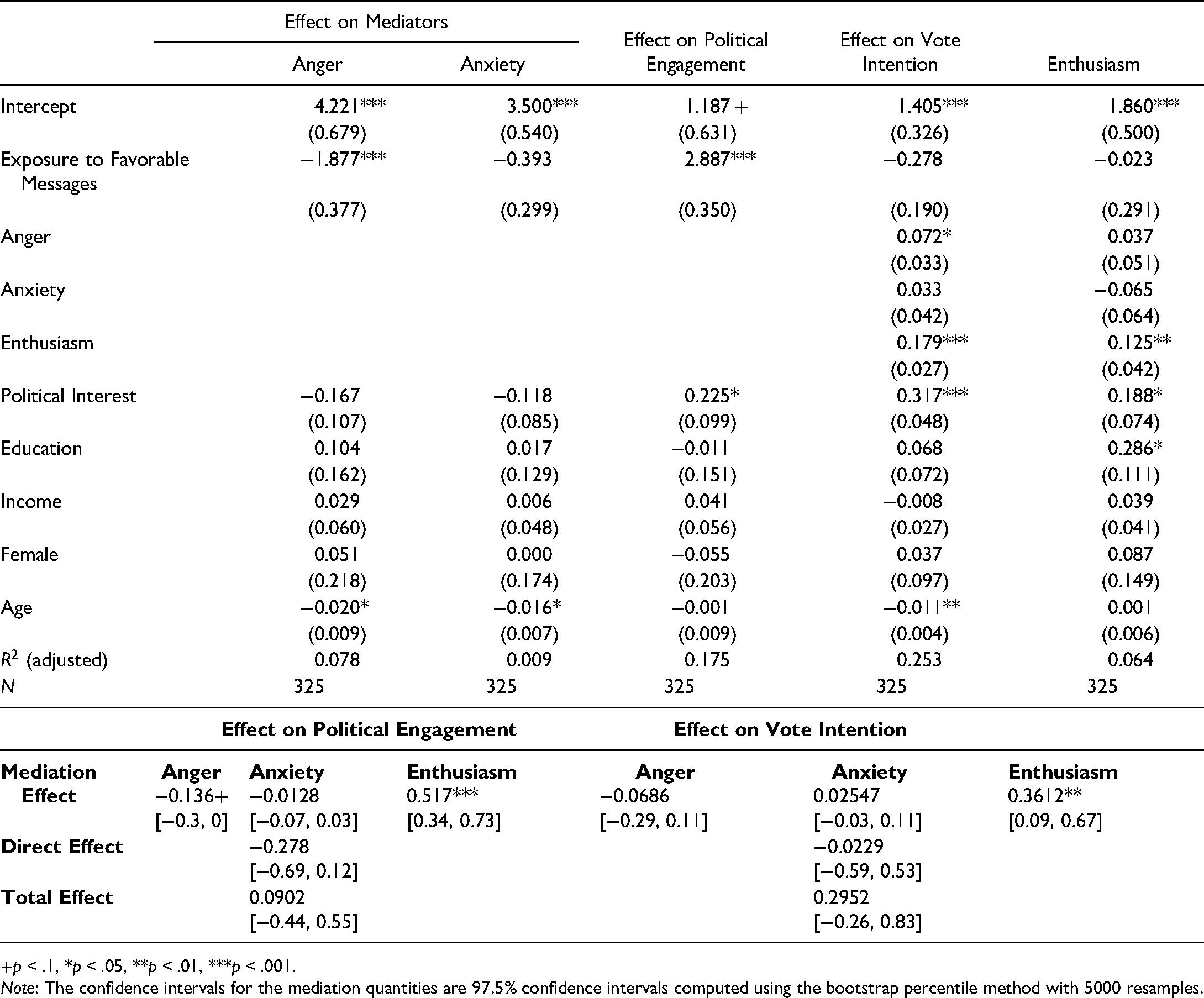
+p < .1, *p < .05, **p < .01, ***p < .001.
Note: The confidence intervals for the mediation quantities are 97.5% confidence intervals computed using the bootstrap percentile method with 5000 resamples.
Pairwise Comparisons Between Indirect Effects of Anger, Anxiety & Enthusiasm.
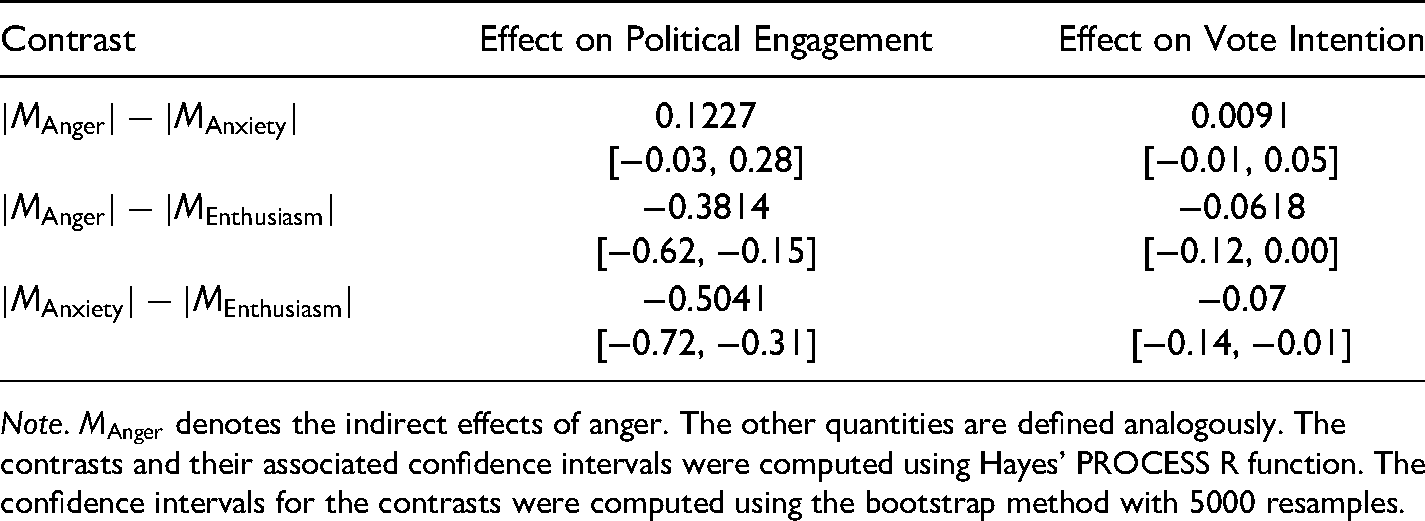
Note.
Results
First, we report the findings for the intention for political participation outcome variable. Our results show that larger adjusted
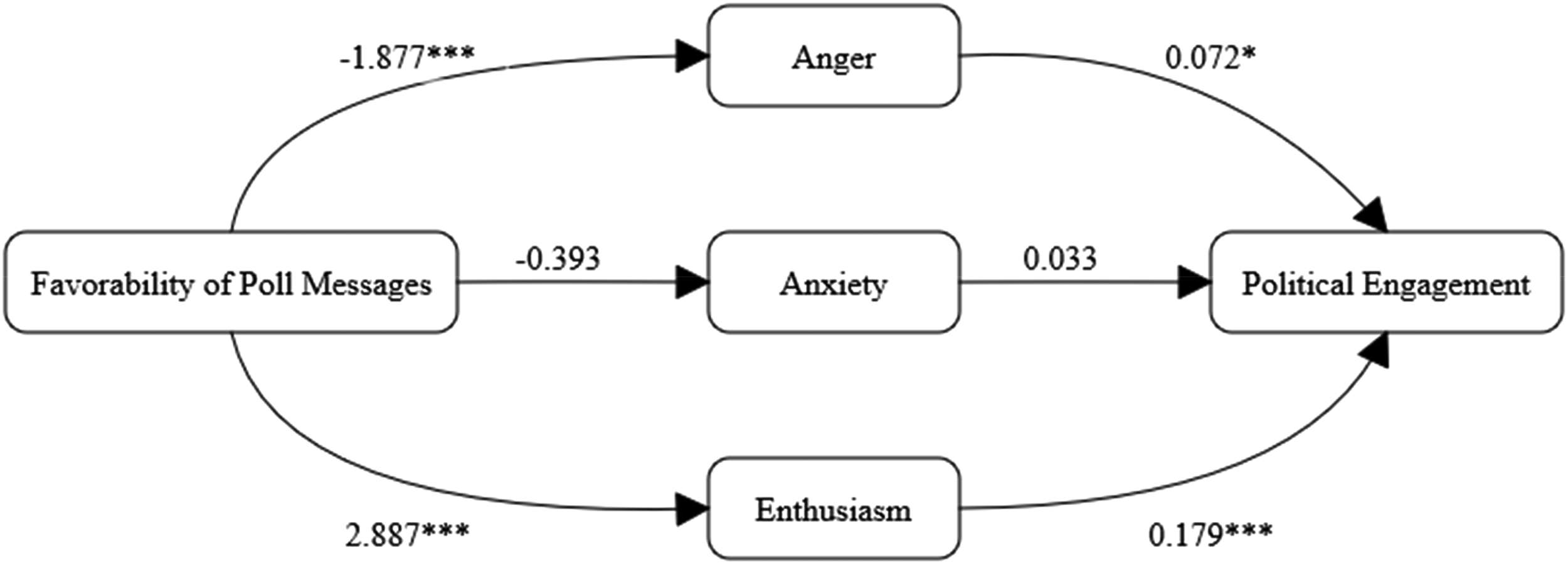
Mediation effect of favorability of poll messages on political engagement through anger, anxiety, and enthusiasm.
Interestingly, the results also show that exposure to favorable messages has a significant direct effect on anger (negative) and enthusiasm (positive) but not on political engagement. This suggests that the main channel by which exposure to favorable messages affects intention for political engagement is through changes in the levels of anger and enthusiasm and that once this has been accounted for, it no longer plays a significant role in activating political engagement.
Next, we discuss the results for the second outcome variable: self-reported turnout certainty. Noticeably, little of its variance is found to be explained by the three proposed emotion mediators (
As a whole, our analysis finds mixed results for H1a, with support found for the political engagement but not for vote intention case. However, H1b is not supported as no statistically significant coefficients are found for anxiety. We found strong support for H2, with statistically significant positive coefficients found for exposure to favorable messages on enthusiasm as well as the average causal mediation effects of enthusiasm on political engagement and vote intention. A sensitivity analysis conducted following the approach advocated by Imai et al. (2010) indicates reasonable degrees of robustness for the aforementioned results (See Supplementary Information file, Appendix 5 for details).
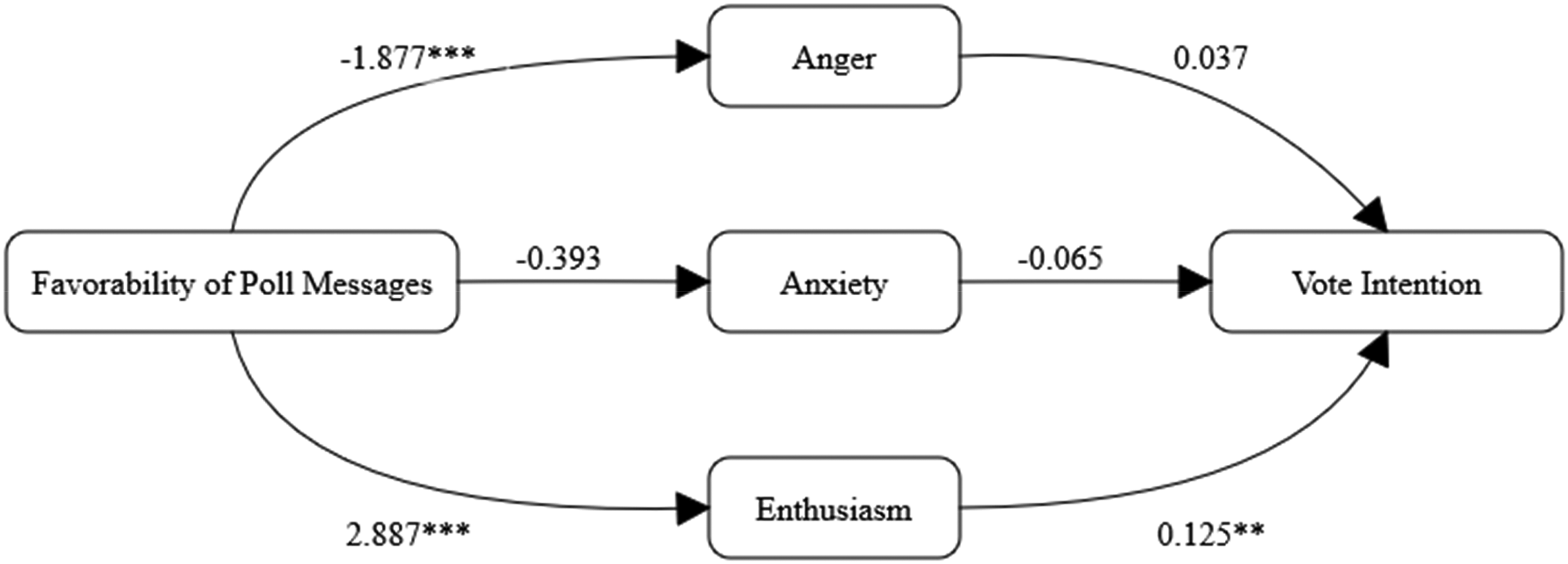
Mediation effect of favorability of poll messages on vote intention through anger, anxiety, and enthusiasm.
Discussion
This study investigated how exposure to polls has a mobilizing effect and how such an effect is mediated by discrete emotions. We show differential mobilization effects by emotions elicited and that positive and negative emotion results differed. Our mediation analysis shows that the positive emotion of enthusiasm plays a key role as a mediator for the intention to engage in political participation, which is consistent with the previous studies (Marcus et al. 2000; Marcus and MacKuen 1993; Stolwijk et al. 2016; Valentino et al. 2011). Exposure to favorable messages about the possible victory of one's favorite party in the forthcoming election increased the positive emotion of enthusiasm, which in turn affected intention for political participation. The current study thus extended the findings on the emotional reactions to poll messages (Bakker et al. 2021; Brader 2006; Stolwijk et al. 2016). We, however, brought a new dimension to this line of work by showing how enthusiasm in addition to anger can play an important role in motivated mobilization. As shown in our results, exposure to favorable messages decreases anger, while anger is associated with mobilization. In this way, the negative emotion of anger though mobilizing by itself, may not bring this outcome when the tone of the exposed message was positive.
Our study shows that favorable news about one's favorite party or candidate (i.e., it is ahead in polls) mobilized supporters in the positive direction. This could be explained through our theoretical framework of motivated mobilization, which we have adapted from the motivated reasoning theory. As shown in various studies, partisan voters are more likely to be highly motivated and engage in activities that help in supporting their pre-existing beliefs (Huddy et al. 2015). When partisan voters get incongruent information, they are more likely to affectively evaluate those messages and engage politically. This study has shown that exposure to polls activated the positive emotion of enthusiasm and the negative emotion of anger, which in turn influenced the intention for political participation.
Among partisan voters, the intention for political participation was positively significantly mediated via enthusiasm. While our study supports the existing findings which show that partisanship is an important predictor of support for a party and candidate, we also explain the mechanisms through which partisanship operates. We show that partisan voters are more likely to be driven by emotions. In other words, when partisan voters are exposed to favorable messages about their favorite party and candidate, it triggers enthusiasm and reduces anger which, in turn, motivates them to take action. Political participation is thus mediated by enthusiasm, which supports the existing studies (Marcus et al. 2000; Stolwijk et al. 2016; Valentino et al. 2011). Valentino et al. (2011) show that anger and enthusiasm tend to be linked with strong mobilization. Our study thus further supports the mobilizing role of enthusiasm and anger. For the negative emotion of anxiety, we found more inconsistent and insignificant results. While several recent studies have analyzed how motivated reasoning affects the processing of poll messages (Kuru et al. 2017, 2019, 2020; Madson and Hillygus 2019), they have largely focused on cognition, and tend to ignore emotion. In the context of an election campaign, which is short-lived and presents a time of heightened emotions, voters tend to make decisions based on emotion even more frequently (Brader 2006). Similarly, opinion polls largely reach individuals through the media, which can trigger specific emotions and subsequent action. At the same time, a growing body of literature shows that exposure to media messages elicits an emotional response, which can affect opinion formation and political behavior (Brader 2006; Marcus et al. 2000; Martin 2004).
Directionally driven people are more likely to act, devise strategies, and get involved in actions that increase the possibilities of achieving their prior target. Lodge and Taber (2013) have demonstrated that biased processing of information is stronger among highly partisan individuals with prior beliefs. Similarly, more politically involved individuals engaged in motivated reasoning to a greater extent when they read poll findings (Kuru et al. 2017). If individuals see new information that conflicts with their preexisting attitudes and beliefs, directionally driven people are more likely to be mobilized since they are strongly motivated. By integrating emotion with the preexisting attitude, the study makes an important theoretical contribution to highlight the role of emotions in political participation and also the powerful effect of positive and favorable messages on mobilization.
The extensive literature on bandwagon and underdog effects assumes that people will only and mostly be responsive to incoming information from poll results; it ignores the role of preexisting views and positions of individuals. While this approach is useful in explaining voting patterns in various ways, it falls short in highly polarized contexts as it ignores the potential of pre-existing attitudes’ that color the initial poll reception stage. This failure to account for prior attitudes may be one reason for inconsistencies in the literature as well as highly contextual findings. In response, recent research on motivated reasoning has focused on how people evaluate polls differentially based on their views; and this conditions the effect of polls on their political decisions and behaviors (cf. Kuru et al. 2017, 2019; Madson and Hillygus 2019). If certain individuals discredit some polls as unscientific or biased, counteracting the message in the first place, there is little reason to expect those polls to have a consistent impact on all individuals, if there is any impact at all. Our findings contribute to this theoretical debate by affirming the important role of emotions in poll reactions. They present a fuller view of motivated reasoning and subsequent motivated mobilization. The results underscore the importance of capturing individual variability in prior views and their shaping of poll reactions through affect-driven motivated reactions. We also demonstrate that motivated poll reception has downstream effects on political outcomes in the context of elections.
Our findings on the role of emotions in poll receptions offer insights on political polarization as well. Recent research showed the importance of affective polarization in shaping politics (Druckman et al. 2021). We illustrate that affect-driven motivated reception of polls, leading to motivated mobilization, could serve as one of the pathways to increasing political polarization in the context of election campaigns. In turn, informational interventions against biased receptions, such as providing methodological details of polls in transparent ways or highlighting expert comments on poll quality, may have limited influence if they fail to prevent emotional reactions from occurring in more specific ways (cf. Kuru et al. 2020; AAPOR Transparency Initiative 2014).
Our findings conform with the existing research conducted in the Western contexts but also offer new perspectives and theoretical insights to understand how emotions may operate across cultures in political mobilization. The Indian polity is defined by weak party attachment with voters not identifying strongly with any one party, which is reflected in the substantial number of swing voters (Heath and Ziegfeld 2018). This suggests that voters have a set of different strategic considerations while deciding their voting preference in local versus national elections. This makes poll results particularly important in the Indian polity as they shape beliefs and political behaviors during elections. On the other hand, the increase in polarization after the BJP came to power at the national level in 2014, has resulted in the salience of identity-based mobilization along the religious lines (Jaffrelot 2021). As a result, one could expect further entrenchment of motivated partisanship and political polarization in India, a phenomenon which is also being seen globally (Carothers and O’Donohue 2019; Vaccari and Valeriani 2021). Our results show how this operates through emotional reactions; hence, they also contribute to normative discussions on democracy such as belief gaps among partisans and the dialogue over electoral legitimacy (Delavande and Manski 2012).
The current study has a few limitations. The study is based on an online experiment and the respondents consisted of the English-speaking middle-class population in India. Hence, the findings should be treated with caution. Moreover, the study is based on the self-reporting method to measure participants’ emotions as well as their intention for political participation as used in the existing research (Kim 2015), but has a limited explanatory power compared to observational measure. Future studies may benefit by capturing actual political participation through online field experiment design. Similarly, the lack of similar studies for a comparison of
Despite these limitations, our study makes an important contribution by extending the motivated reasoning framework to the study of polls to understand their effects on political mobilization by focusing on the mediating role of emotions. Our study shows the importance of focusing on discrete emotions to understand the differential effects of positive and negative emotions in political mobilization. We provide evidence for the motivated reasoning of polls by examining the psychological process by which emotions mediate the influence of poll favorability on participation.
In sum, this study extends the existing literature by making three contributions. First, we focused on both positive and negative discrete emotions (anger, anxiety, enthusiasm) as mediators in motivated processing of polls and the subsequent motivated mobilization. These results also underscore the increasing centrality of emotions in political cognition (Brader 2006; Marcus and MacKuen 1993; Valentino et al. 2011). Second, we examined not only electoral participation but also general political participation, such as signing online petitions and participating in demonstrations. Third, we examined these theoretical contributions in the context of the empirically important Indian elections, where the long and multi-stage voting process renders polls’ influence on participation particularly crucial and consequential. Overall, our results showed that, in general, enthusiasm triggered by exposure to positive messages motivate individuals to engage in subsequent political activities. Our findings also suggest that while anger remains an important emotion to mobilize support, positive poll messages could be equally important to include in the campaign design to mobilize support since they interact with preexisting attitudes of the voters in important and complex ways. Positive messages helped in reducing anger, but such reduction in anger resulted in demobilization. Future research would benefit by testing the role of discrete negative and positive emotions in actual vote choice to probe the pathways by which motivated mobilization may lead to differential election outcomes.
Supplemental Material
sj-docx-1-ijpp-10.1177_19401612221086907 - Supplemental material for Motivated Mobilization: The Role of Emotions in the Processing of Poll Messages
Supplemental material, sj-docx-1-ijpp-10.1177_19401612221086907 for Motivated Mobilization: The Role of Emotions in the Processing of Poll Messages by Taberez Ahmed Neyazi and Ozan Kuru in The International Journal of Press/Politics
Footnotes
Declaration of Conflicting Interests
The author(s) declared no potential conflicts of interest with respect to the research, authorship, and/or publication of this article.
Funding
We would like to thank JSPS Grant-in-Aid for Scientific Research (A) 18H03624 (Representative: Prof. Kazuya Nakamizo, Kyoto University) for supporting this study.

Supplemental Material
Supplemental material for this article is available online.
Notes
Author Biographies
References
Supplementary Material
Please find the following supplemental material available below.
For Open Access articles published under a Creative Commons License, all supplemental material carries the same license as the article it is associated with.
For non-Open Access articles published, all supplemental material carries a non-exclusive license, and permission requests for re-use of supplemental material or any part of supplemental material shall be sent directly to the copyright owner as specified in the copyright notice associated with the article.
