




Abstract
This article enters into debates about media logic in political coverage by way of a case study of the 2015 U.K. General Election. We quantitatively and qualitatively examine two dominant themes of coverage—news about campaign rallies and horse-race reporting—as both are widely seen in political communication scholarship as symptomatic of a media logic. We draw on a content analysis of BBC, ITV, Sky News, Channel 4, and Channel 5 U.K. national television newscasts and semi-structured interviews with their heads of news and/or senior editors to help interpret how far a media logic was the editorial driving force behind coverage. At face value, our content analysis appears to support the media logic thesis, with all broadcasters—in particular commercial television newscasts—covering more process than policy issues. But our case study questions the antecedents of media logic and shines a light on a political logic that may have remained in the dark in large-scale content analysis studies. In following a political logic, we argue that this promoted the horse-race narrative, and naturalized the parties’ highly stage-managed rallies and walkabouts.
Election campaigns trigger an intense power struggle between media and political actors as competing interests fight to control the agenda. The intensity of this battle has been brought into sharper focus by an increasing scholarly interest in how media cover election campaigns. Strömbäck and Lee Kaid’s (2008) edited volume, The Handbook of Election News Coverage Around the World, perhaps provides the most comprehensive global picture, signaling the multiplicity of explanatory factors that influence the reporting of campaigns between countries, from different political and media systems, journalism cultures and norms, to competing styles of party campaigning, rules regulating elections, and levels of engagement among citizens.
In considering the twenty-two countries featured within the volume, they concluded that a media logic was a prominent–or “even dominant”–characteristic of election coverage, with news about the strategy of parties, campaign events and horse-race type stories prioritized above more substantive policy issues (Strömbäck and Lee Kaid 2008: 425). More recent research has suggested that election coverage has become increasingly driven by news media values, although trends can be unidirectional, with different political and media systems playing a role in resisting—or encouraging—a media logic (Takens et al. 2013).
In this article, we enter into debates about media logic in political coverage by way of a case study of the 2015 U.K. General Election. We draw on a content analysis of the United Kingdom’s leading television newscasts over the six-week election campaign, interpreting the volume and nature of coverage between different broadcasters. In doing so, we quantitatively and qualitatively examine two dominant themes of coverage–news about campaign rallies and horse-race reporting–as both are widely seen in political communication scholarship as symptomatic of a media logic in election reporting. To help consider how far a media logic was a driving force behind television news agendas, we draw on semi-structured interviews with the heads of news and/or senior editors from the BBC, ITV, Sky, Channel 4, and Channel 5.
As the United Kingdom has a hybrid media system, with a mixture of public and market-driven broadcasters, our study can examine whether newscasts operating under greater commercial influence pursued an agenda consistent with a media logic. But more broadly, our aim is to consider media logic in both quantitative and qualitative detail by understanding the editorial decisions behind the selection of news and comparing journalistic perspectives with a systematic review of how U.K. newscasts reported the campaign.
Media Logic, Reporting Elections, and Interpreting Campaign Coverage
The concept of media logic broadly describes the routine way in which media content is editorially shaped and structured. But scholars have criticized the abstract way in which it has been defined and the notion that one logic can encapsulate the diverse ways in which media operate (Lundby 2009). The concept of news media logic has been defined by Strömbäck (2011) as “the institutional, technological, and sociological characteristics of the news media, including their format characteristics, production and dissemination routines, norms and needs” (p. 373).
In studies about the reporting of elections, the concept of media logic has generally been used to characterize the degree to which coverage subscribes to the values and conventions of news media rather than a political logic (Strömbäck and Lee Kaid 2008). According to Strömbäck and Esser (2014), a political logic refers to a “need to form, take decisions on and implement policies, and the need to be successful in different processes of winning support in elections or in the battle for publicity, public opinion, and in negotiations and bargaining” (pp. 15–16). When evaluating media coverage of election campaigns, many scholars interpret the contest as a battle between media and political logics. In doing so, it is often found that a media logic triumphs over a political logic because campaign and horse-race perspectives are reported above policy issues, or because journalists speak over politicians and interpret their behavior and actions, or because coverage is personalized and candidate centered (Cushion and Thomas 2013; Takens et al. 2013; van Aelst et al. 2008). Media logic, in this context, is seen to force politicians and political parties to adhere to news values and production routines, with journalists rather than politicians setting the campaign agenda. Of course, how effective media logic is in setting the public’s agenda or engaging audiences remains open to debate. Although there is evidence to suggest that “horse-race” stories attract viewers, at the same time, they can contribute to more cynical attitudes toward politics (Iyengar et al. 2004; Jackson 2011). Similarly, understanding the effect of political logic in news coverage could be dependent on the type of policy agenda, with particular parties “owning” certain issues that might more favorably win voter approval (Kiousis et al. 2015). In recent years, scholars have more carefully considered—with mixed results—the electoral effectiveness of campaign strategies such as attacking opponents (Nai and Walter 2015) or adopting particular policy positions (Adams et al. 2011). In other words, the logic behind political reporting and their effect on audiences should not be assumed but carefully disentangled.
Nevertheless, the weight of scholarly evidence generally supports the proposition that an overarching media logic has increasingly shaped election agendas in many western countries (Strömbäck and Lee Kaid’s 2008). But most of these studies rely on large-scale content studies, with similar operational definitions about what constitutes media logic. So, for example, Brants and van Praag’s (2006) historical assessment of election coverage in the Netherlands interpreted media logic as horse-race coverage (via opinion polls or reflections) and hoopla reporting (via campaign-type news). By way of conclusion, they argued that “the 2003 campaign showed clear signs of media logic: performance driven campaign communication, media orientation on the public, on the whole less substantive and more horserace and poll driven reporting, journalistic dominance” (p. 38). The assumption here–shared by many scholars–was that poll-driven, campaign-related, and policy-lite agendas inherently represent an underlying media logic.
In our view, this broad and widely shared understanding of media logic can be potentially misleading. It assumes, for instance, that politicians want to engage with policy matters when they may be actively seeking to avoid them. Indeed, there may even be a political logic behind prioritizing campaign coverage above issue-based news as party spin doctors can more closely control the backdrop of their leaders’ appearances and the messages being conveyed. Similarly, although scholars have long associated media logic with the obsessive pursuit of the horse-race narrative, from a politician’s perspective, it could act as a convenient distraction from answering more substantive issues or prove electorally advantageous for political parties.
Of course, it would be impractical to assume that large content analysis studies spanning many decades or even countries could provide the necessary context to disentangle the precise media logic behind editorial decision making. But although the longitudinal scope and cross-national depth of political communication scholarship has helped build a macro picture of election reporting internationally, the micro factors that help explain coverage have arguably been marginalized. This perhaps reflects a larger gap in political communication scholarship, with far less qualitative research about the editorial judgments shaping the production of news during the election than quantitative studies interpreting large data sets and trends over time. This is not to suggest that practitioners do not inform political communication scholarship. Indeed, academic libraries are often full of accounts, diaries, and memoirs written by journalists reflecting on their experiences of covering campaigns, although practitioners are often invited to share their postelection reflections in special editions of journalism or political communication journals. But, in our view, there is a limited supply of empirical studies—whether interviews or participant observation—exploring the editorial judgments behind news selection at election time.
Indeed, when production studies do inform empirical studies exploring media coverage of elections they can help explain editorial decisions. So, for example, Semetko et al.’s (1991) study comparing American and British elections revealed a number of important insights about the formation of election agendas and the influences shaping journalistic choices. Nevertheless, we would also agree with Semetko et al.’s (1991) conclusions that On-the-spot observation can shed much light on how media personnel interpret their roles and the kinds of reports they should provide, but only content analysis can show whether such orientations and aspirations have real consequences for what actually gets into the news. (p. 183)
It is in this context that this study enters into debates about how far a media logic shaped election reporting during the 2015 U.K. election. But we begin by providing some context to the 2015 U.K. General Election campaign.
The 2015 U.K. General Election: Media and Political Logics in Context
In the run up to the 2015 U.K. General Election, the main political parties—Labour and Conservative—were consistently tied in the polls, but the final result was a Conservative Party majority. The polling industry undertook a review of their methodology, and identified among other factors that most organizations had overrepresented the likelihood of young people voting Labour and underrepresented elderly people voting Conservative. The perceived closeness of the race meant a coalition was widely viewed as the most likely electoral outcome. Many possible coalitions could have been fashioned, but perhaps because of the polling evidence and the campaigning tactics of political parties, a great deal of attention was paid to a potential alliance between the Labour Party and the Scottish National Party (SNP). Although Duch et al.’s (2010) longitudinal analysis of voters in twenty-three countries found “coalition-directed voting” regularly occurs in multiparty coalition governments, in U.K. politics, this approach to voting is relatively new (p. 698). Consequently, as our analysis suggests, broadcast editors may not have fully considered how to handle party political attempts to encourage tactical coalition voting. Indeed, the focus on a Labour/SNP coalition suited the interests of the Conservative Party, but it overshadowed Labour’s campaigning. Reporters speculating about a possible coalition even led to the Labour Party writing a formal letter of complaint to the BBC about its impartiality. One study suggested that U.K. national newspapers helped legitimatize the editorial focus on a possible Labour/SNP coalition and played an intermedia agenda-setting role that encouraged broadcasters to join in the speculation about postelection deals (Cushion et al. 2016).
Consistent with international trends, the United Kingdom’s main political parties have become increasingly professionalized over recent decades, with campaign agendas carefully orchestrated by dedicated spin doctors and public events tightly controlled by party officials. Press conferences, for example, have been held less frequently by political parties in recent elections, limiting the space for journalists to interrogate their policy proposals during the campaign. Instead, public campaign events tend to be more carefully policed by spin doctors, such as highly staged walkabouts in factories or campaign rallies primarily attended by party activists rather than members of the public.
In different ways, the U.K. media have responded to the increasingly savvy and sophisticated ways of party electioneering over recent years. Studies have shown, for instance, journalists becoming increasingly interpretive of political affairs, adopting a combative role and aggressive mode of address when questioning politicians (Cushion and Thomas 2013). This more skeptical approach to political journalism may also have informed the nature of campaign coverage, with an increasing emphasis on the process of politics in recent elections. During the 2010 campaign, Deacon and Wring (2011) found that 43 percent of television news coverage was about electoral process issues—including campaign events or horse-race reporting—rather than wider policy debates.
Our study will examine the balance between coverage of process and policy in television newscasts but also according to their ownership and regulatory characteristics. Although the BBC is a wholesale public service broadcaster, ITV, Channel 4, and Channel 5 are commercial public service broadcasters. Sky News, meanwhile, has no public service obligations but has to conform to the United Kingdom’s strict rules about “due impartiality,” which all U.K. broadcasters have to follow. Based on our content analysis of U.K. newscasts during the 2015 General Election and interviews with heads and/or senior editors, overall, we ask the following research questions:
Method and Sample
Our content analysis systematically examined television news over the short campaign (March 30 to May 6, 2015, including weekends). A research team coded all news on the United Kingdom’s leading evening newscasts—BBC News at Ten, ITV News at Ten, Channel 4 News at 7
Our variables included whether an item was election related; whether an item was predominantly about policy or process issues, along with the type of process issue (campaign rally, horse race, or TV debate); whether an opinion poll was referenced; and, finally, whether an item featured a reporter on the campaign trail. All variables achieved credible to high intercoder reliability scores according to Krippendorff’s alpha. 1 In light of postelection debates about how the media had covered the campaign and some of the responses from our interviewees, we explored the logic behind the editorial decisions in more quantitative and qualitative detail. Three issues stood out, which we have already acknowledged. First, compared with previous elections, political parties tightly controlled their campaign rallies. Second, opinion polls distorted the agenda because of the (falsely) perceived closeness of the contest. Third, coverage was dominated by the possibility of an SNP/Labour coalition. To explore these observations, our follow-up analysis thus examined
Every item featuring a reporter on the campaign trail and assessed the degree to which the stage-managed nature of a party rally was questioned or not (either comprehensively, somewhat, or not all).
Every poll referenced in election coverage to assess how it was informing coverage (whether it related to the horse race, leadership popularity, or policy preferences).
Every process item to assess the degree to which a Labour/SNP coalition deal was mentioned either implicitly or explicitly in process-related coverage (all variables achieved high intercoder reliability scores 2 ).
In focusing on campaign rallies and horse-race coverage, our aim was to unpack the media logic behind their editorial selection. Both types of stories have broadly been labeled process-driven categories (Deacon and Wring 2011), often associated with a commercial attempt to attract audiences by reporting the razzmatazz of the campaign or the race to be elected ahead of covering policy issues. By considering the content and editorial decisions behind these stories, we question whether they reflect a media superseding a political logic. We acknowledge that there are other possible mediatized measures we could have explored, such as the degree to which reporting was personalized—a concern raised during the 2010 election when the first ever televised leaders’ debates dominated coverage (Deacon and Wring 2011). We would also concede that media and political logics are often broadly operationalized, skating over the influence of commercial forces (Landerer 2013). So, for example, juxtaposing policy (political logic) and process (media logic) stories overlooks the influence of market-driven media, which typically pursues certain issues—crime, for instance—to a greater extent than public service media. We do not accept these logics as conventionally defined in many large N quantitative studies, and our more qualitative approach aims to more carefully understand the forces behind the editorial selection of news.
The lead author conducted semi-structured interviews with either heads of news or senior editors from BBC, ITV, Sky, Channel 4, and Channel 5 within a period of six months after Election Day. 3 These included Paul Royall (editor of BBC News at Six and Ten), Katy Searle (BBC Westminster editor), Sue Inglish, (head of BBC political programming), Geoff Hill, (editor of ITV News at Ten), Michael Jermey (head of ITV news), Ben De Pear, (head of Channel 4 news), Esme Wren (then head of politics at Sky News), and Cristina Squires (head of Channel 5 news). 4 Interviews lasted between approximately thirty minutes and one hour.
Interviews began with broad questions about the election, but more specific themes about editorial influence were then explored in more detail. These broadly included the following: the editorial focus on the process over policy stories, the role polls played in framing coverage, the challenge of despinning the agendas and campaign tactics of political parties, and the way future election campaigns should be reported. Although interviewing senior broadcasters and understanding their editorial judgments was central to our research design, our content analysis acted as the more objective yardstick to interpret the salient themes of coverage. But, as our study shows, the combination of content and production perspectives revealed important insights about the ascendants of media logic that may not have emerged had we relied on just one of these methodological approaches.
Findings: A Commercial Media Logic?
Of the 2,177 items examined over the 2015 U.K. General Election campaign, 843—38.7 percent—were election related. As a proportion of airtime—the measure we primarily use to compare coverage—47.1 percent of all news was about the election. Table 1 shows the percentage airtime dedicated to the election between broadcasters as a proportion of all news over the campaign.
The Percentage of Time Spent Reporting Election, Policy, and Campaign Process Items in U.K. Newscasts during the 2015 U.K. General Election (N in Parentheses).
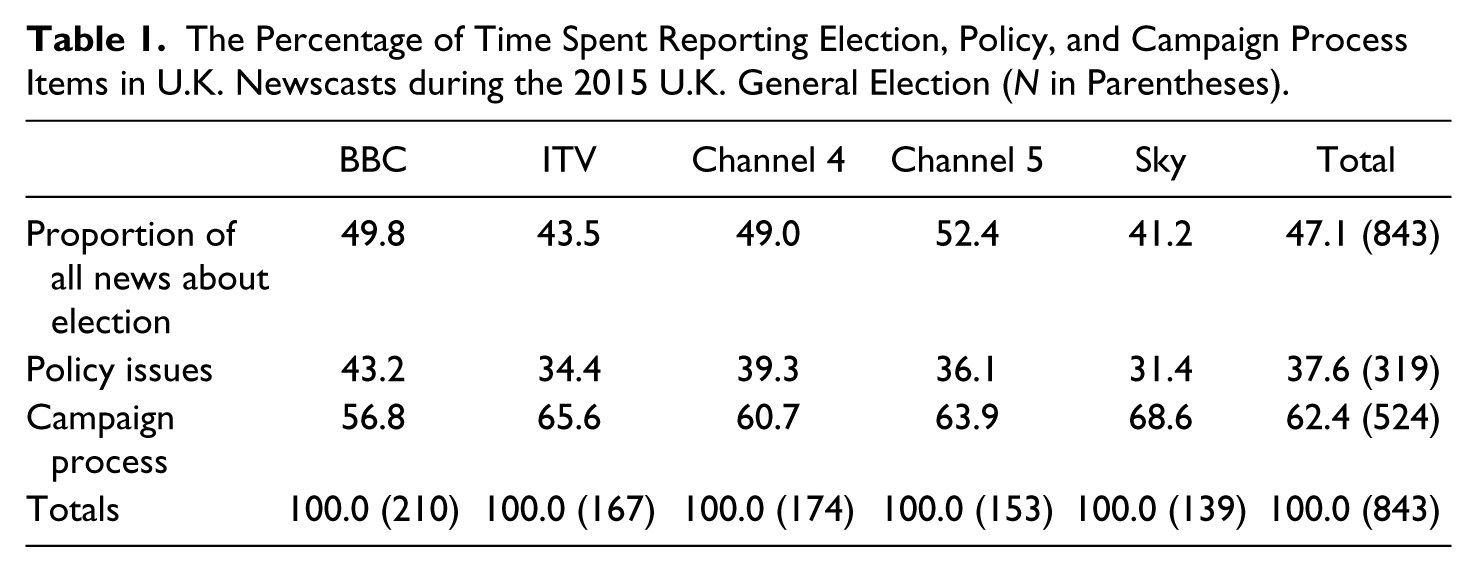
Channel 5 spent most time, proportionally speaking, reporting the election. The BBC and Channel 4, meanwhile, covered the election to a greater extent than ITV and Sky News. But, overall, broadcasters broadly dedicated a similar amount of airtime—between 41.2 and 52.4 percent—to reporting the election. However, we found that the BBC was the most issue based, while Sky News the most campaign driven (see Table 1). In other words, the most commercially driven broadcasters were the most likely to report items related to the process of the campaign rather than about specific policy issues.
But more generally, compared with content analyses of previous U.K. General Elections (Deacon and Wring 2011) or equivalent cross-national electoral contests (Strömbäck and Lee Kaid 2008), the 2015 U.K. television news agenda was far more about the processes of the campaign than about policy issues. By this measure alone, it would appear that the editorial agenda of the 2015 U.K. General Election—including on the main public service broadcaster, the BBC—was clearly driven by a media logic. When all process-type stories were broken down, coverage was primarily about the campaign (51.8 percent)—including rallies and walkabouts—or about the horse race between parties (30.8 percent), in particular about the possibility of a Labour and SNP coalition. The televised leaders’ debates—which were widely reported in the 2010—also took up a reasonable share of campaign coverage (17.4%). We classified items about TV debates as process driven because they tended not to be about policy discussion. Although TV debates feature a considerable amount of policy discussion, coverage was primarily about the performance of leaders rather than about issues debated. We focus on the two dominant themes in coverage—news about the campaign rallies and the horse race—to explore how far election reporting was shaped by a media logic. In doing so, we consider the editorial judgments of the heads of news and/or senior editors, and compare them with our content analysis findings.
The Media Logic of Campaign Rallies
Half of our interviewees suggested that the focus on the campaign rather than policy issues was not always out of choice but necessity. As Sue Inglish, the head of BBC political programming, pointed out, “the parties, virtually all of them, did not hold morning press conferences. So their press operations . . . went out into the country, they were very small controlled groups of people, often party supporters who were in the so-called press conferences.” As a consequence, she argued, you didn’t have any real forum in which the parties were quizzed about their manifestos across a range of different policies, and I think the one issue that one would want to look at next time round is how do you force that examination of policy when the parties don’t want to talk about it? (Sue Inglish, BBC)
Put another way, in the absence of a regular and formalized exchange between journalists and politicians, this may explain why a large proportion of BBC—and TV news generally—was preoccupied by campaign stories. This hints more at a political than media logic shaping coverage as parties were strategically trying to avoid opportunities where journalists could interrogate them about their policy agendas. Indeed, the head of Channel 5 suggested that they tried to address policy debates over the course of the campaign, but parties would not enter into any detailed discussions, with some even encouraging broadcasters to run stories about the closeness of the race: I think it’s really important to concentrate on the issues and I do think that we collectively as an industry perhaps concentrated too much on the polls and what they were saying . . . but do you know what, that’s what the parties were telling us to do. There was a lot of pressure from the parties and the bottom line is . . . they wouldn’t answer the questions. We had David Cameron on our programme live. We asked him about four times, “where was the £12 billion of cuts going to come from?” and he wouldn’t answer it. (Cristina Squires, Channel 5)
This suggests that parties played a key role in editorial decision making, either by their refusal to answer specific policy questions or by encouraging a more process-driven agenda. Of course, arguably editors could have covered policy issues to a greater extent despite political parties not answering their questions. But several interviewees did reveal how parties were trying to exert control of the news agenda or how campaign events should be filmed. Esme Wren, head of politics at Sky News, for example, revealed that . . . there’s lots of very heated exchanges with all the parties about the way the campaign was being driven, actually let’s say the two main ones because the Lib Dems had a much more . . . they wanted you to feel like you could film everything . . . We have a number of run-ins where we say to them we’re not part of your broadcast operation.
There was clearly an awareness from all interviewees about the carefully choreographed nature of campaign rallies as well as how closely they were being policed by party officials. Indeed, several made references to packages they had aired about controlled nature of the parties’ campaign events: We did a piece that went behind the campaign and a lot of BBC outlets did this piece because . . . it [the election] was being described as the most carefully controlled campaign and all of that. And we did a piece that went behind the campaign and how we couldn’t hold microphones and things like that. (Paul Royall, BBC) . . . we did a couple of pieces actually on all the campaigns, showing the fact that this is where we’re allowed to stand, there’s Cameron, we’re not allowed in, we don’t get to ask a question, we’re on a bus, he’s on a plane ahead of us. So if they were trying to control the situation too much, then yes we would expose that the way we saw it. (Esme Wren, Sky News)
Meanwhile, Ben de Pear even pointed out a rival reporter’s unraveling of a party rally: “Someone from Sky I think took a picture of the Conservative launch which, when seen through a 9 × 6 lens looked absolutely massive but when you looked back, it was just 40 party activists in a massive empty warehouse.” The photo in question—tweeted by a Sky News correspondent Niall Paterson—was widely shared on social media, but its popularity was perhaps because it represented a rare moment when journalists were not complicit with the imagery painted by the parties’ publicity machines. Indeed, we revisited every item involving a reporter on the campaign trail—357 in total, representing 42.3 percent of election airtime—to explore how often a rally or walkabout was exposed in some way by a journalist.
Table 2 shows that Channel 5 was the least likely to question a campaign rally and Sky News the most, with more than two-thirds of items on BBC, ITV, and Channel 4 doing so.
Percentage of Election Items Featuring a Reporter on the Campaign Trail and the Extent to Which The Stage-Management of a Party Rally Was Exposed (N in Brackets).
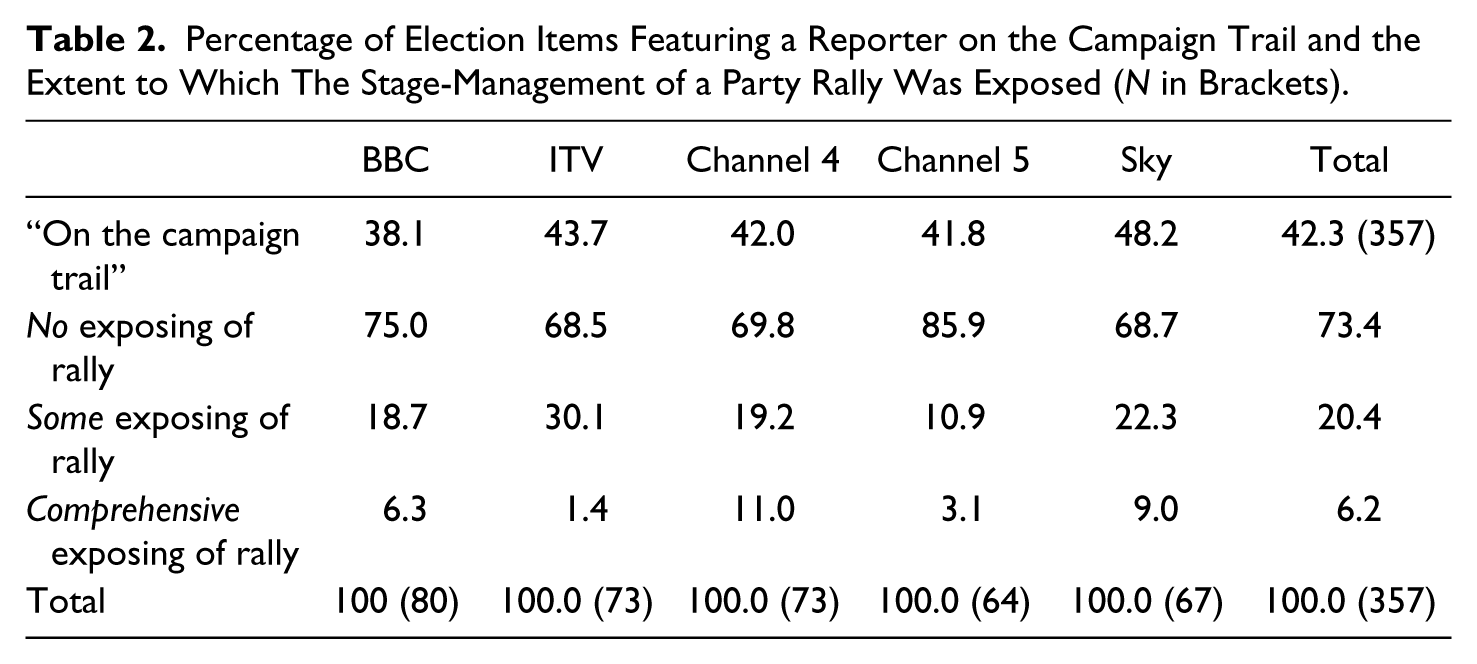
Of course, we did not expect every item to question the stage-managed nature of the campaign but to establish the degree and depth in which they were. At first glance, although more than one in four items exposing stage-managed news might appear substantial, most of these were relatively fleeting references to campaign events (20.4 percent), such as the following: The Conservatives have been criticised for control freakery during this campaign, but you know what, the reason they want things to be just so is because mistakes can be costly. David Cameron knows voters prize authenticity in their political leaders and that’s why he’ll be kicking himself. (Sky News at Ten, April 25, 2015)
As Table 2 further shows, more comprehensive treatment about the constructed nature of campaign rallies was less frequent—6.2 percent in total—but we did identify a number of lengthy packages—most strikingly on Channel 4—where the campaign tactics of political parties were exposed. One included inviting a war photographer to consider the parties’ campaign tactics: A seat on the Lib Dem battlebus costs journalists £750 a day. Hmm. Let’s see if it’s worth the money . . . I’ve come all this way and it turns out that this blue rope means I can’t get close. I’m not in the pool . . . When it comes to the media, the entire event has been carefully managed . . . The atmosphere seems stifling and controlled. You know you get a sense in your fingertips. I find everything is scripted, there seems to be no room for surprises . . . There’s a fear, they don’t seem to want to talk to the people direct, y’know, pump flesh and kiss babies and taste pastries. (Channel 4 News, April 5, 2015)
But although the contrived nature of campaign rallies was clearly exposed at times by broadcasters, overall, the majority of items did not meaningfully question them. In other words, the kind of campaign expose the Sky News correspondent’s tweet revealed about a Conservative rally was not the norm in day-to-day reporting of the election campaign on U.K. newscasts. This demonstrates the importance of comparing our interview responses with a systematic content analysis of election coverage because the editorial impression was that they did address the stage-managed nature of the campaign. But our analysis reveals that only 6 percent of election news items did so comprehensively, with a fifth of items making what was often a fleeting reference to the constructed nature of the campaign.
From this perspective, the parties’ political logic of staging tightly controlled campaign rallies with limited access paid off as broadcasters routinely—and, most of the time, unquestionably—covered them. Put another way, the political logic behind the parties’ campaign events appeared to have superseded a media logic. When questioned about how they would cover future elections, almost all interviewees suggested that broadcasters may be more reluctant to commit resources to following leaders around the country or at campaign rallies.
Although a few interviewees also pointed out that it remains important to reflect the agendas of parties, most cast doubt on the editorial logic of following them on the campaign trail (e.g., the heads of news at Channel 4 and Channel 5 decided not to pay for their reporters to travel on the political parties’ battle buses). This suggests that if parties do not open up access to their campaigns, such as holding regular press conferences, the political logic that arguably led broadcasters to routinely cover them on the campaign trail may be weaker in future elections.
The Media Logic of a Labour/SNP Coalition Deal
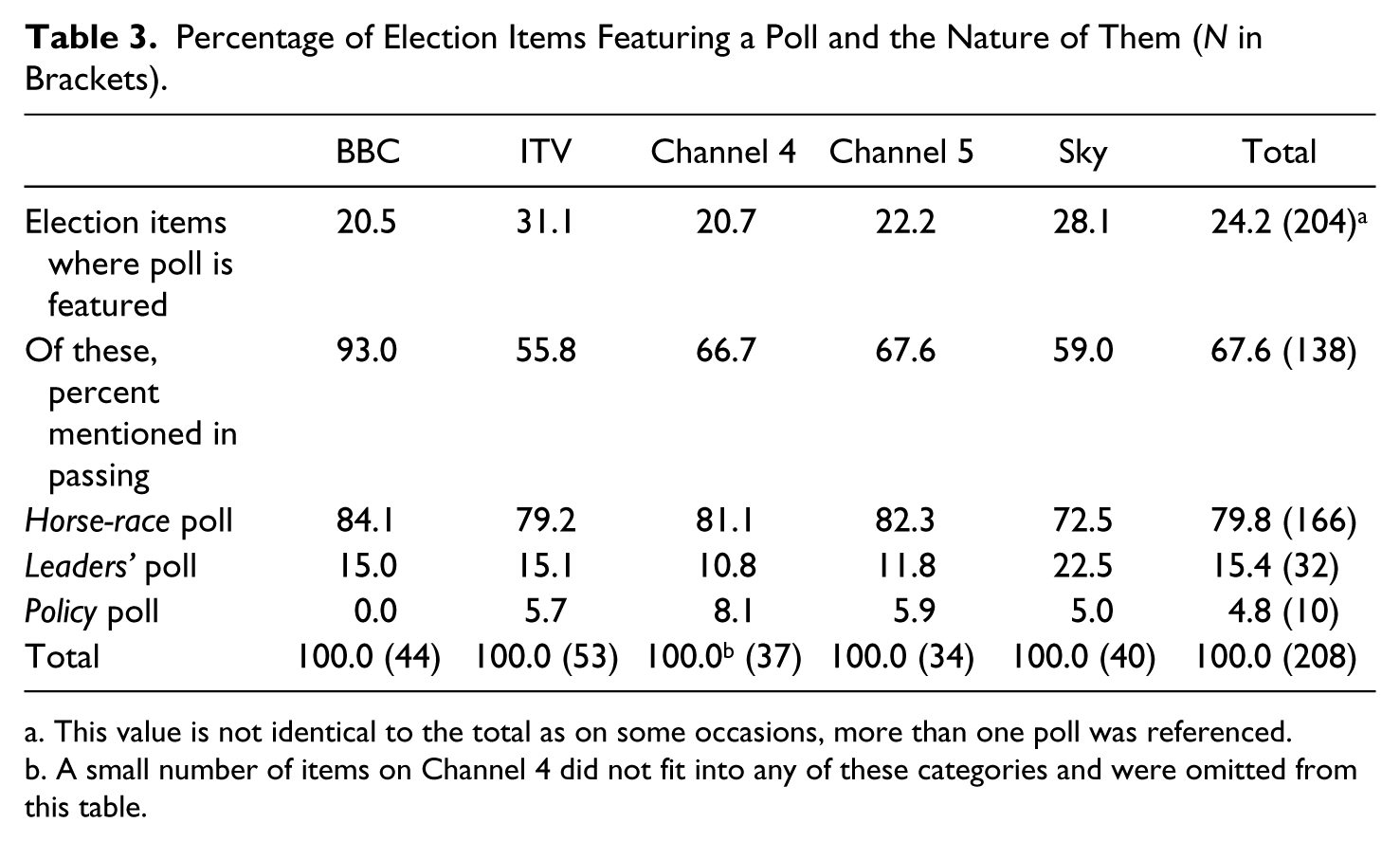
The horse-race narrative was another central theme of campaign-related coverage—representing 29.6 percent of airtime—with news typically informed by opinion polls, the leadership of party leaders, and, most prominently, speculation about possible coalition deals in particular between Labour and the SNP. Of course, the use of opinion polls to fuel the horse-race narrative is long established in studies exploring election coverage (Strömbäck and Lee Kaid 2008). We examined all references to polls and found that close to a quarter of all election items were informed by them (see Table 3). Between one-half and three-quarters of these references on the commercial broadcasters were made in passing, compared with 91 percent on the BBC, which perhaps reflects its strict guidelines on leading with polls during elections.
Percentage of Election Items Featuring a Poll and the Nature of Them (N in Brackets).
This value is not identical to the total as on some occasions, more than one poll was referenced.
A small number of items on Channel 4 did not fit into any of these categories and were omitted from this table.
Table 3 also shows the types of polls featured in television news coverage, which were primarily related to the horse race—79.8 percent of all references—with 15.4 percent about leadership, in particular after the TV debates. Just 4.8 percent of referenced polls—and none on the BBC—were about policy matters. Overall, the emphasis on horse-race-type opinion polls might again reflect an underlying media logic, with broadcasters fascinated with the closeness of the electoral race.
However, as almost all our interviewees pointed out, it would be difficult to overlook the political consequences behind the polling. After all, opinion polls consistently had the Conservatives and Labour neck and neck, with the SNP gaining a significant proportion of seats. This meant that the prospect of a hung parliament—and a postcoalition deal between Labour and the SNP—was the prism through which many reporters interpreted the campaign. There was, in other words, arguably a political logic behind the horse-race narrative because the SNP appeared to be heading toward a power-sharing position at Westminster. Several of our interviewees justified the prominence of the SNP in these terms: We were very conscious of the SNP being of enormous importance, not just to voters in Scotland . . . I think it was legitimate. We’d had five years of a coalition government, the pollsters were all telling us . . . that the most likely outcome was going to be a coalition and, therefore, who was going to make up that coalition was really important. (Cristina Squires, head of Channel 5 News)
Indeed, most of the interviewees were broadly comfortable with the overall time spent featuring the SNP over the campaign.
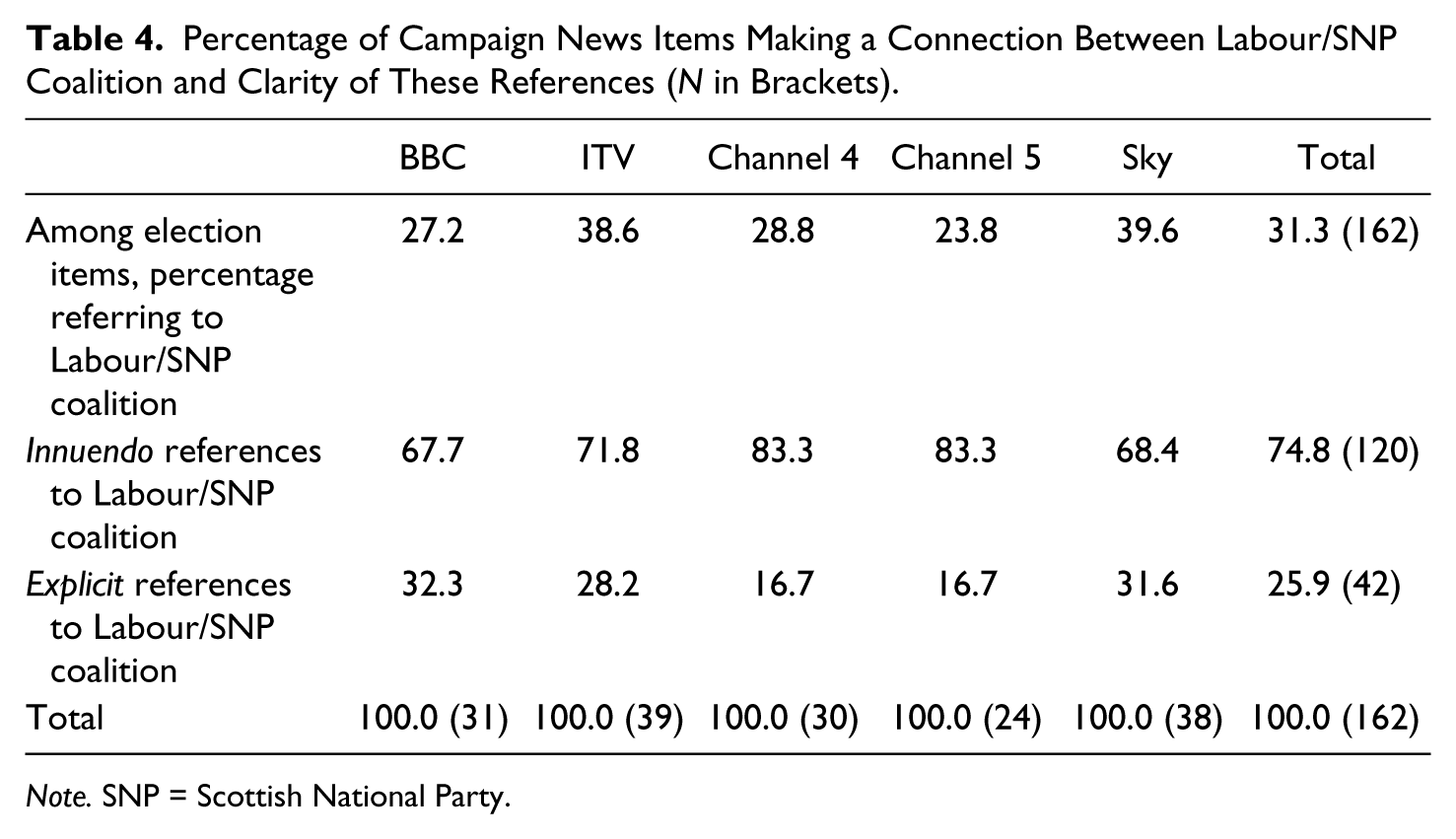
However, relying on the length of time politicians spoke in newscasts alone to assess the relative degree of balance and editorial judgment in election coverage can be a crude measurement. The SNP might not have been heard as much as the Liberal Democrats, for example, but their presence and prominence throughout the campaign could have been more pervasive. We thus revisited every campaign-related item—from rallies to TV debates and the horse race—to assess the extent to which a Labour/SNP coalition deal was mentioned in coverage (see Table 4).
Percentage of Campaign News Items Making a Connection Between Labour/SNP Coalition and Clarity of These References (N in Brackets).
Note. SNP = Scottish National Party.
This was not a straightforward exercise. We found, for instance, forty-two explicit instances—or 25.9 percent of all references—related to a Labour and SNP postelection deal. So, for example, an ITV reporter claimed: David Cameron once again attacked Labour on Scotland, claiming a vote for them could lead to the frightening prospect of a government propped up by the SNP . . . [Labour has] rattled the Prime Minister enough to issue a warning about the dangers of a Labour government backed by the SNP. (ITV News at Ten, April 19, 2015)
At the end of the package, the backdrop—accompanied by a reporter voice-over—comprised of a Conservative poster showing Nicola Sturgeon working Ed Miliband like a puppet. The item ended: “But the Conservative posters are getting blunter. As is their message: vote Tory, to stop an alliance that would only favour the Scots.” But we also found many more implicit connections—120 or 74.8 percent of all references—to a Labour/SNP coalition more subtly linking the two parties together. The following example illustrates how a postelection deal was routinely implied without necessarily using the term coalition: “It’s no surprise that the relationship between Labour and the SNP has gone from bad to bitter. But they could still be forced to work together after May . . .” (Sky News, April 10, 2015).
Overall, the repetition of these implicit references to a possible Labour/SNP coalition—along with more explicit connections—informed close to a third of all campaign-related items (31.3 percent). However, there were some differences between broadcasters, with close to four in ten of Sky News and ITV campaign news items—39.6 and 38.6 percent, respectively—referencing a Labour/SNP coalition deal, whereas less than three in ten were on BBC and Channel 4 (27.2 and 28.8 percent, respectively). Channel 5 had less than a quarter of items making a connection between a Labour and SNP postelection deal (23.8 percent).
The regularity in which this horse-race-type narrative shaped the campaign could be interpreted as a media logic driving the campaign. Interviewees not only considered focusing on a coalition deal involving the SNP a legitimate political story to pursue because of the SNP’s potential role in a future U.K. government, with various degrees of certainty, but some interviewees also pointed out that the success of party campaign agendas played a role in their editorial decision making: . . . let’s face it, the Tories were really successful in pushing this and they knew because they were saying privately to us that it was coming up again and again on our doorstep, which actually I think it proved to be right, although I slightly didn’t believe it when they were saying that but I think it did. So it was very successful. (Katy Searle, BBC)
Rather than concluding that a media logic was responsible for the widespread speculation about a possible coalition deal between Labour and the SNP, from this perspective, a political logic was also driving the agenda. This was even acknowledged by reporters during the campaign: “Tories are still trying to push the possibility of Labour being controlled by the Scottish National Party after the election” (Channel 5 News, April 22). But perhaps the full extent of the Conservative’s campaign political logic behind drawing attention to a possible Labour and SNP coalition deal only became apparent after the election—when the party won an overall majority. Ross’s (2015) insider account of the Conservative campaign strategy, for example, revealed how their spin doctors sought to capitalize on anxieties from English voters about the potential involvement of the SNP in a U.K. government. As the BBC’s Katy Searle pointed out, the Conservative Party’s campaign strategy and ability to help shape the news agenda was impressive. For the purposes of our study, it demonstrates the importance of understanding the influences shaping editorial decisions when interpreting media and political logics and the need to interpret the micro context of specific campaign issues.
Interpreting the Logic behind Editorial Decisions
Overall, we found that the 2015 U.K. General Election was widely reported by all broadcasters. More than half of coverage across all broadcasters focused on the processes of the campaign rather than policy issues. But consistent with the wider literature (Strömbäck and Lee Kaid 2008), the most commercially driven newscasts reported the most news about the process of politics, in particular, Sky News, which dedicated more than two-thirds of its agenda to stories such as campaign rallies and walkabouts, horse-race coverage, or TV debates. At face value, our findings appear to reinforce conventional academic wisdom that a media logic was largely responsible for shaping U.K. television newscasts’ election agendas.
However, drawing on interviews with heads of news and/or senior editors together with our content analysis that dug deeper into campaign coverage than many election studies, we questioned whether the logic behind the news agenda could be explained by media values and conventions alone. Isolating news when a reporter was on the campaign trail and in horse-race coverage, we suggested that a political logic was clearly influencing editorial decisions. In the absence of regular party press conferences, for example, by necessity some editors felt compelled to cover party campaign events despite acknowledging the highly fabricated nature of them.
This lack of interaction between parties and journalists may have encouraged a policy-lite agenda, together with a reluctance from politicians—as Cristina Squires pointed out—to engage with difficult policy decisions such as cutting the welfare budget. Similarly, although the editorial pursuit of the horse race is widely viewed as fulfilling a media logic in political communication scholarship, we suggested that a political logic was also pushing it up the news agenda. This was because much of the horse-race narrative was informed by (misleading) polls that pointed toward the prospect of a hung parliament, and led to much speculation about a possible Labour and SNP coalition deal. But the attention paid to this coalition pact as opposed to other potential deals was not just down to projections about how many seats each party would win, it was driven by a political logic that wanted the media spotlight shone on the SNP’s role in a future U.K. government (Ross 2015). This suggests that broadcast editors should pay greater attention to the party logic of coalition-directed voting (Duch et al. 2010) and consider how it can be impartially reported. For example, Faas et al.’s (2008) analysis of media coverage of polling in the German parliamentary elections found it influenced voters’ expectations of a future coalition and may have had an effect on the electoral outcome.
We would also point out that the editorial explanations from our interviewees should not be uncritically accepted. Broadcasters were not editorially powerless during the campaign. After all, whether it was a political or media logic shaping coverage, we found that commercial newscasts editorially pursued a less policy-driven agenda. Put simply, broadcasters could have chosen alternative perspectives to the political logic being foisted on them. Indeed, the decision by broadcasters to air three prime-time evening leaders’ debates during the campaign—including one with seven parties—demonstrates how editorial decisions can change the news agenda and the prominence granted to political actors. Our interviews with editors were wide ranging, but future research could explore in more detail their editorial decisions with the specific content of news they produced.
Given Conservative and Labour were consistently neck and neck in the polls, it is understandable why journalists interpreted the horse race as a close electoral contest. But putting Labour and the SNP at the center of the horse-race narrative was not a “natural” consequence of media logic but, in our view, an influence of a political campaign logic. In following a political logic, we argue that this promoted the horse-race narrative and naturalized the parties’ highly stage-managed rallies and walkabouts. Although some packages exposed the spin behind the parties’ campaigns—on Channel 4 in particular—most of the time the imagery constructed by party campaign officials went unquestionned in election coverage.
In our view, if coverage had been driven by a more independently orientated media logic, it might have led to a more critical and issue-based election agenda. Why, for example, should broadcasters fall under the spell of political parties’ campaign logic when reporting rallies and walkabouts? A more autonomous approach to reporting elections would be to ignore these rallies or, more routinely, expose the stage-managed nature of them. This would reflect a more interventionist approach to media logic (Strömbäck and Dimitrova 2011) and more discretionary form of journalism (Semetko et al. 1991). However, we are not suggesting that political actors should be marginalized with journalists interpreting their views—a hypermediatized trend most evident in the United States—but they could more regularly and robustly challenge parties’ spin tactics in future campaigns. After all, as campaign rallies and walkabouts have become increasingly contrived affairs with reporters granted limited access to question politicians’ claims, we would argue that there is little democratic value in journalists continuing to cover them so extensively. In trying to control the campaign message, political parties were perhaps responding to a media logic that editorially aims to package news according to its own editorial rules (e.g., Strömbäck 2011). But it would appear that political parties are subverting media logic—such as promoting a horse-race story to heighten fears about a Labour/SNP coalition—to further their own political logic. Of course, strategy news—discussing party tactics and electoral strategies—is a long-established trend in political journalism (Jackson 2011). But it is widely viewed as a media rather than political logic. Our conclusion, in this sense, echos Brants and van Praag’s (2015) observation that there is an “operational fuzziness” to how media logic is often applied by scholars (p. 5).
Indeed, our study about coverage of the 2015 U.K. General Election questioned the antecedents of media logic and shone a light on a political logic that may have been remained in the dark in large-scale content analysis studies. Of course, our findings will not be straightforwardly generalizable to other western democracies because of specific micro factors influencing editorial decisions. But the wider relevance of our study points toward a qualitative need in political communication scholarship to more carefully consider the logic behind quantitative conclusions and widen the methodological scope of election studies to include editorial perspectives on campaign coverage. As our interviews with editors revealed, far from television news being obsessed by a horse-race approach to election reporting, wider (political) campaign influences shaped their decision making. Although scholars in recent years have sought to standardize variables in cross-national studies and deliver greater conceptual clarity to empirical research in comparative political journalism (Esser et al. 2012: 140, emphasis in original), our study has shown that media and political logics are not static but fluid concepts that need to be understood, scrutinized, and interpreted in their micro contexts.
Footnotes
Declaration of Conflicting Interests
The author(s) declared no potential conflicts of interest with respect to the research, authorship, and/or publication of this article.
Funding
The author(s) disclosed receipt of the following financial support for the research, authorship, and/or publication of this article: This work was supported by the ESRC initiator fund administered by Cardiff University and internal funding from Cardiff University and the Cardiff School of Journalism, Media and Cultural Studies.