



Abstract
According to lifestyle politics theory, social media platforms introduce new ways for people to engage in civic life. Based on the communication mediation model, prior scholarship laid out theoretical and empirical foundations for how media exposure to the news positively influences people’s political participatory behavior through supplemental communicative processes. Building on this line of research, we rely on a two-wave panel survey of U.S. adults to examine how the different online and social media communicative patterns among U.S. citizens, such as news use, political expression, and discussion, predict political consumerism behavior - the purchase decision of consumers based on political or ethical reasons. Advancing diverse causal order structural equation models, this study highlights a positive influence of news consumption, social media political expression, and political discussion in explaining political consumerism (i.e., boycotting and buycotting). Specifically, results underscore the importance of political expression and discussion mediating the relationship between online, social media and WhatsApp news use and political consumerism. Implications for future research and limitations to the study are provided in the manuscript.
Keywords
In the last decade, a thriving theoretical and empirical line of research has primarily examined political consumerism as a new form of political participation. Researchers have identified abundant macro, meso, and micro-level predictors, including resource structural variables such as education, and income and psychological variables such as political trust, political efficacy, political interests, and partisan strength (for an overview, see Copeland and Boulianne 2020). Thus, the relationship between digital media use and political consumerism has received reinvigorated scholarly attention (e.g., Becker and Copeland 2016; Gil de Zúñiga et al. 2014a; Kelm and Dohle 2014; Micheletti and Stolle 2008; Parigi and Gong 2014; Ward and de Vreese 2011). Less explored, however, remains the link between communicative antecedents and political consumerism behavior. Some exceptions include Becker and Copeland (2015), Gil de Zúñiga et al. (2014a), and Kelm and Dohle (2014), altogether suggesting that connective social media use and online communication activities are positively associated with political consumerism.
The theory of lifestyle politics (Bennett, 1998) suggests that people shape their meaning system around their immediate social networks, personal beliefs, and values, facilitating detachment from conventional institutional politics. Social media, however, introduce new ways for people to interact with each other and to shape novel civic engagement practices (Ito, 2008), which can channel one's expression into large-scale political actions (Bennett, 2003). Drawing from the communication mediation model (Shah et al. 2005; Shah et al. 2007) and the O-S-R-O-R model (Cho et al. 2009; Jung et al. 2011), our study finds that media exposure variables exert their influence on people's political consumerism behavior through an online communicative process via social media political expression and political discussion).
Although much attention has been paid to how media exposure and political discussions are associated to political participation (Chan et al. 2017; Frank et al. 2012; Gil de Zúñiga et al. 2013; Ikeda and Boase 2011; Lee, 2012; Scherman et al., 2021), research gaps still exist in terms of (1) how media exposure variables and other communicative variables are linked to political consumerism, which is considered as a non-traditional, non-institutionalized kind of political participation (Gil de Zúñiga et al. 2014a), and its communicative antecedents are less studied with only a few exceptions (Becker and Copeland 2016; Gil de Zúñiga et al. 2014a; Kelm and Dohle 2014). Likewise, it also remains unclear(2) how social media political expression and political discussion relates to each other, with some initial communication mediation model and O-S-R-O-R model accounts suggesting these two variables may work in parallel (Cho et al. 2009; Jung et al. 2011; Shah et al. 2005; Shah et al. 2007). And lastly, (3) this study also further clarifies particular media exposure variable nuances that can elicit expression/discussion online and further predict political consumerism behavior, given that nowadays people obtain political information from a variety of media platforms. Against this backdrop, we rely on a U.S. representative two-wave panel data to explicitly examine the role of online and social media news, social media political expression, and political discussion in predicting political consumerism, which advances the traditional communication mediation model and O-S-R-O-R model.
Aligned with previous empirical findings, we show that the communicative dimension of digital media use is fundamentally associated with political consumerism behaviors. Online news, social media news, and WhatsApp news consumption predicted political consumerism via political expression and political discussion on social media. By discussing and exchanging political views with online friends, people are more likely to be mobilized to practice political consumerism (Eveland, 2004; Scheufele, 2002; Robinson and Levy 1986). These findings present further theoretical and empirical support for the connective action theory (Bennett and Segerberg, 2012) and the citizen communication model (Shah et al. 2005).
Literature Review
Changing Citizenship Norms
Over the past decades, academics have been concerned with the decline of political participation (Delli Carpini, 2004; Mindich, 2005; Pirie and Worcester 2000; Putnam, 2000). More recent literature emphasizes digital media as a venue to revive political participation. Some scholars theorize that newer forms of citizenship models, such as “participatory politics” (Cohen and Kahne 2012), “actualizing citizenships” (Bennett et al. 2011), and “participatory civics” (Zuckerman, 2014), are reliant on a wide array of participatory digital media. The essential claim of these modes of civics emphasizes that people exchange information, perform political acts, express their voice, and influence public issues via social media. Political actions are implemented within peer-to-peer relationships and imagined online networked communities.
This rise of political consumerism represents a shift in focus from governmental institutions to the market. The theory of sub-politics (Beck, 1996) suggests that more people seek to tackle important political issues outside bureaucratic politics. For instance, political consumerism is a type of sub-politics in which people aggregate together and use market power to achieve political importance. From the perspective of being an employee, people are less empowered due to the technological revolution, production globalization, weakened legal rights of labor unitions since 1980s. However, as a consumer, people are more powerful than ever because they have higher income and more choice of how to spend the money and leisure time. These new changes have influenced how people get involved in politics. The site of political engagement has moved to the consumption side, meaning that people use purchase power as a consumer to express their political preferences (Scammel, 2000).
Political consumerism, a new kind of political activism, is an “individualized collective action” (Micheletti 2003: 226) grounded in the belief that everyday purchases can be more effective in achieving political ends (Sapiro, 2000). Generally speaking, political consumerism takes two forms: boycotting and boycotting. Boycotting means people deliberately stop buying or using certain product/brand as an expression of protest. Buycotting is the opposite side of a boycott, meaning a deliberate purchase of a company's product in support of their policies or desirable behavior (Gil de Zúñiga et al. 2014a; Micheletti, 2003; Neilson, 2010).
Political consumerism is also a manifestation of what Bennett (2003) termed as “lifestyle politics,” in which individuals disconnect from the institutional construction of identity and enjoy the freedom to construct their lifestyle, identities, and social networks. According to the connective action theory proposed by Bennett and Segerberg (2012), the public action increasingly become a self-expressive act, which is achieved by the convenience of sharing personal ideas on one's social network. Not only that, the core organizing agents of connective action – the digital technology such as the online social networking platforms, enables formation of flexible weak-tie social network and a large-scale self-motivated personal political expression in a variety of interactive forms including posts, images, videos, memes and etc. For example, the digitally mediated action frame “we are the 99%” during the occupy wall street protests is highly personalized, inclusive of different reasons to get involved and can easily be communicated to a wider audience compared to conventional social movement. With the various communication technologies available, people can easily express their political thoughts revolving around the symbolic packet, which travels across large populations online thanks to its adaptability and shareability. Put it simply, there are two elements that are essential to people's political connective actions: (1) The political contents that are easily personalized in digital forms, and (2) the communication technologies that make the personalized ideas sharable within the social network, which can result in framing of collective identity and a rapid scale-up of the political action. Based on the connective action theory, individuals’ identity is derived through inclusive personal expression and the communication process involves a further personalization through the digital connections among online social networks, which might include call to action, online discussion and expression of hopes and anger towards the political event.
This emerging model of connective action represents a logic of the non-traditional political participation (e.g., online political participation, boycotting and boycotting), where formal organization group ties are replaced by the fluid online social networks (Castells, 2000). Individuals use social media to create information networks, communicate political views, and coordinate actions. Echoed with the concept of connective action, political consumerism is a form of civic engagement with “a networked character”, as it is heavily reliant on sharing, peer commentary and social network influence (Gil de Zúñiga et al. 2014a). To understand the networked character of political consumerism better, it remains important to examine what the content of the social connections are, the informational antecedents of the online networked communication, and how they altogether relate to the frequency of conducting political consumerism behavior.
Antecedents of Political Consumerism
Digital media use
Digital technologies potentially empower citizens to form a networked public sphere, increasingly investing their identities in the fluid social and professional network (Castells, 2007), which has changed the way people engage with politics (Benkler, 2006). As shown by prior empirical research, digital news use and especially social media positively influence political participation (Bimber and Copeland 2013; Boulianne, 2009; Gil de Zúñiga et al. 2014; Stromback et al. 2018). Part of the argument is that people expose themselves to a large amount of political information when reading news online, which informs them of where and how to participate in political affairs. Although at the same time, we acknowledge the empirical findings showing the opposite. For instance, Bimber and Copeland (2013) found that Internet use for political information is not consistently related to traditional political participation. The engagement in low-threshold political participation, a phenomenon called “slacktivism” is found to decrease the wiliness to take part in the high-threshold participation such as voting (Kristofferson et al. 2014). In the context of political consumerism, we argue that getting news information online enables citizens to keep up with the latest news about government, companies, and institutions, which is an initial valuable step towards political action. With informational digital media use, political consumers are more likely to learn about essential information that leads to buycotting and boycotting activities. Accordingly, online and offline information is positively associated with political consumerism activities (Baringhorst, 2015; Kelm and Dohle 2018; Zukin et al. 2006). Therefore, in line with these studies, we expect that digital media news use will be associated with political consumerism.
However, the caveat is that the emphasis on general use or time spent on and off digital media fails to recognize the role of specific media use patterns on political participation. The Internet has many facets, acting as an information source and as a communication medium at the same time (Polat, 2005). The communication capacity of the internet enables people to express their political views and have a political discussion with online friends, both synchronous and asynchronously. The social context of internet use, in particular, is closely associated with political participation (Shah et al. 2009). For instance, Neilson and Paxton (2010) find that people with greater social connections are more likely to be political consumers, offering a theoretical point of entry to understand why and how people get involved in political consumerism online.
Online communities built around shared identities and interests enable convenient and inexpensive political participation (Wellman et al. 2003). Citizens who are engaged with voluntary networks are more likely to learn to overcome collective action problems (Hooghe and Stolle 2003; Putnam, 2000). Digital media opens up a new era for citizens to join the political arena. It is a less hierarchical and formal political process and more often directed towards sporadic political issues (Bennett, 1998; Eliasoph, 1998). Putnam (2002) also agreed that the decline of traditional social connection is “offset at least in part by increases in the relative importance of informal, fluid, personal forms of social connection” (p. 411). Therefore, to understand citizens’ political consumerism actions, we need to examine how political discussion and political expression in online social networks play mediating roles.
Communicative media use
While the general media use is correlated with political consumerism, the specific communicative antecedents of political consumerism hasn't been entirely theorized (Gil de Zúñiga et al. 2014a). Past studies have paid attention to the communication variables that predicts political participation. For instance, both mass (e.g., newspaper readership) and interpersonal communication (interpersonal discussion of local issues) play a role in predicting local political participation (McLeod et al. 1999). Shah et al. (2005) proposed the citizen communication model, stating that mass communication influences political behavior through political discussions. Shah et al. (2007) later extended the communication mediation model to the O-S-R-O-R model, in which the ‘R’ represents the reasoning process with a variety of forms, including reflection of media content, political expression, and political conversations (Cho et al. 2009; Jung et al. 2011). Drawing from the communication mediation model and O-S-R-O-R model, we theorize that political expression and political discussion online will be a critical mediator between media news stimuli and political consumerism actions.
We also argue that the role of political expression and political discussion should be differentiated in the literature (Rojas and Puig 2009). More specifically, political expression is an antecedent of political discussion, instead of being parallel to political discussion in the model (Ardèvol-Abreu et al. 2017; Cho et al. 2009; Jung et al. 2011; Shah et al. 2005; Shah et al. 2007). Cho et al (2009) argued that the reasoning stage (“R”) in O-S-R-O-R model consists of both intrapersonal mental processes and interpersonal discussion. Intrapersonal processes take the form of reflecting, integrating, and understanding media contents (McLeod et al. 2001; Mutz, 2006) and composing media for expression (Pingree, 2007). Newer methods of political expressions enabled by Web 2.0 technology such as posting personal political experiences, sharing photos, videos and memes, forwarding political posts and changing social media profiles should be considered as an intrapersonal mental elaboration process. Next, individual's political expression may elicit the interpersonal mental processes, which gears towards political discussion within one's social network, thus leading to orientation and responses (i.e. political consumerism), which is the sequential relationship we will test in the manuscript. In other words, political expression can serve as the informational source for political participation online with effortless sharing and retweeting social media functions. Scores of research in this area have shown that political expression can lead to political participation either directly or indirectly across different nations and cultures (Gil de Zúñiga et al. 2014b; Kim, 2016; Pang, 2018; Skoric et al. 2016; Yamamoto et al. 2015). On the one hand, sharing one's political views would further facilitate political discussion and encounter new information perspectives. On the other hand, those who are active in expressing their political opinions are more likely to seek out more political information for future expressive acts.
People not only just express their political views, but they also discuss political issues online. Political discussion is theorized to be the core of the debate on citizenship norms (Schudson, 1998) by “giving life to a notion of citizen” (Barber, 2003: 184). Political discussion can occur when talking to strong ties and weak ties, can be agreeable and heterogeneous, and civil and uncivil (Valenzuela et al. 2012). The link between political discussion and political participation has also been thoroughly established. Political discussions play a mediating role between media exposure, political learning and political behavior (Eveland and Hively 2009; Ikeda and Boase 2011; Klosfstad, 2015; Lane et al. 2017; McLeod et al. 1999; Scheufele, 2002; Shah et al. 2005; Sotirovic and McLeod 2001; Valenzuela et al. 2012; Zhang, 2012). Interpersonal discussions of vital public affairs issues fuel political participation, functioning as a follow-up on the sparse information gained from prior media exposure (McLeod et al. 1999). During the interpersonal communication process, people will use their interpretive cognitive framework to process and comprehend complex information, gaining political knowledge, and increasing political learning beyond merely exchanging information (Cho et al. 2009; Jung et al. 2011; Eveland, 2004; Robinson and Levy 1986; Scheufele, 2002; Valenzuela, 2011).
Nevertheless, the communicative dimension of social media use is relatively less studied in political consumerism studies. General digital media use and online information use predict political consumerism, consistent with earlier findings of digital media use influencing political and civic participation (Hyun and Kim 2015; Gil de Zúñiga, 2015; Lane et al. 2017). Additionally, adding social media use increases the explained variance of political consumerism, indicating that some social media activities are related to consumerism (Gil de Zúñiga et al. 2014a; Kelm and Dohle 2018).
This study specifically looks into people's information exposure and communicative activities on online media, social media and WhatsApp 1 . Nowadays, people obtain political news not only from news websites, social media (e.g., Twitter, Facebook, Tiktok) but also instant-messaging (IM) apps such as WhatsApp, Messenger, or Telegram. There is a growing attention revolving IM app as a news source and its effect on political participation (Velasquez et al. 2021; Vermeer et al. 2021). According to the Reuters Digital News Report (2020), nearly 25% of the people indicated they used WhatsApp for news information. From the perspective of affordance approach (Evans et al. 2017), WhatsApp differs in the key affordances from other news website and social media platforms (Pang and Woo 2020), Vermeer and colleagues (2021) argued that IM apps, unlike social media, gives users more control over the visibility of the news content and fosters a more private and trusting news sharing environment. IM apps also differ from other social media apps in terms of connectivity and expressivity, which will shape political expression differently (Kligler-Vilenchik et al. 2020). Twitter fosters asymmetric ties and a more diverse network, whereas WhatsApp may more strongly support user interactions with strong social ties (Chan, 2018). For political expression and the generation of political content, WhatsApp enables sequential structured and simultaneous discussions while Twitter displays a loose and fragmented discussion. First, people can share news and their comments with their closest contact conveniently on the mobile device as they consume news (Valeriani and Vaccari 2018). Second, the encrypted and homophilic feature of on WhatsApp enables users to control the reach of such shared news, an affordance suitable for making private and personal political discussion, which has positive influence on mobilization and activism (Gil de Zúñiga et al. 2021; Valenzuela et al. 2021). The distinctive affordances feature across online media, social media and IM apps warrants the need to treat them separately as information sources.
Very few studies explicitly address which communication activities are antecedents of political consumerism and how the informational and communicative process ties in with political consumerism, let alone comparing across multiple media context. Becker and Copeland (2015) went further along with this inquiry. They found that communicative activities such as discussing LGBTQ issues are positively associated with buycott and boycott behavior by studying online LGBTQ publics. To address the research gap, our study aims to compare people's communicative activities on different media (online vs. social media vs. WhatsApp) and its influence on political consumerism. Given the limited research on the role of online and social media news, political expression, political discussion, and political consumerism as a theoretical structure, we propose the following hypotheses:
Method
Sample
Two waves of panel survey data were collected for a large research project on attitudinal and behavioral outcomes of uses of new and traditional media across two waves (June 2019 for Wave 1, October 2019 for Wave 2). The Media Innovation Lab (MiLab) contracted IPSOS Austria to provide the subjects for the survey, which was collected in the United States. All questions in the questionnaire were administered online via Qualtrics at Vienna University. IPSOS curates a massive opt-in panel of respondents of hundreds of thousands of U.S. individuals to achieve U.S. national representativeness and pursue generalizable inferences on the U.S. population. A subsample of 3,000 individuals matching key demographic elements from the U.S. census was stratified from this pool. The final sample left 1,338 valid cases in Wave 1 and 511 valid cases in Wave 2. The cooperation rate was 38% in wave 2. Our cooperation rate is a little bit lower than other panel studies but acceptable. For example, the attrition rate of some studies reaches 48% (Valenzuela et al., 2021), 61% (Gross, et al., 2004) and even 72.4% (Weeks et al., 2021) in wave 2 data collection. The demographic information is listed below: age (Median: 36-55 years old), gender (53.2% female), education (Median: some college), income (Median: $50,000 to 99,999) and ethnicity or race (75.2% Caucasians). Questionnaire items of the major variables (Supplemental Table A3) are in the Supplementary Information File.
Measures
Results
Previous studies on political consumerism and the predictors of political consumerisms relied on cross-sectional survey data (Becker and Copeland 2016; Kelm and Dohle 2018). To better identify antecedents of political consumerism, cross-sectional (IV and DV in T1), lagged (IV in T1 and DV in T2), and autoregressive (IV in T1 and DV in T2, controlling for DV in T1) models were tested. SEM models were used to test plausible relationship between antecedents of political consumerism and political consumerism cross-sectionally and over time. Before fitting our data into the theoretical models, we residualized all observed variables and created a residualized covariance matrix as other research has suggested (Shah et al. 2005; Shah et al. 2007). By using residualized covariance matrix, observed variables were controlled for and more parsimonious models were obtained. The cross-sectional SEM provided an acceptable fit to the data χ2 = 20.824; df = 4; p = 0.000; RMSEA = 0.059, CFI = 0.991, TLI = 0.974, SRMR = 0.019 (Figure 1). The lagged SEM provided a very good fit to the data: χ2 = 6.689; df = 5; p = 0.245; RMSEA = 0.027, CFI = 0.997, TLI = 0.994, SRMR = 0.019 (Figure 2). Finally, the autoregressive SEM provided a very good fit to the data: χ2 = 5.64; df = 5; p = 0.343; RMSEA = 0.017, CFI = 0.999, TLI = 0.998, SRMR = 0.017 (Figure 3). The fit statistics of all three models indicated that the tested models have good model fit and our model parameters are not significantly different from our observation. More details about the data analysis methods, zero-order correlations of the major variables (Supplemental Table A1) and testing of inverse models (Supplemental Table A2) are in the Supplementary Information File.
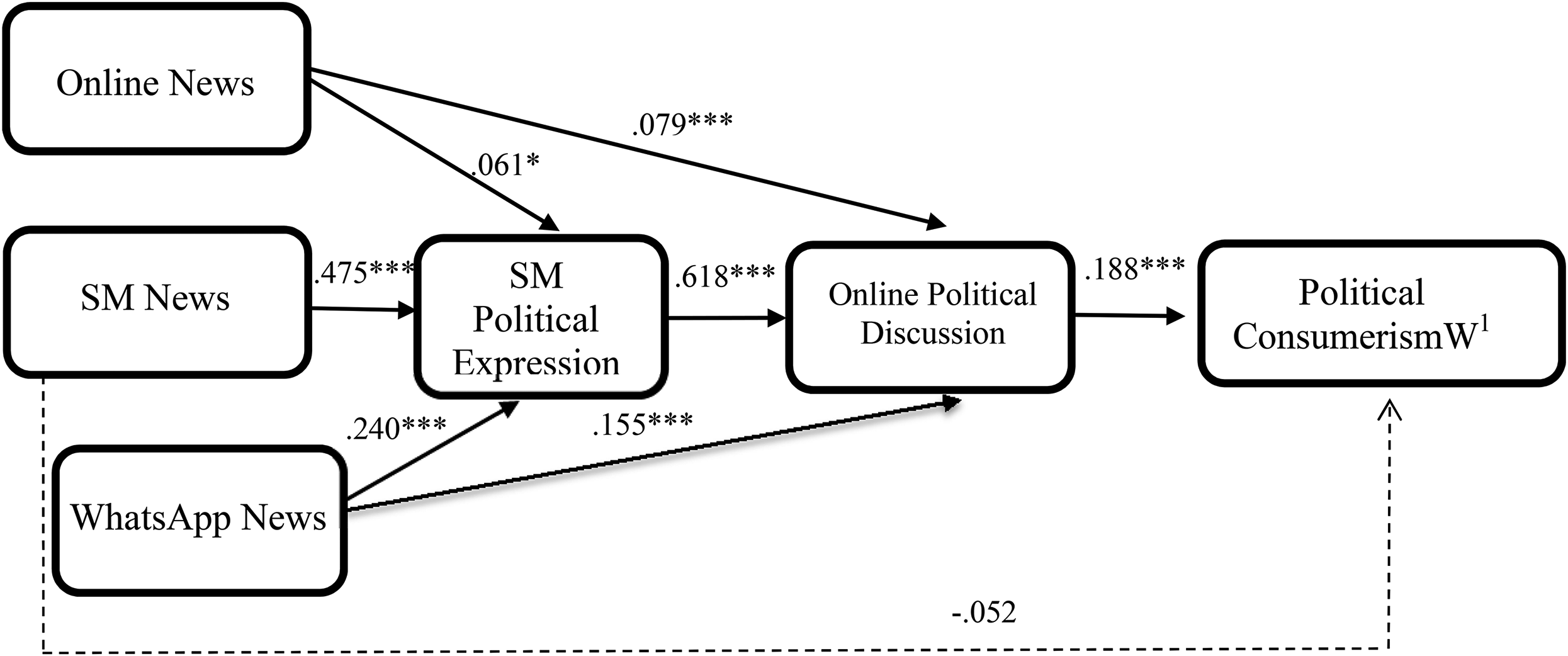
Cross-sectional Structural Equation Model of Key Variables.
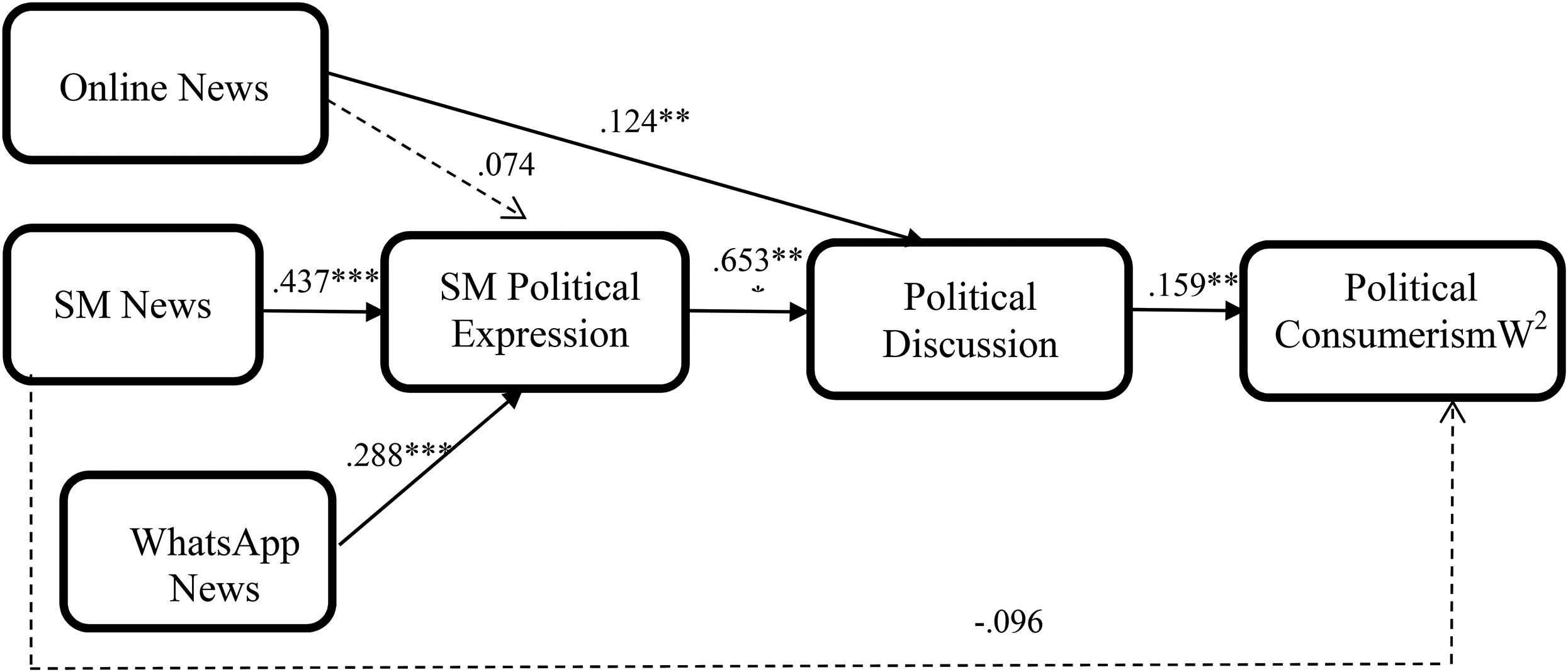
Lagged Structural Equation Model of Key Variables.
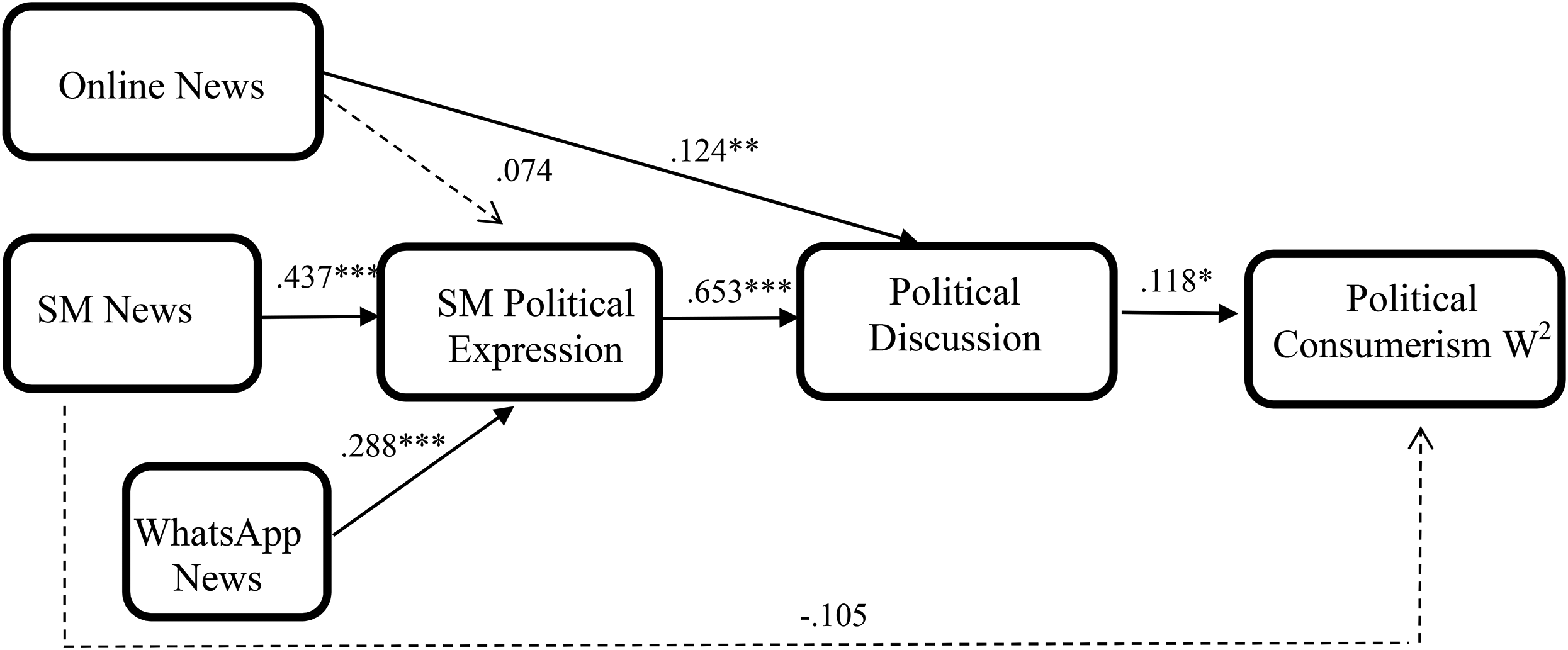
Autoregressive Structural Equation Model of Key Variables.
Indirect Effects of Online News, Social Media News, WhatsApp News on Political Consumerism.
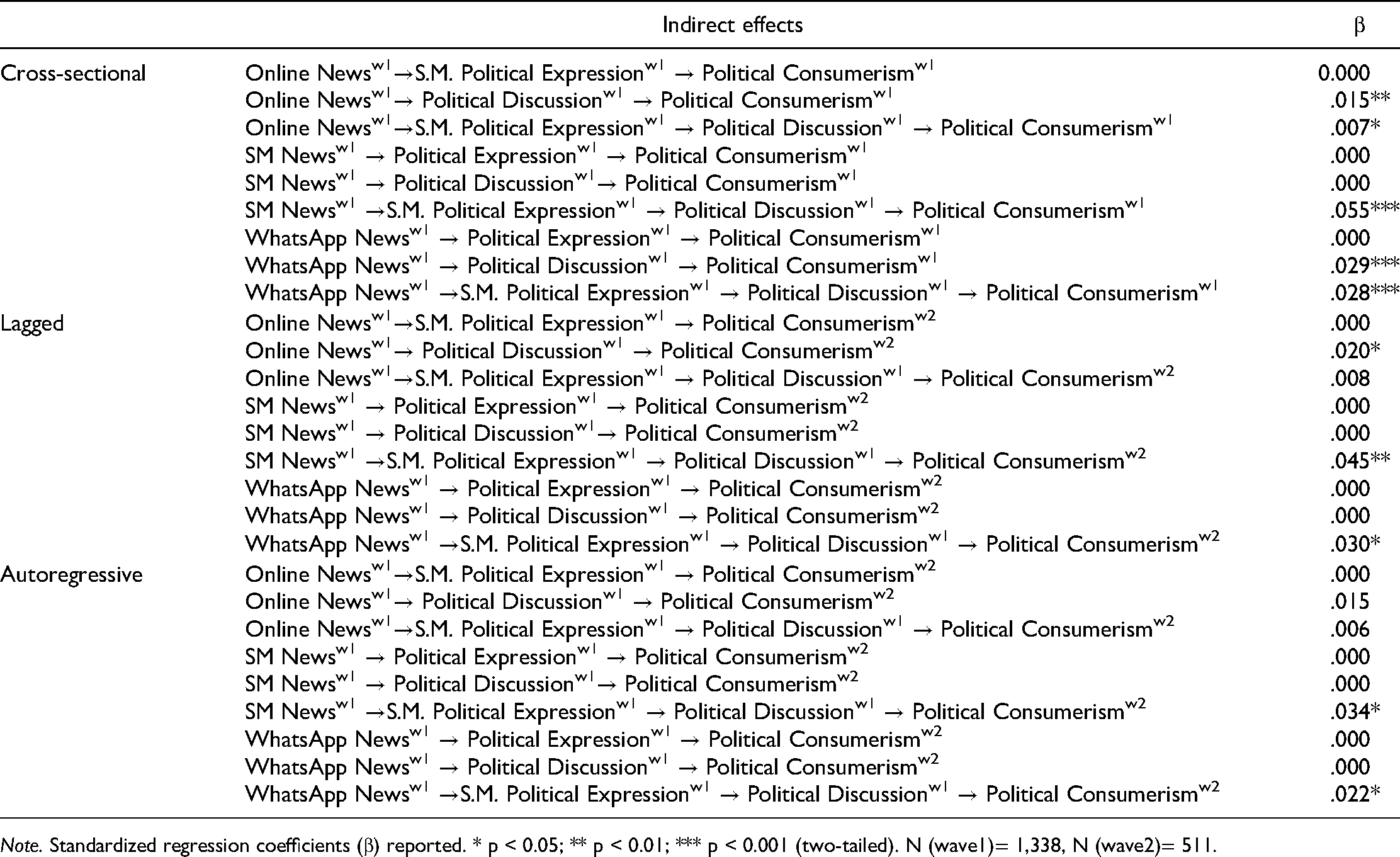
Note. Standardized regression coefficients (β) reported. * p < 0.05; ** p < 0.01; *** p < 0.001 (two-tailed). N (wave1)= 1,338, N (wave2)= 511.
Based on Figures 1 to 3, we conclude that H1 was not supported as no significant direct effect was found between each type of news use and political consumerism. H2 was not supported either since the cross-sectional, lagged and autoregressive SEM all show that social media expression did not impact political consumerism directly. H3 was supported since SEM result shows that political discussion positively impacts political consumerism (cross-sectional: β = 0.188, p < 0.001; lagged: β = 0.159, p < 0.05; autoregressive: β = 0.118, p < 0.05) (see Figures 1 to 3). Hypothesis 4 predicted that social media political expression and political discussion will mediate the influence of online news, social media news and WhatsApp news use on political consumerism (see Table 1). Result indicates that WhatsApp news significantly impacts political consumerism through the indirect effect of political discussion (cross-sectional: β = 0.029, p < 0.001)and through social media political expression and political discussion together (cross-sectional: β = 0.028, p < 0.01; lagged: β = 0.030, p < 0.05; autoregressive: β = 0.022, p < 0.05). For those who use social media for news, social media political expression and political discussion mediated the relationship between social media news use and political consumerism (cross-sectional: β = 0.055, p < 0.001; lagged: β = 0.045, p < 0.01; autoregressive: β = 0.034, p < 0.05).
Finally, for the online news users, political discussion significantly mediated the influence of online news use on political consumerism (cross-sectional: β = 0.015, p < 0.01; lagged: β = 0.020, p < 0.05). Social media political expression and political discussion together mediated the influence of online news use on political consumerism (cross-sectional: β = 0.007, p < 0.05). Based on the results above, social media political expression and political discussion will mediate the influence of online news, social media news and WhatsApp news use on political consumerism in either a cross-sectional testing or models with a time dependency. Therefore, H4 was supported.
Discussion
This study sheds light on the relationship between online news, social media news, WhatsApp news, political expression, political discussion, and political consumerism. First, drawing on O-S-R-O-R communication mediation model, this study lays out several empirical paths that serve as antecedents of political consumerism behavior (Cho et al. 2009; Jung et al., 2011; Shah et al. 2005). Second, political discussion was found to be positively associated with political consumerism. Third, social media political expression and political discussion mediated the influence of WhatsApp news use on political consumerism.
Shifting repertoires of today's civic participation processes call for a more rapid and flexible citizenship norms conceptualization (Bennett et al. 2011; Kligler-Vilenchik, 2017). In the past century, “good citizenship” was rooted in the idea of an “informed or dutiful citizen,” in which citizens participate through political institutions, organized groups, and civic clubs out of a sense of personal duty (Dalton, 2008; Schudson, 1998). The new media environment has given rise to alternative and more fluid citizenship models, including participatory civics (Zuckerman, 2014), self-actualizing citizenship (Bennett et al. 2008), and participatory politics (Cohen and Kahne 2012). Digital media use is often seen as a remedy to the decline of traditional political participation (Loader et al. 2014). The results of this study suggest that while people may steer away from electoral and party politics, they are embracing new modes of political participation. One of these examples is political consumerism, supporting a changing civic practice among U.S. citizens. Generally, our results align with the contemporary scholarship of the relationship between digital media use and political participation (Boulianne and Theocharis 2020; Dimitrova et al. 2014; Gil de Zúñiga et al. 2012; Ohme, 2019). We find that when people read online news, express political opinions, and discuss political issues on social media, they will be more likely to be mobilized and further engage in political consumerism activities, supporting the argument that political use of digital media can lead to civic participation. In contrast, purely leisure and entertainment-oriented online activities do not necessarily mobilize the digital media users (Boulianne and Theocharis 2020) unless citizens express political views (Gil de Zúñiga et al. 2014b). Additionally, our results confirmed the theoretical value of the O-S-R-O-R (Cho et al. 2009; Jung et al. 2011) and citizen communication mediation models (McLeod et al. 1999; Shah et al. 2005) in that communication activities as discussion online will mediate the influence of media consumption on political participation.
People get news information about public affairs, political institutions, government, etc., which fuel further political expression and discussion, and trigger participatory political behaviors (McLeod et al. 1999; Skoric et al. 2016). The interpersonal communication process provides opportunities for people to gain more political knowledge and understanding about political issues. Furthermore, these communicative antecedents mobilize citizens to take political actions (Eveland, 2004; Scheufele, 2002; Robinson and Levy 1986).
Our findings also corroborate the argument that political consumerism has a networked character. As a newer form of political participation, political consumerism is a lifestyle choice subject to peer influence and commentary in one's social network (Gil de Zúñiga et al. 2014a). It also suggests that the dialogue between corporations and consumers starts within one's social network (Saffer et al. 2019). Individuals build the “networked publics” around social issues, and social media has enabled the connection of different publics on a global scale. Consumer activism is one form of networked publics to promote social changes via consumerism behaviors.
Information exposure is a prerequisite for political consumerism. The rise of social media has accelerated how information about corporate political acts reaches citizens. As Earl et al. (2017) suggest, political consumers learn about the latest buycotts and boycott measures through the Internet or social media. Next, information seeking through social media news and online news will encourage a higher frequency of political talk and political expression. Political discussion can help political consumers overcome the uncertainty about the issue and make sense of the political environment (Campbell and Kwak 2011). Everyday conversations about political consumerism can affect social media users’ perceptions of crucial public affair issues and their intentions to participate in buycott or boycott behaviors. Traditional social network research suggests that the influence of social networks stem from both the content and social proximity sources – “the attitudes, emotions, and behaviors flowing between network members” and “the propensity for interaction between two actors in a network” (Perry et al. 2018: 18). This line of research sheds light on the importance of considering the factor of interpersonal discussion in terms of the antecedent of political consumerism. Political consumers transfer their knowledge and information resources to other social media users about their buycotting or boycotting decisions by explicitly expressing their political opinions or joining political discussions online (Baringhorst 2015; Eveland and Hively 2009). With the information flow through the network and the networked social influence (Saffer et al. 2019), people are likely to be informed about the latest buycott or boycott events, get motivated to form a “networked public” who share similar interests, and to take collective actions. Ultimately, political consumers seek to influence politics in a less standardized and government-dependent path.
All these findings, albeit interesting, carry several limitations inherent to the study. The limitations include model fitting differences, sampling retention issues between waves (38%), and other theoretical topics such as critical differences between buycotting and boycotting in which boycotting political participation resembles traditional high-resource, high-engagement activity than buycotting (Copeland, 2014; Ward and de Vreese 2011). Finally, our study offers some potential lines for the scholarship to move forward. Future studies should examine the antecedents to explain nuances in political consumerism behavior such as buycotters, boycotters, and dualcotters (Copeland, 2014). For example, Kelm and Dohle (2014) found that communicative activities exert a more significant influence on boycotting than buycotting. Second, future research should pay attention to specific effects brought upon by political discussion attributes such as interpersonal/online network size, strong/weak tie discussion frequency, agreeable/disagreeable discussion frequency and level of civility in political discussion (Eveland and Hively 2009; Ng and Detenber 2005; Saffer et al. 2019; Valenzuela et al. 2012) and connections between why and how some of these attributes predict political consumerism behavior while other attributes may not be so decisive. This study represents a first step toward that objective. Examination of how different social media use patterns (i.e. informational, educational, connecting, entertainment and communicational purposes) affect political consumerism behavior based on the uses and gratifications approach should open up another venue for research (Cho et al. 2003).
Last but not least, macro-structural variables may also be essential in these models. As Stolle et al. (2005) suggested, country variables are significant in that people from certain countries have higher opportunities for engagement with political consumerism than in other countries. It would be interesting to compare political consumerism in different countries and political and cultural settings to see whether our conclusion remains cross-culturally valid.
All in all, given the historical and consistent deficit found in explaining political consumerism activities in the U.S., this study represents a modest but essential step in clarifying communicative antecedents that lead Americans to engage in political consumerism.
Supplemental Material
sj-docx-1-hij-10.1177_19401612221075936 - Supplemental material for Antecedents of Political Consumerism: Modeling Online, Social Media and WhatsApp News Use Effects Through Political Expression and Political Discussion
Supplemental material, sj-docx-1-hij-10.1177_19401612221075936 for Antecedents of Political Consumerism: Modeling Online, Social Media and WhatsApp News Use Effects Through Political Expression and Political Discussion by Zicheng Cheng, Bingbing Zhang and Homero Gil de Zúñiga in The International Journal of Press/Politics
Footnotes
Acknowledgements
This work has benefited from the support of the Spanish National Research Agency's Program for the Generation of Knowledge and the Scientific and Technological Strengthening Research + Development Grant PID2020-115562GB-I00. Responsibility for the information and views set out in this study lies entirely with the authors. The last author is funded by the ‘Beatriz Galindo Program’ from the Spanish Ministry of Science, Innovation & Universities, and the Junta de Castilla y León.
Declaration of Conflicting Interests
The author(s) declared no potential conflicts of interest with respect to the research, authorship, and/or publication of this article.
Funding
The author(s) received no financial support for the research, authorship, and/or publication of this article.

Supplemental Material
Supplemental material for this article is available online.
Notes
Author Biographies
References
Supplementary Material
Please find the following supplemental material available below.
For Open Access articles published under a Creative Commons License, all supplemental material carries the same license as the article it is associated with.
For non-Open Access articles published, all supplemental material carries a non-exclusive license, and permission requests for re-use of supplemental material or any part of supplemental material shall be sent directly to the copyright owner as specified in the copyright notice associated with the article.
