



Abstract
Online media environments have changed the way young people access news. Despite much research on the topic, the expectations of journalistic news by young adults who have turned their back on traditional news media remain unclear. We use a novel multimethod qualitative online study design to investigate the perceived quality, functions, and expectations toward journalistic news of young adults in Switzerland who use social media as their main source for news and rarely consume traditional media. Nineteen young adults between 20 and 25 years of age with different educational levels participated in our study in May 2020. Our results show that even though the participants only occasionally use traditional news media channels, they still consider journalistic news relevant and appreciate quality standards of professional journalism such as actuality and veracity (Swart 2021b). Among the functions of news, the participants highlighted sociability and identification. Exchange and discussion of news are, thus, of high relevance online but also offline. Also, the participants show a high affinity toward news on mobilizing topics, which are of interest to themselves and their peers, and motivate them to engage with news more intensely. According to the participants, news should be attractively prepared, such as with audiovisual formats and easy to understand and integrate into everyday life. The participants also expressed a preference to consume news articles from different media brands within a single platform. Our study outlines a fruitful path for comprehensive qualitative research with innovative online tools.
Keywords
Introduction
A well-informed citizenry is vital for democracies, and the news media are considered one of the primary sources of information. News consumption is thus shown to determine desirable outcomes for democratic societies, such as political knowledge (Leonhard et al. 2020), political involvement (Prior 2007), and political mobilization (Strömbäck et al. 2017). However, digitalization has fundamentally changed how people access and consume news (Kümpel 2020; Fletcher et al. 2021). For many young people, social media has become the main source for news, and they no longer rely on traditional news media channels, such as the press, radio, or television (Boczkowski et al. 2018; Edgerly, Vraga, et al. 2018b; Schneider and Eisenegger 2018; Geers 2020). Scholars have addressed the question of whether the decline of young people's consumption of traditional news media means that they are disinterested in news and politics, or simply that they receive their information from other sources on social media platforms (Sveningsson 2015; Bengtsson and Johansson 2020).
The shift from traditional channels to online means of access and its positive and negative implications is well researched. On social media, users can search for, engage with, and share news (Kümpel et al. 2015; Oeldorf-Hirsch 2018) and are often incidentally exposed to news they would not seek purposefully (Ahmadi and Wohn 2018; Scharkow et al. 2020). At the same time, news on social media is often consumed by chance, algorithmically distributed based on personal interests, or only read fragmentarily (Boczkowski et al. 2018; Swart 2021a). The increased reliance on social media for news usage has also been identified as a determinant of sinking news consumption (Schneider and Eisenegger 2018) or even news avoidance (Edgerly, Vraga, et al. 2018b; Skovsgaard and Andersen 2020; Edgerly 2021) among younger age groups.
Despite ample research on changing means of access to news in digital media environments, we still know little about why people turn to social media as a news source. Bengtsson and Johansson (2020: 4) argue that “the way digital news interweaves with audiences’ everyday lives, and how sense-making practices around news are situated socially, culturally and experientially” remains under-investigated in the literature. Similarly, Sveningsson (2015: 2) claims that existing scholarship should be complemented with more “insights into how young people actually understand and experience social media as a source of news.” For instance, we know little about the quality criteria young people apply when it comes to news and what functions news exposure has for young people in society. Do young people turn to social media as their main news source because they disregard quality journalistic information? Or do they simply access news via different channels, but still deem the quality and function of journalistic news as important and meaningful?
In this article, we investigate the means of access, quality perceptions, and function of news for young adults and the resulting expectations toward news. For this purpose, we will focus on young adults in Switzerland with a specific news repertoire, namely high social media use and low use of traditional media channels. This group of news users is presumably the most distant from traditional journalistic news usage. Therefore, it is particularly relevant how they evaluate the quality and functions of news. We use an innovative multimethod qualitative study design based on different online tools. Accordingly, our study outlines a fruitful path for comprehensive qualitative research with innovative online tools.
Conceptual Framework
Young People's News Access in Digitalized Media Environments
Digitalization and the rise of social media have changed the way people access news (Chyi and Chadha 2012; Antunovic et al. 2018; Lewis and Molyneux 2018; Costera Meijer 2019). Online news usage is replacing news consumption via newspapers, TV, or radio, especially among young adults (Edgerly, Vraga, et al. 2018b). However, it is not only the channels by which news is accessed that has changed. In the online world, social media and search engines have emerged as common ways to access news in addition to accessing news directly through a news website or a news app (Fletcher et al. 2021). Additionally, the device used for accessing online news has shifted toward mobile phones, especially for younger audiences (Molyneux 2018). Together these developments have consequences for news consumption, both positive and negative.
On social media, users usually do not encounter news bundled or curated by a single news media outlet (Merten 2021). Instead, news articles from a variety of outlets and sources are distributed by algorithms and reach users on a case-by-case basis in their news feeds (Bergström and Jervelycke Belfrage 2018). However, users can also receive news recommendations from friends and be incidentally exposed to news content (Oeldorf-Hirsch 2018; Kümpel 2019). Scharkow et al. (2020) found evidence that incidental news exposure on social media leads to more varied online news diets. New forms of online opinion leaders, or so-called influencers, are also shown to affect young adults’ exposure to news (Bergström and Jervelycke Belfrage 2018).
Access to news online is not only affected by social media but also shaped by other technological factors, such as search engines and mobile phones. Search engines, usually Google, have become a central path to news. The consequences of accessing news through search engines are a subject of controversy. While some studies find at least some indications for biased research results and less diverse information (e.g., Hong and Kim 2018; Kulshrestha et al. 2018; Steiner et al. 2020), the literature also points out that people who use search engines have broader and more diverse news repertoires (Fletcher and Nielsen 2018; Fletcher et al. 2021). Especially for young people, mobile phones are the device of choice when accessing news (Chan-Olmsted et al. 2012; Westlund 2015; Molyneux 2018). This development has been shown to lead to ephemeral and on-the-go consumption of news, including shorter sessions and “snacking” (Molyneux 2018), such as reading only the headlines or short news snippets.
Many studies show that the prevalence of high-choice media environments (van Aelst et al. 2017) goes hand in hand with rising news avoidance, especially among young people (for an overview, see Skovsgaard and Andersen 2020; Toff and Kalogeropoulos 2020). This can lead to users receiving only a small section of what is actually offered by journalistic news outlets (Geiß 2020). Whereas traditional media provide a more comprehensive view about what happens in society, news access via online websites or social media platforms is more shaped by individual needs and preferences (Geers 2020). The question of access is, therefore, central. However, to understand why users turn to social media instead of accessing news through traditional media or news websites, we must also look at the expectations of news among audiences.
Quality and Functional Expectations Toward Journalistic News
Since digital media has transformed not only news formats but also production and distribution processes, the definition and perception of news may have changed for audiences (Bengtsson and Johansson 2020). Younger audiences, for instance, want to have a more active role during their digital news practices, as they circulate news themselves and initiate discussions and want to be part of conversations (Burkey 2018). Digitalization, then, presumably also changed what audiences evaluate as quality and the purposes for which people access news.
Perceptions of quality within the profession of journalism and from a user perspective are not necessarily congruent. Thus, research on media quality distinguishes between the quality of journalism and users’ experience of quality (Costera Meijer and Bijleveld 2016; Bachmann et al. 2021). Whereas traditional news organizations see news as what “should be known” and apply quality criteria such as diversity or relevance (Bachmann et al. 2021), young audiences see news more pragmatically as something that is useful, interesting, and fun to know (Galan et al. 2019). A recent study illustrates that young people evaluate news according to its actuality, veracity, and possibility of facilitating sociability (Swart 2021b). This includes aspects that are relevant for their everyday lives and social relationships (sociability), as well as established criteria of journalism (actuality and veracity) in their quality assessments of news. Further studies confirm that young audiences are aware of and appreciate news that meets established quality standards. A study from Finland shows that young adults wish for even more investigation, verification of journalistic content, and credible sources (Manninen 2019). Drok and Hermans (2015) confirmed these findings for the Netherlands and highlighted the importance of location- and time-independent availability.
Social media offer ample opportunities for social exchange. It may also have amplified the role of news for social interaction, facilitating sociability (Swart 2021b). The importance of news for sociability for young audiences has also been confirmed by other researchers. Costera Meijer (2007) speaks of topics that give young people a sense of belonging. Creating a sense of belonging seems to be an essential function of news consumption for young people and corresponds to the network logics of social media, since young people use social media to share opinions and news about problems of their individual living environments using links, videos, memes, or photos, resulting in a collective identity among the young (Marchi and Schofield Clark 2021). Accordingly, young news users seem to be less likely to look for “’news’ and information as ends in themselves, but rather as the basis for conversation topics, inspiration, a sense of belonging and meaning to their life” (Costera Meijer 2007: 96).
Although young people consider news important to their personal lives, they do not necessarily actively consume it, making them “a group that is of great interest to news publishers around the world, but also one they are finding it increasingly hard to reach” (Reuters Institute for the Study of Journalism 2019: 54). Concerns about (too) low news consumption or even news avoidance among young adults, with negative outcomes for democracy, have been prominently articulated (Edgerly, Vraga, et al. 2018b; Schneider and Eisenegger 2018). To reach young audiences with news, it is necessary to further investigate what young people who mainly access news via social media platforms expect from it. With a focus on the purpose of usage and their evaluation of the quality of news, we formulate the following research question: RQ: What expectations do young adults with social media as their main source for news and low use of traditional media channels have toward journalistic news? How do they assess the quality and functions of news?
Context: Switzerland
In Switzerland, 18- to 24-year-olds usually consume news through websites and social media, while the use of traditional news sources is declining (Reuters Institute for the Study of Journalism 2020). A study shows that in 2020, 55% of the age group between 16 and 29 years consumed news only incidentally and mostly via social media and rarely turn to news from traditional sources such as newspapers, radio, or television. The study concludes that large parts of the younger generation are undersupplied with news (fög – Forschungszentrum Öffentlichkeit und Gesellschaft 2020). This assessment is seconded by the proportion of intentional news avoiders within this age group in Switzerland, which is 31% (Reuters Institute for the Study of Journalism 2020).
Analyzing News Usage Using Qualitative Methods
Qualitative online methods provide a variety of options for combining different (traditional) methods, such as media diaries (Hasebrink and Hepp 2017), in-depth interviews (Toff and Nielsen 2018), group discussions (Schmidt et al. 2019), and sorting techniques (Schrøder 2019). For instance, online forum discussions lead to high response rates and engagement between participants and have the advantages of automatic transcribing and temporal and spatial flexibility (Im and Chee 2006; Moore et al. 2015). Online media diaries have the advantage of allowing participants to document their media activities soon after the occurrence in a simple way (Berg and Düvel 2012). Especially when investigating young people, online methods can deliver extensive results, since they are used in the online media environment, where these participants tend to operate. Within this study, we want to build on positive experiences with qualitative online research and combine different methods using a single platform. To keep our participants motivated, we further implemented gamification, as studies show a positive effect of such elements (e.g., points, levels, or leaderboards) on the motivation of study participants and respondent rates (Cechanowicz et al. 2013; Mekler et al. 2017).
Methods
We see several advantages in using a qualitative online multimethod design. First, the global COVID-19 pandemic particularly affected types of research projects that traditionally rely on face-to-face communication. As social interaction in general has transformed during the pandemic, we can assume that online research methods will gain greater importance. Second, study designs must match the research objects. In our case, the study design itself should reflect the digital media environment of the young adults being observed. Third, qualitative online research is much more flexible in terms of time and space, as discussions can be held anytime and anywhere. We expected that the participants would be more willing to participate if they could complete the tasks in their familiar digital environment, independent of time and location. We combined different methods, firstly, to create variety for the participants and, secondly, to gain insights into different aspects of news access and the corresponding expectations. For instance, chats and forums are suitable for addressing certain topics to be discussed, whereas individual media diaries and sorting tasks show current news media usage behavior in terms of a status quo.
The following sections describe the online platform and its individual elements in detail and illustrate the recruiting process and sampling.
Qualitative Online Platform
We used an online platform created for this study from an external provider specializing in qualitative online market research (Kernwert 2020). The platform was prepared as a website that could be accessed via different technological devices (e.g., smartphones, tablets, laptops) and individual passwords for the participants. On the website, there was a personalized welcome text that described the procedure of the study. On the left side of the homepage, users could add information to their personal profiles (see Figure 1).
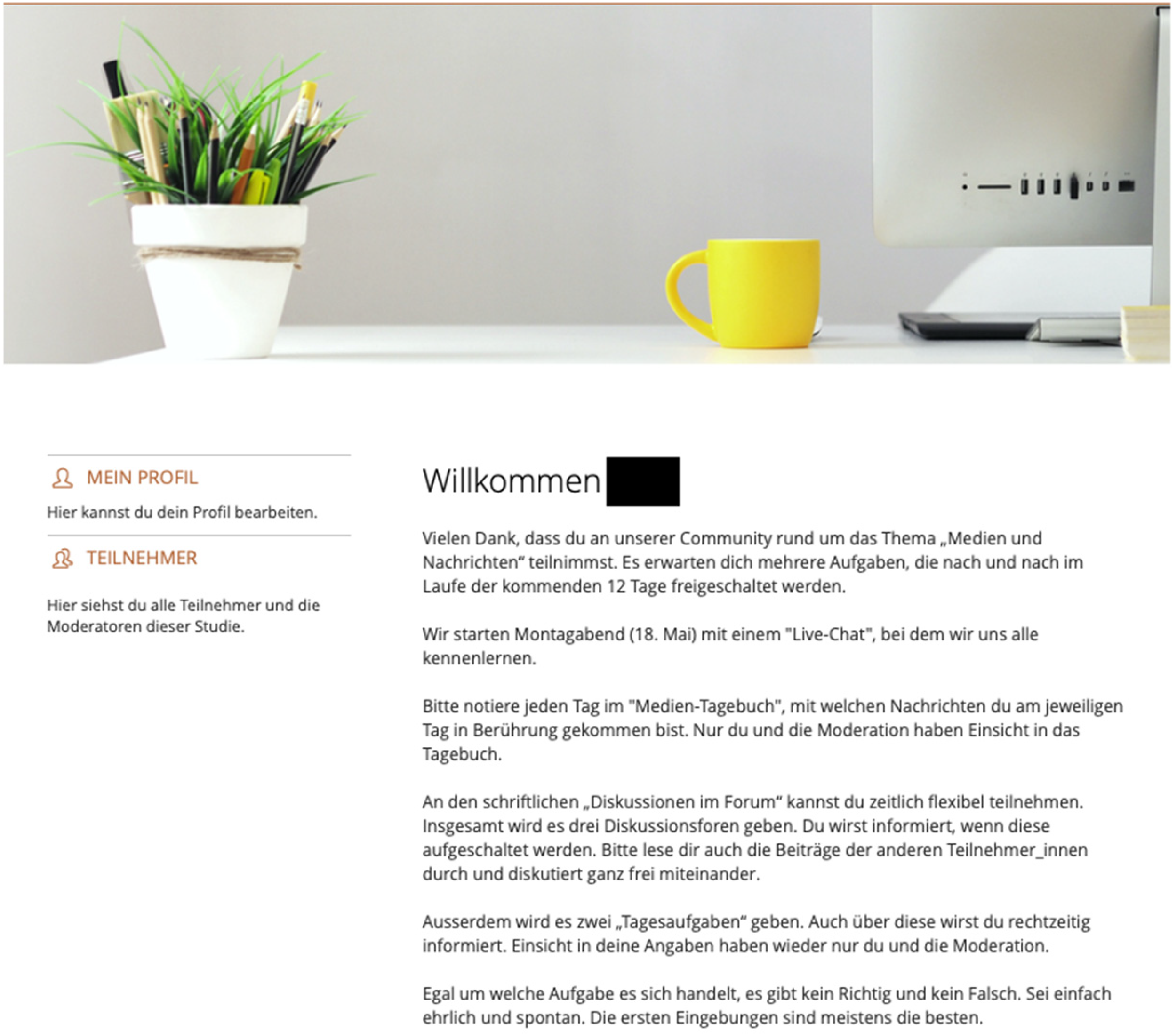
Introduction text on online platform.
On the right side, the different tasks are shown in tiles. Like on a social media platform, users could––and were invited to––create a profile, including a photo, name, age, and hobbies, which was visible to all other participants. This was also the case for the study's moderator, who acted as part of the community, rather than taking the typical role of a study leader. The moderator guided the tasks, participated in the discussions, and engaged in a close and informal exchange with the participants throughout the field phase. The participants could get in touch with the moderator and other participants through personal or public messages. During the tasks, which the participants completed individually, the moderator simultaneously monitored the results via the backend interface and asked for further insights when needed.
To keep the participants engaged over a longer period, we implemented gamification elements. For each solved task, participants gained points and badges that were visible to all participants. They could also “like” other users’ posts. The more tasks the users solved and the more likes they got, the more points and badges they received. In discussions during the tasks, users often used likes when referring to each other (an average of one to five likes per post). About half of the participants were so engaged that they wrote more posts than required. Those who were less active nevertheless consistently responded to questions from the moderator. Only one participant did not complete all the tasks.
In total, the participants completed four different moderated tasks over twelve days in May 2020. Each task was processed via the platform and successively launched during the field period so it could be completed flexibly in terms of time. We conducted a pretest with three people from the age group under investigation to determine whether the tasks were understandable and solvable. Only minor adaptations were necessary.
On the first day of the study, we conducted a one-hour written live chat to get a first impression of the participants’ understanding of “news” and to get to know each other. This was the only task that was time-bound for all participants. We conducted the chat on the same evening in two separate groups, based on their education levels, to avoid possible educational differences and related inequalities. We held the chat in writing because the size of each group would have been too large for a spoken conversation via video. The chat was conducted with a semi-structured interview guide.
Second, we asked our participants to record their daily news usage during the whole twelve days. The media diary consisted of a short leading questionnaire with open text boxes about the news articles they read, the media channels used, and their impression and interest during their media and news consumption to identify the relevance they attribute to news.
Third, we implemented forum discussions on the platform to allow the participants to discuss how they access news, how they evaluate the quality of Swiss news media, what they expect from the news, and for what purpose they access news. The participants were asked to write a minimum of one post. The forum discussions were conducted in writing to allow our participants to take part flexibly in terms of time and place.
Fourth, we set up a sorting task and used circle diagrams (sociograms) to have the participants rank different media channels by credibility and frequency of use to identify different ways of news access and the perceived quality of the channels.
Recruiting and Sample
In total, 19 participants (nine men and ten women) between 20 and 25 years of age from the German-speaking region of Switzerland (see Supplementary Information file, Table A1) were recruited via online calls and an external recruiting office. The addresses for the online calls were accessed via the student mailing lists of the University of Zurich. The recruiting office supplemented the pool of participants to reach the desired quota. Both recruiting procedures were based on a screening questionnaire to reach people who (a) show high use of social media for news purposes (“On an average day, which channels do you use to inform yourself about current news the most?” Options: print media, TV/radio, news websites, social media) and low use of traditional media, such as press, radio, or TV (“How often do you inform yourself via traditional media?” Options: rarely/very rarely; partly; often/very often); and (b) have different educational levels (above/below A-levels). We paid attention to gender balance and an even age distribution for both educational groups.
The study was conducted from May 18th to 29th, 2020. After the completion of the study, the online platform's content was deleted, and the results were exported in HTML and evaluated anonymously. All contributions of the participants were evaluated qualitatively using content analysis based on Mayring (1994). We developed categories inductively using the software MAXQDA.
Results
The study's central findings are presented as follows, structured according to the inductively developed coding scheme (see Supplementary Information file, Table A2). We first provide an overview of how the participants––who are characterized by high social media usage and low use of traditional media channels––define news and how they access it. We then show what quality standards of journalistic news the participants hold and what functions they attribute to news. Finally, we summarize their expectations of news. Overall, we did not find any gender or age differences and only slight educational differences, as described in the relevant sections.
News Definition of Young Social Media Users
We discussed the term “news” during our live chats to further contextualize our results. The study participants with a higher educational level in particular showed evidence of reflection in their understanding of the term: “For me, news is reports about what is happening in the world” (Participant 7). Participants with higher educational levels associate with “news” terms such as “world events,” “information,” or “current affairs” of “general relevance” related to politics, culture, or society. They mainly thought of traditional media like TV, radio, and the press; tabloids were judged as “less important,” indicating that the quality standards of traditional media are appreciated. Similarly, participants with lower educational levels associated news with “world affairs” and “information.” However, they thought more strongly about specific news channels and social media platforms (e.g., Instagram, free newspapers, TV news formats).
Accessing News
Search Engines
Using media diaries, forum discussions, and sorting tasks, we investigated how our participants access news and––in general––which media channels they prefer. Our results clearly indicate that when actively searching for information, they use search engines such as Google most frequently “because other channels do not promise the same range of news” (Participant 8). The participants regard the search options as simple to use and delivering quick results. The search engine is considered more informative and efficient for answering specific questions than is seeking information on social media platforms such as Instagram. One reason for this, according to the participants, is the possibility of comparing the search engine's results, which gives the option to consult different news websites or sources, indicating that professional news sites are still appreciated as trustworthy.
Social Media Platforms and Messengers
Though our participants stated during recruiting that they mostly use social media platforms such as YouTube and Instagram for news purposes, news consumption via these happens rather incidentally when news articles are suggested by the platform. The platforms are used mostly for entertainment. However, when encountering interesting news on social media (e.g., brief news or memes), they often search for further information on the topic via, for example, Google, YouTube, or personal networks, while a complete news offer is not actively sought. When they actively seek news via social media, the video platform YouTube is used, since, in this case, it takes the role of a search engine.
Social media platforms are mainly used via smartphones. When it comes to receiving news, individuals’ online social networks (i.e., friends on social media platforms) play an essential role. For instance, young adults come across news when friends share posts with news stories. Messenger services, such as WhatsApp, are used to exchange news of personal interest or on topics of interest within their peer group (e.g., music, films, and lifestyle, but also news that concerns them personally, such as COVID-19 measures): “Most of the time, I get messages through WhatsApp. I get articles directly, then I read them when I have time” (Participant 10). Also, opinion leaders or influencers act as news distributors when sharing news articles or producing news-like content themselves.
Traditional News Media
As expected, traditional media channels such as TV, radio, and press are used only occasionally or not at all and considered “old-fashioned.” They are substituted with online news sites or news apps of individual outlets, push notifications on the smartphone, or scrolling through social media feeds and finding certain news articles that correspond to their personal interests and have been posted by their friends or subscribed news channels. Traditional media consumption usually happens unintentionally, such as consuming TV and radio when meeting parents at home or when a TV or radio is playing in the background or reading free newspapers available on the train. As one participant writes in his media diary: “I sit on the train for three hours, and there's today's edition of 20Minuten [free newspaper]” 1 (Participant 3).
News Apps
If young social media users consume specific media brands, this primarily happens via free news apps. Typically, they do not search for specific news nor systematically read a set of articles, but rather routinely scroll through the front page and only click on articles that arouse interest. Also, our participants tend not to pay for news when there is a possibility of receiving it for free. Thus, news content that is not available for free is simply not read and is perceived to be of low relevance to the participants. Algorithmic preselection is not of great concern for the participants in our study. In contrast, they appreciate the preselection, as it simplifies the search for information.
Quality Standards of News
Credibility and Professionality
Traditional media channels such as TV, radio, and the press are considered particularly credible and trustworthy, even though they are rarely consumed. The participants have in mind clear quality differences that influence credibility. Accordingly, specific formats of traditional media channels are critically evaluated, such as tabloids or “trash TV”: “What I find problematic is that we have many tabloid newspapers in Switzerland” (Participant 8). Nonetheless, the participants considered traditional media and their online news sites more credible than social media. They assume that these outlets adhere to higher journalistic standards and quality, including more careful curation of content. Google is seen as relatively credible because users can choose which sources of the proposed results to follow––mostly professional news sites.
Veracity
Veracity of news content was revealed to be important for the study participants. This became evident when they raised the issue of misinformation during the live chat. According to the participants, the main problem with social media is the fact that anyone can distribute any content, including “fake news” or conspiracy theories: “I am very active on Instagram and YouTube and can confirm that many lies can be spread there. […] In the end, you don’t know what is right or wrong” (Participant 17). All of them have already been confronted with misinformation, especially via social media. The group with a lower educational level indicated more problems distinguishing between true and false information. In contrast, participants with a higher education level consider many “fake news” or conspiracy theories to be obviously false. Both groups, however, reported that they were well informed on how to verify critical news content, such as by using fact-checking websites or checking the source. Some participants also said that they informed their colleagues about false news by sending them links via WhatsApp.
Functions of News
Sociability
News stories that might arouse interest within the peer group are mainly shared via private channels among friends and family (e.g., via WhatsApp group chats) and not publicly on social media profiles (e.g., Instagram). The participants appreciate the personalized news feed that the peer group curates. Shared news content often matches the interests of the peer group and can lead to further conversations; this includes humorous content and news on lifestyle topics such as music or films. Participants with lower educational levels especially share soft news (e.g., relationships, gossip) or news from their local environment (e.g., traffic accidents), whereas higher-educated participants are also more interested in political news. The face-to-face exchange of news is also of high importance for young social media users when, for instance, meeting friends or family. They also learn about the news when the people in their lives talk about it. Participants who live at home with their parents are often informed about current news when talking with their families, such as at the dining table: “In my case, we discuss topics at the table at breakfast” (Participant 18). Even participants who have already moved from home report that they discuss current events with their families, either face-to-face or via messenger apps. They appreciate these conversations because different opinions meet, and discussions can arise.
Identification
The results indicate that young social media users are interested in news events with a strong mobilizing character, such as the Fridays for Future movement, or emotionalizing events, such as the killing of George Floyd in the US. Such events enable personal identification and can lead to higher engagement with the news and intensified discussions within the peer group. In contrast, more complex political events at the national or European levels appear less relevant to the participants. Also, identification with specific persons (e.g., Greta Thunberg) plays an essential role in the perception of news events. Movements such as Fridays for Future and the Swiss Women's Strike 2019 (which was especially relevant for female participants and university students among them) are topics that activate young people, reflect their values, and appeal to them on an emotional level: “Since there is still unequal treatment, discrimination, and more, we need exactly such events. I think I am relatively well informed on this topic, through friends, media, and social networks” (Participant 16). Political topics can have an integrating function for a group, as they encourage discussions in personal networks, both online and offline. In this context, personal involvement plays a central role: “5G interests me because an antenna will be built directly next to my house” (Participant 5). Topics that directly affect young people encourage them to inform themselves through the news. This finding applies to both of the educational groups that were investigated. However, study participants with a lower educational level tended to have a higher lack of interest in news events outside their personal lives. Our study indicates that young social media users hardly ever inform themselves about topics that do not relate to their personal interests and do not seem to feel that it is essential to be up-to-date about such topics. The feeling of having missed news arises at most when the topic is seen as relevant by one's own peer group.
In contrast, personal involvement during the COVID-19 pandemic did not lead to a sustained interest in the topic. Although most participants increased their news consumption at the beginning of the crisis, the study participants criticized the fact that other topics were hardly covered. As a result, many participants reduced their news consumption or even actively avoided consuming news about the pandemic: “What bothered me at the same point was the fact that they only dealt with this one topic. Consequently, I have completely renounced news” (Participant 11). The group with lower educational levels stated that it was difficult to find out which media one could trust because contradictory results were published, and fake news and conspiracy theories were prevalent.
Expectations Toward News
Appealing Messages
For younger audiences, the presentation of news is important: “I would basically like to see more news that also appeals to teenagers and young adults and is structured accordingly. However, I do not believe that each media house has to implement a TikTok account to publish news” (Participant 7). When it comes to the decision to read the full article, the results indicate that it is essential how headlines of articles are formulated and prepared: they should be entertaining, but also relevant. Relevance, in this context, refers to personal interest. Moreover, content should be easy to understand, especially in the case of political news. As news is often accessed on social media platforms, (audio-)visual forms of news presentation facilitate reaching young target groups: “I find video and audio best. It's convenient, and if you don’t feel like watching, you can play it in the background and multitask” (Participant 2). The content should summarize the most important information as briefly and understandably as possible. The participants in our study also took time for longer podcasts when they were particularly interested in a certain topic (e.g., true crime). They also mentioned that infographics are appealing and help them to understand the content discussed in the article.
Personalized Content and Dialogue
The participants appreciate personalized content, as they are used to this sort of news on social media platforms. Accordingly, they wish for a personalized news bundle from different media brands, which can ideally be accessed via an app that is available at any time and place. It should contain essential information and should be oriented toward their personal interests. The use of one specific media brand does not have enough added value for the young target group: “I want to see personalized content in the style of ‘This article/post/video might interest you.’ Kind of YouTube, with news in different sections, depending on your interests. […] It is very questionable to read articles from only one newspaper regularly. […] A subscription of different magazines together would make more sense.” (Participant 11)
Also, young social media users would appreciate more dialogue in the news context, as they have been socialized through social media platforms characterized by two-way communication. The possibility of commenting on news content should give them the confidence to ask even simple questions, such as in “a forum where you can listen to or read news and ask questions if you do not understand something” (Participant 17).
Discussion
The present study analyzed the expectations toward journalistic news, in terms of quality and functions, among young Swiss people with a specific news repertoire, namely high social media use and low use of traditional media channels. Combining different qualitative methods with an innovative multimethod design made it possible to gain in-depth information about the understanding of news in digital media environments among the target group in focus.
The respondents’ strikingly active participation revealed the added value of using qualitative online tools with social media elements. First, it helped to reach the participants in their usual media environments, which mainly consist of social media platforms. Second, the choice of method also contributed to creating a community among the participants. We regard this as significant because the literature indicates that for young media users, it is more important to engage in conversation with their communities about news than to gathering information as an end in itself (Costera Meijer 2007). In fact, community-building was demonstrated by participants, for example, making specific references to each other in discussions, giving each other “likes,” or finding common interests.
We also assumed that the close contact between the participants and the moderator created a stronger commitment and that the participants were additionally motivated by the gamification elements (e.g., “liking” comments of other participants, creating profiles). Also, questions to and from the participants could be asked in a simple and interactive way. Therefore, we recommend using different online tools in qualitative research to reach target groups better and minimize problems with more traditional methods, especially when face-to-face exchanges are more difficult. Regarding our RQ, we see the advantage of this methodical design in the strong examination of the participants’ own news behavior in combination with close exchange with other participants, resulting in the development of ideas regarding news formats.
Our qualitative study showed that low use of traditional media does not necessarily go hand in hand with news avoidance or that journalistic news is no longer considered relevant. Even though the participants primarily use social media as their main source of news according to self-reporting, they also access news in many other ways, such as via news apps or search engines, which lead them to journalistic news websites. They had a quite clear definition of news in mind, and reflected quality differences among news (e.g., when criticizing tabloids) and the credibility of different news channels and platforms. For instance, our participants rated social media as less credible since anyone can publish content that does not necessarily adhere to journalistic standards in terms of veracity. Our study thus confirms recent findings (e.g., Swart 2021b) that young adults also use established quality criteria of journalism when evaluating news.
Among the functions of journalistic news, our participants highlighted sociability (see also Swart 2021b) and identification. Accordingly, personal networking plays a central role. These personal networks are increasingly shifting toward the online world, such as when young users share and discuss, via WhatsApp, news that matches the interest of the peer group, leading to further discussions. Also, face-to-face exchanges with families and friends to discuss news remain essential (see also Edgerly, Thorson, et al. 2018a). Further, news interest can be very pronounced in cases when young social media users can identify with the topic or its contributor (influencer). This is especially the case for mobilizing topics such as the Fridays for Future movement or the Swiss Women's Strike.
As news consumers, the target group shows two habits that are typical for online environments and which are reflected in their expectations toward news. First, young social media users show a strong habituation to streaming models at a flat rate. Our participants preferred receiving bundled news articles from different media brands via one single platform. Consequently, they do not want to pay for a subscription to a single outlet. Second, young social media users have become used to personalized content offerings. The participants in our study indicated that they wished to receive news articles corresponding to their personal interests. Thus, they do not criticize an algorithmic, personalized selection of news that gives them only a small section of available information. From a democratic perspective, however, it is important that citizens receive news from different areas of society, which was not mentioned by our participants as a crucial function of journalistic news.
Every study has its limitations. The study was conducted during the COVID-19 pandemic, which could have led to a higher awareness of news among the participants. Our results are based on self-reports of our study participants; social desirability could have played a role in certain statements. Also, as the participants were informed about the research topic “news and media use” before the study, they might have dealt more critically than usual with their personal news usage during the study. In addition, we looked at a very specific group of news users by focusing on young adults with high social media usage and low usage of traditional media. It remains an open question whether our results are generalizable for young adults with different news repertoires, such as heavy news users. However, the focus on a specific news repertoire made it possible to gain insight into the perceived relevance of journalistic news for young adults who have moved furthest away from traditional media.
Overall, we wish to highlight two aspects of this study. First, we recommend using online tools for qualitative media research, as our participants remained motivated throughout the study period not least because of the online format and the variety of tasks. We particularly emphasize the written discussions, which made it possible for the participants to communicate with each other at any time and any place over several days. Second, we analyzed a particular group of young media users in Switzerland. The question of what functions and quality young adults who rarely use traditional media and consume news incidentally ascribe to journalistic news is of high practical relevance as well. This group of media users is the most distanced from traditional news consumption and seems to be difficult to reach with journalistic content. However, our study shows that they are still receptive to journalistic news, especially when they can identify with it and when it matches their demands for presentation and accessibility. Therefore, professional journalism should address the needs of this target group more strongly if they want to reach them.
Supplemental Material
sj-docx-1-ijpp-10.1177_19401612211072787 - Supplemental material for Change in News Access, Change in Expectations? How Young Social Media Users in Switzerland Evaluate the Functions and Quality of News
Supplemental material, sj-docx-1-ijpp-10.1177_19401612211072787 for Change in News Access, Change in Expectations? How Young Social Media Users in Switzerland Evaluate the Functions and Quality of News by Lisa Schwaiger, Daniel Vogler and Mark Eisenegger in The International Journal of Press/Politics
Footnotes
Declaration of Conflicting Interests
The author(s) declared no potential conflicts of interest with respect to the research, authorship, and/or publication of this article.
Funding
The author(s) received no financial support for the research, authorship and/or publication of this article.
Supplemental Material
Supplemental material for this article is available online.

Notes
Author Biographies
References
Supplementary Material
Please find the following supplemental material available below.
For Open Access articles published under a Creative Commons License, all supplemental material carries the same license as the article it is associated with.
For non-Open Access articles published, all supplemental material carries a non-exclusive license, and permission requests for re-use of supplemental material or any part of supplemental material shall be sent directly to the copyright owner as specified in the copyright notice associated with the article.
