



Abstract
Changes in global journalism are reflected in myriad cross-national professionalization efforts, including the development and exportation of models for journalism practice. Literature on peace journalism, for instance, suggests that its adaptation across contexts is shaped by forces on several levels, including the influence of individual media practitioners. However, little research examines those likely to practice peace journalism nor the implications of these social profiles on the diffusion of the model more broadly. Drawing on field theory and 20 in-depth interviews with East African journalists conducted between 2020 and 2021, this study explores such questions by identifying shared dimensions of position and habitus across those who attend peace journalism trainings. Findings suggest that these individuals tend to be well educated, share common experiences with conflict, and hold similar interventionist role conceptions. Such findings illuminate the types of social transformations peace journalism may undergo as it is adapted across contexts, with implications for journalism theory and practice.
Global transformations in journalism are reflected in myriad professionalization efforts, including the development and transnational exportation of models for journalism practice. Literature on the international diffusion of journalism models—or ideas about how journalism can or should be practiced—suggests that models undergo an adaptation process when introduced across contexts. But less is known about the relevant factors at work within these adaptation processes as well as how forces ultimately shape the uptake of ideas.
For instance, work on peace journalism, one such model, suggests that its adaptation across contexts is shaped by forces on several levels, including the influence of individual practitioners (Bläsi 2004). However, most research in this domain has focused on professional competencies or journalists’ perceptions of peace journalism, without a full account of the basic social profiles represented in this work. Who gets involved in peace journalism and how might these identities shape its adaptation across contexts?
The following study contributes to this end by examining the individual characteristics and personal backgrounds of East African journalists who attend peace journalism trainings. Trainings represent a first pass at the model-adaptation process and thus are an empirically important space to study this phenomenon. Drawing on Bourdieu’s (1977, 1984) field theory and 20 in-depth interviews, the project’s findings advance an understanding of professional model diffusion that centers journalists as social actors who are affected not only by social processes but also by active participants in their construction, including the ostensible diffusion (or not) of peace journalism.
The Peace Journalism Model
Norwegian sociologist and peace researcher Johan Galtung is credited with contrasting peace journalism with contemporary war journalism as early as the 1970s. War journalism, critics argue, characterizes most conventional conflict coverage in which reports are sensational, superficial, and primarily concerned with depicting spectacles to boost ratings and circulation (Allen and Seaton 1999; Carruthers 2011). Peace journalism, on the other hand, underscores the root causes of conflict and emphasizes areas for common ground or resolution (Galtung 2003; Lee and Maslog 2005). In scholarship on the topic, peace journalism is commonly defined as a practice in which “editors and reporters make choices—of what to report and how to report it—that create opportunities for society at large to consider and value nonviolence responses to conflict” (Lynch and McGoldrick 2005: 5).
In practice, peace journalism can shape reporting practice in several ways. For example, a peace journalism approach guides general story framing, such as foregrounding common interests among sparring parties or highlighting proposed solutions. Peace journalism interventions can also occur at the level of specific word choices, like avoiding hate speech and demonizing language. For this reason, peace journalism has been described as a “broad” framing approach (Lee and Maslog 2005: 324) with potential interventions on multiple levels of the reporting process. Though some have argued such peace journalism framing places too much emphasis on the agency of individual journalists (Hanitzsch 2004) or that it is inconsistent with industry norms (Loyn 2007), others suggest that addressing journalism’s role in the construction of reality is a necessary requisite of normatively “good” reporting (Kempf 2007; Lynch 2014; Youngblood 2016).
Diffusion of Professional Journalism Models
Like related models of journalism practice, such as solutions journalism or development journalism, peace journalism introduces a host of considerations when introduced across contexts. A major debate in this area revolves around concerns that such models, many of which are initially developed in Anglo-American contexts, run the risk of homogenizing news practice and coverage across otherwise diverse socio-political environments. Specific examples throughout history include the exportation of objectivity as a global journalism ethic (Kaplan 2009) as well as the transmission of American press-freedom ideals after World War II (Blanchard 1986). Homogenization theorists suggest that these types of professional development efforts—exported from North America and Western Europe to other parts of the world—may actually be inappropriate or unsustainable in some contexts (Berger 2010; Nyamnjoh 2010).
A second perspective regarding the diffusion of professional journalism recognizes the agency of local industries and practitioners. More specifically, the process of international model diffusion can also be examined as an adaptation process in which professional models for practice are modified within new contexts, this is reflected in the introduction of investigative journalism to Latin America in the 1980s and 1990s. Rather than implement a wholesale version of investigative journalism as conceptualized in American newsrooms, Waisbord (2001) argues that South American regional press engaged in unique adaptations of investigative practices and values situated within local media industries.
While the previous example highlights how forces at the level of press systems shape professional model diffusion, other important factors include the influence of organizational dynamics (Amiel and Powers 2019; Breed 1955) as well as individual practitioners (Doll 2022; White 1950). Of particular interest to this study is the individual, who is arguably most directly tasked with implementing the ideas and practical reporting guidance introduced by models like peace journalism.
Individuals bring a range of experiences and worldviews to reporting, this is aptly reflected in work on the sociology of news. Scholarship in this area assumes that news is socially constructed and that journalists’ work is necessarily imbued by their personal social backgrounds (Park 1940; Schudson 1989). For example, one multi-influence typology highlights individual-level factors influencing peace journalism content, alongside influences at the societal and industry levels. At the individual level, influences include general journalistic competencies (e.g., ability to investigate issues thoroughly and distill information), general conflict competencies (e.g., theoretical understandings of conflict dynamics, processes, and outcomes), and specific conflict competencies, such as knowledge on specific actors, motivations, and regional histories (Bläsi 2004).
However, this understanding of individual influences on peace journalism practice does not fully account for more basic social profiles represented in this work, such as one’s educational background and personal experiences with conflict. This matters because social experiences not only impact individual journalism practice; as a sociology-of-news perspective would suggest, shared social experiences may also shape how—and the extent to which—new ideas and practices can affect change in organizations and industries more broadly. To this point, Bourdieu’s field theory offers one explanatory mechanism to understand how individual backgrounds and personal experiences may shape the larger processes associated with professional model diffusion.
A Field-Theory Approach to Model Diffusion
The use of field theory as a conceptual framework is increasingly popular across journalism studies research (Maares and Hanusch 2022). Developed by French sociologist Bourdieu (1998), a “field” represents a semi-autonomous social space where “various actors struggle for the transformation or preservation of the field” (40–1). In the context of journalism, the concept of a journalistic field takes into account the influence of external forces, such as other professional fields like politics and economics, as well as internal forces, like individuals’ backgrounds, and the complex interactions between both external and internal forces in the pursuit of desirable resources, such as revenues and professional accolades (Benson and Neveu 2005). This has led some to characterize field theory as a study of “meso-level social integration” (Neveu 2007: 338). Beyond merely describing the relationships between external and internal forces, this meso-level approach allows researchers to theorize about the specific interrelated mechanisms at work, ultimately operating through individuals as social actors.
Within the field theory, position refers to one’s location within a hierarchically structured field (Benson 1999). This location, or position, both enables and constrains individuals’ understandings of and responses to changes in the field—such as new practices introduced by peace journalism—because it is shaped by myriad factors that vary by person. Examples of such factors include one’s professional background and broader social experiences, like educational trajectory, socioeconomic upbringing, or gender. For example, individual social position in the journalistic field has been used to explain how media professionals react to economic constraints and technological change (Powers and Vera-Zambrano 2019).
Together, an examination of both field and social position guides researchers to map the relative power dynamics between individuals. These power dynamics are negotiated in part through the attainment or loss of different forms of capital, or valued resources, based on an individual’s position in the field. In the journalistic field, economic, cultural, and social capital are thought to be particularly important (Maares and Hanusch 2022; Moon 2019). Economic capital includes monetary compensation or other types of financial remuneration. Cultural capital, in contrast, can refer to technical expertise or educational credentials as well as symbolic recognition of such, like professional awards or prizes (Bourdieu 2011). Finally, social capital refers to resources leveraged through one’s social circle (Anheier et al. 1995). A field-theory perspective contends that understanding these different forms of capital is critical to understanding the distribution of individuals and power to affect change in any given social space (Willig 2012). Thus, examining which form(s) of capital is commonly associated with those who attend peace journalism trainings is key to understanding the conditions under which adaptation of peace journalism might occur, given that peace journalism is thought to present a challenge to traditional conflict reporting and therefore the larger journalistic field.
Those who attend peace journalism trainings are, of course, not a unified group with a singular set of interests. They represent individuals who are located in different positions in the journalistic field. However, examining the overlap of particular social profiles, including structural position and forms of capital, can provide clues to the kinds of transformations that peace journalism may undergo when perceived by and implemented through these individuals. In other words, those who attend peace journalism trainings are ostensibly tasked with the model’s diffusion, and a field-theory perspective would suggest that this process is necessarily shaped by their social positions.
In the specific context of peace journalism, individual-level factors that have been theorized to be particularly salient in understanding social position include journalistic competencies and experiences with conflict (Bläsi 2004). Journalistic competencies may be shaped by both educational background and career trajectory, inviting the examination of both in addition to experience with conflict. Therefore, the first research question asks:
RQ1: What social profiles, including educational background, career trajectory, and exposure to conflict, are characteristic of East African journalists who attend peace journalism trainings?
Beyond the influence of individuals, the diffusion of new ideas and practices is also bound by the “rules of the game” or doxa of a given field (Benson 1999: 464). Doxa refers to normalized conventions and assumptions that often go unquestioned, such as traditional news values or story exclusivity in the journalistic field (Schultz 2007). Bourdieusian thought bridges these conventions with the agency of individuals when examining habitus, or the internalized beliefs and dispositions that constitute an intuition for the rules of the game (Bourdieu 1984). Habitus is therefore both an outcome of social processes as well as a contributor to them, in that journalists can “position themselves to a certain extent but always within the structures of the social space which surrounds them” (Willig 2012: 379).
Following from previous work, habitus can be operationalized as the ways that journalists describe their role within the journalistic field, or journalistic role conceptions, as this reflects both individual dispositions and structural norms (Maares and Hanusch 2022). Journalistic role conception refers to the ways in which journalists conceive of and articulate the most important aspects of their job and contributions to society. They may refer to (1) normative ideas of what journalists should do, (2) cognitive articulations of what journalists want to do, as well as (3) what journalists actually do in practice (Hanitzsch and Vos 2017).
Numerous roles exist across literature on the topic, and work in this area increasingly compares role conceptions across countries. Led notably by the Worlds of Journalism Study (WJS), which has completed two waves of cross-national surveys, broad role categories include journalists as monitors of power, collaborators with governments, interventionists, and accommodative entertainers (Hanitzsch et al. 2019). Within and across these broad categories, the WJS and associated publications have further explicated roles related to national development and educating the public, both of which have been identified as important in African contexts. Specifically, an examination of eight South Asian and sub-Saharan African countries found that journalists generally subscribed to more developmental role conceptions or the idea that journalism can aid in national development often in collaboration with governments, as opposed to journalism that is more politically adversarial (Kalyango et al. 2020). Others found that journalists in Botswana, Kenya, and Sierra Leone valued a more educator-oriented role, in which journalists educate the public about social issues (Standaert et al. 2021; Statham 2007). While research on role perceptions in East African countries specifically is relatively limited, existing results generally align with the above trends. For example, journalists in Kenya found it important to disseminate information, educate audiences, and promote tolerance (Ireri 2017; Obonyo and Owilla 2017). However, findings from an analysis of role conceptions in Kenya, Rwanda, and Uganda suggest that role orientations become more interventionist, even going so far as to advocate for specific policies or ideas, as political environments become more restrictive (McIntyre and Cohen 2022).
In East African contexts and beyond, role conceptions thus reflect a range of habitus constructions based on both individual positioning and normative understandings of how journalism ought to be practiced, thereby linking expectations of journalism to the everyday practice of journalists (Tandoc et al. 2013). Following from this, and in the context of professional model diffusion, understanding how individuals conceive of these professional roles provides additional clues about how social position may shape the uptake of new ideas and practices associated with peace journalism. This motivates a second research question:
RQ2: What are the primary journalistic role conceptions held by East African journalists who attend peace journalism trainings?
Data and Method
To explore these research questions, this study relies on twenty in-depth interviews with journalists from Kenya, Rwanda, South Sudan, and Uganda. Interviews serve as an ideal methodological tool for this work, as they assist in the meaning-making process and “reveal emotional dimensions of social experience that are not often evident in behavior” (Lamont and Swidler 2014: 7). The interviews were conducted between September 2020 and January 2021 using video conferencing services Zoom and WhatsApp. The average interview length was 51 minutes, and the data were collected as part of a larger project examining East African journalists’ perceptions of and experiences with peace journalism.
Sampling and Recruitment
Purposive sampling for the full project reflected both theoretical and practical considerations. Pragmatically, interview respondents were limited to journalists from nations belonging to the East African Community (EAC) intergovernmental organization, which at the time of data collection included Burundi, Kenya, Rwanda, South Sudan, Tanzania, and Uganda. Situating this study regionally in East Africa, as opposed to a single country, broadened the purposive sample population while maintaining some shared realities across social and political environments. An expanded sampling population was important given that the peace journalism model still remains relatively unfamiliar to most media practitioners (Rodny-Gumede 2016). Thus, identifying enough peace journalism workshops with willing respondents in a single country would be challenging, if not impossible, ultimately jeopardizing the opportunity for meaningful findings beyond one or two well-attended trainings.
However, casting too broad a sampling frame means that media professionals would likely operate in exceedingly diverse sociopolitical and professional working environments. Thus, delimiting the study context to EAC nations provided a necessary compromise. Rather than interviewing media professionals from disparate parts of the world, EAC countries have some shared histories of conflict, including several armed insurgencies or events that involved more than one state and resulted in even wider refugee flows (e.g., M23 rebellion in eastern Democratic Republic of the Congo, 1994 genocide in Rwanda, Lord’s Resistance Army in northern Uganda). Similarly, EAC members’ press systems developed under comparable experiences of colonialism, have been similarly impacted by technological advancement and digitization, and all include some semblance of media pluralism today (Breit 2020).
Of course, this is not to ignore important differences between the countries and media systems included in the project’s sampling frame. For instance, Rwanda and Burundi are thought to have some of the most restrictive political systems and media landscapes in the region, while Kenya is arguably the most open, both with respect to political expression and journalism (Frère 2017; McIntyre and Cohen, 2022; Moon 2021). South Sudan, Tanzania, and Uganda presumably fall somewhere in the middle of this spectrum. Such differences in professional and political environments, among many others to be sure, inevitably shape both the conflict-reporting that is conducted in these countries as well as the individual-level perceptions that respondents share.
Fortunately, a field-theory perspective integrates these assumptions into its analysis. Specifically, field theory assumes that situated sociopolitical and historical dynamics shape the organization of a field as well as the position of social actors within that field (Benson and Neveu 2005). A primary conceptual aim of this study is therefore to identify shared perceptions within a regional field of East African journalism practice with the understanding that individual-level perceptions necessarily incorporate a wider variety of influences, some of which are country-specific. While it is true that such differences may never be fully accounted for, additional reflection is devoted to this in the conclusion.
In addition to practical considerations, it was theoretically important that research subjects start with some basic awareness of peace journalism. Though journalists may learn about professional journalism models in many ways, it is often the case that exposure comes from particular workshops or training experiences. Trainings therefore represent an important analytic site to examine the model-adaptation process. Moreover, asking respondents to reflect on the peace journalism model without existing exposure to its principles and practices would inevitably confound any conclusions drawn about the likely social conditions of reception of peace journalism. Respondents were thus eligible to participate in the study if they had attended at least one institutionally sponsored peace journalism training. Beyond geographic and training criteria, respondents were proficient in English and were eighteen years of age or older. Interviews were conducted in English, given that most interviewees came from English language media outlets and all attended their respective peace journalism trainings in English.
Following IRB approval (00011138) from the University of Washington Human Subjects Division, recruitment began with contacting individuals (N = 12) who participated in the 2017 East African Peace Journalism training workshop in Kisumu, Kenya, using contact information provided by event organizers. This training served as an initial organizing event for sampling given that it was regional, thus providing the desired variation in respondents, as well as relatively large compared to training opportunities limited to single countries. Eight of the twelve participants agreed to participate in the study; I was unable to reach the remaining four participants using methods available to me (professional webpages, Twitter profiles, LinkedIn, etc.). Additional respondents were identified using snowball sampling based on interviewees’ professional references as well as online searches for peace journalism workshops in the specified countries. This process ultimately produced respondents from four countries—Kenya (five), Rwanda (one), South Sudan (four), and Uganda (ten). Regrettably, I was unable to recruit participants from Burundi and Tanzania. While this may be due to a number of factors, it is possible that journalists in Burundi and Tanzania are relatively less likely to attend English-language trainings given the higher use of French and Swahili as major languages in these countries, respectively, compared to English. Uganda, in contrast, is overrepresented in the sample, contextualized by the fact that it is home to the East Africa Peace Journalism Foundation.
With respect to the peace journalism trainings that participants attended, respondents (N = 20) represented five different peace journalism workshops between 2009 and 2021. By and large, respondents self-selected to attend these trainings, with the exception of at least one respondent who explicitly indicated that their supervisor had selected them to attend. Trainings generally lasted between a day and several days, and all were organized locally though often with international sponsorship. To ensure baseline consistency across training messages, I triangulated content by reviewing primary training documentation provided either by interview respondents or directly from institutional hosts. Training content that deviated from the basic peace journalism tenets outlined in McGoldrick and Lynch’s (2000) seventeen good practices in covering war would be excluded; however, this exclusion criteria was not used based on the respondents who agreed to participate in the study.
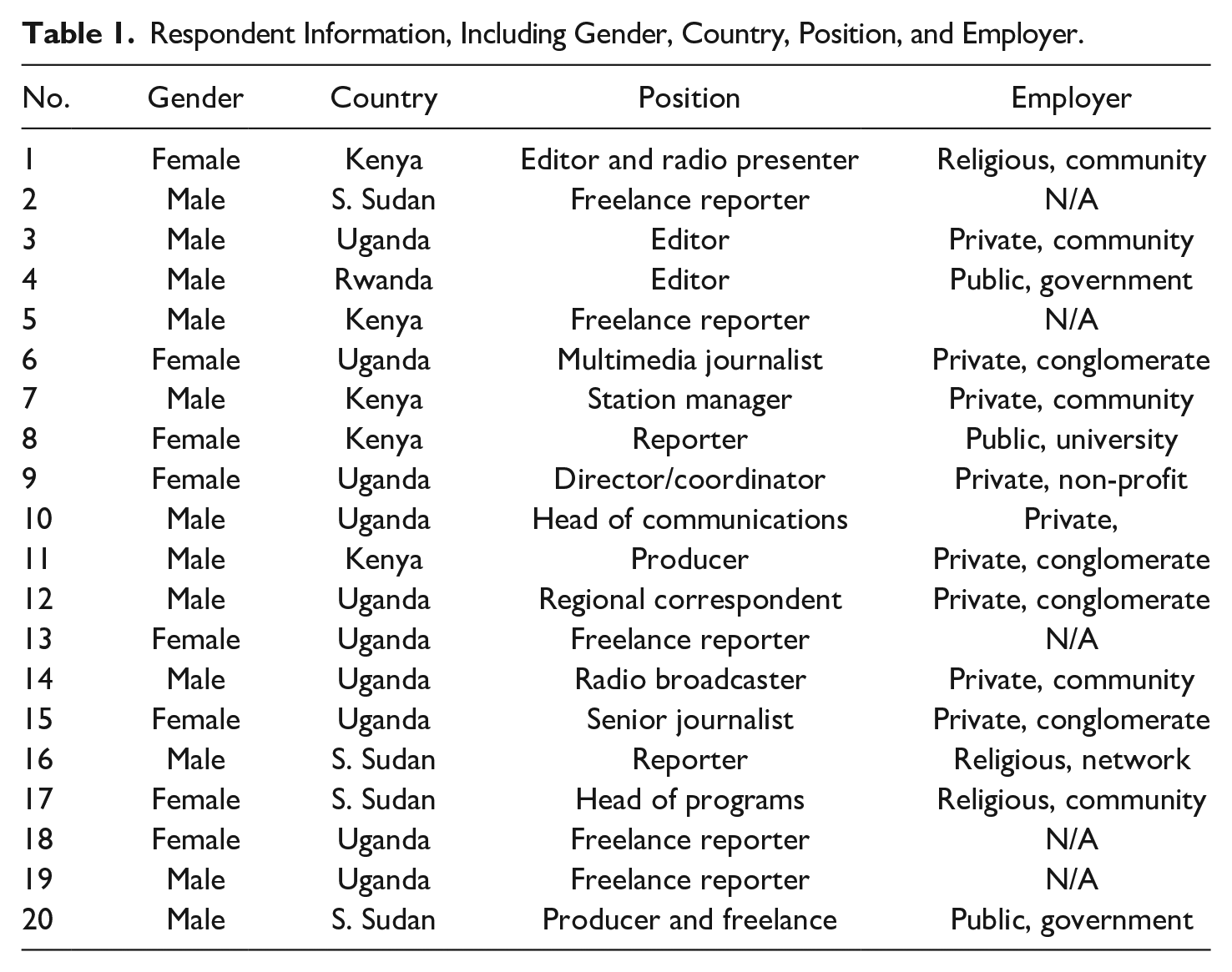
As documented in Table 1, the final sample included roughly equal numbers of men and women. Respondents also worked for a variety of professional employers and across a range of professional positions, including many types of workers involved in the news production process (e.g., editors, producers, managers). This variation was analytically useful in that shared perceptions could not necessarily be attributed simply to differences in professional position alone. Relatedly, while most respondents indicated that they had covered conflict to some degree, none specifically reported serving as conflict or peace-beat reporters.
Respondent Information, Including Gender, Country, Position, and Employer.
The open-ended questions included in the interview guide corresponded to the study’s theoretical interests regarding education, career trajectory, and experience with conflict. Based on the characteristics sampled for—professional position and markers of individual background, such as conflict experiences and education—respondents’ answers to questions became markedly predictable within the first dozen interviews. From this point, recruitment continued until little to no new information related to the project’s research interests would be collected through additional conversations.
Data Analysis
Interview data were organized and analyzed in Dedoose, a qualitative analysis software, using an interpretive thematic analysis approach. Semi-structured interviews lend themselves to interpretive analysis and provide space for researchers to pursue situational meanings or motives (Hopf 2004). I conducted coding at the semantic level with the aim of presenting information as communicated by each respondent, after which it was organized for interpretation vis-à-vis the stated research questions (Braun and Clarke 2006).
Several codes were pre-determined based on the theoretical orientation of the project. These include individual educational background, career trajectory, experience with conflict, and journalistic role conceptions. In coding for education and career trajectory, I created codes for information indicative of education, job description, and work history. In coding for experience with conflict, I created codes for first-hand experiences, second-hand experiences, as well as types of experience (e.g., interstate war, local conflict, mediated conflict). Journalists’ role conceptions were coded as information pertaining to the purpose of journalism, journalistic responsibility, and indicators of journalism quality. While coding for individual backgrounds was primarily deductive, I explored journalists’ role conceptions from an interpretive position rather than applying or fitting existing categories. This allowed conceptions to emerge in the respondents’ own words, leaving my analytical responsibility to effectively characterize conceptions in the data and relate them back to existing literature.
Findings
The analytic processes described above resulted in two key findings: (1) Respondents occupied similar social positions in terms of their educational backgrounds and experience with conflict, and these experiences largely comport with general trends in journalistic profiles in the countries represented based on available data; (2) Respondents also generally shared active, interventionist role conceptions, indicating that reporting approaches like peace journalism may be especially salient for those with particular understandings of journalism. Implications for the adaptation of peace journalism and the extent to which the reporting model represents a transformation to the journalistic field in East Africa are discussed alongside these insights.
Education, Career Trajectory, and Conflict Experience
Of the three indicators of social position examined—experience with conflict, career trajectory, and education—education was most unified across the sample in that respondents shared remarkably similar educational backgrounds. In contrast, career trajectory was most heterogeneous among respondents with a variety of professional pathways and positions represented. Finally, almost all respondents reported some experience with conflict, though these experiences varied in notable ways.
Education
In general, interview respondents were highly educated. Fifteen of the twenty interview respondents received tertiary degrees in journalism or mass communication, and eighteen participants had undergone at least some specialized journalism training. The remaining two respondents had recently completed secondary studies but shared a keen interest in pursuing a university degree in journalism or mass communication in the future. A handful of participants also held master’s degrees, though these degrees were more commonly completed in adjacent fields such as international relations, diplomacy, or development studies.
In addition to basic journalism training and university studies, many respondents had participated in other short courses and journalism trainings beyond peace journalism. These trainings covered topics like investigative journalism, multimedia journalism, photography, and media management. While variation existed with respect to types of university degrees and the content delivered at these specialized trainings, respondents shared a relatively high level of education as well as an orientation toward continual skill building in journalism.
Specifically, there was some consensus that one would “never saying no to a training opportunity” (Rose Kawala, 1 Uganda, January 26, 2021), as such opportunities presented valuable moments to “move higher” (Julius Nakame, Uganda, January 26, 2021) in both their educational and professional trajectories. South Sudanese Journalist Wilson Ibrahim reflected on his advanced certificate in journalism saying, “It is not yet enough for me” (January 29, 2021). This shared enthusiasm for continuing education suggests that individuals interpret peace journalism perhaps not only as a way to practice “good” journalism in the normative sense but also as a practical opportunity for professional mobility.
Career Trajectory
Closely related to educational background is one’s professional career trajectory. While respondents tended to begin from similar educational experiences, their career trajectories varied substantially. As reflected in Table 1, interview respondents held diverse positions at the time of their interviews, from freelance reporters to station managers working at a range of private, public, and faith-based community media houses as well as larger networks. In fact, the most consistent professional trajectory across the sample was one simply characterized by change.
With the exception of two respondents, as well as several who were just beginning their careers out of university, almost all interviewees described short employment at many small outlets. For example, Kenyan radio station manager Stephen Odihambo has held positions at five different radio stations over a span of fifteen years (September 17, 2020). Similarly, Patricia Gwitaba, a multimedia journalist from Uganda, moved reporting positions three times in six years. One respondent who had been in his position for nearly seventeen years acknowledged the uniqueness of this, characterizing himself as “one of the longstanding guys” (George Liku, September 29, 2020).
Respondents left their positions for a variety of reasons including issues like “horrible pay” and feeling “too confined” (Patricia Gwitaba, Uganda, September 27, 2020), as well as in response to media markets that were “so competitive” (Sicily Kalu, Kenya, September 29, 2020). Many respondents also described needing to transition between mediums—for example, from a print journalist to a radio presenter (Serge Abara, Uganda, October 29, 2020)—as well as multitasking on assignments, at times collecting information, photos, and video at the same time to perform their work. These varied career trajectories, while initiated by the media professionals themselves in many cases, highlight the volatility in regional media markets as well as individual tenacity to stay in the industry, despite challenges.
Experience With Conflict
In contrast to the heterogeneity of career trajectory, all respondents also reported some experience—often direct experience—with violent conflict before their introduction to peace journalism. Some participants reported perpetual socio-political strife, like the experience of growing up “in a warzone” during the Lord’s Resistance Army’s insurgency in northern Uganda (Inno Mutesi, Uganda, January 23, 2021). Others had very specific conflict-reporting experiences such as “tasting tear gas” during riots or losing a shoe while “running for dear life” on assignment (Sicily Kalu, Kenya, September 29, 2020). Ugandan correspondent Abdul Kareem shared a similar experience covering a story in the Democratic Republic of Congo: “I remember going to the DRC where the rebels had taken part of the northern Democratic Republic of Congo neighboring Uganda. I also remember jumping over bodies with a car and on foot [and] covering protests” (January 1, 2021).
For those respondents who did not experience violent conflict directly, they often referenced a local or national conflict that impacted them indirectly. Some spoke of having family from a region that had been “of the greatest affected by post-election violence” (Olivia Mwenge, Kenya, October 6, 2020). Others, like Ugandan Serge Abara, reported exposure to more localized and discrete “tribal conflicts” such as “people fighting about land, people fighting about swamps, people fighting about administrative units” (October 29, 2020). Still others discussed prolonged political upheaval, for example, suggesting that people are always having problems “due to some crisis or another” (Wilson Ibrahim, South Sudan, January 29, 2021). In these instances, respondents did not report that they were directly involved in a conflict, though they reportedly brought a kind of proximity to conflict to their media work.
Finally, some participants referenced well-known regional or international conflicts with strong cautionary lessons for the news media. For example, nearly half of respondents described the use of radio to incite violence during the 1994 Rwandan genocide. Others referenced Kenyan election violence in 2007 that elicited international media headlines. In discussing the imminent threat of election violence in Uganda, Abdul Kareem drew a comparison to 2007 violence in Kenya saying, “We had a real-life example in Kenya . . . In the later year 2007, [election violence] happened in Kenya, and people were chopping each other like hens” (Uganda, January 1, 2021). While experiences of conflict were each unique, from intense and direct reporting on violent situations to more generalized experiences of living in a chronic conflict environment, all respondents reported some personal relationship to conflict.
These findings join with respondents’ shared educational backgrounds and varied professional trajectories to provide a sense of the social profiles involved in the ostensible diffusion of peace journalism in East Africa. Included in these markers of individuals’ social position is some indication that cultural capital is important to this group, evidenced by relatively high levels of education and motivation to attend training. On the one hand, this broadly corresponds to the education levels of East African journalists in general, where more than 90 percent of journalists in Kenya, for instance, complete university degrees (Kalyango 2017; Obonyo and Owilla 2017). Trends appear similar in Rwanda, with the initiation of several journalism programs and media capacity-building programs in recent decades (Moon 2023; Njuguna and JJuuko 2019). While education rates may be relatively lower for journalists working in Uganda and South Sudan, based on what little evidence is available, there is still some sense that journalism is indeed professionalizing across the region (Jjuuko, 2017; McIntyre and Cohen 2021; Mwesige 2004).
Similarly, respondents’ experiences with conflict parallel what we might expect from journalists generally in these countries, perhaps unsurprisingly. After all, large-scale conflicts tend to impact whole populations to one degree or another. However, it is noteworthy that not all respondents reported direct experiences with a specific conflict. Given that these individuals are ostensibly responsible for bringing peace journalism practices to their newsrooms, this would support calls for peace journalists to develop an understanding of general conflict dynamics as well as the dynamics of specific conflicts they are covering (Bläsi 2004). In other words, it should not be assumed that journalists who come from conflict-stricken areas somehow naturally possess the sociopolitical information or experience required to conduct the kind of reporting advanced by peace journalism. Trainings should therefore move beyond reporting tactics and writing conventions to include procedures and processes for learning about the range of conflict dynamics that exist.
What are the implications of these basic social profiles for the extent to which peace journalism represents a transformation of the journalistic field? Although a larger representative sample with greater variation across variables is needed, it is worth noting that the seeming ordinariness of respondents’ social profiles—compared to journalism practitioners generally in these countries—is not necessarily bad news for those invested in the diffusion of peace journalism. In fact, this is some indication that the model may find favor with a broad professional audience over time. For example, the high levels of education represented in this sample would suggest that peace journalism trainings are presumably reaching average cohorts of East African media professionals, at least as defined by educational attainment.
Furthermore, many respondents occupied relatively tenuous professional positions characterized by change and volatility. While such professional precarity reflects broader industry trends (Matthews and Onyemaobi 2020), implications for the diffusion of peace journalism are less straightforward. Specifically, despite the capital that comes with educational achievements, the social positions reflected in this sample suggest that those who attend trainings may be more peripheral actors in the larger journalistic field compared to an established “core” who presumably have relatively more job security (Maares and Hanusch 2023: 1277). However, and as others have argued, peripheral actors may actually be best positioned to challenge traditional practices and norms, particularly in African contexts (Cheruiyot et al. 2021; Eldridge 2017). Future research might explore the extent to which such actors are actually able to implement peace journalism practices post-training as well as the relationship between openness to peace journalism and interest in international diplomacy and development, as illustrated in this sample. Such associations may provide additional clues to the types of cultural capital or worldviews that could come to shape peace journalism adaptation over time.
Journalistic Role Conceptions
Beyond individuals’ basic social profiles, the second research question examined journalistic role conceptions to understand how respondents’ habitus may shape the diffusion of peace journalism. Despite variation across countries, employers, and professional titles, respondents expressed shared ideas about their roles as journalists in their respective societies. In particular, interview participants directly referenced their role in facilitating conflict resolution, either by distilling information for relevant parties to use in the peace process or by more directly mediating conflict resolution between sparring groups.
While elements of informing public and facilitating social change exist as dimensions of roles identified in extant role-conception literature, these ideas combined unexpectedly in the context of the interviews. Here, the term “facilitator” represents both dimensions of informing and mediating toward a shared goal of conflict reduction or resolution. Evidence for this understanding of the “journalist as facilitator” can broadly be categorized into two perspectives about how journalists can and should engage with public affairs: (1) providing information or tools for communities to address conflict or (2) providing opportunities or a platform for communities to resolve conflict. Each of these dimensions of the journalist-as-facilitator role conception derives from a shared sense of strong media interventionism.
Providing Information or Tools
A first manifestation of this journalist-as-facilitator role conception is in the provision of relevant information for communities to resolve conflict or find solutions on their own terms. In this case, journalists emphasized their role in providing information so that citizens “are able to make decisions” and “participate in nation building” (Stephen Odihambo, Kenya, September 17, 2020). Silas Malakbungu summarized this perspective by saying,
When I look back at the news reporting that is hard news, I find that most truth is missing . . . Why can’t one actually dig for reality and present it to the public? Once people know the reality, it will make more impact in society. (South Sudan, September 25, 2020)
This understanding of journalists’ roles as stewards of information operates under the assumption that society can and will use verified information to make rational decisions and that it is the journalist’s responsibility to provide these tools.
Providing Opportunities or a Platform
A second expression of the journalist-as-facilitator role conception came in the form of more direct reconciliation efforts. In these instances, respondents underscored journalism’s role in “uniting the community” (Sicily Kalu, Kenya, September 29, 2020) and “harmonizing society rather than dividing it” (Serge Abara, Uganda, October 29, 2020). In practice, this perspective brings together different voices in a public forum where “they can air out some of [their] challenges” (Stephen Odihambo, Kenya, September 17, 2020).
This facilitation may be conducted directly, as Omari Hassan describes with respect to his broadcast programs. He shared: “I make sure that I get the two parties involved to talk about their controversial issues, what actually caused them to do what they’re doing, and the source of the conflict” (South Sudan, February 4, 2021). Facilitation was also discussed indirectly through putting viewpoints in conversation with one another in the context of a news article. In either circumstance, the perspective holds that the journalist’s role is less about providing information and more about providing a space or venue for conflicting parties to engage with one another’s concerns. Within this role conception, communities benefit from facilitated dialogue, and the news media serve as one platform where diverse perspectives can be exchanged.
Strong Media Intervention
Whether facilitation was discussed with respect to information or mediation, the journalist-as-facilitator perspective relied on shared assumptions of strong media effects and interventionism. Time and again, respondents discussed journalism’s capacity and duty to “change society” (Serge Abara, Uganda, October 29, 2020) and the journalist’s power to “destroy or build” (George Liku, Uganda, September 29, 2020). This sense of interventionism appeared both at the institutional level, or the media’s role in “shaping society, setting agendas, and guiding society in how it should behave” (Serge Abara, Uganda, October 29, 2020), as well as at the level of individual journalists. Kenny Senyange reflected on his personal responsibility saying, “As a journalist, I play a major role in ensuring peace . . . that the person who is reading this is not motivated to continue violence or to retaliate” (Kenya, September 24, 2020). Similarly, Ugandan journalist Zaida Ngoy shared: “I realized that I could use my pen and paper and the power of radio, the power of media, and report about the war in a way that exposes the war” (October 19, 2020).
While this sense of strong media effects and the journalist-as-facilitator role conception were most strongly emphasized across the sample, it is worth noting several respondents also mentioned roles typically associated with traditional Western role orientations, such as journalists as watchdogs, monitors of public interest, and neutral disseminators of information. Silas Malakbungu, for example, described the relationship between media interventionism and traditional news values saying that journalists should “be involved in solving [conflict]” while still being mindful of “objectivity, impartiality, and independence” (South Sudan, September 25, 2020). Thus, these findings join existing research suggesting that while monitorial roles may be slightly more pronounced in Western journalism, it also resonates with non-Western journalists, like those interviewed here (Standaert et al. 2021)
In relating the present role conceptions to existing literature, the journalist-as-facilitator role includes elements of what others have called the mediator role, corresponding most closely to providing direct opportunities or platforms for peaceful mediation (McGoldrick, 2000; McQuail 2000). However, the mediator role does not fully capture respondents’ emphasis on distilling information as a form of peaceful facilitation. Instead, the journalist-as-facilitator perspective represented here also echoes elements of the collaborative role (Hanitzsch and Vos 2018). The collaborative role is described as one in which reporters partner with governments to advance societal well-being, at times critiqued as government pandering or propaganda (Pasti 2005). The collaborative role includes its own take on journalists as “facilitators,” which emphasizes voluntary collaboration with public officials to facilitate unity (Hanitzsch et al. 2019). For this reason, this study’s conception of the journalist-as-facilitator role deviates slightly from the collaborative understanding in that journalists emphasize their unique facilitation roles beyond government partnership. References to government partnership, while not completely absent, were rare.
With respect to implications for the diffusion of peace journalism across journalistic fields, these findings reinforce work that has found journalists are more like to support constructive reporting practices when they perceive their role as active participants in societal well-being (Andresen et al. 2017; McIntyre and Sobel 2017). However, some level of media interventionism is to be expected from East African journalists generally. As detailed in the earlier literature review, extant research documents the salience of developmental and educative roles in the region (Kalyango et al. 2020; McIntyre and Cohen 2022; Obonyo and Owilla 2017). On one hand, this insight challenges the extent to which peace journalism represents a true transformation to the journalistic field in East Africa, as there is some indication that journalistic doxa in the region may already reflect dominant role conceptions conducive to its practice. On the other hand, many suggest that journalism education and practices in sub-Saharan Africa still largely reflect Western norms and journalistic products (Obijiofor and M’Balla-Ndi Oelgemoeller 2023; Shaw 2018). In any case, it is again perhaps promising for proponents of peace journalism that the role orientations of those ostensibly most like to integrate the model (i.e., those who attend associated trainings) do not appear to be entirely different from what one might expect from journalists in general, at least in countries represented here.
In other words, East African media professionals may find that the foundational ethos behind peace journalism parallels their existing understandings of journalism. In theory, then, the adaptation of peace journalism in East African contexts could be initiated by individuals with average levels of capital but who are situated peripherally enough to seek changes in how conflict is reported. Of course, the extent to which peace journalism can then be realized in practice is a different matter. Thus, an important follow-up study would be a content analysis or ethnographic account of the extent to which those who attend workshops can implement new practices following those trainings.
Conclusion
This study examined the educational backgrounds, career trajectories, conflict experiences, and journalistic role conceptions of East African journalists exposed to peace journalism training in order to better understand potential model-diffusion processes in this context. Specifically, RQ1 asked which educational backgrounds, career trajectories, and conflict experiences were characteristic among East African journalists who had attended peace journalism trainings, a proxy for exploring shared dimensions of structural positions within the journalistic field. RQ2 examined respondents’ primary role conceptions, as a lens through which to assess shared habitus across the group.
The project’s theoretical orientation suggested that the diffusion of professional models like peace journalism may depend, in part, on the overlap of particular social profiles. Specifically, a field-theory perspective advances the notion that the relationship between habitus and position within a field shape agency, including the ability and motivation to introduce transformations to the field. For example, respondents’ high levels of education (i.e., dimension of social position) likely positioned them with the cultural and social capital necessary to attend their respective peace journalism training. Furthermore, their experiences of career volatility (e.g., dimension of social position) may position them just far enough on the margins of professional norms that they have some interest in creating new definitions of journalism practice. While existing data suggests that interventionist role conceptions characterize East African journalism beyond the respondents presented here, these views also ostensibly ease the integration of peace journalism when professionals perceive their practice as (relatively) normative.
What are the implications of these findings for the diffusion of peace journalism more broadly? While interventionism has historically been excluded from professional journalistic doxa around the world (Hanitzsch et al. 2019; Weaver and Willnat 2012), evidence from this study suggests that these norms may be changing (see also Harlow 2022). Thus, peace journalism’s ability to transform practices across global journalistic fields will depend in part on the process of renegotiating existing journalistic norms, which typically requires the leverage of capital (Deer 2014). In other words, while the diffusion of peace journalism through individuals who already possess some capital risks siloing knowledge and specialization over time, it is also the case that the combination of this capital alongside a habitus characterized by media interventionism may be necessary for peace journalism to create potential change in the field, at least when associated practices are perceived as non-normative.
Of course, this study is based on several assumptions and is not without limits. First, a central aim was to identify shared or overlapping social attributes, which necessarily flatten differences that may exist between professionals. For example, existing research shows that perceived autonomy and economic pressures influence the extent to which journalists can achieve normative role conceptions (Mellado and Van Dalen 2014). It’s possible these same influences shape role conceptions to begin with, thereby shaping one’s habitus and potential openness to peace journalism. Such variations are not explored here, but would ostensibly affect those occupying disparate professional positions in unique ways. Similarly, the snowball sampling approach and interview methodology meant that the findings reflect only the social positions of those who agreed to speak with me; this, too, limits the types of personalities and profiles represented. For this reason, these findings are not broadly generalizable, even while we might anticipate similar mechanisms at work in comparable environments.
Furthermore, the theoretical orientation is based on the supposition that individuals who attend trainings are interested in, and therefore ostensibly mostly likely to practice, peace journalism. Indeed, all but one respondent reportedly self-selected into their respective peace journalism training in the present sample. However, practitioners may have diverse motivations for attending peace journalism trainings, like simply fulfilling a supervisor’s mandate. While such realities could change the likelihood that training participants will integrate peace journalism practices or actively participate in its diffusion across the journalistic field, it remains true that these trainings are perhaps the most controlled environment within which to examine such processes. Moreover, the empirical aim of this investigation is not to substantiate engagement with peace journalism nor does it hold individuals’ understandings of peace journalism to a particular normative standard. Rather, the study documents the social profiles of those most likely to practice peace journalism and advances an understanding of professional model diffusion that is shaped by the characteristics of this group.
Additionally, interviews represent a single point in time. Future work in this area might include a longitudinal study of journalists to better understand whether indicators of social position and habitus indeed impact peace journalism practice post-training. Interviews are also reconstructions, and these reconstructions happened in the context of discussions about conflict reporting. As such, it can be reasonably assumed that I do not have data that is unaffected by the concept of peace journalism, and a nice follow-up project might pair these findings with a study that does not have peace journalism as the theoretical focus.
The proposed longitudinal study above would also be strengthened by the examination of additional indicators of position and habitus. For example, while the impact of indicators like professional trajectory and gender were effectively held constant in this analysis based on variation across these variables without complementary variation in reported experiences, it is still theoretically reasonable to assume that such social experiences may result in varying adaptations of peace journalism in another sample. For this reason, a larger sample and/or further investigations of these indicators in future studies are warranted.
Finally, this study does not attempt to evaluate the diffusion of peace journalism as an intrinsically positive or negative phenomenon. Instead, it follows from a larger movement in global journalism studies to examine social processes and phenomena contextually, ultimately building theory from non-Western vantage points (Willems 2014). Given that the concept of peace journalism emerged in a mainly Scandinavian and Western European academic context, selecting cases based in East Africa provides a valuable lens through which we can consider the possibility of peace journalism uptake across contexts as well as broader discussions surrounding changes in journalism professionalization over time.
In this same spirit, and keeping in mind that “research is not an innocent or distant academic exercise” (Smith 2012: 5), the project adopted a commitment to continual bias checking (Zohrabi 2013). However, even with these efforts in mind, there may still be experiences and reflections that remain hidden from view given my own social positioning. Still, the study’s findings underscore the importance of examining how individual-level variables shape professional model adaptation globally, alongside more common investigations of organizational environments or institutional-level changes.
Footnotes
Declaration of Conflicting Interests
The author declared no potential conflicts of interest with respect to the research, authorship, and/or publication of this article.
Funding
The author received no financial support for the research, authorship, and/or publication of this article.
