



Abstract
This article examines the distribution of advertising in newspapers in Turkey and the impact of the government on the allocation, in particular, of official announcements and of advertising by partially state-owned enterprises and private companies loyal to the ruling party, as well as pressure on other commercial advertisers, during the rule of the Justice and Development Party between 2002 and 2020. It demonstrates that the government has, in the last decade, largely used the advertising sector as a “carrot and stick” tactic to control newspapers through the distribution of official announcements and advertising by state-owned enterprises. It further finds that the state has emerged in recent years as the largest advertiser financing the “captured media,” control of media ownership has proved to be not enough to ensure docile news media. Turkey has shifted to competitive authoritarianism in recent years, and this article demonstrates the selective allocation of advertising, which is a strong component of suppressing the independent media. The article uncovers the impact of government on advertising, using two data sets to show: (i) the total spend on official announcements received by each newspaper and (ii) how much advertising space in square centimeters state-owned enterprises have placed in each newspaper. Interviews with editors-in-chief of newspapers also expose the direct role of government in the distribution of advertising.
In Turkey, the ruling government of the Justice and Development Party (JDP) has dramatically increased its control over the media in the last decade. This phenomenon has been described as a “siege” (Akser and Baybars-Hawks 2012) which by the early 2010s had already resulted in a capture by the 2020s, characterized by aspects such as high media ownership concentration, judicial suppression including imprisonment, online censorship, surveillance and defamation, control of the advertising market, and self-censorship. Pressure on the media and on journalists in Turkey has been discussed globally, particularly in the Western world. Scholars, practitioners, and international nongovernmental organizations have published a number of articles, books, reports, and media freedom indexes that demonstrate the violations of press freedom, of the rule of law, and of accountability (Akser and Baybars-Hawks 2012; Finkel 2015; Kurban and Sözeri 2012; Özpek and Yavcan 2016a; Sözeri 2019; Tunç 2018; Yesil 2016, 2018; Yıldırım et al. 2020).
Media capture refers mostly to a “situation in which governments or vested interests networked with politics try to control the content of the media” (Enikolopov and Petrova 2015: 687; Schiffrin 2018: 1033). When the media are captured, they cannot succeed “in becoming autonomous in manifesting a will of their own, nor able to exercise their main function, notably of informing people” (Mungiu-Pippidi 2013: 41), and they consequently receive a financial transfer or benefit in exchange for their silence (Besley and Prat 2006: 724). In this study, media capture is shown to be a consequence of gradual practices whereby the news media become very loyal or subject to the government or state, with which they “work together in a symbiotic but mutually corrupting relationship” (Nelson 2015: 1).
Both historical accounts (Baldasty 1992) and theoretical models (Besley and Prat 2006; Petrova 2011) point out that advertising is a significant factor in the development of independent media. Higher advertising revenues allow the media to report more independently since they will be less likely to seek state funding or the support of particular interest groups. If they are funded by the government and/or by these groups, the media will be more likely to cover them positively. Therefore, advertising and state subsidies are major instruments for controlling and manipulating the media. Studies have mostly reflected how governments use advertising directly or indirectly “to control the media and keep them in line” (Dragomir 2018) by either rewarding pro-government coverage or punishing critical reporting.
This article further argues that the state has itself emerged as the largest advertiser, financing “captured media” and enabling them to survive when advertising revenues have dramatically declined in the last few years. The government has substantially increased the number of official announcements placed, and the advertising expenditure of state-owned enterprises as the data show in the following sections. With the print media already largely captured through changes in ownership, government policy has turned to this provision of “lifeblood” funding through advertising, which may well determine their very survival.
This article mainly examines the impact of government on the allocation of newspaper advertising in Turkey during the JDP rule between its start in 2002 and 2020, and particularly over the last decade. The reason for looking at this period is that, while advertising had previously been used to some extent to manipulate the media (Finkel 2015; Sözeri 2019), the JDP used this instrument of control in a more systematic and far-reaching way thanks to its increased political dominance and centralized rule. It investigates how the government has played a key role in controlling the news media through the distribution not only of official announcements but also of advertising by state-run and private companies. This study makes three main contributions. First, it presents a unique set of longer-term data, which enables us to see the changing tendencies of government intervention in advertising distribution. Second, it reveals by analyzing advertising expenditure how the state has emerged as the largest advertiser. Finally, it explores how government has become more coercive, year on year, in its control of the advertising sector as Turkey has shifted to competitive authoritarianism (Esen and Gumuscu 2016, 2018; Özbudun 2015).
Advertising, the State and Control of the Media
Advertising has long been used to control the media. Governments use state funding to manipulate the media in thirty-one out of fifty-five countries worldwide (Dragomir 2018). As the news media are heavily dependent on advertising revenue, this has been a very effective tool for supporting or punishing them on the basis of their news coverage, as several studies in different parts of the world such as Hungary and Algeria have shown (Bátorfy and Urbán 2020; Dragomir 2018; El-Issawi 2017).
Di Tella and Franceschelli (2011) have demonstrated the correlation between government advertising and media coverage of corruption scandals in Argentina, finding biased reporting in favor of the government in return for transfers of money to newspapers. Young (2006) meanwhile revealed that in Australia the more income a media outlet receives from government advertising, the less it reports criticism of this high spending. Gehlbach and Sonin (2014) have shown that large advertising markets decrease media bias in private and state media but increase the reason for government to nationalize private media.
Although the impact of government on advertising distribution is widely discussed in the Turkish media and the opposition parties criticize this role, the phenomenon has not been addressed through comprehensive data showing the changing trends over the last decade. Sözeri and Güney (2011) and Kurban and Sözeri (2012) present very useful background on the political economy of the Turkish media, in which they touch on the advertising market. Özpek and Yavcan (2016a) have reflected on how the government has used state-sponsored advertising politically to reward pro-government newspapers, providing limited data for 2015 and also partial figures for the period between 2014 and 2016 (Özpek and Yavçan 2016b).
Moreover, Yıldırım et al. (2020: 1) have recently provided strong “evidence for press–party parallelism dynamics in a competitive authoritarian country.” As the media constitute one of the “four arenas of democratic contestation” (Levitsky and Way 2002: 54), the authorities in competitive authoritarian regimes frequently and actively try to suppress the free media through subtle mechanisms of repression. Levitsky and Way (2002: 58) explain these mechanisms, which include advertising, as follows: “… [these] often include bribery, the selective allocation of state advertising, the manipulation of debts and taxes owed by media outlets….” However, the apparatus of advertising has not been examined with particular reference to this media system in Turkey. Therefore, this study aims to address these subtle mechanisms for controlling the advertising sector, in particular through state-owned enterprises and commercial advertisers, as revealed in interviews with leading editors.
The Political Economy of the Media in Turkey: Cross-Ownership and Clientelism
The political regime and economic system in which the media operate is very significant for explaining media capture in Turkey. There has traditionally been a high degree of political parallelism in the Turkish media, which experienced a remarkable transformation in the period following the military coup of 1980, when the army exercised strong control over the print media and public broadcast channels were the only television that existed. Since the transition to a liberalized market economy in the 1990s, a high concentration of cross-ownership and clientelism has characterized the news media industry. Media ownership is mainly viewed as an instrument and bargaining tool for securing investment and favors in other major “nonmedia” sectors such as telecoms, financial services, construction, and energy, and for acquiring political leverage (Finkel 2015; Yesil 2016). It also gives rise to an “abuse of media power and pressure on politicians” for their lucrative business deals (Christensen 2007: 185).
Today, the number of media outlets in Turkey seems to suggest that the media landscape is quite rich and diverse, but Reporters Without Borders (RSF) reports that 90 percent were controlled by pro-government companies in 2020 (“Turkey-press freedom in figures” 2021). In 2018, there were 196 terrestrial broadcasters (fifteen national, three regional, and 126 local), 162 cable, and 371 satellite channels (RTÜK 2019). One hundred and seventy-one national and 2337 local newspapers also circulated in 2019 (“Print media statistics” 2020), while only twenty of these had a daily circulation of more than 10,000. Including their digital editions, more than 9500 online news media outlets operated in 2020, but most of these are small local outlets whose content is 85 percent directly copied, mostly from news agencies (Kızılkaya 2021). The public broadcaster Turkish Radio Television (TRT) and the state-run news agency Anadolu Agency are the only state-affiliated outlets that openly operate as the government's voice. While there is no state-run newspaper, the local papers are heavily dependent on official advertising.
Officially, the media are largely private. However, credits from state banks have played a key role in ownership changes. The Demirören Group and Zirve Holdings (Kalyon Group), which are businesses very loyal to the JDP, have emerged as the largest conglomerates to join the media sector in this way in the last decade. Demirören owns CNN Türk, Kanal D, the daily newspapers Hürriyet, Milliyet, and Posta, and the DHA news agency. Zirve Holdings owns ATV, A Haber, the daily newspapers Sabah, Takvim, and Yeni Asir. Besides these, the Ciner Group, with HaberTürk TV, Show TV, and Bloomberg TV, and Doğuş Holdings, with NTV, Star TV, and CNBC-e, are the other largest pro-government media groups. These four conglomerates, which operate primarily in nonmedia businesses, dominate the media scene (Media Ownership 2021; Tunç 2018; Supplementary Information file-A1). 1
Before the start of the JDP rule in the 1990s, four different major holdings, namely Doğan, Bilgin, Çukurova, and Uzan, which also conducted significant business in nonmedia sectors, controlled the mainstream media. The fact that in 2002, 84 percent of the daily newspapers sold in the country belonged to the Doğan, Çukurova, or Bilgin groups (Özsever 2004: 125) demonstrates the high concentration of media ownership. These media tycoons largely found the weak coalition governments favorable to their business interests. However, their strong position gradually began to decline with the rule of the JDP, as the government increasingly consolidated its power. Given their awareness that ownership shapes the media landscape, the JDP has followed a policy of transforming this structure. The party targeted these media tycoons and sought gradually to hand ownership to pro-government businesspeople. The Saving Deposits Insurance Fund (Tasarruf Mevduatı Sigorta Fonu (TMSF)), which was designed for collecting debts from bankrupt banks and their parent firms following the 2001 economic crisis, played a key role in subsequent media ownership changes. Since 2002, unsurprisingly, the TMSF has confiscated the media outlets owned by the Uzan, Bilgin, and Çukurova groups and constituting three of the four mainstream media groups and has sold these to holding companies that are very loyal to President Recep Tayyip Erdoğan. The fourth group, the Doğan Group, had to sell its two newspapers in 2011 to pay US$1 billion in tax fines (for a comprehensive analysis of these events, see studies by Yesil (2016) and by Esen and Gumuscu (2018)). Finally, Doğan sold all its media outlets in 2018, meaning the Demirören Group is now the largest conglomerate.
The new owners’ decisions to invest in the media were “not based on economic calculations but rather on political concerns dictated by their dependence on the AKP [JDP] for lucrative deals” (Esen and Gumuscu 2018: 361). Not surprisingly, the circulation share of newspapers fell by about 13 percent within a year after their sale to pro-government businesspeople (Yıldırım et al. 2020). The business elites who owe the government for favors such as the awarding of tenders have in return invested in pro-government media. These state–business relations significantly helped to build a competitive authoritarian regime in Turkey. While business actors can enjoy these favors as long as they are loyal to the JDP and follow its policies, the authorities are ready to demonstrate the consequences of any noncompliant practices through tax audits and fines, and through bankruptcy trusteeship, as they did in the cases of Doğan Holdings, Koç Holdings, and Boydak Holdings (Esen and Gumuscu 2018). The advertising market is part of these state–business relations and has been an influential instrument in building the system.
While the reshaping of the media market, with changes in ownership carried out through confiscation and financial penalties, has played a key role in media capture, it also includes other significant aspects. Legal repression by intimidating and criminalizing journalists has greatly helped the government, which has exerted increasing control over a judiciary (Özbudun 2015) that has become more coercive since the failed coup attempt. The ruling party sacked 4000 judges and prosecutors, who were replaced by loyal and inexperienced newcomers (Reuters staff 2020). Dozens of journalists have been charged with attempting to overthrow the government, endangering national security, and spreading propaganda on behalf of terrorist organizations. Increasing control of the internet and social media, blocking of online content, self-censorship, and replacing experienced journalists with pro-government appointments are all major tools in this capture.
The political economy of the media is substantially determined by the political regime in Turkey. Political scientists have discussed the level of authoritarianism (Esen and Gumuscu 2016; Taş 2015), largely defining the political regime as a competitive authoritarian one in which elections are not fair, civil liberties are systematically violated, and the playing field is highly skewed in favor of the ruling party (Levitsky and Way 2010). Media coverage openly reflects the dimensions of this capture and how much the playing field is skewed. The Organization for Security and Cooperation in Europe examined media coverage ahead of the Turkish elections in 2018 and found that President Erdoğan and the ruling party evidently enjoyed undue advantage in the media (OSCE 2018). Furthermore, this capture is compounded by the limited airtime allocated to opposition parties and presidential candidates, while the JDP and Erdoğan have enjoyed unprecedented television coverage. Erdoğan and his party received 86 percent of live broadcast time on twelve television channels ahead of the 2015 elections (Özgenç 2015).
Shifts in media ownership also resulted in dramatic changes in coverage in favor of the ruling party. While the visibility of the JDP and the main opposition Republican People's Party (RPP) was roughly equal in 2002, the JDP received 50 percent more visibility than the RPP in 2011. The picture had changed dramatically in favor of the government by 2015, when the JDP received almost 4.5 times the visibility of the RPP. The coverage also became remarkably more favorable over these election periods (Yıldırım et al. 2020). These shifts also affected the distribution of advertising. The newspapers began to receive significantly more advertising from state-owned enterprises and official announcements after their coverage became pro-government.
With regard to the significance of newspapers in Turkish politics, in 2018 television was the main source of news (72 percent), while the share of newspapers was only 6 percent (O’Donohue et al. 2020). However, the newspapers are largely owned by the media holdings that also own the television channels. While the rise of digital media has made the news media less profitable by destroying their business models, it is still powerful (Nielsen 2017) due to the symbiotic relation between their owners and the state. Leading journalists working for the newspapers are also strong figures in television and online media. The online versions of these newspapers and television channels are the dominant online news sources (Newman et al. 2019), while other online media outlets provide some alternative news. Thus, the case of newspapers is widely reflective of media capture as a whole in the country.
Data and Methodology
This study has used both quantitative and qualitative methods which are complementary in order to fully understand and explain this phenomenon. Two main quantitative data sets are available that allow us to detect any government role in advertising distribution. The first records the official adverts and announcements distributed by the state-run Basın İlan Kurumu (BİK) (Press Bulletin Authority, also translated as Directorate General of Press Announcements). These show how much the BİK paid each newspaper for official announcements. The second is independently measured data showing how much advertising space (in square centimeters) each newspaper carried annually. The data-gathering company did not provide the complete data set, but it is possible to determine how state-owned enterprises have distributed advertising to each newspaper on a space basis. The author also carried out research in order to see how many advertisements the largest advertisers placed in each year in some newspapers and to detect trends over time.
Semistructured qualitative interviews with the editors-in-chief of newspapers and with media executives, including those in advertising departments, demonstrated their personal experiences of whether or not the government had used advertising as a “carrot and stick.” Fourteen interviews, conducted in person by the author in 2015, 2016, and in 2020 via Skype or WhatsApp, were audio recorded and transcribed. Qualitative data also included four separate interviews conducted by email. Besides these, several statements, news reports, and columns in which leading editors and journalists shared their observations or involvement were included in the research.
The author aimed wherever possible to interview people from newspapers with different political leanings. However, newspapers acting as the “mouthpieces of government” and executives of state-run press institutions mostly declined to comment, while a few provided background on condition of anonymity. The interviewees represent most of the leading newspapers, namely Hürriyet, Habertürk, Sabah, Milliyet, Zaman, Cumhuriyet, Akşam, Yeni Şafak (anonymous), Birgün, and Yeni Asya. Some of these had already left or were fired from their positions at the time of the interviews.
The Advertising Sector in Turkey and its Significance for Newspapers
In Turkey, annual media expenditure 2 on ads on/in television, newspapers, magazines, radio, and cinema, as well as digital and outdoor advertising, has been around US$2.5 billion in the last decade (Association of Advertisers 2020). Due to changes in the exchange rate of the Turkish lira, which fell dramatically in recent years, this dropped to US$1.56 billion in 2019. Television clearly receives the lion's share among all these, with more than 50 percent in the fifteen years up to 2017. Newspapers enjoyed a significant share of advertising distribution until the mid-2010s, reaching a peak of 36 percent in 2005, and then consistently over 20 percent annually until 2014. This decreased to 6 percent in 2019, after a dramatic loss over the last two years, whereas the digital share reached 33.3 percent (Association of Advertisers 2020).
Newspapers have been highly dependent on advertising revenue in Turkey, where, as in many countries, it is their main source of income. The OECD estimated that advertising constituted 59 percent of newspapers’ revenue in Turkey in 2008 (OECD 2010). Revenue from print sales in Turkey does not cover newspapers’ paper and printing costs, even without factoring in other expenses such as personnel and buildings-related expenditure. Newspapers have attempted to increase their circulation in order to boost their advertising revenue, rather than their sales income (Sözeri and Güney 2011: 61). The balance sheets of Hürriyet show that there is no way for a newspaper to operate and survive without advertising revenue unless it is subsidized in some way.
Source and Distribution of Advertising Revenues
Official Announcements
Newspaper advertising mainly comes from two sources in Turkey, namely private advertisers, which traditionally constituted the largest amount of media expenditure, and official announcements distributed by the state-run BİK. 3 Official announcements include public tenders by government and municipalities, postings of public service jobs, court decisions on financial enforcement, and legal notices including bankruptcy. Private refers to all advertising apart from that which is allocated by the BİK, and also includes the advertisements of state-owned enterprises such as state banks and telecom companies, and all private companies. The share of official announcements was relatively low until recent years. However, the BİK has emerged in the last few years as a very big advertiser, for two simple reasons: (i) its allocation has increased remarkably and (ii) the share of private advertising in newspapers has fallen dramatically. The sum represented by official announcements accounted for the overwhelming share of total newspaper advertising in 2019, when the BİK distributed US$82.13 million, whereas total newspaper advertising amounted to US$88.86 million (Association of Advertisers 2020 and Supplementary Information file-A2). The BİK distributed US$36.3 million of the US$82.13 million received in 2019 by national papers. Of the total newspaper advertising figure released by the Association of Advertisers, 41 percent came from the BİK in 2019 (Supplementary Information file-A2, Association of Advertisers email correspondence 2020, and Deloitte Turkey email correspondence 2020). This indicates that the ratio of official announcement to total newspaper advertising has increased dramatically in recent years and this has made the state the largest advertiser, directly controlling almost half of newspaper advertising in 2019.
Figure 1 shows that the ratio of official announcements to total newspaper advertising (defined in the report as the share of newspapers in media expenditure) has gradually increased in the last two decades, with a remarkable rise in the last two years. This suggests that newspapers have become much more dependent on official announcements in recent years.
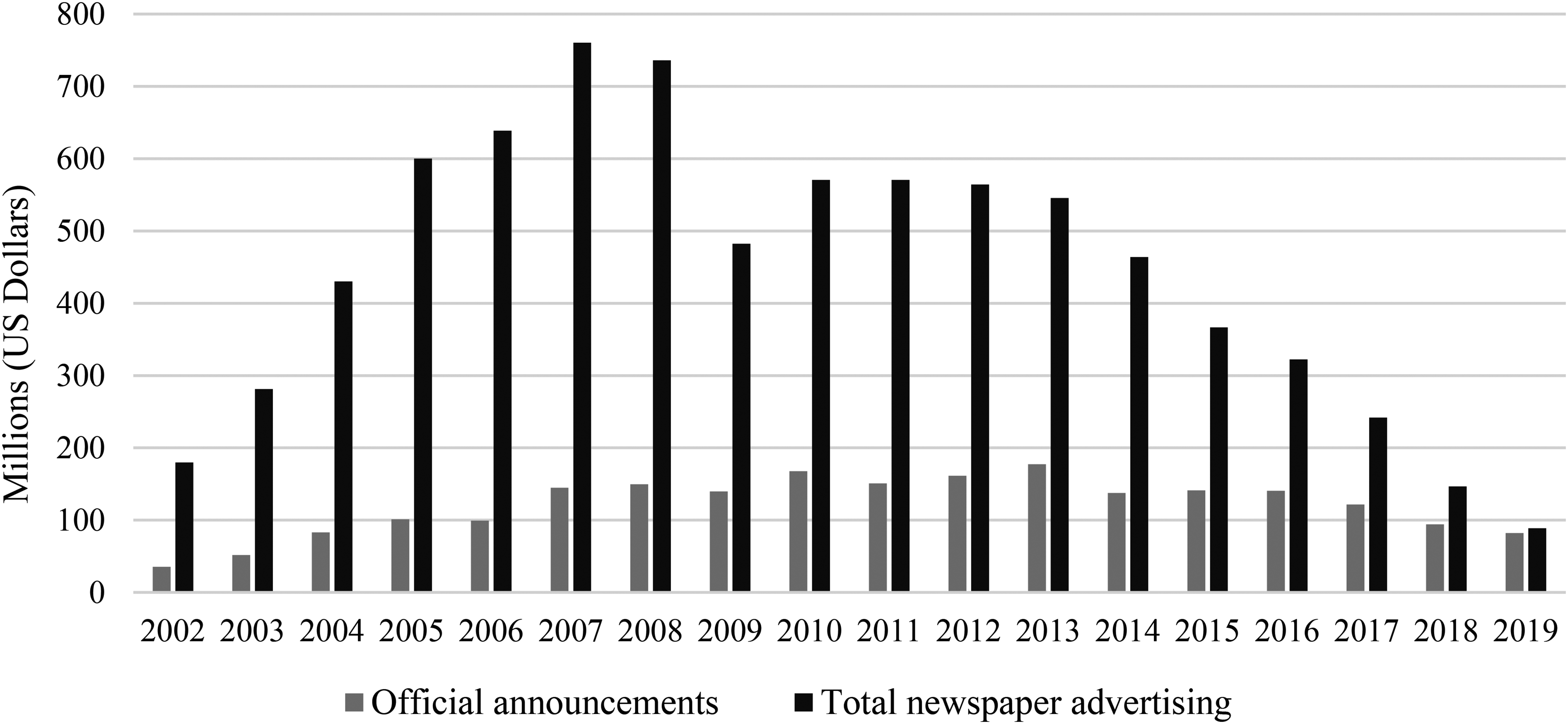
Official announcements and total advertising in newspapers. Source: BİK and Association of Advertisers.
The role of the BİK and how it exercises its authority are crucial for the newspaper industry. The BİK is a state-run agency established (in 1961) to distribute official announcements to the print media. However, its structure, function, legitimacy, and lack of autonomy have been controversial ever since its foundation, as the agency allocates a significant amount of spending through official announcements. The legal structure of the BİK and the selection of its board members show how much it is open to political influence. By law, the General Assembly of the BİK is composed of three groups of members: government, independent, and press. Each group consists of twelve people and elects two members to the Executive Board. The Chair of the Board has to be elected from the government group. The Director General, who is also the seventh member of the Executive Board, is directly appointed by government. This means that the government automatically appoints three Board members. The Board actually includes at least four members appointed by the government, as the law requires that the independents should include representatives of the public broadcaster TRT, the state-run Anadolu News Agency, and university deans (Mevzuat 2020).
The agency is responsible for the distribution of official announcements. More importantly, it has the power to terminate distribution to any newspaper as a sanction at any time by claiming a violation of media ethics. Although the law allows the agency to impose such restrictions and sanctions, this is vulnerable to arbitrary practices due to its government-dependent structure (Kurban and Sözeri 2012: 22; Yanatma 2016).
As to how the agency has exercised its power in the last decade, according to BİK regulations, the main criterion for advertising distribution is circulation. While circulation numbers have changed over time, this regulation classifies newspapers into groups according to their circulation, such as “newspapers with more or less than 50 thousand circulation.” The price of advertising space, in terms of square centimeters, is equal for newspapers in the same group. As figures for both circulation and how much funding each newspaper received in each year are available, the ratio of official announcement revenue to circulation, and thus any political influence or arbitrary practice in distribution, are visible. Investigating how much each newspaper in the same circulation group received for official announcements provides significant insights. Any dramatic changes in coverage, whether in favor of or critical of government, as well as changes in media ownership, are issues to be taken into consideration in this investigation.
Before examining the data, the political affiliation and ideological leaning of newspapers need to be explained. However, categorization is quite challenging due to shifts in ownership or in other social dynamics. As outlined in the section above on the political economy of the Turkish media, ownership of all four media conglomerates has changed over the last two decades. Therefore, we prefer to mention the political stance of each newspaper in each year when they are discussed. Yıldırım et al. (2020: 10) give details of the newspaper groups across the years over this period.
Table 1 shows that different newspapers in the same circulation group receive different amounts of official announcements. To illustrate, in 2010, pro-government newspapers such as Yeni Şafak and Star received more official announcements than their competitors, namely Akşam, Vatan, and Sözcü. However, Akşam's official announcement revenues were very close to those of Yeni Şafak and Star in 2015, a year in which it was completely pro-government after an ownership change in 2013. In the same year, 2015, the critical Sözcü did not receive as much in official announcements as the pro-government Yeni Şafak, Star, and Akşam, although its circulation was three times as high as any of theirs. Not surprising, then, that these three newspapers are all owned by businessmen who are very loyal to President Erdoğan. To illustrate, Ethem Sancak, the owner at that time of Akşam, who had already bought the daily Star in 2007, stated publicly that he had made these media acquisitions in order to support Erdoğan at a time when he had little media support (Hatısaru 2012).
Distribution of Official Announcements by BİK in 2010 and 2015.
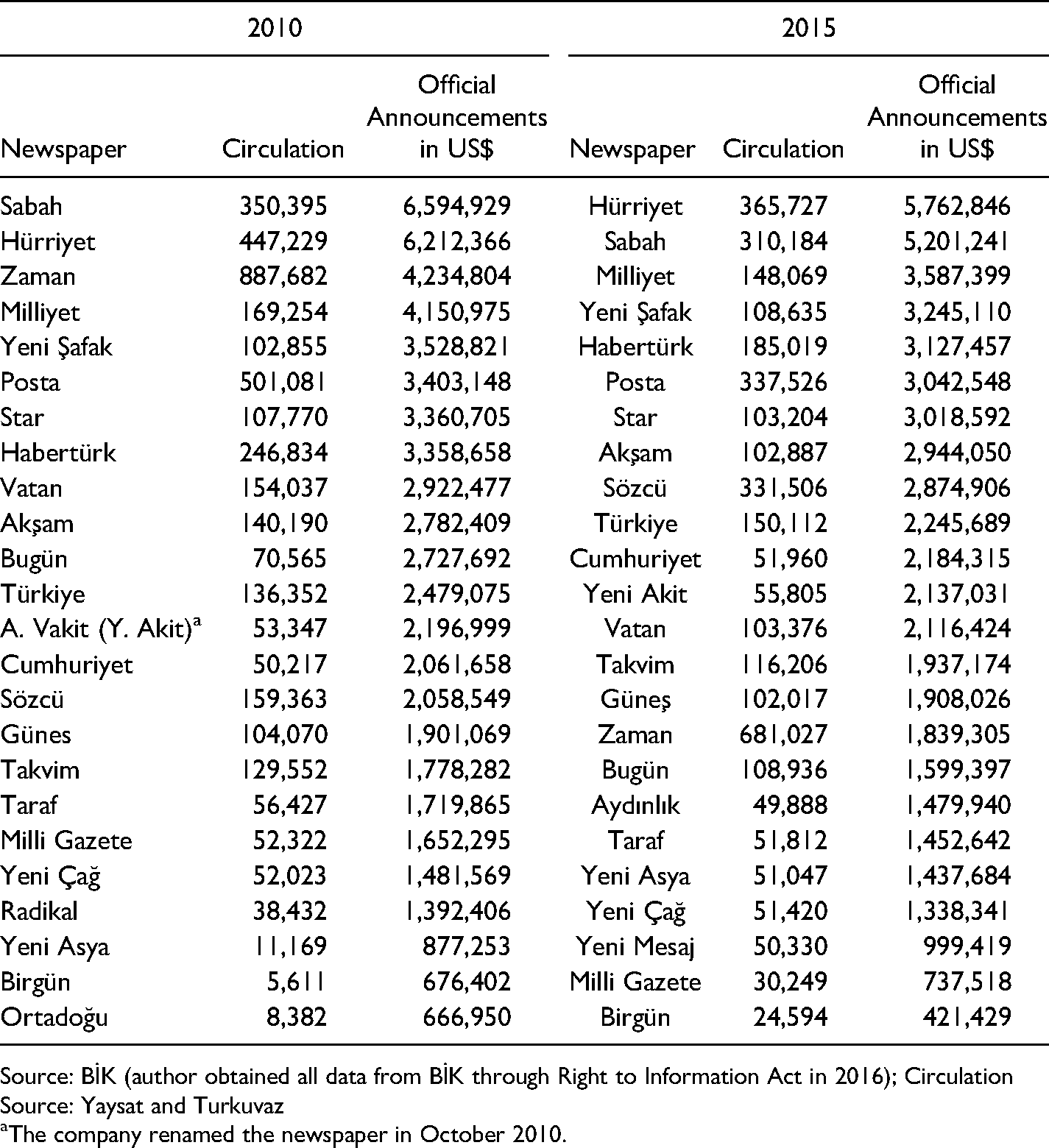
Source: BİK (author obtained all data from BİK through Right to Information Act in 2016); Circulation Source: Yaysat and Turkuvaz
The company renamed the newspaper in October 2010.
These data suggest that the policy of the BİK changed remarkably in 2013, when the Gezi Park protests and a political corruption investigation took place, as we can see dramatic changes in the number of official announcements some newspapers received in each year. Table 1 suggests that circulation did not determine how the agency allocated its spending on official announcements. To illustrate, in 2015, the pro-government Sabah received almost twice as much official announcement revenue as Sözcü, although its circulation was less than that of Sözcü.
The media outlets that are critical of the government, such as Sözcü, Cumhuriyet, Birgün, Evrensel, and Yeni Asya, have criticized the BİK severely in recent years, particularly after the failed coup attempt in 2016, claiming that the agency has not been fair in its allocation and that in practice it has imposed a political ban on public advertising (Open Letter To Bik 2020). A comparison of 2015 and 2017 figures shows that official announcements allocated to these three critical media outlets fell remarkably; Yeni Asya experienced a fall of 69 percent, Evrensel of 54 percent and Cumhuriyet of 36 percent, whereas others benefited from increased allocations, in particular Takvim with an increase of 56 percent and Sabah of 47 percent over these two years (Supplementary Information file-A3). Yeni Asya announced that the BİK has not distributed any official announcements to the paper since January 2020, meaning for more than a year. The daily applied to the court claiming that it is subject to an embargo due to its columnists’ criticism (of the government) (“İlan ambargosuna karşı hukuk mücadelesi başlattık” 2021).
It is also striking that advertising bans on newspapers, based on “press ethics violations,” radically increased in 2020 as compared with 2019 (Open Letter to BİK 2020). Berkant Gültekin, a member of the Editorial Board of Birgün, believes that the BİK has been transformed into an “apparatus of the presidential palace,” inspecting coverage and imposing advertising bans (Gültekin, personal communication, 2020).
The figures showing how the value of official announcements received by each newspaper changed between 2005 and 2017 reflect the impact of politics on distribution. The dramatic ups and downs in official announcements that some newspapers such as Zaman received and the remarkable increase in allocations to most of the pro-government newspapers, in particular Takvim, Akşam, and Yeni Akit, demonstrate this political intervention. This detailed examination suggests that it is not possible to produce a general model or formula to reveal any correlation between circulation and distribution of official announcements in the last two decades. The data implies that distribution is not based on a well-defined system to maximize audience attention and has become more political in the last few years (Supplementary information file-A3 and -A5).
Private Advertising and its Distribution
Private advertising describes all advertising aside from that which the BİK distributes. It encompasses state-owned enterprises including big companies in which the Turkey Wealth Fund (TWF) is a shareholder. The TWF “is the strategic investment arm and the equity solutions provider of the Republic of Turkey” (TWF 2020); its Chair is President Erdoğan who is also chairman of the JDP. Therefore, its advertising distribution is very open to political influence. The distribution of private newspaper advertising can basically be measured in two ways, namely on the basis of spend and by space—the amount that each newspaper receives in square centimeters every year. However, analysis by spend is not possible here because newspapers do not release their revenue, on grounds of commercial confidentiality. A space-based analysis is very helpful since the data show how much advertising each state-owned enterprise distributes to each newspaper.
In parallel with those of the BİK, the figures demonstrate that there is no relation or correlation between the total advertising space allocation that each newspaper receives and its circulation and readership—the estimated number of people who read or are thought to read a particular newspaper. A higher circulation and readership do not deliver more advertising space. The ratio derived from dividing total advertising space by readership and circulation for each newspaper does not explain how companies distribute their advertising. To illustrate, Hürriyet received 30.4 percent of all advertising allocated to the newspapers on this list, while in 2013 its share of readership was only 11.7 percent and circulation 10.9 percent. Notably, the pro-government newspapers Star, Yeni Şafak, and Akşam received more advertising space than the critical Sözcü, although their circulation and readership shares were apparently smaller (Supplementary information file-A4 and -A6; “Arkasındaki güç kim” 2013).
Measuring the Impact of Government on the Advertising Market
To assess the impact of government on private advertising, we can first look at how much advertising spend is allocated to all media by state-owned enterprises listed on the stock exchange, as their balance sheets are public. Thus, we can determine their share of total media and advertising expenditure in order to see how much the government can directly control this market by its spending. Then we can discuss how these partially state-owned enterprises distribute their advertising on a space basis, as the data allow this to be tracked. While the share of the state (Republic of Turkey) in these enterprises varies, the government has control over appointing their boards of directors.
TWF, whose Chair is President Erdoğan, is a shareholder in more than twenty companies in different sectors including financial services, energy, transport, mining, telecoms, food, and real estate. The balance sheets of eight of these companies and their advertising expenditure are available from the Public Disclosure Platform. Their expenditure was as follows in 2019: Ziraat Bankası (₺200.3 million), Halkbank (₺214.6 million), Vakıfbank (₺163.2 million), Turkish Airlines (₺994 million), Türk Telekom (₺368 million), Turkcell (₺554.5 million), Borsa Istanbul (₺9.8 million), and Çaykur (₺36.4 million). 4 In 2019, their total media and advertising expenditure corresponded to 23 percent (₺2.54 billion or US$448.1 million) of total media and advertising expenditure (₺11.05 billion or US$1.95 billion) in Turkey. In addition, their advertising expenditure has risen remarkably in the last two decades as their balance sheets show. The above figures suggest that the government has direct control over at least a quarter of private advertising distribution when other firms in TWF are included. This ratio reveals how the Turkish state has emerged as the largest advertiser in private advertising in recent years.
Advertising by State-Owned Enterprises
How state-owned enterprises allocate their advertising to each newspaper can be tracked on a space basis, although it is not possible to do this by spend. This examination allows us to see any bias in allocation toward specific newspapers. Our data show, on a space basis, the total advertising distribution of Türk Telekom, Avea, TTNet, Turkcell, Digitürk, Turkish Airlines, Vakifbank, Ziraat Bankasi, Halkbank, the Prime Ministry Housing Estate Administration (TOKİ), and the Emlak Konut Real Estate Investment Partnership (Emlak Konut GYO) to each newspaper in each year between 2011 and 2015.
The data show that pro-government dailies receive the highest space allocation by far, whereas critical newspapers receive a very limited share. This reveals that neither circulation nor readership has an impact on the distribution of advertising. The four best-selling newspapers, Zaman, Posta, Hürriyet, and Sözcü, which also held the four top readership positions in 2013, were not among the top four recipients of advertising space purchased by state-owned enterprises. More importantly, these figures clearly conflict with the distribution of all advertising space to each newspaper during this period (Supplementary information file-A6; “Arkasındaki güç kim” 2013).
As Figure 2 shows, the pro-government Star received 13.2 percent of state-owned enterprises’ advertising space, while its share of total advertising space was only 4.2 percent. It is striking that Hürriyet only obtained 6.1 percent of this public advertising, whereas its share of all advertising, by space, was 27.8 percent. Figure 2 suggests that the preferences of state-owned enterprises are not aligned with the advertising sector as a whole or with other significant advertisers.
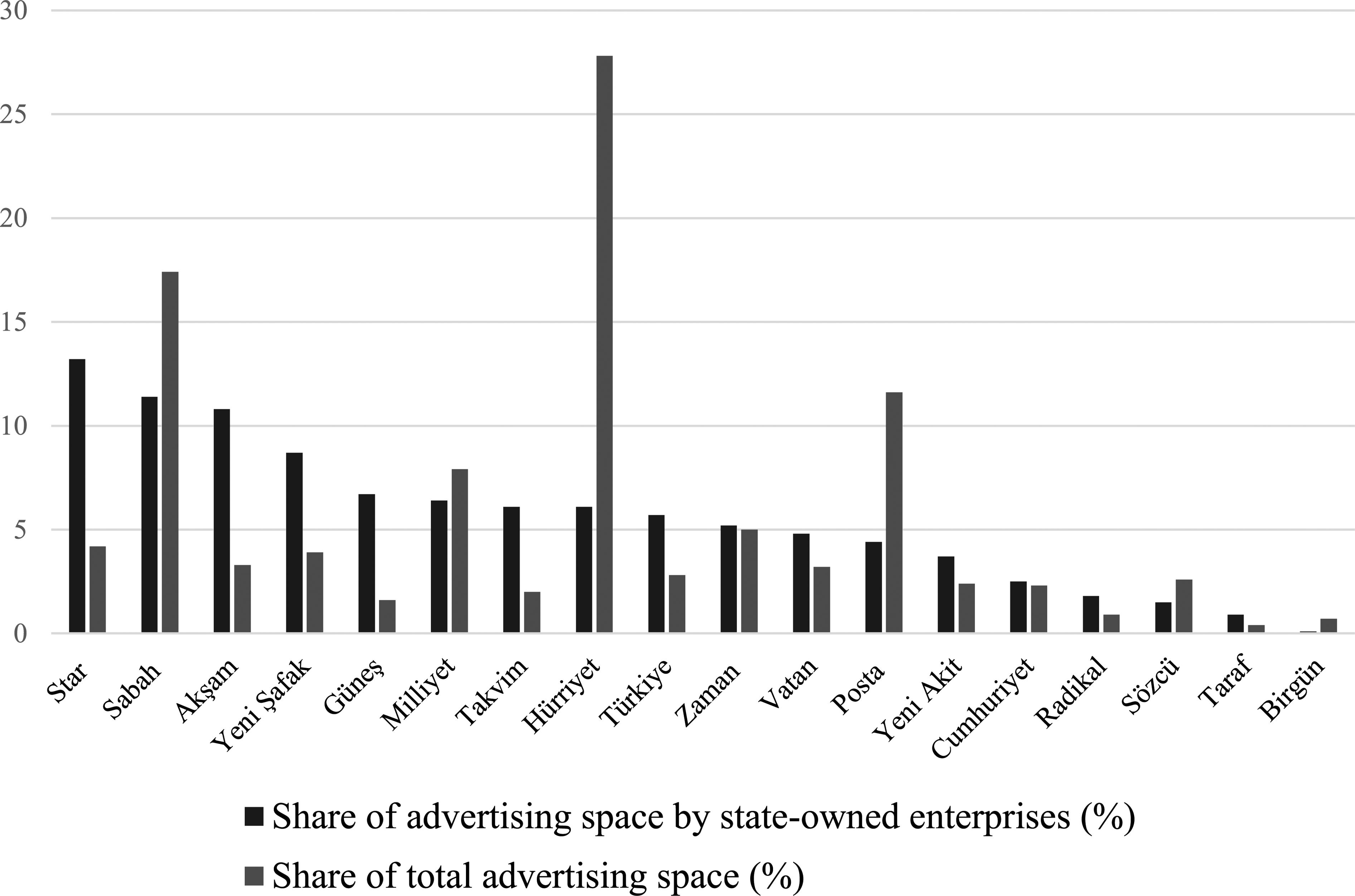
Share of total and state-owned enterprises’ advertising by space for each newspaper, 2011–2015 (%). Source: The Nielsen Company.
Furthermore, the dramatic rises and falls each year in the distribution of state-owned enterprises’ advertising to particular newspapers are very remarkable, as seen in Figure 3. The amount of advertising allocated to pro-government newspapers, such as Güneş and Yeni Akit, increased substantially over these four years. Meanwhile, the amount of advertising distributed to newspapers such as Cumhuriyet, Sözcü, and Zaman fell significantly after 2013. While Cumhuriyet and Sözcü were critical of the government, Zaman explicitly ended its years of strong support for the JDP late in 2013, and started to criticize the party harshly. The government had helped Zaman to receive ads from state-run banks before this dramatic shift in its coverage (Yanatma 2016: 38–9). The advertising share of Zaman and Sözcü fell almost to zero in 2015. The allocation to the mainstream Hürriyet, which belonged at that time to the Doğan Group, also declined, but not as sharply as allocations to the critical dailies.
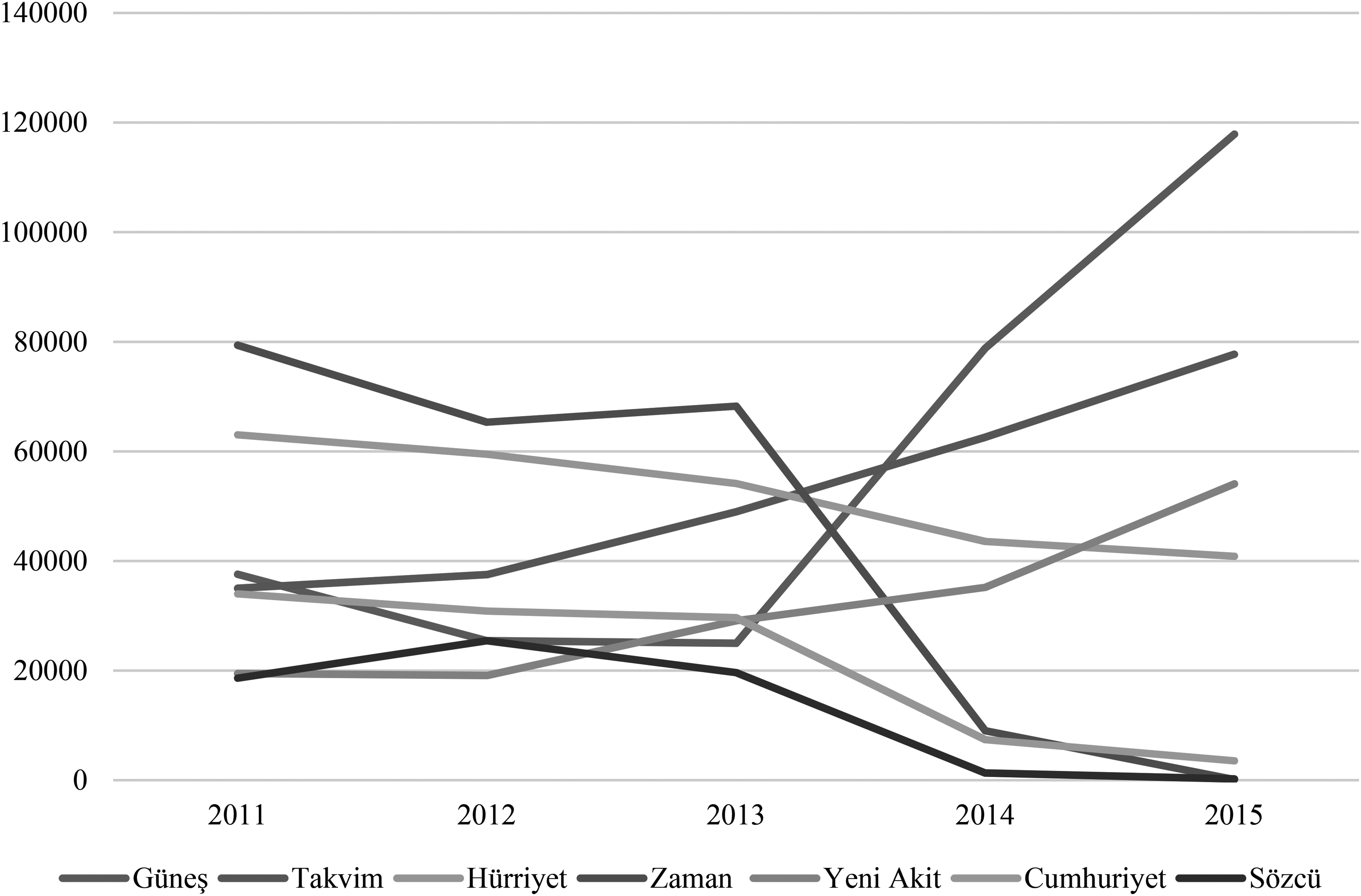
Distribution of advertising space allocation by main state-owned enterprises. (Space: square centimeters/Source: The Nielsen Company.)
Figure 3 also reflects how a change in media ownership has had a direct impact on the advertising distribution as a result of a shift in news coverage in favor of, or against, the government. Since TMSF took control of Güneş and sold it to Ethem Sancak in 2013, the daily has become part of the pro-government media. Its advertising share from state-owned enterprises then rose extraordinarily.
All these figures suggest that state-owned enterprises are heavily under the influence of the government. Figure 3 and the Supplementary data show that these state-owned enterprises evidently use their advertising to reward or punish newspapers depending on their news coverage. Unsurprisingly, the seven newspapers receiving the highest amount of advertising from state-owned enterprises are pro-government. In fact, six of these, as of 2015 all except Milliyet, have been widely described in recent years as “mouthpieces of government” (Yesil 2016: 116).
The critical newspapers Sözcü, Cumhuriyet, Zaman, Bugün, and Birgün received no advertising in the first half of 2016 (Özpek and Yavcan 2016b). Our research on the critical titles Sözcü and Cumhuriyet revealed that state-owned enterprises continued their apparent advertising boycott of these two newspapers after 2016. We could not see any advertising by Halbank, Turkish Airlines, or Türk Telekom in these outlets in this period. Sözcü also reported that state-owned enterprises gave advertising solely to pro-government newspapers (Ertürk 2019).
Besides these state-owned enterprises, there are other entities on which the government has a direct impact, such as municipalities, ministries, and other governmental agencies. In particular, the municipalities of Istanbul and Ankara, which the JDP controlled until 2019, have large budgets and usually buy advertising. The Istanbul Metropolitan Municipality has provided strong support to the pro-government media, not only placing ads but also providing sponsorship (Ağırel 2020). With its huge budget, thanks to financial aid from the state, the JDP itself has been a significant advertiser.
The Impact of Government on Private Companies
It has not been possible to measure the impact of government on the distribution of private companies’ advertising in the same way as we have for state-owned enterprises, given that the data-gathering company does not share this. However, we can detect whether or not the largest private advertisers have placed ads in the critical Sözcü and Cumhuriyet by examining their pages from between 2016 and 2019. We found that some of the largest advertisers, such as BİM Market, A101 Market, Casper Bilgisayar, and İstikbal Mobilya, avoided giving advertising to these two newspapers in this period.
Ayşe Sözeri Cemal, who was the Executive Board member responsible for advertising at Cumhuriyet during these years, disclosed that advertisers had asked her to “bury” their advertisements, meaning not to put the ads in a visible position (bidebunu izle 2018). She stated that they wanted to support Cumhuriyet by placing ads, but preferred not to draw the attention of the government. The leading columnists, editors, and executives of Sözcü, Cumhuriyet, Yeni Asya, and Birgün were at that time on trial, and some of them were sentenced to prison following conviction on charges of “willfully assisting a terrorist organization” (Hacaloğlu and Çolak 2019). These verdicts have apparently had a strong deterrent effect on some private advertisers, which have reduced or stopped their distribution of space to these newspapers (Kazım Güleçyüz, editor-in-chief of Yeni Asya, personal communication, 2020).
Pressure on private advertisers greatly affected their distribution preferences, especially after 2013, and this increasingly became intimidation. Leading veteran journalist Cemal underlined that the government prevented them from distributing advertising to newspapers, online media platforms, and television channels that had the capacity to criticize President Erdoğan: “This has become so influential. The government gave a direct message to the businesses signalling: ‘You definitely pay homage to me or you do not have any chance to survive’” (Hasan Cemal, personal communication, 2015).
High Concentration and Capture of Advertisers
We find, when we examine their largest twenty-five advertisers, based on space, between 2003 and 2015, that newspapers are highly dependent on a couple of dozen advertisers. The total advertising space that each of the top twenty-five advertisers placed in each newspaper, demonstrating the very high concentration of advertisers. When BİK distribution and classified ads are also added to these top twenty-five advertisers, we see that most newspapers are dependent on these twenty-seven entities for more than 50 percent of space taken (Supplementary information file-A7).
Esen and Gumuscu (2018: 363) point out that “direct resistance to the government is costly for the entrepreneurial class,” and this also goes for advertising distribution. The biggest advertisers are the largest business actors, such as Koç Holdings, Sabancı Holdings, and Doğuş Holdings, which are all careful not to challenge government practices, including in their advertising distribution. The government has already made clear the result of any taking of a public stand against it by eliminating certain business groups (Esen and Gumuscu 2018). Thus, the high concentration of advertisers has facilitated control of advertising allocation, gradually resulting in capture of advertisers.
Top Editors Expose Pressure on Advertisers
In addition to our quantitative data, several interviews with former editors-in-chief and declarations from newspapers revealed the pressure on advertisers and the strong role of government in advertising distribution. The common point in their arguments was that the distribution of advertising by state-owned enterprises is widely used to sponsor pro-government newspapers. More significantly, they stated that private companies are subject to heavy political pressure, including threats, not to allocate advertising to newspapers that are critical of government.
The daily Karar in 2018 published a statement that the newspaper had been “faced with an uninterrupted [advertising] embargo since the day they started printing” in March 2016:
Not only public institutions, which are in advertiser positions, but also private companies are obviously blocked from placing ads in our newspaper. Advertisers and agencies distributing advertisements have been warned not to place ads in Karar (“Kamuoyuna ve okurlarımıza zaruri bir açıklama” 2018).
Similarly, the editor-in-chief of Diriliş Postası, Hakan Albayrak, stated in his column that the newspaper was banned from receiving advertising. Albayrak, who was apparently supportive of Erdoğan as of 2015, wrote: “We have been badly blacklisted by some segments of our community [the ruling party] because we occasionally criticize [Erdoğan and the government]. For instance an advertising blacklist” (Albayrak 2015).
The former editor-in-chief of Hürriyet, Enis Berberoğlu, stated that the newspaper had come under the sanction of state-run banks due to its coverage of a corruption investigation in 2013. Berberoğlu said: “The head of the [state-run] Halkbank, Süleyman Aslan, imposed an advertising embargo on us in every sense of the word. He described this [embargo] to our advertising staff” (personal communication, 2015). He also stated that Turkcell, “which was one of the biggest advertisers, did not want to work with them recently, and it kept away due to their news coverage” (Berberoğlu, personal communication, 2015).
Furthermore, Fatih Altaylı, former editor-in-chief of Habertürk, drew attention to the increasing role of media planning and advertising agencies launched by people close to the government. These work as intermediaries between private companies and media outlets for the distribution of advertising. Altaylı stated that the most significant group of advertisers with the highest advertising budgets in Turkey hire these agencies for their marketing affairs as a result of intervention by government and the Ministry of the Treasury. He said:
The mainstream media, or the media that the government is not happy with, lose their advertising coming from not just state-owned enterprises but also private companies due to these media planning agencies. The big companies allocate most of their marketing business to these pro-government agencies, which largely distribute the advertising to the pro-government media outlets. Advertisers keep away from media outlets that the government targets like Hürriyet, Habertürk and Zaman. (Altaylı, personal communication, 2015)
Statements by Erdoğan, who was then Prime Minister, during the Gezi Parkı protests in 2013 reveal the significant role of media planning agencies. Erdoğan stated on TV that media agencies did not distribute advertising to some newspapers and television stations for ideological reasons, and revealed his own intervention in this: “I told my friends (advisers and his team): Detect these [advertising and planning] agencies. Which agencies impose embargos on the advertisers? We are going to do what is necessary.” Erdoğan stated that he talked to some of the advertisers (Göksel 2013).
As to the impact of all these pressures, including advertising, on the newspapers, and not least on their content, the publishers mostly preferred to replace their editors-in-chief in order to signal that their coverage would be comparatively more docile. This encouraged the government to put more pressure on the publishers, who then employed journalists and columnists overtly supportive of the ruling party. All these factors have had a remarkable impact on coverage over time (Babahan, personal communication, 2015), as Yıldırım et al. (2020) also indicate. As of 2020, nine of the ten newspapers with the largest circulation had obviously pro-government coverage both in print and online, and some of these operate as mouthpieces of the ruling party.
Conclusion
This article argues that the Turkish government has a direct impact on official announcements because of the BİK's structure, which makes the agency very open to political influence. The BİK has been criticized several times for its biased policy of granting relatively more official announcements to pro-government dailies, whereas critical newspapers receive fewer. This is supported by data, which also shows that the agency has been using its authority extensively on behalf of the government since 2013. Its practices have become more coercive, with increasing official bans on the placing of announcements in critical newspapers since the JDP lost the elections in Istanbul and Ankara in 2019 after twenty-five years of ruling those municipalities.
By using the data on distribution of advertising space, this research has also uncovered how state-owned enterprises’ advertising budgets have been used either to reward pro-government newspapers or to punish critical dailies. As newspapers have increasingly become pro-government through changes in ownership, most recently through the sale in 2018 of the Doğan Group's media arm to the Demirören Group, a pro-government conglomerate, this policy has clearly become one of financing the captured media through increasing their advertising revenue. The allocation of state-owned enterprises’ advertising has notably played a key support role for political Islamist newspapers that are widely seen as operating as mouthpieces of government. The data suggest that newspapers’ coverage of the government is a definite criterion in advertising allocation by the BİK and by state-owned enterprises, while circulation or readership plays no discernible role. Besides all these data, our interviewees confirmed the government's direct involvement in advertising distribution. Their statements are in line with the data and clearly explain how the system works.
This article also shows that the Turkish state has emerged as the largest advertiser, along with the state-owned enterprises which are under the control of the TWF. Together with these and with municipalities, the government rules over at least a quarter of private advertising distribution. Indeed, the impact of government is more than this figure because its influence over commercial advertisers is also notable. The research has found that concentration of newspaper advertising can be viewed as an element of media capture. This concentration on leading advertisers plays a significant role in politically motivated distribution, as some of these business people are very loyal to the government, while others clearly prefer to avoid any tension with the authorities in order to keep their businesses safe. It also reflects how a government can pressure commercial advertisers, preventing them from allocating advertising to dissident media by demonizing these media outlets through charges of aiding terrorist organizations. The article also argues that where a government finds that exerting control over media ownership fails to provide a sustainable route to securing docile news media, it may be tempted by a different approach; under this the state becomes the largest advertiser, using its control over official announcements and advertising by state-owned enterprises as the major way of funding, and indeed capturing and controlling, the media.
One of the findings of this research is that 2013 marked a turning point in advertising distribution. In that year, the Gezi Park protest and a massive corruption investigation, which resulted in the resignations of four ministers, made the JDP reckless with respect to the rule of law. Yesil (2018: 240) suggests that in response to the failed coup in 2016 JDP rule has become more coercive in terms of dealing with the media. This article further suggests that mechanisms including advertising notably became more and more coercive after the JDP lost control of significant municipalities in the local elections of 2019. While the BİK increased advertising bans in 2020, the government introduced regulations to control social media platforms. All these practices signal a new phase in its determination to stay in power.
Supplemental Material
sj-docx-1-hij-10.1177_19401612211018610 - Supplemental material for Advertising and Media Capture in Turkey: How Does the State Emerge as the Largest Advertiser with the Rise of Competitive Authoritarianism?
Supplemental material, sj-docx-1-hij-10.1177_19401612211018610 for Advertising and Media Capture in Turkey: How Does the State Emerge as the Largest Advertiser with the Rise of Competitive Authoritarianism? by Servet Yanatma in The International Journal of Press/Politics
Footnotes
Acknowledgments
The author gratefully acknowledges the helpful comments and suggestions of three anonymous reviewers and the Guest Editors of the Special Issue, Jonathan Hill and Fatima el Issawi. He is also grateful to Chris Westcott, Bilge Yesil, and David Levy for their valuable critiques and comments, and to the Nielsen Company for providing the very useful data in 2016.
Declaration of Conflicting Interests
The author declared no potential conflicts of interest with respect to the research, authorship, and/or publication of this article.
Funding
The author received no financial support for the research, authorship, and/or publication of this article.

Supplemental Material
Supplemental material for this article is available online.
Notes
Author Biography
References
Supplementary Material
Please find the following supplemental material available below.
For Open Access articles published under a Creative Commons License, all supplemental material carries the same license as the article it is associated with.
For non-Open Access articles published, all supplemental material carries a non-exclusive license, and permission requests for re-use of supplemental material or any part of supplemental material shall be sent directly to the copyright owner as specified in the copyright notice associated with the article.
