



Abstract
Mounting concern surrounds the influence of political actors on journalism, especially as media outlets face increasing financial pressures. These circumstances can give rise to instances of media capture, a mutually corrupting relationship between political actors and media organizations. However, empirical evidence substantiating such mechanisms and their consequences remains limited, particularly in the context of Western democracies. This chapter investigates a recent case in which a former Austrian chancellor allegedly colluded with a tabloid newspaper to receive better news coverage in exchange for increased ad placements by government institutions. We employ automated content analysis to investigate political news articles from seventeen prominent Austrian news outlets spanning 2012–2021 (n = 222,659). Adopting a difference-in-differences approach, we find a substantial increase in media visibility of the former Austrian chancellor within the news outlet that is alleged to have received bribes, as well as a decrease in favorability for challenger candidates. Although this study does not aim to prove or disprove the involvement of specific political actors or media organizations in unethical or illegal activities, it introduces an innovative method for detecting unusual patterns in media reporting. Findings are discussed in the context of current threats to media independence and underscore the crucial need to protect journalistic integrity and ensure unbiased information for the public.
Keywords
Introduction
Independent media are a cornerstone of a free and open society (McQuail 2013), and journalism provides citizens with the information they need to make informed decisions, holds those in power accountable, and acts as a check on government abuse (Delli Carpini and Keeter 1996). In recent years, there has been growing concern regarding the efforts of political and state actors attempting to capture the media, potentially resulting in adverse consequences such as distorting public opinion, suppressing dissent, and undermining investigative journalism (Bajomi-Lazar 2015; Bátorfy and Urbán 2020; Faris, Maeseele, and Smets 2021; Maniou 2022; Özkeçeci 2019; Schiffrin 2018).
A case in point shook Austrian politics in the autumn of 2021 when the country was hit by a political scandal that resulted in multiple corruption charges filed against then-chancellor Sebastian Kurz and his close associates within the Austrian People’s Party (ÖVP). In what was coined as the “Inseratenaffäre,” they were accused, among others, of trying to skew public opinion by making a deal with a tabloid newspaper (Österreich/OE24) to publish manipulated polling data in 2016 and arranging for it to be reported on favorably in return for generous purchases of advertising space by government institutions. The alleged aim of this quid pro quo was not only to induce favorable media bias but also to influence public opinion in favor of Kurz’s rise to power (Karnitschnig 2021a, 2021b, 2021c).
In the academic literature, there are many well-documented cases of media bias and its potential consequences on political behavior, that is, Fox News’ favoritism of Republican candidates during several Presidential and Senate races (DellaVigna and Kaplan 2007) or The Sun’s endorsement of Brexit (Foos and Bischof 2022). Usually, such media biases that result in disproportionate or systematically more favorable coverage (i.e., visibility bias or tonality bias, respectively) for specific candidates, parties, or issues (see Eberl et al. 2017a) are often attributed to historic organizational ties between media outlets and political parties (i.e., party-press parallelism; see Seymour-Üre 1974) or to the broader political leanings of the media (Hallin and Mancini 2004). However, media outlets in a digital media landscape increasingly struggle to earn revenue, which in turn makes them more vulnerable to political and financial pressures (Hanitzsch et al. 2019; Martin and Souder 2009; Olsen et al. 2021).
In certain media markets, political actors, including governmental bodies, can be the instigators of political advertiser pressure, creating fertile ground for political interference in media independence and instances of political or government media capture. Media capture, here, refers to a situation where outside actors actively influence the media to ensure favorable coverage (i.e., both political and economic actors can engage in media capture). They achieve this by rewarding or punishing news organizations or individual journalists. This manipulation can take various forms, such as withholding interviews from certain outlets, imposing highly specific media regulations, or engaging in implicit and explicit blackmail or bribery (Besley and Prat 2006; Prat 2015). Measuring the impact of media capture is challenging because these manipulative mechanisms often evade empirical measurement.
To address this gap, we leverage the unique insights into the alleged mechanisms of corruption and threats to media independence, as unveiled through leaked messages between high-ranking politicians and officials that were made public during the investigation of the Austrian “Inseratenaffäre.” Our study adds to the scholarly discourse on media capture, exploring the symbiotic relationship between political actors with a willingness to use government advertisements as bribes and media organizations that are open to putting their journalism up for sale. Employing automated content analysis, we examine political news articles from seventeen Austrian print and online news outlets (n = 222,659) spanning the years 2012–2021. Using a difference-in-differences approach, our research examines news coverage in terms of both actor visibility and actor favorability. Our aim is to detect patterns that would align with the alleged serious breach of professional political and journalistic norms that are at the center of the “Inseratenaffäre.”
Based on our difference-in-differences strategy, we observe a substantial increase in the visibility of the former Austrian chancellor within a news outlet allegedly receiving bribes. In contrast, several political competitors did not experience similar shifts in visibility. While our findings regarding the sentiment in news coverage are less pronounced, the significance of our findings for understanding contemporary threats to media independence is discussed.
Media Capture
In an ideal world, the government and the media act independently so that the latter can serve as a watchdog, ensuring government accountability (Besley and Prat 2006). Media freedom indicators, however, see this ideal of independence increasingly violated even in established democracies (e.g., Freedom House 2019; Reporters without Border 2024). There is growing evidence that political actors engage in media capture, using a variety of legal, economic, and physical tactics to influence editorial decisions and media bias. Regardless of the tactic, when the goal is to manipulate media content in terms of, for example, the visibility of or tone toward specific candidates, parties, or issues to serve political interests, such actions are normatively questionable and constitute an infringement on media freedom—in some instances, they might even be illegal (e.g., Bahrnehl and Schumacher 2024; Besley and Prat 2006; Enikolopov and Petrova 2015). The literature on media bias effects further suggests that such distortions in media content can result in agenda-setting and framing effects that influence audiences’ perceptions of candidates, party preferences, and even vote choice (e.g., Eberl et al. 2017a, 2017b).
In the nineteenth century, the commercialization of news held the potential to replace traditional systems of party-press parallelism, in which many newspapers were owned by or had close and stable ties to political parties (Baldasty 1992; Hallin and Mancini 2004). Advertising resources emerged as a potential driver to reduce political biases in news coverage (Gabszewicz, Laussel, and Sonnac 2002) and a means to safeguard free and autonomous media, particularly in terms of reducing their susceptibility to political pressures (Petrova 2011; Shoemaker and Reese 2014). However, the reliance on advertising revenue has also engendered novel forms of interdependence, characterized by financial entanglements between news organizations and political or economic elites, each pursuing their distinct commercial and/or political interests.
Frequently debated in the context of Central and Eastern European (CEE) countries, but not limited to these, this phenomenon has given rise to what is commonly referred to as “captured media outlets,” more or less willingly prioritizing the interests of their advertisers over objectively informing the public and holding those in power accountable (Bajomi-Lazar 2015; Enikolopov and Petrova 2015; Mungiu-Pippidi 2012). Instances of media capture, or attempts to do so, have also been observed in countries such as Argentina, Australia, and Spain. In these cases, governments have instrumentalized state or government advertising and undermined the independence of media regulators to exert influence over the media (Di Tella and Franceschelli 2011; Fernández Alonso 2023; Young 2006).
Advertisement Placements: Pressure and Bribe
In and of itself, there is nothing inherently reprehensible about political advertisements. In most countries, a legal framework exists that will allow individual parties, candidates, or government institutions to buy advertising space in media outlets to convey their political or informational messages directly and unfiltered to citizens and potential voters. However, in the context of media capture, government advertising, in particular, has been described as a tool to exert influence over media outlets and (co-)shape media content discreetly, potentially without raising direct suspicion of impropriety or bribery (Besley and Prat 2006; Kossdorff and Sickinger 1996; Sickinger 2009).
Surveys conducted among journalists indicate that they experience pressure to favor prominent advertisers in their news coverage, acknowledging occasional approaches from their editors, their newspaper’s marketing department, or even the advertisers directly (e.g., Hanitzsch et al. 2010, 2019). Still, newspapers and journalists deem this influence on their actual reporting to be limited—even more so when it comes to political reporting (e.g., DeLorme and Fedler 2005; Lacher and Rotfeld 1994; Obermaier, Koch, and Riesmeyer 2018; Reich 2010; Reimann and Schopf 2012). The extent to which editorial integrity may be compromised to please advertisers is arguably influenced by two key factors: adherence to journalistic norms, including the separation of editorial and commercial departments, and the financial pressure advertisers can exert on an outlet, which depends on the size of the advertising market and the outlet’s reliance on advertising revenue (Gehlbach and Sonin 2014; Martin and Souder 2009; Nyilasy and Reid 2011).
Nevertheless, there is a vast amount of empirical evidence when it comes to instances of media capture by commercial advertisers that suggest that some news outlets effectively reward advertisers by producing more and more positively biased coverage of their product and/or increased negative coverage of direct competitors (e.g., Beattie et al. 2021; Blasco et al. 2016; Gambaro and Puglisi 2015; Rinallo and Basuroy 2009; although, see Poitras and Sutter 2009; Rouner et al. 2009). These influences are particularly evident in newspapers that are distributed free of charge, commercial news outlets, and tabloids that heavily rely on advertising revenue (e.g., Beattie 2020; Kolb and Woelke 2010; Lagetar and Mühlbauer 2012; Porlezza 2017).
Limited research delves into the relationship between political advertising and actual news content. One notable study conducted by Di Tella and Franceschelli (2011) focused on Argentinian newspapers and revealed a negative correlation between the extent of coverage dedicated to government corruption scandals in these newspapers and the government’s advertising expenditures in the same outlets during the period from 1998 to 2007. Evidence from Hungary suggests that government advertisements were not only used to transform the media market in the aggregate (see Bátorfy and Urbán 2020) but also directly influenced how much “captured news outlets” would cover government corruption scandals (Szeidl and Szucs 2021). An analysis of political advertisements and news outlets in Mexico found that advertisements are associated with increased visibility and a more favorable tone for the advertising political actors (Macias 2013). Young (2006) investigated the 2004 Australian elections and found that media organizations were less likely to report criticism of government advertising if they received substantial income through such advertisements. In Austria, where political newspaper advertisements are particularly common, studies suggest that the relationship between political advertisements and beneficial news coverage (i.e., in terms of biased visibility and tone) may be again particularly driven by tabloid media that are more dependent on advertising revenue (Eberl et al. 2018; Lengauer and Hayek 2012).
The Austrian Case: “Inseratenaffäre”
Austria’s media system is often classified into the democratic-corporatist model. However, it has also been associated with elements of the polarized pluralist model, particularly concerning low media ethics standards (Brüggemann et al. 2014; Hallin and Mancini 2004; Karmasin et al. 2017). Notably, Austria shows a pronounced inclination toward political influence in newsroom editorial processes and a significant degree of closeness between political figures and journalists (Plasser and Lengauer 2012). These factors, coupled with relatively weak mechanisms for media accountability, especially within tabloid newspapers, which hold a substantial market share (Karmasin & Bichler 2011; Karmasin et al., 2017), highlight potential gateways for mechanisms of media capture.
In Austria, the media market benefits from various forms of public funding, including a well-established system of state newspaper subsidies. While subsidies were historically introduced in 1975, the current legal framework is based on the Press Subsidy Act of 2004, overseen by the Austrian Communications Authority (KommAustria). Notably, free or hybrid dailies, such as the tabloid at the heart of the advertising scandal, are excluded from these subsidies. However, these formal subsidies represent only a small portion of the overall public expenditures in the media market. Between 2012 and 2021, ad expenditures by government institutions or state-affiliated companies in the media market were between three and seven times higher than formal subsidies. Government advertisements alone reached an average of seventeen million Euros per year (Figure 1).
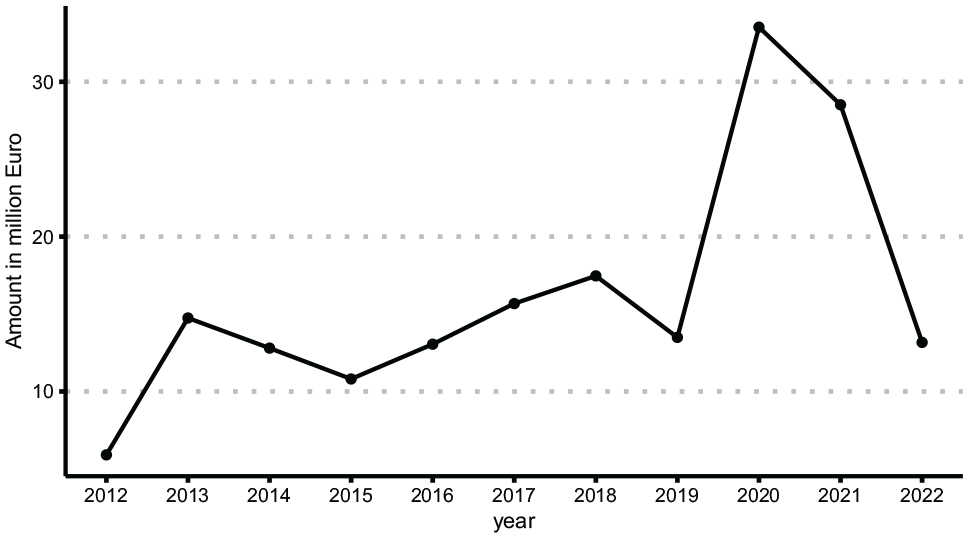
Annual spending of Austrian federal government bodies on newspaper advertisements (print & online).
The ubiquitousness of state spending on newspaper advertisements has long been cause for a more general concern. While the 2012 Media Transparency Law requires government and public bodies to disclose their advertising expenditures with media outlets, it does not establish any rules for the fair distribution of government advertising among different media outlets, nor does it set any upper limits on these expenditures. Additionally, it has been criticized for having too many loopholes and there is, for example, no clear purpose-binding requirement when it comes to placing ads (Seethaler and Beaufort 2019). 1 There are no regulations concerning party advertisements in media outlets, and there is little to no transparency when it comes to placements and costs. Therefore, the alleged misuse of party and government advertisements, primarily aimed at influencing media bias rather than informing citizens, has consistently drawn public and scholarly attention in Austria (Eberl et al. 2018; Kossdorff and Sickinger 1996; Lengauer and Hayek 2012; Sickinger 2009).
Starting in 2016, the alleged political advertisement scandal known as the “Inseratenaffäre” most notably involved former Austrian chancellor and party leader of the Austrian People’s Party (ÖVP), Sebastian Kurz, renowned for his “message control”—a highly strategic and deliberate management of the information and narratives presented to the public and the media (Eberl et al. 2020; Wodak 2022). The spotlight extends further to encompass the third-largest Austrian tabloid, OE24 (also known as Österreich), a relatively young hybrid newspaper (i.e., founded in 2006) that has both a subscription version as well as a free edition and is heavily reliant on newspaper advertisements as their main source of revenue (Kaltenbrunner 2021).
In 2016, Sebastian Kurz was minister for foreign affairs in a coalition government between the ÖVP and the Social Democratic Party (SPÖ). Notably, the ÖVP encountered a decline in public approval that had commenced as early as 2015, precipitating a mounting strain on its party leader, Reinhold Mitterlehner. This internal pressure paved the way for Kurz’s ascent to power within the party and for his eventual assumption of the Austrian Chancellorship after the 2017 election (Eberl et al. 2017; Plescia et al. 2020).
Years later, in the spring of 2021, the Economic and Corruption Prosecutor’s Office (Wirtschafts- und Korruptionsstaatsanwaltschaft, referred to hereinafter as WKStA) obtained leaked chat conversations from the mobile device of Thomas Schmid, a close associate of Kurz within the ÖVP and the chief of staff at the Federal Ministry of Finance. The leaked content comprised an extensive collection of over 300,000 text messages, of which only a small number were publicly disclosed. When the leak became publicly known, the WKStA launched several investigations. The WKStA first publicly raised allegations against Sebastian Kurz on October 6, 2021, and accused him of bribery, corruption, and embezzlement. 2 On that day, the WKStA filed an official report 3 in which it substantiated its suspicions with evidence reaching back to 2016 as well as statements by Thomas Schmid, who became a prime witness in the case. A significant portion of the report documented text messages, in which they more or less openly discussed the intention of media capture (Karnitschnig 2021a, 2021b, 2021c; Jones 2023). 4
According to the WKStA report, Kurz and his associates purportedly conspired to seize party leadership prior to the 2017 national elections. Allegedly, they misused government funds to finance doctored opinion polls that would portray Kurz favorably and facilitate his rise to power, both within the party as well as within the government. Additionally, Kurz faces allegations of coordinating with OE24 to ensure the publication of the aforementioned manipulated opinion polls alongside more positive coverage, reciprocated by the ÖVP-controlled Ministry of Finance’s purchase of advertising space in the newspaper, totaling over €1,116,000. The WKStA report indicates that this alleged arrangement commenced as early as 2016 and persisted until at least 2019. The allegations made in the report were later confirmed by confessions of witnesses, most notably the CEO of the research institution who had conducted and manipulated the polls (Graber and Schmid 2022).
Given the detailed information regarding the suggested chronology and terms of the alleged dealings between Kurz, his associates, and the media outlet OE24, this specific case presents a unique opportunity to engage with possible threats to media independence in an established democratic context. Without aiming to confirm or refute the occurrence of suggested unethical or illegal political interference in media independence, our analysis is situated within the conceptual framework of media capture and supplemented by empirical investigations into the influences of commercial and political advertisements on media bias and journalistic practices. Within this context, we anticipate the emergence of discernible patterns of media bias both in terms of political actor visibility as well as tone within political news coverage that would resonate with the alleged serious breach of professional political and journalistic norms, as discussed above:
Data and Methods
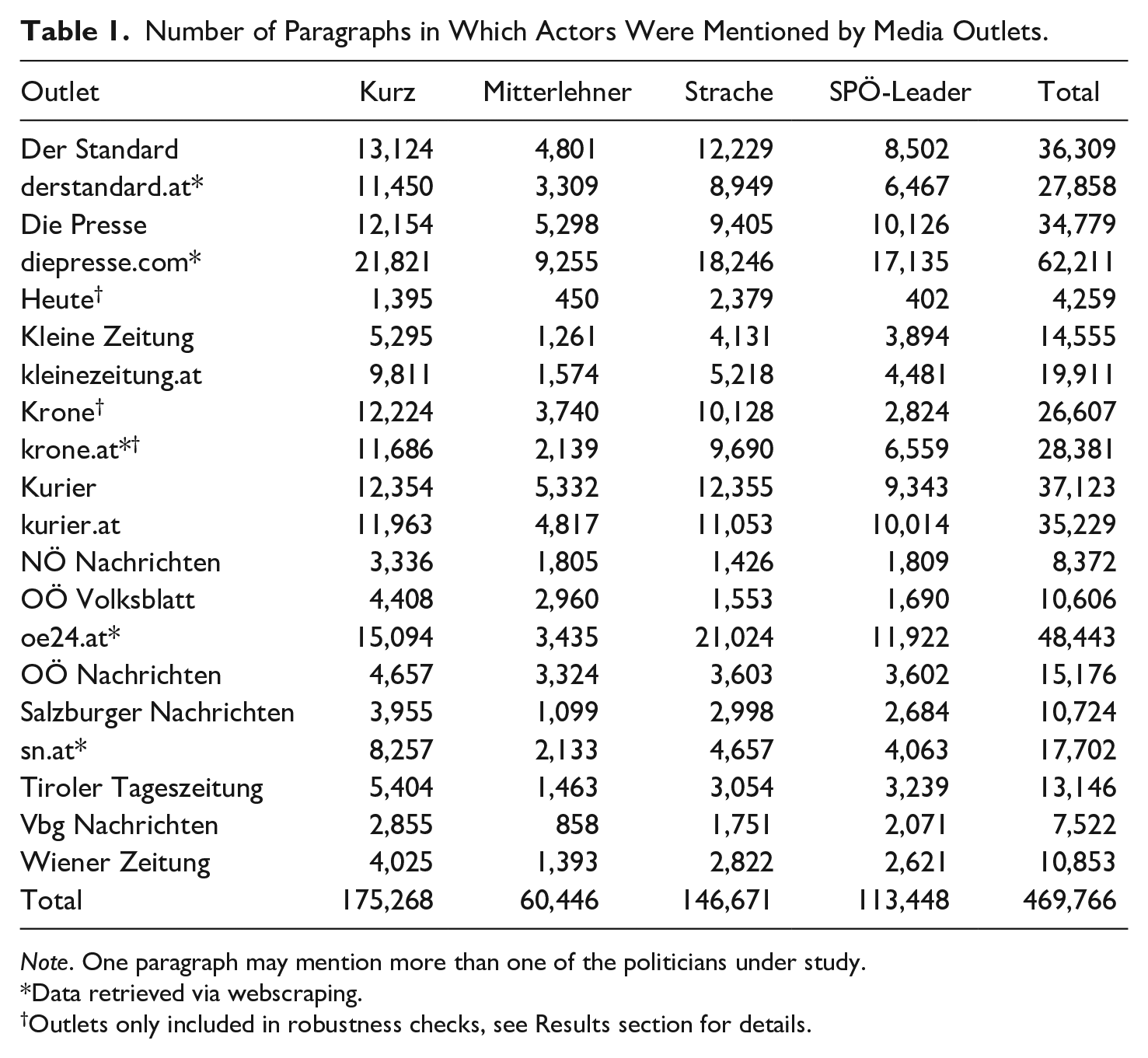
The following main analyses are based on news articles from eleven Austrian print newspapers, as well as six online news outlets (Table 1). While we had access to print and online versions for most news outlets, for OE24, we could only access online articles due to the unavailability of machine-readable print versions in any archive. We chose these outlets because they cover a variety of journalistic styles (quality, tabloid, and regional news), as well as a sufficiently large audience of about 70% of all print and online news consumers in Austria (Media-Analyse 2016). 5
Number of Paragraphs in Which Actors Were Mentioned by Media Outlets.
Note. One paragraph may mention more than one of the politicians under study.
Data retrieved via webscraping.
Outlets only included in robustness checks, see Results section for details.
We collected articles in the timeframe from 01.01.2012 until 31.10.2021. Most articles were accessed via the API of the Austrian Press Agency 6 (APA), which holds the largest archive of Austrian print and online news in Austria. For selected news outlets, we had to resort to web scraping to retrieve their online articles, where we retrieved free and premium content (Table 1).
To identify articles relevant to our research question, we used slightly updated publicly available search strings previously validated by the Austrian National Election Study (AUTNES) (Litvyak et al. 2022a, 2022b). This reduced the sample to articles mentioning Sebastian Kurz, 7 his intra-party challenger Reinhold Mitterlehner, 8 or Heinz-Christian Strache, 9 the leader of the populist radical right Freedom Party (FPÖ). Additionally, we included all party leaders from the Social Democratic Party (SPÖ) during our period of reference: Werner Faymann, Christian Kern, and Pamela Rendi-Wagner. Together with Strache, these actors are reference points for politicians outside of the ÖVP. 10 Party leaders from the Greens, or the Liberal Party (NEOS) were not included in the analysis, as media coverage was too low. Our final sample includes 222,659 news articles mentioning at least one of these politicians.
Measuring Actor Visibility
In line with media bias research and what is often termed “coverage bias” or “visibility bias,” our first outcome variable is actor visibility in the news (e.g., D’Alessio and Allen 2000; Eberl et al. 2017a). To have a fine-grained measure of visibility, we split articles into their respective paragraphs and used the same Lucene-style Boolean search string as mentioned above to detect whether one of the relevant actors is mentioned in a paragraph or not (see the R-Package corpustools by Welbers and van Atteveldt 2020, that also allows for word proximity searches). To avoid overlapping mentions and visibility of the SPÖ-Leaders, we only considered the time periods at which they were officially holding said position. 11 In our sample, Sebastian Kurz is the most visible politician overall with 175,268 paragraphs across all years and media outlets. Heinz-Christian Strache is second with 146,671 paragraphs (see Table 1 for details).
Measuring Actor Favorability
The second important outcome variable, actor favorability, relates to what is often termed as “statement bias” or “tonality bias” and, thus, the quality of news coverage (i.e., whether the tone toward a candidate or party is positive, neutral, or negative), as compared to quantity alone (e.g., D’Alessio and Allen 2000; Eberl et al. 2017a). We rely on a computational approach to sentiment analysis as a proxy measurement for actor favorability.
As off-the-shelf approaches to sentiment analysis are problematic (e.g., Boukes et al. 2020), we fine-tuned GottBERT, a German-language model (Scheible et al. 2020) for the task and validated it with a custom dataset. We used publicly available data from the AUTNES Manual Content Analysis of the Media Coverage 2017 and 2019 (Galyga et al. 2022; Litvyak et al. 2022c) as training data where, for each election, over 8,000 news articles were analyzed. For the studies, coders had assessed whether one of the politicians above was mentioned, and how they were evaluated in the text. The human annotations range from −2 (clearly negative) to +2 (clearly positive) ratings. The coding instructions entailed considering the entire paragraph where the actor is mentioned for the coding decision and considering positive and negative remarks directed at the respective actor (for details, refer to Supplemental Appendix A4).
Additionally, in order to reduce potential biases toward any actor in the training data or the model (e.g., idiosyncrasies on the basis of a politician’s name), we followed a Counterfactual Data Augmentation approach (see Meade et al. 2021). With this procedure, we copied each training unit while swapping the names of each actor in the sample with the names of every other actor. This process made the training data about 30 times larger than the original training set (see Supplemental Appendix A4).
We then ran experiments where we formulated sentiment analysis as a discrete classification task, where the paragraphs are estimated to fall into one of the three categories: positive, negative, and neutral, regardless of which actor is mentioned in the given paragraph. After fine-tuning the model for this task specification, it reached a satisfactory weighted macro F1-Score of 0.77 (precision = 0.77, recall = 0.77).
We also formulated a sentiment analysis as a regression task, which returns continuous sentiment values ranging from −2.0 to 2.0 instead of discrete categories. The regression approach achieved a Root Mean Square Error of 0.65 in the validation dataset. We thus used the fine-tuned model to compute sentiment values for each paragraph in the sample. These sentiment scores were then linked to the political actors based on their occurrence in these paragraphs (see Figure 2). The sentiment scores for each paragraph reflect the sentiment context, meaning that it is also possible that multiple actors are mentioned in the same paragraph, and they have the same score associated with them. We deem this as an adequate strategy because only about 5% of all paragraphs mention more than one actor.
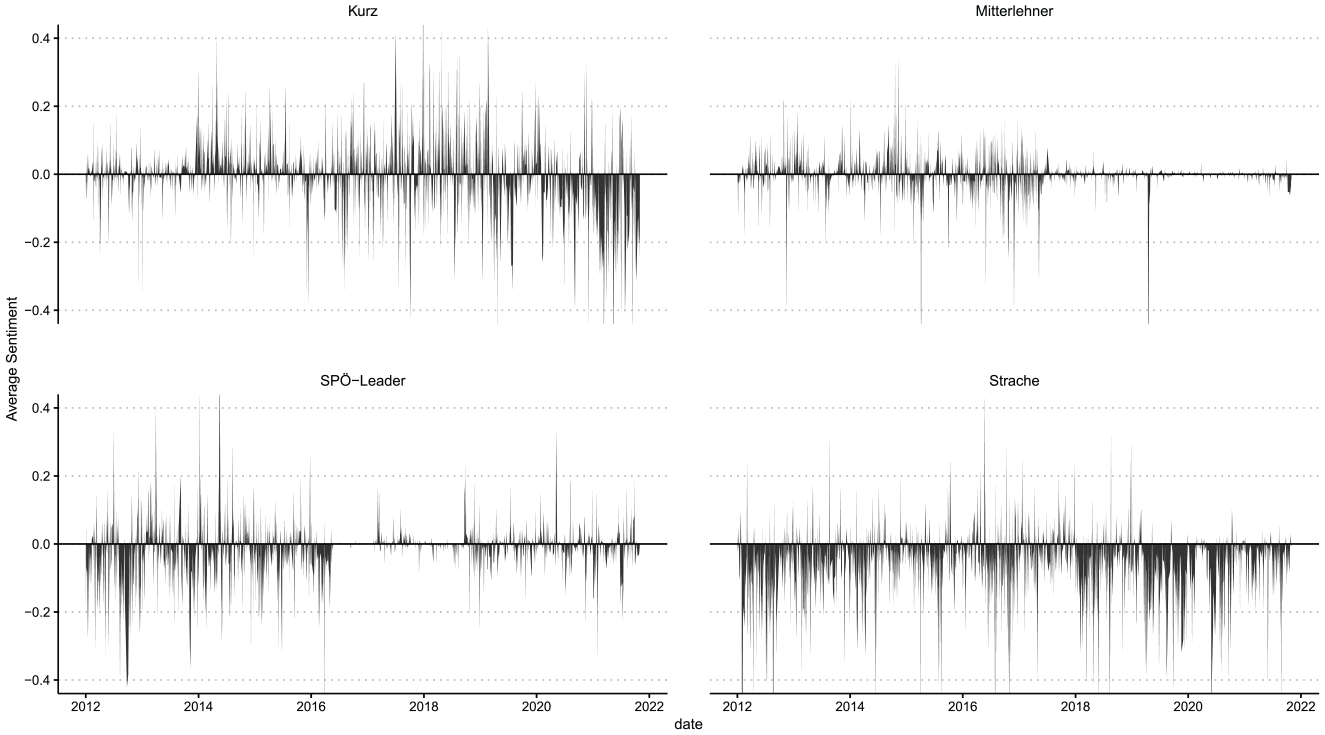
Results of sentiment analysis per politician. Aggregation of sentiment across all outlets on a daily level.
Model Specification
Usually, researchers do not get the detailed insights provided by the abovementioned leaks that allow for the empirical modeling of possible consequences of media capture on media reporting. This is because both the act of bribery and the conditions of such acts tend to remain secret. The Austrian case provides an “informed suspicion” to conjecture that the media coverage in the media outlet implicated in the scandal (i.e., OE24, henceforth referred to as the “treated” outlet) is different from media coverage in media outlets not receiving such short-term financial transfers (henceforth referred to as “control” outlets). 12 However, such a difference in media coverage between treated and control outlets does not necessarily (only) reflect the effect of political interference, if treated and control outlets are not comparable in other dimensions that are relevant for media coverage. This issue of noncomparability of treated and control observations is known as treatment selection bias or the endogeneity problem in the policy evaluation literature (see Angrist and Pischke 2008; Huber 2023). It jeopardizes the evaluation of potential causal effects (or, in this case, the identification of patterns within news coverage that would resonate with alleged arrangements) if not properly addressed.
An inspection of such patterns is nevertheless possible if one can plausibly impose (identify) assumptions on certain behavioral aspects of the outlets in order to tackle the selection bias problem. Our analysis relies on the so-called “common trend assumption,” which implies that in the absence of political interference (i.e., treatment), the (relative) change of average media coverage over time (i.e., the trend in coverage), must be comparable across the treated and control outlets. This means that—without alleged treatment—the relative growth of the visibility of particular actors, measured as the percentage change in visibility from one year to the other, or a change in the favorability would, on average, have evolved in a similar manner for treated and control outlets. This common trend assumption does, however, not impose that the levels of visibility or sentiment are the same in different news outlets and, therefore, allows for variants of the above-described selection bias, which are constant over time (see Lechner 2011). 13
Under the common trend assumption, we may apply a difference-in-differences (DiD) approach, a widely used causal inference method (see Ashenfelter 1978; Card and Krueger 1994; Snow 1855). It is based on (i) computing the average difference of media coverage in the treated outlet after versus before the alleged political interference, (ii) computing the same average difference over time for the control outlets, and (iii) subtracting the before-after difference of the control outlets from the before after-difference of the treated outlet. The intuition for this approach is that the before-after difference for the treated outlet includes both the general trend in media coverage (e.g., due to specific political events) as well as the effect of the alleged political interference. In contrast, the before-after difference for the control outlets only consists of the general trend in media coverage, under the condition that control outlets were not implicated in the allegations. Therefore, subtracting the before-after difference of the control outlets from the before-after difference of the treated outlet permits isolating patterns (i.e., trends) in the media coverage that could relate to secret arrangements at the heart of the “Inseratenaffäre.”
We ran the DiD analysis not only for the political actor that was alleged to be implicated in the case (namely, Sebastian Kurz) but also for politicians not alleged to be implicated (namely, the synthetic SPÖ party leader, Reinhold Mitterlehner, and Heinz-Christian Strache). This approach permits investigating whether the financial ties had different implications among distinct political actors.
We ran estimations for the respective actor visibility and favorability using the open-source implementations by Callaway and Sant’Anna (2021b) and Sant’Anna and Zhao (2020) (see also, Callaway and Sant’Anna, 2021a). We estimate the average treatment effect for the treated outlet (ATET), that is, the average effect on the visibility/favorability outcomes in OE24 in the presence versus the absence of the treatment. For actor visibility, we aggregated the actors’ mentions on the paragraph level to monthly observations for each news outlet in order to have a sufficiently large number of observations per actor, outlet, and period (month). The logarithm of the monthly actor-mentioned count in a specific outlet is the outcome variable for which we estimated the ATET for visibility. The rationale for opting for the logarithm (as opposed to the level) of the outcome lies in its implication of measuring time trends in relative terms (percentage changes) rather than in absolute terms. As newspapers may differ in terms of their number of published paragraphs (i.e., the noncomparability problem) and, thus, the possible count of mentions, the utilization of relative changes is more appropriate with regard to the common trend assumption. 14
We define the pretreatment period from 2012 until 2015 and use it to run placebo tests for our common trend assumption, as trends should be comparable before the alleged political interference in media independence. 15 For each placebo test in the pretreatment period, we compute the ATET based on two adjacent years. This implies that we compare the year 2013 with 2012, 2014 with 2013, and 2015 with 2014 when conducting the tests. We made annual comparisons to account for seasonal effects.
For estimating changes in visibility/favorability after the introduction of the financial transfers (i.e., the posttreatment period), we consider the last year prior to their introduction, namely 2015, as the baseline year relative to which all before-after changes are computed. This implies that, that is, the effect in 2016 is computed based on the average difference in media coverage in 2016 versus 2015. More concisely, the effect is computed as the difference in the before-after changes of 2016 versus 2015 across treated and control outlets. By estimating the ATET in multiple years after the introduction of financial transfers (e.g., by comparing 2017 vs. 2015 or 2018 vs. 2015), we can examine the progression of the effect over time. In an analogous manner, we also estimate the ATET for the sentiment scores in the years 2016–2021. Here, we aggregate the sentiment score at the article level through local clustering rather than on the monthly level as for the actor visibility outcome (which was done to ensure a minimum number of counts per period).
Results
We ran several DiD estimations, in which we compared multiple politicians, news outlets, and outcome variables. The results of the DiD estimations are presented in Figures 3–5 for each politician. Figures B1–B7 in the Supplemental Information file show the results in more depth.
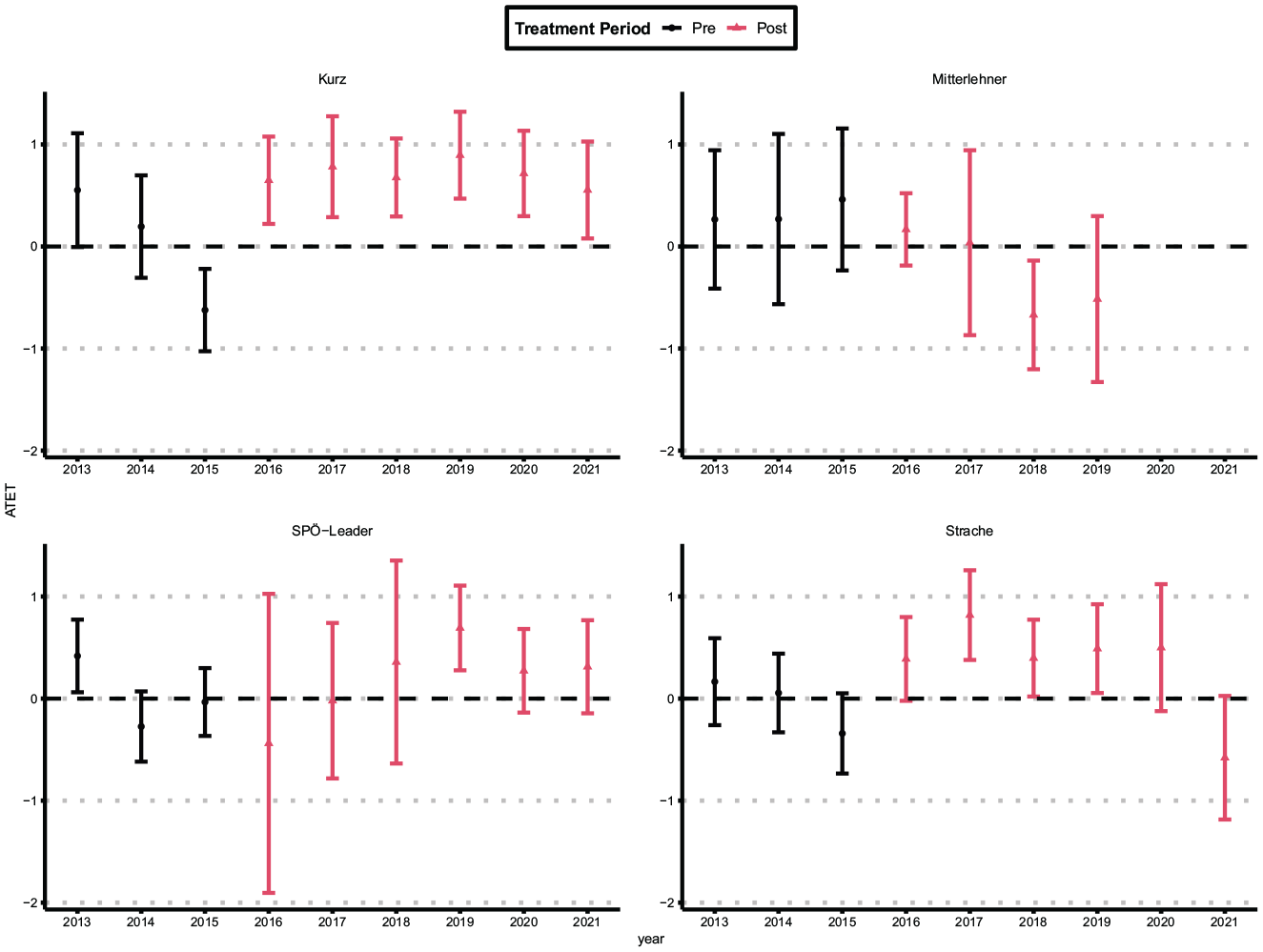
Results of DiD estimations (ATET) per politician on visibility (measured in paragraphs mentioned) when pooling control outlets.
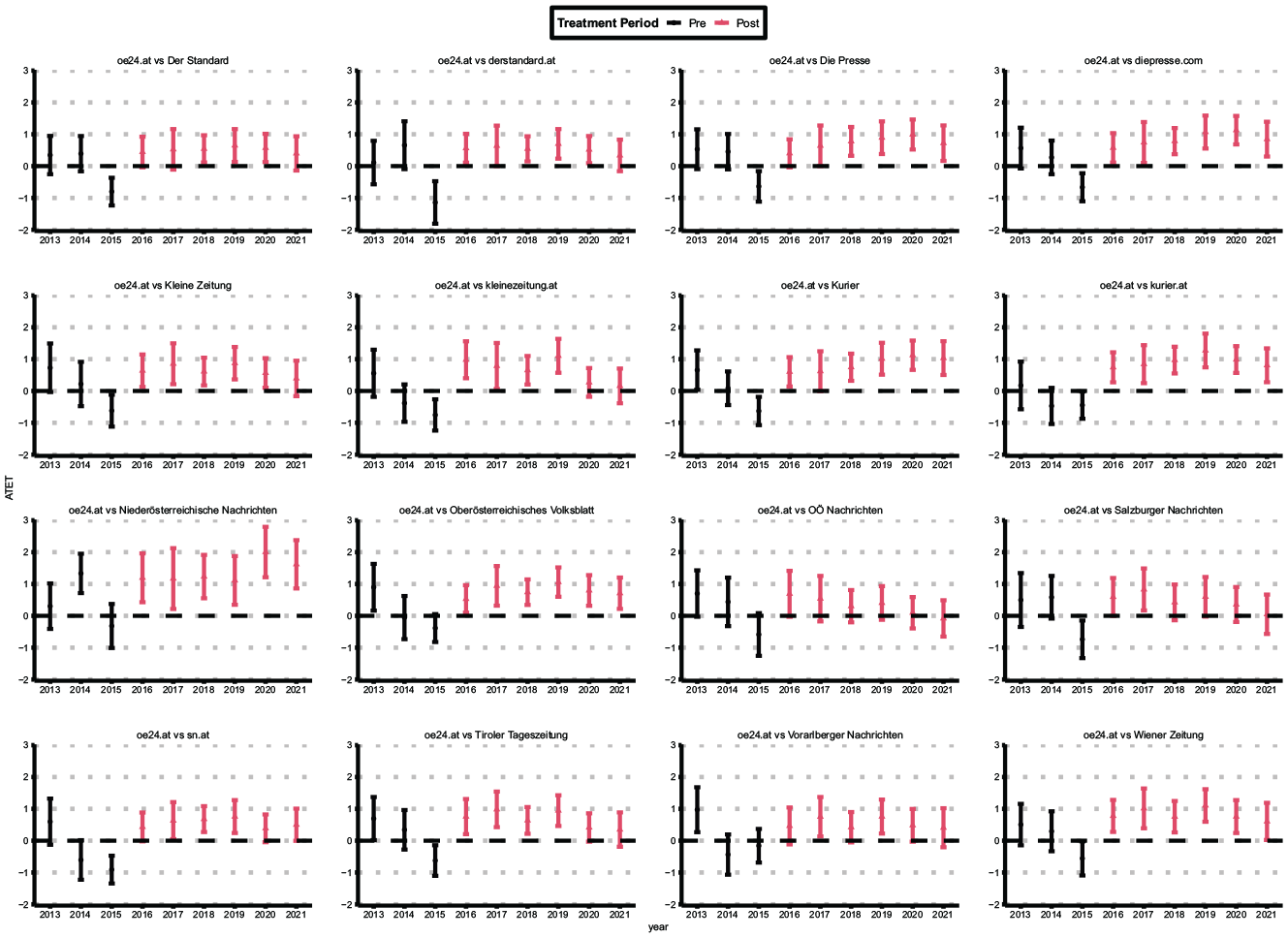
DiD Estimations (ATET) for Kurz’ visibility (measured in paragraphs mentioned) with individual news outlets (nonpooled).
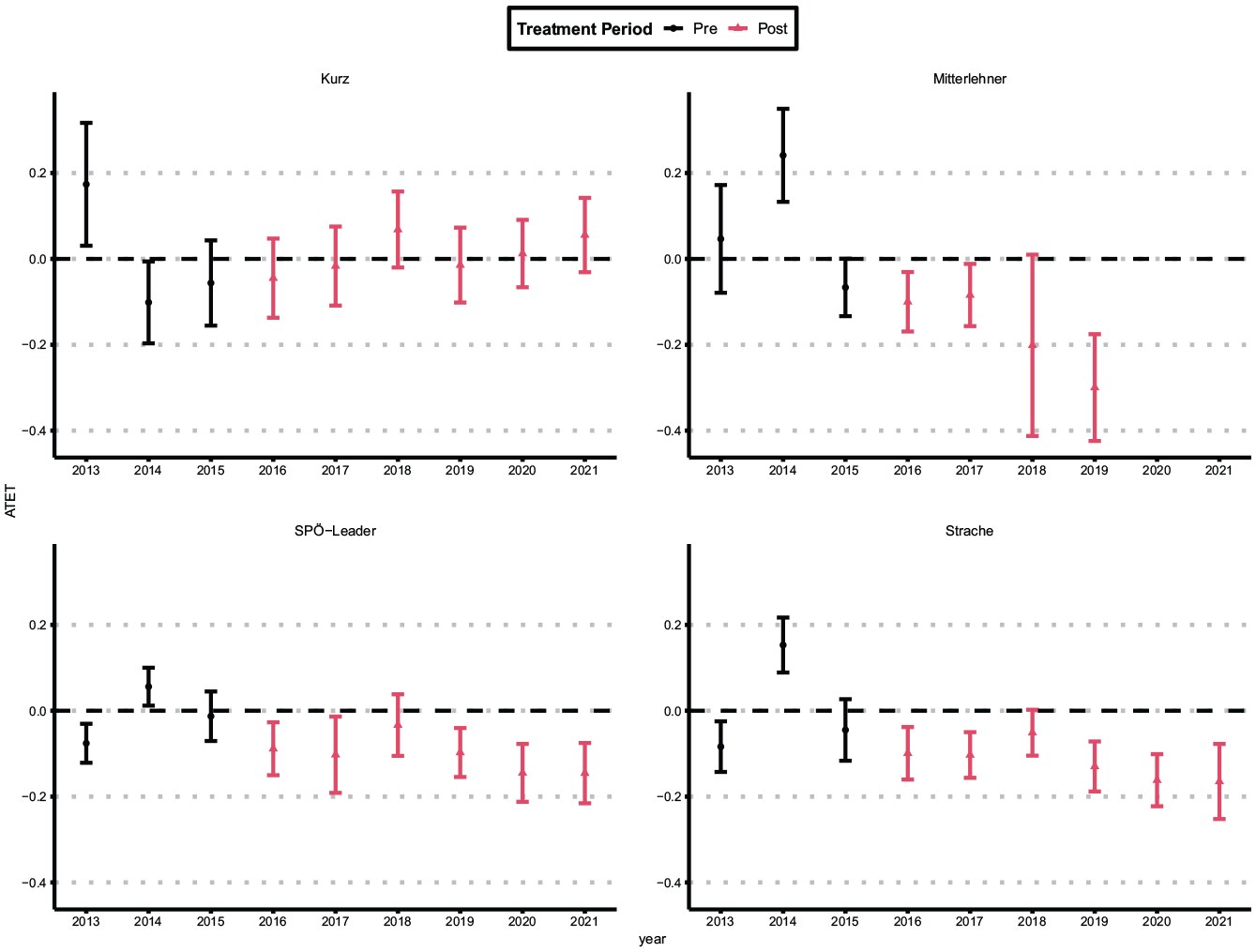
DiD effects on actor favorability (sentiment score) when pooling control outlets.
We first describe the actor visibility trends for our treated and control outlets in the periods prior to the alleged political interference starting in 2016. Considering the average trend from 2012 to 2015, we find it to be rather similar across outlets and politicians, as positive and negative deviations between treated and control outlets largely cancel each other out (see Figure 3). Turning to actor visibility in the posttreatment period, we see that the ATET estimations for Kurz are highly statistically significant and, in terms of their magnitude, quite substantial in any of the outcome periods after the introduction of financial transfers (H1). The point estimates suggest that the number of paragraphs on Kurz has almost doubled after the alleged arrangements, as an effect of 1 corresponds to an increase of approximately 100% in coverage.
In comparison, the effects for Mitterlehner and SPÖ-Leader are all statistically insignificant (just as the placebo tests). 16 This means that the visibility of Mitterlehner and the SPÖ-Leader in OE24 followed the common trend. For Strache, two out of six effects in the posttreatment period are statistically significant (and positive). They coincide with election years. However, no clear pattern is discernible, and effect sizes are lower than for Kurz in the same years. This general pattern also holds when we compare OE24 to each nontreated outlet individually (Figures 4 and Supplemental Figures B1–B3). For each outlet within the control group, we see that the visibility of Kurz in OE24 shows significant and positive deviations starting in the posttreatment period, while no clear patterns are discernible for the other three politicians, lending additional robustness for confirming H1.
Finally, Figure 5 provides the ATET estimates when considering actor favorability in news coverage as the outcome variable. Following the same DiD approach, the placebo tests again show an average trend from 2012 and 2015, with positive and negative trends canceling each other out. Here, ATET estimations for Kurz are not statistically significant, even though the trends in effects tend to be most positive for Kurz compared to the other three candidates. Importantly, however, trends for all other candidates are negative on average, meaning that OE24 started to report more negatively about all other candidates starting in 2016. Hence, while we find no increased favorability pattern for Kurz, aggregate patterns for the other candidates resonate sufficiently with the allegations in our case study (H2). 17
Robustness Checks
To assess the robustness of our findings and further probe the validity of the observed patterns, we conducted a series of additional analyses.
First, we use a separate dataset (n = 250,442) that provides a random sample of party-mentions in the same news outlets (see Supplemental Appendix B2 for details). We then estimated whether there was a treatment effect for major parties in Austria (see Figures B8–B9). The results of this robustness check suggest that there are no consistent effects that are specific to a single political party (see Figures B8–B9). We only find an overall increase in OE24 coverage of all parties, which suggests that the focus was on Sebastian Kurz in particular.
Our second robustness check relates to the two other tabloid newspapers, Kronen Zeitung and Heute. Although the WKStA also raised allegations against the two tabloids in spring 2023, we excluded them from the above analyses because the incidents seem to have occurred independently, and a clear timeline is still missing. Agnostic toward the details of the arrangements, we thus decided to include Heute, Kronen Zeitung, and krone.at in an additional analysis in the group of control outlets. 18 The results presented in Figures B10–B12 show that our previous findings are robust considering this model specification.
Third, we also estimated the effects on actor visibility using the synthetic DiD approach of Arkhangelsky et al. (2018), which can be applied to panel data. The advantage of synthetic DiD is that it does not rely on the satisfaction of the common trend assumption in the original data without reweighting. Therefore, we can allow for differences in the trends of visibility across treated and control outlets, as long as these differences can be tackled by reweighting control outlets. Figure B13 in the Supplemental Information file provides the effects on the visibility of Kurz, Mitterlehner, the SPÖ-Leader, and Strache in OE24 when using the synthetic DiD-based weighted average of the other outlets as the control group. For Kurz, the estimates point to substantial increases in visibility, which is statistically significant at the 5 percent level for every year when relying on placebo treatment effects for statistical inference (as outlined in Arkhangelsky et al. 2018).
Table B1 in the Supplemental Information file provides the actor-specific average effects across all years (2016–2019). For Kurz, the average effect amounts to 0.48 (or roughly 50%) relative to the baseline year in 2015 and is highly statistically significant at the 1% level. In other words, had OE24 followed the same trend for reporting on Kurz as a weighted combination of other outlets in our sample, it would have resulted in a much lower visibility of Kurz than actually observed. We conclude that the results obtained from synthetic DiD align well with the findings from conventional DiD.
Conclusion
In this study, we examined whether there are patterns within news coverage that aligns with the alleged serious breach of professional political and journalistic norms at the heart of the so-called “political advertisement scandal” in Austria. Utilizing a quasi-experimental approach, our analysis unveils a significant discrepancy in the visibility of former Austrian chancellor Sebastian Kurz in the news outlet OE24 compared to other politicians and news sources, corroborating the aforementioned allegations. While OE24 does not report more favorably on Kurz, it reports significantly more negatively on other candidates compared to other news sources.
While allegations led us to expect both increased visibility as well as increased favorability for Kurz in OE24, it is worth considering the following: First, media visibility alone may positively influence subsequent voter judgments (Kiousis and McCombs 2004; Miller and Krosnick 2000). Second, the findings are in line with the idea of “paying positive to go negative” as described by Blasco et al. (2016) concerning commercial advertiser pressure. In other words, increased visibility of the advertiser paired with negative coverage of competitors can very much be understood as a result of advertiser pressure and media capture.
There are several limitations to this study. We could only retrieve the online version of OE24 and not its print counterpart. However, we aimed to keep our sample balanced, including online and offline media as well as broadsheets, mid-range newspapers, and tabloids. We believe that our findings, which focus on trends rather than levels of coverage, effectively minimize the noncomparability problem and are, thus, expected to be independent of differences in journalistic routines between online media and print newspapers, or across various media genres.
Focusing our content analysis on actor visibility and favorability aligns with much of the existing literature on media bias, media capture, and advertiser pressures (e.g., Eberl et al. 2018; Gambaro and Puglisi 2015; Porlezza 2017). However, alternative content indicators could also have been examined, such as the visibility of specific subtopics within media coverage (e.g., Barnehl and Schumacher 2024; Young 2006). Furthermore, measuring favorability with sentiment scores as a proxy also has some weaknesses (Fehle et al. 2021; van Atteveldt et al. 2021). While we used domain-specific training data and fine-tuned the best model possible, there is still room for improvement in developing this method. Nevertheless, given the common trend assumption for the DiD estimations, we account for such inaccuracies in terms of the sentiment level and focus on relative changes in sentiment. Therefore, we deem the method to be reasonably useful and our findings valid.
Our study looked at Austria as a “most likely case” to investigate mechanisms of media capture in Western democracies, which raises the question of its generalizability. However, financial pressures on news outlets are not a problem exclusive to Austria. Moreover, concerns about media capture have gained public attention in other contexts, such as the arrangements between the tabloid Bild and the Liberal Party in Germany (Gilbert and Stark 2023; Fink 2023), as well as the advertisement scandal surrounding Benjamin Netanjahu in 2017 (Gottfried 2019). The Austrian case can, therefore, also be seen as a reflection of a broader trend across the globe.
Furthermore, we do not claim to prove unethical or illegal activities, nor do we claim to disprove the occurrence of such activities. We are not making any legal claims through our analyses. We provide an empirical analysis to identify patterns in media coverage and assess to what degree these may align with the allegations at the core of the Austrian political advertisement scandal.
Despite the aforementioned limitations, our study benefits from well-validated data collections and a robust statistical design. We have carefully considered a priori media distinctions regarding political coverage, temporal changes in that coverage, and variations between political actors. This innovative approach remains largely agnostic to the specifics of alleged interactions between government and media actors and can be adapted to other cases and other data. More specifically, the approach allows us to identify irregularities in news reporting that warrant closer examination as they diverge from what is to be expected on the basis of past reporting by the same news outlet or concurrent reporting on the same actor in other news outlets. Consequently, our study contributes meaningfully to scholarly and methodological debates about mechanisms that are inherently elusive and typically evade direct empirical measurement due to their secretive nature.
Our findings, furthermore, add to the theoretical and normative discussions surrounding the framework of media capture and the potential threat of media corruption to journalistic integrity in Western media systems where political, economic, and financial pressures on media organizations are increasing (Maniou and Ketteni 2022; Schiffrin 2018). Irrespective of whether our specific findings are indicative of the effectiveness of government advertising being used as a tool for bribing media organizations, there seems to be a recurring political yearning to control the Austrian tabloid press in hopes of securing favorable media coverage for upcoming elections.
This recalls another significant political scandal that unfolded just a few months after the alleged dealings between Kurz and OE24. In this instance, FPÖ leader Strache was secretly recorded at a luxury estate on the Spanish island of Ibiza, where he attempted to persuade a woman, who purported to be the niece of a Russian oligarch, to acquire the country’s largest-circulation tabloid, Kronen Zeitung. This scandal, meticulously exposed by investigative journalists and subsequently labeled the “Ibiza scandal,” ultimately led to Strache’s resignation from his position as vice-chancellor (Eberl et al. 2020).
While such a forceful and “hands-on” approach to media control has long been associated with populist-radical right movements, sometimes referred to critically as an “Orbánization” of (media) politics, it is essential to recognize that—at least in Europe—the threat to press freedom is not limited to a single ideology (Sehl et al. 2022; Wodak 2022). Rather, it presents a more widespread and imminent challenge than one might initially assume. The recent Austrian political advertisement scandal underscores the significance of societal concerns regarding the influence of political actors on journalism (Obermaier, Steindl, and Fawzi 2023) and highlights the pivotal roles of critical journalism and an independent judiciary in safeguarding against democratic backsliding. Moreover, it emphasizes the pressing need for greater transparency and stricter regulation in government and public-sector advertising to protect media independence and prevent a state of “journalism for sale.”
Supplemental Material
sj-pdf-1-hij-10.1177_19401612241285672 – Supplemental material for The Austrian Political Advertisement Scandal: Patterns of “Journalism for Sale”
Supplemental material, sj-pdf-1-hij-10.1177_19401612241285672 for The Austrian Political Advertisement Scandal: Patterns of “Journalism for Sale” by Paul Balluff, Jakob-Moritz Eberl, Sarina Joy Oberhänsli, Jana Bernhard-Harrer, Hajo G. Boomgaarden, Andreas Fahr and Martin Huber in The International Journal of Press/Politics
Footnotes
Acknowledgements
We thank the reviewers for their insightful comments that helped improving this article. We also thank Pamina Syed Ali and Randa Ashour for their assistance and Laurenz Ennser-Jedenastik for his insightful comments.
Declaration of Conflicting Interests
The author(s) declared no potential conflicts of interest with respect to the research, authorship, and/or publication of this article.
Funding
The author(s) disclosed receipt of the following financial support for the research, authorship, and/or publication of this article: This study has been supported by the Austrian Press Agency (APA) via the APA-UNIVIE Data Project.
Ethical Approval and Informed Consent Statements
This study protocol was reviewed and approved by Ethics Committee of the University of Fribourg under Application No. 2022-09-01.

Supplemental Material
Supplemental material for this article is available online.
Notes
Author Biographies
References
Supplementary Material
Please find the following supplemental material available below.
For Open Access articles published under a Creative Commons License, all supplemental material carries the same license as the article it is associated with.
For non-Open Access articles published, all supplemental material carries a non-exclusive license, and permission requests for re-use of supplemental material or any part of supplemental material shall be sent directly to the copyright owner as specified in the copyright notice associated with the article.
