



Abstract
This study provides a longitudinal, cross-national account of the relationship between negative news coverage and consumer confidence across all twenty-eight European Union (EU) member states for the period 2005–2017. We rely on an extensive data set of international news agency coverage and a range of economic indicators retrieved from Eurostat. Employing fixed-effects pooled time series and multilevel models, we demonstrate that negative news coverage is negatively associated with consumer confidence, generally. Confirming our hypotheses grounded in media system dependency theory, more specifically, this association was stronger for the sociotropic attribute of consumer confidence than its egocentric attribute. Moreover, the association weakened under circumstances where unemployment was rising as well as in those countries that faced the most severe consequences of the financial crisis. Altogether, news coverage matters especially when people are affected less directly by the consequences of economic downturn.
Introduction
The relationship between economic news and economic perceptions is important, both economically (Kellstedt et al. 2015) and politically (Hetherington 1996). Most centrally, consumer confidence in particular has been of continuous interest to researchers. Ultimately, consumer confidence is likely to affect the economy on all levels, ranging from individual-level economic decisions, such as consumer spending, to macro-level economic indicators, such as gross national product (e.g., Ludvigson 2004; Matsusaka and Sbordone 1995). Political attitudes, intentions, and behaviors are to a considerable extent informed by these economic perceptions as well (e.g., Fitzgerald 2013; Lewis-BeckStegmaier 2000; Nadeau et al. 1999; Sanders 2000). The trust that citizens have in their economy, therefore, might ultimately swing elections and shift existing power balances (Hernández and Kriesi 2016).
Against this background, it is important to investigate the relationship between economic news and consumer confidence. As a main source of (economic) information for many citizens, it is likely that the attention for and tone toward the economy in national media has an effect on consumer confidence (Damstra and Boukes 2018; Hollanders and Vliegenthart 2011). Various studies in different contexts have demonstrated that the coverage of economic news influences economic evaluations (e.g., Blood and Phillips 1995, 1997; Soroka 2006; Svensson et al. 2017). However, we know relatively little about how these effects are conditional upon context characteristics. The vast majority of previous work focused on a single country; a notable exception is Wlezien et al.’s (2017) study examining Canada, the United Kingdom, and the United States. To examine the circumstances under which economic news makes the biggest impact, a cross-context, over-time comparison is needed. This study expands the literature to the context of non-English speaking democracies and includes an unparalleled number of countries: Concretely, we focus on the impact of negative news and how this relationship may vary over time and across all the twenty-eight European Union (EU) member states in the period surrounding the financial crisis (2005–2017).
This paper seeks to address this question in the European context during the economic crisis years, but also considers the period before and after that. Given the disparities between countries, the fierceness of the crisis, and the over-time state of the economy in general, Europe, arguably, offers a suitable background to examine the association of negative news with consumer confidence and how this may vary across time and nation states. In methodological terms, one major advantage is that comparable statistical information on consumer confidence and other real-world indicators tapping economic cross-national differences (e.g., gross national product and unemployment rates) are available for all EU member states.
All in all, this study investigates the following research question:
Theoretical Considerations
Negative Economic News and Its Consequences
Journalists writing about the economy tend to structurally over-select negative and dramatic stories, events, and developments, which consequently leads to a negativity bias in economic news coverage on the aggregate level (e.g., Damstra and Boukes 2018; Fogarty 2005; Hagen 2005; Hester and Gibson 2003; Ju 2008; Soroka 2006; Soroka et al. 2015; van Dalen et al. 2017a). This negativity bias may produce serious misalignments between the real state of the economy and citizens’ perceptions of it; thus, providing a more depressing picture than economic numbers reflect. This might have far-reaching consequences, because (1) media effects on consumer confidence extend above and beyond the impact of real-world indicators (Haller and Norpoth 1997) and (2) negative news is likely to lead to greater declines in consumer confidence compared with the increases caused by positive news (Soroka 2006). All in all, this may have serious consequences: The public may be misinformed about the economy, and news may affect economic perceptions, such as consumer confidence, in undesirable ways, which may eventually have swayed electoral outcomes in the Eurozone (Hernández and Kriesi 2016).
The negativity bias in economic news theoretically aligns with news value theory (e.g., Harcup and O’Neill 2001, 2017), which maintains that negative events, circumstances, and conditions are more likely to be picked up by the news. In addition, journalists covering the economy tend to be more interested in changes (e.g., the dynamics of gross domestic product (GDP) or variations in unemployment rates) than in absolute levels of economic indicators (Damstra et al. 2018). Popular economic topics such as inflation, unemployment, or the housing market are oftentimes dynamic—with up and downs. Information on these topics is generally public and relatively easy to obtain for journalists (e.g., via central bureaus of statistics).
This offers journalists ample opportunities to repeatedly translate negative occurrences and situations into news coverage, or interpret them in negative ways. Such bias may even occur in structural manners, with coverage more negatively skewed when certain parties are in office (Merkley 2018). Empirical research supports this, by consistently showing that economic decline is associated with higher volume of news (e.g., Damstra and Boukes 2018; van Dalen et al. 2017b) and more negative tone of the coverage (Fogarty 2005; Soroka 2006; van Dalen et al. 2017a), while at the same time the opposite—economic growth positively affecting volume and tone—is not found, or only to a limited extent.
Several studies documented how negative news in turn affects economic perceptions, controlling for economic real-world indicators. Blood and Phillips (1995, 1997) were among the first to show that negative newspaper headlines can affect consumer confidence above and beyond real-world indicators. Later studies largely confirm this finding for the effect of economic news in general (e.g., Alsem et al. 2008; Doms and Morin 2004; Hollanders and Vliegenthart 2011; Wu et al. 2002). Yet, results have also been found in the opposite direction: News coverage about the economy also responds to the public’s sentiment (Wlezien et al. 2017). So, a bidirectional relationship seems to exist between the news media and consumer confidence; hence, longitudinal (i.e., not cross-sectional) data are needed to investigate possible causal relationships between the two. Largely replicating the existing literature, we therefore expect:
The question remains which factors condition the association between negative economic news and consumer confidence. To further improve our understanding of media effects, it is crucial that scholars examine the factors determining when citizens are more or less susceptible (Valkenburg and Peter 2013). Although there might be robust evidence for the prevalence of negativity in economic news and for the effects of such negativity on consumer confidence and economic perceptions in general, the literature points to different factors that determine the level of negativity and strength of associations.
For example, the focus of economic news may play an important role in how coverage affects economic perceptions. Several researchers have shown that the attention across economic topics in the news is not evenly distributed; news tends to be particularly focused on unemployment rates (and its dynamics) compared with other economic subtopics (e.g., Fogarty 2005; Goidel and Langley 1995). Arguably, this has consequences for media effects: Valenced news about different topics may yield different effects on economic perceptions. Soroka (2002), for example, shows that agenda-setting effects exist for economic issues that people do not directly experience (unobtrusive) issues, such as budget deficits, while such effects do not exist for (obtrusive) issues that are directly experienced, such as inflation. In our attempt to reveal which contextual factors moderate the effects of economic news, the media system dependency (MSD) theory (Ball-Rokeach and DeFleur 1976) provides a helpful framework.
Effects of Economic News across Borders and MSD Theory
MSD has been defined as “a relationship in which the capacity of individuals to attain their goals is contingent upon the information resources of the media system” (Ball-Rokeach 1985: 487). Thus, individuals will be more dependent on the media—and therefore affected more strongly by it—when the media are their only available source of information for a specific topic. In case alternative sources of information are available, people will be less likely to rely (solely) on the media, and thus will be affected less strongly by it.
Linking this theory to the latent construct of consumer confidence, one may expect differential effects on the separate dimensions of consumer confidence (see Boukes et al. 2018), in particular, the subject dimension which distinguishes egocentric (i.e., the financial situation of one’s own household) and sociotropic evaluations of the economy (i.e., state of the national economy). The effect of economic news on consumer confidence has been found to especially pertain to the perceptions people have of the national economy much more than the personal situation (Boomgaarden et al. 2011; Hagen 2005).
The MSD theory suggest that the reason is that there is a clear asymmetry of information: Whereas people, for example, have insights into their own bank accounts and will be aware of their employment status, there are few other sources than the media helping citizens shape their sociotropic views. Thus, people can (largely) rely on personal experiences and interpersonal communication to evaluate the egotropic attribute of consumer confidence (Mutz 1998), whereas the media are the main source of information to base one’s sociotropic evaluations upon. Accordingly, we expect the following:
The factors that determine how much control the media have over certain information are found on levels varying from (1) the micro-level of the individual citizen and her/his personal circumstances, via (2) the meso-level and the information that is available in one’s personal environment, to (3) the macro-level referring to the information structure and media landscape in a country (Ball-Rokeach 1998). Concerning the macro-level (often national) factors, not much is known yet; the obvious reason being that it requires cross-national data that are difficult to obtain. Based on single-country studies, though, the literature has shown that in situations where access to information is limited (i.e., during crises such as a volcanic eruption, Hirschburg et al. 1986, or due to government censorship, Halpern 1994), people are more dependent on the media, increasing the likelihood of stronger media effects. In the absence of alternative information, the media will thus be relatively powerful. However, cross-national evidence showing how MSD theory relates to the (un)availability of alternative sources of information, as far as we know, is still missing. This kind of research would require data in which levels of alternative information availability vary across contexts.
In the case of a major event, such as disasters or an economic crisis, people will feel the need to better understand the situation and reduce any sense of ambiguity (Jung 2017). As Katona (1968: 22) predicts, situations as these encourage “social learning”: that is, acquiring new knowledge and revisiting one’s existing opinions based on new information. When no alternative sources of information are available, this would open the possibility for strong media effects (Ball-Rokeach 1985). This study, however, investigates whether the undeniable presence of negative economic circumstances fuels direct first-hand experience with the crisis, and therefore may fulfill the role of alternative information source.
Concretely, two context characteristics could moderate the association between economic news and consumer confidence because they determine how strongly citizens will depend on the media to shape their perceptions of how the economy is performing: (1) differences between countries in terms of how hard they were hit by an economic crisis and (2) dynamic changes in the economic situation (i.e., unemployment rate) within a single country. Fundamentally, both these context characteristics reflect the degree in which a country has been affected by the economic crisis, either in comparison to other countries (statically) or in comparison to its own recent past (dynamically). Related to MSD theory, these crisis characteristics pertain to variations in the extent to which people (or people they know) personally experience the consequences and the severity of economic downturn. That is, if unemployment is on the rise, chances increase that people personally experience the negative effects of economic downturn. In a similar way, living in countries that are hit hard by a severe economic crisis makes it more likely that economic downturn is felt directly, which would thus make it logical that people base their economic evaluations primarily on such experiences rather than on how the media report about the economy.
Accordingly, it seems likely that in situations where people do not directly experience economic consequences, the media matter the most. After all, when the economic situation is bad and consequences are felt personally, people do not need the media to inform them about this—they will already know and are not dependent on the media. By contrast, in contexts where the economic downturn is less tangible, people will have to rely on the media to inform their economic perceptions.
Thus, one may expect that stronger economic downturns, manifested in increases of the unemployment rate, will attenuate the effect of negative news on consumer confidence, as media effects are less strong when economic conditions worsen. Moreover, differences between countries in terms of how hard they have been hit by the economic crisis will also moderate media effects; citizens in countries hit hard by the crisis will be less susceptible to the effects of negative economic news. Altogether, this results in the following two hypotheses:
Data, Research Design, and Method
Our data set comprises all twenty-eight EU member states, and includes monthly level data on consumer confidence, negative economic coverage, and the state of the national economies. 1 The time span considered is 2005–2017; this includes the build-up to the financial crisis (2007–2008), the subsequent Euro crisis (2009–2012), as well as its aftermath (2013–2017). With strong fluctuations in economic conditions, this period provides an excellent context to test our hypotheses.
Measurements
Our key variables are operationalized as follows.
Consumer confidence
Public opinion data about consumer confidence is collected from the statistical office Eurostat (European Commission). In each country, a monthly representative sample of the nation’s population is questioned to measure consumer confidence. For the indicator used in this study, the following four questions are included: (1) How do you expect the financial position of your household to change over the next twelve months? (2) How do you expect the general economic situation in this country to develop over the next twelve months? (3) How do you expect the number of people unemployed in this country to change over the next twelve months? (4) Over the next twelve months, how likely is it that you save any money? Questions are answered on a 5-point scale with a neutral middle point.
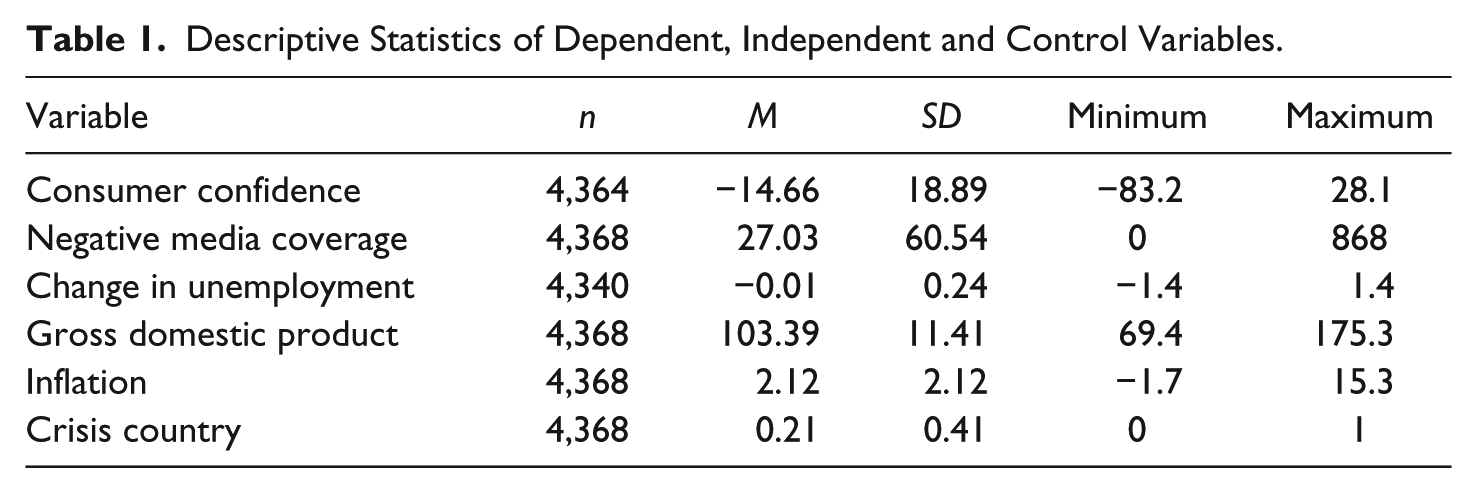
The composite measure (M = −14.66, SD =18.89) is the arithmetic average of the balances (in percentage points) of the answers to those questions, with the unemployment question being reversely coded (European Commission 2018). The measurement, thus, combines egotropic assessments (questions 1 and 4) with sociotropic perceptions (questions 2 and 3). To compare the differential impact of media on egotropic and sociotropic perceptions, we construct two additional dependent variables, using answers to questions 1 (egotropic) and 2 (sociotropic), complemented with the same questions, but then retrospectively dealing with the past twelve months (i.e., “How has the financial situation of your household changed over the last 12 months?” and “How do you think the general economic situation in the country has changed over the past 12 months?” respectively). These are asked monthly as well, but not included in EU’s consumer confidence index (see above). Again, both variables range from −100 to +100. Those items are most similar and suitable for a comparison of effects.
Negative economic coverage
The volume of negative economic news is operationalized based on international press agency coverage. Collecting and content analyzing national media outlets in twenty-eight countries for more than a decade is close to impossible. International press agencies, instead, provide a viable alternative: They cover issues, such as the economy, extensively, and often serve as the input for national media (Boumans et al. 2018). Concretely, we relied on two of the largest worldwide agencies: AFP (Agence France-Presse), originating in France, and AP (Associated Press), a U.S. agency with offices in the vast majority of countries worldwide, including Europe. Both press agencies extensively cover European economics and politics and their articles are available in the LexisNexis data set.
Negative economic news coverage was operationalized by counting the monthly number of articles published by both agencies on negative economic developments, combined with mentions of the respective country name; for example, an article that wrote about “economic crisis” and “Hungary.” 2 The search string for negative economic coverage has extensively been tested and validated within the realm of another project (Vliegenthart and Damstra 2019) and reads as follows: recession OR economic crisis OR shrinking economy OR economic downturn OR economic fall OR financial crisis OR Euro crisis OR banking crisis OR credit crisis.
Correlations between the monthly measurements of negative news coverage across countries are all positive and range from .10 (Cyprus and Sweden) to .98 (France and Germany). Logically, countries that are geographically close and have closer economic ties show stronger correlations. After all, their economies are more strongly interconnected, and economic developments and their news coverage will be more similar.
To validate this measurement of negative economic news coverage and to see to what extent our measure resembles national media coverage, we assessed the correlation between coverage by press agencies and national newspapers for four countries. For that purpose, national newspapers were collected for the period 2005–2016: the German newspaper Die Welt, the French newspaper Le Figaro, the Dutch newspaper NRC Handelsblad, and the Spanish newspaper El Pais (only available from mid-2006 onward). Correlations between the number of negative economic articles in these national newspapers and the number retrieved using the international press agencies are strong: r = .83 (Germany), r = .60 (France), r = .87 (The Netherlands) and r = .62 (Spain). This strengthens our confidence that we grasp the national media environments to a considerable degree by using measures of coverage by press agencies.
A second validation strategy was to consider country-level bias based on economic characteristics. One would expect that objective economic indicators within countries should be strong predictors of (negative) economic news coverage. We constructed a data set with each country as a unit of analysis. As a dependent variable, we used the average score for monthly negative economic attention. As independent variables, we used absolute GDP halfway our research period (2011; Eurostat) and average inflation and unemployment rate as also included in the analyses reported in this paper (see below). These three variables all strongly affected the visibility of these countries—with positive coefficients for GDP (b* = .783), unemployment (b* = .392), and a negative, but insignificant one for inflation (b* = −.152)—and together explained a high amount of variance in the dependent variable (R2 = .81). Inspection of the standardized residuals reveals which countries received more or less coverage compared with what one would expect based on these economic figures. There is no systematic over- or underrepresentation of a certain type of country: For example, Croatia and Poland are covered less than one would expect, but this also happened for the United Kingdom and Italy. None of the deviations is beyond two standard deviations, except for one country: Greece. This country received considerably more attention than one would expect based on the economic indicators. Given the depth of the country’s crisis as well as the many discussions about a potential exit of Greece from the Euro, this unique country’s case could not solely be captured by economic indicators. Overall negative media attention per country is in line with economic indicators, and deviations are relatively limited. Our measurement, therefore, does not show serious signs of bias.
Crisis severity
Not all EU countries were affected equally by the financial and Euro crisis. Especially the Southern-European countries together with Ireland were hit hardest by the crisis. These countries faced strongly rising levels of unemployment and national debts, as well as collapsing housing markets, and some even ended on the brink of bankruptcy (i.e., Greece). In the EU context, these countries can be labeled “debtor countries” (Hutter et al. 2018). To capture this cross-national variation in crisis severity, we included a dummy variable, scoring “1” for the Southern-European countries (Spain, Portugal, Greece, France, 3 Italy) and Ireland, and “0” for the other countries. Previous work (Vliegenthart and Damstra 2019) showed that this is a useful distinction, and it captures the idea that in those countries the consequences of the crisis were directly felt by large shares of the population, while that might have been less evidently so in other countries.
Changes in unemployment
For changes in unemployment, we again relied on data from Eurostat and use the monthly change in the percentage of unemployed people among the country’s labor force. We use seasonally adjusted scores, because these rates correct for the presence of seasonal employment, and in that way reflect the economic situation in the most realistic and comparable manner.
GDP
As a control variable, we include the GDP of each country, again obtained from Eurostat. This variable is indexed in comparison to the 2010 GDP for each country (which takes the conventional value of 100). Here, we have quarterly data at our disposal, meaning that scores reflect change measured every three months and for the following months we value remains the same until a new quarterly measure is available.
Inflation
A second control variable is the level of inflation. Again, we rely on Eurostat data and use annual inflation, based on the Harmonized Indices of Consumer Prices. 4
Table 1 includes the descriptive data for all variables across the twenty-eight EU member states over the period 2005–2017.
Descriptive Statistics of Dependent, Independent and Control Variables.
Analysis
Our data set has a pooled time-series structure, with monthly observations for every country. Our dependent variable, consumer confidence, is strongly auto-correlated, but the Fisher unit root test (pooled augmented Dickey Fuller test with twelve lags) suggests it is stationary in at least one of the panels (Z = 3.11, p < .001) and thus does not need to be differenced. Also, a simple regression model that includes only the lag of consumer confidence as explanatory variable points in the same direction—the coefficient of the lagged dependent variable is significantly smaller than 1, though only just (b = .984, SE = .003). Specific items for egotropic and sociotropic perceptions are mixed (see Supplemental Table A1). Given the fact that particular egotropic confidence is on the edge of being stationary, we have replicated these analyses using a first-differences model. In this model, we use the differenced score for egotropic and sociotropic perceptions, as well as for the undifferenced independent variables (news coverage, GDP and inflation). For reasons of comparability, we do the same for consumer confidence in general (see Supplemental Appendix A), which offers an additional robustness check. The independent variables included in our models are stationary (see Supplemental Table A1).
In the main analyses examining the relationship between negative economic coverage and consumer confidence, we account for unit-level heterogeneity (unobserved variation across countries that is not captured by the variables in the model) by means of a fixed-effects model. 5 In this fixed-effects model, cross-national variation is accounted for by including dummy variables for each of the countries minus one. We also use a fixed-effects model to test differential levels of association for egotropic and sociotropic evaluations (H2) as well as the dynamic interaction effect of negative economic coverage and changes in unemployment (H3).
This model does not allow for testing cross-national variation in associations (H4), since all variance at the country level is already accounted for by the dummy variables. Therefore, we use multilevel models with random-intercept and slope, where monthly observations are nested within countries. 6 In all our models, we account for autocorrelation by including a lagged dependent variable for the dependent variable “consumer confidence.” Furthermore, we include the independent variables with a lag of one (i.e., one month earlier). Model fit did not significantly improve by adding additional lags for the news coverage variable (i.e., t – 2, t – 3). 7
Results
First, we look into the contemporaneous correlation of the variables included in our models. Table 2 provides an overview. Here, we find that the vast majority of variables are significantly correlated in a way that theoretically makes sense. Lower consumer confidence coincides with higher amounts of negative economic coverage, increasing unemployment, higher levels of inflation, and lower GDP.
Correlation between CC, Media, and Economic Variables (n = 4,337).
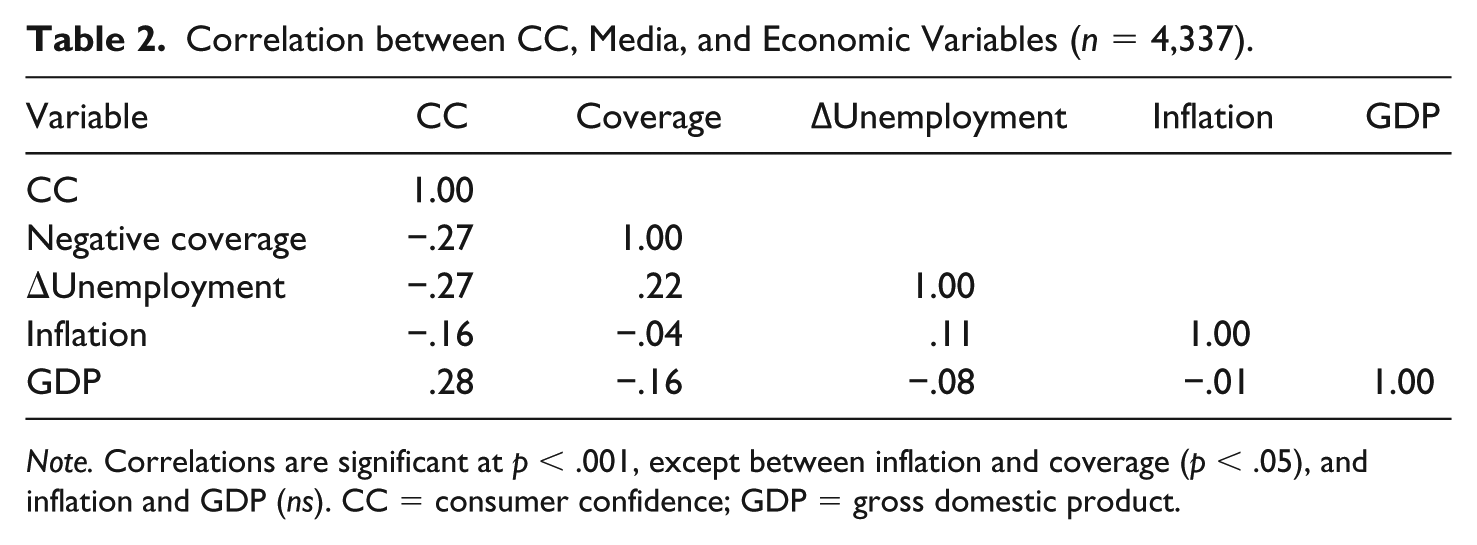
Note. Correlations are significant at p < .001, except between inflation and coverage (p < .05), and inflation and GDP (ns). CC = consumer confidence; GDP = gross domestic product.
Negative Media Coverage and Consumer Confidence
Table 3 displays the results from the fixed-effects model. Previous research and our H1 are confirmed: More negative media coverage is associated with lower consumer confidence. Each additional press agency item including references to negative economic developments in a certain country is followed by an average 0.006 decrease in the consumer confidence index of that country in the next month, measured on a scale ranging from −100 to +100. This is a seemingly limited effect, but news coverage can—as deducted from the descriptives in Table 1—fluctuate heavily from month to month; thus, yielding substantial shifts in consumer confidence. In addition, note that this effect only wears off very slowly, due to the large effect of the lagged dependent variable. Also, the economic variables are associated with consumer confidence in the expected direction. The high level of explained variance is mainly due to the inclusion of the lagged dependent variable.
Fixed-Effects Models Explaining Consumer Confidence (n = 4,309).
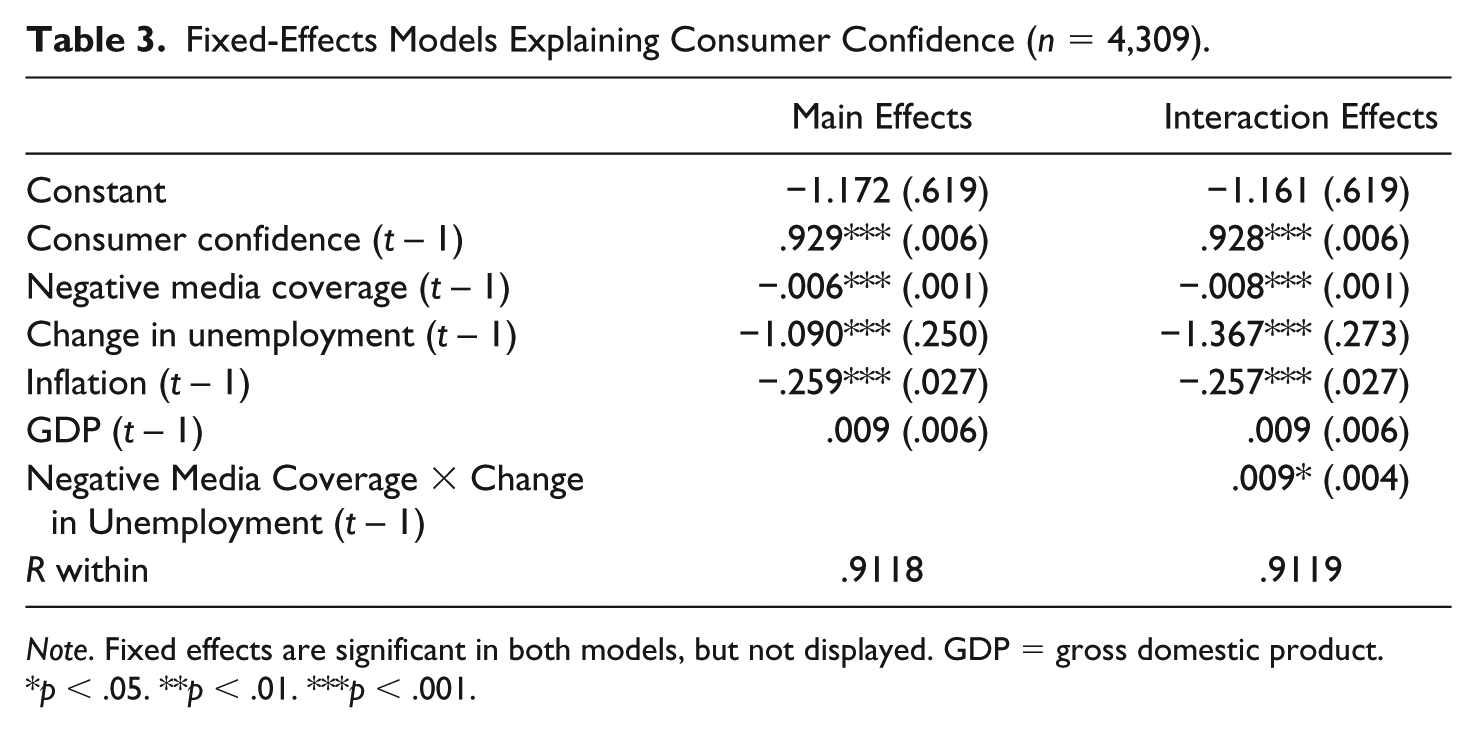
Note. Fixed effects are significant in both models, but not displayed. GDP = gross domestic product.
p < .05. **p < .01. ***p < .001.
When we run the same model for egotropic (the personal financial situation) and sociotropic (general economy) evaluations, a negative association is found for both, as shown in Table 4. Yet, the effect on egotropic evaluations was twice as small (b = −.004) as the one on sociotropic evaluations (b = −.008). This difference is statistically significant (∆b = .004, SE = .002, p < .05). These results confirm H2: Media content has a stronger association with sociotropic evaluations than with egotropic evaluations. In the first-differences model, these differences are even more pronounced (−.005 vs. = −.010; see Supplemental Table A2).
Fixed-Effects Models Explaining Egotropic and Sociotropic Economic Perceptions (n = 4,309).
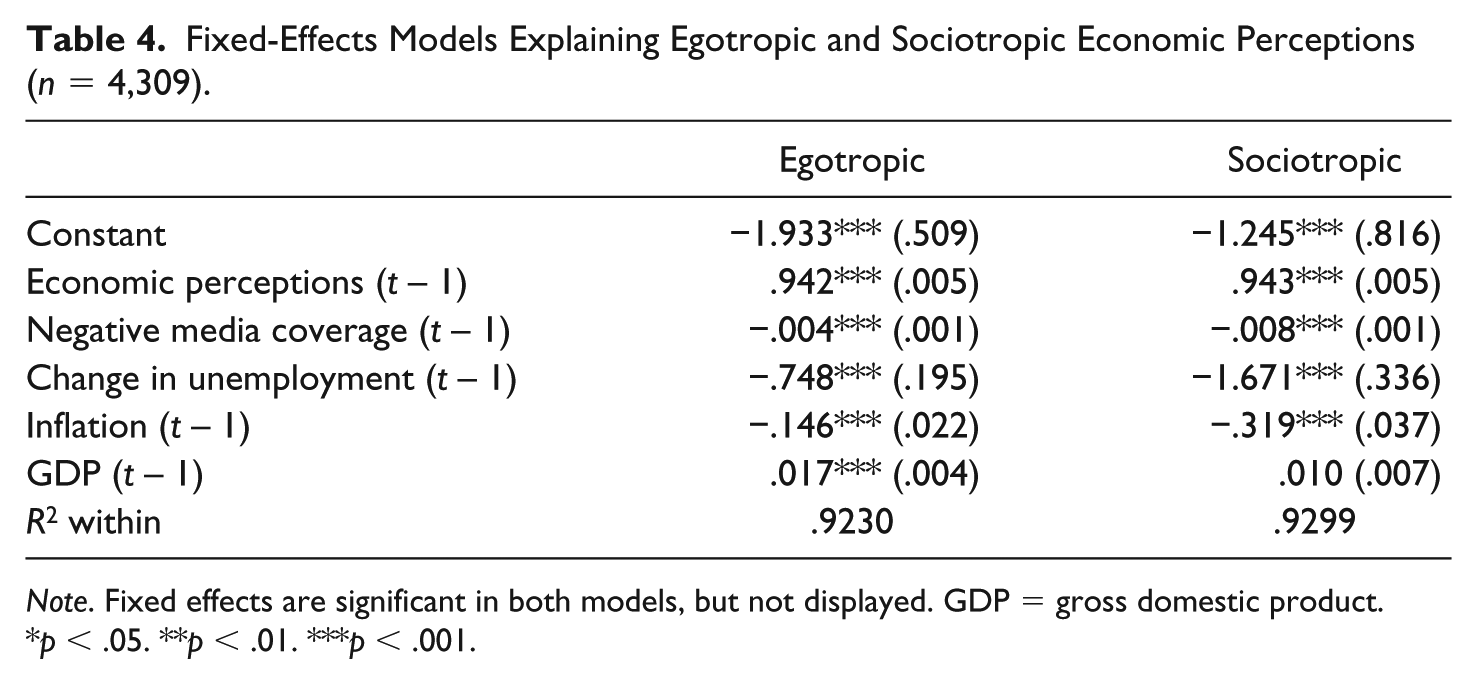
Note. Fixed effects are significant in both models, but not displayed. GDP = gross domestic product.
p < .05. **p < .01. ***p < .001.
H3 suggests an interaction effect between media coverage and changes in unemployment rate, with more negative changes weakening the effect of media content. The second model confirms H3: The positive interaction term in Table 3 indicates that the negative association of news coverage with consumer confidence loses strength with increasing levels of unemployment. A one-standard deviation increase in change in unemployment (0.24) results in a 0.010 × 0.24 = 0.0024 smaller effect of negative coverage; thus, reducing the effect by a bit more than a quarter.
Figure 1 provides a graphical representation of the interaction effect, plotting predicted values based on media attention (ranging from 0 to 200, which is about 3 standard deviations above the mean) for different values of change in unemployment (±2 standard deviations from the mean) with other variables kept at their average. Confirming H3, the strongest associations occur in situations where unemployment decreases (i.e., the solid line). The explained variance of the model goes up with the inclusion of the interaction terms as well, but only slightly.
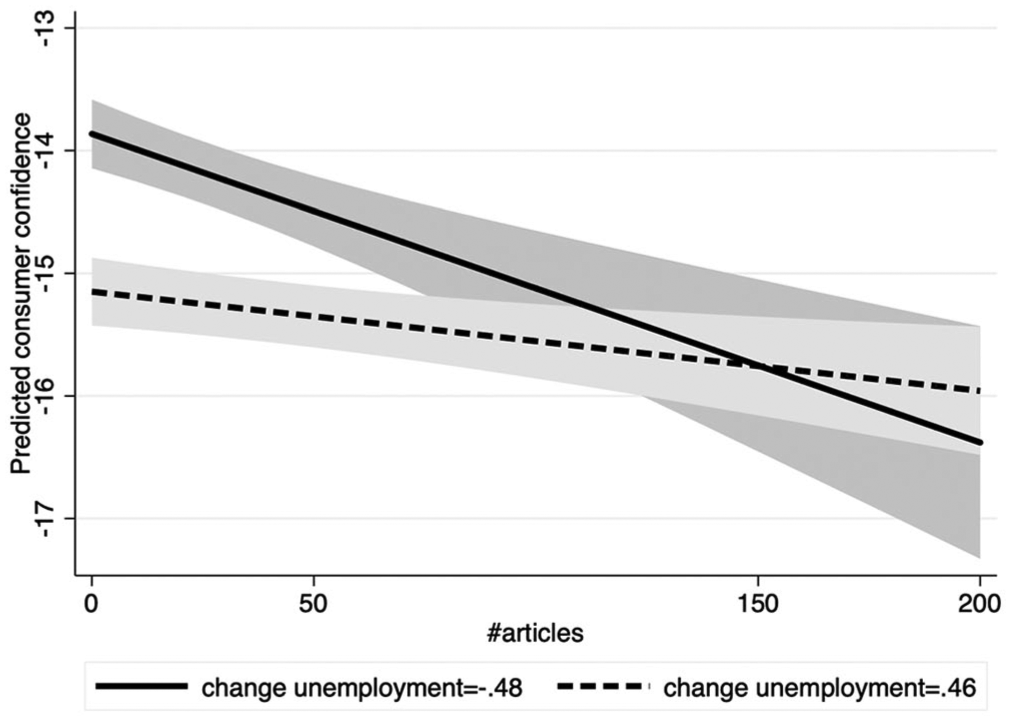
Interaction effect of negative news coverage and change in unemployment.
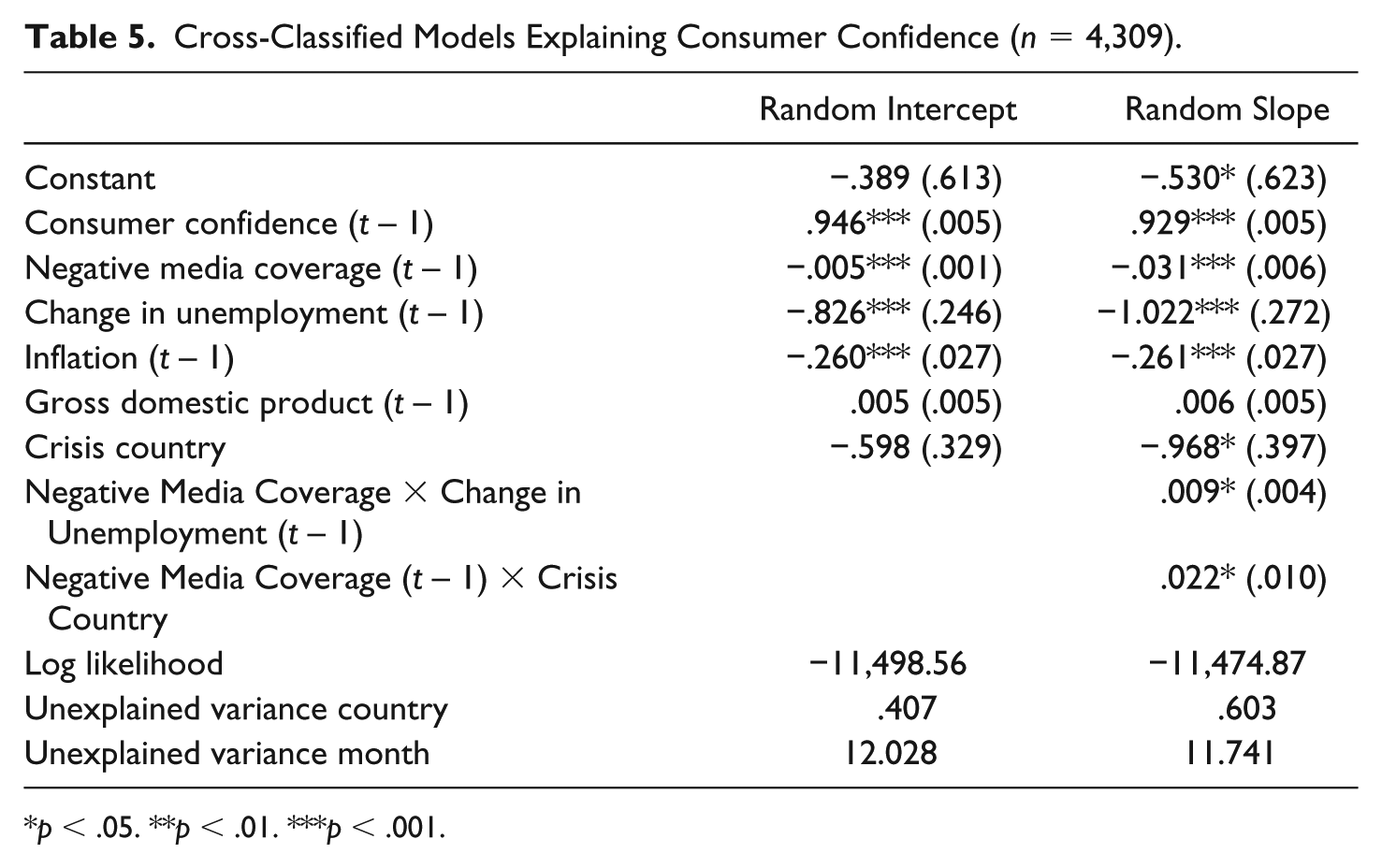
We now move on to the multilevel models, allowing us to test cross-national differences in effects (H4), but also to verify the relation between economic news and consumer confidence (H1). The first model in Table 5 presents the results of a random-intercept model. The results are highly similar to those of the fixed-effects model presented in Table 3 and re-confirm H1: The volume of negative economic coverage has a negative association with consumer confidence, with a similar effect size (–.005 compared with –.006 in the fixed-effects model). Furthermore, we see that the effect of GDP is not significant here. In addition, the crisis country dummy that we added to the model yields a negative, yet not significant effect. This means that consumer confidence lower in those countries hit the hardest by the economic crisis than in the other EU countries. The fact that this is not significant is probably due to the strong impact of previous values through the lagged dependent variable, accounting for initial lower levels in those countries as well.
Cross-Classified Models Explaining Consumer Confidence (n = 4,309).
p < .05. **p < .01. ***p < .001.
The second model in Table 5 allows testing whether the association between media coverage and consumer confidence differs across countries (random slope) and, to that end, includes the two interaction terms—between negative media coverage and both changes in unemployment and the classification of a country as being heavily invested by the crisis. Both these interaction terms are significant and positive, thus (again) confirming H3, and now also H4: In countries that were most affected by the crisis, the negative effect of media coverage is weaker, changing in this model from –.031 to –.009 (i.e., –.031 + .022). Overall, the model outperforms the random-intercept model without interaction effects: χ2(4) = 47.38, p < .001. Figure 2 provides additional insight into the differing effect of negative news coverage in countries hit more versus less severely by the crisis countries, based on the fixed part of the model, while controlling for the unemployment rate and keeping other variables at their mean. We indeed see a steeper line (i.e., a stronger media effect) for the countries hit less severely by the crisis. Yet, the differences in strength remain limited, or at least uncertain, with largely overlapping confidence intervals.
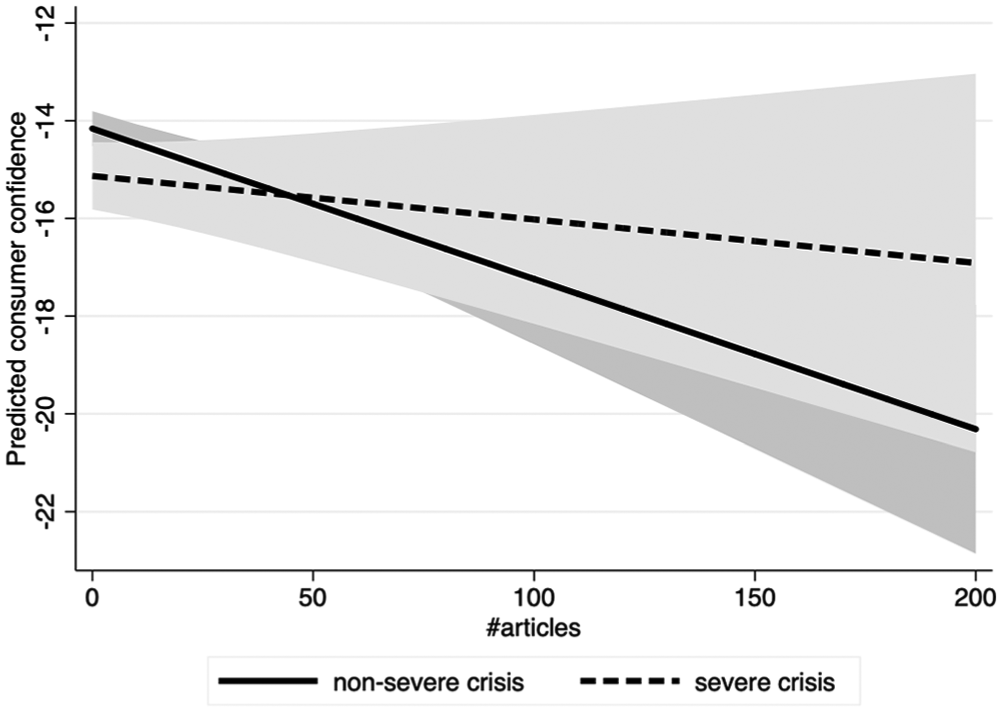
Interaction of negative news coverage and crisis severity of a country.
Discussion
This study set out to investigate whether the association between negative news and economic perceptions is contingent on contextual factors. Concretely, we examined the relationship between negative news coverage and consumer confidence from 2005 to 2018 across all twenty-eight member states of the EU. The main findings are fourfold. First, negative coverage is negatively related to consumer confidence across the board. That is, across time and countries while controlling for real-world economic indicators. This provides a robust and cross-national verification of the existing literature on this subject. Second, and also in line with existing research, this relationship is especially strong for the sociotropic attribute of consumer confidence and to a lesser extent for its egocentric attribute.
Third, across EU member states, the relationship between negative news and consumer confidence weakens when economic conditions are worsening (i.e., unemployment is on the rise). More specifically, the significant interaction effect between unemployment rate and negative news coverage indicates that negatively valenced news has a less strong influence when the economic situation deteriorates. Fourth, the country context affects the relationship between news and consumer confidence even when controlling for the unemployment rate. The results of our study, thus, show that the relationship between negative economic news and consumer confidence is weaker in EU member states that were hit harder by the recent economic crisis compared with countries that were less affected by the crisis. These results are in line with the findings of Vliegenthart and Damstra’s (2019) four-country analyses using national newspaper coverage.
However, some methodological qualifications need to be made. First, we made use of international press agencies to measure negative news coverage. While these agencies seem to considerably overlap with national media in their information provision, they are not a perfect reflection of the national media environments. Country-specific news outlets—which were impossible for us to obtain for most countries—would offer more precise information about economic events, situations, and developments. In addition, all news agency texts that we used in this study are in the English language. This should be mentioned, as coverage in national languages may have reflected different priorities and perspective than English-language coverage aimed at an international readership. Second, we applied a relatively simple search string to detect negative economic news. It can be considered a rather rudimentary measure of valence in news coverage compared with more advanced measures of sentiment (e.g., human coding of single articles or fragments of text). Arguably, the relatively low level of precision (i.e., reliability) in this rudimentary measurements of our independent variable will have resulted in a conservative estimate of the media effects due to larger standard errors (see, for example, Scharkow and Bachl 2017). The conservative statistical models that addressed autocorrelation with a lagged dependent variable and controlled for existing economic perceptions make us even more confident that the estimates found in this study are indicating an important role of the media in the formation of economic perceptions.
Our findings on the contingencies regarding the relationship between negative coverage and economic outcomes enhance MSD theory (Ball-Rokeach and DeFleur 1976). It has been suggested that the degree to which people are dependent on the media can be found on the micro, meso, and macro level (Ball-Rokeach 1998); yet, evidence for the latter level was scarce. Comparing the effects of economic news across countries that widely diverged in terms of economic performance before, during, and after the major crisis, this study demonstrates that the association between media coverage and consumer confidence are weaker when the (negative) economic circumstances are more tangible. In contexts where the crisis was most severe and in situations where unemployment grew most drastically, people will have had alternative sources of information (e.g., personal experiences and interpersonal communication, see Mutz 1998) that decrease their reliance on media coverage. Alternatively, the media mattered most when the consequences of the economic crisis were not felt so directly. The rationale—based on MSD theory—that media effects are less likely to occur in situations where the subject of interest has already been personally experienced, thus, seems to apply to our findings.
We demonstrate this in two ways: (1) dynamically, with an over-time interaction between changes in unemployment and the volume of negative news, and (2) country specifically, with an interaction between nation-based crisis severity and the volume of negative news. In conclusion, our results emphasize the importance of taking contextual factors into account when examining the effects of economic news. Methodologically, our study demonstrates the usefulness of international news agencies in cross-national comparative research. As they provide a reasonable proxy for national news environments and is easily accessible, international news agencies might in several instances be a valid alternative to investigating national outlets, where availability and language barriers hamper the research enterprise.
Altogether, this study substantially contributes to research on economic news effects. By comparing the relationship between negative news coverage and consumer confidence across twenty-eight EU member states and over time, we gained valuable insights into how this relationship is contingent on contextual factors. In general, the results of this paper are important, given the indirect and long-term (negative) consequences news may have for both economic and political developments and decisions (Hetherington 1996; Kellstedt et al. 2015).
Supplemental Material
supplement_material – Supplemental material for When Do Media Matter Most? A Study on the Relationship between Negative Economic News and Consumer Confidence across the Twenty-Eight EU States
Supplemental material, supplement_material for When Do Media Matter Most? A Study on the Relationship between Negative Economic News and Consumer Confidence across the Twenty-Eight EU States by Jeroen Jonkman, Mark Boukes and Rens Vliegenthart in The International Journal of Press/Politics
Footnotes
Declaration of Conflicting Interests
The author(s) declared no potential conflicts of interest with respect to the research, authorship, and/or publication of this article.
Funding
The author(s) disclosed receipt of the following financial support for the research, authorship, and/or publication of this article: This study has been made possible by a VIDI Grant (Project No. 016.145.369) from the Netherlands Organisation for Scientific Research (NWO).
Notes

Supplemental Material
Supplemental material for this article is available online.
Author Biographies
References
Supplementary Material
Please find the following supplemental material available below.
For Open Access articles published under a Creative Commons License, all supplemental material carries the same license as the article it is associated with.
For non-Open Access articles published, all supplemental material carries a non-exclusive license, and permission requests for re-use of supplemental material or any part of supplemental material shall be sent directly to the copyright owner as specified in the copyright notice associated with the article.
