




Abstract
Previous studies using aggregate-level designs demonstrated that the tone of economic news affects consumer confidence. However, the individual-level mechanisms underlying this effect remain to be investigated: It is not clear which consumer confidence attributes are most susceptible to media effects. Theoretically, we integrate the economic voting literature and extend media system dependency by differentiating between the media effects on sociotropic versus egocentric evaluations and the effects on prospective versus retrospective economic evaluations. Methodologically, data from a manual content analysis are linked to data from a three-wave panel survey, containing repeated measurements of consumer confidence. The findings demonstrate that the effects of tone on consumer confidence are largely a consequence of media effects on its sociotropic and prospective attributes: As citizens were exposed to relatively more positive economic news, only the national economic evaluations and expectations for the future improved. The egocentric and retrospective evaluations were not influenced by the tone in news that people had been exposed to.
Keywords
Numerous studies on different time periods and various countries have examined how economic news coverage influences consumer confidence (e.g., Blood & Phillips, 1995; Soroka, 2006; Van Dalen, De Vreese, & Albæk, 2017). Most of this work has relied on aggregate-level data: studying how the volume or tone of economic news coverage in general affects the national population as a whole. This has generated important insights into the overall societal impact of economic news. Simultaneously, however, the question remains how the exposure to economic news of individual citizens affects their personally held evaluations of the economy.
To understand the mechanisms through which these aggregate-level effects convert to the individual citizen, the current study relies on two data sources collected in the Netherlands: A manual content analysis of economic news (i.e., newspapers, television news, and news websites) is combined with a three-wave panel survey with extensive measurements of media consumption and repeated economic evaluation questions. By examining the news content that is consumed by individual citizens and linking this to changes in their economic evaluations, we can estimate how economic news affects the consumer confidence of individual citizens; thus, adding individual-level insights to the previous aggregate-level studies.
We investigate the effect of the tone in economic news and follow the reasoning that exposure to negative economic news will decrease consumer confidence, whereas exposure to positive economic news will do the opposite (Soroka, Stecula, & Wlezien, 2015). Theoretically, this effect can be embedded within valence framing (De Vreese & Boomgaarden, 2003) and information-processing models (Lodge, Steenbergen, & Brau, 1995): Emphasizing negative, neutral, or positive information in an economic news item will affect the receiver’s overall impression of economic conditions in a way congruent with the tone of that media content.
More specifically, we test whether the different attributes of the latent consumer confidence construct are equally susceptible to such an influence of economic news. Contributing to the understanding of the media’s role within the economic voting literature (Kinder & Kiewiet, 1981; MacKuen, Erikson, & Stimson, 1992) and building upon as well as expanding media system dependency (MSD) theory (Ball-Rokeach & DeFleur, 1976; Ball-Rokeach & Jung, 2009), we distinguish between evaluations of the personal (i.e., household) versus the national financial situation and between economic evaluations of the past versus economic expectations for the future. Altogether, this study adds precision to the knowledge of media effects in general (i.e., which attributes of the public’s evaluations are most susceptible?) and to the politically relevant concept of consumer confidence in particular (i.e., individual-level insights).
Dimensions of Consumer Confidence
A differentiation of consumer confidence on two dimensions (i.e., time and subject) is highly relevant, as it relates to ongoing debates about economic voting. A voluminous body of literature shows that economic perceptions have a bearing on citizens’ support for the incumbent president or government. Two controversies characterize this literature (see, for example, Lewis-Beck & Paldam, 2000, pp. 117-118): (1) Are voters more strongly following their sociotropic or egotropic economic evaluations? And, (2) are voters mainly driven by retrospective or prospective economic evaluations? Regarding the first controversy, there is some evidence that voters’ personal economic circumstances may affect their support for the incumbent (e.g., Nannestad & Paldam, 1997; Sanders, 2000). However, most research confirms Kinder and Kiewiet’s (1979) idea that evaluations of the national economy are key (e.g., Hetherington, 1996; Kinder & Kiewiet, 1981; Lewis-Beck & Paldam, 2000): More than by their own pocketbook evaluations, voters follow their evaluation of the national economy when they assess their government.
Regarding the second controversy, considerable evidence supports the claim that voters hold their governments accountable for how they have handled the economy in the past (e.g., Hetherington, 1996; Mutz, 1992; Norpoth, 1992, 1996). Thus, when things go well economically, the government will be rewarded, while worsened economic conditions result in the government being punished at the ballot box. Challenging this perspective, MacKuen et al. (1992, 1996) have argued that voters may act as bankers instead of peasants: Voters’ economic expectations of the future—and not perceptions of the past—would have the strongest impact on their presidential approval (see also Lockerbie, 1992; Nadeau, Niemi, Fan, & Amato, 1999).
As this study aims to scrutinize differences in media effects for specific attributes of consumer confidence, we hope to indirectly contribute to a more complete understanding of economic voting (for an overview, see Hagen, 2008). As the literature suggests that voters are predominantly sociotropic (and, to a lesser extent, prospective), it is valuable to know whether and to what extent these sentiments are (differentially) influenced by mediated information, especially because the media are often neglected in this strand of the literature (Sheafer, 2008).
Following the distinctions frequently made by economic statistical agencies (Organisation for Economic Co-operation and Development, 2000), we specify consumer confidence in two dimensions (see Figure 1): the subject of an evaluation (i.e., financial situation of one’s own household vs. situation of the national economy) and the time dimension of an evaluation (i.e., assessments of the past vs. the future). Theorizing and analyzing these two attributes of consumer confidence (see also Kellstedt, Linn, & Hannah, 2015, p. 195), we provide insights into the effects of economic news.
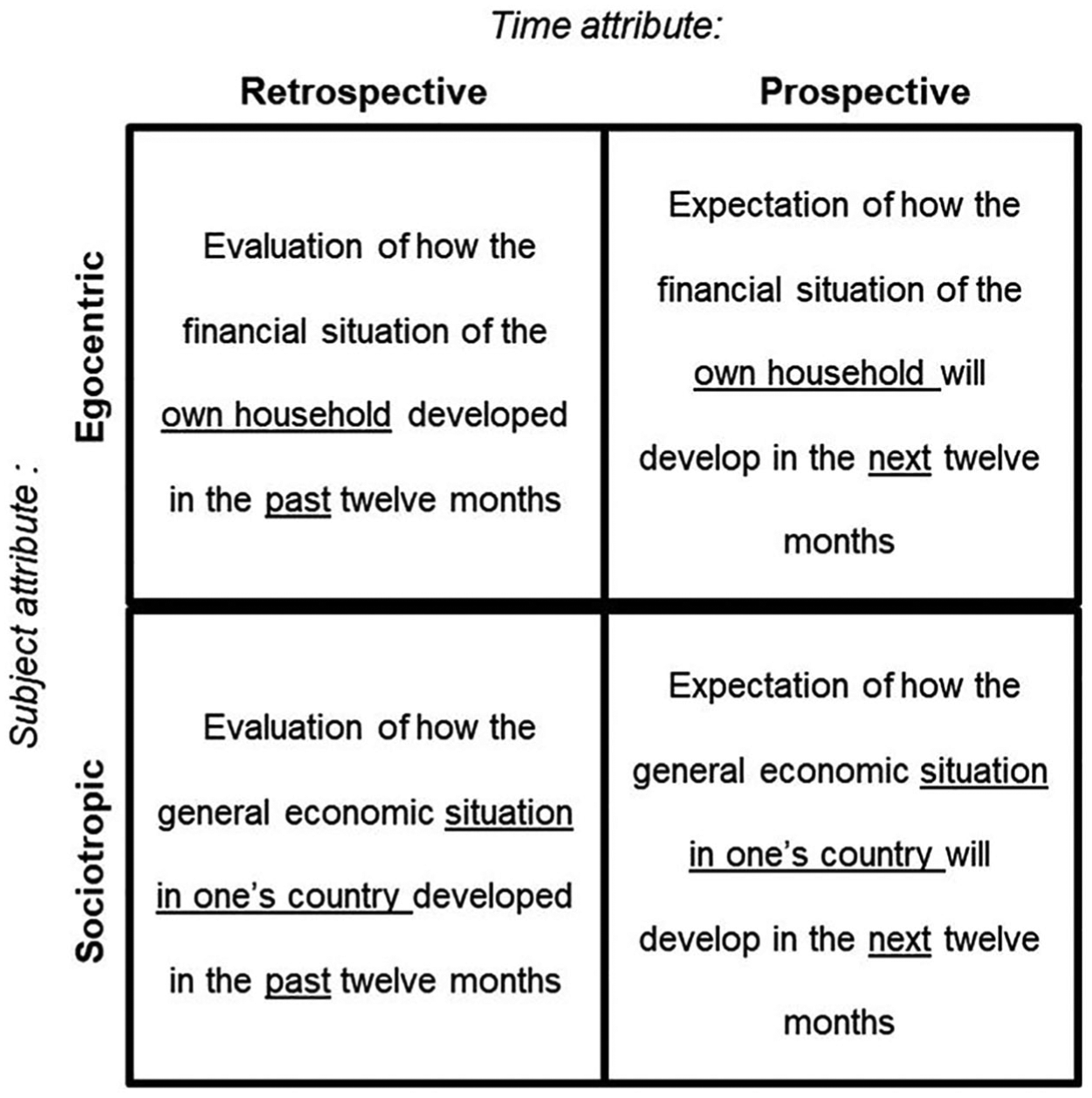
The specified time and subject attributes of consumer confidence.
Media Effects on Consumer Confidence: Processing Information and Media Dependency
The concept of consumer confidence was originally introduced to capture the human element in how citizens develop their economic evaluations (Katona, 1975). Not only do objective economic conditions determine the level of consumer confidence, but a range of external influences (including news media) additionally provide information that may affect citizens’ economic evaluations (Soroka et al., 2015). For example, economic sentiment may be affected by partisanship (e.g., Bartels, 2002; Enns, Kellstedt, & McAvoy, 2012): Economic sentiment not only predicts incumbency support but is also predicted by it. Whereas this sparked academic debate on the causal directions toward consumer confidence (see Lewis-Beck, Martini, & Kiewiet, 2013), the individual-level impact of mediated economic information (another external factor) has remained largely overlooked. Because economic news often does not fully reflect economic conditions (Damstra & Boukes, 2018; Soroka, 2006; Van Dalen et al., 2017), the news may have an independent impact on consumer confidence.
How people deal with new information (e.g., provided by the media) to form and adjust their (economic) judgments can be explained using information-processing models. Traditionally, memory-based models have predicted that citizens store new information in long-term memory and, when needed, recall all these specific pieces of information to “compute” an average judgment (Zaller & Feldman, 1992). The research, however, has shown that this manner of information processing demands too much cognitive effort in most circumstances (Lodge, McGraw, & Stroh, 1989). Information-processing models that consider the constraints of “bounded rationality” are more realistic because people have limited cognitive abilities.
Citizens have a difficult time remembering the details of new information. Even when forgotten, information may still have an attitudinal effect, nevertheless (Graber, 1984). Although memory is weak, processed (but forgotten) messages may still have a lasting effect on the involved evaluations. The reason is that information recall is not a critical mediator between exposure to a stimulus and the subsequent evaluation (Lodge et al., 1995). Impression-driven models of processing explain that citizens integrate new information into the overall impression that already exists in working memory, which was formed by earlier impressions of the same topic (Lodge et al., 1989). This “running tally,” then, is updated with the new information to shape the current impression. In such an online way of processing, the actual piece of information may thus be forgotten once its valence is incorporated in the running tally and, accordingly, may still have an effect on the overall evaluation in a way that requires less cognitive effort.
For the effect of economic news on consumer confidence, this implies that exposure to a positively valenced news item would make a citizen’s overall impression (i.e., running tally) of how the economy is performing slightly more positive. A larger amount of repeated exposure to positive information will further reinforce this impression. Needless to say, negative news will do the opposite (Damstra & Boukes, 2018; Soroka, 2006). All in all, we expect the following:
Under certain conditions, some people are more likely to be affected by the media than others. Directly relevant for the current study is the well-known MSD theory (Ball-Rokeach & DeFleur, 1976). Developed in a period in which scholars learned that neither strong media-effect models (e.g., magic bullet theory) nor limited media-effect models (e.g., selective influence theory) accurately reflect the relationship between media and the public, MSD theory does not explain media effects themselves but focuses on the conditions under which the media are more or less powerful (Jung, 2017). The factors that influence the strength of media effects can be found at levels ranging from the information structure and diversity of information sources available in a country (i.e., macro-level), via a meso-level referring to the available information in one’s personal environment or interpersonal network, to the micro-level of the individual citizen and the psychological processes at work in her or his mind (Ball-Rokeach, 1998). The current article investigates whether, on a conceptual level, a further distinction can be made between media effects on cognitions and attitudes that pertain to the past versus those that pertain to the future (time dimension) and between the cognitions and attitudes that relate to the self versus those that relate to society at large (subject dimension).
Originally, MSD has been defined as “a relationship in which the capacity of individuals to attain their goals is contingent upon the information resources of the media system” (Ball-Rokeach, 1985, p. 487). When the media have exclusive control over the dissemination of particular information—to the extent that people have goals that require access to that specific information—individuals will be dependent on the media (Ball-Rokeach & DeFleur, 1976; Halpern, 1994). Thus, when alternative sources of information are available, people will be less media-dependent.
People are more likely to be media-dependent in ambiguous situations. When an issue is perceived as unpredictable—which is most likely the case for economic conditions in the aftermath of a severe crisis—people are likely to experience affective or cognitive discomfort (Ball-Rokeach, 1985). To reduce this discomfort, they will seek information to learn what is going on and what actions should be taken. If no other sources of information are available, they will be media-dependent to achieve this goal (i.e., reduce discomfort). Following MSD theory, the strength of media effects will thus be conditional upon the ambiguity of a situation and whether the media have exclusive control over the information upon which citizens’ goals are contingent. Applied to the subject and time dimensions that we specified for the consumer confidence concept, MSD theory provides us with clear guidelines to formulate hypotheses.
Regarding the subject dimension, there is an obvious asymmetry of available information for the economic situation of the nation as a whole (sociotropic) versus the personal situation (egotropic). To evaluate the egotropic attribute, a range of alternative information sources are available: Citizens can draw on personal experiences and interpersonal communication (Mutz, 1998). To form an evaluation of how a country’s economy is generally performing, most citizens will have few other options than to rely on the media. In such situations of high ambiguity, people prefer to turn to the media not only for reasons of exclusivity of information but also because they expect a higher level of expertise from journalists than what is available in their interpersonal network (Hirschburg, Dillman, & Ball-Rokeach, 1986).
This explains why Boomgaarden, Van Spanje, Vliegenthart, and De Vreese (2011) found that economic information matters more for (sociotropic) expectations about the national economy than for (egocentric) expectations regarding the personal economic situation. Similarly, Hagen (see his 2008 overview) showed in two studies that egotropic economic perceptions—particularly the fear of losing one’s job—were affected by real-world unemployment figures, whereas the perceived societal importance of unemployment (sociotropic) was affected by media coverage. Due to the higher degree of media dependency for sociotropic compared with egotropic evaluations, we expect the following:
For the time dimension, a clear difference exists regarding the level of ambiguity for assessments of the past versus those of the future. Whereas retrospective evaluations address issues that have already happened, prospective evaluations concern situations yet to come. In terms of Ball-Rokeach’s (1985) idea of ambiguity, the future is unpredictable, whereas not much remains to be predicted for the past. With less ambiguity, people will be less likely to experience a sense of discomfort and, therefore, have less reason to rely on the media to reduce such discomfort. Moreover, the media have stronger control over information on the future than on the past. People have experienced economic changes in the past or know others who did and can therefore base their retrospective evaluations (partly) on real-life occurrences. Their personal environment and interpersonal network, by contrast, will provide less information about prospective economic conditions. This could also explain why news coverage more strongly relates to prospective than retrospective economic developments (Soroka et al., 2015)—this where the media can be of added value to its audience. Without alternative sources of information on the future, people’s dependency on the media increases (Fry, 1981).
The few studies that investigated this phenomenon, however, reported mixed results. Relying on aggregate-level data, Damstra and Boukes (2018) found media effects on expectations for the future but not on evaluations of the past, whereas Soroka et al. (2015) did not confirm this difference. Following MSD theory and the higher ambiguity of future conditions together with fewer alternative sources of information, however, we expect the following:
Method
We rely on a data set in which manual content analysis data are linked to individual-level data from a panel survey that included three repeated measurements of consumer confidence and detailed measurements of media consumption. The linkage of actual media content characteristics (i.e., tone) with individual survey measurements (i.e., consumer confidence) creates a more externally valid test of causality than experiments can possibly do and provides more detailed insights into the mechanisms that are underlying media effects than aggregate-level analyses (De Vreese et al., 2017). The linkage analysis allows for the unraveling of the (expected) effects on consumer confidence of the improving real-world economy from the effects of the consumed tone in news—more specifically, whether consumer confidence especially increased among those who were exposed to more positive economic news.
Data were collected from February until June 2015. It is important to contextualize this research period from the perspective of the economic developments at that time in the Netherlands. Reports of the Statistics Netherlands (Central Bureau of Statistics [CBS]) show that the first half of 2015 was characterized by early signs of recovery after years of economic crisis. In particular, the stock market (Amsterdam Exchange index [AEX]) showed a strong upward trend: It opened the year at 425, reached levels above 500 until the end of May, and zigzagged down to 473 on the last day of the panel survey. Regarding unemployment, the developments were less strong but unequivocally positive: Unemployment was 3.6% (seasonally adjusted) before the crisis (until November 2008) and reached its peak at 7.9% (February 2014); it was 7.1% at the beginning of the study (February 2015) and further decreased to 6.9% by the last survey wave. Similarly, modest improvements were visible in the housing market: In February 2015, the average price of a house was €216,678, which increased to €229,381 by June. Finally, after years of decline, public purchasing power increased again in 2014, with 1.9% and slightly less in 2015 (1.3%). Altogether, the economy gradually improved between February and June 2015, but had not fully recovered from the crisis and the stock market showed mixed signals.
Content Analysis
Economic news items originating from 23 outlets have been analyzed in the periods leading up to the three survey waves. The current study, thereby, includes a wider range of news media types (i.e., newspapers, television, and websites) and news outlet types (i.e., mainstream, softer, and regional) than those of previous studies on this subject and other studies employing the same “linkage” approach. This was important because fewer citizens are reached by the main newspapers and news broadcasts (Mindich, 2005); media diets have increasingly fragmented across platforms and outlets (Prior, 2007). To adequately examine the news that citizens consume, it will be necessary to study a wide selection of outlets.
Using an extensive search string in LexisNexis (see Boukes & Vliegenthart, 2017, Footnote 2), we retrieved 4,439 economic news articles from the newspapers with the largest reach in the Netherlands. This included quality (Volkskrant, NRC, and Trouw) and popular outlets (Telegraaf and AD), the free popular daily Metro, the only Dutch financial newspaper (Financieel Dagblad), and the three largest regional newspapers (i.e., Noordhollands Dagblad, Dagblad van het Noorden, and Gelderlander) that originated from different publishing houses (HDC, NDC, and Persgroep). It is important to include regional outlets because 39% of the consumed daily newspapers in the Netherlands are regional newspapers. To save costs, regional outlets owned by the same publishing house share the production and coverage of national and international issues.
For television, 434 manually selected economic news items from a variety of programs were analyzed. The television programs included regular news casts of the public broadcaster (NOS Journaal and NOS op 3) and the commercial broadcaster (RTL Nieuws). News items were also analyzed in current affairs programs (Nieuwsuur and EenVandaag), a business news show (RTL Z) and two domestically oriented soft news programs (EditieNL and Hart van Nederland).
For the newspaper and television outlets, all news items that dealt with the economy were selected. The same approach for selecting all news was followed for NU.nl, which is the most frequently visited news website of the Netherlands. For four other news websites (Telegraaf.nl, NOS.nl, Volkskrant.nl, and NRC.nl), 25% of the economic coverage was randomly selected (due to budget constraints), leading to a total of 757 analyzed online news items. These four websites are the most popular online platforms of offline news outlets (AD.nl was not included due to practical difficulties scraping its website). Using the same search string as for the newspapers, news website data were retrieved from the INCA platform (Trilling et al., 2018).
“Economy” in this study was defined broadly, including reporting about the general state of the economy and about economic subtopics, such as inflation, unemployment, interest rates, or the housing market. Intercoder reliability for this decision was on the border of acceptable (Krippendorff’s αnominal = .65), but this potential unreliability was largely remedied in the coding process for tone (see below) because coders also had to determine—and thus verify—whether a news item actually contained an economic evaluation.
Tone measurement
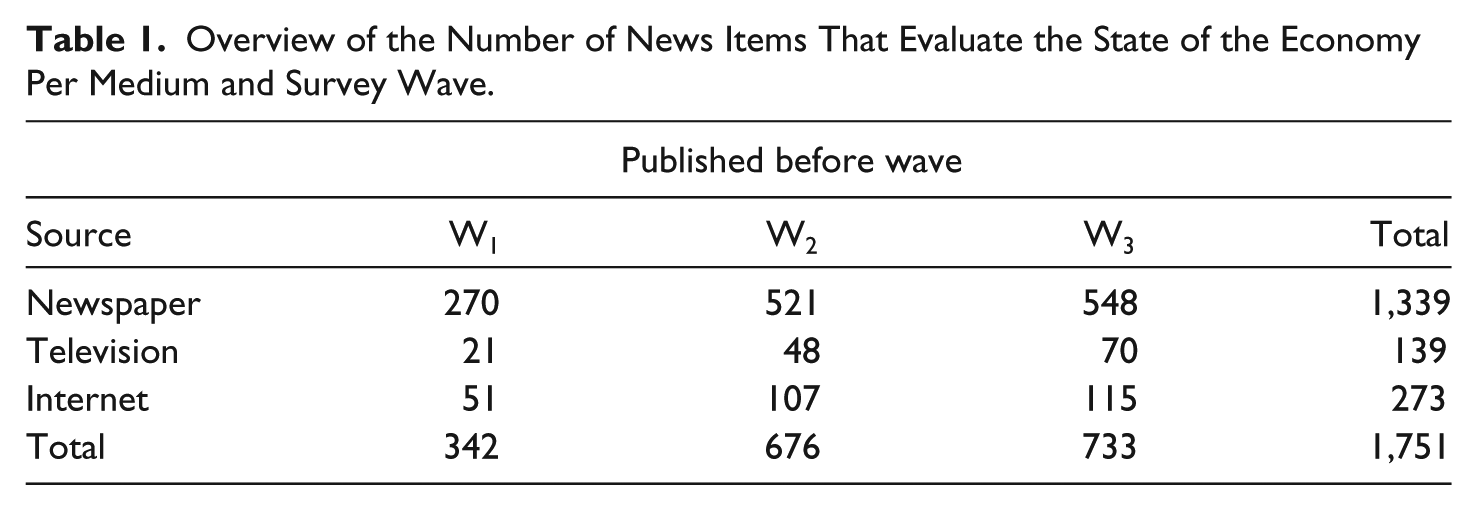
Every selected news item was coded for whether it provided an explicit evaluation of the state of the Dutch economy. Only when an evaluation was present, the valence of news items was scored on a scale from −2 (completely negative), −1 (mixed but mostly negative), 0 (neutral, balanced), +1 (mixed but mostly positive) to +2 (completely positive). The average tone was slightly positive (M = 0.18, SD = 1.53), which does not come as a surprise, given that during the first months of 2015, the Netherlands went through a period of economic recovery. Table 1 provides an overview of the number of news items that contain an evaluation of the economy per medium and survey wave. In the presented analyses, the first wave is solely used to control for the lagged dependent variable. The content data analyzed before fielding the first wave, therefore, are not utilized in the presented analyses but were used for the robustness check (Supplemental Appendix A).
Overview of the Number of News Items That Evaluate the State of the Economy Per Medium and Survey Wave.
Coding was undertaken by a large team of 22 student assistants. Intercoder reliability tests were performed on a subset of 148 articles (both in print and online) that were analyzed by at least three coders. This resulted in a data set of 802 articles, of which 217 contained an economic evaluation (the average article was coded by 4.72 coders). Intercoder reliability statistics, calculated with the help of Python-script Nogrod 1.1 (Wettstein, 2018), show that the tone was assessed reliably by the human coders (Krippendorff’s αordinal = .73).
The data set was aggregated on both the outlet (i.e., specific newspaper, television program or website) and wave level. Accordingly, we created a data set with observations per outlet/wave combination. Every unit of observation, thus, described the number of news items published about the economy before a particular survey wave (i.e., visibility), together with the summed tone score of all these news items within that one outlet.
The sum of tone scores was used rather than the average tone per outlet to take into account that some outlets repeatedly positively (or negatively) covered the economy, whereas other outlets may have only done this once or twice. By summing tone scores, repeated messages of a similar tone carry a heavier weight than a single message of the same tone because the repeated ones arguably should have a stronger effect (Chong & Druckman, 2007): Media effects are mostly learning effects, and louder messages—those frequently repeated—induce more frequent processing, which increases their availability in the minds of recipients (i.e., impact on the “running tally”). Hence, we employ a summed tone measurement.
Survey
A three-wave panel survey was conducted in the first half of 2015. The study was operated by I&O Research (International Standards Organization [ISO]-certified) on a sample of Dutch adults initially recruited using random sampling from population registers. The exact fielding dates were February 23 (Wave 1), April 20 (Wave 2), and June 15, 2015 (Wave 3), with a gap of 8 weeks between each wave.
A total of 9,112 people participated in the first questionnaire, of which 6,386 eventually completed the survey (completion rate: 70.1%). Only respondents who participated in the previous wave were invited for the subsequent wave. For Wave 2, 4,301 respondents completed the questionnaire (completion rate: 69.0%). In Wave 3, there were 3,270 completed surveys (completion rate: 77.0%). The attrition of respondents was considerable (average: 28% per wave); however, response and completion rates were comparable with those of previous studies using different pollsters or contexts.
Independent variables
Media consumption of a wide array of news outlets was measured in the first survey wave. For every news outlet that was content-analyzed, one question asked how many days per week a respondent consumed it. We have followed recommendations on how to tap media consumption by asking for specific media outlets and a concrete frequency to increase the reliability and validity of the estimates (Andersen, De Vreese, & Albæk, 2016). Values are recoded to range from 0 (i.e., minimal use) to 1 (i.e., maximal use). To account for the popularity of regional newspapers in the Netherlands, respondents answered an open-ended question in which they indicated the regional newspaper that they consumed. The open-ended responses were manually recoded to be published by HDC, NDC, and Persgroep to link them to the content analysis results. On average, respondents indicated that they use approximately four news outlets on a daily basis—2.34 television programs (SD = 1.38), 0.92 newspapers (SD = 0.78), and 0.82 websites (SD = 0.87). 1
The individual consumption scores of specific outlets were combined with the actual presence of content features in the specific outlet, as revealed by the content analysis. Hence, the tone is summed across news outlets and combined in one variable because we theoretically do not expect the hypothesized effects to vary across media outlets. For every individual respondent (i) before every wave (j), the frequency of consumption of a certain outlet (k) is multiplied by the summed tone of economic news within this outlet k. We, thereby, follow this formula:

This variable indicates how positive (or negative) the news about the economy was that a respondent would have been exposed to in the period leading up to a survey wave (MW1 = −1.43, SDW1 = 5.28; MW2 = 17.74, SDW2 = 13.99; MW3 = 24.57, SDW3 = 19.80). The same approach was followed for the visibility of economic news to which respondents would have been exposed in the outlets they consumed in the 8 weeks leading up to the survey (i.e., the number of news items; MW1 = 36.26, SDW1 = 29.74; MW2 = 81.86, SDW2 = 60.67; MW3 = 88.99, SDW3 = 64.26). Visibility was included in the analyses as a control variable to verify whether it is indeed the (cumulative) tone of news that has an effect rather than simply the exposure to economic news.
Dependent variable
In line with the traditional measurement of consumer confidence, five questions were asked: (1) In your opinion, has the financial situation of your household improved, deteriorated, or remained the same over the past 12 months? (2) Do you think that the general economic situation in our country has improved, deteriorated, or remained the same over the past 12 months? (3) How will you evaluate the financial situation of your own household in the next 12 months? (4) What is your opinion of the general economic situation in the 12 months to come? (5) Do you think it is the right or wrong time to buy expensive items such as furniture, a washing machine, or a television set?
These five questions—all answered on an 11-point scale, ranging from 0 (much worse) to 10 (much better)—formed a reliable scale in each survey wave (W1: α = .78; W2: α = .78; W3: α = .79). This measurement of consumer confidence, thus, has the advantage (e.g., compared with the Index of Consumer Sentiment [ICS]) that it “neatly forms a 2 × 2 grid” (Kellstedt et al., 2015, p. 195), which follows our theoretical framework. The scales were linearly transformed to range from −5 to +5 to ease the interpretation of the results (i.e., a value of 0 indicates a neutral evaluation of the economy) while maintaining the original 11-point scale.
To test the hypotheses, the scale was broken down into four attributes of consumer sentiment along the lines of our hypotheses: (1) sociotropic evaluations, that is, evaluations and expectations for the general national economy (rW1 = .53; rW2 = .55; rW3 = .52); (2) egocentric evaluations, that is, evaluations and expectations for the respondent’s own financial household (rW1 = .71; rW2 = .73; rW3 = .75); (3) prospective evaluations, that is, expectations for the coming year of the household and general economy (rW1 = .51; rW2 = .46; rW3 = .46); and (4) retrospective evaluations, that is, evaluations of the past year’s development of the household and general economy (rW1 = .39; rW2 = .41; rW3 = .39). All correlations are significant at p < .001.
Analysis
The data set was reshaped into a long (i.e., stacked) format with a unique respondent-wave combination on every row. As such, the data are analyzed in one pooled model instead of analyzing the waves separately. Therefore, 4,301 respondents are used in the estimation of consumer confidence for Wave 2, and 3,270 respondents are used for the estimation for Wave 3. Keeping the incomplete cases in the analysis, attrition becomes a less severe issue because the information of those who dropped out between the survey waves is still considered for the prediction of Wave 2 (Hox, 2010). To address the repeated observations within respondents, ordinary least squares (OLS) regression analyses are run with robust clustered standard errors that correct for intraindividual correlation. Fixed-effects regression models, also including the respondents who only participated in Wave 1, reveal similar results (see Supplemental Appendix A).
The analyses include a lagged dependent variable as a control variable (i.e., controlling for the previous level of the dependent variable), which means that models focus on change in the dependent variable compared with the previous wave and that other individual-level control variables, therefore, are unnecessary. The lagged dependent variable, after all, already captures the effects of respondents’ background characteristics, which are arguably stable over the relatively short study period. Controlling for the general state of the economy is not necessary because this does not vary between respondents. However, we control for “Wave” (coded as −1, 0, or 1) to capture general overtime trends in economic perceptions. Additional analyses also control for economic statistics on the postal code level (i.e., unemployment rate and average income) and find similar results as models without these controls. The results proved to be robust for including time-invariant control variables that measure whether people voted for a government party in the previous parliamentary elections (i.e., positive effect throughout), political left-right ideology (i.e., no effect), and self-reported news consumption without a linkage to content features (i.e., no effect in most models).
Regression diagnostics
Although visibility and tone correlated rather strongly (r = .72)—those who were exposed to more economic news were also exposed to a more positive tone—the models were not confronted with a serious multicollinearity problem (maximum variance inflation factor [VIF] value of 2.42). Normal probability plots show that residuals from the presented models are approximately normally distributed. Further inspection of the residuals demonstrates that autocorrelation (i.e., correlation between the residuals from both waves for the same individual) is weak and negative (−.25 ≤ r ≤ −.19) in all instances. Finally, alternative models with nonlinear transformations of our key independent variables were tested: Models with squared or log-transformed independent variables did not yield significantly better model fit, making us confident in relying on linear models.
Results
Development of Tone in Economic News
Figure 2 displays the average tone in the different news modalities (before aggregating the data into wave-outlet combinations). Overall, there is a clear pattern of economic news becoming more positive over the investigated time period for all three modalities of news media (i.e., newspaper, television, and Internet); a variable measuring the day in 2015 had a positive effect on the tone variable (b* = .07, p = .005). Overall, the tone of television news was slightly more positive (M = 0.32; SD = 0.13) but did not differ significantly from the tone of online news (M = 0.21; SD = 0.09, p = .471) or from the tone of printed newspapers (M = 0.16; SD = 0.04, p = .217). The relatively similar coverage across outlets provides a further reason to combine the tone scores into one independent variable.
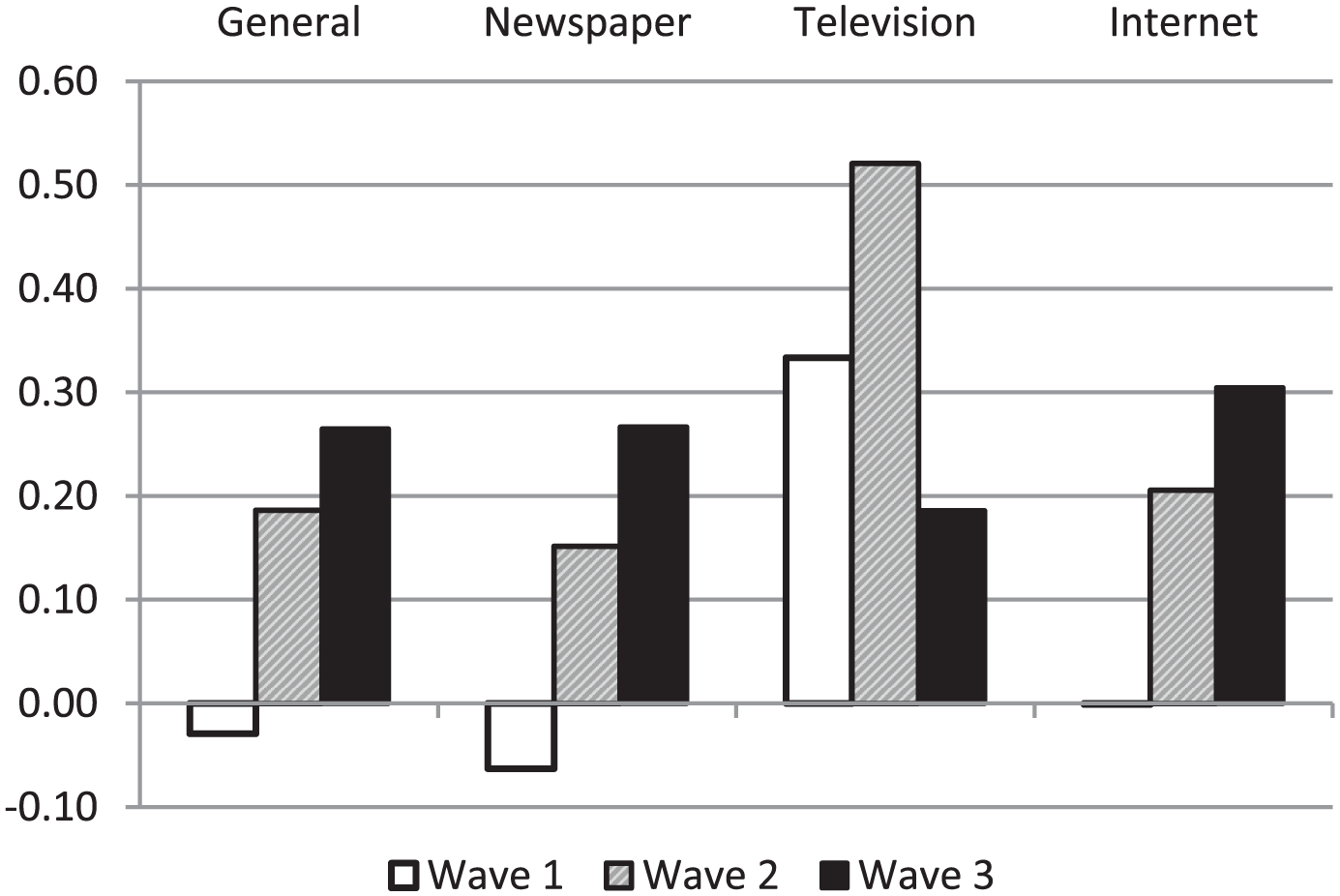
Mean tone scores per medium and wave (at mean values of the other variable and controlling for the wave).
Development of Consumer Confidence
Figure 3 shows that almost all indicators of consumer confidence improved between February (Wave 1) and June 2015 (Wave 3). Except for sociotropic evaluations in Waves 2 and 3, the consumer confidence variables were still negative throughout the investigated period (i.e., scoring below the middle point of the scale on average). Without any further control variables, OLS regression models show that the general indicator of consumer confidence (b = 0.13, p < .001), sociotropic evaluations (b = 0.28, p < .001), evaluations of the past (b = 0.10, p < .001), and expectations for the future (b = 0.19, p < .001) increased linearly with every subsequent wave. The average egocentric evaluations of how the financial situation of people’s own household has, or will, develop(ed), however, remained stable (b = 0.01, p = .340). These trends correspond with the research showing that the least variance occurs in the personal economic evaluations (and most within assessments of national economic conditions; Kellstedt et al., 2015).
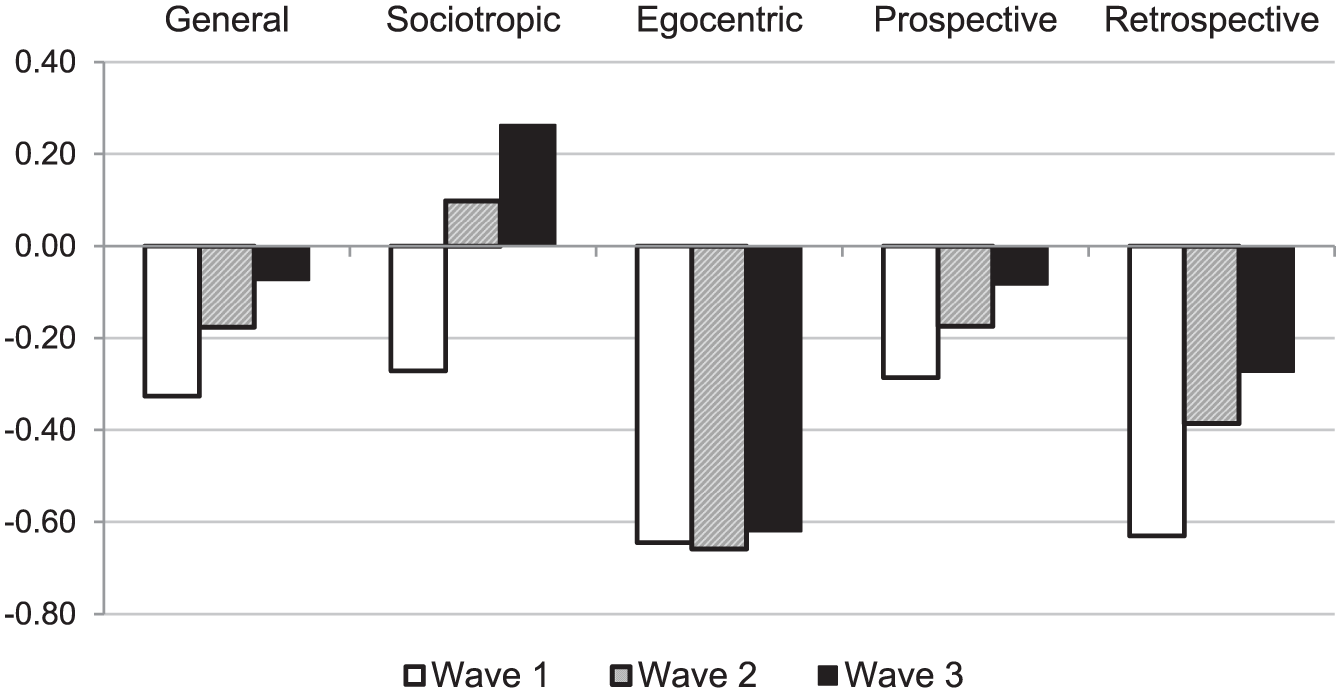
Development in consumer confidence and its specific attributes over time.
Media Effects on Consumer Confidence
Testing the hypotheses, we controlled for the overall trends in consumer confidence between waves (Wave) as well as for individuals’ previous level of the dependent variable (t − 1). We found that the tone in economic news positively affects consumer confidence in general (see Table 2, Model 1). The unstandardized coefficients are small because we use summed tone scores, but the standardized coefficient (b* = .03, p = .005) clearly shows that as people were exposed to more positive news about the economy, their level of consumer confidence increased. This result concretely means that as the exposure to tone in news becomes one standard deviation more positive (i.e., 17.20 points), the general index of consumer confidence will increase with 0.03 standard deviations. Furthermore, a negative effect was found for the number of economic news items that people were exposed to (i.e., visibility; b* = −.03, p = .008), which may be due to the agenda-setting (McCombs, 2005) or “burglar alarm” (Zaller, 2003) function of the media. Confirming Hypothesis 1, positive economic news increases consumer confidence.
Predicting Consumer Confidence and Its Attributes With Media Variables (Pooled).
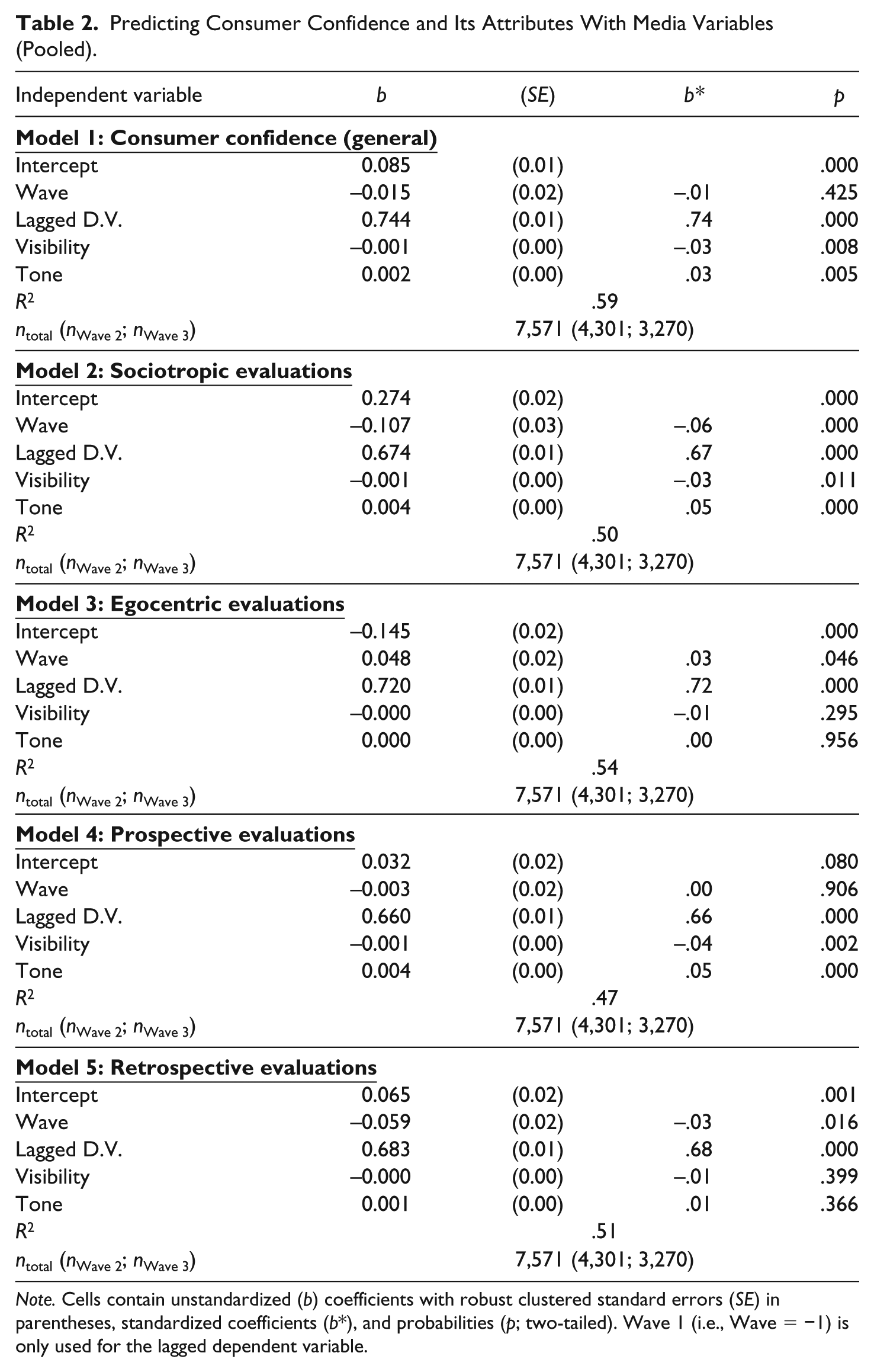
Note. Cells contain unstandardized (b) coefficients with robust clustered standard errors (SE) in parentheses, standardized coefficients (b*), and probabilities (p; two-tailed). Wave 1 (i.e., Wave = −1) is only used for the lagged dependent variable.
To assess whether particular attributes of consumer confidence are more strongly affected than others, we ran separate models for sociotropic and egocentric evaluations. Model 2 in Table 2 shows that the tone in the economic news that people were exposed to affected the sociotropic evaluations of the economy. As people were exposed to more positive vis-á-vis negative news about the economy, their evaluations of the national economy improved (b* = .05, p < .001). In contrast, such an effect was not found in Model 3, which analyzed the effects on egocentric evaluations. The perceptions of how well (or how poorly) the state of respondents’ own financial household developed were insensitive to the tone of the economic news to which people had been exposed (b* = .00, p = .956). The difference in the effect coefficients of tone across the two models (i.e., effect of tone on sociotropic vs. egotropic evaluations) is significant: Wald χ2(1) = 12.99, p < .001. Hence, we find evidence that confirms Hypothesis 2: The tone of economic news positively affects sociotropic economic evaluations more strongly than egocentric economic evaluations, which remain unaffected by the tone of the economic news to which people are exposed.
Regarding the third hypothesis, we analyzed the effects on prospective evaluations and retrospective evaluations. People’s expectations of how the economy will develop in the coming 12 months (see Model 4) were significantly influenced by the tone in the economic news to which they had been exposed. Consuming more economic news with a positive tone caused a more optimistic outlook toward the economic future (b* = .05, p < .001). Evaluations of the economic situation in the past year (Model 5), however, remained unaffected: Tone in economic news had no significant influence on retrospective evaluations (b* = .01, p = .366). A linear comparison of the effect that tone has in Model 4 versus Model 5 shows that prospective evaluations were more strongly affected by the tone in economic news than were the (unaffected) retrospective evaluations, Wald χ2(1) = 7.98, p = .005. This finding is in line with Hypothesis 3.
Discussion
The current study complements a vast body of aggregate-level research by providing individual-level evidence for the effect that the tone in economic news coverage has on consumer confidence and specifies this effect on two concrete dimensions of this latent construct. Linking data from a manual content analysis to that of a panel survey, we demonstrate that the tone in economic news influences citizens’ economic evaluations. By covering a wide variety of news outlets, we were able to analyze a large share of citizens’ news diet and, accordingly, measure the independent variable in greater detail than in the previous research on this topic.
From the content analysis, we found that the tone of economic news improved in the first half of 2015. This reflected real-world economic developments, modestly rising housing prices, decreasing unemployment rates, and increasing purchasing power. Only for television was a relatively more negative tone observed in Wave 3 compared with the previous period. This may be explained by the declines in the stock market occurring in May; apparently, television news may have been more sensitive to these negative short-term developments occurring in a generally improving economy. The overall positive developments of the real-world economy are also reflected in the survey measurements of consumer confidence; people generally became more positive toward the national economy.
The linkage analysis was applied to examine whether the rise in consumer confidence was (partly) caused by the news to which people were exposed or purely the result of the improving economy. Overall, we found positive effects of the tone in economic news on consumer confidence: The media played a mediating role between the improving economic conditions and citizens’ perceptions of these. People who followed the news less intensively had fewer chances to positively update their consumer confidence because they lacked the information to do so and, consequently, remained relatively more pessimistic toward the economy.
However, the effects were not particularly strong. The standardized coefficients did not exceed b* = .05, which implies rather modest effects. One reason is theoretical: The media are not people’s only source of information when forming their economic evaluations. Haller and Norpoth (1997) called the economy “a classic example of a ‘doorstep issue’” (p. 556). There are many alternative sources that contribute to people’s consumer confidence (Katona, 1975), including real-world economic conditions (Lischka, 2015) and interpersonal communication (Mutz, 1998). The modest media effects may, however, also be related to methodological choices.
We used conservative model specifications with strong effects of the lagged dependent variable that already explained a major share of the variance, thus making large effects from other variables unlikely. Moreover, a manual content analysis inevitably copes with unreliability on the side of human coders (Bachl & Scharkow, 2017), and respondents face difficulties in estimating their precise amount of media consumption (Prior, 2009). Effect strengths are, therefore, likely to be severely downward-biased in linkage analyses, only revealing a small portion of the true effect. As Scharkow and Bachl (2017) explain, “Most likely, the true effects are stronger than the observed effects . . . Put another way, scholars who detected media effects can be reasonably confident that a true effect existed and was larger rather than smaller” (pp. 337-338).
In addition to showing that economic news has a direct impact on consumer confidence, our findings contribute to MSD theory (see Ball-Rokeach & DeFleur, 1976) by analyzing the impact of economic evaluations on different attributes. MSD theory predicts that under some conditions—that can be found on the macro-, meso-, or micro-level—citizens are more media-dependent (Ball-Rokeach, 1998; Jung, 2017). In addition, we distinguish a time and subject dimension within the consumer confidence construct at a conceptual level (see Kellstedt et al., 2015). In addition, for these conceptual dimensions, citizens will face more or less ambiguous situations and have more or less firsthand experiences, which determine how strongly they have to rely on the media to achieve their goal of reducing ambiguity and, eventually, shaping their economic evaluations (e.g., Soroka, 2002). By empirically separating consumer confidence into four attributes of evaluations (i.e., sociotropic, egocentric, prospective, and retrospective), we could exactly pinpoint the topic attributes that are most strongly influenced by the media.
Our findings confirm the hypotheses that evaluations of the national economy and expectations regarding the economic future are affected most strongly by economic news, whereas evaluations of the past and of one’s own household remained unaffected. The latter are, most likely, predominantly shaped by personal experiences and interpersonal communication (Mutz, 1998). Thus, not only does MSD theory explain why media effects are stronger or weaker in particular contexts, on particular individuals, or for particular topics, but the current study shows how the MSD framework also explains why—within the same sample—different attributes within the same topic are affected more or less strongly.
An alternative explanation for the finding regarding the time dimension could be a future-oriented focus in economic journalism (see, e.g., Soroka et al., 2015). 2 In journalistic routines, old developments (from the past) may not be considered “news,” while potential future developments are. Whereas the time and subject dimension were separated in the survey measurements of consumer confidence, the dimensions were combined in the content analysis. The decision to not separate them in the independent variable was initially based on theoretical grounds but was later reinforced by methodological limitations. Theoretically, there is sufficient reason to assume that news with a sociotropic scope can also influence egotropic perceptions: News that national unemployment is decreasing may provide an individual with hope that he or she will find a (better) job. Extensive research on exemplification theory (Zillmann & Brosius, 2000), on the contrary, has shown that news with a personalized focus influences evaluations and attitudes toward sociotropic issues (Aarøe, 2011; Boukes, Boomgaarden, Moorman, & De Vreese, 2015): People tend to generalize exemplar information for broader judgments (Brosius & Bathelt, 1994), causing audiences to overestimate the severity of a problem in society at large (Aust & Zillmann, 1996). Less evidence exists for the time dimension, but one could imagine that positive economic news about the past months could make audiences more optimistic about the future.
Theoretically, it thus seemed valid to combine the time and subject attributes into one independent measurement of the tone in economic news; however, methodologically, it also proved to be infeasible to pull the attributes apart. Many news stories (i.e., 26%) simultaneously reported on retrospective and prospective economic developments, whereas another 20% only described the current situation. This interwovenness complicated a reliable annotation of the time dimension by our coders. 3 The data, however, seem to indicate that economic news in our sample more often covered past developments (66.9%) than future developments (38.9%), making the alternative explanation that news would predominantly focus on prospective conditions and therefore particularly affect this attribute of consumer confidence unlikely.
Our findings substantively inform about the possible consequences of economic news. Previous research has shown that sociotropic evaluations of the future economy have an impact on consumer spending (Kellstedt et al., 2015). This is exactly the attribute on which economic news has the strongest bearing. Regarding the fortune of political incumbents, the economic voting literature, moreover, has shown that (mainly) sociotropic evaluations of the economy determine whether citizens reward or punish governing politicians and parties (Lacy & Christenson, 2017); these are both perceptions of achievements in the past (Hetherington, 1996; Norpoth, 1996) and expectations for the future (MacKuen et al., 1992; Nadeau et al., 1999). Therefore, economic news could indirectly influence the popularity of political actors via its impact on sociotropic and prospective evaluations and, therefore, may (partly) explain the major electoral shifts since the outbreak of the financial crisis (Hernández & Kriesi, 2016). The current study, however, demonstrates that news media do not always spread negativity; in times of economic recovery, it also spreads optimism.
Supplemental Material
MediaDependencyAndConsumerConfidence_Final_copyedited_July2019_OnlineAppendix – Supplemental material for Media Effects Across Time and Subject: How News Coverage Affects Two Out of Four Attributes of Consumer Confidence
Supplemental material, MediaDependencyAndConsumerConfidence_Final_copyedited_July2019_OnlineAppendix for Media Effects Across Time and Subject: How News Coverage Affects Two Out of Four Attributes of Consumer Confidence by Mark Boukes, Alyt Damstra and Rens Vliegenthart in Communication Research
Footnotes
Declaration of Conflicting Interests
The authors declared no potential conflicts of interest with respect to the research, authorship, and/or publication of this article.
Funding
The authors disclosed receipt of the following financial support for the research, authorship, and/or publication of this article: This work was partly carried out on the Dutch national e-infrastructure with the support of SURF Cooperative and supported by a VIDI grant (project no. 016.145.369) from the Netherlands Organisation for Scientific Research (NWO).

Supplemental Material
Supplemental material for this article is available online.
Notes
Author Biographies
References
Supplementary Material
Please find the following supplemental material available below.
For Open Access articles published under a Creative Commons License, all supplemental material carries the same license as the article it is associated with.
For non-Open Access articles published, all supplemental material carries a non-exclusive license, and permission requests for re-use of supplemental material or any part of supplemental material shall be sent directly to the copyright owner as specified in the copyright notice associated with the article.
