



Abstract
Background and Research Aims
Porcupines are frequently traded in Asia but evidence of this remains undocumented. This study was undertaken to address the dearth of information on porcupine trade dynamics using Malaysia as a case study.
Methods
To accomplish this, traditional Chinese medicine (TCM) outlets throughout the country were surveyed, the existence of porcupine farms were determined and porcupine seizures in Malaysia from 2011 – 2019 were analysed.
Results
The data revealed that porcupines are coveted predominantly for bezoars used in TCM and for breeding stock. Porcupine bezoars were found in 90% of TCM outlets surveyed though it is likely that the market consists of genuine and fake products. Porcupine farming appears to be gaining popularity and predominantly caters to a demand for breeding pairs. There were 47 seizures amounting to 110 porcupines of at least three species. Seizures included mostly live animals but also meat and quills.
Conclusion
The harvesting and consumption of porcupines is legally permitted in Malaysia. However, it is evident that illegal hunting of porcupines is also occurring. Captive breeding is unlikely to reduce poaching of porcupines considering the high value associated with wild
Implications for Conservation
Research on porcupine trade dynamics in Southeast Asia is limited. This is a conservation concern particularly as porcupines are valued as commercial commodities. As Asian porcupines face a multitude of synergistic threats (i.e., habitat loss, human conflict and illegal hunting), understanding these cumulative impacts on wild populations is a conservation priority. More research on international trade dynamics is also warranted as it is currently occurring without any regulation or monitoring. Listing porcupines in the Convention on International Trade in Endangered Species of Wild Fauna and Flora (CITES) could potentially mitigate this.
Keywords
Introduction
Wild plants and animals have been hunted for consumption and for traditional medicine use around the globe for centuries and this practice remains deeply rooted in modern day culture (Alves et al. 2009, Feng et al. 2009, Nijman and Bergin 2017, Gbogbo and Daniels 2019). However, the trade of wildlife for meat and traditional medicine on a commercial scale has caused excessive and illegal hunting to meet local and international market demands, threatening biodiversity as well as food, livelihood and health security (Fa et al. 2002, Milner-Gulland and Bennett 2003, Lee et al. 2014, Gluszek et al. 2021). Discourse on the issue of unsustainable and illegal wildlife trade has intensified in recent years as we face a global biodiversity extinction crisis (‘t Sas-Rolfes et al. 2019). While there are numerous synergistic threats (e.g., habitat loss and degradation, pollution, invasion of non-native species, etc) contributing to the extinction of species, the global wildlife trade that encompasses species from both the marine and terrestrial realms still remains one of the most pervasive threat in this modern age (Fukushima et al. 2020). It further highlights just how little we still know about wildlife trade including which species are being targeted, for what purpose or to what extent.
Protection status of the different porcupine species in Malaysia.

There is a growing body of research highlighting the significant threat posed by uncontrolled poaching and trade in porcupines in many parts of Asia (Brooks et al., 2010, Chung et al., 2016, Salviana et al. 2017, McEvoy et al. 2019, Hassan and Csanyi, 2022). Porcupines are hunted for various purposes: their meat is valued as an alternate source of protein; they produce bezoars (i.e., a non–digestible food material that forms a stone like mass in their gut), which is valued as a potential traditional cure for a range of diseases including cancer, diabetes, dengue, typhoid, epilepsy, hepatitis, etc; and their quills, although valued in traditional medicine, are also primarily used as hairpins by pregnant women and as souvenirs or talismans against black magic (Brooks et al. 2010, Brown 2015, Lee et al. 2015, Yeung 2019, Hassan and Csanyi, 2022). They are also persecuted as agricultural pests in some places (Safeer et al. 2018, Mustikasari et al. 2019). Wildlife trade surveys across Southeast Asia invariably have detected the presence of porcupines for sale in physical markets and online, including live animals, dead specimens and body parts such as meat, quills or bezoars (Monitor/TRAFFIC unpublished data). Malaysia has been identified as a significant consumer country with regards to porcupines, their parts and products (Tan et al. 2019, Rovie-Ryan et al. 2017, Heinrich et al. 2020), in particular, porcupine bezoar (Brown 2015, Lee et al. 2015, Tan et al. 2019). A market survey of traditional medicine outlets in Peninsular Malaysia in 2018 and 2019 found a high frequency of porcupine bezoars of various types on sale (Monitor/TRAFFIC unpublished data). Not all porcupines have bezoars but the only way to discern this is by killing and cutting them open. Porcupine bezoars have been used in medicine for centuries but has increased significantly in recent years (Lee et al. 2015, Tan et al. 2019, Heinrich et al. 2020). During a 2019 survey for porcupine bezoars on e-commerce websites in Indonesia, Malaysia and Singapore, 121 adverts selling approximately 680–1332 bezoars were obtained over a three-month period (Heinrich et al. 2020). Almost 35% of these adverts were from sellers based in Malaysia. Porcupine meat has also been explored for production (farming) on a commercial scale as it is considered a healthy meat due to its lower fat content and high nutritional value (Norsuhana et al. 2012). There are a few known restaurants that do sell porcupine meat in Malaysia but the extent of its popularity in local cuisine is unknown. Our study was aimed at filling current data gaps regarding the trade of porcupines in Malaysia encompassing what species of porcupine are being utilised, the source of porcupines in trade and the extent porcupines are used for meat and medicine. It is intended that a deeper understanding of such trade dynamics can be used by government agencies, conservation organisations and other relevant stakeholders to sustainably manage the trade in porcupines and ensure wild populations remain secure.
Methodology
Study Area
Malaysia is located in Southeast Asia, with the South China Sea dividing the country into two regions i.e., Peninsular Malaysia on the mainland of Southeast Asia and East Malaysia on the island of Borneo. Peninsular Malaysia consists of 11 states and two federal territories while East Malaysia consists of two states and one federal territory (Figure 1). A map of Malaysia’s location in Southeast Asia and the location of market surveys undertaken in the various states/federal territories of Peninsular Malaysia and East Malaysia.
Study Scope
To investigate the trade of porcupine
Market Survey of TCM Outlets and Restaurants
Surveys of TCM outlets in key cities across Peninsular Malaysia, Sabah and Sarawak were conducted between December 2021 and September 2022. A pre-existing list of TCM outlets at these three locations based on past studies (Gomez 2019; Gomez et al. 2020) was used and updated during the survey. We did not conduct random sampling as not all TCM outlets listed still exist. At each outlet
Conversion of the ringgit (MYR) into USD was based on OANDA currency exchange rate of 0.21089 on 9 November 2022.
Captive-Breeding Facilities
To determine the existence of porcupine captive breeding facilities, a letter of request for information on the number of porcupine farms that are licensed, which species are being bred, quantities and purpose (e.g., meat or medicine or other reasons) was sent to the wildlife authorities in Malaysia i.e., Department of Wildlife and National Parks Peninsula Malaysia (PERHILITAN), the Sabah Wildlife Department (SWD) and the Sarawak Forestry Corporation (SFC) in July 2020. Only PERHILITAN responded with data on number of registered porcupine breeders in each state of Peninsular Malaysia and the quantity of porcupines in captivity. SFC declined to provide data citing confidentiality reasons while SWD did not respond to the first or follow-up request for data. Where possible visits to farms that were open to the public were conducted between December 2021 and September 2022 to gather further information on breeding practices, the purpose of breeding, source and the number of porcupines in captivity. Photos and videos of farms visited were taken when permitted.
Seizure Data Analysis
A letter of request for seizure data involving porcupines during the period 2011 – 2022 was sent to PERHILITAN, SWD and SFC. As mentioned above only PERHILITAN responded with seizure data, SWD and SFC did not respond to request for data. Note, there were no reported porcupine seizures prior to 2011. Seizure Information was also obtained from open sources such as the media and Facebook pages of local wildlife authorities and NGOs. From each seizure incident, we extracted, where available, information on date of seizure, commodity (i.e
There are several limitations associated with seizure data analysis and as such the data presented here should be interpreted with caution. For example, there are various biases associated with such data given the inconsistent manner in which seizures occur including law enforcement levels, arrests and prosecutions as well as level of recording and reporting of seizures are likely to vary across the country. These inconsistencies could for example explain why one location has more seizures than others. It should be further noted that the presented data set should not be assumed to encompass absolute trafficking volumes or scale of the porcupine trade in Malaysia given the biases associated with seizure data and given the overall inherently covert nature of the illegal wildlife trade.
Results
Market Survey of TCM Outlets
Availability
A total of 965 TCM outlets were surveyed across 20 locations throughout Malaysia. This encompassed 865 TCM outlets in Peninsular Malaysia, 37 TCM outlets in Sabah and 63 TCM outlets in Sarawak. Porcupine bezoars were found for sale in most locations (90%) except two in Sabah. Of the 965 TCM outlets surveyed, 68% were observed with porcupine bezoar. This was mostly observed in Peninsular Malaysia where the majority of outlets (72%) were recorded with porcupine bezoar. A further 54 outlets not observed with porcupine bezoars were however willing to place an order with their regular suppliers or agents. In contrast, porcupine bezoars were only observed for sale in 25% of outlets surveyed in Sabah and 38% of outlets surveyed in Sarawak. A
Types of Products
There were various types of porcupine bezoars sold by TCM outlets such as blood, grassy, powdery and fruit. These were either in whole form or pre-packaged or pre-ground (Figures 2 and 3). The delineation of grassy to powdery classification appears to be arbitrary and without any industry standard The different types of bezoars observed for sale in TCM outlets surveyed: a) powdery, b) fruit, c) grassy-powdery and d) blood. The delineation of grassy to powdery classification can be arbitrary and without any industry standard: e) grassy, f) grassy-powdery mix and g) powdery. Grassy-type simply means higher fiber content while the grassy/powdery mix is intermediate and the powdery-type has the least fiber (and usually forms layers, bottom). Pricings are similarly set arbitrarily by the traders based on the relative proportion of fiber vs powder. © M.S. Khoo. The different types of pre-packed bezoar products observed for sale during market surveys. These are usually reported to consist of powdery bezoars. ©M.S. Khoo.

Price
TCM outlets predominantly sold bezoar products using the traditional Chinese weight terms of one Fen or one Li (∼0.375g or 0.0375g) as opposed to whole bezoars. The price for these products varied widely between the different types of bezoars and was not comparable due to the limited price data gathered in Sabah and Sarawak and difference in products available in each location (see S1 – S3
Source
At least 424 TCM outlets selling porcupine bezoar in Peninsular Malaysia provided information on origin of porcupine bezoars with many claiming to have a constant supply (through regular suppliers, distributors, indigenous hunters, self-procured, etc) of wild sourced bezoars from multiple sources. Indonesia was the most frequently mentioned source (n=255) with Kalimantan mentioned specifically 12 times and Sumatra three times. This was followed by locally sourced bezoars (n=161) with Sabah and Sarawak mentioned 71 times and Peninsular Malaysia mentioned 22 times. China was also mentioned twice followed by Cambodia, Lao PDR, Myanmar, Thailand, Brazil and Russia mentioned one time respectively. A further 200 TCM outlets claimed to have a local supplier but were unsure on the origins of the bezoars being supplied. Only one outlet claimed to have a product of artificial origin and another of farmed origin. In Sabah and Sarawak, 20 TCM outlets selling porcupine bezoar provided information on origins with most claiming local sources (n=14) followed by Kalimantan (n=3). China, Peninsular Malaysia and Southeast Asia were mentioned one time respectively. Most (n=16) report that bezoars are wild sourced and genuine. There were five TCM outlets that specifically claimed to source bezoars only from Indonesia as they felt that all local products were likely fake. Similarly, there were three TCM outlets that claimed to only source bezoars locally as products from Indonesia were thought to be fake. Of the TCM outlets not selling porcupine bezoar, the most frequent reason given was that most bezoars being supplied were fake (n=41). Other frequent reasons given included difficulty in procuring genuine bezoars (n=22) and that porcupine bezoars were too expensive (n=22), followed by no market or demand (n=17) or no stock/supply (n=10). There were at least five outlets who claimed not to sell porcupine bezoar because they thought it was illegal. Of the 64 restaurants visited during market surveys, only two were observed selling porcupine meat though this was reportedly based on availability.
Captive Breeding
Based on information obtained from PERHILITAN, there are 68 licensed breeders or porcupine farms in Peninsular Malaysia which in total are reported to have 1,223 porcupines in captivity. All are licensed to breed the Malayan porcupine (as it is reported to be the easiest to breed in captivity) (Figure 4) except one facility that is licensed to breed the Crested porcupine (a) Malayan Porcupines and (b) Asiatic Brush-tailed Porcupines observed being bred in farms visited in Peninsular Malaysia.
Porcupine farms visited in Peninsular Malaysia between December 2021 and September 2022.

None of the breeders visited claim to supply bezoars for TCM. One breeder commented that he had previously hunted and killed over 200 porcupines and only got three bezoars. He has since started breeding porcupines to sell as breeding pairs. There is also one farm visited that makes and sells (at the farm and online) porcupine oils, ointments, balms, pills and quills which are reportedly used in traditional Malay medicine to treat asthma, low virility, lethargy, stomach cramps and bloating and vomiting (Figure 5). The breeding of porcupines for consumption was also not apparent with many breeders claiming they were unable to sustain a regular supply to restaurants. Only one breeder remarked on the intention of selling to restaurants in future. Porcupine parts and products used in traditional Malay medicine: a – c) oils, ointments and balms sold in a shop right next to a porcupine farm; d) quills of Malayan Porcupine being sold in a Sunday Market in Miri, Sarawak; e) example of a product made from ground porcupine quills, with proper label stating source and usage. ©M.S. Khoo.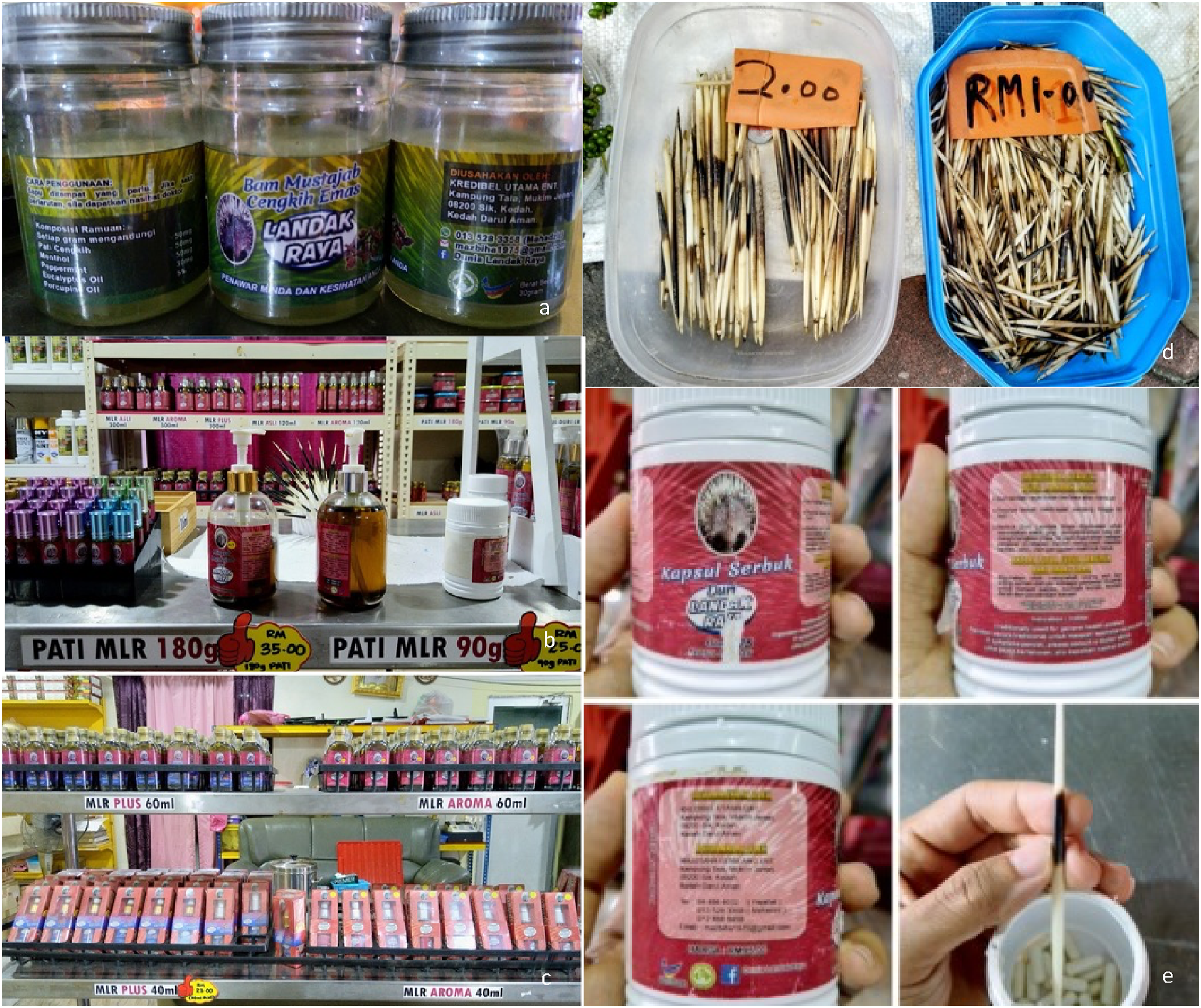
Most farms visited appear to be legitimate captive-breeding establishments in terms of facilities but whether this also applies to the origin of breeding stock is not known (Figure 6). One breeder claimed to have bought their breeding stock directly from PERHILITAN, others claim to have a permit to hunt while some claim to have bought their original stock from the local indigenous hunters. There was one clear exception, where one farm visited was selling some breeding pairs at a much lower price that came without a license. The owner admitted that the lower prices were because they were derived from opportunistic hunting by foreign workers based at nearby farms or construction sites, which is technically illegal. We were unable to obtain official information on captive breeding of porcupines in Sabah or Sarawak. TCM outlets indicated at the potential presence of at least one farm in Sabah, but we could not verify this. Examples of porcupine farm set-up and enclosures and in the bottom right, a baby Malayan Porcupine.
Seizure Data
From January 2011 – to September 2022, we obtained 47 seizures involving porcupines in Malaysia which was estimated to amount to 110 porcupines (Figure 7). At least three species of porcupines were identified in 32 incidents, the most frequently confiscated species being the Malayan Porcupine (n=25) followed by the Asiatic Brush-tailed Porcupine (n=5) and Long-tailed Porcupine (n=2). Most seizures were of live porcupines (n=22, 47%) which involved 81 individuals. Meat (n=11, 23%) and quills (n=10, 21.3%) were next most frequently seized commodities The number of seizure incidents involving porcupines in Malaysia from January 2011 to September 2022, including species involved and estimated number of whole animals (volume of porcupines) based on commodities seized per seizure.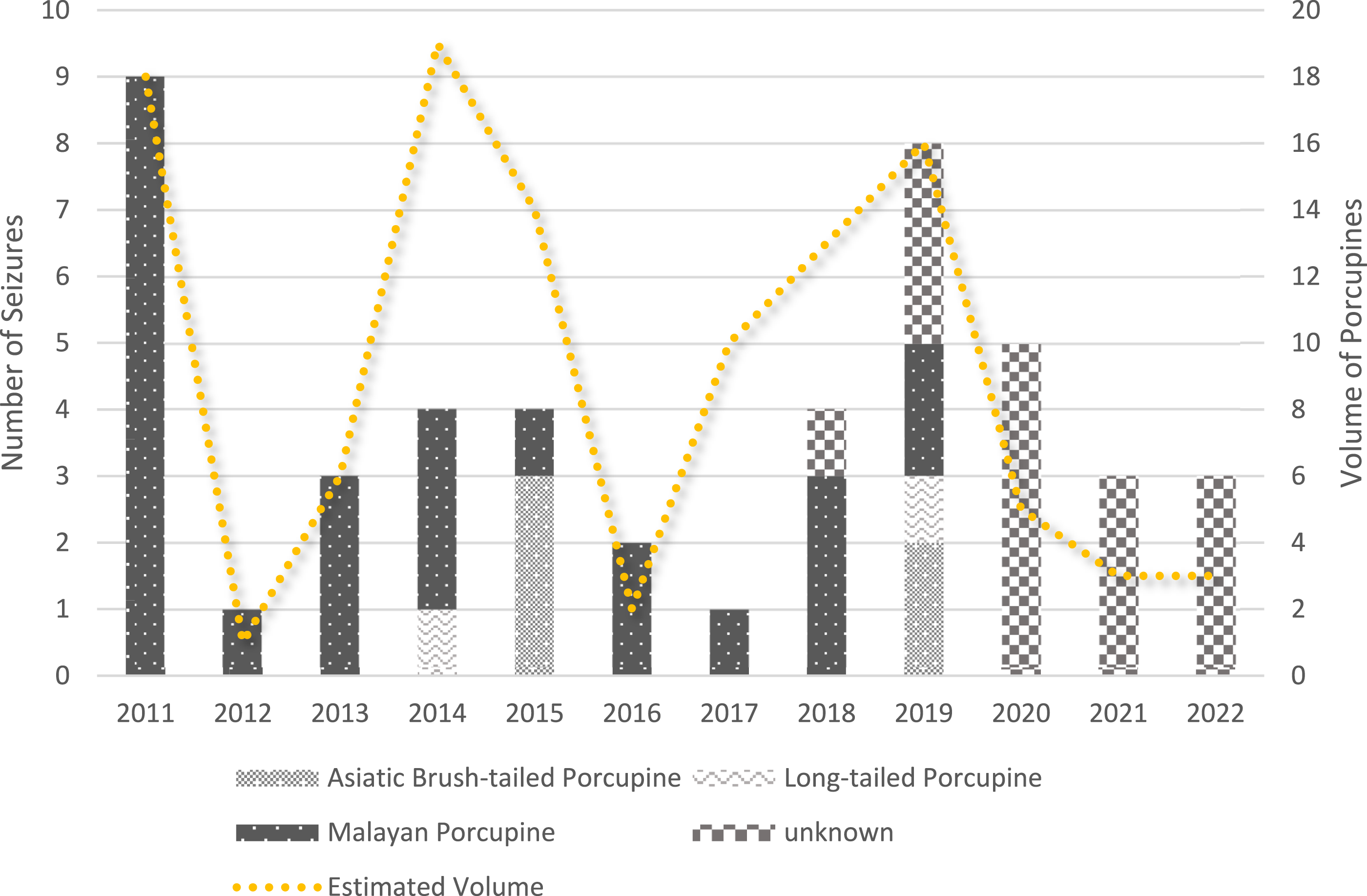
Discussion
Local Use and Trade
Our study shows that porcupines are predominantly coveted for two purposes in Malaysia i.e., demand for bezoar used in traditional Chinese medicine and demand for captive-breeding stock. The trade in porcupine bezoars is particularly substantial having been found for sale in 90% of locations surveyed. According to TCM outlets, porcupine bezoars are consumed for general health keeping purposes as well as to treat a wide range of ailments such as dengue, wounds, urinary infections, insomnia, skin allergies, post-operation care and cancer. During visits to porcupine farms, we also discovered that porcupine parts are used in traditional Malay medicine whereby they are processed into oils, ointments, balms and pills to treat asthma, low virility, lethargy, tooth aches, stomach cramps
Porcupine farming appears to be gaining popularity in some parts of the country though its purpose remains unclear. Based on the 2018 annual report published by PERHILITAN, only seven permits were issued that year, however, this has since grown to 68 permits in 2020 (PERHILITAN 2018). The popularity of porcupine farming can be attributed to various reasons. For one, the government has been encouraging the commercialization of porcupines for the ‘halal’ meat trade (Zainuddin 1998, Rovie-Ryan et al. 2017) and has even published a handbook on commercial farming of the Malayan porcupine (Zainuddin 2006), presumably to promote this industry and its regulation. Another factor could be the ease with which Malayan porcupines reportedly breed in captivity (they can reproduce twice a year and bear between 1 and 4 offspring each time) and the husbandry requirements this entails is quite minimal (estimated at MYR0.40 (USD0.089) animal-1day-1). A pair of Malayan porcupine can sell for MYR4000 (∼USD844
While consumption of porcupine meat is also occurring, it is unclear whether this is more opportunistic in nature (when caught by indigenous hunters or found in traps) or a targeted demand. For example, at least three nature guides encountered in Sarawak claimed to only eat or serve porcupines that are accidentally caught in traps set for wild pigs. However, seizures of porcupine meat suggests that there is some demand, at least for wild porcupine meat. Only one farmer visited noted interest from Malays for porcupine meat and expressed plans to expand his farm from a current 160 porcupines to 300,000 porcupines for it to be commercially viable. Local news articles and blogs dating back to the early 2000s also allude to a local demand for porcupine meat due to its perceived health benefits (Tanin 2006, Zeta-Yap 2015, Singh 2019, Nordin 2022). The fact that we found so few restaurants openly selling porcupine meat could be due to several possibilities including illegal sourcing of wild meat (as evidenced by seizures) is taking place, or restaurants not having a permit to sell wild meat, or that consumers are cooking porcupine meat at home. It is also possible that the emergence of COVID-19 has negatively influenced the demand for wild meat, as Liu et al. (2020) and Funk et al. (2022) suggest. In addition, the high value of porcupine bezoars may overshadow the demand for meat, as at least two hunters in Sabah claimed to target porcupines solely for their bezoars. Further research would be beneficial in understanding whether there is a current market for porcupine meat in Malaysia and if so whether captive-breeding of porcupines will be able to satisfy market demands. According to Norsuhana et al. (2012), there was a slightly greater preference for meat from wild porcupines than captive-bred ones (54.7% vs 45.3%) among 170 Malaysian consumers interviewed for their study. Similarly, porcupine farmers in Vietnam were found to be laundering wild caught porcupines due to consumer preference for wild over farm raised (Brooks et al. 2010).
Source and Legality
The trade of porcupines whether live, for consumption or medicinal use in Malaysia is legal provided the required permits are obtained by all relevant parties (i.e
Breeding stock were derived from the wild legally either through hunting permits obtained from PERHILITAN or from licensed hunters. All farms visited openly displayed permits for operating. Nevertheless, we found evidence of at least one farm also selling porcupines of illegal origins (i.e., hunted opportunistically by foreign workers without hunting permits). There are also farms breeding Asiatic brush-tailed porcupines and since hunting is only permitted for the Malayan porcupine, it potentially implies the original breeding stock was obtained through illegal means. This points to illegal sourcing of breeding stock taking place alongside legal harvest. The relatively high number of seizures involving live porcupines would further support this conclusion.
The legality of the trade in porcupine bezoars is more complicated. The traditional medicine industry in Malaysia is strictly regulated under the Traditional and Complimentary Medicine Act 2016 which governs the registration, licensing and mandatory practice of traditional medicine practitioners throughout the country, and under the Control of Drugs and Cosmetics Regulation 1984 (incorporating latest amendments P.U.(A) 257/2014) which governs the registration, licensing, manufacturing and sale of medicinal products. That said it gets complicated considering the challenges in determining the source of porcupines used for traditional medicine or authenticity of bezoars in trade. It is also unclear how such products are approved for sale or regulated by authorities with the apparent uncertainty surrounding sourcing of bezoars.
Procuring genuine bezoars is rare as not all porcupines have bezoars. For example, one hunter found three bezoars after killing over 200 porcupines, another found nine bezoars from over 500 porcupines killed. A number of studies have indicated the presence of fake bezoars in the market as hunters and TCM traders try to cash in on the high value placed on genuine bezoars (Tan et al. 2019; Okuno and Ichikawa 2020). Fake bezoars are reportedly made using a mixture of herbs and analgesic/anti-inflammatory drugs. According to Okuno and Ichikawa (2020)
Malaysia and Indonesia appear to be the key source of porcupine bezoars according to TCM traders. Studies show that porcupines are being illegally hunted in Indonesia for local subsistence and commercial trade (USAID 2015, Farida et al. 2019, Heinrich et al. 2020, Gomez 2021). Porcupine seizure data analysis in Indonesia between 2013 and 2020 revealed evidence of targeted hunting of porcupines predominantly in Sumatra for international trade (Gomez 2021) and corroborates accounts from TCM traders in Malaysia. Indonesia is home to five species of porcupines (three of which are also found in Malaysia i.e., Malayan porcupine, long-tailed porcupine and thick-spined porcupine), but only one is currently protected by law, the Sunda porcupine (Hystrix javanica, Cuvier, 1823) endemic to the islands of Java, Bali, Sumbawa, Flores, Lombok, Madura, and Tonahdjampea. Nevertheless, hunting of unprotected wildlife in Indonesia is subject to harvest quotas and so far, none have been established for any porcupine species in Indonesia. The fact the porcupines are being harvested and killed for bezoars in Indonesia for trade in Malaysia is concerning. It is clear the remaining four species in Indonesia are vulnerable to unsustainable hunting and illegal exploitation due to poor enforcement and legislative weakness. Other reported sources of porcupine bezoars were Brazil, Cambodia, China, Lao PDR, Myanmar and Thailand, where even less is known about the hunting and harvesting of porcupines for international trade.
Implications for Conservation
Porcupines face a multitude of threats including habitat loss, human conflict and illegal hunting throughout Southeast Asia. Determining how these threats are impacting wild populations is difficult as data on population densities are lacking. However, perceptions of local indigenous hunters in the Royal Belum State Park (an important protected area in Peninsular Malaysia) note a decrease in porcupines over the years (Loke et al. 2020) and similarly by certain indigenous hunters in the Baram Basin in Sarawak (Okuno and Ichikawa 2020). Okuno and Ichikawa (2020) correlate the porcupine bezoar boom with the expansion of oil palm plantations and suggested this was likely due to increasing human contact with porcupines that are attracted to oil palm fruits. Chevallier and Ashton (2006) note that the Cape porcupine in South Africa is widespread and easily adaptable to habitat changes and disturbances, but that this has contributed greatly to its demise as over the years as it has come into increasing contact and therefore conflict with humans. Much the same is noted for the Sunda porcupine in Java (Mustikasari et al. 2019). Greater resources are therefore needed to assess porcupine distribution and density throughout the country to determine their conservation status and needs.
The high value of authentic bezoars raises concerns, as it is likely fuelling the unrelenting pursuit of porcupines, mirroring the pattern observed with other prized wildlife commodities coveted for their presumed medicinal properties e.g., pangolin scales, big cat bones. While commercial farming of porcupines may alleviate pressure on wild populations to some extent, specifically with regards to commercial production of porcupine meat, it is unlikely to be the case where bezoars are concerned. Captive breeding of wildlife for trade is also controversial as many studies show such facilities are of little conservation value as wild-caught animals are known to be laundered and trafficked through them (Brooks et al. 2010, Nijman and Shepherd 2015, Four Paws 2020, WFFT 2020). For example, in Vietnam, porcupine captive-breeding facilities were found to be laundering wild animals which caused local extirpations and shifted poaching efforts to neighbouring Lao PDR (Brooks et al. 2010). Hence, greater research on this front needs to be conducted to assess the effectiveness of captive-breeding of porcupines in the country as well as its need.
Local use appears to be driving the international trade of porcupine bezoars, particularly from Indonesia. This corroborates previous studies looking at the porcupine trade in Asia (Heinrich et al. 2020, Gomez 2021). A 2019 online survey of the sale of porcupine bezoars in Indonesia, Malaysia and Singapore found that about 20% of posts offered international shipping (Heinrich et al. 2020). This study shows at least eight different countries involved in the trade of bezoars with Malaysia. A recent discovery revealed Malaysian citizens, managing logging operations in the Republic of Congo, were purchasing porcupine bezoars and transporting them back to Malaysia in their luggage (Sniegon et al. 2021). The international trade in porcupines is occurring without any regulation in place. Listing Asian porcupine species or perhaps all porcupine species in Appendix II of the Convention on International Trade in Endangered Species of Wild Fauna and Flora (CITES) could potentially solve this issue as it would require any international trade to take place through a system which would allow for regulation and monitoring (Shepherd et al. 2020, Heinrich et al. 2022). Porcupines meet the criteria for listing on CITES Appendix II as per Article II, paragraph 2(a), and Resolution Conf. 9.24 (Rev. CoP17), Annex 2a, paragraph B. This is much needed as there are studies in Southeast Asia that show porcupines are in decline due to habitat loss and conversion as well as uncontrolled poaching (Brooks et al. 2010, Chung et al. 2016, McEvoy et al. 2019, Loke et al. 2020) and this includes Indonesia (Salviana et al. 2017, Farida et al. 2019, Mustikasari et al. 2019). Greater research on porcupine trade dynamics is certainly warranted across the region to assess its scale and impact on porcupine species.
Sustainable and regulated trade in wildlife is arguably said to benefit species conservation. Nevertheless, the high economic value of wildlife trade has meant that legal and illegal markets tend to flourish alongside each other (Phelps et al. 2016, Wong 2019, UNODC 2020). With this in mind, regulation and enforcement of captive-breeding practices including sourcing of breeding stock needs to be more stringent to ensure farms are not relying on illegally caught wild porcupines. Similarly, enforcement effort to tackle illegal hunting of porcupines needs to be prioritised. All of the seizures involving porcupines also involved multiple other wildlife species indicating that enforcement efforts were not targeted at addressing the illegal hunting of porcupines. Greater enforcement effort will be essential in mitigating illegal exploitation of porcupines, their parts and derivatives particularly since porcupines are treated as a commercial commodity.
Supplemental Material
Supplemental Material - The Trade of Porcupines in Malaysia With International Trade Links
Supplemental Material for The Trade of Porcupines in Malaysia With International Trade Links by Lalita Gomez and Khoo Min Sheng in Tropical Conservation Science
Footnotes
Acknowledgements
We thank PERHILITAN for data on porcupine seizures, captive-breeding and regulations in Peninsular Malaysia and Loretta Shepherd for her assistance in procuring this data. We also thank Chris R. Shepherd and four annonymous reviewers for their review and useful comments that helped improve this paper.
Author Contributions
Conceptualization, Lalita Gomez; Funding acquisition, Lalita Gomez; Data collection, Khoo Min Sheng; Formal analysis, Lalita Gomez; Writing – original draft, Lalita Gomez; Writing – review & editing, Lalita Gomez, Khoo Min Sheng.
Declaration of Conflicting Interests
The author(s) declared no potential conflicts of interest with respect to the research, authorship, and/or publication of this article.
Funding
The author(s) disclosed receipt of the following financial support for the research, authorship, and/or publication of this article: We thank National Geographic for their generous funds and support that enabled the undertaking of this project and Riverbanks Zoo and Garden for supporting the publication of this paper.

Supplemental Material
Supplemental material for this article is available online.
References
Supplementary Material
Please find the following supplemental material available below.
For Open Access articles published under a Creative Commons License, all supplemental material carries the same license as the article it is associated with.
For non-Open Access articles published, all supplemental material carries a non-exclusive license, and permission requests for re-use of supplemental material or any part of supplemental material shall be sent directly to the copyright owner as specified in the copyright notice associated with the article.
