




Abstract
Initiatives that aim to regulate the international wildlife trade must take into account its multiple and often complex dimensions in order to be effective. To do this, it is essential to understand the interactions between three of the key dimensions of the wildlife trade: (1) taxonomic unit, (2) geographic origin, and (3) product form and transformation. We propose a framework to provide a structured approach to defining the complexities of the wildlife trade, based on Rabinowitz’s seven forms of rarity. We demonstrate the complexities and how they apply to our framework using two contrasting examples: the trade in elephant ivory, and the horticultural orchid trade. Further we use the framework to map different traceability solutions. To be as efficient as possible, efforts to tackle the illegal and unsustainable utilisation of wildlife should take a more structured approach. This framework identifies challenges that current initiatives may face, how they may interact and provides a structure for designing future interventions.
Introduction
The wildlife trade is multidimensional due to the diversity of the species involved, their geographic origins, and the forms in which products are traded. Illegal and unsustainable trade has been recognised as a conservation issue for many years, prompting various initiatives at the local (e.g. U.S. state-level bans on ivory; Atkins, 2015), national (e.g. UK government's commitment on ivory; Nature Check, 2013) and international level (e.g. London Conference on the Illegal Wildlife Trade, 2014). In addition, increasing attention has focussed on interventions to reduce risks to human health from the trade of some wild species, due to widely reported, although yet to be proven, links between the coronavirus SARS-CoV-2 that caused the COVID-19 pandemic and wild animal consumption (Petrovan et al., 2020). However, a deeper understanding of the issues and complexities involved in the trade is required for any interventions to be effective. While some work to describe the various types of trade has taken place ( Phelps et al., 2016 ), little attention has been paid to the products and markets themselves.
While the wildlife trade is complex, in part due to the very different modus operandi of the different types of trade (legal, illegal, transport routes, demand dynamics) and productivity levels, three factors are reoccurring; What it is (species)? Where is it from (origin)? And in what form is it being traded (transformation)? Here we examine the impact of these three key dimensions related to the product being traded on our ability to understand and regulate the trade in wildlife. We illustrate the impact of the dimensions with two examples representing the extremes, namely the horticultural trade in orchids and the trade in elephant ivory.
Dimension 1—The Taxonomic Unit
Conservation decisions and regulations are often made based on the taxonomic unit of species or groups of species (e.g. the Appendices of the Convention on the International Trade in Endangered Species of Wild Fauna and Flora (CITES; 2016). As such they are hierarchical. For example, when looking at trade in elephant ivory we may focus on a species, such as the African Elephant (Loxodonta africana), on all extant elephant taxa (Savanna, Forest and Asian), or on all extant elephants plus mammoths. This is relatively straightforward but if we consider the horticultural trade in orchids (species of which make up over 70% of CITES species) then we must consider 26,000 known species (plus an estimated 5,000 species that are yet to be discovered and over 100,000 formally named and an unknown number of informally named hybrids) (Hinsley et al., 2015); over four orders of magnitude difference in the number of species compared to elephants. The problem only improves marginally, if identification to the orchid genus is sufficient, with over 800 orchid genera. Therefore, in terms of investigating the trade based purely on taxa involved, it is clear that orchids are potentially more problematic than elephants.
Dimension 2—Geographic Origin (Spatial)
While the number of taxa and their units can be a significant challenge, one also needs to consider its origin as, for example, conventions (e.g. CITES and CBD) are implemented at the national level (e.g. stricter domestic measures under CITES). Returning to the example of elephants vs orchids, while orchids may be speciose compared to elephants, many of these thousands of species are endemic to relatively small geographic areas (Tremblay et al., 2004). This high level of endemism, particularly at the national level, means that, by identifying a species, it is likely we can have a good idea of its origin in the wild, and therefore the national legislation that governs the wild populations. Likewise if you know the origin of an orchid this can make it somewhat easier to identify which species it is. Contrast this with elephants that, although populations are becoming increasingly fragmented and are in decline (Wittemyer et al., 2014), occur across a large geographic area, making identification of their origin difficult without forensic techniques. In this case we have considered geographical origin in terms of range states (natural range), although it could equally be applied to production origin (e.g. captive bred or artificial propagation vs wild origin). This latter point on production origin is a significant problem within the wildlife trade as captive breeding and artificial propagation can allow laundering of wild origin material. Further, due to the challenges of meeting the CITES definition of ‘Artificial Propagation’, the term ‘Assisted Production’ has been introduced (source code “Y”) (CITES Conf. 11.11 (Rev. CoP18)).
Dimension 3—Product Form and Transformation
Traditionally, conservation biologists are trained to think at the level of the taxonomic unit. However, tackling the wildlife trade may require this approach to be altered to frame problems in the context of finished products, far removed from a recognisable species. For example, elephants are obviously not traded as elephants in the ivory trade; the ivory is removed as a whole tusk from the rest of the animal at source, it may be cut down to a smaller size, before being transformed into a final product. The finished product could be a fully carved tusk where the taxonomic origin is obvious (i.e. it is a tusk from an elephant; it may even be possible to identify it to the species level), a smaller object such as a statue or a bracelet, or could even be powdered (Gao & Clark, 2014); the latter being challenging to identify to species. This diversity in the transformed product from elephant to ornament creates obvious challenges in terms of identification. While orchids may be transformed into edible, cosmetic or medicinal products, such as dried Dendrobium stems for traditional Asian medicine (Shi Hu) (Koopowitz, 2001; Liu et al., 2014), these are quite separate from the horticultural trade. For horticulture there is little transformation of plants to a finished product, with the exception of variation in the size of the plant and the phenological state (i.e. flowering vs non-flowering) in which it is traded. The latter is notable as, due to the sheer number of species, orchids are a lot easier to identify when in flower than in their vegetative form.
All three dimensions may be subject to further complexity due to shifting market dynamics. For example, new species may be substituted for old species as their populations are depleted or become more difficult to access (e.g. shifts in the timber trade). Likewise geographical origin may shift, as access and trade routes change (e.g. from Asian to African pangolins). Finally, the product and how it is transformed may change in response to market trends, such as the shift in some areas to powdered traditional Asian medicine in a capsule form.
A Framework for Understanding the Dimensions of Trade
A clear structure for considering the interactions of trade dimensions can help to better understand the diversity of trade. These interactions can be best visualised as a framework (Table 1), following that of Rabinowitz’s (1981) seven forms of rarity. Rabinowitz (1981) describes seven forms of rarity that result from the interactions of three attributes (or dimensions) that if they are dichotomised, they form a 2 × 2 × 2 or 8-celled framework; population size (large vs small), geographic range (large vs small) and habitat breadth (wide vs narrow). In addition to the seven forms of rarity these interactions also result in an eighth form containing species that are not rare but instead can be considered common as they have large populations, with a wide geographic range and wide habitat breadth. In the seven forms of wildlife trade complexity, the three dimensions interact to form the seven wildlife trade challenges; taxonomic diversity (taxon poor vs taxon rich), geographic distribution (wide vs narrow) and product transformation (little vs lot). The equivalent eighth form applies to traded taxa that are few in number, have a narrow geographic range, and for which little transformation occurs between the species and the final traded product. These are likely to be the taxa that are the least problematic when developing initiatives to regulate their trade. This can make them ‘quick wins’ in terms of having the greatest impact, such as through the development of traceability systems or the training of law enforcement officers. However, they are also likely to be more associated with national trade or niche and obscure trades such as the trade in the three species of boid snakes endemic to Madagascar (subfamily Sanziniinae) in the exotic pet trade. The framework presented here is intended to identify the challenges that current initiatives may face, rather than comment on the conservation worthiness of a species or group of species. For example, returning to the case of elephant ivory, consider an ornament, in terms of its categorisation it is highly transformed, taxon poor and has wide geographic origin. This results in the following challenges, that it is relatively easy to identify species (at least that it is an elephant), however it is difficult to identify the geographic origin without forensic techniques, even then it becomes increasingly difficult as the product is transformed (e.g. tusk to beads). By understanding the nature of the challenges it allows more targeted enforcement monitoring and action.
Conceptual Framework For Understanding The Complexities Of The Wildlife Trade In Terms Of The Species And Product, With Examples Of Traded Products In Each Category.

*As increase in species richness usually results in a decrease in geographic distribution per species, these two forms are likely to be rare if considered from the point of the taxon. More likely they will arise when the product has the potential to use a range of unrelated species such as the examples given here
While we have identified three main dimensions that impact on wildlife trade initiatives, an additional fourth dimension that could be considered, but that is particularly difficult, is time. For some species, knowledge of the temporal origin of a specimen is important as it impacts on whether it has been legally acquired and can be sold (e.g. pre-convention ivory or post legally artificially propagated orchids). Other potential dimensions may occur or interact with the three dimensions described here, such as the linguistic diversity used in the sale of ivory, or the other species or materials that may confuse the identification. For example, given the increased interest in the ivory trade, sellers may use codewords to disguise the sale, or advertise it as being of a different material, therefore to identify ivory one would have to distinguish it linguistically in adverts and then distinguish it from other materials such as ox bone or resin. This could potentially result in the species moving from a taxon poor to a taxon rich category, due to this added linguistic and material diversity.
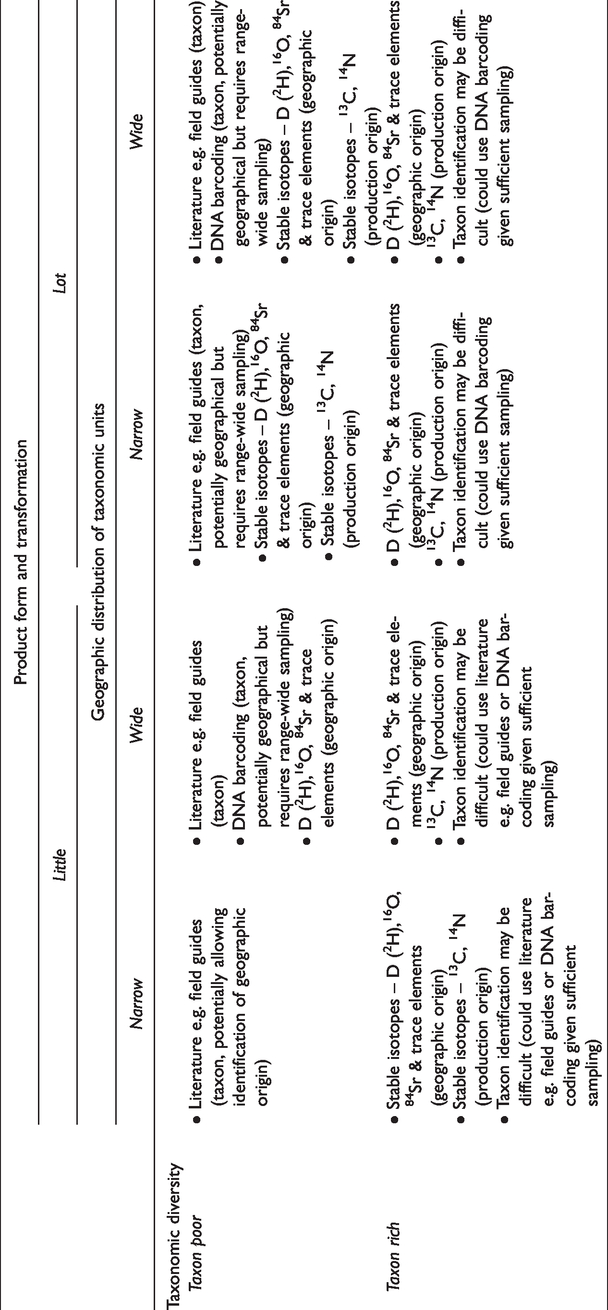
In order to be effective, efforts to regulate and monitor the wildlife trade cannot take a ‘one size fits all’ approach. Our framework can be used to, for example, match current and potential traceability mechanisms to wildlife products to which they may be most suited (Table 2). This allows interventions to be applied that are most relevant to the context, with the aim of increasing efficacy and efficiency. For example, if stable isotope analysis is to be used to identify production type or geographical origin (Hinsley et al., 2016), samples must be collected, prepared, and sent to a laboratory with the right equipment. Depending on the stable isotope being used (e.g. 16O for geographical origin, or 14N for production method), this process may be costly and there may be a delay in receiving the results. This cost is likely to be unnecessary for taxon poor products with a narrow distribution, but could be the only option suitable in other cases. For example, DNA barcoding and stable isotope analysis have the potential to identify the species or geographical origin respectively of a traded product that has been highly transformed, such as elephant ivory, that could not be identified using other methods. However, these methods require a database of existing reference samples to compare traded products to, which would be difficult to collect for taxon-rich products with a wide geographical range, such as orchids.
Conceptual Framework for Understanding the Complexities of the Wildlife Trade in Terms of the Species and Product, as Applied to Traceability Methods.
Interventions that aim to implement broad-scale processes such as supply chain traceability must consider the complexities created by the interactions of the multiple dimensions of species, origin and product. Here we present a structured approach to understanding these complexities and the challenges that they may present. As pointed out by Rabinowitz (1981), while the framework may result in false reification through the conversion of an idea into an object, this simple framework can aid in focusing stakeholders’ thoughts. This framework provides a structure for the design of future interventions aiming to ensure that wildlife trade remains legal, sustainable, and traceable.
Footnotes
Declaration of Conflicting Interests
The author(s) declared no potential conflicts of interest with respect to the research, authorship, and/or publication of this article.
Funding
The author(s) received no financial support for the research, authorship, and/or publication of this article.
