




Abstract
Rhino poaching in Africa has risen alarmingly over the last decade, driven by illegal trade and demand for horns in Asia, where it is used medicinally. Traditional Chinese medicine (TCM) has deep cultural roots, and understanding demand drivers will inform conservation decision-making. We interviewed 15 TCM practitioners in Hong Kong, investigating their familiarity with rhino horn, prescription experiences, and perspectives toward its use and trade. All interviewees believe that rhino horn possesses medicinal properties, despite general unfamiliarity with its chemical composition or any active ingredient. We compiled a list of 16 substitutes, finding that dosage adjustments produce equivalent treatment outcomes that compensate for potency differences. While most interviewees expressed support for trade legalization, most would prefer to continue prescribing substitutes. Further research into TCM stakeholder perspectives and preferences for rhino horn can inform conservation policy.
Introduction
The black market trade in illegal wildlife products is a complex, multibillion dollar industry that encompasses thousands of species and involves diverse actors in harvesting, trading, and consumption (Moreto & Lemieux, 2015; Phelps, Biggs, & Webb, 2016). Rhino horn is one such product that is traded illegally and is used consumptively for cultural, medicinal, and social purposes (But, Lung, & Tam, 1990; Gao, Stoner, Lee, & Clark, 2016; Milliken & Shaw, 2012; Truong, Dang, & Hall, 2016). An international ban on the horn trade has been in place since 1977 under the Convention on International Trade in Endangered Species of Wild Fauna and Flora (CITES), but illegal trade has persisted nevertheless (Emslie et al., 2016), and rising wealth in Asia has driven a surge in rhino horn demand and poaching over the last decade (Di Minin et al., 2015; Emslie et al., 2016; Shepherd, Gray, & Nijman, 2017).
Critics of the trade ban argue that regulatory enforcement has failed to stem the poaching crisis, caused wildlife protection to become militarized, and propelled black market prices to levels that incentivize poaching (Biggs, Courchamp, Martin, & Possingham, 2013; Duffy, St. John, Büscher, & Brockington, 2015). Changing consumer behaviors is challenging given the cultural roots of consumption, and existing conservation measures are unlikely to achieve sufficient demand reductions to meaningfully ease poaching pressure in the short term (Di Minin et al., 2015). Trade legalization has been proposed as a potential solution, wherein improved enforcement would be funded by sales of horn from natural mortalities, existing stockpiles, and harvesting through de-horning (Biggs et al., 2013; Challender & MacMillan, 2014; Di Minin et al., 2015). Between 5,319 and 13,356 kg of horn can be produced per year in South Africa (Taylor et al., 2017). However, considerable uncertainties surrounding market responses bring into question the viability of a legal trade, and trade legalization continues to be a controversial policy alternative (Aguayo, 2014; Collins, Fraser, & Snowball, 2016; Taylor et al., 2017).
Understanding demand is critical to evaluating policy alternatives. China and Vietnam are the largest markets for rhino horn, where it is consumed in traditional Chinese medicine (TCM) among other uses, including as a medium for carvings and as antique or commodity investments (Di Minin et al., 2015; Gao et al., 2016; Shepherd et al., 2017). Intrinsically different to Western medicine (WM), TCM is founded on the philosophy that all natural phenomena can be categorized into the opposite yet complementary forces of yin and yang (陰陽), and diseases are treated by restoring balance and maintaining harmony in the body (Sun et al., 2013). TCM practitioners prescribe herbal medicine containing a combination of ingredients, of which over 10,000 plant, animal, and mineral varieties exist, known as Chinese materia medica (Williamson, Lorenc, Booker, & Robinson, 2013; Xu & Yang, 2009). The distinction between the use of Chinese materia medica for food and for medicinal purposes is not always clear due to their dual uses—medicinal ingredients are often consumed just as food items or in herbal products (Chau & Wu, 2006). The isolated consumption of Chinese materia medica is uncommon when used for the purpose of TCM treatment; compound prescriptions are preferred by TCM practitioners because the combination of ingredients allows different physiological problems to be targeted in restoring holistic balance, while the ingredients interact synergistically to enhance the decoction’s potency and reduce toxicity or side-effects caused by any single ingredient (But, Tam, & Lung, 1991). As a medicinal ingredient used in TCM treatment, rhino horn is used to dispel heat and clear toxins trapped deep in the body (But et al., 1990), but its use—often in isolation by the general public—has evolved in recent times to include treating cancer, curing hangovers, and social consumption (Milliken & Shaw, 2012; Truong et al., 2016), even though consumption for such purposes is not grounded in TCM literature. Although concepts and practices in TCM can seem foreign, it remains an internally consistent, researched discipline (Critchley, Zhang, Suthisisang, Chan, & Tomlinson, 2000; Kaptchuk, 2000; Liu, Wang, Zhang, Fan, & Lin, 2015; Patton, 2011). It may not be appropriate to equate TCM with folk remedies or consumption that is motivated by cultural beliefs, and our understanding of rhino horn consumption would benefit from acknowledging and reflecting on such distinctions (Dang Vu & Nielsen, 2018).
While researchers have repeatedly emphasized the need for an understanding of markets and demand drivers (Challender, Harrop, & MacMillan, 2015; Ferreira & Okita-Ouma, 2012; Taylor et al., 2017), insight from the TCM community remains limited. Practitioners are key stakeholders given their role in prescribing treatments, making it important to engage specifically with them. In this exploratory research, we interviewed TCM practitioners in Hong Kong, a special administrative region of the People’s Republic of China, to investigate their familiarity with rhino horn, perspectives on trade legalization and harvested horn, potential usage in a legalized trade, and experiences with its medicinal application.
Methods
Study Area
People in Hong Kong favor seeking health-care providers over self-management when ill, and the belief that “doctors know best” is widespread (Leung, Wong, Chan, Choi, & Lo, 2005). TCM practitioners act to some extent as rhino horn gatekeepers through prescription, making Hong Kong a suitable place to investigate practitioner perspectives. TCM has been part of the daily lives of the local citizenry for centuries (Lao & Ning, 2015). Although TCM was not recognized in the publicly funded health-care system established under British colonial rule, it persisted in a private medical sector which flourished (Leung et al., 2005). Since returning to Chinese rule in 1997, the parallel development of TCM and WM has become a formal constitutional directive in the city (Hong Kong Government, 1997), and the government has since passed legislation, established a regulatory body, and set up TCM clinics in each district (Lao & Ning, 2015). Hong Kong currently has 7,251 fully registered practitioners, 2,639 listed practitioners, and 43 practitioners with limited registration (Chinese Medicine Council of Hong Kong, 2017). However, the use of TCM services by the general public remains at rates far below that of WM. In their 2016 or 2017 survey, the city’s Census and Statistics Bureau found that 88.6% of people who had consulted a doctor over a 30-day period had gone to see a WM physician, while only 16.7% had consulted a TCM practitioner (HKSAR Census and Statistics Department, 2017).
Interviews
Our objective was to begin building an understanding of TCM practitioners’ familiarity with rhino horn, perspectives on trade, and usage experiences through semistructured interviews. Despite shortcomings as a non-probability sampling approach, convenience sampling was employed given the exploratory nature of this work (Newing, 2011). Potential participants were recruited through referrals from the researchers’ personal networks to facilitate access. Hour-long, audiotaped interviews were conducted face-to-face in Cantonese between May and July of 2016 by the lead author, who was an independent researcher at the time of data collection. The Belmont Report’s ethical principles and guidelines for research on human subjects were applied in study design and execution (Belmont Report, 1979). A set of key questions were used to guide the interviews, and we encouraged interviewees to provide us with additional information wherever possible (Newing, 2011). We divided the interviews into three sections: (a) familiarity with rhino horn’s medicinal properties, clinical use, and substitutes; (b) views on trade ban and legalization; and (c) current and past use of rhino horn (see Appendix A online for full description of interview methodology). Notes taken during the interviews were checked against each audio recording to ensure accuracy prior to data entry and exploratory data analysis.
Results
Interviewee Characteristics
Of the 18 TCM practitioners we approached, 15 agreed to being interviewed. Interviewees were between the age of 41 and 78 years with 3 to 45 years of clinical experience. Ten interviewees learned about rhino horn during formal TCM education. Seven ran independent practices, while eight were employees of corporations offering TCM services. Geographically, their practices spanned 10 of Hong Kong’s 18 administrative districts, including the three most densely populated areas of the city.
Rhino Horn Familiarity
All interviewees found rhino horn to possess medicinal properties relevant to TCM, with seven stressing that it is only suitable when treating severe illnesses. There was unanimous agreement to its consumption alongside other medicinal ingredients in decoctions, but only seven interviewees attested to independent consumption. All interviewees attested to rhino horn’s ability to dispel heat from the body, and all but one agreed to its ability to detoxify blood. Ten interviewees claimed that it is suitable for treating wen bing (温病; infectious diseases caused by oronasally contracting warm-heat pathogenic qi energy; Koh, 2010). As one interviewee explained: If temperatures aren’t particularly high, rhino horn won’t be used because many other medicines [are available]. But for high fevers over 40℃, you might consider rhino horn because it is urgent … TCM has the wei-qi-ying-xue theory (衛氣營血; four levels of the body—outer defenses, vital energy, nutritive level and blood) … where surface level illnesses are relatively minor (eg. common cold), and ones reaching ying and xue are very serious (eg. dengue fever). With some rapid-onset infectious diseases, patients are covered in subcutaneous bleeding on top of a high fever. These are ying and xue illnesses because of hemorrhaging [and internal bleeding]. [Rhino horn] dispels heat and cools blood. High fever is treated by dispelling heat, and subcutaneous bleeding is cleared by cooling blood. (Interviewee 10) TCM practitioners were mostly in agreement that rhino horn is used to dispel heat, detoxify blood, and treat wen bing but were split over other purported medicinal properties, including its ability to treat cancer. Black bars indicate the number of interviewees who attested to the use of rhino horn for each purpose, whereas gray bars indicate the number of interviewees who refuted its use for each purpose.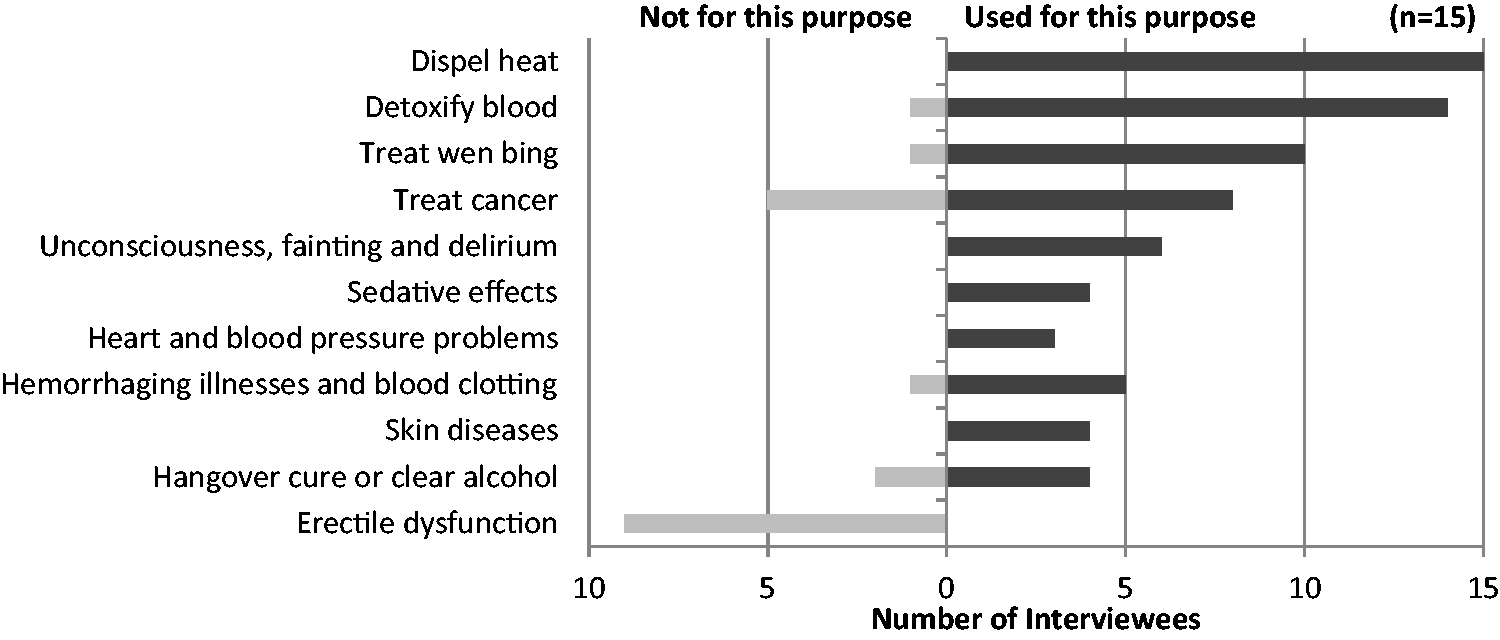
Our interviewees identified 16 different rhino horn substitutes, although only five were named more than once (see Appendix B online for summary of substitutes). All but four substitutes were perceived as less potent than rhino horn, though dosage adjustments enable equivalent treatment outcomes: If we find [other substitutes] too expensive, we can use water buffalo horn which works as well. But you’ll need a larger dose to produce the same effect. (Interviewee 3)
Trade Perspectives
There was unanimous belief that banning trade has reduced consumption, with 14 interviewees citing illegality as the main deterrent to use. Nine interviewees supported legalization to enable trade in harvested horn, of which eight emphasized the need for strict regulatory enforcement. Practitioners who learned about rhino horn during formal TCM training tended to favor legalization, which appeared to increase with the practitioner’s age and clinical experience.
When asked about potency differences between lethally sourced rhino horn and harvested horn, 12 interviewees stated that there would be no difference, while two felt that harvested horn would be somewhat more potent. However, the interviewees were mostly uncertain in giving their answers, with one interviewee refusing to give an assessment without empirical data. The interviewees were split evenly between preferring to prescribe sustainably harvested horn and having no preference between sustainably harvested and lethally obtained horn. All but one of the interviewees who had a preference for harvested horn cited conservation and animal welfare reasons, the other citing a small potency advantage. Of the seven interviewees with no preference for either, three cited equal potency, one cited difficulty in verifying legitimacy of product source, and three cited infrequent or unlikely potential use as the reason for having no preference.
Responses were mixed when it came to whether interviewees would actually use rhino horn if legalized (Figure 2). Of the seven interviewees who would likely increase their prescription of rhino horn, three emphasized that it would only be an additional treatment option. More experienced TCM practitioners appear to be more likely to prescribe rhino horn in a legal trade. Most interviewees would likely continue prescribing substitutes (n = 12), though more experienced practitioners are less likely to do so. Even if rhino horn is made legally available, ensuring legality and sustainability (n = 6), and cost (n = 9) would be concerns for practitioners.
Interviewees were split as to whether they are likely (n = 7) or unlikely (n = 6) to prescribe rhino horn if international trade is legalized; most interviewees felt that they would be unlikely to switch to prescribing rhino horn (n = 10), with a large majority stating a preference for continuing to prescribe substitutes for patient treatment (n = 12).
Rhino Horn Application
All interviewees denied ever prescribing rhino horn. Eight knew of patients who have consumed it without prescription, though these were all described as exceedingly rare. All interviewees cited legal concerns as a barrier to prescribing rhino horn, with four stating that illegality was the only concern at present; social stigma was not a barrier to 12 practitioners. Twelve interviewees estimated that rhino horn is only suitable in treating 1% or fewer of their patients, with many practitioners in this study emphasizing that rhino horn is only suitable for treating severe illnesses and that people in Hong Kong suffering from acute illnesses favor WM to TCM: Cases [where rhino horn is suitable] are very rare because patients need to present high heat, convulsions—very serious wen bing. If they are that sick, they usually won’t see a TCM practitioner. (Interviewee5)
Discussion
Conservation solutions must account for the drivers of demand, particularly given the cultural roots behind consumption. To our knowledge, this exploratory study is the first to engage directly with TCM practitioners in Hong Kong over their perspectives toward the trade and medicinal use of rhino horn. We found that while most interviewees support trade legalization, most would continue prescribing substitutes even if rhino horn is legally available. The inexhaustive list of substitutes we compiled illustrates that rhino horn’s medicinal functions can be achieved with an array of readily available alternatives. Many substitutes are more affordable and accessible to patients (Liu, Wang, Duan, Guo, & Tang, 2010), and potency differences can be compensated for through dosage adjustments. Trade legalization would enable TCM practitioners to offer treatment alternatives to patients, though instances where rhino horn is suitable are rare in communities like Hong Kong where WM is preferred for serious illnesses.
While references to cancer treatment appear in early TCM texts (Liu et al., 2015), consuming rhino horn for such purposes is a relatively new phenomenon (Milliken & Shaw, 2012). This study found disagreement among TCM practitioners in Hong Kong regarding its utility against cancer—of the eight interviewees attesting to such use, two specified that its effectiveness is restricted to blood-related cancers like leukemia. This offers a clue into the potential origins of such use: possibly an extension of rhino horn’s blood cooling and detoxifying effects. Its use to cure hangovers may be a similar, layman’s extension of blood detoxification. While rhino horn’s sedative and procoagulant effects have been researched experimentally (Liu et al., 2011), most of our interviewees did not attest to its use for blood clotting, treating hemorrhage-manifesting conditions (出血病), sedative functions, or awakening the unconscious, making its prescription for such ailments unlikely to be common.
No TCM practitioners in this study reported having ever prescribed rhino horn. While social desirability bias may have influenced responses (Nuno & St. John, 2015), the general sense we gained from our interviews is that TCM practitioners in Hong Kong are unlikely to go out of their way to procure and prescribe a banned substance like rhino horn only to risk facing legal consequences, especially when various substitutes that are more affordable and available can do the same job. As one interviewee stated: Of course [we] won’t use [rhino horn]. If they don’t let us use it, then we won’t use it. It’s that simple … There are a lot of medicinal ingredients we aren’t allowed to use—not permitted to use. (Interviewee 5)
Criminality is not necessarily coupled to the perception that a particular illegal act is deviant (von Essen, Hansen, Nordström Källström, Peterson, & Peterson, 2014). This appears to be the case when it comes to how practitioners in Hong Kong perceive rhino horn prescription. We found legal risks and ramifications to be the primary deterrent preventing prescription, but the use of rhino horn to treat sick patients is generally not perceived as wrong, with social stigma not a barrier to use for a majority of interviewees.
Differences between Hong Kong and mainland China in terms of TCM and WM provision, health-care norms, regulations, and law enforcement may lead to different results if this study is replicated on the mainland. Extensively integrated into the health-care system, TCM is more widely available in mainland China (Griffiths, Chung, & Tang, 2010; Wang et al., 2016; Xu & Yang, 2009), and patient cases in which the prescription of rhino horn is warranted may be more likely than in Hong Kong, where the general public tends to prefer WM for more severe illnesses. Further research is needed to investigate medicinal rhino horn demand in China, and data validity of future studies can be improved with larger sample sizes and specialized questioning techniques for gathering sensitive information (Nuno & St. John, 2015).
The preferences of Chinese consumers using rhino horn without a prescription should also be investigated. Whether or not the general public in China consumes rhino horn as a folk remedy for hangovers or as a means to acquire social status within social and professional circles should be investigated (Truong et al., 2016). A study in Vietnam found that, in addition to its use for medically utilitarian purposes, hedonic values may be associated with the consumption of rhino horn, such as in situations where family members gave rhino horn to their terminally ill loved ones to show that they had exhausted every last resort (Dang Vu & Nielsen, 2018). A different study involving a survey in Vietnam found that rhino horn is commonly consumed to treat minor illnesses and as a tonic to improve general well-being (MacMillan, Bozzola, Hanley, Kasterine, & Sheremet, 2017), and whether these trends extend to China is unknown. Vietnamese consumers are also willing to pay more for wild over farmed rhino horn (MacMillan et al., 2017). Given that Chinese consumers are known to prefer wild over farmed bear bile (Dutton, Hepburn, & Macdonald, 2011), a similar preference for rhino horn seems likely. We found that in making prescription decisions, half of our interviewees have a preference for sustainably harvested horn if it were legally available, although the other half would have no preference for either sustainably harvested or lethally obtained horn provided that potency remains the same. Future research should consider discrete choice experiments to determine preferences for poached, harvested, and synthetically manufactured horns in demand countries (Hinsley, Verissimo, & Roberts, 2015).
Implications for Conservation
For TCM practitioners, rhino horn possesses medicinal properties that are very much real. With definitive scientific consensus concerning its pharmacological efficacy lacking (But et al., 1990, 1991; Laburn & Mitchell, 1997; Liu et al., 2011), millennia-old beliefs and medical practices are unlikely to be dissuaded through demand reduction efforts, and our results lend further support to the exploration of alternative strategies, including trade legalization (Challender & MacMillan, 2014). Although our sample size is limited, our results indicate a likelihood that trade legalization would provide TCM practitioners with a treatment alternative that would be rarely appropriate for clinical prescription. The extent to which trade dynamics would be affected if rhino horn is only considered to be a treatment alternative rather than a treatment necessity is unclear, as TCM practitioners would still have to ensure that it is suitable for the patient before making considerations regarding affordability, substitute availability and effectiveness, clinical experience with its use, and quality of medicinal ingredients sourced. Research to investigate prescription preferences in a legalized trade would be able to provide further insight.
The unique philosophy and historied practice of TCM can be quite alien to conservation scientists and practitioners, which inevitably results in misunderstanding when we attempt to draw parallels to Western medical theory in discussing the medicinal consumption of rhino horn. Research is needed in different demand countries to understand the complex sociocultural nuances behind demand. Gaining a deeper understanding of the philosophy and practices of TCM, and engaging with the TCM community in policy-making, may improve conservation outcomes for species that are used medicinally.
Supplemental Material
Supplemental material for Medicinal Use and Legalized Trade of Rhinoceros Horn From the Perspective of Traditional Chinese Medicine Practitioners in Hong Kong
Supplemental material for Medicinal Use and Legalized Trade of Rhinoceros Horn From the Perspective of Traditional Chinese Medicine Practitioners in Hong Kong by Hubert Cheung, Lorraine Mazerolle, Hugh P. Possingham and Duan Biggs in Tropical Conservation Science
Footnotes
Acknowledgments
We thank all of our interviewees for their time and participation and are grateful to those who helped connect us with potential interviewees. M Lok and two anonymous reviewers provided valuable comments on an early draft of this manuscript.
Declaration of Conflicting Interests
The author(s) declared no potential conflicts of interest with respect to the research, authorship, and/or publication of this article.
Funding
The author(s) received no financial support for the research, authorship, and/or publication of this article.
Supplemental Material
Appendix is available for this article online.
References
Supplementary Material
Please find the following supplemental material available below.
For Open Access articles published under a Creative Commons License, all supplemental material carries the same license as the article it is associated with.
For non-Open Access articles published, all supplemental material carries a non-exclusive license, and permission requests for re-use of supplemental material or any part of supplemental material shall be sent directly to the copyright owner as specified in the copyright notice associated with the article.
