



Abstract
Background and Research Aims
Human-orangutan conflicts are a growing problem in the tropical rainforests of Sumatra. Habitat degradation and fragmentation can drive orangutans to move on to agroforestry plantations and into conflict with farmers. This research examines farmers’ awareness of the roles that Tapanuli orangutans play, their attitudes towards orangutans when they come on their land and the broader political-economic factors which influence interactions between smallholders and orangutans.
Methods
We used a mixed methods approach of quantitative surveys with 275 farmers and qualitative in-depth interviews with 22 key informants from 11 villages on the island of Sumatra, Indonesia.
Results
We found that while many farmers had negative encounters with orangutans eating their crops, their responses differed. Some tolerated the orangutans; others chased them away. The difference stemmed from cultural beliefs about orangutans and their relationship to humans. Some communities hold them as neighbours, others fear them, but in both cases would not harm them. Most farmers do not perceive them as significant threats but as hunger-driven neighbours. Rather than blaming the orang-utans per se, they argue that habitat loss caused by expanding extractive activities is the driving factor of this conflict. They want to see limits on the expansion of extractive industry, alternative income sources and compensation for their orangutan losses.
Conclusion
The study concludes by highlighting five aspects that need consideration for reducing human-orangutan conflicts and with a broader discussion on the need to include the socio-cultural context of the human populations in conservation initiatives.
Implications for Conservation
The study underscores the imperative of integrating local farmers’ perspectives in conserving critically endangered Tapanuli orangutans. It advocates coexistence through crop loss mitigation, deforestation prevention, and compensation strategies, emphasizing the need for holistic, sustainable conservation measures encompassing ecological, social, and economic facets within the region.
Keywords
Introduction
In 2017, Tapanuli orangutans (Pongo tapanuliensis) were confirmed as a separate species from Sumatran orangutans (Nater et al., 2017). Since then, efforts have been made to save these critically endangered great apes from a range of threats to their population (Laurance et al., 2020; Wich et al., 2019). Habitat loss and fragmentation, hunting, conflict killing, limited immunity to disease and extractive industries such as gold mining and power generation from geothermal and hydro energy all pose significant threats to the survival of Tapanuli orangutans (Meijaard et al., 2021; Laurance et al., 2020; Sherman et al., 2021). Tapanuli orangutans have increasingly been observed outside of protected areas, leading to heightened conflicts with local farmers (Kuswanda et al., 2021a; Nasution et al., 2018). Even when Tapanuli orangutans remain within protected areas, the encroachment of farmers into those areas can lead to competition for resources and conflict (Harahap et al., 2022). Despite being the most recent great ape discovered in the 21st century, Tapanuli orangutans risk becoming the next great ape to go extinct (Wich et al., 2019).
Human-wildlife conflict continues to be a major issue in tropical countries, where the convergence of biodiversity-rich ecosystems and expanding human populations often leads to clashes between human interests and conservation goals. In the African tropics, human-elephant (Loxodonta spp.) conflicts are prevalent as livelihoods expand and elephants raid crops (Kiffner et al., 2021; Montgomery et al., 2021). Similarly, in Nepal, interactions between humans and large carnivores like tigers (Panthera tigris) have escalated due to habitat fragmentation and human encroachment into wildlife territories (Dhungana et al., 2018; Sharma & Neupane, 2023). In Indonesia, conflicts with elephants have intensified due to habitat fragmentation and the conversion of forest into agricultural areas. Elephants raid crops, threatening people's livelihoods and posing risks to human safety (Shaffer et al., 2019). Similarly, orangutans are increasingly entering agricultural areas, leading to crop raiding and property damage (Davis et al., 2013; Meijaard et al., 2011). These conflicts have significant socio-economic implications, as they can disrupt agricultural productivity and undermine local support for conservation efforts such as those occurring in the Batang Toru forest.
Research on the Tapanuli orangutans has been conducted to understand various aspects of their biology, ecology, and conservation needs. The remaining Tapanuli orangutans live in three subpopulations in the fragmented forests (Nater et al., 2017). Although orangutans have a long lifespan, their slow birth rate means that just a few deaths each year can threaten the survival of these sub-populations (Marshall et al., 2009). Research has also begun to examine the causes of human-orangutan conflicts (Campbell-Smith et al., 2012; Davis et al., 2013; Meijaard et al., 2011). These include deforestation as land is converted to agriculture, which leads to habitat loss and food scarcity for orangutans, ultimately causing them to feed on agricultural commodities. The existing research concurs that human-orangutan conflict is the major threat to orangutan survival and that a clearer understanding of local people’s attitudes, and social behaviors towards orangutans is needed (Meijaard et al., 2021). Understanding the human side of the human-orangutan conflict is a crucial part of finding solutions to this problem.
This research has the overarching goal of comprehensively investigating human-orangutan interactions through three distinct objectives. Firstly, our primary aim is to assess smallholder farmers’ awareness of the diverse services and disservices provided by Tapanuli orangutans. In this context, ecosystem services, encompassing benefits to human societies from natural ecosystems (Daily et al., 1997), are vital. Orangutan services specifically include provisioning services (such as orangutan meat for consumption), regulation services (facilitating seed dispersal), and cultural services (contributing to cultural value, and aesthetic value). Disservices, representing the adverse impacts of orangutans on human society, such as crop raiding (Wu et al., 2021), will also be thoroughly examined. Secondly, we will delve into understanding the attitudes of smallholder farmers when they encounter Tapanuli orangutans on their land. This objective seeks to uncover the nuanced perspectives and responses of farmers in the face of direct interactions with these primates. Lastly, our research will extend to identifying the broader political-economic systemic factors that exert influence on the complex interactions between smallholder farmers and orangutans. This final objective aims to contextualize the socio-economic and political dimensions that shape and are shaped by these interactions.
Methods
Study Area
Our study focused on local farmers in the Batang Toru Ecosystem (BTE). The BTE is a fragmented forest complex in Sumatra, Indonesia (Figure 1). Administratively, the BTE is spread across three regencies in North Sumatra Province (South Tapanuli, Central Tapanuli and North Tapanuli). This ecosystem comprises lowland to upland forest, ranging from 800 meters to 1781 meters above sea level with steep slopes of 30° to 60° (Fredriksson & Usher, 2013). The forest is home to the critically endangered Tapanuli orangutans, Sumatran tigers, and Sunda pangolins, along with a diverse bird population. Furthermore, the forest is well-known for its rare and endemic plant species, particularly Dipterocarps, Figs, and Rafflesia. These fragmented forests are divided into three main areas, west block, east block, and nature reserve. The Batang Toru landscape spans 249,169 hectares, but the remaining orangutan habitat is approximately 132,040 ha of this (SMILE Batang Toru, 2022). Some 27,906 households live in the Batang Toru Ecosystem (Tarigan et al., 2010) and depend on its ecosystem services for their livelihoods. Many households farm rice or are involved in agroforestry of crops such as durian (Durio zibethinus), petai or bitter bean (Parkia speciosa), and benzoin (Styrax sumatrana). The Batang Toru forest is home to the indigenous Toba Batak, and Angkola Batak people groups, who have sustainably managed forest resources using mixed tree gardens and agroforestry systems. Batang Toru Ecosystem Map.
Figure 1 above illustrates the village study, depicting the overlap of all villages with the orangutan habitat. Although Lobu Pining village in the north and Haunatas in the south are situated outside the orangutan habitat, they still constitute integral components of the Batang Toru ecosystem and are recognized as part of the orangutan exploration area. While the maps showcase the orangutan habitat in conjunction with the villages, it's essential to note that the orangutan habitat is also intertwined with local communities' plantations, rice fields, and settlements. This interconnectedness makes encounters between farmers and orangutans inevitable.
Research Design
We employed a mixed-methods research approach to investigate the relationship between smallholder farmers and Tapanuli orangutans' ecosystem services and disservices in the Batang Toru forest. The mixed methods research approach has been employed to investigate instances of human-wildlife conflict across various geographic locations (Buchholtz et al., 2023; Page, 2023). Using structured interviews with closed-ended questions, we gathered data from a representative group of farmers in the study region. A carefully designed questionnaire with multiple-choice questions was administered, and the data underwent comprehensive descriptive statistical analysis, including frequency and percentage calculations and chi-square tests. Additionally, we adopted a combined quantitative and qualitative research strategy to understand how farmers integrate their knowledge and attitudes related to the orangutans into societal values and consider broader political-economic factors influencing their interactions. Qualitative insights were gathered through in-depth interviews with key informants using open-ended questions, followed by thematic analysis to identify common patterns. This mixed-methods design provided a comprehensive and triangulated exploration of farmers' knowledge, attitudes, and contextualization of Tapanuli orangutans' societal values, along with the political-economic factors shaping their interactions with the species.
Data collection
Distribution of samples by district, villages and forest block.
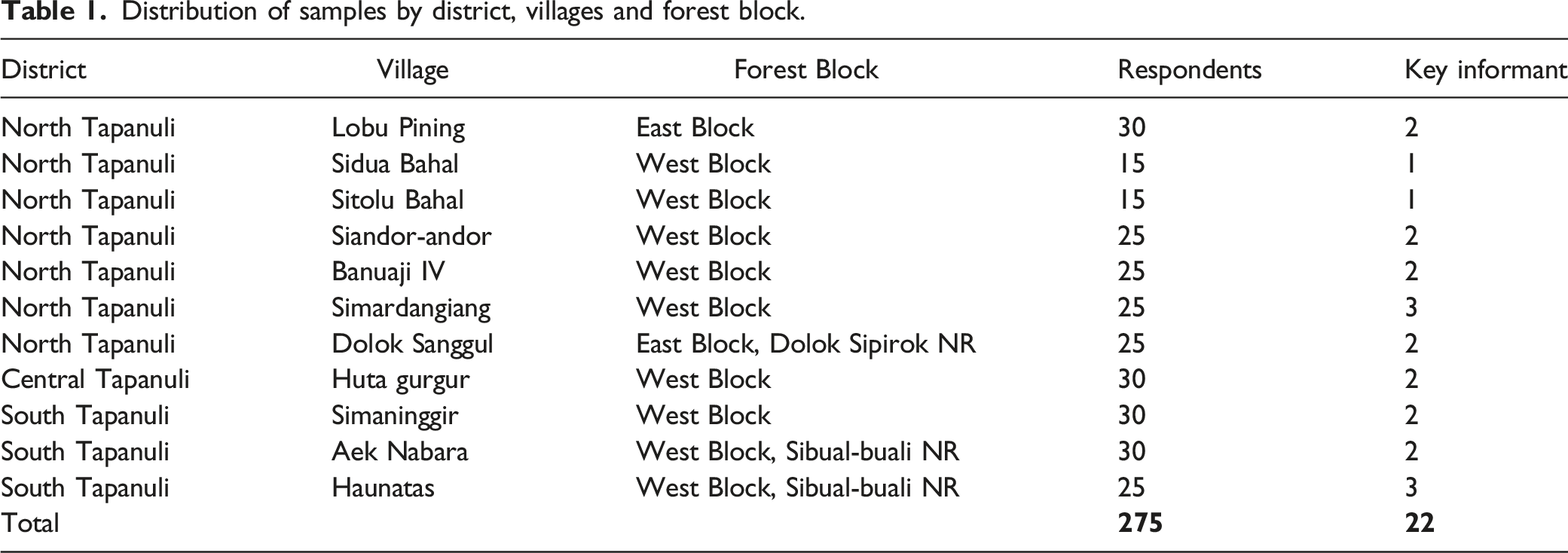
Before commencing interviews, we conducted a pilot study involving farmers who were not part of our research but who were knowledgeable about the Tapanuli orangutans. This pilot was designed to evaluate the clarity of questions and uncover potential issues with the research approach. It also helped us to refine our study to a key set of meaningful variables. Interviews were conducted between 2020 and 2022. Prior to the interview, permission was granted by village authorities and the interviewees themselves. A short briefing explained the context and purpose of the research, how the results would be used and that the respondents were free to decline to answer any question. Interviews typically lasted 30-45 minutes and were conducted in the native Batak language of respondents.
Our comprehensive questionnaire, designed to investigate the interaction between smallholder farmers and Tapanuli orangutans, encompasses seven sections. These sections cover the following aspects: (1) Demographics: Gathering essential information such as age, gender, education, occupation, and farming experience to establish context. (2) Ecosystem Services Knowledge: Assessing farmers' comprehension of Tapanuli orangutans' ecological contributions, encompassing awareness, services provided, and perceived benefits. (3) Attitudes Toward Encounters: Exploring emotional responses during interactions with Tapanuli orangutans, perceptions of their impact, and reactions to crop raids. (4) Losses and Benefits Perception: Evaluating how respondents perceive crop losses, assess the trade-off between benefits and losses, and understand the role of Tapanuli orangutans in this context. (5) Cultural and Economic Values: Investigating cultural practices involving Tapanuli orangutans and examining economic opportunities. (6) Political-Economic Factors: Exploring factors that influence this relationship, such as governmental policies, support for mitigating crop losses, and the involvement of external entities. (7) Overall Perspective: Capturing respondents' overarching opinions, thoughts, and concerns. The quantitative survey was centered on sections 1 through 6, comprising quantifiable queries suitable for statistical analysis, utilizing a Likert 5-point scale. In contrast, sections 7 were designed to elicit qualitative perspectives, thereby enriching our comprehension of farmers' viewpoints.
Data Analysis
Quantitative data were analysed descriptively using MS Excel as follows: Frequencies and percentages were calculated to summarize and analyze the survey data related to farmers' knowledge about the services and disservices of the Tapanuli orangutans, as well as their attitudes toward encounters with the species. Quantitative data pertaining to farmers' knowledge and attitude were analyzed using Chi-square tests in SPSS. For qualitative data, thematic and content analyses were used as follows: Qualitative data were transcribed and coded to identify common themes and patterns related to farmers' behaviors, practices, beliefs, and contextualization of the Tapanuli orangutans's societal values, as well as the political-economic systemic factors that influenced their interactions with the species. The software NVivo was used to assist with this analysis.
Results
Farmers Perceptions of the ‘Roles’ of Orangutans
Farmers identified six ‘roles’ of orangutans that impacted them; seed dispersal, research and education, cultural value, aesthetic value, crop raiding, and meat consumption (Figure 2). Crop raiding was perceived to be the most prominent role, with 74% of farmers acknowledging this activity. Farmers reported that encounters with orangutans in their fields were uncommon, generally restricted to the harvest season of crops such as durian and petai. To allow the fruits to ripen, farmers often leave them on the trees for several days, providing an opportunity for orangutans to forage and feed on them. The farmers highlighted that during these fruiting seasons, they are aware of the potential risks associated with encountering this protected species in their fields. They face a dilemma between protecting their crops and managing the orangutans. They often attempt to expel the primates from their fields by using scare tactics or even inflicting harm, although this can be difficult and risky, given the fact that this species is protected by the Government. Orangutan roles according to local farmers.
Aesthetic value, which refers to the appreciation of orangutans as a part of the local biodiversity and natural heritage, was also considered significant, with 25% of the farmers acknowledging this role. This highlights the cultural significance of orangutans and their role in shaping local perceptions of the forest ecosystem with farmers in several villages seeing the orangutan as a charismatic animal. Some farmers were aware that the Tapanuli orangutan was newly classified as a separate species, critically endangered, and needing protection. For example, the village head in Simardangiang said: “I think around 2018, there has been a surge in news coverage and campaigns focused on the Tapanuli orangutans. Following this period, an increasing influx of individuals has been drawn to our village with the sole intent of inquiring about or conducting surveys on the Tapanuli orangutans. These individuals include photographers, biologists, representatives from NGOs, corporations, and even government officials. Naturally, this phenomenon has prompted us to question the underlying reasons for this collective concern regarding this specific orangutan species. Reflecting on the various visits and discussions, I have arrived at the conclusion that, without a doubt, this species is under the watchful observation of multiple entities.” (T.S, 52 years old).
Another 63-year-old farmer from Simaninggir said: “We’re proud to live alongside the newly identified species - Tapanuli orangutans. Our village has famous waterfalls and dense forests, and if the government promoted our village as a place to see this iconic species, we could protect the species and attract as many tourists as other popular Orangutan spots like Kalimantan and Langkat. Just for your information, none of the villages around the Batang Toru forest are established for Orangutan ecotourism”.
Comments like these showed that farmers in these villages understand the importance of conserving the Tapanuli orangutans as an endangered species and see the potential for ecotourism.
The presence of orangutans stimulated research and education, and this was an important contribution according to 23% of farmers. Orangutans have been studied extensively by researchers for their behavioral, ecological, and evolutionary characteristics (Ancrenaz et al., 2006; Marshall et al., 2009; Nater et al., 2017; Sloan et al., 2018). Furthermore, orangutans are also considered to have educational value, as they are often used as flagship species for conservation education and awareness programs either by the government or NGOs in Tapanuli. Cultural values, which refers to the role of orangutans in local customs, beliefs, and traditions, was acknowledged by 12% of the farmers. Orangutans have cultural significance among local communities, as they are often considered as sacred animals or have cultural myths and stories associated with them. We studied this phenomenon in several villages (Simardangiang, Haunatas, and Dolok Sanggul) where farmers hold unique beliefs regarding the treatment and perception of orangutans compared to other animals such as macaques. In Simardangiang, for example, orangutans are considered neighbors; some farmers like having them around while others do not. However, harming them is not condoned. In Dolok Sanggul, orangutans are not treated poorly due to their distinct appearance and larger size compared to other animals. The physical depiction of orangutans is believed to instill fear in the community, preventing harm to them as they are seen to possess certain powers and are best avoided. Meanwhile, in Haunatas, orangutans are referred to as animals with spirits, and thus, hurting them is deemed an immoral act. Although orangutans are known to disperse seeds of various plant species through their feeding behavior, contributing to forest regeneration and biodiversity (Ancrenaz et al., 2006; Nielsen et al., 2011), only 9% of farmers recognized seed dispersal as an important role.
Meat consumption, which refers to orangutans being a source of food for farmers, was acknowledged by 5% of respondents, however orangutans are not actively hunted like wild boar or deer, and the last occurrence of one being eaten was more than ten years ago. To illustrate, in North Tapanuli, orangutans have been stranded in farmers' fields and farmers attempted to drive them away. Because they remained in the fields, and farmers perceived them to be defenseless, they resorted to hunting them for their meat. It's noteworthy that this practice is not pursued individually; instead, the meat is shared among the farmers. In recent years, rather than being killed and eaten, orangutans have been rescued by NGOs or government bodies.
In summary, farmers in Batang Toru Forest reported that orangutans were perceived to play multiple roles, with crop raiding, aesthetic value, research and education, and cultural value being considered as significant.
Farmers Attitudes When Orangutans Enter Their Land
Fifty-one percent of durian farmers in the Batang Toru forest tolerated the presence of Tapanuli orangutans on their land, albeit with some reservations (Table 2). A quarter of farmers chased them away by throwing sticks and stones at them, with some using an air rifle. Most durian farmers reported losses because of crop raiding by orangutans with more than 90% of farmers in Lobu Pining and Simaninggir experiencing this. In seven villages (Sidua bahal, Sitolu bahal, Dolok Sanggul, Lobu pining, Huta Gurgur, Simaninggir, and Aek nabara) we found a significant association between durian loss and repellence – farmers became less tolerant towards orangutans as they lost more durian. However, in the remaining four villages (Banuaji IV, Siandor-andor, Simardangiang and Haunatas) we found a significant association between durian loss and tolerance attitudes towards orangutans. This implies that as durian losses occurred, farmers tended to exhibit greater tolerance rather than repellence in their attitudes towards orangutans. The in-depth interviews explained that in these four villages orangutans were tolerated because they were viewed as neighbours. One respondent in Simardangiang explained this concept like this: “For us in Simardangiang, orangutans are our neighbours with whom we live side by side. When a hungry orangutan comes to raid durian fruit, other animals are usually not present there because the orangutan has already taken over the area. So, for us, it is like sharing the durian fruit with our neighbour, even though many farmers have their own objections based on their own experiences. However, when encountering an orangutan on a durian tree, we do not harm them but usually say, ‘Take your share, but don't take too much. Leave some for me’. It has been proven that they will take their share, and there is still plenty left for the farmers.” (T.S, 52 years old). Farmer’s Tolerance and Repellence in Response to Crop Loss Caused by Tapanuli Orangutans.
Other ‘tolerant’ responses demonstrated that conserving the forest was a part of the village identity. In Haunatas, E.S (47 years old) said: “We in Haunatas are very knowledgeable in how to handle orangutans when they come to our land without harming them. Some let them be and usually report to me, and I can forward it to the authorities, NGOs, or the government. This is strengthened by the education and awareness, especially our identity as Haunatas communities that has been closely linked to conservation, for instance in 2020, we received an award from the Indonesian government for our forest conservation efforts, which made us known as a wildlife-friendly community and it becomes part of our village identity here.”
Socio-Economic and Political Attributes to the Tapanuli Orangutans
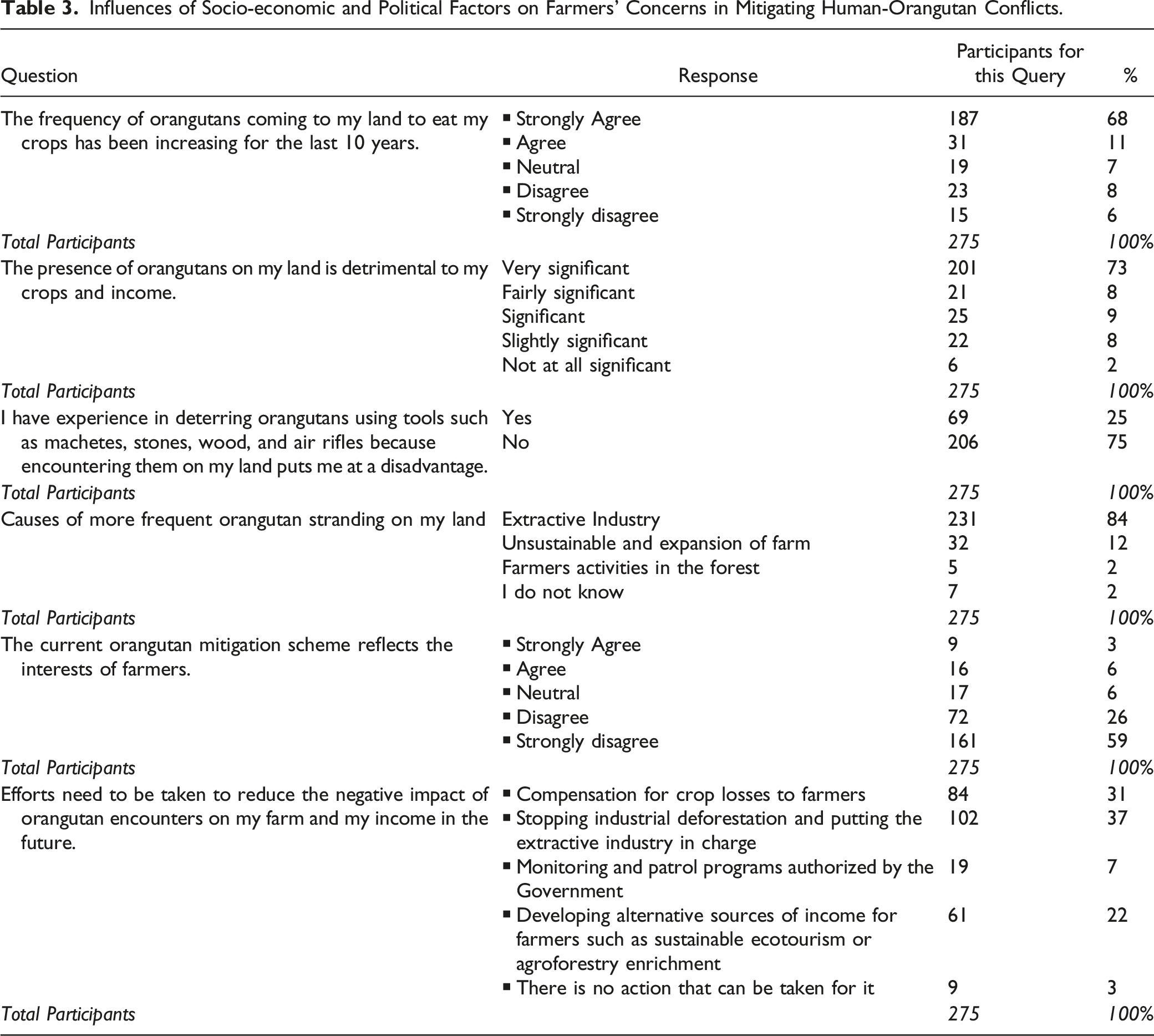
Influences of Socio-economic and Political Factors on Farmers' Concerns in Mitigating Human-Orangutan Conflicts.
In some cases, interventions are needed, for example, in Siandor-andor, an orangutan was discovered stranded and starving in 2020, prompting the locals to report the incident to the authorities. However, in most cases, orangutans leave agricultural land and return to their natural habitat unaided.
Farmers recognise that something needs to be done to reduce the negative impact of orangutan encounters on their farms and income in the future. They endorsed a range of different mitigation approaches including cessation of industrial deforestation (37%), compensation for crop losses (31%) and alternative income sources (22%). Only 3% felt that there were no solutions.
In summary, the findings suggest that farmers in the region face increased human-orangutan conflict, caused by an expansion of extractive industries and agricultural practices. Effective mitigation measures must be developed in collaboration with farmers, which lead to sustainable solutions for conservation and development in the region.
Discussion
Orangutan Roles, Farmers Perceptions, and Conservation Challenges
Several previous studies highlight the positive ecology role of orangutans as ecosystem engineers (Jones et al. (1994) or in seed dispersal (Nielsen et al., 2011; Tarszisz, 2016; Tarszisz et al., 2018b, 2018a) and germination (Ancrenaz, 2007; Nielsen et al., 2011 (Tarszisz et al., 2018b). However, only a minority of respondents comprehend the nuanced role of orangutans as ecosystem engineers. Other studies emphasize the economic benefits of orangutans in generating revenue through tourism (Zander et al. (2014) Susilawati et al. (2019) or their cultural role, revered as sacred animals in some communities (Wadley et al., 1997; Wadley & Colfer, 2004). Local beliefs about orangutans’ treatment and status were studied in Simardangiang, Haunatas, and Dolok Sanggul villages. In Simardangiang, they are seen as neighbors, and harming them is discouraged; instead, farmers share durian fruit with them. In Dolok Sanggul, orangutans are viewed with fear due to their perceived energies. Haunatas regards them as animals with spirits and opposes harm. Similar cultural values were observed in Sentarum Lake, where killing orangutans is illegal, and Dayak communities consider them ancestors, believing they taught important life lessons. Some Batak communities in Tapanuli see orangutans as animals rather than ancestors. Local knowledge is essential for effective conservation, emphasizing cooperation with farmers (Boafo et al., 2016; Whyte, 2013; Yuliani et al., 2018). A small number of farmers also highlight orangutans' importance in research and education, especially for conservation. Orangutans are focal points in conservation awareness campaigns due to their endangered status, as supported by Knott et al., (2021). Their unique traits enhance our understanding of ecosystems. Local farmers value wildlife for education, emphasizing biodiversity conservation and habitat preservation. Tailored environmental education for communities and inclusivity, incorporating diverse perspectives, is crucial (Brias-Guinart et al., 2022).
While a minority of farmers we surveyed recognised these positive roles, most farmers in the Batang Toru forest highlighted the orangutan’s negative contribution, as a crop raider. This aligns with other studies (Ango et al., 2017; Marchal & Hill, 2009; Mc Guinness & Taylor, 2014; Priston, 2008). Local farmers' perceptions of orangutans influence their reactions to crop raiding. Some tolerate them as hungry neighbours, while others fear or revere them as animals with spirits. Understanding these beliefs is crucial for effective conservation. Local farmers view orangutans as crop raiders, leading to economic losses and sometimes using repellents like stones and wood. Some villages have negative attitudes, resulting in harm to orangutans (MoEF, 2020; Mongabay, 2013, 2019). Studies by Siregar et al., (2020) and Hsiao et al., (2013) emphasize the economic importance of agriculture and negative farmer attitudes towards wildlife. Our study reveals nuanced perceptions of orangutan crop raiding, highlighting the need for peaceful conflict resolution (Ancrenaz et al., 2007; Campbell-Smith et al., 2012). In terms of meat consumption, while a few farmers admitted to consuming orangutans in the past, hunting incidents have not occurred in over a decade. Stranded orangutans are now rescued and rehabilitated by NGOs or governmental agencies. As a result, conservation initiatives should not only target hunting and eating bushmeat, but also the socioeconomic and cultural factors that contribute to these behaviours (Bowen-Jones & Pendry, 1999; Cawthorn & Hoffman, 2015; Morsello et al., 2015; Rose, 1996).
The Complexities of Human-Orangutan Conflict and Conservation Strategies
Human-orangutan conflict arises from resource competition exacerbated by extractive industries, habitat loss, and food source depletion (Meijaard & Wich, 2013; Oram et al., 2022). These conflicts, characterized by repeated encounters between Tapanuli orangutans and farmers in adjacent villages, stem from forest clearance and limited food access. The situation is worsened by nest-building in durian gardens, with such incidents, including the discovery of baby orangutans, concentrated in the Western Block of the Batang Toru forest, where extractive businesses like hydro dam electric, gold mining, and geothermal plantations operate. For example, Mongabay.co.id, (2022) has reported that encounters between Tapanuli orangutans and durian plantations are linked to the Batang Toru hydroelectric power plant project.
The strategies proposed by farmers to mitigate adverse impacts align with established conservation practices. These strategies encompass providing compensation to farmers for crop losses, halting industrial deforestation while entrusting the extractive industry with this responsibility, promoting alternative income sources for farmers, such as sustainable ecotourism or agroforestry enrichment, and implementing monitoring and patrols programs. These farmer-endorsed strategies are consistent with recognized conservation measures, which include cessation of deforestation, involvement of local community leaders, integration of conflict mitigation into forest management, creation of biological corridors, and population monitoring (Campbell-Smith et al., 2012; Kuswanda et al., 2021b, 2021a; Meijaard et al., 2021; USAID, 2017; Wich et al., 2019).
Our study emphasizes the significance of fostering trust and collaboration among government agencies, conservation organizations, and local farmers to formulate conservation measures that align with the cultural and social context of the region. Addressing this intricate issue demands a comprehensive outlook that acknowledges its connections to deforestation and land conversion, necessitating cooperation from all stakeholders (Meijaard et al., 2012; Wich et al., 2012). Such collaborative efforts are paramount for the effective execution of conservation initiatives (Carter & Gronow, 2005; Desmiwati, 2017).
Implications for Conservation
Our study delves into the intricate attitudes of local farmers towards Tapanuli orangutans residing in the Batang Toru forest area, offering a nuanced perspective on the potential for coexistence. Despite acknowledging orangutans as crop raiders, farmers demonstrate a level of tolerance that suggests the possibility of harmonious cohabitation. Given the complexity of this problem we propose incorporating the following elements into future strategies: 1. 2. 3. 4. 5.
In tandem with these five aspects, successful conservation strategies protecting great apes, like those implemented in the Congo Basin and West Africa, encompass legislation, law enforcement, protected area management, community-based conservation, economic alternatives to bushmeat consumption and trade, ecotourism, education, and capacity building (Schoneveld-de Lange et al., 2016; Boesch et al., 2021).
In conclusion, our work contributes to a better understanding of human-wildlife conflicts by highlighting how the culture and context of specific human communities determines their responses to orangutan crop raiding. Combining these socio-cultural influences with other economic and ecological elements will ensure that conservation efforts are both comprehensive and sustainable.
Footnotes
Acknowledgments
We are grateful to the farmers in Tapanuli for their willingness to share their knowledge. We would like to thank the IUCN Academy and IUCN Commission on Ecosystem Management for their assistance in enhancing this publication.
Declaration of Conflicting Interests
The author(s) declared no potential conflicts of interest with respect to the research, authorship, and/or publication of this article.
Funding
The author(s) disclosed receipt of the following financial support for the research, authorship, and/or publication of this article: We appreciate the Ministry of Research, Technology, and Higher Education in the Republic of Indonesia for their generous funding support through the Program Magister Menuju Doktor Sarjana Unggul (PMDSU), an accelerated Ph.D. program.
