




Abstract
Restoration projects designed to promote one ecosystem service may have synergistic benefits to other services. Therefore, bundling them can be an effective way to maximize the return to the investments in programs of payments for ecosystem services (PES). Here, we investigated the additional gain of restoration actions—which were implemented as part of a PES program to protect a key watershed for water supply—on increasing functional landscape connectivity in the Atlantic Forest region of southeastern Brazil. Using a landscape ecology approach, we estimated the amount of forest cover before (2006) and after (2012) restoration activities by the PES program and changes in structural and functional landscape connectivity for birds with varying gap-crossing capabilities. Forest cover increased from 42.5 to 86.1 ha after the implementation of restoration projects by the PES program. In the simulated scenarios of landscape connectivity, the mean patch size of functionally connected forest increased by 1,034%, 392%, 248%, and 94% for species with gap-crossing capabilities of 0, 20, 40, and 60 m, respectively. Our results highlight the potential for incorporating biodiversity conservation objectives into PES projects primarily designed to enhance water-related ecosystem services.
Keywords
Introduction
The recognition of the important role that ecosystem services (ES) play in human well-being and economy has led to increased investment in the protection, sustainable management, and restoration of natural ecosystems worldwide (Alexander, Aronson, Whaley, & Lamb, 2016; Constanza et al., 2017; The Economics of Ecosystems and Biodiversity, 2010). Through payments for ecosystem services (PES) schemes, many environmental programs have received extra and decisive economic support for covering their costs. In addition, the providers—farmers, indigenous communities, and so forth—are finally being rewarded for their contribution to the provision of ES to society at large (Bremer et al., 2016; Taffarello, Calijuri, Viani, Marengo, & Mendiondo, 2017; Wunder, 2007). Although an increasing enthusiasm has elected PES as one of the most promising strategies to achieve sustainability (Redford & Adams, 2009), it is evident that there is not enough money available thus far to pay all stakeholders involved in the provision of ES.
One of the strategies to increase the efficiency of PES schemes is to bundle different services into the same project. For instance, instead of focusing on the provisioning of a single and specific ES, like carbon sequestration, a given project could invest in strategies providing multiple services in the same space and time, like carbon sequestration combined with watershed protection and biodiversity conservation (Wendland et al., 2010). This alternative would make it possible to pay for one specific service and to receive many others by spending the same amount of resources. Although the other coprovisioned ES could also be rewarded by society in the future, the use of the proposed strategy could constitute a smart investment for achieving better results with lower costs in the present.
For instance, biodiversity and carbon storage are highly correlated in the world (Strassburg et al., 2010) so that payments to Reduce Emissions from Deforestation and Degradation in such key regions could potentially mitigate species extinction debt (Strassburg et al., 2012). A forest restoration planting implemented on the borders of a water reservoir in southeastern Brazil to increase water purification and storage capacity has also provided multiple cultural ES to the local population (Brancalion, Cardozo, Camatta, Aronson, & Rodrigues, 2014). Another proposal has even suggested that the economic viability of tropical forest restoration is dependent on the adoption of a basket of opportunities, bundling the production of timber and nontimber forest products, and payments for carbon- and water-related ES in the same project (Brancalion, Viani, Strassburg, & Rodrigues, 2012). Despite the potential for bundling multiple ES, Wendland et al. (2010) highlighted that our knowledge on many ecosystem functions and services is still rudimentary, and obtaining accurate spatial data for these services is even more difficult. Therefore, the assessment of the provisioning of multiple ES at the landscape level is of utmost importance for the implementation and improvement of PES programs.
Ecological restoration has a potential for reestablishing or improving the simultaneous provision of many ES in degraded sites (Rey Benayas, Newton, Diaz, & Bullock, 2009), as the goal of this activity is to assist the recovery of an entire portion of a natural ecosystem (Palmer & Filoso 2009). Specifically, ecological restoration projects implemented through PES schemes for protecting watersheds may have a relevant potential for increasing landscape connectivity, as the focus of such projects have been the restoration of native vegetation in buffer zones along springs and streams. For instance, landholdings under PES contracts in Costa Rica increased forest cover, although the effect of the restored forests on landscape connectivity was not assessed (Arriagada, Ferraro, Sills, Pattanayak, & Cordero-Sancho, 2012). By now, such structural elements may both increase forest cover and act as ecological corridors connecting isolated vegetation patches in fragmented landscapes (Gama, Martensen, Ponzoni, Hirota, & Ribeiro, 2013; Martensen, Ribeiro, Banks-Leite, Prado, & Metzger, 2012; Tambosi, Martensen, Ribeiro, & Metzger, 2014).
In this study, we investigated the potential of restoration actions, established as part of a PES program to protect a key watershed for water supply, for increasing functional landscape connectivity. Our hypothesis is that vegetation patches under restoration that were primarily established for water resources protection are additionally playing an important role in the landscape by increasing structural and functional connectivity, thereby demonstrating the potential for generation of multiple ES through ecological restoration efforts. As many ES or disservices are modulated by landscape spatial patterns—such as water quality, disease control, loss of pest control by increase in pest response, pest control by increase of natural enemies' response, pollination, and aesthetic value—we advocate that PES that meet the synergism between services would be a great priority on the restoration agenda (Duarte, Santos, Cornelissen, Ribeiro, & Paglia, 2018).
Methods
Study Site
The Extrema municipality (state of Minas Gerais, southeastern Brazil, Figure 1) is located in the southern portion of Serra da Mantiqueira, which is a part of the Atlantic Forest biodiversity hotspot). The study site is situated inside the Piracicaba-Capivari-Jundiaí watershed (PCJ), recognized for its water production for the 8.8 million people in the São Paulo metropolitan area. After a long planning process, the Conservador das Águas (Water Conservation) project was initiated in Extrema municipality in 2007, when the first farmer was compensated with PES. The Conservador das Águas is a water-related PES program led by the Extrema municipal environmental department and supported through a multistakeholder partnership involving nongovernmental organizations, private companies, and the federal agency of water (Richards et al., 2015). The key areas for watershed protection are identified and submitted to forest restoration by high-diversity tree seedlings plantings (for details, see Rodrigues et al., 2011). The selection of target areas for forest restoration was partially based on the 1965 Brazilian Forest Code, which established the need to protect or restore areas that are not covered by native vegetation. The Forest Code defined several particular areas to be permanently protected: mountain tops, 30-m-wide riparian corridors along each side of streams, and a radius of 50 m around springs (see details in Brancalion, Garcia, et al., 2016a). The Conservador das Águas is the most successful program of PES in Brazil and received a major UN-Habitat award in 2012 that recognized the project as one of the 10 best global conservation practices (http://mirror.unhabitat.org/bp/bp.list.details.aspx?bp_id=4399). From 2007 to 2016, a total of 210 PES contracts were signed, and around US$930,000 were invested to PES for rural landowners (Taffarello et al., 2017).
Location of the study site in southeastern Brazil (a), at the PCJ watershed (b), and within the Posses watershed (c), at Extrema, Minas Gerais. PCJ = Piracicaba-Capivari-Jundiaí.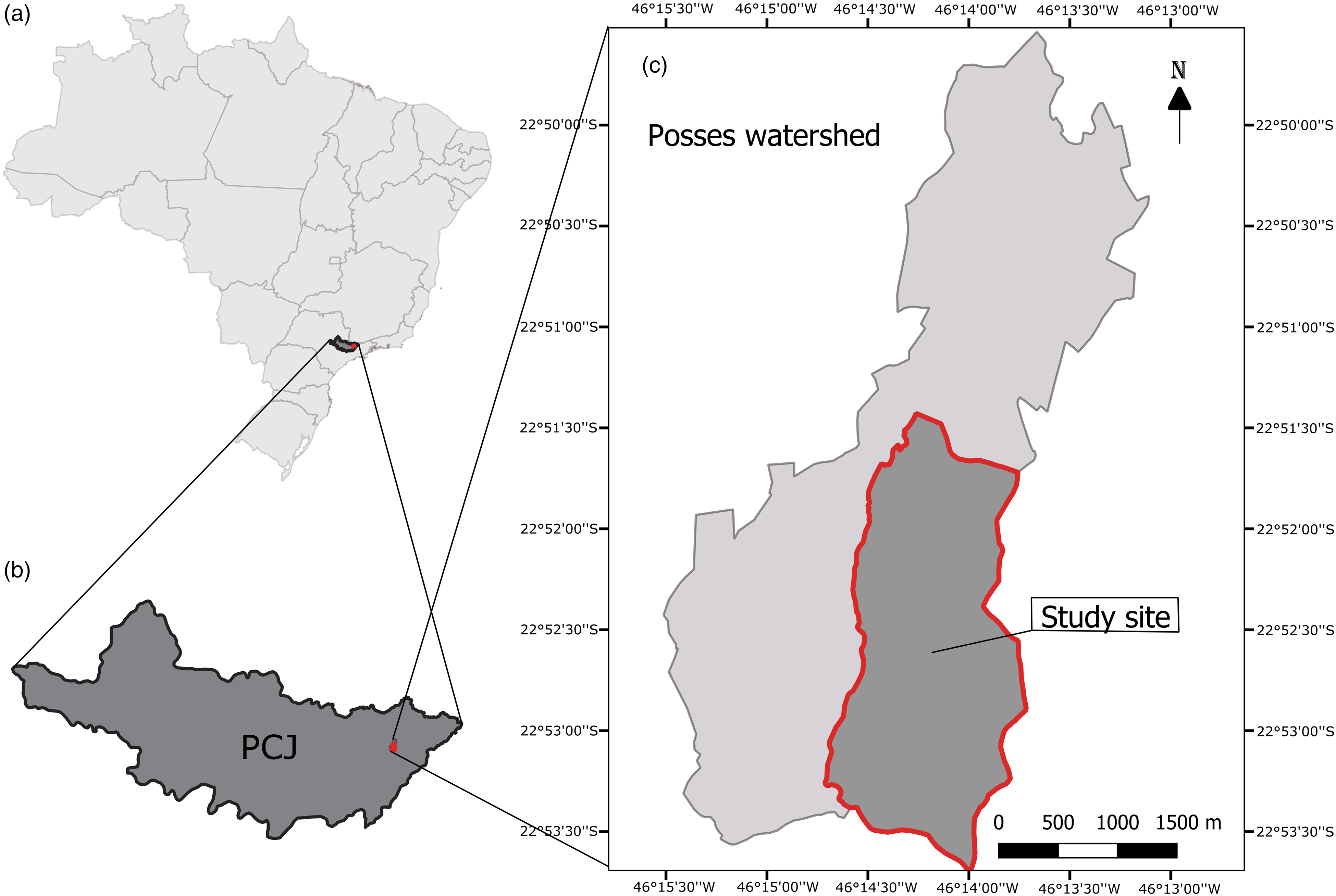
For this study, we selected part of Posses watershed in Extrema (22°51′30″ S and 46°14′30″ W) covering an area of 415 ha as our study site. Posses was the first watershed with forest restoration actions within the Conservador das Águas and was selected to initiate the program activities for being the most degraded watershed of the municipality. This watershed covers 1,201 ha and, similar to the rest of the Brazilian Atlantic Forest (Ribeiro, Metzger, Martensen, Ponzoni, & Hirota, 2009), is highly degraded, with only 7% of forest cover in 2006, prior to the beginning of the Conservador das Águas.
Vegetation Mapping Before and After Restoration
We mapped remnant forests and restored forests using ArcGIS 9.3, a set of aerial photos, and a 2006 Quickbird image with 0.6 m resolution. To evaluate changes in forest cover and connectivity, we considered two different times: one in 2006, prior to the beginning of the Conservador das Águas, and another in 2012, 6 years after the establishment of the first restoration plantings.
We set up a GIS database with UTM projection and South America 69 datum and visually interpreted the high-resolution imagery. All forest patches and landscape features that provide potential for connectivity (potential connectivity features) were considered as patches in our analysis. Forest fragments, young secondary forests, commercial Eucalyptus sp. plantations, agroforestry gardens, and stepping stones were classified as potential connectivity features (i.e., features that promote biological flow). All other landscape features were mapped as open matrix, mostly composed of pasture for cattle.
Landscape Connectivity Simulations
Forest-dependent understory birds are good indicators of biodiversity responses to landscape structure, particularly the effects of patch size and connectivity on richness and abundance (Martensen et al., 2012). Thus, we used information on regional understory birds to simulate the landscape connectivity in the before and after forest restoration scenarios.
A bird survey was conducted in a site located 50 km away from our study site and the following bird species were identified as the most abundant and common species in the forest fragments: Basileuterus culcivorus, Basileuterus leucoblepharus, Thamnophilus caerulescens, and Chiroxiphia caudata (Almeida, Padovezi, & Lima, 2011). According to previous studies, these species are sensible to human disturbances in the landscape because of the limitation they have to move through the matrix and between habitat patches (Awade & Metzger, 2008; Uezu, Metzger, & Vielliard, 2005). Besides, we confirmed that all these species occur in the region throughout ATLANTIC BIRDS dataset (Hasui et al., 2018), and therefore, we used them as models on our landscape connectivity simulations.
According to Awade and Metzger (2008), the probability of B. culcivorus and T. caerulescens crossing a 20 m distance of a nonhabitat patch is higher than 70%; it is about 50% for a 40 m distance and lower than 20% for a 60 m distance. Then, we used information for those bird species and these three distances (20, 40, and 60 m) to simulate functional connectivity possibilities in the studied landscape. Shorter distances imply higher chances for connectivity to occur, while longer ones represent lower chances. Considering that gap-crossing capabilities beyond 100 m are very unlike for the regional birds, we chose 60 m as a limit to test functional connectivity, ensuring higher relevance of results (Awade & Metzger, 2008; Boscolo, Candia-Gallardo, Awade, & Metzger, 2008). Besides that, we also analyzed the structural connectivity, expressed by 0 m of distance between forest patches (gap-crossing capability of 0 m), which represented the strictly forest species.
For each of the gap-crossing capabilities, we calculated the functionally connected forest area. We consider functionally connected forest area as the amount of forest that a particular species is able to access depending on its gap-crossing capability. In this context, if species are able to cross 20 m, all forest patches that are less than 20 m from a focal patch are summed as a functionally connected forest (Martensen et al., 2012).
Forest Cover and Connectivity Calculation and Data Analysis
Forest cover before and after forest restoration through the Conservador das Águas was used to estimate the area of functionally connected forest patches for four gap-crossing capabilities: 0, 20, 40, and 60 m. We transformed our vector polygons (patches and matrix) into raster, where forest patches = 1 and matrix = 0. Then we identified those patches that were near in different gap-crossing distances (20, 40, and 60 m). To make this, we applied the moving window dilatation method using the Neighborhood Statistics from Spatial Analyst toolbox. After this step, every forest patch close to other according to the gap-crossing values was considered as belonging to the same functionally connected forest patch. Then we converted back to vector and, for each gap-crossing capability, we clumped the connected habitats as a unique functional area. To calculate the functionally connected forest area, we summed all patches inside each clump and excluded the matrix that was not considered in this sum. We attributed this functional area to each patch pixel that belongs to its respective connected habitat or clump. The eight raster maps (before and after restoration for the four gap-crossing capabilities) were used for statistical analyses performed in the R software (R Development Core Team, 2016). We performed the variance analysis and estimated the mean and the standard deviation of the connected habitat sizes. Actually, all these functional connectivity calculations can be done using LSMetrics package within GRASS GIS (see https://github.com/LEEClab/LS_METRICS).
Results
The implementation of forest restoration projects in the Posses subwatershed for improving the protection of water resources has more than doubled its natural forest cover, increasing from 42.5 ha (10.2% of the subwatershed) before the beginning of the PES program to 86.1 ha (20.7%) after the restoration of agricultural lands along streams, around springs, and on mountain tops (Figure 2). The new forest patches established by restoration have also increased the mean connected area for all gap-crossing capacities considered in this study (Table 1). For instance, when there is no gap-crossing capacity, mean size of connected patches increased from 1.4 ha to 15.7 ha, hence increasing the mean size of the connected patches by 1,034%. In the future, the forests under restoration may provide habitat for even more sensitive species, as larger forest patches were established. Before ecological restoration, the largest remnant was 5 ha in size, while after the implementation of the projects, the largest one increased to 36 ha (Figure 2).
Patches of remnant and restored forests before (a) and after (b) the implementation of forest restoration projects as part of a program of payments for water-related ecosystem services in Extrema, Minas Gerais, southeastern Brazil. Increase in Landscape Connectivity Promoted by Forest Restoration in a Program of Payments for Water-Related Ecosystem Services in Extrema, Minas Gerais, Southeastern Brazil. Note. The connectivity classes considered a scenario of structural connectivity in which animals would not be able to cross areas of the matrix, and three scenarios of functional connectivity were simulated based on three gap-crossing capacities: 20, 40, and 60 m.

Regarding the increase of functional connectivity, our simulations showed that the recently implemented restoration plantings increased the mean functionally connected forest area by 392% for organisms with a gap-crossing capability of 20 m (Figure 3, Table 1). When the gap-crossing capability was increased to 40 and 60 m, the increase in the mean area of connected habitats were 248% and 94%, respectively (Figure 3, Table 1). Overall, forest restoration increased the structural and functional connection among forest patches in the landscape, especially for birds with reduced capability to cross nonforest areas (Table 1).
The functional connectivity of the landscape before and after the implementation of ER projects as part of a program of payments for water-related ecosystem services in Extrema, Minas Gerais, southeastern Brazil. Three scenarios of gap-crossing capabilities (20, 40, and 60 m) were considered. The different colors within each figure represent the clumps of functionally connected areas. ER = ecological restoration.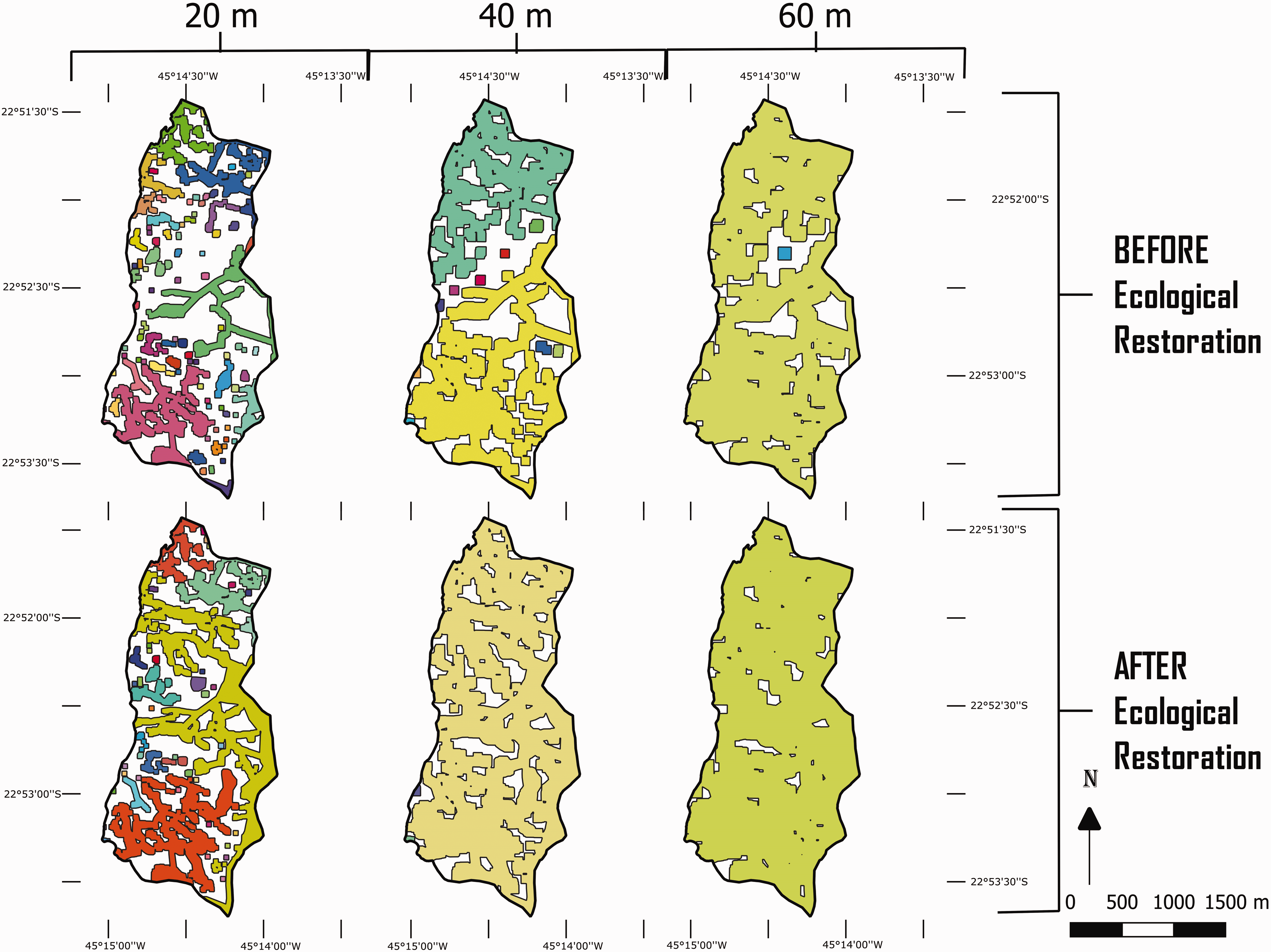
Discussion
The restoration of forests in areas where they protect water resources, such as along streams, around springs, and on mountain tops, has proven to also be effective for improving landscape connectivity in highly fragmented landscapes. This was evidenced by our case study in the Posses subwatershed region in the Atlantic Forest of Brazil. This complement of services was indeed foreseen by the Brazilian Forest Act when establishing the Areas of Permanent Protection, where the protection or restoration of native vegetation is mandatory for assuring biodiversity conservation, soil and water resources protection, human well-being, and many other functions (Brancalion, Garcia, et al., 2016a; Metzger, 2010; Soares-Filho et al., 2014). Fortunately, many other restoration projects designed to reestablish riparian forest corridors to comply with the Forest Act have been implemented throughout southeastern Brazil (Brancalion, Schweizer, et al., 2016b; Rodrigues et al., 2011), with consequent increases of landscape connectivity.
The results obtained here is a good indicative of allying the reestablishment or reinforcement of the provision of important ES to society with biodiversity conservation, even when compared to well-established PES programs across the world. For instance, the well-known PES project of Costa Rica reported a forest cover increase from 11% to 17% after 8 years of project implementation (Arriagada et al., 2012), while in the Extrema case study forest cover has more than double after 5 years. Other studies have also proposed the complementarity of water-related ES with other services, such as carbon sequestration and biodiversity conservation (Wendland et al., 2010), although evidence of the congruence of these services is still weak (Egoh et al., 2007). To our knowledge, our study is the first evidence of increase landscape connectivity mediated by an ongoing water-related PES program. This evidence may play an important role in supporting projects that implement ecological corridors for reconnecting isolated populations of threatened species in the Atlantic Forest region (Banks-Leite et al., 2014; Newmark, Jenkins, Pimm, McNeally, & Halley, 2017; Russo, 2009). Combining multiple benefits or ES or disservices—such as water quality, disease control, loss of pest control by increase in pest response, pest control by increase of natural enemies' response, pollination, and aesthetic value—is desired on every conservation or restauration project. Moreover, when the project results in changes on landscape structure, they will likely result in synergism between several ES (Duarte et al., 2018).
Of the 79 PES projects cited for the Brazilian Atlantic Forest by Guedes and Seehusen (2011), 33 were designed for carbon payments and 41 for water resources protection, but only 5 projects had biodiversity conservation as the main focus for attracting payments, and none of these were based on ecological restoration. Besides, within the 16 water-related PES projects implemented in the Brazilian Atlantic Forest, several have forest restoration as PES eligible actions, but none of them seems to have clear other goals than those related to water services (Taffarello et al., 2017). Thus, complementarity of ES promoted by ecological restoration may help to improve the financial reward to stakeholders by attracting new funding sources, offering of more than one service to buyers, and reducing the transaction costs per service. In this context, payments for biodiversity conservation as another modality of ES may finally become a reality in Brazil and elsewhere.
In contrast to the potential of mandatory forest restoration to provide both watershed services and biodiversity conservation, the Native Vegetation Protection Law of 2012, which replaced the 1965 Forest Code, strongly reduced the minimum width of riparian corridors that must be restored along streams and around springs in Brazil (Soares-Filho et al., 2014). The restoration of thin corridors, which are more susceptible to edge effects (Martello, Andrioli, de Souza, Dodonov, & Ribeiro, 2016; Mendes, Ribeiro, & Galetti, 2015), may provide less functional connectivity of the landscape and thus suboptimal levels of biodiversity conservation services (Brancalion, Garcia, et al., 2016a; Rotta, Viani, & Rosario, 2016). In conclusion, there is great potential for incorporating biodiversity conservation objectives into projects primarily designed and funded for improving the provision of water-related ES, a potential that can be optimized by adopting a landscape ecology perspective in the planning and implementation of ecological restoration efforts. Therefore, identifying the additional ES that are synergic with water-related PES is a great opportunity to increase the perspective of these projects, particularly when the services are modulated by landscape spatial patterns (Duarte et al., 2018).
Implications for Conservation
Forest restoration as part of payments for water-related ES may also contribute for biodiversity conservation through increases in native forest cover and landscape connectivity in highly threatened ecosystems. Biodiversity outcomes should be incorporated into the planning and implementation of water-related PES programs that have ecological restoration as eligible action for PES.
Footnotes
Acknowledgments
The authors thank Alaine Ball for English revision and comments that helped to improve the manuscript.
Declaration of Conflicting Interests
The author(s) declared no potential conflicts of interest with respect to the research, authorship, and/or publication of this article.
Funding
The author(s) disclosed receipt of the following financial support for the research, authorship, and/or publication of this article: R. A. G. V. and P. H. S. B. are supported by grant #2013/50718-5, São Paulo Research Foundation (FAPESP). P. H. S. B. is also supported by the National Council for Scientific and Technological Development (CNPq) of Brazil (#304817/2015-5).