




Abstract
The Colombian Caribbean, one of the most biodiverse regions in the world, is facing great challenges in biodiversity conservation due to accelerated ecosystem transformations and the territorial planning required for peacemaking. We conducted a systematic review of 470 documents published between 1990 and 2015 to evaluate the progress of biodiversity and ecosystem services knowledge, identify biases, and define the priorities for research. Specifically, we describe the main characteristics of biodiversity studies, including the geographic distribution and the ecosystem services studied. We found limited participation by the social and interdisciplinary sciences. Researchers have focused mainly on taxonomic groups such as insects, birds, and mammals, ecosystems such as the tropical dry forest and regulating services. Some geographic areas have very few studies, corresponding to places affected by armed conflict. We propose that it is necessary to focus on plant and microorganism studies and those at the genetic and landscape level, as well as on less studied ecosystems such as urban and agro-ecosystems and places involved in armed conflict that have not been studied. We conclude by exposing insights to enhance some of the biases found and face the challenges: in the short term, the establishment of protected areas to guarantee the supply of ecosystem services for human well-being, in the middle term, an integrated territorial planning, and in the long term, the promotion of the social-ecological systems perspective. Ecosystem services concept reveals the link between biodiversity and human well-being and thus could have the potential to contribute to biodiversity conservation and peace construction in the Caribbean.
Keywords
Introduction
Biodiversity conservation is essential to human well-being (Cardinale et al., 2012; Millennium Ecosystem Assessment, 2005). Despite the local communities, NGOs, and scientific community’s efforts to preserve biodiversity, evidence shows that the rates of biodiversity loss are increasing (Ceballos et al., 2015). In this context, an ecosystem services approach is emerging to evidence the links between people and ecosystems and contribute to biodiversity conservation (Armsworth et al., 2007).
The relationship between biodiversity and ecosystem services is highly complex, and the specific mechanisms that connect them are not well understood for all services (Cardinale et al., 2012; Harrison et al., 2014). Biodiversity can act in various ways in the provision of ecosystem services. Mace, Norris, and Fitter (2012) have proposed that biodiversity can act as a regulator of ecosystem processes, as an end service or as a good. There is strong evidence that supports a positive relationship between biodiversity attributes and the provision of ecosystem services (Balvanera et al., 2016; Cardinale et al., 2012; Harrison et al., 2014). The loss of biodiversity jeopardizes the supply of services and therefore has a negative impact on human well-being (Balvanera et al., 2016; Cardinale et al., 2012).
Colombia is second only to Indonesia in having the highest National Biodiversity Index (CDB-Convention of Biological Diversity, 2001) and contains 10% of the world’s biodiversity (Rangel-Ch, 2015). In the context of a megadiverse country, the Caribbean region of Colombia is the second most diverse region after the Andean region in terms of vegetation (Rangel-Ch, 2015).
Additionally, in terms of conservation, the most extensive biome in this region, the tropical dry zonobiome, is not well-represented in terms of protected areas (0.5% protected) and has been identified as a priority biome for conservation (Banda et al., 2016; Forero-Medina & Joppa, 2010). The tropical dry zonobiome has lost 92% of its original coverage in Colombia (García et al., 2014) and has been classified as a critically endangered ecosystem (CR), according to the UICN’s Red List of Ecosystems criteria, mainly due to the historic expansion of the agricultural frontier, urbanization, and mining (Etter, Andrade, Amaya, & Arévalo, 2015). Mangroves and wetlands have been heavily affected by infrastructure construction (Vilardy, González, Martín-López, & Montes, 2011). Other threats, such as climate change, are expected to have a greater effect on the Caribbean region due to the decrease in water availability and the effect on the biotic process (Etter et al., 2015). This region has endured massive ecosystems changes. Even before the Spanish conquest, native populations had already begun transforming the landscape by cultivating yucca and corn and by building villages (Angulo, 1995). In the 16th century, the emergence of the hacienda and the cattle expansion caused a profound change in forest ecosystems and favored grasslands expansion. Since the beginning of the 20th century, the rapid population growth, the urban–rural migration, and the industrialization process have favored urban growth and therefore deforestation (Etter, Mcalpine, & Possingham, 2008). As a result of this alteration process, transformed ecosystems cover the 68.5% of the Caribbean territory, while the natural ones (those which have not undergone major transformations by human activity) only cover 31.5% (IDEAM, IGAC, IAvH, Invemar, Sinchi, & IIAP, 2007).
Another factor that has shaped ecosystems in Colombia is the armed conflict, a civil and political war that for more than 60 years has confronted the National Government with guerrilla movements, such as the FARC-EP, and paramilitary groups. The consequences of armed conflict on biodiversity are unclear and often mixed with complex combination of damages and benefits (Mcneely, 2003). On one hand, activities such as coca farming and mining, both illegal sources of funding, have caused the destruction and contamination of ecosystems (Dávalos, 2001). On the other hand, the strategies used by the armed groups, such as “gunpoint conservation” (forced prohibition of cutting down trees or hunting), has preserved the coverage of forests that have been used by them to hide from the Army (Dávalos, 2001). Even in some areas, forest regrowth has been favored due to the reduction of forest pressures related to human forced displacement and land abandonment (Sánchez-Cuervo & Aide, 2013).
The Colombian armed conflict has left 8 million victims throughout the country of which more than 1.7 million occurred in the Caribbean (Red Nacional de Información, 2017). Although its causes are complex and multiple, social and political exclusion and land concentration by few owners stand out (Historical Commission of the Conflict and Its Victims, 2015). Access to land is related to the satisfaction of the basic needs of the population such as food, housing, and work. Colombia has one of the world’s highest rates of inequality in land ownership, with a Gini coefficient of 0.863 (a coefficient of 1 would mean that all land belonged to one person; IGAC, 2012). Therefore, in the peace agreement signed between the Colombian Government and the Revolutionary Armed Forces of Colombia (FARC-EP), access to land, the need for a rural reform, reparation of victims, and reintegration of ex-combatants are central issues (Gobierno Nacional de Colombia & FARC-EP, 2016).
The transition from war to peace in the territory can bring new threats for biodiversity conservation because a peak of ecosystem transformation is to be expected as forest frontiers become accessible to legal economic interests such as mining and logging among others (Álvarez, 2003; Dávalos, 2001; Milburn, 2014; Morales, 2017). However, a unique opportunity arises for biodiversity conservation and the ecosystem services valuation because they constitute an important source of livelihood and well-being for the population and its degradation could threaten social and economic stability (Morales, 2017).
In this context, it becomes relevant to compile and analyze the biodiversity and ecosystem services knowledge for it is a key component for adequate territorial and development planning.
The goal of this study is to analyze scientific production related to biodiversity and ecosystem services in the Colombian Caribbean to evaluate the progress of knowledge, identify biases, and define the priorities for research in facing challenges related to ecosystems transformation and the construction of peace. In doing so, we conduct a systematic review to describe the main characteristics of biodiversity studies, including its geographic distribution, to analyze the ecosystem services studied, and to explore the relationships between ecosystem services and taxonomic groups, the levels of organization of biodiversity and ecosystems. We expect to find biases in the production of biodiversity knowledge regarding taxonomic groups, geographic areas, ecosystems, disciplinary focus, topics, and ecosystem services studied.
Methods
Study Area
The Colombian Caribbean region is located on the north side of the country, at South America’s northernmost point. It comprises approximately 142,000 km2 (12% of the national territory), and it is administratively divided into seven departments: la Guajira, Cesar, Magdalena, Atlántico, Bolívar, Sucre and Córdoba, all located between 7°00′ and 12°27′ North latitude and 76°30′and 71°06′ West longitude (Figure 1(a)). This region is characterized by a broad biological and cultural diversity. The ecosystems, product of the interaction between human activity and biomes, are mangrove swamps, wetlands, grasslands, dry forests, deserts, humid forests, and paramos, with most of them being highly transformed (IDEAM et al., 2007). There are six types of biomes in the Caribbean (Figure 1(b)–(h)): (a) Halobiomes: areas with waterlogged soils and strong saline influence, where mangroves naturally grow on brackish to saline tidal waters and plains, (b) Helobiomes: places with bad drainage, permanent flooding, or with prolonged period of flood, located on plains and alluvial valleys, (c) Orobiomes: defined by the presence of mountains that affect water regimes and form vegetation strips related with differences in altitude and temperature, (d) Desert zonobiomes: areas influenced by warm and arid climates. They are found on colluvio-alluvial piedmont geoforms, eolic and fluvial plains, and structural hills. (e) Tropical humid zonobiome: located in humid warm and very humid warm climates, it is found on structural erosional and fluvio-gravitational hills, colluvio-alluvial piedmont, and alluvial plains. (f) Tropical dry zonobiome: areas of warm dry and very warm dry climates, on structural and fluvio-gravitational hills, alluvial and coluvio-alluvial piedmont, and alluvial, fluvial, and eolic plains (IDEAM et al., 2007).
Geographical distribution of (a) numbers of biodiversity studies by department, and (b) biodiversity studies locations. Photographs of the Caribbean Biomes: (c) Halobiome, (d) Helobiome, (e) Orobiome, (f) desert zonobiome, (g) tropical humid zonobiome, (h) tropical dry zonobiome (Photographs c, d, e, and h by J. Aldana-Dominguez; f by C. Conde; g by V.Ochoa).
The Caribbean is also characterized by a variety of cultures, languages, and several ways to connect with nature through relevant local knowledge. Knowing and incorporating this local knowledge in relation to biodiversity is fundamental to understanding biodiversity status, trends, and the benefits provided to people (Diaz et al., 2015). This region supports 20% of the Colombian population (∼9,613,845 persons in 2015), divided into eight indigenous groups, Afro-Colombians, immigrants, and mestizo populations (DANE, 2007). The Caribbean identity is linked to the way its people perceive time, its history of miscegenation and a wide solidarity network (Ferro, 1981). Despite the ecological and cultural diversity, it can be considered a sociogeographical region, different from the rest of the country, due to its history, its geographic context, and its people’s strong regionalist sense (Restrepo, 2004).
The economy of the Caribbean region is based on the tertiary sector which contributes with 47.8% to the regional gross domestic product (GDP). Mining accounts for 13.0% of GDP, which added to that of livestock (3.7%) and agriculture (3.8%), constitute 20.5% of GDP of the primary sector. The secondary sector generates 23% of GDP through industry. In the last two decades, mining and services have increased their importance in the regional economy (Aguilera, Reina, Orozco, Yabrudi, & Barcos, 2013). In addition, the Caribbean has a lag in socioeconomic development compared with the rest of the country. For example, the rates of extreme poverty and infant mortality are higher in the Caribbean than the national average (Development indicators system of the Colombian Caribbean Region, 2017).
Data Collection
A systematic review was conducted using scientific documents (articles, books, book chapters, and theses) related to the biodiversity and ecosystem services of the Colombian Caribbean. To conduct the most complete possible compilation, diverse information sources were used such as the ISI Web of Science, SciELO, and Google Scholar databases. Theses produced at nine universities located in the Caribbean region and Bogota having biology programs were reviewed (gray literature). Search keywords (Table A1) were selected to include most relevant documents, following a low specificity and high sensibility approach (Pullin et al., 2016). All articles obtained through September 2015 and theses published through 2014 were included.
The inclusion criteria were as follows: the study was conducted in any of Colombia’s Caribbean departments, with its primary data being on biodiversity. General works from all over Colombia were excluded (to avoid double counting). Studies related to marine biodiversity and that were conducted prior to 1990 were excluded, considering the fact that the production of biodiversity studies has increased not only all over the world (Liu, Zhang, & Hong, 2011) but also in Colombia (Arbeláez-Cortés, 2013), since 1990.
After eliminating duplicated documents (e.g., theses that were also published in journals, in which case the articles were chosen), a total of 470 scientific documents (Appendix B) were analyzed and a Microsoft Excel database was compiled, in which selected variables and attributes were included (Table C1). Each document’s title, summary, and results were reviewed in the search of information according to the following:
The general characteristics of the document: the type of document, whether the article is published in a journal indexed in the Journal Citation Report (JCR), the institutional affiliations of each author, the year of publication, and the disciplinary focus of the study. Geographical distribution: the department (principal administrative division of the country) where the study was conducted, geographical coordinates (when a study includes various sample locations, these were included as separated rows in Excel database and points on the distribution map), the ecosystem type, and if the study is conducted in a protected area and if so, the type. Subject of the study: the component of biodiversity studied in relation to the organization level of biodiversity (Noss, 1990), the taxonomic group evaluated according to the “the Catalogue of Life” classification (Roskov et al., n.d.) and the main topics of the biodiversity study, which were not mutually exclusive, thus the same study could have more than one topic. Ecosystem services: understood as direct or indirect contributions of ecosystems and their biodiversity to human well-being (TEEB, 2010).
In this study, we classified such services into three categories: provisioning, regulating, and cultural. We used the ecosystem services typology proposed by the Millennium Ecosystem Assessment (2005) and some others suggested by the SNEA (2014) and CICES (Haines-Young & Potschin, 2013) according to its pertinence into each particular study reviewed. Ecosystem services included were reported in biodiversity studies even though the ecosystem services concept was not explicitly used (see Table C2 for criteria used to classify biodiversity studies on ecosystem services categories).
To assess database omission error (documents that fulfill the inclusion criteria but were not found in the systematic review), 20 research experts were contacted, and they were asked to send between 5 and 10 references that they considered relevant based on the inclusion criteria. The omission error was calculated as the percentage of non-included documents in the database compared with the total number of references sent by the researchers. The omission error was 12%. A total of 10 researchers (50%) sent 58 references, of which 7 were not included in the database. Theses had the greatest omission rating (n = 4) compared with books (n = 2) and articles (n = 1). Book and article references were searched and included in the database.
Data Analyses
A descriptive analysis was used to synthetize the information on the main characteristics of the documents. A distribution map of the studies was compiled from the different reported locations using the ArcGIS 10.1 program. The Caribbean region’s main biome distribution is also presented (IDEAM et al., 2007). A second map was created in which the distribution in the number of biodiversity studies is represented by department.
Knowledge regarding Caribbean ecosystem services was explored through a descriptive graphic that shows the number of studies on services related to ecosystems and taxonomic groups. Only services mentioned in more than 10 studies and ecosystems mentioned in at least 7 studies were included. Grasslands (cattle pastures) and crops were clustered into the agro-ecosystems category.
Finally, to statistically evaluate the relationship between ecosystem services (dependent variable) and the biodiversity organizational level and taxonomic groups (independent variables), a redundancy analysis (RDA) was conducted (Ter Braak & Prentice, 1988) using the XLSTAT 2015 software. RDA is a statistical method to extract and summarize the variation in a set of response variables (dependent variable) that can be explained by a set of explanatory variables (independent variables). A Monte Carlo permutation test (500 permutations) was conducted to determinate the significance between the independent and dependent variables. The inertia values were used to evaluate the axes with the most significant variation. In the biplot, services that have a significant association with the explanatory variables (square cosine >0.35) are represented along with taxonomic groups and biodiversity organizational levels (standardized canonic coefficients >0.35), associated with the first two axes.
Results
Characteristics of the Studies
A total of 470 documents produced between 1990 and 2015 were compiled and analyzed. The main source of information on the biodiversity of the Caribbean region of Colombia is found in scientific articles (43%). Books and book chapters (28%) and theses (29%) also contribute significantly to the available information. Most of the articles (65%) are not published in indexed journals (JCR). Biodiversity is studied fundamentally in the natural sciences (91% of the studies), and only a low percentage of studies are from the social sciences (4%) or are interdisciplinary (5%).
A gradual increase in scientific production is observed, since the 1990s, with a peak between 2009 and 2012, and in 2013, there is a decrease. In general, since 2006, the contributions published in the form of articles, books, and chapters are higher than gray literature. The number of theses showed a decrease in the last two periods. Since 2009, there is an evident increase in the amount of books and chapters published (Figure 2(a)).
General descriptive results of biodiversity studies: (a) historical production, (b) author s institutional affiliation.
Biodiversity research is mainly conducted by Colombian institutions (89%), with universities contributing the most. Governmental entities and NGOs also contribute, however, in lesser proportion. The corporative sector and research institutes contribute less. Contributions from international research institutes and NGOs are very limited (Figure 2(b)).
Geographic Distribution
In terms of the geographic distribution of biodiversity studies, the department of Magdalena has been the most studied, followed by Cesar and Cordoba. Atlántico and Sucre have been moderately studied, and la Guajira along with Bolivar were the least studied (Figure 1(a)).
The geographical distribution of biodiversity studies reveals a concentration of evaluated locations along the coast, near department’s capitals, mainly on the western side of the Sierra Nevada of Santa Marta, the Cienaga Grande, the Serranía de Perijá, and in the Cordoba and Cesar wetlands. On the other hand, other areas have been poorly studied, such as mid-Magdalena, Serranía de San Lucas, and la Guajira (Figure 1(b)).
Most of the studies have been conducted outside of protected areas (78.6%). The protected areas with the most biodiversity studies are national parks, such as Santuario de Flora y Fauna Cienaga Grande de Santa Marta, Parque Nacional Tayrona and Sierra Nevada of Santa Marta, followed by regional protected areas (21.4%). Areas protected by civil society have also been studied, however, in lesser proportion (15.6%).
As for ecosystems, a bias is evident for dry forest ecosystems belonging to the tropical dry zonobioma that is typical biome of the Caribbean region. Wetlands and mangrove swamps have also been studied, however, in lesser proportion. Tropical humid forests and paramo ecosystems have received less attention. The few studies on the desert zones of the Guajira (xeric vegetation) are noteworthy. Although ecosystems with anthropogenic influence in the Caribbean are extensive (∼69%, based on IDEAM et al., 2007), with grasslands being the predominant land cover type, we found that these ecosystems have been poorly studied. Biodiversity associated with urban areas, crops, and grasslands have been studied in a very marginal way (Figure 3).
Ecosystem reported in biodiversity studies and land cover extension of the ecosystems (calculated from IDEAM et al., 2007).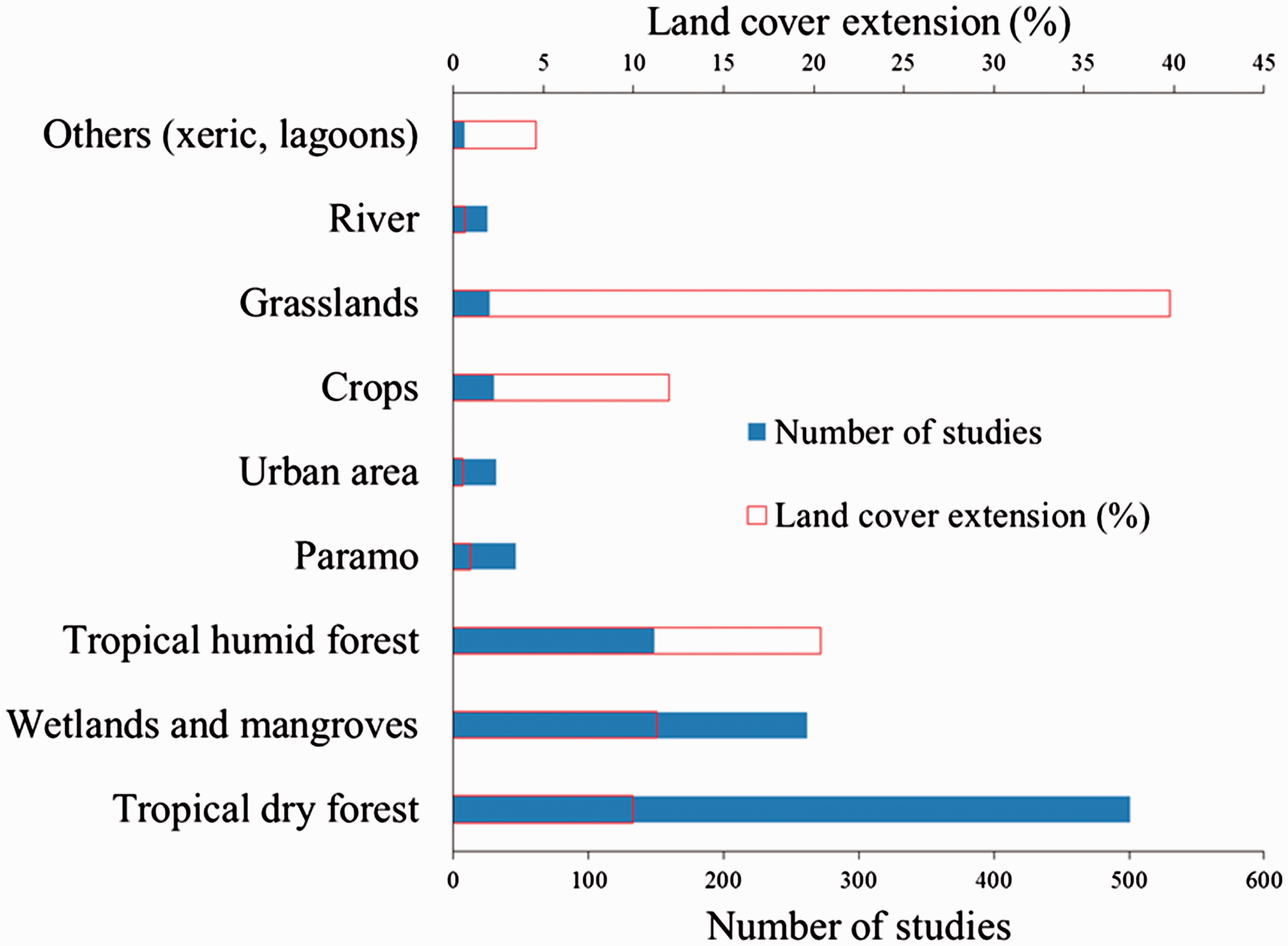
Subject of the Studies
Studies conducted at the community level are the most common (66%), followed by those at the species level (28%), and whereas the landscape (4%) and genetic (2%) levels are the least studied (Figure 4(a)). Animals (66%) are the most studied organisms compared with plants (27%) and microorganisms (7%). Organisms such as bacteria, protozoa, chromista, and fungi are scarcely studied (Figure 4(b)). For taxonomic groups, insect, mammal, and bird were the most studied (Figure 4(c)). Plants, insects, mammals, and fungi are mainly studied in tropical dry forests, while other invertebrates, chromista, and bacteria are mostly studied in wetlands and mangroves (Table C3).
Percentage of studies by (a) organizational level, (b) natural kingdom, and (c) taxonomic group.
The main topics of biodiversity studies are species inventories and studies of species abundance and distribution (64% of the studies). The rest of the topics have been less studied. The topic of functional traits has been the least studied, followed by the explicit study of ecosystem services. The two most studied topics are best represented in articles, even though there are also contributions in books, chapters, and theses. Topics such as taxonomy have been published mainly in articles and pollination and seed dispersion in theses (Figure 5).
Topics of biodiversity studies by document type.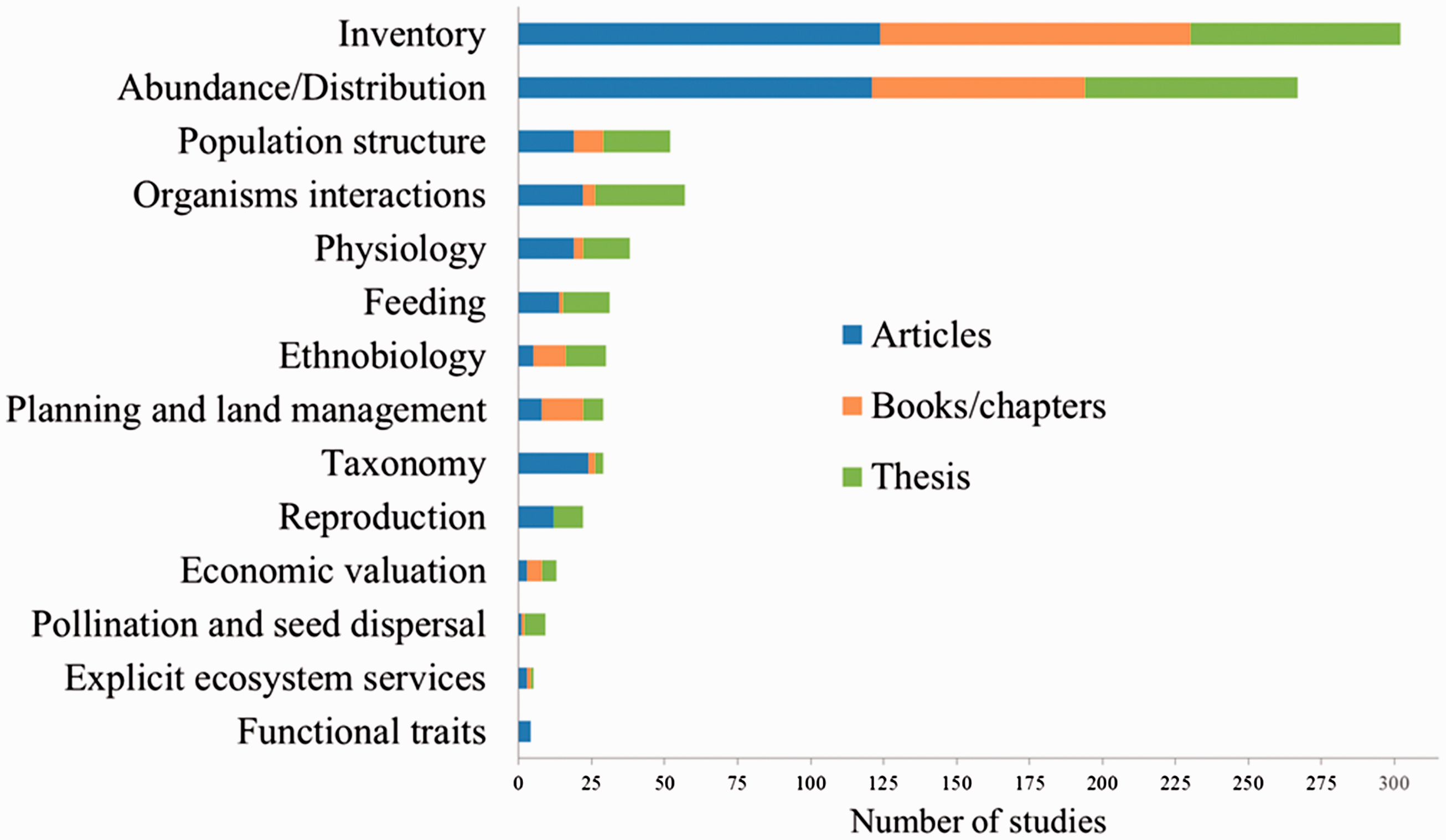
Regarding the natural kingdom and taxonomic group studied by topic, our results show that inventories and studies on abundance and distribution have been more common for plants, insects, birds, and mammals. The topic of taxonomy has been more developed for insects and plants, while the topic of ethnobiology has been more developed in plants (Table C4).
Ecosystem Services
Studies that have explicitly addressed the concept of ecosystem services (n = 5; 1.06% of the studies) are focused on economic (Daza, 2009) and sociocultural valuation (Vilardy et al., 2011) provided by the Ciénaga Grande of Santa Marta and the economic valuation of the conservation of the cotton-top tamarin’s habitat (Reyes & Yepes, 2013; Vargas & Díaz, 2014). Despite the fact that the concept of ecosystem services has been studied very little in an explicit way, it was possible to identify the services that the Caribbean ecosystems provide from the biodiversity studies (n = 169; 36% of the studies).
The most studied ecosystem services in the Caribbean are those involved with regulation (53%). Biodiversity maintenance is the most studied regulation service (Figure 6). Despite the fact that this service is associated with various taxonomic groups, studies on the cotton-top tamarin’s habitat (Saguinus oedipus) and that of the Santa Marta parakeet (Pyrrhura viridicata), both endemic and endangered species, stand out. Provisioning services (25%) take second place, in which food is the most studied service. Finally, the least studied are cultural services (21%). In this category, the predominant service is the local ecological knowledge associated with the use of biodiversity in local communities (Figure 6).
Ecosystem services studied in biodiversity studies.
Knowledge on Ecosystem Services Related to Ecosystems and Taxonomic Groups
Dry forest, wetlands, and mangrove swamps represent the ecosystems with the greatest number of studies related to ecosystem services compared with humid forest, agro-ecosystems, and urban areas (Figure 7). Biodiversity maintenance is the most often studied service, especially in the tropical dry forest. Food services have been reported through fishing in wetlands and mangrove swamps and in a lesser proportion in tropical dry forest. Natural medicines have been mentioned in all ecosystems, with a predominance in the tropical dry forest. As for taxonomic groups, plants are the most commonly studied group, with food, fiber, biodiversity maintenance, and local ecological knowledge services standing out. Biodiversity maintenance appears once again as the most commonly studied service in relation to mammals, invertebrates, and plants. Cultural services are the least often studied and are spread more widely among taxonomic groups (Figure 7).
Number of ecosystem services studied in biodiversity studies in relation with ecosystem and taxonomic group.
Relationship Between Ecosystem Services, Taxonomic Group, and Biodiversity Organizational Level
A significant statistical association is observed between ecosystem services, taxonomic group, and biodiversity organizational level (RDA, p < .0001, 500 permutations). Only species and community organizational levels were associated with services. The first axis, which represents 47.9% of the variance, reveals a bundle of services associated with plants studies: natural medicines, fiber, climatic regulation, cultural services of spiritual value, and local ecological knowledge. It also shows an association among studies on vertebrates, invertebrates, biodiversity maintenance, and species level studies. Community organizational level was also associated with this group, however, in lesser proportion (Figure 8, Table C5). The second axis (24.8% of the variance) represents the association between studies of microorganisms and regulation services: soil formation and fertility and water purification.
Biplot showing two axis of the Redundancy Analysis (RDA). The tags are the ecosystem services with a squared cosine >0.35 and those explanatory variables (taxonomic group and organizational level) with scores >0.35.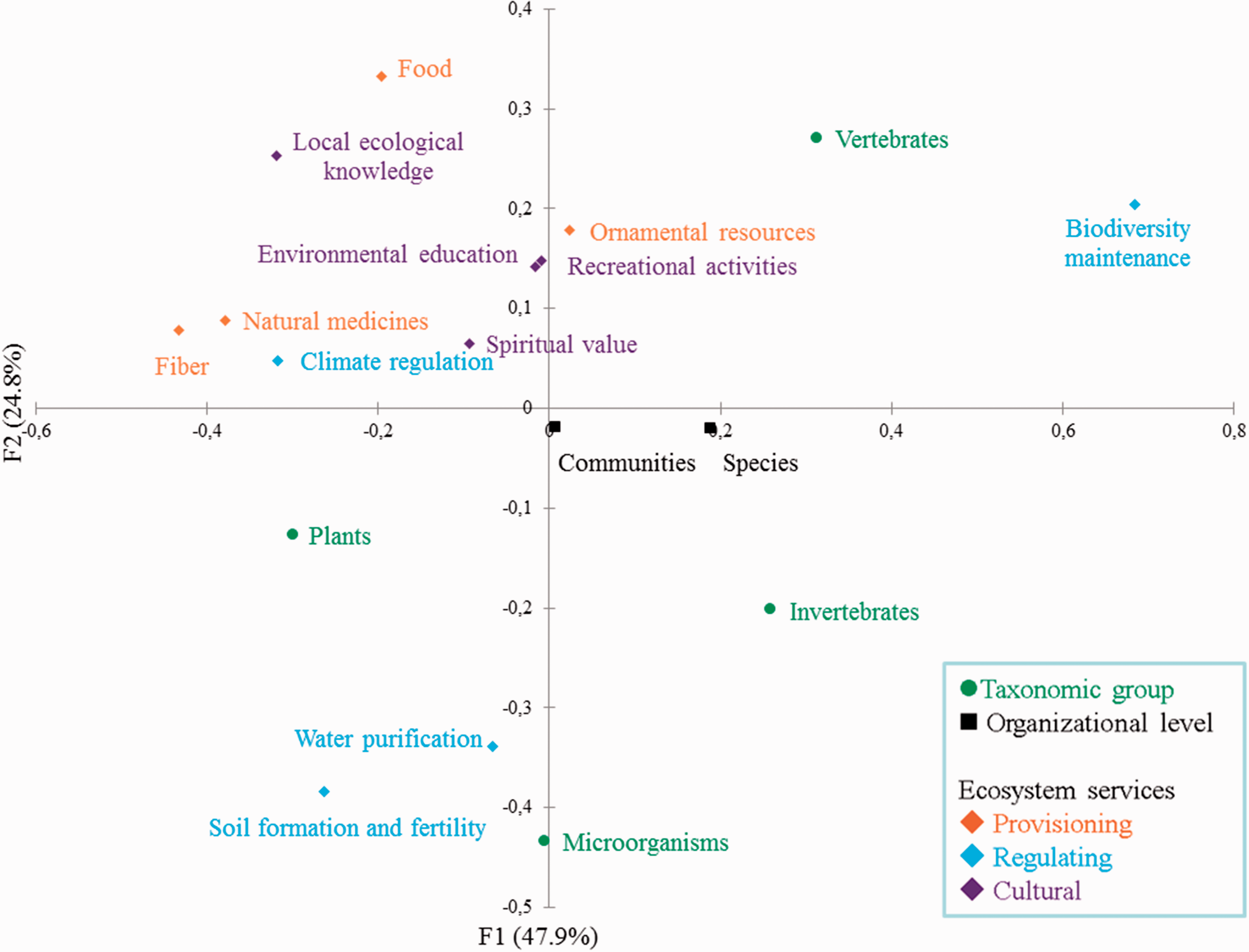
Discussion
The Advances
In Colombia, biodiversity literature reviews have been conducted on specific groups such as birds (Estela et al., 2010) and primates (Stevenson, Guzmán, & Defler, 2010). Recently, a systematic review was also published on biodiversity research from all over the country (Arbeláez-Cortés, 2013). This work was focused on indexed publications and does not include books and gray literature. Therefore, the present review advances in terms of sources of information and includes analyses on other topics such as ecosystems services.
The main Caribbean regional universities with biodiversity programs were created in the 1990s which provided a stimulus to biodiversity research (Figure 2(a)). Moreover, the National University of Colombia conducted many systematic biodiversity studies between 2009 and 2013 (Colombia biotic diversity serie) that included various taxonomic groups in the departments of Cesar and Córdoba and in the mountain range of Perijá, contributing to a significant increase in the knowledge of Caribbean biodiversity (Rangel-Ch, 2009, 2012, 2013; Figure 2(a)).
Conducting a systematic review using only the ISI Web of Knowledge as a source of information in countries such as Colombia is insufficient giving the contributions outside of this database. We found that only 15% of the documents were JCR articles. Similarly, gray literature is an important source of information (29% of the documents) on Colombian Caribbean biodiversity. For tropical countries, it has been estimated that 90% of the contributions on ecology and conservation are found in the gray literature in the form of reports and theses (Corlett, 2011). The knowledge landscape of Colombian Caribbean biodiversity is not so critical, but it is necessary to continue efforts to publish research from theses.
Using theses in a systematic review in countries such as Colombia is important because of the high number of contributions in this type of document but also presents limitations. First, the access to this information is difficult because there is no single institution or database that compiles and makes theses production visible. Performing a systematic review like this requires to visit the universities one by one, which is highly demanding in time and resources; in additional, each university has its own process for systematization, its own timetable, and its own restrictions. The main omission error in our database was in theses evidencing this limitation. The Colombian Association of Faculties of Science that groups universities with biology programs, where most of the theses on biodiversity are produced, could be an adequate instance to promote the compilation and to make this information available to researchers. Second, it has to be taken into account that the quality of theses is not the same as the quality of articles because they have not been evaluated by academic peers. Thus, it should be noted than the amount of studies is not synonymous with the quality of studies. In this review, we did not evaluate the quality of the studies and treated all types of documents equally because our objective was to have an overview of the production of knowledge.
To evaluate the actual contribution of Colombian institutions to biodiversity studies, an analysis was conducted on each author’s institutional affiliation. It was shown that the greatest contribution was made by national institutions, led by universities (Figure 2(b)). On one hand, this demonstrates that biodiversity research is a mature field in science, and on the other hand, it shows that there is a lack of interest from foreign researchers probably due to the fear of conducting fieldwork in a region with security issues (see further).
In Colombia, universities are the institutions that gather the most resources to conduct research. In 2009, for example, 90% of Colombia’s national researchers were linked to universities (Acosta, Caicedo, Arias, Lucio, & Aldana, 2010). The role of universities as agents of change will be fundamental in the perspective of creating knowledge and in preparing the next generations to face the upcoming challenges. The limited contribution from research institutes that are not linked with universities is distressing. In Colombia, there are five research institutes with missions to support the Ministry of Environment in the production and management of environmental research. However, the institutes’ efforts have been concentrated on humid forest ecosystems such as the biogeographic Chocó and the Amazon, as well as marine ecosystems (not included in this review). Recently, the Alexander von Humboldt Institute made some contributions to dry forest research (Pizano & García, 2014) and the Institute of marine and costal research—INVEMAR—has conducted research on issues related to fishing and mangrove swamps, among others (Hernández, López, Sierra, Gil, & Fonseca, 2009; Narváez, Herrera, & Blanco, 2008).
Remarkably only 4% of the studies treat social topics related to biodiversity, and 5% have an interdisciplinary focus. It is urgent to involve social sciences in biodiversity studies because nature’s future and sustainability depend on human behavior. It is fundamental to understand how social factors such as culture, value systems, policies, and the marketplace influence decisions regarding nature conservation (Fischer et al., 2012; Velasco et al., 2015). In the context of sustainability sciences (Kates et al., 2001), the necessity of an interdisciplinary approach is urgent. It will facilitate the construction of useful knowledge to understand and manage complex nature–society relations.
Organization level, taxonomic group, and topics
The bias in terms of fewer genetic and landscape level studies reported in the Caribbean has been also described in other studies (Velasco et al., 2015). Genetic studies in the Caribbean are few (2%), just as in Colombia (Arbeláez-Cortés, 2013). This is a result of the legal and administrative difficulties when applying for genetic research permits (Fernández, 2011). Most studies show a greater scientific effort toward species studies (Fazey, Fischer, & Lindenmayer, 2005; Velasco et al., 2015). However, in the Caribbean, a greater effort was observed at the community level (Figure 4(a)).
Another tendency observed in Caribbean research is the focus on animals compared with plants (Figure 4(c)), similar to what has been described in all of Latin America (66% vs. 37%; Michán & Llorente-Bousquets, 2010), Spain (67% vs. 18%; Martín-López, Montes, Ramírez, & Benayas, 2009), Colombia (69% vs. 31%; Arbeláez-Cortés, 2013), and in conservation literature all around the world (80% vs. 20%; Clark & May, 2002). Colombia is one of the richest countries in the world in terms of plant species (Bernal, Celis, & Gradstein, 2007), and Caribbean plants provide a great number of ecosystem services (Figure 7), so their study must be promoted. Interest in microorganisms has been far lower than that of other groups despite their importance in the preservation of ecosystem functions and their capacities to provide services to society (Cardinale et al., 2012).
In the Caribbean, the most commonly studied animals are insects. This represents a difference from other studies, in which researchers prefer studying birds and mammals (Clark & May, 2002; Fazey et al., 2005; Martín-López et al., 2009; Velasco et al., 2015). This represents an indication of the entomology community’s efforts in the Caribbean.
To have better taxonomic representation in research, supporting the research of taxonomists and the least-studied levels of organization is a priority, especially because it is difficult to preserve what is unknown (Clark & May, 2002). However, it is acknowledged that researchers prefer studying species that have economic importance, are easily accessible, present some degree of conservation threat, and can generate better funding opportunities (Martín-López et al., 2009; Stevenson et al., 2010).
Although it would seem at first sight that biodiversity inventories should be dropped as a research priority, it is important for the Caribbean to continue to document species and community biodiversity in areas that have not yet been evaluated and that are undergoing a transformation process. There is an effort to be made on diversifying the topics of studies and supporting research on functional diversity and ecosystem services.
Studies on ecosystem services
The concept of ecosystem services appeared in the literature in the 1970s, but it was in the 1990s when it became most relevant (Costanza et al., 1997; Daily, 1997). Since 2003 to 2005, with the Millennium Ecosystem Assessment, studies of ecosystem services have increased around the world (Delgado & Marín, 2015). The importance of this concept resides in the fact that it achieved in connecting ecosystems and biodiversity to human needs. However, ecosystem services studies in Colombia have been restricted by low budgets (Balvanera et al., 2012). In the Caribbean, there have been few studies that use explicit ecosystem services concept (1.06% of biodiversity studies), but their potential has yet to be explored and developed, given that ecosystem services research promises to be a way to restore and visualize fundamental links between nature and human well-being and therefore contributes to biodiversity conservation over the long term (Armsworth et al., 2007).
In the Caribbean, the most frequently studied ecosystem services are those related to regulation specifically biodiversity maintenance. This supports the importance of such services among the scientific community.
As our research focused on biodiversity studies, a possible bias exists in the recognition of cultural services that may be represented in social studies. Local ecological knowledge, beyond being considered a cultural service, is a key because of its capacity to maintain and generate new understandings of the dynamic of the ecosystems (Tengö, Brondizio, Elmqvist, Malmer, & Spierenburg, 2014). Its valuation and incorporation is fundamental to understand the links between nature and people, as it has been recognized in International programs such as the Intergovernmental Platform on Biodiversity and Ecosystem Services (IPBES; Diaz et al., 2015). In papers that evaluate ecosystem services as perceived by social actors, provisioning services overtake those related regulation ones because society perceives the values of provisioning services more directly than cultural and regulation services (Vihervaara, Rönkä, & Walls, 2010; Vilardy et al., 2011).
Relationship between services and taxonomic groups
The relationships between biodiversity and ecosystems services are complex and remain unknown for many services. Nevertheless, it has been shown that biodiversity has a positive effect on the supply of ecosystem services (Balvanera et al., 2016; Cardinale et al., 2012; Harrison et al., 2014).
In general, ecosystem services that depend on plants are linked to the number of species and the number of functional groups (Balvanera et al., 2016; Cardinale et al., 2012). According to our results, we found that plants are associated with a great variety of services (Figure 8), but no association has been found at the level of species. This level is associated with the maintenance of the biodiversity of vertebrate and invertebrate groups, demonstrating the preference for these types of studies (Figure 8).
The association between microorganisms and soil formation and fertility services observed in this work has been reported in other studies. Soil organisms are the main agents in the cycling of nutrients, and they modify the physical structure of the soil. Among these microorganisms are microflora (bacteria, fungi), microfauna (protozoa, nematodes), and insects (Balvanera et al., 2016; Barrios, 2007).
As for cultural services such as local ecological knowledge, the sense of place and spiritual value, there exists neither evidence nor knowledge regarding which biodiversity components act to provide these services (Balvanera et al., 2016). This can be a subject to develop in the Caribbean, given the cultural diversity of the region.
Relationship between services and ecosystems
Ecosystem services were more studied in wetlands, mangrove swamps, and tropical dry forests (Figure 7). Within wetlands and mangrove swamps, some ecological processes have been studied: nitrogen fixation by mangrove seedlings (Vanegas, 2004) and heavy metal absorption (Gallo, 1994), which are associated mainly with microorganisms. There have also been studies that show the importance of these ecosystems in terms of food (by fishing), recreation, and local ecological knowledge. In tropical dry forest, the most studied service is the maintenance of vertebrate and invertebrate species (Figure 7). This highly transformed ecosystem is essential not only in the maintenance of biodiversity, but also in the preservation of the hydrological cycle, the water supply for local communities and climate regulation related to carbon storage (Portillo-Quintero et al., 2015). To advance in the conservation of this endanger ecosystem is essential to promote the studies in ecosystem services.
Geographic tendencies
The areas with the greatest number of biodiversity studies are concentrated in the coastal zone; these areas are undergoing high transformation pressures due to the urban growth of large cities such as Cartagena and Barranquilla (Koch, 2015). Although this topic deserves more research, the transformation of coastal ecosystems has probably negatively affected biodiversity.
Protected areas have a primordial function, which is the preservation of biodiversity. Scientific research is fundamental in achieving this goal. However, only 21% of the Caribbean biodiversity studies have been conducted in protected areas. In other studies, and on a global scale, 40% of biodiversity studies have been conducted in protected areas (Velasco et al., 2015). In Colombia, researchers prefer to conduct research outside of protected areas to avoid wasting time on research permit delays (Nemogá & Rojas, 2009). However, these administrative barriers should get better in the future, which will improve the attractiveness of such areas among researchers.
The tropical dry forest has been the most studied ecosystem in the Caribbean (Figure 3). However, it is the most threatened of Colombia’s ecosystems, and it is estimated that there is only 8% left of its original coverage remaining in the entire country (García et al., 2014). In general, forests are the most studied ecosystems (44%) in comparison to arid and semi-arid ecosystems (4%) and littoral ecosystems (2%; Velasco et al., 2015). In the Caribbean, it is more than obvious that little attention has been given to arid zones such as la Guajira and the zones transformed by anthropogenic activities such as urban areas, croplands, and pastures. On a global level, urban zones have also received less attention in terms of ecosystem services studies (Delgado & Marín, 2015). Supporting biodiversity studies in transformed ecosystems is a priority.
Caribbean biodiversity has not been studied in a systematic way. In contrast, researchers have preferred “safer” and “more natural” places. In comparison with other regions in Colombia, the Caribbean has not been sufficiently studied (Arbeláez-Cortés, 2013). The Magdalena department is the most studied (Figure 1(a)) probably because it contains two very important and diverse ecosystems: the Sierra Nevada of Santa Marta, according to Le Saout et al. (2013) the world’s most “irreplaceable” protected area in having the greatest number of threatened bird, amphibian, and mammal species, and the Ciénaga Grande of Santa Marta, the largest coastal wetland in the country, which provides a great quantity of ecosystem services to local communities and maintains high levels of biodiversity (Vilardy et al., 2011). The Córdoba and Cesar departments have been moderately studied, and they have extensive humid areas. Additionally, the Cesar department contains the Serranía of Perija, which is a highly diverse mountain range that has attracted many researchers (Rangel-Ch, 2009).
Not surprisingly, the zones that have been reported to have very few biodiversity studies are those that have been affected by armed conflict. The mid-Magdalena region (south of the department of Bolivar) is considered to be a “red zone,” where perpetual confrontations with paramilitary, guerilla and army groups have maintained the zone in permanent conflict (Barreto, 2009). The mountain range of San Lucas, an area with high levels of biodiversity, has been under guerrilla authority; therefore, scientific community access has been very limited (Álvarez, 2003; Dávalos, 2001). With the present ongoing Colombian peace process, governability will be recovered in conflicted areas, and it will raise the opportunity to explore and study a large part of the territory that has not yet been studied and that possibly still maintains a high level of biodiversity.
The Challenges
The conservation of Caribbean biodiversity presents a great challenge. Given the large transformation of its ecosystems and the current needs to give land to the people who have been displaced and to generate livelihood options for the victims, ex-combatants and rural people, it seems urgent to develop a new territorial planning that allows balancing society’s different interests in the territory. A well preserved territory with a rich and valued biodiversity will be in better conditions to support human well-being.
Moreover, a recent UN document recognizes the profound links between biodiversity, ecosystem services, and human rights. The loss of biodiversity may interfere with the enjoyment of a wide range of human rights, including the rights to life, health, food, livelihood, water, housing, and culture (Knox, 2017). Thus, the full enjoyment of many human rights, including peace, depends on healthy ecosystems.
In addition, with an economic structure based on the tertiary sector and the extraction of minerals that has left a part of the population in unfavorable conditions, it is time to set a new course for economic development that benefits the population that has suffered decades of violence and that uses biodiversity as a source of wealth.
Beyond promoting a green economy with forest-friendly land-use systems for the production of global commodities (Baptiste et al., 2017), it is important to encourage the social valuation of biodiversity and strengthen people’s sense of belonging to the territory, through environmental education. It is fundamental to start restauration processes in the Caribbean ecosystems in order to generate a broad range of ecosystem services that could contribute to peacebuilding. In the Latin American context, most of the countries have faced similar challenges constructing and maintaining peace. Although the contexts of violence and armed conflicts have been very particular to each country (Imbusch, Misse, & Carrion, 2011), the access to sufficient land and decent livelihood is a common denominator (Kay, 2007). Thus, the following ideas could be useful not only to the Colombian Caribbean but also to other Latin American countries.
Final Remarks: Insights for Biodiversity Conservation
This review of the knowledge landscape of biodiversity and ecosystem services in the Colombian Caribbean has shown several biases, such as the limited contribution of social sciences and interdisciplinary studies, the predominance of biodiversity inventories topic, the preference for animal studies and regulating ecosystem services, the limited interest in studying human transformed areas, and the lack of knowledge on natural zones than have been under armed conflict. Considering the challenges in achieving biodiversity conservation due to accelerated ecosystem transformation processes, such as urbanization of the costal ecosystems, and the territory planning required for peacemaking, we propose some ideas to tackle some of these tasks. In the short term, the establishment of protected areas to guarantee the supply of ecosystem services for human well-being and to reduce the transformation process of endangered ecosystems such as the topical dry forest is a priority. In a context of severe transformation threat, the establishment of protected areas can be a successful strategy to avoid deforestation in the short term, as has been demonstrated in other tropical countries (Andam, Ferraro, Pfaff, Sanchez-Azofeifa, & Robalino, 2008). However, to ensure biodiversity conservation, it is necessary to ensure the availability of human and financial resources to manage those protected areas (Gill et al., 2017) and avoid that they became paper parks (Di Minin & Toivonen, 2015).
In the middle term, the formulation of an integrated territorial planning that includes and values ecological and social dimensions and considers the complexity of the territory is an imperative need. In addition, in the long term, the incorporation of the social–ecological systems perspective (Berkes & Folke, 1998), as a broad framework that highlights the links between ecosystems and human societies through ecosystem services (Martín-López & Montes, 2014), to biodiversity research and territorial planning could contribute in the following ways: by revealing the relationships between biodiversity and human well-being, this perspective supports the arguments for biodiversity conservation not only by its intrinsic values but also by its instrumental values, that is, the services it provides to human well-being. Ecosystem services concept has the potential to support a common language and facilitate collaboration between actors in land use planning (García-Llorente et al., 2016); therefore, in the discussion about conservation versus development in areas such as the Serranía de San Lucas, this approach could help understanding that nature conservation is the basis for a sustainable development. Social–ecological systems framework is useful to generate an interdisciplinary vision of nature, creating a fertile field for the social and natural sciences to contribute to a better understanding of society–nature relations and to improve sustainability (Fischer et al., 2015). Strengthening interdisciplinary research in the Colombian Caribbean is an awaiting task. This framework has generated large international collaborations such as IPBES and Ecosystem Services Partnership that evidence the international relevance of these issues. Caribbean universities should take advantage of these international initiatives and create a network among them, to strengthen alliances with other national actors interested in biodiversity conservation to move forward with pertinent and visible knowledge. The role of universities as agents of change will be fundamental in the perspective of creating knowledge and in preparing the next generations to face the upcoming challenges. A practical strategy to use biodiversity and ecosystem services research as a tool for biodiversity conservation and human well-being improvement could be the creation of a governmental-science platform to include key biodiversity knowledge in territorial and sectorial planning.
Now, more than ever, it is imperative to strengthen synergies between different public policies related to climate change, biodiversity conservation, green growth, and ecotourism, among others, with the vision of achieving better human well-being and restoring and valuing the greatest Colombian Caribbean source of richness: its biodiversity.
Footnotes
Appendix A.
Authors' Note
ORCID number of Juanita Aldana-Domínguez is orcid.org/0000-0003-3688-5720.
Acknowledgments
The authors are grateful to the regional universities that allowed us to review their theses repositories, to J. Acuña for her collaboration in visiting some universities, J. C. Sanchez for his comments and editing advice, and Social-ecological systems Laboratory at the Universidad Autonoma de Madrid, especially to J.A. Gonzalez, for the support. The authors also thank the three anonymous reviewers for their thoughtful comments on a previous version of the manuscript which greatly improved the work.