




Abstract
Pollination ecosystem service contributes tremendously to food security; however, little is known about the farmers’ awareness of the ecosystem service to ensure conservation of pollinators. This study determined farmers’ perceptions, knowledge, attitudes toward bees, and pollination in a maize-producing region of Zimbabwe using semistructured questionnaires (N = 828). Generalized linear model and logit regressions were used to determine factors influencing farmers’ ability to identify bees, knowledge of pollination, and fear toward bees, respectively. Identification of bees was positively related to education, years in farming, and negatively related to fear toward bees (p < .001). Fear toward bees was influenced by gender, knowledge of bee attack fatalities, and perception of the importance of bees (p < .001). The majority of respondents (67%) confirmed knowledge of pollination (χ2 = 96.043, p < .001), and the probability of knowing pollination was higher for those who depended on media compared with extension and school education as a source of farming information (p < .001). Our findings suggest that to improve bee conservation, farmers should be made more aware of the diverse bee fauna, specifically regarding their benefits as pollinators compared with the few dangers (resulting from stings) in order to reduce fear and increase willingness to conserve bees. Bee awareness programs need to be accessible to women, youth, and those with less formal education as they exhibited the least knowledge. Our findings also support evidence showing that extension officers should consider various media options for the effective dissemination of information to the different target audiences.
The subject of plant–pollinator interactions has been of interest due to the realization of its major influences on food security and ecosystem stability (Ballantyne et al., 2015). In terrestrial habitats, 67% of flowering plants are animal pollinated (Suttle, 2003), and one third of crop reproduction is solely via insect pollination (Garibaldi et al., 2011; Klein et al., 2007). As such, the global ecosystem value of pollinators is estimated at 1.2 billion USD for Southern Africa (Gallai et al., 2009). However, substantial decline and extinction of these important insects is being recorded (Kosior et al., 2007; Williams, 1982), and most studies are attributing these declines to agricultural intensification (Altman & Mesoudi, 2019; Sánchez-Bayo & Wyckhuys, 2019). Farmers’ actions are therefore key in achieving efficient pollinator conservation and also as a way of incorporating local ecological knowledge to improve conservation (Sobral et al., 2017).
Bee species (both wild and domesticated) are the most important pollinators globally (Fleming & Muchhala, 2008), and their diversity and abundance are the major drivers influencing the pollination ecosystem service (Garibaldi et al., 2013). There are more than 20,000 bee species globally with solitary species dominating. However, the honey bee, Apis mellifera is the major pollinator for approximately 52 of the dominant 115 global crops (Neumann & Carreck, 2010). The honey bee large numbers in each colony grant them an advantage over other pollinator species and therefore have served as a representative for all pollinator species, and farmers are often ignorant of other pollinator species (Bhattacharyya et al., 2017). This bias toward a single pollinator species (Apis mellifera) is unsustainable and may hinder proper ecosystem functioning (Hanes et al., 2018; López-del-Toro et al., 2009) considering that some plant species are specialized.
Developing countries are projected to suffer the most from the economic impacts of pollinator declines as the greater population is dependent on agriculture (Fischer & Heilig, 1997). In Zimbabwe, following the fast track land distribution program of 2,000, ownership and use of agricultural land changed in Zimbabwe. As such, knowledge of new farmers and their perceptions toward pollinators is not known, and no studies have been conducted since the 1990s; yet, conservation efforts have to be pitched in the context of the level of awareness by the practitioners. Farmers are the main key participants in pollinator conservation and their knowledge and perceptions among others are critical in designing intervention strategies as this forms the baseline of the knowledge and information that needs to be disseminated to them.
Although staple crops grown are wind-pollinated such as maize, insect-pollinated crops such as pumpkin (Cucurbita maxima and Cucurbita argyrosperma), okra (Abelmoschus esculentus), potato (Solanum tuberosum), peppers (Capsicum annuum), cucumber (Cucumis sativus), cowpea (Vigna unguiculata), and to some extent common bean (Phaseolus vulgaris) accompany staples in many diets. They, therefore, provide essential macro- and micronutrients (Ellis et al., 2015) and their decline may greatly affect food security in terms of availability, nutrition, and stability (Eilers et al., 2011). Furthermore, insect pollination is crucial for many domestic and wild fruit trees, cash crops such as cotton (Gossypium hirsutum) and other food plants, making them even more important for sustaining food and medicines for most rural communities that depend on them. As such, the conservation of pollinators requires urgent attention by policy makers, conservationists, and farmers alike.
Despite the importance of pollinators for production of up to three-quarters of the crops cultivated worldwide (Klein et al., 2007; Potts et al., 2016), pollination, especially by wild insects, is seldom considered as an important production factor in agriculture (Bommarco et al., 2018; Oliveira et al., 2019). Consequently, most agrarian communities who are strong beneficiaries of pollinators are still in areas with limited information on pollinators (Bhattacharyya et al., 2017). Pollination is one of the ecosystem services taken for granted by many farmers with almost no conservation efforts being carried out for its sustainability (Priti & Sihag, 1997). Many farmers invest in fertilizers, pest control, water management, and other management activities for their crops and no or little investment toward the provision of the important pollination services for the crops (Alemu, 2014). This pollination blindness results in poor pollination services that then negatively impact on yield with farmers not knowing (Burkle et al., 2017; Oliveira et al., 2019).
One fundamental tool to counteract negligence toward under information of pollinator conservation is public awareness and education which was also recommended by the African Pollinator Initiative [API], (2003). However, the first step toward the formulation of awareness programs is to assess the level of pollinator knowledge of the farmers and understand their attitudes toward the species of concern (Ballouard et al., 2012; Randler et al., 2012). Silva and Minor (2017) have already shown that there is a positive relationship between knowledge and attitudes toward bees among adolescents, with this strongly influencing bee-related behavior. Similarly, Wilson et al. (2017) observed that despite the growth in research and advocacy for pollinator conservation, the public remains largely uninformed on the diversity and importance of bee pollinators with this affecting their actions. There is, therefore, a direct link between knowledge and conservation efforts and this should be applied to guide the design and implementation of outreach and extension programs.
In agroecosystems, pollinators have the most monetary and social values but concomitantly are potentially most threatened (Bartomeus & Dicks, 2019; Potts et al., 2016). In many agricultural-dominated landscapes in developing countries, information on pollinator populations and dynamics is scarce. For example, studies on pollinator diversity, distribution, and farmer knowledge and attitude are very scarce in Zimbabwe. There is a paucity of information on the bee species that exist in the country’s agroecosystems, and the closest literature is for sub-Saharan bee fauna by Eardley et al. (2010). Most discussions about bees on most platforms are biased toward honey bees (Apis mellifera) and mainly focusing on its honey production and not pollination services. This bias toward honey bees has also been exacerbated by local terminology that uses the generalized term for bee inyosi/nyuchi to refer to honey bees and all bees. It gives the implication that there is one bee species resulting in all conservation activities being directed toward this single species, the honey bee (Bhattacharyya et al., 2017). It is therefore imperative to assess farmers’ levels of knowledge and understanding of the bee fauna before introducing conservation technologies.
Attitude describes the complex construct of the cognitive (knowledge and thoughts), affective (emotions and feelings), and conative (intended behavior) of Eagly & Chaiken (1993). Attitudes toward bees, therefore, may influence farmers’ desire to conserve it. According to Davey (1994) and Prokop and Fančovičová (2013), insects are normally associated with negative attitudes of dislike, fear, and disgust; hence, bees may further be disliked for their potential to harm people. As such, attitudes toward bees could be influenced by age, gender, level of education, culture, and economy (Kollmuss & Agyeman, 2002) among other factors. An understanding of attitudes of farmers toward bees will give an insight into the barriers of adoption of pollinator conservation activities and how they can be addressed.
The aim of this study was therefore to determine farmers’ knowledge and attitudes of bees as well as factors influencing these perceptions, using the Zvimba district in Zimbabwe as a case study. The specific objectives were to (a) determine factors affecting farmers’ level of knowledge of bees and (b) assess attitudes of farmers toward bees in Zvimba district. The study hypothesized that bee identification ability would be influenced by the source of farming information, where they lived, beekeeping experience, type of farmer, and gender. We also hypothesized that education level, age, size of land owned/used, and years in farming will be positively correlated with bee identification ability. Fear toward bees was hypothesized to be influenced by gender, the experience of bee stings, and prior knowledge of bee attack fatalities. It is expected that the results from this study will be used for formulating awareness campaigns and education programs that can influence different stakeholders, farmers, the general public, extension officers, and policymakers to take action in securing the future of pollinators.
Methods
Study Area
This study was conducted in Zvimba district, Mashonaland West province of Zimbabwe (Figure 1). Zvimba district has high agricultural activity as it lies in agroecological region IIa (Venema, 1998) that receives 750 to 1000 mm annual rainfall with a temperature range of mean minimum 15°C and mean maximum 24°C. Dominant soil types include greyish brown sands and sandy loams derived from granites classified as arenosols (IUSS Working Group WRB, 2006). This region mainly grows flue-cured tobacco (Nicotiana tobacum L.), maize (Zea mays), cotton (Gossypium sp.), wheat (Triticum aestivum), soybeans (Glycine max), sorghum (Sorghum bicolor), groundnuts (Arachis hypogaea), and barley (Hordeum vulgare) due to the reliable rainfall and generally good soils (Mudimu et al., 2006). This district has farmers who benefited from the agrarian land reform program of 2,000. Four main types of farmers are found in Zvimba: (a) communal farmers (land size 5–10 acres per household), (b) A1 farmers (small-scale resettlement farmers who were allocated about 6 ha of land under the land reform program), and (c) A2 farmers (medium- to large-scale resettlement farmers of the land reform program, land size varies between 6 and 30 ha), and (d) commercial farmers (these are mostly owned by white farmers or companies, and sizes are greater than 30 ha). For administrative purposes, the district is subdivided into wards, which are sections through which the community work and share resources and an administrative level at which agricultural extension officers are also deployed.

Map Showing the Location of Zvimba District Zimbabwe.
Sampling and Data Collection Methods
Stratified purposive sampling was used to select 13 of the 35 wards in Zvimba district which had 3 categories of farmers (communal, A1, and A2) for a complete representation of the population (Albuquerque et al., 2014). We did not consider commercial farmers as access to farmers is usually very difficult, and their numbers failed to constitute a substantive population for meaningful analysis. A total of 828 willing farmers were randomly selected from individual farming households for interviewing. A pilot study was conducted before the survey in 7 wards interviewing 56 farmers representing different farm types. The results and reactions to these were used to further improve and perfect the questionnaires before the study.
The survey was conducted between February and March 2019 by 13 enumerators who were Agricultural extension officers of the selected wards. Enumerators were trained beforehand to ensure uniformity, and questionnaires were filled using face-to-face interviews. All interviews and discussions with farmers were conducted in the main local language (Shona) except in special cases where the respondent could not understand the language, English or interpretation was used. Each interview lasted an average of 30 minutes.
Questionnaires were designed to capture information on years spent in farming, annual household income, household size, source of farming information, knowledge of species involved in pollination besides bees and benefits from bees (all open-ended questions), and other closed questions summarized in Appendix. In each ward, the enumerators stopped conducting the questionnaires when there was no new information especially pertaining to crops grown and pollinators known. This approach resulted in a total of 354 communal farmers, 288 A1 farmers, and 186 A2 farmers being interviewed.
The ability to identify bee pollinators was tested by providing respondents with 8 (7 × 5 cm) color printed pictures of the following bee species: Apis mellifera, Plebena armata, Hypotrigona sp., Meliponula ferruginea, Meliponula becarii, Lasioglossum sp. Xylocopa incostans, Xylocopa flavorufa, and we asked each respondent to identify the bee species they knew from the provided pictures. We know that these bee species are common in this district as we conducted a detailed survey (as part of another on-going study on the impacts of different land-use systems on bee abundance and diversity in the area).
Data Processing and Analysis
We performed a thematic analysis of the open-ended questions from our questionnaire. Years in farming were recategorized as few (1–5 years), average (6–20 years), and many (21 years and above). Annual household incomes were recategorized as low (US$100–200), middle (US$201–600), and high (US$601 and above). The household size was recategorized as small (1–4 persons), medium (5–7), and large (above 8). The source of farming information was recategorized as from school, extension services, audio, and visual media (mostly radios and televisions). Species (besides bees) known to be involved in pollination were recategorized as butterflies, flies, birds, and I do not know. The benefits from bees were recategorized as honey, money, and pollination.
We derived an index, the bee identification score from the number of identified bee species from the pictures presented using the formula:

The bee identification scores were then recategorized as low (those who had less than 50%), average (50%–69%), and high (70% and above). We created a variable number of bee uses by counting the number of bees uses cited by respondents, and this variable was recategorized as few (one or fewer uses cited) and many (two uses and above).
Descriptive statistics (means and percentages) were computed to explore the demography of the sample. We employed Chi-square frequency tests to investigate the differences between those who knew pollinators and pollination to those who did not know; those who could identify bees to those who could not; those who practiced beekeeping and those who did not; those who saw bees daily, weekly, and monthly; those who perceived bees as important and those who regarded them as unimportant; those who thought bees were increasing, decreasing, and not changing. The Chi-square test was also used to investigate the association between bee identification scores and uses of bees.
Logistic regression analysis was conducted to determine factors influencing knowledge of pollination and fear toward bees. For these analysis, our set of independent variables were farmer type, gender, age, bee identification score, years in farming, perception on the importance of bees, size of land utilized, size of land owned, practiced bee-keeping before, fear toward bees, where they have lived and source of farming information (as described in Table 1). With the aid of the complete forward and backward stepwise method of logistic regression, the best models describing knowledge of pollination and fear toward bees were selected.
Description of the Explanatory Variables Selected for Logit Regression to Test for Their Influence on Knowledge of Pollination.
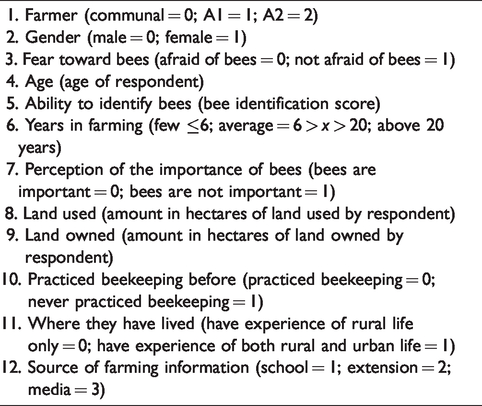
To determine factors influencing the bee identification score, a generalized linear model was used using our set of independent variables in Table 1. All data were analyzed using Statistical Package for Social Science (SPSS) software version 22 of 2013.
Ethical Considerations
Before commencing the study, written approval was obtained from the Zvimba District Administrator. The research was explained to participants before conducting the interview, and a signed consent form was secured from all participants before conducting the interviews. Participants were free to reject study participation or withdraw anytime during the interview. Data collected were used only for the purposes of the study, and participants were assured of the confidentiality of their information.
Results
Characteristics of the Sample
About 80% (662) of respondents had farming as a major source of livelihood. The average age (±SD) of respondents were 49 ± 13.9 years, with the youngest and oldest participants being 18 and 87 years, respectively. The mean family size (±SD) of respondents interviewed was 5.43 ± 2.25 (1 minimum and 21 maximum). The average annual income for all the respondents was US$251. More than half of the respondents (56%, 464) had their education up to a secondary level/minimum of 8 years in school (Table 2).
Characteristics of Farming Households Surveyed.

The major crop grown by 90% of respondents (745) was maize (Zea mays). The main vegetable species grown were the green leafy vegetables Brassica species (75%, 623), tomatoes Solanum species (60%, 497), onions Allium species (36%, 296), and butternut Cucurbita species (19%, 159) which are mostly insect-pollinated. These findings suggest a decline in pollinators will greatly affect the farmers’ diet as only maize of their major crops grown is not dependent on pollinators.
The majority of the respondents (78%, 648) experienced pest problems (χ2 = 209.005, p < .001), and there was a significantly higher percentage of the respondents (57%, 472) using pesticides (χ2 = 14.614, p < .001) compared with physical and biological pest control methods. Maize was the crop cited by the majority of respondents (367) as being treated with pesticides.
Pesticides most cited by respondents were lambda cyhalothrin-pyrethroid (200 citations) and carbaryl carbamate (naphthalenyl methylcarbamate; 63 citations). Respondents who used herbicides cited atrazine (136) and glyphosphate (128) the most. A significantly greater number of respondents (83%) have grown trees in their homes or gardens (χ2 = 19.4, p < .001), and a total of 15 exotic trees species were recorded. Top five dominant tree species grown by respondents were Mango Mangifera indica with 65% (535), Guava Psidium guajava with 44% (363), Lemon Citrus limon with 31% (254), Banana Musa species with 24% (202), and Mulberry (Morus nigra) with 15% (121) of respondents.
Knowledge of Pollinators and Pollination
The majority of respondents (62%) managed to identify at least one other species besides bees which is involved in pollination (χ2 = 48.309, p < .001). The majority of respondents (76%, 629) did not manage to identify more than half of the bee pictures provided (χ2 = 217.121, p < .001), and the average bee identification score for all respondents was 30%. Apis mellifera was the only species correctly identified by an above-average number of respondents (Figure 2).
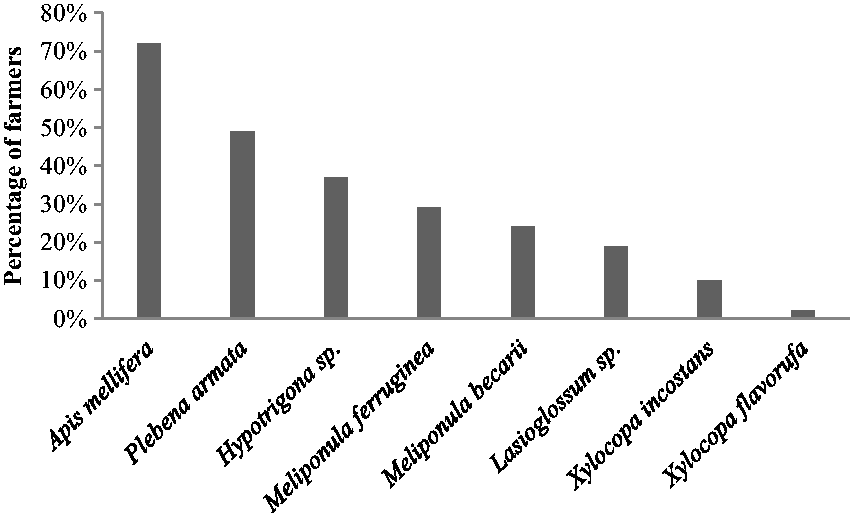
Percentage of Farmers That Correctly Identified Each Species of Bees.
Factors that significantly influenced the ability to identify bees were fear toward bees, education level, and years in farming (Figure 3). Respondents who reported that they were afraid of bees (72%) had a significantly lower probability of identifying bees compared with those who were not afraid (p < .001). The probability of identifying bees increased with an increase in the level of education (p < .001). Years in farming significantly influenced probability to identify bees, those with less than 5 years had a lower probability of identifying bees compared with those with 6to 20 years in farming and at above 20 years of farming, the bee identification score declined (Figure 3). There was also an association between the bee identification score and the number of uses of bees cited by respondents (χ2 = 90.130, p < .001).

A: Effect of fear on bee identification. B: Effect of education on bee identification. C: Effect of years in farming on bee identification.
The majority of respondents (67%, 556) thought they knew about pollination (χ2 = 96.043, p < .001). The binary logistic model fitted to the data to test for factors determining the knowledge of pollination in farmers (Table 3) had an overall prediction success of 87.4%, thus 98.5% for predicting an understanding of the process of pollination and 11.7% for predicting lack of knowledge of pollination. The full model was significantly different from the constant only model (χ2 = 78.838, five degrees of freedom (df), p < .001) showing that inclusion of the explanatory variables improved model prediction of an understanding of pollination and lack of pollination knowledge. The Wald criterion test demonstrated that the following factors had a significant influence on knowledge of pollination: age, perception of the importance of bees, practicing beekeeping, and source of farming information. Probability for knowing pollination was influenced by the source of farming information with the highest probability of pollination knowledge in those who acquired knowledge from media followed by those who acquired knowledge from extension workers and last by those who depended on knowledge from school. Respondents who perceived bees to be important had a greater likelihood of knowing insect pollination compared with those who perceived bees as not important and beekeepers also had a higher probability of knowing pollination compared with nonbee keepers (Table 3).
Logit Regression to Determine Factors Influencing Knowledge of Pollination.

Note. –2 log likelihood = 279.887; Cox & Snell R2 = 0.155; Nagelkerke’s R2 = 0.289, Hosmer & Lemeshow =0.577.
Attitudes Toward Bees
About 92% (764) of the respondents considered bees as important insects (χ2 = 588.4, p < .001), and the major reason for keeping bees was honey production (Table 4). However, only 29% (240) confirmed practicing beekeeping at some point in their lives and 22% (182) had received beekeeping training before. For those who were not interested in beekeeping, the majority (72%) cited fear of bees as the reason, χ2 = 118.034, two df, p < .001.
Responses to the Questions (a) Reasons for keeping bees Directed to Beekeepers Only and (b) Benefits of bees Directed to all Respondents.

Factors Influencing Fear Toward Bees in Respondents
Respondents who had knowledge of bee attack fatalities were 46%; however, only 26% of the respondents knew someone who died of bees. The majority of the population (71%) had an experience of being stung by a bee before and only 11% confirmed having allergies to bee stings.
Overall, prediction success of the logistic regression model testing factors influencing fear toward bees was 66%, thus 50% for predicting fear toward bees and 76.8% for predicting lack of fear toward bees. The full model was significantly different from the constant only model (χ2 = 72.572, four df, p < .001) showing that inclusion of the explanatory variables improved model prediction of fear and lack of fear of bees. The Wald criterion test demonstrated that the following factors had a significant influence on fear of bees: gender, perception of the importance of bees, and knowledge of bee attack fatalities (Table 5). The probability of a male to be scared of bees was significantly lower when compared with females (coefficient –0.698, p < .001). There was no significant difference in knowledge and perceptions of farmers toward bees across wards. Respondents who perceived bees to be important were less likely to have fear toward bees to those who perceived them as unimportant. Those who had heard of bee attack fatalities before had a higher probability of having fear toward bees compared with those who had never heard of bee fatalities.
Logit Regression to Determine Factors Influencing the Fear Toward Bees.
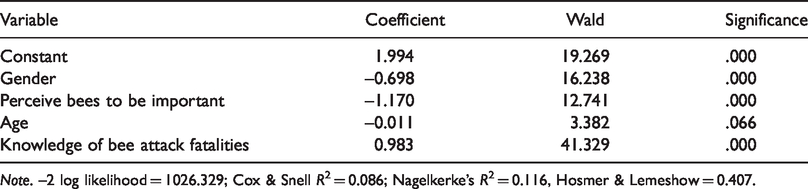
Note. –2 log likelihood = 1026.329; Cox & Snell R2 = 0.086; Nagelkerke’s R2 = 0.116, Hosmer & Lemeshow = 0.407.
Perceptions on the Conservation Status of Bees
A significantly higher number of respondents, 59% thought that bees were decreasing in the area, 25% thought they were increasing, and 15% did not see any change (χ2 = 261.072, two df, p < .001). This finding may be a sign that other bee species in the area could be, in serious local declines. The decline in bees was mainly attributed to veld fires and deforestation (571 citations), pesticides (124 citations), poor honey harvesting methods (58), climate change (58), pests and diseases (17). Forty-six percent of the respondents thought that they saw bees daily, 36% weekly, and 18% monthly (χ2 = 100.065, two df, p < .001). Pollinator conservation activity of leaving flowering weeds in the field for pollinators to forage was agreed to by the least number of respondents (49%) with diversifying crops and reducing pesticides selected by most respondents (72%). Planting trees to improve habitat and forage for pollinators as well as leaving part of their fields uncultivated for pollinators to have habitat was selected by 64% and 67% of respondents, respectively.
Discussion
In this study, we examined the linkages between farmers’ knowledge and their attitudes of bees and sought to determine the most important factors influencing these perceptions, using an agriculturally dominated landscape of Zimbabwe. The majority of respondents depended on farming as a source of livelihood which is the trend in most developing countries where agriculture sustains the rural community and forms a large part of the population (Olajide et al., 2012). However, there are concerns of bee poisoning due to the dominant use of lambda cyhalothrin-pyrethroid and carbaryl carbamate (naphthalenyl methylcarbamate) pesticides (200 citations) in the area which according to Riedl et al. (2006) are classified as highly toxic to bees with extended residual toxicity which can result in 25% bee mortality after 8 hours of application. This finding suggests that awareness programs and campaigns should incorporate information on alternative sustainable methods of addressing crop pest problems as opposed to pesticides and provide the economic value of the bees as farmers can easily interpret costs and make comparisons of production with and without bees.
Factors Influencing Knowledge of Pollinators and Pollination
The Honey bee Apis mellifera was the only species correctly identified as a bee by an above-average number of the respondents. The most poorly identified bee species was Xylocopa spp even though it is common in their environment and this could be attributed to the misconception that the name bees refer only to Apis mellifera. Xylocopa species could have been recognized as a bee by the least number of farmers also because of its morphology which is very different from the honey bee which is considered to be the true bee species. This confirms findings by Bhattacharyya et al. (2017) which showed that knowledge of non Apis bee species was poor in farmers as bees were associated with honey. This finding suggests that bee species with unique morphology from the honey bee species are the most affected by the misconception and may ultimately result in minimal conservation attention accorded them by farmers.
Fear toward bees lowered one’s ability to identify them and the most probable reason could be that respondents who fear bees avoided them making it difficult to gain knowledge of the species. This concurs with Kellert and Berry (1987) who found that negativistic attitudes in females of dislike or fear resulted in the avoidance of the species and ultimately poor knowledge of animals.
In line with our hypothesis, the years spent in farming were also positively related to the ability to identify bees which are expected as years relate to increased time of exposure with bees in the field as well as to different sources of information such as media and extension. This concurs with findings by Silva and Minor (2017) that the more people engage in agriculture-related activities the more their knowledge of bees and their diversity. However, beyond 20 years of farming experience, the ability to identify bees declined and one possible explanation to this could be the effect of old age negatively affecting bee identification (bees are generally very small and therefore require sharp eyesight for distinguishing). In addition, conquering with our predictions, the ability to identify bees increased with the level of education also confirming findings by Misganaw et al. (2017) and Bhattacharyya et al. (2017). This strengthens the idea of awareness and education as a way of improving pollinator conservation.
The majority of the respondents knew about pollination which is different from findings by Misganaw et al. (2017) who found that the majority of the population did not know about the process of pollination suggesting that site and context-specific studies are imperative. Further assessments of pollination knowledge also revealed that the majority knew at least one species besides bees which are involved in pollination. The likelihood of knowing pollination which increased with age could be attributed to more years of experience in farming processes coupled with a longer period of exposure to sources of information (e.g., training workshops, radios, and televisions; Schönfelder & Bogner, 2017). It is, therefore, reasonable to expect farmers to become more knowledgeable of bees and their conservation practices with consistent education overtime.
The higher probabilities of knowing about pollination by respondents with information from audio and visual media stress the importance of the proper choice of information dissemination methods in improving the effectiveness of awareness and education. This is commensurate with the API (2003) which suggested catchy pollinator adverts which can draw the attention of the public amidst a wide range of issues. There is, therefore, a potentially high impact of using media as a communication channel for the conservation of pollinators particularly bees in agroecosystems. Silva and Minor (2017) concur with this finding and suggested that media impact perceptions about pollinators, especially if there is repeated exposure as may occur with television commercials.
Del Castello and Braun (2006) also confirmed that rural areas in most developing countries depend on media for vital information for their livelihoods. Developing countries due to various economic pressures cannot afford adequate extension services (Del Castello & Braun, 2006), and the workshops method for information dissemination which is most popular with extension officers was amongst least preferred methods according to a study by Cartmell et al. (2004). As such, quality information can be packaged according to media channel used and this will require skill and expertise. Media information delivery can easily be varied to cover a greater age range, all gender types, and diverse education levels. Further studies are also required to assess media tools best suited for different audiences.
Knowledge of uses of bees positively influenced bee identification and the perception of the importance of bees also increased the probability of knowing pollination. A possible explanation for this could be that individuals who valued bees probably had an interest in learning about bees and could make individual efforts to improve their knowledge. It is therefore expected that improving knowledge of the farmers on the ecosystem services provided by bees as well as offering incentives for sustainable practices (Silva-Andrade et al., 2016; Western et al., 2019) will motivate them to conserve the species. McKenzie et al. (2013) pointed out that farmers are willing to participate in agroecosystem conservation schemes if they are aware and anticipate benefits from them.
Beekeepers had a higher probability of knowing about pollination compared with nonbee keepers which agrees with our hypothesis and this knowledge could have been acquired during beekeeping training and increased practical exposure to bees and their processes. This concept of practical training in beekeeping can be adopted by pollinator awareness programs, where farmers have practical exposure to bees and their processes of pollination and honey making.
Attitudes Toward Bees and Their Conservation
Farmers generally showed willingness toward the adoption of different bee conservation activities which concurs with findings by Zhang et al. (2019) who also noted high willingness to participate in Eco compensation projects. However, findings suggest that farmers would be more willing to engage in some pollinator conservation activities more readily than others. For example, diversifying crops and reducing pesticides were selected by the greatest number of respondents as compared with leaving some weeds in fields for pollinator forage. Preferred activities could have been perceived to have the least negative impacts on crop production as such awareness programs should, therefore, consider the implications of their suggested activities on crop production. Varied conservation activities will also suit the varied farmer needs and also ensure the hosting of diverse pollinators by offering varied niche requirements (Daphne, 2011).
Most respondents that had experienced social bees nesting in their home or field surroundings did not drive them away even though the majority of respondents considered the species to be dangerous. Handling of bees requires skill, and there is a decline in the handling of bees with expert level according to Schönfelder and Bogner (2017). The majority perceived bees to be dangerous as opposed to safe/friendly species, and these findings conquer the cognitive vulnerability model by Armfield (2006), which states that perception of danger is strongly related to fear. Furthermore, the major reason highlighted by respondents for not practicing beekeeping was fear toward them, and this fear may be justified by previous deaths that have been caused by the species. According to a study by du Toit-Prinsloo et al. (2016) in South Africa, 109 deaths were recorded in the period 2001 to 2011 due to hornets, wasps, and bees. This finding suggests that fear is a strong barrier to bee conservation and has to be addressed by awareness conservation programs if effective pollinator conservation is to be achieved.
Females had a higher likelihood of fearing bees compared with males and this generally conquers with studies by Kellert and Berry (1987) who concluded that gender is one of the strongest demographic influencers of attitude toward animals. In addition, those who perceived bees to be an important species had a lower likelihood of being afraid of bees as compared with those who perceived bees as unimportant. This could be attributed to the fact that perception of importance is driven by in-depth knowledge of species, and knowledge is related to higher and more positive attitudes toward species (Torkar et al., 2010). Furthermore, respondents who had prior knowledge of people who were killed by bees had a higher probability of being afraid of bees than those who did not have prior knowledge of bee killings. This is expected, as fear is influenced by previous knowledge and experiences (Rachman, 1977; Schönfelder & Bogner, 2017). However, it is also interesting to note that respondents who knew people who were killed by bees were far less than those who had heard of bee killings which may suggest that some of the hearsay may not be substantiated or could be exaggerated yet strongly influencing fear of bees. Experience of bee stings also did not influence their fear of bees and confirmed findings by Rachman (1977) and Hewson (1992). This result stresses the need to foster positive attitudes toward bees. Awareness programs will have to provide context-specific information about the numerous benefits associated with bee species in comparison to their few disadvantages as also suggested by López-del-Toro et al. (2009). Females should be targeted for these programs as they were the most affected.
Implications for Conservation
The majority of farmers interviewed affirmed farming to be the major source of livelihood which implies that pollinator conservation is a crucial necessity in the area also considering that most of the vegetables and crops they are growing are insect-pollinated. The study revealed that the media approach of educating, informing, and raising awareness toward pollination and pollinator conservation can be more effective compared with workshops and school education. We also recommend that agricultural extension officers make use of media as a tool for educating farmers on pollination and pollinators. As such, pollinator conservation approaches can be mainstreamed into media platforms that target farmers to increase knowledge and attitude toward pollinators, specifically bees.
Most farmers were able to identify the honey bee species since the term bee is mostly used for the honey bees. Awareness programs on pollinator conservation should, therefore, focus on educating the farmers on the different bee species in their area. Farmers can, therefore, be involved in monitoring bees in their environment especially currently when data are missing on their current status, and how different land uses and climate change have influenced them. This community-driven pollinator monitoring could be useful for early detection of bee populations as farmers are directly involved in agroecosystems and other bee habitats. As such, community-based and accepted solutions can be crafted and the involvement of farmers will also save time and money for carrying out these surveys (de Oliveira Lima et al., 2016).
In conclusion, the study established the importance of understanding attitudes showing that they can be strong barriers to conservation. Attitudes of fear toward bees by farmers negatively impacted knowledge of pollination as well as interest in beekeeping. More in-depth knowledge of bees highlighting their ecosystem services is expected to reduce fear toward the species. Education programs should be practical to enable learning by observation, highlighting protective measures toward bee species and also clarifying dangerous and nondangerous species.
Footnotes
Acknowledgments
The District administrator of Zvimba district is gratefully acknowledged for granting permission to carry out the research. The authors would also like to thank agricultural extension officers who participated in the interviews.
Declaration of Conflicting Interests
The author(s) declared no potential conflicts of interest with respect to the research, authorship, and/or publication of this article.
Funding
The author(s) disclosed receipt of the following financial support for the research, authorship, and/or publication of this article: This work forms a part of the baseline survey conducted for the study of agricultural techniques that conserve pollinators and the financial assistance provided by the Rufford Foundation small grants for conservation is sincerely acknowledged. This work was conducted within the framework of the Research Platform “Production and Conservation in Partnership” (RP-PCP).
