




Abstract
Gut content analysis of a juvenile Chinese pangolin revealed eight ant and one termite species being preyed on. The identification of > 26,000 prey items and a comparison with local ant communities suggest a selective foraging behavior and a tendency for direct predation on arboreal or epigaeic ant nests within secondary forest and shrubland habitats.
Keywords
Introduction
The Chinese pangolin (Manis pentadactyla L. 1758) has experienced a dramatic population decline over the past 20 years, leading to its recent reclassification on the IUCN Red List from Lower Risk/Near Threatened to Critically Endangered (Challender et al., 2014). Despite being listed under the second-class national protection category in China and Appendix II of the Convention on International Trade in Endangered Species of Wild Fauna and Flora (CITES) in 1988 and 1994 (Wu, Ma, Tang, Chen, & Liu, 2002), and upgraded to Appendix I (CITES, 2017) respectively, intensive illegal poaching for putative medicinal use (Soewu & Ayodele, 2009; Yee, Chu, Xu, & Choo, 2005) and bushmeat consumption (Challender, Harrop, & MacMillan, 2015) represent the main reasons for its population decline through most of its distribution range (Challender et al., 2014). Due to their cryptic behavior and low population densities, ecological information on the Chinese pangolins is still fragmentary, limiting the prospects for both in situ and ex situ conservation programs.
Diet composition reflects food preferences and availability and can also give insights into behavior, foraging ecology, and habitat use of a species (Challender, 2009). Furthermore, information on diet may also be relevant to the conservation of both wild (Yu, Peng, Zeng, Yin, & Zhu, 2015) and captive populations of Chinese pangolins (Hua et al., 2015). Given indications of the selective feeding behavior of Chinese pangolins on a subset of social insects (Wu, Liu, Li, & Sun, 2005), the identification of the specific ant and termite species consumed as prey could substantially assist conservation programs. However, existing data on diet are scarce and based mostly on indirect methods, such as inspection of food leftovers at foraging burrows (e.g., Li, Zhou, Guo, Guo, & Chen, 2010; Wu et al., 2005).
As a result of its extensive protected-areas system and its relatively effective implementation of legislation protecting wild animal, Hong Kong Special Administrative Region is perceived as a relative stronghold for wild populations of Chinese pangolin (Challender et al., 2014; Figure 1). However, limited knowledge is available on the species’ ecology in this mosaic of peri-urban and secondary forest habitats. Furthermore, disturbed environments may induce life history shifts in wildlife populations, including diet (Ditchkoff, Saalfeld, & Gibson, 2006). Thus, gaining dietary information on Chinese pangolin populations in this mosaic is urgently needed. Here, after presenting detailed gut content analysis of a juvenile Chinese pangolin collected in Hong Kong and summarizing published diet information, we use knowledge of the ecology of its prey species to infer its foraging habits and habitat use.
Picture of a wild Chinese pangolin (Manis pentadactyla) in Hong Kong. Photograph courtesy of Gary Ades.
Methods
Chinese Pangolin Gut Content Analysis
A wild juvenile Chinese pangolin, weighing 546 g, was found seriously injured by dogs and died shortly afterwards on November 24, 2013, in a peri-urban residential area in the New Territories of Hong Kong Special Administrative Region. The animal was sent to the Wild Animal Rescue Centre of Kadoorie Farm & Botanic Garden to extract the gut contents. Gut contents were preserved in 70% ethanol and later examined under a 40 x stereo microscope. Within the gut, only ants and termites were present, and these were sorted based on their external morphological characters and point mounted for identification to species level. The number of individuals from each caste (i.e., alates, workers, and pupae) in each species was counted. To prevent errors arising from repeated counting of body fragments, only heads were used as counting units. In Formicidae and Isoptera, the head represents a heavily sclerotized body part which is usually preserved during the digestive process. For each species, five intact individuals were imaged to allow standardized measurements (to the nearest 0.01 mm) of morphological traits including Weber’s length (WL; measured in Formicidae only) and head width (HW; Figure 2). Dry weights for each species and their relative castes and stages were obtained by oven drying five intact individuals of each species at 40℃ until constant weight was reached and measured with a microbalance (to the nearest 0.01 mg; Table 1).
Vectors presenting the ant body measurements taken in mm. (a) Head width (HW) and (b) Weber’s length (WL). List of Ant and Termite Prey Species (Worker Caste Unless Otherwise Stated) and Total Number of Individuals Recovered From the Gut of a Juvenile Chinese Pangolin. Note. The following average body measurements (±SD) were recorded from five individuals of each species: WL = Weber’s length (mm); HW = Head width (mm), DW = Dry weight (mg). The frequency of occurrence of each species in three different habitats (G: Grassland, n = 17; S: Shrubland, n = 13; F: Forest, n = 27) in Hong Kong SAR were extracted from Fellowes (1997).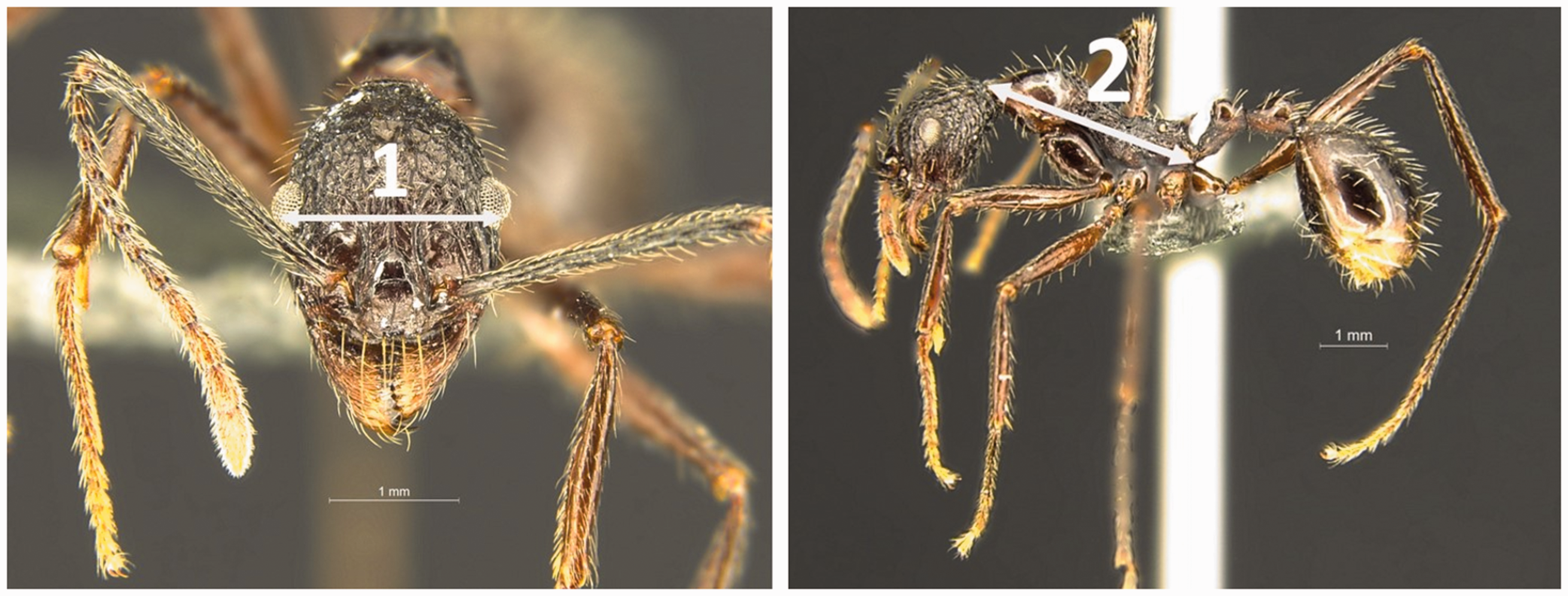

Literature Review on Chinese Pangolin Diet
Review of Chinese Pangolin Diet (Manis pentadactyla) Composition From Different Localities.

Note. The methods used in each study are G = gut content analysis; P = pitfall traps at foraged burrows; B = investigate of leftovers from forage burrows and foraging observations; I = interview with hunters. Prey species nesting stratum are Ab = arboreal; Ep = epigaeic; Hy = hypogaeic. Species identified in this study are bolded and species representing new records for the Chinese pangolin’s diet are marked with an *.
References used: [a] Dong, Zhang, Huang, Chen, and Hu, 2009; [b] Fellowes and Dudgeon 2003; [c] Gaume, Shenoy, Zacharias, and Borges, 2006; [d] Gordon, Chu, Lillie, Tissot, and Pinter, 2005; [e] Huddleston and Fluker, 1968; [f] King and Spink 1969; [g] Li, Yeh, Chiu, Kuo, and Tsai, 2016; [h] Li, Lin, Lan, Pei, and Su, 2011; [i] Li, Tong, Xiong, and Huang, 2010; [j] Li et al., 2010; [k] Liefke, Dorow, Hölldobler, and Maschwitz, 1998; [l] Liu and Xu, 1981; [m] Schuldt and Staab, 2015; [n] Tanaka, Yamane, and Itioka, 2012; [o] Tian et al., 2009; [p] Watanasit and Jantarit, 2006; [q] Wang, 2005; [r] Wang, Mo, and Lu, 2009; [s] Wu et al., 2003; [t] Wu et al., 2005; [u] Wu et al., 1998; [v] Yang et al., 2007; [w] This study.
Insights Into Habitat Use From Ant Prey
We used previous data from extensive ant surveys conducted in Hong Kong (Fellowes, 1997) to calculate ant species occurrences in different habitats and used these as proxies for their local abundance and habitat association. Here again, taxonomy was updated through direct examination of the specimens collected to allow taxonomic correspondence between both studies.
Results
A total of 25,803 ants and 812 termites, comprising six genera and nine species, were recorded. Ants represented the main food source in terms of species richness (eight species), abundance (97%), and biomass (98%; Table 1). The proportion of different ant castes in terms of biomass was workers (89.0%), followed by alates (8.2%) and pupae (2.8%; Table 1).
Discussion
Similarly to a previous study performed during the wet season in Dawuling Nature Reserve, Guangdong, China (Wu et al., 2005), our results indicate that ants represent the main food source for Chinese pangolin. In particular, the results suggest that the juvenile Chinese pangolin was not primarily feeding opportunistically on ant foragers but instead feeds directly on arboreal and epigaeic ant nests. This is supported by the presence of ant pupae and alates retrieved from the gut content. These stages or castes are usually found only within nests and are known to be more nutritious than workers, in particular due to their higher fat content (Redford & Dorea, 1984). The large number of individuals recovered (>26,000 individuals) also supports the nest-raiding hypothesis. As a point of comparison on ant abundance in Hong Kong within secondary forests and shrublands, 708 pitfall traps operating continuously for 72 hr would be necessary to collect a similar number of ants, although without discriminating in species identity (>100 species; R. H. Lee, unpublished data), and thus the efforts needed to collect such a selective and high abundance of workers seems unlikely through random search alone.
The ecology of the most abundant prey species encountered within the gut content (Camponotus nicobarensis, Polyrhachis tyrannica, and Crematogaster dohrni) is also informative as these species are considered arboreal or semi-arboreal species (Table 2), in contrast with ground-nesting species which accounted for only 2.2% of the prey biomass. The first two species nest in hollow wood while the latter builds conspicuous carton nests. Compared with subterranean nests, these nests are relatively fragile and likely to require less energy for a pangolin to feed on. This behavior may allow higher food intake and a lower energy expenditure from the foraging pangolin, which might be advantageous in particular for a juvenile pangolin. This is interesting since the Chinese pangolin is generally considered more terrestrial, and less adept at climbing than the Sunda pangolin (Manis javanica), although the height at which the individual climbed here remains unknown.
Seven ant species are recorded for the first time as part of the Chinese pangolin’s diet (Table 2), which, given the limited number of prior Chinese pangolin diet studies providing exact composition of insect prey, is not surprising. Moreover, some of the previous prey species identifications reported in the literature may be inaccurate, a common difficulty in ant taxonomy (Guénard, Weiser, Gomez, Narula, & Economo, 2017; Lattke, 2000). For instance, the record of the ant Myrmica rubra (Wu, Liu, Feng, & Ke, 1998), a species native to Europe and whose presence is considered dubious in South China (antmaps, 2017), is unlikely. Unfortunately, for those prey records where the purported prey species’ distribution overlaps with the known distribution of the Chinese pangolin, confirmation of previous identifications are impossible without meticulous specimen examination.
The use of relevant sampling methods as a proxy for the Chinese pangolin’s diet is equally important for two reasons. First, in several studies, data were collected passively by setting up pitfall traps around abandoned burrows (Li, Zhou, et al., 2010) or by observations of food leftovers from foraging burrows (Wu et al., 2005; Table 2). Both methods presumed that the ant or termite species sampled were also being preyed upon by the Chinese pangolin which is problematic, since they neglected the potential selective foraging behavior of Chinese pangolins. Second, the selection of particular sampling methods can also induce biases. For instance, pitfall traps are effective for sampling ground-dwelling arthropods but rarely collect arboreal species (Majer, 1997). Our results in Hong Kong also indicate that some of the most commonly sampled and conspicuous ground-dwelling ant species belonging to the Ponerinae subfamily, such as the genera Brachyponera (12%), Diacamma (67%), Ectomomyrmex (54%), Odontoponera (56%), or Pseudoneoponera (25%; species occurrence was calculated at 57 sites, using four pitfall traps along a 15 m transect per site, situated in grassland, shrubland, and forest habitats; Fellowes, 1997), and widespread species of Myrmicinae genera such as Carebara (formerly Pheidologeton) and Pheidole, were absent in the study animal’s gut. One possible reason for this prey selection behavior is the avoidance by myrmecophagous mammals of prey with a well-developed defensive mechanism (e.g., Redford, 1985; Swart, Richardson, & Ferguson, 1999). Species from the Ponerinae and Myrmicinae subfamilies have a sting for self-defense, unlike Formicinae which rely on chemical defense; with the sting of large Ponerinae being especially painful.
Habitat preferences of the Chinese pangolin can also be hypothesized based on the sampling occurrence of ant species in Hong Kong (Fellowes, 1997; Table 1). All the prey species recorded in the diet of the Chinese pangolin are known from secondary forests and shrublands across Hong Kong. The presence in the gut of Anoplolepis gracilipes, an invasive ant associated with disturbed habitats and whose colonies are commonly found at forest edges and near human settlements but rarely in undisturbed forests (Bos, Tylianakis, Steffan-Dewenter, & Tscharntke, 2008; authors pers. obs.), together with other ant species may suggest that the studied individual foraged at forest margins and in shrubland habitats, which contrasts with the disturbance-avoiding behavior observed within heavily hunted rural populations (Wu, Liu, Ma, Xu, & Chen, 2003). However, on the basis of the limited information available here, the distinction between a shift in habitat preference and dispersing individual seeking a more suitable habitat cannot be reasonably established. Understanding local food choices of ecologically distinct populations is necessary for regional conservation success. The use of appropriate methods to determine the exact composition and abundance of the consumed prey could also be informative for captive breeding programs (Challender, 2009; Jordan, 2005). However, it is difficult to conduct extended food choice investigations, like gut content analysis, particularly in areas where wild populations have collapsed.
Diet composition studies of Temminck’s ground pangolins (Smutsia temminckii) in Africa suggest that prey body size can be an important criterion for pangolin prey selection (e.g., Pietersen, Symes, Woodborne, McKechnie, & Jansen, 2015; Swart et al., 1999). Our results partially support this finding, with the majority of prey of relatively large size (WL in ants and HL in termites >2 mm; Table 1). For comparison in Hong Kong, the 10 most common ant species found in forests (Fellowes & Dudgeon, 2003) possess WL ≤ 1 mm, with the exception of the Ponerinae species discussed earlier. We thus propose that the Chinese pangolin might favor the consumption of medium- to large-sized, non-stinging arboreal ant species, and that the use of body size measurements could potentially allow predictions on Chinese pangolin diet in different regions. While the results presented are based on only a single juvenile individual, we believe that due to the cryptic lifestyle and the critically endangered conservation status of the Chinese pangolin, these results are relevant and provide additional information on prey selection and foraging behavior in this species.
Implications for Conservation
Knowledge of how and where Chinese pangolins forage and which species they prey on represents essential information for successful conservation programmes both in captivity and in the wild, but these data are still lacking at present and hindering conservation efforts (Challender, 2009). Our study, though with some limitations due to the examination of a single juvenile individual, indicates potential food selectivity among social insects and in particular within ants; as well as a clear predatory behavior targeting nests which contain protein-rich castes such as larvae and alates (gynes) of arboreal and semi-arboreal species. This information can contribute to the overall knowledge on the foraging ecology of the Chinese pangolin which is valuable in particular for rehabilitation and captive breeding programmes (Challender, 2009; Hua et al., 2015). For instance, the development of artificial habitat closely mirrors the habitat of seized pangolins can reduce their stress and may enhance their survival rate. Similarly, reintroduction programs might benefit from prior knowledge on the ant community at intended release sites and the presence of species known to satisfy the feeding ecology of the Chinese pangolin. Our results also indicate that Chinese pangolins may potentially also use disturbed forest edges and shrublands as foraging grounds. However, we cannot rule out the possibility of the studied juvenile Chinese pangolin was dispersing and looking for vacant territory. Nevertheless, individuals foraging in these habitats generally suffer higher mortality risk due to predators (Andren & Anglestam, 1988; as in this study, by feral dogs) or to roadkill when moving between fragmented habitats (Laurance, Goosem, & Laurance, 2009), and the significance of these impacts on local pangolin populations should be further evaluated. Within disturbed or urban areas like Hong Kong, gaining knowledge on foraging patterns and population dynamics of the Chinese pangolin is crucial for long-term conservation programs.
Footnotes
Acknowledgments
The authors thank Gary Ades and the two anonymous reviewers for providing constructive comments on an early draft of the manuscript. Gut content used was extracted and preserved by the Wild Animal Rescue Centre of Kadoorie Farm & Botanic Garden, as a collaborative effort of the team. The authors also thank Lily Ng and Maria Lo for technical support.
Declaration of Conflicting Interests
The author(s) declared no potential conflicts of interest with respect to the research, authorship, and/or publication of this article.
Funding
The author(s) disclosed receipt of the following financial support for the research, authorship, and/or publication of this article: This work was supported by The University of Hong Kong.