



Abstract
Body condition score (BCS) systems have been used in wild animals as a technique for evaluating the health status of species that are difficult to capture but can be observed in their habitat. In this study, our goal was to enable scoring the BC of wild Baird’s tapir (Tapirus bairdii) without the need for direct observation, using camera trap and opportunistic photographic records. First, we modified a BCS assessment that was created for other tapir species, using captive Baird’s tapirs. Second, we applied it to a set of photographs of wild Baird’s tapir that were obtained over six consecutive years in a protected area in southern Mexico. We compared morphometric measurements and muscle and fat deposited in several anatomical regions. We also evaluated changes in BC between seasons for individuals photographed on several occasions. We show that neck and thorax circumferences are significantly correlated with all BCSs associated with these anatomical regions, whereas abdominal circumference is correlated only with half of the BCS. BCS of captive tapirs that we evaluated averaged 24.93 ± 5.61, which was higher than that of wild tapirs (22.63 ± 3.68). No significant difference in BC was apparent between rainy and dry seasons in our study site; wild tapirs were able to maintain good BC throughout the year. Camera trap records and opportunistic photographs were a useful tool to track changes in BC over time.
Introduction
The body condition (BC) of wild animals is an important determinant of their ability to survive and reproduce. A low nutritional status may compromise the immune system, causing a weak host response to viral, bacterial, and parasitic infections (Katona & Katona-Apte, 2008). The ingestion of low-quality food may cause nutritional and metabolic disorders (e.g., hypovitaminosis, nutritional hyperparatiroidism, and mineral deficiencies), while triggering the depletion of energetic reserves, starting with the glycogen that is stored in liver and muscles, followed by fat deposits and, finally, by proteins (Colín, 2004). Animals with larger fat reserves usually have greater fasting endurance and higher survival than individuals with smaller reserves (Millar & Hickling, 1990). Indeed, a low body mass has been associated with decreased survival and fertility within species (Bassano, Perrone, & Von Hardenberg, 2003). For these reasons, wildlife researchers consider catabolism and mass loss as essential components of the life history strategies of many wild animals (Le Maho, 1977; Sherry, Mrosovsky, & Hogan, 1980; Stevenson & Woods, 2006). Festa-Bianchet, Jorgenson, Bérubé, Portier, and Wishart (1997) argued that individual mass plays an important role in the life history and population dynamics of ungulates.
BC is defined as a direct measurement of the nutritional status of an individual, especially the relative size of energy reserves such as fat and proteins (Peig & Green, 2009). BC assessment is of considerable importance in many ecological studies and as a wildlife management tool, which is the reason why noninvasive techniques have been developed to measure BC in livestock (Edmonson, Lean, Weaver, Farver, & Webster, 1989) and wild ungulates (Ezenwa, Jolles, & O’Brien, 2009). In this article, we use a previously described technique that was developed to assess BC in captive Malayan (Tapirus indicus) and lowland tapirs (T. terrestris) and which uses scores attributed to several body parts to construct a final score for BC (Clauss, Wilkins, Hartley, & Hatt, 2009). We have adapted it to assess the condition of Baird’s tapir (T. bairdii).
Baird’s tapir is a browsing and frugivorous perissodactyl species that is distributed from Southeastern Mexico to the Northwestern Andes (Hershkovitz, 1956). Several populations have been severely reduced through forest loss and hunting. Currently, Southern Mexico is estimated to hold 50% of the global population of Baird’s tapir; however, in areas where forests and native vegetation have been severely fragmented, these animals have virtually disappeared (Naranjo, 2009). The isolation of small populations in fragmented areas makes the Baird’s tapir susceptible to extinction when facing natural disturbances and epidemic diseases (Hernandez-Divers, Bailey, Aguilar, Loria, & Foerster, 2005). Efforts to protect the species would benefit from any information that can be related to the health and nutritional status of individuals.
Tapirs are predominantly nocturnal and crepuscular animals, and often inhabit areas that are difficult to access. Therefore, capturing tapirs in the field can be challenging, as exemplified by our 4-year effort that led to the capture of a single individual. Direct observations are equally difficult to carry out. For these reasons, the use of alternative surveillance techniques has become essential for monitoring the status of tapirs. One such technique is camera trapping, which has been used to record the presence of rare or secretive species (e.g., Olson et al., 2012), to estimate population densities (e.g., Karanth, Chundawat, Nichols, & Kumar, 2004; Rowcliffe, Field, Turvey, & Carbone, 2008), and to document activity patterns (e.g., Ridout & Linkie, 2009) and habitat use (Bowkett, Rovero, & Marshall, 2008).
Our aim is to provide a simple and reliable tool for evaluating the BC of free-ranging Baird’s tapirs using the most readily available information, viz., photographs that were obtained from camera traps. We modified the technique that was developed by Clauss et al. (2009) and added a score for the head, using captive individuals that we were able to weigh and measure. Given that we had a number of individuals with poor BC, we were able to define better scoring criteria for these cases. We tested the correlation between morphometric measurements (neck, thorax, and abdomen circumferences) and the visual appearance of anatomical regions (head, neck, shoulder, ribs, spine and pelvis) in these captive Baird’s tapirs. This aided us in scoring BC of wild tapirs, by comparing them with photographs of captive individuals with a defined BCS (Body Condition Score). The procedure was repeated with different observers to test its consistency. We also applied the technique to a set of Baird’s tapir photographs that had been obtained with camera traps over 6 years in a protected area in southern Mexico to evaluate the BC of wild tapirs. Finally, we discuss how this technique could be an important conservation tool for improving the assessments of Baird’s tapir populations.
Materials and Methods
Tapir Specimens
Captive tapirs
Five zoos in Mexico and one in Belize allowed us to take photographs and measurements of the tapirs in their collection. A total of 15 tapirs (nine adult and two juvenile males, and four adult females) were photographed in captivity, of which 8 were also measured (five adult males and three adult females).
Wild tapirs
As part of ongoing studies on wildlife species in the Calakmul region, we obtained 81 records of tapirs between 2008 and 2013. This region encompasses the Calakmul Biosphere Reserve (CBR), which is located in Southeastern Campeche, Mexico (17°45’–19°15’N, 89°15’–90°10’W). The climate is tropical with a marked dry season, an annual average temperature of 25℃, and average annual precipitation ranging from 950 to 1200 mm, according to location (Márdero et al., 2012). The dominant vegetation types are seasonal tropical forests that differ according to their topographical position, canopy height, species relative abundance, and degree of deciduousness (Vester et al., 2007).
The photographic records were obtained from two studies employing camera traps on the use of waterholes by large fauna and documenting the presence of four tapirs with low BC in villages surrounding the Calakmul Biosphere Reserve. The first study on waterholes ran from 2008 to 2010. The NGO Pronatura Peninsula de Yucatán, A.C., placed 45 camera traps at 15 waterholes (three per waterhole) within the CBR. They used four camera models: WildView Xtreme (Stealth Cam LLC, Grande Prairie, TX, USA), n = 19; Deer Cam DC-100 (Non Typical Inc., De Pere, WI, USA; www.deercam.com), n = 17; Stealth Cam 300 (Stealth Cam LLC; www.epicstealthcam.com), n = 7; and CamTrakker MK-10 (CamTrakker South, Watkinsville, GA, USA; www.trailcam.com), n = 2. The second study took place in 2012–2013, using 18 camera traps of three different models: PC800 Hyperfire professional (Reconyx Inc., Holmen, WI, USA; www.reconyx.com), n = 6; Moultrie Game Spy I-65 (EBSCO Industries Inc., Birmingham, AL, USA; www.moultriefeeders.com), n = 6; and Cuddeback Capture IR digital scouting camera (Cuddeback Inc., De Pere, WI, USA; www.cuddeback.com), n = 6. These cameras were placed at nine waterholes (two per waterhole) of the Calakmul region. In both studies, the cameras remained active 24 hours per day and were checked every 15 to 30 days, to change batteries and empty memory cards. The cameras remained installed and active from April to August, to encompass both the rainy and dry seasons.
Of the 81 photographic records from camera traps, 16 were excluded, either because they corresponded to a same individual in a photographic sequence or because the body was not in full view. Therefore, we used a total of 65 independent records (61 from camera traps and 4 from villages), of which 27 were males, 9 were females, and 29 were from individuals of indeterminate sex (Baird’s tapir does not exhibit obvious sexual dimorphism, even when genitalia are visible). In some cases, photos of the same tapir were obtained on different dates, allowing us to score BC over time. These individuals were identified using distinguishable marks. Two tapirs could be clearly identified with such marks: an adult male with a large cut in his right ear; and a young male, which we had equipped with a telemetry collar.
Assessing BC
Clauss et al. (2009) developed a technique for scoring BC in the Malayan and lowland tapirs that were in zoos in the United Kingdom. We used their technique, which we slightly modified by adding one criterion, the head. A BCS was assigned to each animal based on the visual assessment of the appearance of fat and muscles associated with skeletal structures (head, neck, shoulders, ribs, spine, and pelvic bones; Figure 1; Table 1). These body regions have been used previously to visually estimate BC in African buffalo (Syncerus caffer), Asian elephant (Elephas maximus), impala (Aepyceros melampus), black rhinoceros (Diceros bicornis), caribou (Rangifer tarandus caribou), elk (Cervus canadensis), and mule deer (Odocoileus hemionus; Ezenwa et al., 2009; Wemmer et al., 2006; Gallivan, Culverwell, & Girdwood, 1995; Reuter & Adcock, 1998; Gerhart, White, Cameron, & Russell, 1996; Cook et al., 2001; Cook, Stephenson, Myers, Cook, & Shipley, 2007).
Anatomical regions selected for the assessment of body condition in Baird’s tapir. Criteria and Point Scores Used to Assess Body Condition in Baird's Tapir. BCS = Body condition score.

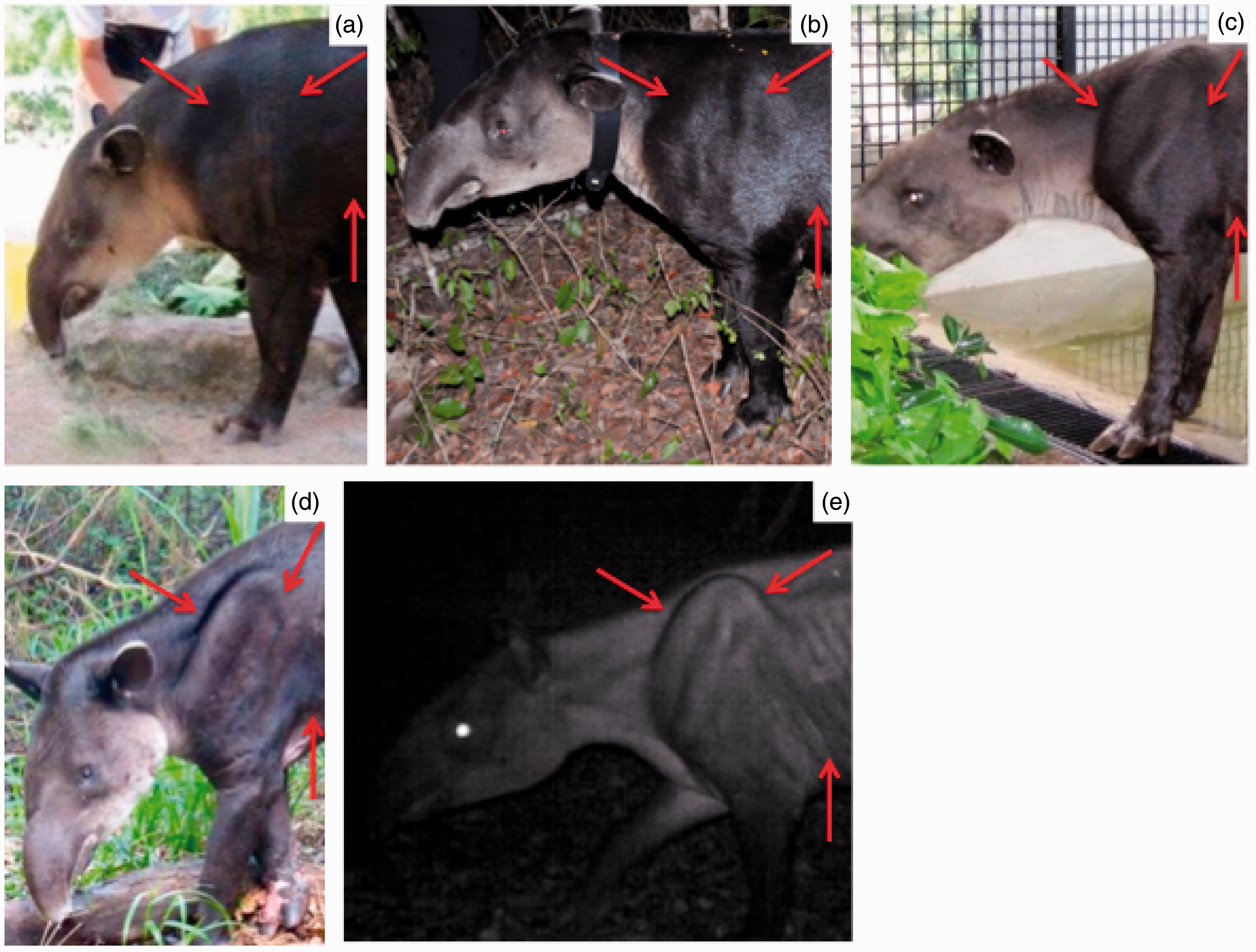
Scores were assigned to each of the six body regions using three or four criteria for each region (Table 1). The six scores were then totaled to obtain the BCS. The total score ranged from a minimum value of 6 up to 30 points. We established subjectively the following ranges: obese (28–30 points); good (22–27 points); fair (16–21 points); thin (10–15 points); and emaciated (6–9 points; Figures 2 to 6).
Head of Baird’s tapir showing skull structures and shape of the proboscis, from an obese (a) to an emaciated (e) animal. Following Table 1 scores as follows: A = 5, B = 4, C = 3, D = 2, and E = 1. Visibility of the muscles of the neck of Baird’s tapir, from an obese (a) to an emaciated (e) animal. Following Table 1 scores as follows: A = 5, B = 4, C = 3, D = 2, and E = 1. Visibility of the bone structures and muscles of the shoulder, from an obese (a) to an emaciated (e) animal. Following Table 1 scores as follows: A = 5, B = 4, C = 3, D = 2, and E = 1. Visibility of the ribs from an obese (a) to an emaciated (e) animal. Following Table 1 scores are as follows: A = 5, B = 4, C = 3, D = 2, and E = 1. Visibility of the pelvic bones, tail, and the spines of the vertebrae, from an obese (a) to an emaciated (e) animal. Following Table 1 scores are as follows: A = 5, B = 4, C = 3, D = 2, and E = 1.



Body Measurements and Body Condition Scores of 11 Baird’s Tapirs.

Note. NC = Neck circumference; TC = Thorax circumference; AC = Abdomen circumference; all measures in cm. Codes for individuals are as follows: C = captive, W = wild, M = male, F = female; hence, CM1 is a captive male.
To improve accuracy and reduce subjectivity, anyone assessing BC must be familiar with the anatomy and range of conditions that a Baird’s tapir may present. We therefore tested the ease of use and consistency of the evaluation criteria during the meeting of the Mexican Tapir Specialist Group, which was held in Zoh Laguna, Campeche in November 2013. We showed three pictures of three tapirs (wild and captive) that ranged from obese to fair BC to each of nine of the participants. Participants were either veterinarians or biologists, but all had experienced physical contact with tapirs. Based on the established criteria (Table 1), each participant then scored the BC of the three tapirs.
Only one of the authors (JPF) scored the BC of the wild tapirs from the 65 photographs that had been obtained in the Calakmul region. The scoring sessions were done over the course of one month.
Data Analyses
We assessed relationships between body measures and the corresponding BCSs for each anatomical region using Pearson’s product–moment correlations (r). We assessed the degree of agreement among the six body scores assigned to each of the 11 tapirs fully measured and scored, using Kendall’s test of concordance (Legendre, 2005) with 4,999 permutations. We did not correct for ties. After we scored the animals, we ordered all pictures of tapirs that had been photographed in the CBR according to the month in which the pictures were taken to test for differences in BC between the dry (December to May) and the rainy (June to November) seasons. We compared BC scores during the dry versus rainy season and within CBR versus zoos using a Mann–Whitney U-test, because data were not normally distributed. All tests with a p-value ≤.05 were considered significant.
Results
Assessing BC
Pearson Correlations Between Body Measurements and Body Scores of 11 Baird’s Tapirs, and Associated p-Values (Within Parentheses).
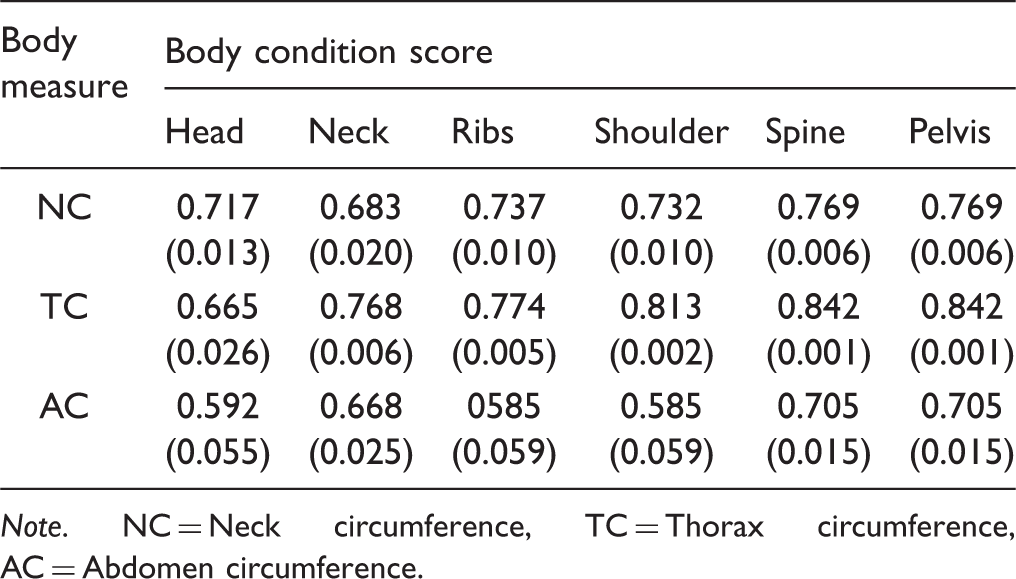
Note. NC = Neck circumference, TC = Thorax circumference, AC = Abdomen circumference.
The evaluation performed at the Mexican Tapir Specialist Group showed that some anatomical regions may be easier to score than others. In the first individual (a fair animal), most anatomical regions were scored as 2 to 3, with the shoulder exhibiting the greatest ranges (Figure 7). The second individual (obese) was scored between 3 and 5, with 5 being the most common score for all anatomical regions. For the third individual, scores ranged between 3 and 5, with 4 being the most common score for most anatomical regions.
Boxplots of body condition scores of three Baird’s tapir, results of the exercise performed by nine members of the Mexican Tapir Specialist Group. Six body regions were evaluated. Scores range from 1 to 5.
Body Score of Captive Tapirs
Of the 15 tapirs that had been evaluated in captivity (11 males and four females), 40.0% were scored as obese (n = 6), 26.7% good (n = 4), 26.7% fair (n = 4), 6.6% thin (n = 1), and none as emaciated (Figure 8). The BCS of the captive tapirs averaged 24.93 ± 5.61 (SD). A tapir that had been confiscated by wildlife authorities at the end of the dry season of 2011 had a total BC score of 15 points at that time. It reached the highest score (30) after 6 months in captivity at a zoo.
Body condition scores (BCS) of wild (black; n = 65) and captive (white; n = 15) Baird’s tapirs. BCS can range from 6 to 30.
Body Score of Wild Tapirs
Overall, the BCSs of captive and wild tapirs differed (U = 399, p = .042). None of the wild tapirs was scored as obese, 77.0% as good (n = 50), 18.4% as fair (n = 12), 1.5% as thin (n = 1), and 3.1% as emaciated (n = 2; Figure 8). The BCS of wild tapirs averaged 22.63 ± 3.68 (SD). One tapir captured in a village during the rainy season that showed a BC score of only 6 at that time reached a score of 26, 7 months after having been translocated to a wildlife rescue centre in Bacalar, Quintana Roo.
There was no significant difference in BCS between the rainy (n = 19; BCS ± SD = 22.26 ± 4.26) and dry (n = 46; BCS ± SD = 22.78 ± 3.46) seasons (U = 416.0, p = .75). The BC of the two males with distinctive marks indicated that scores remained stable over more than 2 years (2011–2013), ranging between 22 and 25 points for the older male, and between 21 and 25 points for the younger radio-collared male.
Discussion
Assessing BC
Several researchers have considered the relationship between BC, body mass, and body measurements in domestic (Machebe & Ezekwe, 2010; Nesamvuni, Mulaudzi, Ramanyimi, & Taylor, 2000; Nicholson & Sayers, 1987; Ozkaya & Bozkurt, 2008) and nondomestic animals (Amaral, da Silva, & Rosas, 2010; Hile, Hintz, & Erb, 1997), as a useful indicator of a population’s general health. For Baird’s tapirs, we found that BC scores were positively correlated with their corresponding body measurements. The high and significant correlations between body measurements and scores (Table 3) indicate that scores are appropriate estimators of BC in Baird’s tapirs.
Clauss et al. (2009) study was the only previous work where the BC of tapirs had been estimated. However, these authors scored captive and mostly obese animals, which prevented them from defining scores that could assess animals in poor physical condition. In our study, 40% of the captive animals were obese (from slightly to extremely obese), due to either inadequate high-energy diets (Association of Zoos and Aquariums, 2013; Clauss et al., 2009) or a lack of space in which to move (Association of Zoos and Aquariums, 2013). In the wild, 4.6% (n = 3) of the individuals were thin or even emaciated (compared with only one thin, old individual in captivity), allowing for a wider range of BC in our study. The significant difference between the BCS of captive and wild tapirs was likely caused by wild tapirs having never reached the maximum score (BCS = 30), as had happened with captive animals, while the latter never reached the lowest score (BCS = 6). This allowed us to provide a method for scoring BC in Baird’s tapir regardless of their condition, from emaciated (BCS = 6) to obese (BCS = 30).
We recognize that scoring systems include a certain degree of subjectivity; however, the observer error regarding some criteria will not substantially bias the results. Results have been often shown to be repeatable, independent of observer experience. Further, variation between observers has been found to be minimal (Edmonson et al., 1989). In our study, we estimate that the head, neck, thoracic, and pelvic areas can be scored reliably, given the consistency among participants in the scores assigned to these anatomical regions. However, the spinal vertebrae and shoulder required that observers were sufficiently familiar with tapir anatomy to be able to differentiate the structures that compose them. Therefore, we recommend caution in the use of these regions to score BC.
Applying BCS to Wild Tapirs of Calakmul
In 6 years of intensive monitoring of tapirs by camera trap, 95.4% of photographic records showed animals with a fair or good BC (i.e., 16–27 points). Tapirs in Calakmul are apparently healthy, similar to the wild populations of lowland tapir that had been evaluated by Medici, Mangini, and Fernandes-Santos (2014) in the Atlantic forest (93% of individuals with good or regular BC, and 7% poor BC) and in the Pantanal (98% of individuals with good or regular BC, and 2% poor BC) regions of Brazil. These Brazilian evaluations were based on captured individuals; therefore, their similarity with our results increases our confidence in the reliability of photographic material to score BC in tapirs.
Despite the strong contrast in vegetation physiognomy between the rainy (June to November) and the dry (December to May) seasons in the region of Calakmul (Vester et al., 2007), no difference was found in the BC of wild tapirs between the two seasons. The harsh dry season would suggest that tapirs, like other herbivores, suffer a decrease in BC during that season due to the lack of both water and high-quality food (Moss & Croft, 1999). In the Calakmul region, tapirs probably have large home ranges (e.g., 18.82 km2 for one male tapir over a period of 2 months in the dry season; Carrillo et al., unpublished data), indicating that they may have to travel extensively to track resources (O’Farrill, Galetti, & Campos-Arceiz, 2013). Travelling such large home ranges might cause variation in fat reserves, especially since males expend a great amount of energy in agonistic interactions related to territoriality (Medici et al., 2014). However, the two males that we were able to follow over more than 2 years maintained good BCSs throughout the year.
Implications for Conservation
Noninvasive techniques can help researchers to obtain information about tapir health. In many parts of their distribution, tapirs live in areas that are difficult to access (Naranjo & Cruz-Aldán, 1998), which may complicate the safe capture of individuals to obtain direct information about the health of tapirs in the wild. Tapirs are also difficult to observe in the wild, preventing the use of direct observations to estimate BC. We suggest that visual estimation of BC using photos can be a very valuable tool for wildlife managers in assessing BC in wild populations of tapirs. Detecting changes in BC of wild, secretive, and endangered species, such as tapirs, may allow signalling the early emergence of diseases or very strong seasonal changes (e.g., droughts) that may affect populations. We also expect this tool to help us to better understand the ecological conditions that influence the BC of wild tapirs.
Footnotes
Acknowledgments
We thank the personnel of Africam Safari, Aluxes Ecopark, Xcaret, Chapultepec zoo, Payo Obispo Zoo, and Belize Zoo for permitting our BC evaluations of the tapirs in their care. For their invaluable help in the field, we are very grateful to the capture team: Mauro Sanvicente, Nicolas Arias, Natalia Carrillo, Antonio Jasso, and Marcos Briseño. This manuscript benefited from comments by David Gonzalez, Gerardo Suzan, and William Parsons. We thank Michelle Guerra, Francisco Pérez, and Pronatura Peninsula de Yucatán, A.C., for sharing materials. Special thanks are due to the authorities of the Calakmul Biosphere Reserve for their support in this research.
Declaration of Conflicting Interests
The author(s) declared no potential conflicts of interest with respect to the research, authorship, and/or publication of this article.
Funding
The author(s) disclosed receipt of the following financial support for the research, authorship, and/or publication of this article: JPF was supported by a scholarship (332977/269696) granted by the Mexican government through CONACYT. The project was funded by grant C01-108348 (CONACYT & SEMARNAT) to SC and RR-H.