



Abstract
An increased interest in social entrepreneurship at the organizational level has a broad impact on human resource development (HRD) professionals. Organizations with an enhanced social consciousness may employ HRD training to create awareness of social issues and facilitate social movement learning. At present, HRD literature lacks guidance on fostering social responsibility among employees. This study, utilizing Q Methodology, examines the efforts of faculty members to change the perceptions of social issues held by learners enrolled in a “business as force for good” course at their university. The findings of this study have implications for faculty members and HRD professionals tasked with improving the social consciousness of their workforce.
“The world as we have created it is a process of our thinking. It cannot be changed without changing our thinking.”- Albert Einstein
An increased interest in social entrepreneurship and social responsibility at the organizational level has a broad impact on human resource development (HRD) professionals. Through the commonly accepted HRD triad of organizational development, career development, and employee training (Bierema & Callahan, 2014), HRD professionals find themselves responsible for enacting many aspects of an organization's commitment to social responsibility (Jang & Ardichvili, 2020). For example, the inclination to do good (i.e., create positive societal impact) at the organizational level allows HRD professionals to leverage their focus on social responsibility to recruit top talent, promote an ethical work climate, and foster motivation among employees (Alizadeh et al., 2021; Voegtlin & Greenwood, 2016).
As organizations increase their social consciousness, recent literature has made the call for HRD to return to its people-centered roots (Alizadeh et al., 2021; Bierema & Callahan, 2014; Byrd, 2017; McGuire et al., 2020). Through fostering individual development, employees may gain a sense of how their work affects the organization at large (Frye, 2020) and experience holistic development as professionals (Bierema & Callahan, 2014). Furthermore, as HRD professionals’ work reflects their organizations’ goals and values (Frye, 2020), organizations with an increased social consciousness may employ HRD training to facilitate social movement learning. This acquisition of new skills and knowledge that can result in employees changing their environment is known as social movement learning (Greiner, 2019). At present, HRD literature lacks guidance on fostering social responsibility within employees to create social change (Alizadeh et al., 2021). In response, this study offers insight to HRD educators or professionals beginning the change process within their organizations by exploring the process of facilitating social movement learning.
Social entrepreneurship can be understood as change-making that meets social needs (Dees, 2001; Forouharfar et al., 2018; Hervieux & Voltan, 2016; What Ashoka Does, n.d.; Wu et al., 2020). The initial stages of social entrepreneurship involve creating an awareness of the need for change.
According to Lewin’s (1951) organizational change theory, recognizing the need for change (unfreezing) is the first step in making any change. Similarly, creating an awareness of the need for change is also the first step in social entrepreneurship. Consequently, our research team utilized an undergraduate Management class as a potential catalyst for the change process.
Historically, the relationship between HRD and Management education has been complicated. While management education has been criticized for being overly theoretical to the point of lacking practical impact (Kuchinke, 2007; Sambrook & Wilmott, 2014; Trehan, 2004), HRD has been criticized as devoid of a precise theoretical foundation (Lim et al., 2013; Lim & Rager, 2015; Trehan, 2004). Still, with humanistic roots (Bierema & Callahan, 2014; Byrd, 2017; McGuire et al., 2005), HRD has long embraced a mission of benefiting an “organization, community, nation, or ultimately, the whole of humanity” (McLean & McLean, 2001, p. 332). Meanwhile, management education accrediting bodies have become increasingly interested in humanistic concerns such as the societal impact of business education (AACSB, n.d.). We believe that through the desire to create more socially conscious organizations and employees, the fields of HRD and Management find convergence.
This connection between humanistic HRD principles and the societal impact principles of management education aligns with the motivations of current business learners who possess a strong desire to do good in the world and to make a positive impact (AACSB, n.d.; De Novelis, 2020; Gerhardt et al., 2021; Wright & Church, 2020;). With these ideas in mind, we redesigned an existing course within our university's management and entrepreneurship programs. What had previously existed as a “Social Enterprise for Entrepreneurs” course was reimagined as a “Business as a Force for Good (BFG)” course. The newly designed BFG course includes social entrepreneurship, B Corporations, and how businesses address social issues with the goal of providing impetus for and becoming forces for positive societal change in the world.
Among the learning outcomes of this course was identifying appropriate intersections between societal needs and organizational goals and strategies for action. To achieve this and other stated outcomes (see Appendix A), we first set out to understand our learners’ perception of the importance of a set of social issues and to discover how learners’ perception of the importance of social issues could be changed through the acquisition of new knowledge. At the onset of the course redesign, we believed that providing learners with an intensive education on social issues would begin the unfreezing process and create awareness of the importance of social issues.
This paper explores how one undergraduate management and entrepreneurship course sought to affect its learners’ perception of the importance of social issues. The following research question guided the first part of our study: How does an increased awareness of social issues through social movement learning and a macro-social work lens change perception of the importance of a set of social issues among learners?
Literature Review
Social Entrepreneurship (SE)
Bill Drayton is often credited with the concept of social entrepreneurship. He founded Ashoka in 1980 to support an elite group of social entrepreneurs (Hammonds, 2005; What Ashoka does, n.d.). Drayton says that “the job of a social entrepreneur is to recognize when a part of society is not working and to solve the problem by changing the system, spreading solutions, and persuading entire societies to take new leaps” (Drayton, 2005, pp. 9–10). More recently, Forouharfar et al. (2018), through an epistemological critique, defined social entrepreneurship as a “socially mission-oriented innovation which seeks beneficial transformative social change by creativity and recognition of social opportunities” (p. 33).
The overlap between social entrepreneurship and economic entrepreneurship (i.e., profit-driven activity) is not completely agreed upon. Roberts and Woods (2005) note, “social entrepreneurship is a construct that bridges an important gap between business and benevolence” (p. 45). Some argue that entrepreneurship is a continuum between social and economic goals (Lakkol & Lakkol, 2022). Chell (2007) suggests that the need for balance in entrepreneurial activity between the social and economic goals can be viewed as a scale where a focus on one takes from the other. On the other hand, Mair and Martí (2006) consider entrepreneurship a focus on social value supported by economic value creation. Porter disagreed by suggesting entrepreneurship equates to “shared value,” which is simultaneously using capitalism's power to create economic and societal value (Driver & Porter, 2012). We advance Porter’s definition within the BFG course, and in this research, for-profit businesses address social problems to create positive societal impact (Driver & Porter, 2012).
Social Entrepreneurs: Change Makers Versus Activists
Over time, organizations supporting social entrepreneurs, such as the Skoll Foundation and the Skoll Centre Social Entrepreneurship, the Schwab Foundation for Social Entrepreneurship, and others, have moved toward a changemaker definition. Social entrepreneurs as change agents focus on the social mission (Dees, 2001; Hervieux & Voltan, 2016). However, some believe that all entrepreneurs are social entrepreneurs as entrepreneurs “improve the quality of goods and services available to consumers, and ultimately raise the standard of living” (Schramm, 2010, p. 21). Various scholars (e.g., Dey & Steyaert, 2012; Komlos, 2015; Opatrny-Yazell et al., 2021; Wydick et al., 2016) suggest that entrepreneurs create unintended societal consequences through their actions. Although many definitions of a social entrepreneur exist, most definitions presented are narrow and fail to recognize recent stakeholder-focused business motivation and related actions.
As societal challenges continue to grow globally, business models built on or those including social issues are becoming the expectation (Esposito De Falco & Renzi, 2020). Intrapreneurs are also change agents (The New Reality | Ashoka | Everyone a Changemaker, n.d.). “Social intrapreneurship is a voluntary and informal employee-led process of utilising entrepreneurial principles to address social or environmental challenges while contributing to the objectives of established organizations (Haski-Leventhal et al., 2022, p. 2).”
Social intrapreneurship is a subset of social entrepreneurship and business intrapreneurship. Social intrapreneurship occurs when employees innovate solutions for social and environmental issues, and, as such, it can help to enhance the connection between CSR and employee engagement (Haski-Leventhal et al., 2022, p. 99).
B Corps are closely linked to Corporate Social Intrapreneurship, with the goal of sustainable innovation (Esposito De Falco & Renzi, 2020). The B Corp movement imagines “a world where all stakeholders, not just shareholders, are valued and prioritized” (Building the Movement, n.d.) and advocates for change via legislative influence, certification of businesses, and sharing the B Impact Assessment (n.d.) tool.
Social intrapreneurship is more structured than activism (Mair & Martí, 2006) but the two may coexist within one organization. Patagonia, founded by Yvon Chinouard, is a Certified B Corporation (Certified B Corporation—B Lab Global, n.d.). Chinouard, who R. L. Martin and Osberg (2007) might define as an activist rather than a social entrepreneur, shows how businesses blend economic and social goals. Within Patagonia’s business model, they address the community, workers, and environment. Simultaneously, Patagonia uses their platform as activists and could be viewed as an organization in the civil stage of organizational learning (Zadek, 2004). Ben and Jerry’s and thousands of other B Corps have a similar bio. These organizations are innovating to address and solve social issues. In some cases, these organizations are new entrepreneurial ventures. In other cases, existing organizations have seen the need to evolve toward “sustainable innovation” (Esposito De Falco & Renzi, 2020, p. 3) as social intrapreneurs.
Stakeholder Governance
Professor Klaus Schwab’s stakeholder theory and vision of stakeholder capitalism became the guiding principle for the World Economic Forum (aka, Davos). His theory was that businesses should serve not just shareholders but all stakeholders, including employees, suppliers, the community, etc. (The World Economic Forum, n.d.). Today, stakeholders are more aware of social issues and how businesses claim to address them (Esposito De Falco & Renzi, 2020). Global evidence shows that businesses have embraced the concept of addressing social issues via a for-profit business model and stakeholder focus. We see these efforts in The World Economic (WE) Forum, the UN Global Compact, and the B Corp movement, etc. Approximately 5083 companies in 80 countries with 15 industries involving over 400,000 workers have become Certified B Corps. They use stakeholder-driven models balancing profit and purpose to “transform the global economy to benefit all people, communities, and the planet” (About B Lab. B Lab U.S. & Canada, n.d.; B Lab Global Site, n.d.).
Employee buy-in for organizational goals is important. Organizations must foster an understanding of social issues and their importance such that all of the individuals in the organization can understand and support the social issue objective(s). Further, while not necessarily the dramatic, high-impact systemic change definition, it may be more pragmatic to consider that social entrepreneurship “in the most general sense is a strategic management framework applied to organizations with societal benefit goals” (Helm & Andersson, 2010, p. 260). Is it, or will it soon be, an order qualifier for all businesses to address one or more social issues within their business model, separate from, say, corporate giving? Haugh (2007) notes the critical piece that businesses are now addressing en masse, which is “innovative responses to human deprivation and environmental degradation” (p. 743). There are many ways to enact positive societal change. Porter noted “meeting social needs is not just a peripheral activity but a core aspect of every business” (Driver & Porter, 2012, p. 421). Porter further notes that our capitalism must become more socially inclusive and ethical with the hope that social entrepreneurship becomes redundant when all businesses focus on both economic and social goals (Driver & Porter, 2012).
Research Method
We designed a Q Methodology Q study to explore our research question: “how does an increased awareness of social issues through social movement learning and a macro-social work lens change perception of the importance of a set of social issues among learners?”
Q Methodology, a mixed method originally developed by Stephenson (1935), allows consideration of subjective viewpoints of the most important and least important elements, which are analyzed quantitatively via factor analysis (McKeown & Thomas, 1988: Newman & Ramlo, 2010). Q Methodology allows the researcher to analyze subjective perceptions of the most and least important items (McKeown & Thomas, 1988), in this case, social issues.
Q Methodology “enables the respondent to model his or her viewpoint on a matter of subjective importance through the operational medium of a Q sort” (McKeown & Thomas, 1988, pp. 12–13). The modeling is accomplished in this study by asking the subjects to rank order a set of social issues according to a particular distribution. Mathematically, factor analysis and Q Methodology work in the same way. In Q Methodology, analysis results in factors which “represent points of view and the association of each respondent with each point of view indicated by the magnitude of his or her loading on that factor” (McKeown & Thomas, 1988, pp. 12–13).
The Course and The Institution
The course for which the Q Methodology study was designed was created and team-taught by a professor of management and a professor of social work. The joining of business and social work is a natural partnership as both professions are concerned with resource availability, the environment, and the economics of communities. Social innovators must deeply understand the roots of social problems and their existence in social structures and practices (Lawrence et al., 2012). Social Work has a long history of working at the macro level to help define social issues, teach individuals to make changes in their communities and organizations and recognize the reciprocal nature of individuals and their interactions in their communities (Kirst-Ashman & Hull, 2019).
Among the learning outcomes of this course was identifying appropriate intersections between societal needs and organizational goals and strategies for action. To achieve this and other stated outcomes (see Appendix A), we first set out to understand our learners’ perception of the importance of a set of social issues and to discover if learners’ perception of the importance of social issues could be changed through the acquisition of new knowledge. At the onset of the course redesign, we believed that providing learners with an intensive education on social issues would begin the unfreezing process and create awareness of social issues.
Though the current generation possesses a strong desire to do good in the world and positively impact society (The purpose action gap, 2021), many learners also feel powerless to enact change (Bohonos et al., 2019). This feeling of powerlessness is especially understandable for learners at our public, 4-year institution. Approximately 20% of our learners identify as minorities, and 45% are first-generation college learners (University of Central Missouri, 2021).
A total of 86% of the learner population is from the same state where the institution is housed. This state ranks 23rd for economic stability and potential (Best States for Economy, 2021) and is designated as a conservative or red state (Gelman, 2010). This was reflected in the learners’ self-identification of their religious and political identities. As learners bring their cultural and lived experiences into the classroom, they may have learned conservative viewpoints and responses related to social issues through observations in their environment (Bandura, 1977). Conservative political ideologies lean toward not helping the poor (believing doing so does more harm than good), tend to be against same-sex marriage and think that stricter environmental laws are expensive and hurt the economy (Nadeem, 2022).
However, because learners are not just religious or political, other sections of their lives may also play into their perceptions of social issues. For example, previous research has shown that learners representing minority and first-generation learners think and learn in terms of connections to their communities (Ives & Castillo-Montoya, 2020). Therefore, highlighting conversations about issues that impact them directly can be a tool to help them look deeper into issues and explore ways to make an impact on their community (Ives & Castillo-Montoya, 2020).
Study Participants
Q Methodology is robust regarding the number of participants; enough subjects to establish the existence of a factor to compare one factor with another (Brown, 1980; Benedict, 1946). The number of participants should be one participant for every two statements (Watts & Stenner, 2012). This research has 32 statements, also called the Q sample. Thus, approximately 16 participants would be sufficient for this study.
The participants in the study were the 25 learners enrolled in the Business as a Force for Good course at our institution. Six learners were entrepreneurship and social enterprise (ESE)-focused majors, 20 were management majors, and one social work major and one theatre major; some had two majors. Thus, some learners intended to start a business while others did not. In addition, none of the learners reported previously starting a nonprofit. Table 1 contains additional demographics.
Participant Demographics.
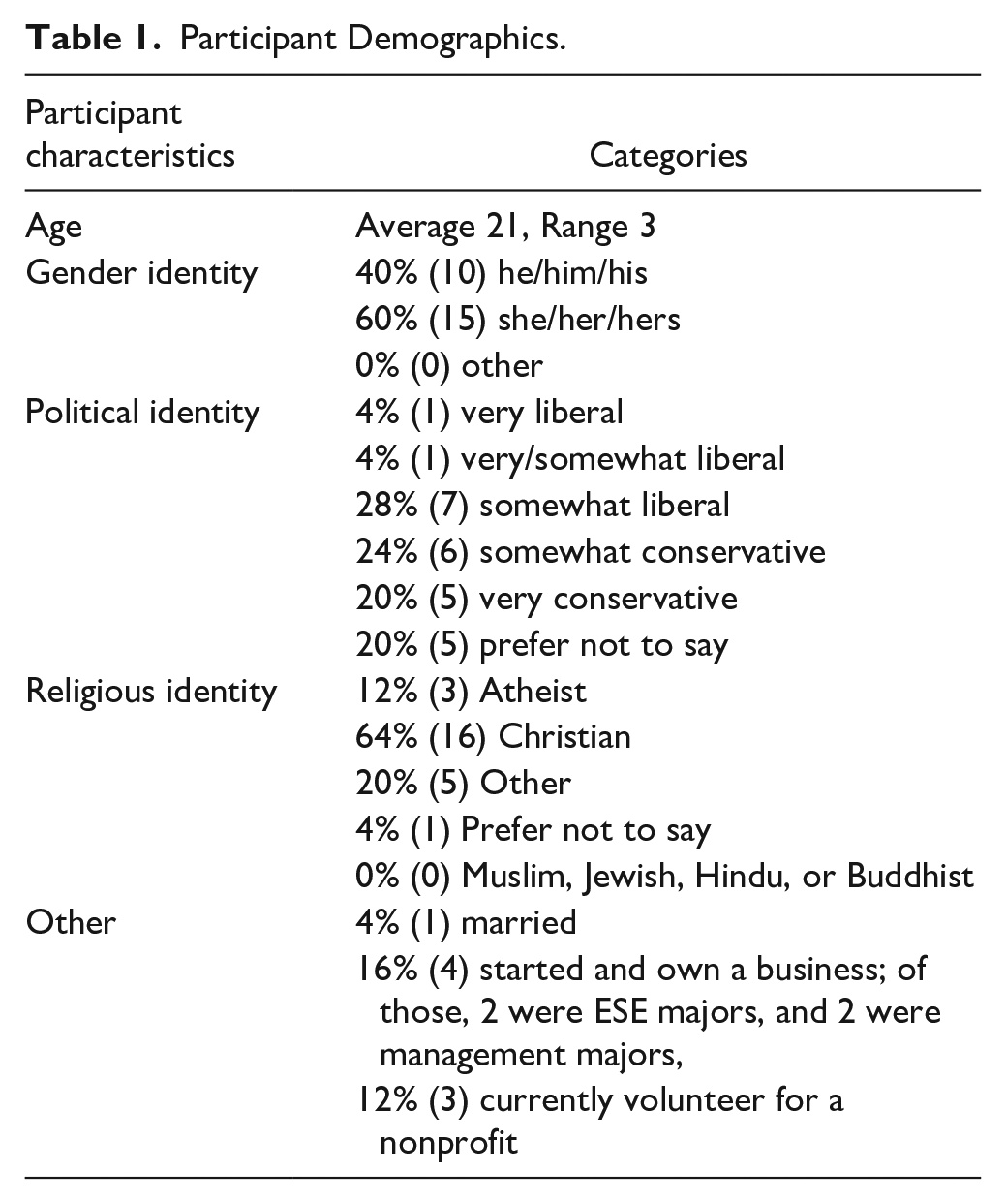
The learners also noted they receive their primary news information from social media, with 19 learners indicating they check social media daily. However, these sources of information could also impact their beliefs related to social issues. For example, concerns about fake news, echo chambers, and a lack of trust dominate conversations about social media (Dubois et al., 2020).
The Q Study
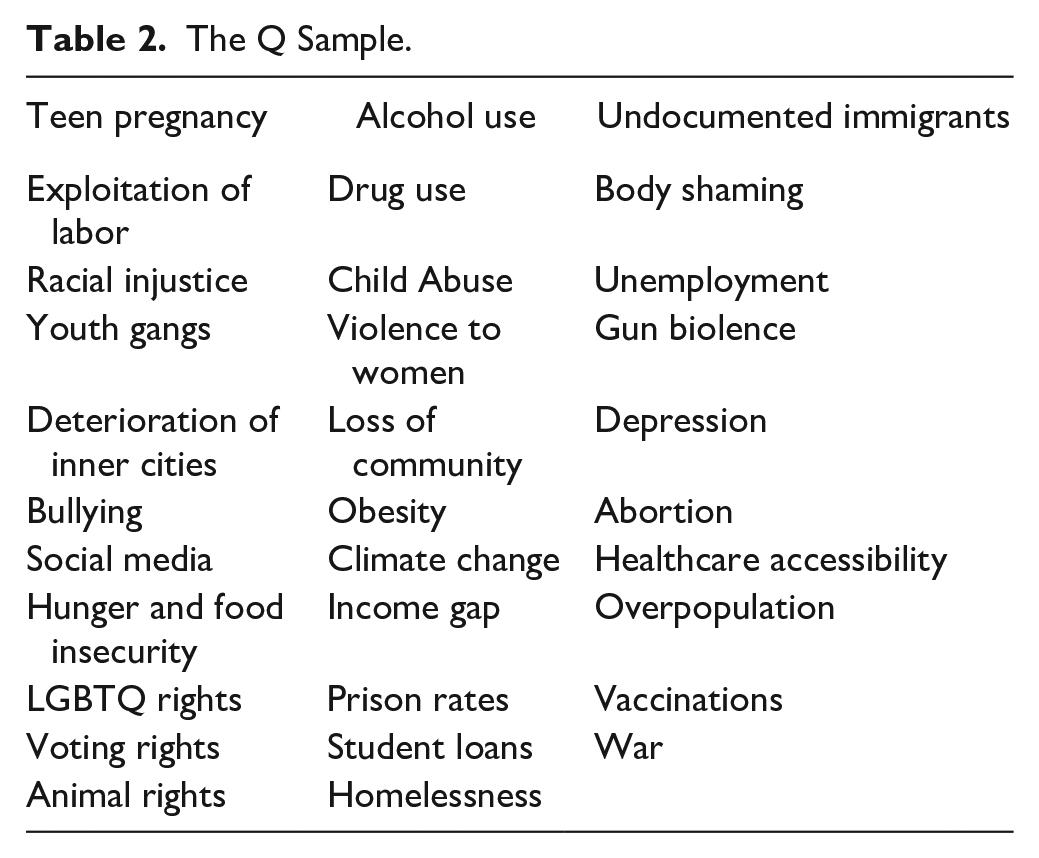
The set of potential social issues is called the concourse in Q Methodology. According to Stephenson (1978), “all subjective communication is reducible to concourses, whether in the sciences, the arts, or any other domain” (p. 24). The Q sample of statements is chosen from the larger concourse. The Q sample was developed in December 2021 by the professor of social work. She adjusted the exercise for this class by using a social problem ranking exercise from the Instructor's Manual of an older macro social work textbook (Brueggemann, 2006). A Google search of current social issues, newspaper topics, and current event searches helped narrow the list to 32 topics. The social issues topics were chosen based on continued relevancy, appearance in priority of the Google searches, news outlet topics, and repetition. Q Methodology requires the participant to rank the statements, the social issues in this research, in terms of their own and relative importance. The Q sample, is shown in Table 2.
The Q Sample.
The initial research question was intended to measure the effect of the macro social work lens in the first three weeks of class. However, the course participants ultimately sorted the Q sample three times throughout the semester, as instructed in Appendix B. The first Q sort, the pre-test, was administered on the first day of the class. On the second, third, and fourth days of class, the learners were exposed to intense social work concepts and problems, and the social work professor led the sessions. Then, the learners again sorted the Q sample during the fifth class period; only learners who attended the first and fifth days of class were included in the first study’s results.
Learning activities presented on days two through four included setting ground rules for difficult discussions, identifying key terms and definitions of terms, and participating in small and large group discussions. Materials that informed these class periods included the course-assigned textbook (Honeyman & Jana, 2019) and three specific episodes from a podcast (Halley et al., 2022). In addition, brief readings focused on basic social work concepts of defining social problems, the problem-centered approach to solving social problems, systems theory, and community practice (Tice et al., 2020). A full description of class days two through four can be found in Appendix C. Again, we had hoped this intensive introduction to social problems would affect learners’ understanding and valuation of social issues. Lastly, all learners, except one who was absent on the first day of class, completed the Q sort again during finals week. The last sort was the measure to determine if the overall course affected the learners’ perception of the importance of social issues.
The learners sorted the Q sample in the first and fifth class periods, resulting in two Q sorts per participant, a pre-and post-Q sort. A Q sort represents the statements as sorted by the participant. This sort represents the participant’s rank ordering of the social issues. Seventeen learners in the class completed the pre, and post-Q sort and only their sorts were included in the study. The 34 Q sorts, two per participant, were analyzed with PQ Method Release 2.35 software (The Qmethod Page, n.d.). Principal component factor analysis was conducted followed by a varimax rotation. The first eight factors were used as that is the maximum quantity of factors allowable in this software version (The Qmethod Page, n.d.).
Results
Q Study Results: Pre and Post Study During the First 3 Weeks
Results indicate that there was practically no shift in the factors between the pre-sort on the first day of the class and the post-sort on the fifth day of class. Thus, the results indicated that the learners did not shift their perception. We chose not to provide all the statistical information for the results of this research because there was no effect. Because there was no effect, we concluded at that time that the learners’ perception of important social issues was firmly entrenched. We then proceeded to create the course with the acceptance of this fact.
Q Study Results: Pre-Sort the First Day of Class Versus Post-Sort During Final Exams Week
The learners completed the Q sort again at the end of the semester. This sort was to determine how the course affected their perception of the importance of social issues.
The same method of used for the first analysis was again used to analyze the first day presort and final post sort. PQ method software rotates a maximum of eight factors. Eigenvalues of unrotated factors that exceed 1.0 are considered significant (McKeown & Thomas, 2013, p. 53). The eigenvalues for the first 14 unrotated factors ranged from 14.3354 for factor 1 to 1.7314 for factor 8; factor 14 was 1.0325, and 15 was .9916. The results did not include six additional factors (i.e., factors 9 through 14). The results proved interesting and meaningful, as shown in Table 3.
Pre and Post Sorts.
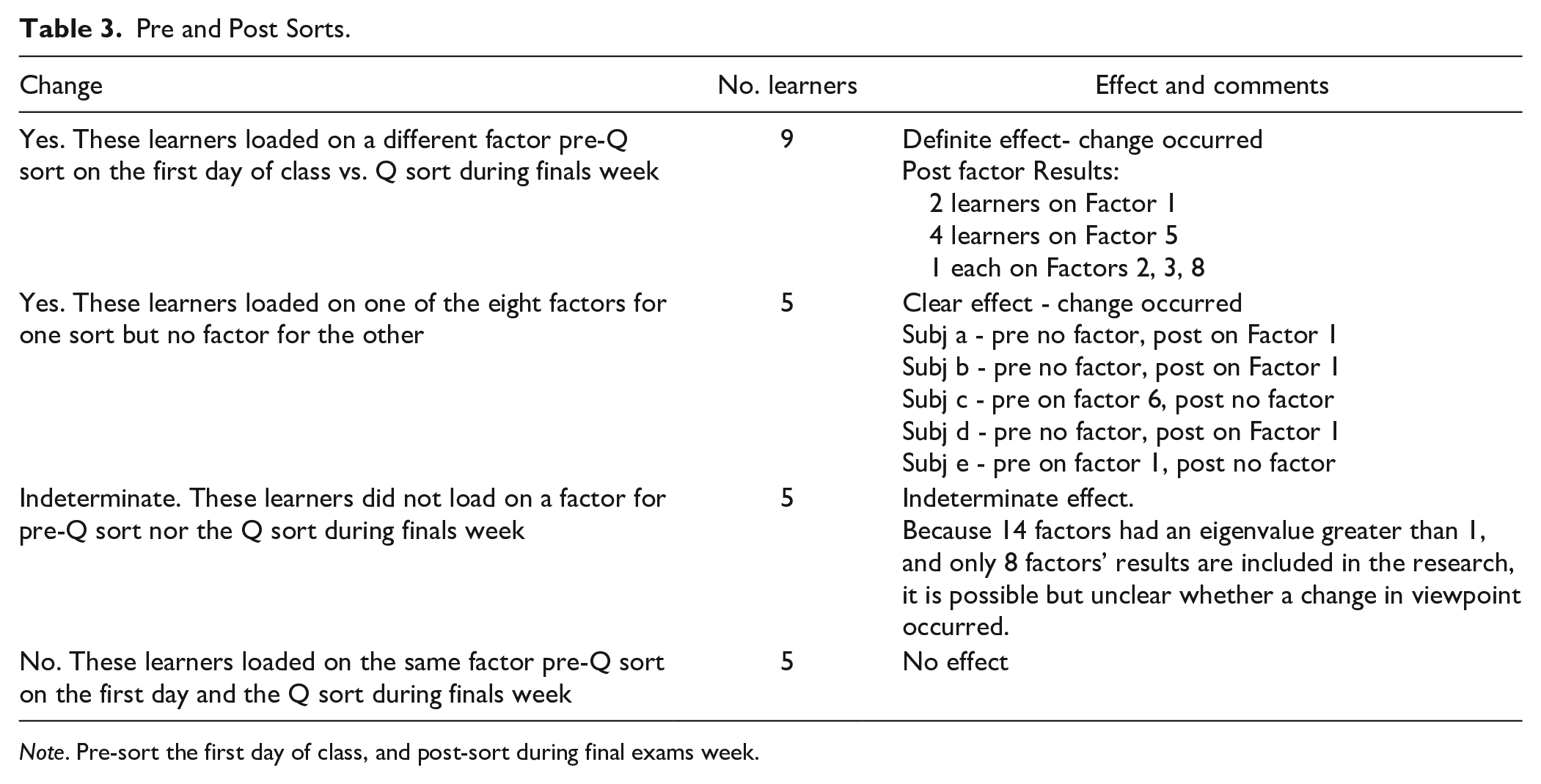
Note. Pre-sort the first day of class, and post-sort during final exams week.
Discussion
Smith and Woodworth (2012) proposed a framework to develop social entrepreneurs and innovators. The present study used several of the same mechanisms Smith and Woodworth (2012) used, as noted in Table 1 of their research (p. 394). However, our study differs because we included learner reflections in our pedagogy. Lastly, this study measures the effectiveness of the pedagogy via Q study, whereas Smith and Woodworth (2012) report via case studies of student work. Likewise, Howorth et al. (2012) guided social entrepreneurship education. Their frame of reference was a comparison of two different social entrepreneurship programs rather than a course-level analysis. Amongst their key principles for educators were focusing on the identities of social entrepreneurship as learners, designing for psychological safety, and a culture of reflective thinking (Howorth et al., 2012). Therefore, the current study used many of the principles recommended in both of these previous studies and provided the learners with plentiful examples of successful social entrepreneurship efforts to see that it is possible to create social change (Driver & Porter, 2012).
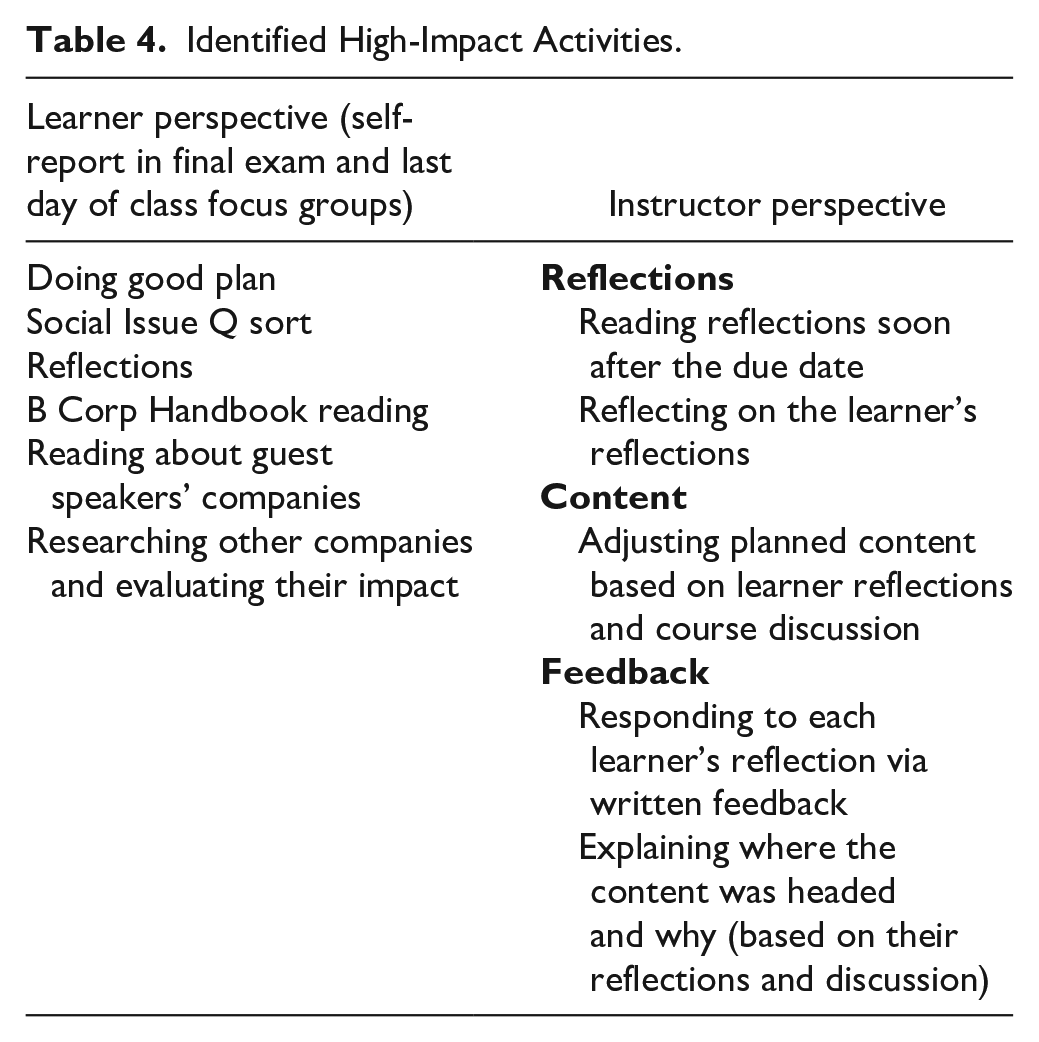
The initial Q sort in this study was evidence that simply learning about social issues was not enough to affect learners' previously held perceptions and beliefs. This outcome aligns with typical findings in HRD literature, which questions the efficacy of employee training. In addition, an array of literature questions whether simply making training available truly supports organizational learning (Chambers, 2016; Kreismann & Talaulicar, 2021; Lancaster & Milia, 2014). However, despite an initial failed attempt to affect the perception through intensive exploration of social issues, we reimagined our course, which ultimately showed an effect on 58% (14 of 24) of the learners’ perceptions of the importance of social issues. This effect was enacted through various active and passive learning components and utilized social interaction and holistic learning—the activities the learners and the instructors identified as most high-impact are shown in Table 4.
Identified High-Impact Activities.
Learner Perspective
Through learner self-reporting in an end-of-semester focus group and a reflection in the final exam, learners identified the aspects of the course they considered to have the highest impact on affecting their perception of social issues. The activities thought to be most high impact by the learners were active learning activities; active learning approaches require interaction between the learners and the subject matter (Kreismann & Talaulicar, 2021). For example, learners listed actively researching guest speaker organizations as high-impact, though they did not identify interacting with guest speakers as high-impact. Further, learners listed actively reading the required text material as high-impact, though they did not include attending lectures about the text material as high-impact.
Overwhelmingly, learners identified the “Doing Good Plan” as the most influential activity throughout the semester. These plans were created in the last few weeks of the semester. Specifically, teams were formed around a learner who was an “entrepreneurial anchor,” a learner who was enrolled or had been enrolled in a separate entrepreneurial business plan writing class. Thus, this anchor already had or was working on a business concept. Through the doing good plan activity, the learner teams identified a social issue that the anchor’s existing business plan could address and created a plan for addressing this social issue. The “Doing Good Plan” outline is in Appendix D. Except for the “relationship to the community” section, the learners themselves developed the outline in the class during a session they led 9 weeks into the semester.
The “Doing Good Plan” continued with the active learning approach, as learners not only identified ways to incorporate social responsibility into an existing business plan but also set implementation goals, timelines, and budgets. Learners also developed assessments to measure the social good's impact on the community and explore unintended consequences. In addition, this doing good plan incorporated social interaction and holistic learning. Social interaction has been identified as a learning strategy that can change learners’ perceptions and attitudes (Kreismann &Talaulicar, 2021). Importantly, this assignment also incorporated critical learning (Bierema & Callahan, 2014), as learners were required to work with classmates with diverse views and think critically about their assignments.
Critical learning was further achieved through written reflections and completing the Q sort. The learners identified both of these activities as having a high impact on their learning. While we intended for the written reflections to promote critical thinking in line with transformational learning principles (Merizow, 2009), we did not intend for the Q sort to be viewed by learners as a high-impact classroom activity. Instead, the Q sort was designed to be related to the present research. However, as the Q sort required learners to reflect on their values and ideas about social issues, and though different from writing written reflections, it had a similar impact. Reflection is continuously identified as an essential tenant of HRD training and adult learning (e.g., Bierema & Callahan, 2014; McGuire et al., 2005; Merizow, 2009; Quinn, 2018).
Instructor Perspective
Our learners regularly engage in reflection and reflective activities throughout their coursework. This element has been purposely scaffolded into our curriculum (Brandhorst et al., 2023). While reflecting upon the course, we also identified the learner reflections as the most impactful of all course activities. Reading our learners’ weekly self-reflection made it clear they had already felt the impact of many systemic societal circumstances. For example, in the third week, the self-reflection included questions related to the good our learners would like to do in their careers, the legacy/impact they would like to make, dream job/employer, entrepreneurial interest, and nonprofit interest. In some cases, the responses were heart-wrenching, but nearly every learner wanted to make an impact. Responses included mentoring young people and helping break negative systemic cycles related to family, drugs, violence, religion, poverty, and equity. In most cases, the learners indicated they had directly experienced or witnessed these issues.
We had an “aha” after reading these reflections. At the time, the first author wrote in her notes: As I was reading their self-reflections, I noticed that a lot of our learners have some interest in a nonprofit or addressing a social issue. But most think they’ll need a lot of money to address it. So, I have provided a list of readings for them of for-profits and not-for-profits that are addressing societal needs. I want them to see that sometimes it doesn’t take a lot of money to do good. If they don’t want to be an entrepreneur but they have strong interest in addressing social needs, they should consider that some employers match employee donations to not for profits or even pay employees to volunteer or donate the hourly wage of the employee to the nonprofit for which they volunteer.
Our preconceived notions were tossed out as we reflected on the learners' reflections. Our learners come from many different places: life experiences, socioeconomic backgrounds, health, race, ethnicity, and religion. Assigning reflections, taking the time to read them, and providing timely, meaningful feedback to each learner pushed us to think carefully each week. The learners did not necessarily need what we planned for them to receive. Providing written feedback every week to every learner and reminding them during class that there was feedback in the LMS grade book was an effort to ensure they felt heard, and their viewpoint was valued.
Implications
Much of what was learned in this study also echoes findings from earlier HRD literature. The first 3 weeks of the semester underscored the idea that the presence of short, intense training is not necessarily enough to engage in organizational learning (Chambers, 2016; Kreismann & Talaulicar, 2021; Lancaster & Milia, 2014). Although we included activities that required active learning and social interaction in class sessions two, three, and four, it simply did not accomplish the goal of changing learner perceptions of social issues. It is possible that the duration between the first two Q sorts was too short to provide the desired impact, a principle that has been explored in HRD training literature (Quinn, 2018).
Additionally, our study revealed that learners did not experience attending guest speakers or professor lectures as high impact components of their learning. Conversely, conducting independent research on the guest speakers and autonomous engagement with the course texts were identified by learners as high impact exercises. This finding is consistent with human resources literature which delineates between passive and active learning activities in the training environment (Kreismann & Talaulicar, 2021). A recent review of HRD training methods indicates that many HRD trainings rely upon the passive learning methods, such as speakers and lectures (B. O. Martin, 2014). Our study indicates that active learning tasks, such as simply reading text or conducting google searches, were more influential for learners than those passive strategies more commonly used in training environments.
Robust evaluative techniques are essential to detect impact and adjust training accordingly (Quinn, 2018). In our study, the Q sort provided what felt like disheartening information to us early in the class. While initially designed for research purposes, the Q sort ultimately served as a formative assessment tool that allowed us to measure the course material’s impact (or non-impact). Had we not issued the Q sort at this early stage in the semester, they may have been unaware of our lack of impact and would not have revised the course accordingly. This finding has implications for HRD professionals in administering training programs; instead of relying upon summative surveying to determine training effectiveness, other measures could be implemented early in the training process to check for effectiveness (Chambers, 2016).
Learner reflections are not just for learners. While reflection has been identified as a critical component of adult learning (e.g., Bierema & Callahan, 2014; McGuire et al., 2005; Merizow, 2009; Quinn, 2018), we used the learner reflections as an opportunity to shape the course via the needs of each learner. When the initial Q sort indicated no effect, we knew they would need to redesign much of the course they had planned. We utilized the course reflections for guidance on how to meet the learners and to provide the types of resources, readings, and assignments that would help the learners find personal value in the course material. Thus, the written reflections were not only an opportunity for the learners to reflect on their learning but also provided a symbiotic experience where we were learning from and modifying our course design based on the personal experiences shared in the reflections.
This reciprocation approach to learner feedback and providing individualized learning materials based on those reflections created a value-added experience for the learner. This approach to receiving learner feedback and changing course design accordingly speaks to the argument for returning to a humanistic approach in HRD (Bierema & Callahan, 2014; Byrd, 2017; McGuire et al., 2005). Although HRD professionals must design training that speaks to the organization's goals (Kreismann & Talaulicar, 2021), effective training must also respond to the needs and values of the learner. “Change is most effective when those affected have input into and involvement in the change” (Bierema & Callahan, 2014, p. 439). Developing training materials that respond to employees’ changing needs and knowledge allows for the level of input and involvement with learning that can only be achieved by considering the learners' reflexivity and processing of information.
Limitations and Directions for Future Research
We recognize that our participant sample may not be generalizable to all populations. A total of 45% of the learners at this university are first-generation college students. Our learners have experienced the results of social issues themselves or via close family and friends. It is unclear whether learners who have not had these experiences would have similar outcomes in the pre-post Q study.
Additionally, the learners in this study had self-selected to be business majors at a mid-sized Midwest public university. Their majors required the course. All learners who participated in the Q study had also taken our university's Integrative Business Experience (IBE) block of courses. This experience includes a for-profit entrepreneurial effort and a partnership with a nonprofit organization chosen by the learners, for which they complete a project and donate their profits. Learners in our management major are often deeply impacted by their IBE interactions with nonprofits and clients. Replicating this study with learners who had not had the intensive IBE experience could be a direction for future research.
Dees notes that a successful social entrepreneur requires a high degree of emotional intelligence and more than a token experience with a nonprofit (Worsham, 2012). As such, another area for future research is studying organizations that incentivize employees to volunteer to determine whether or not this volunteerism creates a more open mindset among employees to address and solve social issues. Do employees with volunteer opportunities via their employer have a different perception of social issues than those without?
Further, despite our documented success in using reflection as a learning tool, we understand that not all students find reflective practice beneficial. Reflective learning is only one of five learning styles learners embrace (Felder & Silverman, 1988). Learning styles can be categorized into four distinct categories: “reflectors” is listed as a distinct learner category (Honey & Mumford, 1992). Recent literature (Stevenson & Dalasio, 2020) examines the modifications that can be made to transformative learning practices to be inclusive of students who possess neurodiversity. This study could be replicated to explore the use of reflection for students with distinct learning style preferences or who identify as neurodiverse.
Finally, from our perspective, a strength of this study is that the course was not politicized. Government policy was not discussed. A variety of viewpoints were often expressed during discussions of social issues. This experience and non-political environment can easily translate to the workplace and is an opportunity for future research. Are employees who are presented with multiple viewpoints and reflective opportunities more likely to change their perceptions? If perceptions do not change because of the reflexive process used in the course, would evidence, such as the focus group and final reflection, etc., show that the process strengthened the perceptions? Why do some people change their perception and others do not?
We believe this research shows a methodology that is not discipline specific. As a future research opportunity, this pedagogical approach and research methodology would be useful in nearly any discipline with regard to creating awareness of social issues and facilitating social movement learning, improving social consciousness, fostering social responsibility, and creating awareness of the importance of social issues.
Conclusion
Through active learning and critical learning techniques, learners experienced the course as high impact. While a few days of content did not have the impact we expected, an entire semester did. By using learner reflections throughout the semester as a reciprocal and symbiotic tool, we could begin the change process by unfreezing the views of our learners, priming them to engage in additional societal change.
The social entrepreneurship literature contains contradictory definitions and intended scale and scope. While we had stated learning objectives (Appendix A), after the first 3 weeks, we determined that we would focus on broadening the learners’ understanding of and ability to evaluate social issues and the different ways and scales at which they can be addressed. While there is a place for systemic equilibrium-changing social entrepreneurs, presenting that as the sole definition can be intimidating, as several learners noted in their reflections. We provided examples of social entrepreneurs, B corps, activist businesses (e.g., Ben & Jerry’s, Patagonia). “The UN Global Compact asks companies to first do business responsibly and then pursue opportunities to solve societal challenges to business innovation and collaboration” (All companies can play a role, n.d., para. 1). This view is shared by many of the authors and organizations attempting to define social entrepreneurship, including the World Economic Forum, the UN Global Compact, B Lab, and others. Our learners learned about both big and small impacts. While we acknowledge that we need a coordinated global approach to save our people and planet, even operating a business as a force for good has a ripple effect.
We now realize that our learners needed more than just a few sessions of macro-social work content to affect their perception of social issues. They required a deep dive into socially responsible business practices to change their views of the importance of social issues. This realization, however, was not the only takeaway. We initially thought we could go in, assess them about the social issues, and somehow quickly make a significant impact and affect their perception. Instead, we found that the three class periods focused on social issues, and macro-social work didn't affect their perception. However, the dialogue about and self-exploration of the social issues contributed to the effect. In HRD, how does this apply in the workplace? There needs to be active work and deep work. One lesson is to see what the employees (or learners) need via listening—and making them feel heard so they keep talking. To bring people in, listen, hear them, and adjust your system.
In conclusion, Dees said in an interview with Worsham (2012, p. 450), I don't think our job is to produce students who immediately launch social ventures upon graduation. That may happen, but if it does, it will be the exception… [such as] helping social entrepreneurs build their ventures into something with greater impact… [it is] more about equipping our students with the tools to be effective in any entrepreneurial social problem-solving activity they might engage.
Similarly, it is our hope that employing the techniques revealed in this study, HRD professionals can aid employees in shifting their perceptions of social issues to fully embrace the societal missions of their organizations.
Footnotes
Appendix A
Appendix B
Appendix C
Appendix D
Declaration of Conflicting Interests
The author(s) declared no potential conflicts of interest with respect to the research, authorship, and/or publication of this article.
Funding
The author(s) received no financial support for the research, authorship, and/or publication of this article.