




Abstract
The purpose of this study is to investigate the effect of biocapacity and institutional quality on inclusive human development in Sub-Saharan Africa. The positioning is motivated by the relevance of complementing the extant literature with an alternative indicator of environmental sustainability. Using system-Generalized Method of Moments (GMM) on a sample of 39 countries, it is found that institutional quality increases inclusive human development and all its components. It is also established that biocapacity positively affects inclusive human development and the underlying positive effect is driven by the inclusive health component of inclusive human development and not by the inclusive education and inclusive income components of inclusive human development. A keen follow-up of environmental laws is a safe path for inclusive human development in Sub-Saharan Africa. Other policy implications are discussed to further enhance the relevance of the findings.
Introduction
This study examines the effects of institutional quality and biocapacity on inclusive human development (IHD) in Sub-Saharan Africa. 1 The prerequisite for inclusive and sustainable development lies in a country’s ability to sustain high levels of economic growth and development over a long period of time while ensuring that everyone contributes to and benefits from the fruits of economic growth and development (Ndikumana 2013). The trend of economic growth and development in Sub-Saharan Africa over the past years has been disappointing. Instead of growing rapidly to catch up with the developed countries, growth has been inadequate to generate a meaningful reduction in poverty (Acheampong, Dzator, and Savage 2021). Seeing that the adoption of technology is cheaper/easier than the invention of technology, African countries are supposed to grow speedily. This is because Africa’s economic growth largely depends on technology adoption thereby aiding them to evade the high costs associated with developing and testing new technology (Juma 2011). Moreover, beyond technology adoption, the development of the continent should also hinge on technology development so that the continent should not subordinate to the global North (Tchamyou 2017).
The effect of institutional quality on economic growth has been well explored in extant literature. Various researchers have yielded varying results using different estimation techniques and from different empirical settings (Zakaria and Bibi 2019; Zall’e 2019). Despite the sustained increase in Africa’s economic growth, Tchamyou (2021) suggest that there is an unequal distribution of the fruits of economic growth in the continent, which remains a challenge among various African countries. This is in line with Ravallion’s (2014) argument that growth has significantly reduced the incidents of poverty but in a more unequal manner.
A critical problem in less-developed countries is the issue of widening and persistent inequality and poverty where economic growth is associated only with the actions of a few. The distributions of the benefits of economic growth have also been limited to a small proportion of the society (Raji 2021) which makes development not to be inclusive. Development is said to be inclusive when the growth process is accompanied by an even distribution of the fruits of economic development including benefits by the most marginalized segment of the society (Berg and Ostry 2011). Inclusive development suggests that the poor should not only benefit from the fruits of economic growth, but they should as well participate in the economic growth process as it traces the importance of equal access to economic opportunities by everyone and the absence of gender inequality (Sen, 2008; Nginyu et al., 2024).
The question of why some countries are developing faster than others has remained an important question in the economic development literature to date. Among other factors, the reason for development differentials between nations are differences in the quality of institutional factors as well as the manner in which the fruits of the economic growth process are distributed (Fonchamnyo et al. 2023; Olanrewaju, Tella, and Adesoye 2019). It has been argued that the economic development differentials between the less-developed and the developed countries are due to differences in institutional quality as it affects the growth process as well as the inclusiveness in the distribution of the fruits of economic development (Olanrewaju et al. 2019).
Traditionally, institutional roles are aimed at formulating and implementing sound policies for broad-based (inclusive) employment, productivity, and economic development. The effectiveness of every economy in successfully achieving its growth process depends on the quality of its institutions. Therefore, prioritizing the quality of institutions is a pivot upon which other drivers of inclusive development rely in order to attain socio-economic prosperity, targets like poverty reduction, among others (Olanrewaju et al. 2019). Nevertheless, improving the quality of institutions still remains a critical issue for inclusive growth in Sub-Saharan Africa (Nginyu et al., 2024).
Despite the growing empirical research on the effect of institutional quality on economic growth and development, the literature fails to substantially focus on the effect of institutional quality on IHD. In this study, the inequality-adjusted Human Development Index (HDI) is used to measure IHD (Nchofoung et al. 2022). IHD is a multidimensional concept, which cannot be holistically measured. According to United Nations Development Program (UNDP 1990) as well as extant contemporary literature (Asongu and Odhiambo 2020b), human development is concerned with improvement in the well-being of people and not just the wealth of the economy in which they live. It focuses on people, their opportunities and choices.
Over the recent decades, global warming and climate change have risen as some global challenges are widely attributed to greenhouse gas emissions. Despite the remarkable significant economic growth expedition in Africa over the past years, the continent has also been trapped in a high level of environmental degradation (Asongu and Odhiambo 2020b). Environmental degradation has become a severe threat to the natural habitat of humanity and other species on earth (Hunjra et al. 2020). Environmental degradation therefore remains a threat to humanity in the Sub-Sahara African region like other regions of the world.
Even though the effect of environmental degradation on well-being has been exploited by many authors, the main measure of environmental degradation used in the literature is inappropriate as it focuses mainly on-air pollution. Air pollution is not the only indicator of environmental degradation (Abid 2016; Adebayo 2023; H. S. Ali et al. 2019; Hunjra et al. 2020; Sarkodie and Adams 2018).
In the light of the above, air pollution is a determinant of environmental degradation and not a measure of environmental degradation. There are other causes of environmental degradation like deforestation and land and water pollution. Therefore, considering just air pollution as a measure of environmental degradation is inappropriate (Al-Mulali et al. 2015). This explains why a more comprehensive measure of environmental quality can be used, namely: the ecological footprint and biocapacity. According to the Global Footprint Network (2017), it measures the ecological assets that a given population requires to produce the natural resources it consumes and to absorb its waste, especially carbon emissions. Environmental biocapacity of an ecosystem on the other hand is an estimate of the total productivity of the natural resources as well as its absorption and filtering capacity of other materials like carbon dioxide (Yue et al. 2013).
Based on the foregoing studies, this study has as objective to empirically examine the possibility of improving IHD in Sub-Saharan Africa through increased biocapacity and institutional quality. The novelty of this study is twofold. First, the use of the inequality-adjusted human development as a measure of IHD. Most of the existing studies on inclusive development have considered only the income dimension of well-being (Adedoyin et al. 2020; M. U. Ali et al. 2021; Shahbaz et al. 2021), while those that considered the multidimensional aspect of well-being do not take into consideration the issue of inequality among the members of the society (Omri and Belaid 2021; Sayer and Campbell 2002). This, therefore, explains the reason for using the inequality-adjusted human development as a measure of IHD. Second, the study uses the novel biocapacity which is a more comprehensive measure of environmental sustainability. While climate change and pollution are important, this study aims to complement the extant literature by focusing on an alternative indicator of environmental sustainability. Accordingly, to the best of knowledge, the nexus between biocapacity and inclusive development is sparse in the extant literature. Biocapacity as understood in this study refers to the amount of the planet’s regeneration, which entails how many resources are renewed as well as how much waste can be absorbed by the planet (Hassan et al. 2019).
In the light of the above, the main research question considered in this study is the following: how do biocapacity and institutional quality affect IHD in Sub-Saharan Africa? The rest of the study is structured as follows. A literature review on the extant contemporary and non-contemporary studies on the subject is covered in Section 2 while, the data and methodology are discussed in Section 3. The empirical results and corresponding robustness checks are presented and discussed in Section 4. Section 5 concludes with implications, limitations, and future research directions.
Literature Review
The literature has documented many definitions of institutional quality (Dixit 2009; Fukuyama 2013; Tusalem 2015). Institutional quality which is used synonymously with governance in this study is the structure and functionality of the social and legal roles that regulate economic activity in a way that enforces contracts and protects property rights (Dixit 2009). According to Nurkse (1953), it is the vicious cycle of poverty that is accountable for the backwardness of least developed countries (LDCs). According to him, there is a circular pattern of forces tending to act and react in such a manner that keeps the LDCs in a state of poverty as the process of capital formation remains restricted and obstructed. For a country to get out of this poverty trap, the country needs radical policies, which can be best done through institutional arrangement. More so, the public choice theory developed by Stigler (1971) and Peltzman (1976), which focuses on the aggregation of an individual interest’s welfare to be more inclusive, is cantered on achieving inclusive development through good and quality institutions (Buchanan 1990; Tullock 2008). Yinusa, Aworinde, and Odusanya (2020) established from an asymmetric co-integration approach that, institutional quality improves inclusive growth in Nigeria over the period 1984 to 2017.
Diler (2021) analyzed the effect of information and communication technology (ICT) on IHD in Turkey’s economy. The study employed annual data over the period 1990 to 2019. The autoregressive distributed lag (ARDL) model was used after investigating the stationarity of variables and co-integration between variables. The Toda-Yamamoto causality test was also used to find the causal direction between variables. The result revealed that information and communication technologies, foreign direct investment, foreign aid, and domestic credit impact the IHD in Turkey.
Yinusa et al. (2020) studied nexuses between financial development, institutional quality, and inclusive growth in Nigeria over the period 1984 to 2017. The study made use of an asymmetric co-integration approach to investigate the long-run relationship between institutional quality, financial development, and inclusive growth in Nigeria. Their results revealed that there is a long-run relationship between financial development, institutional quality, and inclusive growth in the country. It was also found that in adjustment processes to equilibrium for institutional quality, financial development, and inclusive growth were asymmetric in Nigeria, and therefore, financial development and institutional quality are important variables that influence inclusive growth in the country.
Munir and Fatima (2020) investigated the effectiveness of foreign direct investment as a means of financing inclusive growth. The study also investigated how the effectiveness of foreign direct investment varies across countries with differing levels of institutional quality. An indicator for inclusive growth was also constructed using the social opportunity function while that of institutional quality was constructed using principal component analysis (PCA) with data from the World Development Indicators (WDIs) and World Governance Indicators (WGIs), respectively. The study employed a panel of 86 countries and divided them into three clusters based on the ranking of their institutional quality. Using the Hausman specification test, the fixed-effects estimates were preferred over the random effects estimates. Their results showed that foreign direct investment plays a vital role in improving inclusive growth, particularly in countries with low and medium levels of institutional quality.
Asongu, Le Roux, and Biekpe (2017) investigated the effect of ICT in complementing carbon dioxide (CO2) emissions to affect IHD in 44 Sub-Saharan African countries from the year 2000 to 2012. ICT was measured by mobile phone penetration and internet penetration. Based on a system-GMM (generalized method of moments), the results revealed that ICT reduces the potentially negative effect of environmental pollution on IHD.
Ntow-Gyamfi et al. (2020) examined the influence of financial development on inclusive growth taking into consideration the moderation effect of institutions and the regulatory effect in redistributing the gains of financial development to also benefit the poor. Inclusive growth was measured using a social mobility function and an inclusive growth index was also constructed using the Asian Development Bank’s framework of inclusive growth for robustness. Based on a panel of 48 African countries, the findings revealed that there is a non-linear relationship between finance and inclusive growth. Their results also reveal that for financial development to improve inclusive growth, there is a need for an effective institutional setup to regulate financial market participants.
Based on the existing studies, the relationship between IHD and institutional quality has not been well exploited. While most of the studies have focused on the relationship between institutional quality and inclusive growth (Munir and Fatima 2020; Ntow-Gyamfi et al. 2020; Yinusa et al. 2020), the effect of institutional quality is sparse. Although some authors like Asongu et al. (2017) have examined the role of institutional quality in complementing the effect of ICT on IHD, the direct effect of institutional quality has not been well exploited. Owing to lack of data on environmental quality, air polution has been the main indicator of environment quality. In this context, biocapacity, which is a more comprehensive indicator of environmental sustainability (Galli et al. 2020; Hassan et al. 2019), will be used in this study. Biocapacity is the amount of natural resources available at a specific moment in a particular place. Therefore, biocapacity is an important indicator of environmental sustainability.
As articulated in the introduction, this study therefore contributes to the literature by assessing the effect of institutional quality and biocapacity on IHD. It also employs the novel biocapacity indicator to measure environmental sustainability.
Data and Model Specification
Data
The scope of this study is limited to 39 Sub-Saharan African countries from 2010 to 2017. The list of countries is presented in Appendix. The sample size of the study is limited by data availability. The reasons for choosing Sub-Saharan Africa are because: (a) the region happens to be the least in the global HDI rankings and (b) the region also has the highest prevalence of inequality and poverty (Raheem, Isah, and Adedeji 2016). In summary, the choice of the sample and periodicity is simply contingent on data availability at the time of the study.
To investigate the effect of biocapacity and institutional quality on IHD, the dependent variable, IHD is measured using the inequality-adjusted HDI which is being controlled for by its three dimensions: the inequality-adjusted income (standards of living) index, long life expectancy (health) inequality-adjusted index and the knowledge (educational) inequality-adjusted index in conformity with the literature on IHD (Permanyer 2013). Environmental degradation has been confirmed by the recent literature to be involved in IHD (Asongu and Odhiambo 2019; Nchofoung et al. 2022). Biocapacity is measured using the novel ecological biocapacity, measured in global hectares per capita in line with recent literature (Hassan et al. 2019). The six dimensions of institutional quality of the WGIs of the World Bank were used as indicators of institutional quality (Tchamyou 2021). The inclusion of institutional quality as a determinant of IHD is based on the existing literature which found that institutional quality increases IHD (Asongu and Nwachukwu 2016; Asongu and Odhiambo 2020b).
The institutional quality index is constructed using the PCA method based on the six dimensions of governance. The variable trade openness is measured by the sum of imports and exports of goods and services as percentage of gross domestic product (GDP), and foreign direct investment is the net inflows of investment into an economy measured as percentage of GDP. The choice of these variables to proxy for trade openness and financial openness and their inclusion as a determinant of IHD is in line with contemporary literature (Asongu and Nwachukwu 2018; Stylianou, Nasir, and Waqas 2023). Official Development Assistance (ODA) is loans and grants given to a country measured as a percentage of GDP. Its inclusion is justified by the apparent development literature as development assistance has been found to affect IHD (Asongu and Nnanna 2019; Asongu and Nwachukwu 2018; Asongu and Odhiambo 2020a).
Data for this study are from four sources: (a) the inequality-adjusted HDI which is the dependent variable is from the UNDP (Nchofoung et al. 2022), (2) ecological biocapacity is from the Global Footprint Network (2017), (c) the institutional quality variables consistent with Kaufmann, Kraay, and Mastruzzi (2010) are obtained from the WGIs of The World Bank (2022), and (d) the remaining variables are from the WDI of The World Bank (2022). Table 1 presents the descriptive statistics of the variables used in the study. The panel is unbalanced as some observations are less than 312. It is relevant to note that the inequality-adjusted HDI, as employed in this study, while valid, cannot comprehensively measure human development, not least, because human development is also based on factors that are difficult to measure such as happiness, state of mind, inter alia (Alaimo and Seri 2024; Telleria 2023).
Descriptive Statistics.

Source: constructed by authors from secondary data (2023).
Obs = number of observations and Std. Dev = standard deviation.
Table 2 presents the pairwise correlation between the variables. The dependent variable, or inequality-adjusted HDI and its three dimensions are not very correlated while the three dimensions of the dependent variable are highly correlated. It is also found that the different dimensions of institutional quality which are highly correlated among themselves cannot be used in the same regression as it will cause multicollinearity. The institutional quality variables will therefore be used to construct and institutional quality index. Nevertheless, with the exception of the components of the HDI and governance variables, the other independent variables are not highly correlated. Accordingly, the components of the HDI and governance variables that are highly correlated are employed in distinct specifications to avoid the potential concern of multicollinearity.
Pairwise Correlations.

Source: constructed by authors from secondary data (2023).
Model Specification
This study investigates the effect of institutional quality on IHD. Tobin’s (1955) dynamic aggregative production function highlights the role of resources in the growth process. More so, the public choice theory highlights’ the importance of regulating economic activities. The Nurkses’ (1953) theory of the vicious circle of poverty is well traced on the importance of good institutions so as to remove a society from the vicious circle of poverty. The analytical framework of this study is based on a model in which IHD is the dependent variable while institutional quality is the main independent variable among a series of control variables in line with the work of Asongu and Odhiambo (2020b) as specified in equation 1 below.

where IHDI = inclusive human development, BC = biocapacity (environmental sustainability), IQ = institutional quality index, TD = trade openness, FI = foreign direct investment and DA = Official Development Assistance (ODA). Econometrically, the model can be specified as follows:

where εit is the error term and αi are parameters to be estimated i = 1, 2,. . ., N and t = 1, 2,. . ., T.
To estimate the aforementioned model, the system-GMM estimation technique was employed. The motivation for using a system-GMM is found by Arellano and Bond (1991), Blundell and Bond (1998) and later in Levine, Loayza, and Beck (2000) who provided the rationality for using the GMM to study the relationship between variables. GMM adjusts simultaneity not only at the level of the other explanatory variables but also of the dependent variable by the use of a series of instrumental variables generated by the lag of the endogenous variables. Accordingly, estimated results under the static panel models such as fixed effects, pooled ordinary least squares (OLS), and random effects may lead to biased results in the presence of endogeneity caused by potential simultaneity of explanatory variables (Ibrahim 2014).
The choice of the GMM technique is motivated by the fact that the behavior of the outcome variable or IHD is consistent with the technique, especially as it pertains to the corresponding variable exhibiting persistence. In essence, when the outcome variable is persistent, the GMM approach is appropriate (Tchamyou 2019). In the study, the persistence of the outcome is apparent from two main perspectives: (a) before estimation, the correlation between the level series and first lag of the outcome variable is higher than 0.800 and (b) post-estimation, the estimated lagged value of the outcome variable is higher than the rule of thumb of 0.800, for the most part (Tchamyou, Erreygers, and Cassimon 2019). It is also worthwhile to note that the Tobit model can also be adopted for the study because the outcome variable has a limited range (Nchofoung, Achuo, and Asongu 2021). However, comparatively, the GMM technique is better because it addresses concerns linked to endogeneity that are not properly handled by the Tobit regressions technique, especially as it pertains to accounting for the unobserved heterogeneity and time-fixed effects (Nchofoung, Asongu, and Tchamyou 2024).
From the model specified above, let us consider an autoregressive panel data model of the form,

where
There are numerous methods of dynamic panel estimation among which we have GMM. The GMM estimator has several advantages because it is robust to model misspecification since its derivation does not require any particular distributional assumptions on the residuals. It is closer to the theoretical relation because this estimator is chosen so as to minimize the weighted distance between the theoretical values and the observed values. Consistent with Arellano and Bond (1991), the first difference-GMM involves taking for each period, the first difference of the equation to remove the individuals’ specific effects.

The system GMM estimator by Blundell and Bond (1998) combines the first difference equations with the level equations. The system GMM has been found to be more robust than the difference GMM.
The instruments in the equation in first differences are expressed in level, and vice versa. We are going to apply the two GMMs to better understand the results of our study since the result of an estimation can change with respect to estimation method used. The GMM estimator has several advantages because it is robust to model misspecification since its derivation does not require any particular distributional assumptions on the residuals. It is closer to the theoretical relation because this estimator is chosen so as to minimize the weighted distance between the theoretical values and the observed values. The over identifying restriction test does not check the validity of instruments but rather it checks whether all instruments identify the same set of parameters. If the probability is not significant, it implies the instruments are valid, where (null hypothesis) H0 supports the perspective that instruments are valid while H1 (alternative hypothesis) supports the view that instruments are not valid. To proceed to the interpretation of the result of GMM estimation, the instrument used needs to be valid.
After taking into consideration the advantages of panel data as outlined by Baltagi (2013), it will be important to look at the nature of the panel whether it is homogenous or heterogenous before running the regression results. Standard panel linear regression models like random effects and fixed-effects models are based on the assumptions that the parameters of interest are homogenous across panel. This therefore ignores the slope heterogeneity that usually exists across panels which might bias the results. Even if there exist slope homogeneity across the panel, it is important to verify this empirical question before any panel analysis to avoid any biased results. A probability to the test for slope homogeneity across the panel is to apply the F test on the differences of a squared residual from a cross-sectional unit-specific OLS regression and a pooled OLS (Baltagi 2013).
Results and Discussion
Descriptive Statistics
Before the analysis proper, it is important to investigate the specification of our panel model, that is, if the model employed portrays homogenous or heterogeneity slopes across panels.
From Table 3 above, we can conclude that the slope coefficients are not homogenous across the panel as they vary across the different countries included in the panel. Therefore, it is important to do a panel analysis.
Testing for Slope Heterogeneity.

Source: constructed by authors from secondary data (2023).
Correlation Analysis
Furthermore, Figure 1 below shows the relationship between institutional quality and IHD in Sub-Saharan Africa. The figure is divided into four correlations, for the whole sample, low-income countries, lower-middle-income countries, and finally, for the upper-middle-income countries. For the whole sample, correlations suggest that there is a positive relationship between institutional quality and IHD. This shows that at higher levels of institutional quality, more IHD is also apparent. This relationship is found to be consistent in the low-income countries and the upper middle-income countries while in the lower middle-income countries, there seem to be no relationship. Nevertheless, it can be said that, countries with high institutional quality have higher levels of IHD in Sub-Saharan Africa.
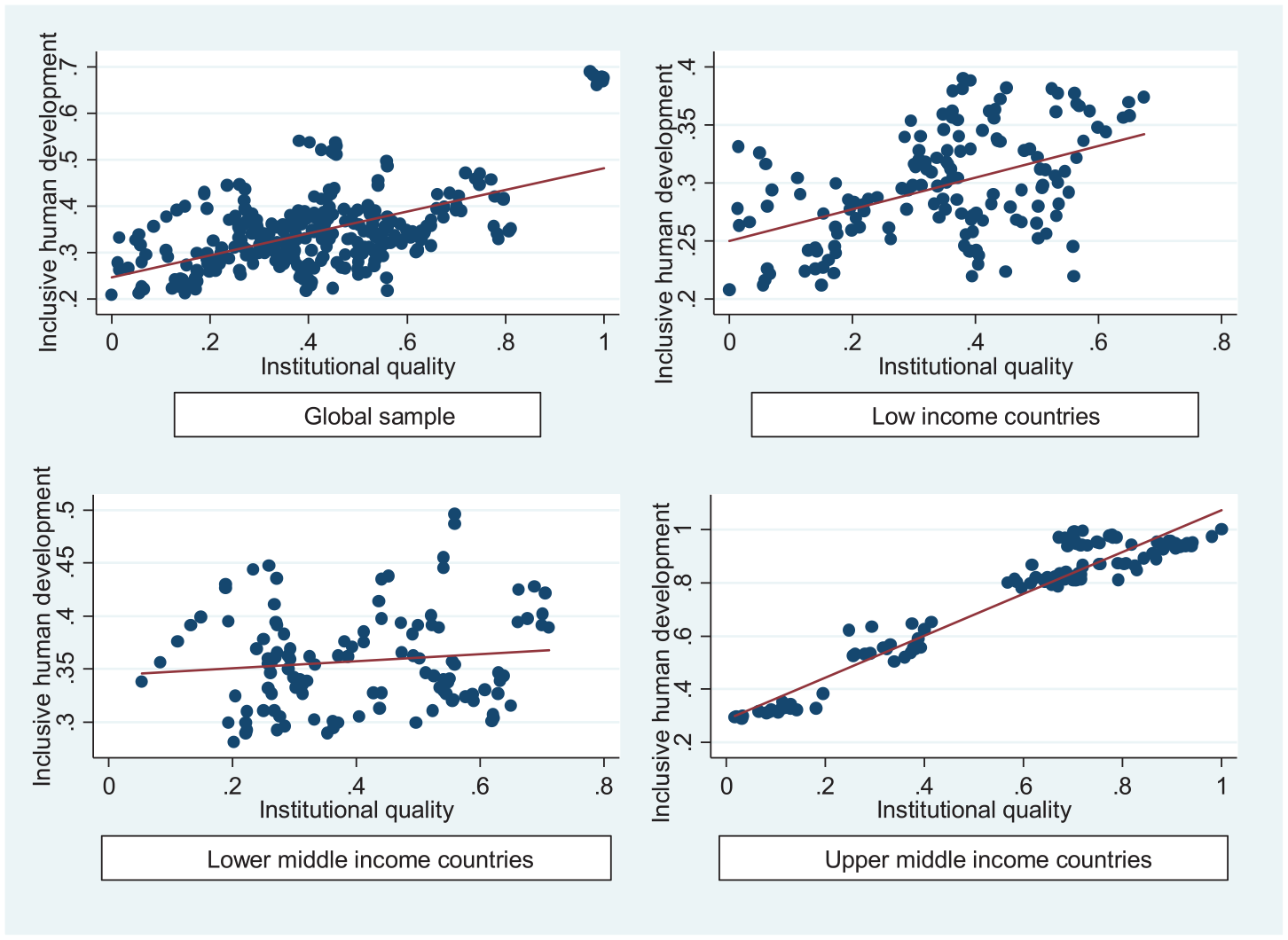
The link between institutional quality and inclusive human development.
In addition, Figure 2 also shows the relationship between environmental sustainability and IHD in Sub-Saharan Africa. The correlation is also divided into four components, for the whole sample, low-income countries, lower middle-income countries and finally, for the upper-middle-income countries. For the whole sample, the correlation suggests that there is a positive relationship between environmental sustainability and IHD. This shows that at higher levels of environmental sustainability, the level of IHD is also high.
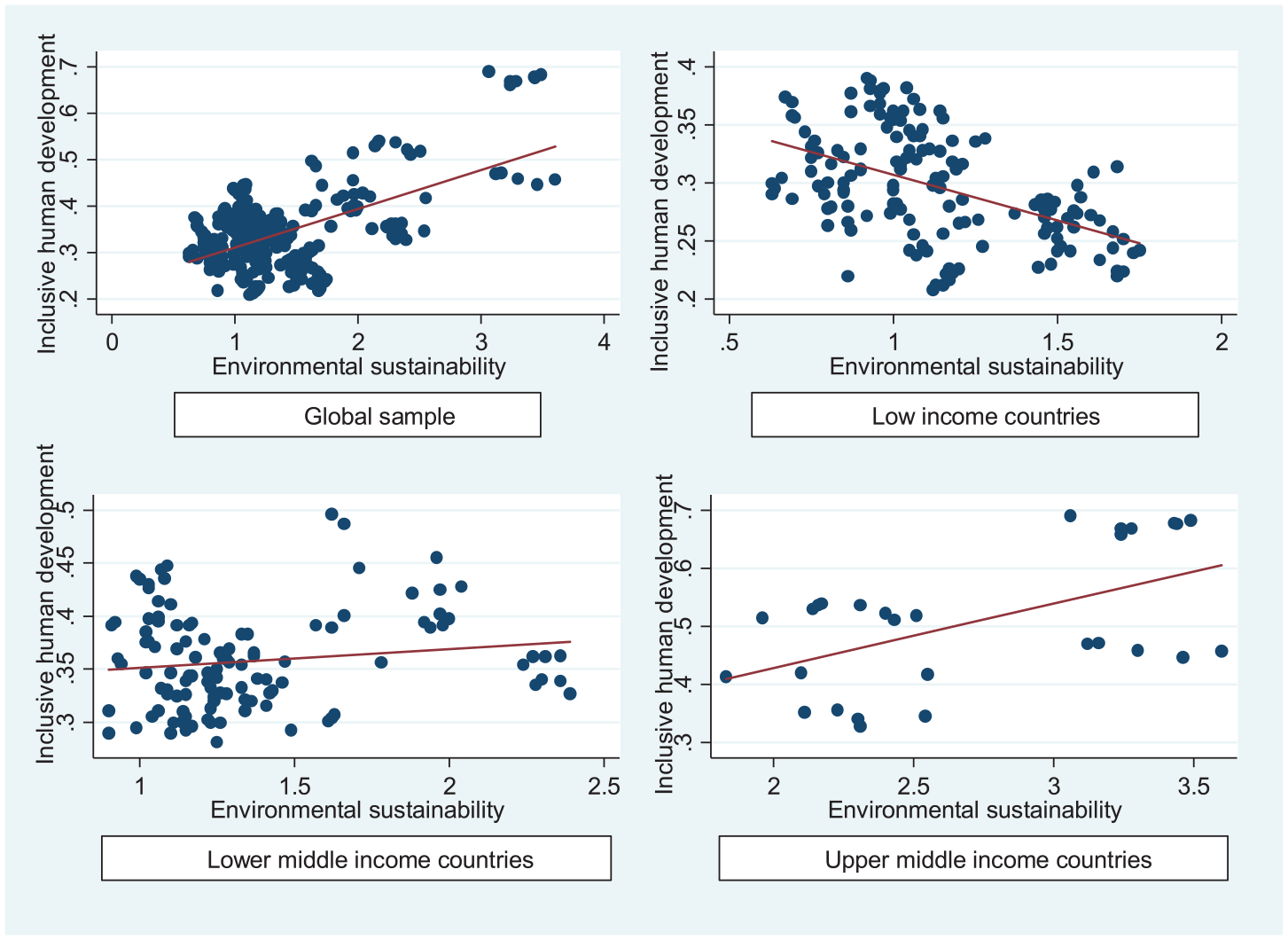
The relationship between environmental sustainability and inclusive human development.
This relationship is found to vary across different income groups. In the low-income countries, the relationship between environmental sustainability and IHD is negative. In the lower-middle-income countries, there is no relationship between environmental sustainability and IHD. On the contrary, in the upper-middle-income countries, the relationship between environmental sustainability and IHD turns to be positive.
Baseline Results
Table 4 below presents the empirical results of the effect of institutional quality and biocapacity on IHD. Column 1 of Table 3 presents the baseline model of the effect of institutional quality and biocapacity on IHD after which the different dimensions that were used to construct the institutional quality index are added alternatively to see the robustness of our results. These variables are alternatively added to also get more insights into the effect of institutional quality on IHD and to avoid multicollinearity because they are highly correlated among themselves.
The Effects of Institutional Quality and Biocapacity on Inclusive Human Development in SSA.

Standard errors of the estimated coefficients in parentheses, the p values of all the tests are in square brackets, *, **, ***: significance levels of 10%, 5%, and 1%, respectively. OIR: Over-identifying Restrictions, AR (1) = autocorrelation of order 1 and AR (2): autocorrelation of order 2. The significance of bold values is twofold. (1) The significance of estimated coefficients and the Fisher statistics. (2) The failure to reject the null hypotheses of: (a) no autocorrelation in the AR (1) and AR (2) tests and; (b) the validity of the instruments in the Sargan and Hansen OIR tests. Constants are included in all regressions.
Source: constructed by authors from secondary data (2023).
From the results of the Arellano-Bond test for Autocorrelation of residuals and the Hansen and Sargan tests of over-identification restrictions above, we found that; there is an absence of autocorrelation of order 1 because corresponding p values were significant at least 10% and the presence of autocorrelation of other two since corresponding p values were insignificant at least 10%. As concerns the Hansen and Sargan tests of over-identification restrictions, the instruments were valid. Therefore, the Hansen test failed to reject the over-identification, suggesting that we have valid instruments and the serial correlation test failed to reject the null of the no AR (2) while rejecting the null of the no AR (1).
From Table 4 above, the coefficient of the lagged of IHD is 0.8942 and significant at 1%. This means that the past values of IHD have a positive and significant effect on the present IHD. Therefore, an increase in the past values of IHD by 1 point will increase the present value of IHD by 0.8942 point. These results are stable even after mining with the different institutional quality variables.
As expected, the coefficient of biocapacity is positive and significant at 1% with a coefficient of 0.0083. This means that, if biocapacity increases by 1 point, IHD will increase by 0.0083 point. These results remained stable even after adding a combination of other control variables. This result is significant at 1% level which makes it relevant for policy recommendation toward improving IHD. The outcome of this result is in line with the findings of Asongu et al. (2017) who established that carbon dioxide degradation has a negative effect on IHD in Sub-Sahara African countries. It is also in line with the findings of Asongu and Odhiambo (2019), who found similar results in 44 Sub-Saharan Africa countries.
Trade openness on the other hand was found to have a negative effect on IHD with coefficient −0.0281. This means that if trade openness increases by one-point, IHD will decrease by 0.0281 point. These results are also stable even after mining with the different institutional quality variables though at different levels of significance.
The results also reveal that foreign direct investment has a negative and insignificant effect on IHD. However, when governance variables are involved, the effect becomes positively significant in most specifications, with the exception of the specification linked to political stability.
The results also revealed that foreign aid has a negative and significant effect on IHD with a coefficient −.0789. This means that if foreign aid increases by 1 point, IHD will decrease by .0789 point. This result is significant at 1 % though becomes insignificant with the different dimensions of institutional quality with the exception of regulatory quality.
Regarding the effect of institutional quality on IHD, it was found that institutional quality has a positive and significant effect on IHD with coefficient 0.0316. This means that if institutional quality increases by 1 point, IHD will increase by 0.0316 point. In addition, some indicators of institutional quality were found to improve IHD; however, the effect control of corruption was not statistically significant.
Accordingly, the results from the system GMM reveal that institutional quality exerts a positive and statistically significant effect on the IHD in Sub-Saharan African countries. This result is in conformity with our a priori expectation. It therefore permits the researcher to accept the second hypothesis of the study which states that, institutional quality has a statistically significant effect on IHD in Sub-Saharan Africa. This result simply reveals that the benefits from institutional quality to these countries equitably improve their well-being. Therefore, institutional quality provides a conducive environment for less-developed economies like Sub-Saharan African countries with opportunities such as faster economic growth, good health, high educational attainment, more employment opportunities, equitable distribution of resources, and among others.
This finding is in line with the finding of Woldegiorgis (2020) who claimed that institutional quality increases IHD in 21 African countries. It is also in line with the findings of Olanrewaju et al. (2019), and Yinusa et al. (2020) who found that institutional quality is a dominant driver of inclusive growth in Nigeria.
Sensitivity Analysis by Change of Dependent Variable
For an in-depth understanding of the effect of institutional quality on IHD, the dependent variable, IHD, was divided into three dimensions, the inclusive income index, inclusive educational index and inclusive life expectancy index. Table 5 presents the results of the effect of institutional quality on inclusive income in sub-Saharan Africa (SSA). Just like the baseline results presented in Table 3, this is a series of mining with the different institutional quality variables because all of them cannot be added to the regression equation at the same time due to multicollinearity.
The Effects of Institutional Quality and Biocapacity on Inclusive Income in SSA.

Standard errors in parentheses, the p-values of all the tests are in square brackets, **, ***: significance levels of 5%, and 1% respectively. OIR: Over-identifying Restrictions, AR(1) = probability of autocorrelation of order 1 and AR(2): probability of autocorrelation of order 2. The significance of bold values is twofold. (1) The significance of estimated coefficients and the Fisher statistics. (2) The failure to reject the null hypotheses of: (a) no autocorrelation in the AR (1) and AR(2) tests and; (b) the validity of the instruments in the Sargan and Hansen OIR tests. Constants are included in all regressions.
Source: constructed by authors from secondary data (2023).
From Table 5, the effect of institutional quality variables remained all positive like in the baseline result in Table 3 and control of corruption remains insignificant. This explains the importance of institutional quality in achieving inclusive income. This shows that for a country to achieve economic growth it must increase its institutional quality. However, given that the AR(2) test is consistently significant in Table 5, the findings are nonetheless reported in order to avoid the file drawer problem or publication bias in scientific scholarly reporting in which, strong/expected/significant results are preferred over weak/unexpected/insignificant results. In the same light, Table 6 presents the results of the effect of institutional quality on inclusive education in sub-Saharan Africa.
The Effects of Institutional Quality and Biocapacity on Inclusive Education in SSA.

Standard errors in parentheses, the P values of all the tests are in square brackets, **, ***: significance levels of 5%, and 1%, respectively. OIR: over-identifying restrictions, AR(1) = probability of autocorrelation of order 1 and AR(2): probability of autocorrelation of order 2. The significance of bold values is twofold. (1) The significance of estimated coefficients and the Fisher statistics. (2) The failure to reject the null hypotheses of: (a) no autocorrelation in the AR (1) and AR(2) tests and; (b) the validity of the instruments in the Sargan and Hansen OIR tests. Constants are included in all regressions.
Source: constructed by authors from secondary data (2023).
From Table 6, the effect of many of institutional quality variables on inclusive education remained positive like in the baseline result in Table 3. However, rule of law is negatively significant while corruption-control, government effectiveness, and regulatory quality are insignificant. The effect of biocapacity on inclusive health is found to be negative. In the same light, Table 7 presents the results of the effect of institutional quality on inclusive health in SSA.
The Effects of Institutional Quality and Biocapacity on Inclusive Health in SSA (Two System GMM).

Standard errors in parentheses, the P values of all the tests are in square brackets, *, **, ***: significance levels of 10%, 5%, and 1%, respectively. OIR: over-identifying restrictions, AR(1) = probability of autocorrelation of order 1 and AR(2): probability of autocorrelation of order 2. The significance of bold values is twofold. (1) The significance of estimated coefficients and the Fisher statistics. (2) The failure to reject the null hypotheses of: (a) no autocorrelation in the AR(1) and AR(2) tests and; (b) the validity of the instruments in the Sargan and Hansen OIR tests. Constants are included in all regressions.
Source: constructed by authors from secondary data (2023).
From Table 7, the effect of institutional quality is found to be positive and significant on IHD. The results remain consistent when the different dimensions of institutional quality are used except regulatory quality which is insignificant. This explains the importance of institutional quality in achieving inclusive education.
The effect of institutional quality is consistently positive on IHD and on its different dimensions; inclusive income, inclusive health, and inclusive education. This explains the importance of institutional quality in mobilizing resources to enhance IHD.
More so, biocapacity positively affects IHD and the underlying positive effect is driven by the inclusive health and not by the inclusive education and inclusive income components of IHD. An increase in environmental quality maintains the functionality of the ecosystem and therefore an increase in inclusive health. Furthermore Sub-Saharan African countries are dependent on natural resources and hence, policies to improve environmental sustainability are accompanied by a reduction in exploitation of natural resources. This reduces inclusive income and subsequently inclusive education as the minority cannot afford the cost of education.
On the contrary, an increase in environmental sustainability is mainly focused of regulating the exploitation of resources. An increase in environmental sustainability will therefore reduce the level of income and hence, the means to afford the cost of education is reduced. This ultimately reduces inclusive education in Sub-Saharan Africa.
Conclusion and Recommendations
Conclusion
This study was set to investigate the effect of institutional on IHD in Sub-Saharan Africa. As clarified in the introduction, the study has contributed to the extant literature on the subject on at least two fronts, notably: (a) by using the inequality-adjusted human development as a measure of IHD and (b) using the novel biocapacity which is a more comprehensive measure of environmental sustainability. Using system-GMM on a sample of 39 countries, it is found that institutional quality increases IHD and all its components. It is also established that biocapacity positively affects IHD, and the underlying positive effect is driven by the inclusive health component of IHD and not by the inclusive education and inclusive income components of IHD, though the models related to the inclusive income component are not valid.
Policy Implications
As clarified throughout the study, the main policy concern is to understand how IHD can be increased in the sampled region. Sound institutions are much desired to effectively harness IHD in Sub-Sahara Africa. Governance can be improved from three main perspectives, especially as it pertains to inter alia: (a) enhancing political governance within the remit of boosting political stability and voice accountability in order to enable better election and replacement of political leaders; (b) ameliorating economic governance in terms of government effectiveness and regulatory quality in order to improve the effectiveness of formulating and implementing measures that deliver public goods to the population, and (c) boosting institutional governance, especially within the prisms of better corruption-control and upholding the rule of law such that at the end of the day, both citizens and the government respect institutions that govern interactions between them. The element of economic governance is particularly worthwhile because the findings have shown that the income and education components of human development do not drive IHD, though corresponding models are not valid. It implies that quality education as well as more equitably distribution of the fruits of economic development can change the dynamics.
The fact that the study has concluded that biocapacity positively affects IHD is a call for policy makers to continue in efforts tailored toward making sure that production and consumption structures of the economy are consistent with the planet’s regeneration of resources, especially as it pertains to how resources are renewed as well as how waste can be absorbed by the planet. Therefore, governments of Sub-Sahara African countries should use state roles in mobilizing both human and natural resources for equitable socio-economic opportunities to achieve the much-desired broad-based IHD and productive employment growth. More so, environmental sustainability should be improved through good environmental policies. From a comparative perspective, it is apparent that policy makers should prioritize the inclusive health component of human development in view of improving human development standards in the sampled countries.
Limitations and Future Research Directions
The major deficiency of this study is that it did not take into consideration the issue of slope heterogeneity in the empirical exercise. Hence, it will be interesting for future research to assess if the established results in this study are relevant to cross-sectional dependence and slope heterogeneity. Moreover, the inequality-adjusted HDI, as employed in this study, while valid, cannot holistically measure human development. Hence, other measures of human development should be considered in future studies in order to establish whether the findings in this research withstand empirical scrutiny. Moreover, the GMM technique from theoretical and practical imperatives eliminates country-fixed effects in order to account for an endogeneity issue caused by a correlation between the lagged outcome variable and attendant country-specific effects. Hence, future studies should take on board such country-specific concerns in order to improve room for country-specific policy implications. Furthermore, the findings in this study are informative but not causal and thus, future studies should use more robust estimation techniques from which causality can be established.
Footnotes
Appendix
Acknowledgements
The authors are indebted to the editor and reviewers for constructive comments.
Authors’ Note
The working paper version of this manuscript is in the public domain.
Declaration of Conflicting Interests
The author(s) declared no potential conflicts of interest with respect to the research, authorship, and/or publication of this article.
Funding
The author(s) received no financial support for the research, authorship, and/or publication of this article.
