




Abstract
Universities are known for their unique, intellectually stimulating culture, where leadership actions significantly shape the learning environment. This study examines the impact of academic leaders’ friendships on faculty members’ psychological well-being within public, private, and semigovernment universities in Pakistan. This research also investigates the roles of bullying behaviors by leaders’ friends and perceived ostracism among faculty members, alongside the moderating effects of resilience. Employing a quantitative research approach, a survey was designed by adopting validated scales from authentic sources. The questionnaire was distributed among approximately 200 faculty members of higher education institutions (HEIs) in Pakistan. Findings reveal that while bullying by leaders’ friends severely impacts faculty well-being, workplace ostracism does not show a similar effect. Furthermore, resilience does not moderate these negative consequences, offering intriguing insights into the complex dynamics of leadership and social interactions within Pakistani universities. The study recommends implementing policies to curb favoritism and bullying while introducing training programs to promote equitable leadership. However, its findings are limited by the cross-sectional design and lack of representation from some regions of Pakistan, suggesting a need for future research to include more diverse samples and explore qualitative insights into faculty experiences.
Introduction
Each institution, organization, and industry possess its own distinct culture and unique work environment. Academia, often referred to as the education sector, also embodies a distinctive culture compared to typical corporations in contemporary capitalistic society. While academia is dedicated to nurturing intellectual growth by imparting knowledge among young minds, the corporate sector is primarily driven by the pursuit of profits through the delivery of products and services. These contrasting objectives lead to a clear disparity between the cultures of both sectors. The culture in academia is governed by the principle academic freedom, allowing for the open discussion and expression of ideas and possibilities, and the exploration of truth through rigorous scientific investigations without undue pressure from political, ecclesiastical, or institutional administrative authorities (Manila-Bate 2023). Owing to the sense of freedom and empowerment in fulfilling their job responsibilities, academic positions are often preferred, as they enable academicians to touch the level of their self-actualization (Manila-Bate 2023).
Globally, academic institutions are grappling with leadership challenges that significantly affect the psychological well-being, satisfaction, and performance of faculty members (Alonderiene and Majauskaite 2016; Cherkowski et al. 2021). Effective academic leadership is widely acknowledged as a cornerstone for fostering an equitable and intellectually stimulating environment in universities. However, in many higher education institutions (HEIs) worldwide, leadership practices fall short of these ideals. Research highlights the prevalence of toxic leadership behaviors, such as favoritism, bullying, and a lack of transparency, which undermine faculty morale and hinder institutional development (Aziz and Quraishi 2017). For example, universities in United Kingdom and Middle East have reported instances where unethical leadership and toxic management culture contribute to low performing workforce and risk of mass resignations (Watermeyer et al. 2024; Yaghi and Yaghi 2021). In Southeast Asian regions, workplace dynamics are often influenced by rigid hierarchical structures, patriarchal norms, and insufficient accountability mechanisms, which create an environment where unethical practices such as favoritism and workplace bullying thrive. Ahmad, Sohal, and Wolfram Cox (2020) emphasized fostering ethical leadership, implementing explicit antibullying policies and ensuring their credible enforcement to promote fairness and well-being among academicians.
Within the broader global context, the higher education sector in Pakistan presents a particularly challenging scenario. Research has shown that Pakistani higher education sector faces numerous problems such lack of quality management, institutional structures, infrastructural facilities, and so on (Murtaza and Hui 2021). Furthermore, faculty in these institutions often report diminished mental well-being, restlessness, low confidence, and increased stress levels (Aziz and Quraishi 2017). This dissatisfaction stems not only from inadequate infrastructure and resource allocation but also from deep-rooted socio-cultural and institutional issues. A significant contributing factor is the leadership crisis within academic institutions, as highlighted by Yasin, Batool, and Ajmal (2019). Their research underscores how favoritism, nepotism, and biased behaviors exhibited by academic leaders foster a toxic political environment, ultimately driving away honest and dedicated employees.
In addition, the hierarchical power structures prevalent in Pakistani society permeate HEIs, exacerbating the challenges faced by faculty members. Leaders often use their positions to build networks of influence through favoritism and nepotism, sidelining merit and equity in decision-making processes. This results in perceptions of injustice and exclusion among faculty, further intensifying workplace conflicts. Moreover, the lack of accountability mechanisms and weak institutional governance in Pakistani universities allow such behaviors to persist unchecked, creating an unproductive work environment (Hoodbhoy 2009).
Given the current environment at universities in Pakistan, this study aims to empirically analyze the dynamics of friendships of academic leaders within Pakistan’s HEIs. By examining these relationships from the perspective of academic staff or faculty members, the study seeks to understand how these interpersonal connections of leaders influence the overall psychological well-being of faculty members, thereby shedding light on the broader implications of leadership behaviors and social networks within academic institutions.
Leader–member exchange (LMX) theory, as articulated in the leadership literature, explains that leaders cultivate close associations with selective followers, known as in-group members, who subsequently receive more attention, resources, and support from the leader (Dansereau, Graen, and Haga 1975). This study aims to examine whether out-group members perceive themselves as ostracized due to the friendships between leaders and their in-group members. In addition, it investigates the possibility of bullying behaviors perpetrated by the leader’s friends toward out-group members, stemming from their privileged positions due to their proximity to the leaders.
Furthermore, this research examines the effects of perceived ostracism and experiences of bullying on the overall psychological health of out-group members in Pakistan’s Universities. The study also aims to understand the role of resilience in mitigating the adverse effects of such counter-productive work behaviors on the psychological well-being of faculty members. By examining these dynamics, the research seeks to provide a nuanced understanding of the interplay between leadership behaviors, social networks, and psychological well-being of academic staff within Pakistan’s HEIs.
Literature Review and Theoretical Foundation
Complexities and Consequences of Workplace Friendships
Friendships, acquaintanceships, companionships, and personal connections within the workplace have frequently been examined in a positive light. Such interactions are considered an inevitable and natural phenomenon, as individuals collaborate and form bonds to thrive collectively. Friendships at workplace are defined as nonexclusive relationships at workplace that are based on mutual trust, commitment, shared interests, shared values, and reciprocal likings (Berman, West, and Richter 2002). There are numerous theories that govern and define the nature of friendship such as social exchange theory (Homans 1974); social identity theory (Leszczensky, Jugert, and Pink 2019); relationship stage theory (Levinger 1980); social penetration theory (Altman and Taylor 1973); and so on. Empirical research has demonstrated that workplace friendships contribute to creative and innovative performance of the employees (Durrah 2023); career progression (Sias and Cahill 1998); enhanced job performance and engagement (Ozcelik and Barsade 2018); employees’ satisfaction (Winstead et al. 1995); create a sense of belonging (Methot, Melwani, and Rothman 2017); and improve overall mental well-being of employees (Craig and Kuykendall 2019).
Nevertheless, recent academic discourse has begun to challenge this predominantly positive perspective by investigating the potential negative implications of workplace friendships. For example, Fasbender, Burmeister, and Wang (2023) have reported that such friendships can engender inter-role conflicts between being a “friend” and an employee, thereby leading to resource depletion and incivility. Furthermore, studies have indicated that friendship networks, which eventually turn into cliques within the workplace, can hinder knowledge sharing and foster workplace bullying (David, Coutinho, and Brennecke 2023). In addition, research has explored the adverse effects of the multiplex nature of workplace friendships, where personal and affective relationships intersect with work-oriented interactions leading to counter-productive outcomes (David et al. 2023; Methot et al. 2016).
Pillemer and Rothbard (2018) elucidated the contradictory nature of “friendship” and “organizational life” by highlighting the foundational elements of friendships: informality, voluntariness, communal norms, and socio-emotional goals. Conversely, work life in the organizational context is characterized by formal roles, involuntary constraints, exchange norms, and instrumental goals. These contrasting elements are inherently at odds, and the intersection of these roles leads to various adverse outcomes at multiple levels in organizational settings (Pillemer and Rothbard, 2018).
However, the impact of workplace friendships becomes particularly crucial and profound when leaders develop bonds of friendship with fellow employees. An extensive body of literature investigates the effects of leader–follower relationships on various organizational outcomes. Early leadership theories, such as the contingency theory of leadership and transformational leadership, have emphasized on the importance of strong interpersonal relationships between leaders and followers for effective leadership (Bass 1991; Fiedler 1964).
One of the most prominent theories that govern the leader–follower relationships is the LMX theory. According to LMX theory, leaders form varying quality relationships with different employees based on common personal attributes, level of trust, respect, mutual obligation, and emotional support (Bauer and Ergoden 2015). These relationships are categorized into two groups: the in-group and the out-group. In-group relationships are characterized by high levels of mutual trust, respect, and support, leading to greater job satisfaction and performance. Conversely, out-group relationships lack these qualities, resulting in lower levels of interpersonal engagements with leaders (Graen and Uhl-Bien 1995).
Boyd and Taylor (1998) conducted a comprehensive investigation into the effects of leaders’ friendships with subordinates, revealing several applausive outcomes, including enhanced communication, a more relaxed working environment, and increased commitment. However, they also identified significant concerns related to attribution bias. Specifically, leaders are more likely to attribute the poor performance of out-group members to inherent personal deficiencies, while attributing the poor performance of in-group members, or those with whom they share a friendship, to external factors beyond the individuals’ control.
As these friendships deepen, they become increasingly conspicuous in the workplace through informal communication styles, such as casual glances and jokes. At this advanced stage, several concerns may arise, including perceptions of favoritism, inappropriate intimacy, manipulation, emotional distress, and jealousy. These dynamics can undermine organizational equity and potentially render such friendships exploitative (Taylor, Hanlon, and Boyd 1992). Similarly, recent literature supports the notion that leaders face conflicting role expectations when working with friends in the workplace. This can make them feel vulnerable, exploited, or hesitant to exercise authority over their subordinate-friends (Unsworth, Kragt, and Johnston-Billings 2018).
One major dark side of the leader–member relationships is highlighted through the LMX social comparison theory. Social comparison is defined as the process by which individuals evaluate their opinions, abilities, situations, and social standings relative to others (Festinger 1957). LMX relationships inherently trigger such social comparisons. Employees assess their own LMX status in comparison to their colleagues. If they perceive themselves to have a lower LMX, it can evoke negative emotions such as hostility and envy, leading to decreased job performance and reduced organizational citizenship behavior (Pan et al. 2021; Vidyarthi et al. 2010).
In collectivist societies like Pakistan, workplace friendships even hold greater significance due to the emphasis on social harmony, interconnectedness, and loyalty (Hofstede 2001). These dynamics can intensify in-group favoritism and out-group exclusion, exacerbating workplace conflicts and their psychological impact (Triandis 1995). Owing to the differential treatment by leaders toward their followers in the workplace, numerous antisocial behaviors can emerge. One such detrimental behavior is ostracism, often referred to as “social death” (Waters 2020).
Ostracism is defined as an individual’s perception of being excluded or ignored by others (Ferris et al. 2008). This behavior ranges from subtle actions, such as no response to greetings or lack of eye contact, to more severe actions like refusal to engage in conversation or complete exclusion from discussions. Individuals with lower levels of LMXs tend to feel discriminated against, suffer from low self-esteem, and perceive themselves as social liabilities or burden to the group (Nelson 2017). Preferential treatment of friends or clique members by leaders, such as rewarding them or providing socio-economic benefits in the workplace, can lead to out-group members feeling ostracized. This can prompt the formation of informal groups among the out-group members, resulting in the creation of silos and widening communication gaps (Pillemer and Rothbard 2018).
Thus, the following hypothesis has been proposed:
H1: Friendships of leaders at workplace engender the perception of workplace ostracism among out-group members in Pakistan’s Universities.
Workplace ostracism is a covert counter-productive work behavior exhibited by leaders that predominantly affects out-group members. However, the actions and behaviors of in-group members toward out-group members have been largely overlooked in previous literature. It is important to note that in-group members or friends of the leaders often enjoy elevated status and privileged positions in the workplace due to their close relationships with the leader. High-quality LMX relationships are associated with greater positional and demographic power for in-group members (Lianidou 2021). Literature suggests that imbalances of power or asymmetrical power dynamics in the workplace, (such as those found in differential dyadic relationships) lead to workplace bullying (Scott 2018; Vaillancourt et al. N.d.). The well-known Zimbardo experiment provides empirical evidence of how power status can corrupt power holders, leading to manipulation, bullying, and inhumane treatment of the less privileged and less powerful (Zimbardo et al. 1971).
Bullying is a prevalent phenomenon, with research indicating that 15 percent of employees experience workplace bullying worldwide (Nielsen, Matthiesen, and Einarsen 2010), particularly in the health and education sectors (Zapf et al. 2020). Workplace bullying is often described as consistent, systematic mistreatment over a prolonged period, during which victims are unable to defend themselves due to power imbalances (Einarsen et al. 2011). These persistent behaviors can be categorized into various types, such as person-related bullying and work-related bullying (Einarsen et al. 2011). A key characteristic of bullying is that the victim is perceived as inferior by the offender (Boudrias, Trépanier, and Salin 2021). Given the perceived sense of superiority among leaders’ friends, we hypothesize the following:
H2: The friendships of leaders in the workplace contribute to workplace bullying of out-group members by the leader’s friends.
Psychological Well-Being of Employees
Psychological well-being is not a new concept; ancient Greek philosophers, raised questions concerning the nature of happiness, the sources of human satisfaction, and the factors contributing to human misery and sufferings. Aristotle, in his seminal work Nicomachean Ethics, written in 350 BC, posited that the highest good humans seek is happiness (eudaimonia). So, this field of inquiry is not new; in fact, humans have been striving to achieve psychological well-being since the dawn of humankind.
Researchers have been attempting to define the construct of psychological well-being for nearly half a century. In one of the earlies scientific studies on psychological well-being, Bradburn (1969) proposed a structural framework, suggesting that psychological well-being is achieved when individuals balance the negative and positive affects in their lives. Bradburn and other researchers identified various indicators of these “affects.” Expanding on this foundation, Ryff and Keyes (1995) conducted empirical research that identified six distinct dimensions of psychological well-being: self-acceptance, environmental mastery, purpose in life, positive relations, personal growth, and autonomy.
Since 1980, there has been a significant surge in research on psychological well-being (Yiğit and Çakmak 2024). Contemporary studies employ various terms to describe psychological well-being, including subjective well-being, mental well-being, and emotional well-being. Voluminous research efforts have been dedicated to defining the constructs of psychological well-being. Such as, the National Institutes of Health (2018) defined emotional or subjective well-being as individuals’ perceptions of life satisfaction and quality of life, categorizing well-being into eudaimonic (purposefulness in life), hedonic (experiential well-being), and evaluative well-being. Building upon this framework, Park et al. (2023) characterized emotional well-being as an individual’s overall positive feelings about life. They identified experiential features (such as the quality of daily or past experiences) and reflective components (judgments about the sense of meaning in life and life satisfaction) as dimensions of psychological well-being.
Postpandemic psychological well-being has emerged as a top priority for many nations (Koh, Blakey, and Ochiai 2021). Increasingly, research underscores the critical importance of employees’ psychological well-being, as it directly influences job performance and overall workplace dynamics (Swanson 2012). This emphasis on psychological well-being reflects a broader recognition of the interconnectedness between mental health and work efficiency. Studies demonstrate that organizations investing in psychological well-being programs for their employees such as counseling services, stress management workshops, and wellness programs, not only succeed in enhancing employees’ mental health but also significantly boost their performance and productivity (Kelly and Snow 2019). However, it is also important to highlight that different stressors, negative behaviors and emotional adversities negatively impact the psychological well-being of employees (Delgado et al. 2021).
In this research, our focus is on two most important interpersonal mistreatments that are workplace bullying and workplace ostracism and their implications on the psychological health of employees.
Workplace ostracism is a relatively subtle form of mistreatment which refers to the perception of an individual of being ignored against the norms and expectations (Howard, Cogswell, and Smith 2019). Because of its covert nature, it is referred to as “cold violence” by Ferris et al. (2008). However, its impact can be equally severe and damaging as workplace bullying. In Pakistan, workplace ostracism has resulted into lower task and contextual performance, organizational learning, work sabotage and various other counter productive work practices (Anjum et al. 2022; Sarwar, Abdullah Hafeez, and Chughtai 2020). Research in Pakistan’s academia shows that due to the cultural context, tolerance for ostracism is higher that is stemming from the reluctance of employees to confrontation (Fatima et al. 2023). However, severe negative psychological consequences have also been reported among the academic staff members such emotional exhaustion, displaced aggression, depression, sadness, anxiety, reduced life, and career satisfaction (Fatima et al. 2023).
Hence, it has been hypothesized that:
H3: Workplace ostracism by the leader affect the psychological well-being of outgroup academic staff members at Pakistan’s universities.
Workplace bullying is one of the most investigated workplace stressors that spoil the mental health of employees (Nielsen et al. 2023). The severe trauma response of bullying shatters the victims’ perception of themselves and the world around them. Research has proved the long-lasting impact of bullying on the diverse mental health problems such as anxiety, depression, posttraumatic stress disorder (PTSD), burnout, decreased self-confidence even suicidal ideation (Conway et al. 2021; Lee, Lim, and Heath 2021). Not only does it influence the psychological well-being of employees, but it also results in increased absenteeism and sick leaves of employees (Raycha and Almoula 2023), which eventually affect the organizational productivity (Cullinan et al. 2020). The relational context between the leader and follower can provide an explanation of bullying as well as coping at workplace (Lee et al. 2021). Bullying by the leaders and supervisors have been frequently reported in the past studies (Hoel, Cooper, and Faragher 2001). However, surprisingly effects of leaders’ friends and acquaintances behaviors have rarely been investigated.
Hence, it has been hypothesized that:
H4: Workplace bullying from the friends of the leader negatively affect the psychological well-being of outgroup academic staff members at Pakistan’s universities.
Role of Employees’ Resilience
In continuously evolving organizational environments, it is crucial to study and demonstrate workplace resilience in response to adversities (King, Newman, and Luthans 2016). Resilience is a key positive work behavior, defined as the capacity of an individual to cope with and adapt positively to adverse circumstances (Jackson, Firtko, and Edenborough 2007). It is also described as a dynamic process of positive adaptation within highly challenging environments (Luthar, Cicchetti, and Becker 2000). Resilience embodies the ability to “bounce back, beat the odds, and transition from being a victim to becoming a survivor and eventually a thriver” (Meichenbaum 2007).
Now going back to our previous discussion, it is hypothesized that workplace bullying and workplace ostracism negatively impact the psychological well-being of employees. However, it is important to note that individuals have unique personalities and different coping mechanisms for the adversities they face. Hao et al. (2015) concluded that resilient personalities can act as a mitigating factor in stressful situations. Furthermore, the well-known Transactional Model of Stress and Coping by Lazarus and Folkman (1984) explains the dynamic and reciprocal nature of interactions between individuals and their environment as they assess stressors and devise coping strategies. Research has shown that resilience mediates the relationship between workplace ostracism and emotional exhaustion (Jiang et al. 2021).
Hence, it has been hypothesized that:
H5: The relationship between workplace ostracism by leader and psychological well-being of academic staff members is moderated by resilience.
Studies have shown that positive psychological factors such as optimism, self-efficacy, self-esteem, hardiness, and resilience are capable of changing the subjective psychological perception of individuals during unfavorable circumstances. Furthermore, research has empirically proven that resilience has indirect effect on the workplace bullying and its outcomes (Meseguer-de-Pedro et al. 2019) as resilience provides a shield to the victim helping them perceive negative experiences as less personally distressing (Gupta and Bakhshi 2018).
In collectivist cultures like Pakistan, where social harmony and group cohesion are highly valued, the role of resilience becomes even more critical (Israa and Suneel 2018). In the context of Pakistan’s universities, resilience may not only help individuals cope with adverse situations but also aligns with cultural norms that emphasize endurance and adaptability (Ungar 2008). Therefore, examining resilience as a moderating variable in the relationship between workplace bullying and psychological well-being is theoretically justified, as it provides insights into how cultural and organizational norms influence individual responses to workplace adversity.
Hence, it has been hypothesized that:
H6: The relationship between workplace bullying by leader’s friends and psychological well-being of academic staff members is moderated by resilience.
Based on the above hypothesized relationship, the following research framework (Figure 1) has been constructed that is being tested in this study:
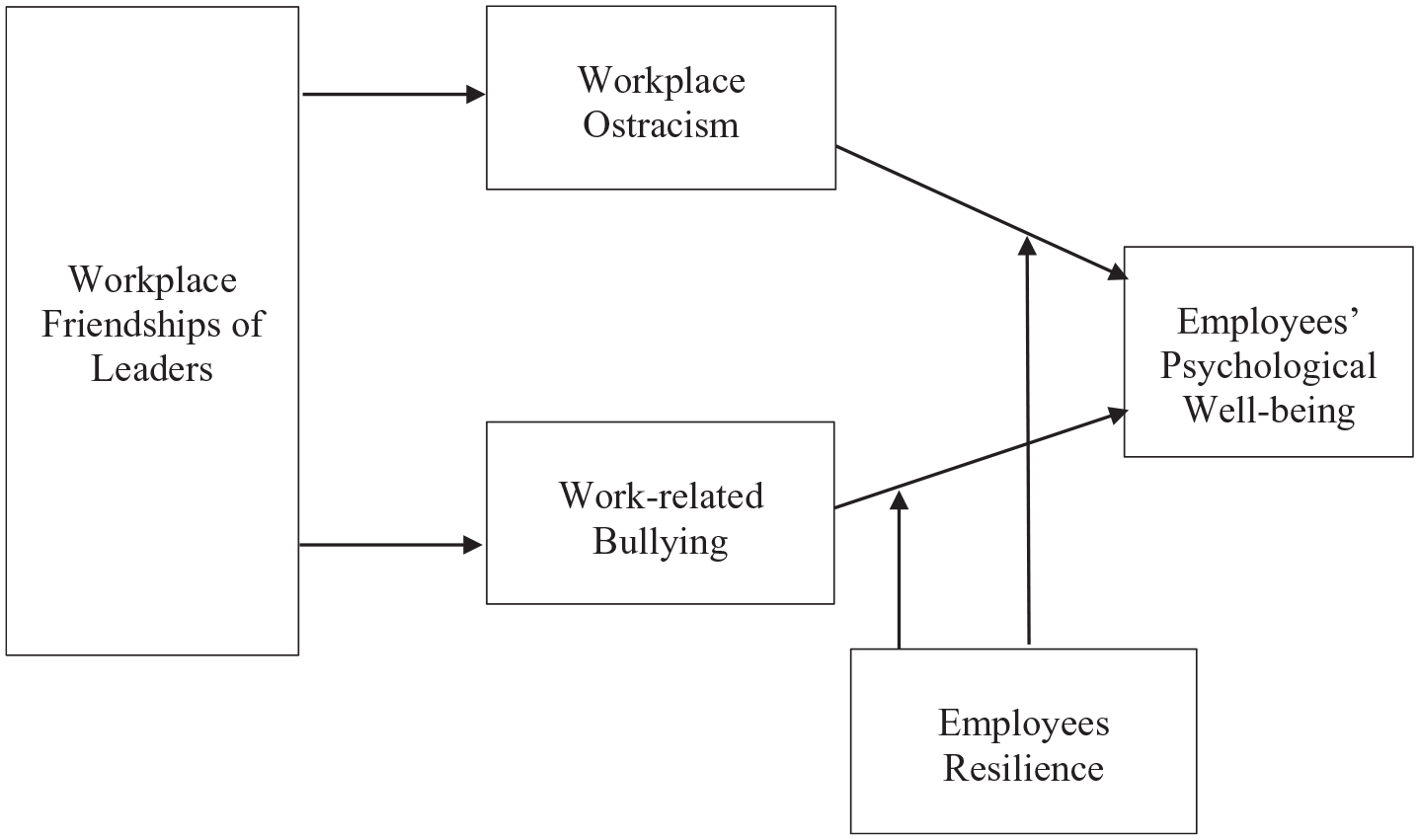
Hypothesized framework of the study.
Research Methodology
Data Collection Procedure
To empirically test the proposed hypotheses, data were collected from academic staff members working in HEIs across Pakistan. The target population included faculty members from public, private, and semigovernment universities. The universities included in the study were selected based on convenience sampling, a nonprobability sampling method where institutions were chosen based on ease of access and the researchers’ academic networks. This approach enabled the inclusion of faculty members from public, private, and semigovernment universities across different regions of Pakistan, ensuring representation while accommodating practical constraints such as time and resource availability. The research instrument was carefully designed, incorporating validated scales for measuring the study variables (details provided in subsequent sections). The survey was administered online using Google Forms.
The survey link was initially shared through official social media groups of Pakistani faculty members, targeting a wide range of institutions. In addition, a snowball sampling technique was employed to further expand the participant pool. Snowball sampling is a nonprobability sampling method in which existing participants recruit future participants from their professional or social networks. In this study, the researchers initially contacted their direct colleagues and invited them to participate in the survey. These participants then shared the survey link within their own professional circles, thereby increasing the reach and diversity of responses.
The data collection process yielded approximately 200 responses. After thorough data cleaning, which involved removing incomplete questionnaires and identifying outliers, 171 valid responses were retained for analysis. Anonymity and confidentiality were strictly maintained, with participants assured that no personally identifiable information was collected. The data collection process was conducted over a span of six to seven months to ensure a comprehensive representation of responses.
A preliminary demographic analysis revealed that 34 percent of respondents were female, while 66 percent were male, with an average age of approximately 39 years. Furthermore, 45 percent of the respondents were affiliated with public universities, 18 percent with semigovernment universities, and the remaining 37 percent were employed in private sector HEIs. Table 1 highlights the demographic profile of research participants. This diverse sample provides a robust foundation for analyzing the impacts of workplace friendships among academic leaders on bullying behavior, workplace ostracism, and the psychological well-being of faculty members.
Demographic Profile.

Variables’ Measures
To measure the variables, five-point Likert scale from strongly agree (5) to strongly disagree (1) was used.
Workplace friendships of leaders
To measure the friendships of leaders at workplace, six items scale was adapted developed by Nielsen, Jex, and Adams (2000). Items were modified to assess the friendship of leaders such as “my leader has formed strong friendships at workplace.” Two items were deleted due to low factor loading in the confirmatory factor analysis. Reliability tests of four items revealed the cronbach alpha value of 0.722 for the workplace friendship scale. Nunnally (1978) suggested that alpha value above 0.7 is an indication of internally consistent scale.
Bullying by the friends of the leaders
Personal bullying by the co-workers was initially measured through the 12 items scale proposed by Einarsen, Hoel, and Notelaers (2009). However, few items were deleted to improve the goodness-of-fit indices and factor loadings in the confirmatory factor analysis. Analysis was conducted with the seven items retained after factor analysis. The reliability analysis showed the alpha value of 0.920.
Workplace ostracsim
Thirteen items scale developed by Ferris et al. (2008) was adopted to measure the ostracisim at workplace. Items with low factor loading were deleted, and seven items were retained to measure the ostracisim. Cronbach alpha for the retained items were 0.881.
Employees’ resilience
Resilience of the participating faculty members were measured through the scale developed by Hodliffe (2014). Items were modifed according to the understanding of academic faculty members. After conducting the confirmatory factor analysis, nine valid items from the original scale were retained. Reliability analysis showed the alpha value of 0.714 for the adopted items.
Psychological Well-Being
World Health Organization (WHO) scale for psychological well-being has been adapted for this study that was originally developed by Bradley (1994). Later the scale was validated and adopted by numerous studies such as by Hansen (2016). Out of six items, five items were retained with the highest factor loading. The reliability stats show the Cronbach Alpha value of 0.648. Pallant (2020) explained that value of reliability indicies could be low if the items numbers are small. Hence, 0.65 has been justified due to five items. Other studies such as by Ursachi, Horodnic, and Zait (2015) have concluded that cronbach alpha range between 0.6 to 0.7 is generally acceptable.
Results and Findings
Confirmatory Factor Analysis
In order to assess the convergent and discriminant validity of the constructs, the confirmatory factor analysis was conducted (Fornell and Larcker 1981) on IBM SPSS AMOS 26.0 statistical software. At first, five-factor model was developed on the AMOS with their respective items. The items with low factor loadings were deleted. Then goodness of fit indicies of five-factor model were compared with the single-factor model (loading all the items on a single factor). Results showed that five-factor model yielded good fit as compared to the single-factor model. Table 2 shows the goodness of fit indicies of both models along with cut-off values recommended by Hair et al. (2010) and Lowry and Gaskin (2014).
Confirmatory Factor Analysis.

Descriptive Analysis
Mean, standard deviation, and correlation values of the variables were computed to get an initial view of the distribution of data. Mean values of the variables were varying from 3.82 to 2.29 with the standard deviations ranging from 0.93 to 0.44. Pearson correlations between the variables were also computed to understand the relationship between variables. Averages, standard deviation values, and correlation stats are listed in Table 3.
Descriptive Statistics.

Notes. ***Correlation is significant at the 0.01 level (two-tailed), **Correlation is significant at the 0.05 level (two-tailed), *Correlation is significant at the 0.10 level (two-tailed).
Structural Equation Modeling
To test the significance and direction of hypothesized relationships, path analysis was performed through the IBM SPSS AMOS 26.0 statistical software. Model successfully achieved all the parameters of model fit. CMIN/df (Chi-Square Minimum Discrepancy/Degrees of Freedom) value was 1.554 with 0.000 P value. Moreover, values of GFI (Goodness of Fit Index), CFI (Comparative Fit Index), TLI (Tucker-Lewis Index), and RMSEA (Root Mean Square Error of Approximation) were 0.848, 0.936, 0.928, and 0.057 respectively, which are in the acceptable ranges suggested by Hair et al. (2010) and Lowry and Gaskin (2014).
Table 4 shows the standardized regression weights of the tested relationships. Results show that workplace friendships of leaders were significantly related to workplace bullying of friends’ leaders (ß = 0.931, p = 0.00) and workplace ostracisim (ß = 0.977, p = 0.00). Furthermore, workplace bullying was negative related to the psychological well-being of employees (ß = −0.854, p = 0.011). However, workplace ostracisim had no significant effect on the psychological well-being (ß = 0.455, p = 0.161). It was hypothesized that workplace resilience would moderate the relationship between workplace bullying and psychological well-being. Similarly, moderation of resilience was hypothesized in the relationship between ostracisim and psychological well-being. However, interaction term of workplace bullying and resilience had insignificant regression weight (ß = 0.077, p = 0.292). Interaction term of ostracisim and psychological well-being was also insignificant (ß = 0.055, p = 0.465). To further understand the moderating effects of workplace resilience, interaction terms were plotted against the other two variables as shows in the Figure 2. Against our expectations, moderation of resilience was weakening the relationship between workplace bullying and psychological well-being, and ostracisim and psychological well-being. Therefore, hypotheses related to moderation of workplace resilience were outrightly rejected.
Results of Hypotheses Testing.

Note. WPF = workplace friendships of leaders, WPB= bullying by the friends of the leaders, OST= workplace ostracism, PSY= psychological well-being.
p < .05. **p < .01. ***p < .001.

Moderating effects of bullying and workplace ostracism.
Discussion
The research aimed to investigate the effects of academic leaders’ friendships within HEIs on counter-productive work behaviors and the overall psychological well-being of faculty members, while considering the moderating effects of workplace resilience. Friendship is generally regarded as a positive construct that fosters workplace cooperation and boosts employee morale. However, the impact of leaders’ friendships in the workplace is complex and multifaceted. On one hand, it provides a sense of security and motivation for in-group members; on the other hand, it can create feelings of hostility, perceptions of bias, and a sense of injustice among out-group members. While a substantial body of research has explored the positive effects of workplace friendships, our study sought to examine the less explored, potentially negative aspects of this double-edged sword. Data were collected from approximately 170 faculty members from both private and public universities in Pakistan, and our findings revealed intriguing insights.
The results confirmed that workplace friendships among academic leaders indeed exacerbate workplace bullying directed toward out-group members by the leaders’ close associates. Faculty members reported experiencing bullying behaviors from these associates, who leverage their privileged position due to being confidant of the leader. The support and attention bestowed by leaders instills a sense of power in their friends, and this perceived power can easily corrupt them, leading them to believe they are above the law. Such uncivil behavior from the leaders’ close associates is prevalent in Pakistan’s higher education sector, where they exploit these friendships to undermine the status and hard work of other employees. This finding aligns with insights from social information processing and social exchange theories, which suggest that power dynamics and contextual values play a crucial role in shaping workplace behaviors. Similar to the findings of a study on public servants in Vietnam, workplace bullying is influenced by the interplay of leadership practices and team power dynamics (Nguyen et al. 2024).
In addition, the results supported the relationship between leaders’ workplace friendships and the perception of ostracism among out-group members. The findings confirmed that these friendships cause out-group faculty members to feel ignored and ostracized within their universities. In collectivist cultures, such as Pakistan, the impact of ostracism may be more pronounced due to the high value placed on relationships and social harmony (Hofstede 2001). This sense of exclusion underscores the adverse impact that preferential treatment and perceived favoritism can have on the broader faculty community, highlighting the nuanced, and often detrimental consequences of leaders’ friendships in academic settings. These findings are consistent with research by Shamsudin et al. (2024) which highlighted how leader favoritism can drive employee-to-employee ostracism through jealousy, using social comparison theory.
It was hypothesized that experiencing ostracism and bullying by workplace friends of leaders would have severe, devastating effects on the psychological well-being of out-group faculty members. The results confirmed this hypothesis in the context of work-related bullying and its impact on psychological well-being. Faculty members who reported being bullied by the leaders’ friends indicated a significant negative impact on their mental health. However, the perceived ostracism did not establish a significant relationship with psychological well-being.
This perspective is supported by research indicating that workplace ostracism, characterized by passive interpersonal interactions such as being ignored or excluded, can lead to increased psychological stress and health problems over time (Wang et al. 2023). Ostracism, being more subtle and less overt than bullying, may not immediately or directly affect an individual’s psychological health. Ostracism can be discreet and insidious, often manifesting as silent treatment, exclusion from social groups, or being ignored during decision-making processes. While these behaviors can contribute to feelings of isolation and alienation, they may not elicit the same immediate and intense emotional response as direct bullying, which often includes overt aggression and hostility. Consequently, the indirect nature of ostracism might result in a slower, more prolonged impact on mental health, which may not be as readily apparent or significant in the short term compared to the acute distress caused by bullying.
Moreover, the nature of academic work, which often involves individual tasks such as research work and teaching, might buffer faculty members from the immediate impacts of ostracism. In roles where solitary work is common, the absence of social interaction may not be as acutely felt, potentially mitigating the immediate psychological effects of ostracism. This could explain why perceived ostracism did not show a significant relationship with psychological well-being in your findings. In contrast, workplace bullying involves direct, aggressive behaviors that are more likely to cause immediate psychological distress. The overt nature of bullying makes it more salient to the victim, leading to a more immediate negative impact on mental health. This distinction aligns with your observation that bullying by leaders’ friends had a significant negative impact on faculty members’ psychological well-being, whereas ostracism did not. These insights highlight the importance of considering both the nature of workplace mistreatment and the specific work context when assessing their impact on employee well-being.
It was anticipated that resilience would moderate the impact of bullying and ostracism on the psychological well-being of faculty members. However, the results did not support this hypothesis. The findings indicated that resilience, regardless of its level, failed to mitigate the negative effects of uncivil workplace behaviors on psychological well-being. One possible explanation for why resilience did not moderate these effects could be the overwhelming and pervasive nature of bullying and ostracism in the workplace. While resilience typically helps individuals cope with stress and adversity, the constant and severe nature of bullying may surpass the protective capacity of even the most resilient individuals. Bullying often involves direct, repeated, and aggressive behaviors that can severely undermine an individual’s sense of self-worth and security, making it difficult for resilience to effectively buffer these impacts. Hence, these findings suggest that while resilience is a valuable trait, it may not always provide adequate protection in the face of persistent and severe workplace mistreatment.
Overall, the results highlight the severe negative effects of workplace friendships on the moral and psychological well-being of faculty members. The psychological well-being of faculty members is crucial for maintaining a productive and conducive learning environment for students. When faculty members are mentally exhausted and face challenges on multiple fronts in the workplace, their ability to impart wisdom, mentor students, and engage in scholarly pursuits is significantly compromised. This not only affects their personal well-being but also undermines the educational mission of universities, ultimately impacting student learning and institutional productivity.
Conclusion
This study explored the impact of academic leaders’ workplace friendships on bullying, ostracism, and the psychological well-being of faculty members, along with the moderating role of resilience. The findings revealed that workplace friendships of leaders significantly contribute to both bullying by leaders’ friends and perceptions of ostracism among out-group faculty members. While workplace bullying showed a strong negative effect on psychological well-being, ostracism did not exhibit a significant relationship with psychological well-being. This suggests that although workplace friendships can foster ostracism, its effects on mental health may be less immediate or pronounced, potentially due to its subtle nature and the individualistic nature of academic tasks in higher education. In addition, resilience did not moderate the effects of bullying or ostracism on psychological well-being, indicating that the pervasive and severe nature of these workplace dynamics may surpass the protective capacity of resilience. These findings highlight the need for ethical leadership and inclusive policies to address the harmful consequences of workplace friendships and promote faculty well-being in HEIs.
Suggestions, implications, and limitations
The findings of this study have significant implications for educational policies and broader social norms in Pakistan. Considering the concerning effects of academic leaders’ friendships in HEIs in Pakistan, it is crucial for universities and higher-education commission to implement policies and urgent reforms to curb favoritism, nepotism, and bullying. National educational policies should incorporate frameworks that promote ethical leadership and equitable workplace practices to mitigate the adverse impacts of favoritism and ostracism. Comprehensive training programs and orientation courses should be introduced for leaders to enhance their understanding of an inclusive and equitable work environment. Leaders need to recognize that their interpersonal relationships within the institution are not merely their private matters but have significant consequences for the entire academic community. These relationships can greatly affect faculty morale, productivity, and psychological well-being.
By grasping the broader impact of their actions, leaders can help create a more intellectually stimulating and fair work environment. Promoting this awareness is essential to mitigate favoritism and ensure all faculty members feel valued and supported, thereby improving the academic environment.
In addition, universities should establish confidential platforms for faculty to file complaints and report grievances, alongside procedures for fair hearings. Effective wellness and psychological support programs are critical for those facing bullying and ostracism. Although resilience did not moderate the relationship between workplace mistreatment and psychological well-being in this study, investing in resilience-building programs is still valuable. Such initiatives can help faculty manage work-related stress and promote a more resilient academic community.
Finally, the findings highlight the need for further research into the complex dynamics of workplace friendships and their multifaceted effects on professional life within universities. Future studies should explore how these relationships impact individual faculty members and broader institutional practices. Researchers should also examine how the political environment within universities—marked by power struggles and favoritism—affects student learning and classroom dynamics.
The study has several limitations that should be disclosed to ensure transparency and guide future research. Research is conducted by two faculty members with extensive experience in Pakistani universities. Despite their efforts to reach a broad spectrum of faculty members across the country, it lacked adequate representation from certain regions, such as Balochistan, and Sindh. Therefore, while the study offers valuable insights from 200 faculty members, its findings may not be generalizable to institutions in diverse cultural contexts.
Furthermore, the gender imbalance in the sample (male = 66 percent and female = 34 percent), with a higher representation of male faculty members, may have influenced the generalizability of the findings. In contexts like Pakistan, where patriarchal norms and gendered workplace dynamics persist, the underrepresentation of female faculty members could mean that unique challenges faced by women, such as exclusion, favoritism, or differential treatment, were not fully captured. This imbalance highlights the need for future research to achieve a more representative gender distribution. In future, employing stratified sampling techniques or purposive sampling targeting underrepresented groups could ensure more inclusive findings, providing a holistic understanding of workplace dynamics across gender lines.
Research employed the cross-sectional survey methodology. While it is effective for large samples, it does not provide the depth of insights that qualitative methods like interviews could offer. Interviews might have yielded a more nuanced understanding of respondents’ experiences. Finally, the study found no support for the moderating role of resilience, suggesting future research should explore different aspects of resilience and their interaction with workplace behaviors to better understand their impact on psychological well-being.
Footnotes
Declaration of Conflicting Interests
The author(s) declared no potential conflicts of interest with respect to the research, authorship, and/or publication of this article.
Funding
The author(s) received no financial support for the research, authorship, and/or publication of this article.
