




Abstract
The basic purpose of the paper is to explore the issues and challenges faced by educational administrators, parents, students, and teachers concerning the effects of armed conflict on educational outcomes. It emphasizes the significance of peace education initiatives in Jammu and Kashmir a region enduring unrest for nearly three decades, profoundly affecting its educational sector. Employing a descriptive qualitative survey method, the study examines the experiences of different stakeholders of education and the factors influencing various stakeholders. The results indicate that academic stress emerges as a dominant risk factor leading to physical and psychological difficulties among the students. The research advocates for integrating peace education into the curriculum, creating a conducive learning environment to empower students in overcoming such challenges. Empirical findings strongly suggest that introducing peace education into the curriculum and peace education as a subject can be instrumental in addressing conflict-related issues.
Contextualizing Peace Education
Galtung argued in 1973 that there was a real need for establishing peace curriculum from schools, colleges, and universities all across the world (Galtung 1973). Reardon (2001) stated, around the turn of the millennium, that peace education appeared to be on the edge of widespread acceptance. In 2009, there was perhaps never a more favorable situation for educators to initiate and sustain peace education in classrooms and communities. Peace education has recently become more closely associated with the concept of positive peace (Reardon 2001), which implies the presence of justice, as opposed to negative peace, or the absence of violence. As a result, the goals of peace education have expanded to recognize and combat the various expressions of structural and cultural violence. According to Harris (2010) in “History of Peace Education,” we have been practicing peace education informally for generations through conflict resolution practices of indigenous peoples and peaceful communities that have been passed down from generation to generation. He identifies religion, encompassing the teachings of figures like Buddha, Baha’u’llah, Jesus Christ, Mohammed, Moses, and Lao Tse, as one of the primary origins of principles for imparting peace to others. He acknowledges that religion has played a role in both conflict and harmony. Harris (2010) traced the development of peace movements in Europe through the nineteenth century, just before the First World War, and from Comenius in the seventeenth century to the rise of the School Peace League in the early twentieth century across the United States to the contributions of Jane Addams, John Dewey, and Maria Montessori to the field. Paulo Friere’s educational philosophy is said to be included into the nature and techniques of peace education initiatives, according to other academics including Bartlett (2008). In addition, peace education unmistakably takes the problem-posing method to education, as opposed to the banking model that promotes rote learning. This includes the fundamental tenet that education may be used to increase a person’s potential and liberate him or her. Regularly providing funding for peace education initiatives all across the world, UNICEF (2009) also created teaching manuals and other materials that are pertinent to the field. The study conducted by UNICEF specifically highlights how armed violence affects young people. The Millennium Development Goals, the Convention on the Rights of the Child, and the Education for All Dakar Framework of Action are inextricably linked in their peace education programs.
Defining Peace Education
Different definitions and types of peace education emphasize nonviolent conflict resolution and conflict transformation differently (Höpken 2003). Galtung’s (1990) distinction between “negative peace” (the cessation of violence) and “positive peace” (structural changes to resolve social injustices that may be a cause of violence) was the source of the most influential ideas regarding the contribution of education to peacebuilding. In addition, it is essential to engage simultaneously at the policy, community, and grassroots levels to achieve lasting peace. Therefore, according to these scholars, it is crucial to assert that the most effective forms of peace education go beyond interpersonal and intergroup encounters to address the underlying causes and structural inequalities that can exacerbate conflict within societies. In situations where violent conflict already exists, such as in Kenya and Afghanistan, education may play a protective role, as Lederach (1997) noted, “by providing points of stability and daily routine for children if it is possible to keep schools operating, by helping understand the underlying causes of conflict, and by strengthening messages within society about the negative effects of violence.” It is a means of educating individuals about alternative, nonviolent responses to conflict. In the context of ongoing peace processes, he adds, “education may also be a means of contributing to social transformation, for instance through reforms to the education system itself and by educating individuals about new arrangements for political representation, justice, and policing.” By educating personnel presently in place or those who will shape future institutions, education is the fundamental tool that makes institutional change in other sectors possible. Education is also the most effective instrument for fostering the economic and social competencies required to generate sustainable livelihoods for future generations and postconflict development. By incorporating history into the curriculum, education has played an important role in promoting reconciliation, particularly in Uganda and Sierra Leone, according to additional studies.
As agents of conflict transformation, schools are positioned as pillars that provide information on combating inequality, environmental degradation, socioeconomic collapse, ethnic tensions, and political enmity. In Kenya, Afghanistan, and the countries that are involved in violent conflicts, a very little has been allocated for community engagement in peace education, and parents are left with the responsibility of ensuring their children’s survival in economically precarious conditions. In discussions of peace education and critical peace education, the question of whether schools and other educational institutions can accomplish the crucial mission of eradicating all forms of violence at all levels is a constant source of tension. According to other scholars, such as Bajaj (2015), the belief in the promise and possibility of peace education programs to contribute to social change is a ray of hope for a peaceful country. In addition to transforming structures of violence, peace education also aims to establish new structures that promote peace, social justice, and human rights.
Contextualizing Armed Conflict, School Education, and Kashmir
This paper posits that in contexts like Kashmir, interventions in Education for Peace can help to build a long-term culture of peace, though this requires walking a tightrope between the interests of the state and civil society (Singh 2017). Through this study of the Impact of armed conflict on education, I argue for an indirect approach to introduce peace education in Kashmir. Furthermore, I recognize that peace education in schools in situations of protracted conflict is fundamentally different from similar interventions in peaceful societies. Two independent states, India and Pakistan, were created as a result of the British colonists’ hurried departure from India in 1947 (Maryam 2016). Despite having a similar past, the two states have been involved in one of the most complicated and bitterly contested conflicts. The fundamental point of disagreement in this dispute has been who controls Kashmir, an ex-princely state. Kashmir has been split into an Indian-controlled portion and a Pakistani-controlled portion since 1948. The Line of Control, which serves as the partition’s de facto boundary, remains in place today. Kashmir has been the world’s most militarized region during the past seven decades. The ongoing unrest in Kashmir is a result of a limited perspective that has been used to uphold peace. Maintaining their claims to the region, ensuring its security, and preserving their reputations are the three fundamental goals of both nations in Kashmir.
The trajectory of the conflict situation from 1989 to the present led to disruptions in education’s functioning. The interaction with the people of Kashmir in and outside the valley is laden with mistrust, suspicion, and terror (Khan 2016; Suri 2013). There is deep-rooted fear, anxiety, and mistrust due to sustained exposure to violence. Armed conflict prevailing in the valley affects children’s innocent minds. Armed conflict has a profound impact on society’s social fabric (Khan 2016). The prolonged unrest in the valley has devastated people, families, communities, and nation as a whole. It obliterates not just the present but also the future. It shatters the lives of the present generation and the dreams of the next generation, having a massive influence on society as a whole. Every section of the population is affected by the present form of unrest in the valley. The communication gap between the people and the authorities is increasingly affecting the social fabric of society. This violence and various forms of lockdown in the valley have resulted in a number of psychological problems among those who have been directly and indirectly affected (Suri 2013). The conflict had significantly affected the child’s physical and mental health, affected their ability to learn and socialize, and adversely affected their transition to adulthood with negative consequences in later years of life (Van Manen 2016). For the countless windows of conflict, education is the top priority. Over the years, the conflict has deeply affected the lives of people in Kashmir. The conflict had affected the livelihood, living conditions, health, and so on of the people living in Kashmir. In education, too, the impact is immense. The political framework established by the British colonial administration at the moment of independence as well as the acceptance of sectarian uniqueness as the foundation for state society construction are two more contributing elements to the conflict (Bose and Jalal 2017). They are the victims of one of the world’s longest interstate conflicts. Thousands of Kashmiris have died as a result of the continuous conflict, which has also contributed significantly to the underdevelopment of Kashmir (Schofield 1997, 2021). As Kashmir and its institutions have continued to be engulfed by violence for the past three decades, the impact on the educational system appears to be the most severe. Being a child during a time of armed conflict is not a good experience.
Understanding Relationship between Conflict and Education
There is an intrinsic relationship between conflict and education (Davies 2009). The media, academia, policymakers, and practitioners are all paying close attention to the topic of education and conflict (Justino, Leone, and Salardi 2014). However, the field of study is still in its infancy. This is mirrored in the abundance of terminology used in the literature to characterize this new field. “Conflict and education, education for reconstruction, education in crises, emergency education, education in fragile nations, and education and instability are some of the words used” (Smith 2005). The existing gaps between theory and practice in education and conflict continue to be major issues. The material provided is insufficient to account for the “broad spectrum of conflict experiences” that education has preserved in conflict-affected communities. However, there are three interconnected frameworks that define the relationship between education and conflict in the existing literature on this emerging topic. As a result, to comprehend the current study, attempts have been made to show these relationships and determine where the gap exists. These connections are: (1) education as the victim of conflict, (2) education’s complicit participation in conflict, and (3) education’s involvement in peacebuilding.
Armed conflict is considered one of the most serious hurdles to education and progress in present times (Global Coalition to Protect Education from Attack 2018; UNESCO 2011). When a conflict breaks out, it has an impact on society and schools, and education also gets affected. Many incidents have been documented in which education and schools have been targeted, and students have been killed in the midst of conflict by various rebel groups (Rai 2018). As a result of the scenario, students were unable to receive an education. The quality of education has deteriorated. Given the difficult state of education in conflict-affected areas in terms of access, enrollment, and dropouts, education is still not a top priority (UNICEF 2017). Existing efforts to support Universal Primary Education (UPE) and achieve the Sustainable Development Goals (SDGs) do not reach children living in conflict-affected areas, and these children’s rights to education are often denied (Jones and Naylor 2014).
According to Save the Children (2006) data, conflict-affected fragile states shelter over half of the out-of-school children. Conflict has hampered access to education and has targeted educational institutions directly or indirectly (Pherali 2016; Stohl 2002; UNESCO 2016). In most of the conflict-affected areas, children do not attend school and even have less access to education (Justino, Leone and Salardi, 2014). Conflict situations have obstructed the proper functioning of the schools, damaged educational infrastructure, and prevented children from going to school, especially girl students. Several times, the targets are teachers, schools, and students as well. In these conflict-affected zones, there is a dearth of teachers, low-quality education, and a lack of teaching and learning material (Williamson 2007). During the course of time, the government and other agencies have intervened and tried to address the issues, but education was not given emphasis (Williamson 2007). Giving importance to the schooling of children and arguing that during and after armed conflict, schooling can support children’s well-being. According to Winthrop and Kirk (2008), schooling can impact children’s wellness through regular school attendance, chances of socialization, and a supportive setting among peers. In his study, Buckland (2005) examined the perspectives of students in three countries: Ethiopia, Afghanistan, and Sierra Leone, and found that in school, children get the opportunity to learn and gain knowledge, as well as enjoy and value the importance of bonding with peers. The impact of the conflict on education is a major concern for educational developments around the world. Education, on the other hand, is increasingly viewed as having a role to play in conflict resolution. Education is a necessary component of both citizenship and professional practice. It plays a critical role in protecting children from harm (Buckland 2005). Article 28 of the 1989 “Convention on the Rights of the Child” recognizes child rights to a free education at the primary level and encourages the establishment of accessible and available secondary education. In his study, Pherali (2016) argued that school education continues to be at the heart of civil unrest in Nepal, both as a flawed institution that failed to promote social justice and as a significant battleground during the conflict. During the conflict, Maoist insurgents frequently kidnapped teachers and students and forced them to participate in “revolutionary training programs” or join the Maoist groups. Mandatory donations were forced on teachers across the country by the Maoist groups, and schools were regularly forced to close (particularly private schools). The educational infrastructures are likely to be targeted when the conflict is going on, and global campaigns to safeguard educational infrastructures during unrest are a long way from the grassroots realities. Attacks on students and schools are usually directed at school administrators and teachers, whose voices are not always heard in discussions on how to plan or rebuild education in times of crisis (UNESCO 2010). While children are obviously at the forefront in times of conflict, the traumatic experiences of administrators and teachers are equally important in reimagining good educational service (Pherali 2016). Salam (2008) investigated the influence of conflict and violence on children’s schooling in Manipur and argued that the conflict situation has destabilized regular school acts as the school remains closed. When violence occurs, it destroys school property, affects transport and communication systems, creates a sense of insecurity among children, forces young children to protest, and creates psychological stress among children, which affects their academic performance. Parents are also apprehensive about sending their children to school when there are conflicting activities going on. A temporary break from learning in school becomes difficult for the child to pick up afresh when they join schools after a time gap.
Methodology
The study focuses on school education and perspectives of different stakeholders such as parents, teachers, educational administrators, and students. The study was done for the PhD purpose and is based on the empirical evidence using both primary and secondary sources of data. It dealt with the broad research questions that revolved around the armed conflict, school education, and peace education which are stated as follows:
How does armed conflict impact the access to and quality of education for school-age children?
What are the key concerns and obstacles experienced by educational administrators, parents, students, and teachers in relation to the armed conflict and its influence on educational achievements?
What are the challenges encountered by the educational stakeholders (such as parents, teachers, students, and educational administrators) during conflict situations in Kashmir Valley?
What is the role of peace education in fostering sustainability and peace within society, and what are the appropriate methods for integrating peace education into school curricula?
The study adopted a mixed method approach, by combining both critical review of existing literature with the in-depth interviews and administration of questionnaires with the key informants (teachers, students, educational administrators, and parents) from the research area. Study was based on a descriptive survey method intended to understand the broad trends of experiences, factors influencing the experiences of various respondents in the research area. The study was descriptive in nature which revolves around the collection of data and its analysis based on the experiences in the “field” (Creswell 2014). By adopting a qualitative approach in the study, the researcher was able to conduct a comprehensive investigation of a broad variety of secondary and primary data and reduce instances of inadequacies associated with the collection of primary data (Kothari 2004).
The study was based on information collected through the research tools such as questionnaires and interviews in the research area from the actual experience of respondents. The field area for the study is Kashmir and the target groups were specific, so purposive sampling and snowball sampling methods were adopted. Data were collected in a phased manner throughout the year 2022 and a pilot study was conducted before conducting final fieldwork in the research area. A total of 115 participants were selected for the purpose of the study that includes 55 students, 30 teachers, 5 educational administrators, and 25 parents from the target population. The study was carried out in Anantnag, a district in the South Kashmir of Kashmir region in the Union Territory of Jammu and Kashmir.
Analysis of Data
The researcher conducted field visits in Kashmir, gathering information during the day and reviewing recorded interviews and field notes. They conducted verbatim transcription and further examination of responses to assimilate pertinent details and understand context. Data analysis involved both qualitative and quantitative methods, using thematic and narrative analysis. Data were edited and rechecked to ensure accuracy. The data were entered and coded for tabulation in NVivo and Microsoft Excel. Interviews were conducted mostly in Kashmiri and Urdu (the local language) and then were translated into English. The data were analyzed to capture the phenomenon by “grasping and formulating a thematic understanding” which is not a rule-bound process but a free act of “seeing” meanings (Van Manen 2016). Grounded in the social constructionist approach, data were not seen as representations of reality but “displays of perspectives” (Silverman 2011). This methodology helps researchers infer the text’s messages and helps in understanding the communication content.
Linking Conflict and Educational Attainment
Akresh (2008) examined the effects of the Rwandan genocide of 1994 and found that the education levels of nonpoor boys have decreased relative to those of poor boys, thereby reducing the disparity between impoverished and nonpoor groups. This disparity is likely due to conflict affecting the resources of the nonpoor, resulting in disproportionately lower enrollment and educational attainment rates. The ongoing conflict in Kashmir has had a devastating impact on the region’s educational system. In addition, students find themselves, through no fault of their own, not only relocated but also without the possibilities for appropriate schooling. As a result, they are denied the opportunity to study properly and acquire the skills necessary to become fully functional members of society. After being exposed to the conflict scenarios, students have trouble concentrating, and teachers are unable to finish the specified syllabus on time, both of which ultimately damage the students’ academic performance.
The trend in board examination results for Grades XII and X (Figure 1 and 2) shows the overall pass percentage of the students who appear for the said examinations. The results of both classes from 2001 onward have had some ups and downs throughout these years. The observed increase in the pass rates (Figure 2) for both classes during the annual examinations of 2013, 2016, 2018, 2020, and 2021 can be attributed to syllabus relaxations implemented by government authorities. These changes were initiated in response to the valley-wide uprising in 2012 and the disruptions in the education sector following the events of July 2016 in Kashmir. Beyond these conflict-related challenges, the education of millions of students was further affected by the repercussions of COVID-19 and the nationwide lockdown that was enforced. To mitigate the severity of these adverse consequences, it is crucial to develop a comprehensive understanding of the mechanisms that underpin the detrimental connection between conflict and educational achievements. Armed conflicts undermine educational outcomes primarily because, in times of violence, children are either withdrawn from school or prevented from attending (Bush and Saltarelli 2000).
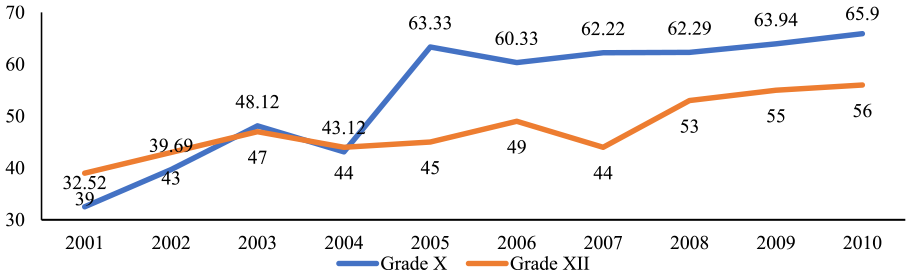
Examination results of Grades X and XII in Kashmir from 2001 to 2010.
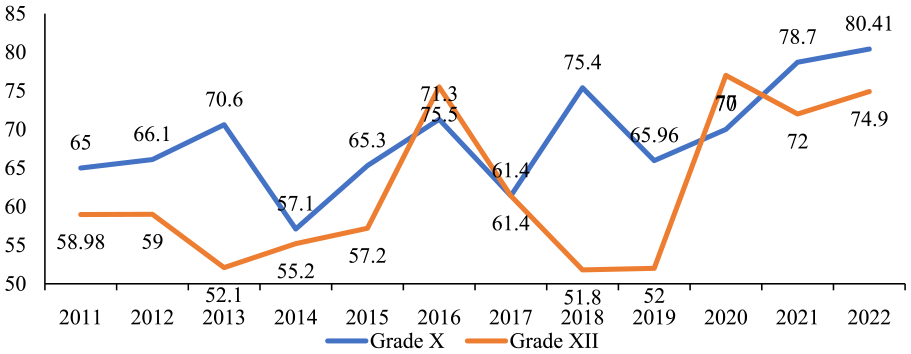
Examination results of Grades X and XII in Kashmir from 2011 to 2022.
Troubled Childhood and Its Impact on Personality of Students
Conflict is a social and political reality that dictates how a person should behave in response to it. According to Durkheim (1973), conflict is a social truth, and social facts are anything that exists independent of an individual. Children are the most vital members of any community; nevertheless, living in a conflict zone makes it difficult for children to have normal childhood. One of the children during Focus Group Discussion (FGD) narrated, Main apne ghar kay aangan mein nahin khel sakhta, aur mujhy kareebi gawoon main khel kay maidanu main jany ki bi ijazat nahin hai. Aarmy waly har taraf ghoomty firty rehty hain. Yehi wajah hai ki mery waldain school jaty waqt humesha mery saath chalty hain. Hum sirf apni family kay saath picnic par jaty hain. Hum sab bhai behen itwaar ko bhi androoni khel khel k waqat guzarty hain. (Fieldwork, 2022, Kashmir) [I am unable to enjoy outdoor activities in my home’s courtyard, and visiting the nearby village playgrounds is also prohibited. The presence of security forces patrolling the area necessitates that my parents accompany me when I go to school. Even on Sundays, my sibling and I are confined to playing indoor games, and we can only go on picnics with our parents.]
Children are impacted both directly and during the course of the conflict in a variety of ways. It has a tremendous influence not just on their physical health but also on their mental health, their ability to survive and develop, and their overall general well-being (Duschinski 2010). The sense of insecurity is pervasive among both the residents of Kashmir and its children. While conflict situations impact individuals of all age groups, it is children who are particularly susceptible to the adverse effects of such circumstances (Duschinski 2010). According to estimates provided by UNICEF (2017), the world’s conflicts and wars have resulted in the deaths of 2 million children, the disabilities of 405 million children, the loss of housing for 12 million children, the separation of more than 1 million children from their parents, as well as the psychological traumatization of 10 million children. The long-lasting violence in Kashmir has been really tough on the people there, especially the children. It has taken away their lives, caused them physical harm, and made it hard for them to have a normal life (Hassan 2012; Khan 2016). Education is one of the most important factors that can assist children who have been exposed to war in adjusting to the reality of their current situation and instilling in them a sense of purpose for the future. It is vital, for the benefit of children, to find solutions that may make education a tool for social cohesion, respecting the rights and dignity of every life and cherishing every childhood. This is because education is one of the most important factors in determining a society’s integrity (Handa 2002). This means that children will have to live their entire lives without the opportunity to receive an education or follow the normal routine of going to school. Children do not have a sense of security when there are any unforeseen situations going on in the area; they are afraid of being kidnapped, and sometimes protesters or agitators may enter the school premises and warn school attendants (teachers and students) to stop working at a school. This causes the children to feel unsafe. The result is that people experience fear as a result. Even when schools are freely accessible, there are many instances in which parents choose not to take their children there. Schools are frequently the target of violent attacks. One of the parent respondents in this regard said that, Mera beta giyarwi jamaat me padh raha hai, woh apny pasand kay iskool mein nahin padh raha hai aur woh apne pasand kay mazameen nahin padh raha, kyunki mera beta jis iskool mein padhna chahta tha who humary ghar say kaafi doori par hai, aur army forces kay darr say hum usko wahan nahin bhej sakhty. (Fieldwork, 2022, Kashmir) [My son is in the eleventh grade, but he couldn’t get into his preferred school with the subjects he wanted. The school he wanted is far from our home, and we can’t send him there because of safety concerns in Kashmir, where anything can happen unpredictably.]
While parents in Kashmir aspire to create a safe and trouble-free environment for their children’s learning and development, the harsh reality they face is widely acknowledged within the region. Due to the ongoing unrest and violence in the valley, the children there have already been robbed of their childhood. Youngsters do not have access to a peaceful environment, and they are unable to study at the institution of their choice.
Figure 3 reveals that respondents have many fears resulting from the traumatic events around them. The conflict is known to have lasting effects on children, preventing them from attending school and confining them to secure locations. The first thing a child sacrifices is the right to education, as traveling to school becomes an increasingly unsafe journey. As a result of conflicts, hartals, curfews, shutdowns, and extreme violence, schools are closed for days, weeks, or even months, leaving children with no other way to continue their education. The importance of human resource development among the students in Kashmir, who are the architects of the future, has received no or little attention by the policymakers so far.
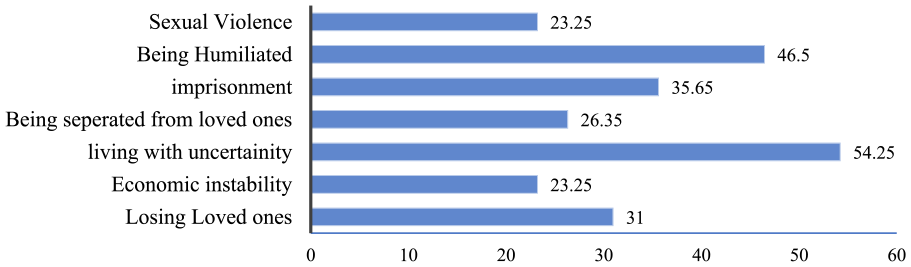
Uncertainties faced by students during conflict situations.
Approximately 54.25 percent of those surveyed expressed that their primary concern during conflict situations is the pervasive feeling of living with uncertainty. In Kashmir, uncertainty has become a constant presence, something the local population has become accustomed to. The situation is so unpredictable that nobody can foresee what will happen next. In the absence of peace, the respondents continued to live with fears of outbreaks of violence and insecurity. One of the respondents stated that, Jab halaat kharab hoon tab Parents ghar say bahar nahin jaany dety, kyunki aaisi moukay pey nawjawan ladky hi victum ban jaty hain . . . (Fieldwork, 2022, Kashmir) [My parents did not allow me to leave home because young males are the most vulnerable of the situations . . . if there is an attack on the security forces; they catch any young male who may be passing by.]
The impact of psychological issues among young children is proving to be more profound and far-reaching than previously understood, significantly affecting their capacity to interact with peers, navigate their home environments, and excel in the classroom. This phenomenon is particularly pronounced and concerning in the context of the Kashmir Valley, where the scope and complexity of the problem are continuously evolving and expanding into new dimensions. One of the educational administrators in South Kashmir conveyed that The main worry here is the extremely challenging circumstances we are facing. Almost every day, we hear about distressing incidents like gunfights, CASOs, and related matters. Life in Kashmir often seems bleak, as if there is no positivity left in the world. While outsiders may view Kashmir as paradise, our perspective is different. Furthermore, the prospect of a brighter future seems elusive. (Fieldwork, 2022, Kashmir)
Children who are caught in the middle of the conflict are more likely to suffer from anxiety, depression, and trauma. The experience of traumatic events is one of the most important risk variables to consider in this setting. The negative impacts of conflict trauma, in particular for children, are not restricted to a single mental health diagnosis; rather, they involve a wide spectrum of developmental difficulties that damage family and peer relationships as well as academic achievement and general well-being. Young children are particularly susceptible to the negative effects of this cumulative stress, as has been revealed by the status of results of Grades X and XII from the last two decades.
Security of the Respondents and Their Education in Conflict Zones
The presence of armed conflict has not only engendered an atmosphere of insecurity within society at large but has also permeated into educational institutions, thereby disrupting the regular teaching and learning routines for both teachers and students. Not only teachers and students are afraid of attending schools but many times parents do feel insecure to send their children to schools. Upon examining the feedback provided by various stakeholders concerning the repercussions of armed conflict on education, it becomes evident that they collectively perceive armed conflict as the most significant issue in Kashmir. This perception arises from the understanding that armed conflict doesn’t solely disrupt everyday life within the valley but also impacts various other sectors, including education, health, and virtually all aspects of daily existence, which necessitate uninterrupted functioning. The mental and emotional well-being of children is profoundly affected by armed conflicts, both in the midst of the conflict and in its aftermath. The prevalence of absenteeism in schools, coupled with the absence of adequate facilities due to the unrest during the conflict, has contributed to the emergence of psychological distress among children.
Figure 4 clearly shows that, students in Kashmir struggle to locate a decent, violence-free environment in which they can settle down. In addition, children who live in conflict zones like Kashmir receive lower quality education as a result of exposure to violence and armed conflict. The security checks while teachers and students are on their way to school become the hurdles to reaching the school on time, and the fear developed out of these checks keeps the minds of both teachers and students preoccupied, which hinders the attainment of education the way it should have been in the schools. The concentration of students gets diminished inside the classrooms by such incidents, which later on impact the outcome of their education in the form of academic achievements.
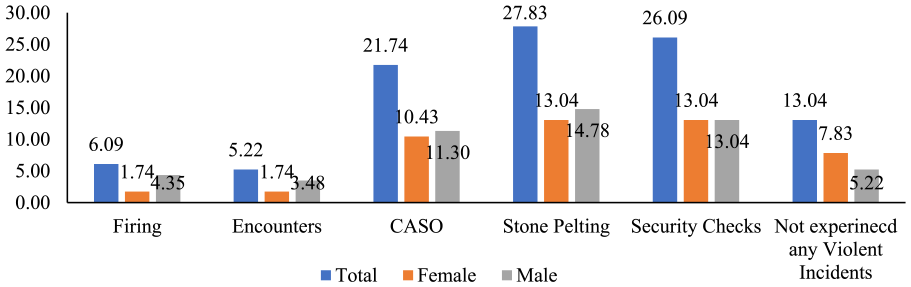
Violent incidents faced by the respondents.
It is evident that the respondents (students) experience several challenges during the teaching-learning process in the classroom. First and foremost, there is less interaction between students and teachers in the classroom, it is a one-way process, and the majority of teachers read aloud the chapters without considering whether or not students are paying attention. The communication constructed between the teacher and learners determines how much classroom events are meant for the learners (Adaba 2017). According to the study’s findings, the majority of students do not have adequate opportunity to discuss their subject-related doubts and problems with concerned teachers and seek solutions for their issues.
Teachers humein yehi kehty hain ki khud say padhai kar liya kro kyunki humary padhany say hi kaam nhe chalayga . . . humari interaction teachers say class mein 40 minute ki hoti hai, uske alawa koi aur mouka nahin milta, us mein bhi teacher sirf padhata hai . . . . (Fieldwork, 2022, Kashmir) [After the reopening of schools in the region following an armed conflict, students often find themselves receiving guidance from teachers to study independently due to the inadequacy of classroom instruction. Furthermore, there is a notable lack of interaction between students and teachers, with the limited contact occurring primarily during the 40-minute lessons, which are typically teacher-centred . . .]
When analyzing the responses provided by teachers regarding the difficulties they encounter while teaching in conflict situations, it becomes evident that they attribute the challenges within the classroom primarily to student absenteeism. According to the majority of teachers surveyed, the extended closure of schools, students’ disconnection from academic activities, and similar factors have collectively led to a noticeable decline in students’ interest in their studies.
Jab Iskool ek taweel waqfay kay baad khulty hain toh ziyda tar talba pehly padhaye gaye sabak ko bhool jaaty hain . . . itny dinu baad class lena ek baar fir say shuru karny jaise lagta hai. (Fieldwork, 2022, Kashmir) [When schools reopen after being closed for a while, many students forget what they learned before. It’s like having to start learning all over again.]
This is an issue faced by every institution in the valley. The disturbance makes it difficult to create an environment that is conducive to learning. Because of the school administration’s worries about security threats, teachers find it very hard to handle these big classes. This means they have to put students from different grades in the same classroom. Furthermore, the limitations imposed by security agencies worsen the challenges faced by both students and teachers when it comes to reaching schools and achieving effective teaching and learning. As a result, it becomes challenging to create a safe and secure learning environment in schools. During events like CASO (Cordon and Search Operations), stone pelting, or any form of violent protests, school activities are halted, and teachers find it tough to maintain the flow of the lessons they had taught before the disruptions. This leads to a lack of continuity in students’ studies.
Experiences of Students after Joining Schools Postconflict Period
Not only does conflict put children in danger of being hurt physically, but it also makes it more likely that they will lose the stability, regularity, and discipline that they have become accustomed to in their everyday lives. Death of family members, separation from or displacement from family, loss of residence, loss of access to education, lack of access to appropriate health care, malnutrition and disability, and psychological long-term effects are among the potential consequences. Students remain psychologically disturbed and are not coping with the present situations and sometimes they do not show establishing relationship with teachers. As one of the teachers opined that, Talba ko besukooni, aman ki kami, aur seekhnay kay liye housla afzaai ki kami ka samna karna padhta hai . . . jis ka nateeja yeh hota hai ki jab halat kay kharab honay ki wajah say calasoon kay daramyaan lamba faasla hota hai toh talba calassen bunk karty huway paaye jaty hain. Hum bahasiyat e ustaad talba ko calassoo main aanay aur hazir hony ki tarbiyat dety rehty hain, lekin bachhy ki nafsiyati sehet sehi na hony ki wajah se sudhrna mushkil ho jata hai. (Fieldwork, 2022, Kashmir) [Students often feel restless, lack a sense of peace, and lose motivation to learn . . . Consequently, students tend to skip classes when there are prolonged gaps due to conflict-related circumstances. As teachers, we continuously strive to encourage students to attend classes, but their psychological well-being has suffered, and the idea of self-motivation is virtually nonexistent in their lives.]
There is no doubt that students’ mental well-being is greatly affected by anxiety and fear when they are exposed to conflict situations. This is evident in both their thoughts and their actions. Fear is another significant factor that contributes to the absence of children from educational institutions that occurs in the wake of violent events. The analysis of the collected data reveals that as a result of the strikes, shutdowns, hartals, and protests it led to school closures resulting students experiencing anxiety and are reluctant to venture outside of their houses. Earlier, number of students have mentioned that they have been subjected to a variety of harmful activities, such as stone pelting, CASO, humiliation, and other similar situations. It is difficult for one to concentrate on their studies because their minds remain preoccupied by being subjected to these frightening circumstances. Due to the widespread closures in the surroundings, classes have been conducted at irregular intervals, leading to an incomplete syllabus. Upon analyzing the collected data, it became evident that the students, who are the respondents, face various challenges during the teaching and learning process in the classroom. The prevailing approach to teaching is unidirectional, characterized by a predominant practice wherein the majority of teachers simply read aloud from the textbooks, often without actively gauging whether their students are truly engaged in the learning process. This issue stands out as a primary and pivotal concern that warrants immediate attention and resolution within the educational framework.
When examining the feedback provided by teachers regarding the challenges they face while conducting classes amid conflict situations, it becomes apparent that they attribute the issues within the classroom primarily to student absenteeism. The extended closure of schools, students’ disconnection from their studies, and similar factors have, according to the majority of teacher respondents, collectively led to a notable decline in students’ interest and engagement in their studies. Regarding this one of the teacher respondents stated that, Jab iskool ek taweel arsy kay baad khulty hain toh ziyda tar talba is baat ko bhool jaaty hain ki ka bunko aakhri baar padhaya gya tha . . . itnay dinu kay baad class lena fir sey shuru karny jaisa lagta hai . . . halaat sehi hony kay baad talba mein gair hazari bahut ziyda rehti hai. (Fieldwork, 2022, Kashmir) [When school starts again after a long break, many students forget what they learned before. It is like we have to begin from the beginning . . . Also, when there’s been a conflict, lots of students often miss school, which makes it even harder to catch up.]
This is a widespread issue in every school in the valley. The fear and disruption caused by armed conflict make it difficult to establish a learning-friendly environment. Teachers put all the pupils from different grades in the same classroom, which makes it very difficult for a teacher to handle such large classrooms because of the constant security issues that continue to worry the school administration. In such situations students are not in a position to learn properly. The mourning, deaths, killings, injuries, and the other conflict-related problems have a worst effect upon the psyche of the students. In such situations learning becomes difficult.
Learning Loss of the Students in Conflict Zones
Jammu and Kashmir has lost a major chunk of working time to strikes and largely to conflicts which is directly visible from Figure 5. According to data compiled by the crime branch of the Jammu and Kashmir police, Kashmir has lost 207 working days in 1991; in 2010, 112 days were lost. Again in 2016, 130 days were lost. At first, 2019 was lost to conflict and crises management and 2020 was lost to COVID-19 pandemic. The normal functioning of schools and government offices in Kashmir was disrupted almost immediately when conflict first broke out there.
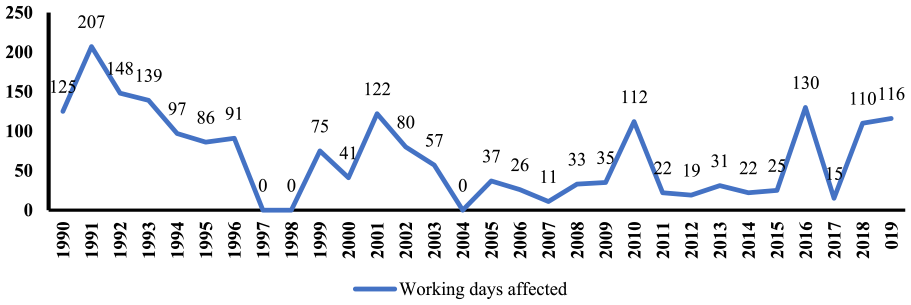
Total number of academic working days in Kashmir division of Jammu and Kashmir in an academic session.
Recovering the lost learning that these students experienced cannot be ignored or postponed. The learning continuity would be disrupted and further learning would be made more difficult if missing information and concepts, such as the activities described earlier, were not present. Any delay in assisting students in recovering lost knowledge would negatively impact their future learning. The total number of days lost from actual work over the course of a year affects how many hours children spend in school. Employees of all educational institutions, in association with employees of all government departments, went on strike for 73 consecutive days in 1990, to protest against human rights violations. This brought an end to the functioning of schools, which had previously experienced some difficulties as a result of interrupted strikes. This is a yet another loss that must be compensated up for in a way that has never been done before, and that is by ensuring that sufficient efforts are put into ensuring that children receive an education. Shortly after the beginning of the unrest in Kashmir, the ability of schools and government departments to carry out their duties was severely affected. During the present study, two students relatedly narrated, Itnay saalun tak iskool say door rehnay kay baad taleem mukkamal karnay ka intzaar karnay kay bajaye kaarobaar shuru karna aur sarmaya kari karna behter hai. (Fieldwork, 2022, Kashmir) [. . . after staying away from school for so many years it is better to start and invest in business rather than wait to complete the education.] baakayda daakhloon kay bajaye faaslaati Taaleem kay mode main daakhla lena behter hai. (Fieldwork, 2022, Kashmir) [It is better to enroll in distance education mode rather than for regular admissions.]
The lack of motivation from being absent from school causes children to choose distance education over regular formal education. Occasionally, students become fed up with the upheavals and abandon school to begin working in shops, small-scale factories, and the like. It has been uncovered that a loss of learning has a negative bearing on the future lifetime earnings of those who have experienced a loss of learning (Donnelly and Patrinos 2022). It is of the utmost importance to make sure that the courses that are intended to recover prior learning are successful, since they demand the utmost consideration. For teachers to have the ability to make full use of educational technology, schools need to be equipped with Internet connection as well as audio-visual aids. Equally important is the need to train teachers who lack confidence in using educational technology. A preassessment of the students’ level of comprehension, level of knowledge, and abilities can help determine how best to adapt the new strategies to cover the academic ground that has been lost. This can help students become more goal-oriented. Face-to-face teaching and learning are unquestionably the most effective mode of instruction, especially for younger children. The teacher’s presence and proximity in the classroom can motivate students. Distance teaching and learning, along with the effects of other factors like shorter duration, lack of digital gadgets for some students, lack of full knowledge about how to use them, lack of infrastructure such as a steady supply of electricity and access to Internet, gender bias that led to more boys than girls owning and using mobile phones, and so on, led to inequality in education and other negative effects ( M.Srinivasan, Jishnu, and Shamala 2021). Conflict situations have negative effects in terms of dropout level as well. Students who don’t go to school during the school closures or who drop out afterward may lose even more learning time. This is because students who miss a lot of classes are more likely to drop out of school. As per the Unified District Information System for Education (2020–2021) reports, the dropout rate at the secondary stage is 16.7 percent in Jammu and Kashmir which is higher than the national dropout rate in the secondary stage. The primary level, which encompasses Classes 1 to 5, has a dropout rate of 3.9 percent, while the upper primary level, which includes Classes 6 to 8, has a dropout rate of 3.2 percent. The data clearly show the picture of learning loss in Jammu and Kashmir. The findings of the study show that a decrease in the number of school working days has a negative impact on the education that children get. It results in children having inadequate learning and raises the likelihood that they may drop out of school.
Peace Education: Prospects and Challenges in Kashmir
The significance of peace education is being more recognized by society, organizations, and government agencies, leading to a rise in its popularity. Peace education seeks to stimulate, expand, and contextualize students’ understanding of peace. Many different schools of thought and practices have been developed to promote peace education, each with their own unique blend of philosophy, experience, and good will. In the twenty-first century, peace may depend on the education of future generations in the skills, knowledge, views, values, and habits that will allow them to construct and sustain it. Education about maintaining peace is more important than ever before, and it must take a comprehensive approach to gain credibility, prestige, and accountability. Peace education is more relevant in view of the conflict situations around the world and the mounting tensions between the countries and within the countries itself such as India, Pakistan, Afghanistan, China, the United States, and other such countries engulfed in the armed conflicts (Clark 2001). The world appears to be shrinking and global issues are becoming localized almost instantaneously, making peace education a necessity for building and maintaining peace among students, families, friends, coworkers, and ourselves. Consequently, there has arguably never been a greater need for peace education than there is today. Peace education is a versatile and multidisciplinary aspect of school curriculum. It includes the teaching of peace, nonviolence, and conflict resolution, as well as social justice, respect for human rights, and concern for the preservation of the natural environment (Page 2004). Promoting peace education in schools is pertinent to cope up with the lost charm in the education system because of the conflict situations. One of the teacher respondents stated that, yeh sab kuch seekhnay kay ammal mein hissa leny kay liye ustaadu ki jaanib say mustanand razamandi say shuru hota hai, jo afraad aur gharoon kay liye infaraadi aur ijtmaayi tabdeeli say guzarnay ka ek eehem aur mawasir tareeqa hai. (Fieldwork, 2022, Kashmir) [It all starts with educators genuinely wanting to be part of the learning journey, which is a crucial and effective way for individuals and groups to go through personal and collective growth. Students need the skills to not only create but also maintain peace.]
Therefore, the methodology of peace education stresses the importance of critical thinking and getting students ready to take action-based decisions on their beliefs. Through the interviews with teachers, the study revealed that there is no magical approach to peace education; rather, it will evolve and grow through practice by adhering to various methodologies, such as creating a supportive classroom. Peace education requires teachers to ensure that their classroom practices promote peace. This fundamental pedagogy will assist students bring peace to the world by studying conflict and peace and learning skills, attitudes, and dispositions from teachers. One of the teachers suggests that, Chunki ek ustaad kabhi bhi khud ko seekhnay wala bannay say baaz nahin aata, isliye ussay talibilmoon ki waseeh paimaany par skills aur interests ki tareef karni chahy aur unki ki hausla afzaai karni chahy. (Fieldwork, 2022, Kashmir) [. . . Since a teacher never stops being a learner himself, he or she should appreciate and foster students’ wide range of skills and interests. In addition to promoting more collaborative mindsets and actions amongst students and colleagues]
Although peace education is included in various subjects like history and social studies in schools, it serves as a way to educate future leaders about change and advocate for peace. For instance, as one respondent noted, having a dedicated section on peace education in the history textbook is a specific way to introduce students to the concept of peace.
Iskool ki satah par peace education humary bachu ko tanazaat kay baad kay halaat mein kayaam aman kay liye matlooba mahartoo say aagha karygi. Taaham ye note karna zarori hai ki kisi bhi nisaabi kitab ya course mein ek hi mazuaaat ki tabdeeli kay liye zarori peace ko farog deny ka liye naakaafi hai. (Fieldwork, 2022, Kashmir) [Introducing peace education in schools will equip our children with the essential skills needed for peacebuilding in post-conflict scenarios. Nevertheless, it’s crucial to emphasize that having just one topic in a textbook or course is inadequate for fostering the level of peace needed for transforming conflicts.]
We also need to learn more about how textbooks affect students. Do kids generally view them as unrealistic worldviews from which they are unaffected? Are there any examples of young individuals actively involved in revising textbooks and conducting their own inquiries into biases or the promotion of militarization? Are there any instances where there has been a lack of development or even a move in the opposite direction as new groupings take office? To keep an eye on these changes, Global Monitoring Report (GMR) might start a “Textbook Watch” comparable to Human Rights Watch. In an intriguing statement concerning the curriculum in apartheid-era South Africa, Bartlett, (2008) noted that “barefaced indoctrination and inequality” created non-Whites’ shared opposition in a way that more covert or ambiguous discrimination most likely did not.
Obstacles to Peace Education Implementation in Kashmir
Although the National Council of Educational Research and Training (NCERT) made efforts to include and execute peace education in the social sciences curriculum and peace education as a subject as well, they did not do so with the necessary care and groundwork. The needs and aspirations of school children were not taken into account, which led to the failure of the implementation plans at the local level. The NCERT, which has actively led a movement to implement peace education in schools across the nation, deserves praise for their efforts. The two main focuses of the NCERT have been curriculum creation and teacher training, which aims to provide educators with the necessary knowledge, abilities, and attitudes. The NCERT also intends to collaborate with other South Asian Association for Regional Cooperation (SAARC) nations to spread peace education throughout the region. Several civil society organizations presently collaborate with the NCERT, and it is believed that this reciprocal sharing of resources and ideas would further India’s goals for peace education. The secondary literature suggests that the majority of peace-related programs were concentrated in four regions of India, that is, Jammu and Kashmir, the North-Eastern states, Maharashtra, and Gujarat ( A.Srinivasan 2009). Ongoing, protracted conflicts in both Jammu and Kashmir and the Northeast have necessitated the peace programs there while Maharashtra and Gujarat have both witnessed phases of communal violence since the 1990s, and reconciliation efforts have played a major role.
Talking particularly about Jammu and Kashmir, one significant barrier to peace education is the ongoing armed conflict and political instability in the region (Singh 2017). The protracted conflict has created an atmosphere of fear, mistrust, and violence, which hampers the effective implementation of peace education initiatives. The following are key factors that impede the introduction of peace education in Kashmir, as perceived by a range of stakeholders:
The volatile security situation in Jammu and Kashmir poses a significant challenge to peace education. The presence of armed groups, periodic outbreaks of violence, and frequent disruptions in the educational system create an environment of insecurity, making it difficult to implement sustained peace education programs. The fear of reprisals or backlash from various stakeholders can also deter educators from engaging in peace education efforts. In this regard one of the educational administrators of Kashmir said that, When any of us express a desire to update the curriculum and fundamental educational standards in our designated regions, we often encounter resistance from other collaborators involved in education management. Unfortunately, there’s a lack of meaningful discussions and dialogues among stakeholders regarding the introduction of a crucial subject like peace education at the school level. (Fieldwork, 2022, Kashmir)
The region’s limited resources and infrastructure pose practical challenges to implementing peace education programs. Inadequate funding, lack of access to quality educational materials, and insufficient teacher training programs hinder the development and delivery of comprehensive peace education curricula. The resource constraints further exacerbate the inequalities in education and limit the reach and impact of peace education initiatives. The political interests and conflicting agendas of various stakeholders, including governments and nonstate actors, can impede the promotion of peace education in Jammu and Kashmir. Political priorities often prioritize security concerns and nationalistic ideologies, which may overshadow the importance of peace education. In addition, the region’s geopolitical complexities can result in power struggles and hinder consensus-building on the significance of peace education. In addition to the above factors, the historical narratives and collective trauma associated with the conflict in Jammu and Kashmir pose a significant challenge to peace education. Different communities may hold divergent interpretations of history, which can perpetuate animosity and hinder the development of shared narratives for peace education. The deeply entrenched emotional scars and traumas experienced by individuals and communities also make it challenging to foster an environment conducive to peacebuilding and reconciliation.
Addressing these barriers requires a comprehensive approach that includes efforts to improve security conditions, promote intergroup dialogue, invest in education infrastructure, mobilize resources, and foster a culture of inclusivity and empathy. Engaging with diverse stakeholders, including government entities, civil society organizations, educators, and local communities, is crucial to overcome these barriers and promote peace education in Jammu and Kashmir.
Conclusion: What to Execute
Peace education has a long history in India, dating back to Mahatma Gandhi’s teachings. Peace education programs in the country are many, dispersed, infrequent, and frequently quite disparate. Furthermore, nothing is known about how these programs affect students and teachers. On paper, there is a supportive ecosystem in place, with the education ministry and other institutes actively involved. However, organizations regularly confront logistical challenges, especially in areas such as Jammu and Kashmir. Overall, efforts to promote peace education have made significant strides in some regions but have encountered challenges due to socio-political barriers. Overcoming these barriers requires a multifaceted approach, including advocacy, resource mobilization, educational reform, and engaging with diverse stakeholders. Creating a conducive environment for peace education necessitates sustained efforts to change political priorities, secure funding, address cultural norms, and challenge entrenched educational systems. The long-term viability of peace education is a significant challenge. Long-term collaborations between comparable and diverse businesses can yield significant benefits. However, the bulk of these various groups of people is now very insular, and there is a need for more dialogue and sharing. Networks that bring together organizations working on comparable concerns, such as the Learning Network, can and should be copied. This is especially important because few nongovernmental organizations (NGOs) have the resources to sustain long-term peace education campaigns in several schools. To expand on its promising start, Jammu and Kashmir administration will need to make concentrated efforts to maintain momentum and create a ripple effect. It is also perplexing that, despite the number of peace programs available around the country, real classroom attendance remains low. Surprisingly, determining the amount of hours spent on peace or human rights education over a certain time period has proven impossible. It is also unclear whether organizations have decided whether to incorporate peace education into the curriculum or address it as a separate subject.
For the Peace Education Program in Kashmir to bear fruit, it is necessary to use teaching strategies that foster a favorable school atmosphere for learning, since the majority of kids learn better when actively engaged in group activities such as role plays and projects. Students participate well in learn-by-doing activities such as serving as peer mediators, debaters, and negotiators, particularly in cooperative, democratic, and inclusive classroom activities. Curriculum should provide students a say in what to study, how to study, and evaluation to facilitate learning. The pedagogy of peace education may be applied to all topics and areas of instruction. While certain topics of peace education, such as human rights or multiculturalism, can be taught as separate courses, they can also be incorporated into other disciplines (e.g. integrating human rights lessons into social science class). Peace education pedagogy may be used in any area, subject, or discipline. A more horizontal teacher-learner interaction is fostered via a dialogical method, in which both teach and learn from one other. Dialogue is a key component of peace education pedagogy. A crucial aspect is pedagogical agency. In contrast to humanitarian views that portray children as innocent, defenseless, helpless, and “in formation,” Winthrop and Kirk’s (2008) research of children in disaster or refugee circumstances demonstrated the importance of learner perspectives and learner action. Instead, the students came to understand themselves as subjects who actively shaped their educational experience rather than as passive objects to be acted upon. Students would look for more explanations for concepts they did not fully grasp, asking those around them for help and, by default, employing their own imagination, inventiveness, and resourcefulness. Children’s feeling of agency may be instilled by involving them in community education initiatives, school improvement projects, and teacher development, among other things. Education policymakers and administrators are urged to investigate and analyze these concepts within their communities so that they are acknowledged as the basis for constructing a culture of peace. And they should work properly and efficiently to incorporate peace education into the school curriculum which would be beneficial to the mental health of youngsters. Therefore, peace education in conflict-affected regions is very necessary and relevant.
Footnotes
Declaration of Conflicting Interests
The author(s) declared no potential conflicts of interest with respect to the research, authorship, and/or publication of this article.
Funding
The author(s) received no financial support for the research, authorship, and/or publication of this article.
