




Abstract
Urban areas are facing increasing social inequalities, which governments try to tackle with social policy. This study examines one of the most ambitious urban policies in the history of Dutch policies that aims to increase educational attainment amongst disadvantaged children in one of the poorest areas in the Netherlands. We investigate to what extent inequality in educational attainment based on parental education has changed during the first period of this programme. We further examine to what extent school characteristics affect educational attainment and how these effects relate to targeting disadvantaged areas for policy intervention. Register data on the individual, school and area level were employed to study these issues. We find that the effect of parental education on secondary school attainment has been stable since the start of the programme, indicating that inequality has not decreased in the context of the programme. Furthermore, several school characteristics, including socioeconomic status and retention rate, were relevant in explaining differences in educational attainment. We discuss the implications of our findings regarding the allocation of public resources for policy programmes based on area and school characteristics.
Introduction
Inequality in educational attainment between children from different backgrounds is persistent and is frequently linked to the neighbourhood and school context (Nieuwenhuis and Hooimeijer, 2016). Different educational policies have been developed to address these inequalities. In this study, we investigate whether inequality in educational opportunity has been reduced in the context of an ambitious urban policy in one of the poorest areas of the Netherlands. This policy is known as the National Programme Rotterdam South (Nationaal Programma Rotterdam Zuid: NPRZ) and has the aim of raising the socioeconomic level of Rotterdam South between 2011 and 2031 (Municipality of Rotterdam, 2011). A substantial amount of public resources is allocated to seven so-called ‘focus’ neighbourhoods. The idea behind the programme is that growing up in Rotterdam South provides a barrier to social mobility for disadvantaged children and that structural and innovative policies are needed to break the cycle of poverty. All primary schools in the focus neighbourhoods therefore have an extended school week, which is expected to lead to better educational outcomes among disadvantaged children.
The main assumption behind the educational policy is that living in the focus neighbourhoods negatively influences educational mobility and that inequality in educational attainment should be addressed at the school level. It raises the question of the extent that social processes at the school level account for the presumed negative effect of living in a larger poor area (Brattbakk, 2014). This question fits within a growing body of literature that investigates how the school and neighbourhood context are related and whether these contexts play a role in explaining educational outcomes (e.g. Ainsworth, 2002; Garner and Raudenbush, 1991; Kauppinen, 2008; Kuyvenhoven and Boterman, 2021; Owens, 2010; Sykes and Musterd, 2011). We contribute to this literature by investigating to what extent the characteristics of NPRZ schools explain the relation between living in a poor area (i.e. the focus neighbourhoods) and educational attainment, thereby focusing on the role of school socioeconomic status (SES). 1
Our study is, however, not a direct test of how neighbourhood and school effects are related. We focus on one of the main assumptions behind the programme, that is, to what extent it is effective to target a larger poor area for school interventions. As we will show, targeting such a large area can be problematic, as disadvantaged schools are dispersed across different areas (cf. Oberti and Savina, 2019). We therefore discuss if area poverty can be used as an indicator for the allocation of educational resources.
Our second contribution is in studying how the effect of parental education on children’s educational attainment has evolved under urban conditions of increasing school segregation (Boterman et al., 2019). 2 Although there is much literature on the relation between parental education and educational attainment, it is unclear how this relation has evolved under these urban conditions in recent decades (cf. Breen and Jonsson, 2005). Inequality in educational attainment is likely to be exacerbated by increasing school segregation in the Dutch educational landscape (see Boterman, 2019), because children tend to perform worse in schools where disadvantage is concentrated (Karsten et al., 2006). Some evidence indicates that the effect of socioeconomic background is stable (Timmermans et al., 2018), but this has not been investigated for the urban context since most of the (sociological) research on trends in educational mobility tends to focus on country comparisons (e.g. Chmielewski, 2019). We shed more light on this issue by studying trends in the effect of parental education on children’s educational attainment. Moreover, our study provides a first insight into what an ambitious policy like the NPRZ might achieve to improve educational opportunities for disadvantaged children.
Our central research questions in this study are: to what extent has the effect of parental education on children’s educational attainment changed in the context of the NPRZ? And to what extent do school characteristics and area poverty play a role in this context? We will first discuss the key elements of the NPRZ and how it aims to reduce inequality in educational opportunity. Next, we discuss the role of area and school effects in the context of the NPRZ. In our analysis we use register data on the individual, school and area level for the Rotterdam population in the period before and after the start of the NPRZ (between 2008 and 2020). We investigate the association between parental level of education and children’s level of education three years after primary school, at age 15. Multilevel analyses were employed to investigate the extent to which this association depends on area and school characteristics.
The Dutch educational system
A brief explanation of the Dutch educational system serves to demonstrate educational mobility in the urban context. Students enter primary school at age four. After eight years, around age 12, they make the transition to secondary school, in which four tracks are available. Tracking thus occurs at an early age (Van de Werfhorst and Mijs, 2010). Students receive an initial track recommendation in the final year of primary school and subsequently take a standardised test including maths and language exercises. Teachers can adjust their recommendation to a lower or higher track based on test performance. 3 The final teacher recommendation determines in which track students will start in secondary school, although they are free to choose a lower track than recommended (but not a higher one). The following four tracks are available in secondary school:
Practical education (PRO),
Pre-vocational education (VMBO), including four different levels ranging from basic to theoretical orientation,
Senior general secondary education (HAVO),
Pre-university education (VWO).
The PRO and VMBO tracks take four years to complete and provide access to different levels of vocational education (MBO). The HAVO track lasts five years and provides access to higher professional education (HBO). The VWO track is the highest-level track and is completed in six years, after which students can attend university (WO).
The transition from primary to secondary school is seen as a decisive step that strongly determines life chances. However, in the first years of secondary school, students are often enrolled in so-called ‘bridging classes’ that consist of two or three different tracks, for instance HAVO/VWO or VMBO/HAVO/VWO. This means that for many students the sorting into their final track is delayed until age 14–15, and mobility between tracks can still occur after initial track placement.
The National Programme Rotterdam South and educational mobility
Rotterdam South (approx. 200,000 inhabitants) constitutes the part of the city located south of the New Meuse river and has historically developed as an area with a high level of poverty. This poverty concentration can be attributed to the cheap housing supply, built for harbour workers in the 20th century, and the immigration of several migrant groups since the 1960s (see Custers, 2021). In 2011, a government commission concluded that the levels of disadvantage in Rotterdam South were of ‘unDutch’ proportions and that a long-term plan was needed to tackle these social issues structurally (Municipality of Rotterdam, 2011). The NPRZ is unique because national funds are directed towards a specific urban area. The scope of the programme in terms of duration (20 years), funding and stakeholder involvement is incomparable to any other Dutch urban policy. The NPRZ includes three ‘pillars’: work, housing and education. The underlying principle is that stakeholders (e.g. the municipality, housing corporations, employers, schools, local councils) collaboratively execute different sub-programmes within these three domains.
The school interventions are modelled after the Harlem Children’s Zone, a social programme in Harlem, New York that has been successful in increasing school achievement amongst poor and mostly black children (Dobbie and Fryer, 2011). The area including primary schools in the focus neighbourhoods is therefore known as the NPRZ Children’s Zone. The two main interventions in the NPRZ Children’s Zone are increased care support for parents and extended school time. 4 The extended school time includes six to 10 hours of extra schooling per week, with the official goal to contribute to ‘good educational results, broad education and social-emotional development of children in the Children’s Zone’ (Kruiter et al., 2020: 7). Schools can freely choose the number of hours extra per week, provided this is somewhere between six and 10 hours, and what activities they organise during this extra time. Activities vary from homework assistance to cultural, sports and curricular activities. Since most schools do not have the capacity to organise these extra activities themselves, external providers are hired to do so. Furthermore, the NPRZ also aims to attract ‘excellent’ teachers to the schools in the Children’s Zone, although based on policy documents it is not clear how this will be achieved (e.g. Nationaal Programma Rotterdam Zuid [NPRZ], 2012).
Besides the official goal of broad educational development, the interventions also have the informal goal to ‘keep children off the street’ (Kruiter et al., 2020). There seems to be consensus among stakeholders that the ‘street’, which can be seen as a neighbourhood process, has a negative influence on the educational development of children, because the perception is that the habitus formed on the street opposes the culture of learning at schools (El Hadioui, 2011; cf. Carter, 2003).
The interventions target schools in the focus neighbourhoods in Rotterdam South, where most of the student population comes from either low- or middle-educated families. As children from these families are expected to perform better in school, the overall effect of parental education on children’s educational attainment should decrease in Rotterdam South. Our first hypothesis therefore reads: the effect of parental education on children’s secondary school track in Rotterdam South has become weaker after the start of the NPRZ (H1).
There are, however, several reasons why this hypothesis might not be supported. First, it has been questioned whether the extended school time will reduce inequality in educational attainment (Dol et al., 2019). A systematic review of this intervention indicates that evidence for causal effects is limited and that its effectiveness depends on implementation (Patall et al., 2010). The only Dutch study that investigated the effect of an extended day programme shows no effect at all (Meyer and Van Klaveren, 2013). Furthermore, within the NPRZ it is not clearly formulated how the extended school time should contribute to better educational outcomes for disadvantaged children, which is reflected in statements by stakeholders who doubt whether the extended school time increases educational performance (see Kruiter et al., 2020).
Second, concurrently with the NPRZ period, a national ‘crisis’ has developed involving a lack of available qualified primary school teachers (Inspectorate of Education, 2019). This teacher shortage particularly affects schools in urban areas with a large share of students with a migration background and low SES, which are considered challenging environments for teachers to work. It has been very difficult for schools in the NPRZ Children’s Zone to attract skilled and experienced teachers, while this is considered a crucial element in making other Children’s Zones succeed (Dobbie and Fryer, 2011). Thus, it is likely that instructional quality in classrooms has been negatively affected due to a lack of high-quality teachers.
Third, a large body of sociological literature documents that educational mobility between generations has been quite stable over a longer period (see Breen and Jonsson, 2005) and, moreover, that achievement gaps according to parental socioeconomic status have increased in many countries (Chmielewski, 2019). In the Netherlands, Timmermans et al. (2018) observe no changes in track recommendation bias based on parental education between the mid-1990s and mid-2000s. 5 Furthermore, a report by the Inspectorate of Education (2019) shows that the effect of parental education on teacher recommendation, after controlling for test performance, increased between 2009 and 2017 after a national policy change was implemented in 2014 that gives more weight to the teacher’s judgement concerning the final track recommendation. Hence, in recent years parental education could have become more important in children’s educational attainment. Explanations for why the effect of parental education endures include genetic factors 6 (Plomin et al., 2016), different educational choices of the higher educated (Breen and Goldthorpe, 1997) and potential pressure by higher-educated parents on teachers to give higher track recommendations (Timmermans et al., 2018).
However, sociological studies on educational mobility trends seldomly consider the influence of urban conditions. School segregation in urban areas may exacerbate educational inequalities because children from lower-educated families have less access to quality schools (Karsten et al., 2006). The urban literature stresses the role of parental choice in this regard: in educational systems with more free school choice, school segregation tends to be stronger (Wilson and Bridge, 2019). Many urban areas are further characterised by increasing levels of residential segregation, which for the large part translates into more school segregation (Boterman et al., 2019). The level of exposure of children from higher-educated families to children from lower-educated families in schools is decreasing in most Dutch cities, including Rotterdam (Boterman, 2019). The implication is that the effect of parental education on children’s educational attainment also becomes stronger, as access to schools with high-performing peers becomes increasingly restrictive for children from disadvantaged backgrounds. Yet, although urban studies, with a focus on geography, do investigate the association between parental education and children’s educational attainment, they rarely consider how this relation changes over time – in contrast to more sociological studies.
Neighbourhood and school effects
A principal point of discussion concerning the NPRZ is how the financial resources for policy interventions should be distributed (Dol et al., 2019). The focus neighbourhoods (approx. 80,000 inhabitants) were chosen because they are considered the most disadvantaged places in the city by the NPRZ, yet the geography of Rotterdam shows that other neighbourhoods in the south, north and east also include large shares of vulnerable residents (Custers and Engbersen, 2022). Although the seven focus neighbourhoods can truly be classified as disadvantaged places, they are not necessarily the most disadvantaged neighbourhoods in Rotterdam South (see Supplement Material for details). There was also discussion within the programme about whether the interventions should be implemented at the neighbourhood level, for instance through welfare organisations, or at the school level (Kruiter et al., 2020). The NPRZ thus first selected the focus neighbourhoods and thereafter the interventions were implemented at the school level.
This issue on implementation relates to an ongoing debate about how neighbourhood and school characteristics affect educational outcomes, including the relevance of different contextual levels and the associated mechanisms through which neighbourhood and school effects are transmitted (e.g. Leventhal and Brooks-Gunn, 2000; Nieuwenhuis and Hooimeijer, 2016). The school context can mediate effects of the neighbourhood, or might even reinforce them (Cook, 2003; Owens, 2010). Poor neighbourhoods and poor schools are generally assumed to negatively impact educational outcomes through mechanisms such as social contagion and negative socialisation (Jencks and Mayer, 1990). Distinguishing between these different contextual effects is especially relevant in the Netherlands with its school system of free choice, meaning children can attend schools outside their own neighbourhood (Karsten, 1994).
Empirical evidence on the relative effects of neighbourhoods and schools is equivocal (Ainsworth, 2002; Garner and Raudenbush, 1991; Owens, 2010; Pong and Hao, 2007), but European studies show that neighbourhood effects on educational outcomes are mostly mediated through the school context (Brannstrom, 2008; Kauppinen, 2008; Kuyvenhoven and Boterman, 2021; Leckie, 2009; Sykes and Musterd, 2011). These European studies suggest that the school is a more important context for socialisation and subsequent educational outcomes than the neighbourhood context, even though the two are obviously related. At the school level, the social mechanisms are more explicit and numerous than in neighbourhoods (Johnson, 2008). Such school mechanisms may include peer group processes, the quality of classroom instruction and school organisation (Thrupp et al., 2002).
The NPRZ has a special position considering neighbourhood and school effects, since the selection of schools takes place at the area level – that is, all schools in the focus neighbourhoods – while the interventions are implemented at the school level. Within the NPRZ, it is generally assumed that children in the focus neighbourhoods face an additional disadvantage from living there, which is one of the reasons for creating a Children’s Zone (NPRZ, 2012). Some studies find that certain spatial effects on educational attainment might occur at levels similar to the ‘focus neighbourhoods’ area (Andersson and Malmberg, 2015; Brattbakk, 2014). Brattbakk (2014) finds that a negative spatial effect on educational attainment is the strongest at the highest geographical level, the district, and argues that area stigmatisation and youth’s activity spaces beyond typical neighbourhoods might explain why this level is the most relevant. However, he also suggests that schools can mediate this spatial effect – the school level is not included in his analysis. As most studies in the European context indicate that area effects are mediated by the school level processes, we hypothesise that the negative effect of living in the focus neighbourhoods on children’s secondary school track is mediated by school characteristics (H2).
Data and method
We use individual register data from the system of social statistical datasets (SSD) to investigate the effect of parental education over time and the influence of area and school context. The SSD combines data from different administrative sources in the Netherlands, such as the population register, educational institutions and the tax authority. Pseudonymised data is made available for scientific research by Statistics Netherlands, subject to legal and ethical restrictions. Our data covers the period 2008–2020, as 2008 is the first year in which data from school registers is available. We selected nine cohorts of students (2008/2009–2016/2017) that were in the final year of primary school and that resided and attended school in Rotterdam. Children who resided outside Rotterdam but attended school there, or vice versa, were thus excluded from the dataset. Children were linked to their parents, households, schools and areas based on unique identifiers. The final dataset included 49,987 students nested in 209 schools and 1727 school–cohort combinations.
Individual-level variables
Secondary school track – the dependent variable is the secondary school track that children followed three years after primary school (around age 15). At that time, most children have been selected into tracks. Some students (9.4%) did not have a single-track level after three years. For them, we obtained the track level four years after primary school. Our dependent variable thus includes the first observed reliable indicator of students’ educational level at secondary school. We classified the track levels into four categories, which we subsequently transformed into International Standard Level of Education (ISLED) scores. This transformation of the dependent variable into a continuous scale of 0–100 increases its interpretability in an international context (Schroder and Ganzeboom, 2014). The following scores are included: lower pre-vocational education (LPV) (PRO/VMBO basis/kader, ISLED = 29.34), upper pre-vocational education (UPV) (VMBO gemengd/theoretisch, ISLED = 45.27), senior general secondary education (SGS) (HAVO, ISLED = 62.3) and pre-university education (VWO, ISLED = 71.92). Missing values (4.1%, due to an unknown secondary school track, emigration or death of the student) were removed through listwise deletion.
Parental education – the highest level of education that either of the parents had achieved. Categories were coded into four dummy variables: lower educated (up to MBO level 2), middle educated (MBO level 2 and higher), higher professional (HBO) and university (WO). Since the number of missing values on parental education tends to be high in the SSD – registration is mostly lacking for (older) immigrants – we included an extra dummy variable to account for these missing values (12.9% in total).
Control variables – we included several control variables to reduce the likelihood of omitted variable bias. These control variables include sex, age, ethnicity, household status, main household income source, disposable household income, household wealth and years spent at the same primary school (see Table 1).
Descriptive statistics.
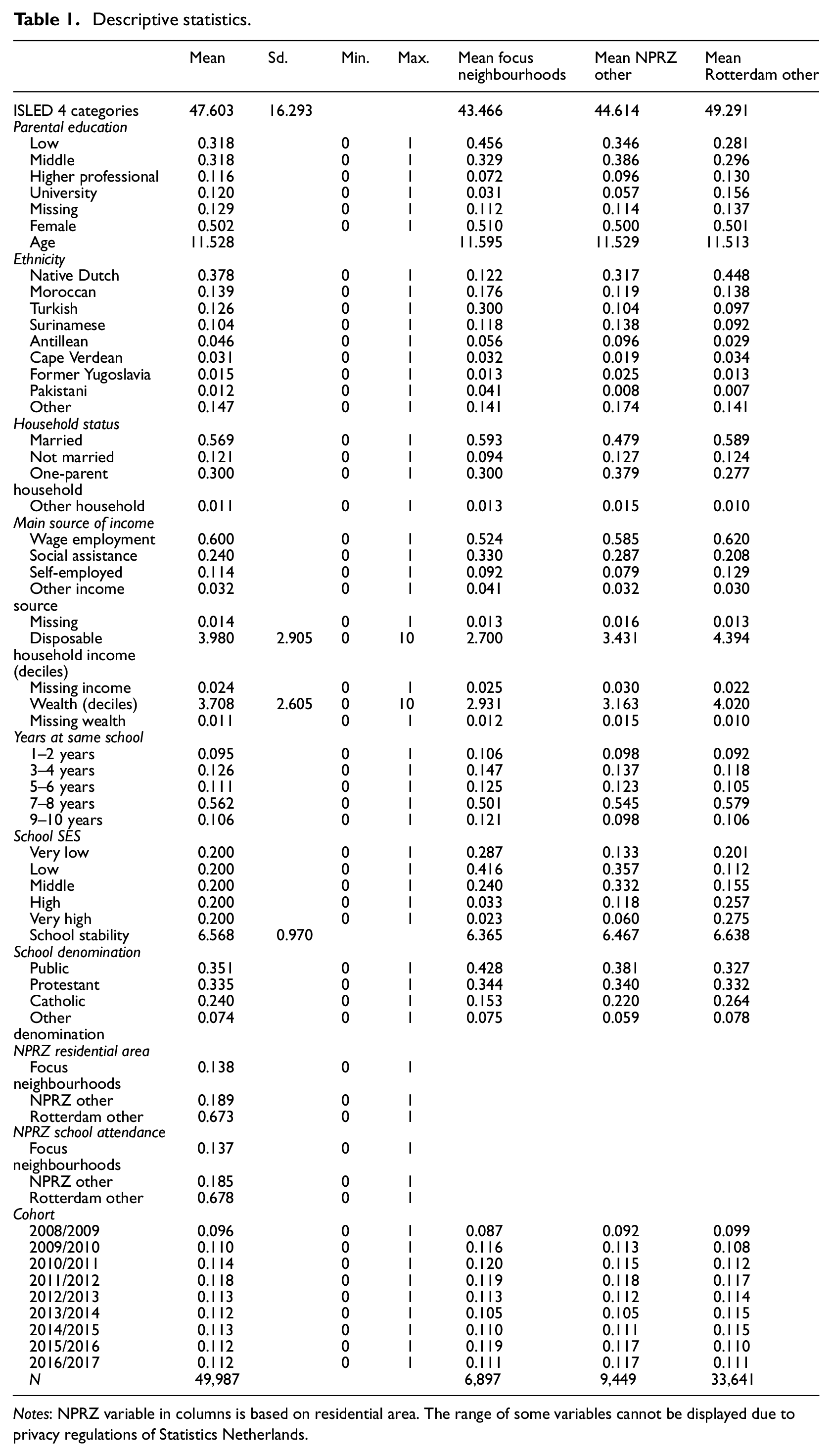
Notes: NPRZ variable in columns is based on residential area. The range of some variables cannot be displayed due to privacy regulations of Statistics Netherlands.
School, area and cohort variables
School SES – the SES level of primary schools was determined by a factor analysis of four variables: the share of low-educated parents, the share of high-educated parents (higher professional/university), the share of students in the lowest quartile of affluent households and the share of students in the highest quartile of affluent households. Household affluence is an indicator in the SSD that combines data on the income and wealth position of households. The factor analysis showed that one scale can be formed from these four variables (factor loadings > 0.85) and therefore a standardised factor score was calculated. Since the distribution was positively skewed – most children attend lower-SES schools – the factor score was recoded into quintiles, including five equal groups from very low (1) to very high (5). The school SES variable was tested for measurement invariance. Results are available in the Supplemental Material.
Two other variables on the school level were included that might explain educational attainment. 7 School stability includes the average number of years students spent at a school. We assume that a lower student turnover results in better educational outcomes, since students are more comfortable and familiar with their school environment (Leckie, 2009). School denomination is further measured by four categories: public, Protestant, Catholic and other.
NPRZ residential area – to investigate the differences between areas, we adopt the NPRZ area classification. Three dummy variables measure whether children lived in the focus neighbourhoods (1), the other NPRZ area (2) or the rest of Rotterdam (3). Although the school interventions are targeted at children who attend schools in the focus neighbourhoods, we deliberately focus on children that resided in the focus neighbourhoods because we are interested in whether there is an area effect – following the logic of the NPRZ. Eighty-one per cent of all children who live in the focus neighbourhoods also attend a school in either their own or another focus neighbourhood.
NPRZ school attendance – this variable includes the same categories as the ‘NPRZ residential area’ variable, but measures whether children attended school in one of these areas instead of residing there. This measure is included in a separate model instead of the NPRZ residential variable to compare the effects.
Cohort – the year in which students started the final year of primary school, including nine cohorts in total (2008/2009–2016/2017). These cohorts are included as dummy variables in the analysis.
Except for the dependent variable, all variables are measured during the final year of primary school. Because the transition from primary to secondary school is a key moment, it is relevant to measure available resources and characteristics at this point in time. Descriptive information about these variables can be found in Table 1.
Strategy of analysis
We use linear multilevel models to test our hypotheses. In these random intercept models, student’s characteristics (level 1) are nested within school cohorts (level 2), which in turn are nested within schools (level 3). The variance components indicate to what extent these levels account for variation in the dependent variable. Based on the models, we also checked multiple residual plots, which showed that assumptions of linearity were met. The models were estimated in R using the ‘lme4’ package.
An empty model (Model 0) is first estimated to calculate the variance proportions at different levels. In Model 1, we include the individual variables and cohorts. The latter are also part of the multilevel structure of the data. We add the NPRZ residential area variable in Model 2. The school-level variables are further included in Model 3a to investigate their effects and how they affect the relation between NPRZ residential area and secondary school track (hypothesis 2), and the NPRZ school attendance variable is used Model 3b. We then split the data into Rotterdam South and the rest of Rotterdam (Rotterdam other). For both parts of the city, we investigate to what extent the effect of parental education on children’s educational attainment has changed over time. We take the cohort 2012/2013 as the reference category, because most schools in the focus neighbourhoods started with the extended school time for the subsequent cohort. We thus expect no change in the effect of parental education up to 2012/2013 and a decrease of the effect thereafter in Rotterdam South (hypothesis 1). This change in effect size is estimated through interacting parental education with cohort (Model 4a and 4b). Robustness checks can be found in the Supplemental Material.
Results
Table 1 shows the population differences between the focus neighbourhoods, and the non-focus neighbourhoods in Rotterdam South (NPRZ other) and the rest of Rotterdam (Rotterdam other). The difference in ISLED score between the focus neighbourhoods and Rotterdam other area is quite large (43.5 vs 49.3). Furthermore, 79% of the parents in the focus neighbourhoods are either low- (46%) or middle-educated (33%), whereas this share is 73% in the NPRZ other area (35% and 39%) and 58% in the Rotterdam other area (30% and 28%).
The first part of our multilevel analyses investigates to what extent the presumed negative effect of living in the focus neighbourhoods is mediated by school characteristics (hypothesis 2, Table 2). Model 0 indicates how much of the variance in the dependent variable can be attributed to each level in the model. The largest part of the variance is on the individual (76%) and the primary school level (23%). 8 The school-level variance indicates substantial differences between primary schools in subsequent secondary school attainment. Yet, a large part of this variation is explained by differences in individual attributes (Model 1), since the school-level variance is reduced by 68% ((59.89–18.91)/59.89) by including the individual-level variables. Based on Model 2, we further observe that the effect of living in the focus neighbourhoods, compared to living in the Rotterdam other area, is non-significant, indicating that living in the focus neighbourhoods is not negatively related to the educational attainment net of individual characteristics and between-school variation.
Linear multilevel models including effects of individual, school and area characteristics on students’ secondary school track at age 15/16 (ISLED scores).
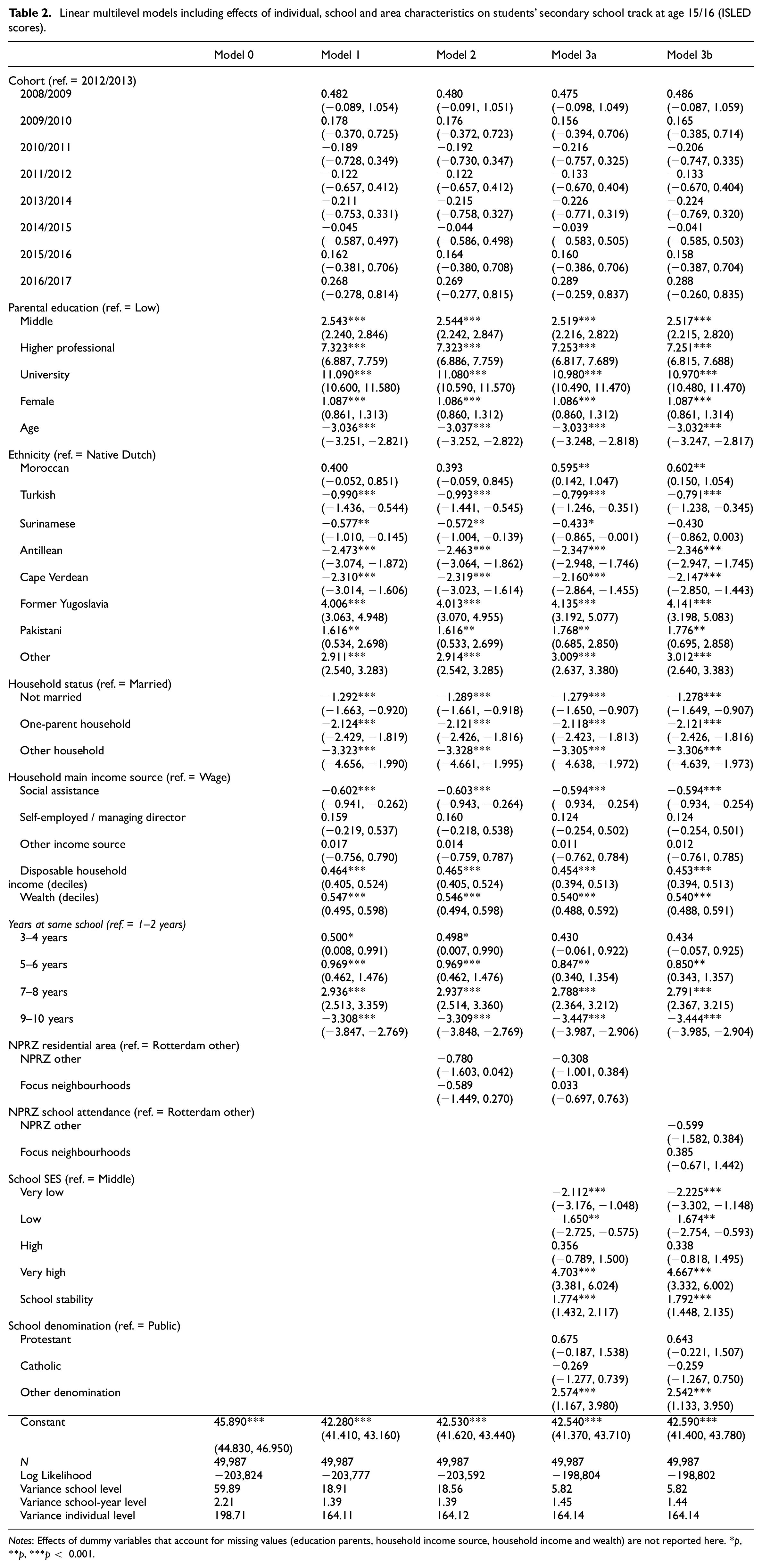
Notes: Effects of dummy variables that account for missing values (education parents, household income source, household income and wealth) are not reported here. *p, **p, ***p < 0.001.
The school-level variables in Model 3a, on the other hand, do explain some of the differences between students. School stability and school SES are both strongly positively related to subsequent secondary school attainment. A one-year increase in average student retention is associated with a 1.8 increase in ISLED score. Attending a school with a very high SES increases the ISLED score by 4.7 compared to attending a middle-SES school, whereas attending a very low-SES school decreases the ISLED score by 2.1. Students at public schools have a 2.6 lower ISLED score than students at other schools. The explained variance on the school level further increases from 69% (Model 2: (59.89–18.56)/59.89) to 90% (Model 3a: (59.89–5.82)/59.89). Regarding hypothesis 2, even though considerable school ‘effects’ exist, there is no negative ‘effect’ of living in the focus neighbourhoods in the first place – note, however, that school-level variance was already corrected for in Model 2. Based on these results, we reject this mediation hypothesis.
In an additional model, we checked whether the effect of NPRZ zones was different when we consider school attendance in the focus neighbourhoods instead of living there (Model 3b). The results are practically the same.
Model 3a shows that school SES is an important predictor. We plotted the distribution of students by school SES and NPRZ residential area in Figure 1. This figure shows that most children in the focus neighbourhoods attend a school where the SES level is below the city average, but the focus neighbourhoods are not the only place where lower-SES children cluster. Especially in the Rotterdam other area, many children attend schools with an equal or even lower average SES than that of schools in the focus neighbourhoods. In the discussion, we explain what this finding means concerning the distribution of policy means.
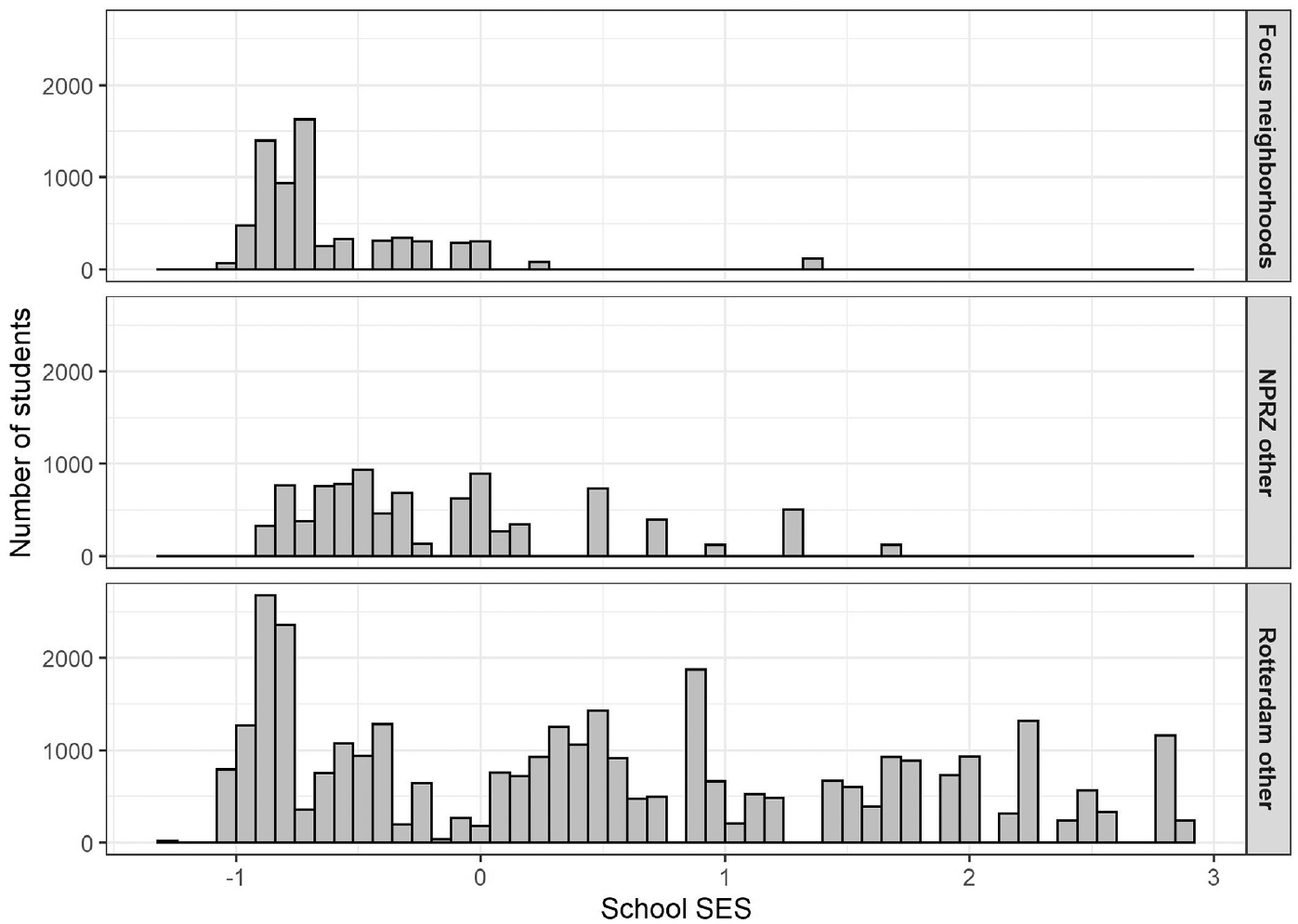
Distribution of students according to school SES and NPRZ area (N = 49,987).
In the final analysis, we examine to what extent the effect of parental education has changed over time (Table 3). 9 For the Rotterdam other area, not a single interaction term is significant (Model 4a), meaning the effect of parental education has been stable between 2008 and 2016. In Rotterdam South, we expected the effect to decrease after 2012/2013 due to the educational interventions in the focus neighbourhoods. The only significant interaction term after the start of the NPRZ is in 2015/2016 for middle-educated parents, which indicates that the difference between low- and middle-educated parents was smaller in this cohort than in 2012/2013. This trend is, however, not sustained as the interaction for the following cohort (2016/2017) is not significant. Figure 2, which includes the predicted probabilities for educational groups, further illustrates that no trend towards more equality can be observed. For all groups, there are some year-to-year fluctuations, but overall predicted probabilities across years are stable. Interestingly, before the start of the NPRZ the effect of higher professional was weaker (b = −4.520 in 2009/2010 and b = −3.488 in 2010/2011), but it is not clear what explains this change in effect size. Overall, we conclude that the effect of parental education on secondary school attainment has not become weaker since the start of the NPRZ, thereby rejecting hypothesis 1.
Linear multilevel models including interaction effects of parental education and cohort on students’ secondary school track at age 15/16 (ISLED scores).
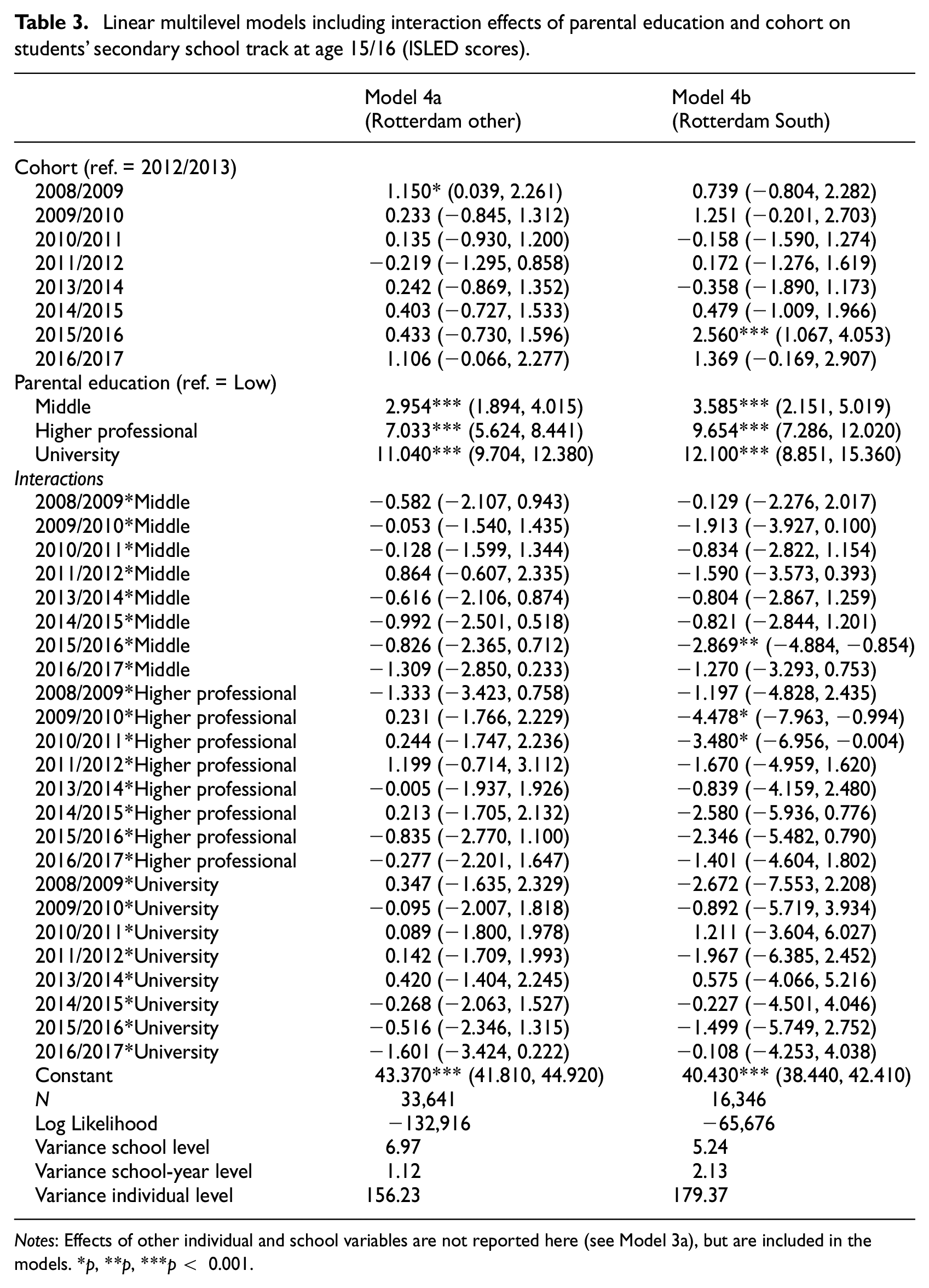
Notes: Effects of other individual and school variables are not reported here (see Model 3a), but are included in the models. *p, **p, ***p < 0.001.
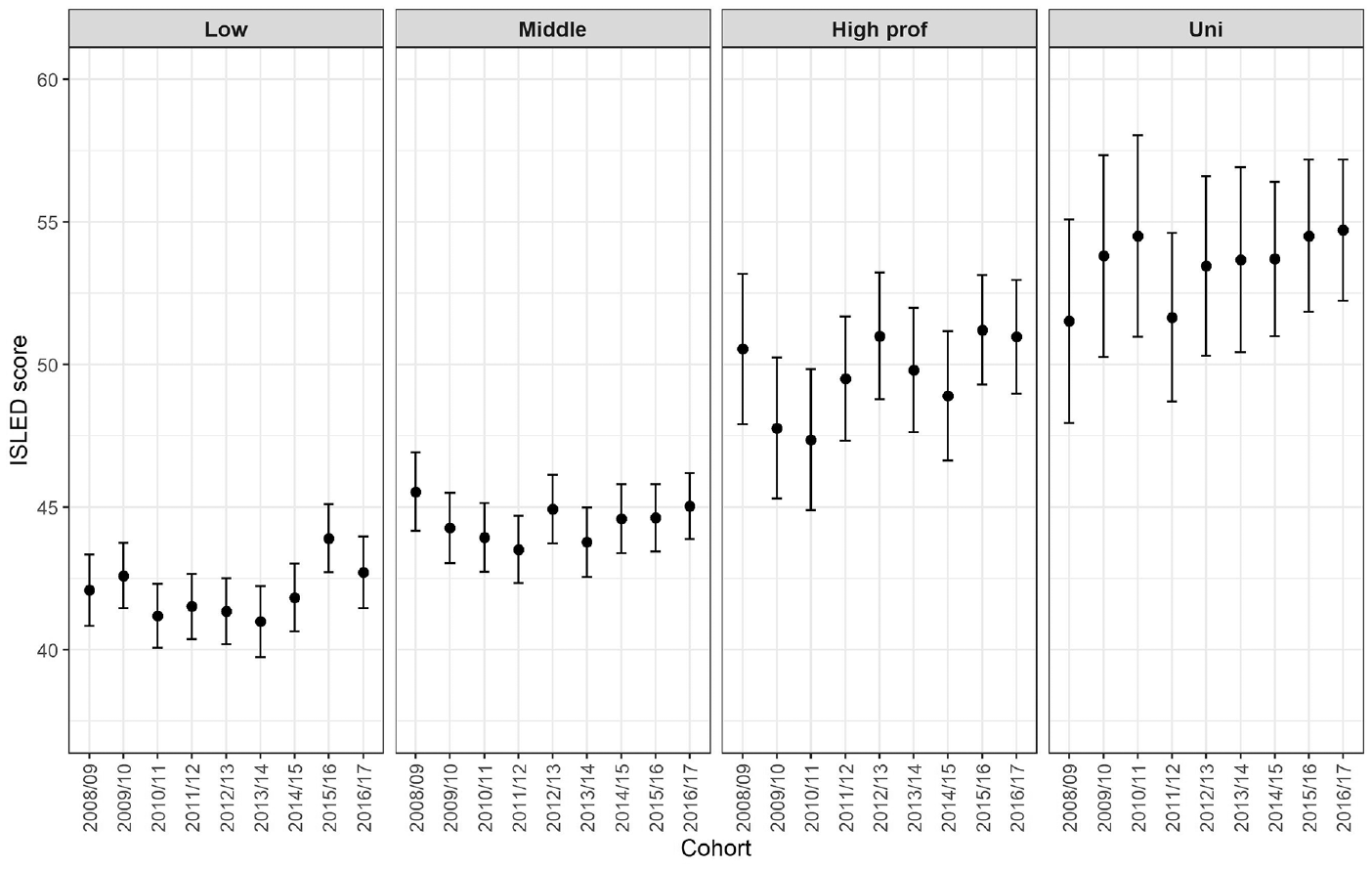
Predicted ISLED scores for different educational groups in the Rotterdam South population (based on Model 4b).
Conclusion and discussion
This study examined how educational mobility has developed in the context of a major urban policy that aims to reduce social inequality. Following the policy choices of the programme, we also studied whether living in the ‘focus neighbourhoods’ provides an additional disadvantage to educational attainment and to what extent schools are relevant in this regard. Register data on the individual, school and area level was used to empirically investigate these issues.
The first main finding is no evidence exists that the influence of parental education on secondary school attainment has decreased in Rotterdam South since the start of the NPRZ. Three explanations can be offered for this result. First, the extended school time might not contribute to better educational outcomes among children in the Children’s Zone. Schools have almost full autonomy in how they use this additional time, which leads to considerable variation in activities. Thus, there is no clear aligned programme in which interventions are implemented that have a clear theoretical link to better educational outcomes and that are supported by previous research. Second, the national ‘teacher crisis’ might have prevented schools from attracting high-quality teachers (see Inspectorate of Education, 2019), while studies indicate that having such teachers is an important aspect of improving achievement amongst disadvantaged children (e.g. Dobbie and Fryer, 2011). Schools like those in the focus neighbourhoods, with a low SES and high non-native population, already tend to attract teachers that are less experienced and less effective in teaching (Steele et al., 2015). The lack of high-quality teachers has probably negatively affected the level of classroom instruction, which is an important mechanism that leads to better educational outcomes (Thrupp et al., 2002). Third, we only investigated four cohorts that have been part of the NPRZ. It might be too early to detect any effects that reduce inequality in educational attainment, as effectively implementing such a large programme can take some time.
We also examined the policy rationale of the NPRZ, which holds that living in the focus neighbourhoods forms a barrier to educational mobility and that this effect is partly produced through the school context. Previous studies have shown that larger-area effects might be more relevant than neighbourhood effects (Andersson and Malmberg, 2015; Brattbakk, 2014), but it remains unclear how this relates to school effects (cf. Ainsworth, 2002). Our main finding is that there appears to be no ‘focus neighbourhoods’ area effect, and hence also no mediation of this effect by school characteristics. We do not preclude that area effects exist in the Dutch urban context, because we assume that the three-category distinction of ‘focus neighbourhoods’, ‘NPRZ other’ and ‘Rotterdam other’ is not specific enough to detect such an effect. The ‘focus neighbourhoods’ area is a place where disadvantage is concentrated, yet it is not strongly distinct from other disadvantaged areas or neighbourhoods in the city (Custers and Engbersen, 2022). Future research might investigate the difference between neighbourhood and area effects more closely in relation to school effects. This issue is outside the scope of this article, which focused specifically on the geographical areas of interest to the NPRZ: Rotterdam South and its ‘focus neighbourhoods’.
We did find substantial school effects on secondary school attainment, especially relating to school stability and school SES. However, these effects, in particular the effect of school SES, should be interpreted with caution. School ‘effects’ can arise from selection into schools instead of representing an influence of the school climate itself (Thrupp et al., 2002; van Ewijk and Sleegers, 2010). When parents are strongly motivated to have their children perform well in school, they might be inclined to send their children to higher-SES schools since school SES and ethnic composition can serve as proxies for school quality (Boterman, 2019). Children who receive more support at home and are more inclined to perform may therefore tend to go to higher-SES schools. Also, since we were not able to take prior achievement of students into account, this might lead to an overestimation of a school effect: students in different schools may have differed in cognitive capacities to begin with (see van Ewijk and Sleegers, 2010).
The school effects do, however, suggest that schools play a role in educational attainment, and therefore the policy choice to allocate financial means within the NPRZ to schools seems appropriate. The ‘focus neighbourhoods’ area includes multiple lower-SES schools, which explains why educational attainment tends to be lower independent of individual characteristics, yet many lower-SES schools are also located in other parts of Rotterdam (see Figure 1; cf. Oberti and Savina, 2019). If the school SES is an important characteristic through which inequality is sustained, public resources should be distributed on this basis. The NPRZ does so in an indirect way, by first selecting the focus neighbourhoods and then providing additional funds to schools in these neighbourhoods. However, from a perspective of distributional justice, it might make more sense to allocate the means directly based on school SES and other relevant characteristics, since there seems to be no additional disadvantage to only living in the focus neighbourhoods (cf. Dol et al., 2019). Targeting such a large area might thus be relatively ineffective for educational policy, whereas a more specific approach based on school characteristics, and neighbourhood characteristics when relevant (e.g. Pong and Hao, 2007), would be more in line with our findings.
In addition, the policy discussion should extend to how resources are spent, since school SES effects operate through different mechanisms that require different forms of investment (Ainsworth, 2002; Owens, 2010; Thrupp et al., 2002). For instance, the shortage of high-quality teachers in the intervention schools has been offered as an explanation for why inequality perpetuates (Kruiter et al., 2020). It has also been suggested that the extended school week might discourage teachers from working at these schools because it complicates the working environment (Kruiter et al., 2020). Focusing on attracting high-quality teachers might be more fruitful for improving educational results than an extended school week (cf. Dobbie and Fryer, 2011; Steele et al., 2015). This issue is, however, complex – in the light of a national ‘teacher crisis’ (Inspectorate of Education, 2019) – and cannot be solved by the NPRZ alone.
We conclude our analysis with some further avenues for future research. Before outlining these suggestions, we emphasise that this study has not been a direct test of the effectiveness of the Children’s Zone programme. We were interested in how educational mobility has developed in the context of the NPRZ, against the background of research that shows levels of educational mobility have been quite stable over a period of many decades (Breen and Jonsson, 2005; Timmermans et al., 2018). Our findings are in line with this view of persistent inequality in educational attainment, which raises questions about the extent to which large social programmes can reduce this inequality. Our study provides a first insight into the potential of the NPRZ to tackle inequality in educational attainment.
Other research approaches are needed to investigate the effectiveness of the NPRZ. Future research should obtain more insight into the qualitative features of the programme, such as which activities are organised at which schools. Currently, a wide variety of activities exists, including both curricular (e.g. maths and language training) and extracurricular ones (e.g. dance and music lessons). It is important to distinguish between the effects of these activities, since some have a more direct theoretical link to educational attainment than others. Thus, the theoretical mechanisms behind the NPRZ interventions should be explicated. More experimental methods are also required to assess the extent to which exposure to the Children’s Zone programme leads to better educational outcomes, for example by using matching techniques to compare students in the Children’s Zone to similar students in Rotterdam or other large cities in the Netherlands.
Supplemental Material
sj-docx-1-usj-10.1177_00420980231162774 – Supplemental material for Change or stability in educational inequalities? Educational mobility and school effects in the context of a major urban policy
Supplemental material, sj-docx-1-usj-10.1177_00420980231162774 for Change or stability in educational inequalities? Educational mobility and school effects in the context of a major urban policy by Gijs Custers, Marjolijn Das and Godfried Engbersen in Urban Studies
Footnotes
Acknowledgements
We would like to thank the editors and the reviewers for their feedback and constructive comments. We are grateful to those who were willing to discuss the content of the article at different stages. Special thanks go to Jan de Boom and Paul van Wensveen.
Declaration of conflicting interests
The author(s) declared no potential conflicts of interest with respect to the research, authorship, and/or publication of this article.
Funding
The author(s) disclosed receipt of the following financial support for the research, authorship, and/or publication of this article: The research for this article was supported by an ODISSEI Microdata Access Grant (MAG).

Supplemental material
Supplemental material for this article is available online.
Notes
References
Supplementary Material
Please find the following supplemental material available below.
For Open Access articles published under a Creative Commons License, all supplemental material carries the same license as the article it is associated with.
For non-Open Access articles published, all supplemental material carries a non-exclusive license, and permission requests for re-use of supplemental material or any part of supplemental material shall be sent directly to the copyright owner as specified in the copyright notice associated with the article.
